



Abstract
Work teams increasingly face unprecedented challenges in volatile, uncertain, complex, and often ambiguous environments. In response, team researchers have begun to focus more on teams whose work revolves around mitigating risks in these dynamic environments. Some highly insightful contributions to team research and organizational studies have originated from investigating teams that face unconventional or extreme events. Despite this increased attention to extreme teams, however, a comprehensive theoretical framework is missing. We introduce such a framework that envisions team extremeness as a continuous, multidimensional variable consisting of environmental extremeness (i.e., external team context) and task extremeness (i.e., internal team context). The proposed framework allows every team to be placed on the team extremeness continuum, bridging the gap between literature on extreme and more traditional teams. Furthermore, we present six propositions addressing how team extremeness may interact with team processes, emergent states, and outcomes using core variables for team effectiveness and the well-established input–mediator–output–input model to structure our theorizing. Finally, we outline some potential directions for future research by elaborating on temporal considerations (i.e., patterns and trajectories), measurement approaches, and consideration of multilevel relationships involving team extremeness. We hope that our theoretical framework and theorizing can create a path forward, stimulating future research within the organizational team literature to further examine the impact of team extremeness on team dynamics and effectiveness.
Keywords
Work teams increasingly face unprecedented challenges in volatile, uncertain, complex, and often ambiguous environments (Codreanu, 2016). For example, teams across the globe have recently had to deal with extreme economic fluctuations (e.g., the U.S. housing bubble) and sociopolitical and geopolitical instability. Furthermore, the COVID-19 pandemic demanded that almost every organizational team respond to the associated challenges. When encountering such disruptions, the macro-level disruptive events may not directly influence all organizational teams, but most teams encounter local disruptive events, such as the sudden absence of crucial team members (Majchrzak, Malhotra, Stamps, & Lipnack, 2004).
Researchers have acknowledged the importance of understanding how teams deal with such events and so have increasingly examined teams tasked with mitigating risks in uncertain and volatile systems with regular exposure to the risk of injury or death. These teams are often referred to as extreme teams (Bell, Fisher, Brown, & Mann, 2016). Initially, research examining extreme teams was often published in specialized journals, books, or grant reports (e.g., Acta Astronautica; Polar Science; National Aeronautics and Space Administration [NASA] reports). Recently, there has been a greater acceptance of extreme team research (Bell et al., 2016; Golden, Chang, & Kozlowski, 2018; Maynard, Kennedy, & Resick, 2018) resulting in the findings being more broadly published in top-tier journals (Hällgren, Rouleau, & Rond, 2018; Hannah, Uhl-Bien, Avolio, & Cavarretta, 2009) including several special issues on the topic (Buljac-Samardzic, Doorn, & Maynard, 2018; Maynard et al., 2018).
This trend has led to some highly insightful contributions to team research and organizational studies (Bamberger & Pratt, 2010) and has included samples drawn from various extreme contexts, such as SWAT teams (Bechky & Okhuysen, 2011), wildland firefighting teams (Weick, 1993), nuclear power plant crews (Stachowski, Kaplan, & Waller, 2009), airline flight crews (Waller, 1999), and healthcare teams (Klein, Ziegert, Knight, & Xiao, 2006; Vashdi, Bamberger, & Erez, 2013). The recent increase in prevalence of literature on extreme teams has meant that there are now general recommendations on what (Driskell, Salas, & Driskell, 2017) and how to study teams in these atypical environments (Bell et al., 2016). While there appears to be traction from researchers recognizing the theoretical and practical value of investigating teams in these complex and rich settings, the current literature presents two major limitations.
First, the definition of extreme teams still appears to be relatively unspecific. Extreme teams have been mostly considered as one type of team, characterized as extreme because the team has to deal with extraordinary physical, psychological, and interpersonal demands requiring significant human adaptation for survival and performance (Driskell et al., 2017; Manzey & Lorenz, 1998). While this is a beneficial starting point, the definition does not provide enough clarity. As a result, what can be considered an extreme team could include a wide array of teams from different industries facing challenges that are hardly comparable. For instance, teams in space or Antarctica (Kanas et al., 2007; Mehta & Chugh, 2011) must deal with confinement, while military teams (Dalenberg, Vogelaar, & Beersma, 2009) or disaster teams (Power, 2018) must deal with active threats to life. In contrast, medical emergency teams or surgical teams experience high levels of stress and drastic consequences for patients (Schmutz, Lei, Eppich, & Manser, 2018; Vashdi et al., 2013). Also, teams typically not considered extreme may also face extraordinary demands under certain conditions, such as the software development teams who contributed to the tragedies surrounding two Boeing 737 Max crashes in 2018 and 2019 (Herkert, Borenstein, & Miller, 2020). However, such teams would not be captured under the extreme team umbrella in the current literature.
Second, a comprehensive theoretical framework that allows theorizing and measurement of the phenomena is missing. We recognize prior attempts in this regard, but we find them incomplete for the purpose of team research. For instance, some organizational scholars have focused on extreme contexts and proposed typologies to organize extreme context research more broadly (Hällgren et al., 2018). Others have described extreme context dimensions that influence the level of extremity and the impact on adaptive leadership responses but have made no mention of team variables (Hannah et al., 2009). Both these approaches help categorize extreme contexts. However, their predictive value for team research is limited because they do not allow researchers to make specific predictions about essential relationships between team inputs, mediators, and output factors.
To address these limitations, we propose a multidimensional framework that defines team extremeness as a continuous contextual variable composed of two dimensions: environmental extremeness and task extremeness. We define team extremeness as a continuum rather than a dichotomous variable, and thereby eliminate the issue of grouping together all teams that work in unconventional and extreme contexts and considering them all equally extreme. Additionally, since team extremeness is characterized as a continuum, it can be applied to all teams, not just to those already viewed as extreme. Furthermore, our framework also allows the differentiation of the two dimensions of team extremeness (i.e., environmental and task extremeness) and so researchers should be better able to adopt a more nuanced view of teams operating in extreme environments by considering unique task and environmental characteristics. Likewise, our framework will make it possible to theorize and develop measures about the impact of team extremeness on team functioning. Accordingly, by leveraging our simple yet comprehensive framework of team extremeness and the team lens that is employed, researchers will be better able to assess the complete impact of team extremeness.
This article aims to make three primary contributions. First, we advance a multidimensional view of team extremeness as an essential contextual variable for team research. To do so, we integrate current research on extreme teams and contexts. We propose a more detailed definition of team extremeness and explain how every team can be positioned on the team extremeness continuum. Second, based on our theoretical framework, we build propositions describing how team extremeness influences team effectiveness. Third, by highlighting the impact of temporal considerations in terms of team extremeness, we discuss how our framework provides a path forward for team researchers to examine these aspects. Team performance and functioning are inherently dynamic, and therefore time needs to be considered when theorizing about extremeness in teams (Kennedy & Maynard, 2017; Leenders, Contractor, & DeChurch, 2016; Mitchell & James, 2001). Further, our framework provides the basis for developing measures to assess team extremeness in all types of teams and contexts.
The extremeness continuum introduced here advances the theoretical understanding of teams facing extreme situations as it allows teams to be viewed as existing on an extremeness continuum. This novel conceptualization will allow for comparisons between different types of teams and help to generalize results gained in more extreme team settings to other settings that might show extreme characteristics during certain periods only (e.g., a management team in a crisis). We anticipate that our framework will have a similar impact on the team literature as the concept of team virtuality, a concept that emerged from work contrasting face-to-face teams with virtual teams. However, the introduction of team virtuality allowed for a more detailed investigation of the impact of virtuality on team inputs, mediators, and outcomes (Kirkman & Mathieu, 2005) and it is hoped that a similar trajectory will occur for team extremeness, as future research builds upon the theories introduced here.
Background
Studies with a formal definition for extreme teams or contexts in the literature.
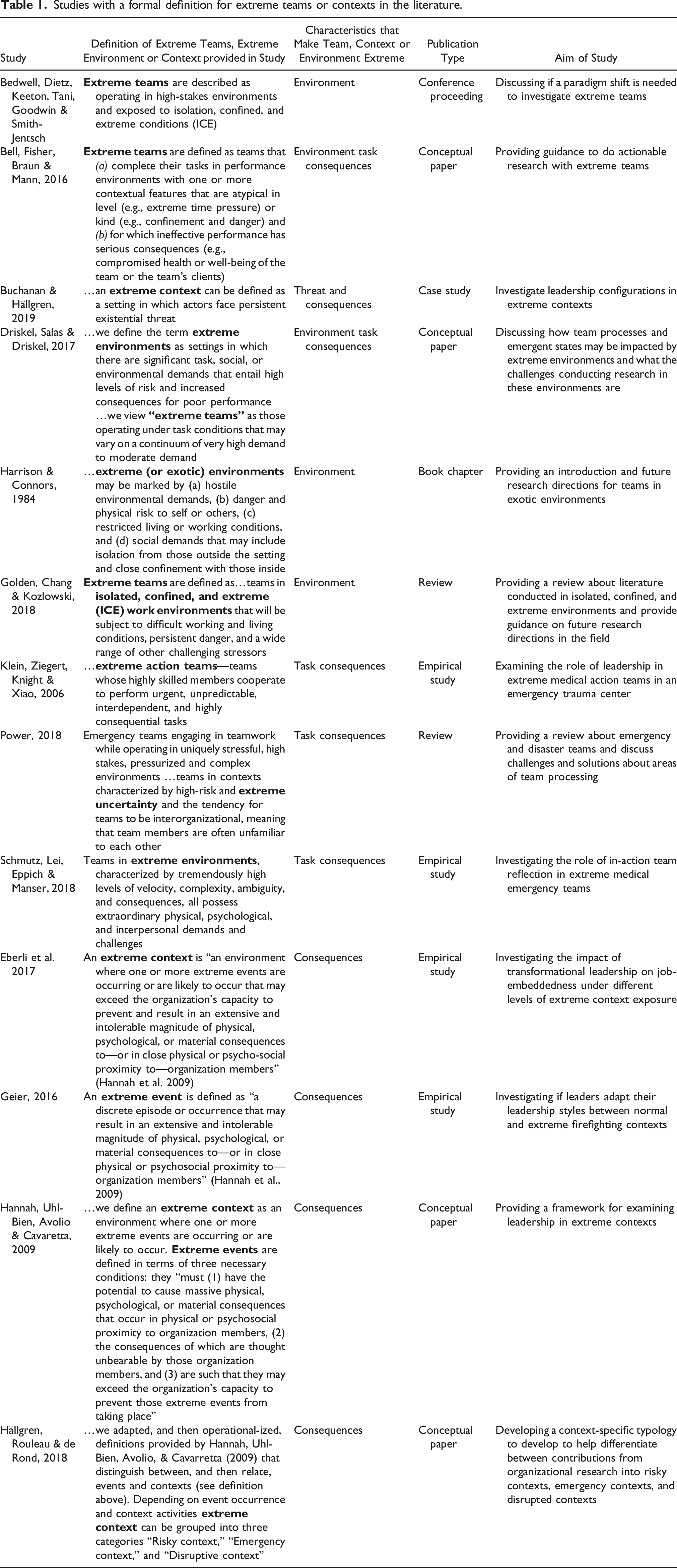
In the following section, we first discuss research focused on the team level, followed by the literature that more broadly talks about extreme contexts at both the team and organizational levels. Based on the discussion of this literature, we provide a path forward for future research as we present our team extremeness framework.
Extreme Teams Literature
The extreme teams literature focused on the team level can be loosely grouped into two domains. The first is concerned with teams in isolated, confined, and extreme (ICE) environments, such as space (Golden et al., 2018), and the other is focused on extreme action teams that operate in dynamic, intense performance events (e.g., a rescue mission), often under time pressure, such as emergency or firefighting teams (Ishak & Ballard, 2011).
Research about teams in ICE environments has recently burgeoned as NASA has become more interested in teamwork as it relates to long-duration space missions (Landon, Slack, & Barrett, 2018; Mesmer-Magnus, Carter, Asencio, & DeChurch, 2016). The very nature of space makes it challenging to study teams in such an environment. Therefore, much of the research has considered teams in space analog environments, such as polar stations (Bell et al., 2019; Ombergen, Rossiter, & Ngo‐Anh, 2021) or analog space stations situated in remote locations including the desert (Abercromby, Chappell, & Gernhardt, 2013) or NASA research centers (Larson et al., 2019). Generally, this literature defines an extreme team simply as a team operating in a high-stakes environment exposed to isolation, confinement, or extreme conditions, such as space or Antarctica (Bedwell et al., 2011; Golden et al., 2018; Harrison & Connors, 1984). As a consequence, all teams that work in an ICE environment are considered extreme teams, as the environment is the sole characteristic that makes a team extreme. This unidimensional and rigid definition neglects other characteristics, such as a team’s task or the consequences of the task. However, some exceptions note that teams can be extreme that do not encounter all three ICE dimensions, but still face challenging working and living conditions (Bell et al., 2016).
Extreme action teams have also received attention in management (Vashdi et al., 2013), psychology (Power, 2018), and the medical field (Reader, Flin, Mearns, & Cuthbertson, 2009). While the literature regarding teams in ICE environments has primarily focused on team inputs and emergent states over time, some researchers investigating extreme action teams have been more interested in the processes and impacts that the team’s challenging task has on performance. Considering that extreme action teams are often formed ad hoc, a long-term view is often very difficult to adopt due to the high rotation that such teams often encounter (Grote et al., 2018). Research has uncovered positive impacts of a variety of team processes and adaptations on performance in aviation, healthcare, police, and firefighter teams (Grote, Kolbe, Zala-Mezo, Bienefeld-Seall, & Künzle, 2010; Lei, Waller, Hagen, & Kaplan, 2016; Marques-Quinteiro, Curral, Passos, & Lewis, 2013; 2019; Schmutz, Meier, & Manser, 2019). In contrast to the definitions provided previously, studies investigating extreme action teams, such as emergency teams or disaster teams, do not explicitly include a hostile environment at all in their definitions (Klein et al., 2006; Power, 2018; Schmutz et al., 2018). They define extreme teams through various task characteristics (e.g., high uncertainty, high time pressure, and ambiguity) and/or significant consequences of poor performance (e.g., team member well-being and patient outcomes).
Overall, there is no common agreement in team research on what defines an extreme team or an extreme environment. While some scholars have identified the environment (focusing on stable contextual characteristics like isolation or confinement) as the only definitional factor of an extreme team, others have stated that an ICE environment is not a necessity, and that atypical task characteristics or their consequences (e.g., compromised health) can also be definitional factors. As such, two major limitations have become apparent in the literature. First, the unidimensional approach to defining extreme teams seems not to capture the different aspects that might be present within an extreme team (Table 1). Second, the notion of an extreme team implies that teams can either be categorized as extreme or not extreme, creating a dichotomic view on the topic that fails to capture the diverse nature of teams that extant literature have considered as extreme. Therefore, we propose that a multidimensional continuum is a more nuanced way to categorize and compare these teams and move the literature forward.
Extreme Context Frameworks
In contrast to studies that dichotically conceptualized teams as extreme or not, both organizational and leadership researchers have adopted a broader view, focusing on the context being extreme (Hällgren et al., 2018; Hannah et al., 2009). Hannah et al. (2009) introduced a thorough definition of leadership in extreme contexts. This work defined an extreme context as an environment where one or more extreme events are occurring or are likely to occur. An extreme event is “a discrete episode or occurrence that may result in an extensive and intolerable magnitude of physical, psychological, or material consequences to—or in close physical or psycho-social proximity to—organizational members” (Hannah et al. 2009, p. 898). This definition assumes that extreme events can occur in any organization, regardless of whether it operates in what may be traditionally considered an extreme context. Weather events, cyberattacks, or terrorist attacks are some examples of extreme events that can potentially affect any team that would not be considered as extreme in normal circumstances.
Hannah’s et al. (2009) framework further states that the level of extremity of the context is influenced by five dimensions: magnitude of consequences, probability of consequences, physical or psycho-social proximity, the form of threat, and location in time. The basic assumption of the model is that various degrees of the five extreme context dimensions will elicit different leadership responses. This framework was the first model that provided a thorough definition of extreme contexts and various typologies. Furthermore, the typology introduced the idea that a context has various levels of extremity. In doing so, the framework has paved the way for studies to look at extreme contexts as a more dynamic variable that influences relationships and outcomes (Burke, Shuffler, & Wiese, 2018; Eberly, Bluhm, Guarana, Avolio, & Hannah, 2017; Geier, 2016; Thielen, Decramer, Vanderstraeten, & Audenaert, 2018).
More recently, Hällgren et al. (2018) adopted a definition of extreme events and provided a context-specific typology. Based on the event’s occurrence and context activities, they defined three types of extreme contexts: risky, emergency, and disruptive. Risky contexts are characterized by constant exposure to potentially extreme events that should be avoided if possible (e.g., oil drilling). Emergency contexts deal with actual events related to the core activity (e.g., wildland firefighting). Disruptive contexts are characterized by events unrelated to the activities (e.g., natural disasters and terrorist attacks).
In contrast to the rest of the extreme teams literature, two frameworks view extreme contexts as a continuous variable (Hällgren et al., 2018; Hannah et al., 2009). We think this is a necessity to address the complexity of the construct. However, the two approaches also have limitations for team research in terms of their predictive value. Hannah et al.’s (2012) framework provides only general guidance on how extreme contexts influence adaptive leadership responses. Due to the complexity of the framework including a high number of predictors and moderators, the proposed mechanisms remain largely untested and its value for hypothesizing and theorizing about the impact of extreme contexts on teams remains limited. The typology of Hällgren et al. (2018) has helped to categorize the literature, but it does not describe the mechanisms by which an extreme context influences behavior or relationships. Additionally, the view of extreme events discussed by Hällgren et al. (2018) is relatively static, while contexts are essentially dynamic, especially over the lifetime of a team (Maloney, Bresman, Zellmer-Bruhn, & Beaver, 2016). During a training phase, military teams might face relatively few challenges. However, when deployed for real action, the context changes and they potentially face many extreme events. Finally, both frameworks exclusively focused on extreme events in their definitions, neglecting contextual aspects that are continuous and not bounded in space and time. Such aspects could still negatively impact a team over time (e.g., isolation) and need to be considered. Based on these considerations, we state that a multidimensional framework for team research is needed. This framework should be simple enough to categorize and compare teams on an extremeness continuum, but also allow theorizing and provides guidance to understand how the context influences team behavior.
Conceptualization of Team Extremeness
Towards a Definition of Team Extremeness as a Team Context
For extreme team research to advance, we need to define an essential contextual variable potentially affecting all teams, which we call team extremeness. Context here is defined by the situational opportunities and constraints affecting the occurrence and meaning of organizational behavior and functional relationships between variables (Johns, 2006). Hence, the context can exert either a main or moderating effect. Considering the context as more or less extreme allows for a more dynamic conceptualization of team extremeness because the same team might go through different levels of team extremeness over time when the context changes (e.g., an astronaut team training on earth and then launching into space). However, we believe that current literature definitions, where extreme context is solely defined by the potential occurrence of extreme events (Eberly et al., 2017; Geier, 2016; Hällgren et al., 2018; Hannah et al., 2009), are not sufficient.
Events are discrete and bounded in space and time such that they have an identifiable beginning and end. Furthermore, they represent a kind of discontinuity and therefore have a nonroutine character which often leads to immediate change (Morgeson, Mitchell, & Liu, 2015). The growing body of research about teams in ICE environments, has shown that contexts, such as Antarctica or space, can have significant consequences that are not necessarily due to specific extreme events. In fact, more stable aspects of the environment can also potentially impact processes or outcomes (Johns, 2006). An astronaut team is confined in a station surrounded by space, a highly hostile environment, and this context represents a constant threat. Even in the absence of a particular event happening, this context might have a significant impact on team behavior or psychological outcomes. Isolation or anti-gravity, in and of itself, can lead to severe psychological and physical consequences, especially over time. Therefore, we argue that extreme contexts can include both the extreme events that occur in them and their characterizing extreme features. Depending on the strength of these events and features, a context can be placed within a continuum of extremeness. We understand extremeness as the likelihood that a context—through extreme events and/or extreme features—can potentially cause massive physical, psychological, or material consequences. Such consequences can impact either team members themselves, their clients (e.g., patients of a surgical team), or larger groups or societies (e.g., the people and communities affected by the Deepwater Horizon oil spill). We see team extremeness as a discrete situational variable that influences behavior directly or moderates the relationships between variables.
Furthermore, team extremeness is defined by both an external and internal dimension, namely environmental extremeness and task extremeness. We chose these two dimensions because they were the two most mentioned in the definitions of extreme teams and extreme context (Table 1). These two dimensions create the team extremeness continuum where all teams can be placed (Figure 1). Environmental extremeness represents external stimuli outside the team boundaries (primarily out of the team’s control and usually at a higher level) affecting the team, or the external actor/entity with whom the team interacts. It is the physical environment in a classic social psychology approach (Johns, 2006; Mowday & Sutton, 1993). Task extremeness represents an internal context related to the actions inside the team’s boundaries. Task extremeness includes the team’s task outcomes or consequences and the physical or psychological impact these tasks can have on members over time (e.g., hard manual labor). Both extremeness dimensions have both stable characteristics and more dynamic influences (i.e., events) on team functioning. We further elaborate on each of the dimensions and the potential extreme events and features below. Team extremeness framework.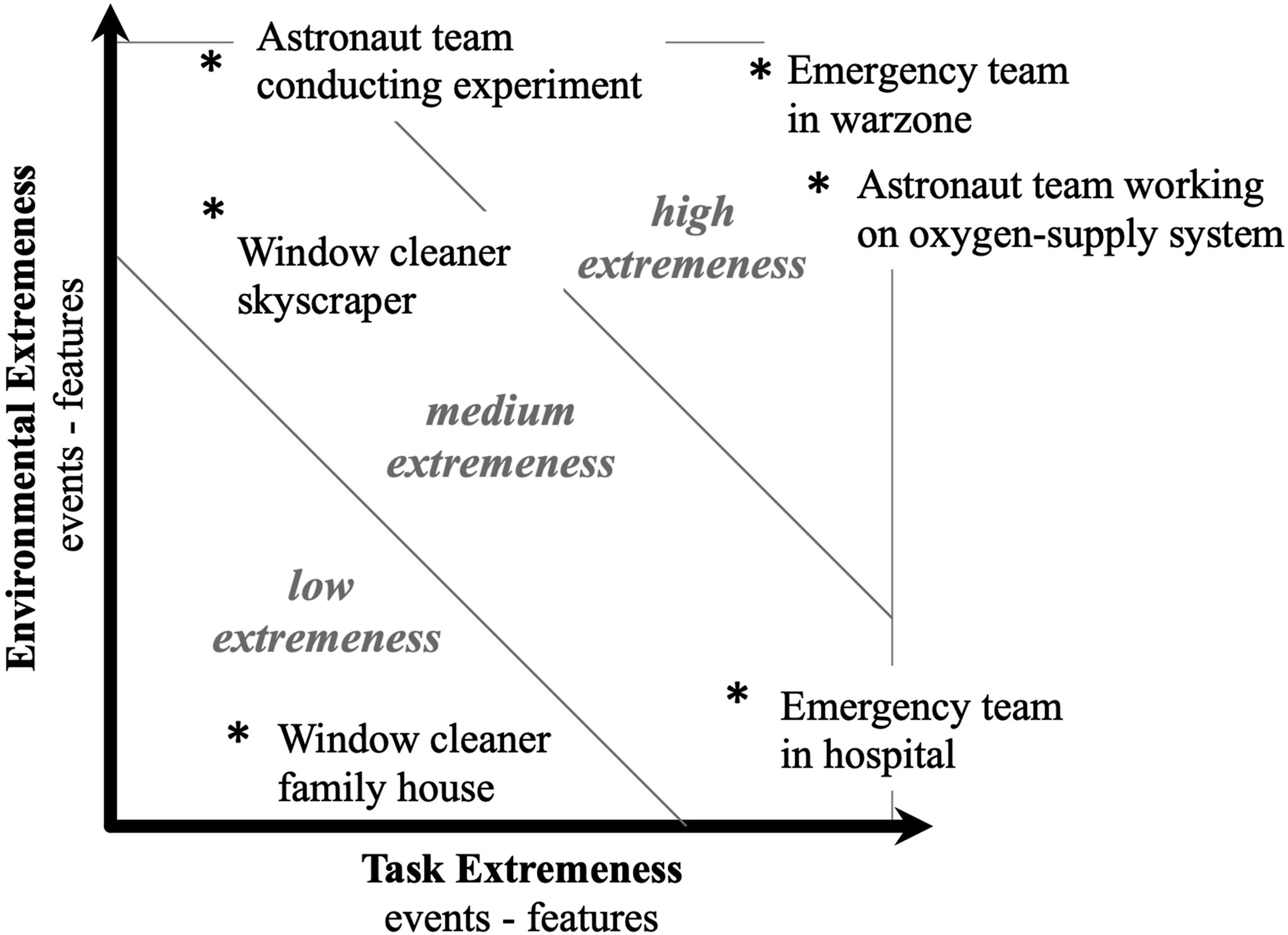
Environmental Extremeness
Environmental extremeness is the external team context or the physical environment in which the team operates in and is characterized by a hostile and threatful capacity that can impair team performance. Environmental extremeness is independent of the main team task and describes the surroundings where work is carried out. Contexts characterized by high environmental extremeness include, but are not limited to, the polar regions, space, deserts, war zones, or the deep sea. Research typically has considered these contexts as exotic or ICE environments (Amils et al., 2007; Golden et al., 2018; Orasanu & Lieberman, 2011).
These settings place extraordinary physical, psychological, and interpersonal demands on people living and working there and significant human adaptation is required for survival and performance (Manzey & Lorenz, 1998). These environments require life-sustaining technologies or protective habitats and equipment and, as a result, many constraints are placed on well-being and performance. Other environments, such as war settings or prisons, are not inherently inhospitable like space, but the social environment is hazardous and provides a constant threat (Orasanu & Lieberman, 2011).
Environmental extremeness can manifest itself as either an extreme event or feature (i.e., can be dynamic or stable), originating from the environment. Examples of extreme events include extreme weather conditions, animal attacks, or meteorite impacts. These represent extreme events bounded in space and time and usually require immediate team adaptation due to their highly disruptive nature. In contrast, examples of more stable features of environmental extremeness include isolation or lack of privacy (e.g., on a space station) that, over time, can have significant psychological or physical consequences (Palinkas, 2003; Palinkas, Houseal, & Miller, 2000; 2004). In addition, exposure to anti-gravity has been shown to have severe effects on both the body (Garrett-Bakelman et al., 2019) and the brain (Ombergen et al., 2017).
Task Extremeness
Task extremeness describes the internal team context and concerns the team’s task and its outcomes or consequences. Most studies on extreme teams have described the task as having “significant” or “serious” consequences (Bell et al., 2016; Driskell et al., 2017; Klein et al., 2006; Schmutz et al., 2018) or have talked about “high-risk” or “high-stakes” (Power, 2018). Task extremeness is defined by the severity of the result of task accomplishment or, more so, by the extreme negative consequences of failure. Thus, the higher the team task extremeness, the more severe the consequences if the team does not perform well. The most extreme consequences often include what we value the most, that is, loss of human life.
We can categorize extreme consequences as affecting the team itself, an external agent, or both. For example, an air leak was detected on the international space station (ISS) in 2004 and the two astronauts on board had the task of tracing and repairing the leak. Failure to repair the space station leak could have had severe consequences for the astronauts (Oberg, 2004). However, a surgical team’s main task is treating their patient. Failure on the part of the team will affect the patient but not necessarily the team itself. Finally, a pilot team is responsible for a plane. Failure to land the plane safely results in negative consequences for the pilots as well as the passengers. That said, task extremeness is not exclusively about physical harm. For instance, a failing management team can result in the bankruptcy of a company which can have a significant impact on the lives of its employees, suppliers, and stakeholders.
As well as being an event resulting from task management, task extremeness can also be characterized as a feature. The work itself can have a physical or psychological impact on teams. Intensive, repetitive manual labor (e.g., mining) can, over time, impact team members’ physical well-being. Furthermore, teams can face psychological challenges when being constantly exposed to threats over more extended periods (e.g., soldiers), leading to psychological distress or post-traumatic stress disorder (Benedek, Fullerton, & Ursano, 2007; Fulton et al., 2015; Marmar et al., 2006)
Placing Teams on the Team Extremeness Continuum
It is important to note that task extremeness is linked with the core team activity and represents the consequence of solving a task. Imminent danger coming from a harsh environment threatening the life of team members is considered environmental, not task extremeness. An astronaut team conducting a physics experiment onboard the ISS does not face high task extremeness as the success or failure of the experiment itself does not have significant consequences for the astronauts or others. However, they operate in space and that is considered high in terms of environmental extremeness. However, there are instances when astronauts might face a task with high task extremeness. For example, in October 2020, an oxygen-supply system failed on the ISS, and the astronaut team had to repair the system. This was high in task outcome extremeness, given that a failure to fix the system could put the crew in danger. This task extremeness coupled with high environmental extremeness results in such an instance being in the high/high area of our two-dimensional model of team extremeness.
A window-cleaning team working on a two-story family house can be considered low in extremeness. The environment and the task do not suggest a substantial level of risk for massive physical, psychological, or material consequences. However, a window-cleaning team with the same task of cleaning windows, but doing so on a skyscraper, can be seen as more extreme as hanging from the top of a tower could be seen as moderate to high in environmental extremeness. The environment in which this team operates increases the likelihood that an extreme event (falling) will happen compared to cleaning windows on a two-story house. The task itself remains low in task extremeness as failure of the team to execute their primary task (cleaning windows) will not have severe consequences apart from dirty windows.
Finally, a medical emergency team managing a critically ill patient can be considered high in task extremeness and low in environmental extremeness. The patient’s life is on the line, but the hospital environment itself is not posing any threat to the team. However, the extremeness of this team changes if the environment changes. If an emergency team is no longer in the hospital, but in the streets managing patients after a car accident, the environmental extremeness will increase since the team is exposed to more threats (e.g., other cars). For a medical team treating wounded soldiers in a warzone the environment itself poses an immediate threat to both the team and the patient, and, at the same time, the task they are performing has severe consequences for the patient. As such, the emergency team in the warzone is in the high/high area of our team extremeness continuum as both the environmental and task components of extremeness are significant.
These examples illustrate that team extremeness can be dynamic, and aspects of it can change over time within teams. The variance in task extremeness stems from the various functions a team is working on. Some tasks might have serious consequences, while others might not. Following this logic, a routine surgery (e.g., appendectomy) can be considered less extreme than an emergency heart surgery because the likelihood of severe consequences differs significantly. The same team might go through various levels of extremeness over its lifetime. This fact illustrates the importance of considering time related to team extremeness, something we address within the future directions section.
Direct Effect of Team Extremeness
Team extremeness is a unique contextual variable that can significantly impact a team and its members. We argue that due to the nature of extreme contexts, two mechanisms are essential when teams face extremeness: stress and situational strength. Stress has several cognitive, emotional, and social mechanisms that impact performance in extreme teams. Stress often occurs in high-demand, high-threat situations that disrupt performance. Stressors are factors that make performing more difficult. This includes time pressure, task load, noise, performance pressure, and ambiguity (Driskell et al., 2006; Driskell et al., 2017). The higher team extremeness becomes, the more challenging the stressors a team will face. An environment like Antarctica or space is characterized by persistent stressors (i.e., features) coming from dangerous conditions. In the same way, potentially severe consequences of a task can put a lot of pressure on a team since failure is often not an option.
Driskell et al. (2015) stated that there were a limited number of cognitive, emotional, and social mechanisms through which stress impacted team performance and proposed five mechanisms. First, stress may increase distractions and decrease attentional focus. It is well-established in the stress literature that an individual’s breadth of attention narrows in stressful situations (Combs & Taylor, 1952). Second, stress may increase cognitive load and demand on capacity. Stress tends to increase the task load. Concurrent tasks can interfere with each other due to the increased demands on limited attentional and processing capacity (Specter & Jex, 1998). Third, stress may increase negative emotions and frustration. Constant exposure to stress can lead to negative emotions, resulting in a negative impact on team decision-making (Pfaff & McNeese, 2010). Fourth, exposure to stress may increase fear and anxiety levels, leading to increased heart rate, sweating, or shaking (Martens, Vealey, & Burton, 1990). This can have serious negative consequences on well-being over time (Kivimäki et al., 2006). Fifth, stress may increase social impairment by reducing the tendency to assist others, increasing interpersonal aggression, neglecting social or interpersonal cues, and demonstrating less cooperative behavior (Mathews & Canon, 1975).
The second mechanism directly impacting teams through team extremeness is situational strength. This refers to implicit or explicit cues from external entities regarding the desirability of potential behaviors (Meyer, Dalal, & Hermida, 2010; Meyer & Dalal, 2009). Situational strength puts pressure on team members to engage in or refrain from certain behaviors. The strength of a situation is defined by four facet structures: clarity, consistency, constraints, and consequences. Clarity describes the extent to which work-related cues are clear and easy to understand. Consistency describes the extent to which cues regarding responsibilities or requirements are compatible or, in other words, if various sources of information provide similar information about the desirability of a particular behavior. Constraints are the extent to which decisions or actions are limited by outside forces, and consequences describe the extent to which decisions or actions have positive or negative implications.
The higher on the extremeness continuum a team is located, the higher the situational strength. In highly extreme contexts, decisions are often influenced or limited by the environment itself. Sudden weather changes will affect an Antarctica expedition team and can significantly limit their actions. An example would be a blizzard leading to a planned expedition being canceled, representing a strong constraint. High task extremeness represents a high-consequence situation, putting higher pressure on the team and minimizing the effect of individual team member differences (e.g., personality and motivation). In the next section, we will present our propositions about the moderating influence of team extremeness, followed by a discussion of the path forward that can be pursued in the field by leveraging our conceptual framework of team extremeness.
Team Extremeness as a Moderator of Team Effectiveness Relationships
To examine how team extremeness dimensions may interact with input variables in shaping team processes, emergent states, and outcomes, we draw on prior research on what makes teams effective in extreme and more traditional situations and present six propositions for future research. We use the well-established input–mediator–output–input model (IMOI) model (Ilgen, Hollenbeck, Johnson, & Jundt, 2005) to structure our theorizing. This widely used model is well suited to describe how teams change over time and how team relationships move from inputs (I) to mediators (M) to outputs (O), and then new inputs for ensuing team interaction sequences (I). Given its prevalence within the organizational team literature, we think it is relevant to our discussion about how team extremeness shapes team dynamics.
Individual-level inputs comprise team members’ knowledge, skills, abilities, values, and personalities. Team-level inputs include team composition, size, roles, and leadership. Organizational-level inputs depend on the type of organization, including culture, team context, and the industry in which teams operate. These input factors link to various mediators, which include interpersonal (e.g., Marcinkowski, Bell, & Roma, 2021), action (e.g., learning and adaptation; (Bedwell, Ramsay, & Salas, 2012), and transition (e.g., planning; Stout, Cannon-Bowers, Salas, & Milanovich, 1999) processes as well as team emergent states. Team emergent states describe temporary states experienced by a team regarding team cognition (e.g., shared mental models; Mesmer-Magnus, Niler, Plummer, Larson, & DeChurch, 2017) and team affective states (e.g., Costa et al., 2018). Output factors include team-level outcomes such as effectiveness, safety, or mission success. Figure 2 provides an overview of all propositions. Propositions how extremeness interacts with team processes, emergent states, and outcomes.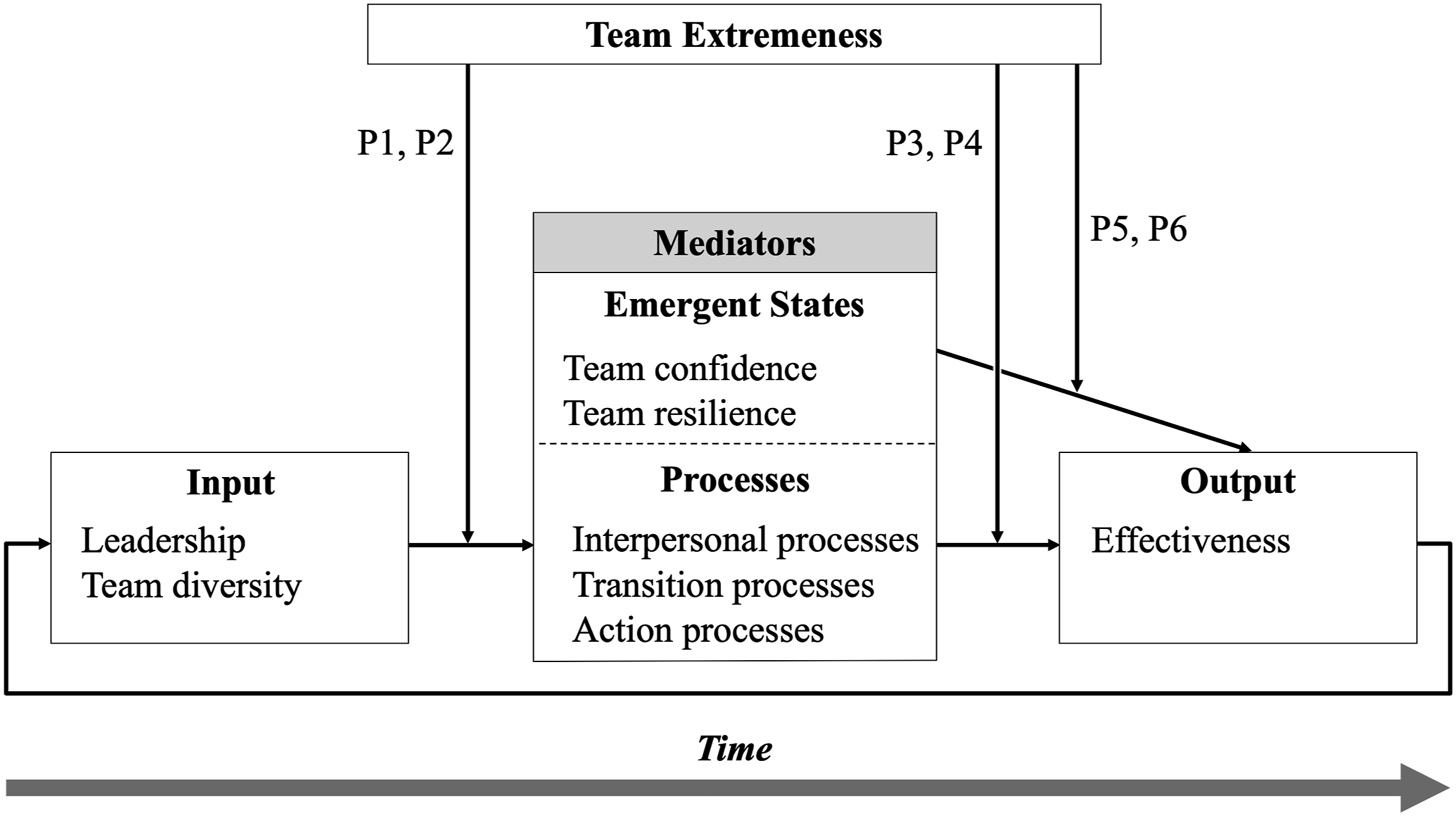
The first two propositions relate to how team extremeness may moderate the relationship between input (I) and mediator (M) variables. When choosing the input variables, we focused on the ones featured most prominently in the literature on team effectiveness and those where the importance of context (task and/or environmental) has already been well-established. First, leadership is an obvious choice because contextual variation is at the very core of all contingency theories of leadership (Peters, Hartke, & Pohlmann, 1985; Vroom & Jago, 2007). Second, we chose team diversity as an essential input variable to investigate because one of the major benefits of assembling team members with diverse backgrounds, gender, nationality, etc. lies in the creation of uncertainty to foster novel ideas for innovation and creative problem-solving (Griffin & Grote, 2020). As uncertainty is likely to increase in line with the level of extremeness experienced by a team, the relationship between team diversity and team processes, such as decision-making or problem-solving, might change significantly. If we consider a crew of astronauts and researchers tasked to undertake a mission to Mars, we could assume that the creation of ideas in team problem-solving would be facilitated by as many different ideas and perceptions as possible (Friedman, Friedman, & Leverton, 2016). However, too many inter-individual differences may lead to conflict or coordination breakdowns as uncertainty increases and the team experiences stress under conditions of high team extremeness, such as would be experienced during a Mars mission (Landon et al., 2018; Lei et al., 2016).
While we acknowledge that there are undoubtedly other variables and relationships for future researchers to consider, we believe that the ones chosen here are the most relevant ones to be included in our model on team extremeness to demonstrate the value of our novel contributions and set the stage for more theorizing and empirical investigations of our team extremeness model in the future. In the following, we further detail our rationale on how we propose team extremeness moderates the relationship between these input variables and associated mediators.
Moderating Effect of Team Extremeness on Leadership–Mediator Relationships
While most studies of team leadership have neglected the influence of team extremeness per se, the importance of leadership and particularly adaptive leadership in mitigating risks and adverse outcomes in situations with high levels of extremeness is undebated (Antonakis, Avolio, & Sivasubramaniam, 2003; Bass & Riggio, 2006; Hannah et al., 2009; Porter & McLaughlin, 2006). Nonetheless, there is great inconsistency regarding the effectiveness of different leadership styles in extreme situations, and researchers have echoed calls for further studies to clarify the current state of research (Dust, Resick, & Mawritz, 2014). Some researchers have argued that leaders should adopt a transactional leadership style in situations of great danger or risk to provide guidance and direction to their followers. For instance, a retrospective study comparing extreme versus normal events in firefighting teams showed that transactional leadership predicted team effectiveness during extreme events only (Geier, 2016). These findings are in line with earlier studies claiming that transactional or task-oriented directive leadership is required in situations of great danger and risk simply because there is no time for transformational vision or coaching (Antonakis et al., 2003; Bass & Riggio, 2006).
Others have argued that a transformational leadership style aimed at building trust, embeddedness, and cohesion predicts team effectiveness in both extreme and non-extreme situations (Dumdum, Lowe, & Avolio, 2013). For example, a recent study by Eberly et al. (2017) of the U.S. Army showed that extremeness moderates the relationship between transformational leadership by unit leaders and perceived on-the-job embeddedness by soldiers. They found that increased job embeddedness reduces turnover intention after extreme events experienced during combat. Such findings could be explained by idiosyncrasy credits, meaning that leaders build credit through trustful relationships and cohesion during non-extreme situations, which then can be spent when extremeness is high (Hannah et al., 2009).
Additionally, various scholars have identified shared leadership as the most effective style under conditions of high extremeness. For instance, a study by Klein et al. (2006) showed that shared leadership in medical teams (extreme action teams) predicted team performance. Another study found similar results in multi-team system cockpit and cabin crews during the extreme situation of an onboard fire (Bienefeld & Grote, 2014). Possible explanations for the importance of shared leadership are offered in a qualitative study by Baran and Scott (2010). They, like Weick (1993), identified sense-making as a crucial emergent state in reducing ambiguity and predicting team performance in extreme situations.
While these studies do not provide a clear picture as to which leadership style is more salient as team extremeness increases (a point that future research should consider), they suggest that the impact of leadership on team processes or emergent states (and ultimately team performance) becomes stronger as team extremeness increases. That is, team leadership becomes more predictive of team success in such situations. Accordingly, we propose that:
The effect of leadership on mediator variables (i.e., team processes and emergent states) will be enhanced as team extremeness increases.
Moderating Effect of Team Extremeness on Team Diversity–Mediator Relationships
Research that has examined team composition within teams facing low levels of extremeness has shown that task-related diversity (e.g., diverse team member ability, cognitive resources, and personality characteristics) is positively associated with team processes, such as information sharing (Dahlin, Weingart, & Hinds, 2005; Horwitz & Horwitz, 2007). Possible explanations for such findings relate to the increased variety of (novel) thoughts and ideas, which—if the diverse ideas are indeed shared within the team—leads to better team outcomes, such as innovation (Cady & Valentine, 1999) and organizational learning (Edmondson, 2003). The moderating role of extremeness on these relationships is thus far unexplored. However, research on ad hoc teams operating in extreme environments or fulfilling extreme tasks, such as emergency trauma teams (Klein et al., 2006), flight crews (Bienefeld & Grote, 2014), or command and control teams (Ellis, 2006) has shown that team members who hardly know each other can operate effectively, even in extreme situations, because they rely on role-based behaviors and standard operating procedures that leave little room for diverse characteristics of individual team members (Griffin et al., 2007). Furthermore, it stands to reason that creative team processes, such as innovation, are less critical when task and/or environmental extremeness are high since team members must operate effectively merely to survive (e.g., SWAT teams and military combat teams).
Besides the positive effects of team member diversity on mediators that extremeness might moderate, the same could be true for negative effects. Too much team diversity can increase task conflict and lower team process efficiency (Stahl, Maznevski, Voigt, & Jonsen, 2010). Moreover, literature on astronaut selection has suggested that high levels of heterogeneity in individual characteristics can threaten interpersonal compatibility, thus negatively influencing team coordination or cohesion, some of the most critical factors for successful long-duration space missions (Landon et al., 2018; Roma & Bedwell, 2017). Furthermore, team resilience, team adaptability, and social support are more likely to be high when team members share personality traits that are high on agreeableness and low on neuroticism (i.e., have lower levels of team diversity regarding their personality; Goldberg, 1993; Lahey, 2009). Based on these findings, we posit that team extremeness moderates both the positive and negative effects of team member diversity on mediators.
Team extremeness moderates the relationship between team member diversity and mediators (i.e., team processes and emergent states) in that as team extremeness increases, the positive or negative effects are dampened.
Moderating Effect of Team Extremeness on Team Process–Performance Relationships
Team processes are central in most models of team effectiveness (e.g., Guzzo & Shea, 1992). Marks, Mathieu, and Zaccaro (2001) developed a taxonomy of team processes that included the three subdimensions of transition, action, and interpersonal processes. Within the transition dimensions, the focus is on activities such as mission analysis, planning, goal specification, and formulating strategies. During action phases, members focus their attention on task accomplishments, monitoring progress and systems, coordinating team members, as well as monitoring and backing up their fellow team members. Finally, the interpersonal process dimension includes conflict management, motivation, confidence building, and affect management.
While there are numerous studies of team processes focused on a single dimension, there is evidence that each dimension of team processes is salient in shaping team effectiveness. In fact, LePine, Piccolo, Jackson, Mathieu, and Saul (2008) conducted a meta-analysis of team processes and evidenced that each type of team process had a positive relationship with team performance. We contend that the relationship between each type of team process and performance will be enhanced as team extremeness increases. The importance of effectively managing each type of process becomes more critical as both environmental and task extremeness increase. As such, we posit that:
The importance of all types of team processes on performance will be enhanced as team extremeness increases. The first step in this area would be for researchers to examine the relationship between each type of team process and team effectiveness to understand if our supposition that team effectiveness is enhanced as team extremeness increases holds true. To accomplish this analysis, researchers will need to examine teams across different contexts and tasks to assess different levels of extremeness and determine if the team process–performance relationship is altered across this continuum of extremeness. This analysis will also provide insight into whether a particular type of team process is more or less important in shaping performance as extremeness varies. There is evidence that the relationship between each of the team process dimensions and performance may be moderated by various factors. Particularly, LePine et al. (2008) found that task interdependence moderated the relationship between team processes and performance such that the processes–effectiveness relationship was enhanced as task interdependence increased. However, they did not provide details on which specific category of team process was more or less important as interdependence increased. We contend that this detailed level of examination is required to better understand the nuanced importance of team processes across different levels of team extremeness. While there has not been research on this topic to date, we propose that the team interpersonal process dimension will become more salient as team extremeness increases. In part, we argue that this process category will become more important as team extremeness increases because teams in such situations are often in close quarters, are not able to avoid interactions, and must rely on one another to a greater extent than would occur in less extreme environments. Furthermore, teams high on an extremeness continuum are regularly exposed to situations requiring a high level of attention and a lot of individual resources. Operating in a highly extreme context, such as a warzone or space, poses a constant threat to one’s health and can lead to feelings of anxiety. In addition, extreme task consequences can increase the pressure on a team, increasing task demands and therefore consuming further resources. Ego depletion theory (Baumeister, Bratslavsky, Muraven, & Tice, 1998) states that individuals only have a limited pool of attention resources that need to be conserved. Research has shown that a state of ego depletion is negatively related to feelings of guilt, prosocial behavior (Xu, Bègue, & Bushman, 2012), and cooperative behavior (Mathews & Canon, 1975). A lack of effective human interactions and prosocial behavior, in turn, can have a negative influence on team interactions and lead to conflicts. This is especially true for teams facing high extremeness, potentially resulting in a constant state of ego depletion. As such, handling conflicts effectively and managing them within the team will be of higher importance when interacting in extreme contexts, compared with other contexts. A lack of interpersonal processes would then subsequently affect action and transition processes. Conflict or negative behavior within a team would hinder reflection or planning (i.e., transition process) and most likely impede coordination (i.e., action processes). Teams high on an extremeness continuum are at a higher risk of conflict due to a lack of resources (i.e., task extremeness) and/or confinement (i.e., environmental extremeness), and so we argue that interpersonal processes have a higher value making it a prerequisite for successful team functioning in general. Based on these considerations, we state:
The relative importance of team interpersonal processes on performance will be enhanced as team extremeness increases and the impact on team interpersonal processes will be greater than that experienced by team transition and action processes.
Moderating Effect of Team Extremeness on Team Emergent State–Performance Relationships
In addition to providing a framework of different dimensions of team processes, Marks et al. (2001) also distinguished such processes from other types of mediators. Namely, they described emergent states as “cognitive, motivational, and affective states of teams that are ... dynamic in nature and vary as a function of team context, inputs, processes, and outcomes” (p. 357). While there are numerous constructs captured within the definition of emergent states as noted by Mathieu, Maynard, Rapp, and Gilson (2008), emergent state constructs, such as confidence, empowerment, climate, cohesion, trust, and collective cognition have received substantial attention within the organizational team literature.
Each of these types of emergent states have been shown to have positive effects on team effectiveness in a variety of contexts (e.g., Rapp, Maynard, Domingo, & Klock, 2021). Generally, emergent states smooth out team interactions in relation to information sharing as well as actions. Psychological safety, team climate, cohesion, and trust, for example, are positively related to voice behavior and information sharing (Edmondson & Lei, 2014; Evans & Dion, 2012; Morrison, 2014; Staples & Webster, 2008). Information sharing and voice behavior are two crucial processes that have various beneficial effects on team performance (Mesmer-Magnus & DeChurch, 2009). Additionally, a variety of emergent states have been connected to enable teams to form accurate explanations and expectations for a task, which is important in helping the team to be able to coordinate their actions and adapt their behavior to the demands of the task and other team members (Fiore, Salas, & Cannon-Bowers, 2001). Likewise, certain emergent states enable implicit coordination through anticipation (Rico, Sanchez-Manzanares, Gil, & Gibson, 2008; 2019; Wegner, 1987). These benefits of emergent states are apt to be even more important as team extremeness increases. In such situations, the byproducts of emergent states (i.e., information sharing, coordination, etc.) become paramount. Namely, sharing of information and implicit coordination is especially important when teams experience stress and must act quickly, as often occurs in extreme contexts (Rico et al., 2008; Wegner, 1987).
Likewise, in line with Conservation of Resources theorizing (Hobfoll, 1989), emergent states are a resource that a team can leverage in times of stress and uncertainty, which are often present as extremeness increases. As previously stated, as team extremeness increases, the resources of a team might decrease through stressful events. In such situations, the team might not be able to switch to the more explicit ways of interaction needed to compensate for the lack of emergent states. Teams facing less extremeness might be better able to compensate for a lack of emergent states than teams in more extreme contexts. Therefore, we argue that all types of team emergent states will become more salient in shaping team effectiveness as team extremeness increases.
The importance of all types of team emergent states on performance will be enhanced as team extremeness increases. There are certain emergent states that will likely be more important than others within more extreme situations. In particular, we will focus on two specific emergent states, team confidence and resilience. We contend that these will play a more prominent role in shaping team effectiveness as team extremeness increases. We chose confidence because it has been shown to be particularly salient for team effectiveness as uncertainty and interdependence rise (Clark & Maggitti, 2011). While team confidence is helpful in all situations, its true impact emerges when teams are put to the test under challenging situations (Gould & Maynard, 2009; Kirkman & Stoverink, 2021). Likewise, resilience is an important construct in relation to team extremeness because, as outlined above, stress and adverse events play a significant role concerning team extremeness. As detailed by Mathieu et al. (2008), there are different constructs (efficacy and potency) embedded within studies of team confidence. Team efficacy is viewed as “a shared belief in a group’s collective capability to organize and execute courses of action required to produce given levels of goal attainment” (Kozlowski & Ilgen, 2006 p. 90) and is generally focused on a team’s specific task. In contrast, potency generally refers to a team’s more general sense of confidence regarding its capabilities on various tasks. There is widespread support for the positive effect that both team efficacy and potency can have on team effectiveness (Gully, Incalcaterra, Joshi, & Beaubien 2002). While this has not been examined with regard to our proposed team extremeness continuum, there is evidence that team confidence is more salient in shaping performance as interdependence increases (e.g., Gully et al., 2002). Similarly, Gibson, (1999) found that the relationship between efficacy and performance was moderated by task uncertainty, which is likely to increase as team extremeness increases. While there is a long tradition of examining team confidence, the topic of team resilience has only recently gained attention within the organizational team literature (Raetze, Duchek, Maynard, & Kirkman, 2021). Here, team resilience has been conceptualized in different ways. Still, several scholars have advocated that team resilience is best viewed as an emergent state as it is dynamic in nature and shaped by adaptation and other team processes (e.g., Maynard & Kennedy, 2016; Sharma & Sharma, 2016). Carmeli, Friedman, and Tishler (2013) provided a nuanced view of team resilience as being composed of two dimensions consisting of “efficacious beliefs of coping with the difficulty and the capacity to adapt” (p. 149). While largely theoretical at this point, several researchers have provided some empirical evidence of the positive relationship between team resilience and effectiveness (e.g., Meneghel, Martínez, & Salanova, 2016). Likewise, several researchers have advocated that team resilience is essential when teams encounter challenges (e.g., Alliger, Cerasoli, Tannenbaum, & Vessey, 2015) or within extreme contexts, such as nuclear power plants (Gomes, Borges, Huber, & Carvalho, 2014). Therefore, we suggest that team emergent states, such as confidence and team resilience, will become more salient as team extremeness increases. As such, we introduce our final proposition:
The relative importance of team confidence and team resilience will be enhanced as team extremeness increases and the impact on both team confidence and resilience will be greater than that experienced by other types of team emergent states.
The Path Forward for Team Extremeness Research
While there are several directions that empirical examinations of team extremeness can take, we encourage researchers to examine our propositions. Namely, we are interested to understand how extremeness moderates the various input–mediator and mediator–effectiveness relationships. Particularly, we are curious if the different types of team processes are more or less salient in shaping team effectiveness. For the sake of brevity, we did not propose whether these team processes would differ in their relationships with various emergent states. However, future research could examine such relationships and whether team extremeness has different moderating effects on them. Furthermore, we encourage future research to address the three important domains of temporal effects, measurement, and level of analysis in relation to team extremeness
Temporal Effects Regarding Team Extremeness
As detailed previously, we do not envision that environmental and task extremeness dimensions are static features of the task and work settings in which teams develop their activities. Time offers an essential perspective that extant extremeness literature has not yet sufficiently addressed. That is, how the extreme events or features composing team extremeness unfold over time and how that reality challenges team mediators and outcomes.
As an event-related contextual variable, the effects of team extremeness over time could be analyzed using the three temporal dimensions proposed by event system theory (Morgeson et al., 2015). These are (1) event duration (the amount of time an event lasts), (2) event timing (when the event occurs considering team developmental stages), and (3) event strength change (event variations over time). However, as team extremeness blends events of different natures (i.e., internal and external) and captures more lasting features of teams’ work settings and tasks than pure events, we focus on the event strength facet and decompose it into two interrelated facets that we find particularly useful to understand how extremeness varies over time.
On the one hand, we identify a facet concerning how extremeness displays a discernible set of interrelationships between its composing elements and how extremeness adopts a particular occurrence configuration over time or extremeness patterns. On the other hand, we elaborate in more detail on a facet concerning the progression or line of development adopted by extremeness over time or the extremeness trajectory. We build on these two team extremeness temporal facets next.
Team Extremeness Patterns
We define team extremeness patterns as the timing and sequences of events (either internal or external) through which extremeness occurs. Even though team extremeness could be understood as a more lasting feature of teams’ work settings and tasks, it does change and evolve. Thus, we find value in understanding the extent to which the pattern of occurrence of the characteristics affects team mediators and outcomes.
In this regard, extant research on teams in dynamic critical situations has suggested that strictly focusing on the amount or frequency of characteristics composing extremeness may not be a good way to understand its effects on team interaction processes and their outcomes (Waller, Uitdewilligen, Rico, & Thommes, 2021). Instead, dissecting the patterns through which the elements characterizing team extremeness occur provides an invaluable angle to reveal its true influence on teams. For example, consider teams operating in an extreme and isolated environment for 6 months, where one team could have reliable video calls with the outside world every 5 days, whereas another team operating in the same isolated environment could have reliable video calls for six consecutive days once a month. If we envision extremeness as being shaped by the frequency of days when they can have reliable video calls during these 6 months, we will obtain the same measure of extremeness for both teams. However, if we analyze the same teams by looking at their video call pattern, the first team will show a distributed pattern that may benefit from gathering and sending relevant information for the team to solve problems timely, while the other team will show a concentrated pattern of video calls that, despite its length, may not offer the team with the ongoing informational support needed. Thus, examining extremeness patterns offers a more detailed understanding of their impact on key team dynamics as compared to an assessment of team extremeness based solely on a frequency count. Particularly, time-event sequences provide a very useful base for addressing questions concerning what extreme characteristics are followed and or combined with what, as well as their evolution (Magnusson, 2000; Tschan, Zimmermann, & Semmer, 2018; Waller et al., 2021).
Team Extremeness Trajectories
Whereas extremeness patterns capture the presence and nature of regularities in the temporal structure of a series of team extremeness characteristics, extremeness trajectories seize the development of such extremeness patterns along a particular period of time. The use of trajectory analysis has recently increased in team research. However, it has been mainly limited to performance trajectories (Sanchez-Manzanares, Rico, Antino, & Uitdewilligen, 2020; Uitdewilligen, Rico, & Waller, 2018). Despite extant research having predominantly considered trajectories as dependent variables, here we advocate for analyzing extremeness trajectories to predict variations in team processes, emergent states, and outcome variables. Thus, we are interested in considering these trajectories as an independent variable affecting other dependent variables or even other trajectories of different variables. For example, a slowly dropping curve of team extremeness may predict a quick upward curve of team learning, which in turn could be related to a slight upward trajectory of team effectiveness.
Measuring extremeness characteristics as continuous variables and with a minimum of three points in time would reveal extremeness trajectories. However, the more points in time captured, the more complex and nuanced the trajectories obtained and examined. Thus, instead of a simple upward or downward trajectory, researchers could capture a sinusoid curve showing extremeness picking up early on, quickly dropping, and slowly recovering its strength over time (see examples Figure 3). Examples of Team Extremeness Trajectories.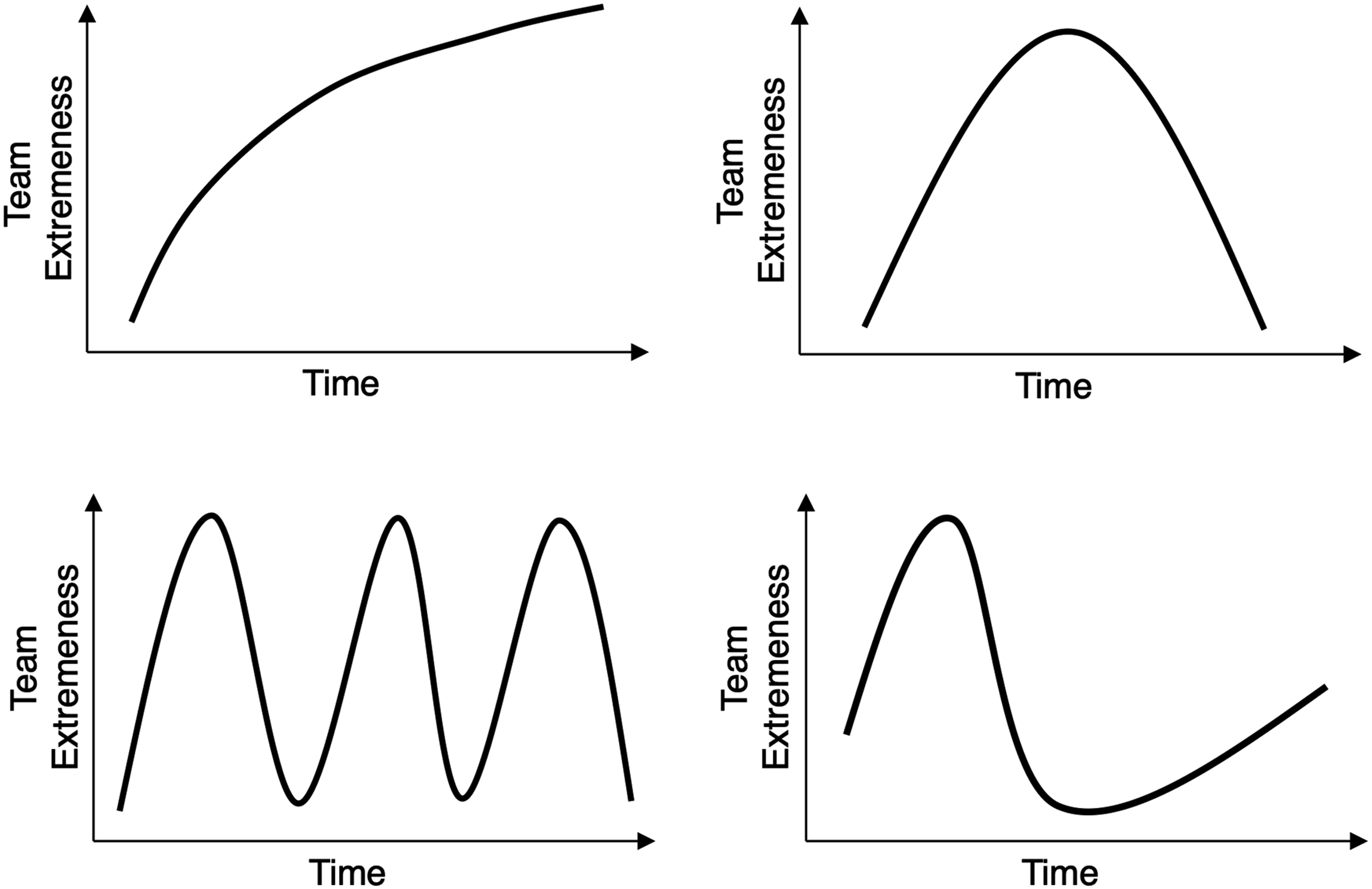
Morgeson et al. (2015) proposed that event trajectories would moderate the effects of an event’s average strength over event outcomes in an augmentative way. In other words, faster event-growing trajectories will make events much more impactful over event outcomes than faster event-declining trajectories. This is a good departing point to guide future research. However, if researchers analyze how the patterns of internal and external characteristics composing team extremeness combine in growing and declining periods of different speed (i.e., trajectory slopes), that will allow for additional refinement in the research questions analyzed.
For example, considering that team stability seems very relevant to understanding teams in extreme circumstances (Käosaar, Marques-Quinteiro, & Burke, 2022), trajectories could be very informative regarding moments of stability where teams could align a proper set of team processes (e.g., transition processes) to better cope and take advantage of unstable moments. Extending this idea to further analyze slope steepness (either positive or negative) could inform us about how quickly teams will get away from stable or equilibrium points, providing an understanding of adaptive team processes under team extremeness variations (Rico, Gibson, Sánchez-Manzanares, M., & Clark, 2019). In addition, analyzing how extremeness trajectories converge with other team process trajectories could help to explain how a team’s fate depends on its initial extremeness conditions and also to the extent that convergence of trajectories create attractors, such as behaviors that a team settles on over time after showing initial transitory (settling-in) behaviors (Abraham & Shaw, 1992), which are crucial for understanding the self-organization of teams as complex systems (Gorman, Dunbar, Grimm, & Gipson, 2017; Ramos-Villagrasa, Marques-Quinteiro, Navarro, & Rico, 2018).
Measurement
The first step in examining the effect of team extremeness will be developing a measure of team extremeness. In particular, we see value in research designed to create and validate a measure of team extremeness to be used within a variety of contexts. Additionally, it will be important to develop an instrument that can evaluate both dimensions of team extremeness (i.e., environmental and task extremeness) as certain dimensions may be more important in certain contexts. We could imagine a team extremeness index, like the Job Description Index (Kinicki, Jacobson, Peterson, & Prussia, 2012), where items describing various aspects of task and environmental extremeness in relation to one’s job are presented. Some researchers may be interested in examining the respective effect that each of these dimensions has on team effectiveness relationships. Further, the potential weighting of the two dimensions needs to be considered. A high value of task extremeness might not contribute in the same way to the overall team extremeness as a high value of environmental extremeness. While there are likely to be other ways to assess team extremeness, developing a survey instrument that team members and/or team leaders can complete about their teams will be an important contribution to this literature.
This raises another important factor for future researchers to consider–who is in the best position to provide an assessment of a team’s level of extremeness? There are situations where an external observer may be the best option to assess extremeness, while at other times, the team members and/or leader may be the best option. However, from our experience, it will be important to recognize that some members’ and leaders’ perceptions of extremeness may be influenced by their level of experience and, more specifically, their experience with a particular task. Such experience may alter their assessment of extremeness, and therefore the impact of experience may be difficult to untangle from an objective measure of extremeness. For example, an expert surgical team performing a very specialized particular procedure, may assess such task as less extreme than less experienced surgeon teams. As such, while team members and leaders are an important source for assessing team extremeness, their responses will be affected by their level of experience, and this shall be considered by researchers studying team extremeness.
Considerations on Measuring Team Extremeness along Time
Analyzing team extremeness patterns opens a promising avenue for researchers interested in further discovering how extremeness occurs and the extent to which different extremeness patterns relate to team processes and emergent states. Obtaining temporal sequences of both the environmental and task events that comprise team extremeness requires first segmenting observations of such events into interacting units or parsing. Identifying such units requires a coding scheme that assigns labels to observed events (Tschan et al., 2018). After that, a method to identify stabilities in the occurrence pattern of the series of coded units can be used. Waller et al. (2021) review two main techniques to identify patterns within teams that we suggest can be leveraged to identify team extremeness patterns.
First, lag-sequential analysis reveals sequential dependencies in a series of events by identifying the probability that two events follow each other (i.e., dependencies), including lagged dependencies at later points on a timeline. A second alternative method for determining the occurrence of team extremeness patterns is T-pattern analysis. This approach typically utilizes the THEME algorithm (Magnusson, 2000), a method that identifies patterns in sequences of events using a stepwise hierarchical method.
Furthermore, analyzing trajectories is a relevant way to model how extremeness composing facets interact over time. While the use of trajectory analysis in team research has increased in the last decade through different statistical approaches (e.g., Latent Growth Modeling), it is mainly limited to performance trajectories and very basic trajectory forms (i.e., slopes), which despite capturing change, do not take advantage of the capacity of such analysis to evidence more nuanced trajectories (Waller et al., 2021).
Trajectories measurement can be made at any time interval, but the selection of the proper interval choice depends on the research question guiding the measurement and understanding when the expected effects are supposed to occur (Zaheer, Albert & Zaheer, 1999). This logic also applies to the identification of meaningful beginnings and/or ends. For instance, a meaningful beginning to study an extremeness trajectory could be the departure time of a research team going to Antarctica. These are not decisions that should be taken lightly, as making sense of the trajectories requires meaningful beginnings, ends, and proper measurement lengths (Waller et al., 2021).
Consideration of Levels of Analysis
Once a measure of team extremeness is developed, and researchers examine the effects that team extremeness has as a moderator of team-level relationships as posited herein, it will open the door to considerations of whether team extremeness also has cross-level effects. While there possibly are upward influences that team extremeness can have on organizational-level variables, we can more easily see opportunities for future researchers to assess the downward effect that team extremeness may have on individual-level constructs. For instance, it might be interesting to examine whether team extremeness shapes individuals’ intention to remain within the team, individual-level well-being, and commitment to the organization and team, among other individual-level factors.
Conclusion
Current teams perform more than ever in contexts characterized by successive changes and increasing uncertainty. That makes the multidimensional conceptualization of team extremeness we develop in here timely for moving team research in this new decade. By considering both environmental and task extremeness factors, we discussed how team extremeness may moderate various input-mediator and mediator-effectiveness relationships. We also highlighted the importance of developing a team extremeness measure, one that accounts for the temporal considerations and its impact across levels that are apt to influence team extremeness. We hope these efforts in paving the way forward will serve as a springboard for future researchers to fully examine the impact of extremeness on team dynamics and performance.
Footnotes
Acknowledgments
We thank the anonymous reviewers for their helpful comments on an earlier version of the paper.
Declaration of Conflicting Interests
The author(s) declared no potential conflicts of interest with respect to the research, authorship, and/or publication of this article.
Funding
The author(s) disclosed receipt of the following financial support for the research, authorship, and/or publication of this article: This work was funded by the Schweizerischer Nationalfonds zur Förderung der Wissenschaftlichen Forschung [grant number PCEFP1_203374] and the Spanish Ministry of Science and Innovation [grant number PID2020-113394GB-100].

Author Biographies
Associate Editor: Tammy L. Rapp