



Abstract
This article contributes to our understanding of how organisations change the set of practices and practitioners involved in strategising, what we term the ‘strategy arrangement’. Drawing on insights from a qualitative study of the introduction and subsequent removal of a new strategy team, we develop a dramaturgical theory of the practices involved in changing strategy arrangements. First, we conceptualise the relationship between the frontstage performances where impressions are generated and the backstage work that takes place to craft and control those impressions. Second, we distinguish between preventive practices designed to ‘stage the show’, where foresight is used to imagine the impressions of the audience and inform the design of the show, and corrective practices designed to ‘save the show’, where the desired impression has been discredited and repair is needed to restore the desired impression. Third and finally, we distinguish between the more innocuous backstage practice of rehearsing, the ‘behind the scenes’ work that involves taking up the roles of actor, playwright, director, audience and critic to craft the show, and the less innocuous practice of conspiring, where team members work ‘behind the backs’ of the audience to construct false impressions. In so doing, we seek to advance strategy-as-practice research by developing a dramaturgical theory of practice that captures the theatrical dynamics of strategic change.
Keywords
Introduction
While there exists a substantial body of research into strategic change, the focus of this scholarship has tended to be on how organisations change their strategies. To date, we have much less knowledge of how organisations change the way they strategise. An important conceptual distinction introduced by strategy as practice is the distinction between the collection of practices and practitioners involved in strategising and the organisational strategies that emerge from this strategising activity. By analysing the so-called ‘three Ps’ of strategy – practitioners, practices, and praxis (Whittington, 2003, 2006) – strategy-as-practice scholarship has begun to address ‘what’, ‘who’ and ‘how’ questions: ‘What practices are used?’, ‘Who is engaged in the practices?’ and ‘How are the practices carried out?’ (Jarzabkowski et al., 2016). In this article, we use the term strategy arrangement to refer to the ‘ways of doing strategy’ (Whittington, 1996: 732) that an organisation uses for a period of time, which bring together a particular set of practices and a particular collection of practitioners. While these two elements can be distinguished conceptually, in reality they are often connected, for example, when organisations use a change to the strategy arrangement in order to generate new (and hopefully better) strategies. In this article, we seek to advance knowledge of the practices through which organisations change their strategy arrangement.
We know that organisations can experience periods of relative stability in their strategy arrangement, when their particular ways of strategising ‘harden into distinct and regular patterns’ (Whittington, 1996: 732). However, we also know that strategy arrangements can be subject to change, when organisations abandon a tried and tested arrangement and try out a new arrangement. This change can occur both in a planned top-down fashion when senior management introduce a new strategy arrangement and also in an unplanned bottom-up fashion when organisational members experiment with new methods of strategising, with or without the knowledge or consent of senior management. At the field level, strategy arrangements can also experience periods of both stability and change. Established arrangements can fall out of fashion and new arrangements can gain popular favour (Smets et al., 2012; Whittington et al., 2003). Evidence for this is found in a number of strategy tools and models that have come and gone over the years (Whittington et al., 2006) and the development of new ‘open strategy’ arrangements designed to bring different sets of practitioners into the strategising process (Hautz et al., 2017). 1
While we know that strategy arrangements can be subject to periods of change as well as stability, we know less about how this change happens. Our article addresses this gap by developing a dramaturgical perspective that seeks to understand the practices used by those promoting and those opposing changes to a strategy arrangement. A core idea of the dramaturgical perspective (Goffman, 1990 [1959]; Mangham, 1978, 1979) is the idea that organisational life can be understood as like a theatrical performance, where actors seek to stage a show that will generate particular impressions with their audience. Specifically, in this article we ask, what practices of impression management are used by proponents and opponents during periods of change to an organisation’s strategy arrangement? We draw on insights from an ethnographic study of an organisation that changed its strategy arrangement and subsequently abandoned the change a year later. By analysing the activities of two researchers who also acted as consultants and change agents on the project, we are able to reveal the activities that went on both ‘on stage’ and ‘behind the scenes’ to manage impressions during the change process.
From the analysis of this case, we seek to make three theoretical contributions to strategy as practice. The first contribution is to differentiate the practices involved in changing strategy arrangements by identifying the relationship between frontstage performances where impressions are generated and the backstage work that takes place away from the audience to craft and manipulate those impressions. Second, we distinguish between preventive backstage practices, where foresight is used to imagine the impressions of different audiences and ‘stage the show’, and corrective frontstage practices, where the actors have failed to generate the desired impression and repair is needed to ‘save the show’. Third and finally, we introduce a conceptual distinction between the more innocuous backstage practice of ‘behind the scenes’ rehearsing, which seeks to maximise the chances of a desired impression being generated, and the less innocuous practice of conspiring ‘behind the backs’ of the audience, which seeks to manipulate the audience by creating false impressions. In so doing, we seek to advance strategy as practice by developing a dramaturgical theory of practice that enables us to understand the dynamics of change in strategy arrangements.
The practice of changing strategy arrangements
The central aim of strategy as practice has been to understand the ‘everyday activities of strategy practitioners’ (Jarzabkowski and Seidl, 2008: 1391). Scholars have therefore sought to understand the nature of the activity that lies behind changes in organisational strategies. Studies have revealed unexpected outcomes in the change process: changes that were unexpectedly adopted by the organisation (Barry and Elmes, 1997) and changes that were unexpectedly abandoned by the organisation after an initial adoption phase (Hodgkinson and Wright, 2002). Change recipients have also been shown to face unintended consequences and breakdowns that trigger forms of reflection and adaptation to achieve the change mandate (Jarzabkowski et al., 2019).
The existing literature has developed a rich picture of the skills and competencies through which actors seek to influence the strategic change process. One body of work has emphasised the discursive and interactional competencies involved in influencing the change process (Balogun et al., 2011; Kwon et al., 2014; Rouleau and Balogun, 2011; Samra-Fredericks, 2003, 2005). Scholars have also begun to move beyond the view that strategic influence is tied to the properties or attributes of actors, such as control over resources or position in the hierarchy. For instance, Kaplan (2008) and Balogun et al. (2015) have both shown how unexpected shifts in power and legitimacy occurred during a period of strategic change as a result of the skilful activities of those advocating and those resisting change. Some studies have focused specifically on the activities of middle managers during periods of strategic change. These studies have revealed that middle managers not only implement strategic directives from above but can also initiate change and seek to exert more influence over strategy formulation, shifting relations of power and control in the process (Balogun and Johnson, 2004; Mantere, 2005, 2008; Rouleau, 2005).
One common theme that emerges from existing research is the political nature of the activity involved in shifting power relations during periods of strategic change. Strategising is here conceptualised as a power-laden activity which involves claims to knowledge that seeks to dominate the subjects and objects constituted by its discourse (Kornberger and Clegg, 2011). For example, research by Jarzabkowski and Wilson (2002), Jarzabkowski (2008) and Jarzabkowski and Balogun (2009) has shown how power relations can be shifted during periods of strategic change when rules, norms and values are brought into play to legitimate particular strategies and delegitimise others. Existing work has also shown how different strategy practices and tools shape the ability of different actors to exert control over the change process: for example, Jarzabkowski and Seidl (2008) showed how the practice of strategy meetings was shaped by the political context of the organisation they studied. Strategy practices and tools are known to shape who gets a voice in strategy interactions. This has been shown by Spee and Jarzabkowski (2009), who have conceptualised strategy tools as objects deployed within the political dynamics between actors, and also by Kaplan (2011), who has shown how the affordances of PowerPoint included and excluded particular ideas and particular actors from the strategising process.
Using qualitative methodologies such as interviews, reflective narratives, diaries and participant observation, this body of research has shown the ‘underbelly’ of activity that underlies strategic change. We seek to contribute to this existing body of work by conceptualising the dramaturgical nature of the activity involved when organisations change their strategy arrangement. In particular, we seek to build on and advance the work of Rouleau and Balogun (2011), who distinguished between the activity of ‘performing the conversation’ and the activity of ‘setting the scene’ for those conversations to happen. Using focus groups and biographic life narrative interviews, Rouleau and Balogun (2011) show how middle managers reflect on how they exercise strategic influence. Crucially, their research has shown the activity involved in ‘setting the scenes’ for strategy conversations, for example, in determining who should be having conversations with whom, when and how. We advance this particular research agenda further by using ethnographic methods to study this ‘behind the scenes’ work and follow its consequences for the unfolding dynamics of changes to strategy arrangements.
A dramaturgical perspective on changing strategy arrangements
Erving Goffman’s dramaturgical perspective has had a lasting impact on theory in the field of management and organisation studies (Manning, 2008; Mueller, 2017; Samra-Fredericks and Bargiela-Chiappini, 2008) and related fields such as accounting (Jeacle, 2014; Neu, 1991; Pentland and Carlile, 1996; Solomon et al., 2013). The concept of impression management and the notions of life as a ‘stage’ consisting of frontstage and backstage regions have been of particular importance. The analogy of ‘social life as theatre’ enabled Goffman to view social interactions as akin to actors performing on a stage (Lofland, 1980). This way of conceptualising interaction as ‘a mutual performance, with each social actor serving simultaneously as actor and audience, shaping and receiving impressions’ (Mangham, 2005: 943) has been illuminating for the study of organisational life in particular.
The concepts of frontstage and backstage have enabled organisational researchers to differentiate the activity that takes place when people are ‘on show’ in the presence of an audience and the activity that takes place ‘behind the scenes’ before or after the performance. The existing literature has distinguished between the ‘reactive’ or ‘remedial’ impression management that takes place after an audience’s expectations have been violated and the ‘anticipatory’ impression management that takes place before any violation of audience expectations (Elsbach et al., 1998; Tata and Prasad, 2015). This distinction can be traced back to Goffman (1990 [1959]: 24), who differentiated between two types of ‘defensive practices’ used to protect against any discrediting of the impression the actor wants to create for the audience: preventive practices are strategies designed in advance on the backstage to avoid having the impression discredited (Goffman, 1990 [1959]: 24) and corrective practices are tactics used on the frontstage to handle discrediting occurrences that have not been avoided (Goffman, 1990 [1959]: 24). Existing research into corrective practices has revealed how and when various tactics are used by organisations to repair or mitigate negative evaluations (Bozzolan et al., 2015; McDonnell and King, 2013; Westphal and Graebner, 2010; Westphal et al., 2012). Research into preventive practices has revealed how organisational actors seek to anticipate, avoid or minimise the possibility that a negative evaluation will be created (Elsbach et al., 1998; Graffin et al., 2016).
The backstage has been shown to have a number of functions in organisations. These functions include providing a region where the public face can be ‘relaxed’ (Ashforth et al., 2008; O’Brien and Linehan, 2014), a place where high-stakes performances can be practised and rehearsed in a ‘safe space’ (Ross, 2007) and a place that serves as a ‘protective space’ where issues can be openly discussed (Mair and Hehenberger, 2014). In addition to the more well-known scenario where frontstage compliance acts as a mask for backstage resistance, recent studies have also shown that frontstage resistance can be coupled with backstage compliance (Ybema and Horvers, 2017). The ‘darker side’ of the backstage/frontstage relationship has also been revealed by research that has shown how the backstage is used to conceal misconduct (Laguecir and Leca, 2019) and keep secrets from being exposed (Ringel, 2019). Studies have also shown how backstage activity is strategically concealed in the myths and fabrications presented on the frontstage, for example, in environmental reporting and CSR reporting (Bansal and Kistruck, 2006; Solomon et al., 2013), management accounting (Goretzki and Messner, 2019) and auditing (Parker et al., 2019; Pentland and Carlile, 1996; Roussy and Rodrigue, 2018). The frontstage is conceptualised as the place where a more anodyne and sanitised version of the organisation is presented, a version that is detached from the messy and sometimes ‘dirty’ reality (Bartunek et al., 2007).
On the backstage, actors ‘craft’ their performance and ask: ‘how will the audience perceive us and how can we design our performance to manage or manipulate their perceptions?’ Mangham (1979) and Mangham and Overington (1987) both explored the role of the backstage in anticipating the contingencies of the performance and rehearsing scenarios for their control: ‘As actor, the self imaginatively performs his own role and that of others, and as audience the self watches and critically evaluates the rehearsal’ (Mangham, 1978: 51). In playing out these simulations of the show, people can take up different theatrical roles, including actor, playwright, director, audience and critic (Mangham, 1978: 51). Crucially for our purposes here, these rehearsals can take place privately in ‘the theatre in the head’ (Mangham, 1978: 50), but they can also take place publicly during rehearsals with others in the same ‘team’ (Goffman, 1990 [1959]). The term ‘team’ is used by Goffman (1990 [1959]) to refer to ‘any set of individuals who cooperate in staging’ (p. 85) a performance and whose ‘intimate cooperation is required if a given projected definition of the situation is to be maintained’ (p. 108). During rehearsals, teams ‘work on getting the right “feel” to their portrayals’ (Mangham and Overington, 1987: 94), including using the opportunity to ‘run through its performance, checking for offending expressions when no audience is present’ (Goffman, 1990 [1959]: 115). Importantly for our purposes, Mangham (2005) also discusses the manipulative side of stage-craft, where organisational actors are ‘fraudulent beings who hide their purposes from others; beings who use props, costumes, gestures, words and settings to manage and manipulate others’ (p. 949). 2 In these situations, the ‘conspirators’ (Goffman, 1990 [1959]: 108) conceal or play down certain facts in order to craft false impressions.
In strategy as practice, the dramaturgical perspective has been mentioned by numerous scholars, but has yet to be developed as a fully fledged theoretical perspective (Mueller, 2017). Some studies have pointed to the importance of the ‘behind the scenes’ backstage activity through which strategising gets accomplished. Jarzabkowski and Seidl (2008) revealed some glimpses into how strategists used backstage ‘closed’ meetings to ‘prepare their responses to the agenda for open meetings’ (p. 1403) and to ‘stage-manage’ (p. 1412) the presentation of strategic ideas. Rouleau and Balogun (2011) also distinguished between the activity of ‘setting the scene’ in which actors prepare for ‘performing the conversation’; however, the dramaturgical metaphors are not developed into a conceptual framework. In their introduction to a special issue on discursive perspectives on strategy, Balogun et al. (2014) discuss research that analyses the ‘backstage crafting of talk’ that enables strategists to ‘facilitate frontstage performances’ (p. 182), also without developing the dramaturgical perspective. While Goffman is often cited in strategy as practice (Rasche and Chia, 2009; Samra-Fredericks, 2003, 2005; Whittington, 2006, 2007), to date the dramaturgical approach remains under-developed, something we seek to address in this article. The study context and methodology will be explained next.
Methodology
Study context
FitCo UK was the largest subsidiary of a US-based multinational corporation which sold footwear and apparel under a single global brand. Around 90% of their business was through four key accounts. At the time of the study, FitCo UK had a turnover of circa £200 million with 250 employees across four core business functions: Sales, Marketing, Product Development and Customer Operations. Corporate strategy was normally the remit of the Global HQ in the United States, who set the strategic direction of the firm in terms of acquisitions, divestments, diversification, and market entry and exit. The business strategy for each subsidiary was left to the discretion of the subsidiary within the parameters set by the Global HQ, which included meeting sales targets within the agreed marketing budget and adhering to the global branding strategy. At the time of the study, no formal strategic planning process took place at UK Board level beyond their regular monthly meetings. The only formalised process was an annual meeting where senior managers from all departments were gathered together to examine the targets and objectives set by the Global HQ.
The data sources used in this article have been derived from a participant observation study of a strategic change project in FitCo UK involving two researchers. The change project offers a somewhat unusual and theoretically illuminating case study in the sense that, unlike many situations where an organisation makes the decision to change its strategy arrangement, in our case it was not initiated by senior management or led by a well-known strategy consultancy hired by the firm. The new ‘strategists’ were also atypical, because they were middle managers rather than senior managers. It was also somewhat unusual in the sense that the change to the strategy arrangement was quite rapidly abandoned by the organisation. The case is therefore a ‘critical case’ (Yin, 2018: 49) in the sense that its atypical features enable it to generate theoretical insights that might not be found in cases where the change in strategy arrangement was planned, promoted and implemented by senior management or an established consultancy firm. As such, the case offers the opportunity to reveal ‘an unusual phenomenon’ and eliminate ‘alternative explanations’ (Eisenhardt and Graebner, 2007: 27), such as explanations based on rational assessments of the effectiveness of the change.
Research design
Table 1 details all the data sources collected during the change project and the two columns differentiate the data collected in the wider study and those selected for detailed analysis in this article. These data sources were selected for analysis because they were pivotal moments when key decisions about the change took place, namely the decision to introduce a new cross-functional strategy team led by middle managers (Phase 1), the contestation around the activities of the new team (Phase 2), the rise of suspicion towards the consultant by some senior managers (Phase 3) and the decision to disband the team (Phase 4).
Data sources.
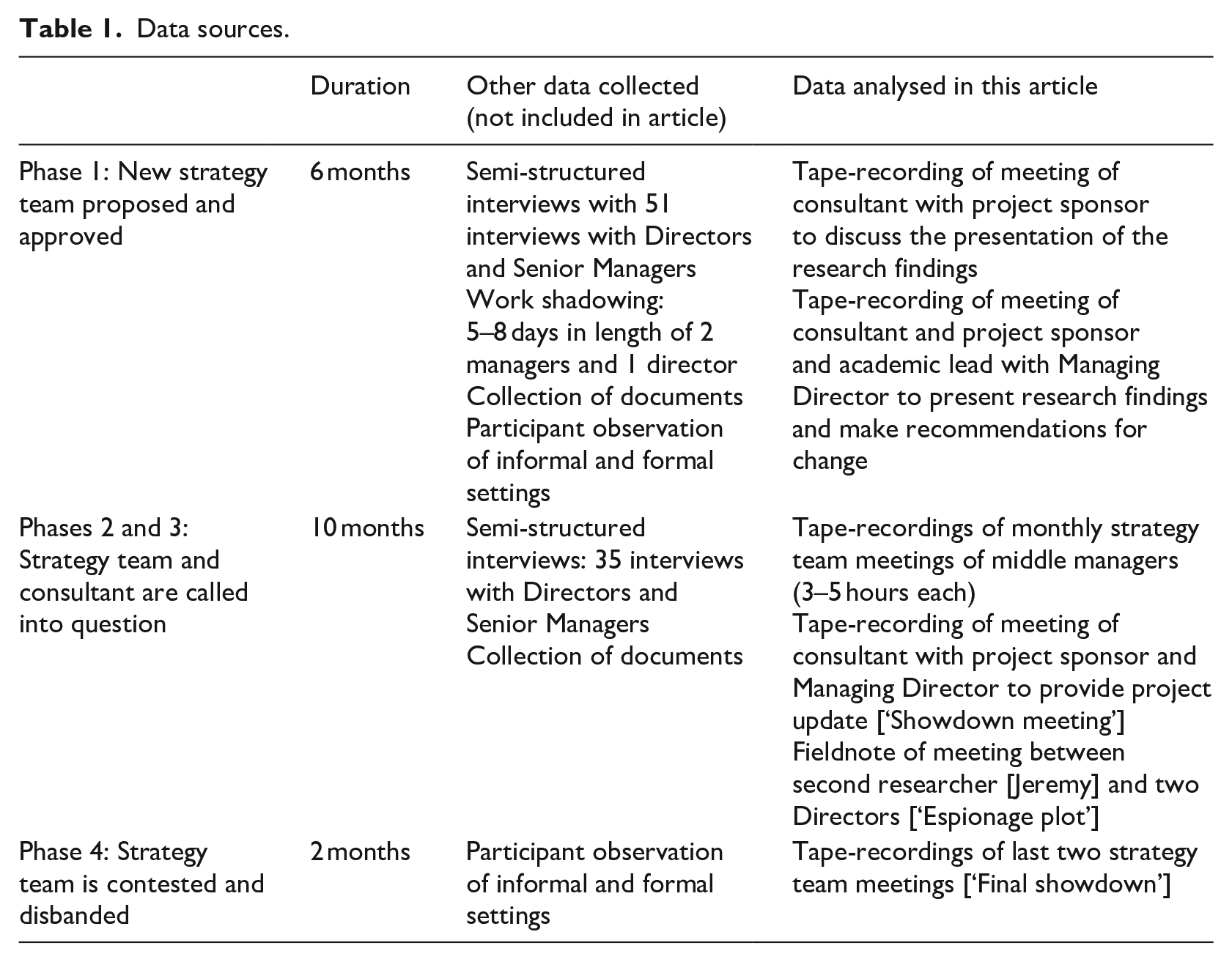
Table 2 provides a list of the names of the key actors involved in the project and their respective roles.
Key actors and roles.
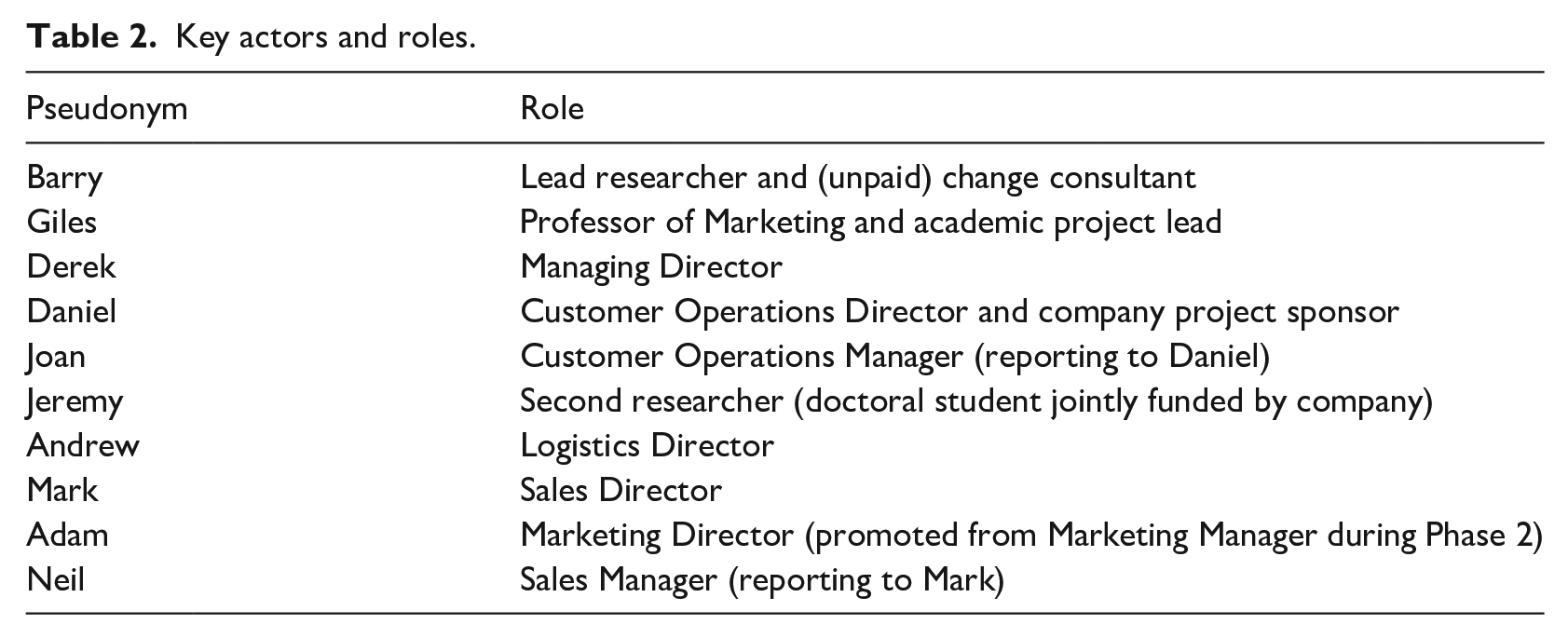
The research project arose from a conversation at an awards dinner between the Managing Director of FitCo UK, Derek (all names are pseudonyms), and the Dean of the Management School of a local university based in the same town. Both were keen to develop stronger links with each other, including links for student employment and placements as well as for research. On the company’s side, Derek asked Daniel, the Customer Operations Director, to identify a current business problem for the academics to research. Daniel suggested looking into the poor feedback from FitCo’s customer satisfaction surveys. On the academic side, the Dean of the Management School asked Giles, a Professor of Marketing, to lead the project and find a suitable researcher to conduct the study. Giles identified Barry, a mature doctoral student with previous senior management experience. Barry was positioned as an action researcher who would work as an unpaid consultant and lead the research project. 3 Barry’s brief from the company was to diagnose the issues underlying the poor customer feedback and make recommendations for change based on his findings.
Barry was given a dedicated desk at the FitCo UK office and spent 3 days a week in the company. He was given a network account for access to company documents, an internal email account and access to the staff directory. He was also given access to customer-facing documents relating to the four key account customers, including the customer satisfaction surveys for the past 6 years (each over 100 pages in total), market reports, minutes of meetings and emails. After analysing this data, Barry set up semi-structured interviews as part of a process of ‘illuminative evaluation’ (Parlett, 1981) with all the Directors and middle managers. Fifty-one interviews were conducted, each lasting between 40 and 60 minutes. Barry was also given permission to sit in middle-management meetings and took fieldnotes of his observations, sometimes contributing to the discussion but mainly just observing at this stage. He also selected three people who had customer-facing roles to arrange a series of ‘work shadowing’ observations. After 6 months in the company, Barry was asked to summarise his findings and report them back to the senior management team. It is here that our data analysis begins, when Barry drafted a PowerPoint presentation with a series of anonymised quotes from the interviews and arranged a meeting with Daniel, the project sponsor, and his team member Joan, to discuss how the findings should be presented to the Directors.
The methodological rationale for selecting specific sources of data for detailed analysis in this article (listed in the final column in Table 1) was twofold: first, they represented interactional moments when the change to the strategy arrangement (the introduction of a new cross-functional strategy team comprised middle managers) ‘hung in the balance’, and second, they represented an opportunity to understand the nature of the activity that took place backstage (where the target audience was absent) and frontstage (where the target audience was present). While this study began with an opportunistic meeting of interests between the company and the academics, post hoc the case study can be regarded as an opportunity for what Yin (2018) and Eisenhardt and Graebner (2007) refer to as ‘theoretical sampling’, where the data or cases are selected on the basis of their ability to test or illuminate a particular theory, in our case strategy as practice and the dramaturgical perspective. However, this can only be seen in retrospect and was not part of the original research design.
In relation to the dramaturgical perspective, we follow Jarzabkowski and Seidl (2008) in emphasising the methodological advantage of employing real-time observation and intensive fieldwork to capture both frontstage interactions (such as formal meetings and presentations) and also the backstage interactions (such as informal conversations while walking to meetings and the closed meetings where plans were made for future meetings). This level of insight into real-time activity is typically hard to ascertain from interviews, diaries or focus groups for two reasons: actors might be unable to recall in detail their backstage activities or they might seek to present a more socially acceptable version of what they did, a factor most pertinent to our discovery of the activity we termed ‘conspiring’. In this study, the backstage access was substantial because the author team also had access to fieldnotes and tape recordings of informal meetings collected by the consultant and second researcher.
This study is therefore ‘insider/outsider’ research because it combines both ‘insider’ and ‘outsider’ perspectives (Langley and Klag, 2019): Barry (the consultant) and Jeremy (the second researcher) are both authors on the paper who shared their fieldwork data and ‘insider’ perspective with the two other authors who were not present in the field and could give a more distanced ‘outsider’ perspective. Given this relatively rare access to the ‘backstage’ work of the consultant and second researcher, we can use this methodological advantage to further the research agenda set out by Balogun et al. (2014), namely building knowledge of how strategists go about the ‘backstage crafting of talk, in order to facilitate frontstage performances’ (p. 182).
Data analysis
The analysis of data for this article does not follow the traditional thematic coding structure used in qualitative studies, where data are inductively coded for emergent themes on a line-by-line basis and codes are progressively collected into more abstract second-order codes (Gioia, Corley, and Hamilton, 2013). As a qualitative process study, the data are structured into a narrative which traces events as they unfolded over time (Langley, 1999), something that ‘chunking’ data up into thematic codes taken out of their temporal context fails to capture (Berends and Deken, 2019: 2). This is especially relevant for the dramaturgical perspective, where the temporal dynamic is central not only to the actual sequences of events but also to the orientation of actors to future events when they are rehearsing and conspiring. According to Goffman (1969 13), stage management occurs when the actor ‘appreciates that his environment will create an impression on the observer, and so attempts to set the stage beforehand’. As such, the temporal context matters for the dramaturgical perspective in two senses: in relation to what does happen next and also what actors anticipate will happen next. Whether or not the anticipated reactions of the audience actually happen, our analysis of the backstage interactions reveal how foresight was used by actors to anticipate the contingencies of the performance. Analysing data from a dramaturgical perspective, therefore, requires a particular form of analysis that captures these two temporal elements: both the flow of events as they actually happened and the future events anticipated by the actors.
Our research question does not lead us to analyse all the activities of the various actors involved in the research project. Rather, it invites us to focus the analytic lens on those activities in which the feasibility and acceptability of the change to the strategy arrangement were at stake. Having the two researchers as co-authors of the article was an advantage here because they were able to pinpoint the moments where the existence of the new strategy team was at stake. We began by analysing the meeting of Barry with Daniel and Joan (see Table 2 for the list of pseudonyms and roles) where the ‘pitch’ for change was planned, and then analysed the meeting with Derek, where the ‘pitch’ was delivered and formal approval for setting up the new strategy team was then granted (Phase 1). We then skip forward in time to the first moment where the activity of the team was called into question and its viability hung in balance. Here, we analyse the team meetings where the team expanded their remit and also analyse an update meeting between Barry and Daniel with Derek, where the activity of the team was openly contested by Derek (Phase 2). Next, we analyse an interaction where two senior managers expressed their suspicion towards Barry’s change activity (Phase 3). In the final phase, we analyse the final two meetings of the team attended by the new Sales Director, who openly contested the existence of the team and ultimately arranged for it to be disbanded (Phase 4).
Our approach to analysing the interactions was grounded in Goffman’s (1990 [1959]) theory of life as a theatre and Mangham’s (1979) development of the dramaturgical perspective in relation to organisational life. To identify a stretch of interaction as ‘backstage’ we sought to identify the way in which the actors oriented towards an audience that was not present but whose reactions were being anticipated. One key marker for this discursive stance was when the actors put themselves ‘in the shoes’ of the audience, imagining their perspective or anticipating their reactions. This included identifying stretches of the interaction where the protagonists used ‘hypothetical reported speech’ (Koester, 2014), a type of speech act in which people refer to what they imagine they might say or their audience might say in a future situation (‘he’ll probably say. . .’. . ., ‘you could say. . .’. . ., ‘I might say.’. . ., and so on).
Our analysis of these backstage situations revealed that actors reported not only what they anticipated others might say but also what they might think or do. Analysing these situations also enabled us to identify the various roles that the actors adopted, as identified by Mangham (1979: 51): the actor preparing the show, the audience member watching the show, the playwright involved in writing the script, the director instructing the other actors and the critic when adopting the stance of the critical audience member. As such, we follow the approach to writing up qualitative process research described by Berends and Deken (2019: 5) as ‘conceptualised composition’, where concepts derived from theory are used to structure the narrative and emphasise the theoretical significance of the data. At the end of each phase of the change, we summarise the significance of the dramaturgical activity we identified.
The next stage of the analysis involved identifying how these backstage interactions could be differentiated according to their orientation to the audience, which we labelled as ‘rehearsing’ and ‘conspiring’. Rehearsing was characterised by the actors seeking to work ‘behind the scenes’ to practice and polish their performance, including expressing their concerns about the weaknesses of the actors and the dangers of their performance, with a view to anticipating and avoiding a failed performance. Conspiring operated ‘behind the backs’ of the audience in the sense that the actors needed to keep these activities hidden from the audience because they were involved in acts of fabrication or misrepresentation that acted against the perceived interests of the audience.
The narrative presented in this article deliberately ‘shines the spotlight’ on the activities of the two researchers, rather than viewing them as neutral vessels for the collection of data. Our approach treated ‘being there’ and ‘being involved’ as a source of analytic insight rather than a methodological problem (Langley and Klag, 2019). We directly address the reticence of qualitative researchers observed by Langley and Klag (2019: 516) towards revealing the nature of their involvement in data collection. Rather than making the researchers ‘disappear’, we make them visible and explicitly write from their perspective (ibid: 519). As a participant observation study, the two researchers were invited into the company to act as unpaid consultants to diagnose, recommend and implement improvements, meaning the research was ‘deliberately oriented toward intervention’ from the outset (Langley and Klag, 2019: 526).
The close involvement of the researcher in data collection has led some commentators to question the trustworthiness of the analysis out of fear that researcher involvement might ‘contaminate’ (Langley and Klag, 2019: 516) decisions about what data are collected and how it is interpreted. Rather than viewing the researchers’ close involvement as a problem that needs to be mitigated to avoid ‘bias’, we give the two researchers an ‘overt and transparent presence’ (Langley and Klag, 2019: 517) in the text and write the narrative from their perspective. For example, rather than claiming we can – or indeed should – eradicate the researchers’ interpretations, we focus explicitly on how the two researchers made judgements about the organisational actors they interacted with and the research/consultancy process. This is evident, for example, in our analysis during Phase 1 of the judgements made about what interview quotes to include in the presentation of findings.
We also ensure transparency by noting when data are derived from tape recordings of meetings, fieldnotes written shortly after the event or the researcher’s recollection of conversations in the absence of fieldnotes. In doing so, we are transparent about when the researchers’ own interpretations entered our analysis. For example, we are transparent about when the second researcher’s fieldnote showed that he interpreted a conversation with two senior managers in Phase 3 as being ‘blackmailed’ into acting as a ‘spy’, despite this exact phrase never being used in the conversation. This is consistent with our theoretical framework grounded in the dramaturgical perspective, because our claim is not that Jeremy was being asked to spy, but rather that Jeremy formed the impression that he was being blackmailed into spying. This transparency is important not only for ensuring faith in the validity of the analysis, or for displaying adequate reflexivity, but importantly also because these impressions are what actually mattered in practice. In other words, from the symbolic interactionist perspective informed by Goffman (1990 [1959]) that we adopt, it was these impressions that shaped the flow of the change activity we sought to study because they were consequential for what the actors took to be ‘real’ and, therefore, informed their next action.
Like Hodgkinson and Wright (2002), we reflect on the researcher’s (largely unsuccessful) attempt to introduce change, including detailed analysis of transcripts of interaction between the researchers and various organisational members and fieldnotes kept by the researchers. Similar to Gephart (1978), we analyse a situation where the researcher analyses social actions done not only by them and but also to them, including instances of ‘status degradation’ where their social status is questioned. However, we do not write in a first-person, auto-ethnographic style (see, for example, Hodgkinson and Wright, 2002; Whiteman and Cooper, 2011), because a broader team of authors were involved in the writing process.
Findings
Barry’s brief at the start of the research project was to diagnose the issues underlying the company’s poor feedback from the customer satisfaction surveys and make recommendations based on his findings. The surveys were completed annually by the four ‘key account’ retail customers. These retailers were important to the company because it did not have its own stores and around 90% of their sales were via these four big retailers. Each retailer had its own distinct position in the market. Some focused exclusively on sports and fitness clothing and equipment, while others were positioned more as casual fashionwear retailers. FitCo therefore needed distinct strategies of product lines, promotions and pricing for each of these customers.
Having been in the company for 6 months and collected data from interviews, observations, documents and work shadowing, Barry was asked to deliver the results of his research in a presentation to the Board of Directors. It is at this point that we start our in-depth analysis of the change to the strategy arrangement.
Phase 1: initiating change
The ‘dress rehearsal’
Before setting the date for the formal presentation of his research findings, Barry sent Daniel and Joan a copy of the presentation. The presentation contained a selection of anonymised quotes from the interviews that Barry had conducted with middle and senior managers. Some of the interview quotes extended beyond operational issues and voiced concerns about the lack of a coherent strategy for the key account customers and for the business overall. For example, one slide contained a particularly critical interview quote from a senior manager:
‘We need a strategy for individual accounts, let alone for our business in general’. (Presentation Side 2 – Interview quote from senior manager)
When Daniel saw the presentation, he contacted Barry and asked him to not distribute it and called a meeting to discuss the content.
At the meeting, Barry, Daniel and Joan discussed how Derek might react to the ‘bad news’ that the company’s own management thought the business was suffering as a result of lacking a clear strategic direction. Barry summarised his own impression of the scale of the problem as follows: ‘There is no business-to-business strategy in this business’. 4 The conversation moved to how Derek might react to this message. Putting themselves ‘in the shoes’ of Derek, they rehearsed how the presentation of the findings might play out. Daniel spoke of the need to avoid causing ‘undue offence’ in delivering the message and Joan mentioned the need to avoid appearing ‘confrontational’. Barry acknowledged their warnings, saying ‘I know he’s the boss and I have to be careful what I say’.
Barry then spoke about the political danger that Daniel was facing as the project sponsor if his presentation ‘ruffled feathers’. He told a story of how he previously tried to deliver strategic change but paid the ultimate price by losing his job. They then discussed the option of ‘diluting’ (Daniel) the findings to make them more palatable and less likely to cause offence. Daniel weighed up the dilemma they faced with this plan:
Because my take on this, as we’ve said before Barry, is that if we are utilising your vast experience and time and commitment so far, if we in any way attempted to dilute or dumb down your findings and your views then, sorry-
It won’t make any impact.
No. Exactly. So to go back to one of our very earlier conversations we might just as well have a go at this, you know if it subsequently gets killed and [they think] ‘that Barry, who doesn’t know what he’s talking about, did it, so he’s going to toe the line’. Well at least have a try and fail.
(Excerpt from meeting)
In the conversation reported above, Daniel and Barry rehearsed a scenario in which they produced a false impression by attempting to ‘dilute or dumb down’ (Daniel) the findings. Daniel concluded that diluting the findings – to make them less ‘confrontational’ (Daniel) and less likely to cause ‘offence’ (Joan) – would risk losing the ‘impact’ (Daniel) they wanted the research findings to have, namely to motivate the need for change. Daniel then rehearsed the alternative scenario, where they did not dilute the findings. When rehearsing this second scenario, he took up the role of ‘critic’ and anticipated the risk that the project would get ‘killed’ (Daniel) if the findings were delivered without any ‘filter’. He also took up the role of ‘playwright’ and prepared a script for himself with a scapegoat at the ready, using the excuse that Barry ‘doesn’t know what he’s talking about’ (Daniel). Weighing up the risk and reward of these two scenarios, they decided it would be better not to dilute the findings to maximise the chances of stimulating the changes to business they both deemed necessary.
As the meeting progressed, Daniel again put himself ‘in the shoes’ of Derek. He imagined the impression that Derek might form if he viewed the research project as a partisan project designed to further Daniel’s sectional agenda. Daniel shared his idea of how Barry could avoid giving off this undesired impression:
Put it this way Barry, if you turn – and you may well do this in your presentation. If you turn around and say ‘Actually Customer Operations is now the most dismal function of the business’ . . . My first reaction [as Managing Director] would not be to say ‘What the hell was I thinking about [i.e. hiring him]?’ My first reaction would be to say, ‘The guy’s got experience, he’s got credibility, he appears to approach this task in a genuine way. I may not like what I’m hearing, but, well, he could have a point’.
(Excerpt from meeting)
Daniel suggested that they should ensure that the PowerPoint presentation criticised the Customer Operations function ‘even-handedly’ alongside the other functions in order to create the impression that the findings of the project are ‘genuine’. Daniel took up the role of ‘director’ to teach Barry how to craft a false impression that would make his research appear neutral and objective, despite the fact that Barry did not have any research findings suggesting that ‘Customer Operations is the most dismal function of the business’.
The final issue they discussed was how Derek would perceive Barry’s credibility. Here, they specifically took up the role of ‘critic’. They anticipated that a critic might not take the research findings seriously if Barry was not seen as a ‘credible’ consultant. Daniel told Barry: ‘your credibility in this process is . . . key’. He started by reassuring Barry that their ‘critics’ would not be that brutal, reassuring Barry that his credibility was high because of his ‘experience and expertise and maturity’. However, he also added his concerns about their ‘show’ from the stance of other ‘critics’. He voiced his concern about the impression that senior management might form because the firm was not paying Barry for his work:
We’re not paying you for this. You’re not on a contract for this. You know . . . in terms of credibility.
(Excerpt from meeting)
Barry was left with the impression that the ‘credibility’ problem arising from not being ‘on a [paid] contract’ was the (undesired) impression that the firm did not value his work enough to pay him. Rather than leaving a good impression – representing a ‘good deal’ by offering his normally quite expensive consultancy services for free – Barry got the impression that Daniel was warning him that giving away his services for free would create the impression that his services were worthless. Barry reassured Daniel of his credibility by mentioning his previous experience as a consultant and senior manager, including experience with the global consultancy firm Cap Gemini. However, Barry did share his concerns about the impression that could be formed by Derek about his lack of experience in the sportswear or fashion industry:
Yeah, but in the end I’m a novice in this business. I’m not a shoe or an apparel marketing guy. Right. I don’t know.
But you’re an experienced business manager?
Yeah, well, you could say that.
Something we’re not necessarily over endowed with in our business.
(Excerpt from meeting)
In this interaction, Barry put forward a scenario where Derek might discredit him due to his lack of experience in their industry. Daniel’s foresight into the scenario was different. He reassured Barry that his expertise from being ‘an experienced business manager’, something he claimed was lacking in the firm, would be enough to give him credibility. Daniel made a further suggestion of how they could handle the ‘credibility problem’:
Maybe Barry the caveat for this, for you, is maybe me, you and Derek to have a conversation before that to say: ‘There is a nervousness around the content of the message’ and not go into details but in terms of ‘Derek, you know the nervousness here is that Barry might feel he’s going to get blown away and written off . . . as he knows bugger all about the sports trade’. Do you know what I’m saying?
Yes I do. . . . Well it might be if we could do something preliminary before I go on holiday. I mean, it might be that I could put something together.
I’m not, sorry, I’m not trying to pull forward the presentation I’m saying don’t talk about any of the detail, I’m saying talk about the principles that you know: ‘Derek, do you understand it? You know in this fact I’m going to be honest and playback what I’m hearing and what I’m seeing’. There is going to be criticisms of all the people round the Boardroom table, eventually. Both collectively and individually. Now if there’s a lack of appetite to hear that message then I need to understand that now so I don’t put a huge amount of work into building something that is going to get just simply blown away.
(Excerpt from meeting)
In this interaction, Daniel suggested that they could make Derek aware of their concerns before the findings were formally presented to the board by arranging an ‘informal update’ (to use Barry’s term) with Derek where they would share their concerns about Barry being ‘blown away’. The aim was to recruit Derek into their team in order to get his advice on how to avoid being ‘blown away’ and ‘written off’ (Daniel) by the board of directors.
Barry agreed to schedule the meeting with Derek and also suggested that he should bring along Giles, the Marketing Professor who instigated the project. Daniel agreed that it was a good idea to test out Derek’s reaction before any formal presentation to the Board. He used foresight to imagine how the board members might react to seeing their interview quotes displayed in public, even though they were anonymised:
I think if you did it to the wider Board of Directors you would have a real problem because people would get very defensive and. . .
. . .
Oh especially in terms of the Board this would put you in a deeply political position yourself.
(Excerpt from meeting)
Barry and Daniel agreed a plan: Barry would produce a second draft of his PowerPoint slides, ‘toning down’ and ‘evening out’ the criticism of the company. Daniel and Barry would then arrange a private meeting with Derek to test his reaction to the ‘bad news’.
The ‘show’: pitching change to the Managing Director
Barry, Daniel and Giles sat in Derek’s office and Barry loaded up the PowerPoint slides onto a laptop screen. Barry said little as the slides were displayed, leaving time for Derek to process the information. In the conversation that followed, Derek acknowledged that the lack of a coherent strategy for their key account customers was a problem. He attributed the cause of the problem to a range of factors, including political in-fighting at Director level and the constant pressure to meet short-term sales targets set by the US headquarters. It was only towards the end of the meeting that Barry started to ‘pitch’ his recommendation for change:
It was very clear when I started to talk [to the middle managers] about key account plans . . . [that] there should be a totally cross functional team at some level, that actually designs a strategy together as a team an integrated strategic approach to that account.
Yeah.
That it’s something they develop and agree with the Board [which would say] ‘that’s the plan at [Customer A]. And we as a group . . . cross functionally designed that together’. It’s an integrated approach.
(Excerpt from meeting)
Barry proposed that he could set up a new cross-functional team of middle managers to formulate coherent strategies for each of the four key accounts. He offered to lead the new team as a consultant on a pro bono basis if he was allowed to use the opportunity to collect data for his doctoral research. The issue of Barry’s credibility was never raised, despite their previous fears about this. Much to their surprise, Derek seemed open to the proposal. Derek asked Barry to draw up a one-page proposal summarising the remit and objectives of the new strategy team and run it past the Sales Director and Customer Operations Director before being signed off by him. Once approved, Derek instructed his personal assistant (PA) to email all the functional managers that had been selected to form the new team. The formal presentation of the research findings to the whole board now seemed unnecessary given the Director’s ‘green light’.
The ‘pitch’ for change had worked. Barry had been given permission to implement a quite radical change to FitCo’s strategy arrangement. This was the first time that middle managers had been given this degree of strategic control of the key accounts and also the first time a cross-functional team had been formally involved in key account strategies, which had previously been controlled mainly by the Sales function.
To summarise, in this first phase of the change project we observed four forms of dramaturgical work involved in initiating the change to FitCo’s strategy arrangement. The first practice was the practice of backstage rehearsal. In this meeting, the consultant and project sponsor took the perspective of future imagined audiences to anticipate their reactions and use this foresight to design their script. A shift in roles was also observed: the consultant shifted between the roles of actor, playwright and critic and the project sponsor shifted between the roles of playwright, director and critic. The two change agents also arranged another rehearsal in the form of an ‘informal update’ with the Managing Director, which positioned the Managing Director as both an audience for the show and a team member who would help to design the show.
The second dramaturgical practice observed during this initial phase was the practice of backstage conspiring, when the consultant and project sponsor discussed whether to dilute the consultant’s research findings to make them more politically palatable and when the change agents conspired to feign impartiality in the presentation of the research findings. The third dramaturgical practice involved the planning of future rehearsals. In dramaturgical terms, the actors did not yet feel confident that the ‘show’ was ready for its audience (the board of directors) and felt another rehearsal was needed, this time with an audience member (the Managing Director) invited into the backstage in the hope of gaining foresight into the board’s likely reactions. Derek was recruited into their ‘team’ to help them anticipate the reactions of the board and design a show that would counter these negative reactions. In dramaturgical terms, Derek was now positioned in two roles: both as a frontstage audience for their presentation of the research findings and as a member of the backstage team preparing for another future audience. Daniel also took up two dramaturgical roles: the role of ‘playwright’ and ‘director’ who suggested a script for Barry to use when confessing his concerns to Derek. The fourth and final dramaturgical practice observed was the frontstage performance itself, where the consultant, project sponsor and academic lead presented the research findings to the Managing Director and ‘pulled off’ the desired impression and secured his approval to change the organisation’s strategy arrangement.
Phase 2: the new strategy team begins their work
The new strategy team began to meet monthly in the company boardroom: a poignant symbol of their new status as strategists, which was not lost on the middle managers themselves. After establishing their ‘charter’ which set out the group’s remit and roles, the team began formulating strategies for each of the four key account customers.
A few months later, the company announced it was about to launch a new brand called Red (a pseudonym). Red was a more ‘edgy’ music and fashion oriented sub-brand aimed at the youth market. Red was about to be launched worldwide with high-profile American celebrity endorsers, including basketball players and hip-hop music artists. A lot was riding on Red to revive the fortunes of the flagging FitCo brand. The team developed the idea of using the Red launch as an opportunity to carve out a more exclusive high-end brand position and ending the chase for sales volume across low-margin discount-driven retailers.
At this point, the change to the strategy arrangement – their cross-functional strategy team comprising middle managers – had begun to develop a new strategy for the UK business: namely, shifting the company towards a more exclusive high-margin brand position at the expense of sales volume. Some members of the team voiced their concerns about how their plans for Red would be perceived by the senior management. Patrick (Sales Manager, Apparel) voiced doubts about whether they would be permitted to make such a radical change in strategy, putting himself ‘in the shoes’ of the Directors and asking ‘Do you think they [the Directors] are going to let us do this with Red?’ Others voiced their reservations about the political repercussions of their ambitious plan. The kinds of strategic decisions they were making about the brand launch were normally reserved for the board and their superiors in the US headquarters. Barry encouraged the team to have the courage of their convictions. He adopted the dramaturgical roles of ‘playwright’ and ‘director’ and gave the team a script of what to say to their superiors:
With the board, we need to be saying to them: ‘This is what we are doing as a group in the immediate term’. Derek has to have backing for this and back it blind.
(Excerpt from meeting)
At the end of the meeting, Barry invited Adam, the Marketing Manager, to draft a document to summarise the team’s view of the company’s strategic problems for him to present to Derek at his next project update meeting. Adam agreed, on the condition that the whole team backed him up, given the risk he was taking if it backfired. Adam drafted a two-page document entitled ‘Looking the Facts in the Face’. As the name suggests, the contents were quite damning of the company. Some selected comments included: FitCo brand • dull and in deep trouble • a weakening no3 in the market • a dead brand with youth • seriously ill with women • recent history of ‘poor’ footwear product • stagnant apparel product line (Excerpt from document)
Barry felt that some editing was required to make the document more palatable. He drafted his own ‘watered down’ version into three PowerPoint slides, adding in some more quotes from his latest tranche of interviews to bolster the message. He also discussed it again with Daniel, who also made some further edits before it was sent off to Derek.
The ‘showdown’ meeting
Barry and Daniel met Derek a few weeks later to present him with the Looking the Facts in the Face presentation. It was soon apparent, however, that Derek had concerns about the new strategy team’s activity. At this moment, Barry had no foresight regarding Derek’s concerns and he was taken by surprise. Derek started by outlining his concerns about the team’s activity.
I’m comfortable with that [the strategy process]. I’m more uncomfortable with the maturities of our people in understanding what this process is, which is of more concern. Because I don’t want you doing our job.
No, absolutely, yes.
(Excerpt from meeting)
Derek went on to explain what he meant when he said that the middle managers lacked the ‘maturity’ to understand the wider strategic context. This included the pressures from the U.S. headquarters to achieve high sales volume, which would have been undermined by their plans for an exclusive launch strategy for Red. He made it clear that the new strategy arrangement had extended its strategic decision-making remit too far, explaining that he did not want the middle managers ‘doing our job’. Derek described his other concerns about the team’s work on the Red launch specifically.
Because what I heard from the Red thing . . ., you know, it’s like you’re leading the Red project?
Eh?
Yes, whatever it was, for me, it just puts up a red flag for me. By saying ‘what the hell are we doing here?’ . . .
Yes, I mean I facilitated that instruction, but I didn’t make any suggestions.
That’s why I’ve got concerns about the maturity of the group to understand. You’ll still have a lot of people with their own agendas.
(Excerpt from meeting)
Derek used the term ‘red flag’ to signal his warning that Barry and his new team had crossed the line. Barry only now realised that the impression of a transgression had been generated by the team, something he had not anticipated. Barry tried to repair the situation, first distancing himself from the transgression by claiming to only have ‘facilitated’ the team. During the exchange, Daniel asked some questions and mainly presented himself as an innocent bystander, unaware of what the team had been planning.
Derek then spoke about wanting to set up tighter ‘policing’ of the team. Tempers were clearly frayed and Derek started shouting, cursing the middle managers:
. . . this is where I get really angry; they’ve got to grow up and understand they’re all part of a team. I’m losing it a bit now because, maybe I do have to go down there and shout this out to them!
(Excerpt from meeting)
Barry sought to restore a positive impression of the team by defending the middle managers and talking about the value of the work they were doing. He issued Derek with a stark warning about the dangers of failing to embrace change, saying ‘unless some serious action is taken, the situation [for FitCo] is terminal’. He pleaded with Derek to give the team the power they needed to address the problem, including ‘influence over your resource allocation decisions’. Derek eventually agreed that the team could continue but only if they were subject to closer monitoring and provided regular updates to the board about their plans.
To summarise, in this second phase of the project we found evidence of two dramaturgical practices. First, the team engaged in backstage rehearsal when they crafted a document for senior management and took the perspective of the Directors to anticipate their reactions. The consultant was also observed to shift between the roles of playwright and director. Second, the practice of frontstage repair was observed when the consultant sought to repair the desired impression of the team in the face of criticism by the Managing Director. This dramaturgical work was consequential for FitCo’s strategy arrangement insofar as the consultant succeeded in convincing the Managing Director to keep the team going, albeit with a more restricted remit and tighter ‘policing’, meaning the new practitioners (middle managers) and new practice (cross-functional teamwork) remained in place, for the time being at least.
Phase 3: senior managers become suspicious
A few months into the change project, FitCo had agreed with the local university to set up a second research project and jointly fund a doctoral studentship to recruit a researcher onto the project. The company hired Jeremy, who was also a mature student with extensive industry experience. Jeremy’s brief was to examine the customer-facing parts of the business and make recommendations for business improvements. He worked closely with Barry and was a member of the new strategy team. Shortly after the ‘showdown’ with Derek, Jeremy was called to a meeting with Daniel, his direct report Joan, and Andrew, the Logistics Director. Daniel and Andrew described their concerns about what Barry was doing, as Jeremy noted later that evening in his fieldnote diary:
When Daniel took his seat, nearest me, he quietly thanked me for my time and suggested he wanted to use this meeting as a means of ‘catching up with the progress you and Barry are making with the [strategy team]’. He continued by saying he had been a little concerned as to not knowing what Barry was ‘plotting and planning’ with the team and the plans for the key accounts. Daniel: The trouble is, Jeremy, as am sure you understand, with Barry not being ‘on the books’ so to speak and doing this work for free effectively, it’s kinda tricky for us to manage him. So, that’s sort of what we’d like to talk to you about today. I got a little nervous and asked him what he wanted to discuss. Daniel: Well perhaps you could bring us up to speed on what’s been happening with the team? We just feel he is making some significant changes to the structure of our business, and well, we just need to know what’s happening, you understand. He then went on to reiterate what I took later to be a warning shot: Daniel: As you know, we really want to be able to help you with your part of the project and the access which you need for the PhD, and so, we’d sort of therefore be really grateful if you could do us a favour and keep an eye on Barry and report back to Joan. I replied by agreeing that I would be only too happy to help with this, and then went to describe the work Barry and I had been doing with the team. . . . After five or so minutes, Daniel stopped me, put his hand up, and said: Daniel: OK, OK, that’s good to hear. It’s just that we were getting a little nervous of the speed of the changes he has been planning and incorporating, so if we are kinda on the same page, it would be great if we could rely on you to be the link between us as a senior management team, and Barry and his work with our middle managers on the project. I said sure, no problem, I’d be happy to help out. The meeting finished with Joan thanking me again for the time, and then she ushered me through the glass door of Daniel’s office and back to the Operations Department where I had a desk assigned. (Fieldnote written by Jeremy, quotations based on same-day personal recollection [Not tape-recording])
After this conversation, Jeremy formed the impression that Barry had lost the trust of the directors, who was suspected of planning ‘significant changes to the structure of our business’ 5 without their knowledge or approval. Jeremy concluded that undertaking the consultancy work pro bono had apparently not caused the unfavourable impression that Barry had feared in Phase 1 (namely, the impression that his labour was not valued by the company). Rather, Barry being not ‘on the books’ (i.e. on the payroll as an employee or contractor) seemed to have left the two Directors with the impression that he was harder to ‘manage’.
Jeremy gathered the impression that providing regular updates on ‘what Barry is up to’ effectively meant he was being asked to ‘spy’ on Barry. He also got the impression that Daniel was no longer on Barry’s ‘team’, having shifted from being a fellow change advocate towards now seemingly controlling Barry’s change activities. Jeremy also formed the impression that Andrew’s comment about the ‘access which you need for the PhD’ meant he was being blackmailed along the lines of ‘work as our mole or we’ll cut off your company access’. In this interaction, Jeremy assumed that the Directors thought that Barry would provide a false ‘front’ if they asked him for updates directly, so they wanted to use Jeremy as a kind of ‘mole’ to gain access to Barry’s ‘back region’. Although Jeremy had agreed to their request, later that evening he met Barry for a pint after work and told him what had happened. 6 Jeremy warned Barry about Andrew and Daniel’s plot to set up a ‘mole’ to spy on him but assured Barry that his loyalty was with him and not the Directors. He promised to only give the appearance of compliance with the ‘espionage’ plot.
To summarise, in this event we observed two acts of backstage conspiring triggered by the strategy team and consultant making unsanctioned changes to FitCo’s strategy and structure. Two different backstages were in concurrent operation across the two distinct ‘teams’: while the Directors were ostensibly under the impression that they had a loyal ‘mole’ who would give them access to Barry’s backstage secrets, at the same time, Barry was ostensibly under the impression that Jeremy was really on his team. Jeremy, as a ‘double agent’, now had to simultaneously sustain two impressions of loyalty. Thus, a complex network of dramaturgical frontstages and backstages had been constructed. Jeremy had to sustain a false impression that the two Directors had secured access to Barry’s backstage activities. Jeremy also had to sustain the impression to Barry that he was only feigning a performance of loyalty to the two Directors, having pledged his allegiance to Barry behind their backs.
Phase 4: the strategy team is disbanded
The final ‘showdown’
The new strategy team continued to meet monthly. Barry told them about the concerns the Directors had about their strategy work. With a greater sense of caution, the team continued with their work on the four key account plans. Shortly before their eighth team meeting, a new Sales Director called Mark, had just joined the business. Unbeknown to Barry, Mark had been asked by the project champion, Daniel, to attend the next meeting of the strategy team. When he walked into the room, Barry did not know who Mark was. He also had no foresight about his opinion of the strategy team. Barry started by giving Mark some background about the work the team had been doing. He then asked Mark:
So, are you fully on board, Mark?
(flat tone) I started yesterday.
(Excerpt from meeting)
Mark’s flat tone and noncommittal response was to be a sign of things to come. Barry continued his ‘sales pitch’ about the value of the new strategy team, emphasising the way the team had improved the previously fragmented approach to key account strategy. Barry’s next move was to speak, somewhat presumptuously as it turned out, about Mark’s role as a member of the new strategy team:
Within FitCo, looking from an external point of view, as I can do, the functions . . . were more fragmented than I’ve seen in other organizations. . . . You know, there’s all these little departments and not – the totality. . . . But that’s sort of come together of course with me and this team.
(Excerpt from meeting)
Barry had been under the impression that Mark’s presence in the room that day indicated not only his sanctioning of the team but also his desire to participate. However, Barry was soon to understand that both assumptions were misplaced. Prior to Mark’s unexpected attendance at the meeting, Barry had had no opportunity for any private backstage conversations with Mark to find out his opinion or any opportunity to practice his ‘sales pitch’ with the project sponsor.
As the meeting progressed, Mark began to question the way the team operated cross-functionally through the account servicing teams (ASTs) they had created. The ASTs were made up of lower level staff who performed all the marketing, sales, logistics and customer operations activities relating to that customer. At this point, Mark spoke up.
Does anyone lead these groups?
No, there’s nobody. I haven’t said ‘You’re the Chairman’. Or Sales should chair it. Or Trade Marketing should chair it or anything like that. . . .
Because . . . it questions who owns the relationship [with the key account customer] and . . . you know I always will say ‘the account manager of sales’ would be my view.
(Excerpt from meeting)
Mark’s opinion that the sales manager should be the only person who formally ‘owns the relationship’ (Mark) with the customer was a direct challenge to the team’s original ‘charter’ to formulate key account strategies cross-functionally. Barry explained to Mark the team’s opposing viewpoint:
Well actually that’s an interesting point there because, as far as the group are concerned, nobody has a relationship with a customer. . . . So if you asked me who owned the account I’d say this group.
(Excerpt from meeting)
As the meeting progressed further, Mark also took issues with the fact that the team comprised middle managers who were formulating rather than just implementing these strategies:
But this is an implementation group, isn’t it?
But this group – and I think Mark’s making a good point, is that this is an implementation group you’re quite right. So anything in here that tends to make it look more strategic isn’t intentional so we should take it out.
(Excerpt from meeting)
Barry had performed a remarkable rhetorical U-turn. From the start of the project, Barry had framed the team as a ‘strategy team’. Up against Mark’s criticism, he had backtracked and reframed the group as merely ‘an implementation group’, offering to edit the Key Account Plans to remove any unintentional reference to ‘strategic’ issues.
The team is dismantled
Two months later, having worked in the company for 18 months, Barry’s consultancy work was coming to an end. He had collected enough data for his research purposes and was preparing to return to the university to write up his thesis. He invited Mark to the next team meeting to discuss who would lead the team after his departure.
At this moment, Barry was not sure about what Mark’s opinion on the team’s future might be. Barry also had no knowledge of the possible manoeuvring going on behind his back that was invisible to him. Barry also had not arranged any backstage conversations prior to the meeting and he walked into the meeting without any prepared script. From his perspective, the stakes were at this stage quite low, having completed his data collection and being ready to exit the company.
Barry started the meeting by proposing that Mark should act as the team’s chairperson from now on. Mark did not take up the offer. Rather, he argued that the team was duplicating what was now happening at Director level. In response to this criticism, Barry tried to restore a positive impression of his consultancy work by giving the credit for this shift at Director level to the work done by the team:
If this group becomes defunct because the directors are starting to do what we said they should do, that’s great, that’s game won. . . . The whole point to this whole exercise was to get the directors to work cross-functionally, to be quite honest. Now, if we are starting to achieve that, that’s ace, that’s great.
(Excerpt from meeting)
The team had just been talked out of existence. Barry framed the conversation as an agreement, making suggestions about who should be invited to the weekly Director’s commercial meeting to ensure it was fully cross-functional and suggesting items for the group’s standing agenda.
A few weeks later, after Barry had left the company, Mark drew up a PowerPoint slide showing the new organisational structure. The team had been formally disbanded, even though some practices of closer cross-functional coordination remained. The strategy arrangement was back to how it used to be, with strategic decisions in the hands of the Directors and an implementation group below them. The change project had therefore concluded with a mixed outcome: while the new practitioners did not remain (the middle manager team was formally disbanded), nevertheless some elements of the new practice were retained (namely, a more cross-functional approach to formulating key account strategies).
To summarise, in this final phase of the project we observed dramaturgical practices when the consultant engaging in attempts to repair the impression of the value of the new strategy team, attempts which ultimately failed. Moreover, it was noteworthy that the consultant did not engage in backstage rehearsing or conspiring during this phase. The consultant also failed to exercise foresight in anticipating the reaction of the Sales Director. In dramaturgical terms, then, because Barry had no foresight into the audience’s reaction and he also had no opportunity to engage in backstage rehearsal. In this final phase, it was the absence of backstage work by the change agent and the failure of frontstage repair work that was associated with the final change to the strategy arrangement, when the new strategy team was disbanded.
Discussion
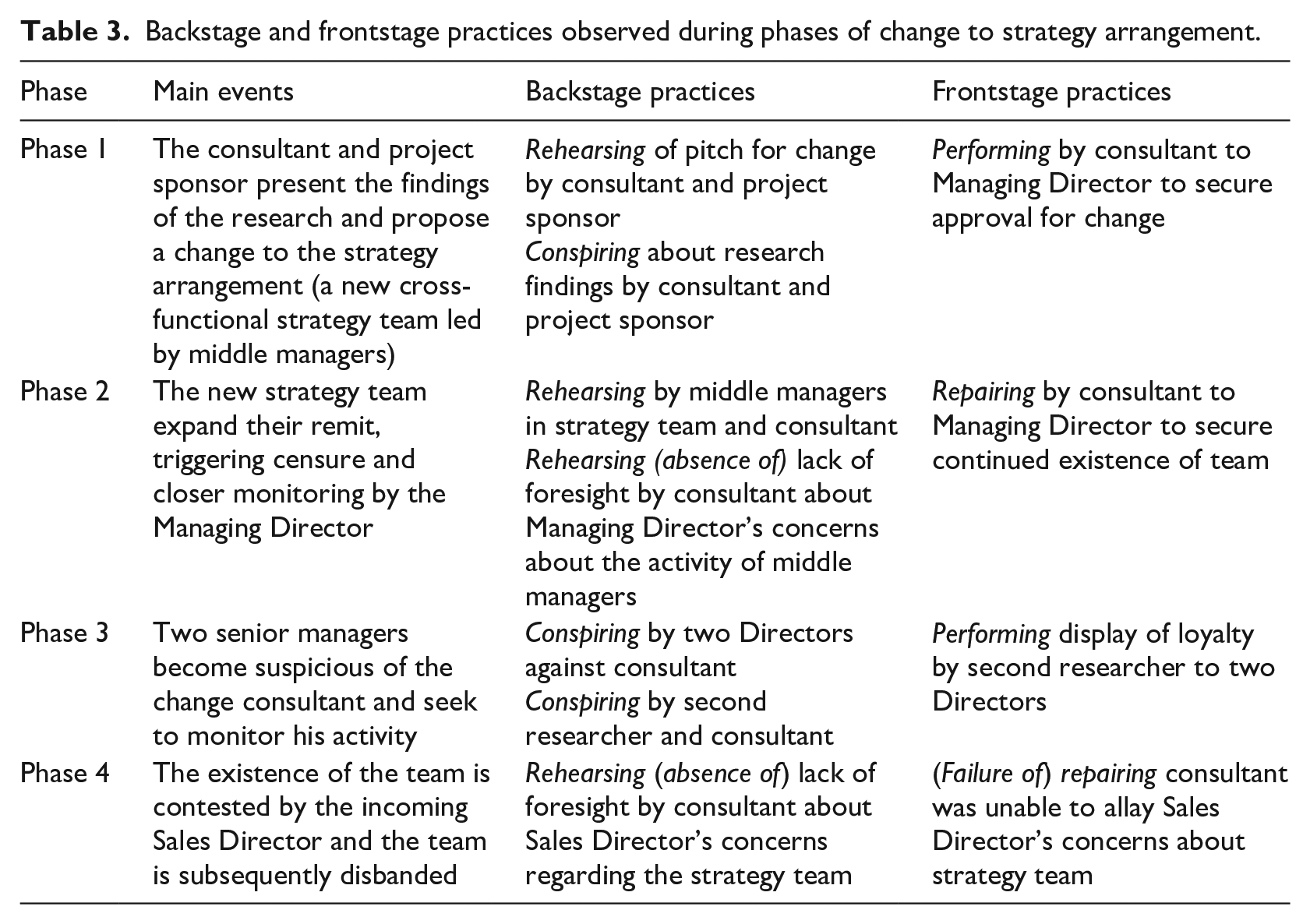
This study has traced the activities that led to a new strategy arrangement being introduced, then contested and later abandoned by an organisation. Our ethnographic narrative has shown how change agents and their fellow protagonists, critics and opponents engaged in a series of backstage and frontstage interactions through which the new strategy arrangement was first proposed (Phase 1), then later questioned and contested (Phases 2 and 3) and ultimately abandoned (Phase 4). Table 3 gives an overview of the backstage and frontstage practices that we identified during the four phases of the change project. Figure 1 also gives a visual schema depicting the relationship between the backstage activities of rehearsing and conspiring and the frontstage activities of performing and repairing that together, we propose, constitute the practice of ‘stage-craft’.
Backstage and frontstage practices observed during phases of change to strategy arrangement.
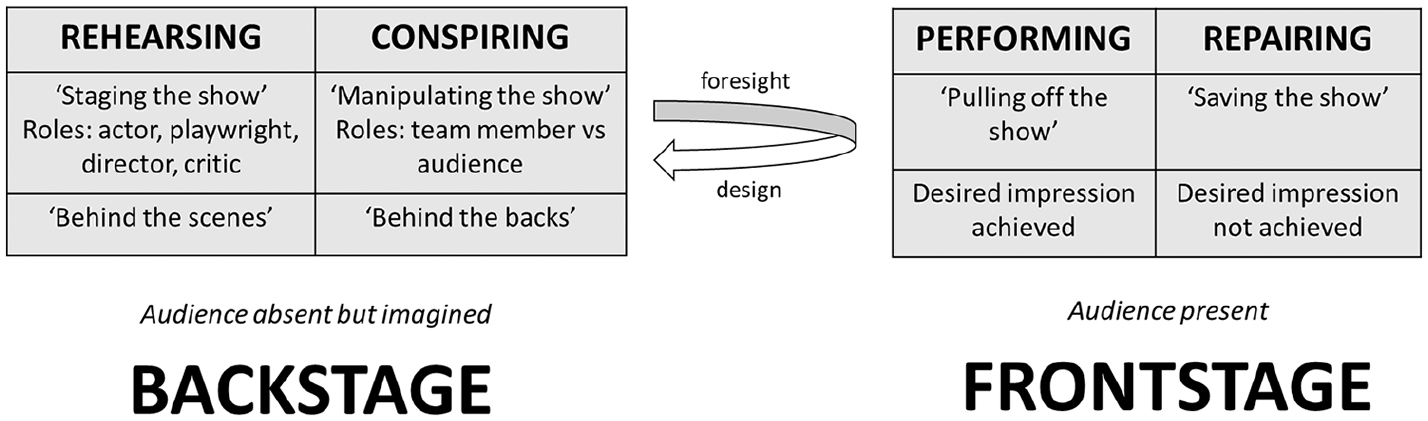
The art of stage-craft.
Our study has identified the backstage activity that took place to ‘rehearse’ the show by anticipating the reactions of the audience and using this foresight to rehearse scenarios that could play out on the frontstage in order to design a performance to ‘pull off’ the desired impression. In these rehearsals, the actors shifted between the role of actor and the role of playwright, director and critic, namely by writing the script, directing others and anticipating the views of potential critics. We propose that we can conceptualise these rehearsal activities as preventive practices (Goffman, 1990 [1959]: 24) designed to ‘stage the show’, as shown in Figure 1. In situations where actors meet sceptical or critical audiences, we can conceptualise the activities as corrective practices (Goffman, 1990 [1959]: 24) designed to repair the impression and ‘save the show’, as shown in Figure 1.
Our study has shown that the backstage is not only a place where the ‘public face’ is relaxed, it is also where the art of ‘stage-craft’ (Goffman, 1990 [1959]: 26) takes place: the calculative preparation that an individual or team undertakes to anticipate the reaction of the audience and control their performance in order to generate the desired impression. Unlike in theatre, where rehearsal typically involves the practicing and polishing of an existing script, our study has shown that the rehearsal is the place where the script itself is written. These practices of script-writing are grounded in the actor’s imagined thoughts and reactions of the future audience. The art of stage-craft, therefore, incorporates not only what the audience actually has said, but also what the actor anticipates the audience will say, when they put themselves ‘in their shoes’.
Figure 1 differentiates between the more innocuous backstage activity in which rehearsing took place ‘behind the scenes’ and the less innocuous and more political backstage activity where conspiring took place ‘behind the backs’ of the audience to manipulate the impressions they form. Our findings suggest that a conceptual distinction needs to be made between performances that (more innocuously) put on the ‘best’ show and those which (less innocuously) put on a ‘false’ show. Acts of rehearsing must remain hidden from the audience to ensure the actor’s attempts at managing impressions are not exposed. The ‘magic’ of the show can easily be lost when the audience can see the ‘moves’ that went into its design. Trust can also be lost if the backstage rehearsal contains contradictions to the ‘front’ being staged. Having a rehearsal exposed might lead to ‘secrets of imperfection’ (Ringel, 2019: 709) being revealed: for example, in our case the confession by the consultant of ‘knowing bugger all about the sports trade’.
The risks of backstage conspiring being revealed to an audience are of a different nature altogether though. The audience would not only see the unpolished ‘show’ being rehearsed and the public ‘face’ being relaxed, they would also see the ‘tricks of the trade’ being used to manipulate them. These are not just ‘secrets of imperfection’ (Ringel, 2019: 708), they are the ‘dark secrets’ (Goffman, 1990 [1959]: 141) that comprise what the audience could view as breaches of social norms or ethical standards. These breaches include not only clear-cut cases of ‘dark secrets’, such as bribery and corruption, but also any activity that deviates from accepted standards of proper conduct. If these acts of conspiring were revealed, the show would not only lose its ‘magic’, it would be revealed for the ‘con trick’ that it is. For acts of conspiring to function – that is, for them to ‘pull off’ the desired impression – requires them to remain ‘behind the backs’ of those they intend to deceive.
In our study, acts of conspiring were observed both from the change proponents as well as sceptics and opponents. At the start of the project (Phase 1), the change proponents discussed conspiring to generate false impressions that they thought would facilitate the change by ‘diluting’ the research findings and feigning impartiality by presenting an ‘even-handed’ critique of the company. Later in the project (Phase 3), as the activity of the team began to ‘ruffle feathers’, change sceptics and opponents conspired against the consultant to more closely monitor his activity, which was interpreted by the second researcher as being asked to ‘spy’. Their ‘spy’ also himself engaged in a double conspiracy, playing an elaborate game of frontstage feigning of loyalty to the two directors while maintaining a backstage betrayal of loyalty. Our study has therefore shown that the political dynamics of changes to strategy arrangements involve acts of backstage conspiracy by change proponents and also change sceptics and opponents.
To summarise the wider analytical implications of our study, then, we propose that the dynamics of change to an organisation’s strategy arrangement can be conceptualised as a series of backstage and frontstage interactions shaped by the skills of practitioners in the art of ‘stage-craft’. Our study has revealed how these dramaturgical dynamics underpinned the change in the strategy arrangement (see Table 3). The initial change to the strategy arrangement was accomplished through a combination of backstage and frontstage activities by the change proponents (Phase 1), which later came up against frontstage and backstage activities of sceptics and opponents of the new strategy team (Phases 2 and 3), and which finally was abandoned in the absence of sufficient backstage foresight and preparation and sufficient frontstage repair to ensure the continued existence of the team (Phase 4).
Finally, our study has also shown that ‘front’ and ‘back’ are not analytical labels that can be attached to a physical or virtual space, such as a coffee break room or online group forum. For example, in our study, an ‘informal update’ meeting with the Managing Director held in his office was oriented to as both a frontstage audience for presenting the research findings and also as a backstage rehearsal of a more formal presentation to the board of directors. Our analysis has also shown that different dramaturgical role identities can be ascribed to the same person in the same interaction. For example, the Managing Director was oriented to as both an audience for their presentation of research findings and as a team member when he was asked to help the team prepare for the formal presentation to the board of directors. As such, we would propose that any space can contain both frontstage and backstage elements. By adopting a backstage ‘style’ or ‘stance’, any region can be transformed into a backstage (Goffman, 1990 [1959]: 130). We would also propose that the role identities of actors can also be conceptualised as stances taken towards the self and others, stances which might shift as the interaction unfolds (Goffman, 1990 [1959]: Ch 2).
To sum up the discussion of our findings, then, our study has sought to develop the dramaturgical theory of practice in three ways. First, we have distinguished between the preventive practices used on the backstage to ‘stage the show’ and the corrective practices used on the frontstage to ‘save the show’. Second, we have distinguished between the more innocuous backstage practice of rehearsing ‘behind the scenes’, where scripts are written and characters are polished as the protagonists shift between the roles of actor, playwright, director and critic, and the less innocuous practice of conspiring ‘behind the backs’ of the audience, where audiences are manipulated and ‘false’ impressions are created. Third and finally, we have sought to move beyond the commonplace understanding of frontstage and backstage as physical spaces, and the understanding of audience and actor as fixed roles, by showing how the different ‘regions’ and ‘role identities’ are adopted as stances within conversations.
Conclusion
Strategy-as-practice research has made considerable progress in understanding the three central components of strategising: praxis, practices and practitioners (Whittington, 2006: 619). However, we still know little about how changes occur in the collection of practices and practitioners used in strategising – what we have termed the ‘strategy arrangement’. In a world in which there exists a diversity of available practices, a polyphony of voices seeking to claim to speak about strategy and a plethora of actors producing strategy discourse (Vaara and Whittington, 2012; Whittington, 2003, 2019), organisations face a very practical problem of deciding who should be involved and what practices they should use. By tracing the work of a consultant and fellow change agents through four phases of a change project, starting with when a new strategy team was introduced, then contested and later disbanded, we have sought to develop our understanding of the nature of the dramaturgical practices involved in changing strategy arrangements.
How, then, is the dramaturgical work of stage-craft connected to the process of changing strategy arrangements? A process study such as this does not seek to establish a causal relationship, for example by claiming that a particular dramaturgical practice causes a change to an organisation’s strategy arrangement to be accepted or rejected, given the range of factors undoubtedly influencing senior management judgement. What our study does reveal, however, is evidence of the practical judgement involved in dramaturgical foresight and the practical skill involved in dramaturgical design involved in facilitating a change to the organisation’s strategy arrangement. We have shown that changes to an organisation’s strategy arrangement which are perceived as politically sensitive or in some way problematic in the eyes of senior management trigger acts of ‘dramaturgical circumspection’, to use Goffman’s (1990 [1959]) term, where actors prepare in advance for ‘how best to stage a show’ and anticipate the ‘likely contingencies’ of the performance (Goffman, 1990 [1959]: 212).
Dramaturgical work is, of course, a pervasive feature of social life. It would be hard to imagine an organisational setting that is completely devoid of all forms of rehearsal and conspiring (Mangham, 1979). However, to extrapolate a point of more general relevance beyond our case, we would argue that periods of change to an organisation’s strategy arrangement heighten the intensity and significance of dramaturgical work. To be clear, our argument is not that all changes to a strategy arrangement will trigger intensive dramaturgical work. In the case of changes which already have widespread acceptance or changes which are judged to be uncontentious, we would not expect the same degree of stage-craft. Rather, we would anticipate that changes to strategy arrangements are more likely to involve intense and high-stakes dramaturgical work when practitioners, in exercising foresight, anticipate a sceptical or critical reaction from the audience.
The dramaturgical perspective has, to date, been used in strategy as practice more as a commonplace way of understanding social life. For instance, Jarzabkowski and Seidl (2008: 1412), Rouleau and Balogun (2011: 954) and Balogun et al. (2014: 182) all use metaphors of ‘life as theatre’ without fully developing a theory of dramaturgical practice. As Mangham and Overington (1987: Chapter 2) observe, the analogy of ‘life as theatre’ is so commonplace that metaphors such as ‘stage’ and ‘scene’ have unreflectively entered the realm of idiom and cliché. However, the danger of this shift arises when ‘the metaphorical roots are obscured’ (Mangham and Overington, 1987: 27) and the theoretical insights of dramaturgy are not developed. We agree with Rouleau and Balogun (2011: 976) that the ‘craft’ of strategic change lies in how actors use knowledge of the symbolic realm and the organisation’s sociocultural system to seek to influence others. We propose that a dramaturgical perspective can help to elucidate the exact nature of the backstage activity through which actors craft their performances to ensure they say ‘the right things to the right people in the right way’ (Rouleau and Balogun, 2011: 976).
Our study develops existing knowledge on the practices involved in strategic change in three main ways. First, we develop the existing literature on the dynamics of the change process which has sought to understand how and why strategic changes are introduced and subsequently contested or abandoned by organisations (e.g. Jarzabkowski et al., 2019). We advance this body of work by showing how assessments of the acceptability or desirability of a strategic change are grounded in the success or failure of change agents to design (on the backstage) and perform (on the frontstage) an impression that meets the social and political expectations of the audience. Second, we advance the body of work that has sought to understand the interactional skills involved in influencing strategic change (Balogun et al., 2011; Kwon et al., 2014; Rouleau and Balogun, 2011; Samra-Fredericks, 2003, 2005) by going ‘behind the scenes’ to understand the nature of the backstage work undertaken by those who advocate and those who contest or resist change. Third and finally, we have contributed to advancing the body of knowledge about the political and power-laden nature of strategic change (Jarzabkowski, 2008; Jarzabkowski and Balogun, 2009; Jarzabkowski and Seidl, 2008; Jarzabkowski and Wilson, 2002; Kaplan, 2011; Spee and Jarzabkowski, 2009) by revealing the ‘darker side’ of backstage activity, where plots are conspired to manipulate audiences and operate ‘behind their back’.
We recognise that the use of drama and theatre as a root metaphor for understanding practice requires some reflection. Metaphors can blind us to the same extent as they can illuminate (Mangham, 1978: 19). The compatibility of the dramaturgical perspective with existing strategy-as-practice theory is important to emphasise here. The dramaturgical perspective wholeheartedly agrees that strategy should be conceptualised as a ‘situated, socially accomplished activity’ (Jarzabkowski et al., 2007). Praxis is situated in a dramaturgical perspective in the sense that, when practitioners define the situation as a ‘frontstage’ because the intended audience is present, the nature of the praxis is markedly different to when practitioners define the situation as a ‘backstage’ interaction being conducted in the absence of the intended audience. We also extend this view further by showing how the same situation can maintain both definitions of the situation based on the stance taken.
Praxis is also irremediably social from a dramaturgical perspective, in line with existing strategy-as-practice theory. The dramaturgical perspective extends existing theory further by showing that strategic interaction is ‘social’ in two distinct senses: practitioners orient not only to the actions and reactions of those present with whom they are interacting, but also to those future audiences to which their ‘show’ or ‘performance’ is targeted. It is this extended dynamic across interactional space and time that the dramaturgical perspective, we propose, is particularly well suited to grasp, namely the ability to ‘exercise foresight and design in determining in advance how best to stage a show’ (Goffman, 1990 [1959]: 212). By anticipating the reactions of the intended audience, the show can be staged in order to maximise the chances of controlling impressions, in both innocuous and less-than-innocuous ways. The term ‘strategic’ used in this Goffmanian sense therefore refers not only to the act of anticipating in advance the impressions of the audience but also manipulating those impressions to one’s own advantage. 7 As such, we can conclude that the ‘art of stage-craft’ is one element of the answer to the key question of strategic organisation, namely ‘how and where is strategizing and organizing work actually done?’ (Whittington, 2003: 119).
Supplemental Material
Appendix_-_all_tables_and_figures_-_final_submitted – Supplemental material for The art of stage-craft: A dramaturgical perspective on strategic change
Supplemental material, Appendix_-_all_tables_and_figures_-_final_submitted for The art of stage-craft: A dramaturgical perspective on strategic change by Andrea Whittle, Alan Gilchrist, Frank Mueller and Peter Lenney in Strategic Organization
Footnotes
Declaration of conflicting interests
The author(s) declared no potential conflicts of interest with respect to the research, authorship, and/or publication of this article.
Funding
The authors disclosed receipt of the following financial support for the research, authorship, and/or publication of this article: The authors would like to gratefully acknowledge the UK Economic and Social Research Council and the company upon which the study is based for their funding of this research.

Notes
Author biographies
References
Supplementary Material
Please find the following supplemental material available below.
For Open Access articles published under a Creative Commons License, all supplemental material carries the same license as the article it is associated with.
For non-Open Access articles published, all supplemental material carries a non-exclusive license, and permission requests for re-use of supplemental material or any part of supplemental material shall be sent directly to the copyright owner as specified in the copyright notice associated with the article.
