




Abstract
What is the managerial identity work involved in becoming a “strategist”? Building on a rich, longitudinal set of interviews, we uncover three tactics through which managers mobilize the strategist identity. The self-measurement tactic uses strategy discourse as a normative measuring stick for evaluating the individual as a manager. The self-construction tactic uses strategy discourse as a blueprint for realizing career aspirations. The final self-actualization tactic uses strategy discourse as an emotional basis for crafting meaning into work. We find that strategy discourse can play both disciplinary and emancipatory roles, influenced by managers’ sense of ontological security. The article highlights the importance of social-psychological processes in strategist identity work and discusses implications for the contemporary opening up of strategy and for other similarly loosely structured occupational groups.
Keywords
Introduction
The sensemaker is himself or herself an ongoing puzzle undergoing continual redefinition, coincident with presenting some self to others and trying to decide which self is appropriate. (Karl Weick, 1995: 20)
The discourse of strategy is something that confronts many members of contemporary organizations, increasingly so (Balogun et al., 2014; Wenzel and Koch, 2018). Of course, strategic competence has long been seen as foundational for organizational leaders (Heracleous, 1998; Porter, 1996). However, middle managers too must interpret and communicate strategy as they translate corporate strategies into action (Balogun and Rouleau, 2017; Mantere and Vaara, 2008; Wooldridge and Floyd, 1990). Ambitious junior managers often take on specialized strategy roles early in their careers, whether working for a period within internal corporate strategy units (Angwin et al., 2009; Paroutis and Heracleous, 2013) or starting out in prestigious strategy consulting firms such as McKinsey & Company. (Mahoney and Sturdy, 2016). Recently, exercises in “open strategy” have extended strategy’s discursive net still wider, with all organizational members potentially included to some extent within strategic conversations (Hautz et al., 2017; Neeley and Leonardi, 2018).
As these various actors engage with strategy discourse, they must also make sense of themselves as legitimate participants in strategy, defining or redefining their social identities. To some degree, they have to see themselves as “strategists.” But the identity of strategist is diffuse and multi-faceted; there is no single, tightly defined professional group, membership of which grants confident and unambiguous entry into strategy work (Whittington, 2019). For many, therefore, becoming a strategist is an existential challenge. Returning to Weick’s (1995) terms at the start, would-be strategists face an “ongoing puzzle,” the task of defining this new identity.
This article examines how middle and senior managers address the puzzle of strategist identity. We take a Strategy-as-Practice perspective on the strategy-identity nexus, focusing on individual strategy practitioners (Vaara and Whittington, 2012) rather than on organizations as wholes (Schultz and Hernes, 2019; Stanske et al., 2019). At this level, we adopt an identity work lens, concerned with how managers fashion both immediate and longer term understandings of their personal selves (Brown, 2017; Lawrence and Phillips, 2019). This identity work is done discursively through narratives that, while dynamic and not necessarily fully coherent (Brown, 2017), simultaneously express and constitute individuals’ self-understandings in relation to strategy. Taking an identity work lens allows a pluralistic and agentic perspective that accommodates aspects of both the two main prior approaches to strategist identity: on the one hand, the critical tradition that emphasizes the disciplinary nature of strategy discourse (Knights and Morgan, 1991); on the other, a more emancipatory approach in which strategist identity has the potential to be a positive resource for individuals in developing their self-understandings (Mantere and Vaara, 2008). Consistent with the agentic perspective, we elucidate three kinds of identity work “tactics” actively employed by managers in relation to strategy—self-measurement, self-construction, and self-actualization. Consistent with pluralism, these tactics are non-exclusive and dynamic, with managers adopting them in overlapping ways according to varying and changing perceptions of “ontological security” (Giddens, 1984)—individuals’ sense of confidence in the world and their place within it. Identity work both builds on and produces this individual perception of ontological security. Personal ontology can be either the object of individual development or its platform.
In short, we shall show how becoming a strategist involves managerial identity work that enrolls societal-level strategy discourse on the one hand, and engages individual-level ontological security on the other. We contribute first by adding to existing understandings of how managers manage the tensions of strategic identity (e.g. Dameron and Torset, 2014) a focus on how they acquire their identities in the first place: the identity work lens addresses how managers become strategists. The identity work lens also helps us to develop a more complex perspective on the roles of strategy discourse than those whose emphases are either more disciplinary (Knights and Morgan, 1991) or more emancipatory (Mantere and Vaara, 2008). Strategy discourse can be enrolled in more than one way. Here, we highlight the central role of ontological security. Depending on their ontological security, sometimes practitioners find strategy discourse more disciplinary, for example, setting norms against which they must measure themselves; sometimes they find strategy more emancipatory, potentially a tool in the construction of careers. The significance of ontological security for identity work introduces therefore important social-psychological elements to developing strategist identity. This has implications for managing the transition from middle management to the leadership positions emphasized by traditional theorists of strategy, rendering it as more than a hierarchical or cognitive move (Chandler, 1990; Porter, 1996). It also has implications for open strategy (Hautz et al., 2017), to the extent that greater participation means that lower level employees too must engage more with strategic discourse. Finally, in examining the identity work of a quasi-profession such as strategy (Whittington, 2019), the study may also have relevance to other loosely structured occupational groups, which may have less defined processes of identification than the more structured groups which have often been examined previously.
In the next section, we introduce our perspective on strategist identity work, its relationship to societal strategy discourse and its grounding in personal perceptions of ontological security. We continue with an account of how we elucidate the identity work of 19 managers through the narratives expressed in repeat interviews with these managers, in the context of commentary from their nominated peers. The first empirical section identifies the three identity work tactics of self-measurement, self-construction, and self-actualization, each making distinct use of strategy discourse; the second examines the role of ontological security in how managers develop these tactics over the course of their careers. Together, these sections address the article’s central research question concerning the role of identity in becoming a strategist.
Identity work: discourse and security
A good deal of research treats becoming a strategist as a largely unproblematic question of hierarchical position, with strategic identity defined by ascension into a top management elite separate from immediate operational responsibilities (Chandler, 1990; Williamson, 1975). Of course, it has also been recognized that to operate effectively at this level requires certain cognitive skills, especially the capacity to undertake “strategic thinking” (Heracleous, 1998; Porter, 1996). Our proposition is that becoming a strategist involves not only the individual ability to think like a strategist but the personal security to feel like a strategist. In order to perform their roles in society confidently and effectively, individuals have constantly to maintain to themselves, and to project to others, some kind of appropriate identity. We explore here the various ways by which managers may undertake this identity work and the roles of ontological security in shaping it.
Identity has already been linked to strategy, particularly via strategy’s forms of discourse (Knights and Morgan, 1991). Discourses construct specific subject positions for social actors, defining what they can or cannot legitimately do (Mantere and Vaara, 2008). Strategy discourse involves the text and talk of strategy, expressed, for example, in books, media, training or ordinary managerial interchange (Fenton and Langley, 2011). Such strategy discourse is often described as having either disciplinary or emancipatory effects on actors and their identities.
The disciplinary effect is exemplified in Knights and Morgan’s (1991) Foucauldian argument that strategy discourse is a “mechanism of power that transforms individuals into particular kinds of subjects who secure a sense of well-being through participation in strategic practices” (p. 251). In this account, managers define themselves as strategists in terms of a societal-level strategy discourse that developed in late 20th-century capitalism and is widely propagated by business media, business schools, and strategy consultants (Knights and Morgan, 1995). This discourse casts managers as rationalist, aggressive, masculine autocrats: as such, it both sets tough standards to strive for and offers a seductive vision of personal possibility (Knights and Morgan, 1995). From a similar Foucauldian perspective, Kornberger and Clegg (2011) analyze the case of Sydney’s Olympic preparations to show how strategy discourse transformed practitioners’ rich understandings of the city’s cultural and ecological issues into rational calculations of costs and benefits. Relatedly, Oakes et al. (1998) show how acceptance of strategic planning concepts can subtly discipline public sector professionals into conformity with new, businesslike norms. Strategy discourse can even “dehumanize” employees throughout an organization (McCabe, 2016), while rendering senior managers into representatives of “homo strategicus” or “strategy machines” (Clegg et al., 2004). Although independent sources of resistance may be found (Ezzamel and Willmott, 2008), strategy discourse changes managerial self-perceptions through the insidious process of transforming what can be legitimately said and done.
However, strategy discourse can potentially have emancipatory as well as disciplining effects on identities. Strategy discourse is not unambiguous. Thus Dameron and Torset (2014) demonstrate that managers and experts confront conflicting expectations about what it is to be a strategist. Accordingly, individuals must resolve for themselves a range of internal tensions within strategy discourse, for example, between analysis and intuition or between thinking and doing. In his study of practicing managers, Mantere (2005) highlights a fundamental dichotomy, suggesting that strategy’s discursive practices can both enable and disable practitioners within organizations. He goes on to show how strategy discourse can be emancipatory in the sense of promoting participation among employees at many levels within organizations, not just among managerial elites: for example, some strategy discourses laud widespread dialogue within organizations, while others demystify strategy, presenting it simply as a set of practical tools by which work can be done and aims achieved (Mantere and Vaara, 2008). Strategy discourse is dualistic therefore, having both emancipatory and disciplinary effects on personal identity.
Dameron and Torset’s (2014) emphasis on how managers themselves resolve discursive tensions points toward a key theme of this article, the sense of agency that is involved in identity. However, we provide an additional twist. Existing studies of strategist identity tend to focus on what strategists are: in Clegg et al.’s (2004) account, the strategist is a simple ‘homo strategicus’; in Dameron and Torset’s (2014) study, they may be more analytical or more intuitive; for Laine et al. (2016), they can be an analytical strategist, a strategic leader, or a state-of-the-art strategist. Here, we shift from such static characterizations of strategist identity toward a more dynamic one, concerned with how managers become strategists. Identity is about more than a final choice of one side or another of strategy’s internal tensions, or the acceptance or rejection of discipline. Strategy practitioners continuously negotiate between plural identities as they develop over time. There need be no definitive resolution of discursive tensions, but chronic balancing and occasional switches as life projects unfold. Recalling Weick (1995), strategy discourse only offers provisional and partial answers to the ongoing puzzle of identity.
As a consequence, rather than merely a matter of subjugation to external discipline (Knights and Morgan, 1991), the relationship of strategy discourse to managerial identity is better perceived as an active one of “identity work.” Such identity work consists chiefly of discursive processes of “people’s engagement in forming, repairing, maintaining, strengthening, or revising their identities” (Ibarra and Barbulescu, 2010: 137). This active sense of identity work is what informs our research question: how do individuals become “strategists”?
Individuals do this identity work by constructing internal narratives of the self within the context of the various external discourses which they have available to them (Alvesson and Willmott, 2002; Ibarra and Barbulescu, 2010; Sveningsson and Alvesson, 2003; Thornborrow and Brown, 2009). Thus, identity work happens at the intersection between the individual self and social forces. It is an individual’s response to societal (Ybema et al., 2009), institutional (Kreiner et al., 2006; Pratt et al., 2006), and organizational (Alvesson and Willmott, 2002; Ibarra, 1999) regulation, an effort at finding balance between personal and social identities. In emphasizing the societal discourse of strategy in particular, we follow Fenton and Langley’s (2011) proposal that “macro-level strategy narratives, micro-level storytelling and individual practice narratives constitute the subject positions and identities of strategy practitioners, influencing their modes of engagement in strategy praxis.” (p. 1181) In their identity work, practitioners combine macro-level societal discourse—like that emphasized by Knights and Morgan (1991)—with micro-level stories drawn from their personal experience.
This identity work is dynamic and unstable. It involves the reflexive exploration, adaptation, and evaluation of “possible selves” (Ibarra, 1999; Markus and Nurius, 1986). Individuals may have many identities of course, at home and in the workplace. However, our focus is on identity work as a form of experimental and adaptive sensemaking in work situations (Ibarra and Barbulescu, 2010; Watson, 2009). Experimentation and exploration mean that identity narratives are seldom “complete” (Boje, 2001). The incomplete nature of identity work is expressed well by Ybema et al. (2009), who note that identity talk reflects, among other things “the incoherence, self-doubt, insecurity, antagonism [. . .] [and] fragility evident in those moments of reflexivity when the actor interrogates rather than secures or glorifies the self.” (pp. 313–314) In examining strategists, we shall follow Ybema et al. (2009) in recognizing the liability to incoherence in identity work narratives, arising both from personal development over time and from the internal tensions of strategy’s own discourse, at once disciplinary and emancipatory (Dameron and Torset, 2014; Mantere and Vaara, 2008).
Ybema et al. (2009) point also to the place of self-doubt and insecurity in identity work narratives. Some individuals relish the freedom of crafting their sense of selves, while others find themselves paralyzed by existential anxiety (Alvesson, 2010; Giddens, 1984, 1991). The decisive factor for retaining agency is what Giddens calls “ontological security.” Ontological security is defined as “confidence or trust that the natural and social worlds are as they appear to be, including the basic existential parameters of self and social identity” (Giddens, 1984: 375). While our environments do not in fact unfold in a predictable manner, ontological security allows us to go about our daily lives as if they did; it is a “protective cocoon” (Giddens, 1991: 40) within which we can conduct ourselves in a creative, inquisitive, and hopeful spirit, without succumbing to the paralysis of existential anxiety. Some degree of ontological security is a crucial component of professional life, providing basic conditions for getting on with the job (Knights and Clarke, 2014). Such security is informed by an individual’s whole life experience, both professional and personal (Billett, 2011). Identity is an evolving set of narratives, authored by its subjects from the broad portfolios of projects and circumstances that make up their lives (Billett, 2011; Ybema et al., 2009).
Ontological security plays two important parts in identity work. On the one hand, it is the object of this identity work, involving the repair of breaches to security (Alvesson, 2010). As such, identity work is a continuous but typically incomplete search for coherence within and among subjects’ various narratives, aimed at building ontological security (Ibarra and Barbulescu, 2010). On the other hand, ontological security can be the foundation for identity work, as it is for any kind of agency: security allows for learning and growth. Identity work becomes a “reflexive project of the self” (Giddens, 1991). These reflexive projects involve continuously revised biographical narratives that seek to make sense of the multiple choices made available in the contemporary conditions of late modernity (Giddens, 1991: 5). Ontologically secure individuals are capable of projecting themselves into the future as agents, their narratives aiming to give their trajectories a clear and conscious rationale (Wenger, 1998). In other words, ontological security can be both the object of protective repair and the basis for confident self-projection. This dual characteristic of ontological security has implications for the kinds of identity work pursued by the managers that we will introduce later.
Although important for all kinds of identity work, the question of ontological security is liable to be particularly acute with regard to strategist identity. Many studies of identity work have been undertaken in professions such as surgery (Pratt et al., 2006), the priesthood (Kreiner et al., 2006), law (Brown and Lewis, 2011), or elite soldiering (Thornborrow and Brown, 2009) which have tightly defined guides and paths for their identity work—be they scriptural, ethical, or military codes. Strategy, on the other hand, is a permeable and precarious occupation, in which entry is relatively easy, careers are ill-defined, and professional standards are unpoliced (Whittington, 2019). One does not become a strategist just by receipt of some professional qualification. The tensions described by Dameron and Torset (2014) are endemic; there is no sure and single way of becoming a strategist. In the late modern work contexts of the 21st century, where mutual commitment between employers and employees is rare and portfolio careers are common (Sennett, 2006), the diffuse career paths of strategy are much more typical than those of tightly defined traditional professions such as law or surgery. Citizens of late modernity increasingly lack clearly delineated, institutionalized professional selves toward which to work their identities (Giddens, 1991). Managers particularly are faced by ambiguity as they build their identities (Alvesson and Willmott, 2002; Watson, 2008, 2009). They work with ill-defined social identities such as “leader” (Carroll and Levy, 2010; Grint, 2010), “entrepreneur” (Hoang and Gimeno, 2010; Mantere et al., 2013), “project manager” (Hodgson, 2002), or indeed “strategist” (Whittington, 2019).
The identity work lens, as it focuses on the reflexive practice of identity builders in their personal narratives (Alvesson, 2010; Giddens, 1991), therefore has the potential to extend our understanding of how managers become strategists. In particular, it can show how both disciplinary and emancipatory aspects of strategy discourse play out in active processes of identity building by individuals. Identity work is not simply a labor of conforming (Ibarra and Barbulescu, 2010; Watson, 2008, 2009). Especially with regard to strategy, it is a dynamic and pluralistic narrative performance that both repairs and builds upon ontological security. This diverse nature of strategy-identity work is likely to be a particular feature of many occupations in the uncertain conditions of late modernity (Giddens, 1991).
Methodology
Our empirical effort is one of theory elaboration (Lee et al., 1999), which “occurs when preexisting conceptual ideas or a preliminary model drives the study’s design” (p. 163). While mindful of the loosely structured context of strategy, we could draw on prior identity work literature to reflect upon the important, but less understood arena of strategist identity work. Our perspective on strategists’ identity work is broadly a discursive one, in which the subjects’ own narratives are both an expression, and constitutive, of identity (Brown, 2017). In this discursive perspective, subjects’ narratives are accepted as dynamic and not necessarily fully coherent, allowing for both plural views at the same point of time and for changes over time.
As we wanted to study identity work during a developmental stage of a managerial career, we conducted and analyzed longitudinal set of 55 interviews, focused on 19 senior managers, drawn from different firms and several cohorts of the Strategic Direction course at the Institute of Directors (IoD) in the United Kingdom. The overall size of the cohort out of which the 19 managers were sampled was 90 course participants.
The strategy course was not the focus of our research in and of itself. Rather, following Dall’Alba’s (2004) research on medical practitioners, we used the course as a methodological device to access a group of practitioners consciously investing in their own development as strategists. Although the course was part of their development, our interest included how the longer career trajectories of these managers contributed to their becoming more strategic in their identities (Rae, 2004). Table 1 introduces the interview subjects and the data set. The average age of these managers was just under 42 at the time of first interview. Reflecting the small- to medium-sized firm orientation of the IoD, the average size of these managers’ business units was 280 employees. Six (31.6%) had no formal tertiary education and three (15.8%) were women (22% of British senior managers were women in 2018: Women in Business, 2018). While we shall report some numbers in the following, given the nature of the sample, we cannot generalize confidently beyond it. Our chief purpose is to exemplify the different ways in which contemporary strategy discourse can be mobilized in the identity work of managers.
Subject characteristics and data set.
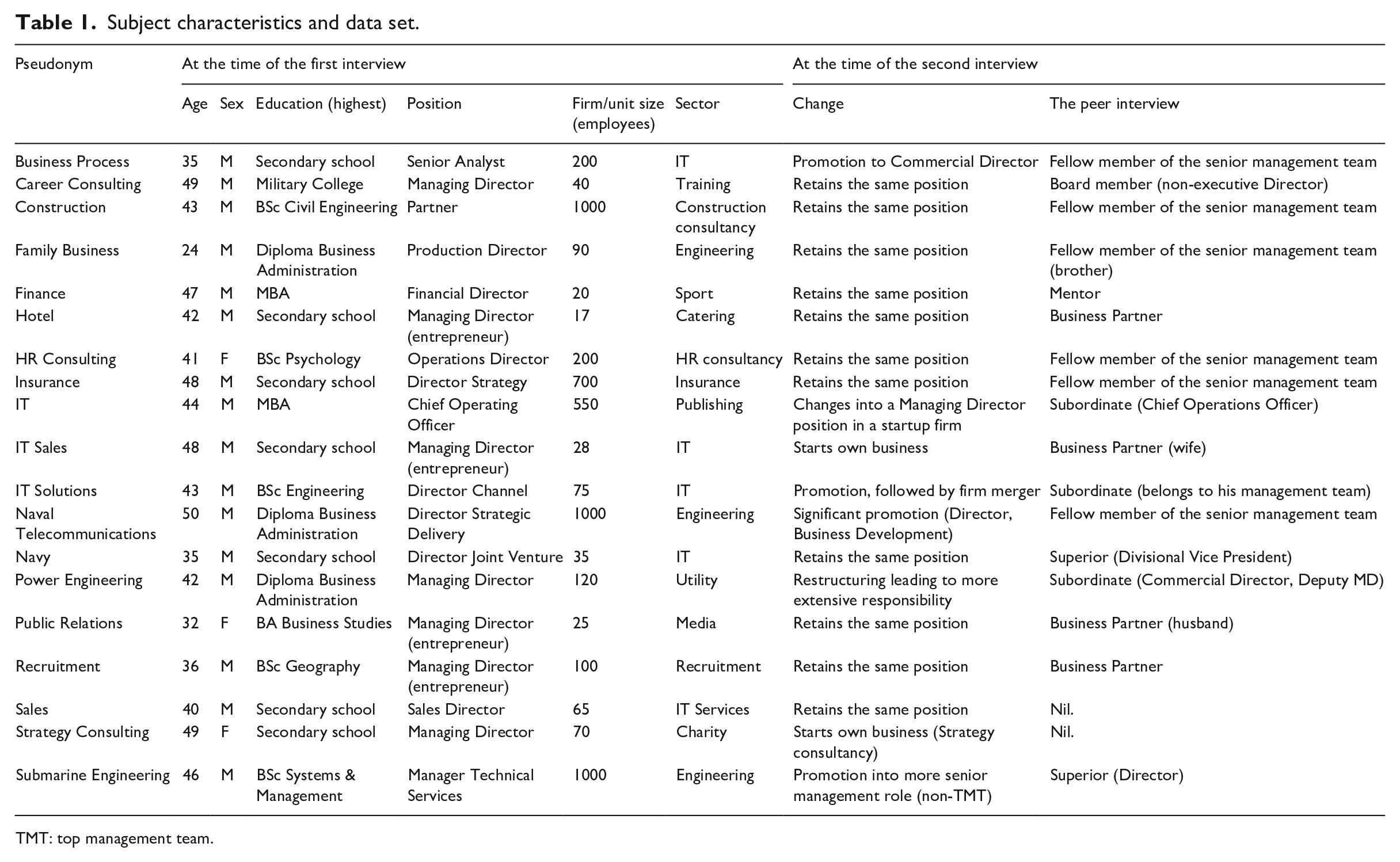
TMT: top management team.
To plot out this work of becoming a strategist, therefore, the second author conducted three interviews per manager. 1 Following Watson and Harris (1999), the second author conducted two interviews with the subjects themselves: one before the course, another between 6 and 12 months afterwards. While these two interviews form the primary source for identity work, the second author also conducted a peer interview after the course. These peers were nominated by the subjects, as people who knew them well in their working contexts. Peer interviews gave us access to a more independent viewpoint on the subject’s development (Sandberg, 2000), while consciousness of these interviews may have enhanced the reliability of the subjects’ own interviews. All interviews were recorded, transcribed verbatim, and analyzed using NVivo. The interviews lasted between 45 minutes and 2 hours, resulting in transcripts of between 2500 and 15,000 words.
The interviews were semi-structured (see Table 2 for interview outlines). The first interview introduced both the organizational context, in terms of strategic challenges and practices, and the subjects themselves in terms of their careers, education, training, mentors, and reading. These interviews also inquired about specific experiences of strategy work, particularly probing critical incidents (Boyatsis, 1982; Eraut, 1994), comparing those in which they believed they coped well with those they managed not so well. Following Dall’Alba (2004) with respect to medicine, subjects were also asked what they thought strategy was—what it involved and what was important about it. They were also asked to assess their own competence (Sandberg, 2000), particularly where they thought they were strong and where they thought they were weak. Finally, interviewees were asked about their expectations of the course outcome. The second interviews began by catching up with the subjects’ businesses and careers since the previous interview and the course. Again, the interviews inquired about recent experience of strategy work, this time probing for reflections on how their approach might have changed since the previous interview. Similarly, subjects were again asked about their definitions of strategy and their personal strengths and weaknesses. This repetition of questions across first and second interviews provided some sense of change or otherwise, but also allowed for retrospective narratives on both occasions: second interviews often harked back to the past. In addition, subjects were asked directly about their learning and reflections from the course. The peer interviews took place around the time of the second interviews, and concentrated on organizational context, the subject’s participation and competence in strategy (again, with a focus on critical incidents), and areas in which the subject still had development needs.
Interview outlines.
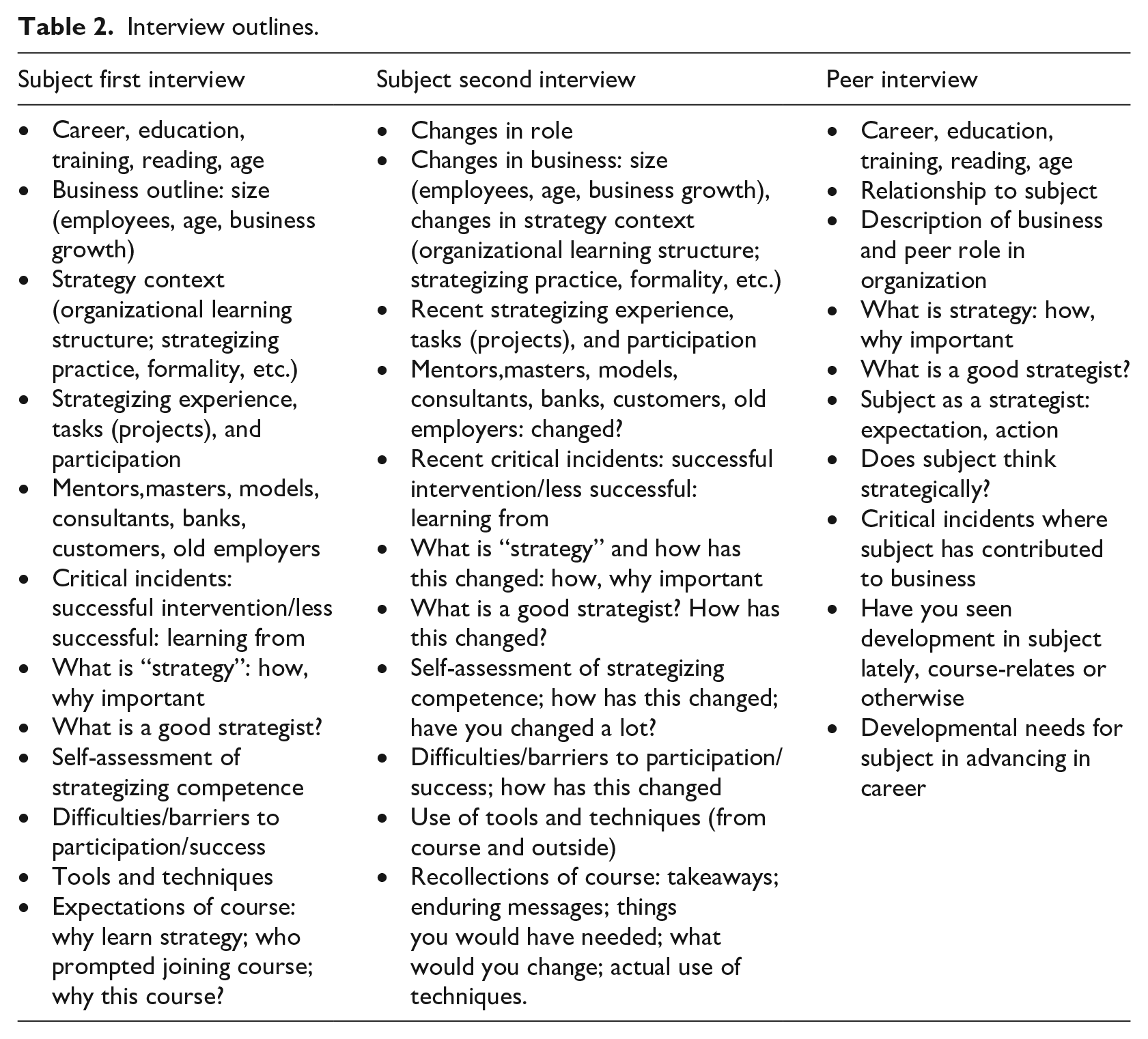
As our focus is identity work rather than the practice of strategy itself, subject interviews are appropriate for capturing the narratives involved in such work (Brown, 2017; Ibarra and Barbulescu, 2010; Watson, 2009). We highlight three features of the interview design. First, the retrospective and repeated nature of the interviews allowed us to explore identity work as a dynamic phenomenon over time: repetition gave some access to changes in the period before and after the course, but retrospect meant that each interview also afforded opportunities for long-run narratives of the interviewee’s ongoing development. Second, although the subjects’ own narratives are the primary bearer of identity work here, the peers provided us with a more rounded view of the reflexive projects and a check on matters of fact. Third, in focusing on identity work, our concern was not with how our subjects conformed to some standard metric of “strategic,” but with how the interviewees actually used the term: strategy was there when the term was invoked (Mantere, 2005).
Analysis of the interviews
Given our intent to elaborate theory, our analyses progressed in an abductive manner in a dialogical process between theory and the data (Alvesson and Kärreman, 2007; Mantere and Ketokivi, 2013). To ensure consistency in our analyses, the two authors analyzed the data in isolation during a number of stages during the process, stopping to compare notes. We began with a round of open coding, seeking to identify contrasts and commonalities between the three interviews regarding each subject. As the second author had conducted all the interviews, the first and second author coded the complete data set in isolation, compared notes, and integrated the coding structure in a negotiation process. Comparison between the primary data of the managers’ own identity work and the views of peers was sometimes helpful in understanding tensions between development paths. This open coding gave rise to a large set of first order categories relevant to managers’ identity work.
We began our second round of analysis by considering the large set of initial codes against existing identity work literature. In order to theorize from the identity narratives we had encountered, we wrote a memo for each subject interviewee, seeking to capture the main incidents and developments that the subjects (and their peers) saw as central for individual developmental paths. The two authors divided the data set into two groups of interviewees and wrote memos for their share. After this, we reviewed and discussed each of the 19 resultant memos. These memos proved to be an efficient “display” for accessing and comparing units from the rich data (Miles and Huberman, 1994). Our final round of analysis resulted in the identification of three identity work tactics: self-measurement, self-actualization, and self-construction. They were abducted from our interviews, drawing on ideas from existing research regarding identity work and strategists. Table 3 shows how the three tactics were encountered across the subject and peer interviews.
Three identity work tactics.
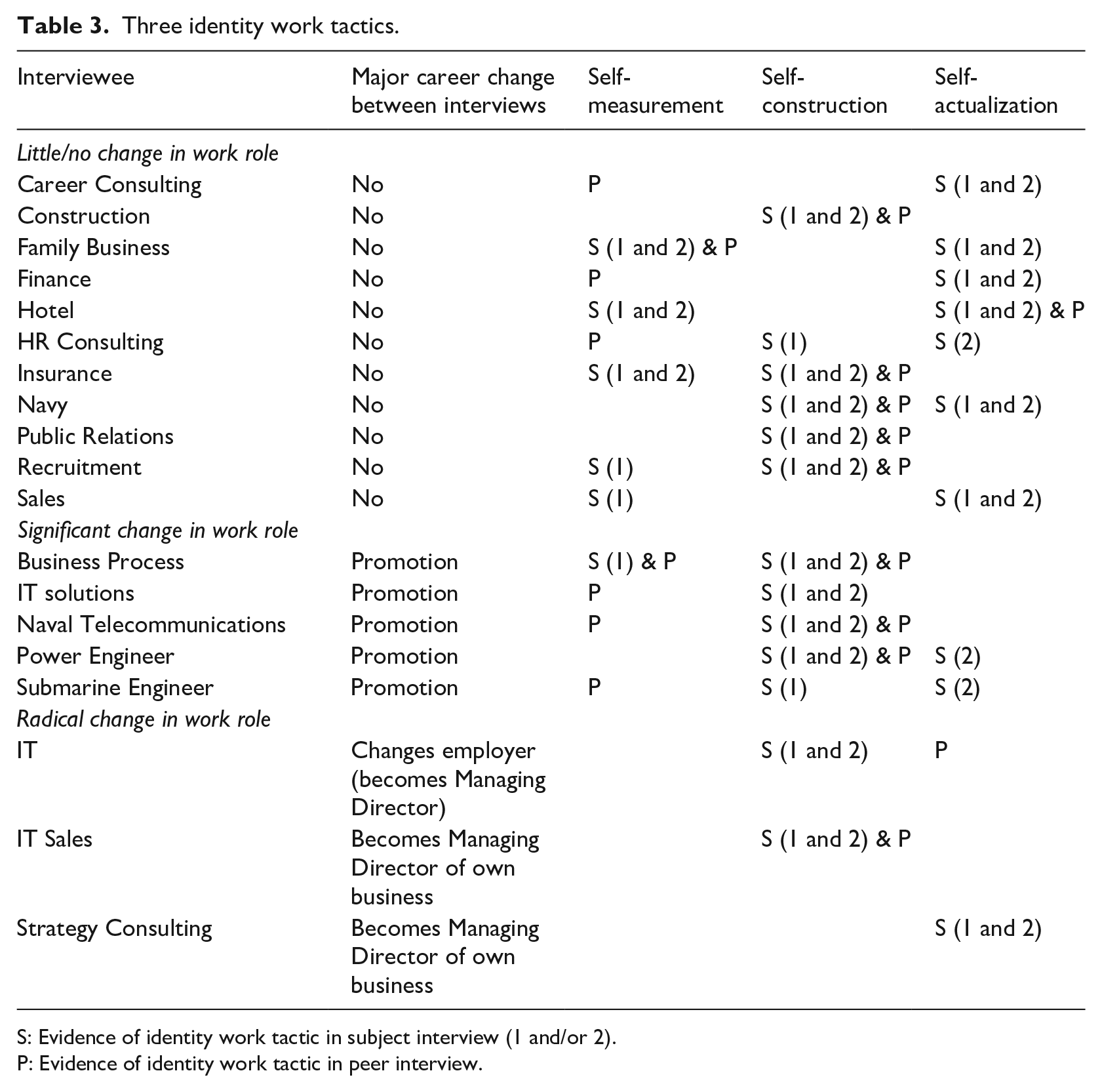
S: Evidence of identity work tactic in subject interview (1 and/or 2).
P: Evidence of identity work tactic in peer interview.
In our analysis, we focus primarily on the managers’ own interviews as the expression of their identity work. Table 3 demonstrates that we found more than one tactic being used in some interviews (e.g. Family Business and Hotel). This pluralism could reflect the combination of narratives about the present and the past, but some of our subjects used divergent narratives even when speaking of their quite recent selves (e.g. Insurance later). Multiple tactics are consistent with the earlier proposition that identity work is often incomplete and only partially coherent (Boje, 2001; Brown, 2017; Ybema et al., 2009: 313–314). Following Weick (1995) at the start, interviews were sites in which subjects were actively striving to make sense of themselves, as part of the ongoing puzzle of determining an appropriate self. This personal struggle might be opaque to the view of peers, one reason perhaps for discrepancies between subjects and peers.
Three tactics for working with strategist identity
At the core of our findings are three discursive tactics that strategists employ in their identity work. Self-measurement, the first tactic, approaches strategist identity as an external norm, against which individuals evaluated their sense of self-worth as managers. In using the tactic of self-construction, interviewees used external strategy discourse as a source of flexible blueprints for becoming a better manager in a reflexive process of career development. In their use of the final self-actualization tactic, our interviewees drew on strategy discourse as a source of meaning in their working lives. As in Table 3, interviewees typically used more than one tactic: six used the self-measurement tactic; 13 the self-construction tactic; 10 the self-actualization tactic. While the retrospective elements of both interviews rule out a simple “before” and “after” comparison, it is notable that self-measurement was less common in the second interviews than in the first and that self-construction was more common among those experiencing a change in role between the two interviews. Although peers cannot express directly interviewees’ identity projects, in 12 instances, they coincided on at least one tactic; in seven they did not. Only two peers pointed to the self-actualization tactic, as against eight for self-measurement and nine for self-construction.
Self-measurement
Interviewees who used the self-measurement tactic strove toward an idealized external norm of strategy. Such narratives typically reflected a strong pressure to measure up to the standards set by prevailing strategy discourse, consistent with Knights and Morgan’s (1991) presentation of strategy as a disciplinary constraint on managerial identity. This was the least frequent of the identity tactics and even for the six adopters this form of disciplinary pressure was not entirely dominant: as in Table 3, none relied on the self-measurement tactic alone. 2
The perceived deficit vis-à-vis strategy discourse, particularly that from the IoD, was strongly reflected in both the interviews of Family Business. In the first interview, Family Business regarded a better understanding of strategy as essential to being a company director: You are trying to learn more all the time as far as strategy is concerned and look at more things like if I’d done two years ago I would have forgotten about looking at competition. So now you are looking at these different areas more. It’s hard to give an explanation as to how you see things in two years’ time—if you’re not learning as you go along you’re wasted, you’ve had it . . . (Family Business, first interview)
Family Business continued to use the self-measurement tactic in the second interview. There he saw participating in the course as crucial to compensating for his narrow experience relative to another, apparently superior course participant: I haven’t been out of the industry and had another job and I thought: this guy’s good at his job. I’ve never had that myself. And I think it’s a similar position for the other two [brothers also on the course]. (Family Business, second interview)
This self-measurement in the context of training or similar development activities was common. For Insurance, the self-measurement tactic responded to the embarrassment experienced on an earlier, unrelated strategy course where he had been exposed as lacking: In fact this last little strategy session we had, the guy handed out this hand-out which mentioned three or four names and books and what have you, and I was embarrassed to say that I’d never heard of one of them. I really must sort of pick it up now. (Insurance, first interview)
Here, the strategy discourse of business education exerted unambiguous disciplinary pressure, with Insurance seeing himself as failing to measure up to dominant standards. The new reading appeared more obligatory vis-à-vis peer norms than about learning or development for their own sake. Insurance’s second interview continued this narrative: [A member of his company’s board] would bring me books back from trips you know, business books. He’d say: “read this.” They were very simple little books, but he said “read this,” “read this,” and by reading those sometimes it gave me the feeling that ok, what I’m doing is right. Because there’s a way of checking myself. Like I said to you before, my school education and everything else was very poor, I didn’t really achieve there, so it is, as a first time out, it’s good to know what you’re doing and the stepping stones you take. Instead of being out there in the wilderness. (Insurance, second interview)
Insurance thus typifies the self-measurement tactic, an effort to “check himself” against an external textual standard, reinforced in his case by acute awareness of his “very poor” education.
However, self-measurement could also involve comparison with standards discovered in the course of ordinary work. Business Process realized his failure to measure up by working with a group of American venture capitalists (VCs): You know, when you put your head up you—you know, you might be missing something in this market-place. And so the VCs were very good like that. The Americans—very different culture. Very, very analytical and . . . I do find with a lot of them, they are very intelligent and very academically qualified. (Business Process, first interview)
For Business Process, the comparison laid bare the risk of missing real business opportunities. Similar was true for Recruitment, again someone who saw strategy training as a means of compensating for narrow business experience: A lot of the directors—I’m the group managing director—a lot of the people at the top of the company pretty much . . . we’re self-taught really in terms of strategy. It’s uncharted territory. We’re predominantly recruitment background people, [but] we’re managing and running a recruitment business, rather than doing recruitment . . . There’s obviously a lot that we don’t understand . . . Hence the need for the training. (Recruitment, first interview)
Here training is presented not as the source of perceptions of inadequacy but as the solution.
Self-construction
Interviewees who employed the self-construction tactic used strategist identity as a platform for career advancement. Self-construction is task-focused, looking at the job, organization, and industry experiences that the developing manager needs in order to realize a career plan: strategy is just part of that, something to add to a portfolio of identities that might, for example, include leadership as well (Grint, 2010). Whereas self-measurement is about catching up with a discursive ideal in order to complete a current identity, self-construction is about using the ideal as part of a project to create an expanded identity.
To return to the case above, for Insurance self-measurement did not exclude adopting a self-construction narrative as well: both Insurance and his peer saw strategist identity as important for his career. The biographical reach of the interviews allows the expression of plural tactics across time. Thus, for Insurance, the same first interview accommodates both the retrospective embarrassment that drove the self-measuring tactic behind the IoD course and a forward-looking ambition where the same course is now understood as helping him beyond his current position: I’d like to get these examinations, this [strategy] examination under my belt, I’d like to move to this chartered directorship status. I’m also chairman of a small company as well as working here, [the insurance company] . . . So I’m chairman of the board there, and that really interests me and that’s something I get a buzz out of. But I want to be working, sorry working towards a situation where, maybe when retirement comes, or maybe if early retirement comes, I could pick a couple of non-exec positions up somewhere. (Insurance, first interview)
Self-construction is narrated as part of an identity project that uses the external blueprint of strategy to develop a managerial career. The narrative indicates the incorporation of strategy as part of a continuing journey, rather than arrival at a “fully formed” manager. The self-construction strategy involves a critical and reflexive search for a richer management identity through the accumulation of experiences suggested by the normative ideal of a strategist. Rather than a measure of one’s current self-worth, as is the case with self-measurement, self-construction incorporates strategist identity as part of an identity project looking to the future.
The interviewee Business Process also combined self-construction with self-measurement initially, but by the second interview was converging on the more positive tactic. There had been a change of job role, but the IoD course appears to have had a clear effect, as he discusses its influence on his personal growth: . . . you start sub-consciously thinking of these things, being open to—to knowledge whereas before it would have been internal, this—being really quite prescriptive. [The IoD course] has enabled me to start thinking oh well, actually what’s the outcome going to be? What’s the outcome we’re looking for, not how are we going to do it? Where do we want to get to and how we’re going to get there sort of from the next—whereas previously well, how are we going to get somewhere, and it might not be the right place. Q: Yeah. So you get a bigger picture? BP: Bigger picture, yeah. Absolutely, the bigger picture and starting off not from a technology perspective but starting off actually outside in the external world of well, what are we all trying to aim for? You know, what—what are the blue chips for [anonymized company] and how do they relate? Because if they don’t relate why are we doing it? (Business Process, second interview)
These self-construction narratives often highlighted how strategist identity could build on earlier professional experiences. Strategy was the next stage in their advancement. For example, in his first subject interview, Business Process expressed the aim of rounding out what his peer called his “engineering identity,” which encouraged an excessively “black and white” perspective. While Business Process seemed to be distancing himself from at least part of his previous professional identities, several of our interviewees treated their earlier identities as resources for constructing strategist identity. Rather than the past being a source of weakness, earlier professional identity was respected as a solid basis on which to build. The new identity is seen as an extension of a previous one. In the cases of IT and Navy, both admitted they had things to learn about strategy, but their respective backgrounds in marketing and the navy none the less contributed to their strategist identity: I think because of the [. . .] marketing element in terms of my work, and because I seem to have a passion for the consumer, then I tended to approach these a little bit more strategically earlier on. I think it’s interesting that as my career has gone on I, if you like, built the operational people skills on top of the strategic component rather than doing it the other way round (IT, first interview). We are mostly a group of ex-services people [military, airforce and naval], in a company of accountants and engineers, and we think very much more strategically than most people around here. Maybe it comes from our services training. We understand the difference between strategy and tactics. (Navy, first interview)
None the less, despite the resources provided by earlier experiences, the last step to an identity as strategist still involved a “rounding out,” the extension of self-construction. To continue with Navy, he admitted that he had to learn how to translate his initial strength in strategic thinking into a capacity for strategy delivery: I guess my strength is I’m good at seeing connections, having conversations with different people, picking different bits of information and seeing how they fit together. I’m quite good at helping other people be creative, though I’m not sure I’m so good at it myself. Things I’m not so good at are drilling down into detail, asking the question so I really understand what somebody is saying. I go on perception too much. I like starting stuff, and then I get bored. I’m not a finisher. (Navy, first interview)
Self-actualization
The self-actualization tactic is used when an individual seeks meaning in work by bringing out some perceived personal potential, allowing their own desires and aspirations to express themselves more fully. Strategist is a latent identity ready to be realized. Here, there is some combination of professional and personal selves (Billett, 2011). But there is ambivalence in this aspirational identification with strategy: the potential subsuming of self in strategist identity arguably reflects the seductive power of strategy discourse (Knights and Morgan, 1995). In any case, while for the two earlier tactics strategy discourse provided either an external standard to measure up to or an external resource to be acquired in self-construction, for self-actualization strategy was something more fully internalized.
Thus, interviewees employing the self-actualization tactic often discussed the strategist identity as something that was natural or inherent to them. A clear example was the interviewee Sales who in his second interview expressed an affinity with strategy because he saw himself as a rational planner by his very nature: I would say [planning comes to me] probably as much [by] nature. I mean when I was at school the only things I was good at were technical drawing and maths. Both are very very logical subjects. Motor vehicle engineering [I am good at but] I’m absolutely no good with electrics. I can’t see electricity therefore I find it very hard to understand, I mean forget working how a radio works, but I could and have built a car. Q: Yes you like cars, I remember. A: I’m a car freak. You know anything with an engine in, anything mechanical and I’m very keen because it’s quite logical. Q: And that transfers over to planning? A: Yes I think so. Yes I mean you just look at the sheer mathematics, you know in terms of, I’d probably be a very good statistician—say that when you’ve had a few beers! Because I like to plan the statistics, you know work on what do we have to do to get to where we need to be—mathematically. (Sales, second interview)
Similarly, Strategy Consulting, who had fairly recently moved from a leadership position in a charity, identified enthusiastically with strategy (not surprisingly perhaps): “I truly believe in strategy, you’ve got to know where you’re going and you’ve got to put in place steps to get there. You have to know, you have to know what you want” (Strategy Consulting, second interview). Despite doubts about his professional competence, for Family Business, strategy pervaded more personal aspects of his life: I love strategy! It’s with everything—it’s with the girls when you’re 15 [years’ old]. Everything revolves round strategy and if you’re thinking deeper, everything’s strategy—from how you approach your parents ‘I want to be out until 2 o’clock in the morning but I’m only 16’—what’s my strategy going to be here?—I’ll empty the dishwasher, I’ll mow the lawn, I’ll make sure I can get home safely. Then you’ve got your goal and in the end you can achieve it. (Family Business, first interview)
Strategy was seen also by self-actualizers as a source of meaning. In his second subject interview, interviewee Power Engineer uses “strategic perspective” as a characteristic of a meaningful work role: It wasn’t as strategic as I wanted, and that’s one of the reasons why I looked to do something else, to be fair. So when this opportunity came up to be [CEO] of a business, I thought that’s what I want. I had a little taste of that bigger picture, looking outwards at the customer perspective. [. . .] This is much more of a strategic perspective: half my time is spent looking outwards and half looking inwards, which is much better. (Power Engineer, second interview)
Self-actualization might sometimes involve some idealization of the strategy role. In his first subject interview, Career Consulting answers a question of what he things a strategist is by describing himself as “a thinker”: I’ve now got a team round me so that I can now do the thinking bit. You know, a lot of these guys . . . you get to the factory gate and you say to the guys on the shop floor: “what sort of day have you had today?” “Oh great, I’ve made a thousand widgets. And what did you do?” “I’ve had a jolly good think” You know, it doesn’t feel right. But . . . that’s exactly what I’m here for. I should be doing the thinking. (Career Consulting, first interview)
The peer was less convinced that such a cerebral and elitist ideal was key to becoming a strategist. She notes that strategy work in the Career Consulting’s role should involve influence and networking to help the organization position itself and secure resources, and that he was not strong in these areas. She therefore emphasizes the need for self-measurement, something that the subject himself did not refer to in either of his interviews. For Career Consulting, as for others, the strategy identity remains a personal ideal which they aspired to actualize in their working lives.
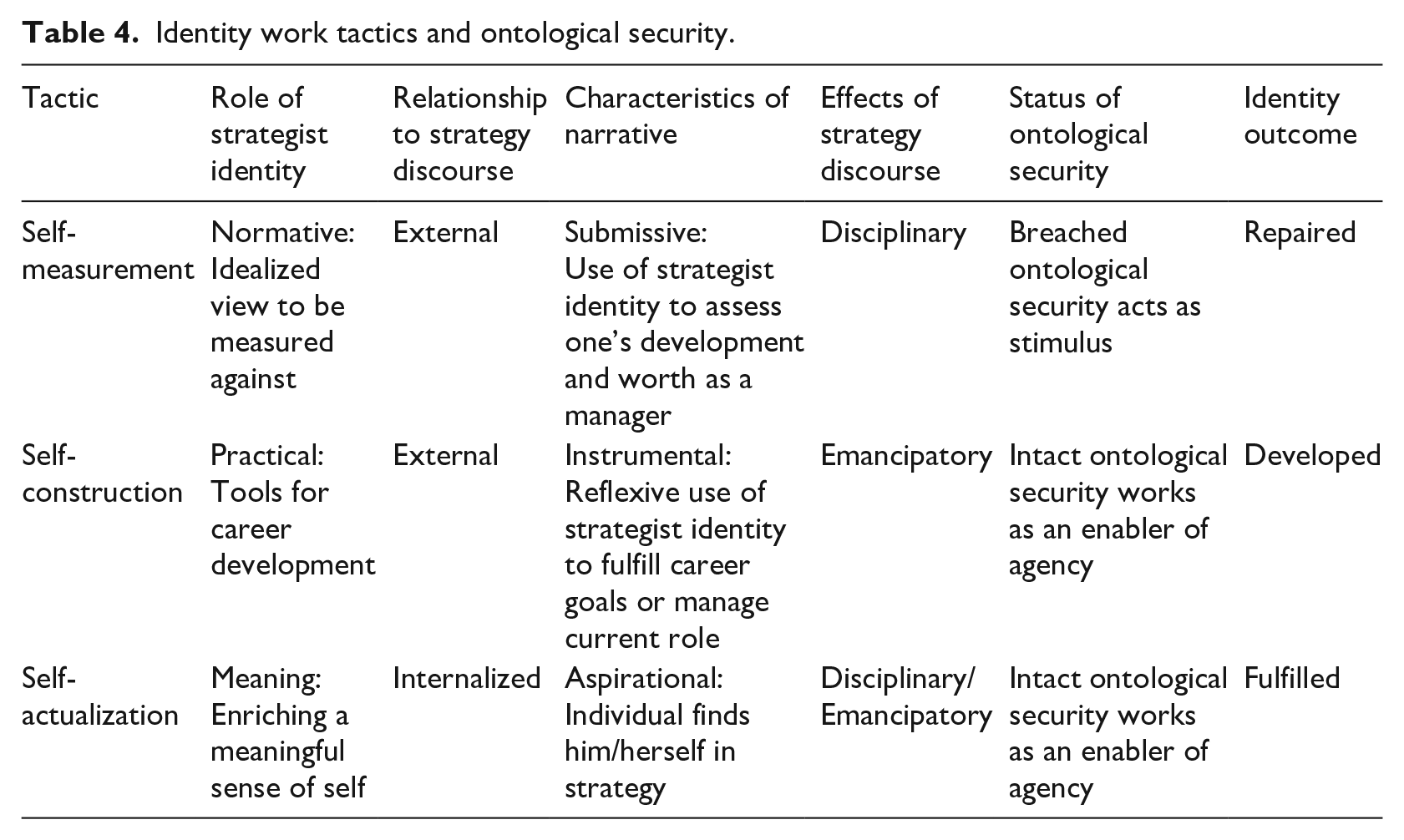
Table 4 summarizes some key characteristics of the three identity work tactics we have discussed so far. They differ on several dimensions. In the first place, the role of strategy identity varies: for self-measurement, strategy identity is normative; for self-construction it is practical; for self-actualization, it is a source of meaning. For the first two, the relationship between manager and strategy discourse is an external one, identity being something to go out and get; for self-actualization, on the other hand, strategy identity is more internalized, a part of what managers already or potentially are. Here, the dichotomy between disciplinary and emancipatory strategy discourses is diluted. Certainly, there are tensions. Thus, the self-measurement tactic is disciplinary in the Foucauldian sense of imposing an external standard to which subjects must submit (Knights and Morgan, 1991), while the naked instrumentalism of self-construction is emancipated, speaking to the demystified practicality described by Mantere and Vaara (2008). However, there is ambivalence in the self-actualization strategy: on the one hand, self-actualization involves the freeing of the subject to realize their personal aspirations; on the other, subjects internalize the disciplining powers of discourse within themselves. The crucial point though is that these various identity tactics—disciplinary, emancipatory, or mixed—are non-exclusive. In line with the pluralistic and agentic perspective developed earlier, the same managers can use more than one tactic over the course of a career or even at the same time (Table 3). Managers mobilize varieties of strategy discourse. The next section explores the role of ontological security in stimulating or enabling different identity work tactics. Tactics respond to the varying status of individuals’ ontological security.
Identity work tactics and ontological security.
Ontological security in the development of strategist identity
Given the pluralistic and agentic use of strategist identity tactics, in what conditions are they deployed and with what potential outcomes? This section completes the final two columns of Table 4 by considering how ontological security relates to chosen tactics and the kinds of outcomes sought. The role that ontological security plays in identity work is central to our contribution. Sometimes, identity tactics respond to breaches in ontological security, where subjects perceive personal shortcomings in need of repair; sometimes, identity tactics respond to intact ontological security, where subjects feel confident enough either to develop or to fulfill themselves. To explore more deeply the relationship between ontological security and identity work tactics, we shall draw on the analytical memos we wrote on each subject, constructing three vignettes outlining one of the identity work tactics used by a particular individual and exploring their personal backgrounds.
Repairing ontological security through self-measurement
In each of his interviews, Family Business used both self-measurement and self-actualization tactics. Here, however, we focus on the inadequacies of education, experience, business professionalism, and access to mentors that left him feeling insecure about his strategic capabilities at work (although he was more confident elsewhere). Vividly, Family Business describes himself as feeling “crap” about himself as a manager.
Family Business is a production director in a family business, with only a diploma rather than a full degree. He is in his mid-twenties and broke off his education to join the business, where he has spent all his career so far. The company is a medium-sized manufacturing company, which subcontracts for much larger companies. The senior management team consists of him and his two brothers plus a managing director recently recruited from outside the family—an important addition as, according to Family Business, “professionalism is something the business lacks.” The team is all below the age of forty and perceived as lacking in experience. The father remains chairman of the board but is increasingly remote. In the first interview, Family Business laments the lack of an inspiring mentor—paternal or other—to learn from: I wouldn’t say my father [is a good source for learning] as he is in his late 50’s and you’re fresh and trying new ideas. With certain decisions he can be very wise, [but] there is not one particular person I know I would like to be my model or my mentor. Q: Not a model or mentor? A: I would like to work for someone like Richard Branson [Business celebrity, founder of the Virgin corporation]
Participation on the IoD course has a radical effect on the interviewee. The experience of being able to makes sense of the course contents endows him with confidence, as does observing fellow students who do not embody extraordinary capabilities of “Bransonesque” proportions: That was my biggest personal gain, the thought God; I’m not crap after all [—] That was my biggest self-gain.
Speaking of himself and his two brothers who had also attended the course, he concludes, “Next time we’ll believe in ourselves more.”
This Vignette is a story of self-measurement as it presents the protagonist as trying to work from perceived inadequacy toward an idealized normative view of strategists as “great men” such as Richard Branson. The starting point is a breach in ontological security, perceived inadequacies in his managerial skills. In this sense, the breach was similar to those of Business Process—exposed to American venture capitalists—or Insurance—shown up for his lack of reading—both described earlier. The course is part of a process of repair, a measuring up to the norm. Family Business discovers he is “not crap” after all. He and his brothers can start to believe in themselves more.
For Family Business, strategist identity is something external, acting on the self of the individual. That is, he did not challenge what he needed to become, but focused on what was expected of him if he was to measure up to strategist identity. The elevated ideal of Richard Branson sets the unquestioned standard. In this sense, self-measurement narratives are submissive, as the narrator adopts an uncritical approach toward the dictates of societal strategy discourse. This is consistent with Knights and Morgan (1991, 1995) who present strategy as a disciplinary influence that constrains and homogenizes managerial identity. However, we have seen that Family Business uses the self-actualization tactic too, appealing to the strategic sense shown in his youthful maneuvers with girls and parents. Self-measurement is not an exclusive tactic.
Building on ontological security for self-construction
The self-construction tactic is founded on intact ontological security, which facilitates self and career development. Rather than subsuming one’s own goals and desires in expectations of an appropriate “strategist,” self-construction uses strategy as a resource for becoming what the individual is working toward. The value of strategist identity is practical, something the individual uses as one step toward expanding managerial identity more broadly: becoming a strategist is not an end in itself, but rather a means to an end.
The overarching goal of IT was his career aspiration to one day head an international corporation. He had an MBA from a leading European business school and had attended executive education courses at a prestigious American business school. He had work experience from various multi-national corporations and had been a consultant in one of the Big Four accounting firms. Throughout his career, he had constantly sought new roles, gaining experience in a variety of companies, functions and international contexts. Following the advice of a professional coach, for most of his career he had set himself a target of at least five days self-development work a year. At the time of the first interview, he was vice president of a business division of a large American IT corporation. Joining the Institute of Directors course was partly prompted by a new board-level position: “So that’s why I’m taking this particular lot of IOD courses. I want to get an understanding of what’s my responsibilities. And also it’s an opportunity just to go back to school and learn some different skills, meet different people.”
For IT, strategy was not a matter of anxiety, but something to be enjoyed and a skill to set alongside the operational capabilities required of a large company: But I would say probably about five years into my career I started to look at some businesses, especially my consultancy time, where I was a member of a smaller team. And I’d look at businesses and get back to some of the market analysis on them, and begin to think more strategically. And I think in those three years, looking at the number of businesses in sort of rapid succession, and doing some sort of market attractiveness analysis, you tend to—it drives you more strategic, even though you don’t have large teams. And then it was really after a while in [Company in the Energy Sector], that then I began to sort of [get] larger teams underneath me and build that side of the skill base. That was really my objective from the [Company in the IT sector, current employer] side, I mean, you know, [current employer] is a pretty established business model, and pretty established strategy, and really the set in that type of company depends on how well you operate, how well you can execute the packages, and that’s really why I wanted to do that type of role . . . I enjoy doing the analytical, strategic analysis behind some things.
IT maintained a number of professional networks with previous co-workers and extra-organizational peers. He “disciplined himself” to get in contact with them in regular intervals. These networks enabled him to understand further which types of positions he needed to experience in an effort of realize his aspiration of one day becoming the leader of an international corporation. Between the interviews and after the course, he took on a new challenging position as the CEO of a startup operating in an emerging market.
The self-construction tactic rests on an intact sense of ontological security. In the case of IT, there is little questioning of his ability to measure-up; rather the focus is on how to become what he wants to be. In the Vignette, or the interviews that informed it, there were no signs of IT’s confidence being shaken or of his sense of security breached. Rather, he approaches his own learning actively, challenging himself to allocate time and effort to his development. By contrast with the submissive narrative in the Family Business Vignette, the second Vignette features an instrumental narrative (Table 4). He sees himself as emancipated, the master of his future. If rather less bullish, a similar kind of career instrumentalism is seen earlier in the self-construction tactic of Insurance, with his pursuit of a non-executive directorships. In the earlier example of Business Process, the instrumentalism was more diffuse, concerned with developing a general strategic competence. Both are actively building on the ontological security from which they can construct these next steps. But whether with diffuse or specific goals, self-construction is about pursuing strategist identity as part of a wider developmental project of the self.
Building on ontological security for self-actualization
Like self-construction, the self-actualization tactic builds on an intact sense of ontological security, whether drawn from professional or personal life (Billett, 2011). Strategist identity is a vehicle of personal expression. Thus the third Vignette shows how Strategy Consulting accumulated her strategic strengths through years of experience as leader of a growing charitable organization. She professes never to have endured a “crisis of confidence.” Money was not the point of developing her strategy consulting firm, but the excitement of making an impact on her clients.
At the time of the first interview, Strategy Consulting was acting as the managing director of a small charity that coordinated fundraising for the benefit of the elderly. She had begun her career in sales and went into the charity sector after a period staying at home to care for her children. Although she had no tertiary education, growing the charity had given her confidence, particularly in her strategic capabilities: “as the business got bigger and I came away more and more from hands on and ended up sort of looking at the strategic direction and stuff like that more, you know, it actually helped me identify what my . . . strengths were” (second interview). Between the two interviews, she realized that she was not the right person to lead the next stage of her organization’s development: Last year I resigned as chief exec of [the charity]. That position I’d held for seven years. Basically because, you know, I felt I’d done my job there. I was wanting a new challenge but not knowing what it was and so busy within the job that I felt I didn’t have time to know where I wanted to go. And also, I was just redoing strategy for the next five years and redoing the vision thing for [the organization]. I went through all the vision things that I’d been taught and realized that I’d got this vision that I wasn’t there. So, if I wasn’t there in five years’ time I didn’t feel I was the right person to actually take the company there and that it was probably better for the company as well as for me to move on, so took that decision. The realization that she “wasn’t in her company’s vision” was followed up by the interviewee founding a strategy consultancy, built around applying the strategic management tools that she had learnt on the IoD course to the charity sector. She had little hesitation about launching: “I didn’t have a confidence crisis, no, because I can’t remember that I’ve ever had a confidence crisis.” She enjoyed the strong positive response that she got from her new consulting clients. The significant changes she was able to influence in their organizations testified to the fact that she had discovered a position where she could make a more meaningful contribution. She explained: “It’s not the money thing for me, it definitely isn’t. I don’t have to earn any more than I’m earning from [main client] . . . It’s very exciting.” For Strategy Consulting, strategy identity was about her readiness to “think big,” by contrast with the process skills of her business partner: “I’ll do the strategy, she can go in and do the work. She’s very process-driven and, you know, my strength is ‘hey, here’s a great idea’ and hers is ‘yes, but how do we do it?’” (second interview)
In the case of Strategy Consulting, the theme of self-discovery was predominant in both her interviews. The awkwardness of formulating a vision for her employing organization and “not being in that vision” is characteristic of her search. The narrative is aspirational rather than submissive or instrumental (Table 4). She approached the strategist identity from the perspective of leading a meaningful life, doing things she found significant and challenging rather than just earning money. The aim was personal fulfillment.
Self-actualization in part reinforces the disciplinary view in that it exhibits the “seductive” aspect of strategy discourse (Knights and Morgan, 1991). For Strategy Consulting, there is pride in working on the “great ideas,” and this ties her to her work, with little regard for money. Yet self-actualization contains some tension with the disciplinary view. While some individuals appear seduced entirely by the siren song of business strategy, reveling in this identity, other managers appear less influenced by professional exposure to strategy discourse. Strategy is part of their whole life experience. For Sales and Family Business, two other users of the self-actualization tactic (see earlier), strategy is something that predates their working careers: strategy discourse is read back into their youthful tinkering with cars or maneuvers with girls. For them, a strategic sensibility is something they have always had, even if not fully realized. While insecure about their skill in business strategy specifically, they both express a confidence in the extracurricular identities that come to inform their self-actualization tactics as strategists. Sales has a sense of “logic” that helps him as a “car freak”; Family Business is boastful about his success with girls and parents. In short, self-actualization relies on one kind of security or another—personal or professional—while containing both disciplinary and emancipatory elements. This tension between the emancipatory and the disciplinary (see Table 4) can be conceived as a “narrative wrestling match” between the self and the strategist social identity, where the self has the potential of rewriting received identity by injecting some aspects of personal identity, rather than simply succumbing to the external norms of business strategy.
Concluding reflections
The primary contribution of our work is to add to understanding of the practitioners of strategy, one of the principal concerns of the Strategy-as-Practice literature (Vaara and Whittington, 2012). In its examination of the relationship between individuals and strategy discourse, much of this literature has focused on what people do with strategy discourse: how and why they resist it (Laine and Vaara, 2007), whether or not they are able to participate because of it (Mantere and Vaara, 2008), how they use it to get what they want in their organizations (Suominen and Mantere, 2010), and how they relate to the tensions within the discourse (Dameron and Torset, 2014). Our focus here has been on the role of strategy discourse in becoming a strategist.
“Strategist” is a social identity that applies variously to many sets of individuals: senior executives, specialists such as Chief Strategy Officers, consultants, middle managers and increasingly those lower level employees drawn into forms of “open strategy” (Angwin et al., 2009; Whittington, 2019). The challenge of becoming a strategist is therefore a common one, although our concern has been specifically with how managers acquire this identity. Becoming a strategist is more than a hierarchical (Chandler, 1990) or cognitive (Porter, 1996) move. In this study, even senior managers could be burdened with self-doubt. Becoming a strategist involves feeling like a strategist. It is the product of active identity work, a transformation of the self.
The identity work of becoming a strategist involves the telling of narratives that bring together aspects of societal strategy discourse with personal stories from subjects’ own experience (Billett, 2011; Fenton and Langley, 2011). Identity work is agentic, involving the selection of tactics, and pluralistic, allowing for non-exclusivity of tactics. We have uncovered three identity work tactics: self-measurement, self-construction, and self-actualization. These tactics stand in different relationships to ontological security. Self-measurement responds to breached security and is a tactic of repair. Self-construction and self-actualization draw on intact senses of ontological security, providing bases either for personal development or for fulfillment. As their security develops, managers may pursue more than one tactic over the course of their careers. Wrestling with the “ongoing puzzle” of identity (Weick, 1995), they may even express more than one tactic simultaneously.
In this light, strategy discourse does not emerge as simply disciplinary (Knights and Morgan, 1991); rather it is something that may be engaged tactically in various ways. Self-measurement does indeed reflect a submission to the external standard of strategy. The case of self-actualization is more complex: internalization sometimes reflects seduction by the societal discourse of business strategy but sometimes also responds to strategic senses of the self that are established in prior professional development (e.g. as a naval officer or marketing executive) or even outside the workplace and early in life (e.g. in hobbies or romance). Self-actualization is not unambiguously disciplinary. The self-construction tactic is still more emancipatory, treating strategy discourse as a mere instrument in personal projects, with strategist identity a stepping stone in personal careers. In short, there is no single “homo strategicus” (Clegg et al., 2004). There are different ways of incorporating strategic discourse into managerial identity; self-construction even transcends it.
Becoming a strategist therefore involves more than the acquisition of “strategic thinking” skills (Heracleous, 1998; Porter, 1996). It is a social-psychological process which may entail a transformation of the self. This may not be easily grasped by outsiders: as we have seen, even close peers are liable to underestimate subjects’ self-actualizing identification with strategy. Moreover, transformation is a matter of deep ontological security as well as surface cognitive skill. The achievement of security is core to the process, either as stimulus or as platform. This security may have diverse and obscure origins, not only in exposure to strategy discourse but in early extracurricular life or prior professional experience. Developing strategists involves looking beyond cognition toward the personal and the biographical. The kinds of security found in complete biographies may be a resource in building strategy competence.
The complexity of strategist identity work has implications for recent tendencies toward more “open” forms of strategy process (Hautz et al., 2017; Seidl et al., 2019). Open strategy involves the inclusion of more actors in the strategy process, often lower level employees, a long way away from the traditional strategy elite. For them, their hierarchical position and episodic involvement are likely to pose heightened challenges of identity and security. As Neeley and Leonardi (2018) have shown for inclusive initiatives using social media, participants in open strategy can easily face confusion, embarrassment, and discouragement. The result may be an effective withdrawal from apparently open strategy processes: employee participation risks ending up as merely “ceremonial,” an exercise in “open-washing” (Vaara et al., 2019). We have examined managers, not lower level employees. However, by extension, our study suggests that authentic open strategy initiatives require more than permission to participate. If employees are to become strategists in an effective sense, then the opening up of strategy will entail significant investments in human capacities. This may involve development in terms of the basic cognitive skills of strategy, but it is likely also to involve the cultivation of personal security and identity. Openness demands confidence. Here, there will be an important role for the more emancipatory aspects of strategy discourse: the exaggerated ideals that oppressed such managers as Family Business are liable to be felt still more sorely by lower level employees. Our study implies that new participants in the strategy process should be encouraged to draw upon strategy discourse selectively, employing emancipatory elements as positive means to boost their security in what will be an unfamiliar and previously remote activity. Of course, strategy discourse may not have the same affordances for everybody: we need to go beyond the managers in this study. An important part of the research agenda on open strategy (Seidl et al., 2019), therefore, should be the identity work of non-managerial employees as they enter the strategy arena and the limiting or enabling roles of strategy discourse as they do so.
Our study places strategist identity alongside previous studies of identity work in more tightly structured professional and occupational groups such as lawyers (Brown and Lewis, 2011), paratroopers (Thornborrow and Brown, 2009), priests (Kreiner et al., 2006), and surgeons (Pratt et al., 2006). Strategists participate in an occupational group where entry barriers are both blurred and, with the rise of open strategy, falling (Whittington, 2019). In many respects, the identity challenge of becoming a strategist may be closer to becoming a homeless street person than becoming a qualified lawyer (Snow and Anderson, 1987). It takes deep, uncertain, and agentive identity work. In the late modern work contexts of the 21st century (Giddens, 1991; Sennett, 2006), where the diffuse career paths of strategy appear more typical than those of tightly structured traditional professions, this kind of identity work looks likely to be increasingly common. We have only examined the case of strategy. However, to the extent that our findings are general, they suggest that other loosely structured occupations will be characterized by the pluralistic and agentive identity work of strategists: actors will have to find the equivalent tactics appropriate to their own particular group. Again, ontological security will be important, in all its ambivalence: sometimes people will be seeking to repair their security; sometimes they will be able to use it as platform for further advance. As for strategy, actors will need to attend to deeper social-psychological foundations as well as more obvious cognitive skills. The experience of other groups such as entrepreneurs or project managers is increasingly being investigated (Hoang and Gimeno, 2010; Hodgson, 2002; Mantere et al., 2013), but now there is opportunity for systematic comparison across similar occupational identities. Research should be seeking out general patterns of identity work in the loose occupational groups that increasingly characterize contemporary work, contrasting them with the established ones of traditional professions (Barley et al., 2017; Whittington and Anderson, 2019).
We highlight three limitations to our study. First, interviewing individuals who participated on a strategy course gave us access to managers confronting the challenge of strategist identity by design. This is methodologically convenient, but the drawback means that all our informants were working with strategist identity to some extent. Hence, this study cannot be used as evidence regarding the salience of strategy for managerial identity work in general. Second, Table 1 in the “Methods” section shows that the data set is unequally distributed in terms of gender (the sample included only three women), somewhat exaggerating the overall gender imbalance of the population of managers (Women in Business, 2018). The gendered nature of strategist identity work cannot therefore be a focus of this study, yet it remains an important topic for future research, especially given the masculine nature of strategy discourse identified by Knights and Morgan (1991). Third, we rely on a limited number of interviews. The nature of our findings should therefore be understood as theory elaboration, and they represent analytical, rather than statistical generalization (Yin, 1994). They need to be examined further in wider and larger contexts to allow more confident generalization about their prevalence and relative importance.
Further studies would allow investigation of the implications of different identity work tactics for the growth and careers of the managers who use them. Our findings do offer some indications that identity work tactics may relate to career outcomes. Table 3 plots the use of the three identity work tactics against short-term developments in the 19 managers’ careers, that is, changes in the roughly 6 to 12 months between interviews. While identity narratives are only one influence on career transitions, Table 3 does suggest a pattern. All three cases involving radical work transitions (IT Sales and Strategic Consulting leaving their organizations to become Managing Directors of their own businesses, and IT becoming a Managing Director in another business) involved the absence of self-measurement, as reported by either the peer or the interviewee. Self-measurement tactics were rarely associated with even smaller changes in role (Business Process is the exception in having undergone a significant role change). This does not mean that self-measurement is necessarily prohibitive to long-term career progression; indeed, security repair may drive good performance in one’s current role. What it does suggest is that the adoption of different identity work tactics may be associated with different patterns of career progression. This is something that larger scale research over longer spans of time could investigate further.
To conclude, becoming a strategist involves identity work, an ongoing narration of the self. Strategy discourse can play different roles in this identity work, disciplinary or emancipatory, allowing for a range of tactics. Ontological security relates closely to the adoption of different identity work tactics. Becoming a strategist therefore involves more than transition to elite hierarchical positions or even the acquisition of relevant cognitive skills. It is a deep social-psychological process through which managers must come not only to think like a strategist but to feel like a strategist.
Footnotes
Declaration of conflicting interests
The author(s) declared no potential conflicts of interest with respect to the research, authorship and/or publication of this article.
Funding
The author(s) disclosed receipt of the following financial support for the research, authorship, and/or publication of this article: The second author received financial support from the Economic and Social Research Council SKOPE research program.
