



Abstract
Research on the strategic organization of time often assumes that collective efforts are motivated by and oriented toward achieving desirable, although not necessarily well-defined, future states. In situations surrounded by uncertainty where work has to proceed urgently to avoid an impending disaster, however, temporal work is guided by engaging with both desirable and undesirable future outcomes. Drawing on a real-time, in-depth study of the inception of the Restoration and Renewal program of the Palace of Westminster, we investigate how organizational actors develop a strategy for an uncertain and highly contested future while safeguarding ongoing operations in the present and preserving the heritage of the past. Anticipation of undesirable future events played a crucial role in mobilizing collective efforts to move forward. We develop a model of future desirability in temporal work to identify how actors construct, link, and navigate interpretations of desirable and undesirable futures in their attempts to create a viable path of action. By conceptualizing temporal work based on the phenomenological quality of the future, we advance understanding of the strategic organization of time in pluralistic contexts characterized by uncertainty and urgency.
Keywords
Introduction
Early evening on 16 October 1834, a fire quickly engulfed and destroyed the Palace of Westminster—the home of the Houses of Parliament and a symbol of British democracy for centuries. In the decade prior to this calamitous event, it was evident that the Palace building dating back to the Middle Ages was poorly ventilated and in a state of general disrepair. As architect Sir John Soane wrote in 1828, the “House of Commons chamber was stuffy” and the House of Lords was an “extensive assemblage of combustible materials” (Higgins, 2017). The fire was “an accident waiting to happen” (Shenton, 2012). While urgent action was required, nothing was done to remedy the situation. The building eventually constructed in its place was an architectural masterpiece with a magnificent neo-Gothic riverside frontage. Today, the Palace built by the Victorians is in need of urgent repairs and undergoing a complete transformation. The 2019 Act of Parliament called for the “Restoration and Renewal” (R&R) of the Palace building. As in the Victorian period, preparations for such a large reconstruction program and efforts to avoid another catastrophic incident stimulated considerable debate about what a Palace “fit for the future” might look like.
A large, complex, and strategic endeavor of this kind cannot be conceived without considering future possibilities (Kaplan and Orlikowski, 2013; Tsoukas and Shepherd, 2004) and navigating a viable path of action (Schutz, 1967: 67). Prior research helps us understand how the continuity and discontinuity between the past, present, and future are constructed and how organizational actors engage with a future (Augustine et al., 2019; Gioia et al., 2002; Kaplan and Orlikowski, 2013) conceived to be “desirable” in terms of the attraction of an action’s end state (Liberman and Trope, 1998: 7). However, extant research neglects to consider how orienting toward an “undesirable” future guides strategy making. In response to this shortcoming, our study of desirability in temporal work draws upon the concepts of anticipatory and anticipated emotions in social psychology (Baumgartner et al., 2008) and phenomenological and pragmatist views of time (Emirbayer and Mische, 1998; Kaplan and Orlikowski, 2013; Mische, 2009).
Our study identifies how engaging with both undesirable and desirable futures, and the interplay between them shape temporal work. Based on the phenomenological quality of future states, understanding and preventing an undesirable outcome require distinctive forms of collective action not captured in prevailing views of future-oriented action. Organizational members are motivated into action by the urgent need to avoid the feeling of regret experienced in the present that a detrimental outcome—such as the burning down of the Palace—might become a reality in the future. In building theory from the case study, we develop a conceptual model of temporal work to explain how actors collectively engage with and link together interpretations of the desirable and undesirable to guide and mobilize future-oriented action. In a dialectic process, organizational members move between the abstraction of a desirable future to invoke imagination and concrete manifestation of an undesirable future to evoke action. As they do so, members navigate a path of future-oriented action by orienting themselves toward desirable outcomes while simultaneously steering clear of undesirable obstacles.
Theoretical background
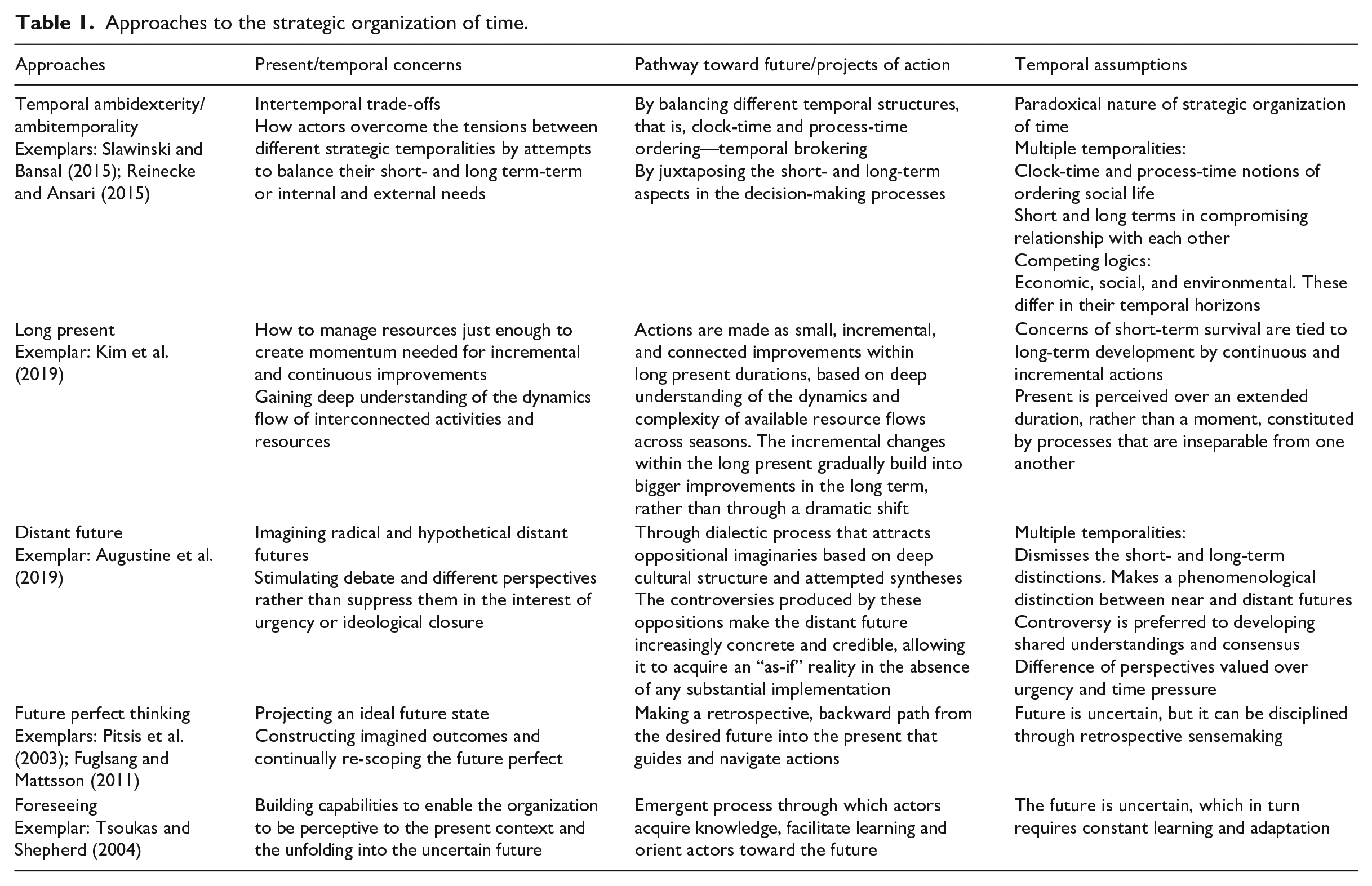
Understanding how organizational actors collectively orient themselves toward the future bridges strategizing and organizing (Bansal et al., 2019). Strategy is inherently temporal: organizational members engage with the future and make decisions in the present while building on the past (Bansal et al., 2019; Kaplan and Orlikowski, 2013). Practice- and process-based studies of strategizing have recently become interested in a phenomenological view of time, exploring connections between interpretations of the past, present, and future to develop useful strategic accounts (Burgelman et al., 2018; Langley et al., 2013). Research focuses on how actors form an understanding of the present, how narratives preclude certain futures and favor others, and how actors construct strategic accounts linking interpretations together as they orient toward the future. Table 1 summarizes approaches to the strategic organization of time.
Approaches to the strategic organization of time.
Retrospective and prospective approaches
In extant research, retrospective cognitive processes shape how actors collectively engage with future states and define new courses of action (Weick, 1979). Drawing on the early work of Schutz (1967), Pitsis et al. (2003) show how actors use “future perfect” thinking to construct a path of action toward a realizable future outcome. By projecting non-existent phenomena into an imagined future and then working backwards to the present, actors engage in a retrospective construction of paths that should be taken to achieve a desired outcome (Gioia and Mehra, 1996; Kaplan and Orlikowski, 2013). For future perfect thinking to be effective, however, actors need to know where they want to go. Retrospective approaches tend to downplay forward-looking cognitive work involved in planning and initiating strategic change in organizations, particularly when expectations or aspirations about the future are ambiguous or unclear, such as new product development (Stigliani and Ravasi, 2012). Recent advances in temporal theories of agency call for research to consider forward-looking thinking in collective settings (Ganzin et al., 2020; Garud et al., 2014). Building on foundations of “foreseeing” (Costanzo and MacKay, 2009; Tsoukas and Shepherd, 2004), research highlights our inability to comprehend an uncertain future and the need for organizational capability to address present circumstances and unfolding conditions. Actors engage in prospective work and creative imaginings of a desirable future state (Gioia and Mehra, 1996; Kaplan and Orlikowski, 2013) when there is no “objective past experience” to draw from, such as novice entrepreneurs in the start-up stage of a new venture (Ganzin et al., 2020).
Prospective approaches emphasize the role played by aspirational imaginations in collective envisioning of a desired future and how to relate to it (Gioia and Thomas, 1996). Many challenges confronting organizations today are concerned with the needs of current and future generations (Bansal, 2019). There is a growing interest in understanding how projected future end states—short- versus long-term temporal horizons—are framed in the context of multiple temporalities and competing present circumstances (Reinecke and Ansari, 2015; Slawinski and Bansal, 2015). Building on intertemporal tensions that occur when “the demands of today differ from the needs for tomorrow” (Smith and Lewis, 2011: 389), scholars have focused on how organizations align conflicting demands to guide future actions. For example, the concepts of temporal ambidexterity (Slawinski and Bansal, 2015), temporal brokerage, and ambitemporality (Reinecke and Ansari, 2015) were introduced to show how organizations in temporally complex domains perform balancing acts to address conflicting strategic demands. Kim et al. (2019), however, suggest that under resource constraints, actors reconcile intertemporal tensions through incremental and connected improvements within a “long present” duration.
Near and distant futures
Research on future-oriented action is primarily concerned with the feasibility of strategic choices aligned with past experience and with achieving consensus and a shared understanding of the goals required to coordinate and guide action (Hatch and Schultz, 2017; Pitsis et al., 2003; Stigliani and Ravasi, 2012). The assumption that future-oriented action is grounded in past experience and constructed in continuity with present-day conventions and beliefs is, however, ill-equipped to address how actors develop and engage with more transformative and utopian futures. In a study of geoengineering, Augustine et al. (2019) analyze qualitative attributes—the desirability—of future states and suggest that people relate to “near” and “distant” futures in qualitatively different ways. Distance refers to how close a future is to experience and convention (Liberman and Trope, 1998). Whereas practical concerns of feasibility predominate when actors engage with near futures, Augustine et al. (2019) argue that abstract features and belief systems associated with desirability are more important when actors construct distant futures. Their study describes a dialectic process showing how abstract ideas about the future become concrete through discursive attempts to reconcile diverging, oppositional imaginaries. Augustine et al. (2019) found that while the controversy associated with opposing imaginaries prevented immediate coordinated action, it had the effect of rendering the distant future of geoengineering increasingly concrete and credible. This process allowed a distant future to acquire an “as-if” reality in the absence of any substantial implementation, enabling people to orient their actions toward (or away from) this future (Beckert, 2013).
An underlying assumption in much of this research is that actors are motivated to achieve a desirable future. They orient their actions toward desirable, although not necessarily well-defined, future states (Gioia and Mehra, 1996), such as geoengineering solutions to mitigate climate change. Research on future-oriented action tends to study prolonged, unfolding futures when there is sufficient time for actors to develop tentative interpretations and reach a consensus and shared understanding of the end state (Kaplan and Orlikowski, 2013) or engage in debates about futures involving controversy and conflict, which inhibit immediate coordinated action (Augustine et al., 2019). However, prior research has paid less attention to understanding how actors envision desirable future states while seeking to prevent detrimental or calamitous outcomes.
Desirable and undesirable futures
The notion of “desirability” plays a central role in strategic organizational processes, such as scenario planning, designing strategic narratives, and prospective sensemaking (Bruskin and Mikkelsen, 2020; Gephart et al., 2010). Questions about how actors collectively engage with the future are central in contexts where expectations or aspirations about the future are ambiguous or unclear, or where there is no objective past experience to build upon (Ganzin et al., 2020; Garud et al., 2014). In such situations, actors engage in prospective and imaginative thinking to “structure the future by imagining some desirable state” (Gioia and Mehra, 1996: 1229; Kaplan and Orlikowski, 2013).
Prospective approaches emphasize the role of creative imagination in the construction of a desirable future (Gioia and Thomas, 1996), including projecting idealistic symbols and aspirational organizational images. Desirable futures arise in social processes expressing fantasy and fictional hypotheticals (Beckert, 2013) representing future possibilities as discontinuous breaks with present-day conventions and institutionalized beliefs (Augustine et al., 2019). Abstract, notional, and hypothetical characteristics of desirable futures allow imaginaries to be less continuous with present and to consider a plurality of alternative possible states, rather than clearly defined, immediate possibilities (Mische, 2009: 696). Envisioning desirable future possibilities is an impetus for action, even if the path leading to those projective possibilities remains unclear (Gioia and Mehra, 1996).
Desirable futures provide a sense of hope and emotional belief that “another world is possible” or that “things can be better” than what they are right now (Mische, 2009, 2014a). In this vein, forces of aspiration and hope lay the groundwork for transformative change in social structures and in individual thought and action (Mische, 2009). Baumgartner et al. (2008) distinguish between anticipatory and anticipated emotions. “Anticipatory emotions” describe the hope and fears actors experience in the present about something they feel might happen in the future. Uncertainty about what is likely to happen when engaging with a desirable future is an integral part of anticipatory emotions (Smith and Ellsworth, 1985). Associated with a significantly lower degree of uncertainty, “anticipated emotions” describe the way actors feel about a future that has happened. Actors imagine how they would feel—good or bad—if the imagined future event had actually occurred (Baumgartner et al., 2008: 686). When engaging with an undesirable future, actors may experience the emotion they would feel—at some future point in time—as if the devastating event that concerned them had actually happened (Abraham and Sheeran, 2003). Considerations of undesirable futures are based on the probability that such states will occur, rather than the possibility that they might occur (Baumgartner et al., 2008). Organizational members engage with the future based on predicting or forecasting of possible futures. Unlike projective work associated with desirable future possibilities, such anticipations are based on pre-factual thinking about imagined consequences (Wilson and Gilbert, 2003).
“Anticipated regret” describes the negative emotions actors feel when facing undesirable future events and recognize that the present situation could have turned out better had they acted differently (Zeelenberg, 1999). Anticipated regret contains a strongly retrospective aspect because it describes how actors look backwards from the future to guide present decisions (Zeelenberg and Pieters, 2007: 15). In cognitive psychology, anticipated regret is associated with the feeling of regret that follows inaction (Abraham and Sheeran, 2003). It captures the negative emotions actors experience when they compare the anticipated outcome of their decision not to act with the outcome they would have experienced had they acted (Loewenstein and Lerner, 2003).
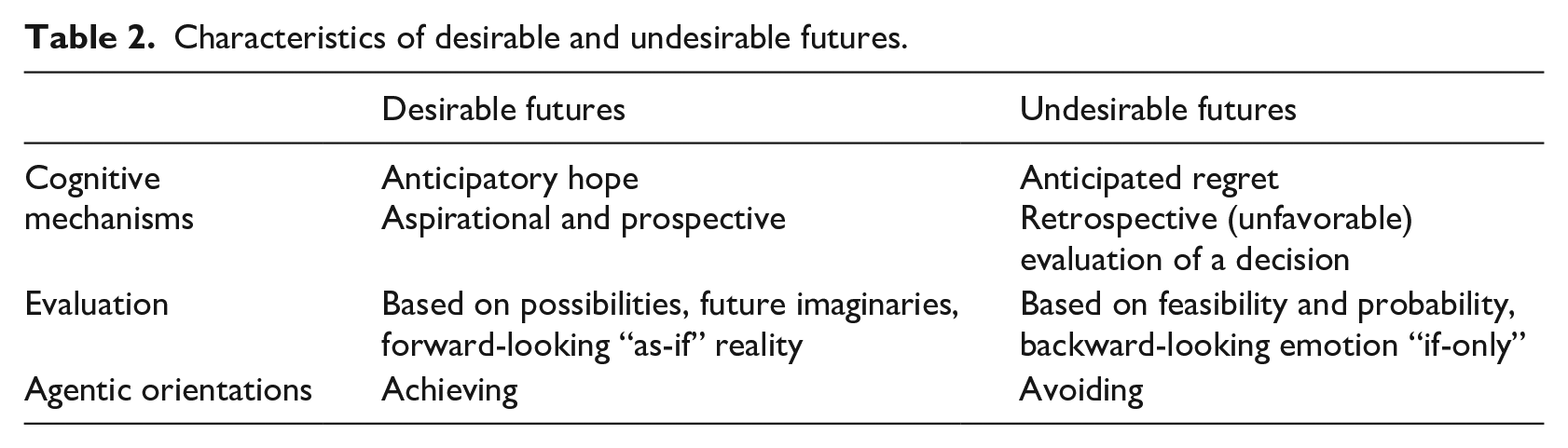
The intensity of anticipated regret experienced depends on the context of action and relative importance of the future outcomes. In contexts where outcomes are socially important, such as in nascent entrepreneurship and business start-ups (Baron, 1998; Hatak and Snellman, 2017; Roese, 2005), decision-makers are more likely to engage in anticipated regret and “if only . . .” patterns of thought (Roese, 1997). Generally, however, anticipated regret manifests as “a feeling for doing” and motivates actors to avoid experiencing the regret arising from a failure to act. Envisioning an undesirable future event impels actors to imagine how they might avert a negative outcome by deliberately evoking a sense of anticipated regret and increases the likelihood that preventive action will be taken to avoid it (Abraham and Sheeran, 2003). The characteristics of desirable and undesirable futures are described in Table 2.
Characteristics of desirable and undesirable futures.
In the case of the Palace of Westminster, actors were not initially motivated by the aspiration and hope of achieving a desirable future. Rather, it was the fear of a catastrophic failure (a major fire) and anticipation of undesirable future events (the ongoing dilapidation of the building) that motivated, shaped, and guided their actions in the first instance. Our findings show that desirable and undesirable end states are qualitatively different ways of engaging with and experiencing the future, and each is associated with distinct cognitive mechanisms. We argue that understanding the interplay between desirable and undesirable futures is important for strategizing and organizing and provides novel conceptual insights. However, the mechanisms guiding collective efforts to address and navigate different futures remain unclear. We therefore ask the following research question: How do actors construct a path forward when engaging with possible futures—desirable and undesirable—surrounded by uncertainty?
Methods
Research setting
Grounded in our interest in understanding the role played by the desirability of future states in temporal work, we focused on the highly uncertain early stage of strategizing in a large project. As described in the next section, our case study site is the R&R program of the Palace of Westminster. The R&R program preparations provided an unusual opportunity to observe temporal work in the very early stage in the inception of an organization’s life, when participants have a fuzzy, ill-conceived understanding of the problem and no formally agreed way of tackling it. The setting aligned with our interest in the projective dimension of human agency (Emirbayer and Mische, 1998), deliberation, and “hyperprojectivity” (Mische, 2009). Being involved so early in the project provided exceptional access and a unique opportunity to study future strategizing in temporal work. As initial ideas emerged, participants engaged in problematizing, explored the scope of work, studied the feasibility of future alternatives, and identified how to create a capable organization to deliver the program. The symbolic historical, political, and cultural importance of our case—reconstructing the home of British Parliamentary democracy—allowed us to gain a deeper understanding of temporal work when conditions are highly strategic, urgent, and uncertain.
Data collection
A real-time longitudinal study was undertaken between November 2018 and June 2019 by the first author and main field researcher, who spent an average of 2 days a week in the field. To build reliability and capture real-time “in the making” phenomenon (see Fachin and Langley, 2017), we drew from multiple sources: observations, in-depth interviews, archival data, and field material. Our database consisted of 45 interviews (three rounds), direct observation conducted in 50 consecutive meetings of the leadership team (typically 1.5 hours long), and ten strategy workshops (between 0.5 and 2 days in duration) consisting of all members of the leadership team. The first author attended guided site tours for program members and Parliamentarians and gathered archival and internal publications (including various program reports, presentations, and meeting agendas). Our research was supported by an extensive collection of independent media coverage, reports by industry experts and academics, and online publications (e.g. industry blog releases), comprising 60 different sources. These documents constituted the main source of data for the first period of the R&R program described in the findings section.
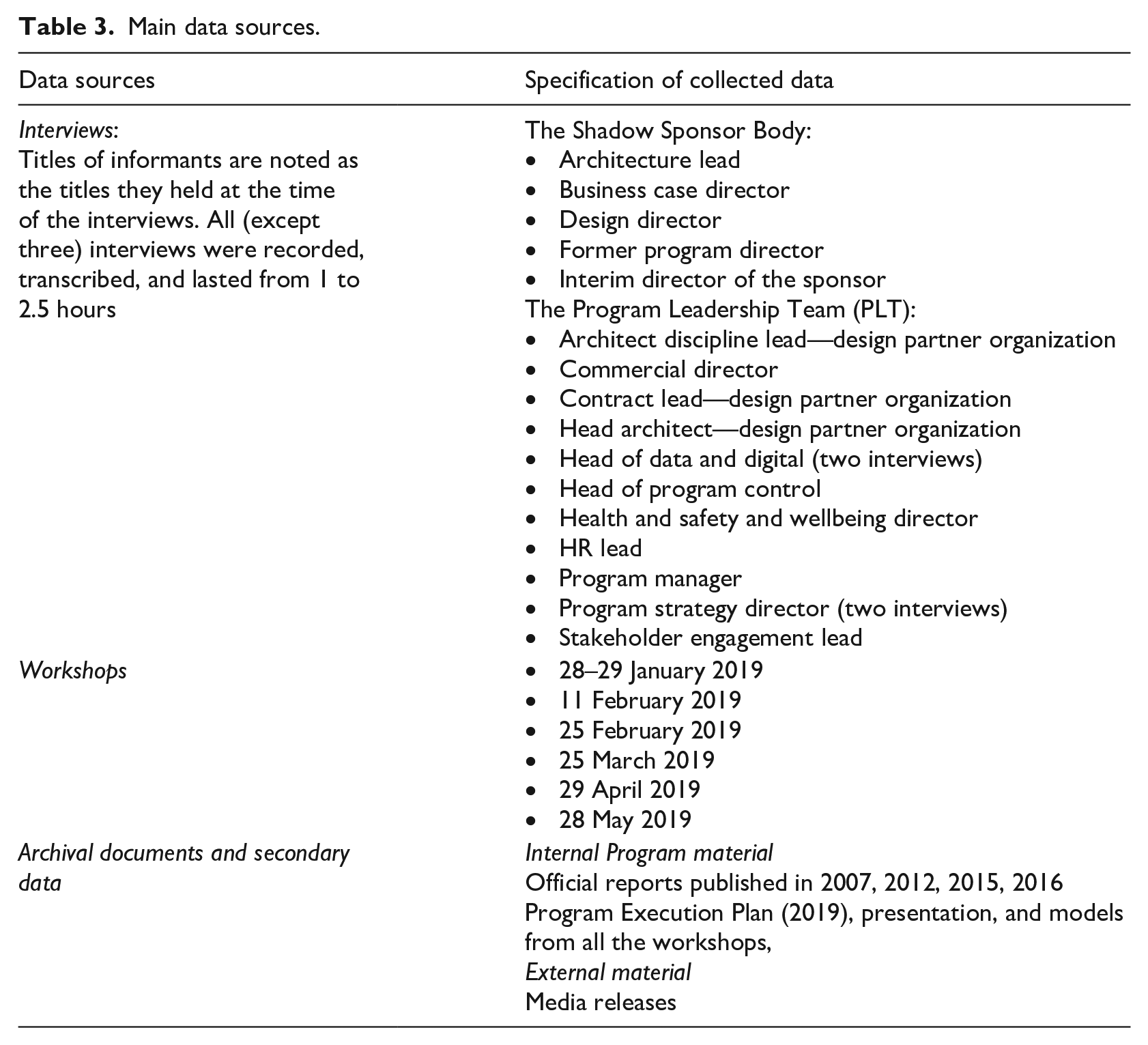
Data collection focused on how organizational members engaged with multiple futures over time. While the entire dataset served as a source for contextualizing our argument, we drew upon a detailed analysis of observational data where the future of the R&R program and organization was discussed and planned, including six strategy workshops and 18 of the interviews with the leadership team (Table 3). Informants represented the entire leadership team which doubled in size during the study. Whenever possible, we collected presentation material and photographed the practitioners engaged in assigned exercises. The first author gathered additional data, including presentations and other artifacts (exhibits, diagrams, lists, and figures), created by the participants during the workshops. Direct observations allowed the field researcher to study participants in situ with their peers, focusing on their discussions and conversational comments (Jarzabkowski et al., 2013). Our observations during the workshops and detailed accounts of the events obtained from the interviews enabled us to gain a deep appreciation of temporal work based on situated interactions (Langley et al., 2013).
Main data sources.
Data analysis
The research aimed to advance our understanding of how organizational actors collectively engage with desirable and undesirable futures and agree upon viable paths of action. The chosen analytical strategy was to develop theory by iterating between inductively generated data categories and theoretical constructs found in literatures on the strategic organization of time, temporal work, and social psychology of anticipatory and anticipated emotions. The analysis has been conducted in four consecutive phases.
In the first phase, we used temporal bracketing as a way of structuring the informants’ description of events (Langley, 1999). We produced a 110-page chronological case story, using interviews as the primary sources of data. For the “lead-up” to the inception of the R&R program in 2018 (before we commenced our data collection), we drew upon reports and documents to reconstruct key events. These accounts were complemented by retrospective interview data to help us connect various events in our narrative. This thick descriptive case captured the unfolding events of inception and development of the program in detail. Some themes reoccurred during the data analysis. Examples of such themes are conditions of “urgency,” referring to the time pressure with regard to action needed to tackle the issue of the crumbling buildings, and “uncertainty” regarding what the future of the Parliament should look like, which made envisioning and realizing futures difficult. The urgent and uncertain nature of the project formed the overall context for our study of temporal work and strategizing.
Inspired by our theoretical interest in future-oriented action in collective settings, in the second phase, we engaged in abductive analysis (Locke et al., 2008), iterating between the data analysis and broader conceptions of temporality and agency (Emirbayer and Mische, 1998; Kaplan and Orlikowski, 2013; Mische, 2009). Rather than relying on computer-based coding, we repeatedly read through all the notes, interview transcripts, and documents and hand-coded the data. Our analysis focused on how future-oriented action addressed the urgency and uncertainty surrounding the future of the Parliament. Observations from the workshops served as primary sources of data, while the interview data and documents were used to corroborate and deepen emerging interpretations. To develop the account presented here, we initially structured the data around main strategic activities to start the program. The 2-day workshop in January 2019, for example, was designed to encourage actors to apply “future perfect thinking” approach to the Program. With the support of interview data, we were able to observe how team members addressed different futures as the project evolved.
Temporal brackets defined the beginning and the end of three slightly overlapping periods identified in our findings (see Figure 1) and demarcating events identified the occasions when team members discussed new future-oriented approaches. In period 1, participants created a collective sense of urgency by stressing that “something needs to be done” to avoid a “catastrophic failure,” such as a major fire. As we will see, these concerns and efforts were instrumental in the formal approval and inception of the R&R program. However, in period 2, we noticed a shift in direction, when participants began to engage with imaginative and projective work to envision a Parliament that was “fit for the future” and to develop a strategic account to achieve that desirable end state. In period 3, we observed how actors constructed a “canvas” and “platform” that enabled them to move forward in the face of uncertainty by relating to future possibilities.
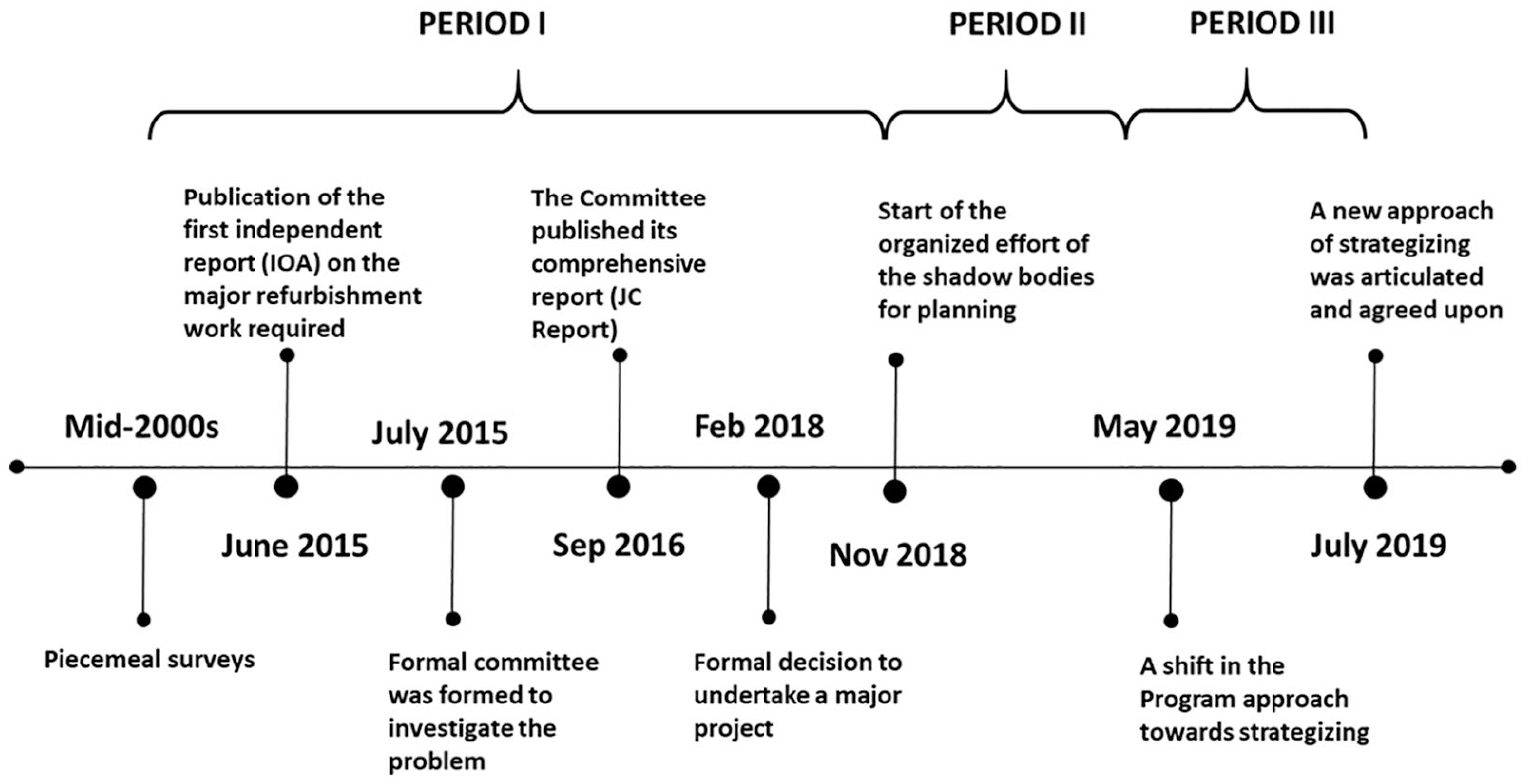
Timeline of the main events—temporal bracketing.
In the third phase of our analysis, we developed our coding scheme by continuously consulting the literature on the strategic organization of time. Recent work on intertemporal tensions and temporal ambidexterity (e.g. Reinecke and Ansari, 2015; Slawinski and Bansal, 2015) and the qualitative distinction between distant and near futures (Augustine et al., 2019) inspired us to reflect on our data in terms of different future possibilities and how actors relate to them, and recognize the interplay between desirable and undesirable futures. However, our review of prior studies convinced us that there was a need for further conceptual development to identify the specific cognitive mechanisms attributable to the way in which team members engaged with the qualitatively different conceptions of the future. Drawing on insights from social psychology literature (Abraham and Sheeran, 2003; Baumgartner et al., 2008; Zeelenberg, 1999; Zeelenberg and Pieters, 2007), our interview data were filled with passages where actors’ descriptions of the situation and events corresponded to anticipated regret as an underlying mechanism. We identified the relationship between desirable futures and anticipatory emotions (such as hope) as a cognitive mechanism underlying projective efforts, informed by the work of Mische (2009, 2014b). Drawing our theoretical conjectures and emerging empirical observations, we filled a gap in extant research by identifying two mechanisms that guided temporal work: steering away from an undesirable future and orienting toward a desirable future.
In the fourth phase, we developed a more systematic and fine-grained conceptual analysis of how organizational members engaged with undesirable and desirable futures. We went back to the data and found temporal work in our case as situated activities that followed a dialectic process when actors attempted to resolve underlying tensions between the degree of abstraction required to imagine alternatives possibilities to present-day social reality (e.g. Augustine et al., 2019; Beckert, 2013) and degree of concreteness and particularity that made action possible (e.g. Kaplan and Orlikowski, 2013). An analytical framework consistent with the spirit of pragmatism and application of temporal construal theory in organization studies emerged. This framework allowed us to uncover three main practices associated with efforts to address the desirability of the future and move forward under conditions of uncertainty: constructing a shared sense of urgency, expanding a diverging set of future possibilities, and developing the collective capacity to understand complex tensions. As these categories emerged from the analysis of the data, we assembled and integrated these insights into a conceptual model that captured how actors collectively understand, link, and navigate between desirable and undesirable futures. Figure 2 illustrates how we analyzed and connected our findings to conceptual constructs.
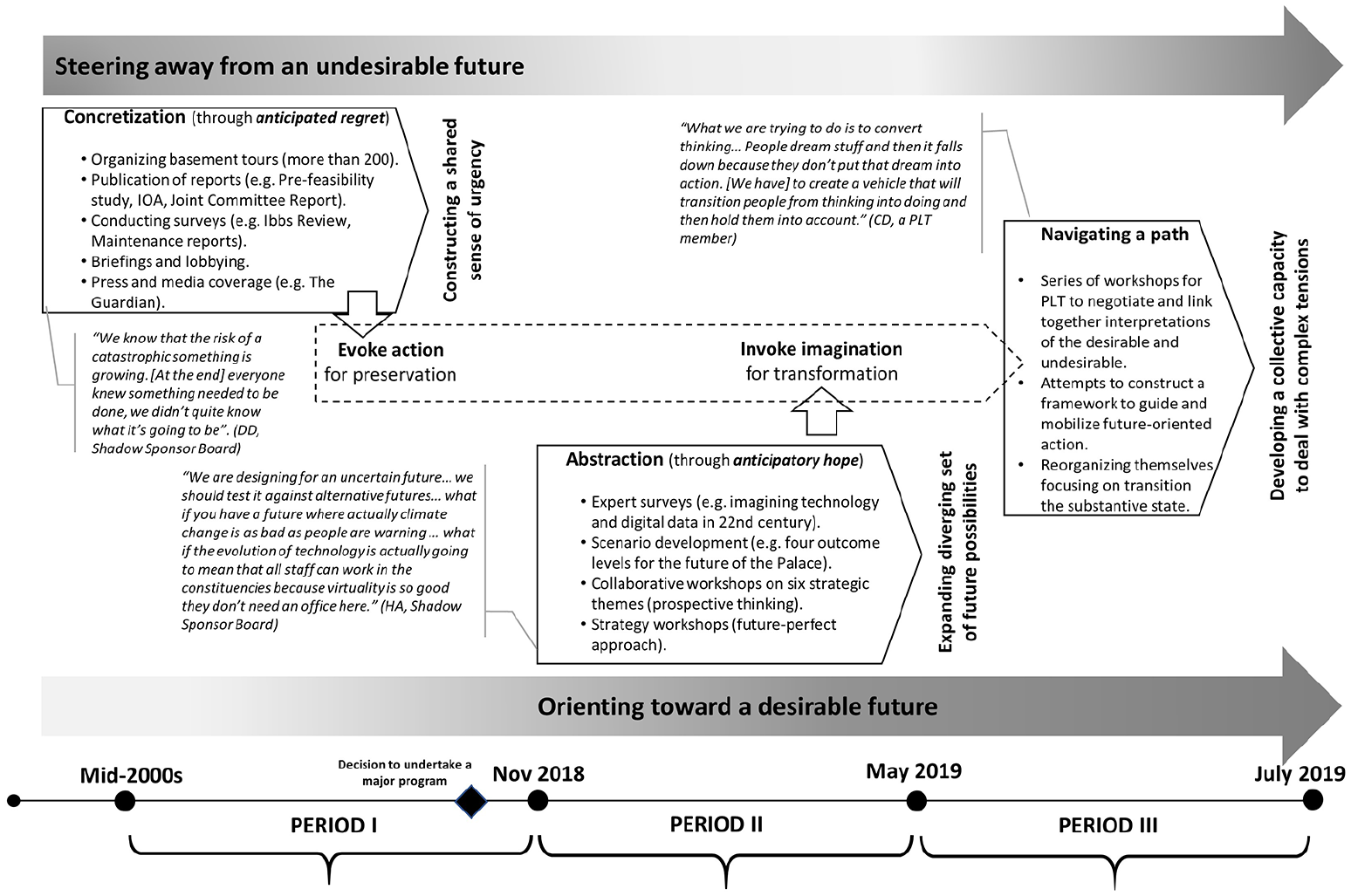
Conceptual structure of our findings.
Introduction to the case study
The Palace of Westminster is not only the home of Britain’s Houses of Parliament, it is also a global tourist attraction and an iconic symbol of the United Kingdom. Although some of the original buildings date back to the late 11th century, the Palace became the seat of government and permanent home for Parliament from the early 15th century. Its reputation as one of the world’s most famous and distinctive historical buildings was recognized when it was granted the status of Grade I UNESCO World Heritage site. The neo-Gothic structure of the Palace of Westminster constructed after the 1834 fire was designed by Sir Charles Barry. Despite its grand external appearance, however, the inside of the Palace building has experienced a long period of decay. There has been no significant renovation of the Palace building since a major reconstruction was undertaken after the bombing of the Chambers during the Second World War. From the 1990s, various investigations, feasibility studies, and parliamentary inquiries—such the Ibbs Review (1990)—warned of a “looming crisis” associated with the general disrepair and ruinous neglect of the building.
Despite the well-documented need for modernization of the Palace by the early 2000s, the question of whether or not a major restoration should take place remained controversial. Those against the refurbishment were concerned about wasting taxpayer’s money when other public projects might be more worthwhile or worried that any delay would leave Parliament located semi-permanently outside the Palace. Those in favor of major works were not just concerned about preserving the building’s heritage status or protecting it from calamity, they believed reconstruction was an opportunity to radically transform Parliament and make Britain’s political culture ready for the 21st century. Irrespective of whether they were against or for a major refurbishment, those involved wanted to avoid any disruption to a building that had been the home of Parliament for centuries. By the 2010s, a growing number of Parliamentarians recognized that the situation could no longer continue. Something needed to be done to restore and modernize the building. The risk of fire was now so great that a fire-safety team patrolled the Palace, day and night, all year round in search for signs of smoke or flames. There were at least 40 reports of fire between 2008 and 2012. As one Member of Parliament (MP) put it, “. . . it is time we got a grip and made a decision. I do not mind what the decision is in the end, but make a decision we must, surely to God.”
In January 2018, Parliament voted for the “R&R” and agreed that both Houses of Parliament would entirely move out—or “fully decant”—and return on completion of the work. The vision for the program, which received Royal Ascent and became an Act in October 2019, is “to transform the Houses of Parliament to be fit for the future as the working home for our Parliamentary democracy, welcoming to all, and a celebration of our rich heritage” (National Audit Office, 2020: 18). Emulating the approach used to deliver the London 2012 Olympics and Crossrail (London’s new inter-urban railway line) construction programs, Parliament agreed that a two-tier governance structure—with a Sponsor Board and Delivery Authority—should be established when the program become “substantive” (also referred to as a statutory state). Whereas the Sponsor Body would have overall responsibility for the program, setting strategic objectives and overseeing the work, the Delivery Authority would develop the design, cost, and schedule, procure contractors, and manage the program. The Sponsor Board was formally established in April 2020 and the Delivery Authority set up as a limited company in May 2020. As soon as Parliament’s intention to legislate became clear, the two organizations were established in “shadow” form to prepare for the launch of a large and complex multi-billion pound program lasting many years.
Our study was motivated by the need to understand how members of the shadow organizations worked collectively to find a way of navigating toward a successful future outcome while avoiding unfavorable events or happenings. Responsible for creating an organization with the capabilities to deliver the program, the joint shadow team faced numerous choices about how to prepare for a future shrouded in uncertainty. Members of the team had to plan for the substantive phase when the outcome—a building fit for the 21st century and beyond—had not been finalized. They had to arrange to move the Houses of Parliament to another location and prepare for a major refurbishment of the Palace while having little or no clarity about the future purpose, design, and use of the building. Yet the poor condition and increasing risk that a major fire could delay the program and disrupt the parliamentary process itself created an intense pressure and “sense of urgency” (Granqvist and Gustafsson, 2016) to accomplish the preparatory work as quickly as possible. Conflicts and differences in opinion had to be overcome to reach a shared understanding of the problem and agree on how to proceed.
Findings
The findings presented in three sections illustrate the main periods of strategizing, distinguished by the temporal focus and navigational efforts to steer clear from of disruptive events and achieve a desirable outcome. The first period describes how a shared sense of urgency encouraged actors to focus on avoiding an undesirable future, including the fear of failure and a major disruption to Parliament. In the second period, organizational members imagined desirable future outcomes and worked backwards to identify the paths required to achieve them. The third period describes how actors moved forward when the end state remained unclear.
Period 1: avoiding disaster
By the 2000s, there was a growing recognition that the Palace was no longer fit for purpose. Drawing on over a decade of evidence and reports arguing for major works, the Management Boards of House of Commons and House of Lords published a Pre-Feasibility study in 2012, which called for the R&R of the Palace. The study investigated the feasibility of a major reconstruction of the building, outlined possible options, and recommended that a full decant of Parliament was the most viable approach. Although the study was not effective in mobilizing politicians and governing bodies into immediate action, it did provide important evidence and arguments for a subsequent report—the Independent Options Appraisal (IOA)—published in 2014, which outlined the strategic case for the R&R and presented fully costed “hypothetical” scenarios for various delivery options.
Those in favor of a major refurbishment had to attract support for the R&R program when a number of politicians and senior parliamentary staff remained actively opposed to it. Many had a strong emotional attachment to the iconic status of the building and remained unconvinced that a decant to another building was necessary while a refurbishment program work was underway. Therefore, the House authorities called for a more concrete investigation to address the difficulties involved.
In July 2015, a formal “Joint Parliamentary Committee on The Palace of Westminster,” consisting of members of both Houses of Parliament, was established to conduct a comprehensive study of the building. Drawing upon prior experience and legislative work, the committee realized that little or nothing would happen unless they were able to create a sense of urgency and momentum behind the proposed plans. The committee organized a series of briefings and presentations to provide evidence for the program of work, including taking politicians, senior staff, and other key stakeholders on tours of the basement of the building. By showing people the actual state of the building’s disrepair, the committee was able to raise awareness and promote the immediate need for a major undertaking. The “basement tours” became a regular and crucial part of an ongoing campaign to renovate and renew the Palace buildings. But it took time to attract support as there were several changes in the UK Government between 2016 and 2019. The committee effectively had to start all over again when briefing new Government ministers and advisors. During our field work, the first author joined one of the basement tours in 2019. After witnessing the state of the basement, tour participants recognized how dilapidated the building had become: “I used to be a coal miner and the heat down there reminded me of that,” or “this looks like catastrophe waiting to happen,” and “why is it taking you so long to start the program?”
In its report published in September 2016, the Joint Committee emphasized that there was a clear and pressing need to tackle the backlog of work to the Palace in a comprehensive and strategic manner. Efforts to make the building safe and secure were analogous to “trying to fill a bathtub with a thimble while the water is draining out of the plughole at the other end” (Joint Committee on the Palace of Westminster, 2016: 30). Recognizing that a “doing-nothing” approach was no longer feasible, the report identified five options for the R&R program. The two decant options recommended moving both Houses of Parliament and their staff into temporary accommodation not far from the Palace. The Joint Committee’s report was a galvanizing moment for the inception of the R&R program because it showed for the first time that the work could be accomplished without disrupting the work of Parliament. The report also suggested a two-tier governance structure (Sponsor Body and Delivery Authority)—similar to the arrangement used for recent high-profile projects in the United Kingdom.
Attempts to gain approval for the R&R program were motivated almost exclusively by the need to protect and preserve the Palace. There was a growing acceptance that it was becoming increasingly unsafe and in need of urgent repair. As one director explained, insufficient attention was paid to identify desirable outcomes for the Palace in the 21st century: “we knew something needed to be done, we didn’t quite know what it’s going to be.” As another director put it, We don’t think the building is not safe. The risk is to the continuity of the Parliamentary business. So a few weeks ago, we had a water leak in the Chamber and we had to stop the sitting; that kind of thing is happening more and more often. It will continue to get more and more frequent. Now, if you think of the political circumstances we are in, where you get these absolutely mission-critical Brexit votes. There will come a day that we will have the final vote on Brexit and it is a deal or no deal. If the sitting has to be suspended, if the House has to be stopped because there is fire, or a flood or because the power goes out, that’s a national disaster.
Soon after the publication of the 2016 Report, the press and media added impetus to the growing momentum for the R&R program to proceed as rapidly as possible. In December 2017, for example, The Guardian noted that the Palace buildings were at risk of catastrophic failure without extensive refurbishment, urging MPs to take action (Higgins, 2017). After a delay due to prolonged Brexit negotiations and an unexpected snap General Election, the situation was finally resolved in January 2018 when the House of Commons voted (by a majority of only 16 votes) for both Houses to fully decant during construction and return on completion of the work. Those who voted against the R&R program emphasized the huge costs of a major refurbishment and were uncomfortable with moving Parliament to another location, while those in favor emphasized the risks of a “looming disaster” and “catastrophic failure.” As custodians of the Palace buildings, parliamentarians felt a sense of responsibility for future generations and the need to make the building fit for the 21st century and beyond. After the approval of the R&R program by the House of Lords in February 2018, work began on establishing the shadow bodies responsible for R&R program preparations.
Those promoting the R&R program during the first period created a collective sense of urgency that work had to proceed quickly to avoid an impending disaster. The combination of a fear of failure and duty of care for the future home of Parliament stimulated a feeling of anticipated regret and need to avoid an undesirable future. The pressure that “something needs to be done” resulted in the R&R program and a need to establish a two-tier governance structure to manage and oversee the endeavor.
Period 2: imagining a desirable future
Established in 2018, the shadow sponsor body comprised Parliamentarians and senior staff representing the interests of the House of Commons and House of Lords. It was responsible for appointing the shadow delivery body, including formerly Building Design Partnership (BDP), an architectural practice, Jacobs, a large program management firm, independent consultants, and an in-house team including architects, engineers, heritage, and conservation experts and maintenance staff. The two shadow bodies were jointly responsible for establishing substantive organizations with the capabilities needed to start delivering the program in 2020.
The Palace building had to be designed to adapt to the future needs and requirements of Parliament. BDP carried out a survey and asked leading experts about the technologies likely to be incorporated in the building in the future. A senior manager described the results of the survey: We asked them: what is your area going to look like in the 22nd century? What we found in technology and digital data, people could only look into about 5 to 10 years ahead, beyond that is just really speculation, and certainly beyond 15 years is really speculation. There are lots of concepts out there that may happen, but they may not happen, so actually working out what the future is going to look like is really difficult. It is very easy to illustrate that because you think back 15 years, the smartphone hadn’t arrived and it completely transformed the way we live and work. The next technology is not going to be a better version of smartphones, it is actually going to be something else, and we don’t know what it is. So it is really difficult to design for that.
Guided by the Royal Institute of British Architects (RIBA) Stage I Plan of Work, 1 BDP established “the desired Project Outcomes” by referring to previous and similar projects and gathering information by undertaking site appraisals and collating site information (e.g. building surveys). During a series of workshops, led by BPD and members of the shadow bodies, participants were asked specific questions about how future aspects of the design aligned with the strategic themes of the program. Participants in the workshops developed four “outcome levels” from levels 0 to 3. Outcome Level 0 was the “base case” required to maintain the current state. Outcome level 1 referred to the strict minimum requirement “needed” to improve the state of the place. Outcome level 3 identified the maximum improvement imaginable. While participants were easily able to describe outcome levels 1 and 3, they found it more difficult to envisage outcome 2—Parliament renewed—because it described a feasible, realizable, and yet aspirational end state.
The shadow sponsor and delivery bodies occupied the same building near the Palace and were directed by the PLT. The PLT appointed senior members of the shadow bodies to lead the program and leverage their vast experience and knowledge of large complex projects. Since there was limited time before the shadow bodies would become substantive, the PLT was under intense pressure to define the R&R program structure and objectives. Although PLT members had extensive knowledge and experience gained on other major UK programs, they struggled initially when preparing for the R&R program because the outcome and arrangements for achieving it were so unclear. The PLT, therefore, focused on understanding what a desirable future might look like to help direct their preparatory work. Project plans, work-breakdown structures, program risk assessments, reporting policies, and other processes were produced to prepare for the substantive R&R program in 2020. In practice, however, this work often simply replicated what had taken place on previous programs, rather than making the adjustments required to address the specific challenges and context of the R&R program.
The sponsor held collaborative workshops between Summer 2018 and Spring 2019, bringing together Parliamentarians and senior members of the shadow bodies, to gain a greater appreciation of the purpose and future direction of the program. Guided by the R&R vision statement to create a Palace that was “fit for the future,” participants in the workshops developed six strategic themes: “Time & value for money,” “Sense of History,” “Functionality and design,” “Health, safety and security,” “Accessibility and inclusions,” and “Sustainability.” These attempts to reach agreement on the purpose and desirable end state of the program helped to inspire, motivate, and direct the preparatory work undertaken before the program became substantive. Participants were invited to imagine more concretely what a desirable future Palace might look like, using various creative practices to interpret, articulate, and produce a clear image of the program end state. They were asked to answer specific questions such as “What message should the design convey about the future of Parliament?” They were encouraged to create a bold and innovative vision of the future (as the Victorians had done in the 19th century) while protecting a landmark building that had played such a symbolic role in British history.
There was considerable discussion and some disagreement among participants about how much the design of the Palace should remain faithful to the mid-19th-century structure and what parts should be radically transformed for the 21st century. According to one participant, the design should be based entirely on Sir Charles Barry’s original neo-Gothic design to maintain the heritage status of the building and all features added since then (such as the renovation after the Second World War and new catering facilities) should be removed. Another participant disagreed, arguing instead that “there seems to be a strong sense of right and wrong. The right building seems to be the original design and anything added to that over the decades is wrong.” He challenged the assumption that the original design is more significant than those features that had been added and constructed in the intervening years to adapt to the changing role of Parliament. As a result of this discussion about “age and significance,” participants decided that clear criteria based on the functionality and purpose of Parliament fit for the 21st century had to be developed to decide what parts of the original building need to be preserved or renewed. They faced the challenge of finding a balance between identifying the future requirements of the building while protecting its heritage status and preserving its “sense of history.”
Physical analogies were used by participants in the workshops to highlight features of each strategic theme, such as a “Duracell Bunny,” to represent the long-lasting and iconic features of the Palace and an “ornate jewellery box” to represent immense value, fixed space, and potential for improving the Palace buildings. Participants played with the wording of each theme to generate synonyms, alternative meanings, and new images of program objectives. They drew pictures and sketches to stimulate thinking about the future of the program, such as how to improve accessibility, while preserving the heritage status of the building. Such images, interpretations, and solutions were discarded or selected, revised, and refined during workshop discussions and participant interactions.
Participants in the various workshops developed categories and statements to describe envisioned futures for the R&R program such as “create a secure, efficient, flexible and accessible workspace for now and future proofed,” “recognize the value of the building and its heritage collections by safeguarding, conserving and enhancing,” or “optimize the environmental impacts.” Articulated in an abstract way, however, such statements were unable to provide clear, specific, and practical guidance for those preparing for an outcome that should endure for at least 150 years without requiring another large-scale refurbishment. Some of the categories developed by participants (e.g. “restorative maintenance”) attended to more immediate or near future needs, while others reached into the distant future, such as BDP’s study of new technologies.
Following one of the monthly strategy meetings organized by the PLT, participants engaged in a “future perfect strategizing” exercise. Referring to what worked well in the London Olympics 2012 project, participants were encouraged to think beyond their present priorities, using future-perfect thinking to imagine a successful end state when the refurbished Palace would be “fully open for business and used by stakeholders.” Working backwards from a desirable future, they were asked to identify the particular course of action needed to achieve it. Participating in groups of four to convey their thoughts and ideas on flipcharts, members of the PLT were reminded to keep the preferred end state in mind as they attempted to identify the course of action required to achieve it. According to one of the directors, the exercise was the first opportunity for members of the PLT to engage in open and less formal conversations about the tasks and responsibilities of those involved in the R&R program. The facilitator responsible for leading the exercise was surprised about the plurality of views, varying assumptions, and diverging interpretations developed by participants. Whereas one participant wanted to narrow down options identified by the groups, others wanted more open and expansive discussions about the difference between “outputs and outcomes” or “transition and transitioning.” Futures differed in terms of the nature of the work (e.g. classifying assumptions based on restoring the old and constructing the new builds), function of the various spaces in the buildings (e.g. education facilities and meeting places), and governance required to deliver a desirable future (e.g. the clarity of the governance structure and capacity of the supply chain).
In this structured exercise, groups were asked to narrow down their various interpretations and convert them into a few “manageable” categories to address the scope and requirements, business case and funding, and design and delivery of the program. They placed the categories in chronological order and developed “conceptual models” to understand how the categories fitted together, and identified processes and schedules for achieving the desired end state. One model depicted a linear process with a clear start and end point of scheduled work, while another visualized a spiral, three-dimensional (3D) process with “iterative cycles” of work to deliver the program (see Figure 3). Most workshop participants believed that the cyclical model (on the left in Figure 3) provided the most accurate representation of the R&R program. However, one senior manager was less impressed by this 3D model which he said “is a fine representation of our real-time activities, but I cannot represent it, it is too abstract.” Some other participants also wanted greater clarity to assist in the planning and definition of program tasks, with clearer start and end dates.
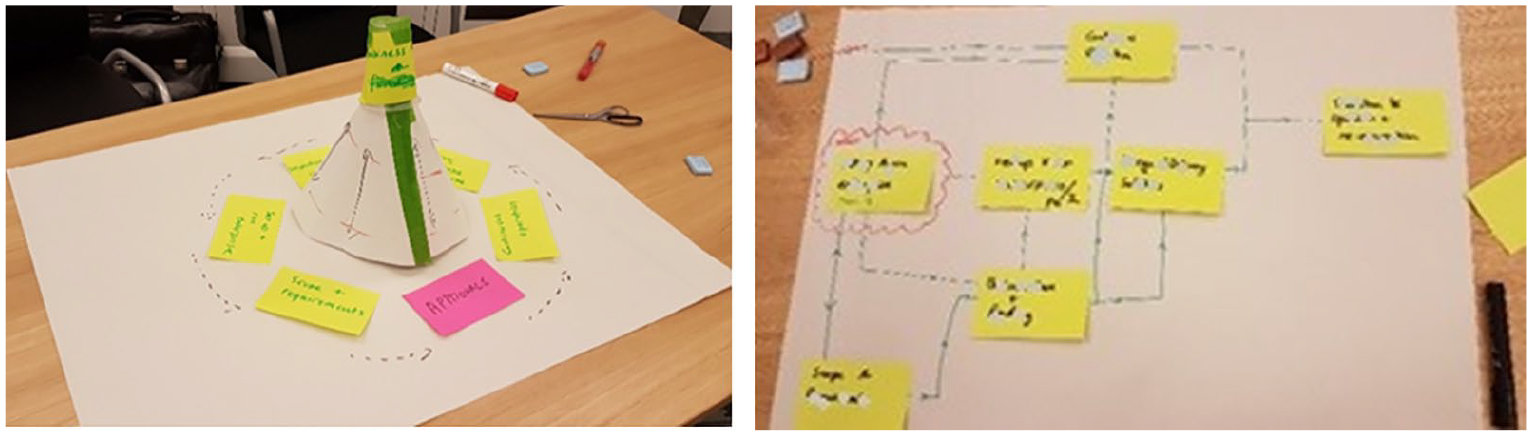
The PLT members developing and visualizing three-dimensional process with “iterative cycles” of work (left) and linear process (right) to deliver the program.
After a few rounds of discussion, workshop participants recognized that there was little agreement on the desirable future and the tasks required to achieve it. A director offered this reflection on the session: We found this exercise extremely difficult, all matters are completely subjective. We concluded that we need to progress on RIBA I. We don’t have enough information in this exercise. We are struggling to find consensus. Each of us has their own understanding of it. As a group we concluded that we need to complete RIBA I to give us more information about the building. We need some scoping activities written down; identifying the point in time when we may have enough information to do this exercise again.
Although work during this second period was undertaken to imagine possible desirable futures for the R&R program, participants could not reach an agreement because their interpretations were too subjective, fragmented, and insufficiently concrete to guide what needed to be done to achieve it.
Period 3: navigating a path
During the third period, from April to June 2019, the PLT and members of the shadow bodies shifted from focusing on the desired future to developing a shared understanding and reaching a consensus on how to actually transition to the substantive state. Many believed that the nature of the task and capabilities required to execute the program had not been fully appreciated. As one manager explained, we were “a bit floaty, it’s a bit fluffy, and a bit hairy-fairy and we have got the project team of people that are ‘go, go, go, go, go’.” The conventional “let’s just get on with it” approach assumed that the problem facing the shadow bodies was understood as “what is the task and how can we deliver it?”. However, senior managers now recognized that they faced the more fundamental challenge of cognitively reframing the problem and figuring out “how can we know what the task is?” and only then organizing the work to achieve it.
Early on in this period, an entirely unexpected event raised the profile and urgency of the R&R program. The fire that devastated the cathedral of Notre-Dame de Paris, one of France’s most famous buildings, on 15 April 2019, reinforced the belief that work on the Palace was urgent if a similar catastrophe was to be avoided. The need for remedial action to protect the Palace was discussed extensively in Parliament and the British media. As the Leader of the Opposition clarified in Parliament, You see beautiful buildings like that and think of the beautiful buildings we’ve got in this country. If any of those were destroyed in fire, how would we feel about it? (Elgot, 2019)
Parliament approved legislation to avert the possibility of a catastrophe on this scale destroying the Palace by bringing forward the formal approval dates required to substantiate the Sponsor Body and Delivery Authority as independent entities.
A belief that a change of approach was required to deal with the earlier commencement of the program became apparent in several meetings of the PLT held in April and May 2019. To get things moving, the PLT organized workshops to develop a strategic framework that comprised program workpackages and schedules. Participants were encouraged to listen to each other’s perceptions, transcend divergent opinions, achieve a common understanding, and build the consensus required to agree a way forward. The outcomes of the workshops were codified and used to guide the actions of the substantive bodies during program delivery. As one participant observed, [The program] conceptual outcome is progressive, ambitious, data driven, [based on] whole life value of the project and its long-term impacts. We talk about all that but we don’t have a common view of what it means, we don’t have a plan to achieve it. . . So, how is that going to go well unless we organize ourselves properly to be ready to deliver what we think we want to deliver. We don’t have consensus at the moment of what that looks like.
In a half-day PLT workshop held in May 2019, program leaders were encouraged to think of multiple futures, including their hopes, fears, and aspirations for the program. By orienting their thinking in terms of the interplay between desirable and undesirable futures, participants were able to develop a strategic framework including an overarching workstream, comprising nine interrelated workpackages, to achieve a “substantive state.” They created a two-dimensional figure to visualize and develop the content of the workpackages. One dimension addressed what had to be accomplished to avoid an undesirable future by sustaining the operation of Parliament for over 150 years without disruption. The other dimension identified six strategic themes and the program’s aspirations to achieve a desirable future. The content of each workpackage, placed at points where the two dimensions intersected, was developed by challenging existing assumptions about the attributes, uses and functions of the building (e.g. building services, heritage, and education facilities), and possible sources of failure. Participants identified a variety of categories, such as “next generation building services,” “restoration work,” and “new construction.” The “owner fit for purpose” category, for example, identified how to avoid failures in existing building operations in the future. This work helped participants understand how aspirations to achieve the program’s strategic themes at a future date had to be located in present circumstances, such as the capabilities required for “defining and validating” and “exploring and conditioning” the work.
In a process of constantly switching orientation between current and future states, participants in the workshop were able to achieve a shared understanding about the capabilities required to undertake the work defined as a set of workpackages. The importance of the new approach was underlined when participants said that that the strategic framework provided a “vehicle,” “canvas,” “platform,” or “machinery” to deliver the program in a highly complex, contested, and uncertain environment. Avoiding the temptation to prematurely narrow down and freeze the plan, participants believed that the strategic framework would be sufficiently open, adaptable, and responsive to unexpected circumstances and changes in future conditions.
Around the same time, members of the PLT agreed on the following definition (noted in an internal document) of the substantive state: “the levels of organizational maturity required to discharge all obligations placed on the respective entity.” Constructing a shared understanding of what was required to become substantive became apparent during PLT meetings as participants with diverse and often conflicting perspectives began to interact, voice their concerns, and articulate their preferences. The following conversation between two members of PLT during the strategy meeting in May 2019 illustrates the process:
“I am still struggling with the plan to get to the Substantive state versus the plan to get to what the job [end-state] is.”
“There is a piece of work to define what’s the job and then there is a piece of work to configure the organization that can deliver the job. They have recursive relationship.”
“Can you explain it again, because I am really struggling with it.”
“If all you did from the substantive point of view is to create a vehicle and you pay no attention to the payload. . . [T]he configuration of the job is dominant, the configuration of the vehicle is secondary. And we constantly getting ourselves wrapped up [in the latter]. . . what is the actual job?”
“So what I don’t get about the workstreams, what’s dominant in them is that how we get the vehicle, but not really what the job is.”
“Let’s suppose that in order to define and validate that what you are achieving what you need to do with respect to [heritage], what you need is the whole team to do that. There is a head of restoration and the head of restoration will say ‘I will tell you what refurbishing a historic building looks like,’ and . . . there are two things at the same time, one is what the work stream looks like and the other the reason why it looks like that: because that’s what we are trying to do. [For example], we don’t want only to refurbish and restore, but our aim is to keep it like that for a long time. That means that the people who are using it have to look after it properly, so that informs what the workpackages [in this case setting up a capable sponsor organization] should be about.”
Engaged in this process of reflection and collective sensemaking, the PLT gradually integrated, refined and agreed upon the strategic framework required to achieve a substantive state. As a senior manager explained, a strategy was created to “render thousands of discrete events in a systematic way into an agreed position” and enable them to initiate the program under severe time constraints. The same manager clarified, It isn’t the case of we are building the railway and the only thing you have to deal with is where the stations are going to be and after that it is just a railway. It is a very nuanced and inter-connected challenge to accommodate the things that are in tension or the things where people have different views. You need a machine for that. It doesn’t matter what the outcome is as long as it is sound.
The PLT had originally assumed that the Sponsor Body was solely responsible for envisioning the intended outcome, specifying the scope and identifying the objectives of the R&R program, whereas the Delivery Authority was responsible for organizing to execute the program as planned. But given the ambiguity surrounding the two-tier structure of the program, the PLT recognized that a more collaborative approach was required and informally agreed to dissolve the pre-defined boundaries and merge the two bodies into a single, co-located management team for the remaining period. The PLT believed that this collaboration was necessary to achieve the shared understanding, clarity of purpose, and focus required to transition the substantive state and prepare for program delivery.
Rather than think of multiple futures in terms of discrete, independent outcomes—such as catastrophic failure, the minimum restoration to maintain Parliament, or maximum possible work for the renewal of Parliament—members of the co-located shadow teams began to identify links among the possible futures. They converged on a common perspective of the future as a “single track”: a continuum from the undesirable to the desirable future, connected by fear of a failure, the need to maintain the heritage of the Palace, and the aspiration to progress to a desirable future. The shift from discrete, fragmented interpretations straddling multiple futures to an aligned, shared, and processual view helped members of the PLT to prepare for the future in the absence of concrete program plans. One of the senior design directors made the following remark: So [fear of failure] gets you to a point, you then have to engage with this diverse group of people [. . .]. There is a fear bit and then there is a need bit, which is: it’s got to be accessible, it’s got to be serviced properly, it’s got to be fire-proof. So the easier next step is to take people through a needs-based approach, to create a building for future you need to do as a minimum this, this, this, and this. And then beyond that you get to the aspirational bit, which, there is sort of an essential work and then there is a discretionary bit, and the discretionary bit is clearly the most contentious where you get [hundreds of] different opinions potentially. So you got to get passed the fear bit, go through the needs-based bit and then get to the aspirational bit, which is more discretionary and then that is, we’re in the middle of that process basically.
By the end of the third period, the co-located shadow team gradually constructed a shared understanding of how to prepare for the future and found a way of steering course by seeking to avoid undesirable situations and events and striving to achieve a desirable outcome.
Discussion
This study examined the early stage of strategizing in the case the R&R program to understand the role of future desirability in temporal work. In the remainder, we develop a conceptual a model and advance theory by suggesting how desirable and undesirable futures can be addressed in research on temporal work.
A model of future desirability in temporal work
While engaging with the future is often portrayed as a process of achieving something desirable, our findings show that efforts to avoid an undesirable future played an important role in freeing up resources and mobilizing action. We present a model of future desirability in temporal work to identify how actors construct, link, and navigate interpretations of desirable and undesirable futures in their attempts to create a viable path of action. The model in Figure 4 illustrates how temporal work is guided by two core mechanisms—steering away from an undesirable future and orienting toward a desirable future—of interconnected, complementary, yet distinct performative logics of orientation. Orienting toward a desirable future represents a break with the past and supports transformative change, whereas steering away from an undesirable future encourages efforts to preserve the past and stabilizes existing arrangements.
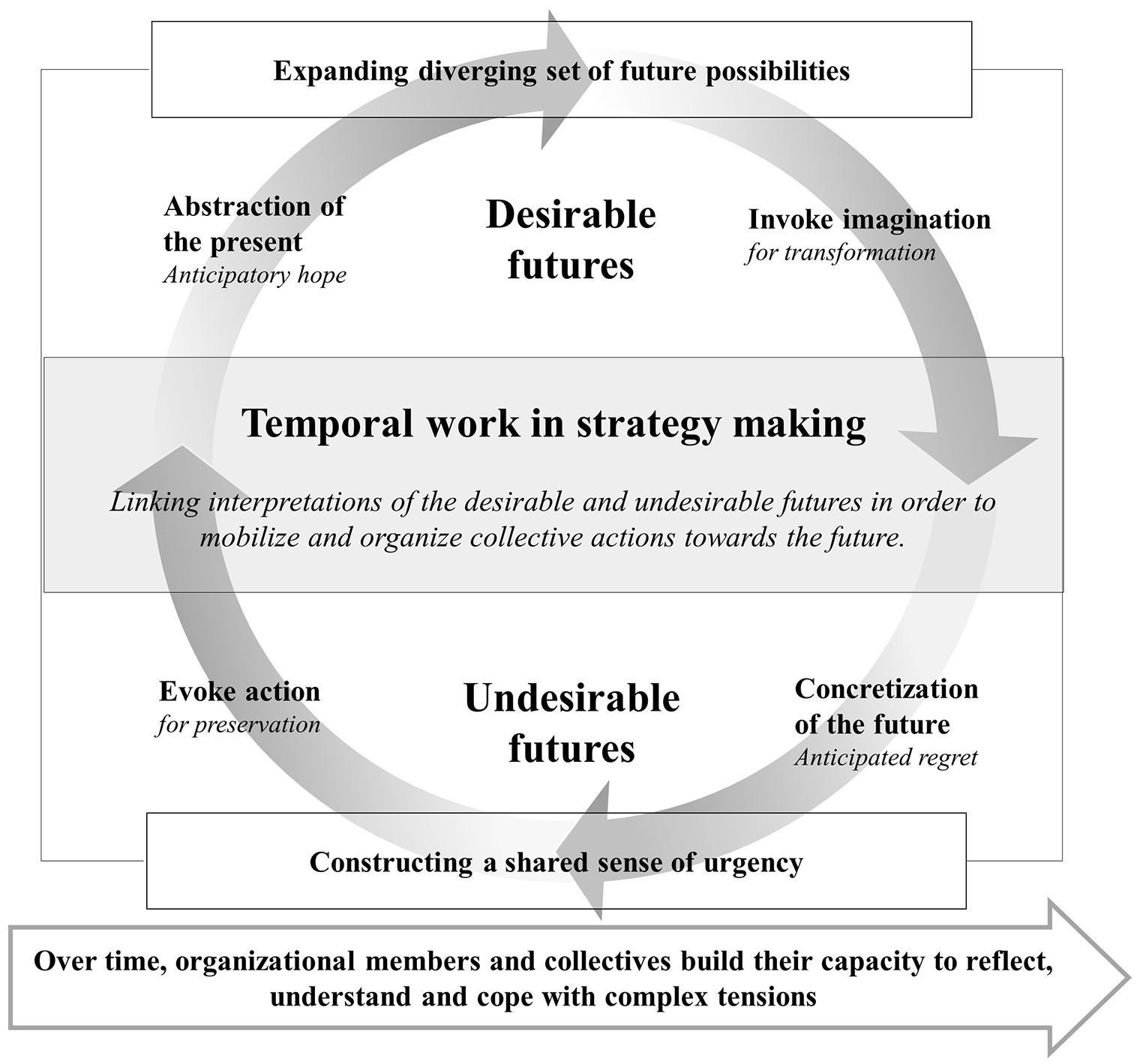
A model of future desirability in temporal work.
Temporal work is guided by constructing a shared sense of urgency and considering an expanding set of future possibilities (as represented in the boxes at the top and bottom of Figure 4). The model illustrates a dialectic process alternating between the abstraction required to invoke imagination and concreteness needed to evoke action. As they navigate a path to the future, organizational members face the challenge of understanding and managing complex tensions between concreteness and abstraction. Strategic accounts must be concrete enough to be practically feasible in present circumstances, but also sufficiently abstract to pursue future possibilities in ways that challenge and move beyond current arrangements (the middle box in Figure 4). The rest of this section elaborates different elements of the model.
Mechanisms for engaging with the future
Steering away from an undesirable future is the first mechanism guiding temporal work. Steering away from a potentially damaging or destructive outcome helps actors identify problems and assign responsibility for addressing them. It encourages actors to fully understand the concrete implications of their decisions and repercussions emanating from actions taken in the present time. In this way, actors evaluate the consequences of inaction versus action (Dutton and Duncan, 1987; Roese, 1997). They do so by evoking a feeling of “anticipated regret”: an underlying cognitive mechanism generating pervasive and powerful emotions people seek to avoid. Regret over an undesirable outcome is experienced when at a certain moment in time action could have been taken to prevent the outcome from happening (Zeelenberg and Pieters, 2007). In the R&R case, decision-makers believed that they were the custodians and responsible for passing the building on to the next generation in a better condition than they inherited it. Research in social psychology suggests that regret is experienced as an aversive state, focusing attention on one’s own role and responsibility in the occurrence of a regretted outcome (Zeelenberg and Pieters, 2007). The realization that another decision might have been preferable when looking back from the anticipated future is an important precondition for the feeling of anticipated regret. Feasibility assessments—such as the availability of alternative temporary locations for the Houses of Parliament—added to the general feeling of anticipated regret and were instrumental in accelerating the process resulting in the program’s formal approval.
As a cognitive mechanism, anticipated regret increases the concreteness of future states as participants consider what the future will be like in particular instances. For example, by placing themselves in a future after something undesirable occurred, Parliamentarians and in-house staff experienced some of the emotional distress they would have felt as if the event had actually happened. The imminent risk of a calamity was not something they had to imagine might occur. The dilapidation of the Palace was so evident it was more matter of when, not if, this future would become a reality.
Anticipated regret connects the notion of an undesirable future to sensory experiences and vivid emotional responses felt in the present. The concreteness of an undesirable future stimulates actions in the present required to prevent the occurrence of a detrimental outcome. Past events are influential in concretizing undesirable futures and identifying the consequences of inaction (Hernes and Schultz, 2020). Actors reflect on how things were in the past, why such events occurred, and how they may occur again in the future. In the R&R case, for example, the fear that the Palace might catch fire as it had done in such a catastrophic way in 1834 took hold, intensified, and became something that had to be avoided at all costs, particularly after the Notre-Dame fire. Actionability increases (Liberman and Trope, 1998; Trope and Liberman, 2003) because the need to act in the present is closely connected to the possibility of an undesirable future.
Orienting toward a desirable future is the second mechanism guiding temporal work. Forward-looking and imaginative thinking underpins efforts to engage with future ends states that are desirable, but not clearly defined (Gioia and Mehra, 1996). The prospect of achieving an improved future supports transformative change, rather than efforts to preserve the current state of affairs. The locus of agency lies in the “hypothesization” of experience as actors detach themselves from the day-to-day circumstances they face and are afforded the freedom to imagine alternative future possibilities (Emirbayer and Mische, 1998). Hope is the essential cognitive mechanism enabling this to happen as actors consider various conjectural possibilities and recognize the transformative potential—that another world is possible—of the current situation (Mische, 2009, 2014a). Forces of aspiration and hope encourage actors to take on challenging and symbolically important endeavors that might otherwise seem “costly, risky, slow, frustrating, and often painful” (Mische, 2014a: 3). In the R&R case, projective practices helped actors consider how Parliament might successfully operate, function, and be used by future generations. Such activities encouraged participants to overcome restrictive efforts to maintain the status quo, think creatively, and imagine hypothetical futures (Augustine et al., 2019; Gioia and Thomas, 1996).
Projective engagement with a desirable future can be conceived as a process of abstraction and generalization (Augustine et al., 2019) enabling actors to transcend the here and now, and move beyond current discourses and experiences. Images of desirable futures are often abstract and general, tied to broader ideologies, identities, and values, rather than more particular, concrete, and detailed instances (Augustine et al., 2019). Our findings show, for example, that participants frequently resorted to vague and general terms when trying to imagine the future, such as the heritage and symbolic value of the Palace. Multiple past events happening over an extended period of time were grouped together and stripped down to essential features, such as the “emblem of parliamentary democracy,” to address the future. The increasing degree of abstraction used to imagine desirable futures helped actors address various possibilities, critically evaluate current approaches, and create the conditions for transformative change.
Dynamics of desirable and undesirable futures in temporal work
We suggest that strategy making in temporary work involves a dialectic process of moving between abstraction and concreteness toward action (Raisch et al., 2018; Weick, 2009). Organizational members simultaneously address the tensions arising from an ongoing interplay between relying upon abstraction (the desirable future) to invoke imagination and concreteness (the undesirable future) to evoke action. Through a series of practices, organizational members negotiated, linked, and built upon various interpretations of desirable and undesirable futures to devise appropriate strategies and mobilize collective action.
A growing sense of anticipated regret serves to bind together organizational members and create a strong behavioral push (Roese, 2005) toward action. In settings where narratives of continuity prevail, organizational members construct a shared sense of urgency by showing how the possibility of an undesirable future is linked concretely to present circumstances. In the R&R case, reporting, lobbying, and other evidence-gathering activities were instrumental in amplifying the severity and urgency of the situation by drawing attention to the building’s visible disrepair and ever-present threat of another catastrophic fire. The aversion regret (Abraham and Sheeran, 2003; Sheeran and Orbell, 1999) associated with failing to act creates a sense of urgency and stimulates calls for action (Slawinski and Bansal, 2015). The pressure to act immediately encourages members with diverse interests and conflicting interpretations to reach agreement on how to prevent a detrimental outcome. Similar to the idea of diagnostic framing in social movement research, organizational members focus on reaching a consensus to remedy a problematic situation, rather than agreeing on what precisely has to be done to tackle it (Benford and Snow, 2000). Despite their diverse interests and the lack of clarity about the future of the Palace, galvanizing events—such as gaining parliamentary approval for the program in 2018—served as a binding commitment between various stakeholders to work together and established momentum for change. Creating a program organization to coordinate work and build collaboration among the parties is “a way of spreading a sense of urgency” that something now needs to be accomplished (Lundin and Söderholm, 1995: 438).
Orienting toward a desirable future enables organizational members to evaluate a diverging set of future possibilities and hypothetical alternatives, and creates the conditions for a departure from the status quo. Motivated by aspiration and hope (Emirbayer and Mische, 1998; Mische, 2009), actors in our case were able to consider alternative possibilities and construct new understandings of how Parliament could be radically transformed to address the needs of future generations (Gioia and Mehra, 1996; Mische, 2009). Abstract and generalized representations used to imagine how the Palace building might operate in the future generated a wide variety of interpretations, interests and conflicting opinions. However, the divergent and experimental nature of such practices often results in greater uncertainty about future states (Augustine et al., 2019). Under such conditions, “future perfect” reasoning (Weick, 1979) is difficult as there is little agreement on what the future is and how it can be perfectly realized (Stigliani and Ravasi, 2012). As our findings revealed, organizational members are unable to develop the shared schemata required to support coordinated action needed to transition from present to the imagined future states (Dionysiou and Tsoukas, 2013; Kaplan and Orlikowski, 2013).
Our findings reveal that actors developed a collective capacity to deal with complex tensions. While prospective and aspirational practices lay the groundwork for transformative change, a sense of urgency evokes the need for collective action when the end state remains ambiguous and unclear. Facing inaction, frustration, and exasperation about “getting the job done” triggers actors to question, apprehend, and reflect on what is required to move forward in the face of uncertainty. Adopting the governance arrangement used for the London 2012 Olympics, for example, involved a great deal of critical reflection and adjustment to the R&R context. Significant efforts are, therefore, required to overcome the inertia and constraints imposed by prevailing cognitive approaches and practices (Gilbert, 2005; Leonard-Barton, 1992). This interpretive shift—or reflectivity—demonstrates an ability to question taken-for-granted “habits of thought” (Emirbayer and Mische, 1998) and conventional approaches—“let’s just get on with it”—to program management.
Consideration of future desirability in temporal work provides a new way of strategizing. Organizational members balance desirable and undesirable mechanisms and benefit from their mutually enabling qualities (Smith and Lewis, 2011). Actors construct strategic accounts that are sufficiently stable to allow them to ground their work within present circumstances and exigencies, but flexible enough to enable them to pursue projected future possibilities in ways that challenge and transform current practices. As actors in the R&R case engaged with undesirable futures, they anchored their interpretations about strategic themes for the program—desirable future states—in the practical concerns and current priorities. Anchoring was achieved by thinking about what it is needed to preserve the Palace so that Parliament could continue undisturbed for at least 150 years. In this way, actors were able to make concrete linkages between the future and the present. In this balancing process, actors engaged with abstract themes to envision a desirable future while moving forward with concrete, actionable, and viable strategic frameworks situated in current circumstances.
Organizational members gradually increase their reflective capabilities to understand, reframe, and address the tensions arising in a dialectic process of abstraction (desirable future outcomes) and concreteness (undesirable future outcomes; Raisch et al., 2018; Schad and Bansal, 2018). By situating themselves within the flow of time, actors are able to think about where they are going, where they want to go, and how they can move from the present to the chosen destination. In the R&R case, the focus shifted from understanding of different futures as discrete and independent outcomes to processual and interlinked accounts combining future possibilities into a common perspective. Temporal work progressed from what one participant labeled a “need-based” to an “aspiration-based” approach to allow for the possibility of a variety of futures and accounts, without the need for a clearly defined end state. A framework constructed and accepted by all members was used to explore future opportunities and avoid premature attempts to minimize uncertainty, such as fixing the plan or freezing the design too early.
A desirable future helps diverse stakeholders work together to overcome inertia and achieve aspirational goals that are not constrained by existing commitments and priorities, whereas as an undesirable future focuses attention on stabilizing the present and plays a performative role in mobilizing resources and evoking action. As our study shows, the sense of urgency shared by organizational members was the primary impetus for transformative action. Working as distinct mechanisms in strategy making, desirable and undesirable futures combine, complement, and reinforce each other in a dialectic process. Organizational members face the challenge of moving through the dual movement of abstraction and concreteness toward action. This cyclical process produces a progression, as actors develop a fuller and more sophisticated understanding of underlying tensions (Raisch et al., 2018).
Theoretical contributions
Our study of temporal work identified how organizational actors develop a strategy for an uncertain and highly contested future while safeguarding ongoing operations in the present and preserving the heritage of the past. By linking interpretations of the future with particular understandings of the present and the past, actors were able to move forward in the face of considerable uncertainty (Kaplan and Orlikowski, 2013). Prior literature focuses on organizational temporality and the influences of time in strategy practice (see Table 1), but has neglected to consider the desirability of futures in strategic processes and how actors engage with and act upon the future (Augustine et al., 2019; Bruskin and Mikkelsen, 2020).
Undesirability in future-oriented action
Literature on the strategic organization of time has focused on understanding the present concerns of actors as they orient toward the future. Research has explored the tensions between different temporal expectations (Reinecke and Ansari, 2015; Slawinski and Bansal, 2015), forward-looking and prospective sensemaking practices (Gephart et al., 2010; Stigliani and Ravasi, 2012), projection of a desired or expected future event (Pitsis et al., 2003), and dialectics of radical and hypothetical futures imaginaries (Augustine et al., 2019). But prior studies often assume a forward-looking projection of desirable futures, motivated by aspiration and hope, and focus on managing the uncertainty associated with efforts to achieve desirable future states. Although some studies have identified how unexpected situations or crises may act as triggers for sensemaking (Weick, 1988), the role of undesirability in future-oriented action, motivated by desperation and inaction, has been the main focus of analysis. Bruskin and Mikkelsen (2020), for example, show how organizational members use lost war metaphors –such as “The End”—as they anticipate a despondent future outcome. In such situations, the expectation of an undesirable future evokes negative emotions such as fear, anger, or anxiety, which may constrain or prevent efforts to act (Maitlis and Ozcelik, 2004; Sandberg and Tsoukas, 2015).
Our research, by contrast, shows how the anticipated regret felt when people think about undesirable outcomes shapes future-oriented action. Efforts to prevent an undesirable future are not primarily motivated by the possibility that some calamitous happening might occur, but rather by the probability that it will occur (Baumgartner et al., 2008). Under such conditions, actors are less concerned with setting and managing future expectations—the “state of looking forward” (Borup et al., 2006: 286)—and with efforts to meet future expectations (Garud et al., 2014). They are more concerned with evaluating the consequences of a decision not to act, rather than the experience they might feel had they acted (Loewenstein and Lerner, 2003; Zeelenberg and Pieters, 2007). In doing so, organizational actors engage with “if only” patterns of thought: a causally potent antecedent action by which actors avoid undesirable future outcomes (Roese, 1997). By narrowing the range of possibilities, counterfactual and retrospective engagement with undesirable futures helps to mobilize collective action. Acting as a judgmental anchor, orienting toward undesirable futures fosters agreement among diverse organizational actors. It achieves this by creating a shared sense of urgency that “something needs to be done” to remedy the problematic situation and prevent the anticipated outcomes.
The future is often conceived as a commodity used to enact strategic visions (Wenzel et al., 2020). The performative power of urgency and emotionality evoked when actors perceive an undesirable future is neglected in prior research. By highlighting the agency of undesirable futures, our study provides novel insights into the practices of strategic management. The distinction between the desirable and undesirable helps to distinguish between phenomenologically distinct processes of engaging with and acting on the future. Preventive efforts to avoid the undesirable do not automatically result in consensual expectations or direct actions toward “what needs to be done.” By engaging with the desirable and undesirable, actors are able to plot a path toward the future.
Navigating the future: the interplay between the desirable and undesirable
Our study responds to a recent call to undertake research on future-oriented processes and how actors experience the future as a “problematic, open-ended temporal category” (Wenzel et al., 2020: 1442). Understanding how organizational members move forward and engage with the future in open-ended settings raises questions about the appropriateness of strategic activities performed in the present. Considering the future desirability of an endeavor may help actors in pluralistic settings—involving “multiple objectives, diffuse power and knowledge-based work processes” (Denis et al., 2007: 17)—recognize the need for urgent strategic action, overcome inertia, and steer clear of detrimental outcomes. Strategizing is particularly challenging in a setting where the goal of the endeavor is not yet explicitly defined or articulated.
The notion of desirability provides a new way of understanding the role of the future in temporal work. Rather than setting consensual expectations in envisioning a desirable future, actors move forward by anchoring abstract notions of desirable future states in the practical concerns of the present. This was achieved in the R&R case by efforts to strike a balance between preserving the past (steering away from the undesirable) and achieving a transformative vision of the future (orienting toward the desirable). Navigating a path toward the future emerges as a dialectical interplay between the concreteness required for action and the abstraction enabling imagination. Managing these tensions allows actors to establish a concrete and plausible path of action without becoming preoccupied in abstract notions of a distant future or letting the practical concerns of the present overshadow future aspirations.
Our findings contribute to the literature by moving beyond a consideration of time horizons in temporal work (e.g. Flammer and Bansal, 2017; Reinecke and Ansari, 2015; Slawinski and Bansal, 2015) to focus on the role of desirability in future-oriented collective action. Engaging with undesirable and desirable futures involves an ongoing dialectic between opposing agentic orientations (avoiding vs achieving) and change narratives (transformation vs preservation). As they move toward the future, actors gradually acquire a more developed understanding of underlying tensions and develop reflective capabilities to understand, shape, and respond to challenging situations (Emirbayer and Mische, 1998; Raisch et al., 2018).
Implications for practice
Managers undertaking complex, novel endeavors and facing contextual challenges of immense social and political significance need to focus a great deal of attention on the early phase of strategy making. Responsibility for producing a transformational outcome for society intensifies the emotions felt when managers envisage and identify alternative futures. Future perfect strategizing may, however, be less applicable when actors consider the possibility of an undesirable future. Two guiding principles may inform how managers act in the present to address undesirable futures. First, emotions of anticipated regret associated with an undesirable future may infuse action and stimulate the urgency needed to move beyond stalemate situations. Second, managers navigating a path forwards may find that there are moments when attention focuses on steering away from an undesirable future (as thinking concretely creates momentum for action). At other times, orientating toward a desirable future is important (as thinking abstractly opens up possibilities to move beyond current constraints and exigencies). Managers might benefit in their efforts to follow a viable course of action by simultaneously addressing the reciprocal relationship between undesirable and desirable futures (as indicated in Figure 4). Such guiding principles are important for temporal work in strategy making in settings of social and political significance where managers have to achieve transformative change while preserving vital elements of the past.
Suggestions for future research
We suggest two promising avenues for future research. First, the analysis suggests that the emotion-related mechanisms of anticipated regret and anticipatory hope help to explain how actors involved in temporal work address the desirability of future. The role of emotions has attracted growing interest in organization theory (Kouamé and Liu, 2020), strategic change (Huy, 2012), organizational decision-making (Maitlis and Ozcelik, 2004), and sensemaking (Maitlis and Sonenshein, 2010; Sandberg and Tsoukas, 2015). Linking the mechanisms suggested here to this literature could provide for a more integrated perspective on emotional mechanisms in strategizing and organizing. Second, our analysis suggests that collective future-oriented action is not solely enabled by agents’ emotional and socio-cognitive processes. In line with Schad and Bansal (2018: 1495), we found that the underlying complexity of nested tensions cannot be simply “wished away” through shifts in actors’ perceptions of them and may require changes in hierarchical and relational arrangements among organizational actors. Such interdependent changes may help actors overcome established boundaries and reflect on connections between the different parts of an organization while focusing on establishing the capabilities required to achieve a large, complex and strategic endeavor. We therefore encourage future research to examine power dynamics, such as framing contests in strategy making (Kaplan, 2008) and their implications for collective future-oriented action.
Conclusion
Our study explored two phenomenologically different cognitive qualities of future desirability and considered their implications for temporal work. While strategy formulation and planning are often formulated in terms of hope and aspiration, our analysis revealed that actors engaged in strategy making may find themselves torn between what is desirable and what is to be avoided. In a metaphorical sense, the challenge facing the crew at the helm is not simply about steering a course between the lesser of two evils, as in the proverbial use of “between Scylla and Charybdis.” Rather, the navigational task is about taking into account hazards such as rocks, thunderstorms, and sea monsters associated with failed enterprise, as well as envisaged promises and aspirations, such as reaching a coveted destination. Our findings reveal how organizational members in temporal work engage, sequentially and simultaneously, with different perceptions of the future. By considering desirable and undesirable futures, actors were able to move forward in the face of considerable uncertainty and recreate a Palace “fit for the future.”
Footnotes
Acknowledgements
We sincerely thank Tima Bansal and three anonymous reviewers for their constructive and insightful guidance throughout the review process. We would also like to express our deepest gratitude to John Pelton MBE for his continuous support throughout this research project. We are also grateful to the leadership team and staff members of the Restoration and Renewal program who welcomed us to participate in their day-to-day activities and gave their valuable time for interviews, discussions, and comments. We are thankful for feedback on earlier drafts of the paper from participants in seminars at the 10th International Process Symposium, Halkidiki, Greece; the Management Department of the Wharton School at University of Pennsylvania; the Organization and Management Forum at the Department of Business Studies, Uppsala University; and the Collaborative Research Seminar Series at the Department of Management and Engineering, Linköping University.
Declaration of conflicting interests
The author(s) declared no potential conflicts of interest with respect to the research, authorship, and/or publication of this article.
Funding
The author(s) disclosed receipt of the following financial support for the research, authorship, and/or publication of this article: The authors gratefully acknowledge financial support from ESRC Project X funding (Grant Number ES/S009841/1) and from Jan Wallander and Tom Hedelius’ Foundation for Social Science (Grant Number P17-0111). The data cannot be made public due to reasons of confidentiality. The usual disclaimers apply.
