



Abstract
Organizations’ attention structures are traditionally perceived as stable “pipes and prisms” representing organizational communication and procedural channels. Changes in attention structures are typically attributed to top-down interventions. In this study, we extend the “dynamic Attention Based View” by demonstrating first that attention structures are plastic and second that they can be “bent” through bottom-up adaptations of communication channels previously designed from the top. Using a single case study of the large telecommunication corporation Ericsson, we show how mid-level organizational actors manifest distinct forms of agency in reacting to adverse changes in attention structures: projective agency and iterational agency. Organizational actors regain influence over the strategy-making process through two corresponding practices: reinvention (the projective agency of adding new channels) and renewal (the iterational agency of restoring old channels).
Keywords
Introduction
The original attention-based view (ABV) highlighted the importance of organizational “pipes and prisms,” the communication and procedural channels that direct attention to certain strategic issues and away from others (Ocasio, 1997; Ocasio and Joseph, 2005). In this view, these attention channels form a stable structural “architecture,” typically designed top-down according to Chief Executive Officer requirements (Joseph and Ocasio, 2012). However, Ocasio et al. (2018) have recently called for a shift from this static “pipes and prisms” emphasis on channel structure toward a more dynamic ABV, one in which social interaction is important to attention. They look to the dynamics inside attention channels, rather than to the channels themselves. We take a similarly dynamic view but return the focus to attention channels. In particular, we show how actors interactively bend the pipes of organizational attention to their own purposes. Actors can reshape channels from below. Pipes are plastic. They have dynamics too.
Our purpose, therefore, is first to demonstrate the plasticity of communication and procedural channels of attention and then to show how this plasticity may be shaped not just top-down but bottom-up as well. We examine the potential for plasticity and bottom-up structural change by tracking how attention channels were adjusted following a radical redesign of the attentional structure at a large Swedish telecommunications business, Ericsson. This top-down redesign initially displaced the internal corporate strategy group from its central position in the organization’s attention channels. We ask the research question: “how do organizational actors regain attention in response to adverse changes in attention structures?” We show how the corporate strategists regained attention by introducing new or restoring old attention channels through practices of reinvention and renewal. Reinvention involves expanding previously used attention channels through the addition of new communication and/or procedural elements. Renewal involves the restoration of previously used attention channels into the attentional structure after a period of interruption. Reinvention has an element of novelty that renewal has not. Together the two practices helped the corporate strategy group regain attention through their own reshaping of the communication and procedural channels of the firm.
We focus on an internal corporate strategy group because of the important roles such strategists typically play in organizational attention. Corporate strategists provide strategic information, planning procedures, and analytical tools to senior managers both at the corporate center and in business units (Ocasio and Joseph, 2008; Regnér, 2003). However, with the contemporary shift from the 20th Century “Chandlerian firm” (Ocasio et al., 2023), such corporate strategists have become subject to widespread cutbacks and critique (Grant, 2003; Martin, 2014). Their vulnerability as a group has even led to them being termed “the precarious profession,” frequent victims of corporate restructuring (Whittington, 2019). The dynamic ABV adopted here encourages a less fatalistic perspective on corporate strategists. Consistent with the distributed agency implied by the dynamic ABV (Ocasio et al., 2023), Ericsson’s corporate strategists overcame what initially seemed like a radical downgrading. Even in adversity, they were able to bend the pipes of attention at least somewhat to their own advantage.
Our study therefore seeks to make two contributions to the emergent dynamic ABV (Ocasio et al., 2018, 2023). First, we demonstrate that attention channels are more plastic than the concept of organizational attention structure tends to imply. This plasticity allows for incremental adjustments in between the episodic redesigns emphasized so far in the literature. In this sense, we go beyond the dynamics of communicative practices, the focus of Ocasio et al. (2018), to consider the dynamics of attention channels themselves. Second, we suggest that, while senior management is well placed to make radical changes and incremental adjustments, changes in attention channels can also be driven from below. Attention channels do not simply originate from the top. Focusing on Ericsson’s corporate strategists, we demonstrate their capacity to bend on their own account the “pipes and prisms” of attention using practices of reinvention and renewal. Corporate strategists have more agency and less precarity than often thought. In the terms of Emirbayer and Mische (1998), reinvention manifests a projective agency oriented to the future, while renewal involves an iterational agency grounded in the past. Moreover, our model of attention channel dynamics goes beyond corporate strategists and is relevant to other groups who compete for attention within organizations, sometimes in the face of adverse organizational change (Dutton et al., 2001; Shepherd et al., 2017).
Theoretical background
The ABV is concerned with the “social, economic and cultural structures that govern the allocation of time, effort and attentional focus of organizational decision-makers” (Ocasio, 1997: 195). These structures shape the focus of decision-makers on specific strategic issues and thereby influence how organizations recognize upcoming strategic issues and respond to them strategically (Joseph and Ocasio, 2012). Structures shape this decision-maker focus in part by regulating the communication and procedural channels that together act as “pipes and prisms for information processing” within the organization (Ocasio et al., 2018: 157). In the original ABV, communication and procedural channels are seen as “concrete,” in the sense of having material existence and specific locations in time and space (Ocasio, 1997: 194). Together they form “relatively static” organizational “architectures”: for example, General Electric experienced four significant shifts in its organizational architecture in the whole period 1951 to 2001 (Joseph and Ocasio, 2012: 635). Research to date has focused primarily on formal communication channels such as corporate policy boards (Joseph and Ocasio, 2012), corporate market intelligence (Vuori and Huy, 2016), stakeholder relations sessions (Rerup, 2009), and other types of strategy meetings (Jarzabkowski and Seidl, 2008; Wenzel and Koch, 2018). Our study too focuses on the formal channels associated with the strategy process but with the aim of demonstrating more plasticity than typically allowed for in the original ABV.
Moreover, we shall broaden the sources of this plasticity. Traditionally, the original ABV literature saw top management as the primary designers of formal communicative and procedural channels (Ocasio, 1997; Ocasio and Joseph, 2008). While acknowledging lower-level actors, Ocasio (1997: 197) describes the CEO and the top management group as typically “the most critical players in attention regulation.” Top managers configure administrative systems that define the specific hierarchical positions of organizational actors involved in communication and procedural channels (Lovas and Ghoshal, 2000), thereby setting up the structural contexts that work as selection mechanisms for strategic initiatives aligned with top management team (TMT) attention focus (Burgelman, 1983; Noda and Bower, 1996). Top managers can also shape attention through cross-level channel integration, transmitting strategic issues, and initiatives up and down the hierarchy (Ocasio and Joseph 2012). In their longitudinal study of General Electric’s strategic planning structures through the second half of the 20th century, Ocasio and Joseph (2008: 268) conclude: “strategic planning systems evolve over time and are subject to transformation by the CEO.” From Ralph Cordiner in the 1940s to Jack Welch in the 1980s, each General Electric CEO designed their own distinctive communication and procedural channels to fit their particular strategic visions and leadership styles.
By contrast to this top-down perspective on attention structures, two related perspectives give more weight to the distributed agency. First of all, the issue-selling literature has reconceived the struggle for attention in organizations as occurring within a “pluralistic market-place,” with strategic issues “sold” by various actors (typically middle managers) and then “bought” by senior managers (Dutton et al., 2001: 716). Hierarchically inferior actors actively compete to help TMTs recognize (Dutton and Ashford, 1993) or categorize (Julian and Ofori-Dankwa, 2008; Miller and Lin, 2021) strategic issues. Middle-managers frequently engage in political activities to promote strategic initiatives that are dear to their particular interests (Kreutzer et al., 2015; Toegel et al., 2022). Thus, the issue-selling literature establishes the relevance of distributed agency for attention. However, its concern is primarily with selling issues within existing attention channels. Indeed, Dutton et al. (2001) suggest that compliance with current protocols and appropriate levels of formality are crucial factors in successful attention gaining. Our concern is different: we extend the sense of bottom-up agency to examine not the selling of issues but the shaping of channels.
The second perspective allowing for more distributed agency is associated with the emergent dynamic ABV (Laamanen, 2019; Ocasio et al., 2018, 2022). The dynamic ABV departs from the earlier concern for static attention structures to emphasize the role of communication in attention dynamics: “communication through social interactions, both within and between communication channels, allows organizational participants to jointly attend to and co-orient themselves with changes in strategic issues, initiatives, and activities throughout the organization” (Ocasio et al., 2018: 157). Ocasio and colleagues thereby point to the noisy buzz of communicative interactions inside and around attention structures. This shift in focus from structure to what is happening within and between channels is accompanied by a de-centering of top management: “the dynamic view of attention can be seen to democratize and further open up strategy development” to a wider range of actors (Ocasio et al., 2023: 3). Social interaction typically implies some scope for mutual influence between hierarchical levels, not just one-way command. Here, the dynamic ABV is partly inspired by practice theory, bringing a greater appreciation of the messy, uncontrollable realities of social interaction within organizations (Ocasio et al., 2018). Taking a practice lens to the traditional top-level focus of the ABV, Nicolini and Korica (2021) show how CEO attention is liable to be overwhelmed, dependent on a range of mundane practices including post-it notes, open (or closed) office doors, and continuous conversations to exert at least some control.
While practice theory illuminates the limited control of those at the top, it can also bring an appreciation of the agency of those below. In the strategy field, practice theory scholars have often relied upon a restricted sense of agency (Mantere and Whittington, 2021), typically considering it in terms of skillful adaptive maneuvers in response to the immediate demands of circumstance (Fauré and Rouleau, 2011; Kaplan, 2011; Whittle et al., 2021). This is consistent with the “practical-evaluative” form of agency described by Emirbayer and Mische (1998) as involving the ability to adapt improvisationally to the contingencies of the moment. It particularly reflects the tactical agency identified in the practice theory of de Certeau (1984), concerned with the ordinary negotiation of everyday life. However, drawing upon a range of practice theorists, Emirbayer and Mische (1998) alert us to two other forms of agency: “iterational” and “projective.” In its archetypal form, iterational agency involves the selective recall and application of schemas of action from the past. By contrast, projective agency looks to the future and is characterized by innovation. The same actors may draw on different kinds of agency. The displaced corporate strategists of our study showed both iterational agency in bringing back discarded practices and projective agency in terms of bringing in the entirely new.
The remainder of the article explores how organizational actors regain attention in response to adverse changes in attention structure by bending communication channels to their own advantage. Channels are more plastic than the ABV’s structural formulation originally implied. In this sense, we extend the dynamic ABV to include the dynamics of channels as well as those of communication. Moreover, we find that the bending of channel structures is not solely the prerogative of top management, the original focus in the ABV. Mid-level corporate strategists drew on practices of reinvention and renewal either to introduce innovative new channels or to restore old ones. To this extent, the agency of actors outside top management goes beyond the power to shape interactions to include the capacity to change the channels in which these interactions take place.
Method
To better understand the dynamics of attention structures, we conducted an in-depth case study (Siggelkow, 2007) set in a large telecommunication and networking equipment manufacturer, Ericsson. We used this case as revelatory one (Yin, 2003) as Ericsson underwent a radical strategic change that had significant effects on the organizational attention structure. We specifically focus on one group of organizational actors adversely affected by this change and analyze how they worked to re-establish their position within the new attention structure and regain the attention of senior managers. The focus on the single organization provided us with a greater richness of data and an in-depth understanding of the context in which actors found themselves.
Research context
Ericsson is a large firm with more than 95,000 employees and customers in 180 countries. It has a matrix organizational structure combining Business Units (BUs) focused on products and services and Market Areas (MAs) with the responsibility to serve different geographical areas. Several group functions such as Research and Development, Marketing, legal affairs, HR, and a Strategy Group provide support to the entire organization. The firm’s size and existence of group functions created a complex attention structure similar to the cases of GE (Joseph and Ocasio, 2012) and Novo Nordisk (Rerup, 2009).
Within this architecture, multiple groups supported the TMT in the strategy-making process. The Strategy Group (henceforth SG) consisted of around 30 people and was principally responsible for gathering strategic business intelligence, analysis of the competitive environment, and strategic planning. Ericsson also had a Technology Strategy (TS) Group focused on technological developments relevant to Ericsson’s businesses and reporting directly to the Chief Technology Officer. Smaller strategy groups were also located within BUs. At the beginning of 2017, Ericsson appointed a new CEO and TMT who set a new strategy accompanied with major organizational restructuring that led to considerable changes in the attention structure of the strategy-making process.
In this study, we focus on the activities of SG—the oldest and largest strategy team within Ericsson with its long-standing independent status as a Group Function (GF). The radical change disrupted the communication and procedural channels available to SG members as their structural position changed. In 2017, it was first merged with the Technology Strategy. Consequently, a year later SG became a part of the newly established BU called Technology and Emerging Businesses. The number of SG members was reduced to around 15.
Data collection
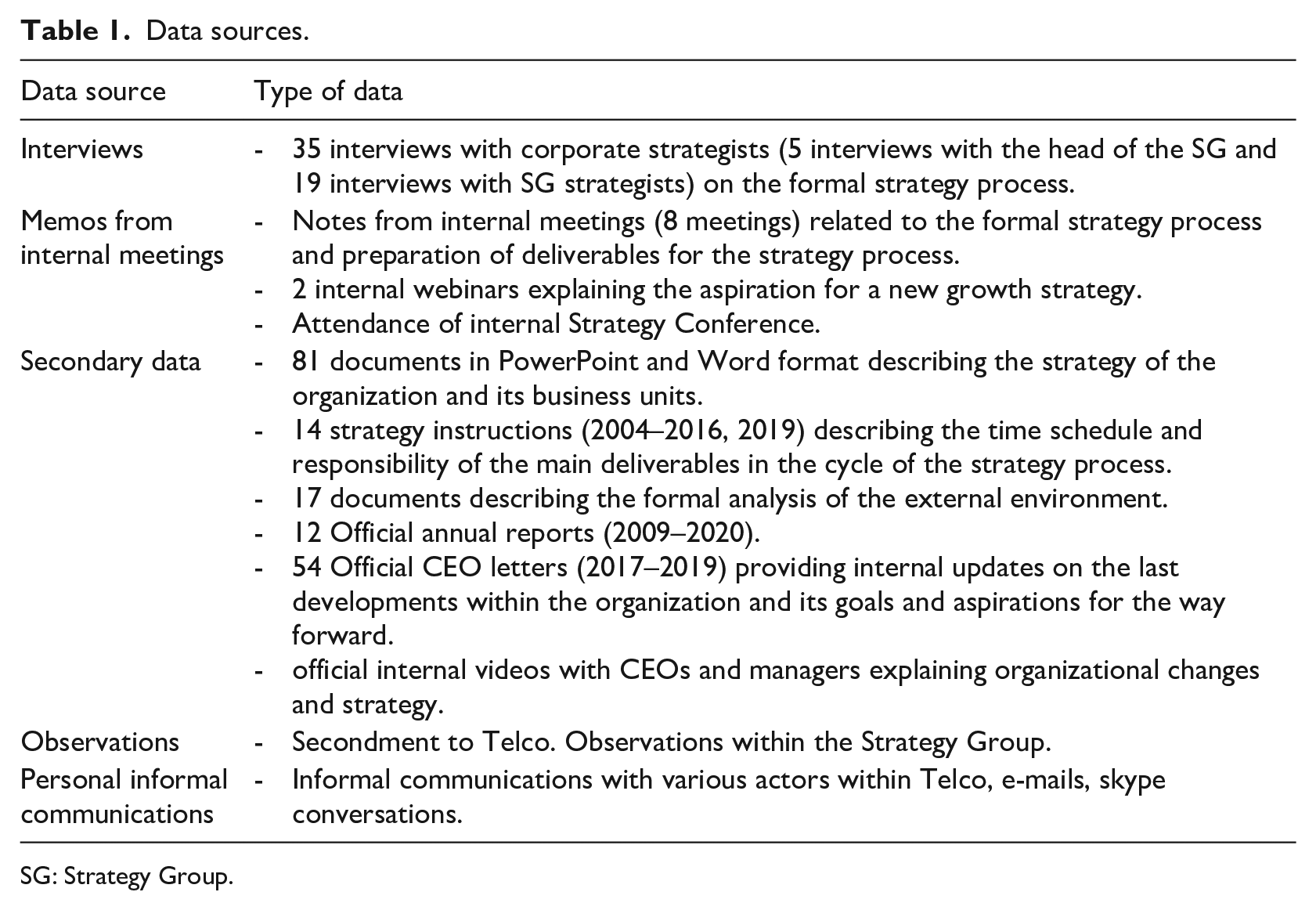
Although this study focuses on changes in attention structure throughout 2017–2020, we have also collected retrospective data to understand the structure of procedural and communication channels before the major restructuring. The major data collection concluded in 2020. We had follow-up interviews with two representatives of SG in 2021 and 2022 to better understand the outcomes of the group activities. We collected data from a variety of sources (Table 1) and triangulated them to gain insights about changes in attention structures and the activities of the corporate strategists that led to the adaptation of their communication channels.
Data sources.
SG: Strategy Group.
Interviews
A primary data source for this study is a set of 35 semistructured interviews with corporate strategists. We started by interviewing members of SG, complementing these data with interviews from members of BUs strategy teams and Technology SG to understand the communication channels used by corporate strategists across Ericsson. We also interviewed the Heads of SG, BU SGs, and the Technology SG to better understand how they see the core responsibilities of respective teams in the strategy-making process before and after the change in attention structure. Finally, we also spoke with a CEO advisor to understand the strategy-making process and roles of various actor from the perspectives of the TMT.
Observations
The first author was seconded to Ericsson and spent 18 months working with SG. During this time, we collected notes from 8 formal meetings related to the formal strategy process and preparation of SG deliverables. In addition, the first and second authors attended two internal 2 days meetings among corporate strategists (Strategy Conference) organized in 2019 and 2020. Finally, the secondment of the first author provided an opportunity to attend multiple informal internal meetings and conversation exchanges among members of SG that were summarized in notes.
Secondary data
We complemented the interview and observational data with publicly available annual reports and more than 100 secondary documents (PowerPoint presentations and other files) describing the strategy of the organization, strategy of specific BUs, as well as strategy-making process. Access to the intranet allowed us to collect 54 internal CEO letters, recordings of internal webinars and videos describing strategy at different stages in time. We also collected 14 strategy instructions—a document describing time schedules and responsibility for the main deliverables in the cycle of strategy process. Finally, in line with Ocasio’s (1997) definition of communication and procedural channels as including reports and administrative protocols, we also collected internal documents like PowerPoint presentations and reports that were transmitted through communication channels.
Data analysis
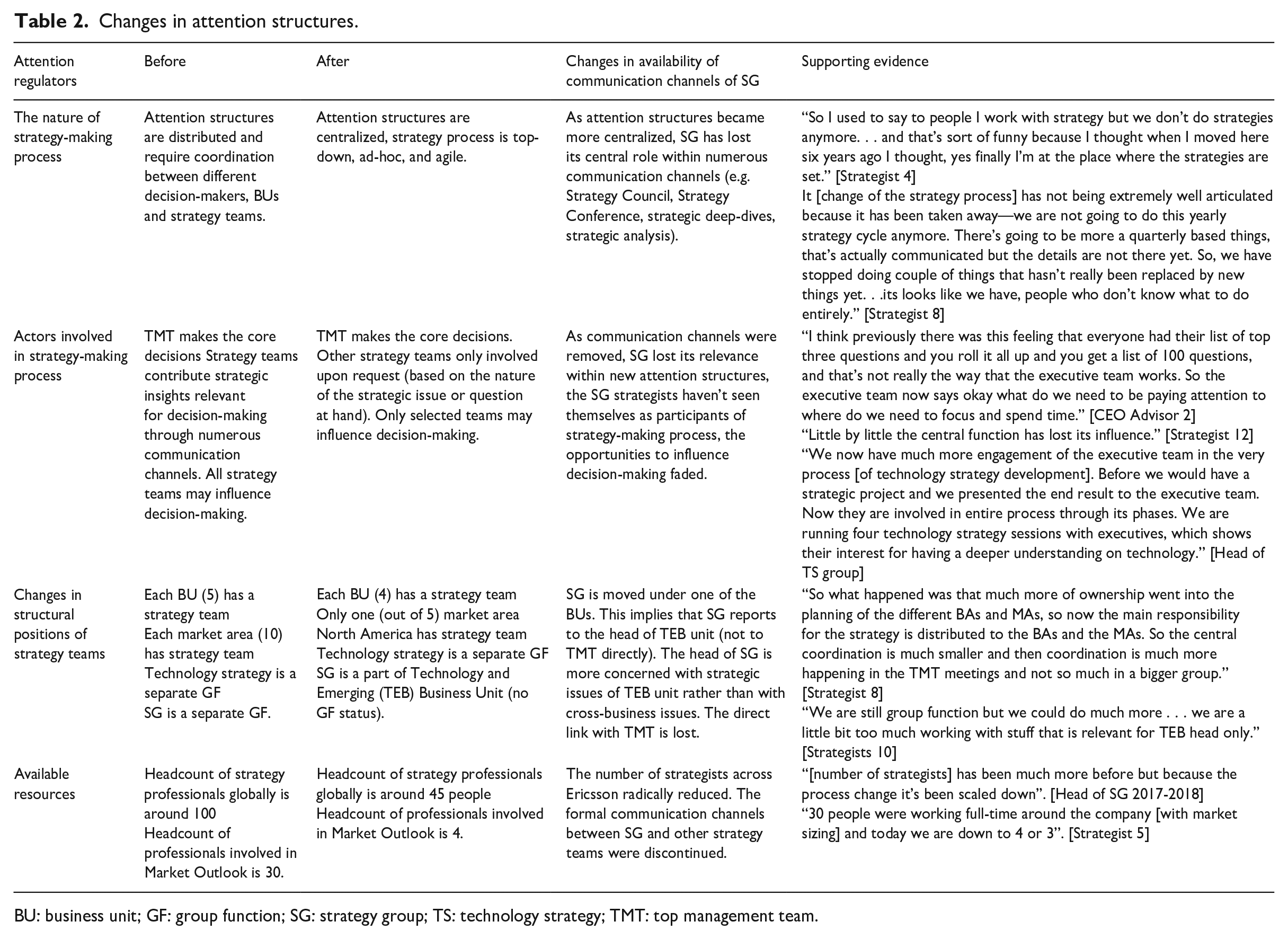
We adopted a processual analytical approach (Langley et al., 2013) to gain better insights into the interactions of a focal group of actors in the context of a structural change. We started by reviewing available qualitative data and constructing a detailed story of the changes (Langley, 1999) in the attention channels used for strategy-making at Ericsson. The multiple interviews with SG members revealed that their ability to influence the strategic attention of the TMT had been drastically reduced after the radical change in attention structure. Following Langley (1999) we bracketed available data into two periods—before and after the radical change. We identified two main elements of attention structure: strategic planning and work with strategic issues. Following Ocasio (1997) we documented the changes in these processes based on four categories: the nature of strategy-making process, involved actors, changes in structural positions, and available resources (Table 2).
Changes in attention structures.
BU: business unit; GF: group function; SG: strategy group; TS: technology strategy; TMT: top management team.
Next, we focused on how organizational actors, adversely affected by structural change, regained attention within the new attention structures. To analyze their activities, we selected the communication and procedural channels available to SG members before and after a radical change. In line with the definition of communication and procedural channels (Ocasio, 1997), we focused not only on activities like meetings but also on specific procedures that were aimed at the production of documents or reports through knowledge exchange and coordination between multiple actors. For instance, we treated Situation Analysis as a procedural channel as it implied the use of particular analytical tools for the identification of strategic insights subsequently synthesized into a formal report. For the sake of conciseness, in the remainder of the paper, we refer to communication and procedural channels as communication channels. We studied the formal strategy instructions and drew on interviews with various strategists. At this stage, we realized that majority of communication channels previously available to SG were no longer available to them after the restructuring. However, the observations demonstrated that SG members were actively seeking ways to re-establish prior communication channels within the new attention structures and continued to maintain some of them informally. The follow-up interviews with informants provided confirmation that by 2021 the SG had regained much of its old importance within the new attention structure.
To better understand this process of regaining attention, we especially focused on events (Langley, 1999) in which SG members performed activities aimed at modifying the new attention structures to their own advantage. At this stage, we focused on the interviews and observations. We identified such events and open-coded SG members’ activities related to them. Our approach was similar to a “grounded theory” strategy (Langley, 1999). By coding and recoding activities performed by SG members, we abstracted them into several groups according to their purpose (experimenting with new procedures, mobilizing participation, promoting new channel, evaluating new structures, building partnerships, and revalidating existing channels). What struck us at this point was that the activities were characterized by two distinct rationales—creative reconstruction of the channel and selective reuse of old channels (those used in the attention architecture before the radical top-down redesign). The activities themselves were broadly related to understanding the attentional context within the organization, cooperating with other organizational actors at the same or lower level, and interacting with organizational actors at higher levels. Finally, based on the outcomes of the activities, we aggregated them in two adaptation practices: reinvention and renewal. How these activities were implemented within each practice differed based on the underlying rationale. The next section provides illustrative examples of each practice.
Findings
Roles of corporate strategists and change of attention structure
We focus on two important components of Ericsson’s strategic attention structure—the strategic planning cycle and strategic issue management. Each attention component consisted of a set of communication channels. The strategy planning cycle, known internally as “the strategy wheel,” included several dedicated strategic events, reports, and procedures that ultimately led to setting the company’s strategic direction. The strategic issue management process involved regular meetings and procedures aimed at identifying, selecting, and executing strategic issues and initiatives. This structured management of strategic issues enabled an effective allocation of resources to strategically important initiatives that often cut across Business Units and Market Areas. Fixed communication channels provided a formal administrative context that clearly defined roles for contributing to strategy formulation. Members of SG had a central role within the communication channels of both the strategy planning cycle and strategic issue management. They led several forums and internal procedures and were responsible for the coordination of other actors within these communication channels. This allowed SG members to steer strategic conversations and enabled a direct input into strategic decision-making and consequently made members of SG feel important and valuable actors in shaping strategy at Ericsson. Reflecting on the SG role, one of its members explained, We are doing deep dive investigations on topics and give a report to the top team [. . .] so that is supporting role for executive team [. . .] [our] bosses can build their opinion when it’s time for the key decisions. So if we do our job right [. . .] it would be easier to make a decision [. . .] because we give them [TMT] the right tools and the right background. (SG strategist 2)
The communication channels were used for organizing and managing the focal strategy-making processes. Within those channels, SG members often utilized strategic tools or techniques for analyzing products, organizational capabilities, and competitive environment. Within the strategic planning cycle, strategists from SG conducted forecasting (e.g. Market Outlook), gathered market and competitive intelligence (e.g. Situation Analysis), and developed scenario plans. They presented the outcomes of these procedures in elaborate strategic reports and PowerPoint slides, which were later used by BUs as input into their business planning. Within strategic issue management, SG was involved in the identification and analysis (deep-dives) of strategic issues that cut across the company. For instance, SG was actively involved in coordinating cross-level and cross-function organizational events such as the Strategy Conference—an annual meeting of strategy professionals from various Business Units. Similarly, within the Strategy Council—a forum for discussing cross-unit strategic issues—SG members were responsible for keeping and updating the list of strategic issues and co-chairing the regular meetings.
The major organizational restructuring of Ericsson that began in 2017 significantly changed the attention structures of the established strategy-making process (see Table 2). The simplified strategy-making process reduced the importance of cross-unit communication channels that were used for both the strategic planning cycle and strategic issue management. Simplification resulted in a more centralized strategy process limited to a smaller group of key decision-makers. This radical change disrupted the core communication channels available to SG members. The prior elaborate strategy processes that enabled distributed contributions changed radically offering much less opportunity to gain strategic attention. Different SG members reflected on the changes in attention structures: “central coordination became much smaller and [was] happening in TMT meetings and not so much in a bigger group” (SG strategist 8, March 2018); “the CEO didn’t want to see this [strategy] wheel (SG strategist 4, October 2017)”; “[CEO] doesn’t want us to discuss; he wants us to act” (SG strategist 2, September 2017).
First, within the new attention structure, the cross-unit communication channels became less relevant. As BUs were encouraged to work independently and the coordination of strategic updates, strategic events, and strategy teams previously performed by SG became irrelevant. Second, the greater focus of the TMT on the efficiency of BUs weakened their interest in regular work with cross-BU strategic issues. Restructuring led to a reduction of the communication channels in which SG had held their central position. As the strategists explained, The big thing—we don’t have that direct link to those meetings [cross-group strategy forums], we really don’t know that well what’s going to happen in those meetings, we are a little bit disconnected at the moment. (SG strategist 12; September 2018) The whole group has been in limbo for a year, we don’t know what we’re going to do, we only know that they [TMT] had taken away the decisions from us . . . the things we do in SG were taken away from us. (SG strategist 11; May 2018)
The reduced relevance of their old communication channels created great dissatisfaction among members of SG. Some SG members had their role changed, and moved away from the group, while those who remained emphasized how limited the position of SG had become: I feel it [change in the strategy group] strongly, and I know that other people are disappointed in it. (SG strategist 1; September 2017) I used to say to people I work with strategy but we don’t do strategies anymore . . . (SG strategist 4; October 2017)
Members of SG felt they had lost their prominent role within the strategy-making process. The irrelevance of familiar communication channels within the new attention structure reduced the opportunity to feed strategic insights into TMT’s strategic decision-making and blocked the opportunity to shape the attention of fellow strategists throughout the rest of the organization.
However, by the end of 2020, the members of SG had recovered their strategic influence and reestablished a central position within the new attention structure, thereby regaining the attention of the TMT. In 2020, the group recovered its status of independent GF (after being previously attached to a Technology and Emerging Businesses Unit), which repaired the broken line of communication with TMT and increased its ability to influence strategic decision-making. As an SG member explained: “now the strategy process is kind of back, with a lot of engagement from top management.” [Strategists 2, February 2021]. The section below explains how SG modified the new attention structure to work around the formal demotion of their position.
Adaptation to the new attention structure
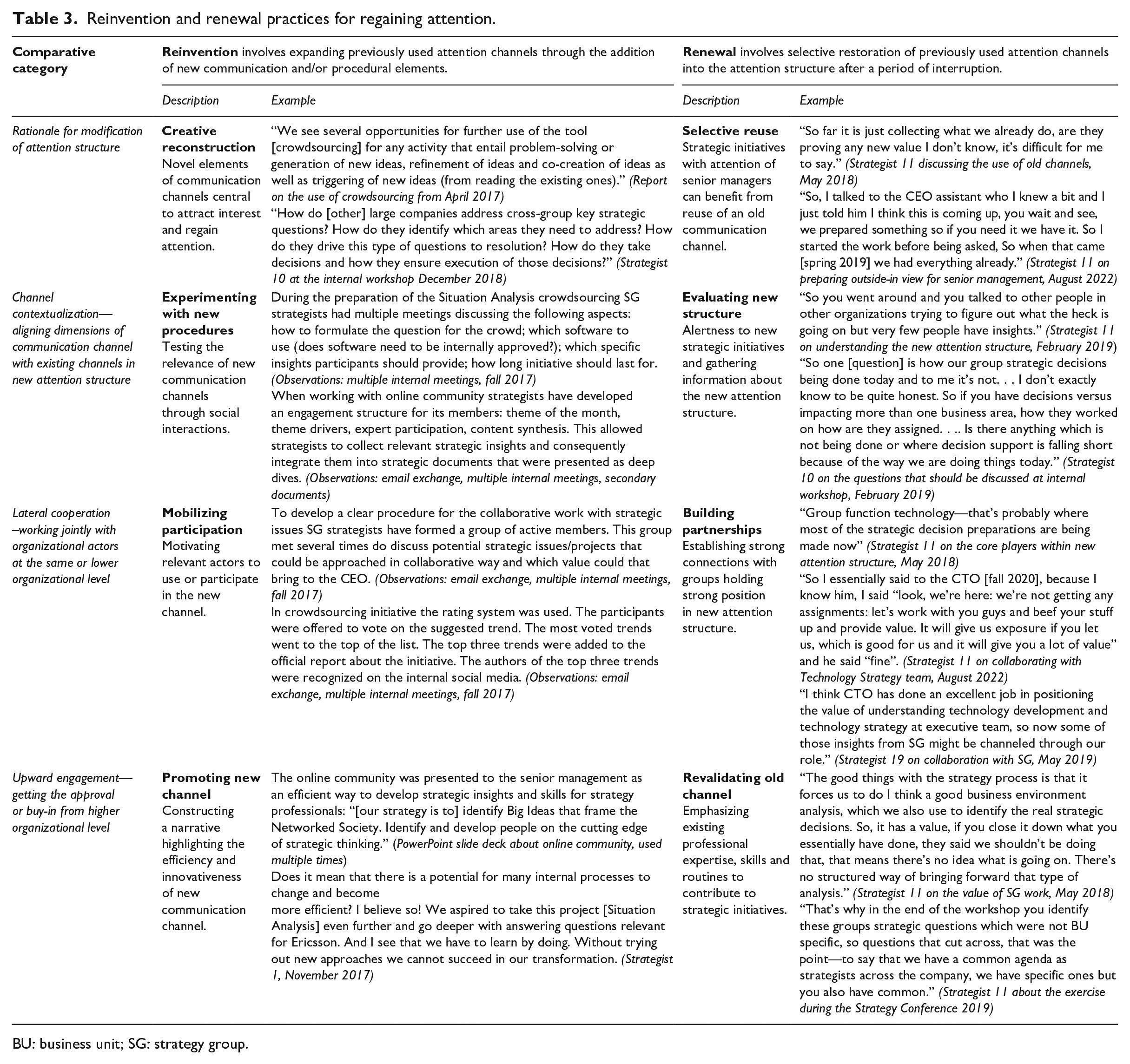
Despite finding themselves in a precarious situation, members of SG responded by purposively adapting the new attention structures to regain their previous influence. They used reinvention to produce new communication channels building on the ones that already existed within the old attention structure. Here, they creatively combined a previously used channel with novel communication or procedural elements and by doing so effectively created a new communication channel aligned with the new attention structure. On the other hand, they used renewal to selectively reinstate old communication channels after a period of interruption during which these channels had been suspended. Renewal is about restoration rather than innovation. Both approaches aimed at attracting attention back by regaining relevance within the new structural distribution of attention. However, they differ in their underlying rationales and the activities performed by the strategists involved. Reinvention involves creative reconstruction of existing communication channels and emphasizes novelty. Renewal involves selective restoration of previously used channels without modifications. Table 3 describes the three types of activity required for successful reinvention and renewal: channel contextualization, lateral cooperation and upward engagement. Each of them involved different kinds of activities depending on whether they related to reinvention or renewal.
Reinvention and renewal practices for regaining attention.
BU: business unit; SG: strategy group.
Reinventing communication channels
The question of “How should we revise our approaches to strategy?” was often a central theme of formal and informal discussions within SG. In line with the ABV’s valuing of novelty (Shepherd et al., 2017), the SG increasingly believed that the introduction of novel communication channels may be the way forward to attract the attention of relevant organizational actors. Also, they saw radical changes in the competitive environment as justification for innovation in channels: The number of [strategic] choices becomes larger because it’s a much more open field [Ericsson entering 5G arena] and that makes it more difficult to be working with the (current) company strategy process [. . .] And that requires new skills for people and a new paradigm on how to make decisions, how to prepare for decisions. It’s not so linear. (SG strategist 2; September 2017) What should the new strategy process look like? What are the new ways of working, how do other companies deal with this? What are the capabilities needed for the new strategy process? (Head of SG; October 2018)
The members of SG initiated three channel reinventions that created new communication channels on the basis of those existing in the previous structure. First, they reinvented the Situation Analysis technique used for strategic planning by widening participation in the exercise and utilizing digital technology to support the process. Second, they adopted an internal crowdsourcing approach aided by introducing a novel collaborative software to identify strategic growth areas for the company. This channel reinvented the role of deep-dive technique used for identifying and selecting strategic issues. Third, they established the Strategic Customer Engagement team to develop a capability for the co-creation of innovation strategies with the key customers. This completely novel activity within SG built on existing relationships with customers but introduced a more structured approach to strategy co-creation. Increased participation and openness were the innovative elements common to all three reinvented channels. The first two relied heavily on deploying digital technology for widening participation across the organization. The third one focused on collaboration with key customers (telecom operators) to co-develop strategies for exploring emergent businesses. The Head of SG described this third channel as something that was highly unique for the group. SG members saw the relevance of introducing the more collaborative way of strategy-making for bringing the group back to the center of strategic conversations: If we’re not mobilizing the force of the hundred thousand people working for Ericsson, then it’s just six-seven guys having fun. That’s nothing. The power of using the organization is the thing. (SG strategist 11 on reinventing Situation Analysis, May 2018) The biggest value of this exercise [crowdsourcing] is to show a different approach to solving strategic issues. (SG strategist 1 on reinventing deep-dives technique, December 2017) The Strategic Customer Engagement team collaborates with customers to co-create business strategies in the areas of Internet of Things, Cloud and 5G. The team uses deep dives to work on data monetization, smart cities, automated transport and logistics as well as digital manufacturing. (SG strategist 11 and Head of Strategic Customer Engagement Team, July 2018)
Reinvention and the perceived novelty of proposed collaborative communication channels raised several challenges for the group in terms of contextualization of communication channels, lateral cooperation and upward engagement (see Table 3). For reinvention, contextualization involved experimentation with dimensions of a new communication channel and aligning it with other channels of attention structure. For this, new procedures for the participation of a wider set of actors and the processing of their inputs had to be developed and tested. For example, before the crowdsourcing initiative could be introduced, SG members had to decide: which types of strategic issues should be addressed with the use of a collaborative approach (e.g. identification of trends in the coming 5 years); the time allocated for work with these issues (e.g. strategic challenges had to be identified within one calendar month); and how people should interact with each other (e.g. which specialized crowdsourcing software to use). Similar procedural considerations were important for introducing IT-enabled Situational Analysis and the establishment of Strategic Customer Engagement Team. As SG members coordinated the entire process of setting the new procedures and influenced the identification of strategic topics they started to slowly regain a more central role in the new communication channel.
Reinvention of communication channels also required cooperation across the organization and beyond (i.e. for Strategic Customer Engagement) and strategists from the SG acted to mobilize the participation of relevant actors. Mobilization implied activating the willingness of other organizational actors to take part in the new communication channel. Any increase in participation signaled the success of the reinvented channel. Also, the large number of participants led to a greater variety of inputs and insights and therefore better quality of information produced through new channels. To assure greater participation, SG members advertised collaborative channels via personal networks and internal social media websites: This is a fascinating opportunity to test a new way of working and give direct input into the first phases of strategy, the situation analysis [. . .] Participation does not require much in terms of time and effort as it is done purely at your own pace and you can easily pop in and out during the week of the pilot. (Internal post October 2017)
In addition, to mobilize participants strategists often relied on various reputational incentives (e.g. internal recognition of active contributors), monetary incentives (e.g. small prizes like vouchers and books), and gamification elements (e.g. voting points, dashboards, and badges). SG members also actively looked for internal sponsors. They wanted to collect further evidence of the new channel’s relevance within different situational contexts and by doing so signal its usefulness to senior decision-makers. For instance, members of SG met with representatives of the Internal Analytics Group to expand the use of Situation Analysis. Similarly, the “burning questions” within 5G commercialization and IoT (Internet of Things) were discussed respectively with the 5G Program Manager, a representative of the Chief Technology Office, and managers from BUs to better prepare collaborative activities with key customers (Strategic Customer Engagement): So what he did was clever. He went around to the Heads of the regions and the major accounts and presented the idea first, and then we brought it up and of course they love this because the more stuff they can take on and use to improve the relationships they have with major customers the better. (SG strategist 11 on mobilizing participation in Strategic Customer Engagement)
Finally, upward engagement was crucial for winning the interest and approval of senior management and validating new channels. Strategists had to promote new channels by justifying their value and fitting them with the newly established strategy process. Not surprisingly, the introduction of novel channels was often met with reluctance and skepticism. To overcome that, SG members constructed a narrative by using language similar to that used by the CEO in his strategic communication to increase resonance with the top management and align with the attention focus of the important decision-makers. Yet, within the new attention architecture, the SG members sometimes had no direct channels for communicating with TMT and hence had to connect with other actors that possessed those links. For instance, SG members approached a CEO advisor to discuss using an online community to identify potential strategic issues: “[we] had a very good meeting with (our CEO’s Advisor 1) earlier today regarding how we can leverage our online community insights and new ways of working” [SG strategists 1]. They also wrote a report describing the procedure and the outcomes of the reinvention of Situation Analysis channel and informally shared this with other managers (e.g. CTO office). This report emphasized the speed and low costs of the reinvented channel. Specifically, the strategists wrote: Our conclusion is that the approach can be extremely effective for Ericsson in several ways. Although the design and management of the process need some additional trials and experimentation, we find clear benefits in using this tool as a potential way to support and improve Situation Analysis but also other similar processes which require expertise and insights from multiple actors. (Report—Using digital tools for Situation Analysis trend scanning, November 2017)
As part of the promotion, strategists from the SG group also carefully built a narrative around the Strategic Customer Engagement channel. Because of the reorganization, they were part of the newly established BU with a mandated to create new businesses in the domains that went beyond Ericsson core business. The CEO required any such exploration of new business opportunities to be conducted in collaboration with core customers (telecom operators). This enabled SG to justify reinventing the existing channel of engagement with customers as a dedicated new capability targeted at the collaborative exploration of new opportunities. A corporate strategist from the SG reflected: “The CEO really liked this story [about Strategic Customer Engagement]. It was a good story to tell.”
These adaptive experiments sometimes failed to create a direct impact on strategic decisions (e.g. the crowdsourcing approach project aimed at the identification of new growth areas was not accepted by senior decision-makers). However, the use of this reinvented channel was not inconsequential as it provided SG members with an opportunity to voice their strategic recommendations. In sum, experimenting with new procedures, mobilizing participation, and promoting new channels helped SG members to reinvent some channels and adapt to the new attention structure.
Renewing existing communication channels in the new strategic context
If reinvention builds on an assumption that novelty and creative reconstruction help with regaining attention, renewal relies on the selective reuse of familiar routines. Hence, renewal refers to the selective restoration of channels the SG used within the old attention structure. This flexible renewal approach is recognizable in the observation by the Head of SG that “the demand for our capabilities has increased and we again work on the topics that help to maintain the long-term value creation capability and support competitive advantage” [January 2020].
However, this renewal approach should not be mistaken for a passive reaction by corporate strategists to the situation in which obsolete channels suddenly became in vogue. It requires alertness to situations favorable to the reuse of an old communication channel. Moreover, similarly to reinvention any restoration required contextualization, lateral cooperation, and upward engagement yet with different emphases and distinct actions. Contextualization for renewal necessitates an evaluation of the new attention structure. Lateral cooperation focuses on building partnerships with groups holding strong positions in the new administrative arrangement. Upward engagement requires revalidating the reused channel by emphasizing how it contributes to the success of a particular strategic initiative.
Contextualization required SG members first to evaluate the context of the new strategy-making process. They needed to gather information about the new attention structure, learn about the roles of key actors, and understand their attention focus. Such evaluation of the present attention structure enabled members of SG to identify demands or gaps within the structure and then select an appropriate old communication channel to respond to these demands. As SG lacked a direct link with the TMT they had to utilize their informal networks to inquire how the TMT deals with strategic issues within the new structure. The multiple internal conversations with senior actors across Ericsson revealed that senior managers worked in a more centralized manner and kept strategic discussion within a small circle. When specific strategic questions or initiatives emerged, they employed different strategy teams “on demand.” As a CEO advisor explained, We’ve been trying out and working with a new model where we use more a task force concept because there are 15 executive team members. It doesn’t make sense that every important decision has to get approved by all of them all of the time. So we said, okay can’t we say who are the key stakeholders and who will be the champion or the lead and then they’ll drive that work. (CEO advisor 2, April 2019)
In this more task-force-oriented environment it was important for members of the SG to evaluate where their professional expertise could add value and stay alert to any strategic initiatives that potentially benefit from the reuse of old communication channels. This alertness and the benefits from selective reuse are demonstrated by the SG involvement in the Vision 2030 strategic initiative. This major strategy project focused on identifying future growth opportunities and analyzing gaps between them and organizational capabilities. The TMT was strongly committed to this initiative, which was supported by one of the leading global management consultancies. The SG won a seat at the table and the Head of the influential Technology Strategy group described the organizational arrangement and division of professional expertise thus: We [SG and TS] are leading this project. We have external support from a major consultancy firm. We [TS] bring detailed insights on technology development. Our responsibility is to identify relevant technology, assess opportunities created by changes in technology and recommend into which technologies to invest. SG is looking more at market development and business models, and we bring links between technology and opportunity. (Head of TS group, January 2020)
However, this important role for the SG in the development of the Vision 2030 was not simply given and the comment by one of the involved corporate strategists hints at other considerations about the involvement and contribution: This [Vision 2030] is driven by top management with heavy involvement from [external consulting company]. The CTO persuaded the CEO to allocate the project to SG and TS. We are very keen to lead this as this is the most important activity for us in the last few years. (SG strategist 10, January 2020)
For the SG to be more prominently involved, lateral cooperation through partnership building was important. Partnership building implies identification of common purposes or tasks and sharing of responsibilities, resources, competencies, and benefits. SG built a strong partnership with the TS—the group that became increasingly influential and worked more closely with the TMT within the new attention architecture. TS engaged frequently and deeply with the TMT through various sessions around technology deep-dives: Technology strategy is now identified as a leading strategy, which suggests it has to be produced first . . . Technology strategy is now the main input into the formal strategy process. We run technology strategy sessions with them (TMT) four time per year. For the last three years they have shown a keen interest in technology development. (Head of TS group, January 2020)
This partnership helped SG to get involved in the major strategic initiative. Being an important part of the Vision 2030 project enabled renewing some old channels such as organizing the Strategy Conference (in the past, an annual event for strategists across Ericsson) and offering strategic analyses to members of BUs involved in forming the Vision 2030. This also required more coordination across BUs and therefore increased the importance of intraorganizational communication channels.
Similar to reinvention, the renewal of communication channels required upward engagement. Unlike the reinvention effort that required intensive promotion of a new channel to TMT by demonstrating alignment between the channels and organizational strategy, renewal offered an opportunity to revalidate old channels. Revalidation implies the skillful framing of the added value for old procedures or events to make them accepted again. Within the Vision 2030 initiative, SG members effectively demonstrated their strategic expertise and competency. In the two annual Strategy Conferences the group effectively demonstrated their capability to analyze competitive environment, service business models, and market trends that complemented TS’s expertise in technology and applications. As one of the strategists put it: “When we worked together, their [TS group] messages became a lot stronger when we started adding some dollars and cents and market and industry knowledge to it” [SG strategist 11, August 2022]. Hence, with the reintroduction of analytical (e.g. deep-dives and situation analysis) and coordination (e.g. strategy conference and strategy agenda), SG members were able to demonstrate their expertise and influence some decisions through participation in the strategy-making process: If you’re going to do strategy you need to keep a business perspective, you need to keep a R&D capability perspective, you need to keep a technology outlook perspective, you need to have a competitive analysis, otherwise you cannot formulate it [. . ..] To do a good job, you need to put all these aspects together. (Head of TS group, May 2019)
The increased importance across BUs’ communications channels enabled SG to position themselves as a “silo breaker” at the corporate level and argue that they were a group uniquely positioned to coordinate strategic issues and initiatives across Ericsson. The channel renewal allowed the group to regain their cross-BU position. During the Strategy Conference, the Head of the SG group explained: We work on the topics that help to maintain the long term value creation capability and support competitive advantage. We analyse the external environment and keep track of competitors. We drive internal projects that cut across company. We are BU agnostic and provide them with an unbiased point of view. We work directly with our customers on strategy development. (Head of SG, January 2020)
Evaluating the new attention structures, building partnerships, and revalidating channels are important activities for navigating the new attention structure that helped SG members to renew old channels (with their salient role in them). It shows the resilience of these communication channels, which despite being made temporarily obsolete could be reinstated at the opportune moment and within appropriate strategic initiatives. Unlike reinvention which requires much effort to develop, promote and legitimize channels, renewal requires selective recall of old channels and patience from corporate strategist to wait for the right moments and initiatives to reintroduce them.
Discussion
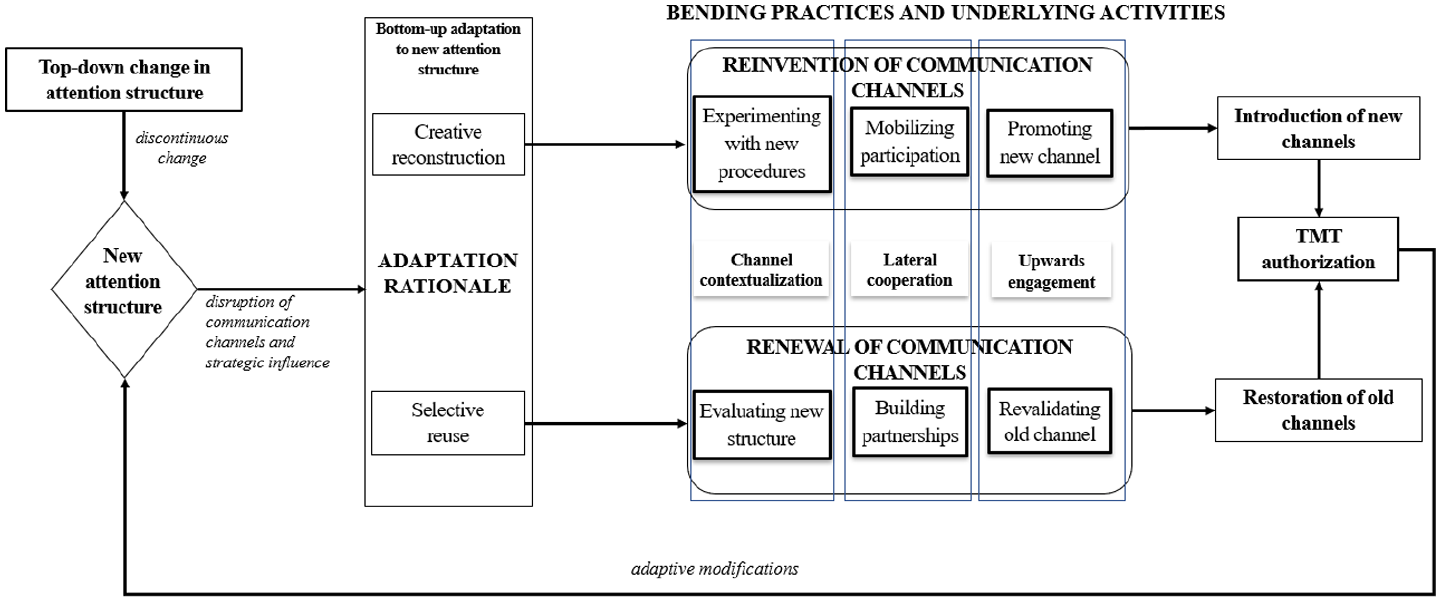
We develop our findings into a conceptual model addressing the dynamics of attention channels (see Figure 1). The model shows how radical and top-down change in attention structures can trigger adaptive and bottom-up responses from mid-level organizational actors, who bend imposed structures more in their favor through the reinvention and renewal of communication channels.
Model of attention structure dynamics.
Our model establishes two types of change in the dynamics of attention channels. First, and consistent with extant research (Brielmaier and Friesl, 2022; Joseph and Ocasio, 2012), there are of course the radical changes in attention structure resulting from TMT top-down interventions. These create discontinuity between old and new communication channels. Second, and less recognized in extant research, there are the adaptive and more incremental modifications that follow the discontinuous change and bend the new structure through bottom-up reinvention (involving new channels) and renewal (involving pre-existing channels). Although the new architecture provides the basic communication structure, it remains inherently plastic and malleable to the purposive interventions of motivated actors from outside the TMT.
Reinvention and renewal of communication channels can unfold in parallel and both help actors to regain the attention lost within the new architecture. Reinvention requires creative reconstruction and is motivated by the rationale that the very novelty of a communication channel helps with attracting the attention of senior managers (Shepherd et al., 2017). The affected actors build on a communication channel that was pertinent to their influence within the previous attention structure and purposively combine it with novel elements. They experiment with new procedures (e.g. crowdsourcing was done via separate interaction software with clearly defined new procedures) and create a new channel.
In our case, the disrupted channels such as Situation Analysis and deep-dives into strategic issues were combined with novel elements of wider participation including various internal and external actors. Furthermore, channel reinvention—such as the IT-mediated collection of strategic information—requires further adjustment of attention structure. For example, accommodation of collaborative forms of strategy-making implies an extension of communication channels along new spatial, temporal, and procedural dimensions (Brielmaier and Friesl, 2021) through the involvement of a broader set of actors. However, if such reinvented channels are not coupled with other channels within attention architecture (Ocasio and Joseph, 2005), influence on TMT strategic attention will be hard to achieve.
Renewal is based on the assumption that disrupted attention channels could be selectively reused for resolving new strategic initiatives—those with the attention of senior managers. Such selective restoration requires alertness and identification of adequate issues/initiatives that already resonate with senior managers. Renewal, therefore, often requires an opportune moment favorable to reusing an old communication channel made temporarily obsolete by the new attention structure. Also, any selective reuse benefits from the evaluation of the new structure and such an in-depth understanding of the new attentional context enables recognition of structural “gaps” appropriate to the restoration of previously used channels. Hence, renewal extends the life of an old communication channel after a period of interruption. The previously used communication channel is repurposed to make connections within the new attention structure. In this case, the channel does not require modification.
In our case, SG members managed to restore the disrupted communication channels of the Strategy Conference and deep-dives within the strategic initiative of Vision 2030. In the context of renewal, the focal group of organizational actors utilized their existing legitimacy within their respective strategy fields (Belmondo and Sargis-Roussel, 2022; Paroutis and Heracleous, 2013). Their strong expertise helps to revalidate the old channel. However, the challenge remains to contextualize the previously used channels within the new attention structure. Renewal requires entrepreneurial judgment in finding opportunities within the new structure (Ren and Guo, 2011) and assessment of how to best fit an old communication channel to support a strategic initiative at hand. This implies knowledge and evaluation of the local stakeholder agendas, use of known protocols and rules as well as identification of the right formats and channels for communication (Rouleau and Balogun, 2011).
The two distinct practices of reinvention and renewal may be used simultaneously but determine the character of activities underlying them and prioritize its different aspects (Figure 1). Although both practices require placing channels within the context of a new attention structure, this is achieved through different means. Reinvention demands contextualization of the novel part of the channel. Although the reinvented channel builds on the previously used one, the extension of the channels through the involvement of new actors or use of different tools demands the elaboration of new procedures and intense experimentation. On the other hand, in renewal, contextualization is achieved through the careful evaluation of the new attention structure that reveals the best way to selectively reuse old communication channels. The procedures performed within the channels are known and the challenge is to find strategic initiatives with TMT attention in which the renewed communication channel could add value. Similarly, the actions related to lateral cooperation accentuate different types of relationships. In reinvention, the cooperation is aimed at participant mobilization—embracing new channels by participants in the process increases the chance to attract the attention of the senior managers. In renewal, the cooperation requires building partnerships with a group of actors that hold strong positions within the new attention structure. Such partnerships allow the focal group to integrate the renewed communication channels with the activities of the more powerful group. Renewal of old communication channels requires skillfully building on activities that already have the attention of senior management. Finally, both practices require upward engagement activities. In the case of reinvention, this engagement is focused on the promotion and legitimization of a new channel. Focal actors construct a narrative that underscores the innovativeness of a new communication channel. In renewal, these activities are mostly focused on revalidating the channel within the new context. The reuse of the old communication channel enables the focal group of actors to demonstrate and claim the relevance of their expertise and skills in the new attention structure. These upward engagement activities help lead eventually to the final authorization of the new or restored channels by the TMT.
Theoretical implications
Our study makes two theoretical contributions to the emergent dynamic ABV (Ocasio et al., 2018). First, we provide insight into the dynamics of attention, shifting the focus from the dynamics of the interactions within communication channels to the channel structures themselves. The original ABV (Joseph and Ocasio, 2012; Ocasio, 1997) tended to regard attention structures as static architectures subject to episodic redesign. The dynamic ABV should include the dynamics of structures as well as communications. Pipes are bendy as well as noisy. We demonstrate that attention structures are capable of adaptation through incremental change between episodes of redesign. Attention structures can be modified through the repurposing of old channels (renewal) or the generation of new communication channels (reinvention). Extending the “pipes and prisms” metaphor (Ocasio et al., 2018), the dynamics of attention structures involve not just the radical replumbing characteristic of CEO-led change but the bending of the pipes in place. Pipes get bent as new pipes are squeezed in and old pipes are pushed back. Hence, attention structures are not rigid, instead, they are inherently plastic. Such plasticity does not suggest instability but implies a continuous ability to adapt. This adaptability is an important response to the demands of the fast-moving world faced by contemporary post-Chandlerian firms (Ocasio et al., 2023).
Second, we extend the agency involved in attention channel change to lower-level actors and distinguish two forms. While Dutton et al. (2001) acknowledge more distributed forms of agency in issue-selling, and Ocasio et al. (2018) do the same for interactive communications, they largely take attention structures as given. In particular, the original ABV typically saw chief executives and the TMT as the primary designers and shapers of attention structures (Ocasio, 1997). We emphasize how these attention structures are also potentially shaped by the agency of lower-level actors: structures are subject to bottom-up as well as top-down change.
We distinguish two forms of agency here. In the terms of Emirbayer and Mische (1998), the agency of the lower-level actors may have either a predominantly projective dimension characterized by the future-oriented generation of alternative communication channels (reinvention) or a predominantly iterational dimension distinguished by the selective reuse of communications channels from the past (renewal). The projective agency of reinvention involves a capacity to imagine new possibilities and innovate creatively. On the face of it, this may seem a stronger form of agency than the iterational agency of renewal. However, renewal is not to be underestimated: it goes beyond the day-to-day tweaking of existing channels to involve the selective restoration of channels from the past. Hence, both reinvention and renewal contain an additional degree of agency beyond those of the issue-selling literature or the original ABV: they involve evaluating and amending attention structures rather than just responding to particular strategic issues. Of course, these forms of agency are not wholly independent, but require social interactions equivalent to those stressed in the communicative interactions of Ocasio et al. (2018): that is, the building of partnerships, the mobilization of participation, and the upward promotion of new channels or revalidating of existing channels. Adapted structures rely finally on authorization by top management. Nonetheless, the initiative for structural change can come from below and take both creative and restorative forms. In this sense, we emphasize the value of expanding the sense of agency within the Strategy-as-Practice field (Mantere and Whittington, 2021) to include all three of Emirbayer and Mische’s (1998) forms. As well as de Certeau’s (1984) practical-evaluative maneuvering of the moment that has often been the focus, there are also more reflective forms of agency, involving the capacity either to draw selectively from the past or to project creatively into the future.
This study has focused on the strategy professionals commonly perceived as central in strategic attention structures due to their specialist identity within the strategy field (Belmondo and Sargis-Roussel, 2022). These strategy professionals are under pressure in contemporary conditions (Grant, 2003; Martin, 2014). Although Whittington (2019) has emphasized the precarious position of strategy professionals, he underestimates how in practice these professionals have the capacity to resist adverse change and reassert their positions. They are not passive actors within predetermined administrative systems (Lovas and Ghoshal, 2000), but are agentic in adapting to the radically changing organizational context. Their specialized knowledge and strong professional identity (Mantere and Whittington, 2021) enabled them to continuously reinvent and renew existing communication channels. Equivalent capacities for the agency are likely to be found among similar mid-level professional groups subject to adverse changes in attention structures, for example, Marketing, Human Resources, Research & Development. Hence, our model of attention structure adaptation (Figure 1) is not limited to corporate strategy professionals but may also apply to broader organizational professional groups, and future research could examine how reinvention and renewal of the communication channels undergo in different contexts.
Conclusion
This study investigated how corporate strategists regain attention in response to radical changes in attention structures. By providing rich insights into the interplay between attention structures and activities of organizational members that had lost their strategic influence within those structures, this study contributes to the current development of a dynamic ABV (Ocasio et al., 2018). Particularly, we demonstrate how the reinvention and renewal of channels enable the bending of top-down designed attention structures. These structures are more plastic than allowed for in the “pipes and prisms” model of the original ABV (Joseph and Ocasio, 2012; Ocasio, 1997). Bending occurs as actors expand channels to introduce new elements and as they fit back old elements into the existing formal design. In this sense, attention structures are not fixed architectures subject to episodic redesign but rather have internal flexibility that leaves space for more continuous adaptation. With respect to the dynamic ABV (Ocasio et al., 2018), attention structures are dynamic too. Moreover, the dynamics stem not only from the top. Structural adaptation can come from below as well. Our perspective extends the agency allowed for in the dynamic ABV from communications to the structures themselves. Even adverse structural change can leave space for a group of organizational actors to regain attention through the introduction of new pipes or the restoration of old ones. Organizational actors can proactively adapt their communication channels to the changing context of strategy-making.
Finally, our study has limitations. This study is based on a single case of a large organization in the telecommunication industry that implies a boundary condition—we expect our model to be relevant for large multibusiness organizations where different groups compete for the attention of the TMT, rather than for SMEs where attention structures may be less hierarchical, while communication and procedure channels may be less formalized. Hence, more comparative research in different organizations can be conducted in the future. Comparing the dynamics of attention structures in other multinational corporations will allow verifying identified patterns and provide a more nuanced understanding of conditions in which reinvention and renewal take place. Also, this study specifically focuses on teams of corporate strategists. Hence, future studies could investigate other organizational groups (HR, Finance, IT, etc.) to compare how changes in attention structure may affect the adaptation of communication channels of different professional groups within the organization and therefore their salience within the strategy-making process.
Supplemental Material
sj-docx-1-soq-10.1177_14761270231184616 – Supplemental material for Bending the pipes: Regaining attention through reinvention and renewal
Supplemental material, sj-docx-1-soq-10.1177_14761270231184616 for Bending the pipes: Regaining attention through reinvention and renewal by Anna Plotnikova, Krsto Pandza and Richard Whittington in Strategic Organization
Footnotes
Funding
The author(s) disclosed receipt of the following financial support for the research, authorship, and/or publication of this article: This paper benefited from funding received from the European Union (EU) research and innovation program under the Marie Skłodowska-Curie grant agreement No. 675866 (Curie European Industrial Doctorate action COINS).

Supplemental material
Supplemental material for this article is available online.
Author biographies
References
Supplementary Material
Please find the following supplemental material available below.
For Open Access articles published under a Creative Commons License, all supplemental material carries the same license as the article it is associated with.
For non-Open Access articles published, all supplemental material carries a non-exclusive license, and permission requests for re-use of supplemental material or any part of supplemental material shall be sent directly to the copyright owner as specified in the copyright notice associated with the article.
