




Abstract
This article develops the attention-based view of crises. Crises implicate the failure of structures that shape attention throughout a system and initiate attempts to transform these structures. As crises are so influential, case studies of crisis provide rich details from which to build theory. Synthesizing insights from 80 qualitative case studies of crises, we build a theoretical framework that revitalizes scholarly understanding of how structure and attention relate in today’s complex systems. This framework reveals how everyday social practices instantiate structure, compose systems, and shape the quality of attention, such that practices constitute both a source and solution to crises. Understanding the systemic nature of attention through practices might therefore advance our collective capacity to face crises. It also contributes more broadly to ongoing conversations about how to apply the attention-based view in today’s world, where important organizations look less and less like traditional big businesses, notions of structure implied by formal organization charts are diminishingly relevant, and the quality of attention matters more than its quantity.
Keywords
Introduction
One of the founding mandates of the information processing approach to organization theory was to explain why people can accomplish more within organizations than they could alone or through other forms of organizing, like markets (Joseph and Gaba, 2020; March and Simon, 1958). Perhaps the key contribution of the attention-based view was to formalize an axiomatic explanation that organizations realize a complementarity between the attention of their members and the structure that organizes them (Ocasio, 1997). People have a limited capacity in their quantity of attention: there is vastly more information available in their environment than any individual can possibly process. But organizational structure provides channels through which information can selectively flow (e.g. from corporate headquarters to different business units), so people only receive the information they need to act effectively on their limited part of the environment. In essence, structure is a means of making the most of the limited attention capacities of many individuals.
But much has changed, both in the world of organizations and in organizational scholarship, since the attention-based view was first formulated over a quarter-century ago. In fact, all three of its core concepts have undergone substantial transformation. Take the organization: many of the most important organizations today no longer look like traditional big businesses (Ocasio et al., 2022). Organizations are instead more distributed and porous. The concept of organizational structure, even as understood in traditional big businesses, has also undergone major scholarly revisions. Instead of seeing structure as fixed “pipes and prisms” through which information flows and gets dispersed, as might appear on a formal organization chart, structure is now seen as residing in more dynamic patterns of communication (Ocasio et al., 2018). Attention too has undergone dramatic changes. Especially drawing on insights from mindfulness practices, it has become apparent that attention is not merely a limitation in the quantity of information that individuals can process (Kudesia, 2019). Attention instead varies in its quality. And it may be the quality of collective, rather than just individual, attention that matters most in the precarious environments that organizations now face (Rerup, 2009; Weick and Sutcliffe, 2006).
So how can we retain the attention-based view’s central axiom—of organizations realizing a complementarity between structure and attention—in a world where all three of these concepts mean different things? Organizational structure is no longer a fixed and formal hierarchy, within a self-contained business, and attention is no longer a fixed quantity for structure to manage. Both are dynamic and fluid, rather than fixed. Although these revised understandings of structure and attention define each concept more rigorously on their own, the difficulty in jointly relating the two and thus theorizing their complementarity has grown significantly, as they are now both moving processes. It is hard to understand which affects the other through which mechanisms, as both concepts have seemingly less solidity upon which to pin down any firm connections.
Against this theoretical backdrop, we develop the attention-based view of crises. Crises are rare and significant public events that threaten negative impact on stakeholders (James et al., 2011). They are an ideal context in which to elaborate the attention-based view for two reasons. First, crises reveal failures in the structures shaping the attention of organizations—and initiate attempts to transform these structures in order to retain the hard lessons learned from the crisis (Turner, 1976). These processes generating crises implicate actors both within organizations and beyond them—and reveal the dynamism and variable quality of attention throughout the broader system. Second, because crises are so impactful, they have been analyzed through qualitative case studies that detail these processes with unusual richness. Crises therefore not only serve as a context that captures the empirical processes most needed to revitalize the attention-based view’s central axiom but crises also provide the substantive content to enact this revitalization, in the form of case studies that so richly depict these processes.
In this article, we therefore synthesize insights from across 80 case studies of crisis to introduce a theoretical framework for the attention-based view of crises (see Figure 1). This framework reveals the importance of social practices—the concrete and empirically observable activities that people enact with regularity—as the missing link between notions of structure and attention. But practices are not merely a meso-level unit of analysis to explain how macro-level structures unidirectionally shape micro-level attention in our framework. Rather, we rely on theories of practice as valuable conceptual tools to bring structure and attention onto an even level where their reciprocal relations can be understood in a more dynamic and fluid manner.
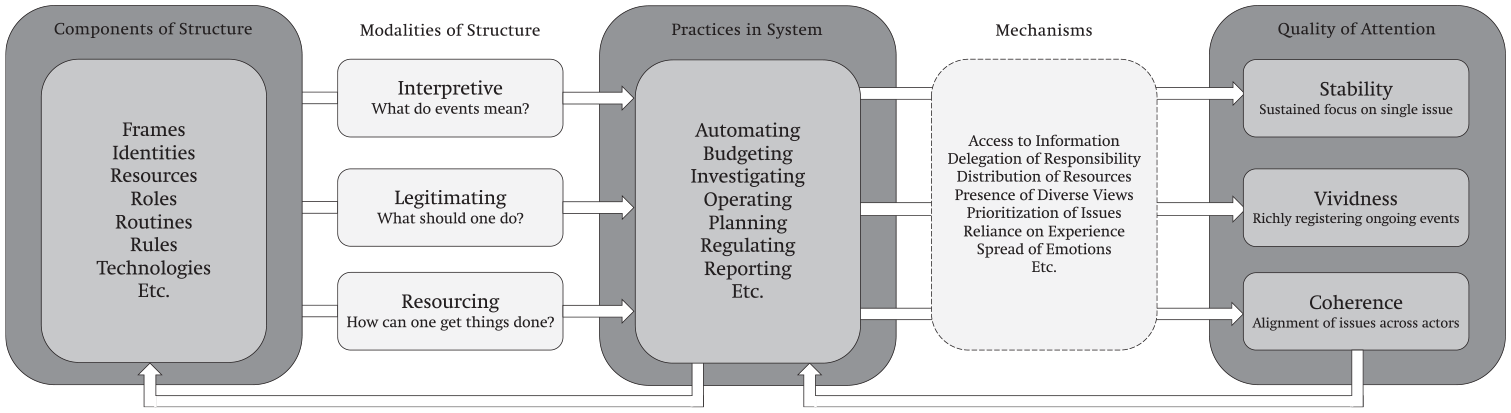
Practices as nexus of systems, structure, and attention.
Our framework draws particular inspiration from one such theory of practice, structuration (Giddens, 1984), which we believe uniquely speaks to the conceptual challenges currently facing the attention-based view. Structuration provides a means of grounding the attention-based view in concrete practices, so each of its three core concepts can be understood as analytical moves from the central nexus of practice. Structure is recognized by moving from concrete practice to the more general principles that negotiate the continuity of practice across repeated enactments. In doing so, structure gets re-animated as something dynamic, which is not merely a constraint, but also an enabler of human agency. Systems are identified by tracing out the universe of relations between actors that are all held together by the repeated enactment of practices. In doing so, the distributed nature of attention expands beyond organizational boundaries to include a broader set of relevant actors and activities. Attention is located not in the quantity limitations of individuals, but in qualities that both shape and are shaped by the social enactment of practices. In doing so, it becomes possible to differentiate how mechanisms relate to the distinct attentional qualities of actors throughout the system. Taken together, our theoretical framework therefore revitalizes the central axiom of the attention-based view through the context and content of crises—unpacking the dynamic relation between structure and attention as it relates to today’s complex systems.
This framework offers contributions both to the crisis literature and the attention-based view. Although failures of attention are widely implicated in crises, the crisis literature seldom traces attention back to structures, which leads to distorted and myopic understandings of why systems experience crises (see Silbey, 2009). By theorizing and exemplifying how concrete practices instantiate structure, compose systems, and shape the qualities of attention, this framework helps identify linkages between factors related to crises that have previously remained disconnected in the crisis literature—and may thereby lead to more accurate understandings of crisis. In doing so, this framework also contributes to ongoing discussion about how the attention-based view should best be applied when its core concepts have changed so much (Ocasio et al., 2022). By placing practices at the center of this framework, we suggest a way forward for the attention-based view even beyond crises. This way embraces the dynamism of structure as it is enacted in practice, transcends organizational boundaries to consider the broader system, and identifies mechanisms by which the qualities of attention are shaped by practice. By unpacking how practices relate to the quality of attention, it explains failures of attention and suggests potential correctives in ways that the established theorizing about inherent limitations in the quantity of attention cannot.
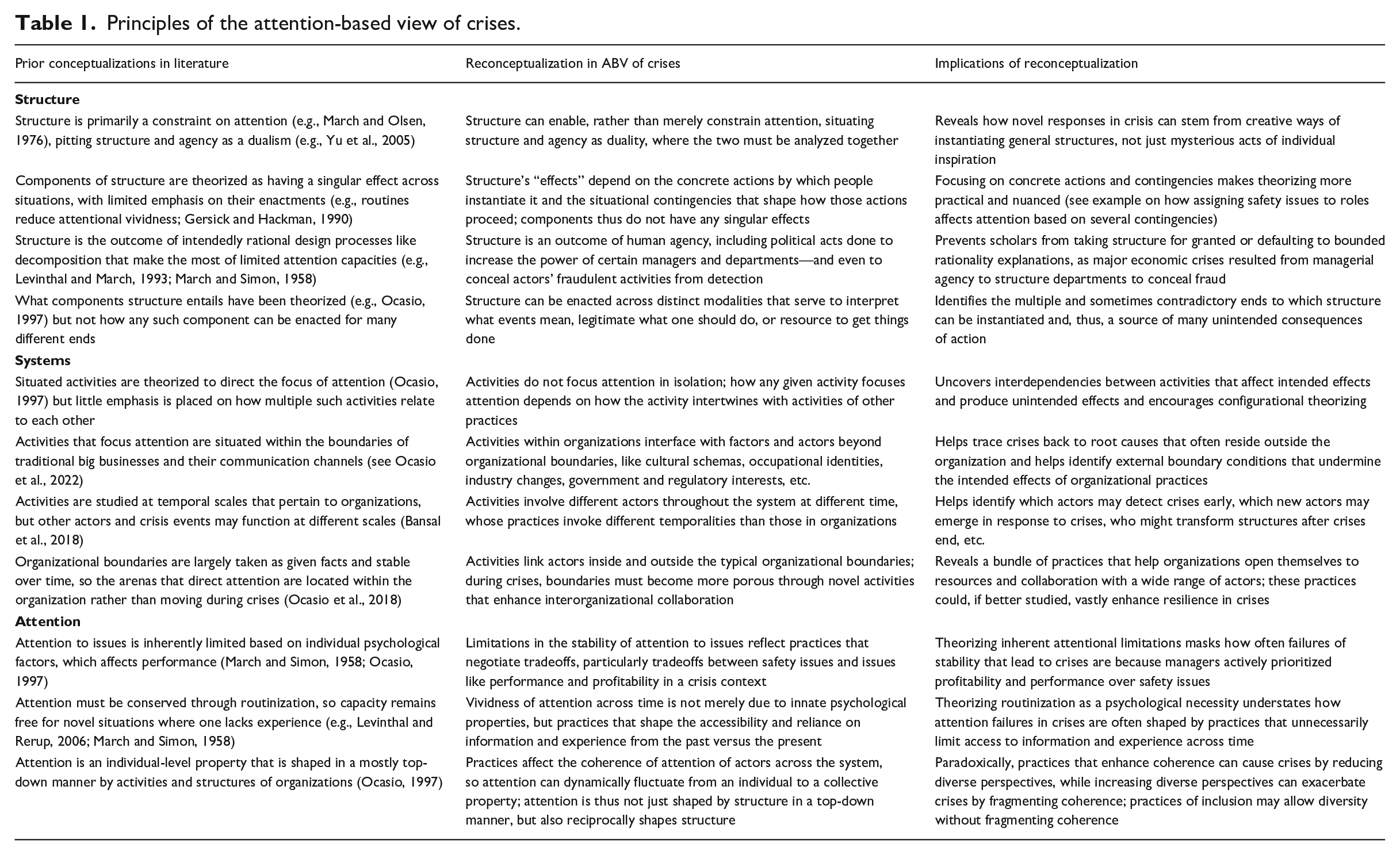
In what follows, we first overview our method for synthesizing case studies of crises to build our theoretical framework. We then provide a general overview of how structure, systems, and attention are conceptualized within this framework. Next, we apply the framework to cases of crisis, illustrating its generative potential for understanding structure, systems, and attention in crisis contexts (see Table 1). We close by discussing how our framework contributes to and sets the stage for further research on attention, crisis, and the attention-based view of crises. Indeed, as systems grow ever-larger and more complex, the scale of issues that give rise to crises is fast expanding in ways that may outstrip the attentional capacity of our systems (Bansal et al., 2018). By developing the attention-based view of crises, we share in the aspiration that if systems could better manage the quality of distributed attention, they would enhance their capacity to face the expanding scale of these challenges (Ocasio et al., 2022; Rerup and Salvato, 2012).
Principles of the attention-based view of crises.
Method
To develop our theorizing on the attention-based view of crises, we proceeded through the following stages, which align with best practices for building theory through an interpretive synthesis of qualitative case studies (e.g. Hoon, 2013; Saini and Shlonsky, 2012).
Research question
We began with an initial research question—to revivify the core axiom of the attention-based view through qualitative case studies of crisis—that set the stage for the development of our theoretical framework. This research question followed from our intuition that disparate conditions identified within crisis research could be integrated and enriched by better theorizing the structural nature of attention—and that the attention-based view’s central axiom about the complementarity between structure and attention could be developed in light of crisis contexts, making case studies of crises the ideal content with which to revivify the attention-based view. Our intuition accords with the crisis literature, which argues that case studies of crisis uniquely provide “the opportunity to capture significant detail and insight into underlying relationships that can lead to theory development” (James et al., 2011: 482).
Locating articles
We then identified studies for potential inclusion in our analysis using several complementary methods. We first assembled a corpus of qualitative case studies by consulting five recent reviews related to crisis (Dahlin et al., 2018; Gregg et al., 2022; James et al., 2011; Maitlis and Sonenshein, 2010; Williams et al., 2017). This primary set of studies was then supplemented by our own manual search of case studies discussing “crisis,” “crisis events,” and “crisis management” in the title, abstract, and keywords of 12 top organizational journals (Academy of Management Journal, Administrative Science Quarterly, Organization Science, Human Relations, Organization Studies, Journal of Management Studies, Journal of Management, Journal of Organizational Behavior, Management Science, Strategic Management Journal, Management Learning, and Strategic Organization). Finally, we scanned the references of these collected articles to identify any additional relevant studies to include in our corpus.
Inclusion criteria
We excluded all studies that were (1) not qualitative (i.e. quantitative or purely conceptual articles), (2) not about crises (e.g. articles that used the term “crisis” in figurative manner, as in a “crisis of confidence”), (3) not case studies (e.g. opinion articles that discuss a crisis without any formal analyses or ethnographies that examine crisis-free systems rather than case studies of actual crisis events), or (4) did not discuss the conditions underlying crises (e.g. articles that focused on managing public relations after a crisis). As definitions differ in the exact features required for an event to constitute a “crisis,” we sought to be more inclusive to enhance our capacity for theoretical insight (e.g. Maitlis and Sonenshein, 2010). For instance, some definitions stipulate that crises must have large economic consequences (Shrivastava et al., 1988), which could potentially exclude smaller crisis events that are nonetheless quite instructive about team dynamics (e.g. Kayes, 2004; Weick, 1993). We collected a total of 132 articles, of which we coded the 80 articles covering 42 crises that met our inclusion criteria.
Inductive coding of case studies
We both read through every case study. In an initial round of coding, we identified the type of crisis (e.g. natural disaster, economic crisis, industrial accident), stage of crisis (pre-crisis, during-crisis, and post-crisis), and any non-organizational actors (e.g. government, regulatory, media, industry, stakeholders) being studied in the case and then narratively summarized the processes related to the crisis. Specifically, we extracted out the conditions the study identified as exacerbating or alleviating the crisis along with the concrete data that supported these conditions. We took the conditions and data of each study at face value and did not attempt to double check them by collecting new primary data. As several case studies examined the same crisis, we did, however, ensure that the explanations different studies of the same case offered did not contradict each other. We found that these studies largely either overlapped and offered supplemental information about similar conditions or provided distinct and complementary perspectives. We then assembled a database of crises and their conditions and began a cross-case analysis through an inductive coding process. Similar to other inductive coding methods, we clustered together similar lower-order conditions into more abstract higher-order aggregate conditions based on the similarity of the conditions the case studies describe as occurring related to the crisis (e.g. Miles and Huberman, 1994), such that the typical aggregate condition had three cases that illustrate it and the set of conditions exhausted our database. This inductive coding produced a set of 22 aggregate conditions that relate to the exacerbation or alleviation of crises at its different stages; they were general enough to apply across several cases but specific enough that they differed in ways that revealed the need for further theorizing.
Deductive coding of case studies
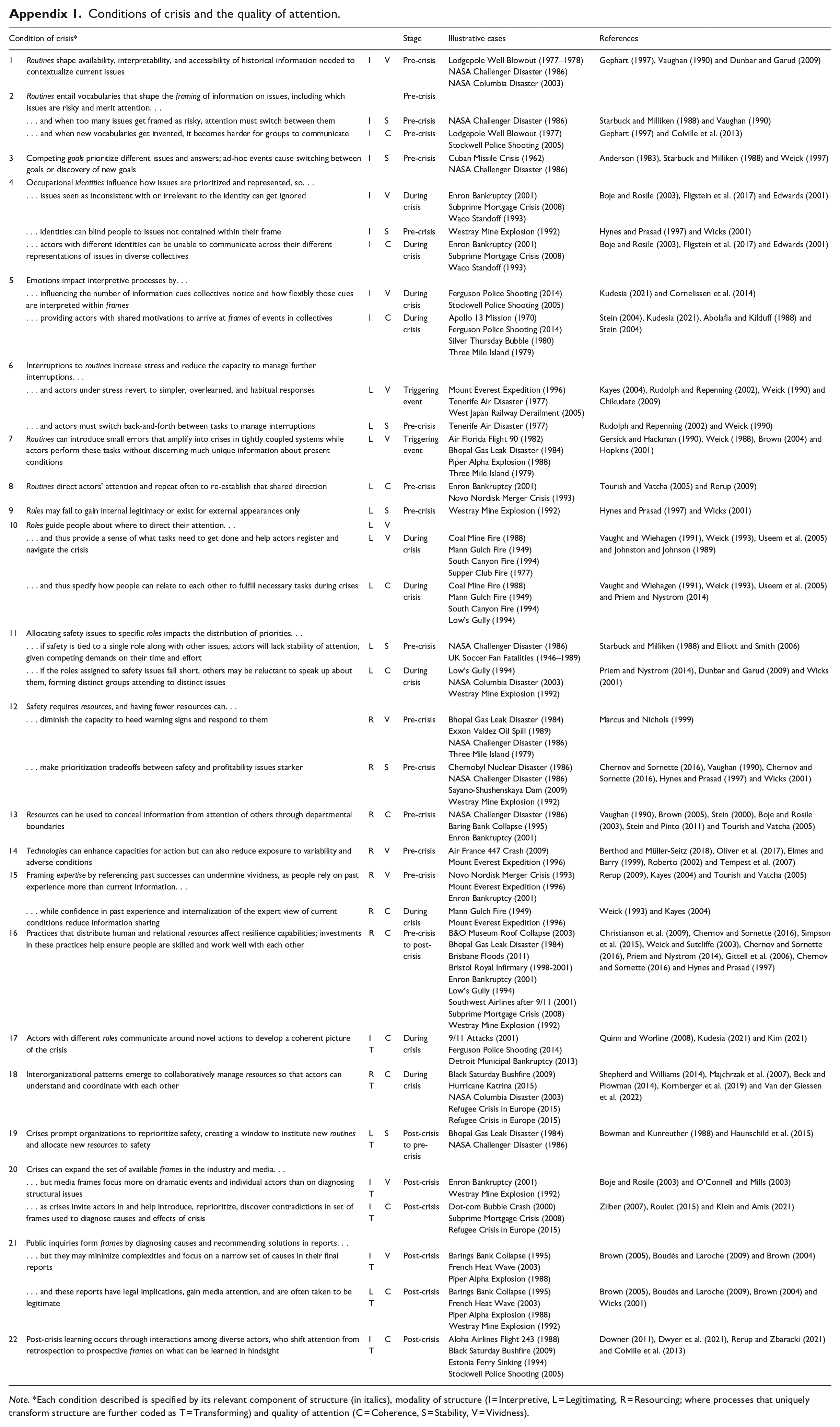
At this point, we began to bring the existing literature into our coding process, using codes that will be explained in the following section. Drawing on practice theory, particularly structuration (Giddens, 1984), we coded which components (like rules and resources) and modalities (interpretive, legitimating, and resourcing; see next section) of structure were involved in each condition. Drawing on the attention-based view (e.g. Rerup, 2009; Rerup and Salvato, 2012), we coded which qualities of attention (stability, vividness, and coherence; see next section) each condition impacted. Whenever possible, we sought to identify the concrete mechanisms that influenced the quality of attention in these conditions. Such integrations of inductive and deductive coding, moving back and forth between the data and multiple theories from the literature, are critical for understanding processual phenomena (Orton, 1997)—such as the relation between structure and attention being theorized here. To summarize what we learned from the coding processes thus far, we wrote 23 manuscript pages describing the conditions and summarizing the cases, which illustrated them in terms of how structure was instantiated or transformed, what actors in the system were involved, and what attention qualities were implicated, which we further represented in a more condensed tabular form (see Appendix 1).
Theory building
This tabular representation of conditions from the crisis literature became our primary artifact for theory-building (Cloutier and Ravasi, 2021). We analyzed it by sorting the table using its various codes, like stage in the crisis process, quality of attention impacted, modality of structure, and so on. This allowed us to ask questions of the data that helped identify generative patterns in how these codes covaried (e.g. how do conditions related to attentional stability differ from conditions related to vividness or coherence, how do the same components of structure function differently through different modalities, how do practices that instantiate structure before crises differ from those which transform it after crises?). We used answers to these questions to further iterate between data and theory, identifying how the conditions in the table reflected insights from the attention-based view which could be revised using analytical tools afforded by practice theory (e.g. organizational activities shape attention as the attention-based view theorizes; how might structuration help us understand conditions where crises stem from the way multiple organizational activities intertwined together?). In doing so, we saw how our emphasis on practices could help address several known limitations in core concepts of the attention-based view. That is, practices could bring greater dynamism to notions of structure, expand out the range of relevant actors and activities throughout the system, and identify mechanisms that impact the qualities of attention. We formalized these revised concepts and their interrelations in our theoretical framework (see Figure 1). Finally, we walked through each element of this framework in light of the case data to elaborate specific principles for each of its three concepts (structure, systems, and attention) to show more specifically how our framework can be used to theorize an attention-based view of crises (for an overview, see Table 1).
Theoretical framework: practice as a nexus of structure, system, and attention
In this section, we briefly overview our theoretical framework in a general manner, before illustrating its elements more specifically in light of crises. Our framework draws heavily from theories of practice, and particularly structuration (Giddens, 1984; Sewell, 1992). As shown in Figure 1, it accordingly views practices—those concrete and empirically observable human activities that occur with regularity like budgeting, planning, and reporting—as the central nexus of structure, system, and attention. Given the centrality of practices to our framework, practice is itself located centrally in our figure. One can thus begin with the practices in the center and move outward in different directions to conceptualize and examine structure, systems, and attention.
Structure
Structure is the principle that patterns practices and gives them continuity across their repeated enactments. Components of structure include rules, resources, frames, and so on that provide a generalizable basis for action of people in a system. Structure exists only in a virtual form (stored in the memories of people who know how to enact rules, resources, frames, etc.) and as instantiated in action. While structure is general enough to be transposed across many situations, it requires human agency to instantiate in any specific situation. Structure therefore has an important element of dynamism, where the degree of continuity of a practice from one enactment to the next depends on the agency of those instantiating it. Thus, one can discover structure by starting with a practice and closely examining how actors instantiate its general patterns in specific situations, thereby reproducing or transforming it to varying degrees. Beyond components like rules, resources, and frames that specify what structure entails, three modalities explain why structure is enacted. Structure is enacted in ways that give rise to interpretive (what do events mean?), legitimating (what should one do?), and resourcing (how can one get things done?) modalities of action. In our framework, analytical moves to discover structure thus entail identifying paths from the leftmost box of Figure 1 to a practice in the middle box (e.g. how do operating practices draw on identities to legitimate attention to one issue over another?).
Systems
Systems are reproduced relations between actors, organized as regular practices. Systems are thus only held together by the repeated enactment of intertwined practices that link actors across time and space—and the totality of a system is coextensive with the universe of relations between actors held together by practices. Whereas structure has a substantial virtual element, systems are defined by concrete patterns of social relations situated in time and space. Systems can therefore differ in the degree to which actors throughout the system are integrated through practices. Thus, one can discover the extent of the system by starting with any practice and tracing how that practice connects to other practices and which actors the full constellation of practices assembles together. Doing so introduces an important element of temporality around the regularity of occasions when actors from different parts of the system come together. It also allows one to begin with familiar practices in organizations, but to then trace those practices beyond the limiting confines of organizational boundaries to actors and activities distributed more widely throughout spaces in the system. In our framework, discovering systems entails moving vertically between practices in the middle box of Figure 1, tracing their relations across temporal and spatial boundaries (e.g. how do budgeting practices affect the compensation of actors whose tasks relate to safety, to thereby impact whether safety issues are attended to during operating practices?).
Attention
Rather than attention being purely individual with fixed properties, like a limited capacity, practices can affect the quality of attention of the actors they assemble. But as much as practices impact the quality of attention, the quality of attention that actors bring to practices also reciprocally shapes how those practices are enacted. As such, attention is perhaps the key realm within which structure and agency interface. Agency is not conceptualized here in a dualism that opposes structure. Agency and structure instead relate as a duality, where people express agency in how they participate in practices—and thereby help reproduce or transform structure as they instantiate it in action. The dual manner with which attention both affects and is affected by practice reflects this duality of structure and agency. Furthermore, as practices hold together social relations that integrate actors across time and space, the quality of attention is not purely individual. Qualities of attention instead come to be shared by multiple people as they relate through intertwining practices, such that attention can take on an explicitly systemic nature.
These qualities of attention are threefold, where attention varies in terms of its stability, vividness, and coherence (Rerup, 2009; Weick and Sutcliffe, 2006). Stability describes sustained focus on a single issue over time, where repeated examination helps to better understand the issue and respond to it appropriately. Vividness entails the richness with which ongoing events are registered. It requires integrating peripheral and contradictory information about issues and interpretations that may only emerge if multiple issues are examined simultaneously. Coherence describes the extent to which actors throughout the system align their attention to the same issues, which enhances trust and information sharing while limiting conflict and coordination problems. Thus, one can begin to understand systemic attention by starting with a practice and examining the mechanisms by which it affects and is affected by the qualities of attention of its assembled actors. In our framework, this entails identifying paths from a practice in the middle box of Figure 1 to an attention quality in the rightmost box (e.g. how do planning practices influence the number of issues competing for attention and what does that do for the stability of attention to any one particular issue?).
In sum, our theoretical framework suggests that a close emphasis on practice provides a means to conceptualize and analyze the structures that influence attention and the mechanisms by which they do—given the fuller set of actors and activities that comprise the system. In doing so, our framework helps reconceptualize each of the three core concepts of the attention-based view: shifting structure from something static and formal to being dynamically instantiated through practices (which can be enacted through multiple modalities), moving from traditional big businesses to exploring how actors all throughout the system (both within and beyond organizational boundaries) get linked together through practices, and moving from its view of attention as a fixed and limited individual capacity to instead specify how practices relate to variations in the qualities of attention (of individual and collective actors over time and across spaces within the system). That is, theorizing practice as a central nexus makes it possible to reinvigorate the attention-based view—including in a manner that uniquely speaks to crises. In what follows, we therefore unpack the three key elements of our theoretical framework: structure, systems, and attention. For each element, we identify principles for theorizing crisis using our framework, which refines and elaborates the attention-based view to better understand crises.
Theorizing structure in the attention-based view of crises
Building on our framework, we introduce four principles for theorizing structure within the attention-based view of crisis, illustrated by examples from crises.
Structure can enable, rather than constrain attention
Structure is largely theorized in terms of “constraints on the allocation of attention” even if components of structure (like rules and resources) will never “completely specify” attention within those constraints (March and Olsen, 1976: 39). Human agency therefore gets theorized as occurring outside of structure. Such theorizing creates a dualism, where structure and agency are seen as distinct phenomena (e.g. Yu et al., 2005). Our theoretical framework emphasizes that structure and agency relate as a duality, not a dualism (Giddens, 1984). Structure can enable human action, rather than merely constraining it. Structure entails a generalizable basis for human action that guides but never fully determines how people will act in a specific situation. As such, any component of structure can be applied to new situations to offer guidance where it would otherwise be lacking (Sewell, 1992). People can apply structural components in creative ways that help them navigate crisis situations that are unprecedented for them. Consider two cases of fires in which roles, as a component of structure, enabled rather than constrained human agency. During a 1988 coal mine fire, socialization into role structures like the “buddy system,” helped miners coordinate a safe evacuation of the mine (Vaught and Wiehagen, 1991). Or in a 1977 supper club fire, employees drew not only on work roles to navigate the fire (e.g. servers helping diners in their area) but also their gender roles—with men providing more overall assistance, especially in attempting to control the fire (Johnston and Johnson, 1989). These roles were enacted in creative ways that enabled, rather than constrained attention by providing employees with a sense of what tasks needed to get done (enhancing the vividness with which they registered the crisis) and specifying how people could relate to each other to fulfill those tasks (enhancing their collective coherence).
Structure must be instantiated in action
While components of structure are sometimes theorized as having inherent effects on attention (e.g. routines will erode attentional vividness; Gersick and Hackman, 1990), our framework suggests that because structure is general, its effect will depend on the concrete actions that instantiate it and the relevant situational contingencies. Consider, for instance, the following practical question: Does allocating safety issues to a role help stabilize attention on these issues over time? Allocating safety issues to a person with multiple roles might unintentionally erode stability—as occurred when, in response to crises totaling 288 fan fatalities in the UK soccer industry, safety issues fell to club secretaries who already had to juggle a host of other issues like ticket sales, hotel bookings, travel arrangement, employee contracts, and financial matters (Elliott and Smith, 2006). The dramatic moment when a NASA contractor was told to “take off your engineering hat [concerned with safety] and put on your management hat [concerned with profitability]” and thereby reverse his vote against launching the Challenger shuttle in 1984 (Starbuck and Milliken, 1988: 333), shows how when a person has to attend to multiple issues, stability to any one single issue becomes difficult.
Yet, allocating safety issues to its own dedicated role is no panacea either. Doing so can also cause failures of attention, just related to coherence between actors. In the failed 1994 military training at Low’s Gully, although the leaders responsible for safety issues ignored expert safety advice and made critical mistakes (like proceeding without maps, star charts, radio beacons, or flares in dangerous terrain), team members long remained reluctant to raise these safety issues themselves (Priem and Nystrom, 2014). In the 1992 Westray Mine explosion that killed 26 men, managers neglected their safety role, which similarly created a barrier of communication between them and miners (Wicks, 2001). When safety issues are allocated to one group and production issues to another, the groups are unlikely to attain coherence about unfolding crisis events—as was exemplified when foam shed during takeoff damaged the 2003 NASA Columbia shuttle (Dunbar and Garud, 2009). Allocating safety issues to a dedicated role may thus enhance attentional stability, but at the cost of fragmenting attentional coherence to safety issues in the system, as others become reluctant to speak up about safety or see it not as their priority. As such, roles do not have “an effect” on attention. Which of its many possible effects are realized depends on how it is instantiated in action—in light of situational contingencies that differentially impact distinct qualities of attention like stability and coherence.
Structure is an outcome of agency
Structure is both the medium that guides action and the outcome of action (Giddens, 1984). Without holding this insight in mind, it becomes easy to take current structures for granted and miss how actors actively shaped those structures to direct attention in ways that can give rise to crises. The canonical explanation for divisional structures, for instance, has to do with decomposing complex problems into relatively separate, smaller pieces, which should help forestall crises by loosening interdependencies (Levinthal and March, 1993; March and Simon, 1958). Yet, in two large economic crises, actors exerted their agency to shape organizational structure in ways that had the exact opposite effect. They used resources to deepen divisional boundaries so they could conceal information and prevent coherence of attention around risky activities, which made crises more likely.
Barings Bank was the world’s first merchant bank and long-term banker to the British royal family before it collapsed in 1995 with trading losses of £860 million. After deregulation in the mid-1980s, the conservative Baring Brothers bank founded its Baring Securities arm to take advantage of new trading opportunities (Stein, 2000). At Baring Securities, traders like Nicholas Leeson took great pains to refuse traditional controls and establish a radically contrasting culture, helping him hide massive losses in account “88888” only reported in a margin file that few took notice of (Stein, 2000). Beyond their limited knowledge about securities trading and inability to penetrate contrasting cultures across divisions, the fact that Baring Securities fast accounted for half the profits (half of which went into a shared bonus pool) provided strong incentives for lax internal regulation that failed to establish coherence of attention between the divisions (Brown, 2005). A remarkably similar story occurred in Enron, the energy and commodities firm once valued at $70 billion which declared bankruptcy in 2001. Intense competition arose between the traditional “asset-heavy” business focused on oil and gas and an “asset-light” business focused on gas-related financial innovations made possible by deregulation (Boje and Rosile, 2003; Stein and Pinto, 2011). When the head of the latter business became CEO, he sold off stake in the former, and consolidated attention around his asset-light business using elaborate rituals and routines (Tourish and Vatcha, 2005). Top managers then used accounting practices like creating “special purpose entities” to hide balance sheets losses while lobbying for further deregulation and favorable legislation, using close ties to the Bush presidency (Boje and Rosile, 2003). Both cases reveal how actors made use of resources and roles to enact activities like hidden accounts and special purpose entities in accounting practices to actively shape other aspects of structure, like divisions; this, in turn, reduced the coherence of attention by concealing information, such that others throughout the organization and beyond had little idea of their fraudulent activities.
Structure is enacted in three modalities
Building on work enumerating components of structure that shape attention (e.g. March and Olsen, 1976; Ocasio, 1997), our framework helps emphasize how any such component of structure can exert its effects through three modalities (Giddens, 1984). The same component of structure can function to interpret what events mean, legitimate what one should do, or resource to get things done. Structure is thus not reducible to formally written rules, organization charts, or information technologies, but entails the schemas that guide how people interpret and act on them (Sewell, 1992). Consider how even a resource like expertise can exert its effects beyond by helping people get things done in the resourcing modality. Expertise instead often exerts effects on attention based on how it is framed, in the interpretive modality. In the 1993 Novo Nordisk product recall crisis, expertise framed using a “world champion” label inhibited middle managers from heeding and reporting upward concerns about regulatory compliance (Rerup, 2009: 882). In the 1996 Mt. Everest climbing expedition disaster, the “100% success rate” label guided climbers to over-rely on their leader for direction (Kayes, 2004: 1278). Enron’s labeling of MBA hires as “the best and brightest” created a sense of confidence and entitlement that belied how freshly-minted MBAs were too inexperienced to understand its complex fraud (Chernov and Sornette, 2016; Tourish and Vatcha, 2005). Such discursive practices frame expertise in the interpretive mode—and thereby reduce vividness of attention, as people rely on past indicators of success rather than registering current information that may be contradictory and indicate failure. Not only is expertise itself interpreted but it also influences interpretations. Actors perceived as experts can interpret events optimistically through terms like a “10 o’clock fire” that would be extinguished by 10 AM (Weick, 1993), claims that “all indications point towards a successful climb” (Kayes, 2004: 1277), or confident actions like taking breaks to eat (Weick, 1993) or rest (Oliver et al., 2017). These optimistic and confident interpretations gain credence from the actors’ expertise. They can prompt others to internalize the expert view on the situation, sometimes even against their own intuitions of danger, and then fail to speak up—eroding the vividness and coherence of attention in the system. To understand how components of structure actually exert their effects, it is necessary to examine how they are being concretely enacted through speech and action within the three modalities of structure.
Theorizing systems in the attention-based view of crises
Building on our framework, we introduce four principles for theorizing systems in the attention-based view of crisis, illustrated by examples from crises.
Intertwined practices influence each other
Concrete activities, like attending meetings and sending memos, are known to channel attention in particular directions (Ocasio, 1997). Our framework elaborates how the specific activities that channel attention are subsumed within broader practices—and are subject to contingencies based on how these practices are intertwined with other practices, including practices that invoke different modalities of structure (Nicolini, 2009; Schatzki, 2011). Consider how budgeting practices in the resourcing modality can impact the interpretive modality of risk management practices. After 71% of the safety and quality control staff were cut from 1970 to the 1984 Challenger shuttle launch, even safety managers missed the change in designation of the crucial O-ring part from a critical issue accounted for by redundancy (C1-R) to one unaccounted for by redundancy (C1)—as it was buried among 8,000 other issues, 829 of which were also labeled with the highest criticality level (C1/C1-R) in three-inch thick books (Starbuck and Milliken, 1988; Vaughan, 1990). Given the abundant safety issues requiring attention relative to the scarce resources, new interpretive vocabularies of risk like “hazards” or “accepted risks” proliferated to help selectively “focus attention” on issues (Starbuck and Milliken, 1988: 334) and actors reclassified issues under increasingly less severe risk categories (Vaughan, 1996). Budgeting and risk management practices were thus intertwined, such that changes in budgeting undermined the interpretive possibility of stable attention to safety issues.
A similar intertwinement occurred in the 1992 Westray Mine explosion that killed 26 men. In this case, there was no interpretive ambiguity: it is straightforward how sparks in the presence of coal dust and methane gas lead to explosions—and rules for managing coal dust were present in government and company manuals. But these rules for operating practices were not enacted in a way that granted them internal legitimacy. The only resources put behind safety rules were the requests for volunteers to earn overtime pay for tasks that render the coal dust inert (Hynes and Prasad, 1997) and managers punished miners who refused to use unsafe open-flame acetylene torches with suspensions or denigrating tasks (Wicks, 2001). Other rules, like a health and safety policy instituting a gag order on speaking about safety to outsiders, coupled with their lack of a union and weak government support given to whistleblowers (Hynes and Prasad, 1997; Wicks, 2001), led miners to lose stability on safety issues over time. Yet, while the safety rules had no internal legitimacy, they served an external function: to provide a “veneer of legitimacy” during ceremonial inspection practices from regulators (Wicks, 2001). In this way, practices intended for safe operations were undermined by intertwined practices related to budgeting, punishing, and reporting, to ultimately reduce the stability of attention to safety issues in the organization.
As a final example, the protective effect of roles discussed previously can be made harder to establish based on its intertwinement with other practices. Given how wildland firefighter teams are often assembled from a seasonal workforce by combining unfamiliar crews into temporary teams for larger blazes led by undertrained leaders, durable role structures are hard to establish and it is thus unsurprising that stress and panic can take over as roles collapse—as illustrated by the 1994 South Canyon Fire (Useem et al., 2005) and the 1949 Mann Gulch fire (Weick, 1993).
Practices interface beyond organizational boundaries
Given its original emphasis on traditional big businesses, the attention-based view is not particularly well-suited to understand activities that occur beyond organizational boundaries (Ocasio et al., 2022). Crisis research has identified conditions that make crises more likely across operational, managerial, regulatory, and legislative levels—particularly when several such conditions align (e.g. Leveson, 2011; Reason, 1997). But, although this research shows the need to look beyond the organization, theorizing in terms of levels does not actually clarify how, when, or why different actors get involved in crises. In contrast, our framework emphasizes how practices link together a broader set of actors into a system, such that factors beyond the organization can influence what happens within it.
In the Westray Mine explosion, for instance, a “tragic hero” schema was woven into the occupational identity of miners. It dates back to legends and entails a long “history of black lung disease, mine fires and explosions, roof cave-ins, and near escapes from innumerable disasters” and prominent memorials dedicated to fallen miners in disasters throughout mining communities (Hynes and Prasad, 1997: 615). Economics also matter. In Westray, as in other energy-related crises like the 1979 Three Mile Island nuclear meltdown, 1986 Chernobyl nuclear disaster, and 2009 Sayano-Shushenskaya Dam flood, top managers drew on cues from the government to prioritize energy production over safety issues (Chernov and Sornette, 2016). It is hard to fully understand why attention to safety issues was not stable without going beyond the organization into the culture of nearby communities and financial and political investments of government actors around energy needs (Wicks, 2001). Practices also reveal how even apparently external actors, like regulators, are linked to organizations in ways that help reveal regulatory failures. In the leadup to both the Barings Bank collapse (Brown, 2005) and Challenger launch (Vaughan, 1990), regulators’ practices made them dependent upon the entities they were meant to regulate for information and resources, giving those entities concealed control over regulatory attention.
In other cases, it becomes helpful to focus on changes in the industry. The commercialization of Mount Everest from an elite mountaineering practice to part of the adventure tourism industry led to more climbers with less expertise. By framing the climb using competitive and narcissistic goals (Elmes and Barry, 1999) and relying on new technologies like oxygen provisions, climbing groups lost sight of their limits (Tempest et al., 2007), and instead let biases direct their attention (Roberto, 2002). They became unable to form vivid representations of the challenges they faced. To focus solely on these biases, however, would ignore how activities within climbing practices related to broader industry changes. In the 2005 West Japan Railway Company derailment case, which claimed 108 lives, cultural practices served as boundary effects on organizational practice. Because of cultural schemas around shame-inducing punishments for interruptions to service, a train driver divided his attention: making appeals to the conductor to discount the service delay, while increasing the train speed, which led the train to derail as it hit a curve (Chikudate, 2009). Whereas the punishments rule may have enhanced safety in the culture where it was designed, it had the opposite effect in this case because of how it interfaced with Japanese cultural schemas.
Practices involve different actors at different times
A focus on practices also helps identify when and how different actors throughout the system become linked (Giddens, 1984). These notions of temporality are critical in understanding, for instance, how crises might be identified early by what type of actors, what new actors may emerge in light of the crisis, and what actors are responsible for transforming structures in response to crisis. In the case of Enron, different actors became involved at different times because they were attending to different cues based on their respective practices. Stock analysts identified red flags earlier with the “Triple Top” (three peaks in stock price from August to October 2000) whereas the media did little reporting before the October 2001 stock write-down and December 2001 bankruptcy, as they attended to whistle-blowing, congressional hearings, and trial activities given their practices that require dramatic encounters between protagonists and antagonists (Boje and Rosile, 2003).
Indeed, media reporting and public inquiries were two actors that typically get involved in post-crisis practices, with the espoused intention of vividly representing the crisis and helping systems come to a coherent understanding of them. But default media frames often generate low levels of vividness, as they focus narrowly on dramatic events and individual actors, rather than broader structural factors that organize the wider system of impacted actors—like deregulation (rather than corporate executive drama) in Enron coverage (Boje and Rosile, 2003) or corporate malfeasance (rather than natural disaster and tragedy tropes) in Westray mine explosion coverage (O’Connell and Mills, 2003). Public inquiry reports are often more akin to “fantasy documents” (Birkland, 2009) than vivid representations of systemic causes of crisis. Reports like from the Cullen Inquiry into the 1988 Piper Alpha oil platform explosion may thus function as a document that “depoliticizes disaster events, legitimates social institutions, and lessens anxieties by concocting myths that emphasize our omnipotence and capacity to control” (Brown, 2004: 95). Although news reporting and public inquiry practices may increase coherence of attention in a system—by helping all actors arrive at a shared understanding—this coherence may still be low in vividness.
In contrast, local stakeholders on the frontlines of crisis at times can attain coherence around remarkably vivid representations of the crisis. Consider passengers aboard United 93, a flight hijacked during the 9/11 Terrorist Attack. They used available resources like phones to contact loved ones on the ground and engaged in discussions with each other to attain coherence around a vivid representation of what was then incomprehensible: that the terrorists intended to crash the plane rather than hold them hostage (Quinn and Worline, 2008). This representation gave rise to a new collective identity and courage to counterattack against the terrorists and prevent them from reaching their intended target. In some cases, these vivid and coherent representations not only helped stakeholders cope with immediate circumstances but even set the stage for post-crisis transformations of structure. This occurred during Detroit’s 2013 municipal bankruptcy, when residents generated a new frame for how to incubate local businesses and thereby contribute to the city’s turnaround as they took pragmatic actions to solve immediate and urgent demands in impoverished communities (Kim, 2021). Consider residents of Ferguson, MO in 2014 who saw the fatal police shooting of a Black teenager and began spontaneous protests. As acts of moral anger in the crowd directed attention away from civil rights organizations and police officers, a new protest strategy around race and policing emerged from a cadre of young residents that would help grow one of the largest social movements in United States history (Kudesia, 2021).
Organizational boundaries become flexible during crisis
Although the attention-based view originally presumed traditional organizational boundaries, today’s organizations are often more “distributed” and “porous” in form (Ocasio et al., 2022: 107). Perhaps nothing exemplifies this distributed and porous nature than activities during unfolding crises. Crises reveal failures in organizational capacities for control—and thus often require resources from actors beyond their boundaries. For instance, when NASA’s Columbia shuttle disintegrated upon reentry, many resources were needed: NASA knew the science, FEMA knew emergency responses, and EPA knew hazardous materials (Beck and Plowman, 2014). But the same components of structure like routines and roles that incubated the crisis can often inhibit emergent attempts to respond to it with these external actors. Our framework emphasizes how systems are tied together based on practices, such that boundaries between actors within and between organizations are always dynamic, and can expand or contract based on the practices that actors initiate (Giddens, 1984). To date, less is known about the types of practices organizations enact when their boundaries must be expanded to accept resources from external actors. Such practices differ from formal coordination practices like Incident Command Systems in favor of minimalistic practices like twice-daily meetings that, in the context of the NASA, provide “just enough structure to create some order, but not so much as to inhibit ongoing experimentation” (Beck and Plowman, 2014: 1241). Technology also plays an important role in coordinating which actors can provide what resources—as with KatrinaHelp Wiki after Hurricane Katrina in 2005 (Majchrzak et al., 2007). Local stakeholders also help fill gaps left by organizations, government, and nonprofits. After many donated resources went to waste after the 2009 Black Saturday bushfire, local residents developed new roles and routines to coordinate logistics of obtaining resources from external actors (Shepherd and Williams, 2014). As coordination during the 2015 refugee crisis in Europe shows, local stakeholders rely on a logic of tact as they act (Kornberger et al., 2019) and form collaborative networks that exclude organizations unable to interface with these emergent practices (van der Giessen et al., 2022). A core feature of these emergent practices is that they maintain moderate levels of coherence: just enough for actors to coordinate, but not more, as they need to delegate and begin urgent tasks.
Theorizing qualities of attention in the attention-based view of crises
Building on our framework, we introduce central themes for theorizing each of the three qualities of attention in the attention-based view of crisis, illustrated by examples from crises.
Practices and stability
Stability—or sustained focus on a single issue over time with repeated examinations to understand the issue and respond to it appropriately—in the context of crises primarily has to do with tradeoffs between safety issues and other competing issues. Such tradeoffs manifest across practices that involve different components of structure. Allocating safety issues to roles, as has been discussed, is fraught with situational contingency. Distributing fewer resources to safety issues in budgeting practices is more straightforwardly related to diminished stability, and thus set the stage for crises. Layoffs of safety and quality control personnel and reductions in maintenance and training practices that stabilize attention on safety issues were common factors across crises like the 1979 Three Mile Island partial nuclear meltdown, 1984 Union Carbide gas leak in Bhopal, and 1989 Exxon Valdez oil spill (Marcus and Nichols, 1999). As discussed before, the NASA Challenger case shows how fewer resources can complicate the intertwining interpretive practices intended to detect safety issues (Vaughan, 1990)—and crises in the Chernobyl and Three Mile Island nuclear plants, Sayano-Shushenskaya Dam, and Westray Mine show how government actors who desire more resources help shape managerial prioritization of energy production over safety issues (Chernov and Sornette, 2016).
Decision-making practices also affect stability. As decision opportunities arise, they direct attention sequentially to different issues from one moment to the next. These issues all entail accountability to different actors, engagement in different practices, and imply different and often incompatible governance mechanisms, like legal fiduciary duties, supervisor-subordinate relations, deference to technical expertise, responsiveness to political constituencies, and so on (Romzek and Dubnick, 1987). As NASA went through a “fine-tuning” process that switched between these issues as problems arose (Starbuck and Milliken, 1988), they lost track of prior issues and whether the “residual” of these prior issues itself formed a pattern (Weick, 1997: 398–399), and thereby missed important trends in the leadup to the Challenger launch. Responding to decision opportunities that arise during crises can even cause actors to discover new issues, as they debate how to respond. In the 1962 Cuban Missile Crisis, a chance note that the Attorney General passed to the President while listening to an airstrike proposal introduced a “Pearl-Harbor-in-reverse” analogy. This analogy surfaced a new issue—acting consistently with and maintaining public perceptions of American traditions—that helped sway the decision to a blockade rather than commencing an airstrike against the small island country of Cuba (Anderson, 1983).
Practices intended to learn from crisis by transforming structure also emphasize stability, including throughout an industry. After the Union Carbide gas leak in Bhopal, another chemical company changed its practices to reprioritize safety, such as by reducing on-site plant inventories of flammable chemicals like ammonia and chlorine and separating out safety recommendations from cost appraisal practices, reducing their intertwinement (Bowman and Kunreuther, 1988). But such transformations to enhance stability on safety issues take work and certainly may entail missteps—like when an industry-wide production cutback on a dangerous chemical raw material led a purchasing department to buy a three-year supply before it ran out and the fire marshal had to be contacted when it all arrived on-site (Bowman and Kunreuther, 1988). New steps were thus added to routines, like having a consulting firm weigh the risks of such purchases before making them to ensure safety. It is also always possible that productivity and performance issues may later reclaim priority over safety issues and undo some of these changes, as exemplified by the oscillation between the 1986 Challenger and 2003 Columbia disasters at NASA (Haunschild et al., 2015).
Practices and vividness
Vividness—the richness with which ongoing events are registered, through integrating peripheral and contradictory information about issues and interpretations—in the context of crisis primarily has to do with practices that shape the accessibility and reliance on information and experience from the past versus present. Automation practices, for instance, can reduce the amount of experience people have directly operating, rather than monitoring systems. As the 2009 Air France 447 crash illustrates, when automation technologies failed, pilots with little experience flying manually in unusual conditions entered a state of growing panic and were unable to vividly represent information about their altitude and pitch, leading to the loss of 228 lives (Berthod and Müller-Seitz, 2018; Oliver et al., 2017). As previously discussed in relation to roles, interactions that emphasize experience and expertise can erode vividness. Maintenance practices similarly reveal how an abundance of experience, rather than an absence of it, can lead to low vividness. The first in a series of events triggering crisis is often an error in a routine maintenance practice with which actors have plenty of experience—as occurred with condensate polishers (that filter minerals from water entering the steam generator and regularly get blocked) in the Three Mile Island meltdown (Hopkins, 2001), condensate injection pump (that takes the heavier fractions of gas which get condensed into liquid propane for export) in the Piper Alpha explosion (Brown, 2004), and (possibly) while cleaning a clogged pipe (without inserting a slip blind to prevent the cleaning water from backing up and catalyzing a chemical reaction) in the Union Carbide gas leak (Weick, 1988). The 1982 Air Florida Flight 90 crash suggests that the effects of experience may be practice-specific. Although the pilots knew that snow and ice accumulating on the plane was a problem—they even broke protocol to position their plane behind a DC-9 taxiing ahead of them, mistakenly thinking the warmth from its engines would melt the snow and ice on their wings—during the takeoff checklist practice, the captain still did not turn on the anti-ice, likely as a matter of abundant past experience flying in hot weather (Gersick and Hackman, 1990).
Practices that shape access to information also influence the vividness of attention as crises unfold. In some cases, information may not be available. During the Lodgepole Well Blowout (1977–1978) perceptual information initially had to be relied on—such as whether the rotten-egg odor of hydrogen sulfide was concentrated enough to imply a leak of deadly sour gas rather than purified sweet gas—until quantification practices were enacted (Gephart, 1997). Even if relevant information exists, it may not be presented in an interpretable form. In the NASA Challenger disaster, no trend metrics were created despite half of the recent flights experiencing problems with the O-rings that sealed the rocket booster. Such metrics would have validated engineer intuitions that problems were related to cold weather, thus aborting the launch (Vaughan, 1990). In NASA’s 2003 Columbia disaster, the information was available, but access was tied up in a bureaucratic “catch-22” routine: the Debris Assessment Team had to first provide objective evidence to Mission Management establishing the need for photos (that could document whether foam shed during takeoff damaged the shuttle) but those photos were the only source of evidence (Dunbar and Garud, 2009: 411). It instead had to rely on modeling and estimation practices.
Practices and coherence
Coherence—the extent to which actors distributed throughout the system align their attention to the same issues—in the context of crisis surfaces a paradox, where practices that enhance coherence can cause crises by reducing the diversity of perspectives, yet increasing diverse perspectives can fragment coherence and thereby also exacerbate crises. For instance, Enron’s employee recruitment and assessment practices developed a level of coherence comparable to that of cults—with grueling job interviews, required reading of Machiavelli’s The Prince (a nickname of the CEO), “love bombing” with lavish gifts after job offers were accepted, a “rank and yank” practice that routinely fired underperforming (or problematic) employees, and more (Tourish and Vatcha, 2005). These intertwined practices directed attention throughout the company to its charismatic CEO’s grand vision of being “the world’s leading company”—and gave rise to a “no bad news” culture that punished dissent and fired employees who shared any unfavorable information. This culture was instrumental in incubating its eventual crisis (Chernov and Sornette, 2016; Tourish and Vatcha, 2005). Similarly, communication practices that helped spread arousing negative emotions like anxiety enhanced coherence in the police service, but this coherence excluded alternative perspectives and solidified around the mistaken interpretation that an innocent man was a fugitive terrorist in the Stockwell shooting (Cornelissen et al., 2014).
Yet, the mere presence of diverse perspectives is no guarantee against crisis—as is evident in cases where actors with different occupational identities were unable to attain coherence. The FBI team responding to the 1993 Waco standoff never achieved coherence around the intention of the Branch Davidian cult leader because one actor framed it based on his identity as a trained tactician whereas the other actor did so using his negotiator identity, leading to an incoherent collective approach that ultimately led to 76 deaths (Edwards, 2001). The Federal Reserve Bank similarly failed to anticipate the 2008 Financial Crisis in part because its key actors were largely identified with macroeconomics, and thus attended to relatively few aggregate indicators like inflation, unemployment, and GDP growth. Members with private banking identities, in contrast, attended to relevant issues like the housing bubble, financial markets, and bank liquidity, but remained marginal (Fligstein et al., 2017). So the mere presence of diverse perspectives alone is insufficient: it seems to erode coherence across actors in ways that exacerbate unfolding crises.
What may help resolve this paradox are practices that go from the mere presence of diverse perspectives to participation that includes these perspectives (Rerup, 2009). For instance, while public inquiries and their lessons learned seldom transform structures (Birkland, 2009), when they do, it is often through participation with other actors throughout the system. Participative, rather than punitive, practices helped the UK soccer industry question coherence around shared frames—like blaming soccer hooligans rather than fundamental ground safety and design issues for fan casualties—and transformed relevant structures (Elliott and Smith, 2006). Similarly, the learning from the Black Saturday bushfire did not reside in the 67 recommendations of the public inquiry (Dwyer et al., 2021). It rather emerged when practitioners after the inquiry prospectively considered how to implement changes. Firefighters reframed warning the public about fires as part of their job while using their occupational identities and experience to question how a new warning system might undermine the responsibility for safety felt by people in fire-prone areas. After the 1994 sinking of the ferry Estonia led to 852 deaths, diverse actors including regulatory agencies, trade associations, and nongovernmental organizations all identified causes consistent with their existing frames (Rerup and Zbaracki, 2021). But because all these actors brought forth different features of the crisis, from their participation, new learning emerged at the system level.
Discussion: advancing the attention-based view (of crises)
An axiom of the attention-based view has proven incredibly insightful: that organizations work by realizing a complementarity between the attention of their members and the structures that organize them. But how can it best be understood in today’s world, where each of these three core concepts have changed since the view was first formulated a quarter-century ago? Where important organizations look less and less like traditional big businesses, notions of structure implied by formal organizational charts are diminishingly relevant, and the quality of attention matters more than its quantity? This article offers a potential answer by looking toward crises. Although crisis research recognizes the crucial role of attention, it has theorized attention in a way that seldom links it back to structure and thereby frequently blames crises on frontline operators (Silbey, 2009). And although the attention-based view axiomatically links attention back to structures, crises provide rich case studies which can help revitalize how these linkages are theorized beyond the confines of traditional big businesses (Ocasio et al., 2022). Through an interpretive synthesis of 80 qualitative case studies of crisis, we therefore developed a theoretical framework for the attention-based view of crises. This framework can help revitalize the attention-based view with new insights needed to meet the systemic challenges which loom large in today’s world (Bansal et al., 2018). In what follows, we elaborate the key contributions and implications of our framework for attention, crisis, and the attention-based view of crises.
Contributions of the present work
In its canonical articulation, the attention-based view portrays the relation between structure and attention in a largely top-down manner that cascades across levels of analysis: macro-level organizational structures influence meso-level situated activities, which in turn direct the micro-level focus of individual attention (Ocasio, 1997). Of these levels, the meso-level activities that situate attention are of utmost importance, but remain the least examined aspect of the attention-based view (Brielmaier and Friesl, 2023). Our framework suggests a rather radical reorientation. Drawing on structuration theory (Giddens, 1984), we ground our entire attention-based view of crises in these under-examined activities. The concrete activities in repeated social practices like budgeting, planning, and reporting now become the very nexus from which the core concepts of structure, systems, and attention are reconceptualized, interrelated with one other, and analyzed empirically.
Through this grounding in practices, we bring structure and attention onto an even level and suggest that attention and structure reciprocally influence each other through practices distributed across the entire system, rather than giving priority to organizational structure as a top-down influence on attention. We do not theorize practice as a meso-level of activities that mediates between macro-structure and micro-attention. We instead flatten out the attention-based view so that practice becomes the primary unit of analysis and concepts like structure, systems, and attention become different analytical moves away from practice. Structure is recognized by moving from the concrete activities in practices to the general principles that pattern them across their instantiations, introducing greater dynamism and human agency into structure. Systems are identified by tracing out the set of social relations organized by these practices, including actors and activities that extend beyond the temporal and spatial boundaries of organizations. And attention is located in three distinct qualities that both shape and are shaped by the enactment of practices, rather than in the fixed quantity limitations of individual-level information processing.
Our theoretical framework provides numerous insights that refine, elaborate, and rethink how structure, systems, and attention have been conceptualized in prior work and offer implications for future work (for specific examples, see Table 1). Taken at a high level, our framework helps resolve ambiguity about the nature of structure in the attention-based view (e.g. Barnett, 2008). It serves as a reminder that organizational structure is not some monolithic thing, but is rather multiple. Rather than talking about “the hierarchy,” our framework would examine its distinct components (roles of supervisors, routines for evaluating employees, technologies for reporting, etc.) and how they intertwine. Not only does our framework expand the list of such components from case data (to include frames, identities, and so on; see Appendix 1), but it helps define what even qualifies something as a component of structure: namely, that it provides a generalizable basis for human action that actors can transpose across situations (Giddens, 1984; Sewell, 1992). This definition situates structure and agency in a duality, whereas prior work has theorized structure purely as a constraint, situating agency outside of structure in a dualism (March and Olsen, 1976; Yu et al., 2005)—or situated agents as part of structure who nonetheless retain “some discretion” over how they enact their roles, such that structure and agency are not truly distinguished (Ocasio, 1997: 197). Doing so opens up new avenues regarding how people can enact structure in ways that can trigger, mitigate, manage, and transform in relation to crises.
Just as structure is not merely a constraint in our framework, nor is attention primarily a limitation of individual information processing, as it is in canonical attention-based view work (March and Simon, 1958; Ocasio, 1997). That is, we do not treat attention as a limited capacity to be distributed by organizational structure. Attention is rather treated as a quality that shapes and is shaped by human engagement with social practices—and as these practices intertwine to reach throughout the social relations that compose systems, attention can take on systemic rather than purely individual qualities. Although the quality of attention (rather than mere limits in its quantity) has been extensively discussed in theoretical terms (e.g. Dane, 2020; Ocasio et al., 2022; Rerup and Salvato, 2012; Weick and Sutcliffe, 2006), it has seldom been used to actually analyze case studies (for an exception, see Rerup, 2009). To develop our theoretical framework, we analyzed the quality of attention in 80 case studies, which dramatically enlarges the field’s knowledge base about conditions that affect attentional quality (see Appendix 1). In doing so, our framework helps advance long-standing debate about whether attention is limited or not (e.g. Kudesia and Lang, 2022; Levinthal and Rerup, 2006; Weick and Sutcliffe, 2006). It shows how crises are not best attributed to inherent psychological limitations in the quantity of information that individuals can process. Crises are rather due to fluctuations in three qualities of attention that are associated with specific practices through implicated mechanisms. When we attribute to individual psychology attentional failures that may have actually resulted from social practices, we misallocate blame for crises and miss an opportunity to improve practice (Silbey, 2009).
Limitations and future research
Indeed, perhaps the major unresolved question, on both practical and theoretical levels, is how the quality of attention can be improved to better detect, manage, and learn from crises. If fluctuations in attentional quality are influenced by practices, then perhaps distinctive practices are needed to properly manage these fluctuations. This seems to be the premise behind notions of mindfulness (Weick and Sutcliffe, 2006), where metacognitive practices can help organizations monitor and adjust the quality of their attention over time (see Kudesia, 2019; Kudesia and Lang, 2022). But it is not straightforward how to relate the literatures on crisis and mindfulness because in many ways the two literatures are orthogonal. Mindfulness research samples high reliability organizations, which do not experience crises because they regulate attention so well, and are studied through ethnographic methods designed to analyze culture. Crisis research, in contrast, uses case studies sampling discrete crisis episodes, which implicate failures of attention. It is our hope that by situating the crisis literature in attentional terms, where the mindfulness literature concerns the regulation of attention, we can help integrate these complementary literatures. Such an integration should build on the systemic nature of attention developed here. In our framework, it is the repeated enactment of intertwined practices that binds actors across time and space into a system (Giddens, 1984). Future work could build on this insight from structuration with insights from other practice theories that provide a richer language to analyze how intertwined practices come to form larger bundles (see Nicolini, 2009; Schatzki, 2011). Such work could thus examine how attentional vulnerabilities emerge in certain times and spaces in systems simultaneously with how mindfulness practices monitor these intertwined practices to regulate attention failures.
It is also important to note that we utilized crisis research to help theoretically develop the attention-based view. As with any theory building from cases, our framework cannot include insights missing from the articles we sampled. Perhaps articles from engineering, law, political science, or public policy journals could correct any blind spots caused by our sole sampling of organizational articles—and inclusion of working papers could counteract potential publication biases. Nonetheless, any blind spots in our literature review need not translate into blind spots in our framework, given how we built it relying on first principles from well-established practice theories like structuration (Giddens, 1984). And any conditions of crisis that remain blind spots in the organizational literature relative to other fields simply offer arbitrage opportunities to conduct new research that further enhances the attention-based view of crisis. Future research on crises could also derive fresh insights by returning to our database of case studies to creatively recode or retheorize it (see Appendix 1). Perhaps different types of crises, be they industrial or natural, proceed differently through stages of crisis or generate outcomes of differing severities. Given our emphasis on developing the attention-based view, our theoretical framework certainly does not exhaust possible insights from the database to answer other valuable research questions.
In sum, attention is deeply implicated in human activities. As these activities become ever-more widely distributed across time and space, it becomes important to understand the quality of the attention being brought to these activities in increasingly systemic rather than individualistic terms. These widely distributed and intertwined human activities can be a source of crises or a solution to them. It is our hope that understanding the systemic nature of attention leads us in the direction of solutions.
Footnotes
Appendix
Conditions of crisis and the quality of attention.
| Condition of crisis* | Stage | Illustrative cases | References | |||
|---|---|---|---|---|---|---|
| 1 | Routines shape availability, interpretability, and accessibility of historical information needed to contextualize current issues | I | V | Pre-crisis | Lodgepole Well Blowout (1977–1978) NASA Challenger Disaster (1986) NASA Columbia Disaster (2003) |
Gephart (1997), Vaughan (1990) and Dunbar and Garud (2009) |
| 2 | Routines entail vocabularies that shape the framing of information on issues, including which issues are risky and merit attention. . . | Pre-crisis | ||||
| . . . and when too many issues get framed as risky, attention must switch between them | I | S | Pre-crisis | NASA Challenger Disaster (1986) | Starbuck and Milliken (1988) and Vaughan (1990) | |
| . . . and when new vocabularies get invented, it becomes harder for groups to communicate | I | C | Pre-crisis | Lodgepole Well Blowout (1977) |
Gephart (1997) and Colville et al. (2013) | |
| 3 | Competing goals prioritize different issues and answers; ad-hoc events cause switching between goals or discovery of new goals | I | S | Pre-crisis | Cuban Missile Crisis (1962) |
Anderson (1983), Starbuck and Milliken (1988) and Weick (1997) |
| 4 | Occupational identities influence how issues are prioritized and represented, so. . . | |||||
| . . . issues seen as inconsistent with or irrelevant to the identity can get ignored | I | V | During crisis | Enron Bankruptcy (2001) |
Boje and Rosile (2003), Fligstein et al. (2017) and Edwards (2001) | |
| . . . identities can blind people to issues not contained within their frame | I | S | Pre-crisis | Westray Mine Explosion (1992) | Hynes and Prasad (1997) and Wicks (2001) | |
| . . . actors with different identities can be unable to communicate across their different representations of issues in diverse collectives | I | C | During crisis | Enron Bankruptcy (2001) |
Boje and Rosile (2003), Fligstein et al. (2017) and Edwards (2001) | |
| 5 | Emotions impact interpretive processes by. . . | |||||
| . . . influencing the number of information cues collectives notice and how flexibly those cues are interpreted within frames | I | V | During crisis | Ferguson Police Shooting (2014) |
Kudesia (2021) and Cornelissen et al. (2014) | |
| . . . providing actors with shared motivations to arrive at frames of events in collectives | I | C | During crisis | Apollo 13 Mission (1970) |
Stein (2004), Kudesia (2021), Abolafia and Kilduff (1988) and Stein (2004) | |
| 6 | Interruptions to routines increase stress and reduce the capacity to manage further interruptions. . . | |||||
| . . . and actors under stress revert to simpler, overlearned, and habitual responses | L | V | Triggering event | Mount Everest Expedition (1996) |
Kayes (2004), Rudolph and Repenning (2002), Weick (1990) and Chikudate (2009) | |
| . . . and actors must switch back-and-forth between tasks to manage interruptions | L | S | Pre-crisis | Tenerife Air Disaster (1977) | Rudolph and Repenning (2002) and Weick (1990) | |
| 7 | Routines can introduce small errors that amplify into crises in tightly coupled systems while actors perform these tasks without discerning much unique information about present conditions | L | V | Triggering event | Air Florida Flight 90 (1982) |
Gersick and Hackman (1990), Weick (1988), Brown (2004) and Hopkins (2001) |
| 8 | Routines direct actors’ attention and repeat often to re-establish that shared direction | L | C | Pre-crisis | Enron Bankruptcy (2001) |
Tourish and Vatcha (2005) and Rerup (2009) |
| 9 | Rules may fail to gain internal legitimacy or exist for external appearances only | L | S | Pre-crisis | Westray Mine Explosion (1992) | Hynes and Prasad (1997) and Wicks (2001) |
| 10 | Roles guide people about where to direct their attention. . . | L | V | |||
| . . . and thus provide a sense of what tasks need to get done and help actors register and navigate the crisis | L | V | During crisis | Coal Mine Fire (1988) |
Vaught and Wiehagen (1991), Weick (1993), Useem et al. (2005) and Johnston and Johnson (1989) | |
| . . . and thus specify how people can relate to each other to fulfill necessary tasks during crises | L | C | During crisis | Coal Mine Fire (1988) |
Vaught and Wiehagen (1991), Weick (1993), Useem et al. (2005) and Priem and Nystrom (2014) | |
| 11 | Allocating safety issues to specific roles impacts the distribution of priorities. . . | |||||
| . . . if safety is tied to a single role along with other issues, actors will lack stability of attention, given competing demands on their time and effort | L | S | Pre-crisis | NASA Challenger Disaster (1986) |
Starbuck and Milliken (1988) and Elliott and Smith (2006) | |
| . . . if the roles assigned to safety issues fall short, others may be reluctant to speak up about them, forming distinct groups attending to distinct issues | L | C | During crisis | Low’s Gully (1994) |
Priem and Nystrom (2014), Dunbar and Garud (2009) and Wicks (2001) | |
| 12 | Safety requires resources, and having fewer resources can. . . | |||||
| . . . diminish the capacity to heed warning signs and respond to them | R | V | Pre-crisis | Bhopal Gas Leak Disaster (1984) |
Marcus and Nichols (1999) | |
| . . . make prioritization tradeoffs between safety and profitability issues starker | R | S | Pre-crisis | Chernobyl Nuclear Disaster (1986) |
Chernov and Sornette (2016), Vaughan (1990), Chernov and Sornette (2016), Hynes and Prasad (1997) and Wicks (2001) | |
| 13 | Resources can be used to conceal information from attention of others through departmental boundaries | R | C | Pre-crisis | NASA Challenger Disaster (1986) |
Vaughan (1990), Brown (2005), Stein (2000), Boje and Rosile (2003), Stein and Pinto (2011) and Tourish and Vatcha (2005) |
| 14 | Technologies can enhance capacities for action but can also reduce exposure to variability and adverse conditions | R | V | Pre-crisis | Air France 447 Crash (2009) |
Berthod and Müller-Seitz (2018), Oliver et al. (2017), Elmes and Barry (1999), Roberto (2002) and Tempest et al. (2007) |
| 15 | Framing expertise by referencing past successes can undermine vividness, as people rely on past experience more than current information. . . | R | V | Pre-crisis | Novo Nordisk Merger Crisis (1993) |
Rerup (2009), Kayes (2004) and Tourish and Vatcha (2005) |
| . . . while confidence in past experience and internalization of the expert view of current conditions reduce information sharing | R | C | During crisis | Mann Gulch Fire (1949) |
Weick (1993) and Kayes (2004) | |
| 16 | Practices that distribute human and relational resources affect resilience capabilities; investments in these practices help ensure people are skilled and work well with each other | R | C | Pre-crisis to post-crisis | B&O Museum Roof Collapse (2003) |
Christianson et al. (2009), Chernov and Sornette (2016), Simpson et al. (2015), Weick and Sutcliffe (2003), Chernov and Sornette (2016), Priem and Nystrom (2014), Gittell et al. (2006), Chernov and Sornette (2016) and Hynes and Prasad (1997) |
| 17 | Actors with different roles communicate around novel actions to develop a coherent picture of the crisis | I |
C | During crisis | 9/11 Attacks (2001) |
Quinn and Worline (2008), Kudesia (2021) and Kim (2021) |
| 18 | Interorganizational patterns emerge to collaboratively manage resources so that actors can understand and coordinate with each other | R |
C | During crisis | Black Saturday Bushfire (2009) |
Shepherd and Williams (2014), Majchrzak et al. (2007), Beck and Plowman (2014), Kornberger et al. (2019) and Van der Giessen et al. (2022) |
| 19 | Crises prompt organizations to reprioritize safety, creating a window to institute new routines and allocate new resources to safety | L |
S | Post-crisis to pre-crisis | Bhopal Gas Leak Disaster (1984) |
Bowman and Kunreuther (1988) and Haunschild et al. (2015) |
| 20 | Crises can expand the set of available frames in the industry and media. . . | |||||
| . . . but media frames focus more on dramatic events and individual actors than on diagnosing structural issues | I |
V | Post-crisis | Enron Bankruptcy (2001) |
Boje and Rosile (2003) and O’Connell and Mills (2003) | |
| . . . as crises invite actors in and help introduce, reprioritize, discover contradictions in set of frames used to diagnose causes and effects of crisis | I |
C | Post-crisis | Dot-com Bubble Crash (2000) |
Zilber (2007), Roulet (2015) and Klein and Amis (2021) | |
| 21 | Public inquiries form frames by diagnosing causes and recommending solutions in reports. . . | |||||
| . . . but they may minimize complexities and focus on a narrow set of causes in their final reports | I |
V | Post-crisis | Barings Bank Collapse (1995) |
Brown (2005), Boudès and Laroche (2009) and Brown (2004) | |
| . . . and these reports have legal implications, gain media attention, and are often taken to be legitimate | L |
C | Post-crisis | Barings Bank Collapse (1995) |
Brown (2005), Boudès and Laroche (2009), Brown (2004) and Wicks (2001) | |
| 22 | Post-crisis learning occurs through interactions among diverse actors, who shift attention from retrospection to prospective frames on what can be learned in hindsight | I |
C | Post-crisis | Aloha Airlines Flight 243 (1988) |
Downer (2011), Dwyer et al. (2021), Rerup and Zbaracki (2021) and Colville et al. (2013) |
Note. *Each condition described is specified by its relevant component of structure (in italics), modality of structure (I = Interpretive, L = Legitimating, R = Resourcing; where processes that uniquely transform structure are further coded as T = Transforming) and quality of attention (C = Coherence, S = Stability, V = Vividness).
Funding
The author(s) received no financial support for the research, authorship, and/or publication of this article.
