



Abstract
Within psychology education, there is a growing focus on undergraduate students’ psychological literacy; enabling students earlier in their psychological training to directly apply their learning to their lives and in addressing contemporary societal challenges. This growing focus was a key driver for the creation of the course “Connecting and Working with Nature”. This course is a fully online, first-year psychology course that explores the human–nature relationship and sought to grow students’ knowledge and skills relating to nature connectedness and well-being while simultaneously supporting the development of their psychological literacy. To evaluate the course in relation to fostering students’ psychological literacy across personal, professional and community domains, we utilised a range of data sources including surveys, work samples, and focus groups. The findings generated through our mixed methods analyses support that our students did indeed foster their psychological literacy and draw connections between the content and their own lives, across all three domains. Courses that explore the human–nature relationship are well suited to the early development of psychological literacy. This course provided learning experiences that were tangible for all students, while also being a “safer” domain within which to ask students to begin applying their newfound psychological knowledge and skills.
Introduction
Psychological Literacy
International estimates indicate approximately one in two undergraduate psychology students do not progress to further training in psychology, although there is wide variability between countries (Pinquart & Bernrado, 2014). In our Australian context, this figure is estimated to be even higher at up to 80%. Coupled with the growing focus and funding incentivisation for producing work-ready graduates, and recognition of the inherent value of psychology education for individuals, communities, and broader society (Schweinsberg et al., 2021), these drivers have increased the emphasis on fostering psychological literacy throughout all levels of psychology training. While definitions of psychological literacy vary (Newell et al., 2020), a common conceptualisation is the “intentional values-driven application of psychology to achieve personal, professional, and community goals” (Cranney et al., 2022, p.3). This conceptualisation is underpinned by multiple competencies, such as strong knowledge of the subject matter, the capacity to apply knowledge flexibly to novel situations, and self-awareness and critical reflection in understanding mental processes and behaviour of the self and others (McGovern et al., 2010). We argue that with active support, undergraduate psychology students, even in their first year, can begin to recognise and articulate how their learning can be applied to diverse problems or situations within their own lives, the world around them, and the grand challenges of our time (Cranney & Dunn, 2011; Hulme, 2014).
Psychological Literacy and the Human–Nature Connection
We cannot separate considerations of human health and well-being from that of the planet (Rabinowitz et al., 2018), making the study of people's relationships with the natural world and how we can make these more sustainable, a key challenge for the field of psychology (Clayton & Brook, 2005). Higher levels of nature contact and connection have been associated with positive changes in people's physical health, emotional health, cognitive function, and social well-being. Indeed, examples such as the COVID-19 pandemic serve as a powerful illustration that our health and well-being is interdependent with the health of other species and ecosystems and strongly influenced by our relationships with other living beings (Bonilla-Aldana et al., 2020). In a large representative sample, visiting natural environments more than once a week was found to be positively associated with general health (Martin et al., 2020). Further, in recent years the benefits of contact with nature, even viewing nature through a window, was found to have positive mental health outcomes during the COVID-19 pandemic (Soga et al., 2021). Meanwhile, a stronger psychological connection with nature has been associated with greater hedonic (‘feeling good’) and eudiamonic well-being (‘functioning well’) (Capaldi et al., 2014; Pritchard et al., 2020; Zelenski & Nisbet, 2014). Greater levels of nature connection have also been associated with pro-environmental behaviour, making re-connecting individuals with nature a key means of moving toward more sustainable ways of living and being (Mackay & Schmitt, 2019; Martin et al., 2020). Yet, despite a proliferation of research evidence supporting that increased contact and psychological connectedness with nature is protective for our physical health and psychological well-being, the global population is becoming increasingly urbanised, and many individuals and communities are becoming ever-more disconnected from the natural world (e.g., Keniger et al., 2013; Kuo 2015; Martin et al., 2020; Pouso et al., 2021; UN, 2018).
Building the capacity of our students to apply psychological knowledge to enhancing the human–nature relationship is vital if the discipline of psychology is to contribute meaningfully to tackling these many challenges. Yet, to date, limited psychology curricula have deeply engaged with the issue of human relationships with the natural world and how we can make these more sustainable (Pearson, 2013). While there is no one-size-fits-all means of embedding psychological literacy within courses and the psychology curriculum more broadly, case studies have provided one useful means of sharing innovations, evaluations, and good practice (Hulme & Cranney, 2021; Mair, Taylor & Hulme, 2013; Taylor & Hulme, 2015). In that spirit, this paper will outline development and evaluation of an innovative psychology course “Connecting and Working with Nature.” This course was designed to help students foster psychological literacy in the context of enhancing human and planetary well-being through increased contact and connection with nature. We also sought to increase psychologically literate citizenship, which refers to the integration of psychological literacy with our obligations as global citizens to live well and contribute to making the world a more just and sustainable place (Hulme & Cranney, 2021). Through the course, students are introduced to relevant theoretical perspectives such as biophilia, stress reduction theory, attention restoration theory, and one health approach (Kaplan, 1995; Kaplan & Berman, 2010; Kellert & Wilson, 1993; Rabinowitz et al., 2018; Ulrich et al., 1991). Students also explore empirical evidence that connects our physical health and psychological well-being with nature contact and psychological connection with nature (see previous examples). First Nations perspectives, particularly those of Aboriginal Australians, are woven through the course in relation to more holistic and ecologically minded conceptualisations of health and social and emotional well-being, as well as connection to and caring for country (for example Gee et al., 2014; Randall, 2009; ReconciliationAus, 2015; Ungunmerr-Baumann, M-R., 2010). Evidence-based pathways to enhancing nature connection are also explored and implemented (Lumber et al., 2017).
Developing the Course “Connecting and Working with Nature”
The course was designed and delivered as a fully online university-wide elective, meaning it has the capacity to build psychological literacy around human–nature relationships, well-being, and sustainability, for students within and beyond the discipline of psychology. Indeed, if we are to address the many and varied challenges facing today's society, psychological literacy will be valuable to both students for whom psychology is their primary discipline, as well as those who may take only one or two single psychology units as part of a broader program of study.
Curriculum Design
The course curriculum was designed with a dual emphasis on the development of theoretical understanding alongside the application of this learning in personal and professional contexts, as evident in the course learning outcomes (Figure 1) below.
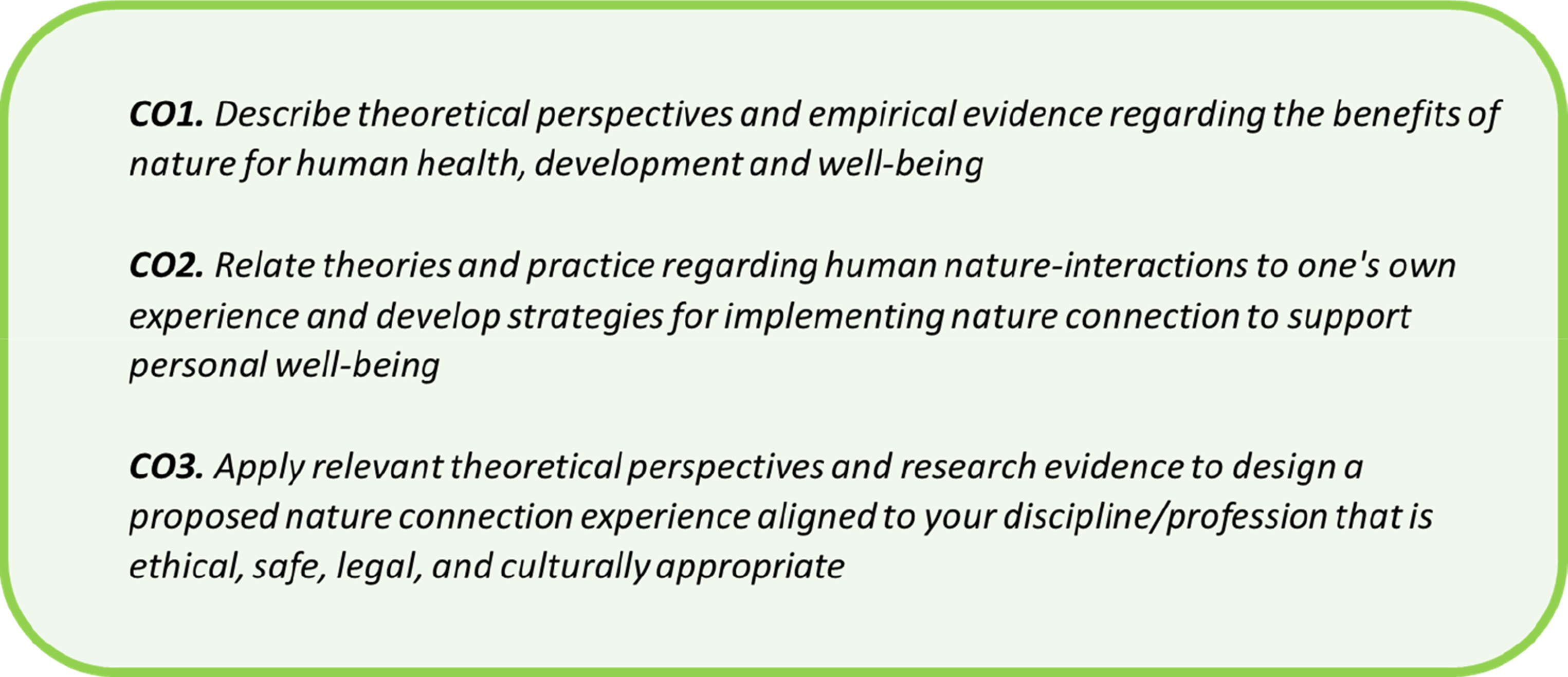
Course learning outcomes.
A consistent weekly structure was used across the course (please refer to Figure 2). Within each week, the Theories and Evidence stream built conceptual knowledge of how our relationships with nature contribute to physical and psychological health. The Professional Applications stream introduced students to a range of different practitioners who work across different modalities of practicing with nature, encouraging students to explore pathways and practices for their future work. The Nature Connection Practices stream described evidence-based practices, such as a sit-spot or nature journaling, to enhance personal nature connectedness and consider future professional applications of these techniques. Through these nature connection practices students began to
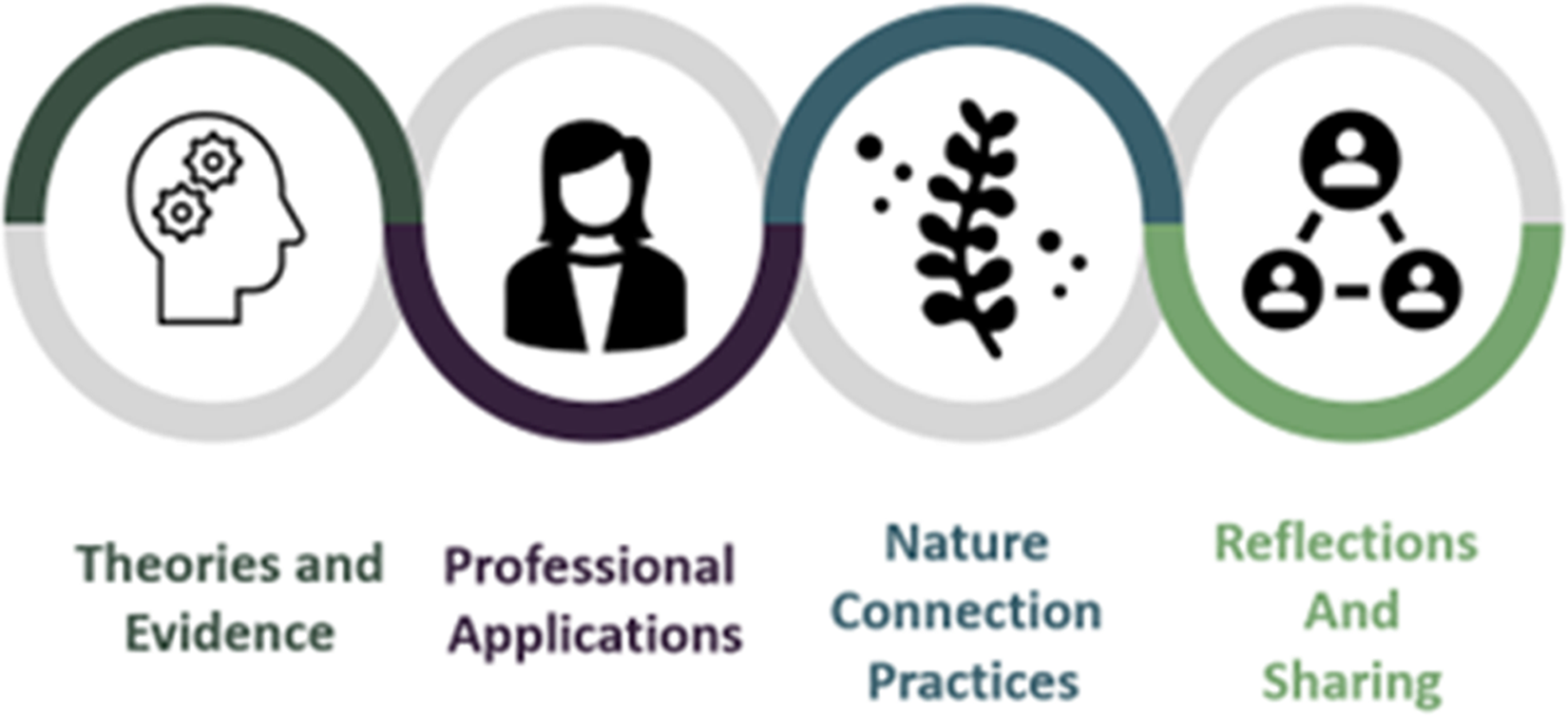
Four core pillars of the course that supported development of psychological literacy.
Assessment Design
Reflective Journal: The purpose of the reflective assessment was to encourage students to think deeply about the course content and to connect this to their own lives and experiences. Through the assessment, students were encouraged to put the theory and research into practice and consider what worked for them or did not work and why, as well as if and how their relationship with the natural world changed or evolved across time following the DIEP (Describe – Interpret – Evaluate – Plan) reflective model (Boud et al., 1985). The first reflective submission (700 words) was due in week 4 and worth 15% of the course grade, providing an opportunity for students to receive feedback. The second series of reflections (2000 words) were due in week 10 and worth 45%.
Plan for a Nature-based Activity: Given the growth in nature-based practices within the helping professions (Naor & Mayseless, 2021), students also explored professional applications of working in partnership with nature and developed a plan for a proposed evidence-based nature activity. The plan for a nature-based activity requires students to think from the perspective of a potential future practitioner in their chosen field. Within this assessment students provide a rationale for their chosen activity, alignment to their chosen population, the evidence base supporting likely benefits, as well as considering the practicalities associated with facilitating the proposed experience and safety, ethical and cultural considerations. The plan (1800 words) was due in week 9 of the course and worth 40% of the course grade.
Methodology for Evaluation of the Course
The purpose of the course was to foster the development of students’ psychological literacy in the context of the human–nature relationship. A multi-faceted approach to the evaluation was chosen to enable us to consider the development of psychological literacy through different lenses and from multiple stakeholder perspectives. Within the data collection phase of the broader evaluation of this course, we employed four primary data collection methods:
pre and post course surveys completed by students student work samples shared to class Padlets (forums)
summative student work samples
focus groups with students and teaching staff
Ethics approval was obtained from the University of South Australian Human Ethics Committee (#204831) for this research project to use anonymous data from formative course learning activities (pre–post course survey and Padlet posts as detailed below), as well as collecting additional data specifically for this project. At the conclusion of the course, students were invited by email to participate in the research evaluation if they wished to do so by completing an end of course survey, taking part in a focus group, or submitting their course assessments to the research team.
Procedure, Materials, and Participants
Course Survey
All students enrolled in the course during Term 3, 2022 (n = 101) completed pre- and post-course measures of nature connection (using the NR-6; Zelenski & Nisbet, 2014), and six dimensions of subjective well-being (18-item measure from Ryff et al., 2010; Ryff & Keyes, 1995) as part of their learning activities, with anonymous aggregate class data assessed in this research comparing week 1 and week 8 scores. The class was primarily comprised of students enrolled in the psychology program (84.2%) but also had students from social work and social sciences (4%), community health (2%), health sciences (2%), as well as communication, digital media, and students enrolled through Open Universities Australia. Students were also invited via email to complete an optional brief post-course online survey, pertaining to students’ experiences within the course and if or how they felt these experiences had impacted their contact with nature, connection to nature, and wellbeing. A total of 17 students (response rate = 16.83%) responded to the online survey. For further detail regarding the survey instrument or sample characteristics, please refer to (removed for blind review).
Student Work Samples from Learning Activities (Formative)
Students were supported through formative learning activities each week to engage in evidence-based nature connection practices and to share their feelings, observations and experiences with their peers (see Figure 2). In the final week of the course, students were invited to provide any final thoughts and reflections from their course experiences and these final anonymous responses were included in this evaluation (n = 43).
Student Work Samples from Assessment (Summative)
Data were sourced from summative student assessments for students who opted for their data to be included during the online survey (n = 7).
Focus Groups with Students and Staff
A total of six students (three male and three female), participated in focus groups or individual semi-structured interviews (subject to student availability). These sessions ran for between 30 and 60 min and questions explored impacts of the course on students’ knowledge, attitudes, and behaviours; the way students view and relate to nature; their nature connection practices; and psychological literacy. Four staff (three female, one male) also participated in separate focus groups, which explored the same question prompts but from the teaching staff perspective.
Questions explored included whether participants felt the course had impacted the way they viewed nature or related to nature; the amount of time they spent in nature; which aspects of the course (if any) impacted their knowledge, attitudes, and behaviours; and whether they planned to continue any nature connection practices beyond the course. Participants were also asked about any barriers that encountered to engaging with nature and whether they felt the course contributed to their capacity to apply their emerging psychological knowledge to personal, professional, and community contexts. Staff responded to these questions in relation to their interactions with students and also shared their personal reflections as individuals.
Approach to Analysis
Quantitative methods were employed to analyse changes in nature connectedness or subjective well-being pre- and post-course based on the aggregate class data. Reflexive thematic analysis was utilised to explore shared patterns of meaning within the student experience across the remaining data items (open-ended survey responses, student work samples, and interviews/focus groups with students and teaching staff) in line with Braun and Clarke (2022). Meaning was explored semantically in relation to written or spoken data using deductive processes through the lens of psychological literacy (Braun et al., 2023). Specifically, this centred on student experiences of personal, professional, and community or societal impacts or applications of the course. Aspects of the course design that were identified as linked to positive influence in these domains were also explored. Complete coding was utilised in that each data item could be categorised into multiple domains. Where specific quotes are provided the corresponding source of the data has been denoted (e.g., FG P3 = focus group participant 3). As acknowledged within reflexive thematic analytical approaches that “knowledge generation is inherently subjective and situated” (Braun & Clarke 2022, p.8), our interpretations are guided by our relationship to the course resources and delivery as content developers, educators, and active researchers in the fields of conservation psychology and teaching and learning pedagogy.
Findings
The following sections outline the research findings in relation to four key domains: (1) the course design, followed by examples of psychological literacy in (2) personal, (3) professional, and (4) community or societal contexts. Key themes and insights from the evaluative data will be shared alongside our interpretations in this section before inferences for the development of psychological literacy more broadly in undergraduate psychology education are explored in the discussion.
Evaluating the Course Design
Connecting Theory and Research Evidence with Personal Experiences
A recurring theme reported by students in relation to the course design and how this supported their learning was the importance of connecting theories and evidence with the experiential elements. Initially some students thought the course might be “airy fairy” (FG P5- male) or “hippie” (FG P4- female). However, they found that the opportunity to learn about theories regarding human relationships with the natural world and explore empirical evidence that aligned with the weekly practical activities helped make their learnings tangible. Focus group participant 2 (male) noted “the scientific part really gave me the confidence to trust the processes” and expressed “the scientific definitely blended well with the practical—because you were learning the evidence, and then you were [doing] the practical”. Similarly, survey participant 6 noted the best aspect of the course being “it offered a great balance of experiential learning and theory” while survey participant 13 stated they “absolutely loved finding the science to my spirituality”.
The topic itself was also highlighted as increasing student engagement and the capacity to easily apply learnings to real-life as everyone is “continually exposed to nature” (FG P5- male). Students described this course as having a substantial impact: “it was just like, oh wow, it did actually have a huge impact on my life” (FG P2- male). Focus group participant 3 (female) explained “a lot of the stuff that I’ve learnt from the course, I’m still doing and talking to people about and implementing”. For students, there seemed to be something powerful in learning about the benefits of nature contact and connection and then practically experiencing this.
Reflection, Connection, and Application Through Assessment
Several aspects of assessment were also identified as contributing to students’ capacity to apply the concepts they were learning. Focus group participant 1 (male) described “the reflection aspect of the course was amazing” in creating new insights. One student discovered, upon reflection, how important their relationship with nature had been in managing their mental well-being while living rurally in recent years. Through this insight they have proactively worked to reconnect now that they are in an urban environment. Other students also spoke of how this course specifically helped them to build their skills and confidence in reflective practice: “you need to learn how to do reflections, and doing nature-based reflections I think are probably the easiest I’ve had to do because its tangible” (FG P5- male). While another explained “I couldn’t connect with other things that I didn’t know, but… we’ve all been out in nature, so we all know how to connect with nature, so this gave me a deeper understanding of the knowledge that I was being taught” (FG P2- male).
Similarly, the planned nature-based activity assessment was highlighted by students as a strength of the course, describing the task as “authentic assessment, so it's very real life. It's something that you could almost replicate in the future, but you could also do it now… It was crafted in such a way that you could demonstrate a lot of your skills” (FG P4 – female). This speaks to the importance of choosing the right courses and assessments within a psychology program that lend themselves to fostering students’ ability to connect learning to life. Within this course, the emphasis on nature, which we are a part of and constantly in connection with, made the context accessible to all students. They could try what they were learning in real time within their own lives, and this, as well as the intentional assessment design to inspire personal and professional applications of learning, seem to have been important contributors to reported outcomes.
Psychological literacy development in the personal domain
Within the personal domain, students were able to directly apply their learning to their own lives. This was strongly illustrated in the final class Padlet, where 86% of student posts (37 out of 43 responses) included discussion of personal outcomes. The personal benefits were further illustrated through data from the two class survey instruments. Students’ average time in nature increased by >50% from an average of 2.82 to 4.36 h per week. Wilcoxin Signed-Rank Tests also demonstrated nature connection as measured through the NR-6 (p < .001) and all six domains of the subjective well-being measure were statistically significantly higher on average at the end of the course than at the beginning (p < .01). These examples suggest students were taking their learning ‘outside of the classroom’ and implementing this into their daily lives with observable effects.
Changed Attitudes and Behaviours
At the end of the course, 13 out of 14 students who responded to this item within the end of course survey (92.86%) reported the course had changed the way they viewed and interacted with nature. Students reported an expanded understanding of nature – beyond pristine wilderness – to something they could connect with anywhere during their daily lives, including in urban locations and indoors. One participant spoke of ‘bringing nature in’: “I’d never had plants in my house ever, and now I do” (FG P4 – female), while another explained that “in the middle of suburbia, we can still reconnect with nature” (FG P1 – male). Students described that the way they interacted with nature also shifted, such that there was now a greater intentionality when they were outdoors. This, in turn, further encouraged them to prioritise getting out and spending time in nature again.
Nature Connectedness
Students also reported changes to their relationships with the natural world and their nature connectedness. Many students reported, through the Padlets and focus groups, that the depth of their relationship had shifted and that this allowed them to see things “you didn’t normally see or notice” (FG P3 – female) and it was “almost like a veil had been lifted” (FG P4 – female). Survey participant 14 further explained “I only ever really used my eyes. This course taught me to engage with nature using all my senses”. As a result of their increased nature contact and connection, students reported positive changes to their well-being such as decreases in feelings of stress and anxiety (e.g., “decreased stress levels shown on a smart watch”; Padlet, P11), as well as a greater sense of relaxation, creativity, and restoration of their focus (e.g., “studying outside to increase concentration”, Padlet, P28). Positive changes in mood were also observed and a stronger sense of gratitude (e.g., “general positive outlook on life”, Padlet, P7) and purpose in life. One student described that it had transformed a daily task like walking the dog to an opportunity to connect and invest in relationship with nature and care of the self, while another explained “what I enjoyed was looking at the environment and the surrounds and the hugeness of nature and the world around us, it gives me perspective” (student journal). Figure 3 below summarises the breadth of physical, cognitive, and social/emotional benefits reported by students of the course.
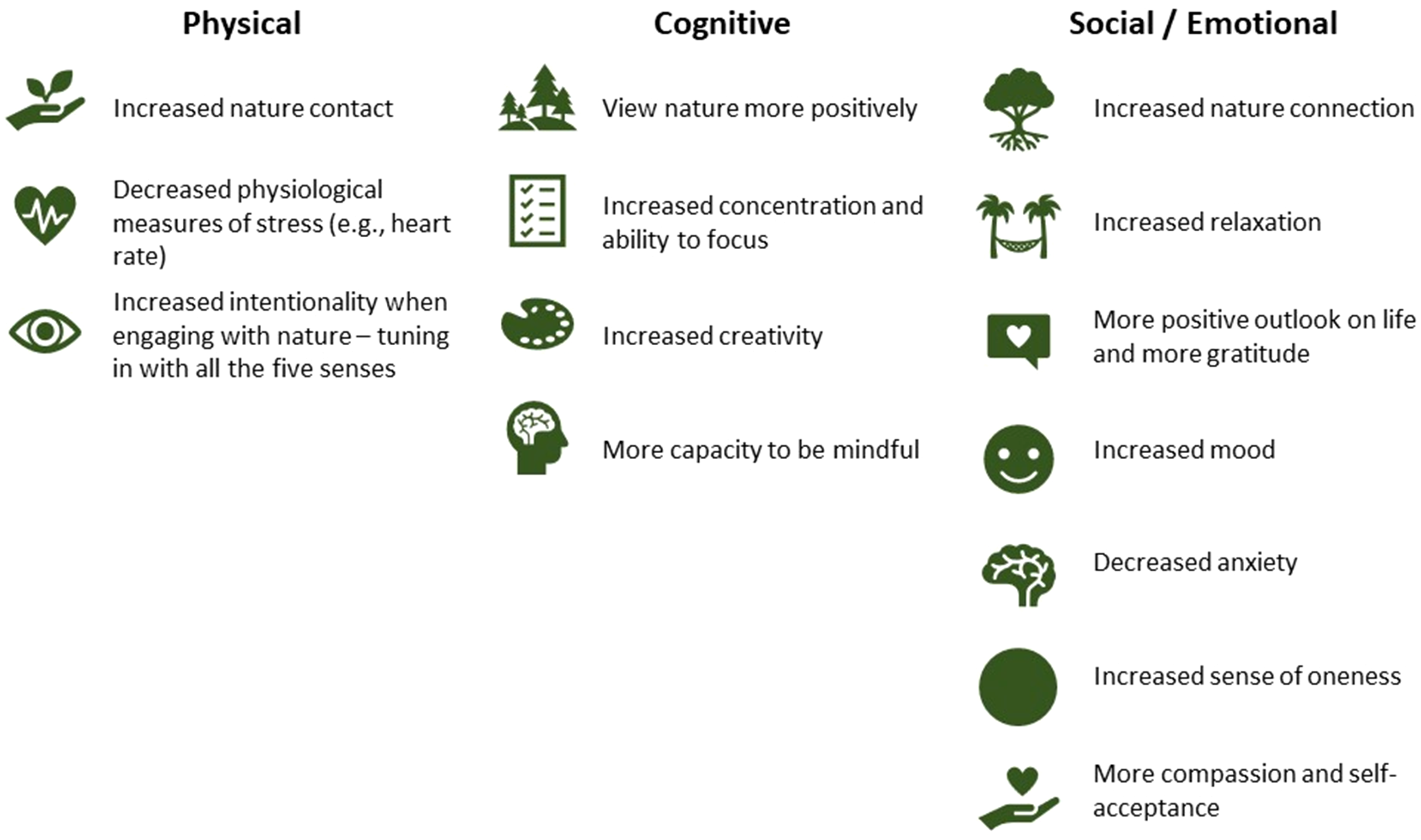
Summary of the personal changes students reported from their course learning through surveys, focus groups, Padlet posts, and summative assessments.
Taking the Learning Forward
Student feedback suggested that the course enabled them to build up a valuable toolkit of knowledge and skills they could use to support their success at university and beyond. One student described the nature connection activities as a “tool they could take away as a person, regardless of what they did in their future careers” (Padlet, P2). Focus group participant 4 (female) explained: “nothing has ever changed me like that, and that course did… wow, your subject changed my life”. Many students expressed engaging with nature more regularly e.g., “whenever I get stressed out with uni… I go out to the garden, and I completely immerse myself in that… so I touch and feel, smell, I hear, and-and that's how I utilise nature now… it's a tool now to manage stress” (e.g., FG P2 – male). Similarly, survey participant 9 expressed now “I react faster to mental health challenges like stress or low moods by getting into nature”. Following these observed benefits, all 14/14 respondents in the end-of-course survey reported that they planned on continuing to use the nature connection practices they had implemented during the course, and many had changed their immediate physical environments to invite more nature in. One student built a garden patio with flowering plants to bring the bees in and to enable connection with nature through the aromas of different plants, while another chose to move house to be near a National Park. Several others initiated, or added to, indoor plant collections.
This highlights the importance of designing psychology courses that build personal psychological literacy, especially as this applies to supporting well-being, early in the degree (ideally in first year), as this can equip students with tangible strategies to employ throughout and beyond their studies.
Psychological literacy development in the professional domain
Professional applications were a clear theme in focus groups and student work samples, as well as being reflected in 30% of the posts on the final sharing Padlet. Responses fell into five main areas as detailed below.
Understanding the Evidence-Base for Practice
Through the project assessment students had to think from the perspective of a future practitioner by considering which specific nature-based activities would be appropriate and beneficial for a target audience with a particular symptom or condition. Students reported this task as building “a deeper understanding of therapeutic benefits of nature in a professional context” (Padlet, P2). The assessment also required students to provide empirical evidence to support their proposed activity and to think very practically in terms of logistics and safety considerations. Feedback from the teaching team expressed in staff focus groups indicates that students were challenged to move beyond their personal experiences or idealised versions of engaging with nature, to critically engage with the idea of evidence-based practice as a potential future practitioner and think about practical constraints in outdoor environments.
Understanding Barriers to Behaviour Change
Through their personal experiences of working to change their nature contact and connection, students were better able to appreciate challenges that can arise in the context of behaviour change. Being able to think from the perspective of a potential future client, or others more generally, will be an important skill in their future professions. Students provided examples of living only ten minutes from the beach but still finding it difficult to get there, despite knowing it was good for them. Many students struggled with the multiple external commitments they were juggling alongside their studies.
Translation to Current Practice
For those already employed in the mental health and social service sector, several students reported implementing nature-based activities into their current work and seeking the support of their supervisors to engage in professional development opportunities in this emerging area. One student “integrated nature connectivity into case planning for clients living with mental health disorders” (Padlet, P29) while another noted in their reflective journal: “On a professional level, I can see that there would be many opportunities to incorporate psychoeducation about nature connections into my social work practice, particularly when working with clients and their families. I would base my practice on evidence-based research, as well as my own learnings and experiences of connecting with nature.”
Enhancing Workplaces
Students reported making changes to their current physical working environments by taking meetings outdoors (e.g., “brought my staff meetings to this river”, Padlet, P29) or bringing plants inside. Another detailed turning to nature to help manage stressful situations at work “it's happened a couple of times when I had really long conversations that weren’t always pleasant. I just went, ‘I need a break’ and walked outside sat in nature for 5 min and walked back… it felt like a magic wand” (FG P4 – female).
Professional Aspirations
The course also opened students’ minds to new pathways in psychology and saw more students aspiring toward working in partnership with nature “I just wanted to keep doing the assignment on, what you would do with nature in terms of helping people” (FG – P3, female). One student said the course had encouraged them to consider moving away from 1:1 work with clients to consider how we could better change systems that shape access to nature. Another was interested professionally in how nature can help people disconnect from technology and reconnect to themselves and the world around them. Other students reported wanting to pursue “ecotherapy” (Padlet, P15), “Green Social Work” (Padlet, P22), or “Include elements on nature therapy into Forensic Psychology (Padlet, P26).
These results indicate that, much like personal literacies, professional literacies can be established and explored early. Moreover, doing so can support students in growing their understanding of the scientist-practitioner perspective underpinning psychology, to begin early exploration of potential career pathways and applications, and to begin developing foundational skills in the translation of evidence into current or potential future practice.
Psychological literacy development in the community and societal domain
Beyond personal and professional contexts, students also described how they had applied their learnings in their broader communities (e.g., networks of friends and family). Students additionally noted critical consideration and shifts in their behaviours regarding the impact of their actions on the natural world. Around 40% of posts on the final-sharing Padlet included broader community or societal outcomes. This domain was also strongly reflected in focus group responses and student reflective journals, with implications for students as parents particularly pronounced.
Interactions with Children in Nature
Community impacts were most seen in relation to students’ interactions with children. Students who were parents not only describe prioritising time in nature for their children more, but also that the course had changed their own level of engagement and ways of relating to children while in nature. Focus group participant 2 (male) reported now employing a more wondering and questioning style, for example on seeing a bird “I wonder where his home is… What does he do… Does he have a little family there?” In this way they were more conscious of helping to build children's natural curiosity and ability to tune into the natural world. One parent of a child diagnosed with ADHD reported particular benefits upon getting out more into nature “it worked. The benefits of it are just insane. They’re visible. They’re palpable” (FG P4 – female). For many parents in the course, these experiences supported a realisation that as adults we can actively encourage and facilitate kids’ engagement with nature. Moreover, these parents were intentionally talking with their own children about how we are all a part of nature, e.g., “there's another family here that you need to consider” (FG P2 – male). There was a sense that “if we can get that—if we can kids to do it early—we can get kids to connect with nature, to realise their impact, to realise they are nature, they might grow up into people who will respect nature and who will not take as much from nature” (FG P4 – female).
Friends and Family
Sharing learnings more widely was also commonly reported. Survey participant 8 exclaimed “absolutely brilliant subject… It is the topic of conversation for me in any social occasion, I’m sure my friends and family are sick of me talking about it!” Focus group participant 3 (female) similarly described how they “can’t stop talking about-about it [strategies and evidence learnt through the course] because it is, so simple” and that she now encourages her partner to take a break in nature when they are stressed from work. She also shared that when friends or family mentioned they had loved ones that were unwell, she found herself discussing research about recovery times in hospitals when plants were present and introducing a friend going through a divorce to a nature journal as a means of helping to manage their stress and emotions during that difficult time. Another student (FG P6 – female) shared “I think I noticed too, during the course… people around me benefitting from nature and realising, ‘Oh, okay. This is really special.’ Like, this is special, not just to me or—that it's special to other people.” The sense of sharing and connectedness among the student group (even in this online course) was also carried forward independently by some students with examples such as students establishing a bird watching group to look up the birds they were discovering in their respective environments and learn more about them.
Pro-Environmental Behaviours and Reciprocal Relationships
While this course did not have a substantial emphasis on behaviour change and sustainability (as this is covered more comprehensively in our third year Conservation Psychology course), we did anticipate that changes in nature connectedness would be associated with more pro-environmental behaviour. In line with this expectation, more reciprocal relationships between students and the natural world began to emerge. This in turn led to a desire to give back to nature (e.g., survey participant 7 “I view my relationship as reciprocal which is new for me” and survey participant 8 “I see now that I am part of nature instead of a hierarchy with me at the top”). As described by focus group participant 3 (female), “the key was getting us all to connect, because as soon as that happens, then it's just this flow-on effect of wanting to nurture nature and ensure that it's okay.” Survey participant 5 explained the course “did inspire me to look at engaging in some more conservation activities, not just enjoying and connecting with nature but actively preserving it”. Survey participant 7 added “with the newfound connection has come a sense of responsibility that extends further than it has before”.
Specific actions reported by students included reducing their consumerism, employing “reuse/reduce/recycle practices consciously” (Padlet, P21), supporting community gardens, creating wildlife friendly gardens including “buying a bird bath to encourage birds into the garden” (Padlet, P27) and “growing our own food” (Padlet, P35), becoming involved in citizen science groups, and engaging in volunteering. One participant described how if they saw rubbish on a beach previously, they would think it was terrible but would not stop, yet now “I try to clean it up… and be an active participant in trying to preserve nature” (FG P2 – male). Focus group participant 3 (female) explained “As soon as you started feeling like you were on the same level and there was no hierarchy, that we’re all in it together, then you wanted to help them and look after them, and, you know, avoid the bug spray and just pick the spider up and put it outside type of thing.” Importantly, while several students spoke of their increased nature connection leading to concern for the health of our environment, students also conveyed a sense of hope and inspiration. “You know, you wanna get up in the morning—you—because you’re like, ‘I wanna tell everybody else about this.’ or, ‘I wanna change policies,’ or, ‘I wanna show more people about having this nurturing relationship with nature.’ And, uh, that's-that's it. That's what we’ve gotta do is we’ve just gotta get everybody else connected to it so that they wanna do the same” (FG P3 – female).
These examples speak to the potential of education that is transformational, rather than solely informational. Through intentionally designing for psychological literacy, students could meaningfully translate their learnings not only within their own lives but in their immediate communities and in many instances walked away from the course with a desire to live in a more harmonious way with nature.
Discussion
Within this case-study we have considered the development of psychological literacy in an online elective first-year course focused upon “Connecting and Working with Nature”. Our findings have demonstrated that through this course students were able to engage in the “intentional values-driven application of psychology to achieve personal, professional, and community goals” (Cranney et al., 2022, p.3). When students were asked to provide feedback on the course design, key components they identified as underpinning their emerging psychological literacy were 1) the intentional interweaving of theory and research streams with experiential learning or personal experience, and 2) the constructive alignment of assessments (reflection and planned nature connection activity) with intended learning outcomes in the personal and professional domains respectively (Biggs, 1999; Coulson & Homewood, 2016). This highlights the value of purposefully designing psychology courses (where appropriate) to have a clear interconnection between evidence and practice and applying principles of authentic assessment that connect students’ learning to life (ATN, 2020).
Within the personal domain, students reported a strengthened psychological connection with the natural world, and in turn, benefits to their personal well-being. Given the established literature (e.g., Robotham & Julian, 2006) showing that many higher education students find their studies stressful, this provides an important foundation to further consider how undergraduate psychology education and nature connection, can further equip higher education students to manage their well-being during and beyond the course of their studies.
In the domain of professional applications, our findings suggest that through the course students built an awareness of how psychological knowledge can be implemented into their current or future roles and that broad areas of psychology, such as nature connection, open a range of future career roles many had not previously considered (Naor & Mayseless, 2021). We feel this is important as intentional engagement with professional applications within undergraduate programs can enhance the work-readiness of 3-year psychology graduates and reinforce the value and contribution of undergraduate psychology education as a whole (Hulme & Cranney, 2021), irrespective of whether students progress to further post-graduate training.
Boyer (1990) talks about how meaningful education should be transformative in nature, benefiting not just individual students but also their wider communities or our society. Within this course evaluation, in the broader community or societal domain, we identified a range of benefits that extended beyond individual students to their friends, families, communities, and their care for and protection of the natural world. These findings underscore the value of striving for psychologically literate citizenship as a key outcome of psychology education and further evidences the potential of psychology education to be a valuable toolkit in its own right for creating healthier and happier lives and societies (Cranney & Dunn, 2011; Hulme, 2014).
Limitations & Directions for Future Research
These findings should be interpreted in the context of several limitations. Firstly, as an elective course, we acknowledge that students who have more of an interest in the relationship between humans and the natural world are likely to self-select into this course, and therefore these specific findings would not be expected to directly translate to all psychology students. Given the anonymous nature of the pre- and post-course survey data, we are also only able to explore changes in class aggregates across nature connection and subjective well-being. There is additionally the possibility that students who had the most positive course experiences self-selected into the end of course survey or focus groups.
Despite these limitations, given the convergence of diverse data sources in relation to the development of students’ psychological literacy within this course cohort, we feel this case study still adds to an important emerging evidence base that effective psychological literacy development can start early in students’ studies. Future research would benefit from engaging in prospective studies of students progressing through courses intended to foster psychological literacy, with capacity to match student responses pre- and post-course, and that explores which subject areas are best suited to the early development of psychological literacy.
Conclusion
This special issue explores centring psychological literacy in undergraduate education internationally. This case-study provides one illustration of the potential value this can afford students personally and professionally, and how this may help our graduates become more psychologically literate global citizens, using their education to improve the world we live in (Hulme & Cranney, 2021). Three key take-away from our experiences and evaluation for other educators include:
Footnotes
Declaration of Conflicting Interests
The authors declared no potential conflicts of interest with respect to the research, authorship, and/or publication of this article.
Funding
The authors received no financial support for the research, authorship, and/or publication of this article.
