



Abstract
Psychology is the second most popular undergraduate degree choice in the UK (The Complete University Guide, 2020). However, the value of psychology undergraduate degrees is increasingly under scrutiny (Brinhaupt et al., 2016; Halonen & Dunn, 2017). Therefore, it is important to establish how psychology undergraduate students may differ from other subjects, in terms of skill development and knowledge acquisition. In recent years, scholars have argued that development of “psychological literacy” crucially differentiates psychology students from their peers in other disciplines (see Chew, 2021). However, there is, to date, no empirical evidence that directly explores whether psychological literacy is, indeed, a unique set of skills and outcomes that only psychology students develop. The present study serves to fill this gap in the literature.
Psychological literacy comprises a set of attributes, whereby students apply their subject-specific psychology knowledge and skills to solving real-world problems. Psychological literacy encourages students to apply their psychology knowledge to everyday life and to address local and global problems (Boneau, 1990; Cranney et al., 2012; McGovern et al., 2010), and has been conceptualized as both (a) a set of distinct learning outcomes or competencies, and (b) a pedagogical philosophy or approach to teaching psychology (Cranney et al., 2022). Cranney et al. (2012) define psychological literacy as “the general capacity to adaptively and intentionally apply psychology to meet personal, professional, and societal needs” (p. iv). In a recent revised definition of psychological literacy, created in consultation with various stakeholders, Newell et al. (2022) conclude that there are three core aspects that make up the construct, including the ability to: critically analyze psychological phenomena, use scientific methodology and principles, and communicate understanding of psychological processes. Therefore, proponents of psychological literacy suggest that a psychology education can improve students’ global and cultural awareness whilst encouraging them to become responsible and ethical “global citizens” (Cranney et al., 2012; Mair et al., 2013; McGovern et al., 2010). Global citizenship is the notion that people belong to one large global community and should work towards benefitting it (Cranney & Dunn, 2011; Davies, 2006). The focus of psychological literacy on “respect for diversity” (McGovern et al., 2010) and “ethical and socio-cultural issues” (British Psychological Society, 2019) suggests it may be aligned with global citizenship ideals in higher education (Cranney & Dunn, 2011; Pownall et al., 2021). Psychological literacy should enhance communication, psychological knowledge and its application, critical thinking, and employability attributes (Hulme & Cranney, 2020).
Psychological literacy is increasingly embedded in national standards for psychology teaching in the UK and more widely (e.g., APA, 2021; Cranney et al., 2021; Cranney et al., 2012). Due to this, a growing number of educators are suggesting novel ways of measuring it, embedding it into the curriculum, and promoting it as a set of learning outcomes (Newstead, 2015; Roberts et al., 2015; Mair et al., 2013; Taylor & Hulme, 2015). This echoes the definition provided by the Quality Assurance Agency (QAA, 2019). The QAA is an independent charity that monitors and advises on standards and quality in UK higher education, as well as providing accreditation internationally. Their standards and policy drives practice across the UK. In the QAA Subject Benchmark Statement for Psychology, which is a policy document that informs all psychology programs in the UK, there are certain defining principles that “guide a degree course in psychology” (p. 4) and make up psychological literacy. Aligned with Newell et al.’s (2022) redefinition of psychological literacy, the QAA definition includes research-related skills (e.g., “knowledge and the acquisition of a range of research skills and methods …” and “develop an understanding of the role of empirical evidence”), as well as broader skills related to critical and analytical thinking (e.g., “present multiple perspectives in a way that fosters critical evaluation”). These attributes of psychological literacy are the defining principles used in the present study.
Over recent years, there has been much debate over the conceptualization of psychological literacy, particularly regarding how it is situated amongst other learning outcomes and how discipline-specific it is (Murdoch, 2016). One view of psychology literacy is that it refers to a set of generic graduate attributes or undergraduate outcomes that all students within higher education are trained to develop (Cranney et al., 2012; Murdoch, 2016). “Graduate attributes” here refers to skills and qualities that a student is expected to possess after completion of their higher education program of study (Cranney et al., 2009; McGovern et al., 2010). Given how psychological literacy is closely tied with global citizenship (McGovern et al., 2010), there is a suggestion that all higher education disciplines must teach some psychological literacy skills if they wish their students to graduate as global citizens (Cranney & Dunn, 2011). However, this raises the important question of whether psychological literacy skills are unique to psychology graduates. In theory, psychological literacy should be discipline-specific because it comprises one of the three “psychology specific” characteristics that Murdoch et al. (2016) suggests set psychology students apart.
Therefore, it is necessary to investigate whether psychological literacy features in non-psychology degrees, from a student perspective. The present study serves as a follow up study of Harris et al. (2021), who investigated how psychology students perceive the attributes of psychological literacy, as defined by the QAA (2019) principles. Harris et al. (2021) demonstrated that, while psychology students were not explicitly aware of the term, they did value the individual attributes that it comprises. It is useful, therefore, to consider how and whether students recognize the prevalence of psychological literacy in their experiences of teaching and learning. Evidence suggests that psychology undergraduate students in the UK have an intuitive understanding of psychological literacy, and value its skills for all future career paths (Harris et al., 2021). However, it remains unclear whether psychological literacy is an attribute unique to psychology students, or whether it comprises a set of generic skills that are shared with students of other subjects. It is also unclear whether psychological literacy attributes are perceived to be prominent across other, non-psychology subjects. Therefore, the present work crucially extends this research, by providing the first examination of psychological literacy across subject disciplines. This serves to contribute to the ongoing appraisal of psychological literacy (see Cranney et al., 2022), by investigating the extent to which psychological literacy skills are unique to psychology students.
Some scholars argue that skills taught during a psychology degree set psychology majors apart from other graduates (Chew, 2021), with some going as far as saying that “just about every job suitable for a general graduate will be done better by a psychology graduate” (Florance et al., 2011, p. 699). Kent and Skipper (2015) suggest that this may be due to increased research and critical thinking skills learnt in a psychology degree in comparison to other subject areas. This idea that psychology programs give psychology students a unique advantage supports psychology’s classification as a STEM + science (Trapp et al., 2011). Trapp and colleagues (2011) suggest that psychology functions a STEM + science because it fulfils and, crucially, goes beyond STEM criteria; for example, by emphasizing ethics and communication (i.e., British Psychological Society, 2019; McGovern et al., 2010). In turn, if these skills are not developed in other STEM subjects, it would suggest that psychological literacy is unique to the discipline of psychology. Furthermore, psychology is considered as a distinct hub science (Boyack et al., 2005; Cacioppo, 2007). Although psychology has an “interdisciplinary nature” with close relationships with other disciplines such as medicine and neuroscience and often sharing both theory and empirical research, those who are taught psychology benefit from their own unique set of skills (Cacioppo, 2007).
Despite the classification of psychology as a STEM + subject suggesting that it must encompass unique skill sets, there is some doubt in the literature (see Halonen & Dunn, 2017). This may be driven by the inherent broad applicability of psychology education to future graduate roles, which may diminish the unique value that learning psychology can have for students. As most psychology graduates do not go on to careers directly involved in psychology (e.g., Hamilton et al., 2018; Trapp et al., 2011), it is useful to consider whether psychology graduates develop a unique skillset in comparison to other disciplines that may benefit them in terms of employability and career prospects. The present study is thus important, given that this is the first rigorous, empirical investigation into the uniqueness of psychological literacy to psychology students.
The Present Study
Despite the emerging literature which (re)considers the conceptualization and definition of psychological literacy (e.g., Cranney et al., 2022; Newell et al., 2022; Newell et al., 2019), there is limited empirical research that considers whether psychological literacy is subject specific or whether it is also perceived to be prominent in other subject areas. When investigating the construct of psychological literacy and the components that make it up, Roberts et al. (2015) suggested that whilst there were some psychology specific facets, psychological literacy also included some more generic graduate attributes. Heritage et al. (2016) showed that elements of psychological literacy differentiated Australian psychology and speech pathology students only in the second year of study. Psychology students scored higher on skills relating to reflective processes, and speech pathology students scored higher on generic graduate attributes. This weak differentiation suggests that psychological literacy does not predict group membership, and thus as a whole may not be unique to psychology (Heritage et al., 2016).
The present study constitutes an extension of Harris et al. (2021), in which we examined how psychology students perceive and understand the attributes of psychological literacy as defined by the QAA (2019). This study identified that psychology students generally are aware of psychological literacy, however, may not recognize it explicitly as this term. In this early work, we concluded that “it may be beneficial to repeat the current survey with students from other disciplines” (p. 65) in order to paint a more complete picture of how psychology students’ perceptions of psychological literacy may differ from other students. Despite this call for research, there has been no research which investigates whether psychological literacy, as defined by education bodies (e.g., British Psychological Society, 2019; QAA, 2019), encompasses a set of skills that are only perceived to be prominent by psychology students, or whether students from the humanities and other STEM subjects also perceive psychological literacy attributes in their subjects. Due to the notion that psychological literacy was initially conceptualized as subject-specific knowledge (Boneau, 1990), we hypothesized that psychological literacy represents discipline specific skills. Therefore, we predicted that psychology undergraduates will perceive psychological literacy attributes to be more prominent in their degree (characterized as higher awareness, more opportunity to develop them, more confidence in defining the terms, and higher value) compared with other students.
Method
Participants
For the current study, 179 non-psychology students (127 female, 47 male, and 5 non-binary) were recruited through the online participant pool Prolific and were paid the equivalent of £7 per hour for their participation. All participants were currently studying for undergraduate degrees in UK universities. We recruited students from a range of humanities and non-psychology STEM subjects including English (n = 51), History (n = 42), Mathematics (n = 49), and Physics (n = 37). These subjects are from discipline areas that are distinct from psychology, and therefore provide a stringent test for our hypothesis that psychological represents discipline specific skills. The data collected from the non-psychology students was compared to data previously collected from 117 psychology students that were currently studying in UK universities (Harris et al., 2021). In the final sample, including both psychology and non-psychology students, 56 (18.9%) students were in the first year of their studies, 104 (35.1%) in second year, 133 (44.9%) in third/final year, and three students (1.0%) were in a placement year. To provide some context, the UK Higher Education system, undergraduate degrees are typically 3 years of full-time study. In the UK, students also have the option of taking a year out of their studies to work in industry, which is referred to here as “placement year.” Data for the psychology students were collected in August 2020, and data from the non-psychology students during November 2020. Therefore, all students for this study were recruited in the context of the COVID-19 pandemic, during which time teaching was delivered online.
Materials and Procedure
This study was approved by the local School of Psychology Ethics Committee (for both the psychology student recruitment; Reference: PSYC-77 and the non-psychology students; Reference: PSYC-104). This research was conducted as an online questionnaire hosted on Qualtrics. Participants were first presented with an information page explaining the purpose and aims of the study and then, after providing informed consent, were able to take part in the survey. Measures, data, and Supplemental Information can be openly accessed on Open Science Framework (see Pownall et al., 2022).
Measures
In the first part of the survey, participants answered questions pertaining to demographic information (including their degree subject, their current year of study, current degree class, university, and desired work sector). Following this, participants were shown a list of the core eight attributes of psychological literacy, according to the Quality Assurance Agency (2019) and British Psychological Society accreditation standards (British Psychological Society, 2019). These included items such as “the ability to conduct research independently” and “the ability to understand real life applications of theory to the full range of experience and behaviour.” Some of these items were slightly adapted from the original British Psychological Society competencies for brevity and clarity (see Pownall et al., 2022). Both the psychology and non-psychology students completed the same surveys. The only differences between the two surveys were that one attribute “the ability to apply psychological understanding to real world questions” was re-worded for non-psychology students, in that “psychological” was changed to “subject-specific.” This change was considered appropriate, so as not to prime other students with thinking that the construct is inherently unapplicable to them because it focuses on psychology only.
For each of the eight skills, participants were asked to report whether they had been made aware of this skill in their degree (1 = not at all aware to 7 = highly aware), to what extent they felt they had developed it so far in their degree (1 = not at all to 7 = to a very high level), and how confident they felt in their ability to define each skill to another student (1 = not at all confident to 7 = completely confident). Finally, participants reported how important they believed each skill to be in their future graduate careers (1 = not at all important to 7 = completely important). These items aimed to measure “awareness,” “development,” “confidence,” and “importance” of the psychological literacy constructs and were based upon those used by Morris et al. (2013) and Harris et al. (2021), which assessed psychology student perceptions of psychological literacy. The order in which skills were presented to each participant was randomized through Qualtrics. Finally, as an exploratory measure not further analyzed here, participants were asked whether they were familiar with the term “graduate attributes” (yes/no) and were all asked to briefly define “graduate attributes” in their own words.
Attention checks
To ensure data quality, there were three attention checks throughout the questionnaire. These were questions featuring a 1–7 Likert scale, where participants were asked to select specific responses (2 or 5) or to leave them blank. Participants who failed two or more attention checks were automatically excluded from the survey and their data were not used in analyses. This was to ensure data quality and to avoid “data farm” participants in Prolific. Some respondents (19 of 198) were removed from the sample following attention checks, resulting in the 179 used for analysis.
Results
Data Preparation
We first averaged participant’s responses to the questions related to awareness, development, confidence, and importance of each psychological literacy attribute to create a composite item for each attribute for each participant (see Table 1). This created one item which referred broadly to the perceived prominence of the eight attributes in a student’s subject. We created an aggregate for each attribute due to (a) the high Cronbach’s alpha when treating the four questions as a scale (see Table 1), (b) our interest in overall perceptions of the attributes, rather than a specific interest in one aspect of these perceptions, (c) in order to establish commonalities without performing multiple statistical tests, leading to inflated rates of Type 1 errors. This aggregate score demonstrates how prominent psychological literacy attributes are perceived to be by students. For clarity, each attribute has been given a short title and the full corresponding QAA descriptions can be viewed in Table 1 and the Supplemental Information.
Average Perceived Prominence of Each Attribute (Awareness, Development, Confidence, Importance), Including Full QAA Description, Split by Discipline, Including Cronbach’s Alpha for Each Scale.
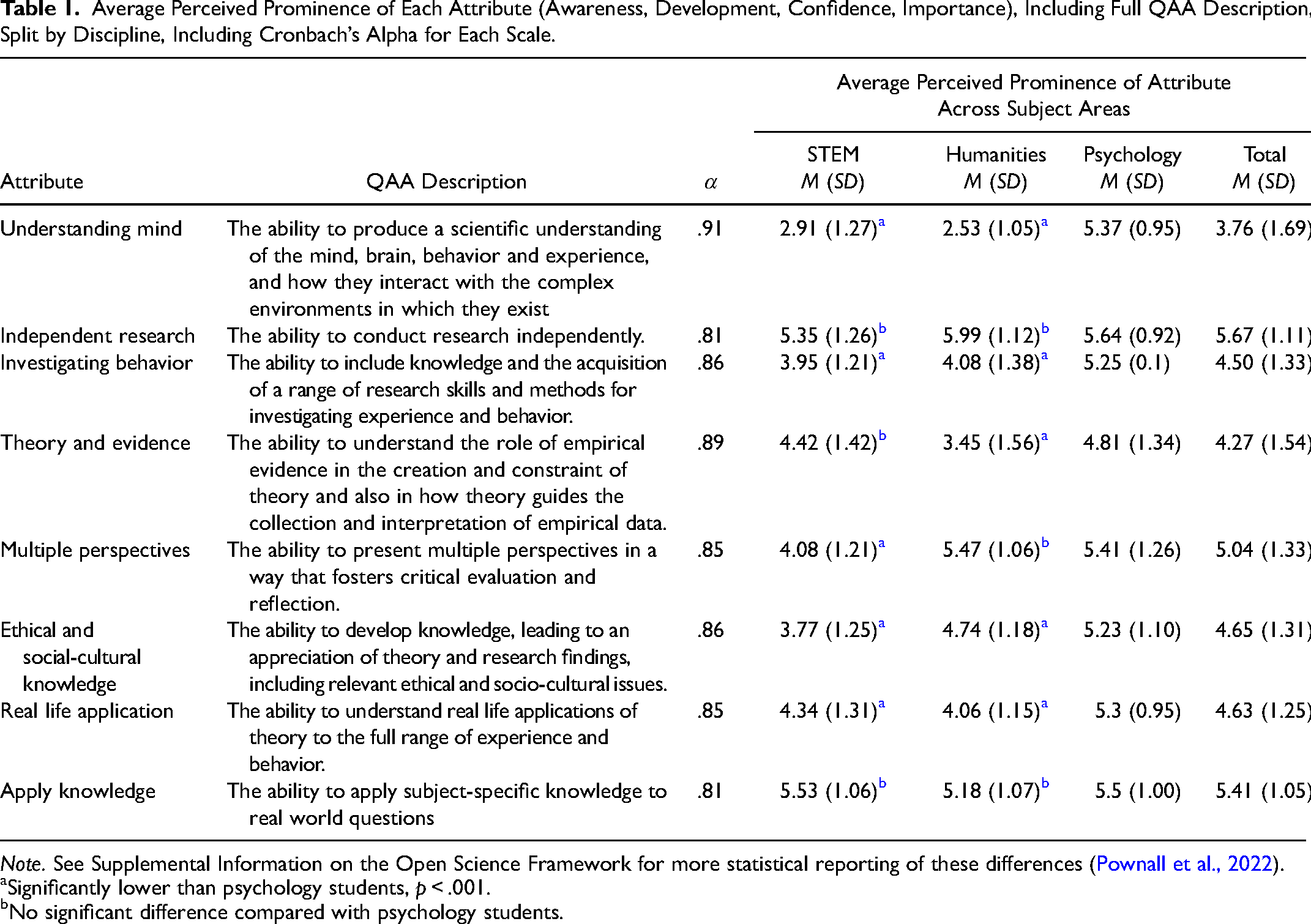
Note. See Supplemental Information on the Open Science Framework for more statistical reporting of these differences (Pownall et al., 2022).
Significantly lower than psychology students, p < .001.
No significant difference compared with psychology students.
Subject Differences in Graduate Attributes
To test the hypothesis that psychology students will show higher perceived prominence of each attribute in their subject (compared with non-psychology STEM and Humanities students), we ran a multivariate analysis of variance (MANOVA) with the three different subject groups (Psychology vs. Humanities vs. non-Psychology STEM). We first checked the data for outliers. Mahalonobis statistics suggested that there were seven outliers in the dataset. As participants who failed two or more attention checks had already been removed from the dataset and in the interest of preserving adequate sample size for each subject group, these outliers were left in for analysis. Retaining the outliers did not impact the results, so they were retained in the dataset.
Next, to check assumptions of a MANOVA, we ran Pearson’s bivariate correlations for each of the eight attributes. There were no signs of multicollinearity in the data and no correlations were above Tabachnick and Fidell’s (2013) recommended 0.90 cut off. After assumption checking, we then ran the MANOVA, with subject group as independent variables (non-psychology STEM, Humanities, and Psychology), and the eight different attribute scores as the dependent variables. A Box’s M value of 115.88 with a significance level of p < .001 was calculated, suggesting that the homogeneity of variance assumption may not be robust, so the statistic Pillai’s Trace was adopted (Tabachnick & Fidell, 2013). This MANOVA revealed a statistically significant main effect of subject group on graduate attribute scores, F(16, 574) = 36.66, p < .001, Pillai’s Trace = 1.011, ηp2 = .505. Bonferroni multiple comparison post-hoc tests revealed that overall, psychology students reported significantly higher perceived prominence of the psychological literacy attributes compared with other subjects, in all but two attributes (Independent Research and Apply Knowledge; p < .001). Table 1 highlights these significant differences and see Supplemental Information for the post-hoc test output including mean differences and 95% confidence intervals.
Exploratory Analyses
We then theorized that perceived psychological literacy prominence may increase as students’ progress throughout their degree. To first check distribution of year of study, we ran a chi-squared test, which confirmed that there were no significant differences of year of study (first, second, third/final, and placement year) on subject allocation, X2 (12, N = 296) = 18.37, p = .105. Finally, as an exploratory follow-up analysis, we tested whether year of study interacted with subject to produce differences in student’s perceptions of the prominence of the attributes using a 3 (subject: psychology vs. non-psychology STEM vs. humanities) × 4 (year of study: first year vs. second year vs. third year vs. placement year) MANOVA, attending to the interaction, and there were no significant interactions on any of the eight attributes, F(40, 1410) = 1.002, p = .47; Pillai’s Trace = .138. Note, though, that some of the cells for this analysis were small (e.g., placement year, n = 3). See Supplemental Information for complete reporting of these exploratory analyses (Pownall et al., 2022).
Discussion
The current study aimed to determine whether non-psychology students recognize attributes of psychological literacy in their degrees. This aimed to contribute to the ongoing reappraisal of the unique value of psychology undergraduate education. We investigated students’ awareness of the attributes, development of them, confidence in explaining them, and perceived importance for student’s careers. Overall, we found that psychology students reported significantly higher perceived prominence of attributes that comprise psychological literacy, compared to both humanities and non-psychology STEM students, in the majority of the attributes. This suggests that the majority of psychological literacy attributes are indeed unique to psychology undergraduate students, which serves to demonstrate the value of a psychology education. Only the attributes “independent research” and “apply knowledge” showed no significant differences between psychology and non-psychology STEM or humanities. The attribute “present multiple perspectives” only differentiated psychology students from non-psychology STEM, and “theory and evidence” only differentiated psychology with humanities. Overall, this study serves to delineate the aspects of psychological literacy that are unique to psychology students, and the aspects that may constitute more generic graduate attributes that is prominent in all undergraduate education.
Further inspection of the data also suggests some emerging patterns in the attributes that distinguish psychology undergraduates from the other subjects. For example, three of the attributes that psychology students reported higher perceived prominence of included a reference to “behaviour” (e.g., “the ability to produce a scientific understanding of the mind, brain, behaviour and experience …” and “the ability to include knowledge and the acquisition of … skills and methods for investigating experience and behaviour.”). Whereas in comparison the attributes that psychology students did not differ from humanities and non-psychology STEM students were more generic (e.g., “the ability to conduct research independently” and “the ability to apply subject-specific knowledge to real world questions”). This suggests that some of these attributes may indeed be more general graduate attributes and reflective of skills that all students should develop during their undergraduate studies (Cranney, 2013). More broadly, this also suggests that the understanding of behavior constitutes a unique skill which differentiates psychology students from other students. This fits well with the original conceptualization of psychological literacy by Boneau (1990) as a knowledge-based phenomenon, terms necessarily understood by students of psychology. This also echoes Newell et al.’s (2022) revised definition of psychological literacy. This is an important finding, especially given how the utility of a psychology education is increasingly called into question (Halonen & Dunn, 2017), as it reaffirms the degree’s unique value.
Moreover, one of the attributes that also showed differences between psychology and non-psychology students was Attribute 6 (“The ability to develop knowledge, leading to an appreciation of theory and research findings, including relevant ethical and socio-cultural issues.”). Psychology students reported significantly higher perceived prominence of this attribute in their degree compared with both humanities and non-psychology STEM students. This attribute does not include the word “behaviour” explicitly, but instead focuses on knowledge and appreciation of research findings and theory. This finding may suggest that a strong focus of psychology education is understanding broader ethical and socio-cultural issues, in a way that is unique to psychology as a subject. Indeed, ethical and socio-cultural knowledge are inherently tied to understanding behavior too, given how increased awareness of ethics and socio-cultural norms is likely to translate into one’s behavior (Cranney & Dunn, 2011). Further, this attribute is implicitly tied closely to the concept of global citizenship (Davies, 2006), and psychological literacy has been conceptualized as the subject-specific embedding of a global citizenship education (Pownall et al., 2021). That suggests that as psychology develops ethical understanding more than the other subjects surveyed in this study, psychology students may have particularly well-developed global citizenship skills and insights (Cranney & Dunn, 2011).
Taken together, the significant differences seen in the scores of these four attributes between psychology and non-psychology students may also thus suggest that there are, indeed, psychological literacy attributes that are unique to psychology students (e.g., Quality Assurance Agency, 2019; British Psychological Society, 2019). These finding mirrors and extends Roberts et al.’s (2015) model, which posits that psychology education is characterized by (1) generic graduate attributes, (2) reflective processes, and (3) appreciation of psychology as a helping profession. Similarly, Newell et al.’s (2022) revised model of psychological literacy defines the constructs by attributes such as applying psychological knowledge, written communication skills, and critical thinking. Our results also suggest that the notion that psychology students are able to understand behavior specifically may set them apart from other subjects, and thus be an important part of psychological literacy as a pedagogic concept. Psychology students may benefit from harnessing this unique attribute, particularly in an employability context.
Importantly, there were attributes that only differentiated psychology students from humanities, but not other STEM students not in psychology. For example, psychology students reported higher perceived prominence of “the ability to understand the role of empirical evidence” compared with humanities students but answered comparably to non-psychology STEM students. This suggests that this attribute of psychological literacy may be prominent across all science-based degrees. The sharing of skills between psychology and other STEM subjects supports Trapp et al.’s (2011) assertion that psychology functions as a STEM + science. In terms of skills included in psychological literacy as commonly defined in various subject benchmarks (i.e., British Psychological Society, 2019; QAA, 2019), psychology students share some with other students of the sciences (e.g., Trapp et al., 2011). Similarly, we also found evidence for the inverse of this, in that “the ability to present multiple perspectives” differentiated psychology and humanities students from non-psychology STEM students, but not from each other. Therefore, this suggests that psychology may “bridge a gap” between STEM and humanities, tapping into attributes that feature across both subject areas.
To understand this further, Cacioppo (2013) suggested that as a “hub science,” psychology is moving towards becoming increasing interdisciplinary. Indeed, having developed the unique skills seen in the current study, psychology students could make valuable contributions to work in other subject fields. These contributions could, for example, come from their expertise in knowledge of behavior, research skills, or from applying ethical knowledge to research. Similarly, the current findings are beneficial for graduate prospects of psychology students; it confirms that they do develop some unique and interdisciplinary skills, which may make them useful within many places of employment. These skills could be helpful in various employment roles; for example, understanding of behavior when working with the public, or ethics and understanding of socio-cultural issues when developing a business strategy. Further, the current study finds that there are significant differences in psychological literacy between psychology, humanities, and non-psychology STEM students. This partially corroborates the findings of Heritage et al. (2016), who found that generic graduate attributes and reflective processes differentiated psychology students from second year speech pathology (a STEM subject) students. This suggests that some attributes that make up psychological literacy are not unique to the discipline and may also be developed in other disciplines (Heritage et al., 2016).
In our current study, non-psychology students did not report higher perceived prominence of any of the eight attributes, compared with psychology students. However, it is notable that most of the attributes that significantly differentiated psychology from the other subjects contained the word “behaviour” in the full QAA description (see Table 1). For example, the attribute “the ability to produce a scientific understanding of the mind, brain, and behaviour,” “the ability to understand … experience and behaviour,” and “the ability to investigate experience and behaviour” all significantly differentiated psychology from non-psychology students. In contrast, the attributes that showed no significant differences between psychology and non-psychology students were more generic and did not refer to “behaviour.” This contradicts the findings of Heritage et al. (2016), who found that generic graduate attributes did differentiate psychology from non-psychology (speech pathology) students. However, such differences reported by Heritage et al. (2016) may be due to the structural differences in psychology and speech pathology courses, or other aspects of speech pathology as a comparison group (e.g., it is vocational, which may mean it features less generic graduate skill development and prioritizes more specialized skills).
Moreover, it is important to note here that the present study was interested in understanding perceptions of the prominence of psychological literacy attributes across subjects. This means that our study has the inherent limitation of self-report biases and may call into question how legitimate or valid student’s testimony of their learning is. Perceptions of attributes are a useful place to start because, arguably, if students do not perceive the salience of principles and values, the impact of embedding them into the curriculum may be limited. We did not measure “actual” prominence of psychological literacy teaching by, for example, examining syllabi, accreditation standards, or curricula in these subject areas. We thus invite other researchers to extend this line of inquiry, by using more direct and explicit methodologies to examine the actual prominence of psychological literacy attributes across subjects. This may start with an investigation into educator’s practices, exploring whether educators outside of psychology show awareness, development, confidence, and importance of psychological literacy attributes.
Furthermore, future work in this area may also aim to replicate our findings with larger and more diverse samples. For example, future research could recruit participants from more than the four non-psychology subjects used here, such as the social sciences (e.g., sociology). Future work could also assess student’s actual development of psychological literacy attributes (e.g., through assessing student’s performance on authentic psychological literacy assessments). Continuing this research with further subject areas and using more authentic and rigorous methodology would help to establish the validity of the findings reported here and throughout the literature (e.g., Heritage et al., 2016). The non-psychology subjects in the current study were chosen so for their breadth and variation, and so the humanities and non-psychology STEM groups were of roughly equivalent sizes.
In conclusion, the current study suggests that some of the skills making up psychological literacy are unique to psychology students, in particular, attributes that center around understanding of mind and behaviors specifically, while some are reflective of more generic graduate attributes. These findings give an indication of skills psychology students can utilize when applying for employment post-graduation and gives weight to the claims that psychology students do have skills that set them apart from other graduates (i.e., Florance et al., 2011). In turn, this supports the teaching of psychology as a valuable undergraduate discipline in times when it is being increasingly scrutinized.
Supplemental Material
sj-docx-1-top-10.1177_00986283221130298 - Supplemental material for Does “Psychological Literacy” Feature in Non-Psychology Degrees? A Cross-Discipline Study of Student Perceptions
Supplemental material, sj-docx-1-top-10.1177_00986283221130298 for Does “Psychological Literacy” Feature in Non-Psychology Degrees? A Cross-Discipline Study of Student Perceptions by Madeleine Pownall, Chloe Thompson, Pam Blundell-Birtill, Samantha J. Newell, and Richard Harris in Teaching of Psychology
Footnotes
Acknowledgments
This project was funded by a University of Leeds Laidlaw Undergraduate Research and Leadership Scholarship awarded to Chloe Thompson.
Declaration of Conflicting Interests
The authors declared no potential conflicts of interest with respect to the research, authorship, and/or publication of this article.
Funding
The authors disclosed receipt of the following financial support for the research, authorship, and/or publication of this article: This work was supported by the Laidlaw Foundation.

Supplemental Material
Supplemental material for this article is available online.
References
Supplementary Material
Please find the following supplemental material available below.
For Open Access articles published under a Creative Commons License, all supplemental material carries the same license as the article it is associated with.
For non-Open Access articles published, all supplemental material carries a non-exclusive license, and permission requests for re-use of supplemental material or any part of supplemental material shall be sent directly to the copyright owner as specified in the copyright notice associated with the article.
