



Abstract
Life history (LH) strategies are results of trade-offs that species must make due to inhabiting certain ecological niches. Although it is assumed that, through the process of developmental plasticity, similar trade-offs are made by individuals in response to a certain level of harshness and unpredictability of their local environments, the study results on this matter are not consistent. In LH-oriented psychological research, such inconsistencies are often explained as a consequence of significant individual differences in phenotypical quality and owned resources, which make studying trade-offs difficult due to different costs and benefits of the same behaviors taken by different individuals. To verify if traditional LH patterns can be found among individuals with more comparable qualities, than in the general population, the current study was conducted on a group of male criminal offenders, who are typically associated with a fast LH strategy. Our results did not show any support for either LH trade-offs or unidimensional character of LH strategies in the criminal group studied. The traditional biodemographic LH traits, that we used to assess a LH strategy, merged into three well-known LH dimensions (mating, parenting, and somatic effort) that yet turned out to be entirely independent from each other. Moreover, each LH dimension turned out to be uniquely related to a different aspect of the developmental environment. The implications of the obtained results are discussed.
Keywords
Introduction
Although in life history theory (LHT) literature, fast–slow continuum is used both for explaining variation in LH strategies of distinct species as well as differences between individuals within a population, the validity of the latter approach remains under discussion. Traditional LH patterns are often observed on a taxonomic, rather than on an individual level (Stearnes & Rodrigues, 2020; Van de Walle et al., 2023). As some researchers point out, differences in LH strategies are well justified at the level of species, occurring mostly due to selection, but there is no “Darwinian” process that could be responsible for LH differences at an individual level (Zietsch & Sidari, 2020).
Other researchers argue that distinct selective mechanisms on an individual level and a species level may serve as separate ways to reach similar aims (Woodley of Menie et al., 2021; Galipand & Kokko, 2020). An illustration of that could be a concept of reaction norms that underly the process of changes in an organism's phenotype in response to some conditions of their environment. An exemplary adaptive reaction norm occurs in a situation where an individual, who is at elevated risk of dying prematurely due to inhabiting an adverse environment, responds to such environmental cues by exerting higher reproductive effort than somatic effort (Galipand & Kokko, 2020). Importantly however, although on an individual level, phenotypic plasticity leads to modifying LH traits in response to the environmental conditions, these adaptive changes may not necessarily align with the evolutionary responses seen on a species level (Van de Walle et al., 2023). In fact, empirical support for fast–slow continuum, existing because of developmental plasticity, may be not as strong and consistent as typically presented in the literature (Frankenhuis & Nettle, 2020).
Importantly, LH strategies emerge due to both correlations as well as trade-offs between LH traits. LH research program includes investigating how limited resources owned by individuals are allocated toward reproduction and survival across the stages of life. Time and energy allocated in one area cannot be spent in another, which can lead, for example, to heavy investments in reproduction at the cost of health and well-being, resulting in shorter lifespans (Sear, 2020), or in attracting numerous sexual partners and producing numerous offspring at the expense of the quality of both (see Lu, 2021).
Although LH trade-offs are deeply embedded in LHT narrative, there is mixed evidence about their occurrence across species (Bolund, 2020). The results of studies on human trade-offs also show inconsistencies. For instance, with regard to the trade-off between quality and quantity of offspring, many recent study results have shown that at least in relatively developed countries, people with slow LH strategies tend to have more offspring when compared to individuals with faster LH strategies (Richardson et al., 2017; Woodley of Menie et al., 2017; Mathes, 2018; Međedović & Petrović, 2019; Međedović, 2019a). The fact that the quality-quantity trade-off might no longer influence fertility patterns, seems to result partly from the prevalence of contraception (see Kwiek & Piotrowski, 2020), but may be also a consequence of many individuals owning enough resources to invest both in the quality and quantity of children (Richardson et al., 2017).
Other inconsistencies occur in relation to the trade-off between reproductive and somatic effort. Whereas many studies show negative relationship between female reproductive effort and longevity, there are also contradictive findings showing positive associations, or no associations at all (Jasienska, 2009, 2020). Much less research has been conducted on trade-offs between reproductive and somatic effort in men, who, compared with women bear very little energetic cost of biological reproduction and for whom the number of children tends to increase longevity (McArdle et al., 2006; Zhang et al., 2023). Male reproductive effort in this kind of trade-off can be better reflected by mating effort, since traits and behaviors that help males in winning intrasexual competition, are the same as these that put them at higher risk of mortality from many sorts of external and internal causes (Min et al., 2012; Regan & Partridge, 2013; Gems, 2014; see Kruger, 2014).
It should be noted, however, that men with an elevated interest in mating effort do not comprise a homogenous group. Instead, they differ in many features important for mating success, such as phenotypic quality or the number of owned resources. For example, the immunity costs of higher testosterone may vary among men with different phenotypic quality, making healthier and stronger individuals less affected, and hence, according to the handicap principle, more successful in the mating market (Folstad & Karter, 1992). Moreover, when it comes to resources, it is well established in the literature, that young men from low socioeconomic backgrounds are especially prone to engage in risky, potentially harmful intrasexual competition, due to the “nothing to lose” attitude common in this demographic (Kanazawa & Still, 2017). At the same time, high mating effort is often employed by men with high socioeconomic status, who own enough resources to attract numerous mates with no need to engage in risky activities (Buss, 2019). Taking the above into consideration, at least some men might be able to invest significantly in matting effort without compromising longevity. Mortality that stems from trade-offs seems to particularly affect individuals from lower socioeconomic backgrounds, with fewer resources to allocate in competing life tasks and, although such dependency occurs among both sexes (Jasienska, 2009; Winkleby & Cubbin, 2003), it tends to be stronger for males (see Kruger, 2014).
Lack of consistency can be also seen regarding findings on mating-parenting trade-off. Whereas many study results seem to support its existence (e.g., Apicella & Marlowe, 2007; Beall & Schaller, 2014, 2019; Longman et al., 2018; Međedović, 2019b), more in-depth analyses conducted by Kruger (2017) showed that mating and parenting effort, although weakly inversely correlated, shared only 4% variance. This suggests a possibility of mating and parenting existing as distinct LH dimensions, rather than opposite sides of one trade-off (Kruger, 2017). Similar conclusions might be drawn from a study by Valentova et al. (2020), where some individuals were found to make trade-offs between mating and parenting in concordance with LH assumptions, while other subjects did not invest either in parenting or mating effort, or they highly invested in both (Valentova et al., 2020).
To sum up, the mixed results concerning all the LH trade-offs suggested in this paper seem to stem from the fact that people differ in their living conditions, available resources, and the amount of support they get from others. This is responsible for different costs and benefits of behaviors under different conditions, resulting in various kinds of trade-offs, or even in the lack of them in the case of more privileged individuals that can invest significantly in many different life tasks at the same time. As a result, individuals varying in resource acquisition, living conditions, and the position they hold in a social ladder, may have the same number of offspring, or sexual partners, but it will be caused by different behaviors or strategies (Stearnes & Rodrigues, 2020; Bolund, 2020). Indeed, the fact that individual differences in phenotypic quality and the number of owned resources can mask the existing trade-offs is one of the most common problems that hamper research in this area (Bolund, 2020; Frankenhuis & Nettle, 2020). Conducting a study on individuals that represent similar social background could be beneficial for verifying the existence of traditional LH patterns within our species.
The Current Study
As it has been stated in the previous section, considering that LH patterns might be confounded in research by significant individual differences in resource acquisition (Van de Walle et al., 2023), it should be easier to capture them when studying a population that is more homogenic in terms of environmental background, social position, and owned resources. For this reason, we decided to conduct a study on a group of male street offenders. Street crime relates to various kinds of criminal activity most typically including offences against the person (e.g., murder, assault) and offences against property (e.g., burglary, theft), but in broader terms, also drug crime or hate crime (Sanchez, 2019).
Although no group can be entirely homogenic with regard to the traits and behaviors of its members, study results consistently show that, compared to the general population, criminal offenders tend to share many characteristics that are indicative of employing relatively fast LH strategies (see Ellis, 1988). There is a consensus in the literature that engaging in street crime is much more common among males employing fast LH strategies, who tend to have lower education, worse jobs, are more likely to be unmarried and childless as well as more likely to die earlier (Mathes, 2018). Importantly, individuals from the low social stratum do not possess skills and social access to more sophisticated forms of breaking the law (Scheingold, 2010), as opposed to corporate and white-collar offenders who tend to be materially privileged, well-educated and respected individuals with accomplished careers (Shover & Hunter, 2010; Sanchez, 2019). Thus, street offenders not only appear to employ faster LH strategies than the general population, but also seem to be the most accurate representatives of fast LH in the criminal population. What is more, criminal offenders tend to be characterized by features like high libido and preferences for novelty that facilitate pursuing mating through striving for having sex with many partners, rather than attracting one high quality mate. Elevated levels of aggression and impulsivity, typical for criminals, additionally increase the likelihood of having sex with partly consenting partners as well as outcompeting sexual rivals (Rowe, 2002).
In general, it can be expected, that, in the case of less privileged street offenders, childhood exposure to adversity leads to further development of consistent fast LH strategies with clear-cut trade-offs that favor investing in mating effort at the expense of parenting and somatic effort. That seems to make street criminal offenders a suitable study group in the context of verifying the hypothesis about the existence of unidimensional LH strategies and trade-offs among their components.
Also, of importance is that, in most of the studies on trade-offs that we referred to in this article, LH components were assessed psychometrically. There is a need for more research to verify whether the mixed results about LH trade-offs are corroborated when using more traditional biodemographic LH indicators. Although assessing LH strategies psychometrically helps to enrich LH studies with aspects that are unique to humans, traditional LH indicators are crucial components of LHT and excluding them entirely from LH research can lead to confusion about whether the results should be interpreted in the LHT context (Copping et al., 2017). As we agree with Sear (2020) that focusing on traditional LH traits, related to growth, reproduction, and survival, brings more clarity to the literature, in the current study, we decided to focus on biodemographic LH traits exclusively, to verify the existence of both correlations and trade-offs between them as well as their associations with early environmental conditions that would be indicative of the importance of developmental plasticity in forming LH strategies at an individual level.
Method
Participants and Procedure
The research sample consisted of 312 incarcerated males aged 19 to 72 (M = 35.48; SD = 10.24), both first-time offenders (62.4%) and reoffenders (37.6%). Most participants have been serving their sentences for committing more than one crime. The criminal offences that were most often committed by participants were crimes against property (theft, extortion, burglary, robbery), and offences against the person (assault, homicide, abuse).
In order to verify whether the criminal sample from the current study could be treated as representative of the street criminal population, we measured the level of education and the prevalence of growing up without at least one parent, which for the purpose of this study were used as proxies for social status and social support. We then compared the obtained results with the national data for the general population.
Compared to males from the general population (Statistics Poland, Social Surveys Department, 2022), lower levels of education were more prevalent in the criminal sample (15.3% vs. 8.8% for primary education; 16.3% vs. 4.6% for lower secondary education, and 36.7% vs. 31.4% for elementary vocational education). Secondary education was more often obtained in the general population (34.1%) than in the criminal sample (25.6%). Similarly, having higher education diplomas was more prevalent among males from the general population (20.7%), than among the inmates (6.1%).
Growing up in a single-parent household was reported by 27.8% of the subjects. In comparison, within the period when the majority of the subjects were children, single-parent families in Poland were on an upward trend ranging from 12.7% in 1970 to 19.4% in 2002 (Statistics Poland, Demographic Surveys Department, 2019).
The results presented above seem to suggest, that as foreseen, the individuals studied are characterized by relatively low social status and social support.
All procedures performed in the study were in accordance with ethical standards. Prior to starting our research project, the Ethic Committee at Jagiellonian University provided approval. The study was conducted in six correctional institutions in Cracow County, Lesser Poland. Participation in the study was entirely voluntary and anonymous. In each facility, the same procedure was followed. A few days before the arrival of the researchers, inmates received written information about the time, aim, and estimated duration of the study. In the day of the study, one of the researchers, accompanied by a prison psychologist, visited prison cells to ask the inmates if they were willing to participate. The convicts who consented were then individually invited to the prison psychologist's office, to sign a written consent form and to complete the questionnaires. The respondents were not rewarded for their involvement.
Measures
Family environment harshness was measured using The Risky Families Questionnaire (Taylor et al., 2004). The measure contains thirteen questions with regard to the frequency of behaviors and situations from childhood, which are indicative of experiencing various kinds of abuse and neglect or growing up in a family with alcoholism or drug addiction. The responses are rated on a 5-point Likert-type scale (from Never to Very often). The higher the score, the harsher early family environment was. The measure demonstrates good internal consistency (alpha between 0.90 and 0.94; see Chua et al., 2017).
To assess the early life neighborhood harshness, we used a subscale of City Stress Inventory (CSI, Ewart & Suchday, 2002), called Neighborhood Disorder. The subscale consists of eleven items that present different indicators of neighborhood harshness. The internal consistency for the subscale is good (alpha = 0.88; Ewart & Suchday, 2002). Originally, participants were asked to report how many times they experienced each situation over the previous year (never; one time; a few times, often). However, by virtue of the character of this study, the subscale was used for retrospective assessment of childhood neighborhood, which naturally would make such a precise assessment of the events’ frequency challenging. For this reason, the participants were instructed to give their answers using 5-point Likert-type scale (from Never to Very often), just like with the previous measure. Furthermore, considering that some indicators of neighborhood disorder common in the USA (e.g., gang fights) are unusual in the Polish context, we excluded such items from the questionnaire. That left us with six items describing various aspects of neighborhood harshness representative of Polish neighborhoods (i.e., exposure to drug dealers nearby home; loud arguments between neighbors; hearing neighbors complaining about the police or the crime rate in the area; arrest or incarceration of an acquaintance).
The measure of childhood unpredictability was created partly based on some items from Life Events Scale (D’Imperio et al., 2000), and partly from National Longitudinal Study of Adolescent to Adult Health (Add Health, http://www.cpc.unc.edu/projects/addhealth). The developed questionnaire contains 27 “yes” or “no” questions, which relate to events and situations from childhood that should elevate the participants’ perception of environmental unpredictability. The questionnaire contains such exemplary aspects of early unpredictability as frequently moving houses; changing schools due to misbehavior or as a result of moving houses; retaking class; being homeless due to escaping from home, being forced to leave home or a catastrophe; lack of parental care; being taken from parents by the police or social care institution; parental unemployment, addictions and marital problems; mental illnesses in the household; suicides, terminal diseases and fetal accidents among friends and young family members. Each “yes” response was rated as 1 and “no” was rated as 0. The higher the score, the higher the level of childhood unpredictability was.
To assess traditional LH variables, we created a questionnaire with direct questions regarding mating effort (age of sexual debut; number of sexual partners), parenting effort (age at becoming a father; number of children; number of women the subject has children with), and somatic effort (self-assessed health state; self-assessed life expectancy). The questionnaire also included items related to LH traits of participants’ parents treated as additional aspects of developmental environment (i.e., the age of the mother at her first labor; age of the father when his first child was born; number of siblings; average intervals between mother's childbirths). Such biodemographic parental LH indicators are rarely included in LH research despite being assumed as important factors influencing the development of children's LH strategies (Surbey, 1998).
Results
Variable Space
Before starting the analysis, the collected indicators were grouped, to reduce the variable space. Within childhood adversity, variables such as family environment harshness, neighborhood harshness, and childhood unpredictability were treated as independent dimensions and were not grouped (their space was not reduced) due primarily to the research model. Indicators of LH strategy of participants’ parents: age of the mother at her first labor, age of the father when his first child was born, the number of siblings, average intervals between the mother's childbirths, the absence of the biological mother, and the absence of the biological father, were factor analyzed to determine the overall structure of the construct. Full descriptive statistics of these variables are presented in Table 1, with the exception of the statistics for dichotomous indicators of parental absence, which are provided in Table 2.
Descriptive Statistics of Research Indicators (N = 313).

*p < .05. **p < .01.
Statistics for Parental Absence (N=313).

First, the construct of indicators of reproductive strategy of participants’ parents was developed. Exploratory factor analysis using the main component method (Principal Component Analysis, PCA) was performed on six standardized variables prior to the analysis (standardization was required because the variables were measured at different scales with different ranges). The Kaiser-Meyer-Olkin (KMO) measure of sample adequacy was .50, which is a low but acceptable result (Field, 2009). Bartlett's sphericity test, χ2(15) = 263.14, p < .001 indicated that the correlations between the items were high enough to perform the analysis. Based on the Cattell criterion, three factors explaining a total of 73.93% of variance were isolated. Since the analyzed structure represented more than one dimension, to allocate individual items to the isolated factors, we have selected the Varimax orthogonal rotation method, which assumes minimal correlation of the obtained subscales (Field, 2009). The factor loadings of the rotation matrix components are shown in Table 3.
Indicators of Reproductive Strategy of Participants’ Parents; Rotated Factor Loadings; Varimax Rotation.

The first indicator obtained, parents’ average age, was formed by the age of the mother and the age of the father, which were strongly positively linked at the time of becoming a parent. In further analyses, the average age indicator of both parents is used (in this case there was no need for standardization because both were expressed in years). Father's and mother's absence were also strongly positively correlated; therefore, the parental absence variable was created. It is the sum of dichotomous indications of absence (0 = no absence, 1 = absence of one parent; 2 = absence of both parents). The more siblings the subject had, the smaller the average intervals between their mother's childbirths were. Therefore, the last variable, sibling rivalry, was formed by standardized indicators: the number of siblings and average intervals between the mother's childbirths, the latter value being reversed to maintain a constant direction of interpretation of the variable. However, due to poor reliability of this factor (α = .39; see Table 5), in further analyses we decided to use number of siblings and average intervals between the mother's childbirths as independent variables.
Descriptive Statistics of Indicators Obtained as a Result of Factor Analyses (N = 313).

*p < .05. **p < .01.
Then, an attempt was made to define the construct of the participants’ LH strategies, which should include age of sexual debut, number of sexual partners, number of children, age of becoming a father, number of women the subject has children with, health state, and life expectancy. For this purpose, another exploratory factor analysis was conducted. The KMO measure of sample adequacy was .51, which is a low but acceptable result (Field, 2009). Bartlett's sphericity test, χ2(15) = 522.22, p < .001, indicated that the correlations between the items were high enough to perform the analysis. The results of the analysis allowed us to isolate three factors, explaining a total of 77.57% of variance (Table 4).
Traditional Indicators of LH Strategy Structure, Rotated Factor Loadings, Varimax Rotation.

Note: KMO measure of sample adequacy was 52. Bartlett's sphericity test, χ2(21) = 214.86, p < .001 indicated that the correlations between the items were high enough to perform the analysis. The Kaiser criterion indicated 3 factors with an eigenvalue greater than 1 explaining a total of 65.92% of variance.
The analysis explicitly showed that the construct is not one-dimensional but can be expressed in three dimensions. The first factor, parenting effort, was formed by standardized values of the number of children, the number of women the subject has children with and the age at becoming a father. Although associations between these variables were expected, their directions were only partly in line with the expectations. It was assumed that higher number of children and higher number of women the subject has children with would be associated with lower age at becoming a father, which would be indicative of faster LH strategy. In our analyses though, a higher number of children with higher number of women turned out to be connected with older age at becoming a father. Somatic effort was formed by standardized health state and life expectancy variables. The better the subjects assessed their health state and the longer they expected to live, the higher their somatic effort was. The last dimension, mating effort, was formed by age of sexual debut and number of sexual partners. The variables correlated negatively with each other (the lower the age of sexual debut of the subject, the more partners they had). The higher result of this dimension was interpreted as a higher level of mating effort (for this reason the standardized age of sexual debut has been reversed). Despite the low reliability of this factor (α = .21; see Table 5), we decided to retain it in further analyses due to its theoretical importance for LH-oriented research. Descriptive statistics of the variables obtained as a result of factor analysis are presented in Table 5.
Life History Dimensions and Various Aspects Early Environment
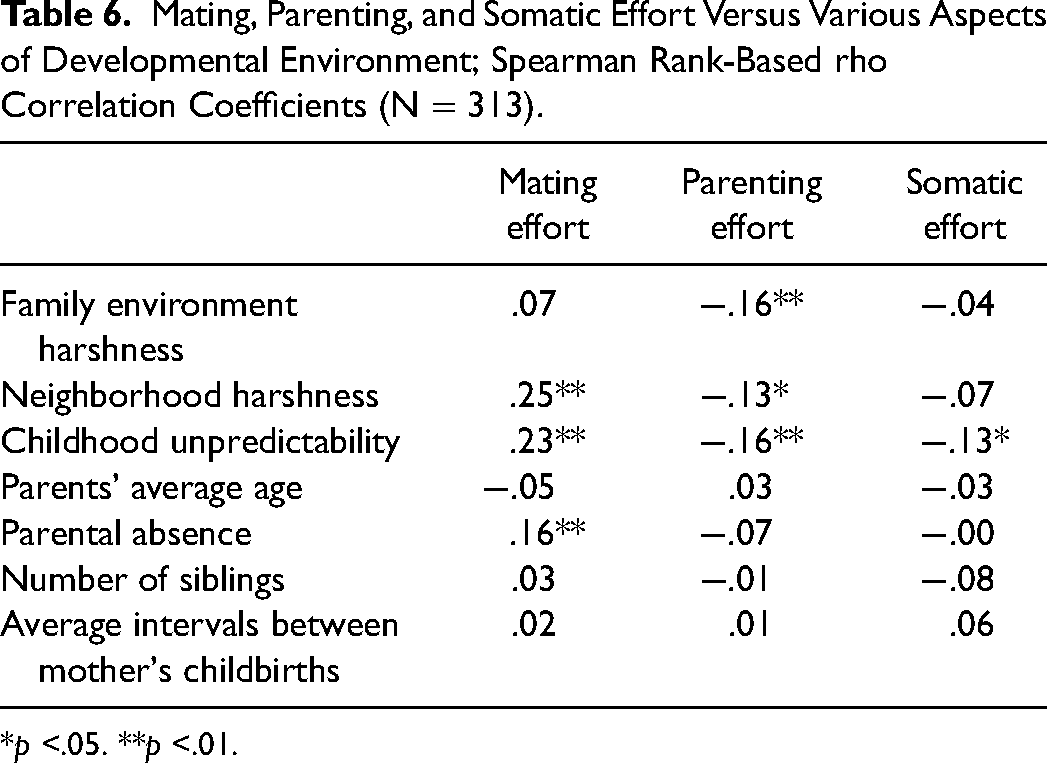
A correlation analysis was performed to determine the relationship between the participants’ LH dimensions (mating effort, parenting effort, somatic effort), and different aspects of early developmental environment: the reproductive strategy of participants’ parents (parents’ average age at arrival of their first child, parental absence, number of siblings and average intervals between the mother's childbirths), family environment harshness, neighborhood harshness, childhood unpredictability) (Table 6). Spearman's rank-based non-parametric rho correlation test was used for the analyses, the properties of which allow for a good estimation of correlation coefficients in the case of distributions that deviate significantly from the normal distribution (Field, 2009).
Mating, Parenting, and Somatic Effort Versus Various Aspects of Developmental Environment; Spearman Rank-Based rho Correlation Coefficients (N = 313).
*p <.05. **p <.01.
The obtained correlation coefficients indicate that the higher the level of mating effort declared by the subjects, the higher the levels of neighborhood harshness, childhood unpredictability, and parental absence. The greater the parenting effort declared by the subject, the lesser the degree to which they determined the level of family environment harshness, childhood unpredictability and neighborhood harshness. It was also observed that, as the somatic effort increased in the study sample, the level of childhood unpredictability decreased weakly.
The correlation matrix was also calculated between developmental environment indicators (Table 7). All three standardized questionnaires correlated positively to a moderately strong degree—the higher the level of family environment harshness, the higher the rates of neighborhood harshness and childhood unpredictability. Regarding indicators of the participants’ parents’ LH strategy, lower parental age at the arrival of their first child was positively associated with parental absence. In addition, the younger the participants’ parents were at the arrival of their first child, the higher the levels of family environment harshness, neighborhood harshness, and childhood unpredictability. In turn, parental absence was positively associated with family environment harshness, neighborhood harshness, and childhood unpredictability. Number of siblings was positively correlated with family environment harshness, neighborhood harshness and childhood unpredictability (Table 8).
Intercorrelations Within Developmental Environment (N = 313).

*p <.05. **p <.01.
Correlations Between LH Dimensions (N = 313).

*p <.05. **p <.01.
The three dimensions of the participants’ LH strategies turned out to be completely independent. There was no relationship between them.
In order to check whether mating effort, parenting effort, and somatic effort can be predicted on the basis of family environment harshness, neighborhood harshness, childhood unpredictability, parents’ average age at the arrival of their first child, parental absence, number of siblings and average intervals between the mother's childbirths, three multivariate regression analyses were performed (Table 9).
Predictors Mating Effort, Parenting Effort, and Somatic Effort.

*p <.05. **p <.01.
Before proceeding with the analyses, key diagnostic tests were conducted. The Durbin–Watson test indicated that the residuals are not correlated, which means that random components are not related to each other, so there is no autocorrelation in the model, and measurement errors are independent (Field, 2009). The correlation of predictors was also checked by the Variance Inflation Factor (VIF) collinearity test and the tolerance coefficient. The tests showed no exceptions to the assumptions of the models, which means that the relations between the predictors are not strong enough for the strength and direction of the relationship between them to affect the incorrect estimation of relationships with the variable explained in the model (therefore, the basic assumption of regression analysis is not invalidated; Field, 2009).
The proposed model for mating effort turned out to be a good fit for the data, F(7, 269) = 2.33, p = .025 and explained 3.3% of volatility. The model included only one predictor: neighborhood harshness (β = .19, p = .006). Based on the increase in the neighborhood harshness indicator, a small increase in mating effort can therefore be expected. Other factors were excluded from the model as not having a significant impact on the mating effort. The analogous model calculated for parenting effort was good fitted for the data, F(7, 268) = 1.37, p = .216, but there were no significant predictors. The last model explaining somatic effort also did not meet the criterion of a suitable fit, F(7, 269) = 1.10, p = .365 and explained only 0.2% of variance. However, the model included the predictor childhood unpredictability (β = −.19, p = .043) as statistically significant. Based on the increase in childhood unpredictability, a slight decrease in somatic effort can be expected. Other factors were excluded from the model as having no significant impact on the explanatory variable. The constant of the equation (β = .23, p = .587) was statistically insignificant, which may indicate the poor measurement and predictive properties of the model.
Discussion
Clustering of life history traits and the existence of LH trade-offs
One of the aims of the current study was to verify whether the traditional biodemographic LH traits cluster together in line with the assumption about the one-dimensional character of LH strategies. Our results showed no support for such a unidimensional construct of LH. Instead, we found that the LH traits coalesced into three well-known LH dimensions (mating effort, parenting effort, and somatic effort), that yet turned out to be entirely independent from each other. Thereby no trade-offs between mating, parenting, and somatic effort could be found. The independent nature of LH dimensions has been already found in previous studies with psychometrically assessed mating and parenting effort (e.g., Valentova et al., 2020; Kruger, 2017). Our findings corroborate the previous results using the data on traditional biodemographic LH variables and additionally enrich the previous results with corresponding data on somatic effort.
Importantly, difficulties in finding empirical support for LH trade-offs on individual level have been often interpreted as a consequence of individual differences in resource acquisition and social position that make detecting trade-offs challenging, due to very different costs and benefits of the same behavior taken by individuals under very different circumstances. Thus, to obtain more clear-cut trade-offs, we attempted to minimize the social inequalities between subjects by conducting research on street offenders that tend to come from similar, deprived social backgrounds. Lack of any dependencies between mating, parenting, and somatic efforts of criminals who participated in our research, seems to suggest that individual differences in resource acquisition and social position might not necessarily be the only factors responsible for inconsistent study results on LH trade-offs.
A possible explanation for the lack of association between mating and parenting effort could be that LH trade-offs associated with reproduction might be no longer visible due to factors like improvement in healthcare system, the existence of government benefits for families, and the prevalence of contraception (see Kwiek & Piotrowski, 2020). With regard to the latter, many recent studies conducted in developed countries have shown the pattern of higher fertility rate among individuals with slower LH strategies (Richardson et al., 2017; Woodley of Menie et al., 2017; ), suggesting that at least in the modern world having a child tends to be more often a decision, rather than a side effect of promiscuity. Quite surprisingly, our results suggest that this seems to be the case, even among criminal offenders. Not only did we not find any trade-off between mating and parenting in the criminal group, but also, counterintuitively, the participants who had a higher number of children with a higher number of women became fathers at a later, not earlier, age and reported lower levels of all kinds of adversity experienced while growing up (more benign family environment, safer neighborhood, and more predictable life). Although the association between higher fertility and slower LH strategy has been found in several recent studies on Western populations, to our knowledge, this is the first study showing the same pattern among middle-income country residents that additionally represent lower social strata.
Regarding somatic effort, we expected that it would be in a trade-off with mating effort, which intensity is often associated with engaging in risky behaviors that elevate the chances of premature death. We also assumed that higher somatic effort would be positively linked with parenting effort, since in males parenting has almost no biological costs and can lower chances of engaging in risky mating competition (Gettler et al., 2011). Our analyses showed, however, that somatic effort was independent of both mating and parenting efforts. Such results, combined with previously described lack of trade-offs between mating and parenting, seem to enforce the picture of independent dimensions of LH strategy. On the other hand, although such findings make our overall results on LH trade-offs more consistent, they should be interpreted with caution, considering that our study was conducted in a prison setting. Incarceration can be undoubtedly traumatic experience, but at the same time, serving a sentence of imprisonment often leads to improvement in self-assessed physical health (Yu et al., 2015; Binswanger et al., 2011). There is then a possibility that our participants would rate their health and life expectancy lower if they were asked after being sent to prison.
Life History Patterns and Developmental Plasticity
Another purpose of this study was to verify the existence of the link between LH and early exposure to various kinds of childhood adversity, to find out whether individual variance in LH patterns can be explained as the product of developmental plasticity. When assessing the early adversity, we asked the participants not only about their early childhood experiences of various kinds of harshness and unpredictability, but also about some LH strategy indicators of their parents, that could potentially increase the participants’ risk of developing faster LH strategies both through creating more adversity of family environment as well as through inheritance.
Our analyses have shown that although experiencing adversity in childhood was associated with faster LH patterns for both the inmates and their parents, LH dimensions of the inmates and their parents were unrelated with each other. Only growing up without biological parents was positively associated with the participants’ mating effort, whereas such traditional LH indicators of the participants’ parents as age at becoming parents, number of children, and intervals between subsequent births showed no connections with the participants’ mating, parenting, and somatic effort. Such results seem to suggest that intergenerational similarities in LH pace might be mainly the effect of living under similar environmental conditions. The design of this study does not allow for drawing conclusions about heritability of LH strategies. However, lack of associations between traditional LH traits of the participants and their parents seems to be in line with the premise that the genetic bases of behaviors are just a potential that needs certain environmental conditions to be developed.
Some interesting results have also been found regarding the link between the participants’ LH and early adversity. It turned out that each LH dimension was related to various aspects of developmental environment. We found parenting effort to be negatively correlated with the family environment harshness and neighborhood harshness, but not predicted by any of them. Mating effort had positive associations with neighborhood harshness and environmental unpredictability but was predicted only by neighborhood harshness. Finally, low somatic effort was both associated with and predicted by neighborhood unpredictability. Such results seem to suggest that, although in line with LHT assumptions, early adversity leads to faster LH pace on the individual level, different dimensions of LH strategies can be independently affected by various aspects of that adversity. This goes beyond the cumulative risk approach, suggesting that at least regarding LH patterns, the cumulative risk model that assumes one additive effect of all adversity indicators on further developmental outcomes, might be too simplistic. Although there is no doubt that most aspects of harshness and unpredictability matter for LH strategies development, instead of simply summing up, each of them might play a unique role in shaping a particular LH dimension.
In future research, it would be recommended to determine and focus on the exact mechanisms that underlie LH components. Finding out how and why a particular aspect of developmental environment might influence a particular LH component can further our understanding of the role the developmental environment plays in formation of individual LH patterns.
It is hard to compare our findings with results obtained in other studies due to the high variability of ways in which developmental experiences are measured. For instance, in twenty-one empirical studies reviewed by Young and colleagues (2020), environmental unpredictability was assessed by fifteen different measures, and the few studies utilizing the same measures did so only by using the same databases. Lack of consistency in the way some aspects of early adversity are measured makes it difficult to replicate study results like ours and might be in part responsible for inconsistent findings regarding the importance of different aspects of early environment for the development of LH strategies. Therefore, there is a need for more precise and regulated assessment of various aspects of early adversity. Establishing the most accurate measures that would be consequently used by researchers to assess various aspects of developmental environment, would add more clarity to the research results, and by that possibly contribute to finding more clear-cut dependencies between particular components of early adversity and LH strategies.
To sum up, the results of the current study support the assumption about developmental plasticity underlying individual differences in LH strategies, but they also suggest that exact mechanisms of this process might be quite nuanced and hence require further research.
Limitations and Future Directions
A few limitations of the current study and recommendations for future research have been addressed already in previous parts of this section, due to their relevance to the matters discussed. Here, we list some other issues that can be seen as limitations of our study, alongside directions for future research.
First, due to the cross-sectional character of the study, all the participants assessed aspects of developmental environment retrospectively, which can never be as accurate as more objective measures typically used in longitudinal studies. This issue appears to be limiting especially with regard to studying incarcerated criminal offenders, who not only are characterized by high prevalence of ADHD and comorbid conditions (Ginsberg et al., 2010; Berryessa, 2017), but also may have a tendency to idealize the period of their life before conviction (see Piotrów & Kadzikowska-Wrzosek, 2021).
Importantly, choosing street offenders as subjects of the current study was supposed to help with detecting LH trade-offs due to potential similarities in life circumstances of criminals. At the same time, however, it created some limitations with regard to other aims of this research, such as verifying the role of developmental plasticity in shaping LH. Considering that vast majority of criminal offenders tend to come from harsh and unpredictable backgrounds, individual differences in LH patterns developed from different exposure to early adversity are harder to detect than in studies on populations that are more diverse in this context.
Considering the above, in future research, using more accurate and objective measurements of early harshness and unpredictability, as well as conducting comparative research including subjects from various kinds of socioeconomical backgrounds, would possibly result in obtaining stronger dependencies and stronger causal relationships between early environment and LH outcomes. On the other hand, the fact that the developmental environment was associated with all LH outcomes in a predictable manner, and that the inmates growing up in harsher and more unpredictable environments turned out to develop faster LH despite the limitations mentioned above, emphasizes the importance of early environment in shaping LH differences on an individual level. It also shows that, although criminal offenders tend to develop faster LH strategies, compared with the general population, due to experiencing relatively high adversity, there is still some variability in exposure to that adversity among criminals.
Similarly, although engaging in street crime itself can be treated as indicative of employing relatively fast LH strategy, individuals perpetrating these crimes can still differ from each other with respect to some LH-relevant characteristics that might, to some extent, influence LH outcomes. The fact that we did not empirically verify how similar the subjects were with regard to variables important for LH trade-offs such as owned resources or phenotypical quality, can be treated as another limitation of this study and as something that researchers should be mindful about when conducting similar studies in the future.
All things considered, although treating street offenders as representatives of the “faster” end of the LH continuum is certainly a valid assumption, in future research studying the criminal population in more detail might enable more precise verification of the possible existence of LH trade-offs as well as to find more nuanced ways in which developmental plasticity works. Additionally, considering our findings about distinct LH dimensions being uniquely associated with various aspects of developmental environments, further research on criminal population with regard to this matter could result in developing more detailed predictions about developmental consequences of certain experiences, which would contribute to creating more tailored prevention strategies.
Conclusion
In the current study conducted on a group of male criminal offenders, we found no support for the unidimensional character of LH strategies as well as no support for traditional LH trade-offs within LH strategies. The biodemographic LH traits of the inmates clustered into three LH dimensions (mating, parenting, and somatic effort), that turned out to be entirely independent from each other. Additionally, although the three LH dimensions were associated with developmental environment in directions predictable from LHT, each LH dimension was found to be associated with various aspects of early environment. As an overall conclusion, our results suggest that whereas developmental plasticity is responsible for differences in LH patterns on an individual level, more research is needed to establish the exact mechanisms that underlying this process with regards to distinct LH dimensions.
Footnotes
Declaration of Conflicting Interests
The authors declared no potential conflicts of interest with respect to the research, authorship, and/or publication of this article.
Funding
The authors disclosed receipt of the following financial support for the research, authorship, and/or publication of this article: The research for this publication has been supported by a grant from the Priority Research Area (Society of the Future) under the Strategic Programme Excellence Initiative at Jagiellonian University.
