



Abstract
This study tested whether life history strategy (LHS) and its intergenerational transmission could explain young adult use of common psychoactive substances. We tested a sequential structural equation model using data from the National Longitudinal Survey of Youth. During young adulthood, fast LHS explained 61% of the variance in overall liability for substance use. Faster parent LHS predicted poorer health and lesser alcohol use, greater neuroticism and cigarette smoking, but did not predict fast LHS or overall liability for substance use among young adults. Young adult neuroticism was independent of substance use controlling for fast LHS. The surprising finding of independence between parent and child LHS casts some uncertainty upon the identity of the parent and child LHS variables. Fast LHS may be the primary driver of young adult use of common psychoactive substances. However, it is possible that the young adult fast LHS variable is better defined as young adult mating competition. We discuss our findings in depth, chart out some intriguing new directions for life history research that may clarify the dimensionality of LHS and its mediation of the intergenerational transmission of substance use, and discuss implications for substance abuse prevention and treatment.
Introduction
Substance use disorders (SUDs) are among the most frequently experienced psychiatric disorders in the United States. In 2011, an estimated 20.6 million persons aged 12 or older (i.e., 8% of the population) met the criteria for substance abuse or dependence during the past year (Substance Abuse and Mental Health Services Administration [SAMHSA], 2012). Substance abuse bears a large economic footprint in addition to its impact on the lives of individuals. The National Center on Addiction and Substance Abuse (CASA) estimated that the total governmental expenditure on substance abuse at all three levels of government (i.e., federal, state, and local) totaled 467.7 billion dollars, or more than 10% of the entire governmental budget (CASA, 2005).
Young adults are of special interest in efforts to reduce the societal burden imposed by substance abuse. In 2011, 60.8% of full-time college students were current drinkers, while 39.1% were binge drinkers and 13.6% were heavy drinkers. For young adults who were not enrolled full time in college, these figures were observed at 52.0, 35.4, and 10.5%, respectively (SAMHSA, 2012). An estimated 39.5% of young adults currently use tobacco products (SAMHSA, 2012). Young adults also abuse illicit substances, of which marijuana use is most prevalent by a wide margin. About 21% of young adults were current users of illicit substances, with 19.0% reporting that they were marijuana users (SAMHSA, 2012).
Young adult substance abuse has been linked to many adverse outcomes such as increased delinquency (Nation and Heflinger, 2006), impaired cognitive functioning (Jacobus, Bava, Cohen-Zion, Mahmood, and Tapert, 2009), emotional distress (Goldstein, 2011), respiratory problems and lung cancer (CDC, 1994), and accidents or other behaviors that lead to serious medical injury and death (Miller, Naimi, Brewer, and Jones, 2007; Pompili et al., 2012). This study brings life history theory to bear on substance use during young adulthood. If life history variables can explain substantial variation in substance use during this period, there may be impetus for leveraging the literature on human life histories to improve substance abuse prevention and treatment.
Life history theory
Evolutionary psychology attempts to discover how the brain changes the environment to facilitate the reproduction of the organism (Hagen, 2005). To transform the environment in a manner conducive to reproduction, brains must drive humans to find food and mates, best competitors, avoid predators and pathogens, and help kin (Buss, 2009; Hagen, 2005). To accomplish these tasks, humans convert bio-energetic resources into survival and reproductive strategies (Chisholm, 1993; Del Giudice, 2009; Figueredo et al., 2006).
Life history theory (LHT) is a mid-level evolutionary theory that provides an account of what survival and reproductive strategies humans invest in given their genes and the environments they inhabit (Chisholm, 1993; Ellis, Figueredo, Brumbach, and Schlomer, 2009; Figueredo et al., 2006; Rushton, 1985). In particular, LHT suggests that humans fall along a spectrum from early reproduction and allocation of resources toward mating effort, to later reproduction and devotion of resources toward somatic and parental effort (Chisholm, 1993; Ellis et al., 2009; Figueredo et al., 2006; Rushton, 1985). This continuum of reproductive strategy has recently been referred to as the fast–to–slow life history continuum in the human behavior and evolution literature (e.g., Figueredo et al., 2006). Behaviors and traits such as risk-taking, short-term thinking, anti-sociality, earlier sexual debut, and acquisition of greater numbers of sexual partners have been observed to reflect a faster life history strategy (LHS). Behaviors and traits such as careful consideration of risks, long-term thinking, cooperation, greater sexual restrictedness, and better mental and physical health have been observed to reflect a slower LHS (for reviews, see Ellis et al., 2009; Figueredo et al., 2006). Fast LHS appears to be a facultative response to harsh and unpredictable environments, whereas slow LHS seems to stem from safety and predictability (Brumbach, Figueredo, and Ellis, 2009; Ellis et al., 2009).
Life history strategy and substance use
Several scholars have brought LHT to bear on substance use theoretically and empirically (Hill and Chow, 2002; Jones and Figueredo, 2007; Richardson and Hardesty, 2012). They have argued that LHT provides a powerful explanatory tool that can provide new insights into the etiology of substance abuse and also help identify novel targets for prevention and treatment interventions (e.g., Richardson and Hardesty, 2012). Research has indicated that the brain experiences substances as biologically valuable via their modulation of basic motivational systems (i.e., via their effects on dopamine transmission and incentive salience; Goldman, Darkes, Reich, and Brandon, 2006; Nesse, 1994, 2002; Volkow, Fowler, Wang, Swanson, and Telang, 2007). As mentioned, research also suggests that human behaviors coordinate within overall life history strategies that function to translate biologically valuable resources (e.g., food) into mating effort or somatic and parental effort (Chisholm, 1993; Del Giudice, 2009; Figueredo et al., 2006). In a recent theoretical synthesis of LHT and dual process models of cognition, Richardson and Hardesty (2012) used cognitive science to integrate these findings and suggested that once we know where individuals fall along the life history spectrum, we also have information about their liability for substances use. The authors predicted that liability for substance use reflects a fast LHS because reliance on implicit or automatic cognitive processing (adapted to harsh and unpredictable environments) underpins fast LHS and also renders humans vulnerable to the signals of biological value that psychoactive substances provide. From this perspective, substance use is generally seen as a byproduct of a psychological adaptation to harsh and unpredictable social conditions.
Consistent with the above, research has suggested that particular types of substance use coordinate with fast life history traits. For example, studies have linked college student mating effort to smoking (Jones and Figueredo, 2007) and also indicated that alcohol use coordinated with fast life history traits (Hill and Chow, 2002). Research has also linked fast LHS to lower levels of executive functioning (Figueredo, Gladden, and Beck, 2011). This suggests that fast life history strategists may rely on implicit processing, which operates at the expense of the prefrontal explicit or deliberative processes (Lieberman, 2007; van Honk and Schutter, 2007) that underpin executive functions such as attention shifting and inhibition (Friedman et al., 2006). Taken together, this research provides some initial support for the notion that specific types of substance use coordinate with life history traits and that implicit processing may drive fast LHS (for further discussion, see Richardson and Hardesty, 2012).
Despite emerging research on how substance use coordinates with life history traits, it is not clear to what extent specific types of substance use coordinate with the overall life history dimension that has subsumed these traits in prior research. It is also not clear how overall liability for substance use (i.e., the tendency to use a variety of substances) coordinates with life history traits or latent LHS. In this study, we fill these gaps in the literature by examining the extent to which liability for substance use reflects young adult LHS.
LHS and the intergenerational transmission of substance abuse
Researchers have observed the intergenerational transmission of substance abuse and identified explanatory mechanisms such as genetic transmission, history of shared environments, and a number of family variables including dysfunctional family systems, poor parenting, and direct modeling (for a review, see Thornberry, Krohn, and Freeman-Gallant, 2006). Interestingly, many of the same mechanisms that transmit high levels of substance use from parents to children have been implicated in the intergenerational transmission of LHS. For example, although the adoption of faster or slower LHS is developmentally contingent on environmental cues, studies have illuminated a genetic basis for LHS and indicated that humans inherit a degree of their propensity toward a faster or slower strategy. In one study, Figueredo, Vasquez, Brumbach, and Schneider (2004) estimated the heritability of LHS at .65. In addition, Figueredo et al. (2006) implicated many of the brain regions responsible for substance abuse (i.e., the frontal cortex, amygdala, hippocampus, nucleus accumbens, and dopaminergic pathways; Goldstein and Volkow, 2002; Margaron, 2004; Volkow, Fowler, and Wang, 2004; Volkow et al., 2007; Yucel, Lubman, Solowij, and Brewer, 2007) in the development and maintenance of LHS, suggesting that perhaps substance abuse and LHS share common genetic and neuropsychological bases.
Intergenerational transmission via shared environment is grounded in the assumption that many youths grow up in the same type of environments as their parents. For instance, the literature shows strong support for the intergenerational transmission of socioeconomic status (SES; Carvalho, 2012), which implies that environmental cues for faster or slower life history strategies are often persistent across two generations. In the United States, for example, greater loss of health and fertility among lower SES women compared with those of higher SES can cue the adoption of faster life history strategies among both parents and children (Geronimus 1987, 1992). Consistent with these notions, pregnancy and high-risk sexual activity among teens have been linked to welfare dependence, low SES, and the intergenerational transmission of poverty (for a review, see Figueredo et al., 2006). There are likely reciprocal relationships between parental behavior and the dimensions of the environments shared by parents and children (e.g., safety and predictability). In part, parents may be the passive recipients of the environments they inhabit, while some active environmental selection and maintenance likely occurs as well.
Finally, family variables such as dysfunctional family systems and poor parenting have been identified as manifestations of faster LHS (for a review, see Figueredo et al., 2006). As Hill and Kaplan (1999) pointed out, there are two sets of decisions that parents have to make— one regarding individual fitness, and the other, offspring fitness. Parental investment decisions often reflect environmental risk and also provide signals that children can use in the facultative development of their own life history strategies (e.g., early attachment; Belsky, 1997; Chisholm, 1993; Del Giudice, 2009; Quinlan, 2012). In terms of genetic fitness, parents who invest in children in an environmentally contingent manner will reap benefits, as will children who can respond to parental behavior with the most adaptive reproductive strategy available.
Parent LHS may predict LHS in their children because (1) parents and children share genes, (2) parents inhabit and maintain environments that influence LHS development in children, and (3) parents provide behavioral cues that bear on children's LHS development. In this study, we examine the possibility that liability for young adult substance use can be explained by the intergenerational transmission of LHS.
The Current Study
This study brings LHT to bear on substance use by testing whether LHS and its intergenerational transmission can explain substance use among young adults. The questions driving this research are: (1) Among young adults, to what extent can liability for substance use be understood as a manifestation of LHS? And, (2) does the intergenerational transmission of LHS from parent to child explain young adult substance use?
Methods
We used National Longitudinal Survey data to test the extent to which LHS subsumed young adult substance use and also whether parent LHS could predict child substance use during young adulthood through young adult children's LHS. We addressed our research questions by testing a structural equation model (SEM) using the one step and single or few best indicator(s) approach advocated by Leslie Hayduk and colleagues (see Hayduk, Cummings, Boadu, Pazderka-Robinson, and Boulianne, 2007; Hayduk and Glaser, 2000; Hayduk and Litvay, 2012). Hayduk's method emphasizes theoretical precision over the use of scales that include many observed variables, and adheres more closely to path modeling tradition than to the factor analytic convention of using many indicators and multiple steps of testing (see Hayduk and Glaser, 2000; Mulaik and Millsap, 2000).
Hayduk and Litvay (2012) suggested that researchers use theory to locate the correct latent variables (i.e., construct centroids; see Little, Lindenberger, and Nesselroade, 1999) and then model the single or few best indicator(s) of these variables. This approach allows for the specification of more complex latent structures due to decreased complexity at the measurement level. This is often a necessary trade-off because of sample size limitations, but also because of the increasing likelihood that structural models will fit poorly as the number of measurement portions increases. Large models with many multi-item scales will often fail due to redundancy in item wording, greater likelihood that item content will overlap the meaning of other latent variables and their reflective indicators (e.g., because scales have deficient discriminant validity; see McGrath, 2005), and greater likelihood that the latent portions of models will be misspecified (e.g., due to omission of latent variables; see Hayduk and Litvay, 2012).
LHT provides mid-level rather than proximate explanations for coordination among a variety of human psychological and behavioral domains. From a causal modeling perspective, mid-level explanations describe the behavior of variables that impact their observed indicators indirectly (e.g., LHS impacts responses to items measuring neuroticism indirectly through latent neuroticism). If a variable directly impacts its indicators, it is their proximate cause, providing proximate explanation of item scores. By traditional factor analytic standards, studies of mid-level latent variables like LHS will require measurement of many domains to ensure that the latent variables of interest are located. This implies that many scales, each including many items, are needed. This requirement can place a burden on life history researchers in terms of survey length and sample size, and would seem to imply that they could not capitalize on nationally representative sets that may include scales that measure some life history domains but only one or two indicators of others.
Fortunately, simulation research has indicated that many items and higher levels of internal consistency, or large factor loadings, are not required to locate construct centroids and recover unbiased parameter estimates when a broad selection of indicators are available and when confirmatory latent variable modeling is used (Little, Lindenberger, and Nesselroade, 1999). In other words, a broad selection of indicators can provide valid measurement even when indicators are only moderately related to their constructs or reflect them indirectly. This is good news for life history researchers because it suggests that shorter surveys and smaller samples can be sufficient when strong theory is available to provide precision in indicator selection and model specification (as described in Hayduk and Litvay, 2012). This also suggests that nationally representative longitudinal sets such as NLSY97, which were not designed to test life history evolution and do not provide full scales that measure LHS, can still be quite valuable to life history researchers because they provide indicators of a broad selection of life history domains and their large sample sizes facilitate the testing of models with complex latent portions.
Sample
This study examined data from the National Longitudinal Survey of Youth 1997 (U.S. Bureau of Labor Statistics [BLS], 2013). The NLSY97 data document the school-to-work or adolescence-to-adulthood transition and are comprised of two samples: a cross-sectional sample representing the U.S. population born in the years 1980 through 1984, and oversamples of the black and Hispanic population born in those years. Participants were drawn from 75,291 households in 147 primary sampling units that did not overlap; 8,984 individuals were interviewed in round 1 and data for more than 84% of the initial sample were available in round 13. Table 1 presents demographics for the full NLSY97 sample.
Participant demographics

The NLSY97 contains extensive information on respondent labor market behavior and educational experiences, along with family and community background. These data can help researchers examine the longitudinal influence of schooling, environmental, and other factors on a variety of outcomes. For a full description of the NLS97 data and the procedures by which they were collected, see the NLS97 website (http://www.bls.gov/nls/nlsy97.htm).
We used life history theory to select 18 indicators of life history traits from the variables available in the national survey. The 18 items were selected as indicators of parent LHS in 1997, child LHS in 2009, and child liability for substance use in 2009 (see Table 2). In 2009, participants were aged 22 to 26. Because attrition is often a concern with longitudinal data, we conducted a missing data analysis. In this study, we used a custom set of survey weights in our analyses that adjusted for the survey design and also for use of 1997 and 2009 data. We constructed these weights using the web app provided on the NLS website (http://www.nlsinfo.org/weights/nlsy97).
Descriptive statistics for survey items

Missing data
In this study, we conducted a missing data analysis because our data were longitudinal and attrition was a concern. Across 18 variables, 8,984 cases were initially available for analysis. We examined the variables carefully and found that 16.1% of the data was missing on average, with a range from 8.0% missing for mother's age at first childbirth (1997) to 16.6% for number of days young adults drank alcohol (2009). We investigated the missing information for our 18 variables further and found substantial mean differences for collected information on whether or not missing data were present. For example, we observed that cases missing parent income data in 1997 averaged more smoking in 2009 than non-missing cases. These observed mean differences suggested that the missing completely at random assumption (MCAR) for listwise deletion was inappropriate. Therefore, we found it necessary to make the relaxed assumption of missing at random (MAR; Little and Rubin, 2002). We used multiple imputation to handle the missing data and used 12 auxiliary variables to help satisfy the ignorable missingness assumption (Little and Rubin, 2002). These included self-reported data for some of our 18 variables that were gathered at other time points and also data for several personality traits. We generated five imputed datasets using the NORM 2.03 package for Windows (Schafer, 1997).
Our study contained several skewed variables that violated the normality assumption of our imputation model. While this isn't ideal in theory, the methods literature indicates that in the context of ordinal variables and skew, multiple imputation under a normal model preserves important characteristics of the data set as a whole (e.g., variances) and makes use of all possible information (Enders, 2010; von Hippel, 2013). The idea is that although the imputed values do not look like the observed values, the imputed variable behaves like the observed variable in the analysis. One strategy that has been recommended for satisfying the normality assumption of imputation models is the transformation of skewed variables prior to imputation. However, research suggests this actually hurts the imputation of variables that are linearly related because it introduces non-linearity and residual non-normality (von Hippel, 2013). Although transformations help match variables' marginal distributions to the imputation model's assumptions, they create problems with the effects between variables and can skew residuals, which together lead to imputed values that bias estimates in the analysis phase. In this study, we chose multiple imputation under a normal model and imputed skewed variables as they were, given that this method is robust to departures from normality assumptions and produces reasonably unbiased parameter estimates that reflect the uncertainty associated with estimating missing data (Enders, 2010; Little and Rubin, 2002; von Hippel, 2013).
Instruments
We selected indicators of parent and child LHS that have been observed to reflect a broad set of domain-specific LHS components in prior research (for a review, see Olderbak, Gladden, Wolf, and Figueredo, 2014). Following Little, Lindenberger, and Nesselroade (1999), we expected that this broad selection would enable us to locate the correct latent LHS variable. We observed the standardized coefficients between latent variables and their reflective indicators for information regarding reliability and construct validity (Bollen, 1989; Kline, 2010). Because of our focus on theoretically driven latent variables and use of few indicators instead of scales, and because the assumptions of coefficient alpha (see Cronbach, 1951) are unlikely to hold in practice (Bentler, 2009; Green and Yang, 2009; Sijtsma, 2009), we did not report alpha in the discussions of most of our instruments, with one exception: We used a scale to measure neuroticism because we theorized that this construct was somewhat ambiguous to participants, and we used coefficient alpha to tentatively assess its reliability.
Parent LHS (1997). In this study, we planned to specify a latent variable representing respondent parent's LHS, which manifested as household income, parental health, mother's age at first childbirth, and quality of the home environment maintained by parents. We chose income as an indicator of LHS because although research suggests that diverging life history strategies may develop as a function of childhood SES, rather than adult SES, higher income during adulthood can be conceptualized as investment in safe but low-yield decisions (e.g., investment in education or other forms of embodied capital), which are characteristic of slower LHS (Griskevicius, Tybur, Delton, and Robertson, 2011). This is consistent with the observation that for roughly 99% of the U.S. population, income is occupation-generated (Beeghley, 2004). In addition, the correlation between childhood and adult SES has been observed at r = .41 (Griskevicius et al., 2011). Thus, greater childhood SES may impact the development of slower LHS and the tendency to engage in low-yield and safe investing, which in turn manifests as greater education and income during adulthood. In this study, income was measured as household gross income reported by parental respondents. We divided income by 10,000 to achieve item variance ratios that would ensure model convergence.
We chose parental health as an indicator of LHS because it reflects somatic effort, and prior research has shown that health reflects LHS indirectly through covitality (Olderbak et al., 2014). Parental health was measured by self-report and rated on a five-point Likert scale from “excellent” to “poor.” We reverse coded this variable for conceptual clarity. As suggested by Olderbak et al. (2014), we used biological mother's self-reported age at first childbirth (i.e., the timing or delay of reproduction) as a life history parameter. To measure the overall quality of the home environment maintained by parents, we used the riskiness of the family home environment index created by the developers of the national survey. The index is based on Caldwell and Bradley's Home Observation for Measurement of the Environment (HOME; Caldwell and Bradley, 1984; Bureau of Labor Statistics, 2013) and combined responses to items that measured domains such as the quality of the youth's physical home environment, family routines in an average week, the extent of parental monitoring, and the quality of youth-parent relationships. These items measured domains that reflected parental investment. Scores ranged from 0 to 21, with higher scores indicating greater risk. We divided riskiness of the home environment by 100 to ensure model convergence.
Child LHS during young adulthood (2009). This study examined manifestations of young adult LHS including neuroticism, delinquency, health, and mating effort. We chose to include neuroticism because prior research showed that it reflected LHS indirectly through the general factor of personality (Olderbak et al., 2014). We measured adolescent neuroticism using five self-report items that assessed anxiety and depression (i.e., nervous, calm, down, happy, and depression). An example of item wording is, “How much of the time during the last month have you been a very nervous person?” During young adulthood, the neuroticism scale had a mean of 11.55, a standard deviation of 2.42, and Cronbach's α was observed at .79. The latter suggested that this scale's items were internally consistent during young adulthood and might reflect a single dimension. We measured adolescent health as self-reported general health rated on a five-point scale from “excellent” to “poor.” Item wording was, “How is your general health?” We reverse coded this item for conceptual clarity.
As suggested by Olderbak et al. (2014), we used respondent children's reported number of sexual partners during the past 12 months as a life history parameter. We specified this variable and also respondent's reported number of persons dated in the past 12 months as reflecting young adult mating effort. For number of sexual partners, we needed to use a distribution that could handle counts (e.g., negative-binomial or Poisson). Unfortunately, number of sexual partners exceeded the max number for counts and categorical variables in MPlus 6.11 and also contained imputed values below zero. We considered transforming this variable after imputation. However, transformations appear to perform poorly in the context of count data, especially when dispersion is large (O'Hara and Kotze, 2010). We also theorized that this variable's reliability decreased as counts became more extreme and the difference between one and two sexual partners was not equal in meaning to the difference between, say, 15 and 16 partners. Thus, we planned to treat number of sexual partners as ordinal and bucketed participants into four categories of mating effort, ranging from fewest to most partners, on the basis of substantive rationale and item distribution. The categories were as follows: none or a single partner, two partners, three to six partners, and more than six partners. As a result of multiple imputation, the number of people dated item contained some out-of-range values that fell below zero. We recoded values less than −5 into −2, values between −4 and −1 into −1, and then analyzed the −1s and −2s as they were. According to Enders (2010, p. 265), this is good practice when the prevalence of out-of-range values is low. In this study, only 7.1% of the values were negative for the number of persons dated item. There were five categories of this variable ranging from fewest to most persons dated. The categories were as follows: less than or equal to −5; −4 to −1; 0; 1 to 4; and 5 or more.
We used young adult delinquency as an indicator of the antagonistic social strategies and investment in risky but potentially high yield decisions that reflect fast LHS (Figueredo et al., 2006; Griskevicius et al., 2011). We measured young adult delinquency using self-reported number of times participants had attacked someone, stolen items worth more than 50 dollars, and committed other crimes in the last 12 months. We planned to specify these items as reflecting latent delinquency and treat them as ordinal for the same reasons as number of sexual partners. Similar to the number of persons dated item, the delinquency items contained some out-of-range values that fell below zero. Almost all of these values were −2s or −1s. We recoded values less than −2 into −2 and analyzed the −1s and −2s as they were. No more than 7% of the values were negative across the delinquency variables. There were five delinquency categories ranging from fewest to most incidences and they were invariant across the items. The categories were as follows: less than or equal to −2; −1; 0; 1; and 2 or more.
Liability for young adult substance use (2009). In this study, liability for substance use during young adulthood was measured with items that assessed how often the participant reported using tobacco, alcohol, and marijuana in the last 30 days. An example of item wording is “How many days have you used marijuana in the last 30 days?” We planned to specify these three items as reflecting latent liability for substance use. To ensure model convergence, we divided the substance use items by 30. Unfortunately, the NLSY97 does not contain detailed information on a variety of “harder” or uncommonly used illicit substances. Some items in the survey assessed use of any drugs like “cocaine or crack or heroine,” but information about the use of each substance was not available. Further, in 2009 only 3% of participants had ever used any of these hard substances, and far fewer participants had used these substances in the last 30 days. Due to the conflation of the use of various hard substances, and because prevalence of use was so low, we did not examine items regarding hard substances.
Analyses
This study used structural equation modeling (SEM) to simultaneously test the extent to which young adult substance use reflected latent young adult LHS and also whether parent LHS predicted substance use among young adult children indirectly through young adult LHS. We used the MPlus 6.11 software package to test our models, used raw data as input, and used Robust Weighted Least Squares (WLSMV) as the estimator. We used WLSMV because we needed to treat the number of sexual partners and the delinquency variables as ordinal. In addition, we used WLSMV because there was substantial skew among the young adult substance use items (i.e., skew statistics slightly larger than 2). Research on the Robust Weighted Least Squared estimator has indicated that it yields unbiased estimates when SEM is used in the context of moderate skew (Muthén, du Toit, and Spisic, 1997). We observed that the ratio of cases to freely estimated parameters exceeded 100 to 1 for all hypothesized models, easily satisfying the minimum ratio often indicated for SEM studies (Bentler and Chou, 1987). Because we analyzed very large samples that provided a great deal of statistical power, all significance tests were conducted at the p < .001 level. Finally, we used the split-half method to minimize Type I error (i.e., pure sampling error; Pohlmann, 2004) by randomly splitting our data, testing and modifying models using one half, and validating models using the other half.
Sensitivity analyses. We planned a sensitivity analysis because the NLS97 sampled 3,855 siblings and this introduced some dependence among the data for respondent children and also the parents of multiple respondent youth. To test whether this dependence influenced our estimates, we planned to test our models using samples that included all respondents with no NLS97 siblings, plus a random selection of one sibling from each household with multiple respondent youths. If we found substantial differences between the results for the full sample and this no-siblings sample, we would report on the latter.
Hypothesized model
Our hypothesized model (see Figure 1) tested whether young adult LHS subsumed liability for young adult substance use. In addition, this model tested whether young adult LHS translated parent LHS into liability for young adult substance use. We also tested our hypothesized model across the sexes because prior research has documented sex differences in reproductive strategy (e.g., Mealey, 2000). For conceptual clarity, we changed the valence of parent LHS so that higher scores corresponded to faster LHS and lower parent income, poorer parent health, earlier age at first childbirth, and greater home risk. Thus, higher scores on parent and also young adult LHS implied faster LHS.
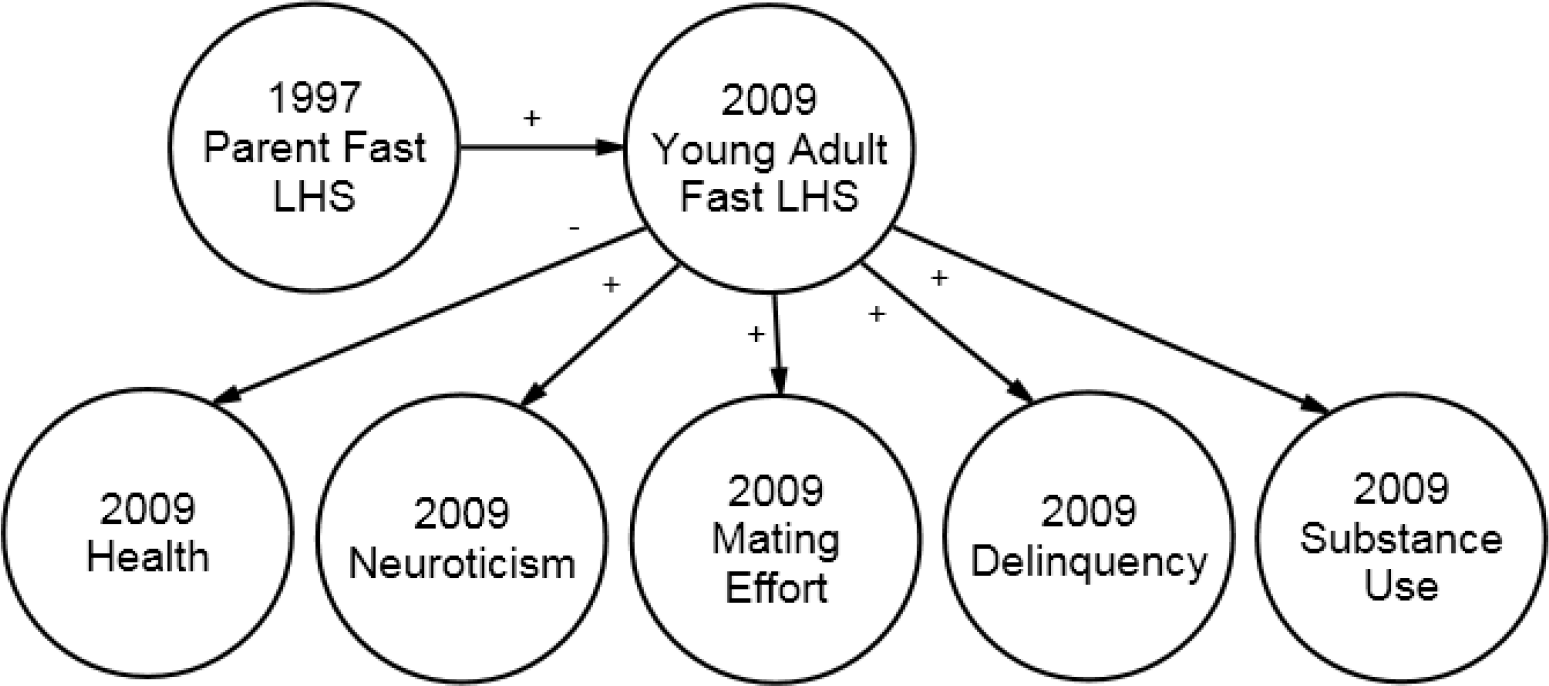
Hypothesized structural model
Goodness of fit criteria
This study used a variety of fit indices because they provide different information about model fit. We considered the substantive meaningfulness of the model, Tucker-Lewis (TLI) and comparative fit (CFI) indices greater than .95 (Byrne, 2001; Hu and Bentler, 1999), and root mean square error of approximation values of less than .05 (RMSEA; Browne and Cudeck, 1993) as evidence of acceptable fit to the data. MPlus 6.11 provides average fit indices and an average χ2 likelihood ratio statistic (Byrne, 2001; Kline, 2010) when multiple imputed sets are analyzed using WLSMV. In this context, the package does not report a pooled likelihood ratio test.
Results
Structural equation modeling
We tested our hypothesized structural model and it appeared to be severely miss-specified, observed as a non-positive definite matrix with standardized effects of latent variables on reflective indicators that were greater than 1, very small effects of young adult fast LHS on health and neuroticism, and evidence of poor fit to the data (see Table 3).
Models of parent LHS, young adult LHS, and young adult substance use

Note. Model 3 = Model 2 + Alcohol use, smoking, and number of persons dated regressed onto parent fast LHS + Covariances between calm and happy items from the neuroticism measure.
Given the findings related to health and neuroticism, we specified a model that included these variables as correlates of young adult fast LHS instead of its indicators. We tested this model and it was over-identified with 126 degrees of freedom and characterized by a RMSEA value below .05, along with CFI and TLI values that fell well below their .95 cutoffs. Most indices suggested this model provided inadequate fit to the data and should have been rejected (see Table 3). We considered modification indices greater than 100, standardized residuals greater than 2, and substantive rationale in identifying sources of misspecification in the model. We modified the model by regressing smoking and alcohol use on parent fast LHS. These modifications were consistent with prior research that has linked SES and related variables to use of common substances after controlling for other latent variables (e.g., Patrick, Wightman, Schoeni, and Shulenberg, 2012; Richardson, 2011). We also regressed number of persons dated on parent fast LHS given the possibility that, in addition to reflecting young adult mating effort, number of dates might reflect slower LHS parents' encouragement to engage in “official” dating rituals that allow young adults to size each other up for compatibility and show that they might make good parents in the future. Consistent with this, research on assortative mating suggests compatibility and relationship satisfaction are more important in the context of slow LHS (Olderbak and Figueredo, 2010). Finally, we specified covariances between the calm and happy items subsumed by neuroticism due to redundant item wordings.
We tested the modified structural model (i.e., Model 3) and it yielded a well-fitting solution (see Table 3). This model was over-identified with 123 degrees of freedom and was characterized by a RMSEA value well below .05, and CFI and TLI values above .95. Consistent with this, we found that no areas of substantial strain remained for the modified structural model. To minimize Type I error, we cross-validated Model 3 using the other half of our data and by testing it across males and females. All fit indices suggested that the model fit the second half of the data, the male data, and the female data very well (see Table 3). Model 3 sex differences are described below.
In addition to interpreting the model fit indices, we interpreted the substance of the model's statistically significant parameter estimates (ps < .001; see Figure 2 and Tables 4 and 5). First, we observed the effects of the theorized latent variables on their reflective indicators. Parent fast LHS had moderate to large effects on its indicators, with βs ranging from .39 to .53 in absolute value. Young adult neuroticism had large effects on its reflective indicators, with βs ranging from .59 to .73 in absolute value. The effects of liability for young adult substance use on its indicators were moderate to large in size, with βs ranging from .39 to .52. Young adult mating effort had moderate to large effects on its indicators, which were number of partners dated (β = .36) and number of sexual partners (β = .67). Young adult delinquency had moderate to large effects on its indicators, with βs ranging from .31 to .42. In Model 3, the first-order latent variables, young adult mating effort, delinquency, and substance use reflected the second-order latent variable—young adult fast LHS. Young adult fast LHS had a large positive effect on substance use (β = .78) and moderate positive effects on mating effort (β = .44) and delinquency (β = .42). The observed parameters suggested that the reflective indicators provided broad, reasonably reliable, and valid measurement of their respective constructs.

Final model 3
Unstandardized and standardized effects, model 3
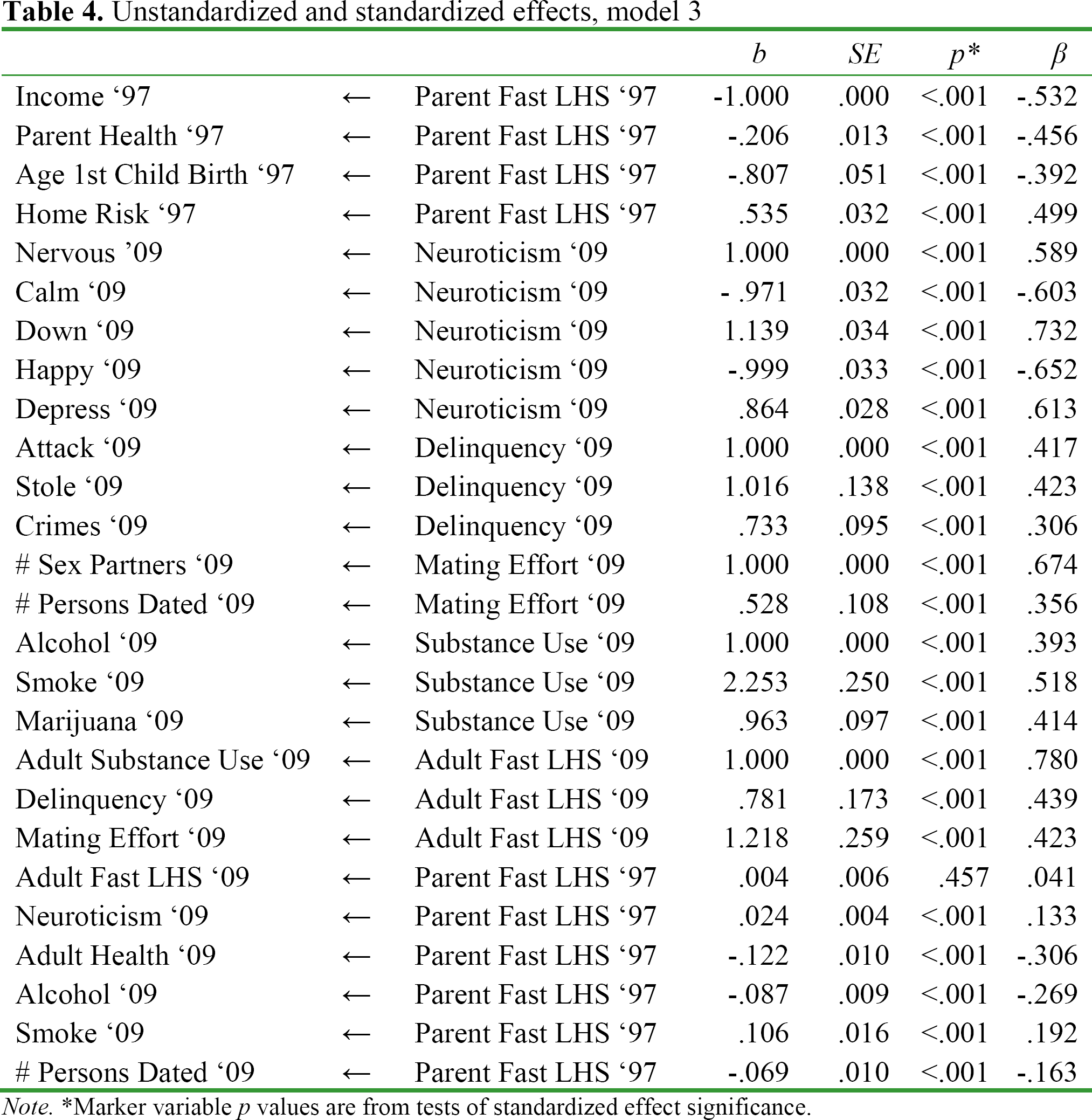
Note. *Marker variable p values are from tests of standardized effect significance.
Covariances and correlations, model 3

Next, we observed and interpreted the model's structural regression coefficients. We found that standardized effects were small in size, with βs ranging from .13 to .31 in absolute value. We found that parent fast LHS had small positive effects on young adult smoking and neuroticism, small negative effects on number of persons dated and alcohol use, and a moderate negative effect on health. Parent fast LHS did not have any significant direct or indirect effects on young adult fast LHS or liability for substance use. A small positive correlation was observed between young adult fast LHS and neuroticism, while small negative correlations were observed between fast LHS and adolescent health and between health and neuroticism. In light of parsimony, the substance of the parameter estimates, and the observed indices of fit, we accepted Model 3 as the best representation of the relationships between the variables.
Sex differences. We tested our final model across males and females and the fit to each group's data was excellent (see Table 3). No effects varied by sex in terms of statistical significance, and we observed that only one effect of a latent variable on its reflective indicator appeared to vary substantially by sex. The effect of young adult mating effort on number of sexual partners was observed at β = .75 for males and .59 for females. We also observed that only one structural regression coefficient appeared to vary across the sexes. The effect of parent fast LHS on young adult neuroticism was observed at β = .18 for females and .06 for males. We explore these sex differences further in the discussion.
Sensitivity analyses. We tested Model 3 against our no-siblings sample to assess whether dependence among the siblings in NLS97 influenced its estimates. Model fit was very similar between the samples with and without siblings (for the latter, χ2 = 381.11; CFI = .96; TLI = .95; and RMSEA = .03). Only one effect differed in its level of statistical significance: For the effect of parent fast LHS on young adult neuroticism, p < .001 for the siblings sample and p = .01 for the no-siblings sample, although its magnitude did not appear to vary substantially. We tested the model across the male and female samples with and without siblings and observed no apparent differences. Given the single observed difference for Model 3, we reported on the full sample.
Discussion
This study tested whether LHS and its intergenerational transmission could explain substance use among young adults. Before tying our results back to our primary research questions, we wish to address the finding that not all of our indicators of young adult LHS reflected a life history dimension. In particular, health and neuroticism did not reflect the latent fast LHS variable that subsumed mating effort, delinquency, and liability for substance use. Brumbach et al. (2009) reported similar findings in a study of adolescent and young adult LHS that also analyzed longitudinal and nationally representative data. During young adulthood, Brumbach et al. (2009) found that social deviance, which subsumed delinquency, impulsivity, Machiavellianism, and alcohol use, did not reflect a latent life history variable that subsumed variables such as health and education. The authors suggested that perhaps life history traits begin to reflect a single dimension during middle adulthood. As another possibility, a multi-dimensional structure might subsume life history traits across the lifespan. This would be consistent with the externalizing and internalizing dimensions that have emerged from personality traits and behaviors in research on pathological and normal personality (e.g., Krueger, 2003; Krueger, Markon, Patrick, Benning, and Kramer, 2007; Krueger, McGue, and Iacono, 2001; Markon, Krueger, and Watson, 2005). Along this line, it is interesting to note that although low levels on the slow life history factors (or K-factors) that emerged in prior research may correspond to higher levels of neuroticism (i.e., anxiety and depression) and lower levels of health, altruism, conscientiousness, parental investment, and earning potential (Figueredo, Vasquez, Brumbach, and Sneider, 2007), they do not necessarily imply greater mating effort (Gladden, Figueredo, and Jacobs, 2008; but see Figueredo et al., 2005). For instance, several studies have reported that slow LHS did not subsume mating effort, which was instead subsumed by latent variables named psychopathy or psychopathic and aggressive attitudes (Figueredo, Gladden, and Hohman, 2012; Gladden, Figueredo, and Jacobs, 2008; Olderbak et al., 2014), a construct that has often reflected an externalizing dimension that is distinct from the internalizing dimension that subsumes anxiety and depression (e.g., Krueger et al., 2007). Taken together, the studies discussed above suggest that mating effort and its functional correlates (e.g., dominance seeking, aggression, and risk-taking; Trivers, 1971) may vary uniquely from the slow life history dimension that subsumes timing of reproduction, somatic effort, and parenting effort. In this study, perhaps young adult fast LHS could be better defined as young adult mating competition.
There are several reasons why mating competition might be independent of slow LHS in large human (i.e., within species) samples. Van Noordwijk and de Jong (1986) describe a model in which T (total amount of resources available to an individual) = R (investment in reproduction) + S (investment in somatic growth or survival). The implication is that, given lots of within-population variation in T, a positive correlation between R and S might be observed. In other words, with access to more resources, organisms have the potential to invest more in mating effort as well as somatic effort. So it is possible, in principle, that studies of human LHS could be plagued by suppression effects if they fail to control for resource availability. In our study, we controlled for parental income, so this seems to be an unlikely problem. However, perhaps parental income is not a good indicator of resource availability during this period because parents control their resources and young adult have not yet accumulated significant embodied capital of their own. However, this would suggest that variation in income may be restricted in range during this period, which should imply that a suppression effect is more unlikely.
Sibly and Brown (2007) note that variation in metabolic efficiency could have an effect similar to resource access. We did not have any measure of this parameter, so it is possible that this omission suppressed the trade-off between mating competition and slow LHS. That is, this trade-off might manifest among people characterized by the same level of metabolic efficiency, but not in the U.S. population at large. Perhaps good genes have a similar effect, with high mate value individuals able to invest more in mating competition and also slow LHS.
Sibly and Brown (2007, 2009) may have laid the groundwork for an additional explanation for the independence between mating competition and slow LHS. The authors demonstrated that holding body size constant, species' locations on the slow-fast life history continuum were functions of two “lifestyle” components, including diet and mortality. Greater access to energetic resources corresponded to faster strategies, whereas decreased mortality corresponded to slower strategies. Extrapolating to within-species theorizing, it seems possible that independent mating competition and slow LHS systems could have evolved among humans if mortality and access to resources varied with relative independence. Complicating this picture for researchers, however, is the fact that modern humans accumulate extra-somatic wealth that can be invested in warding off death and in mating competition.
Finally, there are plenty of ways that modern Western societies differ from the hunter-gatherer ecologies to which humans are generally adapted (Hill and Kaplan, 1999). Perhaps the significant extra-somatic capital that modern humans accumulate decouples mating competition from slow LHS. Whatever the case, it is clear that more research is needed to confirm the dimensionality of young and middle adult life history traits and also identify how differences between Pleistocene and modern environments bear on human LHS. Such research is especially salient given a recent critique of psychological measures of LHS that have stemmed from Differential K theory (see Copping, Campbell, and Muncer, 2014). The authors suggest that better validation of such measures is needed, including linkage to life history parameters such as the timing of puberty and reproduction as well as number of sexual partners.
Our results indicated that young adult fast LHS explained 61% of the variance in young adult liability for substance use (see Table 4). In contrast, health and neuroticism were minimally and only indirectly related to substance use through young adult fast LHS. Perhaps poor health and neuroticism don't become important correlates of substance use until middle adulthood. This would be consistent with substance use typologies such as Cloninger's categorization of alcoholics into Types 1 (associated with anxiety proneness and loss of control over alcohol intake after age 25) and 2 (associated with impulsivity and antisocial behavior before age 25; Cloninger, Sigvardsson, and Bohman, 1996). Our model suggests that fast LHS is the primary driver of substance use during young adulthood. However, given our discussion of the dimensionality of life history traits, it might be better to conclude that mating competition subsumes most of the variance in young adult substance use. Future research could shed light on this issue by modeling additional indicators of substance use, mating competition, and also timing of reproduction, somatic effort, and potential parental effort among young adults.
Parent fast LHS did not predict fast LHS or overall liability for substance use among young adults. The absence of a direct effect of parent fast LHS on young adult fast LHS was very surprising. Stemming from our discussion of the dimensionality of life history traits, one potential explanation for this finding is that LHS is transmitted along two dimensions—slow LHS (i.e., delayed reproduction coupled with somatic and parental effort) and mating competition. Perhaps this study, despite our best efforts to use theoretical precision in indicator selection, located the slow dimension among parents while locating the mating competition dimension among young adults. Slow LHS among parents may predict slow traits but not mating competition among children, whereas mating competition among parents predicts mating competition but not slow life history traits among children. We had access to good indicators of parent slow LHS, including timing of reproduction and somatic and parental effort. Perhaps this variable would not also subsume parent mating competition. More research is needed to address this possibility, and additional theoretical work is required to determine whether this empirically derived proposal can be reconciled with life history theory or is biologically plausible.
Two additional potential explanations of the finding discussed above are (1) that the effect of parent fast LHS on young adult liability for substance use, through young adult fast LHS, was nil because of the lengthy 12-year lag between the measurement of parent and child variables, and (2) that unique features of the environments young adults typically inhabit in Western societies moderated the effect between parent and child LHS. Regarding (2), perhaps young adult fast LHS is relatively uncoordinated with parent fast LHS because during this period children often leave their home environments, inhabit novel young adult dominated ecologies (e.g., college), and are integrating themselves into new social groups. During young adulthood, reproductive strategies among children may not have canalized much and may not yet reflect their parents' strategies. As young adults find ecological niches for themselves and their social statuses and attachments stabilize, perhaps their life history strategies begin to bear greater resemblance to the strategies maintained by parents. In other words, the observed independence of parent slow LHS and young adult mating competition dimensions may be an artifact of modern Western environments. The study of “emerging adulthood” reflects the many unique features and experiences of this population. To address these possibilities, future research could test whether adolescent LHS links parent LHS to young adult substance use.
Parent fast LHS did have direct effects on the use of specific substances. In particular, parent fast LHS had small negative effects on young adult alcohol use and small positive effects on young adult smoking. These findings are consistent with research indicating that SES, which includes income, predicts greater alcohol use and lesser tobacco smoking among young adults in the US (e.g., Patrick et al., 2012). Perhaps LHS explains this finding. Parent fast LHS also had a significant positive effect on young adult neuroticism and a moderate negative effect on young adult health. These effects of parent LHS on child health and neuroticism were persistent across a twelve year lag (i.e., from 1997 to 2009) and are consistent with findings that slow life history dimensions are heritable and subsume covitality (i.e., mental and physical health; see Figueredo et al., 2004, 2006). These effects are also consistent with the literature on family environment and family functioning that we discussed in LHS and the intergenerational transmission of substance abuse. After controlling for young adult fast LHS, parent fast LHS predicted fewer persons dated during young adulthood. As suggested, this may reflect a greater tendency of slower LHS parents to encourage children to go out on “official” dates where food and recreation are purchased.
During this study, we observed few sex differences in the structure of life history traits. However, young adult fast LHS did appear to have a smaller effect on number of sex partners for females than males. This suggests a very interesting avenue for future research. Among young adult females, perhaps mating effort is thwarted by childbirths, which impose less of a burden on males employing a fast LHS. The positive effect between parent fast LHS and young adult neuroticism was larger for females, suggesting faster parent strategies may exacerbate anxiety and depression in females to a greater extent than in males. Further research could examine family structure as a moderator of this effect. Finally, it is important to note that we have reported on structural sex differences only. Mean differences on the constructs we studied likely exist as well (for discussion, see Mealey, 2000), but our primary interest in this study was elucidation of structure.
Richardson and Hardesty (2012) suggested that life history theory (LHT) provides a powerful explanatory tool that can provide new insights into the etiology of substance abuse and also help identify novel targets for prevention and treatment interventions. Indeed, this study indicates that fast LHS or mating competition explained most of the variance in liability for young adult substance use. Scholars such as Howard Schaffer (2012) have recently argued that substance abuse is underpinned by an addiction syndrome, of which heightened substance use is just one manifestation. The current study provides some support for this view. Additional research that simultaneously estimates the linkages between substance use and life history indicators is sorely needed. Such work could help to clarify the relationship between slow LHS and mating competition, along with the extent to which substance use is a byproduct of these dimensions.
Implications for clinicians and prevention specialists
Mental health model interventions have a long history of targeting parental structuring of the home environment, parental income, and other parent life history traits in efforts to improve the mental health and adjustment of children. This study suggests that such interventions may not have effects on fast LHS (or mating competition) or liability for substance use that persists into young adulthood. Two exceptions seem to be alcohol use and smoking behavior. Controlling for young adult fast LHS, parent fast LHS predicted higher levels of smoking into young adulthood, while predicting lesser alcohol use. Perhaps future research will bear out the notion that a focus on mating competition dimensions among parents would be more useful in treatments. If so, this might imply that interventions could focus on cuing decreases in mating competition and externalizing behaviors instead of focusing primarily on increasing slow LHS or mental health.
Perhaps the most important practical implication of the current research is that substance use should be considered in a broader ecological context. For clinicians and preventionists, adopting an ecological view of substance use will mean attempting to impact dimensions of LHS to indirectly influence a variety of outcomes such as substance use. As the mental health professions move toward a greater focus on comorbidity, we believe LHT can provide a guiding framework for understanding why certain disorders co-occur. From a life history perspective, many psychiatric disorders may co-occur as manifestations of reproductive strategies adapted to particular environmental conditions. Ultimately, evolutionarily informed research and practice may move the field toward a broader and less pathologizing view of mental disorders.
Limitations
Several limitations complicate our inferences from this study's results. This study is limited by the use of self-report data. Error can be introduced in the retrieval processes associated with memory, and self-presentation bias can sometimes influence results. In spite of their limitations, self-report data are economical and robust enough that their use is very common. In this study, the error introduced by memory and self-presentation bias is noted but not thought to be substantially systematic. Causal inferences based on this study's results must remain tentative. As we note in our discussion of the intergenerational transmission of LHS and substance use, parent LHS cannot be understood as completely exogenous to child life history traits due to genetic inheritance (i.e., LHS appears to be heritable; Figueredo et al., 2004). Genes represent unmeasured variables that could cause parent LHS and child life history traits. Future research can use genetic information to address this potential confound.
Another limitation of this research is related to NLS97. The national survey was not designed to test life history evolution. Because of this, we were not able to measure fundamental dimensions of environment such as harshness and unpredictability (Ellis et al., 2009). We did have access to an index of the quality of the home environment parents maintained for children, but more extensive environmental measures would have added important information to this study. We also relied on single indicators of several life history domains. We expected that the use of a broad set of life history indicators would allow us to locate the LHS construct centroids and recover the correct between-construct parameter estimates (Little, Lindenberger, and Nesselroade, 1999). However, because a single dimension did not emerge from our life history indicators, we relied on a single indicator of health and did not partial out measurement error variance for this variable. Because the assumption of zero error is often untenable, the estimates associated with health should be interpreted with some caution. In this study, an adequate measure of the use of uncommon illicit substances was not available. Although this study suggests that fast LHS (or mating competition) is the primary driver of young adult substance use, it might be the case that this latent variable does not predict the use of uncommon illicit substances to the same extent that it predicts use of tobacco, alcohol, and marijuana. Future studies of the linkages between LHS dimensions and substance use should examine data for the use of other illicit substances. For now, inferences regarding uncommonly used illicit substances should remain tentative.
Finally, our findings cast some uncertainty upon the identity of the latent constructs we modeled. The pattern of results seems to suggest that substance use reflected young adult mating competition and not where parents fell along a slow life history dimension (i.e., delayed reproduction coupled with somatic and parental effort). However, these findings must be interpreted with caution until additional research can bring more data to bear on the dimensionality of life history traits and the potential mediating role of LHS in the intergenerational transmission of substance use.
In spite of the limitations discussed, we believe this research has made important contributions to the literature at the interface of human LHS and substance abuse etiology, including some interesting questions and important directions for future research. In addition, this work provides information that could be valuable to clinicians and preventionists who intervene on substance abuse. Some major strengths of this study lie in its careful use of these complex survey data, including the incorporation of complex sampling weights, implementation of modern methods for handling missing data, and use of sensitivity analyses at key methodological decision points. We hope that other life history researchers will take advantage of existing nationally representative sets and that this study spurs additional work at the interface of life history theory and substance use etiology.