



Abstract
Exploitative strategies involve depriving others of resources while enhancing one’s own. Life history theory suggests that there are individual differences (life history strategy) and environmental characteristics (life history contingencies [LHCs]) that influence the use of exploitative strategies. However, past work manipulating LHCs has found mixed evidence for the influence of this information on exploitative behavior. We present three studies that help clarify the effects of this type of information. Results indicated that younger individuals are most sensitive to LHC information. We also found, contrary to predictions, that communicating slow LHC information (i.e., high population density, intraspecific competition, and resource scarcity) increased rather than decreased the temptation to engage in exploitative behavior. Limitations and future directions are discussed.
Like other animals, humans must acquire resources for survival and reproduction. These include food, mates, shelter, tools, and money (Gorelik, Shackelford, & Weekes-Shackelford, 2012). There are three main strategies used to acquire these resources: individual strategies, cooperative strategies, and exploitative and deceptive strategies (Buss & Duntley, 2008). Individual strategies include behaviors like toolmaking and solo hunting. Cooperative strategies include social exchange and coalition formation. Finally, exploitative strategies include coalitional warfare and free riding. Exploitative strategies involve depriving other people of a resource while simultaneously enhancing one’s own (Buss & Duntley, 2008). The behavior need not be criminal or socially deviant. In some cases, an exploitative behavior is a criminal act (e.g., robbery). In other cases, it is not criminal (e.g., deceiving a sexual partner about one’s long-term romantic interests). An exploitative strategy may encompass both violent and nonviolent tactics, including deception, manipulation, coercion, intimidation, terrorization, or force. Despite the importance of understanding exploitative strategies, Buss and Duntley (2008) argue that there is little empirical work concerning the use of exploitative strategies. One theory that can enhance our understanding of exploitative strategies is life history theory (LHT; Kaplan & Gangestad, 2005; McArthur & Wilson, 1967; Reynolds & McCrea, 2015; Rushton, 1985; Stearns, 1992). LHT can help explain both individual differences and environmental influences in the use of exploitive strategies.
LHT
A mid-level evolutionary theory, LHT concerns the allocation of bioenergetic and material resources (Kaplan & Gangestad, 2005; Rushton, 1985; Stearns, 1992). Resource allocation exists along a continuum in which one end ranging from somatic effort (the energy and resources allocated to the continual survival of an individual organism) to reproductive effort (the energy and resources for the production of new organisms; Figueredo, Vásquez, Brumbach, & Schnieder, 2004) on the other. Reproductive effort can be subdivided into mating effort (resources allocated to obtain and retain sexual partners) and parental/nepotistic effort (resources allocated to enhance offspring and genetic relative’s survival). There are both between- and within-species differences in bioenergetic and material resource allocation.
At the between level, species can be conceptualized in terms of r versus K selected. In r-selected species, there is preferential allocation of resources toward reproductive and mating effort and the emphasis is on producing new organisms. In K-selected species, the allocation preference is instead toward somatic and parental/nepotistic effort. The emphasis is on survival of oneself and/or current offspring rather than producing new organisms. For example, rabbits have very fast sexual development, high fertility, little parental care, and short life spans. They would thus be characterized as r-selected (Figueredo et al., 2006). Elephants, on the other hand, have very slow sexual development, produce a smaller number of offspring at any given time, have high parental care, and a long life span. Thus, they are a K-selected species.
LHT originally focused on species-level comparisons (Cole, 1954; Dobzhansky, 1950; McArthur & Wilson, 1967). However, within species level, or individual differences in life history strategy (LHS), has also become a focus of the theory (Charnov, 1993; Gadgil & Solbrig, 1972; Promislow & Harvey, 1990; Rushton, 1985). Rushton (1985), for example, argued that individual differences in life history could parsimoniously explain many traits in humans. In addition to the density-dependent (how population growth is affected by population density) predictions of LHT, the “slow–fast” continuum was introduced (Bielby et al., 2007; Promislow & Harvey, 1990; Roff, 1992; Stearns, 1983). The slow–fast continuum focused on the adaptive covariation in life history traits (like body size, gestation length, metabolic rate, and timing of reproduction) and, importantly, the effects of mortality rates. Modern LHT is a mix of both evolutionary biology and behavioral ecology and tends to view both population density and differential mortality rates across age-groups as factors influencing LHS (Figueredo et al., 2004).
LHS differences are realized as a set of coordinated traits which facilitate reproductive strategies and solve adaptive problems (Figuerdo et al., 2004, 2005; Figuerdo et al., 2006). In other words, individuals do not display random differences in traits but rather have an assorted suite of traits that allow them to pursue a LHS on the slow–fast continuum. For example, psychological evidence indicates that slower life history strategists tend to have long-term mating, high parental investment, high group altruism, law abidingness, and are less prone to risky behaviors (Figuerdo et al., 2004, 2005; Figuerdo et al., 2006). These traits are consequences of a trade-off of somatic versus reproductive effort.
Although LHT predicts that traits like law abidingness and parental investment will be higher among fast life history strategists, LHT does not propose that any one strategy is inherently better than another (just as it is not argued that elephants are better than rabbits). At the same time, there are environmental contexts that are more advantageous (i.e., result in increased fitness) for fast or slow life history strategists. Thus, there are contexts that result in the evolution and development of a slow LHS and other contexts that result in the evolution and development of a fast LHS. The environmental contingencies theorized to be relevant to the evolution and development of LHS are referred to collectively as life history contingencies (LHCs; Reynolds & McCrea, 2015).
LHCs
The two primary LHCs are harshness and unpredictability (Ellis, Figueredo, Brumbach, & Schlomer, 2009). Harshness refers to externally caused morbidity and mortality (e.g., risk of being killed by a conspecific), and unpredictability refers to the spatiotemporal variation in harshness. Population density, intraspecific competition, and resource scarcity are also important influences. LHT predicts that the combination of low harshness of the environment, low population density, low resource scarcity, and low intraspecific competition will result in a fast LHS. Hence, this contingency is a fast LHC (FLHC). In contrast, the combination of low harshness of the environment, high population density, high-resource scarcity, and high intraspecific competition should result in a slow LHS (Ellis et al., 2009). Hence, this contingency is a slow LHC (SLHC). Despite the fact that in both sets of contingencies there is low harshness of the environment, in the SLHC the population is near its carrying capacity (the resources available can no longer sustain the number of individuals in the population) and conspecifics must engage in greater competition to gain access to resources including food, territories, and mates. The result is a greater strain on attaining resources and a more energetically sparing phenotype (the organisms observable characteristics). A trade-off toward somatic effort is more advantageous in this case.
LHT makes similar detailed predictions concerning the spatial–temporal variation in harshness (i.e., unpredictability). High unpredictability and high variance in adult mortality–morbidity should result in an fast LHS (FLHS). It is not difficult to see why in this context a somatic effort trade-off would be more disadvantageous as compared to a reproductive effort trade-off. By investing in somatic effort, individuals will tend to have offspring later, if they have offspring at all. However, there is variation around the mean for life expectancy. Thus, investing heavily in the phenotype and putting off having offspring is problematic if the environment is unpredictable. Allocating effort toward mating and reproduction, on the other hand, results in relatively larger fitness gains because these individuals will be more likely to reproduce before dying. The influence of these LHCs has been supported by evidence in numerous species; here, we focus on human research.
Griskevicius, Delton, Robertson, and Tybur (2011) examined correlations between crime, socioeconomic status (SES), and reproductive timing. These researchers found that violent crime was associated with the age that people had children, even when controlling for SES. Consistent with LHT, in areas in which there were higher violent crime rates (indicative of high harshness), people reported having children sooner. In addition to this correlational research, Griskevicius et al. (2011) examined LHCs using an experimental methodology where story primes were used that communicated harshness and unpredictability. Using story primes as the manipulation, results indicated a prime by perceived resource availability interaction. Specifically, for people who felt they grew up relatively poor, the mortality cues were associated with wanting to reproduce sooner.
Work by Dunkel and colleagues also manipulated information relevant to life history (Dunkel, & Mathes, 2011; Dunkel, Mathes, & Beaver, 2013; Dunkel, Mathes, & Decker, 2010; Dunkel, Mathes, & Papini, 2010). Specifically, participants were asked to imagine that they had 5 months, 5 years, or at least 50 years left to live. Dunkel, Mathes, and Decker (2010) found that, when participants imagined shorter life expectancies, they were more likely to show interest in short-term mating. Dunkel, Mathes, and Papini (2010) found these shorter life expectancies increased participants’ inclination to express anger and be aggressive.
Longitudinal data also support the effects of LHCs on behavior. Using the survey data from the National Longitudinal Study of Adolescent Health, Brumbach, Figueredo, and Ellis (2009) found that both environmental harshness (exposure to violence from conspecifics) and unpredictability (frequent changes or ongoing inconsistency in childhood environments) during adolescence were associated with several life history traits, including social deviance. Specifically, there was a positive association between environmental unpredictability experienced in adolescence and social deviance expressed in young adulthood. Unpredictability was also related to the development of an FLHS. Collectively, these studies demonstrate the relevance of LHCs to human behavior. There has also been research on life history and more specifically exploitative behavior.
Life History and Exploitative Strategies
Evidence indicates that LHS is consistently related to exploitative strategies, but that the effects of LHCs on exploitative strategies are mixed. Dunkel and Mathes (2011) used life expectancy manipulations with a sample of college students to understand the effects of LHCs on sexual coercion. Participants imagined that they had just been to the doctor for a checkup and were told they had 5 months, 5 years, or 50 years left to live and to answer the questions with this in mind. Results indicated that a shorter life span was associated with an increased willingness to engage in sexual coercion. More importantly, Dunkel and Mathes (2011) found that individuals with high short-term and low long-term mating preferences in the short life expectancy condition were more willing to engage in sexually coercive behaviors. Gladden, Sisco, and Figueredo (2008) used questionnaires and a structural equation modeling approach and found that a slow LHS serves as a protective factor in decreasing sexual coercion.
Kruger, Reischl, and Zimmerman (2008) used items from the Monitoring the Future study in a large correlational design. Using structural equation modeling, results indicated a relationship between social developmental environment (e.g., physical safety) on the one hand and interpersonal aggression and resource exploitation on the other. This effect was mediated by time perspective. In other words, a FLHC was related to being more aggressive and engaging in more exploitative behavior. However, some of the items used to indicate resource exploitation may have been better indicators of delinquency than of exploitation (e.g., trespassing). Recent work by Reynolds and McCrea (2015) focused on developing measures of exploitative strategies: a behavioral measure called the Dot Game and a self-report measure called the Exploitative and Deceptive Resource Acquisition Strategy Scale (EDRASS).
The Dot Game is a task in which participants (using their computers) view a series of pictures with varying numbers of dots. Participants are asked to count the dots as fast as they can. They are further told that they will be competing against another randomly selected player for a limited resource (up to a US$1 as a bonus). Most importantly, participants have an opportunity to cheat, and thus exploit the other player’s resources, by deciding how much of the money to allocate to the other player. Participants are told that only they get to see the results of the task. Because all participants are told they won half of the trials, allocations greater than US$0.50 are therefore evidence of exploitation.
The EDRASS was developed to better understand the variety of resources (e.g., mates and money) and tactics (e.g., violence and deception) that might be part of an exploitative strategy. Three studies supported a four-factor structure to the measure, with the factors labeled coercion for sexual resources, retaliatory violence, deception and manipulation for sexual resources, and deception and manipulation for monetary resources. Each item of the EDRASS asks participants to imagine a scenario, which contains an exploitative behavior, and then rate how tempted they are to engage in the behavior.
Reynolds and McCrea (2015) theorized that a fast LHS and the environmental conditions that lead to the evolution and developmental of a fast LHS (e.g., high mortality and unpredictability) should be related to greater use of exploitive strategies. This was tested in two experiments, one using the Dot Game and the other using the EDRASS. In both experiments, participants were measured on individual LHS and read one of the three primes, a FLHC prime, a SLHC prime, or a neutral prime. The expression of life history traits via LHCs is usually considered over the course of development. That is, harshness, unpredictability, population density, intraspecific competition, and resource scarcity are usually theorized to take time to translate into life history trait differences. Furthermore, factors like harshness are expected to have the greatest effects on life history traits when these contingencies are experienced early in life. Thus, the experiencing of LHCs in childhood and young adulthood will later translate into differences in the assortment of a suite of traits (e.g., Brumbach, Figueredo, & Ellis, 2009). However, it was theorized that exploitive strategies might be more amenable to change even in adulthood. For example, we can compare exploitative strategies to the life history traits of health and reproductive timing. A somatic allocation of effort may take considerable time to result in phenotypic changes in health. Reproductive timing is also restricted, dependent on the behavior of potential mates. An exploitative resource acquisition strategy, on the other hand, does not depend on a consenting conspecific or for environmental influences to be translated into health differences over time. Work by Dunkel and Mathes (2011) as well as by Griskevicius and colleagues (2011) supports this argument.
However, the experiments in Reynolds and McCrea (2015) did not support the contention that exploitative strategies are amenable to quick change. Using the Dot Game, the FLHC prime had a small but reliable effect on exploitative behavior. However, no effects of the SLHC were found, and the effects of FLHC were not observed on the EDRASS. There are several explanations for these results. First, the prime manipulation may have been too minimal, as participants only imagined environmental changes. A second possibility is that the environmental cues are only relevant to LHS during part of development. That is, it could be that LHCs are more impactful for juvenile individuals but not for those in middle adulthood (M age was 35 years in these studies). Lastly, it is possible that the specific environmental contingencies theorized by LHT do not influence the use of exploitative strategies. The purpose of the current research is to address which of these explanations is most likely to be true.
Current Research
The current studies therefore attempted to determine whether LHCs can affect exploitative behavior when using stronger manipulations and younger samples. To strengthen the manipulations used by Reynolds and McCrea (2015), participants in the present studies were asked to imagine the scenario and put themselves in that situation. They were also asked to answer the exploitative questions based on how they would feel in that situation (see also Dunkel & Mathes, 2011). We also used samples of different ages to determine whether LHCs only influence younger individuals. Reynolds and McCrea (2015) used older samples, which may explain why they did not observe effects of LHCs.
Study 1
In Study 1, we sampled from a relatively young university population. Our hypotheses were the same as those of Reynolds and McCrea (2015).
Interactions between LHS and LHCs were tested, but no specific direction or magnitude of effect was hypothesized.
Method
Participants and Design
The sample consisted of 157 (19.7% male and 80.3% female; M age = 19.75, SD = 2.46) University of Wyoming students. We report all data exclusions, conditions, and variables of interest for all studies. Two participants were excluded from the analysis (see below). Sample size of roughly N = 160 was determined through power analysis of a between-subjects design with three conditions and a medium effect size (f = .25). Participants were recruited through online participant pool and given course/extra credit as compensation. This study employed an experimental design with one between-participants factor (LHC manipulations). LHS scores were measured and included as a continuous measure.
Materials
Life history
The Mini-K was used to measure LHS (α = .74; Figueredo, 2007). This 20-item scale asks participants whether they agree with statements like “While growing up, I had a close and warm relationship with my biological mother.” The Mini-K was chosen in this case due to its brevity compared to the Arizona life history battery (199 items). Higher scores on the Mini-K Scale indicate a slower LHS.
Exploitative behavior
The EDRASS (Reynolds & McCrea, 2015) was administered as a measure of temptation to engage in exploitative strategies (α = .90). This 22-item measure asks participants to imagine different exploitative scenarios and rate, on a 7-point scale, how tempted they would be to engage in the behavior from 1 = extremely untempted to 7 = extremely tempted (see Appendix for all items). For example, “You are on your first date with someone that you recently met. Both of you have enjoyed the evening and are back at your place. Your date has had a little too much to drink and passes out. How tempted would you be to do anything sexual to your date while they are passed out?” Higher scores on this scale indicate greater temptation to engage in exploitative behavior. Each factor can be analyzed separately or combined to form a total score. In the current research, we use a total score, as it is more normally distributed than any one factor, has the highest reliability, and most importantly, we did not have different predictions for each factor.
LHC manipulations
The FLHC and neutral primes were taken from Griskevicius et al. (2011). The FLHC prime was designed to communicate that the world is dangerous and uncertain. The neutral prime involved a story about lost keys. Finally, the SLHC prime was taken from Reynolds and McCrea (2015). This prime was designed to communicate food scarcity, increasing population, and competition in the dating market. All scenarios were formatted to look like a New York Times article to increase the perceived legitimacy of the reading (see Appendix).
Procedure
Participants completed a demographic questionnaire and the Mini-K. They were then randomly assigned to read one of the three LHC primes (FLHC, SLHC, or neutral). Finally, they completed the EDRASS. All responses were made using a Qualtrics survey.
Results
Data Screening
No missing values were identified, and variables were adequately normally distributed (skew < 2.0, kurtosis < 2.0). Participants were equally distributed across the LHC manipulation (FLHC condition n = 53, SLHC condition n = 52, and neutral condition n = 52). There was one univariate outlier (i.e., Zs > 3.29) on the EDRASS and three for the age variable. One of the latter cases was removed from the analysis (age, Z = 5.38). All other univariate outliers were part of a continuous distribution. One multivariate outlier was detected based on Mahalanobis distance >20.515 for a χ2 distribution with five predictors and p ≤ .001 (Case 1). This case was also removed from the analysis, reducing the sample size to n = 155. No problematic collinearity was detected. There was sufficient linearity and homoscedasticity. The residual plot indicated that residuals were normal and independently distributed.
Primary Analyses
To test the hypotheses, multiple regression with dummy coding of the condition variable was used. Predictors were the Mini-K (LHS), two LHC dummy codes, and the two-way interaction terms for LHS and LHCs. We did not include sex or the interactions of the primary variables with sex, as the sample was over 80% female. The overall model was significant, F(5, 149) = 4.98, p < .001, R 2 = .143, 95% CI [.034, .223]. Thus, this combination of predictors is expected to account for between 3.4% and 22.3% of the variability in EDRASS scores in the population. LHS significantly predicted EDRASS scores, β = −.267, t(149) = −3.476, p < .001. Specifically, as LHS increased by 1 SD, there was a −0.267 SD decrease in the EDRASS. LHS uniquely accounted for 6.9% of the variance with a 95% CI of [1.31%, 15.3%]. The comparison of the FLHC condition to the neutral condition was significant, β = .175, t(149) = 1.989, p = .049. Specifically, the FLHC condition, relative to the neutral condition, was associated with an increase of 0.175 SD in the EDRASS and the FLHC condition uniquely accounted for 2.3% of the variance with a 95% CI of [0%, 8.27%]. The comparison of the SLHC condition to the neutral condition was significant, β = .209, t(149) = 2.382, p = .018. Specifically, the SLHC condition, relative to the neutral condition, was associated with an increase of 0.209 SD in the EDRASS and the SLHC condition uniquely accounted for 3.3% of the variance with a 95% CI of [0.07%, 9.94%]. Neither the interaction of LHS and the SLHC versus neutral prime condition, β = .092, t(149) = 0.998, p = .320, nor the interaction of LHS and the FLHC versus neutral prime condition, β = −.057, t(149) = −0.652, p = .516, were significant.
Discussion
Results of Study 1 indicate support for Hypotheses 1 and 2. Individuals with a slow LHS are less tempted to engage in exploitative behavior than are those with a fast LHS. The FLHC condition was associated with an increase in temptation to engage in exploitative behavior. Hypothesis 3 was not supported. Not only was the SLHC condition not associated with a decrease in temptation to engage in exploitative behavior as predicted by LHT, it was actually associated with an increase in exploitative behavior. After reading about competition in the job and dating market and a rise in the population, participants were more tempted to engage in exploitative behavior. A slow LHS should generally inhibit behavior like social deviance and criminality (Figueredo, Gladden, & Hohman, 2012). Thus, it is unclear why the SLHC condition had the effect that it did.
These results extend the findings in Reynolds and McCrea (2015). Although the observed effect of the FLHC is small, the effect was reliable. However, left unclear was the reason that we observed effects of the LHCs on the EDRASS in this study, whereas Reynolds and McCrea (2015) did not. In this study, we not only included stronger manipulations but also a much younger sample. In other words, the observed effects of LHCs could be due to stronger manipulations, a younger sample, or both. We continue to explore the reasons for the inconsistent effects of LHCs in Study 2. Although the results of LHS and the FLHC condition are clear and supported hypotheses derived from LHT, the results for the SLHC condition are less clear.
Study 2
In Study 1, we found more consistent effects of LHCs. This result could be due to the stronger manipulations and/or the younger sample. In Study 2, we again used the stronger manipulations but recruited an older sample. If the effects of Study 1 replicate in Study 2, it would suggest that the cause of the inconsistent effects of LHCs in prior research were due to the weaker manipulations. If the results do not replicate, it would suggest that previous samples were not young enough because LHC information as it relates to exploitative strategies is most relevant to those in young adulthood. Finally, we included several questions as a manipulation check to determine that the primes were functioning as intended. For example, we asked participants if the story made them feel that the world is dangerous as well as if they needed to invest in themselves (see Griskevicius, Delton, Robertson, & Tybur, 2011; Reynolds & McCrea, 2015). Although we expected the effects of LHS to be the same as in Study 1, we had competing hypotheses concerning the effects of the LHCs.
If LHCs can influence the behavior of older individuals, our predictions would be the same as in Study 1.
Alternatively, if LHCs only influence the behavior of younger individuals, there should be no effect of either LHC condition.
Method
Participants and Design
The sample consisted of 152 people (43.4% male and 56.6% female; M age = 37.25, SD = 13.39) recruited through MTurk. Sample size was determined though power analysis and our previous studies. All participants had to be located in the United States, have at least a 95% approval rating, and be at least 18 years of age in order to participate. Participants were compensated US$0.35. This study employed an experimental design with one between-participants factor (LHC manipulations) and LHS was measured.
Materials and Procedure
Measures in Study 2 (Mini-K: α = .84; EDRASS: α = .95) were largely identical to Study 1. A series of manipulation checks were added. Specifically, participants were asked how dangerous, uncertain, unpredictable, and unsafe the world is. They were also asked how much they wanted to invest in themselves, if they felt the population was increasing, and how much they felt competitive. Responses were made on a 7-point Likert-type scale (from 1 = not at all to 7 = very much). All responses were again made using a Qualtrics survey.
Results
Data Screening
No missing values were identified, and variables were adequately normally distributed (skew < 2.0, kurtosis < 2.0). LHC manipulation showed even splits (FLHC condition n = 48, SLHC condition n = 50, and neutral condition n = 54). There was one univariate outlier on the Mini-K (i.e., Z > 3.29), however, this value was part of a continuous distribution. No multivariate outliers were detected based on Mahalanobis distance >20.515 for a χ2 distribution with five predictors and p ≤ .001. No problematic collinearity was detected. There was sufficient linearity and homoscedasticity. The residual plot indicated that residuals were normal and independently distributed.
Manipulation Check
To determine whether the conditions had their intended effect, we analyzed the manipulation check items with planned comparisons. We first compared the FLHC condition to the neutral condition. Participants indicated that the FLHC condition made them feel that the world is more dangerous, t(149) = 11.165, p < .001, d = 2.213; unsafe, t(149) = 12.812, p < .001, d = 2.542; unpredictable, t(149) = 4.164, p < .001, d = 0.829; and more uncertain, t(149) = 5.673, p < .001, d = 1.125, compared to the neutral prime.
We next compared the SLHC condition to the neutral condition. Participants rated the SLHC prime as making them feel more competitive, t(149) = 6.077, p < .001, d = 1.194, that they wanted to invest in themselves more, t(149) = 3.014, p = .003, d = 0.592, and that the population is increasing, t(149) = 11.934, p < .001, d = 2.342. These results indicate that the conditions had their intended effects on participants and that the effects were generally large.
Primary Analyses
To test the hypotheses, multiple regression with dummy variables was used. Predictors were the Mini-K (LHS), two LHC dummy codes comparing each LHC prime to the neutral prime condition, and the two-way interaction terms for LHS and LHCs. We present the standardized model. The overall model was significant, F(5, 146) = 3.041, p = .012; R 2 = .094, 95% CI [.005, .165]. Thus, this combination of predictors is expected to account for between 0.5% and 16.5% of the variability of EDRASS scores in the population. LHS significantly predicted EDRASS scores, β = −.265, t(146) = −3.262, p < .001. Specifically, as LHS increased by 1 SD, there was a −0.265 SD decrease in EDRASS scores and LHS uniquely accounted for 6.6% of the variance with a 95% CI of [1.3%, 15.27%]. The comparison of FLHC condition to the neutral prime condition was not significant, β = .035, t(146) = 0.387, p = .699. The comparison of the SLHC prime to the neutral prime condition was not significant, β =.158, t(146) =1.755, p = .081; nor was the interaction between LHS and the SLHC prime, β = .032, t(146) = 0.378, p = .706; and nor was the interaction between LHS and the FLHC prime, β =−.036, t(146) =−0.368, p = .713.
Follow-Up Analyses
We conducted another regression, with age and the interaction of age and experimental conditions to test if the effects of the LHC manipulations depend on age. Predictors in this analysis included the Mini-K (LHS), the two LHC dummy comparisons, age, and the two Age × LHC interactions (see Table 1 for the results). Of note, there was a significant main effect of age (older individuals score lower on the EDRASS) and a significant two-way interaction of age and SLHC condition (see Figure 1). A test of the simple slopes demonstrated that the comparison for the SLHC to the neutral prime was significant for younger people (p = .009) but was not significant for older people (p = .749). Thus, there was a significant effect for the SLHC condition, but only for younger participants. Furthermore, this SLHC effect increased exploitation, relative to control, which replicates the unexpected finding from Study 1. A final regression found a main effect of sex (males score higher on the EDRASS relative to females; p = .024), but no interactions of sex with the FLHC, SLHC, or LHS (p = .786, .323, .896, respectively).
Regression Model With Age and Age Interactions Added.

Note. LHS = life history strategy; FLHC = fast life history contingency; SLHC = slow life history contingency.
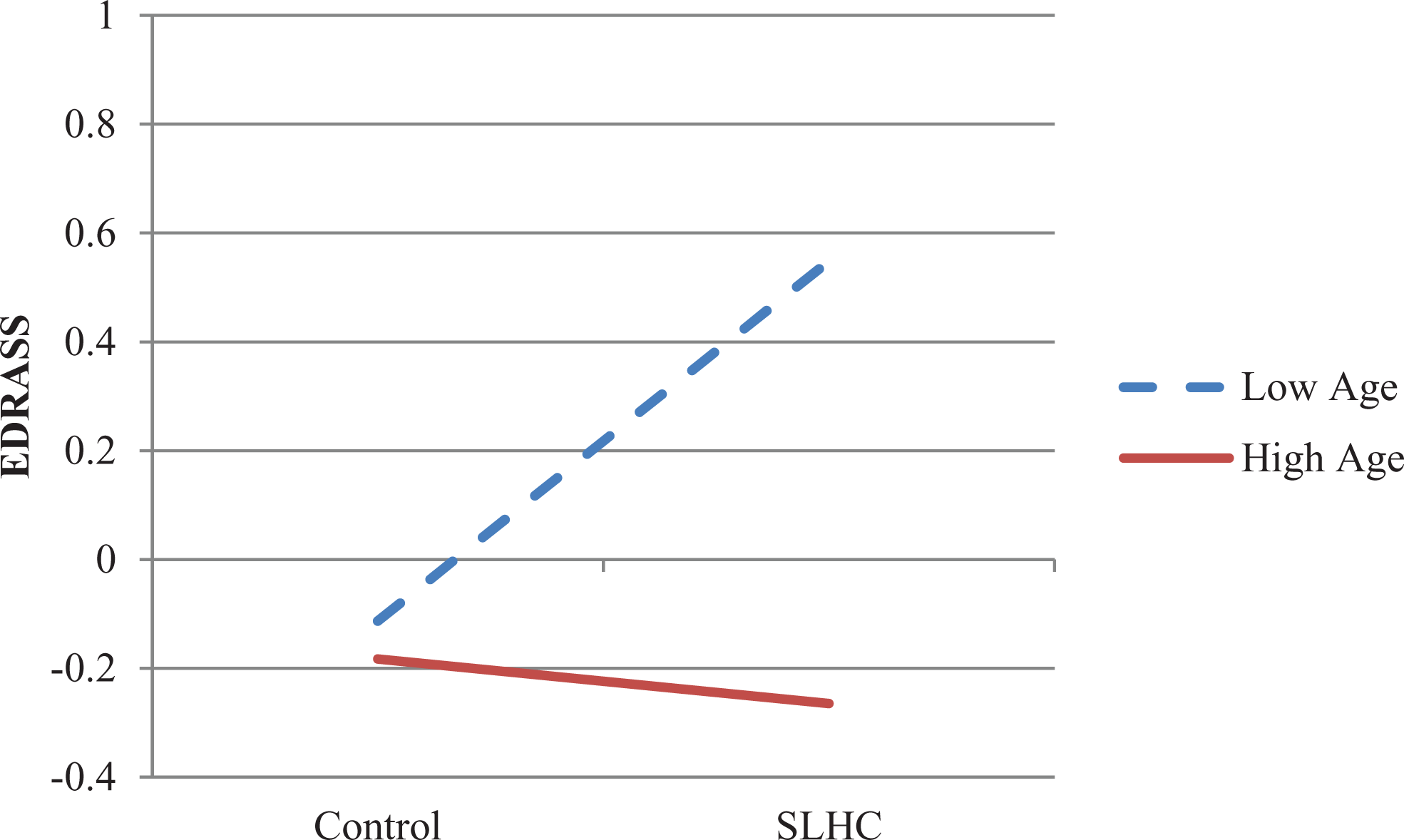
Simple slopes for the interaction between the slow life history contingency condition and age. Results are standardized and high age is +1 SD and low age is −1 SD.
In a final analysis, we examined the relationship between the manipulation check questions and EDRASS scores, which we present in Table 2. While most of the manipulation check questions did not hold a reliable relationship with the EDRASS, both feeling competitive and that the population is increasing showed a positive relationship to EDRASS scores. Thus, the more the scenarios were rated as making participants feel competitive and that the population was increasing, the more tempted individuals were to engage in exploitative behavior.
Correlations Between Manipulation Check Questions and the EDRASS.

Note. Asterisks indicate significant p value. EDRASS = Exploitative and Deceptive Resource Acquisition Strategy Scale.
Discussion
In Study 2, we again investigated the effects of LHS and LHCs on exploitative strategies. Results continued to support the role of individual differences in LHS in the use of these strategies. Study 2 is the fourth study (including those of Reynolds & McCrea, 2015) to demonstrate that a slow LHS is associated with less use of exploitative strategies. This relationship seems to be robust with self-report and behavioral measures and with college and older samples.
As observed by Reynolds and McCrea (2015), there were no main effects of LHCs in Study 2. However, in the follow-up analysis, we did find a significant interaction between the SLHC prime and age, such that there was a significant effect of the SLHC prime, but only for younger individuals. This suggests that age is a key factor in moderating the effect of LHCs on exploitative behavior. Furthermore, these results suggest that although individual differences in LHS are relevant for exploitative strategies across the life span, LHCs as they relate to exploitative strategies are only relevant into young adulthood. Alternatively, it could be that younger individuals are more sensitive to the particular LHC information conveyed in the primes.
Study 2 also provides some insight into the unexpected effects of the SLHC prime. Recall that, in Study 1, the SLHC condition was associated with an increase in EDRASS scores, contrary to our prediction. In Study 2, we included manipulation check questions to confirm that the LHCs had their intended effects. Our results confirm that the SLHC prime conveyed the desired information: feeling that the population is increasing, that individuals need to invest in themselves more, and that they need to be more competitive. We also found that feeling more competitive and that the population was increasing was associated with higher scores on the EDRASS. Thus, one possible explanation for the aggravating effects of the SLHC prime is that competitiveness and population density increases exploitative behavior. We examine this issue more closely in Study 3.
Study 3
Study 3 sought to address the unexpected finding that the SLHC increased the use of exploitative strategies, which was in the opposite direction of our hypothesis. Based on the results of Study 2, it seems that the competitiveness and population density promoted by the prime may result in a slightly different mind-set than intended. Specifically, the SLHC condition may have put participants into a scramble competition mind-set rather than a contest competition mind-set.
Ellis, Figueredo, Brumbach, and Schlomer (2009) argue that high population density, high resource scarcity, and high intraspecific competition should result in a slow LHS. These environmental features are not orthogonal. For example, when there is high population density, this usually means that there are fewer resources available and more competition between individuals. However, competition can take multiple forms: one form being a scramble competition and the other being contest competition (Danchin & Cézilly, 2008; Ellis et al., 2009; Rogers, 1992).
Scramble (also called unadapted, incidental, or exploitation) competition is a form of competition in which individuals have equal access to resources (Danchin & Cézilly, 2008; Rogers, 1992). Although this may sound egalitarian, the effects on population dynamics can be devastating (see Rogers, 1992). The reason that it is sometimes called incidental competition is because individuals may not come into direct contact with one another. As individuals consume resources, fewer resources are available to others, but the competition is indirect. Thus, individuals scramble to exploit resources before someone else does.
In contest (also called adapted or interference) competition, individuals do not have equal access to resources (Danchin & Cézilly, 2008; Rogers, 1992). This is called adapted competition because it is the result of evolved competitive adaptations for obtaining disproportionate amounts of resources. Due to these adaptations, as resources are depleted, some individuals will suffer less or not at all in terms of growth and reproduction. Additionally, unlike scramble competition, contest competition tends to promote population density stability in relation to the carrying capacity of the environment.
The forms that competition can take are relevant to the present discussion because contest competition tends to characterize K-selected species like humans. The population regulation that tends to be a feature of contest competition is more strongly associated with a slow LHS (Ellis et al., 2009; Pianka, 1970). Recall that in this type of environment, a somatic compared to reproductive effort trade-off is advantageous. Specifically, in high population densities, slow life history traits enhance fitness through adaptations that make new resources available, which promote physiological homeostasis, and that aid in the acquisition of resources. Although the SLHC condition in our experiments may have contained the key features that are associated with a SLHC, it actually may have promoted a scramble competition mind-set.
The SLHC condition emphasized that there is high competition in the dating and job market. However, this competition was phrased as if the competition was already severe. Thus, despite participants’ feeling that they needed to invest in themselves, it is plausible that participants felt they needed to exploit resources now before other people took those resource for themselves. In other words, participants may think that resources must be acquired now as they are becoming scarce. Perhaps the SLHC condition would have also had an effect on individual or cooperative resource acquisition strategies, but this was not measured in our studies. To summarize, we believe the unexpected SLHC effect may have been due to participants interpreting the scenario as a situation where resources needed to be acquired now before other people take those resources. Exploitive tactics are a viable means to do so.
An alternative explanation as to why the SLHC condition increased exploitation is that the condition could have made individuals sensitive to getting resources. This is a different explanation in that individuals would be more exploitative regardless of the time course of competition. In the control condition, participants are not primed to think about resources. While the FLHC and the SLHC conditions communicate different information, both conditions may prime individuals to think about resources. Thus, it could be that the LHCs primed individuals to want resources, and because the only option was an exploitative strategy, they choose exploitation.
To test these explanations, we created a second type of SLHC prime. Specifically, the original SLHC prime was adapted to emphasize that population density, competition in the dating and job market, and food scarcity are starting to become problems, but that they are not difficult challenges at the present time. In other words, the challenges that need to be met will happen in the future. The title of the story was “Life in the Future” to emphasize this point. This may better reflect the theorized LHCs because there is time to build up competencies and abilities. The original SLHC condition may have unfortunately emphasized that the competition was intense at the present and resources needed to be procured immediately. If the scramble LHC condition increases exploitation and the contest LHC condition decreases exploitation, it would support the hypothesis that high population density, resource scarcity, and intraspecific competition can make individuals use strategies that are more conducive to a slow LHS.
On the other hand, if both the original SLHC condition (now referred to as scramble LHC) and the contest LHC condition increase exploitation, it would support the hypothesis that this LHC information makes individuals sensitive to gaining resources.
Method
Participants and Design
The sample consisted of 159 (42.1% male and 57.9% female; M age = 19.82, SD = 2.08) University of Wyoming students. Participants were recruited through online participant pool and given course/extra credit as compensation. This study employed an experimental design with one between-participants factor (LHC manipulations) and participants were measured on LHS.
Measures
The Mini-K was again used as the measure of LHS (α = .75) and the EDRASS was used as the measure of exploitative strategies (α = .92).
LHC manipulations
The scramble LHC condition was the SLHC condition used in Studies 1 and 2. This condition communicated food scarcity, increasing population, and competition in the dating and job market. The contest LHC condition was nearly identical to the scramble LHC condition, except that the LHC information was framed to communicate that food scarcity (increasing population, etc.) was happening in the future and that individuals should invest in themselves now to meet those future challenges. We titled the article, “Life in the Future” and we emphasized that when thinking about the questions on the EDRASS, that they should consider those challenges as not happening now but in the future. The neutral condition was the same as in Studies 1 and 2. All scenarios were formatted to look like a New York Times article.
Procedure
Participants completed a demographic questionnaire and the Mini-K. They then read one of the three LHC manipulations (contest LHC, scramble LHC, or neutral) and completed the EDRASS.
Results
Data Screening
No missing values were identified, and most variables were adequately normally distributed (skew < 2.0, kurtosis < 2.0). However, age showed minor positive skew (1.90) and some kurtosis (4.60). LHC manipulation showed even splits (FLHC condition n = 53, SLHC condition n = 53, and neutral condition n = 53). There were four univariate outliers on age (Zs > 3.29), however, these values were part of a continuous distribution. One multivariate outlier (Case 17) was detected based on Mahalanobis distance >20.515 for a χ2 distribution with five predictors and p ≤ .001. This case was removed reducing sample size to n = 158. No problematic collinearity was detected. There was sufficient linearity and homoscedasticity. The residual plot indicated that residuals were normal and independently distributed.
Main Analyses
Multiple regression with dummy coding for the categorical variables was used. The predictors were the Mini-K (LHS), two LHC dummy codes, and the two-way interaction terms for LHS and LHCs. We present the standardized model. The overall model was significant, F(5, 152) = 7.719, p < .001; R 2 = .202, 95% CI [.080, .289], accounting for between 8% and 28.9% of the variability of EDRASS scores in a population of college students. LHS significantly predicted EDRASS scores, β = −.303, t(152) = −4.164, p < .001. As LHS increased by 1 SD, there was a −0.303 SD decrease in EDRASS scores and LHS uniquely accounted for 9.12% of the variance with a 95% CI of [2.56%, 17.61%]. The comparison of the scramble LHC condition to the neutral prime condition was significant, β = .251, t(152) = 2.987, p = .003. The scramble LHC condition, relative to the neutral condition, was associated with an increase of 0.251 SD in the EDRASS, and the scramble LHC condition uniquely accounted for 4.67% of the variance with a 95% CI of [0.05%, 11.68%]. The comparison of the contest LHC condition to the neutral prime condition was significant, β = .228, t(152) = 2.713, p = .007. The contest LHC condition, relative to the neutral condition, was associated with an increase of 0.228 SD in the EDRASS, and the contest LHC condition uniquely accounted for 3.88% of the variance with a 95% CI of [0.28%, 10.46%].
Although there was no interaction between the scramble LHC condition comparison and LHS, β = .016, t(152) = 0.183, p = .855, there was a significant interaction between the contest LHC condition comparison and LHS, β = .266, t(152) = 0.273, p = .002. The effect size on the interaction was 5.4%, 95% CI of [0.79%, 12.65%]. Figure 2 presents the interaction with LHS (± 1 SD). A test of the simple slopes demonstrated that the comparison for contest LHC to the neutral prime was significant for slow LHSs (p < .001) but was not significant for fast LHSs (p = .742). Thus, fast LHSs did not show different levels of exploitation in the control versus contest LHC condition. In contrast, slow LHSs increased their exploitation in the contest LHC condition compared to control. Follow-up analyses revealed no significant effects of sex (e.g., main effect, p = .896).
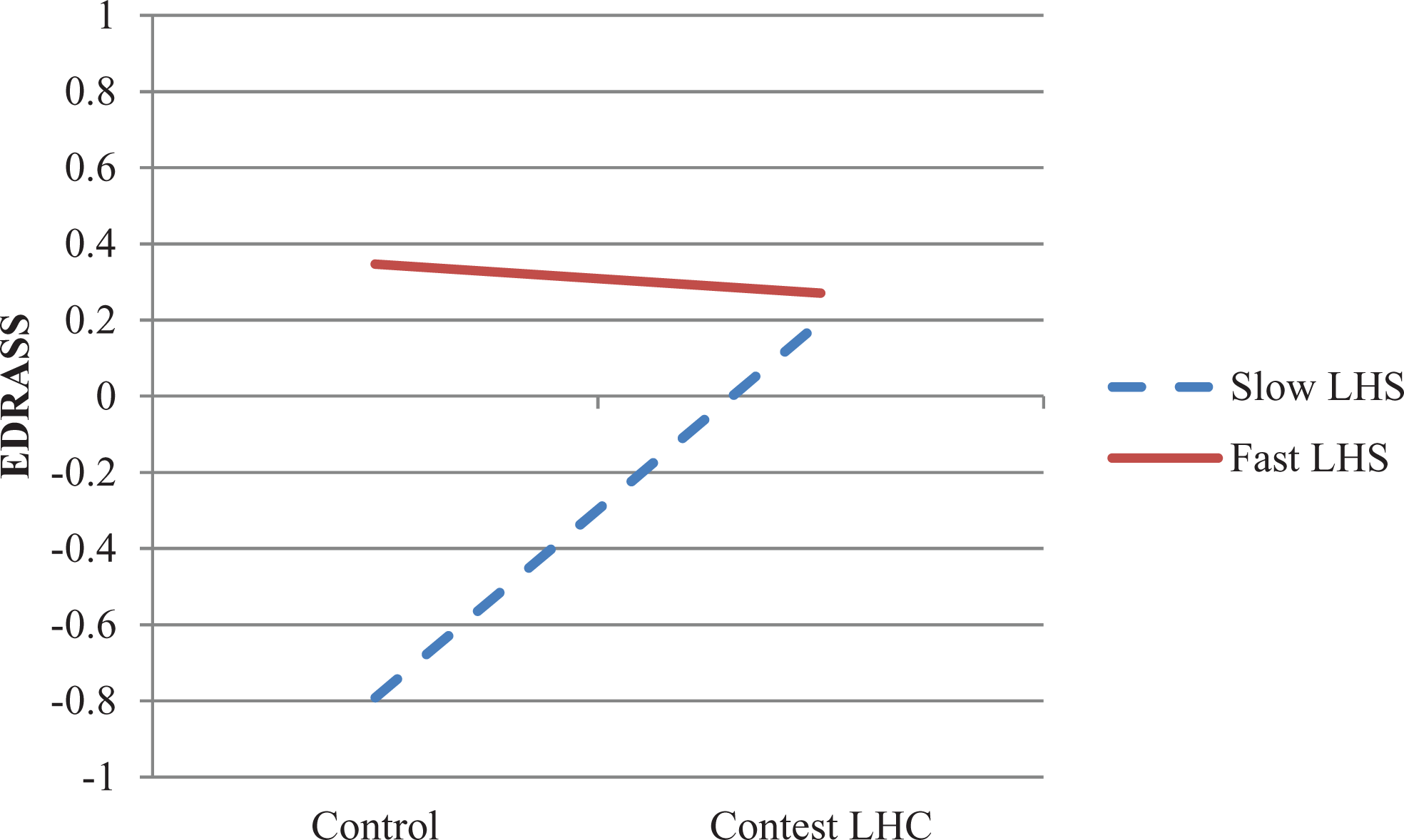
Simple slopes for the interaction between the contest life history contingency condition and life history strategy (LHS). Results are standardized and slow LHS is +1 SD on LHS while fast LHS is −1 SD on LHS.
Discussion
The purpose of Study 3 was to understand why the SLHC prime resulted in increased exploitation in Study 1 and among younger individuals in Study 2. We revised the LHC manipulation to compare scramble and contest competition. We tested whether the effect of food scarcity (population density, etc.) on exploitation is related to using resource acquisition strategies more conducive to a slow LHS or if the LHC information sensitizes individuals to gaining resources. The evidence supported the alternative hypothesis that LHC information communicating high population density, resource scarcity, and intraspecific competition, whether in the present or in the future, increases the temptation to use exploitative strategies. More specifically, the SLHC/scramble LHC condition again resulted in an increased temptation to use exploitation. There was a significant effect of the contest LHC condition. However, this effect was qualified by the two-way interaction with LHS. Specifically, slow LHSs demonstrated increased exploitation in the contest condition, whereas there was not a significant effect among fast LHSs. Thus, only slow LHSs increased exploitation in the contest LHC condition. Also of note, we again found reliable LHC effects among a younger sample. This bolsters the conclusions from Studies 1 and 2 that younger individuals respond more to LHC information.
General Discussion
The present work was conducted to better understand the conditions under which LHC information impacts exploitation. First, we observed consistent LHC effects among younger, but not older, individuals. However, we unexpectedly observed that contingencies that promote a slow life history (high population density, intraspecific competition, and resource scarcity) nonetheless increased temptation to engage in exploitative behavior. That we found aggravating effects for both the scramble and contest LHC conditions suggest that these conditions simply made individuals more sensitive to resources. This highlights a limitation of the current research. In this research, we only measured exploitative strategies. Perhaps participants only felt more tempted to engage in exploitative strategies because we did not give them the option to use either individual or cooperative strategies. Of course, in some situations, exploitation may be the most salient strategy option. Nonetheless, future research should attempt to use measures that capture multiple resource acquisition strategies. For example, a behavioral game could be created that competed individuals, and gave participants the option of acting alone, cooperatively, or exploitatively with their partner. This would be the more critical test of the idea that high population density, intraspecific competition, and resource scarcity promote a more general sensitivity to resources or rather increase exploitative behavior specifically. In other words, it is important to show that high harshness and unpredictability, for example, are associated with increased use of exploitative strategies even when individuals have the option of using individual and cooperative strategies. This would entail creating new measures but would be an important step in this research. In addition to this research being limited in only measuring exploitative strategies, this research suffers from the limitation of only using one measure of exploitative strategies. Reynolds and McCrea (2015) used a behavioral measure, the Dot Game. The Dot Game is also advantageous because it allows individuals to be altruistic, thus measuring more than exploitation. We focused on the EDRASS because it captures a greater variety of exploitation and is more easily administered. However, the EDRASS is a self-report of hypothetical behaviors. Thus, it is important to determine whether the present results would replicate with behavioral measures, particularly one that can measure all resource acquisition strategies simultaneously.
If research continues to find that high population density, intraspecific competition, and resource scarcity are associated with an increase in exploitative behavior, we may need to revise LHT predictions regarding resource acquisition. Although LHT makes clear predictions concerning many outcomes, resource acquisition strategies are very complex. For example, classic life history traits like body size may be easier to predict, but there may be more nuances to the use of resource acquisition strategies. Thus, it may be beneficial to integrate other theories and explanations. For example, it could be that for humans, with high population density comes a sense of anonymity which then increases exploitation. It could also be that when there are few resources and high competition, individuals view the benefits of cooperation as few and far between. On the other hand, exploitation may be an attractive option. Thus, in environments characterized by high population density, intraspecific competition, and resource scarcity, there may be some trade-offs to somatic effort (e.g., smaller body size) but others that allow the pursuit of exploitative strategies. Indeed, research suggests that body size can coevolve independent of other Life History (LH) traits (Bielby et al., 2007; Oli, 2004). Additionally, the effects of high population density (food scarcity, etc.) for exploitative strategies would have some important implications. Consider that the world is indeed increasing in population and resources (like water, jobs, etc.) are becoming scarcer. The implication is that the future may be a place of increased exploitation.
The most perplexing finding from the present research is the interaction between the contest LHC condition and LHS on exploitative behavior. One potential explanation that would fit LHT is that slow LHS individuals were using a diversification strategy. That is, slow LHSs may increase exploitation to diversify how they acquire resources. However, the corresponding effect for fast LHSs was not significant. This could reflect a limitation of using college student samples, who are more likely to be on the slow side of the continuum. As a result, we did not capture the most fast LHSs. For example, if we recruited a juvenile delinquent population, who are more likely to be fast LHSs and young, we might find that the contest LHC condition decreases their exploitative behavior. What is unsatisfactory about this explanation is that the interaction only occurs for the contest LHC condition, but not the scramble LHC condition. Regarding age, however, we did find reliable age effects across the three studies. This has important implications because it suggests that after a certain point in development exploitative strategies are more difficult to change. The age data also show that the individuals who were the lowest on the ERDEASS tended to be older. This suggests that as we get older, we may rely less on exploitation. This is consistent with the age and crime relationship in the criminological literature (Farrington, 1986; Piquero, Farrington, & Blumstein, 2003; Sweeten, Piquero, & Steinberg, 2013). However, as exploitation and criminal behavior are distinct constructs, future research may investigate the differences in age effects for crime versus exploitation.
A focus on the mediators of LHC effects might also be useful. Such was the approach in Kruger at al. (2008). They found that time perspective was an important mediator of LHC effects. Coupled with a measure of exploitative strategies that includes the option of using individual and cooperative strategies, measuring time perspective might further illuminate the effects of different LHCs.
Conclusion
This area of research clearly deserves more attention. Particularly worthy of more attention are the effects of population density, food scarcity, and intraspecific competition, as work on exploitation and LHCs has tended to focus on harshness and unpredictability. We found that LHC effects on exploitative behavior are only consistently found in younger samples, but that LHS is associated with this behavior across the life span. We also found, contrary to our predictions that high population density, intraspecific competition, and resource scarcity, whether framed as scramble or contest competition, increased exploitation. While many questions remain, applying LHT to exploitative strategies has advanced our knowledge.
Footnotes
Appendix
Declaration of Conflicting Interests
The author(s) declared no potential conflicts of interest with respect to the research, authorship, and/or publication of this article.
Funding
The author(s) received no financial support for the research, authorship, and/or publication of this article.