




Abstract
Life history (LH) strategies explain how organisms adapt to the environment and make the best use of their resources to fulfill bodily maintenance, growth, reproduction and other functions. The K-SF-42 is a short version of the 199-item Arizona Life History Battery for assessing seven different domains of LH strategies. This article aims to evaluate the psychometric properties of a Chinese version of the K-SF-42. We recruited 1,016 Chinese university students, who aged 16 to 28 years old (M age = 19.47, SD = 1.17) to participant in an anonymous questionnaire. Results of the confirmatory factor analysis supported the second-order six-factor model (except romantic partner attachment), and the scale and subscales of such measurement displayed good internal consistencies. With the exception of religiosity, all of the subscales showed significant positive correlations with a brief unidimensional measure of LH strategies (i.e., the Mini-K). The criterion-related validity of the scale was further supported by the association between its higher score (suggesting slower LH strategies) and the lower levels of childhood harshness and unpredictability. This study provided evidence for the satisfactory applicability of the Chinese version of the K-SF-42 to a Chinese population and contributed to the further investigation of the LH strategies’ mechanisms underlying human behavior across cultures.
As a mid-level theory in evolutionary biology, the life history (LH) theory provides a framework to address resource allocations that aim to maximize people’s fitness (Ellis et al., 2009; Figueredo et al., 2017). The theory has been widely employed to explain phenotypic variations in response to environmental conditions such as the differences in the pace of maturation, biological development, and the degree of social cohesion (e.g., Belsky et al., 1991; Chisholm et al., 1993; Del Giudice, 2009; Ellis et al., 2009; Figueredo et al., 2018). Given that the phenotypes of organisms living in an unstable environment with limited resources are different from those living in a stable environment with ample resources, LH theory postulates both resource availability and environmental factors to be major determinants of the physiology, behavior, development, and reproduction of an organism(Wells et al., 2017). In the LH theory, the chain of variations of LH traits constitutes LH strategies (Ellis et al., 2009).
The fast-slow LH strategies involved a bundle of the variations (or trade-offs) of LH indicators, such as sexual, reproductive, parental, and social behaviors (Ellis et al., 2009). The trade-offs are how organisms, including human beings, adapt to the environment and make the best use of their resources to fulfill bodily maintenance, growth, reproduction, and other activities (Belsky et al., 2012; Brumbach et al., 2009). For human beings, different traits in fast and slow LH strategies are illustrated by trade-offs in their behaviors, such as reproduction, marriage, and risk-taking behaviors (Brumbach et al., 2009; Ellis et al., 2009; Lu & Chang, 2019). Basically, the fundamental trade-offs (e.g., growth and maintenance, current and future reproduction, as well as quality and quantity of offspring) result in different LH traits in the slow-fast LH continuum (Ellis et al., 2009). When more resources and energy are spent for the reproductive effort (i.e., mating, parenting, and nepotism), less are available for the somatic effort (i.e., survival and body maintenance, growth, and development) and verse vice (Geary, 2002). For instance, fast LH strategies involve relatively more devotion to the reproductive effort and hence are characterized by the earlier onset of puberty, sexual debut, age of reproduction, and more offspring, whereas slow LH strategies have opposite features (Amir et al., 2016; Giudice et al., 2015).
Apart from these sharp distinctions between fast and slow LH strategies on the evolutionary and biological levels, the two types of LH strategies are proposed to also contrast each other from the behavioral and psychological perspectives (Del Giudice, 2014; Figueredo et al., 2017). Thus, in recent years, researchers have been adopting a psychometric approach to measuring LH traits in these two domains, and applying the LH theory to explain human decision making and behaviors, such as risk-taking behaviors (Mishra et al., 2017), social trust (Petersen & Aarøe, 2015), and obesity (Hill et al., 2016). However, the burgeoning interests in LH theory and LH strategies have not gone without criticism. For example, Zietsch and Sidari (2019) argued that the human traits covariation in the fast-slow continuum was not generally appropriate. They also highlighted the important roles of genetic contributions, in addition to environmental determinants, in the development of LH strategies and their related traits. Del Giudice (2020) also criticized the application of LH strategies to explain the specific behavior (e.g., an investment decision), as LH strategies refers to resource allocations and trade-offs at the general level. Scholars like Del Guidice (2020) stressed that empirical research must consider not only theoretical assumptions but also methodological practices (e.g., reliable and valid measure(s) for LH strategies).
Regarding the measurement of LH strategies, biological outcomes, behavioral traits, as well as psychological features have been considered and assessed as salient indicators of LH strategies. Unlike biometric assessments that based on developmental parameters (e.g., weight at birth, speed of growth, age at sexual maturity, and length of life span; Figueredo et al., 2015; Figueredo et al., 2017), psychometric assessments rely on behavioral and psychological indicators (e.g., interaction with family and friends), which are relatively easier to be self-evaluated and self-reported in surveys, to measure LH strategies. The Arizona Life History Battery (ALHB; Figueredo, 2007) is the most well-known and comprehensive example of psychometric assessment tools used behavioral and cognitive indicators of psychosocial resource allocations to measure LH strategies. ALHB has 199 items, which contains seven subscales, namely (1) Insight, Planning, and Control, (2) General Altruism, (3) Religiosity, (4) Romantic Partner Attachment, (5) Mother/Father Relationship Quality, (6) Family Contact and Support, and (7) Friends Contact and Support. Higher factor scores of these seven subscales indicate slower LH strategies. As it takes the respondents much time and attention to complete all 199 items, the developer of the ALHB has constructed a 20-item scale, i.e. the Mini-K, to summarize the general content of ALHB (Figueredo et al., 2006; Olderbak et al., 2014). Yet, a research study has shown that the Mini-K suffers from limited reliabilities, probably because it fails to address the multidimensionality of LH strategies (Olderbak & Figueredo, 2010).
In view of the limitations of both the ALHB and the Mini-K, Figueredo et al. (2017) developed the K-SF-42, which is a seven-dimensional measure with 42 items extracted from the ALHB for an adequate coverage of major domains regarding resource investment to predict fast/slow LH strategies. In this scale, a higher total or subscale score indicates a slower LH strategy. The scale meets good psychometric standards in terms of internal consistency and validity, while demonstrating better psychometric properties than the Mini-K (Figueredo et al., 2017). Furthermore, it also performs well in terms of the convergent validity, incremental validity, and internal consistency across samples from five countries (i.e., Australia, Italy, Mexico, Singapore, and the United States). However, its applicability to the Chinese population has not been empirically tested. Thus, the present study aimed to validate a Chinese version of it by examining its psychometric properties and proposing scale modifications if necessary.
In the current study, the psychometric properties of the Chinese version of the K-SF-42 were examined with the data from a Chinese college student sample. The seven-factor structure of the scale and the internal consistency of each factor were tested. Its criterion-related validity was evaluated by the correlations between the K-SF-42 and the Mini-K. It was hypothesized that both the overall and sub-scale scores of the K-SF-42 would be positively correlated with the Mini-K score. The criterion-related validity would be further demonstrated by negative correlations of the K-SF-42 with not only childhood harshness but also childhood unpredictability. According to the LH theory, childhood harshness is defined as the rate of extrinsic morbidity-mortality rate during childhood (e.g., low socioeconomic status [SES]), while childhood unpredictability refers to the extent of stability of the local environment during one’s early stages of life (Doom et al., 2016; Ellis et al., 2009). In other words, high levels of childhood harshness and childhood unpredictability are the two major indicators of an adverse environment in early life (Brumbach et al., 2009; Chang & Lu, 2018; Ellis et al., 2009). Research studies have found that such adverse environments tend to result in the development of fast LH strategies (e.g., Ellis et al., 2009). Therefore, a high K-SF-42 score (which suggests slow LH strategies) was hypothesized to be negatively correlated with high levels of childhood harshness and unpredictability.
Material and Methods
Participants and Procedure
We recruited 1,016 Chinese university students (70.40% female; M age = 19.47, SD = 1.17, age ranged 16–28) at two public universities in China in 2019. Following briefings on the study purposes and their rights as participants, the students gave their consent and voluntarily completed a self-administered, anonymous online questionnaire using their own smartphone devices in a classroom setting. No monetary compensation was provided to them. Ethical approval was obtained from the research ethics committee of the corresponding author’s affiliation.
Measures
The Chinese version of the K-SF-42
The 42 items of the original English version of the K-SF-42 (Figueredo et al., 2017) was translated from English into Chinese through standard translation and back-translation (Brislin, 1986). After two bilingual psychologists checked the Chinese translation against the original version, we conducted a pilot study with five Chinese college students. Based on their feedback, the items of Romantic Partner Attachment were not applicable, because they had no romantic partner or even romantic relationship experience. Due to this common characteristic of our college sample, we decided to drop this subscale in this version.
Participants were asked to express their endorsement, using a 7-point Likert scale (−3 = strongly disagree to 3 = strongly agree), to 18 items of three subscales including Insight, Planning, and Control (e.g., “When I encounter problems, I don’t give up until I solve them.”), General Altruism (e.g., “I contribute a great deal to the welfare and well-being of my friends these days.”), and Religiosity (e.g., “Religion is important in my life.”). They were also asked to use a 4-point scale (0 = not at all to 3 = a lot) to indicate their views on 18 items of three subscales including Mother/Father Relationship Quality (e.g., “How much time and attention did your biological mother give you when you needed it?”), Family Contact and Support (e.g., “How much have your relatives helped you get worries off your mind?”), and Friends Contact and Support (e.g., “How much have your friends told you that you had done something well?”). The total score of each scale was computed and a higher score suggested a slower LH strategy.
The Mini-K
The 20-item Mini-K scale was used to measure LH strategies on a single continuum (Figueredo et al., 2006). We employed a Chinese version of the Mini-K scale that has been adopted for Chinese adolescents and young people (Chang & Lu, 2018). The response scale was a 7-point Likert scale ranging from 1 (strongly disagree) to 7 (strongly agree), with higher scores indicating slower LH strategies. The internal reliability of the scale was .85 in this study.
Childhood harshness
Consistent with the previous studies (e.g., Doom et al., 2016; Simpson et al., 2012), we measured childhood harshness by Griskevicius et al.’s (2011) 4-item scale regarding childhood SES, on a 7-point scale ranging from 1 (strongly disagree) to 7 (strongly agree). A sample item is “My family usually had enough money for the things when I was growing up.” A higher score represented a higher childhood SES (i.e., a lower level of childhood harshness). The internal reliability of the measure was .87 in this study.
Childhood unpredictability
We used Zhou et al.’s 7-item scale (2018) to assess childhood unpredictability with a 5-point Likert response scale (0 = no to 4 = severe). Consistent with the previous studies (Barbaro & Shackelford, 2019, Szepsenwol et al., 2015), the scale measured the extent of unstable childhood situations regarding family income, residence and parenting. Sample items include “I have had experiences of changing residence” and “I have had experiences of physical hurt or abuse by parents or other family members.” We added a specific note in the scale instruction asking participants to only include experiences in their childhood. A higher mean score represented a higher level of extrinsic unpredictability in earlier stages of life. The internal reliability of the measure was .72 in this study.
Demographics
Two demographic items, namely gender (0 = female, 1 = male) and age, were included in the questionnaire.
Data Analysis
Descriptive statistics, reliability tests, correlation analyses, and regression analyses were conducted with the SPSS 24. Using Amos 24, confirmatory factor analysis (CFA) was carried out to test the factor structure of the K-SF-42. We first examined the original second-order model (i.e., 6 indicators underlying a general factor of LH strategies), and modification would be made for improving the model fit according to the path significance test and the modification indices provided by Amos 24. The goodness of model fit was evaluated by χ2 value, comparative fit index (CFI), Tucker Lewis Index (TLI), root mean square error of approximation (RMSEA), and standardized root mean square residual (SRMR; Kline, 2015). A model with CFI > 0.90, TLI > 0.90, RMSEA < 0.08, and SRMR < 0.08 is considered as reflecting an acceptable fit to the data (Hair et al., 2010). Cronbach’s αs were used to examine the internal consistency of the subscales. For the criterion-related validity, we assessed the validity by testing the K-SF-42’s correlations with the Mini-K and determined the predictive validity through its correlations with childhood harshness and childhood unpredictability. A hierarchical multiple regression was further conducted to examine the relationships between the K-SF-42 and childhood harshness as well as unpredictability after controlling for the demographic variables.
Results
Confirmatory Factor Analysis
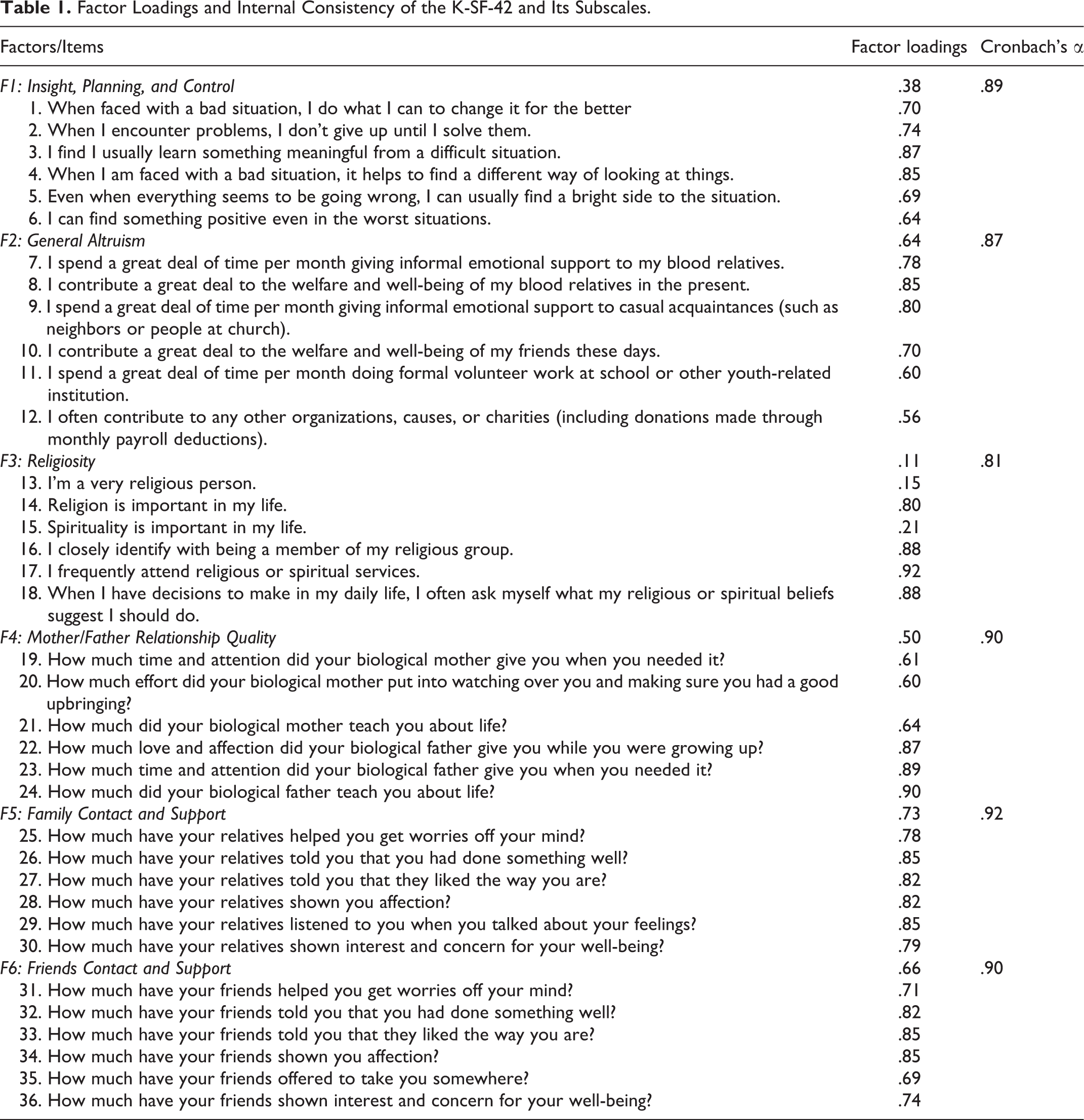
We first tested the second-order six-factor model, in which the six factors of the K-SF-42 loaded on one higher-level construct of LH strategies. The results showed a fair model fit, χ2(666) = 4,238.75, p < .001, CFI = .850, TLI = .839, RMSEA = .078 (90% CI [.076, .080]), SRMR = .096. After examining the modification indices, four error covariances were added (i.e., between items 5 and 6, item 11 and 12, items 13 and 15, as well as items 25 and 26), and the revised model showed an acceptable fit with the data, χ2(584) = 2,725.18, p < .001, CFI = .912, TLI = .905, RMSEA = .060 (90% CI [.058, .062]), SRMR = .093. The factor loading of Insight, Planning, and Control, General Altruism, Mother/Father Relationship Quality, Family Contact and Support, Friend Contact and Support, and Religiosity on the general contrast were .38, .64, .50, .73, .66, and .11 respectively, while factor loadings of all individual items are presented in Table 1.
Factor Loadings and Internal Consistency of the K-SF-42 and Its Subscales.
We also examined the more parsimonious one-factor unconstrained model for our revised Chinese version of the K-SF-42, but its model fit was poor, χ2(594) = 16,933.86, p < .001, CFI = .327, TLI = .286. RMSEA = .165 (90% CI [.162, .167]), SRMR = .164.Based on the above results, we selected and used the second-order six-factor model in the subsequent analyses.
Reliabilities and Inter-Factor Correlations of the K-SF-42 Factors
The revised Chinese version of the K-SF-42 demonstrated high reliability for the overall scale (Cronbach’s α = .89) in the study. As showed in the Table 1, the Cronbach’s α of the six subscales were also satisfactorily high, ranging from .81 to .92.
Pearson correlation coefficients showed that all factors in the scale were significantly and positively correlated with each other, rs = .07 to .46, ps < .001, except two mildly negative correlations found between (1) Religiosity and Insight, Planning and Control and (2) Religiosity and Mother/Father Relationship Quality, rs = −.07 and −.10 respectively, ps < .05.
Criterion-Related Validity
To begin with, we assessed the correlations between the overall score of the K-SF-42 and the Mini-K. We found that there was a high and positive correlation between the two scales, r = .61. Moreover, all of the K-SF-42 subscales, except Religiosity, were significantly and positively correlated with the Mini-K, rs = .34 to .61, ps < .001 (see Table 2). All in all, the Chinese version of the K-SF-42 demonstrated a high criterion-related validity.
Descriptive Statistics and Inter-Correlations of Constructs of the K-SF-42.

Note. PSR = Possible score range.
*p < .05. ***p < .001.
Additionally, the overall score of the K-SF-42 was also found to be positively correlated with childhood SES (i.e., the opposite of childhood harshness) and negatively correlated with childhood unpredictability, r = .29 and r = −.15, ps < .001, respectively. Furthermore, the scores of those six K-SF-42 subscales had significant correlations with high childhood SES (i.e., low levels of childhood harshness), rs = .10 to .27, ps < .01. With the exception of General Altruism and Religiosity, all subscales displayed significant and negative correlations with childhood unpredictability, rs = −.07 to −.43, p < .05.
A hierarchical multiple regression analysis was conducted to investigate whether childhood harshness and childhood unpredictability would independently explain the variances in LH strategies. The results are summarized in the Table 3. After controlling for gender and age in the Block 1, both childhood SES in the Block 2 and childhood unpredictability in the Block 3 were found to be significant factors of LH strategies as measured by the K-SF-42, β = .28 and β = −.12, ps < .001, respectively. Moreover, they both significantly explained additional variances on LH strategies, R 2 childhood SES = .08 and R 2 childhood unpredictability = .02, ps < .001, respectively. To summarize, the Chinese version of the K-SF-42 demonstrated acceptable criterion-related validity with regard to childhood harshness and childhood unpredictability.
The Final Model of Hierarchical Regression of Childhood SES and Unpredictability on the Total Score of the K-SF-42.

*p < .05. **p < .01. ***p < .001.
Discussion
This study aimed to make a psychometric evaluation of the K-SF-42, which is a well-established condensed assessment of the multiple behavioral and cognitive domains of LH strategies, when applying it to Chinese emerging adults. To the best of our knowledge, this study was the first to investigate the applicability of the K-SF-42 to a Chinese population, and we found that our revised Chinese version met the psychometrics standards. The six-factor model of the K-SF-42 with 36 items (except the Romantic Partner Attachment) was also confirmed by our Chinese data, and this further supported the LH strategy construct with main areas of behavioral and cognitive indicators loaded in a general construct.
In our study, the second-order six-factor model not only showed a good fit with the data, but also performed better than the one-factor model. All the items scored high factor loadings, except for the two items in the subscale of Religiosity (i.e., items 13 and 15). Consistent with an earlier study (Figueredo et al., 2017), the internal consistency of the K-SF-42 was higher than that of the Mini-K. Including Religiosity, all subscales had an internal consistency of over .80, which is higher than the widely-accepted value of .70 (e.g., Cortina, 1993; Nunnally, 1978). However, one should note that Religiosity was negatively associated with two LH strategy domains (i.e., Insight, Planning and Control and Mother/Father Relationship Quality)—albeit such negative correlations were mild (< .10). The Religiosity subscale performed well in the samples of other countries (Figueredo et al., 2017), but its psychometric properties underperformed other subscales in our Chinese sample. This could be due to the differences in perceptions for religion and religiosity between the modern Chinese and Western societies. In the West, church-like organization and dogmatic authority of religions are prevalent (Goossaert, 2005). On the contrary, the Chinese government discourages such practices, and calls some of them feudalistic superstition (“Feng Jian Mi Xin” in Chinese). Hence, religion could be a relatively sensitive topic for most Chinese people (Yang, 2012; Zhu, 2009). While certain items of the Religiosity subscale such as “I’m a very religious person” may be perceived as a neutral and typical self-description item in the Western societies, it could be viewed as a self-stigma of being superstitious by the Chinese community. Moreover, different countries/cultures may have their own dogmas, which are basically the equivalent of religion, and hence “religiosity” is culturally specific (Sear, 2020). It is plausible that conformist adherence to social norms, instead of the measured Religiosity per se, is a better indicator of (slow) LH strategies in Chinese culture. For example, it is possible that conformity to Communist Party dogma can be a LH indicator in China. Further research may identify other proper items for developing conceptually equivalent measures for “religiosity” in the sociocultural context of China.
In our revised version of KSF-42 for Chinese emerging adults, the Romantic Partner Attachment subscale was removed because some pilot participants reported not having either a romantic experience or a stable romantic partner. It is not totally unexpected because the average age of first marriage was observed a raising trend and the number of single adults who reached the legal marriage age (20 for female and 22 for male) in mainland China was over 170 million (Xinhua, 2018), and even later for those with higher education. Besides, Romantic Partner Attachment is a controversial indicator of LH strategy (Richardson, Sanning, et al., 2017). The evidence on its associations with LH strategies was mixed. For example, a secure type of romantic attachment was found to be associated with slow LH strategies, while insecure attachment types were not totally a component of fast LH strategies (Del Giudice, 2018). Further studies should be conducted to examine whether the Romantic Partner Attachment subscale is a reliable and effective indicator of LH strategies in general Chinese adults.
In line with Figueredo et al. (2017), the significant positive correlations between the Mini-K and the total and subscale scores (except Religiosity) of the Chinese version of the K-SF-42 provided empirical evidence for the criteria-related validity of this Chinese version of the K-SF-42. Mother/Father Relationship Quality, Family Contact and Support, Friend Contact and Support, as well as General Altruism were found to be positive psychosocial indicators of slow LH strategies. Living in the social context, cooperation, and reciprocity are usually associated with long-term benefit at the cost of immediate rewards (Del Giudice, 2014), and therefore these behaviors related to the reciprocity are supposed be good indicators of slow LH strategy. Another cognitive indicator was Insight, Planning, and Control, since reward orientation suggests the trade-offs between fast and slow LH strategies on the psychological level (Kruger et al., 2008). Fast LH strategies are associated with higher impulsivity, present orientation, and carving for reward, whereas slow strategies are associated with more impulsive control, future orientation, and delayed gratification.
However, one should also note some existing controversies for using behavioral and psychological indicators to measure LH strategies. Biological outcomes are fundamental features of the fast-slow continuum in LH strategies, but biometric assessment and data are relatively less available, while most biological indicators (e.g., time of puberty) are difficult, if not impossible, to make a self-report and such self-report can also be subject to recall bias. Therefore, behavioral/psychological indicators are used in many self-reported measurement tools of LH strategies. However, given the high complexity of some psychological traits (e.g., personalities), their indicator role(s) can be ambiguous. Taking extroversion as an example, two out of its six facets (i.e., warmth and affiliation) were included in slow LH strategies, while some other facets (e.g., dominance and sensation seeking), were indicative of fast LH strategies (Del Giudice, 2014). Considering the complex interplay among biological outcomes, psychological features, and behavioral patterns, behavioral/psychological indicators of the LH strategies must be carefully selected and empirically tested. Some selected behavioral/psychology indicators may be less reliable in some sociocultural contexts since the links between behavior and biology sometimes are less stable than expected across contexts. The underperformance of Religiosity in our Chinese sample illustrates this issue, and hence an inventory using behavioral/psychological indicators is recommended in a population only after a validation study in that population.
As hypothesized, the total and subscale scores of the K-SF-42 (except Religiosity) were also negatively associated with childhood harshness and unpredictability. Our regression results provided empirical support to the LH theory in which both childhood harshness and childhood unpredictability were highlighted as the crucial and independent factors on the development of LH strategies in not only Western samples (e.g., Ellis et al., 2009), but also a Chinese sample. Although Richardson, Chen, et al. (2017) reported effect of SES on LH indicators only among female collage participants, not all the college students, our findings showed the general association between higher childhood SES and slower LH strategies, even after controlling for the demographic factors. Previous studies reported that individuals with lower SES, especially childhood SES, tended to have an earlier age of menarche (girls), start reproduction earlier, take more risks, and prefer immediate reward, which suggested fast LH strategies (Amir et al., 2016 , 2018). In addition to low childhood SES, a highly unpredictable living environment during childhood was revealed to be associated with a faster LH strategy among Chinese college students in our study. Such results echoed with the Western findings that people living in a highly unpredictable environment were associated with earlier puberty development, more casual sexual relationship, and a higher rate of adolescent pregnancy than peers living in a stable environment (Ellis et al., 2009).
It is prudent to point out several limitations of the present study. First, our college student sample limits the generalizability of the findings, which may not apply to the Chinese population as a whole or other age groups. Considering our participants’ age groups that some of them has not experienced the romantic relationships and had partner yet, Romantic Partner Attachment was removed from this validated scale. Second, one should pay attention to the larger proportion of female participants in our sample. As there are some observed gender differences in the LH strategies (e.g., Del Giudice, 2014), the overall scores of the K-SF-42 might be biased toward females. Third, the cross-sectional design of our study makes it infeasible to examine the test-retest reliability of this scale. Although the criteria-related validity in relation to childhood harshness and childhood unpredictability was demonstrated, we suggest future studies with longitudinal design to further test the theorized predictive effect of childhood harshness and unpredictability on LH strategies. Furthermore, the criterion-related validity shown by the correlation between the K-SF-42 and the Mini-K was also limited because both measures belong to the offshoots of ALHB. Other measurement tools for LH strategies, such as Life History Rating Scale (Dunkel et al., 2016) and Mating Effort and Parenting Effort Scales (Kruger, 2017) can be considered as external criteria in future validation research for the K-SF-42. Last but not least, some limitations of the self-reported questionnaires for LH strategies, including the K-SF-42, have been identified (e.g., lack of biological indicators; Del Giudice, 2020). Future studies may consider using both self-reported measure and experimental tasks and/or laboratory results for a comprehensive assessment of LH strategies.
Despite its limitations, this study is probably the first to validate the Chinese version of the K-SF-42 for the assessment of the LH strategies with multiple indicators in a Chinese sample. Our findings have demonstrated that the Chinese version of the K-SF-42 is a good psychometric measurement tool, which makes possible not only indigenous research, but also international comparison in the future studies on the LH mechanisms underlying human behavior.
Footnotes
Acknowledgement
We would like to thank Tai Ching In for assistance in preparation of this manuscript.
Author Contributions
Ms. Meng Xuan Zhang conducted the literature review, questionnaire design, project coordination, data collection and analysis, finding interpretation, and manuscript writing. Prof. Bryant P. H. Hui contributed to data interpretation, manuscript preparation, and finalizing the manuscript. Prof. Anise M.S. Wu was the principal investigator of the project. She was responsible for the research conception, design, and coordination, data interpretation, and manuscript preparation. All authors contributed to and approved the final manuscript.
Declaration of Conflicting Interests
The author(s) declared no potential conflicts of interest with respect to the research, authorship, and/or publication of this article.
Funding
The author(s) disclosed receipt of the following financial support for the research, authorship, and/or publication of this article: The research was supported by the research grants of the University of Macau (MYRG2019-00014-FSS). The funding source had no role in the study design, collection, analysis or interpretation of the data, writing the manuscript, or the decision to submit the paper for publication.