




Abstract
The dark triad (DT) traits are differentially related to psychometrically assessed life history strategy (LHS), such that psychopathy is strongly associated with a faster LHS, whereas narcissism appears to be, if anything, a slow LHS indicator. However, the research supporting these generalizations has been based largely on undergraduate samples in which LHS has been measured using the Arizona Life History Battery (ALHB; or its short version the Mini-K), an instrument that arguably lacks adequate coverage of low-extroversion content linked to a slower LHS. In this study, 929 U.S. MTurk workers completed a set of DT instruments, a 10-item Big Five Inventory, a 42-item version of the ALHB (K-SF-42), and the life history rating form (LHRF), which is less weighted toward high extroversion content than the ALHB. Factor analysis of the DT instruments yielded factors corresponding to callousness, secondary psychopathy, and socially adaptive narcissism (leadership/authority and grandiose exhibitionism). Callousness and secondary psychopathy were fast LHS indicators with respect to both LHS instruments. Socially adaptive narcissism appeared as a slow LHS indicator with respect to the K-SF-42 but as a fast LHS indicator with respect to the LHRF. Variation in extroversion accounted entirely for the K-SF-42’s positive association with socially adaptive narcissism. This study suggests that narcissism’s apparent status as a slow LHS indicator may be more a matter of measurement than of substance.
The “dark triad” (hereafter, DT) of personality comprises the positively intercorrelated traits of narcissism, Machiavellianism, and psychopathy (Muris et al., 2017; Paulhus & Williams, 2002). These traits share a core, variously characterized as callousness (Jones & Figueredo, 2013), low levels of agreeableness (Jakobwitz & Egan, 2006), or low levels of HEXACO honesty–humility (Lee et al., 2013). They differ in that narcissism is focused on gaining the admiration of others, psychopathy on the impulsive exploitation of others for tangible gains, and Machiavellianism on a cynical, calculating approach to social life (Jones & Paulhus, 2011). Machiavellianism is probably best conceived as unidimensional (Rauthmann, 2013), whereas psychopathy (Hare & Neumman, 2005; Lilienfeld & Andrews, 1996) and narcissism (Ackerman et al., 2011; Back et al., 2013) comprise multiple factors, the content of which remains a matter of debate, as discussed further below.
Life history theory (LHT) describes and explains evolutionary processes that shape organisms’ allocations of energy among the competing demands of growth, bodily maintenance, and reproduction (including courtship and parental investment; MacArthur & Wilson, 1967; Pianka, 1970). A “faster” life history strategy (LHS), which is favored when extrinsic mortality and morbidity rates are high, prioritizes reproductive effort over somatic (i.e., growth and maintenance) effort, mating effort over parenting effort, and offspring quantity over offspring quality (Charnov, 1993; Stearns, 1992), whereas a “slower” LHS prioritizes the opposite energy allocations. A large body of research, beginning with the seminal work of Draper and Harpending (1982), Rushton (1985), and Belsky et al. (1991), has used LHT to describe and explain individual differences among humans in a variety of traits, including personality traits. Relationships between life history (LH)-linked psychological mechanisms and biodemographic outcomes are likely affected by environmental novelty. For example, “slow” psychological configurations are actually associated with higher completed fertility in contemporary humans (Woodley of Menie et al., 2017).
Both theory and data suggest links between high levels of DT traits and a faster LHS. Figueredo et al. (2005) included Machiavellianism in a battery of fast LHS indicators. Jonason and colleagues (Jonason et al., 2009 , 2010; Jonason & Tost, 2010) have emphasized two behavioral propensities linked to both the DT and LHS: future discounting and the pursuit of short-term mating opportunities. The DT’s core of callousness, or low honesty–humility, is a plausible feature of human-specific faster LH strategies in the context of human “ultra-sociality.” Humans, unlike other primates, practice costly and elaborate cooperation among nonkin in large groups, a behavioral pattern facilitated by species-typical psychological traits that promote cooperation and inhibit exploitation (Hill et al., 2009). However, payoffs from investing in cooperative social relationships were probably frequently considerably delayed in ancestral environments (Gurven et al., 2000). Thus, variation in cues of mortality/morbidity rates has driven, and continues to drive, individual differences in the predominance of cooperative versus antagonistic social schemata (Chua et al., 2016; Figueredo & Jacobs, 2010; Figueredo et al., 2018; Patch & Figueredo, 2017). Altruism toward nonkin is less advantageous as a function of the probability that either altruist or recipient will be dead before the altruistic act is reciprocated. Conversely, higher mortality/morbidity rates increase the advantages of exploitative behavior.
The three DT traits are differentially related to psychometrically assessed LHS, as are the facets comprising narcissism and (possibly) psychopathy. Psychopathy has consistently been found to be associated with faster LHS as measured by the Mini-K (Figueredo et al., 2006), a short version of the Arizona Life History Battery (ALHB; Birkás et al., 2018; Figueredo, 2007; Jonason et al., 2010, 2017; but see Gladden et al., 2009). Psychopathy is also positively associated with narrower facets of fast LHS, such as sociosexual orientation (willingness to engage in uncommitted sex; Jonason et al., 2009; Semenyna et al., 2017; Tsoukas & March, 2018), and a tendency to discount the future consequences of one’s actions (Birkás & Csathó, 2015; Jonason et al., 2010 , 2017; Jonason & Tost, 2010). Međedović (2018) tested whether, in an all-female sample, psychopathy facets mediated relationships between harsh childhood environments and two LH factors (expected future fitness and long-term mating), each comprised of a set of biometric LH indicators (e.g., age at menarche). Results were mixed, but the meanness facet of psychopathy was unrelated to the LH indicators.
Machiavellianism has been found to be negatively associated with the Mini-K in some studies (Birkás et al., 2018; Chen, 2018) but not in others (Jonason et al., 2010). A recent cross-national, multisample study (Jonason et al., 2017) found no unique relationship of Machiavellianism to the Mini-K after controlling for psychopathy. Consistent with the view that Machiavellianism, unlike psychopathy, entails a long-term, flexible orientation (Jones & Paulhus, 2011), one study found that future orientation and present-hedonistic time perspectives were unrelated to Machiavellianism but related (negatively and positively, respectively) to psychopathy (Birkás & Csathó, 2015). Thus, future discounting as a fast LH facet is not generally associated with Machiavellianism. Short-term mating and its associated attitudes are positively related to Machiavellianism (Ali & Chamorro-Premuzic, 2010; Jonason et al., 2009; McHoskey, 2001), but some findings (Tsoukas & March, 2018) indicate that this association disappears after controlling for psychopathy.
Slower LHS as measured by the Mini-K is either unrelated (Jonason et al., 2010) or positively related (Birkás et al., 2018; Jonason et al., 2017) to narcissism. A study of over 30,000 participants from 53 countries found consistent associations of narcissism with short-term mating indicators (Schmitt et al., 2017). Narcissism has been found to be positively associated with a present-hedonistic time perspective but unrelated to future time perspective (Birkás & Csathó, 2015). Jonason et al. (2017) argue that high levels of narcissism promote only the short-term mating strategy aspects of a fast LHS and that with respect to the building and maintenance of social bonds and networks, narcissism is a slow LHS indicator. Distinguishing among the facets of narcissism promises to shed additional light on the issue of the relationship of LHS to narcissism.
The factor structure of the Narcissistic Personality Inventory (NPI; Raskin & Hall, 1979; Raskin & Terry, 1988), the most widely used self-report narcissism instrument, is a contentious issue (reviewed by Schmitt et al., 2017). Most researchers classify some aspects of narcissism, including confidence and effective leadership, as “socially adaptive,” in contrast to other aspects of narcissism, including exploitativeness and feelings of entitlement, which are classified as “socially maladaptive.” Importantly, the terms “adaptive” and “maladaptive” do not in this context refer to biological adaptiveness. In general, behaviors associated with a faster LHS tend to be viewed as “socially undesirable” because they inflict costs on others, not necessarily because they inflict costs on the person engaging in them (Sherman et al., 2013). Functional evolutionary analysis seeks to elucidate the conditions under which traits promote fitness (i.e., are biologically adaptive) even when these traits lead their possessors to violate social norms. The socially maladaptive facets of narcissism are more strongly associated with the pursuit of short-term mating than are the socially adaptive facets of narcissism (Schmitt et al., 2017). A three-factor solution of the NPI (Ackerman et al., 2011) has yielded the dimensions leadership/authority, grandiose exhibitionism, and entitlement/exploitativeness.
McDonald et al. (2012) factor-analyzed these three narcissism facets, a Machiavellianism measure, a two-facet psychopathy instrument (fearless dominance and impulsive antisociality), and measures of sociosexual orientation and aggression. Two factors were retained. The first factor, which was negatively associated with the Mini-K and therefore labeled a fast LH factor, comprised Machiavellianism, the entitlement/exploitativeness facet of narcissism, the impulsive antisociality facet of psychopathy, sociosexuality, and aggression. The second factor, which was positively associated with the Mini-K and therefore labeled a slow LH factor, comprised the leadership/authority and grandiose exhibitionism facets of narcissism and the fearless dominance factor of psychopathy.
The Present Study
The present study builds on the work of McDonald et al. (2012) and Jonason et al. (2017) in three ways. First, my participants were internet respondents rather than college undergraduates, and they therefore span a much wider age range than in previous research on this topic (see Method). This is important because levels of DT traits decline with age (Barlett & Barlett, 2015), and psychometrically assessed LHS has been found, in a longitudinal study, to become “slower” with age (Kubinski et al., 2017). It is not known whether the documented associations between DT traits and LHS are robust across the life span.
Second, the structural model of psychopathy used by McDonald et al. (2012), comprising fearless dominance and impulsive antisociality facets, and based originally on the Psychopathic Personality Inventory (PPI; Lilienfeld & Andrews, 1996), is controversial. Based on a meta-analysis of the PPI’s nomological network, Miller and Lynam (2012) argue that fearless dominance, as measured by the PPI, is not a central component of psychopathy. Indeed, in the absence of high levels of antagonism and disinhibition, fearless dominance is a component of healthy psychological functioning. In the present study, I use Hare and Neumann’s (2005) four-factor model of psychopathy: interpersonal manipulation, callous affect, erratic lifestyle, and criminal tendencies. In a two-factor model (Hare, 1996), the first two factors comprise primary psychopathy, while the second two factors comprise secondary psychopathy.
Third, the assessment of human LHS is also controversial, particularly regarding (1) whether the construction of higher order “super factors” is a useful analytic tool and (2) the importance of testing causal links between psychometric LH indicators (e.g., personality traits) and biometric LH tempo markers such as number of sex partners (Black et al., 2017; Copping et al., 2014; Copping et al., 2017; Del Giudice, 2018; Figueredo et al., 2015; Richardson et al., 2017). A more specific controversy concerns the relationship between the Big Five or Five-Factor Model personality dimensions (extroversion, emotional stability, agreeableness, conscientiousness, and openness to experience; Digman, 1990) and LHS. Some evidence indicates that all five factors load positively on a general factor of personality (Musek, 2007; but see Davies et al., 2015), which is an index of general social effectiveness (Dunkel & van der Linden, 2014) and a slow LHS indicator (Rushton et al., 2008). However, although there are firm theoretical and empirical grounds for inferring that conscientiousness and agreeableness are positively associated with a slow LHS, the picture is less clear with regard to emotional stability, extroversion, and openness. Del Giudice (2014, 2018) has argued that (1) the interpersonal warmth and gregariousness facets of extroversion are slow LHS indicators, whereas the excitement-seeking and dominance-striving facets are fast LHS indicators and (2) the intellect facet of openness is a slow LHS indicator, whereas the imagination facet is a fast LHS indicator. Some evidence indicates that the ALHB/Mini-K fails to reflect the hybrid fast–slow character of extroversion, in that many of these instruments’ items tap high-extroversion content (which contributes to “slower” scores), whereas almost no items tap the kinds of low-extroversion propensities arguably linked to a slower LHS (Manson, 2017). This feature of the ALHB/Mini-K, in turn, could explain its positive relationship with narcissism, given that narcissism is more strongly related to extroversion than to any other Big Five trait (Jacobwitz & Egan, 2006; Muris et al., 2017; Paulhus & Williams, 2002; Schmitt et al., 2017). An alternative psychometric LHS instrument, the life history rating form (LHRF: Dunkel et al., 2016), which has been validated with respect to biometric LH indicators (e.g., age at sexual debut; Dunkel et al., 2015), is not as strongly weighted toward high extroversion content as is the ALHB/Mini-K (Manson, 2017). In the present study, I compare results using the LHRF to results using a recently published short version (the K-SF-42) of the ALHB (Figueredo et al., 2017).
Based on the research reviewed above, I predicted that (1) slow LHS, whether measured by the K-SF-42 or the LHRF, would be negatively associated with psychopathy and Machiavellianism and (2) narcissism would be positively associated with slow LHS as measured by the K-SF-42 but not with slow LHS as measured by the LHRF. By design, I made only these two rather general predictions. My data analytic strategy (see Method section) featured an exploratory factor analysis (EFA) of Machiavellianism and the component facets of psychopathy and narcissism. Additional inductive tests assessed relationships between the resultant factors and the two LHS measures.
Because the DT traits are validated, widely used psychological constructs (Furnham et al., 2013; Muris et al., 2017), confirmatory factor analysis (CFA) might seem to be a better choice of analytic tool than EFA. However, one goal of the present study was to partially replicate McDonald et al.’s (2012) analysis of the relationship between DT traits and LHS, substituting (for reasons described above) an instrument based on Hare and Neumann’s (2005) four-factor psychopathy model for an instrument based on the PPI (Lilienfeld & Andrews, 1996). Like McDonald et al. (2012), I sought to determine whether narrower facets of psychopathy and narcissism map onto faster or slower LHSs in ways that crosscut the major DT traits. To address this question, an EFA is necessary.
Method
Participants
I recruited 1,037 U.S. resident participants using Amazon’s Mechanical Turk (Buhrmester et al., 2011). Participants were paid $2.80. Data from 108 participants were excluded from analyses because participants (1) did not respond to seven or more items (N = 6), did not indicate their age or gender (N = 5), or gave incorrect answers to at least one of the two embedded liar-detection items (i.e., items with factually correct answers; N = 97). Among the remaining 929 participants, the mean (±SD) age was 36.4 years (±11.0; range: 18–76; median = 34). The sample was 48.7% female. Its ethnic composition was 77.3% White, 7.3% African American, 6.0% Asian American, 4.5% Latino/a, and 4.9% of mixed ethnicity, “Other,” or not provided.
The final sample size exceeded the planned sample size of 895, which was intended to provide .85 power to detect bivariate correlations of .10 with an α level of .05. This research was approved by the Institutional Review Board of the University of California, Los Angeles (Approval #17-001150). Informed consent was obtained from all participants in accordance with the terms of this approval.
Procedure and Instruments
Besides their age, gender, and ethnicity, participants were asked to provide three indicators of socioeconomic status (not analyzed in this study): childhood zip code, educational attainment, and household income. Participants were then asked to complete (in randomized order) the following instruments:
K-SF-42
This 42-item version of the ALHB includes six items from each of the seven ALHB scales (Figueredo et al., 2017). These scales (with exemplary items) are (1) Insight, Planning, and Control (“when I encounter problems, I don’t give up until I solve them”), (2) General Altruism (“I contribute a great deal to the welfare and well-being of my friends these days”), (3) Religiosity (“religion is important in my life”), (4) Experiences in Close Relationships (i.e., attachment style; “I don’t feel comfortable opening up to romantic partners”), (5) Relationships with Biological Parents (“while you were growing up, how much did your biological mother teach you about life?”), (6) Family Contact and Support (“during the last month, how much have your relatives told you that they liked the way you are?”), and (7) Friends Contact and Support (“during the last month, how much have your friends shown you affection?”). Responses on the items comprising the first four scales are made on a 7-point Likert-type scale (“strongly disagree” to “strongly agree”). Responses on the items comprising the remaining scales are made on a 4-point Likert-type scale (“not at all” to “a lot”). The overall K factor is calculated as the mean of the standardized scores of the seven scales.
LHRF
This instrument (Dunkel et al., 2016) includes 20 items drawn from the California adult Q-sort (CAQ; Block, 1978). These items consist of the 10 highest ranked (“slowest”) items and the 10 lowest ranked (“fastest”) items of the CAQ slow LH template (Dunkel et al., 2015). An example of a “slow” item is “Is a genuinely dependable person.” An example of a “fast” item is “Keeps people at a distance; avoids close relationships.” Participants were asked to rate themselves on each item on an 8-point scale from 1 = not descriptive to 8 = very descriptive. Scores on the 10 fastest items are reverse-keyed.
Trimmed MACH*
This five-item Machiavellianism instrument (Rauthmann, 2013) is based on analysis, using item response theory, of the widely used MACH-IV (Christie & Geis, 1970). Responses are made on a 7-point Likert-type scale anchored by “strongly agree” and “strongly disagree.” Items include “anyone who completely trusts anyone else is asking for trouble.” One item is reverse-keyed.
Twenty-five–item NPI
Items are paired statements, for each of which the participant is asked to choose the one that best describes their opinion, for example, “I try not to be a show-off” and “I will usually show off if I get the chance” (Ackerman et al., 2011) Eleven items load on a leadership/authority factor, 10 on a grandiose exhibitionism factor, and four on an entitlement/exploitativeness factor. An individual’s score for each factor is the proportion of items, loading on that factor, for which the individual endorsed the narcissistic statement.
Twenty-item self-report of psychopathy (SRP)
Five items tap each of the four psychopathy factors (Williams et al., 2007). These factors, with exemplary items, are (1) interpersonal manipulation (“I find it easy to manipulate people”), (2) callous affect (“I’m not afraid to step on others to get what I want”), (3) erratic lifestyle (“I enjoy drinking and doing wild things”), and (4) criminal tendencies (“I have been arrested”). Responses are made on a 5-point Likert-type scale, anchored by “strongly disagree” and “strongly agree.” A total of five items are reverse-keyed.
Big Five Inventory (BFI)-10
This is a very short BFI, containing two items (one positively keyed, one negatively keyed) for each of the five dimensions (Rammstedt & John, 2007). All items are preceded by the phrase “I see myself as someone who…” Responses are made on a 5-point Likert-type scale, anchored by “strongly disagree” and “strongly agree.” Only extroversion scores were analyzed in this study. These scores were computed as the means of the items “is outgoing, sociable” (positive-keyed) and “is reserved” (reverse-keyed).
Data used in this study can be accessed at: https://doi.org/10.5068/D1MQ18.
Data Analysis
Analyses were conducted using Stata Version 16 with the addition of the hireg (hierarchical regression) module (Bern, 2003). All scale scores were standardized for analysis but age was not standardized. Female was coded as 1, male as 0. The trimmed MACH*, the four psychopathy factors, and the three narcissism factors were entered into a principal factor analysis, followed by oblique oblimin rotation. For each resulting factor, individuals’ scores were calculated using the regression method. These factor scores were then regressed, separately, on the K-SF-42 and LHRF scores.
Results
Descriptive Statistics and Reliability
Table 1 shows descriptive statistics (for unstandardized scores) and scale reliabilities of the instruments. In addition to the overall K-SF-42, results are shown for each of its scales. In addition to the facets of the NPI and SRP, which were used in the factor analyses described below, results are shown for total NPI and total SRP, calculated as the means of the standardized scores of all of the facets comprising each instrument. Table 2 shows bivariate correlations among the LHS and DT instruments. Age was slightly positively correlated with K-SF-42 scores (r = .07, p = .04; i.e., older individuals were pursuing a slower LHS) and was more strongly positively correlated with LHRF scores (r = .19, p < .001). Women’s scores on both LHS instruments were significantly higher (slower) than men’s scores (K-SF-42: M ± SD female = 0.09 ± 0.60, M ± SD male = −0.08 ± 0.61, t = −4.29, p < .001, Cohen’s d = −.28; LHRF: M ± SD female = 0.20 ± 0.96, M ± SD male = −0.18 ± 1.00, t = −5.74, p < .001, Cohen’s d = −.38). Men scored significantly higher than women on the SRP (M ± SD female = −0.20 ± 0.66, M ± SD male = 0.19 ± 0.81, t = 7.93, p < .0001, Cohen’s d = .52) and the NPI (M ± SD female = −0.12 ± 0.73, M ± SD male = 0.11 ± 0.89, t = 4.27, p < .0001, Cohen’s d = .28), but there was no significant sex difference on the trimmed MACH* (M ± SD female = −0.16 ± 0.99, M ± SD male = 0.05 ± 1.01, t = 1.75, p = .08, Cohen’s d = .11). Women in this sample were significantly older than men (M ± SD female = 37.41 ± 11.4, M ± SD male = 35.54 ± 10.5, t = −2.62, p = .009, Cohen’s d = −.17). However, all the sex differences reported above (K-SF-42, LHRF, SRP, and NPI) remained highly significant (p < .001) in multiple regressions with age and sex as predictors. The trimmed MACH* sex difference remained nonsignificant (β = .10 ± .07, p = .15) after controlling for age.
Descriptive Statistics of the Sample (Unstandardized Scale Scores).

Note. N = 929. α = Cronbach’s α, calculated across its seven scales for the K-SF-42 and across all their items for the NPI total and SRP total scores. Because the K-SF-42’s scales differ with respect to the number of points, no overall K-SF-42 mean or SD can be calculated. The K-SF-42’s relationships with parents, kin contact and support, and friends contact and support are 4-point scales. The SRP is a 5-point scale. The trimmed MACH* and the K-SF-42’s Insight, Planning, and Control, altruism, religiosity, and Experiences in Close Relationships are 7-point scales. The LHRF is an 8-point scale. Scores for the NPI scales are the proportions of narcissistic choices endorsed. K-SF-42 = short form of the Arizona Life History Battery; LHRF = life history rating form; NPI = Narcissistic Personality Inventory; SRP = self-report of psychopathy.
Zero-Order Correlations Among Life History Strategy and Dark Triad Measures.

Note. N = 929. Part-whole correlations (between the full NPI and its factors, and between the full SRP and its factors) are omitted. p values are <.001 except where indicated. K-SF-42 = short form of the Arizona Life History Battery; LHRF = life history rating form. NPI = 25-item Narcissistic Personality Inventory. SRP = 20-item self-report of psychopathy.
nsp > .05. *p < .05. **p < .01.
Factor Analysis of DT Facets
Principal factor analysis of the eight DT facets yielded a solution in which the first factor accounted for 92.6% of the variance and had an eigenvalue of 2.89 (compared to an eigenvalue of .70 for the second factor). Applying an oblique oblimin rotation yielded a three-factor solution. Loadings of each DT facet on each of these factors are shown in Table 3. The first factor, with substantial (>.40) positive loadings for Machiavellianism, the entitlement/exploitativeness facet of narcissism, and the interpersonal and affective facets of psychopathy, is interpretable as capturing the core DT propensity toward lack of concern for others’ well-being (callousness; Jones & Figueredo, 2013). The second factor, with substantial positive loadings for the erratic lifestyle and criminal tendencies scales of the SRP, is straightforwardly interpretable as secondary psychopathy. The third factor, with substantial positive loadings for the leadership/authority and grandiose exhibitionism scales of the NPI, represents the less noxious features of narcissism (socially adaptive narcissism).
Loadings of Dark Triad Facets on Factor Extracted From Principal Factor Analysis With Oblique Oblimin Rotation.

Note. Loadings >.40 are indicated in boldface. Factor 1 is interpretable as callousness, Factor 2 as secondary psychopathy, and Factor 3 as “socially adaptive” narcissism. NPI = Narcissistic Personality Inventory; SRP = self-report of psychopathy.
To test for possible sex differences in this factor structure, I ran a CFA (structural equation measurement model) based on the factor structure generated by the EFA described above and then tested for invariance of the path coefficients across women and men. No difference was found between the model in which the coefficients were constrained to be equal in the two sexes, and the model in which they were allowed to vary, likelihood ratio χ2(5) = 2.64, p = .75.
Relationships of DT Factors to LHS Measures
Table 4 shows, for each of the three extracted DT factors, the results of multiple regression analyses in which the predictors were age, sex, and either the K-SF-42 or the LHRF. For all three DT factors, sex had an independent, significant effect: Women scored lower than men. For all three DT factors, except for secondary psychopathy in the model including the LHRF, age had an independent, significant effect: Older individuals scored significantly lower than younger individuals. For callousness and secondary psychopathy, both the K-SF-42 and the LHRF were independent, significant negative predictors of participants’ scores. For “socially adaptive” narcissism, the two LHS measures were independent significant predictors of participants’ scores in opposite directions: Individuals scoring higher on the K-SF-42 were higher in “socially adaptive” narcissism, whereas individuals scoring higher on the LHRF were lower in “socially adaptive” narcissism.
Comparison of Models Regressing Dark Triad Factors on Age, Sex, and Life History Strategy Measures.

Note. N = 929. Standardized coefficients are shown. LHRF = life history rating form.
**p < .01. ***p < .001.
I also ran models in which the independent variables included, in addition to age, sex, and one LHS instrument, the interaction term between age and the LHS instrument. These interaction terms had no significant relationship with callousness or “socially adaptive” narcissism. Interaction terms of age with both the K-SF-42 (standardized β = −.25, p = .015) and the LHRF (standardized β = −.19, p = .046) were significantly related to secondary psychopathy. For both the K-SF-42 and the LHRF, the negative relationship between the LHS instrument and secondary psychopathy was stronger in older individuals than in younger individuals.
Post Hoc Analysis: The Role of Extroversion
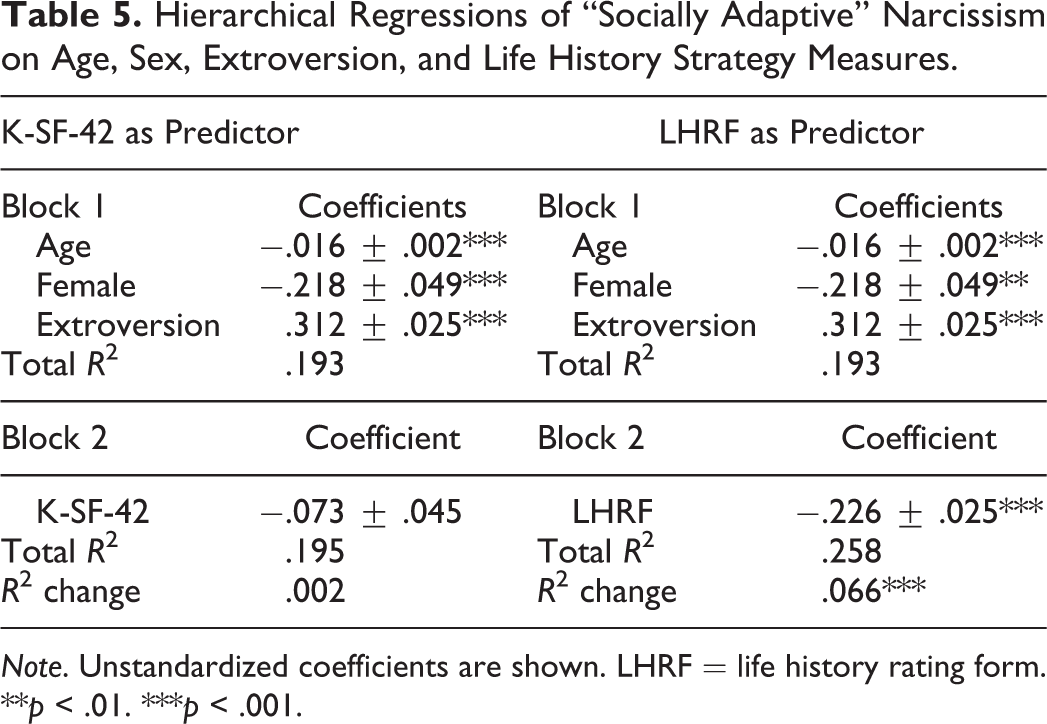
Based on (1) the results reported above and (2) the proposed differences between the ALHB and the LHRF in their coverage of extroversion-related content (Manson, 2017), I examined, for each of the two LHS measures, whether it predicted additional variation, beyond that predicted by extroversion, in “socially adaptive” narcissism. Both the K-SF-42 (r = .44, p < .001) and the LHRF (r = .24, p < .001) were significantly positively correlated with extroversion as measured by its two BFI-10 items. In the first block of a hierarchical regression model with “socially adaptive” narcissism as the outcome variable, I included age, sex, and extroversion as predictors. In the second block, I added either the K-SF-42 or the LHRF as a predictor. Table 5 shows the results. Unsurprisingly, extroversion was significantly positively related to “socially adaptive” narcissism. The K-SF-42 added no predictive power to the model. The LHRF did add predictive power: Beyond the effects of sex, age, and extroversion, individuals scoring higher on the LHRF were lower in “socially adaptive” narcissism.
Hierarchical Regressions of “Socially Adaptive” Narcissism on Age, Sex, Extroversion, and Life History Strategy Measures.
Note. Unstandardized coefficients are shown. LHRF = life history rating form.
**p < .01. ***p < .001.
Discussion
In a large sample of U.S. internet respondents, with an average age in the mid-30s, most aspects of the DT of personality were associated with a faster LHS, as measured by two psychometric LHS instruments. These associations were fairly robust across age, although a factor corresponding to secondary psychopathy was more strongly associated with faster LHS at older ages than at younger ages. A novel finding of this study is that a factor comprising the more socially adaptive facets of narcissism, leadership/authority and grandiose exhibitionism, appeared either as a slow or a fast LHS indicator, depending on which of two LHS instruments was used: a short version of the ALHB (Figueredo, 2007) or the LHRF (Dunkel et al., 2016).
With regard to associations between DT facets and the ALHB/Mini-K, these results are broadly similar to those reported by McDonald et al. (2012) for an undergraduate sample. However, using a psychopathy model comprising of interpersonal manipulation, callous affect, erratic lifestyle, and criminal tendencies (Hare & Neumann, 2005), I found that no psychopathy facets were associated with a slower LHS.
Finding a positive association between narcissism, or at least its more socially adaptive facets, and psychometrically assessed slow LHS, is consistent with previous research findings (Birkás et al., 2018; Jonason et al., 2017; McDonald et al., 2012). Narcissism, in contrast to the other two DT traits, is associated with a task-oriented style of coping with psychological stress (Birkás et al., 2016), which in turn is plausibly linked to a slower LHS. Strong motivation to attain leadership positions is not necessarily part of an exploitative social orientation; indeed, leadership in small-scale human societies generally entails competently coordinating collective tasks and resolving disputes (von Rueden & van Vugt, 2015), although the personality traits associated with leadership in small-scale societies generally do not include the self-aggrandizement typical of leaders in large-scale societies.
An alternative interpretation of this study’s results is that narcissism, or at least its more “socially adaptive” facets, has been mischaracterized in the literature as a slow LHS indicator because the ALHB and its derivative instruments are too heavily weighted with high-extroversion content that contributes to “slower” scores (Manson, 2017), even though extroversion is best regarded as a hybrid trait containing both fast and slow facets (Del Giudice, 2014, 2018). In contrast, of the LHRF’s 20 items, only three loaded on an extroversion factor extracted from the LHRF’s 100-item parent instrument, the CAQ (McCrae et al., 1986), and one of these three items (“behaves and acts quickly”) loaded positively on extroversion but was selected as a fast LH indicator (Dunkel et al., 2016). This interpretation is supported by my finding that the K-SF-42’s positive relationship with “socially adaptive” narcissism was entirely accounted for by extroversion’s positive relationship with “socially adaptive” narcissism.
Finally, a promising recent treatment of the relationship between the DT traits and LHS (Del Giudice, 2018; Chapter 4) incorporates the insights that (1) multiple, separable regions comprise the behavioral space defined by both fast and slow strategies and therefore (2) global, one-factor-based LHS scales such as the ALHB and LHRF fail to capture adequately the subtler patterns of individual variation that LHT can illuminate (see also Copping et al., 2017; Richardson et al., 2017). Specifically, in Del Giudice’s (2018) extended, human-specific life history model, fast strategies share propensities toward high mating effort, impulsivity, and risk-taking, but they are separable into an antagonistic/exploitative profile and a seductive/creative profile. The former profile, which entails overt competition for dominance (i.e., status based on successfully intimidating others), is expected to overlap strongly with psychopathic traits. The latter profile, which includes mentalistic cognition, creativity, and competition for skills-based prestige (see Henrich & Gil-White, 2001, for the dominance-prestige distinction), is expected to overlap with narcissistic traits. Future research should explicitly test this conceptualization of the DT traits as components of LHS.
Limitations
Participants in this study were exclusively U.S. residents. Although much research on DT traits (e.g., Neumann et al., 2012), including their links with LH-related traits (e.g., Schmitt et al., 2017), has been conducted cross-nationally, almost nothing is known of the extent to which these findings from WEIRD (Western, Educated, Industrialized, Rich, and Democratic) societies (Henrich et al., 2010) can be generalized to the small-scale, face-to-face societies that characterized human life through most of our evolutionary history. Furthermore, although my participants were in some respects (particularly age distribution) more representative of the national population than an undergraduate sample, MTurk workers as a group have their own distinctive unrepresentative characteristics, such as being considerably less religious than Americans generally (Burnham et al., 2018). The two-item extroversion measure from the BFI-10 does not tap extroversion’s narrower facets. Furthermore, an alternative rotation of Big Five extroversion and agreeableness, yielding the interpersonal circumflex variables dominance and nurturance (Trapnell & Wiggins, 1990), might do better than extroversion at capturing LHS-linked variance. Using this framework, MacDonald et al. (2016) found that nurturance is negatively associated with avoidant attachment and positively associated with the Mini-K (i.e., a slower LHS). Finally, this study used only self-report data, which has limits that have been widely discussed (Funder, 2001). The study of human LHSs will be enhanced by testing hypotheses via direct, ethological observation of quotidian behavior (e.g., van Brummen–Girigori & Buunk, 2016).
Conclusions
The psychometric assessment of human LHS remains an unsettled research area (Black et al., 2017; Copping et al., 2017; Richardson et al., 2017). Mapping the nomological networks of global, one-factor-based LHS instruments can shed light on unresolved controversies. Here, I have shown that two such instruments, the K-SF-42 and the LHRF, show opposite relationships to some facets of the DT of personality. These results may contribute to methodological and substantive advances in the study of human LHS and personality.
Footnotes
Author’s Note
All procedures described here were approved by UCLA’s Institutional Review Board (Approval #17-001150). Informed consent was obtained from all participants in accordance with the terms of this approval.
Acknowledgment
The author thanks the UCLA Experimental Biological Anthropology lab group for discussions.
Declaration of Conflicting Interests
The author(s) declared no potential conflicts of interest with respect to the research, authorship, and/or publication of this article.
Funding
The author(s) disclosed receipt of the following financial support for the research, authorship, and/or publication of this article: This research was funded by the Academic Senate of the University of California, Los Angeles.
