



Abstract
Local news media organizations should not only focus on restructuring, but also on revitalization to maintain their vital function in local communities. Although organizational leaders do understand the need for a transformation, they do not always succeed in making the organizational transformation. Drawing on the literature of boundary spanning in combination with the organizational literature on leadership, this study aims to understand how organizational leaders can foster the organizational transformation. This study examines to what extent organizational leaders can empower and facilitate boundary spanners to overcome the institutional boundaries in the transformation process of a local news media organization. Evidence comes from in-dept interviews with journalists, non-journalists and managers from a regional news media organization in transformation in the Netherlands. Our findings show that the effectiveness of boundary spanners depends on how organizational leaders set organizational goals and organize the reward system. Furthermore, nominated boundary spanners with a coaching logic are more effective than spanners with an authoritarian logic to transform a hierarchical organization into an agile network organization. Another finding is that the introduced scrum methodology to improve organizational agility and innovativeness only works effectively with diverse teams.
Keywords
Introduction
Many local news media organizations closed in recent years due to the rise of Internet and digital technologies (Casero-Ripollés and Izquierdo-Castillo, 2013; Weber and Monge, 2017). Of those still surviving, many have laid off reporters, reduced coverage and pulled back circulation (Napoli et al., 2017). The dramatically decline of local news media organizations and journalists have affected many communities. These communities have experienced a steady erosion of reliable sources of local news and information (Hayes and Lawless, 2015, 2017). Moreover, the declining local news coverage is also reducing citizen engagement and has a knock-on effect on local democracy (Rubado and Jennings, 2019). Without news services that comply with the four pillars of democracy - diversity, accessibility, quality, and independency -, the public is not able to make well-informed choices which could endanger a country’s democracy (Kaufhold et al., 2010; Van Dijck, 2020; Zuboff, 2019). Therefore, it is importance to safeguard the social interests of news services (Clogston, 2014).
To maintain their vital role in the society, it is important that organizational leaders not only focus on the restructuring of existing local news media organizations as a response to deteriorating performance, but also on the revitalization of these organizations (Chakrabarthy and Gargiulo, 1998). This requires a transformation of these organisations occurring along three dimensions: changes in goals, boundaries, and activities (Aldrich and Ruef, 2006). Although organizational leaders of local news media are aware of the importance to change, they do not necessarily succeed in making the transformation (e.g. Evens et al., 2017; Weber and Monge, 2017). Studies show that the transformation process of news media organizations is often hindered by the existence of different or conflicting institutional logics within these organisations and between their external stakeholders (Kosterich, 2021). These institutional logics are defined as a socially constructed set of practices, beliefs, rules and systems by which organizations and individuals make sense of their social reality and act accordingly (Thornton and Ocasio, 1999). For instance, the existence of the dominant professional logic of journalists and the market logic of managers in news media organizations can create tension within these organizations. The market logic is based on the means to achieve profit or cost-effective management, while the professional or non-commercial logic is based on loyalty to the audience, independency, and reputation building. The existence of tensions within the organization can even become institutional boundaries between individuals or departments hindering the transformation process (Raviola and Dubini, 2016).
Organizational leaders of news media organizations can organize and facilitate boundary spanning activities to overcome the institutional boundaries and accelerate the transformation process (Belair-Gagnon and Holton, 2018; Jay, 2013; Kosterich, 2021; McPherson and Sauder, 2013; Waeger and Weber, 2019). Boundary spanning implies the maintenance of exhaustive contacts among employees from different organizational units and between the organization and its external environment (Aalbers and Dolfsma, 2015). Boundary spanning can help to build the capacity for successful collaboration by creating direction, alignment, and commitment for change efforts (Cross et al., 2013). These activities are generally organized and executed by so called boundary spanners (Paraponaris et al., 2015). They are organizational members functioning as intermediaries between different individuals and groups involved (Williams, 2002, 2013), and enabling a productive interaction between individuals and groups with different institutional logics (Meyer and Hammerschmid, 2006).
There is a long history of research explaining how boundary spanning activities can contribute to bridge or even remove differences between institutional logics and on the role of boundary spanners for example the role of product and project managers as institutional entrepreneurs to promote new practices (Kosterich, 2021; Royal et al., 2020). These boundary spanners need beneficial conditions, and policies to organize and execute their role (Pedersen et al., 2019). Studies have already begun exploring the necessary conditions and policies to empower boundary spanners to foster change in their effort to maintain the vital function of news media organisations (Kosterich, 2021). What the role of organizational leaders should be in creating the context in which boundary spanners operate effectively during the time of strategic and structural change is less examined.
This study therefore focuses on the role of organizational leaders may play to facilitate boundary spanners to overcome the institutional boundaries in the transformation process of a regional news media organization. We build on the literature of boundary spanning in combination with the organizational literature on leadership to understand how organizational leaders can foster adaptation. The latter literature pays attention to the role of leaders in setting strategic goals for the organization while creating a context in which individuals and teams successfully carry out assignments in service to those goals (Dinh et al., 2014; Siagchokyoo et al., 2020). Although several dimensions of leadership can be identified, this study focuses on empowerment and facilitation, as these are interesting dimensions for organizational transformation research (Van Meerkerk and Edelenbos, 2018). Empowering is about encouraging and facilitating boundary spanners in identifying and overcoming boundaries, while facilitating is about engaging in activities that stimulate relationship building and commitment among different individuals and groups within the organization (Van Meerkerk and Edelenbos, 2018). Therefore, the research question of this study is to what extent can organizational leaders empower and facilitate boundary spanners to operate effectively in an organisational transformation process.
In order to empirically examine the role of organizational leaders in empowering and facilitating boundary spanners, we conducted in-depth interviews with managers, journalists and non-journalists from a regional news media organization in the Netherlands. Conducting in-depth interviews is an appropriate approach to understand the role of organizational leaders in empowering and facilitating boundary spanners (Belair-Gagnon and Holton, 2018; Kosterich, 2021). This publishing and printing house is in the middle of an organizational transformation process. It has already applied the authoritarian restructuring phase - laid off reporters, reduced coverage and pulled back circulation – and is now in the more participative revitalization stage.
This paper is structured as follows. First, we offer a literature overview on the boundary spanning and leadership concepts to provide a deeper understanding on the role organizational leaders can play in the transformation process in relation to their empowering and facilitating behavior and activities. We then give a description of our case and case study method. This is followed by the section that presents the results. The results show that institutional logics and boundaries exist between individuals and departments. The organizational context created by the organizational leaders did not empowered and facilitated boundary spanners enough to organize and execute their tasks effectively in fostering the organizational transformation. The final section concludes and discusses the implications of our research.
Literature
Institutional boundaries
In the process of transforming organizations learning, flexibility, and adaptation are of importance to respond to a continuously changing environment (Buono and Subbiah, 2014). However, within such a dynamic learning environment, like the news media industry, organizational members will experience boundaries due to the existence of different or conflicting institutional logics (Akkerman and Bakker, 2011; Besharov and Smith, 2014). These institutional logics are socially constructed patterns of symbols, practices, assumptions, values, and beliefs that organizations and individuals use to produce and reproduce their material subsistence, organize time and space, and provide meaning to their daily lives (Thornton and Ocasio, 1999). These institutional logics differ in both means and ends and can create conflicts and tensions within the organization causing possible boundaries between individuals, departments and external stakeholders (Greenwood et al., 2017; Matinheikki et al., 2019).
Akkerman and Bakker (2011: 133) define a boundary ‘as a socio-cultural difference leading to a discontinuity in action or interaction.’ Boundaries are the social phenomena that distinguish individuals and groups from each other (Bowker and Star, 1999; Carlile, 2002). These boundaries can create difficulties with respect to collaboration and cooperation (Schotter et al., 2017). Boundaries can be found throughout the whole organization; hierarchical boundaries, which are related to differences in organizational power and authority (Reagans et al., 2004; Zenger and Lawrence, 1989); inter-functional boundaries between departments, professions, teams, and functions (Dasí et al., 2017); and geographical boundaries, which are created by physical distance (Cramton, 2001; Hinds and Mortensen, 2005). These boundaries divide the organization into smaller cohesive parts and provide the basis for organizational categorization focused on specialization (Ernst and Chrobot-Mason, 2010; Zhao and Anand, 2013). The division of cohesive parts creates different organizational entities to which members feel identified. The division and identification function of boundaries foster in-groups and out-group feelings (Gaertner and Dovidio, 2000; Richter et al., 2006). In situations in which identification with the in-group is very strong, feelings of ‘us and them’ can exist among organizational actors. These feelings can increase difficulties to make connections with outer-group members (Shin et al., 2017). Strong in-group identification can thus function as an invisible boundary for effective collaboration.
News media organisations are not thoroughbred commercial entities but must also comply with public interest, artistic and creative imperatives. Given the characteristics of news media organisations, different institutional logics exist between journalists, non-journalistic employees and managers (Deuze, 2011; Fortunati et al., 2009; Raviola and Dubini, 2016). Not only differences exist between distinct groups, but also within subgroups. For instance, Achtenhagen and Raviola (2009) show that within the journalistic profession tensions may also arise as well due to the existence of different groups of journalists e.g. desk journalists, and news reporting journalists. Belair-Gagnon et al. (2020) show that tension exists between the professional journalistic logic of traditional journalists and the audience-oriented logic adopted by intrapreneurial journalists. Furthermore, individuals within an organization can attribute to several institutional logics and that the interpretation of institutional logics depends on the individual who employs it (McPherson and Sauder, 2013). The existence of these different or even conflicting institutional logics can create tensions and boundaries hindering news media organisations in making the transformation.
Boundary spanners and organizational leadership
In situations of complex change processes in which individuals and groups are interdependent on each other, boundary spanners can foster the transformation process (Ernst and Chrobot-Mason, 2010, 2011). Boundary spanners are individual organizational members that incorporate the function of intermediaries between organizational groups or entities (Williams, 2002) to manage cross-boundary connections (Zietsma and Lawrence, 2010). Schotter et al. (2017) characterize boundary spanners as individuals that perform communication and coordination activities within and between organizations to integrate activities across multiple cultural, institutional, and organizational contexts. Boundary spanners incorporate a central role in inter-group relations (Friedman and Podolny, 1992) helping to create direction, alignment, and commitment for collaboration among organizational members (Cross et al., 2013). Their activities can result in reduced internal tensions caused by conflicting institutional logics.
Organizational leaders should create the context in which boundary spanners can operate effectively. They should set strategic goals, generate awareness and acceptance of organizational goals, but should also stir their employees to accomplish organizational goals (Bass, 1990). In particular in the context of change, the degree to which they facilitate and empower boundary spanners determine the effectiveness of the functioning of boundary spanners in bridging or even removing institutional boundaries. Empowerment is about encouraging and facilitating boundary spanners in identifying and solving problems. Van Meerkerk and Edelenbos (2018) stress that empowerment aims at fostering a proactive, self-confident attitude among boundary spanners given them a sense of personal power and stimulates their commitment. Boundary spanners feeling more empowered are more inclined to come up with their own initiatives, and will invite others to become involved in the transformation process (Sarin and McDermontt, 2003). Facilitation aims at encouraging relationship building among different individuals and teams within the organisation and its external stakeholders. Organizational leaders with a facilitative management style are more inclined to stimulate information exchange, enhance mutual understanding, and build on a group identity (Ostrom, 1998).
To foster the transformation process, organizational leaders can formally assign individuals to the function of boundary spanners. The assigned boundary spanners are known as nominated boundary spanners (Levina and Vaast, 2005). Organizational leaders should empower and facilitative these boundary spanners. They should equip them with some initial capital to become a successful boundary spanner-in-practice (Levina and Vaast, 2005). This can be either in the form of economic (e.g. financial), cultural (e.g. education and expertise), social (network), or symbolic (titles or awards) capital (Johlke et al., 2002).
When individuals occupy a position within the organization in which boundary spanning responsibilities are associated, it is not guaranteed that they are able to effectively span boundaries (Pedersen et al., 2019). Nominated boundary spanners do not necessarily have to become boundary spanners-in-practice. Although they may be still being perceived as legitimate boundary spanners, they need the ability to understand the different institutional logics involved and need to have the capability to effectively bridge or overcome institutional boundaries (Aldrich and Herker, 1977; Whelan et al., 2011). Other organizational individuals without formal assignment can (un)intentionally carry out boundary spanning duties. When organizational leaders enhance the empowerment of these individuals, they will increase their perceived legitimacy so that they can operate more effectively. Besides, they can support them with resources and empowerment to do their job. In the meantime, organizational leaders should reconsider the role of nominated boundary spanners who are not fulfilling their assigned role in particular when they are not able enough or willing to fulfil their tasks. They can hinder the transformation process.
The effectiveness of boundary spanning is also co-determined by the organizational culture, development of the right structures, policies, and procedures within the organization (Leifer and Delbecq, 1978; Schotter et al., 2017). Organizational culture includes the expectations, experiences, philosophy, and vision of the organization, as well as the values that guide behavior, and is expressed in self-image, inner workings, interactions with the outside world, and future expectations (Ravasi and Schultz, 2006). In achieving the mission and vision of the organization, organizational leaders are setting organizational goals and create a context in which these goals could be achieved. These goals are outcome statements that define what the organization is trying to accomplish, both programmatically and organizationally. They reflect the major actions of the organization, and provide objectives and guidelines for managers. When these goals are unrealistic or vague then their effectiveness as a management tool will decrease. Furthermore, the way the organization is organized can influence the achievement of goals and objectives. Beneficial conditions, and policies are needed to achieve the goals and objectives (Siagchokyoo et al., 2020). Several scholars emphasize that conditions and routines influence the organization and execution of boundary spanning activities (Pedersen et al., 2019). Matinheikki et al. (2019) show that internal tensions can be mitigated by aligning the existence of different goals by jointly forming governance and an incentive system to encourage collective action towards shared interests. Other scholars also show that incentive structures are an important determinant for effective information sharing across boundaries (e.g. Davenport, 1994; Davenport et al., 1992). Hence, organizational leaders who not only set clear organizational goals and beneficial conditions, but also empower and facilitate boundary spanners to do their job are more likely to succeed in transforming their organization.
Methodology
Evidence for this study comes from an incumbent publishing and printing house in the Netherlands. Due to the fact that the organization is still in the transformation process, the authors had to sign a confidentiality form to guarantee the anonymity of the organization. The publishing and printing house is a medium-sized regional news media organization that was founded in the late 19th century. The mission of the organization is to connect the local community and local entrepreneurs within the region. The news media organization consists of an operating news media company and an operating printing company. The news media company publishes daily and weekly newspapers, door-to-door magazines, and news websites. It reaches every week more than 1.5 million households and around 3.75 million readers and the news websites are retrieved by more than 1.1 million visitors every month. The printing company prints mainly newspapers and professional and public magazines. The organization has recognized the ever-increasing demand for digital timely local news and new advertisement possibilities. To respond to the changing needs of both their readers and advertisers, the organization formulated a new strategy based on two pillars in 2019. The first pillar is the transformation towards an agile digital news media organization focused on renewal and redesign. The second pillar incorporates the adjustments of the publishing strategy in which focus switches from generating offline advertisement revenue towards online and mobile product-market combinations and generating more revenue from the news consumer market. However, the organization lacks the financial resources to invest in new technologies and to adapt to the new demands and requirements. Therefore, the organization decided to transform the organization into an agile network organization to improve its innovativeness and adaptability towards the fast-changing environment. According to the organization, the transformation is focused on the shift from profit to purpose, from hierarchy to network, from controlling people towards empowering them, from planning to experimentation and from privacy towards a transparent organization. In its surviving attempt, the organization is following the typical path of reorganisation (Chakrabarthy and Gargiulo, 1998). It started with restructuring the organization as a response to deteriorating performance. It laid off journalists, non-journalists and managers, reduced coverage and pulled back circulation. The total number of employees declined from 290 in 2019 till 180 in 2021.
We employed a semi-structured questionnaire for the interviews in order to reveal the existence of institutional boundaries, the functioning of (nominated) boundary spanners-in-practice, and the role of organizational leaders in creating the context for boundary spanners. All respondents received the same set of predetermined questions. Interview questions included: What is your understanding of the transformation strategy of the organisation? What are the organisational goals related to the transformation? How do you and your colleagues in the department experience the transformation process? Do you see resistance? And if so, how and why? Do you see differences between the implementation of the transformation strategy between departments? And if so, how and why? Do you notice specific actions within the organization to overcome these boundaries? And if so, what kind of actions? Which individuals are facilitating these actions and are they formally assigned to do this task? What is the role of organizational leaders in the transformation process? Do they facilitate individuals and teams to overcome the boundaries and tensions to foster the organizational transformation? And if so, what kind of policies and procedures are developed by them?
Overview of the respondents.
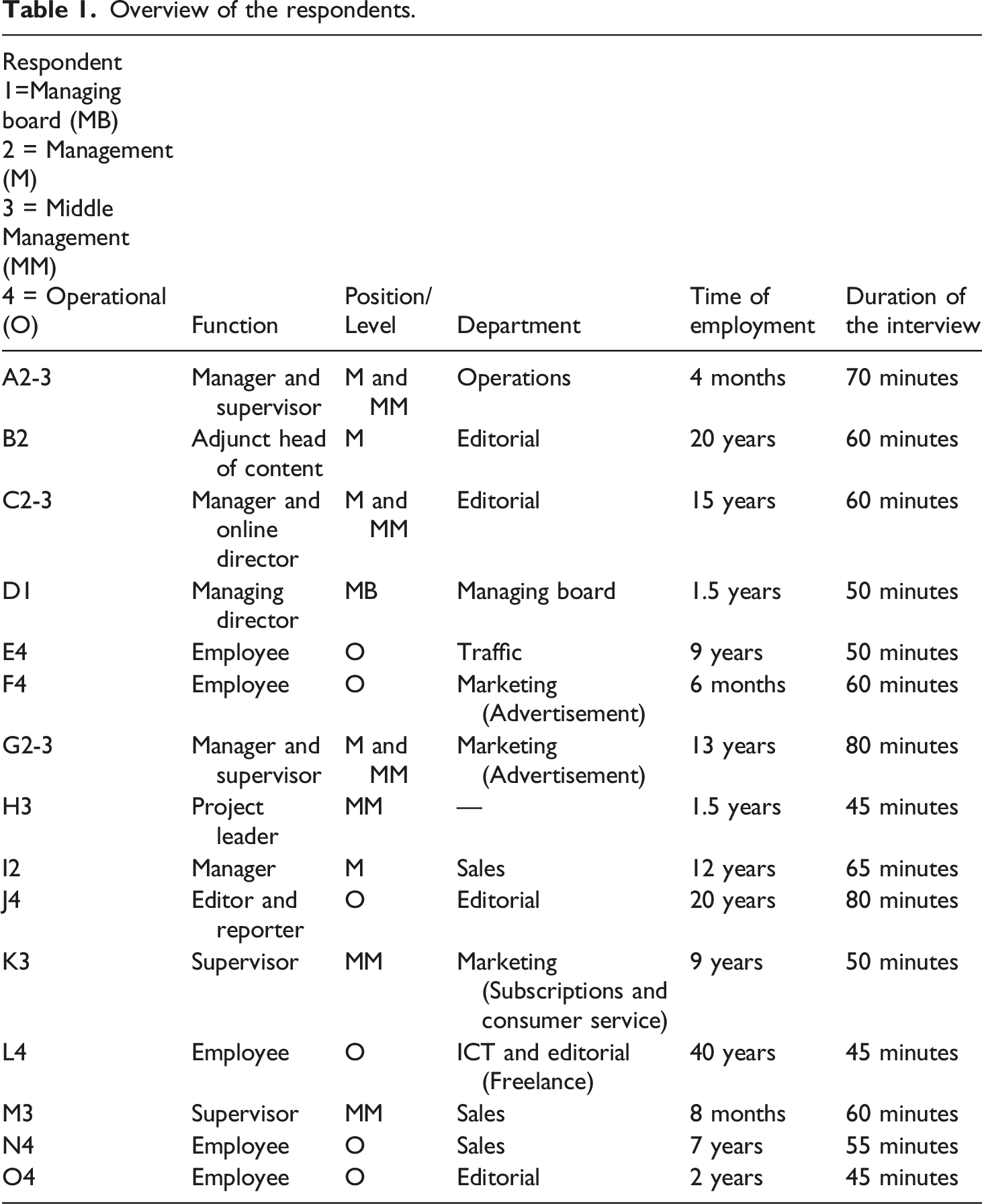
The interviews were recorded with the permission of the respondents and transcribed literally. We followed the three phases of coding: first, the transcripts were read carefully and every valuable interview fragment was provided with a label that represented the fragment (Bryman, 2012). Within this first phase of coding, Thornton et al.’s (2012) institutional framework with the types of societal institutional logics has been used as a starting point for analysing the presence of institutional boundaries. The existing broad and general concept defined by literature on boundary spanning provided the direction in deriving open codes for fragments related to boundary spanning. Organization leadership concepts related to facilitation and empowerment were used to analyse the role of organizational leaders. The number of open codes has been organized and minimized by merging overlapping codes and deleting non-relevant open codes. In the next phase, groups of themes were identified that presented institutional logics specific to the context of the case company. The same process was followed for the boundary spanning related fragments. These phases of open and axial coding alternated each other constantly as an iterative process. In the last phase of selective coding, specific patterns within the coded fragments were identified.
Results
Existing dominant institutional logics within the publishing and printing house.
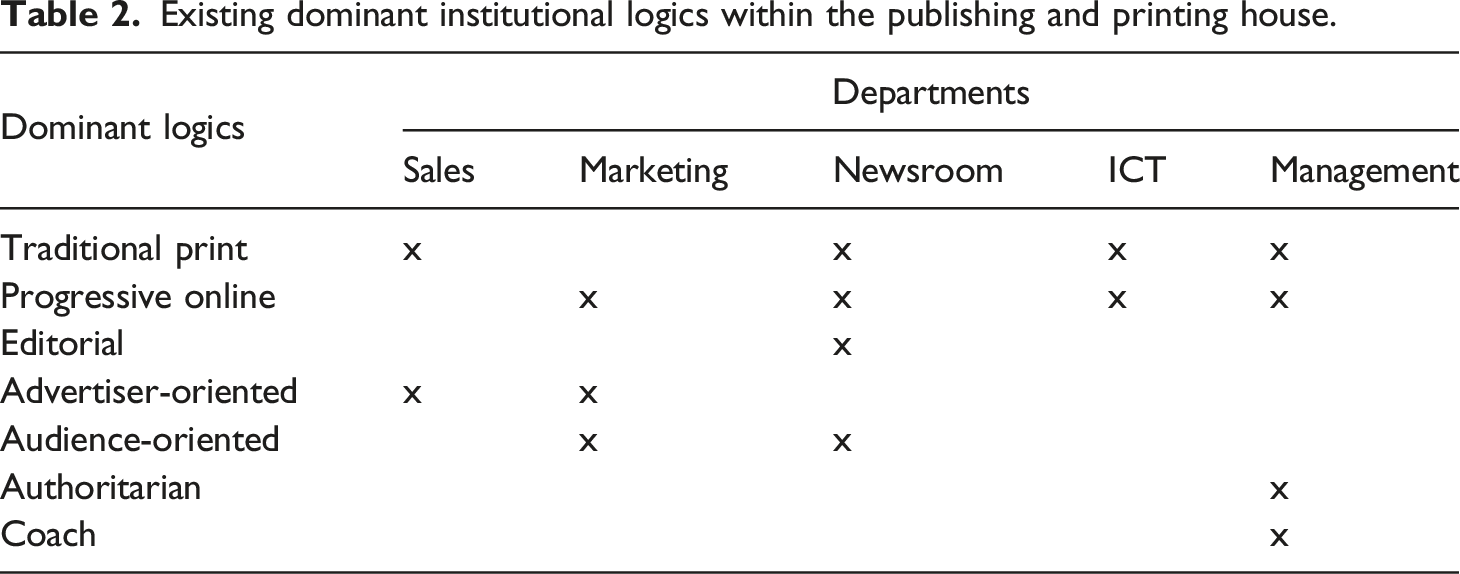
The behaviour of journalists, non-journalists and managers were not solely influenced by the dominant logic of their department or team, but also by their attitude towards the organizational transformation into an agile network organization with an increasing focus on online. Within the organization, a group of employees and managers believed that the core business of the organization should remain the traditional print media, while another group, driven by a progressive online logic, believed that organizational survival depends on a shift towards online activities. The existence of these different logics caused tensions and increased inner and outer group feelings. As a consequence, some individuals started to feel frustrated and thwarted by others. Despite the existing differences between logics, journalists, non-journalists and managers started to understand the need to change due to the deteriorating performance of the organization.
The transformation process of the organization started with the appointment of a new managing director in 2018. According to the respondents, the newly hired managing director set the organizational transformation in motion. Or as respondent J4 pointed out: “The managing director has played a very important role in this. He has a different vision than the previous managing board on how the company should function and how employees should be treated.’’ [J4]
The managing director started to assign managers and supervisors as nominated boundary spanners. According to the newly hired managing director, managers and supervisors had to play an important role to implement changes successfully further down the organization. Due to their position and authority within the organization, they were able to facilitate and to implement the changes to achieve the organizational goals. They could align their team members by involving them in the transformation process to increase the commitment for change.
Whether they were able to facilitate and enable employees to behave as more empowered and informed organizational actors depended on the skills and mindset of the nominated boundary spanners. The marketing manager, for instance, was an acknowledged nominated boundary spanner who was inclined to improve the relationship between the somewhat conservative sales department and the progressive marketing department. He organized inter-departmental meetings to align the different interests between the departments. Furthermore, he stimulated his marketing team to communicate outside the hierarchical communication lines and enabled the team members with the functional freedom to do so. As a member of the marketing team emphasized: “He tries to coach his marketing team to approach others and to collaboratively decide how to fill in this interdepartmental collaboration.’’ [F4]
Another acknowledged nominated boundary spanner was the adjunct head of the newsroom. He mitigated resistance for organizational transformation by having one-on-one conversations with individuals about their view and opinion concerning the transformation. During these personal conversations, he tried to emphasize the need for organizational transformation. Furthermore, the recently hired operations manager was also acknowledged by others as someone who tried to implement a more bottom-up approach by empowering his team members with more decision-making responsibilities. He used an inclusive management style. All his team members were valued and were treated with dignity and respect.
Not every nominated boundary spanner was able to execute the assigned tasks. In particular, nominated boundary spanners characterized with the traditional authoritarian logic struggled with their tasks to contribute to the transformation of the organization towards a more open and agile network organization. They found it not easy to adapt a more facilitating and coaching role after having been acting as the ‘boss’ for many years. The organization offered training programs to facilitate these boundary spanners to change their directive leadership style into a more coaching one. However, these boundary spanners did not experienced enough support in adapting the coaching logic. As respondent (G2-3) observed: “Managers and supervisors are solely informed to change their managerial function. I miss real support to help them to change their leadership style. For example, HR can join and facilitate the conversations between the supervisors and the operational employees and allow them to give feedback to their supervisors. They can learn from the feedback.’’ [G2-3]
Although the managing director organized personal coaching sessions, he also stimulated operational employees to disobedient their supervisors if they showed a too much authoritarian behaviour. This created tension between him and the boundary spanners. Or as respondent D1 emphasized: “I call on people to be disobedient to their supervisors. Managers are not happy with this but it helps to improve the empowerment of employees. Furthermore, it enables discussion which ultimately improves the performance of the organization.’’[D1]
In the meantime, the managing director tried to create a context to facilitate boundary spanners in achieving the organization goals. He implemented a new work structure of temporary multidisciplinary project teams. The aim of these teams was to accelerate the shift towards online activities and to improve organizational agility and innovativeness. He introduced the scrum methodology and facilitated managerial members to use this method by providing them with scrum training sessions. Furthermore, he activated employee engagement by stimulating information exchange by organizing periodical meetings with departments to inform employees about the current organizational situation and to give them the opportunity to ask questions about decisions taken. Furthermore, he launched an internal digital communication platform. On this platform, boundary spanners could share information about the multidisciplinary projects and employees could share their ideas to foster the transformation.
Although the nominated boundary spanners were empowered to involve employees within multidisciplinary projects, these multidisciplinary projects teams were not very successful. The reason was that many of these projects mostly consisted of nominated boundary spanners and individuals driven by a progressive online logic. As respondent G2-3 observed: “The frontrunners are the ones that get involved in the projects. As a result, you miss the connection with many other colleagues and so you are not actively involving them in the transformation process. They will not embrace the changes.’’ [G2-3]
Due to the composition of teams, the organization did not received many new ideas, and suggestions to bridge the gap between different or even conflicting institutional logics. According to the respondent from the ICT department: “Those projects always include the same people. They are from the management or middle management. […] Maybe you should also invite other people to those projects as well. Especially operational employees often come up with very good ideas but they do not get the attention.’’ [L4]
Respondents observed that the organizational leaders skipped a crucial step in the transformation process. They did not defined and communicated a clear organizational transformation roadmap including goals. As respondent M3 and respondent A2-3 emphasized: “…the bigger picture is missing. […] A coherent vision that everybody can relate to would contribute to more and better cooperation within the organization.’’ [M3] “The plan above all needs to be sharpened. Now, we just let it happen so to speak. We are just doing a lot of things and we will see whether it is successful or not. We notice that it is difficult to define the goals of the projects we are doing. Everybody thinks differently about the goals of the projects.’’ [A2-3].
Due to a lack of a clear vision on the transformation including organizational goals, employees missed guidance in the transformation process, resulting in misalignment of achieved individual, departmental, and organizational goals. The misalignment was enhanced by the functional organizational structure and the presence of stand-alone departmental goals. Employees were mainly rewarded when they achieved their individual and departmental goals. They were not stimulated to invest time and effort in creating and maintaining cross-boundary relationships. Respondents emphasized that the reward system actually strengthen the internal focus of departments. The reward system did not rewarded cross-boundary co-operations and collaborations. As respondent O4 stressed: “Rewarding people who cooperate with other departments? We are not stimulated to do that.” [O4]
These non-beneficial conditions did also not really facilitated boundary spanners to operate and execute their tasks effectively. They also had to deal with an organizational culture that did not really shown appreciation for employees functioning as boundary spanners-in-practice. According to the respondents, more acknowledgment for boundary spanning efforts could help to improve the performance of boundary spanners and could increase the number of boundary spanner-in-practice. As respondent C2-3 emphasized: “If you hear more often you are doing a great job or something like that, it will stimulate people to take up such an intermediary role. […] If you make people who are trying to span boundaries more important or give them at least some attention, they will be encouraged to continue doing that.’’ [C2-3]
Conclusion and discussion
The rise in digital technology has disrupted the local news media landscape. Many communities have witnessed their local news media organizations closed in recent years or laid off of journalists, reduced media coverage and circulation after suffering from deteriorating performance. The industry’s old way of doing business no longer ensures economic pathways that are viable and sustainable for incumbent local news media organizations (Doyle, 2013; Evens et al., 2017; Peters and Boersma, 2017). The dramatically altered local media landscape has affected among others the quantity and quality of local news and citizen engagement (Hayes and Lawless, 2017). To maintain their vital role in the society, incumbents should not only focus on restructuring as a response to deteriorating performance, but also on revitalization of the organization (Chakrabarthy and Gargiulo, 1998). Although organizational leaders do understand the need to transform the local news media organization, they do not always succeed in making the organizational transformation. Literature shows that the existence of different or even conflicting institutional logics within the organization can create boundaries hampering the transformation (Akkerman and Bakker, 2011). Organization leaders can assign boundary spanners to overcome these boundaries and to foster the transformation process. Although organization leaders set the organizational goals and empower and facilitate the boundary spanners to operate and execute their tasks effectively, research about their role is limited. Therefore, this study aimed to increase our understanding of the role of organisational leaders in empowering and facilitating boundary spanners in an organizational transformation process. We applied the boundary spanning theory in combination with the organizational leadership theory to analyze a Dutch regional news media organization that is in the middle of an organizational transformation process. In this way, we contributed to the transformation literature of news media organizations.
The case study showed that different institutional logics existed within the organization. Among these different logics the tension between the traditional print logic and the progressive online logic influenced the progress of the transformation. Organizational leaders assigned managers and supervisors as boundary spanners to overcome the boundaries and accelerate the transformation process. However, they were not always the most effective boundary spanners-in-practice, although they had the position and the power to organize and execute boundary spanning activities. Boundary spanners with an authoritarian logic were less effective to involve and facilitate employees to commit to the organizational transformation. The transformation from a hierarchical organization towards a more open and agile network organization fits more the coaching logic rather than the more traditional authoritarian one. Even when they were willing to adapt the coaching logic, they did not always felt the support from the organizational leaders. Although organizational leaders offered training and personal coaching sessions, they did not created a save context that facilitated these boundary spanners to adapt the coaching logic. Organizational leaders even stimulated employees to disobedience their managers or supervisors. This created new tensions within the organization between the assigned boundary spanners and their team members and between the boundary spanners and the organizational leaders. When organizational leaders make decisions they should always consider whether the decisions are reinforcing or weakening the empowerment and facilitation of boundary spanners to operate effectively.
Organizational leaders introduced a new work structure of temporary multidisciplinary project teams working with the scrum methodology to improve organizational agility and innovativeness. The new context was not really fostering the transformation. Teams consisted mainly of frontrunners characterized with the progressive online logic. However, these teams are only effective when teams also include employees who have other institutional logics. Moreover, everyone within the organization should be included in the transformational process, otherwise the boundary spanning efforts may not be effective to foster the organizational transformation.
Another finding is that the organization showed a lack of a clear vision including organizational goals on the transformation, misaligned departmental goals, and a reward system rewarding employees for accomplishing their daily functional activities and not for cross-boundary co-operation activities between and within departments. Due to a not well-defined vision including organizational goals, employees missed guidance in the transformation process and shared goals to collectively worked on. Furthermore, the rewarding of employees depended on the achievement of individual and departmental goals and not on cooperation with other departments in the organization. In this context, boundary spanners were not enough facilitated to organize and execute their tasks effectively. Organizational leaders are responsible for defining and communicating a clear vision and setting related goals for the organization (Bass, 1990). They should also create a context to empower and facilitate employees to achieve these goals (Dinh et al., 2014; Siagchokyoo et al., 2020). This means that the reward system should include the achievement of shared goals and collaborations between departments to contribute to the transformation. In this context, boundary spanners can play an important role in making the transformation successfully. The finding confirms previous studies that organizational leaders should develop and facilitate beneficial conditions and policies to facilitate boundary spanners to operate efficiently (Schotter et al., 2017).
Although the findings from the case study are in line with findings from studies from other industries, this study also confirms the uniqueness of news media organizations. For instance, these organizations have to deal with the existing tension between the editorial and the market related audience and advertising logics within the organization hindering the transformation process. These organizations are not thoroughbred commercial entities. Information including news is not only a market-based good. It also is a public good and fundamental to ensuring that the information needs of communities are met in democratic societies (Plessing, 2014). Due to the unique character of news and information, it is generally a challenge to sell news and information as a profitable business activity. It has always been primarily financed by arrangements based on income derived from sources other than selling news to consumers (Picard, 2013). More research is needed to understand how local news media organizations can deal with these challenges to maintain their vital role in the society.
The results of this study could be strengthened with a cross-case comparison. In such a way we could test whether the impact of organizational leaders on the effectiveness of boundary spanners was particular to our case, or whether it is a more general phenomenon in the transformation process of local incumbent news media organizations. It would also be interesting to investigate how antecedents of organizational leaders may play a role in the empowerment and facilitation of boundary spanners in fostering the transformation of local news media organizations.
Footnotes
Declaration of conflicting interests
The author(s) declared no potential conflicts of interest with respect to the research, authorship, and/or publication of this article.
Funding
The author(s) received no financial support for the research, authorship, and/or publication of this article.
