



Abstract
Current research has shown that transformational leadership improves instructional practice, particularly by creating an environment that promotes educators and fosters a sense of belonging to improve teaching and learning efficacy. Despite substantial evidence that transformational leadership motivates educators, improves change-oriented organizational citizenship behavior, promotes organizational appreciation, and improves instructional practices, research on their interconnections is lacking. To fill this gap, this study used a moderated mediation model to look at how transformational leadership affects the way teachers teach in the UAE government schools, where ongoing reforms to education stress the importance of leadership-driven pedagogical improvement. Data were collected from 297 teachers across government schools in the United Arab Emirates (UAE) using survey tools that assessed transformational leadership, change-oriented organizational citizenship behavior, perceived organizational appreciation, and instructional practices. After controlling for gender, medium of instruction, teaching cycle, and experience, the findings revealed a significant relationship between transformational leadership and instructional practices, but only when perceived organizational appreciation was high. Furthermore, change-oriented organizational citizenship behavior fully mediated the relationship between transformational leadership and instructional practices. Additionally, perceived organizational appreciation moderated the mediation process in the path from change-oriented citizenship behavior to instructional practices. These findings highlight the critical role of leadership in fostering a supportive organizational climate that enhances instructional effectiveness. The study underscores the need for educational policymakers and school leaders to cultivate appreciation-driven environments that empower teachers to engage in innovative and change-oriented instructional practices.
Plain Language Summary
In an understudied setting, the current study used a moderated mediation model to investigate the processes behind the link between transformational leadership and instructional practices. Survey instruments assessing transformational leadership, change-oriented organizational citizenship behavior, perceived organizational appreciation, and instructional practice were used to gather data from 297 teachers in government schools in the United Arab Emirates (UAE). Following adjustments for gender, medium of instruction, teaching cycle, and experience, the results revealed a strong correlation between transformational leadership and instructional practice but only when perceived organizational appreciation was high. Moreover, change-oriented citizenship behavior totally mediated the interaction between transformational leadership and teaching strategies. Furthermore, perceived organizational appreciation affected the mediation process in the road from change-oriented citizenship behavior to instructional practice. The results of this study show how well moderated mediation models help to understand the conditional indirect effects of transformational leadership on educational practices.
Keywords
Introduction
Strong and effective leadership is essential for guiding schools through the complexities of modern education. As instructional landscapes evolve due to technological advancements, blended learning, and flexible learning spaces, school leaders play a crucial role in fostering adaptive teaching methods, cultivating a supportive organizational culture, and ensuring that teachers feel valued and appreciated. Transformational leadership (TL), which emphasizes vision, motivation, and individualized support, has been widely recognized as a key driver of instructional improvement, shaping both teacher engagement and organizational climate (Bellibaş et al., 2021; Bush, 2014; Gumus et al., 2018). By creating an environment that values recognition and collaboration, TL fosters the conditions necessary for teachers to engage in professional growth and innovative instructional practices (Kwan, 2019; Shields & Hesbol, 2020).
A growing body of research highlights that TL enhances instructional effectiveness by fostering teacher motivation, encouraging proactive engagement in school development efforts, and promoting a culture of recognition and appreciation (Eyal & Roth, 2011; Cansoy, 2018; Ma & Marion, 2021; Nasra & Heilbrunn, 2016). Specifically, TL has been linked to change-oriented organizational citizenship behavior (COCB), where teachers take initiative in improving school processes, as well as to organizational appreciation (OA), which reinforces teachers’ perceptions that their contributions are valued (Kouali, 2017; Khasawneh et al., 2012). However, despite evidence connecting TL to these factors, less is known about how they interact to influence instructional practices. In particular, it remains unclear whether COCB serves as a key explanatory mechanism between TL and instructional practices and whether OA strengthens or weakens this effect. Understanding these relationships is critical, as a lack of appreciation within schools may diminish teachers’ willingness to adopt innovative instructional strategies, ultimately affecting educational quality.
This study addresses these gaps by employing a moderated mediation model to examine how TL influences instructional practices through the mediating role of COCB and the moderating effect of OA. Grounded in Conservation of Resources (CoR) theory, which posits that workplace resource depletion can lead to disengagement and reduced performance, we argue that strong school leadership can mitigate these effects by fostering an environment where teachers feel supported and valued (Cooper & Quick, 2017; Hobfoll, 2011; Park et al., 2014). By integrating perspectives from leadership and instructional research, this study provides insights for policymakers and practitioners on optimizing leadership practices to improve teaching effectiveness. Specifically, we examine (a) whether COCB mediates the relationship between TL and instructional practices and (b) whether OA moderates both the direct and indirect effects of TL on instructional practices through COCB. Addressing these questions contributes to a deeper understanding of how leadership strategies can enhance instructional quality and student success in evolving educational settings.
Theoretical Framework
The CoR theory (Hobfoll, 2011) posits that individuals are continually preoccupied with their access to resources. Resources are the elements that teachers need to effectively carry out their responsibilities (Bettini et al., 2020; Holmgreen et al., 2017). Teachers may benefit from various forms of support, including social support from colleagues or leaders, instructional and personal resources, such as pedagogical knowledge, subject knowledge, and classroom management competencies (Halbesleben et al., 2014). Additionally, resources can be valuable attitudes like self-efficacy and motivational beliefs (Hobfoll, 2011). Therefore, individuals can experience stress due to concerns about the potential loss of these resources, as their depletion poses a threat to their professional growth as teachers and potentially jeopardizes their job security. To manage or avoid this stressful situation, teachers actively engage in acquiring and maintaining new resources, also referred to as resource conservation. To ensure their survival, it is crucial for teachers to possess dependable reservoirs of resources.
CoR theory provides a comprehensive framework to explain how TL in schools affects teachers’ COCB, OA, and IP. In environments with high resource levels, such as those under a transformational leader, resources can be maintained, added to, or made resilient to losses (Bass & Riggio, 2006). High social resources, such as support from the principal or teaching team, physical resources (e.g., good access to high-quality teaching facilities and resources), and internal resources (e.g., training and teaching qualification programs), can encourage COCB and OA. According to CoR theory, high-resource environments promote further resource gains (Holmgreen et al., 2017). High levels of COCB may lead teachers to use their teaching knowledge and skills to improve classroom instruction and increase their resources. Inadequate resources in school settings can result in subpar instructional practices and collaboration among teaching and grading teams. Low-resource school environments can lead to poor interpersonal dynamics among teachers, as they may exhibit self-protective behaviors commonly seen in stressed employees (Haq & Bouri, 2022).
Transformational Leadership and Instructional Practice
From the perspective of CoR theory, TL can be seen as a significant resource for teachers. It provides support, motivation, and opportunities for growth, which are valued resources in the workplace (Bettini et al., 2020; Hobfoll, 2011). Individuals strive to accumulate and protect their resources, and in the context of teaching, TL represents a valuable resource that encourages teachers to engage in effective IPs.
Research in the field of education is increasingly demonstrating the beneficial effects of TL on educational outcomes. Most of the research in this field concentrates on indirect impacts, such as enhancing teacher motivation and intellectual stimulation (Bellibaş, et al., 2021; Herawati & Haryono, 2020), and enhancing teacher effectiveness (Windlinger et al., 2020) to enhance student outcomes (Eyal & Roth, 2011). However, evidence regarding indirect effect is not conclusive Leithwood and Sun (2012) have demonstated a clear and direct relationship between TL and IP. The authors of this meta-analysis offered a precise definition of TL, encompassing several distinct leadership practices, two of which were directly linked to enhanced instructional practices. Therefore more research is need to make a provide a more established argument regarding the direct and indirect association between TL and IP.
Change-Oriented Citizenship Behavior as a Mediator
COCB involves proactive efforts to improve the work environment (Bettini et al., 2020; Koopman et al., 2015). These efforts usually go beyond the duties explicitly stated in the employment contract and involve making positive changes to the organization. Previous studies have indicated that COCB could be a promising psychological mediator in the relationship between TL and IP (Mitchell, 2019; Yu, 2019). This means that TL practices can encourage teachers to make constructive modifications to their classrooms or even to the entire school to enhance TP (Liu, 2021) because TL prioritizes the cultivation of a trusting and compassionate educational setting (Leithwood & Sun, 2012), wherein teachers are encouraged to undertake proactive measures to enhance IP.
The mediating role of COCB can be explained using the CoR theory framework. This theory posits that employees who perceive their resources to be conserved and protected are more inclined to engage in voluntary behaviors that are advantageous to their organization. According to Hobfoll (1989), the act of conserving resources can boost an individual’s feelings of safety and overall happiness, which, in turn, promotes behaviors that benefit others. Leadership behaviors such as those exemplified by TL contribute to the creation of a school environment that values teachers’ resources. Consequently, this may have positively influenced teachers’ inclinations to display COCB. This is consistent with the notion that teachers are more inclined to go above and beyond their official job responsibilities when they believe that their resources are being conserved and replenished, rather than exhausted. Moreover, TL encourages followers to embrace change and innovation (Kammerhoff et al.,2019). This leadership style motivates teachers to challenge the status quo and engage in behaviors that promote positive change. Teachers who experience TL are more likely to exhibit COCBs, as they are inspired to contribute to the betterment of the organization.
This study suggests that TL can have a pivotal impact on teachers, motivating them to implement beneficial modifications in their classrooms or across the entire school to enhance pedagogy and knowledge acquisition. This leadership style cultivates an atmosphere motivating teachers to be creative and proactive in enhancing their teaching methodology (Berkovich & Eyal, 2017; Sezgin et al., 2024). Consequently, teachers may participate in what is known as COCBs. Teachers engage in COCBs, which encompass activities that surpass their official job responsibilities, to foster beneficial transformations within schools. These behaviors may encompass activities such as assuming leadership positions, engaging in professional development initiatives, implementing innovative teaching methods, and collaborating with peers. According to CoR theory, when teachers engage in COCBs, they acquire the emotional and professional resources required to start and maintain positive changes in their teaching methods. The resources encompassed in this context may consist of self-assurance of one’s capabilities, a feeling of possessing responsibility for one’s work, assistance from peers and superiors, and dedication to ongoing enhancement. By utilizing TL, educational administrators can establish a supportive and empowering environment that fosters teacher motivation and confidence in the implementation of effective instructional strategies. Ultimately, this can result in improved teaching methods and academic performance. Based on previous analysis of the relevant literature and CoR theory, we propose the following hypothesis:
H1: COCB acts as a mediator in the positive relationship between TL and IP.
Organizational Appreciation as a Moderator
OA pertains to the degree to which employees perceive themselves as valued and acknowledged for their contributions within the organization (Milliman et al., 2003). Teachers who receive recognition and appreciation from their school administrators are more inclined to experience increased motivation, dedication, and job satisfaction (Guarino et al. 2006). OA can manifest in diverse ways such as verbal acknowledgment, incentives, prospects for career advancement, and a nurturing work atmosphere.
The existing literature suggests that employees who form strong relationships and feel a sense of belonging and appreciation are more likely to experience greater job satisfaction and engagement (Bass & Riggio, 2006; Johnson & Martinez, 2021). Employees working in positive and appreciative environments report enhanced creativity and innovation, which results in a broader culture of innovation (Turner & Davis, 2019). Within an educational environment, this heightened recognition of organizations should be evident through enhanced teaching efficacy explained by overall job satisfaction (Huang et al., 2013). As such, supportive leadership behaviors that signal to the teacher that their teaching abilities are valued and appreciated likely increases teacher efficacy (Edinger & Edinger, 2018) and, in turn, increases teaching quality (Hidayah et al., 2023).
The CoR theory in the context of OA highlights the significance of providing teachers with fresh resources like skills, expertise, and social support through recognition and acknowledgment. When school leaders engage in practices that acknowledge employee achievements, it fosters a positive cycle of resource accumulation, enhancing well-being and promoting continuous learning. Teachers who feel valued by their leaders are motivated to improve teaching methods, leading to better outcomes in teaching and learning (Park et al., 2014).
Regarding the moderating influence of OA on the TL-COCB relationship, teachers are more likely to engage in COCBs when the school principal demonstrates more TL. These behaviors include taking on leadership roles, engaging in professional development activities, and implementing new teaching strategies. The moderating effect of OA implies that the influence of TL on COCBs can be strengthened or weakened based on the degree of OA within a school. Teachers who perceive a significant amount of OA are more likely to participate in COCBs as result of TL. Being appreciated and acknowledged for their endeavors can bolster their drive and dedication to making constructive contributions to the school (Geijsel et al., 2003). If teachers perceive low levels of OA, the positive impact of TL on COCBs may decrease. In the absence of appreciation or acknowledgment, teachers may exhibit reduced motivation to proactively undertake or dedicate extra effort to implementing change, even if prompted by transformational leaders (Moolenaar et al., 2010). Hence, OA functions as a mediator that enhances or alleviates the impact of TL on teachers’ conduct. The synergy between TL and strong OA cultivates a favorable setting for promoting COCBs among teachers, resulting in enhanced teaching practices and superior student learning outcomes (Thoonen, et al., 2011). Therefore, the following hypothesis is posed:
H2a: OA significantly moderates the direct relationship between TL and COCB.
Regarding the moderating influence of OA on the COCB-IP relationship, the presence of OA within a school may influence the impact of COCBs on IP. Teachers who perceived a high degree of OA are more inclined to experience motivation, commitment, and satisfaction with their role. The presence of a positive organizational climate cultivates feelings of trust and loyalty among teachers, motivating them to persist in participating in COCBs (Skaalvik & Skaalvik, 2011). Consequently, they may be more motivated to adopt innovative IPs, explore new teaching methods, and pursue professional development opportunities to improve their teaching practices. However, in a setting where there is a lack of recognition, or if it is believed that recognition is insufficient, the strong connection between COCBs and IP may be weakened. Teachers may experience feelings of being underappreciated, unacknowledged, or lacking support, which can reduce their drive to dedicate more effort to implementing changes or enhancing instructional methods (Day & Gu, 2013). Hence, OA functions as a moderator that can either strengthen or diminish the connection between COCBs and IP. A supportive and appreciative organizational climate increases the probability that teachers will convert their proactive efforts into concrete enhancements in IP, ultimately leading to improved student learning outcomes (Thoonen et al., 2011). Therefore, we hypothesize that:
H2b: OA significantly moderates the indirect relationship between TL and IP through the mediating effect of COCBs.
Methods
Sample
The sampling frame for this study consisted of teachers currently working in government-funded schools in the Abu Dhabi Emirate and teaching middle and high school grades. According to the most recently published statistics, 10,441 teachers work in government schools in Abu Dhabi (Statistics Centre Abu Dhabi, 2020), with 3,009 working in Cycle 2 (middle) and Cycle 3 (high) exclusively, and 5,161 were not assigned to a specific cycle. Of these multistage teachers, approximately 43% were instructing at the kindergarten (KG) and primary levels, while 57% were engaged in teaching at Cycles 2 and 3, specifically in secondary education. From this, it was calculated that there are an estimated 5,950 teachers currently teaching in Cycles 2 and 3 in government-funded schools in the Emirate of Abu Dhabi. Teachers from Cycle 2 and 3 were selected as the target demographic for the following reasons. Firstly, secondary school educators conduct highly specialized classes necessitating distinct pedagogical topic knowledge that informs domain-specific instructional methodologies. In this more autonomous context (OECD, 2023), the impact of transformational leadership techniques on instructional innovation and adaptability may be more significant than for generalist educators. The role of organizational appreciation as a moderator may be more significant in secondary schools.
Convenience sampling and snowball sampling were chosen to gather data from a specific group of participants. Following this approach, 329 teachers were selected from Cycles 2 and 3 in public schools across the Emirate of Abu Dhabi, constituting approximately 5% of the total sampling frame. In addition to convenience sampling, the snowball technique, a non-probability sampling technique was employed to enhance participant recruitment. By combining convenience sampling and snowball sampling, we successfully recruited a diverse cohort of Cycle 2 and Cycle 3 teachers from public schools in the Emirate of Abu Dhabi. We adopted these techniques due to the study’s contextual framework. Convenience sampling facilitated access to a readily available participant pool, circumventing the bureaucratic complexities associated with stratified sampling at educational institutions. Snowball sampling facilitated a broader spectrum of replies via referrals inside professional networks. Moreover, probabilistic techniques presume that variables are uniformly distributed throughout the sample and may fail to identify instances of teachers demonstrating COOCB or OA (Etikan & Bala, 2017). On the other hand, the 5% sample size approximation offers a practical, efficient, and dependable approach for ascertaining representative samples without superfluous resource allocation. Instead of pursuing disproportionately large sample sizes, we ought to concentrate on sampling strategies that harmonize precision, cost, and feasibility—an objective that the 5% rule successfully fulfills (Wan et al., 2014). The objective was to capture a comprehensive range of perspectives from educators working in different educational contexts (Bryman, 2016). This strategic approach ensures a well-rounded representation of experiences and insights.
Data Collection
An online survey was selected as the primary means of data collection because of its convenience and flexibility (Dillman et al., 2014). Participants were provided with a web link to the survey, enabling them to respond at their own convenience and from any location with internet access. Online surveys facilitate efficient data gathering from a dispersed and diverse participant pool, making them suitable for reaching a broad range of individuals (Krosnick et al., 2015). The online format allowed teachers to complete the survey autonomously, ensuring that their responses were unbiased and not influenced by external factors. This approach minimizes potential interviewer bias and encourages candid and authentic responses (Reips, 2002).
The study minimized risk by using non-sensitive survey questions, ensuring voluntary participation, and allowing withdrawal at any time without penalty. Surveys were anonymous, with no identifying information collected, and the study received ethical approval from the institutional review board. The research offers valuable insights for informing policy and improving practice in the field of education, benefiting both society and participants. Given the minimal risks—mainly time commitment and low emotional impact—the benefits outweigh potential harm. Informed consent was obtained through an introductory information sheet outlining the study’s purpose, procedures, risks, and confidentiality. Participants indicated consent by checking a box before starting the survey.
Measures
The outcome measure used in this study was the teachers’ IP scale. The items included in the scale were selected from the inquiry-based instruction, teacher-directed instruction, and adaptive instruction scales used in the PISA 2015 student background questionnaire (OECD, 2017). The wording of the items was adapted to suit a teacher-directed questionnaire rather than the original student-directed questionnaire. As in the original study, the respondents were required to choose an option on a five-point Likert scale (ranging from 5 = “in every lesson” through to 1 = “almost never”) regarding the frequency with which they employed instructional practice. Example items include “I explain how a science idea can be applied to several different phenomena (e.g., the movement of objects, or substances with similar properties)” and “I change the structure of the lesson on a topic that most students find difficult to understand” (Cronbach’s alpha = .959). Appendix A shows all the measurement items.
The TL scale consists of five items that reflect the underlying concepts of transformational leadership. Teachers were asked to report to what extent they agreed with several statements on a five-point Likert scale ranging from 5 = “strongly agree” to 1 = “strongly disagree.” These items were drawn from the TL scale used in the PISA 2015 cycle (OECD, 2017). Example items include “The principal tries to achieve consensus with all staff when defining priorities and goals in school” and “The principal is aware of my professional needs” (Cronbach’s alpha = .946).
COCB was measured using items adapted from Morrison and Phelps (1999) and implemented by Choi (2007). The items were adapted and disaggregated to reflect voluntary and school-based behaviors. The items required responses on a five-point Likert scale ranging from 5 = “strongly agree” to 1 = “strongly disagree.” Example items include “I frequently come up with new teaching methods” and “I frequently come up with new ways to complete a task” (Cronbach’s alpha = .918).
Organizational appreciation (OA) was measured using items adapted from the organization-based self-esteem scale implemented by Pierce et al. (1989) and reduced to five items by Milliman et al. (2003). The scale was adapted in the present study to reflect the teachers’ views regarding how they are valued as employees in their schools, with responses on a five-point Likert scale ranging from “strongly agree” to “strongly disagree.” Example items include “My school makes me feel like I count around here” and “I feel like I am an important part of this school” (Cronbach’s alpha = .931).
Demographic items were also included as control variables based on previous studies: gender (male = 0, female = 1), teaching cycle (Cycle 2 = 0, Cycle 3 = 1), medium of instruction (English = 0, Arabic = 1), and years of teaching experience (a continuous scale variable) (Cairns, 2023; Mullis et al., 2020).
Data Analysis
Data analyses were conducted utilizing SmartPLS 4.1.1 (Ringle et al., 2024). PLS-SEM is capable of handling intricate models featuring numerous mediating and moderating relationships. PLS-SEM is superior for exploratory research and theory development compared to covariance-based SEM (e.g., AMOS, LISREL), rendering it appropriate for moderated mediation models (Hair et al., 2019). PLS-SEM demonstrates greater resilience to limited sample sizes, non-normal data distributions, and formative measurement models, aligning with the study’s methodology (Sarstedt et al., 2017).
The hypotheses were evaluated by using bootstrapping with 5,000 samples. The analyses utilized bias-corrected and accelerated 95% confidence intervals (CIs) with centered variables, as outlined by Aiken and West (1991). To assess the mediation effect, the PROCESS macro was used to compute bootstrapped CIs. Bootstrap methods are considered more effective than alternative tools for mediation analysis such as the Sobel test. We performed a bootstrap analysis with 1,000 iterations and bias-correlated estimates, as recommended by Hayes (2013). The mediation effects were considered significant if both the lower and upper CIs did not include zero. To gain a deeper understanding of the moderation effects, we calculated the conditional direct and indirect effects, referred to as “simple slopes,” using the “pick a point” approach (Hayes & Matthes, 2009; Preacher et al., 2006). This approach involves interpreting samples at one standard deviation above and below the mean as indicative of “high” and “low” levels of perceived OA, respectively.
Results
Assessment of Common Method Variance
To minimize common method variance (CMV) and social desirability response bias, we employed several strategies throughout the study. CMV was primarily addressed by using multiple data collection methods, which helped ensure that results were not overly influenced by a single source of data. To protect respondents’ privacy and reduce bias, we ensured that the survey was completed anonymously. On the first page, participants were reminded that their responses would remain confidential, and a reassuring statement was included: “There is no right or wrong answer to these questions. We value your overall impressions.” This approach was designed to encourage honest responses and mitigate social desirability bias. To further ensure the clarity of the survey and reduce potential sources of bias, we followed best practices outlined by Podsakoff et al. (2003), who recommended avoiding double-barreled questions and overly complex language. This helped ensure that each question was clear and unambiguous. After data collection, we assessed CMV using various statistical methods. Specifically, following Podsakoff et al. (2003), we tested two measurement models using partial least squares (PLS-SEM). The first model included all constructs, while the second introduced an additional latent variable. The results showed insignificant path coefficients, indicating that CMV did not significantly affect the data. Additionally, we examined the correlation matrix to verify that the significant relationships between the measured variables were consistent, further confirming the absence of CMV. In addition to CMV, we also considered the potential influence of negative affectivity bias, a psychological trait that can lead individuals to respond more negatively or irritably, which might skew the results (Watson et al. 1988). To account for this, we included a scale measuring negative affectivity, adapted from Yannopoulos et al. (2012). The scale consisted of three items, each rated on a five-point Likert scale (1 = Strongly Disagree to 5 = Strongly Agree): “I tend to become excessively irritated by minor setbacks”; “Frequently, I get feelings of irritation in response to minor inconveniences,”and“There are instances when I consistently feel a heightened state of tension throughout the day.” By controlling for negative affectivity, we ensured that this psychological trait did not distort the relationships we were testing. As Flynn et al. (2018) suggest, controlling for such biases is essential to minimizing method bias and ensuring the validity of the study’s conclusions.
Construct Validity
To assess convergent validity, the grand mean-squared loadings for the items on each scale were computed to derive the average variance extracted (AVE) value. The accepted minimum AVE value is 0.5, indicating that the construct explains at least 50% of the variance in the indicators on the scale (Fornell & Larcker 1981).
The method used in this study involved calculating the heterotrait-monotrait (HTMT) ratio, which serves as a measure of the correlations among all survey items, across different constructs relative to the correlation among items specified as belonging to the same construct.. The recommended threshold for HTMT values is <0.85, suggesting that the constructs are sufficiently distinct from one another as recommended by Henseler et al. (2015). The findings of the HTMT ratio analysis (see Table 1) show that the discriminant validity of the data is adequate.
Heterotrait-Monotrait (HTMT) Ratios.

Note. n = 297. Cyc = teaching cycle; Med = Medium of instruction; Exp = Experience; TL = Transformational leadership; COCB = change-oriented organizational citizenship behavior; OA = organizational appreciation.
Together, these metrics offer adequate evidence that a reflective measurement model comprising four latent constructs accurately describes the data. The reliability tests confirmed that the model meets the criteria for item reliability, internal consistency reliability, convergent validity, and discriminant validity. Thus, the model can address the substantive research questions outlined previously. Subsequently, we employed the variance inflation factor (VIF) to assess the presence of multicollinearity among the constructs, as advised by Wilden et al. (2013). The VIF values for the reflective measures varied from 1.191 to 3.302, significantly below the acceptable threshold of 5 (Hair et al., 2010). The results indicate that each variable exhibits a high degree of statistical significance, thus validating the appropriateness of the measurement model for the data (Table 2).
Correlations and Descriptive Statistics.

Note. n = 297. VIF = Variance inflation factor; Cyc = teaching cycle; Med = Medium of instruction; Exp = Experience; TL = Transformational leadership; COCB = change-oriented organizational citizenship behavior; OA = organizational appreciation.
Squared root of the AVE is on the diagonal. bCorrelations.
Table 2 shows that multicollinearity is not a concern, as none of the zero-order Pearson correlation coefficients exceed .90. The highest correlations were found between the constructs of transformational leadership (TL) and citizenship behavior (r = .728), as well as between TL and organizational appreciation (OA) (r = .759). However, these correlations are still below the square root of the Average Variance Extracted (AVE) values (shown on the diagonal), which confirms the discriminant validity of the constructs. The outcome variable, instructional practice, shows moderate correlations with the main constructs of the study: TL (r = .424), citizenship behavior (r = .524), and OA (r = .535).
Mediation Analyses
To test our first hypothesis, that COCB mediates the relationship between TL and IP, we conducted a mediation analysis (Table 2). The impact of TL on IP was statistically significant (β = .170, p < .01). There was also a significant and positive effect of TL on COCB (β = .490, p < .001) and of COCB on IP (b; β = .301, p < .05), such that the indirect effect of COCB on the relationship between TL and IP was significant (β = .148, 95% bias-corrected bootstrap .053 to .264). Although there was a significant indirect effect, the direct effect between TL and IP remained statistically insignificant (β = .022, p > .10), suggesting complete mediation and providing support for H1.
Moderated Mediation Analyses
We performed moderation and moderated mediation analyses to examine our second hypothesis. The results are displayed in Tables 4 and 5. These tables list the path coefficients for the proposed version of the model, with significant paths denoted by asterisks. These findings suggest substantial mediation and interaction effects. Specifically, teachers with a higher perception of OA experienced a significantly greater direct influence of TL on IP. Similarly, teachers with a higher perception of OA experienced a notably stronger indirect influence of TL on IP through the mechanism of COCB.
To gain a deeper understanding of this moderating effect, we conducted simple slope analyses to examine the conditional effects of COCB and TL on IP. These analyses were performed using the “pick a point” method outlined by Preacher et al. (2007). This method uses the data points of the moderator variable to calculate the effect of the independent variable at each individual data point. The analysis of conditional direct effects (Table 3) reveals a significant positive moderation effect of perceived OA on the relationship between TL and IP (conditional direct effect = .233, p < .01). Similarly, the analysis of conditional indirect effects (Table 4) revealed a significant positive moderation effect of perceived OA on the relationship between TL and IP through COCB (conditional indirect effect = .232, p < .01). To provide a descriptive analysis, we graphed the projected IP against TL, differentiating between low and high levels of perceived OA (1 standard deviation below and above the mean, respectively; Figure 1).
Mediation Results (Process Macro).

Note. n = 297. Cyc = teaching cycle; Med = Medium of instruction; Exp = Experience; TL = Transformational leadership; COCB = change-oriented organizational citizenship behavior; SE = standard error; LLCI = lower limit confidence interval; ns = not significant; UCLI = upper limit confidence interval.
p < .05, **p < .01, ***p < .001.

Conceptual model.
As stated by Preacher et al. (2007), Tables 4 and 5 display the point estimates and 95% CIs for the conditional direct and indirect effects, following the recommended approach. When perceived OA was high, a significant direct effect was observed (.191; 95% CI [0.105, 0.456]). In contrast, direct effects were not significant at moderate and low levels of perceived OA (.054; [−0.032, 0.277] for the moderate level; −.084; [−0.220, 0.096] for the low level). Moreover, the indirect effects of perceived OA were statistically significant at all levels, including high, moderate, and low. The effect sizes were as follows: .326 [0.173, 0.573] for the high value, .259 [0.142, 0.460] for the moderate value, and .192 [0.099, 0.341] for the low value. Similarly, we graphed the projected IP in relation to COCB for low and high levels of perceived OA (1 standard deviation below and above the mean, respectively) (Figure 2). In summary, the relationship between TL and IP is influenced by the perceived level of OA, affecting both direct and indirect paths. This finding supports both hypotheses H2a and H2b (Figure 3).
Moderation Results-Conditional Direct Effects (Process Macro).

Note. n = 297; Cyc = teaching cycle; Med = Medium of instruction; Exp = Experience; TL = Transformational leadership; COCB = change-oriented organizational citizenship behavior; SE = standard error; LLCI = lower limit confidence interval; ns = not significant; UCLI = upper limit confidence interval.
p < .05. **p < .01. ***p < .001.
Moderated Mediation Results-Conditional Indirect Effects (Process Macro).

Note. n = 297; Cyc = teaching cycle; Med = Medium of instruction; Exp = Experience; TL = Transformational leadership; COCB = change-oriented organizational citizenship behavior; SE = standard error; LLCI = lower limit confidence interval; ns = not significant; UCLI = upper limit confidence interval.
p < .05. **p < .01. ***p < .001.
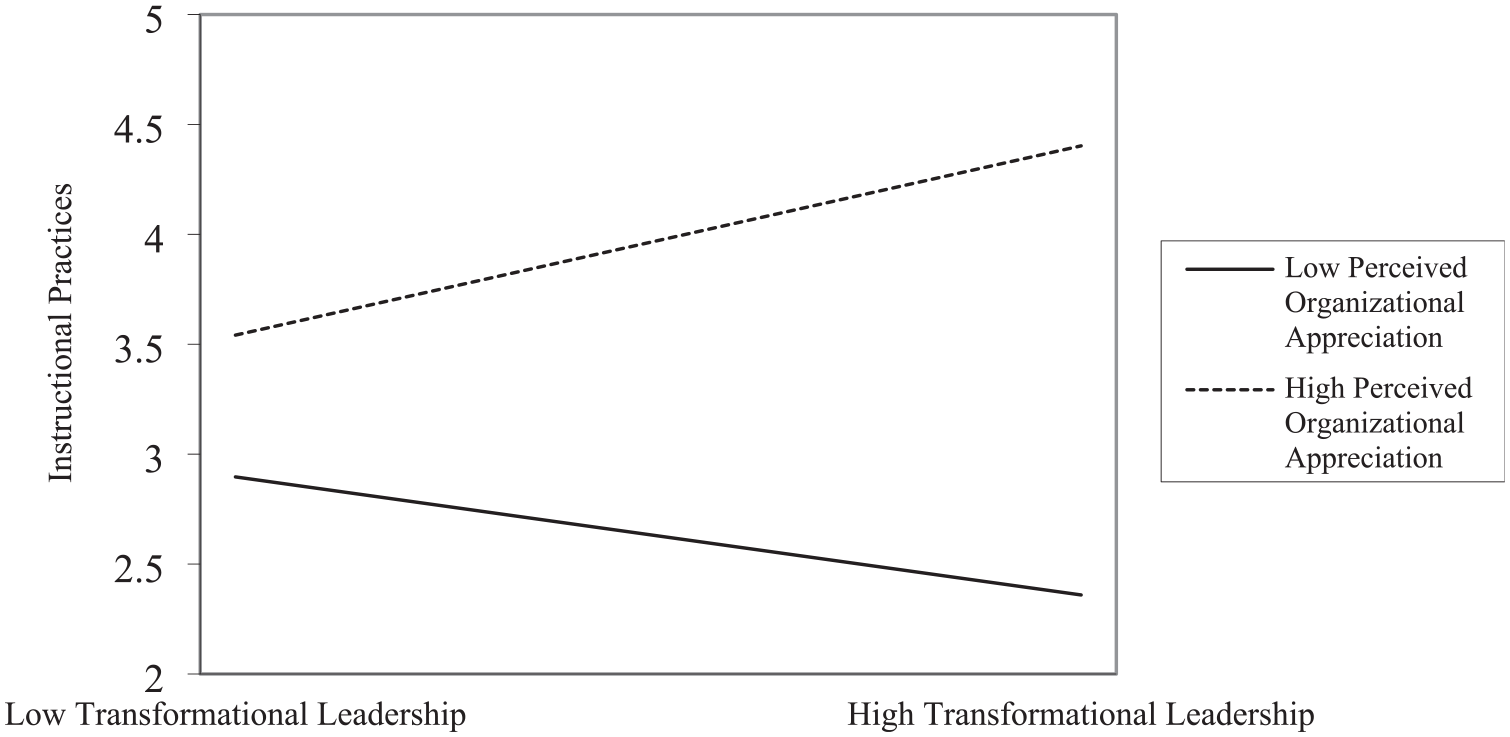
The interaction of transformational leadership and perceived organizational appreciation on instructional practices.

The interaction of change-oriented citizenship behavior and perceived organizational appreciation on instructional practices.
Discussion
The effect of leadership styles on IP has garnered considerable academic interest (Bellibaş et al., 2022). Nevertheless, the fundamental regulatory and mediating mechanisms remain largely unresolved. Based on recent studies on organizational behavior and psychology (Bakker et al., 2023; Kaltiainen et al., 2024), and the CoR theory, we tested (a) whether COCB mediates the positive association between TL and IP and (b) whether perceived OA would moderate the direct association between TL and IP as well as the indirect association between TL and IP via COCB using a dataset collected from teachers in Abu Dhabi, UAE. The findings of our study revealed that (a) COCB was observed to mediate the relationship between TL and IP, and (b) Additionally, perceived OA was observed to modulate both the direct relationship between TL and IP, as well as in the indirect relationship through COCB.
This study makes a valuable contribution to the existing literature. First, we found that change-oriented citizenship behavior (COCB) completely mediated the positive association between transformational leadership (TL) and instructional practices (IP). This suggests that TL does not directly or significantly influence teachers’ use of effective instructional practices. Instead, TL has a significant and powerful impact on fostering COCB, which is cultivated in a TL-driven environment. Prior studies have highlighted the beneficial role of COCB in improving organizational performance and outcomes (Thompson et al., 2020). The present study both reaffirms and extends the understanding of the connection between COCB and the TL-IP relationship within the specific context of the UAE education system.
According to the theory, teachers who have a large amount of resources are more likely to continue accumulating even more resources over time, as per the self-perpetuating nature of resource accumulation (Cooper & Quick, 2017). Within the framework of TL environments and COCB, this self-perpetuating cycle of resource accumulation holds particular significance. When teachers actively participate in COCB and acquire resources, they enhance their ability to fulfill the requirements of their profession, promote student learning, and enhance their instructional practices. Consequently, this boosts their perception of effectiveness and overall happiness, thereby providing additional motivation to persist in their involvement in COCB and amassing resources. The ample resources acquired through TL environments and COCB can be utilized to create and execute superior teaching and learning experiences. Teachers with access to a wide range of resources, such as teaching materials, opportunities for professional growth, and supportive networks, are more prepared to establish captivating and significant learning environments for their students (Egozi Farkash et al., 2022). Teachers can utilize their accumulated resources to customize their instructional practices in order to address the varied needs of their students, cultivate critical thinking and problem-solving abilities, and enhance academic success. To summarize, TL environments and COCB have complementary functions in improving teachers’ resource accessibility, safeguarding against detrimental stressors, and promoting the accumulation of resources over a period of time. The ample availability of resources enables educators to create and execute exceptional teaching and learning opportunities that enhance student achievement and contribute to favorable organizational results.
The results of our study support the notion that OA plays a significant role in explaining the association between TL and IP. However, this was the case only among teachers who reported a high level of perceived OA. The impact of TL on IP was not statistically significant among teachers who perceived a low level of OA. Therefore, a strong perception of OA acted as a catalyst that amplified the impact of TL on teaching methods.
A school environment that is welcoming, supportive, and cooperative and where teachers experience a high level of OA can enhance the positive effects of high levels of TL on the IP effectiveness. Such environments can enhance positive relationships between teachers and students, minimize negative emotions experienced by teachers, foster a sense of belonging and connection to the school, address a lack of communication between school leaders and teachers, and ultimately decrease the likelihood of teachers experiencing high levels of anxiety. Nevertheless, school environments characterized by conflict and competition, where teachers experience high levels of stress, can diminish teachers’ self-esteem (Hui et al., 2022). Consequently, the absence of effective TL, coupled with a deficiency in perceived organizational support, can increase the probability of anxiety problems among teachers. This explanation aligns with previous studies that have demonstrated that cognitive vulnerability to emotional disorders functions within a diathesis-stress framework (Song, 2022). This framework suggests that when individuals experience life stress that aligns with their underlying negative self-schemata, they are more prone to developing anxiety (Clark & Beck, 2010).
In terms of CoR theory, this finding suggests that although TL builds teachers’ resources and indirectly affects IP via COCB, increased OA translates into the implementation of more effective IP. One logical explanation for this is that the types of resources that lead to increased OA are directly related to how teachers teach their lessons (Parker et al., 2022). In other words, feelings of being valued and trusted, which are aspects of OA, may be due to an increase in teachers’ social resources (e.g., status within the school) and not related to psychological resources that could result in changes and improvements in IP. For example, the psychological resource of professional mastery (in this case, teaching mastery) are likely to lead to effective teaching behaviors, such as being a critically reflective practitioner who is always looking to improve IPs. For this reason, it is perhaps not surprising that the significant indirect pathway is via COCB when OA is perceived as high.
Conclusion
Several limitations apply to this research. First, the cross-sectional design of this study limits causal inference. This study found relationships between variables, but causality and temporal dynamics are unknown. Longitudinal research designs can reveal the durability of observed impacts and illuminate leadership practices and organizational dynamics. Second, this study used a quantitative approach because it was appropriate for testing moderated mediation effects in a large sample, even though qualitative methods could have offered deeper insights into teachers’ lived experiences. A qualitative interpretivist approach was not incorporated because of the study’s emphasis on generalizable patterns, validated survey instruments, and the requirement to reduce researcher bias. Future studies could build on these findings by using both qualitative and quantitative approaches to delve deeper into the subtleties of teachers’ experiences and perceptions. Third, using teachers as the sole data source raises the possibility of shared method variance, which could affect variable relationships. Future studies could use multisource data collection to gain insights from educational stakeholders. Forth, a further qualitative study could yield valuable insights into the mechanisms by which transformational leadership influences instructional practices in UAE schools. Focus groups may elucidate teachers’ narratives within transformational leadership contexts, revealing the motivations behind their engagement in COOCB and identifying the most significant forms of appreciation, particularly in relation to enhanced instructional practices. Finally, this study’s focus on UAE education limits its applicability to other cultures and regions. Due to UAE schools’ unique cultural nuances, leadership practices, and organizational dynamics, the conclusions may not apply to other regions. Comparative research across educational systems and cultures to examine the cross-cultural aspects of TL, OCB, and OA may yield valuable insights. These findings can be used to create culturally sensitive leadership strategies.
Notwithstanding these constraints, this study produces significant consequences for professional practice. First, this research underscores the pivotal role of transformational leadership in fostering change-oriented OCB and organizational appreciation (Baker, 2019). This insight equips educational leaders with a foundation on which to recalibrate their leadership approaches, infusing them with transformational qualities. By cultivating a culture characterized by inspirational vision, intellectual stimulation, individualized consideration, and idealized influence, leaders can effectively guide their teams towards embracing change, enhancing teacher engagement, and nurturing a shared sense of organizational appreciation (Johnson et al., 2020). Building on the established link between TL and COCB, educators and administrators can harness this connection to empower teachers. Encouraging educators to embrace behaviors that transcend their formal roles, challenge conventional norms, and drive innovation can infuse renewed vitality into educational practices. Educational institutions can establish platforms that recognize and incentivize COCB, fostering an environment where teachers are empowered to contribute significantly to the institution’s growth. Second, this research underscores organizational appreciation as a pivotal element of effective leadership, which educational institutions can integrate by fostering cultures centered on appreciation. Acknowledging teachers’ endeavors, valuing their contributions, and commemorating their accomplishments can initiate a positive cycle of motivation, ultimately leading to elevated instructional practices and improved student outcomes (Wiley et al., 2023). The findings also emphasize the significance of job satisfaction and teacher well-being. To address these aspects, educational leaders can interweave them into the fabric of their institutions by creating environments that prioritize teacher welfare. Recognizing the interplay among teacher satisfaction, leadership styles, and instructional methods, schools can implement support systems, avenues for professional development, and initiatives promoting work–life balance, thereby enhancing the comprehensive well-being of educators (Ortan et al., 2021). Third, the research’s implications extend to the heart of education, namely student engagement and learning. Schools can harness the insights to create vibrant learning environments. When teachers are inspired by transformational leadership, they in turn inspire students through innovative instructional practices. The positive ripple effect extends to student engagement, motivation, and ultimately, improved learning outcomes (Nguyen et al., 2019). Forth, academic institutions might utilize the discoveries of this research to create focused leadership training initiatives. By customizing training that nurtures transformational leadership qualities, schools can equip leaders with the skills to drive positive change, foster collaboration, and create a culture of appreciation. Leadership development initiatives can serve as catalysts for elevating educational institutions to new heights of excellence (Day et al., 2016). Fifth, the research’s implications transcend individual schools, fostering a collaborative ethos within the educational landscape. Schools, administrators, and policy makers can engage in knowledge exchange, sharing best practices, insights, and strategies. By collectively embracing TL, COCB, and OA, educational institutions can collectively elevate the quality of education (Jakavonytė-Staškuvienė & Barkauskienė, 2023).
Footnotes
Appendix
Measurement Scales and Items.

| Factor loading | Cronbach’s alpha | CR (rho_a) | CR (rho_c) | AVE | |
|---|---|---|---|---|---|
| Transformational leadership | .946 | .949 | .959 | .823 | |
| TL 1 | .888 | ||||
| TL 2 | .913 | ||||
| TL 3 | .898 | ||||
| TL 4 | .943 | ||||
| TL 5 | .895 | ||||
| Change-oriented citizenship behavior | .918 | .925 | .935 | .673 | |
| COCB 1 | .734 | ||||
| COCB 2 | .874 | ||||
| COCB 3 | .772 | ||||
| COCB 4 | .830 | ||||
| COCB 5 | .885 | ||||
| COCB 6 | .837 | ||||
| COCB 7 | .798 | ||||
| Organizational appreciation | .931 | .943 | .948 | .785 | |
| POA 1 | .887 | ||||
| POA 2 | .932 | ||||
| POA 3 | .776 | ||||
| POA 4 | .887 | ||||
| POA 5 | .939 | ||||
| Instructional practices | .959 | .963 | .965 | .755 | |
| IP 1 | .806 | ||||
| IP 2 | .828 | ||||
| IP 3 | .861 | ||||
| IP 4 | .902 | ||||
| IP 5 | .864 | ||||
| IP 6 | .888 | ||||
| IP 7 | .897 | ||||
| IP 8 | .864 | ||||
| IP 9 | .903 |
Note. For all factor loadings, p < 0.01. CR = composite reliability; AVE = average variance extracted. Model fit results: SRMR (0.067); d_ULS (1.841); d_G (0.923); Chi-square (1,432.357); NFI (0.834).

Ethical Considerations
Ethical approval for the survey was obtained from the UAEU Social Sciences Ethics Committee under protocol number ERSC_2022_5164.
Funding
The authors received no financial support for the research, authorship, and/or publication of this article.
Declaration of Conflicting Interests
The authors declared no potential conflicts of interest with respect to the research, authorship, and/or publication of this article.
Data Availability Statement
Data sharing not applicable to this article as no datasets were generated or analyzed during the current study.