



Abstract
Despite universal agreement on the consequences of the organizational trust climate, little attention has been given to studying its determinants. This study aimed to investigate the role of managers’ transformational leadership behavior in developing trust climate in the hotel industry. Based on the social exchange theory, this study also examined the mediation effect of organizational justice in the relationship between managers’ transformational leadership and trust climate. Data were collected from 323 full-time employees engaged in three-star Bangladeshi hotels. The study employed a PLS-SEM approach to test the hypotheses. Results exposed the significant impact of managers’ transformational leadership on the hotels’ trust climate, and organizational justice mediates the aforementioned relationship. These findings highlight the role of managerial transformational leadership and organizational justice in developing and nurturing a climate of trust. Based on the results, the study offers theoretical and practical implications, along with further research directions.
Introduction
An organization with a climate of trust (CT) has a higher possibility of having better teamwork and goal attainment (Lin et al., 2016). A trust climate is an atmosphere of shared belief among organizational members about managerial trustworthiness in the workplace (Jiang & Probst, 2015), which fosters harmony among members while also promoting the development of new ideas (Sahoo & Sahoo, 2019). People were found to have job security and satisfaction, organizational commitment, motivation, work engagement, and less turnover intention and burnout when they were engaged in organizations that had a high level of shared trust (Jiang & Probst, 2015). A CT, thus, has consistent and positive impacts on employee performance as well as company success (Fainshmidt & Frazier, 2017; Lin et al., 2016; Li & Yan, 2009). Besides, during business uncertainties and economic crises, shared and mutual trust would help all the stakeholders in an industry (Guzzo et al., 2021). Hospitality firms globally encounter the highest business challenges due to different national and international economic crises and political unrest, while the success of these businesses depends on the competence of their workforce. In the hospitality industry, scholars exposed the low levels of trust among employers, managers, and employees, which limits their willingness to cooperate, share knowledge, respect others, communicate openly, and be creative (Akter et al., 2021; Jia et al., 2019; Oh, 2022; Qiu et al., 2019). The poor level of trust among hospitality employees inversely affects their attitude and behavior toward their work and workplace (Akter et al., 2023a). However, it is yet to be explored how a climate of shared and mutual trust can be developed and nurtured in hospitality companies. Notably, the hospitality and tourism industries have been considered significant employment-generating and GDP-creating industries, contributing 295 million jobs and 7.6% of GDP globally (WTTC, 2023). Only a small amount of research (e.g., Akter et al., 2021, 2023b; Lin et al., 2016; Sahoo & Sahoo, 2019) has been conducted to determine the antecedents of the organizational trust climate in different industry contexts. Hence, it is necessary to identify the determinants that can shape the hospitality companies’ CT and to check how these determinants impact this climate.
To cope with the changes in the global market, hospitality companies have regularly been transforming their business strategies and approaches. Employees of these companies might not have adequate knowledge behind this transformation; eventually, sometimes they feel insecure (Escortell et al., 2020; Kim et al., 2021). Also, during the business crises (e.g., COVID-19 and the Russia-Ukraine war), they feel threatened. In such crisis situations, from the business point of view, hotel managers have to adapt, and from the employee point of view, managers have to communicate corporate strategies to the employees to influence their performance (Kim et al., 2021). In the hospitality industry, these skills can be observed in transformational leaders who care for employee welfare as well as corporate success (Akter et al., 2021; Escortell et al., 2020; Kim et al., 2021). Besides, TL has been indicated as an effective leadership style that has capability for organizational change and innovation (Cao & Le, 2024). They exhibit idealized influence, creating a sense of trust and admiration. On the other hand, hospitality people frequently experience biased and unfair staff treatment (for salary and benefits, placement and promotion, skill development opportunities, training facilities, power, shift work, and so on) in the organization (Dimitriou, 2022; Russen et al., 2021). They even experience harassment from the management staff, causing negative workplace relations. Therefore, to address these problems, organizational justice (OJ) has become a novel idea with fair processes for staff dealing, particularly in the hospitality industry (Akter et al., 2023b; Luo et al., 2017). OJ removes conflicts between the employer/manager and staff and improves mutual trust among them (Sahoo & Sahoo, 2019).
Considering the primary review of the literature in the context of the hospitality industry, this study envisions that transformational leadership (TL) and organizational justice may stimulate a climate of trust in hospitality companies’ working environments. Transformational managers acknowledge the contributions of the working people and treat them with respect and dignity (Akter et al., 2021). They display trustworthy and ethical behavior that reciprocates employee trust in managers’ decisions and trustworthiness in their actions. Therefore, the TL style of managers is considered a significant approach to ensuring OJ in the organization (Engelbrecht & Samuel, 2019; Lim & Moon, 2022). In addition, the TL approach promotes the social exchange relationships at work (T. J. Chen & Wu, 2017; Chun et al., 2016), which cause the development of an atmosphere of shared and mutual trust (Akter et al., 2021; Lin et al., 2016). Still, it is unexplored empirically whether both these organizational practices (TL and OJ) can nurture and develop the CT of the hospitality companies. Therefore, based on the social exchange theory, this research plans to investigate the direct effect of TL on the hospitality companies’ climate of trust and the mediating effect of OJ on the relationship between TL and CT in the context of the hospitality industry in Bangladesh.
The industry is a key driver of the Bangladeshi economy, contributing 3.02% of its GDP (GOB, 2023). Besides, a large number of people (2.28 million) have been engaged in the hospitality industry in Bangladesh (WTTC, 2023). So, it is essential to analyze the working climate that exists in their workplace. Upon achieving the objectives of the study, it will contribute to the literature by highlighting TL as a predictor of OJ and CT. As far as the researchers’ knowledge goes, the mediating role of OJ in the relationship between TL and CT is revealed in this study for the first time. Also, by exposing TL and OJ as important determinants of companies’ CT, the present research will enrich the understandings of the hospitality industry’s authority regarding approaches to improving the working climate. Therefore, the hospitality authorities may take the initiative to create an atmosphere of shared and mutual trust in every work setting, which will enrich the overall working environment and foster corporate goal achievement.
Literature Review and Hypothesis Formulation
Climate of Trust
Climate is “the set of norms, attitudes, and expectations that individuals perceive to operate in a specific social context” (Pirola-Merlo et al., 2002). Climate is considered a critical element of an organization because it facilitates intra-organizational coordination functions (Stahl et al., 2011) by reducing coordination costs (Helfat & Peteraf, 2015). Trust means “believing and expecting that a specific person will perform a specific function for the trustor when monitoring and controlling their actions is not possible” (Mayer et al., 1995). Trust is essential for the development of intra- and inter-firm relationships, which result in social relations and the formation and functioning of an organization (Kacperska & Łukasiewicz, 2021; Laschinger et al., 2012). Therefore, the CT can be viewed as “the aggregate perception of trustworthiness that team members have about one another” (Langfred, 2004). A trusting climate includes reliance on the honesty and sincerity of others, feelings of safety and comfort, mutual understanding, intentions of loyalty, sharing information, and open communication (Buvik & Rolfsen, 2015), thus causing organizational and employee outcomes, for example, job security, employee relations, firm performance, competitive advantage, quality of work life, and employee well-being (Akter et al., 2021, 2023a; Fainshmidt & Frazier, 2017; Jiang & Probst, 2015; Lin et al., 2016; Sahoo & Sahoo, 2019).
Transformational Leadership
For coping with organizational change and mitigating business crises (economic and political unrest), TL is a popular leadership style in service-providing firms (Kim et al., 2021). Because during this situation, employees feel vulnerable, which eventually affects firm performance, while transformational leaders inspire people to attain their desired objectives. According to Yulk (2010), transformational leaders are people-oriented and concerned with the interpersonal relationship between the leader and followers, which shares most of the characteristics of the contemporary leadership styles (e.g., servant leadership, spiritual leadership, and authentic leadership). Bass (1985) identified four dimensions of TL, including charisma (idealized influence), inspirational motivation, intellectual stimulation, and individualized consideration. These dimensions make transformational leaders more popular than other leaders, particularly in the service sector (Rafferty & Griffin, 2004). Bass and Avolio (2000) defined TL as “the leadership behavior to recognize and communicate organizational vision, develop trust relations, and share knowledge among team members.” A transformational leader can transform employee values, principles, attitudes, and motives and can engage them in both in-role and extra-role behaviors to perform better for organizational success by ignoring personal interests (Shelton, 2012). Furthermore, transformational leaders strive to practice fair policies and procedures toward the people; thus, they ensure consistent efforts to develop the trust and confidence of the employees in the organizations (Roache, 2023).
Transformational Leadership and Climate of Trust
Leaders are portrayed as climate engineers in any institution (Naumann & Bennett, 2000), while transformational leaders are regarded as the nurturers of shared trust among organizational members (Akter et al., 2021; Le & Lei, 2018). Transformational leaders/managers prioritize open communication to establish transparency in the organizational culture (Roache, 2023). By utilizing open communication, they encourage employee participation, share information, provide regular updates, and foster collaboration. All these functions develop two-way dependence and mutual respect, which are the foundations of trust (Shelton, 2012). From the managers’ side, TL, generally, has been used to motivate employees, who respond enthusiastically with devotion to goal achievement (Roache, 2023). From the employees’ side, transformational leaders/managers are genuinely concerned for individuals’ needs and well-being, as well as their professional and personal development (C. Chen et al., 2021). They provide opportunities for skill and career development, which in turn demonstrate their commitment to employee success. Their concerns and commitment to employees ultimately foster employee trust in the managers (Cao & Le, 2024). Besides, they acknowledge and appreciate employee performance, which lets their staff know the importance of their presence and contribution to the firm’s overall success (Hussain & Khayat, 2021). Moreover, they inspire staff to be creative, modify their (negative and poor) thoughts, and boost their awareness, which can lessen mutual distrust (Lin et al., 2016; Shelton, 2012). Thus, transformational managers’ charismatic influence transforms employee attitudes and group behaviors as well as develops mutual trust, causing the establishment of a trusting workforce (Sun et al., 2014). The social exchange theory comprises the leader-member exchange at the workplace (Casimir et al., 2014; Walumbwa et al., 2011), and thereby, TL is supported due to its significance in the creation of exchange relationships (T. J. Chen & Wu, 2017; Ko & Hur, 2014). Further, considering the numerous fascinating organizational and employee outcomes of TL, such as work involvement, organizational commitment, trust, job satisfaction, and quality of work life (Akter et al., 2021; C. Chen et al., 2021; Engelbrecht & Samuel, 2019; Ha & Le, 2021; Hussain & Khayat, 2021; Siswanto et al., 2020), it is expected that TL can result in another organizational outcome, that is, trust climate. Therefore, the study develops the following hypothesis:
Transformational Leadership, Organizational Justice, and Climate of Trust
Social exchange theory indicates trust as a critical factor in establishing an exchange relationship that requires the originator to trust that the recipient will respond in kind (Gould-Williams & Davies, 2005). If proper reciprocation exists in the organization, both the organization and its employees will be more trustworthy and will remain loyal and committed to each other. Social exchange relationships help to understand justice (Rupp & Cropanzano, 2002). According to Beugre (1998) OJ is the “fairness of social and economic exchange.” When justice is practiced, a reciprocal exchange takes place between the organization/manager and the employee. Because, justice corresponds to both organizations and managers, comprising corporate policies and procedures and managers’ concerns for employees.
From the managers’ side, when they practice TL styles, they can easily display fair practices in their daily interactions with followers (Engelbrecht & Samuel, 2019; Nandedkar & Brown, 2018). They utilize their values and ideas to ensure that all group members maintain consistently high ethical standards. Thus, transformational managers are likely to improve employee perceptions of OJ. Also, they impact companies in designing employee-oriented corporate policies and procedures, while they also practice fair, unbiased, and consistent organizational actions in employee treatment (Nurhidayati et al., 2021; Phong & Son, 2020). Ha and Le (2021) argued that transformational managers can contribute to building a justice framework that is able to be applied to different areas of firms. Moreover, they coordinate employee needs and corporate functions, and thereby managerial actions reflect the application of fair and just organizational practices (Khan et al., 2023; Nandedkar & Brown, 2018). Researchers found a significant influence of TL behaviors on employee perceptions of OJ (Khan et al., 2023; Nurhidayati et al., 2021; Phong & Son, 2020).
When justice is institutionalized, different organizational and employee outcomes have been observed, such as organizational citizenship behavior, employee relations, organizational commitment, turnover intentions, quality of work life, job satisfaction, and employee performance (Aggarwal et al., 2022; Akter et al., 2023b; Hermanto & Srimulyani, 2022; Jang et al., 2021; Jehanzeb & Mohanty, 2020; Sahoo & Sahoo, 2019; Shimamura et al., 2021). In addition to these, the working people feel secure and can rely on the supervisors/managers, and even the managers can depend on the employees’ decisions (Akter et al., 2023b; Hameed et al., 2019). That is how, mutual trust and cooperation between managers and employees can be fostered. Scholars reported that organizational justice causes a high level of shared and mutual trust throughout the organization (Akter et al., 2023b; Hameed et al., 2019; Sahoo & Sahoo, 2019). OJ is also found to play a mediating role in the relationship between TL and organizational citizenship behaviors (Cho & Dansereau, 2010) and TL and quality of work life (Gillet et al., 2013). Therefore, it can be assumed that OJ can mediate the relationship between TL and CT. To the best of the researchers’ knowledge, however, previous research has overlooked the investigation of the mediating role of OJ in the aforementioned relationship. So, the following hypotheses can be developed:
Theoretical Framework
The social exchange theory (SET) of Blau (1964) posits that social interactions involve an implicit expectation of reciprocity, where individuals expect that their contributions and efforts will be reciprocated by others (Cropanzano & Mitchell, 2005). According to this view, a company can promote justice in organizational actions and employee treatment by practicing transformational leadership style, in which working people will experience a trusting relationship and thus will be trustworthy to others. In a transformational leadership-led environment, generally, the leader-follower exchange is characterized by the leader’s investment in the development and well-being of employees (Akter et al., 2021). This leader emphasizes individualized consideration, recognizing and addressing the unique needs of each employee (Shelton, 2012). This personalized approach contributes to the perception of fair and equitable treatment (Engelbrecht & Samuel, 2019; Gillet et al., 2013). More specifically, transformational leaders demonstrate fairness in decision-making, provide clear and transparent procedures, treat employees with respect and dignity, and focus on individual development and empowerment (Roache, 2023). All these behaviors foster employee perceptions of procedural, interactional, and distributive justice (Gillet et al., 2013). Thus, perceived organizational justice may reciprocate with transformational leadership behaviors. In addition, when people are treated in an unbiased manner, a fair and supportive environment is created, where mutual respect and dependence are generated and improved; the emergence of a climate of trust will be the consequence (Akter et al., 2023b; Engelbrecht & Samuel, 2019; Sahoo & Sahoo, 2019). Therefore, this research gets the theoretical support of the social exchange theory for developing a research model, as demonstrated in Figure 1.

Research model.
Methods
Data Collection
The sample consisted of full-time employees serving in the operational divisions of Bangladeshi three-star hotels. According to the Ministry of Civil Aviation and Tourism of Bangladesh, a total of 20 three-star hotels are in operation, with around 1,000 full-time employees serving in different operational departments (housekeeping, food and beverage production and service, leisure and lifestyle, and front office). The Krejcie and Morgan’s (1970) Table suggests a sample size of 278, when the population size is 1,000. Previous research, however, found that the response rate of full-time employees of hotels is around 62% (Akter et al., 2021). Hence, this study followed the advice of Bryman and Bell (2003) to consider a larger sample size than the required sample size in order to avoid the problem of sample attrition. Therefore, considering Akter et al.’s (2021) finding, this research planned to contact a total of (278 × 100/62) 449 respondents for data collection.
The researchers primarily communicated the HR Divisions of all the 3-star hotels, seeking their consent for the survey to be conducted. Of these Heads, 17 replied by showing their interest in the survey process. Then, another letter was sent to these 17 Heads, demanding the total number of full-time operational employees and their basic information (e.g., employee name, designation, department/division, phone number, and email address). After getting their employee information, the researchers prepared a possible respondents’ list in alphabetical order. Afterward, using a systematic random sampling technique, 449 respondents were selected. Therefore, during September–October 2023, a self-administered questionnaire was sent to the selected respondents using Google Forms via their email addresses. The questionnaire contained a cover letter mentioning the research purpose, ensuring the anonymity and confidentiality of the data to be collected. Furthermore, the target respondents were asked for their consent and voluntary involvement in the survey. So, in the Google Form, the participants were directed to the main part of the questionnaire only when they had given their free consent to participating in the survey. According to current institutional, national, and legal standards as well as regulations, this study did not require any ethical approval.
The questionnaire was divided into two sections: the first featured demographic questions for the respondent, and the second had questions concerning the research variables. The respondents answered the questions in the second section on a five-point scale (from “strongly disagree” = 1 to “strongly agree” = 5). A total of 338 responses were received, resulting in a response rate of 75%. Out of 338 responses, 15 were removed due to missing and outlier values; thereby, 323 responses were kept for further statistical analysis.
Measurement
The questionnaire of this study contained 19 items, which were taken from previously established scales. To measure transformational leadership, Carless et al.’s (2000) global transformational leadership scale was adopted (with α = .93). Evidence (Gillet et al., 2013; Munir et al., 2012) shows the acceptability of Carless et al.’s (2000) TL scale. A sample item was “My manager communicates a clear and positive vision of the future.” Eight items were taken from Elovainio et al. (2010) to measure organizational justice (with α = .86). Originally, the OJ scale was developed by Colquitt (2001). Elovainio et al. (2010) assessed and validated Colquitt’s (2001) OJ scale in the service sector. Numerous studies have utilized this scale in different service industries (Akter et al., 2023b; Elovainio et al., 2015). A sample item was “My organizational procedures are free of bias.” Finally, a four-item scale developed by Huff and Kelley (2003) was adopted to measure the climate of trust (with α = .79). Several prior studies proved the acceptability of this CT scale (Akter et al., 2021, 2023a, 2023b; Fainshmidt & Frazier, 2017; Poon, 2003). A sample item was “There is a very high level of trust throughout this organization.”
Data Analysis
The study used SPSS version 21 for preliminary data screening, frequency analysis of the respondents’ demographic profile, and descriptive and correlation analysis of the study variables. To validate the instrument and test the hypotheses by PLS-SEM analysis, the study used SmartPLS 3.0 software. PLS-SEM involves a two-step process: assessment of the measurement model for testing the reliability and validity of the instrument; and assessment of the structural model for testing the hypotheses of the research model. To test the hypotheses, a bootstrapping function of 10,000 sub-samples was generated in SmartPLS 3.0.
Results
Respondents’ Characteristics
The respondents to the survey were composed of people from different demographic backgrounds. There were 232 (71.83%) male and 91 (28.17%) female participants. 147 of participants (45.51%) were from 35 to 44 years of age, 86 (26.63%) from 25 to 34 years of age, and 55 (17.03%) from 18 to 24 years of age. Also, 33 respondents (10.22%) of the sample were between the ages of 45 and 54. The least age group that participated in the study was the 55- and above-aged people, with only 2 respondents, representing only 0.61%. Married participants were 221 (68.42%), unmarried 83 (25.7%), separated 8 (2.48%), divorced 6 (1.86%), and widowed 5 (1.54%). Among the participants, 163 (50.46%) had a bachelor’s or master’s degree, 81 (25.08%) had higher secondary certificates, 41 (12.69%) had secondary school certificates, and 38 (11.77%) had professional (diploma) certificates. The housekeeping department accounted for 100 of the total participants (30.96%), food and beverage service 74 (22.91%), front office 61 (18.89%), food and beverage production 51 (15.79%), and entertainment/leisure and spa 37 (11.45%). In terms of the tenure of service, 131 of respondents (40.56%) had 1 to 5 years of experience, 98 (30.34%) had 6 to 10 years, 57 (17.65%) had 11 to 15 years, and 37 (11.45%) had less than a year of job experience.
Descriptive and Correlation Analysis of Study Variables
The mean and standard deviation were computed to define the descriptive nature of the variables and the respondents’ general perceptions. Since each item was scored on a five-point scale, a mean value closer to five is considered a high agreement, while a value closer to one is considered a low agreement. The mean value of all variables was greater than 3. Among all, organizational justice displayed the largest mean score of 3.406. Furthermore, the scores of the standard deviation indicated that the dispersion values were less than 1 for all three variables. Transformational leadership showed the lowest standard deviation score of 0.667.
The study also carried out a correlation analysis to measure the inter-relations among the study variables (transformational leadership, climate of trust, and organizational justice). The results indicated that there are significant correlations (at p < .01) between TL and CT (r = .492), TL and OJ (r = .474), and CT and OJ (r = .502). The results of descriptive and correlation analyses are exhibited in Table 1.
Descriptive Statistics and Correlations of Study Variables.

p < .01 (one-tailed).
Measurement Model Assessment
This research analyzed the measurement model to confirm the reliability and validity of the measurement items of the constructs. Table 2 (Figure 2) shows the results of the measurement model analysis. Following Chin et al.’s (1997) suggestion, items that met the minimum threshold value of 0.6 were taken. Hence, due to the poor loading, one item (TL1) of transformational leadership was removed from the model. In the assessment of internal consistency reliability, results confirmed that the scores of composite reliability (CR) of all the constructs met the minimum cut-off value of 0.7. The results confirmed the necessary convergent validity, as the score of average variance extracted (AVE) of all the constructs was higher than 0.5.
Outcomes of Measurement Model.

Note. TL = transformational leadership; CT = climate of trust; OJ = organizational justice; FL = factor loadings; CR = composite reliability; AVE = average variance extracted.

Measurement model.
This study then assessed the discriminant validity of the constructs using the Heterotrait-Monotrait ratio (HTMT) criterion. In assessing the discriminant validity, HTMT is a superior method to the traditional methods (e.g., Fornell and Larcker’s criterion and cross-loadings; Ringle et al., 2020). Results (in Table 3) show that the HTMT values were smaller than 0.85, and ranged from 0.416 to 0.572 for all constructs, which indicates the discriminant validity of the model. Further, the study checked for potential collinearity using the variance inflation factor (VIF). Results demonstrated that the VIF scores varied from 1.000 to 1.166, that is, lower than the cut-off value of 5, indicating no collinearity issues (Hair et al., 2017).
Discriminant Validity by HTMT.

Structural Model Assessment
The research tested the hypotheses and determined the coefficient of determination (R2), effect size (f2), and predictive relevance (Q2; Hair et al., 2017). For testing the hypotheses, this study first examined the path coefficients from the results of the PLS algorithm approach using SmartPLS 3.0. Afterward, the study examined p-values, t-values, and confidence intervals from the results of Bootstrapping approach (with 10,000 subsamples) using SmartPLS 3.0. The results are exhibited in Table 4 (referring to Figure 3). The results indicated that TL (β = .231, t = 3.964, p < .000), and OJ (β = .447, t = 8.709, p < .000) have a strong effect on CT. therefore, hypotheses 1 and 3 (H1 and H3) are supported. Also, the results exposed the significant impact of TL (β = .377, t = 7.178, p < .000) on OJ. Thus, hypothesis 2 is supported. Further, the study analyzed the mediation effect of OJ in the relationship between TL and CT. Results indicate that OJ significantly mediates the relationship between TL and CT (β = .169, t = 5.256, p < .000). The mediation effect is considered significant since the indirect effect of TL on CT through OJ is found significant (Preacher & Hayes, 2008). Therefore, hypothesis 4 is also supported.
Outcomes of the Structural Model.

Note. H = hypothesis; TL = transformational leadership; OJ = organizational justice; CT = climate of trust; BC = bias corrected; LL = lower limit; UL = upper limit.
t > 2.33 at p < .01; (one-tailed).

Structural model.
The study assessed the coefficient of determination (R2) value (Table 4 and Figure 4) for the endogenous constructs CT (R2 = .331) and OJ (R2 = .142), indicating a substantial model and a moderate model consequently (Cohen, 1988). Afterward, this study examined the effect size (f2) of the exogenous variable on the R2 of the endogenous variable (Figure 4). Results show that f2 of TL on CT (0.068) was small, TL on OJ (0.166) and OJ on CT (0.257) were medium (Cohen, 1988). Finally, the study assessed the models’ predictive relevance (Q2) using a Blindfolding procedure in SmartPLS 3.0. Both the Q2 values were higher than zero (0), indicating that the models have predictive relevance (Geisser, 1974; Stone, 1974).
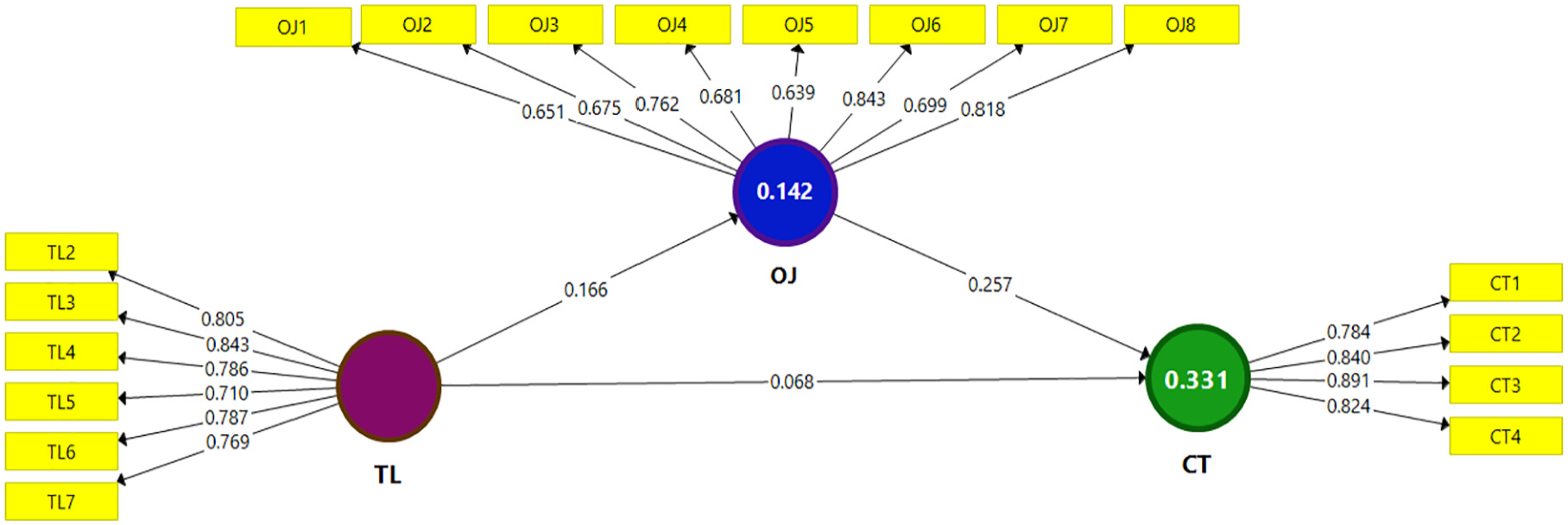
Result of R2 and f2.
Discussion and Conclusion
The study aimed to investigate how managerial transformational leadership contributes to the hotels’ trust climate by promoting their organizational justice in the Bangladeshi hotel industry context. After the empirical investigation, the results supported all the hypotheses of this research. The findings exposed that managers’ transformational leadership behaviors can easily create and nurture a climate of trust among the working groups in the Bangladeshi hotel industry, which supports the findings of prior research (Akter et al., 2021; Engelbrecht & Samuel, 2019; Yue et al., 2019). This finding is aligned with the arguments of social exchange theory. As such, the findings of this research indicated that transformational managers support staff development, recognize their performance, nurture trust and cooperation, teach them approaches to analyzing problems, and inspire them to perform even beyond capacity. All these actions create a climate where hotel operators rely on others’ performance and become reliable to others. Also, transformational managers’ strong values for the organization and supportive employee treatment help employees’ trust in their managers.
Second, this research revealed that managers’ transformational leadership behaviors can promote the practices of organizational justice in Bangladeshi hotels. This finding is consistent with the results of prior studies (Engelbrecht & Samuel, 2019; Ha & Le, 2021; Khan et al., 2023; Nurhidayati et al., 2021). All these research indicate that transformational leaders/managers can influence firms’ awareness of the application of fair and unbiased practices in all their organizational operations and employee treatment. Transformational managers complete organizational procedures in a consistent manner and justly. They treat their employees with respect and dignity. Employees can even share their (organizational procedure-related) feelings with their managers. Transformational managers also satisfy employee needs and design and provide appropriate salaries and benefits to the employees. So, when firms utilize transformational leadership behaviors throughout organizational procedures, employees’ OJ perceptions go to the highest level (Engelbrecht & Samuel, 2019; Nurhidayati et al., 2021).
The results also affirmed that the practices of organizational justice can create a climate of mutual trust in the working environment of the hotel industry. This result is supported by prior similar research (Onagh & Azimi, 2018; Oosthuizen et al., 2018; Sahoo & Sahoo, 2019). These studies identified organizational justice as a successful predictor of organizational trust and trust climate. Besides, this result supports the social exchange theory, which states that companies’ justice and fair practices can generate mutual trust among organizational members. They highly trust managers and others when they perceive that organizational procedures and functions are operated justly and consistently and that their companies deal with employee issues with proper concern. Consequently, they start to become trustworthy to the managers and others. They share their knowledge and experiences with the team members and respect and value others actions (Sahoo & Sahoo, 2019). That is how they develop a shared and mutually trustworthy working climate.
Finally, in this research, organizational justice is found as an intervening variable in the relationship between managers’ transformational leadership and trust climate in Bangladeshi hotels. This finding supported the result of a similar study by Katou (2015), which demonstrated that organizational justice mediates the transformational leadership—organizational trust relationship. It also supported the views of social exchange theory, which argue that supportive transformational managers practice justice and fairness in all levels and areas of the firm, which generates mutual and shared trust among the organizational people and, thereby, the development of a trusting climate in the working environment can be an obvious consequence.
In the hotel business, the skills of transformational managers are tremendously required to prepare for, manage, and find solutions during crisis moments and any organizational changes (Kim et al., 2021). In addition to the business perspective, transformational leaders’ role is found to be significant in the hotel industry for caring for employee welfare and inspiring the workforce for improved performance (Akter et al., 2021; Escortell et al., 2020; Kim et al., 2021). Hoteliers can practice consistent, unbiased, and fair organizational operations with responsible and supportive transformational managers. In consequence, organizational members feel secure and respected at work, and they start being trustworthy to others (e.g., managers, the organization, and colleagues), as well as trusting in others’ trustworthiness. Taking these facts into account, efforts should be made to practice transformational leadership style and organizational justice in hotel business firms in order to develop an atmosphere of mutual trust and a healthy working environment.
Theoretical and Practical Contributions
The results of this research work have a number of theoretical implications. First, although numerous studies have investigated the outcomes of transformational leadership, fairly few have examined its implications for OJ and CT. The findings of this study support and validate the application of the principle of reciprocity of the social exchange theory in clarifying the relationship between TL, OJ, and CT. This research also exposes the applicability of the principle of reciprocity of SET in a South-Asian developing economy. Second, this research helps reveal a hidden mechanism (organizational justice) through which transformational leadership can work to enrich a working (trust) climate. It thus adds to the body of knowledge on the direct effects of TL on CT while also responding to the call for exploring the mediating variables. Third, this research contributes to the transformational leadership theory, which indicates that a transformational leader can build a positive working climate and cultivate shared and mutual trust and respect in this climate (Bass et al., 1987). Fourth, the research also contributes to the trust theory of Mayer et al. (1995). Only a few studies have investigated trust among members of a working team or intra-group trust with their antecedents (Akter et al., 2023b; Sahoo & Sahoo, 2019). Moreover, this research has added new knowledge by introducing the mediating role of OJ in the relationship between TL and CT, which has been overlooked in the past literature. By adopting TL as a key determinant and CT as an outcome of organizational justice, this research offers a complementary view that adds new knowledge to the OJ literature.
In addition to its theoretical contribution, the study provides organizations within the hotel industry with insights for TL, OJ, and CT for improving overall working environment. The hotel industry in Bangladesh experiences employee unhappiness with their work and work settings. Hoteliers can convert this unhappiness into happiness by cultivating intra-group trust, mutual understanding, and open communication among the working people in order to improve the work settings and make their jobs enjoyable. These are all easily achievable when leaders/managers can transform employee values and attitudes using leader-follower relationships. This study highlights the fact that transformational leaders’ influential behavior is very important in enhancing organizational justice and the development of a climate of shared and mutual trust in the working environment. They serve as role models for ethical behavior in organizational processes and employee treatment. In these regards, they attempt to create a positive and inclusive organizational culture by emphasizing ethical decision-making and integrity, encouraging employee participation and expression of their opinions, addressing conflicts in an impartial manner, and providing open and transparent performance feedback. All these actions reflect transformational leaders’ just and consistent organizational practices and fair and ethical employee treatment that improves employee perceptions about organizational justice. Thus, when employees perceive fairness in their interactions with the organization, it fosters trust and enhances overall morale. Besides, other actions of transformational leaders (e.g., sharing knowledge and information with followers about organizational changes and business challenges, supporting their ideas, providing opportunities for professional development, assisting them when needed, and acknowledging their contributions) make employees feel secure, valued, and confident, which in turn develops trustworthy relationships among the working group members. Hence, it is up to the hoteliers to take actions to utilize TL behaviors to improve organizational justice and foster a trusting climate that can lead to employee engagement and loyalty and a positive workplace culture.
Furthermore, transformational managers have been regarded as equal opportunity providers and ethical decision-makers. They apply policies and procedures consistently across all employees while treating them with respect and dignity, resulting in improved employee morale and working climate. Therefore, the designated authority of the Bangladesh Government (Ministry of Civil Aviation and Tourism), Bangladesh Parjatan Corporation, and other associated authorities need to formulate effective guidelines and strategies for practicing TL behaviors and organizational justice in the development of a trustworthy workplace for the operators that can contribute to employee well-being, satisfaction, and loyalty as well as individual, team, and firm performance.
Limitations and Future Research Directions
There are a number of limitations to the study, which may inspire potential avenues for further research. The first limitation of the study is using the data collected by a cross-sectional survey. Longitudinal research tracking the impact of TL on OJ and CT over time can provide a more robust understanding of their dynamics. This will enable researchers to identify temporal variations, observe long-term effects, and capture any changes in the mediating role of OJ over organizational working environment. So, future researchers can highly prioritize the longitudinal studies to analyze the proposed framework. Another limitation of this study is that it was carried out in Bangladesh, a particular nation. Hence, the findings must be utilized cautiously when applied in relation to other cultures and economies. Additionally, the current study suggests that future studies can take into account the hotel industries of other (developing and developed) nations and economies to improve the acceptance of the proposed model. Finally, the study focuses on the hotel industry, which limits its generalizability to other organizational contexts. The impact of TL on OJ and CT may differ in industries with different structures, cultures, and technological demands. Future studies should explore the mediating effect of OJ in various organizational contexts beyond the hotel industry. Examining industries with different technological requirements, such as healthcare or manufacturing, would provide broader insights into the relationship between TL, OJ, and CT.
Footnotes
Acknowledgements
Kaniz Marium Akter wrote this article as a result of her PhD study, Subrata Banik assisted in concept development and data analysis, and Swee Mei Tang and Zurina Adnan contributed as the supervisors for the thesis.
The authors thank the Bangladeshi 3-star hotel authorities for giving such an opportunity to conduct this study. They also thank the participants who provided the data.
Declaration of Conflicting Interests
The author(s) declared no potential conflicts of interest with respect to the research, authorship, and/or publication of this article.
Funding
The author(s) received no financial support for the research, authorship, and/or publication of this article.
Ethical Approval
We have obtained informed consent from the survey participants. However, at our institution (Mawlana Bhashani Science and Technology University), there is no Ethics Committee to approve our study. Besides, in Bangladesh, there is no requirement to get the approval of the Ethics Committee in Social Science and Business Research. Therefore, we cannot submit such an approval with this manuscript.

Data Availability Statement
Data sharing not applicable to this article as no datasets were generated or analyzed during the current study.