



Abstract
The article concerns the strategic narratives concept as a tool of soft power and proposes methods and techniques of analysing strategic narratives. We argue that the best approach should apply a methodological triangulation which combines different methods and techniques while simultaneously addressing gaps in the implementation of theoretical perspectives. We present a theoretical concept of analysis and validate it using the example of a case study of the Crimea conflict in 2014 and 2015. Relying on the following three sources of original data: content analysis of media coverage (press comments over 8 weeks of 2014 and 2015), a cross-sectional survey (Computer Assisted Telephone Interviewing), and survey and focus group interviewing on the reception of Internet memes; we show that a strategic narrative works both in the media and in the opinions of media recipients. Investigating the ‘Machiavellian Russia’ strategic narrative, we show that mass-media interpretation of present events seems to depend on historical context and comparisons, which create a specific bubble around recipients of media messages.
Introduction
The concept of strategic narratives (Miskimmon et al., 2013; Roselle et al., 2014) has gained increasing importance in recent years. This is fully justified if we consider that strategic narratives can be recognized as one of the main soft power tools of political and social agents. In fact, we are discussing a complicated phenomenon that poses a considerable challenge for scholars: strategic narrative is about understanding the world and global events in a certain way, which on the one hand operates in the media, and on the other hand, can be noticed and internalized by media recipients. The explanatory (explaining political and social phenomena) and persuasive (persuading to a specific vision of the world) potential of strategic narratives cannot be overestimated. That is why studying this concept seems so difficult and so fascinating at the same time.
In the following sections, we briefly describe the importance of strategic narratives as the soft power of contemporary international actors. Next, we pay attention to theoretical approaches that may be useful in analysing strategic narratives, while indicating the difficulties in implementing these theories in empirical practice. Then we propose a scheme of analysing these narratives – a set of triangulated methods and techniques which enable the strategic narratives to be tracked in different media spaces. As a case, we chose the conflict in Ukraine of 2014 and its coverage in Polish public discourse. We decided to study this case because the issue is complex, complicated, and has a profound impact on the audience, so it is potentially a good example for tracking and analysing the strategic narratives that are transmitted by the media and, consequently, in the minds of audiences. Furthermore, we argue that these kinds of analyses can lead us to notice and reconstruct the repetitive ways of interpreting important political events and processes.
Theoretical background
To satisfy theoretical considerations, key terms need to be clarified. The first and most important term for this article is ‘strategic narrative’. According to Miskimmon et al. (2013), narratives are defined as a means to ‘construct a shared meaning of the past, present, and future of international politics to shape the behavior of domestic and international actors’ (p. 2). In other words, it is the way of describing the world that exposes specific values, meanings and ideas, and at the same time serves to explain and encourage specific actions of political actors. There is no doubt that the boundaries of this concept are still under discussion. According to Roselle et al. (2014), for example, strategic narratives can be understood at the following three different levels: as International System Narratives, National Narratives and Issue Narratives (p. 76), while Livingston and Nassetta (2018) argue that strategic narratives can be used only to describe international political processes, conflicts and issues (pp. 102–104).
These considerations apart, it is obvious that strategic narratives are of great importance not only in political communication, but also in policy-making in general. As Roselle et al. (2014) have argued, ‘the concept of strategic narrative is particularly relevant in international relations today. [. . .] Narratives are even more important for ordering the chaos’ (p. 74). That is also why strategic narratives are particularly suitable for analysing public discussions on international conflicts. They also allow us to better understand the past – as more coherent, meaningful and influential – and take action for the future. Thus, the significance of strategic narratives cannot be overestimated, since they make sense of not just events, but of history, the present, and, most importantly, the future (Livingston and Nassetta, 2018: 106).
Today, it seems necessary to see strategic narratives as sources of soft power, a concept introduced for the first time in the late 1980s. Joseph Nye’s (2004: 5) well-known definition of ‘soft power’ describes it an ability to influence the behaviour of others to get the outcomes you want. Unlike hard powers (military and economic), whose strength lies in the use of inducements ( ‘carrots’) or threats ( ‘sticks’), soft power lies in its indirect impact on the environment: A country may obtain the outcomes it wants in world politics because other countries – admiring its values, emulating its example, aspiring to its level of prosperity and openness – want to follow it (Nye, 2004: 11). According to Bukh (2016: 449), culture, political values and foreign policies are seen as the main sources of a state’s ability to attract and co-opt others to act in the interests of the wielder of soft power. Of course, there is always a question of how to measure the effectiveness of soft power. We believe a complex study on strategic narratives can be a reasonable and appropriate way of assessing this.
Once we know the definition of strategic narratives and their social and political significance, we should look for theoretical perspectives and, as a consequence, methodological tools that will allow strategic narratives to be studied. It is important to consider that, in the modern world, strategic narratives are disseminated by the media. Therefore, we argue that in order to successfully investigate strategic narratives and their effectiveness we should, to some extent, first analyse media content and then media recipients’ opinions and impressions. Hence, the basic tool for media-content analysis should consist of a set of analytical categories which reflect the most important elements of the narrative. This kind of codebook will allow results to be obtained – a reconstructed narrative – which will then become the starting point for creating research tools for the next stages of the project: a questionnaire for Computer Assisted Telephone Interviewing (CATI) or a script for Focus Group Interviews (FGI).
The inspiration for creating such a codebook comes from two concepts related to strategic narratives and already discussed in the literature devoted to narratives: framing theory and the dramatistic pentad of Kenneth Burke. We will now briefly discuss how they can be used to investigate strategic narratives.
The concept of framing has been widely described in different scientific disciplines, among which the most important for this article is political communication. In this approach, audience frames are defined by Robert Entman (1993: 53) as mentally stored clusters of ideas that guide individuals’ processing of information. Frames can perform up to the following four functions: define problems, specify causes, convey moral assessments, and endorse remedies (Entman, 1993, 2004, 2010: 391). Entman also notices that framing is an omnipresent process in politics and policy analysis. Moreover, researchers identify media or news frames as working routines for journalists, which allow them to quickly identify and classify information and pack it in order to effectively communicate it to audiences (Gitlin, 1980: 7). Frames introduce or raise the salience or apparent importance of certain ideas, activating schemas that encourage target audiences to think, feel, and decide in a particular way (see for example, Gross and D’Ambrosio, 2004; Iyengar and Simon, 1993; Kim et al., 2002; Price et al., 1997). There are five devices that signify the uses of frames which are as follows: metaphors, exemplars, catchphrases, depictions, and visual images (Gamson and Lasch, 1983; Gamson and Modigliani, 1989).
How does framing relate to strategic narratives? Livingston and Nassetta (2018: 102) present a synthesis of these two, as they call them, analytical devices in political communication. They argue that framing theory, in recent years mostly used to analyse domestic discussions in politics, remains insufficient to describe complex communication processes and international relations in the 21st century. They point out that strategic narrative scholarship is much better suited to describing today’s globally networked flows of conflicting narratives among adversarial states (Livingston and Nassetta 2018: 102). Looking carefully at both concepts, they describe this relationship as follows: As with framing, strategic narratives emphasize the role of ideas and language in politics, though on a larger geographical and temporal scale (Livingston and Nassetta 2018: 102), because frames exist within strategic narratives (p. 107). They also show differences between the following two concepts: Frames are less ambitious and are situated within the contours of strategic narratives; they are to strategic narratives what particular storms are to global weather patterns. Frame contestation emerges as struggles over the meaning of events within the contours of broader strategic narratives (Livingston and Nassetta, 2018: 103). Regardless of whether we take this approach or not, one thing is certain: since the frames are parts of the narrative, by studying the frames, we can try to deconstruct the narrative to some extent. To do this, we perform the operationalization of the category of frame, that is we should precisely identify its components in the journalistic material and properly decode it.
The second concept used as an inspiration to create the analytical tool is the dramatistic pentad provided by Kenneth Burke (1969) containing components of narratives. The origins of this approach, of course, lie in the field of literary criticism and rhetoric, but its classical structure allows us to successfully apply it to media-content analysis. Moreover, Roselle et al. (2014: 75–76) also pointed out the usefulness of this concept in setting out the component parts of strategic narratives. According to Burke, the first component of narrative includes characters (actors), those who have the power to act and influence events. The second component is the scene (setting, space), indicating the environment in which events take place. Another component is the act (conflict, action), meaning the act that happens between actors. Next is agency (means), which refers to the instruments and methods actors use. Purpose, the final category, indicates the motives of actors and, thus, can create a kind of code of conduct. Therefore, the pentad divides the situation into five parts. Pentad analysis is about studying relationships between these parts. As Burke (1969: 228) explains, this scholastic hexameter defines questions to be answered in the treatment of a topic: Who, what, where, by what means, why, how, when. Unfortunately, the method for finding the key components in the text or material is not specified. They also need to be operationalized and reflected in an analytical tool if we want to successfully use it in media-content analysis.
Hence, by creating analytical categories that allow for deconstructing the frames and dramaturgy incorporated in the text or image, we can obtain a tool to study strategic narratives in various types of media materials. However, another relevant issue which should be kept in mind is the interpretation and internalization of strategic narratives by recipients (Roselle et al., 2014: 74–75, also point this out). The narrative works only when it effectively imposes interpretation and is subsequently accepted by the reader or viewer. Therefore, it is very important in the research to apply techniques and tools that will check whether the recipient has decoded the strategic narrative contained in the message. Our proposal of such tools is presented in the following section.
Methodological proposal – how to track strategic narratives
General assumption of three media-related social spaces
We assume that strategic narratives are created and distributed in three spaces created by the media. First of all, there is the traditional area of the media (among which the press occupies a special place, creating space for both information, and in-depth analysis and commentary). Second, there is the awareness and opinions of people who use media (especially traditional forms) and, on the basis of the information and interpretations shown in these media, form their views and attitudes. Third, there is an area of media consumers’ creation, meaning the content that people create and reinterpret under the influence of media-shaped opinions. People, by decoding and encoding meanings, create new content that is relevant to important media events and topics. This content is distributed on the Internet mostly – the best example being Internet memes. It is increasingly common for memes to be of interest to the traditional media (catalictic relation); they are reinterpreted with the process of the redistribution of meanings. When we examine these three areas, we are likely to discover how strategic narratives work: what content they create, how this content is processed and reinterpreted, and what social effects they may exert upon the world.
Although these kinds of media spaces create some difficulties in analysis and description, they can be examined using other tools. Therefore, we propose a methodological triangulation that may allow a systematic description of those spaces. We point out these techniques because they allow us to operationalize general, imprecise categories proposed by framing and dramatistic pentad. For example, the codebook can contain exact criteria for the identification of an actor and their actions, as well as codes that present this actor (e.g. metaphors or comparisons). Thanks to this solution, it is possible to decompose the content of an article or audiovisual material and thoroughly decode its meaning. The opinion poll (led with CATI technique) is very effective in tracking views and attitudes of media recipients. Of course, one can also use other opinion research tools, such as Computer-assisted web interviewing (CAWI) or Pen-and-Paper Personal Interview (PAPI) surveys. The choice of tool always depends on the purpose of the research, as well as the resources and possibilities available. Finally, studying the third space is not easy because we are dealing here with content that results from the processing of information provided to recipients by traditional media. That is why we propose a two-stage study here: first, we analyse the content of such polysemous materials, using semiotic analysis for memes, and later we check the opinions and reactions of recipients to such content (in this case memes) with a questionnaire and FGI. As before, these are not the only tools available. Audience responses can be checked using other techniques, such as eye-tracking (although we have made such an analysis, we lack the space to elaborate on it in this article), galvanic skin response or face-tracking.
Aims of the study and research questions
We tested this methodological approach in a complex study devoted to the Crimean conflict of 2014–2015 1 and conducted in the Laboratory of Media Studies at the University of Warsaw. We recognized that public discussion about this conflict is a perfect example of exploiting strategic narratives, as there is a plethora of different areas connected with this international conflict which may be studied. In other words, we have a case of international conflict which is politically, economically and culturally important, limited in time, and involving the most important national actors, which is discussed both in the media and among ordinary citizens. It provides an opportunity for examining the presence and impact of strategic narratives in many different fields of social discussion.
The general aim of the project was to assess whether and which strategic narratives about the conflict are manifested in the media (with the example of the press – as a traditional medium of continuing high credibility and citation index) and in the opinions and assessments of media recipients. In addition, we wanted to verify to what extent the discourse of the Polish press (journalistic) is explanatory (explaining the situation to the readers) and how it is anticipatory (whether it is able to predict the scenario of the events).
Triangulation of methods and techniques – analytic tools
As far as the press are concerned, we conducted a survey of journalistic texts in the Polish press devoted to the events in Crimea at the beginning of 2014 and on the anniversary of these events in 2015. The study included journalistic publications in more than 50 national newspapers and magazines between February and March 2014 (from the escape of Viktor Yanukovych to the annexation of Crimea by the Russian Federation) and between February and March 2015. The study was conducted using quantitative and qualitative content analysis. The subject of encoding (deepened description according to dozens of research categories) was a total of nearly 430 articles – 311 articles in 2014 and 119 articles in 2015 met the criteria. We qualified all opinion-forming articles for analysis, distinguishing the following five types: ‘fueilletons’ (topical opinion pieces), analysis-essays, comments, interviews and reportages. The article represents the unit of analysis. In order to answer the research questions, we carried out detailed analysis, dedicated to particular threads and elements in the texts. The key code consisted of nearly 40 categories, partly open-ended, to be answered and completed by coders, and partly closed with a ‘cafeteria style’ checklist, offering a range of options for selection. These categories were related to the following:
Description of the basic text parameters (date and place of publication, author, column, page, type of text (one of five indicated above), profession and nationality of the first author, and – optionally – second and third authors);
General theme of the text (perspective – checklist of potential answers, indicating national perspective such as Polish, Russian, Ukrainian, American and so on, and broader political perspectives, such as European or Western; topic – open-ended category in which coders needed to summarize the topic of the article; main theme – one of the following: political, economic, sociocultural, legal; side threads – the same checklist);
Description of possible sanctions against Russia (political, economic, military, undetermined – as open-ended categories) and sanctions from Russia on the Western world (political, economic, military, undetermined – as open-ended categories);
References to historical contexts (whether or not they appear in the text; if so, coders needed to summarize and indicate each of these references);
Actors mentioned in the article (enumeration, qualification in the active-passive alternative, description of the actor and verification whether any of the possible actors is present in the article: Ukrainian, Russian, Polish, other nations, social groups in Ukraine, international bodies);
Narration presented in the article (definition of the situation, causes of the situation, scenarios of the development of the situation, the most likely scenario, subject of the conflict and dispute axis – all of these categories were open-ended, coders needed to summarize and describe them);
The language used to describe the case (especially the form of the subheadings, leads, and the figures included in the text: comparisons, metaphors, and affected words, such as meaningful, strongly negative or positive adjectives or nouns; coders noted these specific terms and what they refer to).
The corpus was coded by 27 coders. Intercoder reliability reached approximately 73 per cent–88 per cent with a mean of 79.25 per cent and SD of 4.15. Aggregated data were recoded and cross-referenced – first of all according to key, clustered categories. It should be underlined that this codebook was constructed to operationalize Burke’s dramatistic pentad and to reconstruct frame markers. Individual categories can be assigned to these concepts table (please see Table 1).
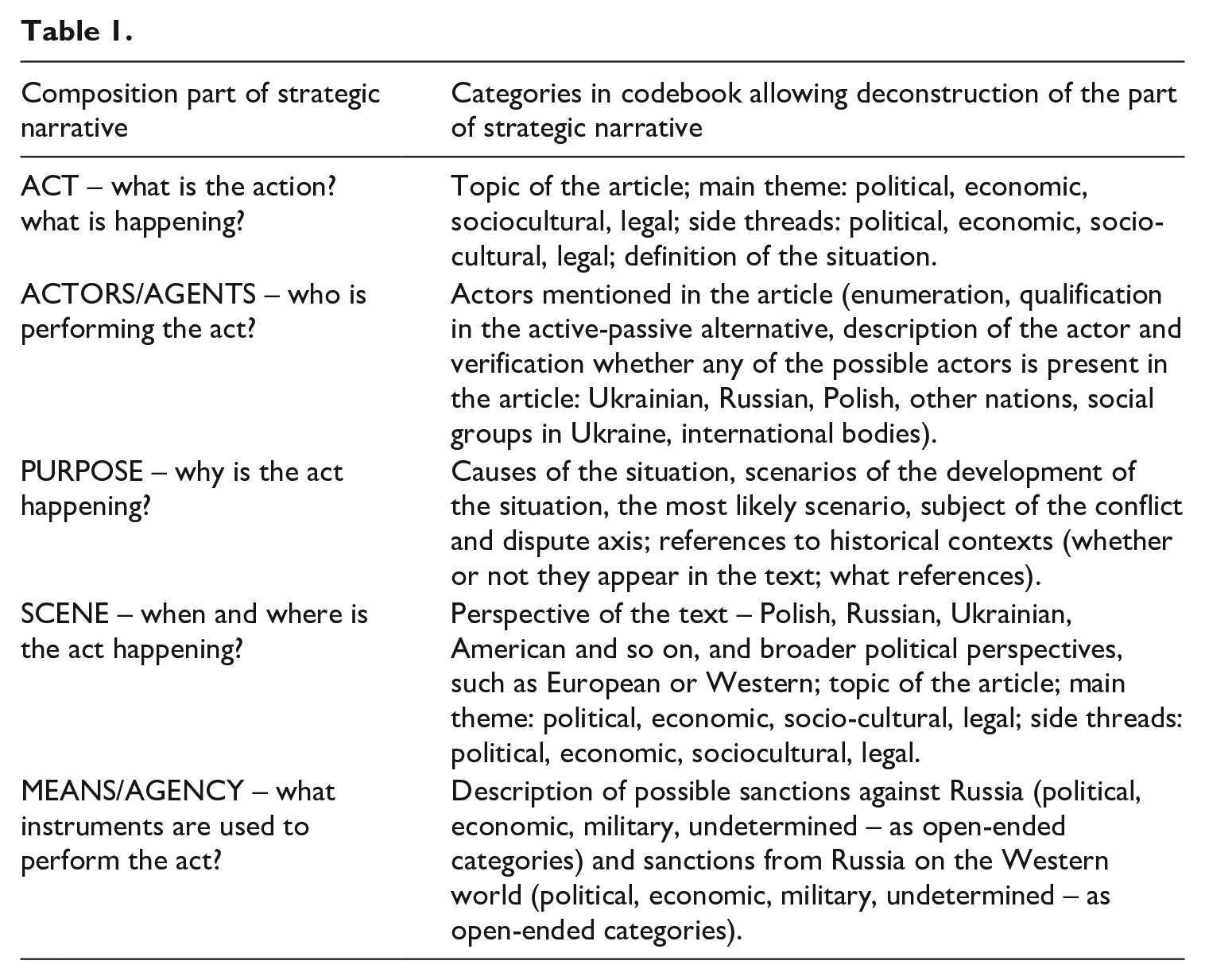
The second area – people’s opinions – was checked using a CATI survey. The survey was conducted with a representative sample of Poles on 9–12 June, 2016 and concerned the events in Crimea. We conducted 1650 interviews and then used a weighting process on the results to reflect statistical proportions in the population of adult Poles presented in Central Statistical Office reports for 2015. During the interview, we asked respondents three main questions and five metric questions (gender, age, education, number of inhabitants in the place of residence, and whether she/he lives in the city or the countryside). The main questions were as follows: (1) Who do you think is responsible for the conflict in Ukraine? (2) Counting from today, how long do you think the conflict in Ukraine will last? (3) Do you think that media in Poland reliably report on the conflict in Ukraine? The questions are constructed in a way that largely follows the results of our press content analysis which gave interesting and replicable results in areas concerning the leading, responsible actor in the dispute (Russia and Vladimir Putin) and predictions about the development of the conflict and its duration. The third question is related to the widely discussed phenomenon of media credibility (especially in the coverage of controversial and ambiguous topics). 2 Specifically, we extracted the crucial components of strategic narrative from our press analysis and then constructed questions that addressed these important elements.
Our third area, the creative response of media consumers, the content that people create and reinterpret under the influence of media-shaped opinions, was assessed through analysis of Internet memes. We analysed these memes in the fields of semiotic and compositional analysis, and through FGI in two heterogeneous groups: students (12) and people aged 50+ (the older generation −9). Each participant was shown 10 memes, for 8 seconds each, concerning the events in Crimea. After viewing the material, the respondents filled in a short questionnaire in which they answered questions about Internet memes: (1) Which meme did you like the most? (2) Which meme did you find the funniest? (3) Which meme aroused a sense of fear/horror? (4) Do you think any of these memes casts Putin in a positive light? (5) Which meme do you think is the most pro-Western? (6) Which meme, in your opinion, is the most pro-Russian? (7) Which meme, in your opinion, describes best the essence of the conflict in Ukraine? Apart from basic issues, such as assessing the attractiveness of the meme, the questions were structured to include key components of the analysed strategic narrative, such as public perception of Vladimir Putin or the meaning of the Crimean conflict. After completing the questionnaire, the respondent was invited to the FGI room and took part in a FGI conducted according to a previously prepared scenario. In the first, general part, the moderator assessed the following issues: the essence of the memes, the analysis of the topics presented in the memes, the determination of the political situation interviewees were concerned with, and their hero/heroes. The second, more detailed part of the conversation was a discussion on individual memes, selected by means of a survey, which most interested participants and, preferably, appealed to them. The discussion covered issues related to the characteristic features of a given meme, conveyed by emotions and the presented characters. The issue of the symbolic reading of the meme was also touched upon. As in previous parts of the project, the interview scenario also included crucial components of strategic narratives revealed in press articles.
A triangulated study example – selected results 3
Due to the limitations of this article and its primary purpose (presentation of the methodological concept), we have no space to present our project results in a detailed and extensive way. Therefore, we present only selected results which illustrate how to expose the presence of strategic narratives in the areas we propose. Thus, we have chosen only the main strategic narrative visible in articles analysed, which ran through all stages of the research project and from which conclusions can be compiled and compared. We call this strategic narrative ‘Machiavellian Russia’. 4 It shows Russia as an aggressive, manipulative, but at the same time effective and efficient entity, in conflict with the broadly understood democratic West and primarily looking after its own interests. It is also worth adding that Vladimir Putin appeared in most articles as the epitome of Great Russia, which is why in this strategic narrative Vladimir Putin is also included and assigned the same characteristics. In the next sections of this article, we will show which elements construct such a narrative and how it is manifested in recipients’ opinions and impressions.
Press analysis
In terms of press content analysis, many conclusions from the analysis of research categories show how the strategic narrative of ‘Machiavellian Russia’ is being built. We list the most important of them here. First, the study showed that 23 per cent of texts in 2014 and 26 per cent of texts in 2015 constructed a definition of the situation as ‘Russia masters the situation’. This was confirmed to some extent with the most frequent historical contexts and historical comparisons recalled in articles in 2014 and 2015 – the Crimean crises were compared to the Russia–Georgia conflict and the Second World War, conflicts in which Russia mainly achieved its goals. Another important category was the object and axis of the dispute; 82 per cent of texts in 2014 and 73 per cent of texts in 2015 suggested it was a political conflict (only 4%–6% of articles defined the conflict as economic), which is also a part of the ‘Machiavellian Russia’ narrative of being effective in political games. Another important factor in this context is the actor category. We tracked actors mentioned in the articles (enumeration, qualification of active-passive alternative, description of actors and verification of whether one of the assumed possible actors is present: politicians, states, international organizations, Ukrainian, Russian, Polish society, other nations, social groups in Ukraine) and analysed which of them was most often the subject of metaphor. It turned out that journalists metaphorized states and regions (Russia, Ukraine, the West, Poland, the European Union, Europe, Crimea, the United States, France) as well as politicians (Vladimir Putin, Viktor Yanukovych, Donald Tusk, Barack Obama, Angela Merkel). It is worth adding that the main actor in this narrative is Vladimir Putin. The President of the Russian Federation was among the persons’ most frequently described metaphorically (62 times – 11% of all metaphors) and was at the same time the second most frequently metaphorized actor in the research. Putin is shown here as a cunning player, with many aces up his sleeve and playing dirty tricks. The very popular game metaphor refers to the tactics of a Communist country and implies similarities between contemporary Russia and USSR. Among countries, or groups of countries, Russia was most frequently metaphorized (119 times) and was also the actor most frequently defined using a metaphor. Overall, 21 per cent of metaphors were related to Russia. Therefore, the first and second most frequently metaphorized main actors were Russia and Vladimir Putin, which shows that Polish publicists treated them as central and influential participants in the conflict, arousing strong feelings and a range of connotations. Moreover, Russia and Putin were presented as active actors, rather than offensive ones. 5
This conclusion is also borne out by the frames that articles comprised. Frames are usually hidden in connotative titles, watchwords, captions under pictures and in pictures themselves, and analysis of these particularly significant language expressions proves that the following frames are the most important in the studied articles:
Capacity and activity frame: this refers to the ability or power to act in your own interest. This frame reflects the perception of the Crimean conflict as a dynamic competition between East and West for influence and domination in Europe. It exposes the dynamism of the most important actor, namely the Russia of Vladimir Putin, and its active role in the conflict. This frame is constructed by, among other things, the following metaphorical statements: ‘Russia wants to extend its control’, ‘Russia will swallow them up and will not even feel it’, ‘political Darwinism – the weaker Ukraine is rightly devoured by stronger the Russia’, ‘You can’t cock a snook at Russia’, ‘Russia gets up off its knees’, ‘Russia will enter Ukraine as deeply as the international community allows’, ‘this is just another stop on his [Putin’s] path to rebuilding the Soviet empire’;
Morality and game frame: according to this frame, the main actor in this dramatic situation, namely Putin’s Russia, treats the conflict as a kind of game from which it wants to emerge victorious at any cost. There are many references to gambling and card games. In this sense, for Putin, the Crimean conflict is a challenge and a game of domination in global geopolitics which he wants to win even by immoral means. This frame is constructed by, among others, the following statements: ‘It would give Moscow the opportunity in Ukraine to play the game it is used to and the game it knows how to play’, ‘Putin plays a game of chess while we play marbles’, ‘the Russian president holds all the cards’ and ‘he can play his ace’, he’s a ‘Russian chess player’;
Health and safety frame: this frame presents the Crimean conflict as a disease affecting global geopolitics. In this approach, the Russian Federation was presented as a sick element of a metaphorical political ‘health system’, causing the death or illness of other participants. Therefore, Vladimir Putin is an insane leader with an insatiable appetite for power and influence, which he satisfies at the expense of other states – components of the global system. Russia is effectively destroying international security to fulfil its political ambitions. This frame is constructed by, among others, the following statements: ‘You need to attack cancer cells precisely’, ‘Putin lost contact with reality, lost his mind’, Russia represents ‘breathtaking hypocrisy’, ‘the appetite of the Russian president was tremendous’ or ‘Putin’s appetite is increasing’.
Taking all of these results into consideration, it should be pointed out that such significant display by the main entities in this dramatic situation – the Russian Federation and Vladimir Putin – proves that they constitute the crux of this strategic narrative.
CATI survey
The second stage of our research was devoted to the opinions of Polish citizens. The CATI survey showed that Poles believe that mainly Russia (over 60% of indications) and Ukraine (about 10% of indications) are responsible for the conflict. Other actors (e.g. the US, EU, Poland, the West) were almost absent in the answers. This means that Poles identify the main actors of the conflict according to the scheme presented in the traditional media. For Poles, as for the press, the story of the conflict is in fact a strategic narrative about a strong, effective, crafty Russia, and thus a ‘Machiavellian Russia’. Also, Poles do not agree with the predictions regarding the duration of the conflict in Ukraine. The answer which appeared more often than others (0–1 years, 1–2 years, 2–3 years, 3–5 years, over 5 years, it will never end) was ‘none of the above’ (26.79%). These results clearly show that Poles are divided in their assessment of the duration of the conflict in Ukraine. None of the answers received a dominant percentage of indications. Such a result may prove that, for Poles, the course of the conflict remains unpredictable, perhaps because it is managed by an effective Russia, more effective than Western countries, which would like to immediately resolve the issue. The third question was not directly related to the strategic narrative discussed here, but instead provides some context to the answers of respondents to previous questions. Over 41 per cent of Poles believe that the media in Poland do not report the conflict in Ukraine reliably. Almost every third Pole (31.25 %) thinks that the war beyond our south-eastern border is presented credibly. In total, 5 per cent has no opinion on this subject, but almost every fifth person (22.43%) thinks it is difficult to say whether the media is credible or unreliable in reporting events from Ukraine. This result may suggest limited confidence in the modern media, which are perceived as a sphere of influence of various people, institutions and countries. Therefore, media recipients are not able to clearly indicate whether, in the era of media manipulation and disinformation, such a complex conflict is reported on reliably or perhaps in a way that corresponds to one of the parties (e.g. Russia, which is effective in its actions).
Internet meme study – content and reception
Many similar conclusions can be drawn from the study of Polish Internet memes about the conflict in Ukraine. This part of the research project is particularly important because it shows the space in which the ‘Machiavellian Russia’ strategic narrative is received. On the one hand, we describe memes, so we indicate whether and how this narrative is perceived by the meme creators – Internet users; on the other hand, we analyse the reception and interpretation of these memes in FGI’s. In other words, we investigate whether and how the strategic narrative of ‘Machiavellian Russia’ is transmitted between media recipients.
The same actors (especially politicians) are found in these memes. The definition of the situation is described in similar ways to those in the press and relations between the characters are also similar. By this means, we can say that the creators of Internet memes reproduce the strategic narrative of ‘Machiavellian Russia’ presented in the press. As an example, we can present the results for the ‘Martians’ meme, which can be considered the most important for the whole group (please see Figure 1).
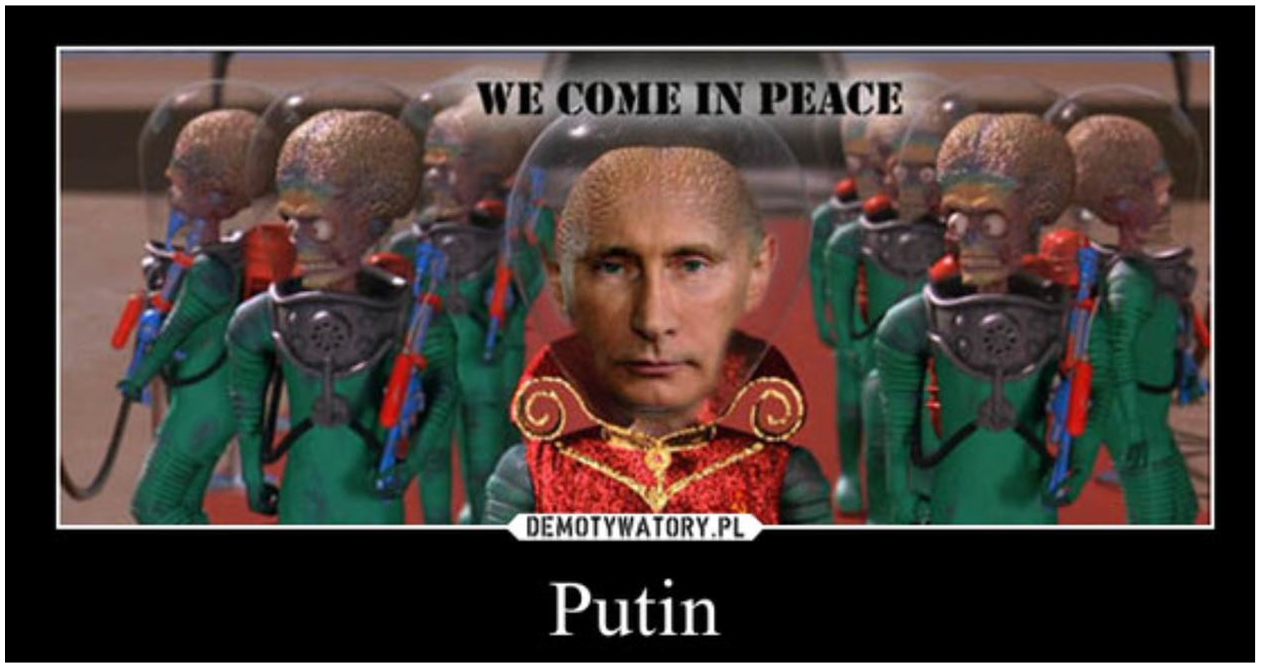
‘Martians’ meme.
As we have shown, meme analysis is possible on the following two levels: basic – limited to the content presented in the picture – and deep, with a cultural context; namely metaphors, symbols and the message contained in the movie ‘Mars Attacks’ (1996), directed by Tim Burton, to which the meme directly refers; the meme is a modified still from this American production. In the foreground, in the central part of the meme, the image of an alien – the Martian leader – is visible. A likeness of Vladimir Putin has been superimposed on its face. The author did not simply replace the head of the alien with the image of the Russian president, but applied a laborious and sophisticated technique. Displaying the figure of the Russian president in such a way shows his leading position and how he controls the presented situation. It is worth noting that Putin’s clothing is significantly different from the costumes of the rest of the Martians. His red cloak is reminiscent of both the imperial dress or the royal coronation cloak and the characteristic clothing from Star Wars movies (provoking numerous associations with Emperor Palpatine, the main antagonist in these movies). Putin has a disproportionately large head with his brain bulging out, a dispassionate expression and stares directly at the recipient of the image. His face and eyes can indicate that his actions do not arouse any emotions in him, and that he acts consciously and without mercy. Such a visual image of Putin corresponds to the image presented in press articles and creates, among other elements, the narrative of ‘Machiavellian Russia’.
Importantly, a very similar interpretation of Putin’s character in the meme was presented by respondents during the FGI, according to whom Putin’s face resembles that of a poker player (Respondent no. 4: He has an ace up his sleeve. Respondent no.3: He has a face which says ‘nothing will stop me’.). One of the respondents noticed, however, that Putin’s face is not really frightening in itself, but only in the context of his actions: I would not say in my life that this is a macabre face. No no . . . but it scares us with all its knowledge (Respondent no. 2). Behind Putin, on the left and right, there are other aliens. The respondents associated these characters with the officers protecting the political leader (Respondent no. 4: Yes, I would say that they protect him. Respondent no. 1: They will do anything for him). They also compared Vladimir Putin to a queen bee and the other Martians to drones. The green colour of their suits brings to mind the famous ‘green men’, soldiers in Russian army uniforms.
The words ‘We come in peace’ at the top of the picture are ironic, because the Martians do not look peaceful – quite the contrary. The way in which the figures are presented and the picture is composed with such an inscription is supposed to bring to mind the Russians’ hidden purpose, which is world domination. Even recipients who do not know the plot of the film will see the irony contained here. Putin and his troops are portrayed as insolent liars, focused on brutal conquest of the world. The picture clearly shows that the Martians are prepared for a direct fight. It is worth noting that this conclusion proves the functioning of the strategic narrative in minds of the recipients; they interpret the seemingly neutral sentence unambiguously, assigning Machiavellian features to Russia and Putin.
Through the figure of the president, Russia is compared to a newcomer from another planet, and the Martian invasion of Earth is juxtaposed with the Russians invasion of Crimea. The Earth in the movie is, therefore, a metaphorized Crimea, exposed to the attack of foreign, hostile forces. The Russians, despite their assurances of peaceful intentions, invaded Ukraine – just as in the movie Martians attacked the Earth – explaining their reasons for an apparent referendum and giving assurances that there are no Russian troops in Crimea.
Conclusion
To sum up, we believe that even this selective presentation of results of the study shows that the proposed triangulation allowed us to find the same key components of strategic narratives which function in different media spaces but still create similar patterns of event interpretation. In this way, it is possible to deconstruct and analyse strategic narratives, and more importantly, to clearly expose how repetitive and schematic they are. Of course, a specific strategic narrative works in favour of some entities more than others, so the essential questions remain: Who is promoting this strategic narrative? Why is it so strongly present in the media? In the case, we have analysed – ‘Machiavellian Russia’ – it seems that the history of not only Russia, but also Polish–Russian relations and the history of the Second World War and the Cold War era are of great importance. Thus, our study shows how important the past and history are in building an effective strategic narrative and, as a consequence, understanding the present political reality in a specific way. Essentially, mass-media interpretations of present events seem to be based on strategic narratives and influenced by historical context and comparisons, which create a specific bubble around the recipients of media messages. In other words, present events are reinterpreted (in a process of coding and decoding of meaning) by journalists (mass media) in relation to historical contexts. Then, they are analysed and internalized by media recipients, thanks to their historical memory, knowledge, and personal and national experiences. This process is like the schema of a bubble in which every association depends on former events and phenomena. At the same time, it answers the question of why strategic narratives can be so strong and so effective.
For now, we know that the study of strategic narrative is crucial to understanding how all aspects of a conflict are defined, constructed and understood. Moreover, the interplay of narrative types can help explain how actors characterize and narrativize the immediate protagonists and the situation. Next, war and conflict will be affected by the more extensive and intensive connectivity that is a feature of the new media ecology and digitization disrupts the sequential structure of narratives of conflict. Finally, political and military leaders responsible for creating and projecting strategic narratives to legitimize war, conflict or peacebuilding have to become more reflexive about the assumptions mentioned earlier.
Footnotes
Acknowledgements
The authors would like to thank Professor Magdalena Wojcieszak (University of California, Davis) and Professor Anna Mierzecka (University of Warsaw) for their valuable and constructive suggestions that greatly improved the article. The authors are also grateful for the insightful and inspiring comments of the reviewers.
Funding
The author(s) received no financial support for the research, authorship, and/or publication of this article.
Notes
Author biographies
 ) at Faculty of Journalism, Information and Book Studies in University of Warsaw, Poland. He was also Deputy Director for Research and International Cooperation at the Institute of Journalism at Warsaw University (2012–2016). Publications of his work include over 30 articles in academic journals and 5 books. He is interested in political communication, investor relations and biometric research in media studies.
) at Faculty of Journalism, Information and Book Studies in University of Warsaw, Poland. She is the author of papers on the language of the media and media narratives in contemporary newspapers. She is interested in the rhetorical analysis of media coverage and public discourse, as well as biometric research in media studies.