



Abstract
This article assesses how Western mainstream news media framed causal factors of Russia’s 2022 invasion of the Ukraine. The article is based on a synthesis and integration of scholarly studies as well as a primary data analysis of Western mainstream newspaper reporting. The research firstly conducts an integrative literature review investigating how Western mainstream news media have reported on Russia and the new Cold War more broadly. Using this as a backdrop, a quantitative and qualitative content study investigates how causes of the 2022 invasion of Ukraine were framed in the US, the UK and the German press. To contextualize news media framing, the second section critically assesses the Western diplomatic and historical record of NATO expansion. The article identifies two competing explanatory frameworks: the dominant Western news media narrative assumes that Russia/Putin’s imperial ambitions and nefarious traits have caused the war, and a second narrative, advanced by several scholars, former diplomats and selected journalists, asserts that NATO’s eastward expansion created the context for Russia’s invasion. The article concludes that the second narrative has been de-emphasized in the news. Such framing is contrary to the historical and documentary record, and links to a marginalization of non-military solutions to solve the conflict.
Introduction
On 23 February 2022, 200,000 Russian troops invaded Ukraine with the goal of toppling its government and conquering the Russian-speaking territories in the south and east (Lieven, 2022). Having initially anticipated a collapse of the Ukrainian government, Russian troops faced major resistance. The fighting has since then concentrated around Eastern Ukraine, spanning a south-east line over the Kherson, Zaporizhzhia, Donetsk and Luhansk regions that Russia annexed in September 2022. The war has significant ramifications, including high military and civilian deaths, worldwide economic and social turmoil, the threat of nuclear disaster as well as geopolitical tensions.
Members of the North Atlantic Treaty Organization (NATO) including the US, the UK, Germany and various EU countries have supported Ukraine with military aid and instituted harsh economic sanctions on Russia. On 24 January 2023, the Bulletin of the Atomic Scientists (2023) moved its Doomsday Clock to 90 seconds before midnight, warning that the war in Ukraine marked ‘the closest to global catastrophe’ the world has ever been. The Bulletin called upon Russia, Ukraine and the NATO countries to find ‘a path to serious peace negotiations’.
This article critically interrogates the Western mainstream news media’s response to the Russian invasion of Ukraine. It focuses on assessing how potential Western contributions to triggering the war, most notably NATO eastward expansion, have been reported. This is significant because how the news represents the causes of war bears on public understanding and the remedies that are prescribed (Entman, 2004).
The article assumes, in accord with liberal press theories, that the news media must balance a diverse set of arguments made on all sides of a conflict and consider their factual veracity. Moreover, it is the news media’s task to critically reflect on the official justifications of war to limit a ‘government’s war-making powers’ (Nichols and McChesney, 2005: 37). This should, of course, include a critical investigation of Russia’s role. At the same time, the Western news media should interrogate the role of NATO-states who, due to their military support for Ukraine that has involved the supply of heavy weapons, training of forces and intelligence sharing, could be regarded as participants in the war. Accordingly, liberal press theories assume news media to be an independent arbiter of their own government (Kovach and Rosenstiel, 2021).
The article is separated into two sections: first, the literature about how Western mainstream news media have reported on Russia and the new Cold War more broadly is assessed. Using this as a backdrop, a quantitative and qualitative content study investigates how causes of Russia’s 2022 invasion of Ukraine were framed in the US, UK and the German press. To contextualize news coverage, the second section conducts a review of the historical and diplomatic record about NATO eastward expansion. The article finds that the causal factors behind Russia’s invasion of Ukraine have been framed in a binary fashion (Boyd-Barrett, 2022):
(1) An official narrative advanced by Western governments and the news media holds Russia mainly responsible. Proponents of this view argue that Russian President Vladimir Putin advanced imperial interests in the pursuit of a greater Russia.
(2) A second narrative presented by former high-level diplomats, Russia scholars and selected journalists, and confirmed by the diplomatic and historical record, suggests Western co-responsibility in the sense that NATO expansion provoked the invasion.
The conclusion argues that the mainstream news media has downplayed Russia’s security concerns and NATO’s militarization of the region. This has affected the portrayal of the war in Ukraine and the discussion of potential solutions.
Reporting on Russia: The (new) Cold War consensus and the invasion of Ukraine
Cold War ideology
Western news media reporting of Russia historically links with the ideology of anti-communism and its components – the ‘Soviet threat’ and ‘Red scare’ (Boyd-Barrett, 2020; Herman and Chomsky, 2008[1988]). The broader function of this ideology has been to enhance the capability of Western states to engage in power projections (Keeble, 2017: 26). Past examples when anti-communist ideology served to justify questionable Western policies often enacted against social democratic or mildly socialist reform movements include (Blum, 2004, 2006: 1–2; Boyd-Barrett, 2020: 82–83; Herman, 2017; Herman and Chomsky, 2008[1988]: 28):
US election interference after World War II against popular communist parties in Italy (1947–1948) and Greece (1947–1950).
US ‘counterrevolutionary’ interventions in Guatemala (1947–1954) and Nicaragua (1981–1987) against alleged communist subversion.
The McCarthy era anti-communist witch hunts (1950–1954).
Interventions in Cuba (1959–1980s) and other countries like Angola (1975), Vietnam (1955–1975) and Afghanistan (1979–1989).
Interventions aimed at dismantling about 50 foreign governments and 30 popular nationalist movements between 1945 and 2005.
Anti-communist ideology influences news practices and coverage. This has already been indicated by Lippmann and Merz’s (1989: 87) classic study from 1920, which looked at New York Times coverage of the Russian Revolution between 1917 and 1920. Lippmann and Merz (1989: 91) described the reporting of the Russian Revolution as ‘nothing short of a disaster’ because ‘the net effect’ of coverage ‘was almost always misleading’. Lippmann and Merz provided a devastating judgement of the Times’ journalism: ‘They were performing the supreme duty in a democracy of supplying the information on which public opinion feeds, and they were derelict in that duty.’ Several factors explained this performance: the reliance on official albeit misleading information; the use of semi-official statements based on anonymous sources; the assignment of stories to correspondents who held a partisan view on the events or were ill-equipped; and the manifestation of a ‘blatant’ editorial slant that influenced news stories in contravention of professional codes (pp. 105–106).
Similarly, Hallin’s (1989: 25, 69) study of Vietnam War reporting identified political officials as the main information source able to manipulate US news content. While news media displayed procedural criticisms of government–military policies, discourses largely remained within the bounds of a bipartisan Cold War consensus. To justify a US military invasion aimed at defeating what US officials referred to as Soviet-led communist aggression in Vietnam, Cold War ideology omitted incongruent facts, such as Vietnam’s independent nationalism (pp. 48–49, 58, 110). McNair’s (1988: 196) study also found that, apart from some exceptions, British television news during the 1980s displayed ‘stereotypical images’ of the Soviet Union rooted in ‘conservative ideology’. Significantly, anti-communist ideology has the properties of what Entman (2004: 24) defined as an ‘overarching paradigm [original emphasis]’: ‘Paradigms are networks of habitual schemas that promote the application of analogies from previous major stories to new developments. Frames that tap into such paradigms are particularly influential.’ What this means is that novel frames about Russia draw from earlier scare stories. There is a network of tropes that links back to a multitude of historical events and may be evoked to add a nefarious edge to any Russian political behaviour (Herman, 2017).
The restructuring of the Cold War consensus
The Cold War consensus declined in its importance after the dissolution of the Soviet Union in 1991 (Entman, 2004). The US emerged as the sole superpower in a unipolar world. Russia arose as the strongest power from the former Soviet states, albeit much weaker in economic and military terms than the former Soviet Union. At the same time, NATO, which had been established as a defensive military alliance during the Cold War, expanded eastward, entering in what Russia still regarded as its sphere of influence. The US-led NATO powers broke with the détente imperative that had balanced the national interests of both sides during the Cold War (Cohen, 2019). With this geopolitical context in mind, Cohen spoke of the emergence of a new Cold War.
The new Cold War has been paralleled by a reemergence of ideology structuring how Russia has been reported in the news media. While some news reporting, including in opinions sections and minority audience programmes, has been more factually varied, also operating outside the new Cold War framework, the overall trend in reporting verges towards demonizing Russia (McLaughlin, 2020: 174–176, 181; McNair, 1988: 196). This framing has included a binary ‘othering’ between a ‘superior’ (‘us’) and an ‘inferior’ (‘them’) group which has regarded the former as benign, democratic and the latter as nefarious, authoritarian forces in world affairs (Diesen, 2022: 8). In the same way as the leaders of Western ‘enemy’ states were portrayed in the past, the news media has caricatured Putin as a ‘global threat, a monster, an evil mad man’ (Keeble, 2000: 65; also, McLaughlin, 2020: 174).
Western news media have often focused on Russia’s imperial ambitions without factoring in how Russia may have responded to policies instigated by Western countries. For instance, after pro-Russian Ukrainian President Viktor Yanukovych had been ousted in the Western-supported Maidan protests, Russian forces annexed the Crimean Peninsula in 2014. A study by Krüger (2016: 8) found that the German mainstream media presented a narrow range of opinion on the developments in Ukraine at the time. He identified several examples of disinformation, misrepresentations and neglected facts, which all fitted the same pattern: benefiting the Maidan movement at the expense of the pro-Russian faction.
Russia has also been associated with digital media interference in the 2016 US presidential elections and the polities of other states. It turned out that US politicians and elements from the intelligence services inflated the so-called ‘Russiagate’ allegations (Boyd-Barrett, 2020; Cohen, 2019). Russia’s potential contribution to influencing the US election was minuscule compared to how the Hillary Clinton and Donald Trump campaigns utilized social media, as well as how right-wing media influenced the election outcome (Zollmann, 2021). Boyd-Barrett (2020: i, 83–98) classified the ‘Russiagate’ narrative as a discourse of ‘distraction’ that served to deflect from NATO’s militarization of Eurasia.
The news media has also applied double standards that serve the interest of Western powers. The US has engaged in multiple wars of aggression, often in conjunction with other NATO countries like the UK and Germany, such as the 1999 bombing of the Federal Republic of Yugoslavia, the 2001 intervention in Afghanistan or the 2003 Iraq War (Mandel, 2005). Since 1776, the US has carried out 500 military interventions globally, 60 per cent of them took place between 1950 and 2017, while one third of them happened after 1999 (Military Intervention Project [MIP], 2023). Since 1945, the UK has conducted 83 military operations in 47 countries (Curtis, 2023). Many of these interventions have been launched to overthrow governments or popular opposition movements deemed hostile to Western interests. However, the news media has rarely framed NATO states as aggressors or imperial powers (Schiffer, 2022: 184; Zollmann, 2017). In contrast, and, as McLaughlin (2020: 175) wrote, the advance of a Russian ‘enemy image’ has functioned ‘as a stick to beat Putin and resurgent, post-Soviet Russia, often distracting from the West’s role [in] triggering tension’. This framing of Russia has also omitted other dimensions of the country’s politics. For instance, Western news media have distorted Russian security interests: Russia has been presented as mainly driven by Putin’s disdain for democracy and desire for rebuilding the former Soviet Union (Diesen, 2022: 8; see also Mearsheimer, 2022). A consistent pattern of news media reporting has been to frame Russia’s concerns about NATO expansion as ‘unreasonable and inexplicable paranoia’ (McLaughlin, 2020: 175–176).
The 2022 Ukraine War: Russian aggression vs NATO expansion
When Russia invaded Ukraine, the news media connected with these already established habitual schemas. To demonstrate this, I conducted a quantitative and qualitative study looking at how US, UK and German newspapers reported the first two weeks of Russia’s invasion of Ukraine that commenced on 24 February 2022. The study captures important keywords that signify the media’s framing of Russia’s invasion and investigates how these phrases connect to larger discursive structures (Entman, 1993: 52). Database studies have limitations as they are based on keyword searches that exclude other text. Without further exploration, they do not measure if a keyword refers to the Russian invasion or another event. Hence, to enhance validity, a deeper qualitative analysis is conducted. The study assesses two related issues: firstly, it counts news items indicating that Russia’s invasion was unjust and/or aggression conducted in violation of legal standards. This captures substantial critical frames that destabilize the legitimacy of a foreign policy action. Secondly, the study counts news items indicating that Russia’s invasion could have been conducted in response to NATO enlargement. This captures frames that undermine the argument that Russia is mainly responsible for the war. The overall aim of the study is to identify the main drift in the press across countries and newspapers which is assumed to reflect a Western consensus. The chosen newspapers represent a ‘best-case approach’ (Entman, 2004: 77): two leading liberal broadsheets as well as one right-wing tabloid with high circulation in each country were selected.
As the data in Table 1 illustrates, the nine US, UK and German newspapers published 3,410 news items on Russia during the first two weeks of the invasion. 952 (28%) of items indicated that Russia was the aggressor (frame 1): they included the keywords Russia and aggression, unjustified, unlawful, or unprovoked. This sample only captures a set of critical keywords; my wider readings suggest that many items not included in it equally depicted Russian actions as nefarious.
US, UK and German newspaper framing of Russia’s invasion of Ukraine during two weeks (24/02/2022–09/03/2022). 1
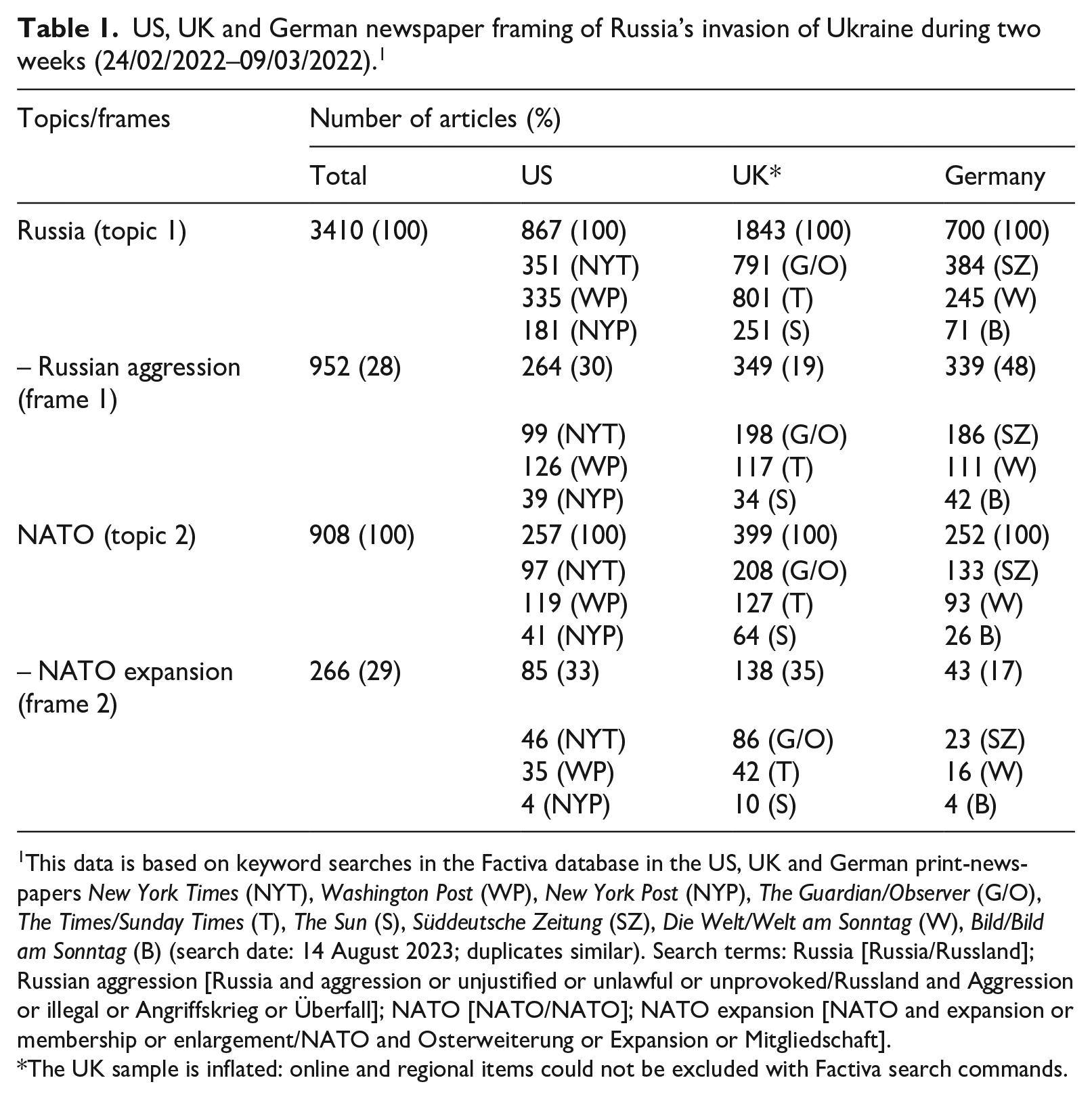
This data is based on keyword searches in the Factiva database in the US, UK and German print-newspapers New York Times (NYT), Washington Post (WP), New York Post (NYP), The Guardian/Observer (G/O), The Times/Sunday Times (T), The Sun (S), Süddeutsche Zeitung (SZ), Die Welt/Welt am Sonntag (W), Bild/Bild am Sonntag (B) (search date: 14 August 2023; duplicates similar). Search terms: Russia [Russia/Russland]; Russian aggression [Russia and aggression or unjustified or unlawful or unprovoked/Russland and Aggression or illegal or Angriffskrieg or Überfall]; NATO [NATO/NATO]; NATO expansion [NATO and expansion or membership or enlargement/NATO and Osterweiterung or Expansion or Mitgliedschaft].
The UK sample is inflated: online and regional items could not be excluded with Factiva search commands.
The German press comprises the largest relative number of items framing Russia as the aggressor: 339 out of 700 items (48%); 264 out of 867 items (30%) in the US and 349 out of 1,843 items (19%) in the UK press included the relevant keywords. Germany’s proximity to the war (geographical and political) is one factor explaining the high number of items. While the US is located farthest away and has been least affected by the war, it constitutes the world’s leading supporter of the Ukraine in military and economic terms. This explains the relatively high number of articles depicting Russia as an aggressor. The UK is also a major supporter of the Ukraine but has arguably less of a stake in the country than Germany and the US. Hence, the UK press included the lowest number of items on frame 1.
As Table 1 further shows, a smaller number of news items linked the Russian invasion to NATO expansion (frame 2); 266 of 908 items (29%) mentioning NATO also included the keywords expansion, membership and/or enlargement. On the country level, the number of items referring to NATO expansion was 85 out of 257 (33%) in the US, 138 out of 399 (35%) in the UK and 43 out of 252 (17%) items in the German press.
If we compare both sets of data (labelled as frame 1 and frame 2 in Table 1), 3.6 times more articles in the two-week period identified Russia as the aggressor as opposed to mentioning NATO expansion (3.1 in the US, 2.5 in the UK and 7.9 times more articles in Germany). The German sample included the lowest number of articles considering NATO expansion and it is in accord with the other findings that the range of debate in Germany was narrower than that in the US and UK.
Overall, the press across countries and outlets emphasized frames that depicted Russian actions as an aggressive war to foster Russia’s imperial interests. The press de-emphasized frames that depicted Russia as a country with a national interest struggling against NATO expansion. This finding encapsulates the Western consensus.
The data can be further illustrated based on a qualitative analysis of a selection of articles from the sample. The following two editorials represented the dominant narrative: according to the New York Times (2022: 20), Russia’s invasion of Ukraine constituted ‘aggression’ and a ‘declaration of war on a scale, on a continent and in a century when it was thought to be no longer possible’. Putin provided ‘dangerous and destructive leadership’, the scope of his ‘professed ambition’ was ‘alarming and bewildering’, his behaviour ‘xenophobic, imperial and misguided’ (New York Times, 2022: 20). The Guardian (2022: 2) spoke of an ‘illegal, immoral and outrageous’ invasion that constituted ‘a massive assault by an aggressor with a well-documented ruthlessness and disdain for civilian lives’. The invasion was ‘a terrible blow to the broader international system’ while Putin ‘has spelt out his utter contempt for the teetering rules-based international order’. The Guardian described Putin as a ‘president who has twinned aggression abroad with repression at home’.
Such reporting was facilitated by the fact that the Russian invasion was obviously criminal, reckless and unjustifiable. It led, however, to the point when the news media surrendered their obligations to impartially cover different sides of the story. Even if we unpack those news articles that included keywords about NATO expansion, the main thrust of coverage remained the same.
Many of the items mentioning NATO expansion legitimized this policy or only cursorily included critical statements. For instance, the New York Times’ editorial indicated that NATO had not principally influenced Russia’s actions in the Ukraine (the Times: ‘Mr. Putin’s attack is not primarily about NATO or security’) (see New York Times, 2022: 20) while Guardian journalist Harvey pointed to analysts who suggested that NATO expansion had been used as a pretext by Putin (see Harvey, 2022). Several items included short critiques of NATO expansion when referring to comments made by foreign leaders. For example, some Chinese and French officials were more sympathetic to Russia and the press reported how they had blamed NATO expansion for creating tensions and/or threatening Russia’s security (see McCoy and Harlan, 2022: A13; McCurry et al., 2022). Such statements often appeared in a negative context that highlighted Russian culpability.
A small number of dissident politicians in the US, UK and Germany who criticized NATO expansion were also quoted in the press. For instance, the New York Post reported how Democratic former Republican Tulsi Gabbard had ‘faced bipartisan outrage for suggesting NATO expansion was to blame for Russia’s invasion of Ukraine’ (Levine, 2022: 6). The UK press reported on 11 Labour MPs who had signed a statement by the campaigning group Stop the War Coalition in which ‘the idea that Nato is a defensive alliance’ was refuted because ‘its record in Afghanistan, Yugoslavia [Libya and Iraq] clearly proves otherwise’ (Badshah and Sparrow, 2022). Yet, these MPs had to withdraw their names from the statement as they were threatened to be removed from the parliamentary party. As a Labour party spokesperson commented in The Guardian (Badshah and Sparrow, 2022): ‘there will never be any confusion about whose side Labour is on – Britain, Nato, freedom and democracy – and every Labour MP now understands that’. Similarly, the German press reported that seven parliamentarians of the left party Die Linke had produced a statement which described NATO as co-responsible for the war. Die Linke’s foreign policy spokesman Gregor Gysi had consequently accused these politicians in an interview with Die Welt as lacking emotion (Hofmeier, 2022: 6, 45).
These examples illustrate how voices who ascribed responsibility to NATO encountered flak from within their own parties. The press did not scrutinize why dissent was marginalized and rarely provided assessments of NATO expansion that went beyond the parliamentary consensus.
The German press hardly included any substantial critiques of NATO expansion. For example, a news feature by Kornelius (2022: 7) in the Süddeutsche Zeitung made the case that NATO expansion had not affected Russian security and that NATO had taken Russia’s interests seriously. Kornelius described the West, NATO and the USA as helpless bystanders. He depicted Russian moves towards the Ukraine as motivated by Putin’s fear of democracy. According to Kornelius, the argument that NATO had ruled out an expansion to the east was a myth not supported by the archival record (as the next section of this article demonstrates, Kornelius’s assessment of the archival record is wrong).
In contrast, the comment pages of the US and UK press included more critical viewpoints. Political scientists Benson and Smith (2022: B03) argued in an opinion piece for the Washington Post that too many analyses had focused on factors intrinsic to Russia (such as Putin’s desire to enhance Russia’s power) when examining the causes of Russia’s invasion. Benson and Smith (2022: B03) pointed out how Ukraine had positioned itself to join NATO, an alliance that aims to counteract Russia, arguing that this alignment made ‘war attractive’: Ukraine’s membership in NATO was hardly imminent, but Russia felt threatened enough by the possibility that it was willing to launch a war to prevent it . . . Recognizing the dynamic at play is the first step toward understanding the conflict . . .
In an opinion column for The Guardian, foreign policy analyst Carpenter (2022) reviewed the US policymakers who had predicted that NATO enlargement ‘would lead to war’ because Russia would see it as a hostile policy. According to Carpenter, warnings by policymakers such as the former Cold War planner George Kennan, former Secretary of State Madeleine Albright, former Deputy Secretary of State Strobe Talbott, or former Secretary of Defense Robert M. Gates ‘were ignored’ and ‘Washington’s treatment of Russia . . . was a policy blunder of epic proportions’. Carpenter concluded that ‘we are now paying the price for the US foreign policy establishment’s myopia and arrogance.’
On a macro-level, such commentaries were scattered deviations from the dominant range of permissible opinion (similar reporting patterns have also been identified by other scholars, see Precht and Welzer, 2022: 21; also, Prinzing, 2022; Schiffer, 2022). The press mainly regarded Russia as the responsible party in the war and did not seriously factor in NATO co-responsibility.
This important finding is in accord with a quantitative study of 4,300 items published in Germany’s leading quality news media between 24 February and 31 May 2022 which found that, in 93 per cent of items, Putin or Russia were attributed as solely responsible for the war in Ukraine. The ‘West’ was designated as (co-)responsible in only 4 per cent and Ukraine in 2 per cent of all coverage (Maurer et al., 2022: 10). In fact, the core notion of the official Western narrative has been to speak of an ‘unprovoked’ invasion. 1 Western news media transported this argument indicating the success of the official Western framing strategy. For example, the February 2022 editorials in the New York Times (2022: 20) and The Guardian (2022: 2) described the invasion as ‘unprovoked’. Noam Chomsky commented that, in Western discourse, ‘it is almost obligatory to refer to the invasion as the “unprovoked invasion of Ukraine”’ as indicated by ‘hundreds of thousands of hits’ on Google (Baroud, 2022). A study by Greene (2022) showed how the notion of an ‘unprovoked’ war ‘has been echoed repeatedly across the media ecosystem’.
While Russia is to blame for launching an illegal war and its grotesque consequences, it could be questioned if there have been contributing factors. For instance, the notion of an ‘unprovoked’ invasion conceals several provocations by the US and their allies. This history must be disentangled to comprehend the responsibility of the West for what has been happening in Ukraine (Greene, 2022). To put news media coverage in perspective, the next section reviews the historical and diplomatic record about NATO’s eastward expansion.
NATO expansion as a contributing factor to the Ukraine War
Broken promises?
According to one scholarly school of thought, in 1990, during negotiations about German reunification, the administration of then-US President George H.W. Bush made a ‘categorical assurance’ to the then-President of the Soviet Union, Mikhail Gorbachev: If Gorbachev agreed that a reunified Germany was part of NATO, then NATO would not enlarge further east to incorporate former Warsaw Pact countries in the alliance (MccGwire, 2005: 119). The rationale was to allow for ‘a non-aligned buffer zone’ between the Russian border and that of the NATO states (McCgwire, 1998: 26). In 1994, the then-US President Bill Clinton administration made NATO enlargement an official policy (Gaddis, 1998: 148). Does this mean that a categorial assurance was broken by the West? Russian leaders have, indeed, suggested that Russian actions in the war with Georgia in 2008 and the conflict with Ukraine in 2014 happened partly as a response to such a broken assurance (Sarotte, 2014: 90–91; Shifrinson, 2016: 7). Many policymakers and experts in the US and other Western nations, on the other hand, argued that Russia only used an alleged assurance as a pretext for imperial policies (Shifrinson, 2016: 7). This is in line with another scholarly perspective which contended either that the issue of NATO eastward expansion was not discussed in the negotiations or that Gorbachev never received a formal promise by the West (see Sarotte, 2014: 91; Shifrinson, 2016: 8). A scholarly middle-ground perspective has been provided by Sarotte (2014: 91) who argued that in February 1990 Western leaders ‘hinted’ to Gorbachev that NATO would not expand eastwards. She wrote that, by mid-February 1990, the US had established a firm position of not making any further remarks about NATO expansion (p. 94). This was done with a view to keeping NATO as the dominant Western military alliance in the region and to counteract a potential pan-European security structure (pp. 94–95). Sarotte suggested that the West was able to persuade Gorbachev to agree to German reunification for financial assistance but without a promise to freeze the NATO borders (pp. 96–97).
It could be argued, then, that clarifying this issue is important because it can contribute to an understanding of whether Russian policies in Eastern Europe have merely been driven by Russian imperial ambitions or by security concerns (see Shifrinson, 2016: 9–10).
That Washington made a categorical promise to Moscow was confirmed by Jack F Matlock, former US Ambassador to Russia in Moscow (1987–1991) (MccGwire, 1998: 26). Furthermore, declassified US government documents, published in 2017 by the National Security Archive, shed light on how these assurances unfolded. In a meeting with Gorbachev on 9 February 1990, the then-US Secretary of State, James Baker, evoked the concept that NATO would expand ‘not one inch eastward’ on three occasions (Savranskaya and Blanton, 2017). For example, Baker asked Gorbachev what he thought about the idea of ‘a united Germany keeping its connections with NATO, but with the guarantee that NATO’s jurisprudence or troops will not spread east of the present boundary?’ In his response, Gorbachev said ‘that a broadening of the NATO zone is not acceptable’ (Gorbachev Foundation Archive, 1990).
Did Western leaders consistently make similar promises to Soviet leaders after February 1990? Other documents demonstrated how, during the following months, a broad understanding about non-NATO expansion cascaded through Baker and other foreign leaders like then-German Chancellor Helmut Kohl and then-German foreign minister Dietrich Genscher. As Savranskaya and Blanton (2017) commented: ‘All the Western foreign ministers were on board with Genscher, Kohl, and Baker’. During multiple high-level meetings between February 1990 and July 1991, Gorbachev and Soviet delegations were assured by Western leaders including then-British Prime Minister John Major and then-British Foreign Secretary Douglas Hurd that the Soviet Union’s security interests would not be violated. In fact, Western politicians suggested the establishment of a new security structure in Europe that was inclusive of the Soviet Union. As late as July 1991, a Soviet delegation, reporting to the recently elected President of the Russian republic, Boris N Yeltsin, met with then-NATO Secretary General Manfred Woerner. The Russian memorandum of the meeting provided the following summary: ‘Woerner stressed that the NATO Council and he are against the expansion of NATO (13 of 16 NATO members support this point of view)’. Savranskaya and Blanton (2017) provided the following assessment: The documents show that multiple national leaders were considering and rejecting Central and Eastern European membership in NATO as of early 1990 and through 1991, that discussions of NATO in the context of German unification negotiations in 1990 were not at all narrowly limited to the status of East German territory [GDR], and that subsequent Soviet and Russian complaints about being misled about NATO expansion were founded in written contemporaneous memcons and telcons at the highest levels.
High level assurances by Western to Soviet leaders were thus made on a continuous basis in 1990 and 1991 (see also Shifrinson, 2016; Trachtenberg, 2021). An historical study by Trachtenberg also showed that Baker and Genscher gave assurances that NATO would not expand to the Warsaw Pact area more broadly rather than just to the area of the former GDR. These were ‘not legally binding’ agreements ‘but promises nonetheless’ (Trachtenberg, 2021: 202). Another study by Shifrinson (2016: 11) summarized the documentary record: Additional archival evidence indicates that U.S. officials repeatedly offered the Soviets informal assurances – a standard diplomatic practice – against NATO expansion during talks on German reunification throughout the spring, summer, and fall of 1990. Central to this effort was a series of bargaining positions through which the George H.W. Bush administration indicated that Europe’s post–Cold War order would be acceptable to both Washington and Moscow: NATO would halt in place, and Europe’s security architecture would include the Soviet Union. Collectively, this evidence suggests that Russian leaders are essentially correct in claiming that U.S. efforts to expand NATO since the 1990s violate the ‘spirit’ of the 1990 negotiations: NATO expansion nullified the assurances given to the Soviet Union in 1990.
Shifrinson demonstrated that the US sprinkled the idea of a cooperative security structure in official talks with Soviet leaders while quietly engaging in a strategy aimed at establishing a European order ‘dominated’ by the US (pp. 11–12). So, this also confirms Sarrotte’s argument in the sense that the US used the promise of non-expansion as a bait so that Gorbachev would agree to a reunified Germany in NATO (Trachtenberg, 2021: 195). And these policy designs can be seen as a root cause of what is happening in Ukraine today. As Shifrinson (2016: 41) warned in 2016, ‘Western scholars and policymakers should not be surprised that contemporary Russian leaders resent the United States’ post–Cold War efforts and are willing to prevent further NATO expansion – by force, if necessary.’
A force of destabilization
Opposition to NATO expansion has not just been voiced by former Soviet leaders or Putin but across Russia’s political spectrum. During the 1990s, Russia has ‘consistently opposed NATO enlargement’ fearing tensions and destabilizing effects (Skalnes, 1998: 56). Yeltsin’s spokesperson Sergei Yastrzhembsky said in December 1996 that NATO-expansion ‘would only lead to negative consequences’; by February 1997, nearly half of the representatives of the parliament, reflecting the whole Russian political spectrum aside from the liberal-democratic Yabloko party, spoke out against NATO expansion and urged the Kremlin to initiate ‘military and political’ measures to counter it (Skalnes, 1998: 56). Even Russian policymakers who are pro-Western and favour reforms have been opposed to NATO expansion as they think it will strengthen ‘nationalist and communist’ sectors in Russia (Skalnes, 1998: 56). Skalnes summarized Russian strategic concerns as follows: ‘The Russians fear that NATO expansion is designed to exploit Russia’s current military weakness and complete the encirclement of Russia. Avoiding the latter has been of particular concern in Russian military thinking.’
These Russian views are well known in and shared by significant parts of the Western diplomatic and scholarly communities. Several retired high-level Foreign Service, State Department and Department of Defense officers wrote a letter to the US Secretary of State concerning NATO enlargement in May 1995 (MccGwire, 1998: 24). The officials wrote: In our view, this policy risks endangering the long-term viability of NATO, significantly exacerbating the instability that now exists in the zone that lies between Germany and Russia, and convincing most Russians that the United States and the West are attempting to isolate, encircle, and subordinate them, rather than integrating them into a new European system of collective security. (Davies, 1995)
In June 1997, Clinton received a letter written by 50 former bipartisan senators, cabinet secretaries and ambassadors calling US efforts to extend NATO ‘a policy error of historic importance’ (MccGwire, 1998: 23). The experts noted that NATO expansion would destabilize the post-Cold War arrangement. Moreover, the letter described how the policy ‘continued to be opposed across the whole political spectrum in Russia’ and this would undermine Russian elements in favour of reforms and collaboration ‘with the West’ while strengthening ‘the non-democratic opposition’ (MccGwire, 1998: 23). Matlock (2022), the former US Ambassador in Moscow and signatory of both letters, stated in testimony before the US Senate Foreign Relations Committee in 1997 that NATO enlargement may well go down in history as the most profound strategic blunder made since the end of the Cold War. Far from improving the security of the United States, its Allies, and the nations that wish to enter the Alliance, it could well encourage a chain of events that could produce the most serious security threat to this nation since the Soviet Union collapsed.
There had also been a firm consensus by historians that NATO enlargement was a bad idea, US-Cold War historian John Lewis Gaddis wrote in 1998 that NATO enlargement violated every strategic principle and that he could ‘recall no other moment in my own experience as a practising historian at which there was less support, within the community of historians, for an announced policy position’ (Gaddis, 1998: 145).
Provoking Russia: Extending NATO to the Ukrainian–Russian border
Yet, NATO continued its policy of expansion. By 2005, NATO had integrated all the former Warsaw Pact states (Romania, Poland, Bulgaria, Hungary, Slovakia, Czech Republic and Albania) and the three new independent Baltic republics (Estonia, Latvia, Lithuania) in the alliance reaching ever closer to the southern border of the Russian heartland and adjoining Iran, Afghanistan and Xinjiang (MccGwire, 2005: 119–120).
As Russia could not prevent the Central European states from joining NATO, they focused on Ukraine as a ‘red line’ for further NATO consolidation (see Skalnes, 1998: 57). Russian leaders have consistently voiced concerns about NATO’s plans to integrate Ukraine in the Western military alliance right up to the invasion in February 2022 (Mearsheimer, 2014, 2022). For instance, Yeltsin said in 1997 that Ukraine’s integration into NATO would ‘fully undermine’ diplomatic affairs with the West (Skalnes, 1998: 57). In 2008, when NATO contemplated at the summit in Bucharest allowing Ukraine and Georgia into its alliance, Putin said he considered admitting these two countries into NATO as a ‘direct threat’ to the Russians (Mearsheimer, 2014: 79). Around the time of the 2008 NATO summit, William Burns, then-US ambassador in Moscow (and at the time of writing the director of the CIA), wrote the following memo to the then-US Secretary of State Condoleezza Rice: Ukrainian entry into NATO is the brightest of all red lines for the Russian elite (not just Putin). In more than two and a half years of conversations with key Russian players, from knuckle-draggers in the dark recesses of the Kremlin to Putin’s sharpest liberal critics, I have yet to find anyone who views Ukraine in NATO as anything other than a direct challenge to Russian interests. (Mearsheimer, 2022)
Ukrainian NATO membership has also not been supported by the two major regional European powers: France and Germany. Yet, as Mearsheimer (2022) has documented, multiple US administrations have continued ‘to make Ukraine a Western bulwark on Russia’s borders’. According to Mearsheimer, this included the following policies:
Encouraging Ukraine to become a member of the European Union thereby pulling it closer in the Western orbit.
Pressuring France and Germany to publicly acknowledging that Ukraine and Georgia would be joining NATO at some point in time.
Supporting the Maidan uprising in Ukraine that would oust pro-Russian Ukrainian President Viktor Yanukovych in 2014.
Training annually about 10,000 troops of the Ukrainian military since 2014.
Providing weapons to Ukraine (as decided by then-US President Trump in 2017).
Conducting NATO–Ukrainian ‘joint military exercises’ (such as, in 2021, the operations Sea Breeze and Rapid Trident).
Reiterating the 2008 decision from the Bucharest Summit to make Ukraine a NATO member with the Membership Action Plan (MAP) (this was in June 2021 after Joe Biden had become US President in January 2021).
Cementing Ukrainian NATO membership when in November 2021 the US and Ukraine signed the ‘US–Ukraine Charter on Strategic Partnership’ which pushed for further ‘Euro-Atlantic’ integration [since the 1990s, the West has trained Ukrainian army personnel at a base near Lviv, Ramzy, 2022].
At the end of 2021, Russia proposed two drafts of ‘mutual security treaties’ to the US and NATO which were open to further debate with the aim of addressing how Russia claimed its security was affected (Benjamin and Davies, 2022: 64). According to the US peace activists Benjamin and Davies, the US and NATO ‘refused to take Russia’s drafts as a basis for negotiation on any of the issues they raised’ including ‘NATO expansion’ (p. 64). Earlier, the US had jeopardized the 2015–MINSK II agreement by advancing military over political solutions (p. 47). The Ukraine, Russia, France, Germany and the Organization for Security and Co-operation in Europe (OSCE) had put forward MINSK II. MINSK II included a set of policies (cease-fire, buffer zones, OSCE monitors, elections in the Donetsk and Luhansk Oblasts) to finding a political solution for the conflict between the Ukrainian government and pro-Russian separatists in Eastern Ukraine (p. 46). If the US had pressured the Ukrainian government to adhere to MINSK II while seriously engaging with Russia’s security proposals, the conflict that had been building up since 2014 might have been defused.
A war foretold
The evidence discussed in this section suggests that NATO expansion contributed to the war in Ukraine by way of militarizing the region. In fact, the late Russia scholars Cohen (2019), the former US ambassador to Moscow, Matlock (2022), the academic Chomsky (Baroud, 2022) as well as the journalists Vanden Heuvel (2022) and Pilger (2014), amongst others, have made such arguments. Moreover, this narrative has most forcefully been articulated by ‘realist’ scholar Mearsheimer (2014, 2022).
Already in 2014, Mearsheimer (2014: 82) warned that if Ukraine decided to side ‘with the West against Moscow’, Putin ‘would wreck Ukraine as a functioning state before he would allow it to become a Western stronghold on Russia’s doorstep’. After the Russian invasion of Ukraine in February 2022, Mearsheimer (2022) renewed his critique, arguing that Putin had referred to Ukrainian ties with Western states and particularly NATO as major concerns on multiple occasions. For example, on the eve of the invasion, Putin had claimed that Russia faced ‘a permanent threat from the territory of today’s Ukraine’ which according to Mearsheimer (2022) referred to Ukraine being transformed into a military launchpad for Western powers. As Mearsheimer (2014: 81) argued in 2014: A huge expanse of flat land that Napoleonic France, imperial Germany, and Nazi Germany all crossed to strike at Russia itself, Ukraine serves as a buffer state of enormous strategic importance to Russia. No Russian leader would tolerate a military alliance that was Moscow’s mortal enemy until recently moving into Ukraine. Nor would any Russian leader stand idly by while the West helped install a government there that was determined to integrate Ukraine into the West.
Similar warnings have been expressed by Pilger (2014) who in 2014 noted how ‘Nato’s military encirclement has accelerated, along with US-orchestrated attacks on ethnic Russians in Ukraine’. Pilger warned that if Putin could be ‘provoked into coming to their aid, his pre-ordained “pariah” role will justify a Nato-run guerrilla war that is likely to spill into Russia itself’. It appears that Pilger’s prophecy has come true as a proxy-war is currently being conducted in Ukraine (Benjamin and Davies, 2022: 8).
Conclusion
According to international law, self-defence and/or authorization by the United Nations Security Council are the only legal grounds for war (Mandel, 2005). Russia’s invasion of Ukraine did not meet these criteria and thus constitutes a crime of aggression. But does this mean that there are no other factors that triggered the invasion? The historical and documentary record shows that NATO expansion had been identified as a destabilizing force for US, European and Russian security by leading diplomats and policy makers on all sides. It also shows that Western leaders have been aware of Russian ‘red lines’ which mirror the same security outlooks upheld by Western powers. In fact, in 1823, the US established the Monroe Doctrine (after US President James Monroe) which basically dictated US dominance over the Western hemisphere (Abelow, 2022: 9). As Abelow commented: Any foreign power that places military forces near U.S. territory knows it is crossing a red line. U.S. policy thus embodies a conviction that where a potential opponent places its forces is crucially important. In fact, this conviction is the cornerstone of American foreign and military policy, and its violation is considered reason for war [original emphasis].
In reverse, it could be argued that US-led NATO policies provoked Russia’s invasion. Yet, the news data and studies reviewed in the first section of this article show that the Western news media has largely blanked out any notion of Western culpability for the war in Ukraine. The Western news media has downplayed Russian security concerns about NATO eastward expansion and the prospect of Ukrainian integration into the military alliance. Moreover, the news media has overwhelmingly framed the imperial ambitions of Russia/Putin as the cause of the war. The dominant causal framing links to the remedies that have been evoked to solve the conflict. The news media has advanced military at the expense of diplomatic solutions (Precht and Welzer, 2022: 10, 21, 27). News media framing is in line with the Biden administration’s April 2022 announcement of weakening Russia via militarily supporting Ukraine (Bertrand et al., 2022). This policy has led to a deadly prolonging of the war (Benjamin and Davies, 2022: 79). It also has been mirrored by a militarization of NATO countries and Russia. Since Russia’s invasion in 2022, the US, UK and Germany have committed more than $50 billion to support the Ukrainian military (Mills, 2023: 4, 46). In December 2022, Biden signed a new spending bill aimed at providing a further $47 billion in aid for Ukraine (Davis, 2023). On 27 February 2022, German Chancellor Olaf Scholz introduced a special fund for the Bundeswehr of €100 billion in addition to an annual defence budget of €50 billion (Bundesregierung, 2022), the largest military upgrade in Germany since World War II. EU member states had already by May 2022 proclaimed defence budget increases of about €200 billion (European Commission, 2022). Russia has increased its military spending by 9.2 per cent in 2022, becoming the world’s third largest purchaser (after the US and China) (Times of India, 2023). Akkerman et al. (2022: 1) argue that the war in Ukraine has been used ‘as a smoke screen to justify replenishing, expanding and modernising’ stockpiles of weapons ‘and to bend and reshape existing arms trade regulations’. Yet, in a show of patriotism, the news media has avoided scrutinizing the Western military build-up.
Footnotes
Acknowledgements
The author thanks Richard Lance Keeble and the anonymous reviewers for remarks on an earlier version of this text.
Funding
The author received no financial support for the research, authorship and publication of this article.
