




Abstract
Pregnant Rapunzel Emergency is part of a series of online free games aimed at young girls (forhergames.com or babygirlgames.com), where dozens of characters from fairy tales, children’s toys and media feature in recovery settings, such as ‘Barbie flu’. The range of games available to choose from includes not only dressing, varnishing nails or tidying messy rooms, but also rather more troubling options such as extreme makeovers, losing weight, or a plethora of baby showers, cravings, hospital pregnancy checks, births (including caesarean), postnatal ironing, washing and baby care. Taking the online game Pregnant Rapunzel Emergency as an exemplar of a current digital trend, the authors explore the workings of ‘dark digital play’ from a number of perspectives – one by each named author. The game selected has (what may appear to adults) several disturbing features in that the player is invited to treat wounds of the kind of harm that might usually be associated with domestic violence towards women.
Defining terms: Setting out perimeters
Maybe scholars should declare a moratorium on defining play. Maybe, as Victor Turner said in one of his last writings, play is indefinable … Dark play may be conscious playing, but it can also be playing in the dark when some or even all of the players don’t know they are playing. Dark play occurs when contradictory realities co-exist. (Schechner, 1988: 15–16)
Notwithstanding the compelling argument above, the apparently innocent term ‘play’ is all too often used as a metaphor for what is innocent when it is not (Grieshaber and McArdle, 2010), not least because it encompasses what the great play theorist Brian Sutton-Smith (1997: 132) called ‘dark play’. In response to what psychologists (Pellegrini and Smith, 1998), animal studies research (Burghardt, 2005) and neuroscientists such as Antonio Damasio (1994) were uncovering about the primary associations of play to survival and resistance to stress, Sutton-Smith formed a ‘dialectic of playful emotions’ which included hitherto neglected aspects such as ‘gross play’, ‘shock’, ‘risk’ and ‘disruption’, inheriting theatre director Schechner’s ‘dark play’ as illustrative of creative-destructive processes when the usual rules of play are subverted or sabotaged.
Bird and Edward’s (2015) ‘digital play framework’ set out what they perceive to be learning behaviours, including the ludic, which is categorised as ‘symbolic, innovation play’. Jackie Marsh et al.’s (2016) classifications for digital play developed this framework, including Sutton-Smith’s (1997) dialectic and Hughes’ (2002) taxonomy to devise various digital play categories, including ‘deep play’ (where the child feels as if in a fight for survival), ‘fantasy’ (superhero/character) or ‘mastery play’ (gaining control of environments). Marsh et al. (2016) has also examined the ways in which parents and carers can support or scaffold children’s encounters with new technologies, harnessing their interest to develop wider forms of literacy, including the visual and digital.
Yet these are still rather benign models. As Sutton-Smith (1997) warns us, ‘masteries’ are a limited kind of reality. He cites Goffman (1961), who believed that, in play, it is as if the player is learning in a virtual way how to act in control when metaphorically under fire. This article explores the idea that dark digital play might appear to invite new possibilities for the experience of playing as positively acting out the feeling of surviving the dark, but when all three authors examine Pregnant Rapunzel Emergency closely at the levels of player, parent observer, interpreter and digital programmer, the game is stitched up, gender-wise. 1
We will begin in close-up, with participant observations of a young female child interacting with the game – reflecting anxiety of ‘appropriacy’ for a parent and feminist woman. Then, digging under the visible, we seek out the author or producer of the online sites, and explore the digital make-up of the game in terms of its programming templates and marketing strategies. Finally, at the interpretive level, we analyse the game’s tropes and metaphors as part of gendered, psychoanalytic discourse.
What can contemporary online games tell us about the realities of dark play? Is there dark play in the game itself, the observer or the player, the maker or production? Are constructions of childhood darkened in the player’s consumption of products like these, or is that fear itself an adult assumption and construction? Working across the perspectives of parent, educationalist and computer scientist, we aim to explore questions crucial to an interdisciplinary understanding of dark digital play.
Rebecca Sinker: A mother’s perspective
This section writes from an autobiographical case-study tradition of late 20th-century feminist writers such as Valerie Walkerdine (1990) and Carolyn Steedman (1992), where ‘fictions of femininity as they are performed in real life situations’ carry powerful messages of teachers and parents who do not hesitate to confess their dilemmas and reveal the dark side of themselves’ by ‘juggling with contradictions’ (Tamboukou and Ball, 2003: 209).
My seven-year-old daughter came home from after-school club, sat down at the computer and found a website called kizi.com, which she had been playing on at school. A banal, colourful click-and-drag hairdressing scenario appeared and she settled down. About 15 minutes later, I noticed a very different scene. The background was bright pink and the scene was a hospital bed with a pregnant cartoon female (Figure 1). She was staring worried and wide-eyed from the screen, with a black eye and tears brimming, covered in bruises and scratches, and spiked with what looked like large thorns.
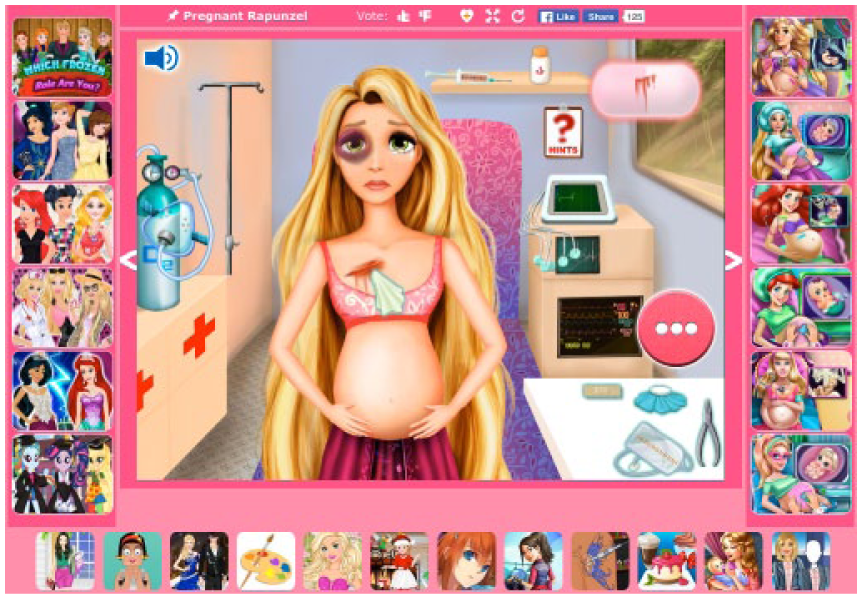
Pregnant Rapunzel Emergency screenshot.
That was my introduction to the world of online pregnancy games for girls. www.mafa.com, a games hub, is home to ‘the best free girl games’ online. Styled in bright pink and purple, the site has hundreds of cooking, makeover, baby-care, dressing-up, bridal and party-prep games, featuring big-eyed, lustrous-haired, mainly Caucasian teens with a large contingent of cartoon celebrities from Disney and television, including Elsa (Frozen), Rapunzel (Tangled), Ariel Sofia (Princess Sofia) and Dora (Dora the Explorer). In amongst these are slightly less-expected scenarios, including dentistry, surgery and pregnancy.
At first glance, as an adult female and mother, whose work involves digital media production and learning, my semiotic sirens went off loudly. The excessive pink was one thing; the ultra-fem characterisation (a Barbie/anime mash-up) was another. The context was something else. I do not necessarily recognise all the Disney princesses out of context (in the emergency room as opposed to the enchanted forest), so to me the graphics immediately suggested teen pregnancy and domestic violence. A young woman beaten by the boyfriend who had knocked her up? But was this an overreaction to a simple fantasy-land aesthetic with some (probably copyright-infringing) characterisation thrown in as an easy hook?
At the time, I steered my daughter back to the safer waters of CBBC (Children’s BBC), and later did a bit of research, which revealed just how many of these strange games were out there. At the time, the only thing I could find which had noted this phenomenon was a blog by Philippa Warr on the games review site Rock, paper, shotgun. According to the chief executive officer of SuperData Research, Joost van Dreunen: Sites like MaFa.com appeal largely to girls, accounting for 92% of traffic. About four out of five of these women are teen and tween girls, which explains the predominance of popular Disney characters like Elsa. Interestingly, however, about 21% of these women are adults aged 18–34. In terms of business model, this type of web-based game portal draws the lion share of revenues from ads and cross-promotion, and relies for only 2–5% of annual revenue on direct purchases. (Warr, 2015)
Parental anxiety around screen time and digital content is high and increasing (Byron, 2008; Palmer, 2007). Young girls feeling pressured to conform to body images, gender stereotypes and sexualised selves from a young age, juxtaposed with the contradictory identities of childhood, is also well reported (Coy, 2009; Robinson, 2013). As the images (and communities) that our children have access to online are proliferating, the feeling of losing control or influence (and the associated guilt) has to be balanced with the reality that each older generation has fretted about unsuitable cultural influences or technologies with regard to their children. One approach is to talk through what they are seeing, feeling and thinking as they encounter and play with this content online. So, a year after I first saw my daughter playing games on www.mafa.com, we revisited the site together:
And you first discovered this when you were at after-school club – is that right? Can you remember when you first found it?
Yeah. And you’re not allowed to play it.
You’re not allowed to play this? Who said?
At school. Not allowed.
Ah. You did discover these at school, so obviously the teachers have seen them now and said they’re not allowed … so, do you remember playing these games?
Can I play now?
…
Who is she?
She’s … Rapunzel.
How do you know?
Cos she’s got long hair.
Oh, OK. You recognise her, yeah?
Yeah.
And why do you think she’s pregnant?
Because she’s giving birth to a baby.
Is she pregnant in the story of Rapunzel?
[shakes head]
So, how do you think she got pregnant?
I don’t know [carries on playing the game].
…
OK. Tell me about the way she looks.
Pregnant!
Yes. What else?
I don’t know.
She’s not wearing very much, is she?
No, cos she’s giving birth!
Oh, OK. So that makes sense then, does it? Now, how do you think she got hurt? Because she had a black eye and scratches, and she needed bandages, didn’t she, and looking after … What do you think happened? What’s the story?
I think she fell down and hurt herself.
Did she? What makes you think that?
By the way I can see – that’s her baby.
Where do you think she fell down?
In a bush.
In a bush? Is that how she got hurt, do you think?
I think so. Now, what do I do? [carries on playing the game. Once completed she goes to the main hub page to look for another]
…
Can you play that one?
No that … I don’t want to … That’s not one … I just want to play this one.
Why? Because she’s not pregnant [in that one]?
She’s not had her baby yet. And in all those ones she does.
Oh, I see. So you want to see the ones where she’s having her baby.
In that one she’s …
But that’s not her, is it?
No, but it’s a different girl and she’s gonna have two, see? One, two.
So, do you like the games that show the people being pregnant?
Yes.
Why? What is it about them you like?
I don’t know.
Think about it. … Tell me about the pregnant women.
It’s just that you have to help them. And if I want to be a doctor or somebody who helps get the baby out, you have to learn.
At home, we have covered the basics of bodies, babies and reproduction, through children’s books like Amazing You! (Saltz, 2008), through natural history television and through conversations when her teacher was pregnant. What became clear through this dialogic episode was that the act of giving birth held a real fascination because that was the part she had not seen. She has seen women who are pregnant and she has seen them with newborn babies, and she knows where babies come out. But she has not seen a human birth, so Pregnant Rapunzel Emergency might hold the key:
Look. She’s hurt again, isn’t she? What’s that in her legs?
That’s thorns?
How do you think those got there?
She’s got a nosebleed as well.
How do you think she got a nosebleed and thorns? She’s very badly hurt, isn’t she?
Yeah.
How did she get so badly hurt? Do you think somebody hurt her? Or do you think she had an accident?
Had an accident.
Or do you think she was running away and maybe ran … sorry, I’m giving you lots of ideas. What do you think might have happened? What are your ideas?
I think that she was running, and then she, erm, wasn’t looking, and then she tripped into a thorn bush, and that’s how she got all her thorns.
Oh, I see … What’s that? What’s that doing?
It’s checking her heart.
And now what are you doing?
Now I have to … do this … It’s eye drops, I think. I think so. Oh, I have to take the thorns out. Oh, she’s being brave [referring to her facial expression].
What does that say?
‘Remove the wooden hill … nails.’ Oh, they’re not …
Wooden nails? …How did she get nails in her?
Oh, I actually think … I actually think it wasn’t a thorn bush. She was in the pub and then she … just got nails.
How did she get nails in her, in a pub?
Beats me!! Look, this is helping her!
[laughing] What are you doing to her now?
‘Apply … the … an … ti … sep … tic … lotion’. … So it’s helping her wounds.
So, we’re not sure how she got hurt, although you think she might have got … fallen over in a pub and got some nails in her?
Well, I actually don’t know.
Well, I don’t know either!
While I saw games imbued with gender stereotyping and implied violence, my daughter appeared largely unfazed by this. The lipstick and long hair were recognisable female signifiers for her, as was the fact of pregnancy, but the injuries were presumed accidental, not a signal of violence or trauma. In her own experience, cuts, grazes and bruises are common, a result of playing hard, cycling or climbing, and rarely inflicted deliberately by others. That is the analogy that she naturally drew. And her role, as the player, was a simple one of caregiving – a virtual ‘kiss it better’:
What plaster shall I give her?
Oh, you can choose a colour! Whichever you like, I guess. Oh my gosh, she needs a lot of plasters! Now what are those marks there?
They’re bruises!
Are they? How do you know?
It’s because you can tell. I got a bruise on my leg!
And does it look like that?
Yeah! … It looks like that one, not that.
How do you think she got the bruises, Tilly?
I think … erm … oh, it’s an ice pack … I think she fell … Look! Now watch! Look at her!
Oh, you made her feel better. Now what?
X-ray. You need to … Look, there’s the baby – oh, you missed it.
…
Finished! What? … Oh my gosh! There has to be one where there’s a baby coming out [searching].
Is that what you’d like to see next? Would you like to see one where the baby’s being born?
…
And what do you think about the music? [calm, bland, beauty-spa-type muzak]
Really nice.
You like it? What do you like about it?
It’s not like ‘Dzzzurrrur, Dzzzurrrur, zzzuuur’ [makes repetitive thrash-guitar, speed-metal-type music sounds], like that. I just like the way it’s all nice [bobs her head and smiles].
She was evidently attracted to the simple task-oriented gameplay with a familiar character and predictable results, and possibly even soothed by the banal background music and gentle pace. She also saw this as a comfortable mix of learning (about medical procedures, maternity, caregiving) and fantasy scenarios (mermaid babies, vampire babies). But she realised that it was not for everyone:
Do you think teenagers would play these games?
No! Cos it would be a bit boring for them.
So, it’s for younger children like you? But you’re not bored with it yet.
No.
And one more question about school. Why do you think school won’t let you play these games?
Cos there’s too many little kids there.
And why shouldn’t little kids see these games?
Cos it’s too violent.
How is it violent?
Not violent, but they shouldn’t do it.
Why?
I just don’t think they should … because it’s … it’s not really appropriate for them.
Is that what the teachers say?
[nods]
And do you know what isn’t appropriate?
No.
Is it cos the ladies are pregnant?
No.
Or because they’re hurt?
Both!
Do you think the little kids would ask too many questions?
Yeah, and they would just keep playing them.
Oh. So even playing these games is not appropriate when you’re little. Why is that?
Wait … I’m trying to find one where the baby actually comes out.
Is that what you’d prefer to see?
[she starts a Google search for MaFa.com and birth games]
What does that say?
‘Giving birth games’. Yeah, these are the ones! [the Marks & Spencer advert starts again] Oh, why is it this ad all the time?! Mum, can I have a tiny piece of something to eat?
That’s why! Because they want you to feel hungry.
Can I have a drink?
It’s highly suggestive.
Can I have a drink?!
Are my anxieties around suggested (unquestioned) violence unfounded? Certainly, my daughter was not disturbed in the way she has been when seeing other apparent depictions of violence, injury or birth. These include paintings by Frida Kahlo, whose portraits she is very drawn to – works such as Henry Ford Hospital (1932), with its bloodstained sheets and floating iconography of industrial, medical and cultural symbols, or The Broken Column (1944), with its open wound from neck to womb, revealing a shattered Ionic column (Figure 2). According to curator Tanya Barson (2005), the iconography of chingada, or ‘victimhood’, is present in several of Kahlo’s paintings and references not only her own accident, physical pain and subsequent miscarriages, and her betrayal by husband Diego Rivera’s infidelity, but also more broadly the historical wounding of women and the status of Mexico as the long-suffering, violated mother at the hands of European domination. The Broken Column also features Kahlo’s signature gaze holding the viewer, this time with a shower of teardrops beneath the monobrow and her riven torso studded with nails. Could the Rapunzel game designers be referencing their art history education?
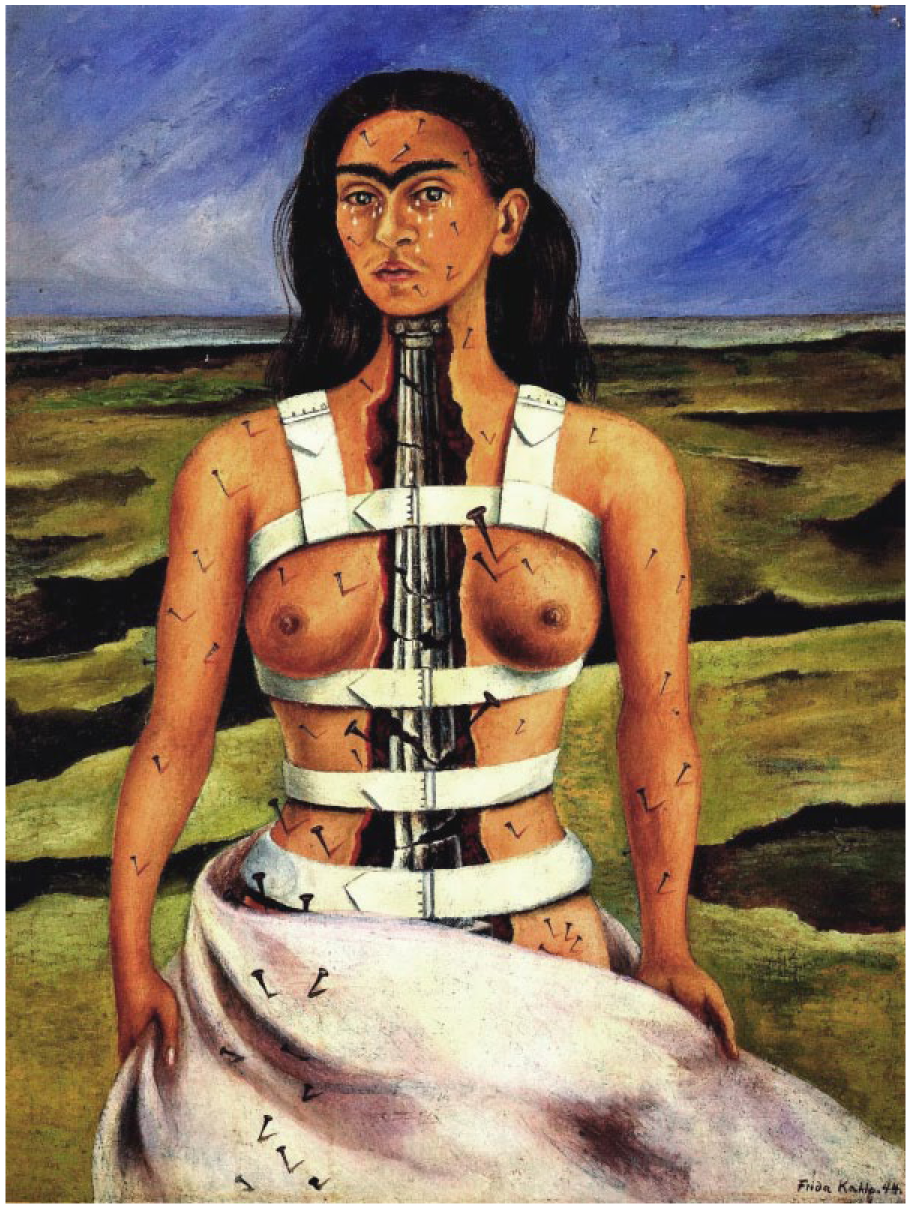
Frida Kahlo self-portrait: The Broken Column (1944).
While the gender stereotyping in the actions and aesthetic is evident, this could be counterbalanced when considered alongside other imagery, scenarios and counternarratives that she encounters in books and films. The gender roles offered in this game type and on these hubs, mixing real-world simulation with role play, are undoubtedly limited (Pei Ling Ong and Tzou, 2009), but can also be seen alongside a much broader array of options that she encounters through play, popular culture and people in her life. What is evident, though, is that these are a poor substitute for sex education, and that she is ready for an alternative (preferably illustrated) explanation.
Mike Phillips: A digital perspective
Pregnant Rapunzel Emergency lives in an interconnected world of game web portals that have evolved over the years through a complex ecology of software capability, pay-per-click or PPC advertising revenue streams, 2 fan art/fan fiction (fanfic), a global community of independent game developers and a restless audience that feeds on creeping innovations in stimulation. Pregnant Rapunzel Emergency is the product of this slow evolution and interplay of human desire with technology.
The evolution of these template web games dates back to 1980s graphic adventure games on domestic game stations and micro personal computers, such as the Amiga, Atari, ZX81 and Spectrum (Donovan, 2010). Authoring for these platforms required a reasonable grasp of coding and distribution through floppy disks, cartridges or by retyping raw code from bulletin boards or printed magazines, and it was not until the advent of the World Wide Web in the early 1990s, combined with the emergence of authoring packages such as HyperCard (Lasar, 2012) and Macromedia Director (Lingoworkshop, 2005), that the process for games production became more democratised for more graphically oriented designers. Web-browser plug-ins such as Shockwave and Flash enabled these designers to distribute their products through the Web, which in turn led to the growth of a community of independent game developers.
Surviving on Flash-heavy website design (Flash is software developed by Adobe to create animated web content) and the production of Flash banner adverts, these designers were motivated to provide maximum audience engagement through simple interactive elements underpinned by a PPC advertising revenue model. The PPC business model relies on advertising companies paying host websites for every click on an advert – the more clicks, the more income, some of which trickles down to the Flash banner developer. In order to attract more clicks, Flash adverts became gamified ‘clickbait’ to the extent that some websites lost their content altogether and became ‘honeypots’ (computer security mechanisms set to detect, deflect or counteract attempts at unauthorised use of information systems) through which adverts could be delivered to users. These hollow websites rely on a constant stream of traffic, with users spending as long as possible on a page so that adverts can be absorbed through their peripheral vision, on the slight chance that one might be clicked on.
These honeypots are a perfect symbiotic system or mutualism: advertisers reach huge audiences and developers demonstrate their skills and receive a cut through the amount of web traffic, with the host website taking the cream off the top, and audiences satiated with a tsunami of gratification. The analytics that run behind these games in turn generate a form of algorithmic-driven evolution for the games. Web traffic is monitored to ensure that popular games are copied and re-versioned: a character being swapped out or into another game template; a colour palette or expression duplicated; a particular theme or interaction tweaked and honed through a process of algorithmic selection to ensure survival of the fittest/cutest/saddest. It is not unheard of for the host company to instruct a developer to bastardise their creation to cater for these enhancements, or to copy another developer’s style, behaviour or interactions. This swarm-feeding on digital content is to satisfy viewers’ needs so that they might occasionally click on an advert.
The adverts themselves are part of another behavioural construct. ‘Behavioural advertising’ uses a range of techniques to deliver a personalised advertising experience based on the browsing history of the user (McDonald and Cranor, 2010). The idea is that the longer you browse the Web, the more relevant the adverts will be to your needs, to the extent that at some point these systems will know what you want before you are aware of it. These predictive algorithms deliver adverts anticipating your desire and can be modified based on demographic data and temporal factors (such as changes in location, weather and news items), along with more complex inferences based on the confluence of multiple data sets.
The adverts appearing in the margins, assuming that an ad blocker is not installed, will therefore be targeted at the primary user of the web browser. Considering the age of the majority of users, it would be reasonable to assume that a fair proportion of primary users will be a parent or guardian, and not the player of Pregnant Rapunzel Emergency. The adverts appearing in the peripheral vision of the player will, therefore, be targeted at a completely different demographic than the player. Pregnant Rapunzel and thousands like her will be surrounded by adverts pushing white goods, fashion and merchandise, matching completely different lifestyle aspirations to those of the young player. These incongruous artefacts frame the medical instruments of Rapunzel’s maternity ward with a peripheral glimpse of her suburban future. This strange montage does not appear to deter the business model that maintains its existence through generating massive amounts of web traffic to sustain the clickbait environment. www.mafa.com has around 5.57 million clicks per month. 3
The games themselves are simplistic in structure and celebrate the moveable sprites of early arcade games and interactive authoring environments, such as Macromedia Director and HyperCard. These clusters of pixels form a simple image which is independent from the background or other layers in a game scene. Their location can be altered by coding their x and y axes to allow simple animations to be created. Sprites can move behind or in front of other sprites, and are attached to key presses to create simple two-dimensional games. An event can be created when two or more sprites collide, triggering audio or new animations. Alternatively, moveable sprites can be attached to the mouse pointer or cursor, allowing them to be moved around the screen and placed on top of other sprites to trigger events, such as combining two sprites with a click and holding down the mouse button and then releasing them with a ‘mouse up’. This is essentially the template of behaviours that these games use, and it is surprisingly effective and addictive, especially when compared with the three-dimensional immersive richness of modern multi-user game platforms like the PlayStation and Xbox.
In a sense, the games are a direct translation of the paper-cut-out, dress-them-up games from the Bunty comic in the 1950s into the virtual two-dimensional worlds of the computer screen for the 21st century. ‘Wipe the blood or puss using tissue’ becomes a simple process of selecting the tissue sprites and dragging them to the blood and puss sprites, the convergence of which removes the blood and puss sprites; the sad Rapunzel face sprite is swapped and Rapunzel smiles.
The sun is now setting on the era of browser plug-ins, and Flash, with its endless security breaches, is slowly being replaced by HTML5, a media-oriented version of HTML which allows many of the same affordances to be built directly into a web page. 4 The international community of independent game developers is adapting to the new production skills in order to meet the demands of the technology, new advertising mechanisms and the desires of the players. But what of the desires of these developers? It is easy to focus on the gameplay and the experience of the players, seeing the games themselves as a given, an a priori artefact in the world, and to forget that someone, somewhere spends time making these things. The intentionality of the designer to create these experiences for the player is another behavioural ecology, a mix of mastery of the computational environment and graphic skills to make these jewel-like forms combined with a pragmatic engagement with the financial motivation to construct seductive clickbait. The craft of coding is as seductive as the flow of play, and the finely tuned subtle differences between each of these near identical games require a casual obsession to give birth to each templated experience. This process blends practical, mechanical making with an ability to predict how the player will feel, a sense of practice and, undoubtedly, a begrudging love for the content. What are the feelings of the developer on his MacBook as he (and the probability is that the developer will be a he) inserts the nails into Rapunzel’s pixelated flesh?
The gender balance in game developers is shifting, but undoubtedly the majority are male, in their twenties and working alone. The statistics are problematic because generally they do not cover the independent game developers, instead focusing on a larger, more stable games industry. The independent game developer community consists of freelancers working from home or as part of randomly formed outsourced project teams. Developers who produce templated games for the likes of www.mafa.com are not statistically measured, but would probably fall in the crossover space between programmers and graphic designers. Statistics from the International Game Developers Association would suggest that this category is between 89% and 95% male. 5 These developers would also cross over into the web developer community, where the gender split has a marginally better balance. In contrast, the Internet Advertising Bureau (2014) has suggested that 52% of gamers are female, and pregnant Rapunzel’s home is focused at the younger sector of this demographic.
Pregnant Rapunzel Emergency hangs with an international community of developers drawn from across Europe, North America and Asia. It is hosted on international servers run by companies registered wherever tech-hub and start-up funding is available. It plays on the fine line that exists between fan art and copyright infringement, but also provides a portal to millions of users should Disney need to generate traffic around a new product. In a global tensegrity of contracting, subcontracting, farming out and open portfolio submissions, ownership and intellectual property rights are flexible commodities that bend under algorithmic and player pressure.
Pregnant Rapunzel Emergency lives, then, in an international world bounded by aggressive advertising, serviced by male developers and played by little girls – none of which operate ‘innocently’. Hence, it is something of a template for the contradictory realities present in Schechner’s (1988) definition of dark play.
Victoria de Rijke: A psychoanalytic perspective
Consistent with Sutton-Smith’s (1997) view of play as performance, in 2005 the zoologist Robert Fagen suggested that play theorists begin to consider play from aesthetic perspectives, asking whether dark, emotional aspects of human consciousness might be the key drivers for imaginative thought and creative behaviour – ideas borne out by those in psychology (Pellegrini and Smith, 1998) and even longer by those in psychoanalysis (Bettelheim, 1979; Winnicott, 1977). Psychoanalytic readings search deep below the surface for hidden meanings – not least for the ways we are conditioned, socially, emotionally and psychologically.
In Bruno Bettelheim’s (1979) Freudian study of the fairy tale, The Uses of Enchantment, the character of Rapunzel is Oedipal: a jealous mother figure (the witch) restricts a young daughter’s independence by locking her in (the phallic) tower. He points to Rapunzel finding the means of escape within her own body (the tresses of long hair the prince climbs) and her role in curing the prince of blindness, caused by his fall into thorns (by weeping merciful tears on his eyes). A Freudian reading suggests that the Rapunzel game replicates this Oedipal play by offering the role of independent carer to the female child, online, on-screen (the parent blind to it all), and that it was Rapunzel, impregnated by the prince, who fell into the thorns and who now requires the child player’s mercy.
This places the female child in a self-evidently gendered and also compromised position. The child has little factual knowledge of pregnancy or birth, whilst the game focuses purely on the need for a beautiful female figure’s dressing of a series of surface wounds and traumas.
Imogen Tyler’s (2011) study ‘Pregnant beauty’ reveals women’s perception of pregnancy as no longer a form of temporary ‘escape’ from the demands of beauty and desirability, and that, in fact, a deeper commodification of maternity exists under neo-liberalism – a process that contributes to lived gender inequalities. Our fascination with celebrity pregnancies, pregnant beauty contests, television shows or online ‘bump’ and foetal scan ‘galleries’ has moved pregnancy centre stage. Pregnancy porn is now mainstream. Similarly, for Donna Haraway (2008: 138), ‘as any feminist knows who has survived the biopolitical wars waged, “reproduction” is a potent matter’. Feminist critics have argued that this has resulted in a social order where biological mothers are replaced with ‘mother machines’ (Corea, 1985), producing the new (test-tube) monsters of our post-human (all-too-human) society (Braidotti, 2006). Considering all the games (pregnant Snow White or Arial or Barbie or Minion or Elsa having an accident or prenatal care or check-up or emergency or giving birth, etc.) are laid out in an endlessly reproducing pink digital grid featuring row upon row of wombs requiring fixing up, the gene laboratory is more than suggested, as is a prison – little-girl nurses tenderly fixing up generically reproducible mothers-to-be in the game, as the game. It is as sinister and subjugated as Margaret Atwood’s (1985) dystopian Handmaid’s Tale. The incursion of new technologies into natural, animate life actually revealed life as ‘artificial’, making possible a new notion of the body – what Haraway coined the ‘cyborg’ (Grebowicz and Merrick, 2013). Feminist critics of reproductive technologies have argued for decades that this features the same old continuation of patriarchal control over women’s bodies – a fact perhaps borne out by the confused gender pronouns of the games’ instructions: ‘You can play Pregnant Rapunzel Emergency in your browser for free’, the text reads. ‘Rapunzel is pregnant, and you must help her because it is injured and wounded all over his body’. Whose body is it? Hers, its and, finally, his.
Freud (1962: ix-xi) recognised that the question ‘Where do babies come from?’ was as important to the child as the Riddle of the Sphinx was to the ancients. Asch (1976) has further noted that masochistic patients frequently describe feeling guilty of having physically wounded their mothers during pregnancy or delivery. Such fantasies are fostered by family myth, such as the mother or others melodramatically or humorously stating that the birth or baby nearly killed them or wounded them internally (Ross, 1988: 84). Although the games suggest that picking apples or walking in the woods can be risky, in social reality women are more prone to harm from partners than strangers if pregnant (Aston, Bacchus, Royal College of Midwives, Taft as cited in Welldon, 2011). Also, any image of a pregnant woman who is visibly harmed suggests a potentially injured third party: the unborn child. Given the health and well-being of a pregnant mother is tied to that of the child, the implication is that the player is actually self-healing.
Role play ideally reassures the child of their identity formations, but Tyler (2005) has argued that consumer culture is predicated on ‘negative narcissism’ (emptiness, anxiety and guilt), with growing evidence of eating disorders or early caesareans to avoid weight gain (pregorexia; Bruton, 2008) and cosmetic surgery for a ‘mommy market’, offering tummy tucks or breast lifts after pregnancy. The female doll or idealised (princess) figure, associated with a feminine sense of self as well as the mother, is therefore pregnant with meaning for the child. 6 As doll or figure play offers the child feelings of projective identification – fantasies of ‘being’ a baby as well as omnipotent control, such as ‘being’ a parent – this game could be darkly suggesting that pregnancy is narcissistic injury.
Princesses, mothers and doctors are long-established roles in children’s playing, perhaps especially princess play for girls, propagated with the 20th century’s emphasis on the Disney-type (Snow White (1937), Cinderella (1950), The Little Mermaid (1989) and Frozen (2013), to name a few). Pregnancy-related fantasy and role play linked to waiting for a sibling is well documented in psychoanalytic literature, associated with the need for playing out mother–baby interactions and identifications, potential sibling rivalry, anxiety and guilt (Klein, 1988; Winnicott, 1977). Play as a ‘search for self’, documented by Donald Winnicott throughout his career working with children, is part of the ‘mirroring’ process the baby initially requires from the mother or primary carer, gradually developing layers of independence beyond the carer through imaginative play.
One such example of imaginative play – ‘playing doctors’ – refers to games where young children role-play (often in secret) as doctors or nurses with patients as a pretext for examining their private parts. Although some parents are uncomfortable with this (assuming, perhaps, that the game is consciously sexualised), genital play can be considered a normative, if not healthy, part of psychosexual development, as long as all participants are willing and relatively close in age. Freud (1962) called this children’s ‘sexual research’ and Melanie Klein argued further that: We can spare the child unnecessary repression by freeing … the whole wide sphere from the sense veils of secrecy, falsehood and danger, spun by a hypocritical civilisation upon an affected and uninformed foundation. We shall let the child acquire as much sexual information as the growth of its desire for knowledge requires. (Klein, 1921: 1)
The irony is that Klein soon realised – by analysing her own son – that children do not necessarily wish to have parent or teacher figures assist them with sexual research. Klein recognised that authentic objects and object relations are important to children in play, and the Rapunzel game’s features – the stethoscope plus equipment typically found in an emergency trauma ward, such as cardiac and baby monitors, oxygen masks, syringes, thermometers, pliers, bandages, pills and wipes – clearly attract the child: ‘Look, this is helping her!’ Once you have clicked on the right objects and applied them, such as hooking pregnant Rapunzel up to all the monitors and oxygen mask, using pliers to remove a bloody splinter from her neck and wiping her black eye, the tears that spray from her eyes begin to lesson and, when finished, she smiles, the sound track applauds and sparkles emit from her body.
Wounds are visible signs of trauma and damage – but also obviously suggestive of mental wounds. A visibly broken body, wounds on the skin, dark bruising or open cuts may be surface damage but get ‘under our skin’ because they open us up to the vulnerability of ourselves and one another as literally skin thin. To borrow Judith Butler’s (2004: 19) observation: ‘Let’s face it. We’re undone by each other’.
Orthodox Freudian theory might view female neurotic horror at the sight of wounds as a failure to reconcile themselves to their lack of the male organ – the wound received in childhood or ‘castration anxiety’. But, for psychotherapist Melanie Klein and the children she analysed, wounds and injury represented both sadistic and anxious aspects of the child’s early superego tussle with and against the mother, where ‘anxiety is both a spur for aggression and destruction and then an avenue for guilt and creative reparation’ (Britzman, 2015: 64). There is no doubt that risk to the mother carries primal anxieties; Luce Irigaray (1991) later theorised the loss of the mother to the child as ‘primary matricide’.
The child describes her playing role as a state of (parent-like) obligation, or ‘having to’: ‘Now I have to … do this … It’s eye drops, I think. I think so. Oh, I have to take the thorns out. Oh, she’s being brave’. The child’s knowledge of fairy-tale tradition correctly suggests ‘thorns’ for Rapunzel, whereas the game labels them as ‘wooden nails’, which her mother questions:
Oh, I actually think … I actually think it wasn’t a thorn bush. She was in the pub and then she … just got nails.
How did she get nails in her, in a pub?
Beats me!! Look, this is helping her!
Pointing to the central Kleinian dilemma, Julia Kristeva (Britzman, 2015) asked: ‘under what conditions are the anxieties that tear us apart amenable to symbolisation?’ As evidenced by this article, the symbolisation within the Rapunzel game raises the adult’s anxiety levels, but not the child’s. For an adult, nails driven into flesh might carry religious crucifixion connotations, yet the child, having invented a context (the pub) where the accident may have happened (typical of Marsh et al.’s ‘mastery play’ or surviving in challenging environments), becomes merely tetchy at this point, closing down discussion (‘Beats me’) and reminding the observer ‘Look’ – that to succeed in the game simply requires ‘helping her’.
Of course, we cannot ‘rub out’ wounds with a few little digital wipes, as the game suggests. Wounds continue inside us. Once a surgeon has pronounced a wound or a scar healed, for a therapist the work has just begun for its ‘integration’ into new insights. It may be that the game encourages empathy and tenderness towards the plight of another – perhaps joining in that experience momentarily with a temporary identification or ‘mirroring’, which at its extreme becomes a doctor/nurse/hospital fixation. Given that role-playing in a hospital or medical scene involves assuming the roles of doctors, nurses, surgeons and patients to act out specific or general medical fetishes, and medical fantasy is a genre in pornography, although the fantasy may not necessarily involve pornography or sexual activity, the psychoanalytic view of medical fetishism is that of a sexual disorder or perversion, where hospital objects might act as overdetermined symbolic substitutes. The child is stitched up in how she plays the game by the limitations of its rules and tools, by its fixed gender positioning (stereotyped Rapunzel, colours, theme tune and girly, sparkly game features) and by the terms of its successful completion being via the same set of treatments rather than any provisional or disruptive sense of play. The fact that any of hundreds of versions of the game are completed in the same way acts as a sinister kind of conditioning, rather than offering the fluidity or changeability of anything actually playful. Schechner (1988: 15) recognises that the human needs to ‘play dangerously with the body’, but also insists that real play ‘is unfinishable’.
Conclusion: Post-dualist perspectives
In ‘Beyond the baby and the bathwater’, Erica Burman (2001) argues for what she calls ‘post-dualist’ approaches, working between different constituencies’ perspectives and constructions towards a multiple perspective. Our threefold playing around one game is partly designed to expose those tensions – not to smooth them, but to acknowledge and live with them. This suggests that multiple readings are likely to reveal multiple post-feminisms.
A post-feminist sensibility is more than aware of ‘femininity … increasingly figured as a bodily property … the dominance of the makeover paradigm … the marked “re-sexualisation” of women’s bodies; and an emphasis on consumerism’ (Gill and Scharff, 2011: 4). In this sense, Pregnant Rapunzel Emergency raises so many questions: in relation to production and consumerism perpetuating a post-feminist cultural ideal of pregnancy; with regard to the invention of a (statistically male) programmer’s unconscious, even pornographic phantasy of pregnancy in the guise of traumatic hysteria; and perhaps even suggesting that techno-consumerism can heal all wounds.
In relation to viewing the game as a kind of dark-play factory for producing babies and sexist paradigms, we have noted the age discrepancy (between the young player and pregnant female figures); placing the responsibility for good-enough natal care with the female child; ideas of contemporary femininity as a wounded condition waiting to be redeemed and ‘fixed’ by surgery; and children’s unconscious guilt about fantasies of harm to mothers and babies. If online games such as this carry ‘fantasies of immortality as well as procreation and parenthood’ (King et al., 2012: 304), they could equally foster dread of external and internal injury as ‘cure’ it.
It is worth remembering that the single most expensive risk in the National Health Service is damage to a child at birth. Computer scientists working with obstetrics to create a robotic simulation of birthing scenarios found the robotics engineer could not conceive of a way of building in every possible variable. It is no wonder that www.mafa.com does not include it, although the child searches for that game to play.
In search for the self – as Tyler (2011: 29) puts it, ‘subjecting oneself to technologies of self’ – rather than experiencing pregnancy as a perverse maternal fetish, or beauty as a fixed norm against which to measure, judge or correct oneself, we would argue for the likelihood of the 21st-century child taking plural positions when she plays. However dark the digital processes at play here, and although Pregnant Rapunzel Emergency conceals the (painful) reality of birth itself, the user knows there is no pregnancy without a child, there is no game without the player, and there is no play without the feeling of playfulness. If play is adaptive survival and its darker forms involve risk, harm, shock and disruption, then the enactment of harm followed by reparation makes Pregnant Rapunzel Emergency an excellent case study of digital dark play. The game displays all of these forms bar transgressive, ‘unfinished’ play, where the child can manipulate beyond the limits of the game, as demonstrated by Tilly’s frustration with wanting to view an actual birth: ‘Finished! What? … Oh my gosh! There has to be one where there’s a baby coming out [searching]’.
There seems to be no doubt that ‘play can have a darker side’ (Pellegrini and Smith, 1998: 578). Positivist models of play do not include the possibility that more extreme, impulsive, risky and dark forms of play carry important research knowledge. It is as important to acknowledge that many forms of play with new technologies are necessarily controversial, as evidenced by Mortensen et al.’s (2015) ‘dark side’ to digital gaming.
In this context, Pregnant Rapunzel Emergency and hundreds of online games like it should perhaps be viewed as cautiously as if they were dark digital sex toys, since, in playing them, sex as gender is compromised and limited; princess beauty myths are replicated; pregnancy is medicalised; wounds are erased with one rub of the mouse or pad; and the reality of its producers, advertisers and bankers is kept hidden, smuggled behind the surface of the screen. Perhaps what adults fear is that it is not so much girls playing online games, but games playing with girls. Yet there are doubtless more variables – and, for the players themselves, more personally felt triumphs, tribulations and fun – than we can dream of. It thus seems apt to leave the last word to our boldest dark-play theorist, Brian Sutton-Smith: Play we might conceptualize as what I came to call a viability variable, one supplied as a genetically based technique that allows us to triumph over regular, ordinary distresses and disasters or, more simply, to feel good about life in general. Perhaps as birth is the evolutionary salute to sex, a general feeling of viability is the evolutionary salute to play. Just as sex, though fun, can also create birth, so too can play, which is also fun, create a lively viability. Thus do both fulfill their evolutionary tasks. (Sutton-Smith, 2008: 95)
Footnotes
Funding
The author(s) received no financial support for the research, authorship, and/or publication of this article.