




Abstract
New sociomaterial and performative directions in literacy research on digital technologies and play in early childhoods may complicate the established concept of digital play. This study contributes to this line of research by empirically expanding on the concept of the postdigital. In the study, postdigital refers to how both “digital” and “non-digital” agentic materialities are allowed to act messily in contemporary early childhood play, unsettling the notion of the digital as a discrete category. By analyzing a case of two five-year-old children playing Minecraft with wooden and synthetic blocks in a preschool common room within an agential realist framework, we find that a postdigital play practice is performed through playful, sociomaterial configurations of “joining,” “building,” and “not running out of things.”
Keywords
Introduction
Broadly speaking, literacies are social practices through which humans put modalities into action—writing, composing music, navigating a website—to make meaning and interact (e.g., Lankshear and Knobel, 2011; Rowsell and Pahl, 2015). Most contemporary literacy research accordingly studies ethnographically how participants’ lives are unfolding in situ, locating relevant everyday social practices and how these are learned and enacted (e.g., Bloome and Green, 2015). Accordingly, young children’s play practices can be understood as embodied literacies enacted by producing action texts with moving bodies (Wohlwend, 2018). In recent years, early childhood literacy researchers, prompted by the emergence of digital devices in young children’s lives, have turned toward the intersections of play and digital technologies: “digital play” has emerged as a widely used conceptualization to connote how young children use digital devices in ways that afford their play to develop in new directions (e.g., Bird and Edwards, 2014; Marsh et al., 2016; Stephen and Plowman, 2014). However, new lines of research in the field of young children’s literacies departing from sociomaterial and performative perspectives bring into question how we research literacies (Erstad and Gillen, 2020). Most notably, they are challenging assumptions about what agencies are involved in the performance of young children’s literacies: play literacies are performed into being not only through the ingenuity of young children’s social meaning-making, but through configurations of more-than-human agentic materialities (e.g., Boldt and Leander, 2017; Hackett and Somerville, 2017; Kuby and Rowsell, 2017).
We have been prompted by sociomaterial and performative perspectives on literacy to explore what we talk about when we talk about the digital. In educational policies, as well as the public imagination, the digital is constantly evoked: as something to be feared, embraced, anticipated, and so on (Burnett and Merchant, 2020). Practitioners and policymakers in the education field often pigeonhole the digital into designated areas or periods of time for it to be enacted or not (Erstad and Silseth, 2022). Young children’s play, however, is famously boundary-crossing (Sutton-Smith, 1997), often both real and virtual at the same time (e.g. Giddings, 2014). In contemporary playgrounds, the digital is both mundanely invisible and ubiquitously present (Apperley et al., 2016; Marsh, 2019; Nansen, 2020; Nansen and Apperley, 2020; Nansen et al., 2019). Researchers, practitioners, and parents need a language for these boundary-crossing practices: an “undoing of the digital”—thinking anew about the current state of the digital—is thus warranted (Burnett and Merchant, 2020). We argue for the concept of postdigital play as an analytical heuristic to understand young children’s contemporary play literacies, suggesting that, in young children’s lived experiences, the digital does not denote discrete units but is thoroughly entangled with their everyday play literacies. It follows that what constitutes relevant literacies for young children should be reimagined. In our study, we analyze a case of young children playing Minecraft with wooden and synthetic blocks in a preschool common room. In this setting, we show how “being in creative,” referring to the Creative Mode of Minecraft, is performed into being through configurations of the emergent agencies of blocks and hands, golems and multiplayer features, constituting a postdigital play practice. Through an intra-action analysis of the young children’s block play, situated in an agential realist framework (Barad, 2007), we explore the following research question: How are young children’s postdigital play practices performed?
First, we discuss relevant research literature on digital technologies and play in early childhoods to situate our study in the research field. Second, we introduce our theoretical framework. Third, we describe our methodological approach. Fourth, we present our analysis. Finally, we discuss how the study contributes to previous research on literacy, digital technologies, and play in early childhoods, and point to the practical implications of our study.
Digital technologies and play in early childhoods
Ambiguities and paradoxes are at the heart of play theory, and play has materialized in very different ways throughout history and across cultural milieus (Sutton-Smith, 1997). The increasing presence of digital technologies in early childhoods is, however, often framed in opposition to what is deemed desirable play (e.g., Palmer, 2015) and has been found to challenge how we understand play (Ljung-Djärf and Tullgren, 2009). Describing and explaining distinctive characteristics of early childhood play in a digital age has thus emerged as a central practice for researchers interested in young children’s contemporary literacies (e.g., Erstad et al., 2020). To situate our study, we discuss previous research from the broader field of literacy studies that has aimed to understand digital technologies and play in early childhoods.
A major line of research has been situated within a sociocultural and Vygotskian paradigm that emphasizes how digital technologies afford young children’s play to develop in new, creative directions (Bird and Edwards, 2014; Edwards, 2016; Fleer, 2016, 2017, 2018; Stephen and Plowman, 2014). Bird and Edwards (2014: 1158), for example, find that “rather than limiting imaginative play, digital technologies may be seen to support children’s achievement of symbolic representations and their engagement in complex acts of pretense.” This unfolds through children first exploring features of digital playthings to understand them (epistemic play), followed by using the same features in playful and imaginative ways that can augment more traditional play practices (ludic play). Fleer (2016) similarly finds that digital technologies add another layer of complexity to young children’s play practices as new digital tools are introduced. From a Vygotskian stance, new play practices—which emerge in the interplay of young children and the cultural–historical material and psychological tools they use—constitute zones of proximal development that hold the potential to support learning. The zone of proximal development implies incremental progress toward higher psychological processes (Vygotsky, 1978). Accordingly, it suggests a form of teleological normativity, which is reflected in these studies as they emphasize the development of creative skills and symbolic representations. Furthermore, in these studies, digital technologies are also understood as tangible playthings (e.g., a stationary computer or an animation app) located within certain spatial boundaries (e.g., the preschool or the home) that young children manipulate in playful ways. These practices are typically understood as taking place within larger learning ecologies where young children often move across boundaries (Arnott, 2016; Arnott et al., 2019). A notable exception is the work of Bird, who finds that young children in imaginative play use non-working technologies (e.g. a smartphone with a dead battery), non-digital playthings (e.g., a rectangular block), and create their own representations (e.g., drawing a phone on a sheet of paper and cutting it out) to represent digital technologies (Bird, 2019). Following a Vygotskian framework, Bird finds that young children use imaginary artifacts to recreate, make sense of, and learn about their social worlds, where digital technologies such as smartphones are significant artifacts.
Today, new digital technologies are capable of making connections across sites, and their presence in everyday practices is ubiquitous and often subtle. Research from the broader literacy field has long attended to how everyday use of digital technologies and media often seems to contradict the commonly held belief that the digital belongs to a radically different category than the non-digital. Nineteen years ago, Leander and McKim (2003) argued that online and offline spaces were constructed in social processes of “siting” among adolescents. Fourteen years ago, Stevens et al. (2008) argued that there is a reciprocal relationship between “in-game,” “in-room,” and “in-world” when children are gaming. Eight years ago, Burnett et al. (2014) argued that digital media use among young children reconfigures the relationship between the real and the virtual, and the material and immaterial. Recently, empirical research on digital technologies and play in early childhoods coming from sociomaterial and performative approaches has continued this conversation to argue against a priori ontological separations between child and digital playthings, or home and preschool, preceding their potential subsequent blending. In the following, four studies within this line of research are discussed in more detail.
Marsh (2017) analyzes a three-year-old girl playing with an iPad, an internet-connected Furby, and PAW Patrol toys and describes the child’s play as connected along various dimensions: for example, digital and non-digital, online and offline, and human and non-human. The connections, however, should be understood as a “constant flow” that also co-constitutes what is connected. Accordingly, she suggests that the researcher, rather than departing from fixed binaries, should aim to locate, untangle, and describe hybrid connections as they emerge. In her study, for example, connections between the girl and the digital plaything unsettle binary notions of the active child and the passive plaything, thus allowing for a more sociomaterial and performative stance on agency—i.e. the relationship between the girl and the toy, rather than either one alone, makes things happen. In another study, Lundtofte et al. (2019) explore the use of tablet computers among 4–7-year-olds and suggest that the position of the tablet computer varies—a spectrum from absorbent to utensilent is proposed—which affects the ways agency is performed. Similarly to Marsh, agency is thus understood as belonging neither to the tablet computer nor the child but as performed in the relationship between the two.
Other researchers in this line of study demonstrate a shift in how space is understood. Whereas research situated in sociocultural or socio–ecological perspectives emphasizes situated practices and how they are nested in larger ecologies, new research situated in sociomaterial and performative perspectives understands space as performed through practices. In a study of two toddlers video-calling relatives at home, Flewitt and Clark (2020) find that digital technologies participate in the performance of the home, not as a microsystem in young children’s ecologies, but as a more networked space, reaching beyond its outer walls, as, for example, grandparents are recruited into the home on small screens. Gillen and Kucirkova (2018) study practitioners and children’s innovative use of digital technologies in early years classrooms and similarly find that spaces are produced through flows that leave each space bleeding into other spaces—for example, through connections made to the young children’s homes, facilitated by the use of digital technologies. Boundaries between spaces are, in these studies, described as “porous” (Flewitt and Clark, 2020) and “percolating” (Gillen and Kucirkova, 2018), which relates to an important analytical point: a narrow focus on classroom and home practices as isomorphic with what happens inside the walls may fail to recognize the hybrid connections that are made after the digital.
Common to these four studies is a sociomaterial and performative perspective on space (Flewitt and Clark, 2020; Gillen and Kucirkova, 2018) and agency (Lundtofte et al., 2019; Marsh, 2017). Sociomaterial and performative perspectives afford researchers to reposition their gaze to explore how specific taken-for-granted units or entities contingently emerge—and can thus always materialize differently. As digital technologies enter our homes and classrooms, new hybridities emerge: Whatsapping grandma before bedtime reconfigures what a home is, and young children’s immersive experiences of playing Subway Surfers on a tablet computer contingently reconfigure who is really playing.
Positioning our study
While the mentioned studies situated in sociocultural or socio–ecological frameworks typically recognize the “hybrid mix of digital and non-digital” (Stephen and Plowman, 2014: 339), the “intermeshing of digital play and social pretend play” (Fleer, 2016: 84), the “blurring boundaries between children’s traditional and more converged forms of play” (Edwards, 2016: 515), or how young children “fluidly [transition] between digital and non-digital play” (Arnott et al., 2019: 401), we aim to problematize a priori separations between the digital and the non-digital. Accordingly, we position our contribution as continuing the sociomaterial and performative line of literacy research on digital technologies and play in early childhoods. While these studies find that young children’s movements across digital and non-digital domains reconfigure agency and space, we aim to empirically explore how the digital and non-digital are performed (or not) through young children’s play practices. To achieve this, we are guided by the sociomaterial and performative perspectives of agential realism to study young children’s postdigital play—a novel concept that unsettles binary notions of the digital and the non-digital.
Agential realism
Sociomaterial and agential realist analyses have gained attention in the research field of early childhood literacy (e.g., Boldt and Leander, 2017; Hackett and Somerville, 2017; Kuby and Rowsell, 2017). Moreover, as previous research suggests, such approaches are particularly apt in studies of young children’s play with digital technologies. A central claim of agential realist analyses is of a relational ontology. According to Barad (2007), ontological reality is relational and becoming. What we normally take to be separate units or entities—e.g. a tablet or the body of a child—are performed into being through relational processes of intra-action. Specific intra-actions perform agential cuts, which make up the contingent boundaries of units or entities. Moreover, the matter in question is not mute, passive things with added significance from active, meaning-making humans. Rather, they emerge through dynamic intra-active more-than-human configurations. This is referred to as sociomateriality. For our study, this has important implications. Firstly, practices are primary, and units or entities emerge through practices. This means that rather than studying how the child interacts with a tablet, we study how the child and the tablet are contingently performed into being. Secondly, we focus on the more-than-human configurations of practices. This means that rather than analyzing social construction—humans alone talking something into (discursive) being—we study sociomaterial performance through intra-active configurations of things, humans, words, spaces, and so on.
…And play
Lundtofte et al. (2019) claim that conceptualizations of emergence and performativity in sociomaterial theories are mirrored in theories of play as a worldful practice that decenters “our own feeble minds” to include the agentic powers of more-than-human entanglements (Bogost, 2016: 224). The conceptual pairing of dwelling and building further illuminates this notion of play (Ingold, 2011). While building refers to an idea originating in a human mind only to be executed on the world, dwelling here is more relational and less anthropocentric: working with the world to explore what emerges. For example, when playing with Lego bricks, a worldful, dwelling practice allows you to pick them up by chance, registering through touch and vision the qualities they possess. As they are placed on top of and next to each other, they start to resemble an airplane, before a tall Lego brick is placed on the nose of the plane, transforming the aircraft into a swan, or a hammer when you flip it around. Playful practices thus involve a radical openness to more-than-human forces of the world, such as the sound of a guitar string or the movement of an arm. While play is commonly identified as a state between freedom and creativity, and rules and control (Caillois, 1961), in this study, the improvisatory, processual qualities of play are highlighted and elaborated upon, in concert with the relational ontology of agential realism.
Postdigital play
Originating in art theory, the postdigital refers to the “messy state of media, arts, and design after their digitization” (Cramer, 2015: 19, italics in original). The post- in postdigital departs from understanding the digital as something that has “already happened,” arguing that new configurations emerge in the wake of the digital, as it enters messy relations with the non-digital (Jandrić et al., 2018: 893). Today, the digital permeates young children’s lives, as it has entered into messy relations of new playgrounds and playthings (Apperley et al., 2016; Marsh, 2019; Nansen, 2020; Nansen and Apperley, 2020; Nansen et al., 2019). According to Nansen (2020: 130): These configurations comprise materialities of mobile media, young children’s embodied play and everyday lives, and wider cultural contexts, discursive formations and commercial interests in shaping practices and meanings of digital childhoods.
The authors cited above find that young children are engaging with mobile digital devices designed to have interfaces that expand their reach into traditionally non-digital spaces. A feedback loop is thus generated: young children dynamically engage in hybrid, postdigital play (Giddings, 2014), and commercial interests attend to these play practices, designing postdigital playthings and playgrounds. Paradoxically, however, this ubiquity moves the digital to the background: experientially, the digital is no longer constituted through a clear break from the social, the real, or the non-digital but is a permanent condition of the world (Jandrić et al., 2018).
Illustrating the postdigital: during preschool circle time in our fieldwork, a few children carefully attend to a digital device on the wall that registers the volume of the children’s voices, with green and red lights indicating an appropriate or inappropriate volume, respectively. To end the circle time, the children would touch drawings (hug, handshake, fist bump, and high five) on a poster on the wall to indicate how they would greet two designated children before they washed their hands—a practice resembling a host of 2018 viral videos from American kindergarten classrooms. Are these digital practices? Non-digital practices? Marsh (2019) argues that it makes sense to talk about postdigital practices when these assumed boundaries are transcended, and tensions are brought to the fore. As digital technologies become more widespread and imperceptible, theories of the postdigital embrace more porous boundaries between the digital and the non-digital. However, the postdigital is not merely something that emerges in the interaction of digital and non-digital domains: mirroring relational ontologies, postdigital phenomena may also co-constitute the digital and non-digital, resulting in the emergence of a contingent, fragile, and rich boundary zone that accentuates tensions between this binary (Ryberg et al., 2021).
Our theoretical contribution expands upon Marsh’s assertion that as play practices increasingly emerge across and connect domains, we need new analytical and theoretical tools to describe them. Theories of the postdigital, along with a relational ontology, afford researchers the freedom to pay less myopic attention to either the digital or the non-digital and to explore how entities that we assume belong to one of these domains (for example, Minecraft as a “digital” technology) are instead performed into being as a broader configuration of agentic materialities. Methodologically, this implies an “account of the wider context for play” and innovative and experimental methodologies (Marsh, 2019). In the next section, the methodology of our study is described.
Methodology
Our case study is a part of a larger, multi-sited naturalistic ethnographic research project. From May 2020 to November 2021, the first author regularly visited (64 times in total) and video-recorded three classrooms in one preschool (ages 3–6) and three family homes (focal children ages 4–6) as a fieldworker, guided by a general interest in the role of digital technologies in young children’s daily lives. For this study, our guiding research question was the following: How are young children’s postdigital play practices performed?
Traditionally, ethnographies attend to human (social) actions and accounts as units of analysis, performing analysis by interpreting said actions and accounts while attending to researcher bias (e.g. Hammersley and Atkinson, 2019). Accordingly, one could argue that ethnography is rooted in humanism, privileging human meaning-making. There are thus tensions between traditional ethnographic methodologies and agential realism. However, ethnographies may be key to access emergent more-than-human configurations. Ethnography allows the researcher to be in the moment as everyday practices unfold. In an agential realist sense, ethnography involves participating in and adding to an emergent, intra-active configuration during all phases of research: doing fieldwork is to immerse oneself in a phenomenon and recognize one’s entanglement with the subject under study (Pink, 2012). When studying a game of “The floor is lava” at the preschool, the fieldworker shadowed the children before participating in the game, sensing with his feet what it felt like to step on lava. Furthermore, through ethnographic interviews, the rules and loopholes of the game were explained as they became salient. Through this embodied and participatory approach to studying everyday practices, the fieldworker and the observation tools employed participate in the performance of practices. Later, as the authors, on their desktop computers, write the article you are now reading, new words are added, not as a reflection or representation of dead video recordings and field notes, but as participating in an ongoing intra-active configuration. Ethnography is not a way to gain insight about something pre-supposed but rather a responsive and performative exploration of the performance of emerging phenomena (Pink, 2012).
Aided by the conceptual framework of sociomateriality, we argue for a multimodal intra-action analysis in which the unit of analysis is a play practice involving three children. Through a multimodal transcription of an episode into categories of gaze, block movement, posture, and talk of each participant (Cowan, 2014), we zoom in on 12 min during which children play Minecraft with wooden and synthetic blocks in the preschool common room. As the fieldwork progressed, we grew interested in the role of gaming in their daily lives, which informed our choice of episode and subsequent attention to how the play practice involved a configuration of being in creative which unsettled our pre-supposed binary distinctions of digital and non-digital. Guided by the conceptual framework of agential realism, we explore how agential cuts are performed and materialized in the young children’s play practices in the transcripts and the videos—the “specific material engagements that participate in (re)configuring the world” (Barad, 2007: 91). In other words: what agencies are allowed to act? While material engagements can be studied on different granular levels, our choice of performing a fine-grained analysis allowed us to study the performances of local material specificities that, in themselves, are complex networks that constitute and are constituted by broader ecologies: a central insight from decades of micro-ethnographic research. Our methodological and analytical framework allows us to consider how more-than-human configurations—for example, posture, wooden blocks, and the preschool common room—perform postdigital play practices.
As agential realism stresses recognition of more-than-human intra-action, we are also encouraged to further expand our researcher gaze in less anthropocentric ways (Lenz-Taguchi and Hultmann, 2010). Traditionally, micro-ethnographic analyses emphasize, for example, sequentiality (how verbal utterances build upon each other) and member relevance (how verbal utterances make things relevant for participants) (McDermott et al., 1978). From an agential realist standpoint, these analytical tools privilege human interaction while disregarding mattering phenomena traditionally thought of as “non-human.” Kucirkova (2021) claims that young children’s literacy practices should be studied across time and locations in “rich ethnographies” to account for sociomaterial entanglements, further noting that in effect, narrower micro-ethnographic analyses may struggle to account for this. Thus, ethnographic approaches may supplement multimodal micro-ethnographic analyses to understand the complexity of young children’s digital technology practices (Flewitt, 2011). Ethnographic insights, while in tension with some basic tenets of agential realism, are thus key to our intra-action analysis.
Ethics
In the current study, all children are anonymized, data was stored safely, and consent forms were gathered from the children’s parents in accordance with Norwegian research ethics guidelines (The Norwegian National Committee for Research Ethics in the Social Sciences and the Humanities, 2022). Furthermore, all children were properly informed about the research and their right to withdraw from participation.
Research with young children is morally challenging work. On the one hand, young children should be protected from research practices that have negative impacts on their lives. Because children may be likely to assent due to power imbalances between them and adult practitioners and researchers, additional sensitivities toward how children in different ways may express dissent or assent are key (Huser et al., 2022). Furthermore, the performance of ethics is a situated practice: the fieldworker should be attentive to how official guidelines and laws relate to their research practices and to how moments unfold contingently in felt ways that may also be ethically problematic (cf. A rights-based approach as opposed to an ethics of care, see Cockburn, 2005; Edwards and Mauthner, 2002). The fieldworker thus makes informed decisions, not simply, for example, based on children explicitly assenting or dissenting, but also, for example, based on perceived changes in moods and atmospheres. In our case, we argue that the fieldworker’s immersion in the children’s lives through his fieldwork and his 10 years of experience as a preschool teacher sensitized him to these complex ethical dimensions.
On the other hand, children should not be sheltered from research. Empathetic, responsive fieldwork has the potential to enrich young children’s lives. We found that the children were very eager to talk about their interests—for many of the children, these were “islands of expertise” they enthusiastically shared with anyone interested in listening (cf. Crowley and Jacobs, 2002). Inspired by Corsaro (2011), we aimed for the role of a playful, curious researcher. This materialized in long conversations about their Christmas wish lists while climbing rocks, apprenticeships in paper folding techniques the children learned from YouTube tutorials, and collaboratively setting up video equipment for recording sessions. Inspired by Bird (2018), the children were also asked to come up with pseudonyms for themselves, which we argue made our purpose in their lives more tangible for them: we were writing a book about them. We also suggest that this may have made the concept of anonymity clearer for the children.
Finally, the dissemination of research findings is also beneficial, as it adds to understandings of the experience of being a young child today. Accordingly, our moral imperatives were inclusion and fairness (with and for children), with an emphasis both on the meaningful, assenting participation of the young children and its significance for the research community, practitioners, parents, and others who aim to improve young children’s lives (cf. Bodén, 2021). However, when these aims conflicted, we acted to ensure that the participating children had a neutral or positive experience with our fieldwork.
Case description
The neighborhood where we performed our fieldwork is located in a suburban area of a large Norwegian city consisting mainly of duplexes with large green areas in between. It is a socio–economically diverse family neighborhood with many different national backgrounds represented. The preschool at the center of our study has five classrooms, around 80 1–6-year-olds, and 13 staff members. The three children in this study all belong to the same classroom and live near one another.
Yahtzee Champignon (Yahtzee) is a five-year-old boy, and one of the focal children of the broader research project, with a keen interest in gaming and watching YouTube and movies. He lives with his mother, father, and older brother in a duplex. He is an avid Minecraft player on the family tablet computer—alone and with his brother—but also just watches his brother play from time to time. Recently, some Minecraft YouTubers have piqued his interest, most notably NRK Flippklipp. In preschool, Yahtzee does not play Minecraft or watch YouTube but often wears Minecraft merchandise and initiates conversations and play activities inspired by Minecraft. Captain Sabertooth (Captain) is 5 years old and lives with his mother, father, younger and older sister. He likes some of the same games and movies as Yahtzee, but has less of an interest in Minecraft. Captain indicated that he does not have much experience playing Minecraft but watches his older male cousins play from time to time. Captain and Yahtzee are friends and play together often at preschool. They are both expressive and imaginative, constantly coming up with new ideas to fuel their play.
In Minecraft gameplay, Minecraft Creative is a mode that allows the player–avatar infinite blocks, the ability to fly, and the absence of a health and hunger bar, which together enable the player–avatars to explore the virtual environment with few limitations. As opposed to Minecraft Survival, which is a role-playing game, Minecraft Creative is a sandbox game. The children in the preschool are generally most familiar with Minecraft Creative. This is because parents tend to restrict the children’s gameplay to this mode, as they perceive it as safer (with regard to violent imagery) and more educational. After a Minecraft Creative multiplayer is created, other players can join the creator locally or online. Fan-made Minecraft tutorial videos on YouTube are frequently discussed by the children in the preschool as inspiration for Minecraft Creative gameplay.
We will now zoom in on a 12-min episode during which the boys are playing in the common room of the preschool. The first author walks around with a roaming video camera and one stationary video camera recording a wide angle shot. He is sometimes approached by the children, who ask for help or his opinions on issues they are interested in. Sitting next to the boys, the first author and his roaming camera are sometimes quite close and intimate, but at this point, they are a familiar sight around the preschool, rarely commented upon. The common room is located adjacent to the kitchen, flanked by two parts of the preschool. The common room has a large, elevated stage with curtains in one corner, several benches, a high-jump landing mat, and two large crates with synthetic and wooden blocks both in and around them (Figure 1). Anthony, a four-year-old boy, is also minimally and partially involved in the episode in question. For analytical purposes and the sake of readability, his background and contributions are less highlighted. The common room.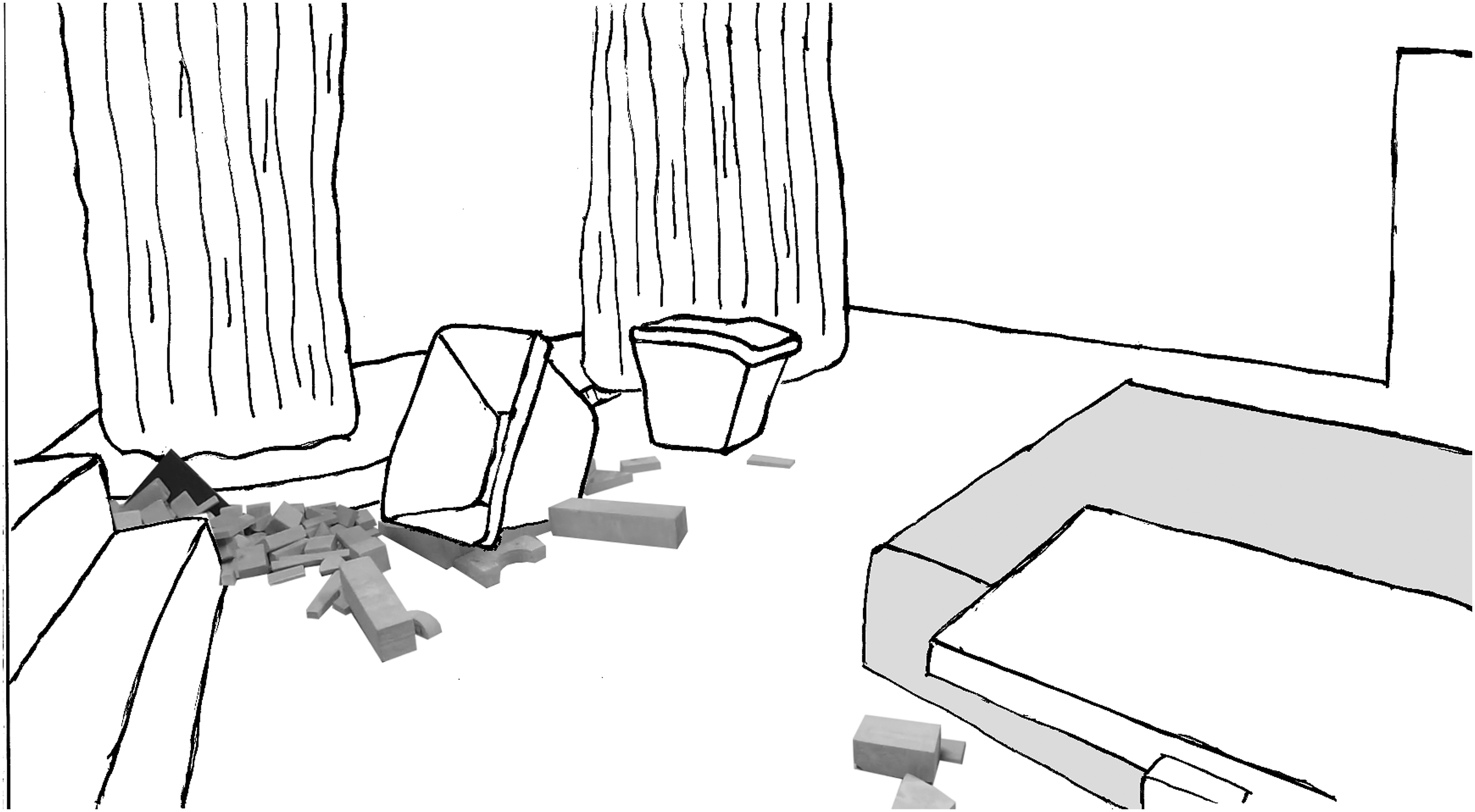
Though preschool staff are often seen walking through the room, the children play mostly unattended. Before the episode, the boys engage in very physically active play. First, a “play” is performed on the stage featuring “Trash Mario,” “Trash Luigi,” “Trash Yoshi,” and “Trash Monster,” who hide in “trash cans” (crates with blocks on top) to scare and catch the others. Then, “spider and flies,” a form of tag, is played. Finally, the boys engage in rough-and-tumble role play as characters from the franchise The Avengers, who employ various weapons against each other. As they run around wildly, Yahtzee suddenly turns to Captain and slowly asks: “Wait up! You wanna play Minecraft?” The following visual narrative (Figure 2(a)–(j)) of anonymized video stills and descriptive captions illustrates the 12-min episode in broad strokes.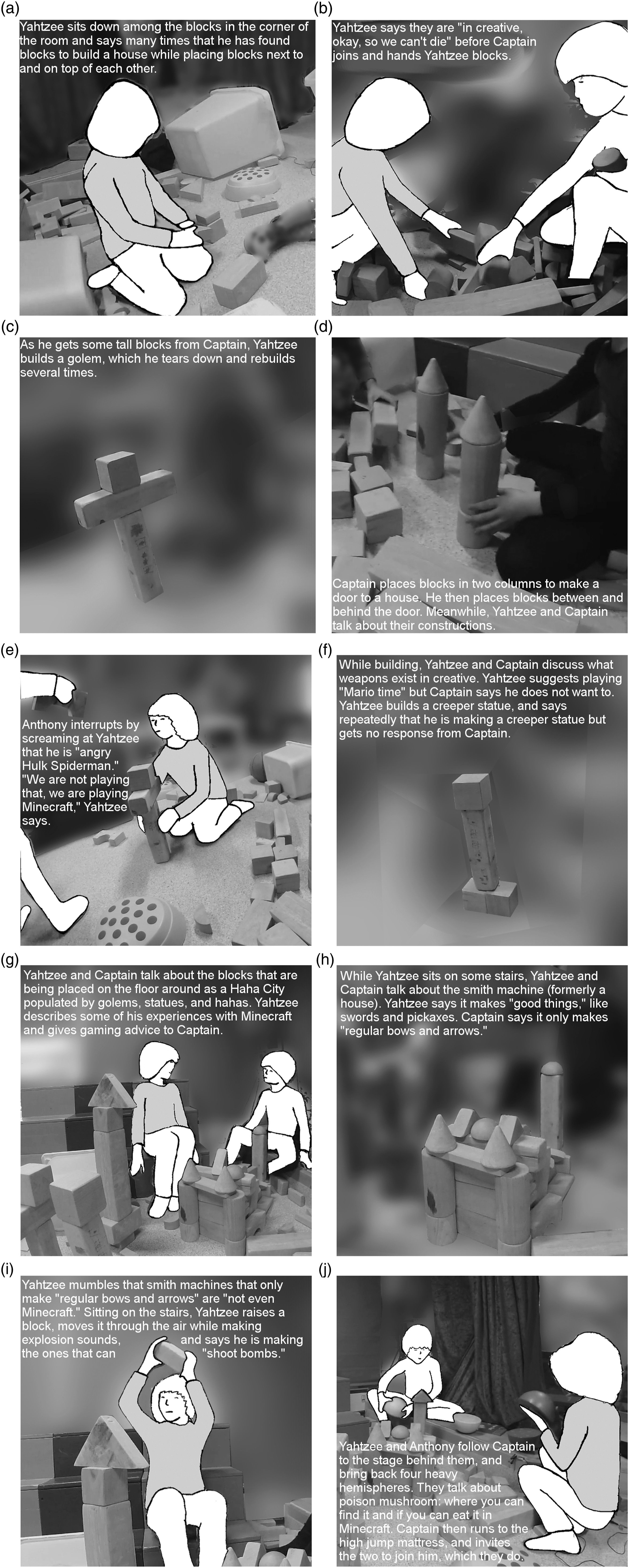
Analysis
In the episode of the visual narrative, Minecraft is constantly evoked, not just as a topic of conversation but as playing “playing Minecraft” or, more specifically, playing “being in creative” (Figure 2(b)). In the following analysis of two excerpts from the 12-min episode—bearing in mind that “practices of knowing are specific material engagements that participate in (re)configuring the world” (Barad, 2007: 91)—we explore how being in creative is performed. We will show that what we claim to be a postdigital practice of being in creative is performed in the preschool common room block play through configurations of agentic materialities in three sociomaterial specificities—joining, building, and not running out of things—chosen for their illustrative power and prevalence in our data. Joining is a specificity of being in creative that appears early in our case as a verbal statement by Yahtzee, but which we argue is also performed through more-than-human configurations. In the following excerpt, Yahtzee starts “playing Minecraft” before Captain eventually joins him (Figure 3). Yahtzee invites Captain to join him in creative.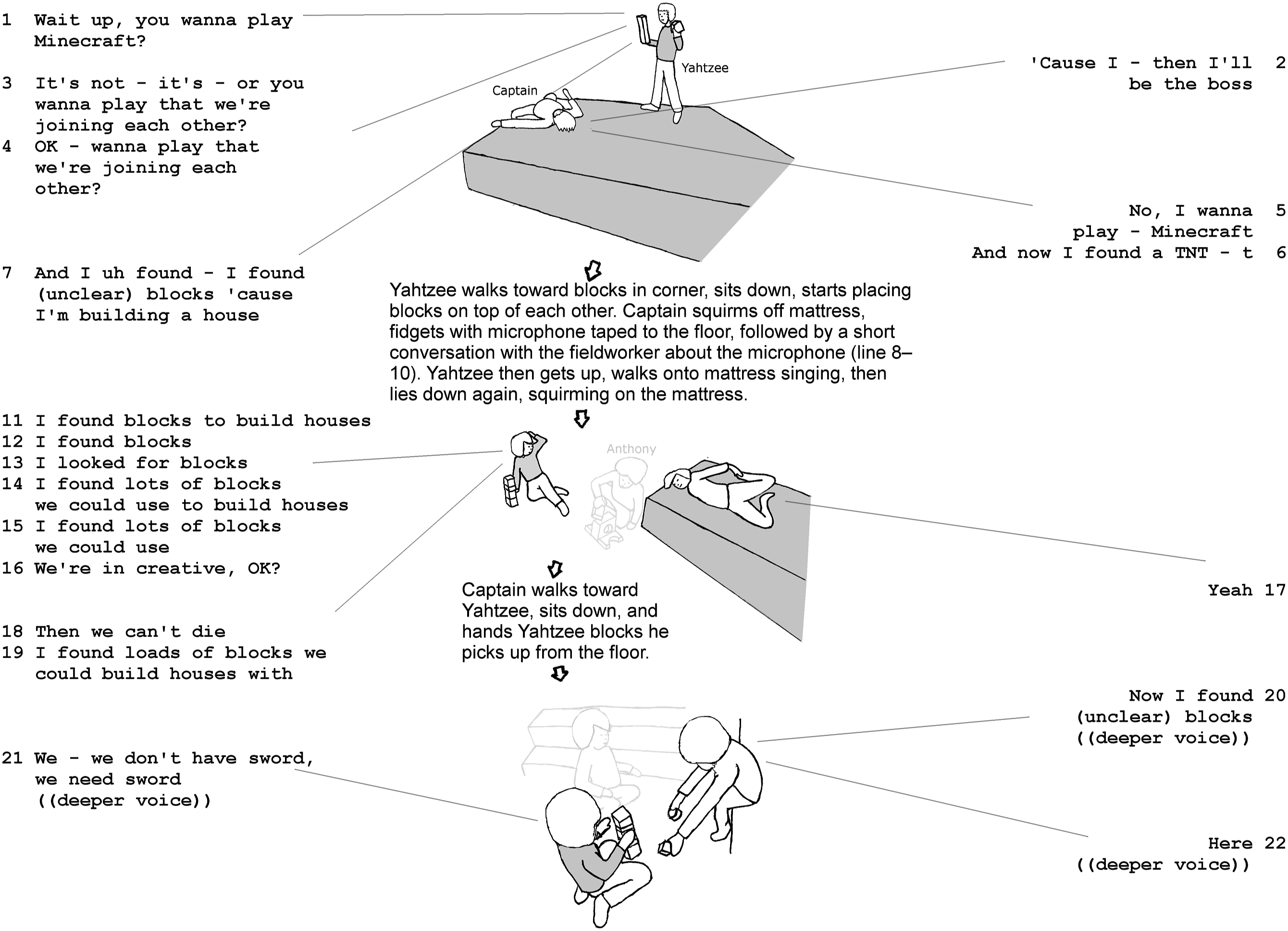
Two players joining each other (the invitation is uttered in English, the default language of Minecraft) is different from the hierarchical practice of having or being a “boss” (Figure 3, lines 2–4). Yahtzee says repeatedly that he found blocks to build a house (Figure 3, lines 7, 11–19). It is reasonable to interpret this as an invitation to Captain to join him, who after 45 s joins Yahtzee, hands him blocks, and says in a deeper, animated voice (indicating a playful tone): “Now I found (unclear) blocks” (line 20) (blocks also uttered in English). Joining, in this configuration, is a cooperative performance, played with each other rather than one being a boss or the two of them playing against each other. Minecraft players joining in multiplayer mode is thus allowed agency to act in a new configuration. Furthermore, the absence of the health and hunger bar in Minecraft Creative is allowed agency to act as Yahtzee exclaims that being in creative implies that they “can’t die” (Figure 3, lines 16–18), contributing in the preschool common room to configurations of a cooperative and peaceful practice. Other—non-digital—emergent agencies are also allowed to act. In Figure 3, third still, for example, Yahtzee–Captain–Anthony–blocks perform a specific material configuration of their bodies in a circle gazing toward the blocks in the center (cf. Ecological huddle, Goffman, 1961), which enables the children to join each other in a common project of building a house. We argue that the more-than-human configuration of joining performed in the preschool is postdigital because emerging agencies of the health and hunger bar or multiplayer mode are allowed to co-exist with the emerging agencies of the boys and the blocks. Boundaries are unsettled by the practice as not only themes and characters of Minecraft are inserted into the play (e.g. playing a creeper) but as actual gameplay practices (e.g. doing multiplayer) are allowed to be performed, and thus exert emergent agency, in a preschool common room: they are playing “playing Minecraft.” However, being in creative is also performed through a larger ecology of configurations. Joining intra-actively enters configurations of specificities, such as building and not running out of things. These three specificities contingently constitute and are constituted by each other, together performing a postdigital practice of being in creative. In the next excerpt, we will see how the specificity of building and not running out of things is performed in concert with the other specificities (Figure 4). Yahtzee and Captain discuss golems and houses.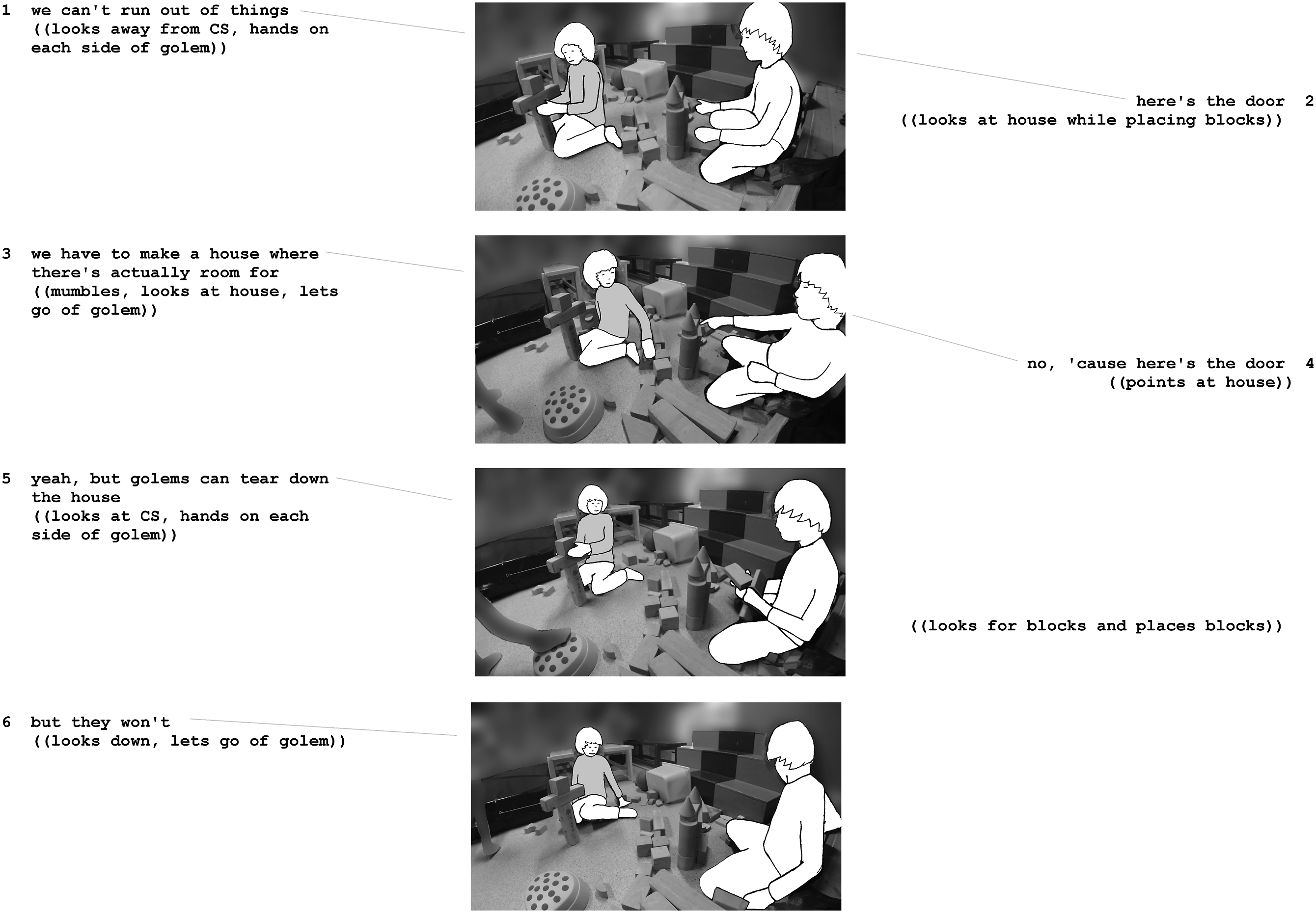
Placing his hands on each side of the golem, as if about to move the golem toward Captain, Yahtzee first explains that golems can tear down the house Captain builds (Figure 4, line 5). This is probably triggered by the preceding conversation in which Yahtzee wants Captain to build a bigger house (Figure 4, line 3), which Captain does not do (Figure 4, line 4). Yahtzee then adds that “it won’t” (Figure, 4, line 6), stabilizing the more peaceful specificity of building. While the configuration may at any moment disintegrate into “golems [tearing] down the house,” the specific configuration ensures that this does not happen here. Building—rather than tearing down—is, among other things, stabilized as it is performed in concert with joining. The golems’ abilities to tear down houses in Minecraft is allowed to exert agency in a new configuration. Furthermore, comparing the body postures in the stills, we can see a configuration of Yahtzee gradually turning toward Captain. The Yahtzee–golem also alternates between a proximally nearer association (Yahtzee holding the golem with both hands) to a more proximally distant association (Yahtzee letting go of the golem). Yahtzee settling on the more inviting, proximally distant association to the golem and gradually turning toward Captain contributes to the cooperative and peaceful performance of joining and building. Dwellingly, then, the boys allow both the features of the Minecraft golem and their own bodies to exert agency in a postdigital configuration.
The number of blocks also contributes to the cooperative and peaceful performance because Yahtzee and Captain can easily add to the building practices without competing for blocks. In Figure 4, the boys sit among an abundance of blocks and embody in a distributed way—as body–blocks—not running out of things in creative. Not running out of things is talked about throughout the case. Initially, Yahtzee says he found “lots of blocks we can use to build a house” and, later, “loads of blocks” (Figure 3, lines 14, 15, and 19). Later, while building the golem by placing a cube-shaped block on top of two long blocks in a T shape, Yahtzee says that “we can’t run out of things” (Figure 4, line 1). Through this more-than-human intra-action of an abundance of blocks in the preschool common room, Yahtzee’s verbal statements, and the unlimited items feature of Minecraft Creative, not running out of things emerges contingently. Importantly, we argue that the practices are not purely emergent but stabilized (for now) through repetition and connection. For example, Yahtzee’s repetitive chanting about finding blocks to build a house (Figure 3, lines 7, 11–19) serves as a stabilizing force in their block play. Furthermore, by allowing game features to exert agency during block play, postdigital play practices gain a foothold and materialize in the preschool common room.
The three specificities add to complex configurations, emerging as more than the sum of their parts, as the recurrence of joining, building, and not running out of things are performances improvised upon as variations and counterpoints, against and with each other. For example, as both the multiplayer mode of Minecraft and specific collaborative body postures are allowed agency, joining emerges and stabilizes. The binary of the digital and the non-digital is unsettled, and a postdigital play practice of being in creative is performed.
Discussion and conclusion
In the following, we discuss how the study contributes to previous research on literacy, digital technologies, and play in early childhoods, and point to the practical implications of our study.
Being analytically informed by agential realism has sensitized us to how literacies are configurations of contingently agentive materialities, allowing us to “undo the digital” (Burnett and Merchant, 2020) as we find that the young children participate in configurations of agentive digital and non-digital materialities, unsettling the digital and non-digital binary. Furthermore, our study provides empirical findings suggesting that the postdigital is a useful heuristic to account for what new configurations are made possible in contemporary early childhood play after the digital.
Previous research on digital play emphasizes play as a cultural–historical activity mediated by specific material (e.g., an animation app on a tablet computer) and psychological tools (e.g., role play) (Bird and Edwards, 2014; Edwards, 2016; Fleer, 2016, 2017, 2018; Stephen and Plowman, 2014). While recognizing that digital play sometimes bleeds into the non-digital, these studies are based on a priori ontological cuts between the digital and the human. For example, the conceptualization of epistemic and ludic play (Bird and Edwards, 2014) positions the human as a privileged ontological being: developing digital play literacies is a matter of humans mastering and creatively appropriating discrete digital devices. Emerging sociomaterial and performative perspectives, on the other hand, understand literacy as performed through configurations of more-than-human agentic materialities (e.g., Boldt and Leander, 2017; Hackett and Somerville, 2017; Kuby and Rowsell, 2017). In our study, we show how the children, rather than adopting a privileged position of mastering or appropriating, dwell in the intra-action of digital and non-digital agentive materialities (Ingold, 2011). Through this movement, in configurations of joining, building, and not running out of things, they are performing postdigital play practices, and a multidirectional quality of play emerges: preschool play is not simply downstream from home gaming, but unfolds in a rhizomatic structure with no easy starting point. Postdigital play can thus be understood as young children’s dwelling submission to an entanglement of material agencies, heterogeneous relations, and messy practices, consequently unsettling assumed boundaries between the digital and the non-digital.
Furthermore, as opposed to the design of a series of studies on digital technologies and early childhood play adopting sociomaterial and performative stances (Flewitt and Clark, 2020; Gillen and Kucirkova, 2018; Lundtofte et al., 2019; Marsh, 2017), as well as other studies which have explored the concept of postdigital play (Apperley et al., 2016; Marsh, 2019; Nansen, 2020; Nansen and Apperley, 2020; Nansen et al., 2019), we importantly study a traditional case of block play rather than the use of more advanced digital technologies of the Internet of Toys or augmented reality. Our argument thus builds on the findings of previous studies regarding the blurred boundaries between the digital and non-digital but extends their argument by finding that the postdigital is also performed in cases where no digital playthings are present. Our study can be read in concert with Bird’s (2019) research on how young children represent digital playthings in their imaginative play through non-working digital playthings, non-digital playthings, and their own creations. However, while Bird finds that in her case, knowledge about Minecraft constitutes discursive resources that young children put into play while building a Minecraft city with non-digital playthings, thus supporting their learning of cultural and social practices in creative ways, we find that being in creative in our case of block play is much more entangled with the act of playing Minecraft on the family tablet computer. In our study, neither practice is granted primacy; instead, being in creative is a play practice that emerges through the intra-action of the two.
Following the call for action made by Burnett and Merchant (2020) to “undo the digital,” we thus advocate a literacy conception that is closer to what we would argue young children’s relationship with digital technologies is actually like: entangled, messy, and unpredictable. Furthermore, we encourage preschool practitioners and parents to continue exploring novel literacy practices with their children, departing from an understanding of the digital not in isolation, but in a configuration of other agentive materialities. For example, during our fieldwork, a preschool teacher brought printouts of Super Mario characters and blocks to the children, encouraging them to play Mario by making their own levels on the stage in the common room. In this novel way, we would argue, he supported their postdigital play practices. As digital technologies and play in early childhoods are increasingly participating in and emerging through complex relations, we hope to see new ways of facilitating fun and imaginative practices for young children at home and in educational institutions.
Footnotes
Acknowledgements
Thank you to all children, parents, and preschool practitioners who took part in the study. Thank you to all participants at seminars organized by the research groups LiDA (University of Oslo), LEaD (University of Gothenburg), and TLC (University of Bristol), as well as members of support networks PhD First Aid (LiDA, University of Oslo), and Sociomaterial Reading Group (Faculty of Education, University of Oslo) for valuable comments and questions on early and late drafts. Thank you to peer reviewers and editors at the Journal of Early Childhood Literacy for precise and thought provoking criticism during the review.
Declaration of conflicting interests
The author(s) declared no potential conflicts of interest with respect to the research, authorship, and/or publication of this article.
Funding
The study is funded by the Department of Education at the University of Oslo.
