




Abstract
In this paper, we ponder the ecologies of spacetimematterings folded into resistance practices and their relationality with figurations of agency outside and beyond datafication agendas. Accountability cultures bound up with datafication have consequences that include a diminished agency for both children and educators. We take inspiration from the idea that enactments of resistance can cause cracks to appear that forge creative spaces where different kinds of doings related to agency emerge. The context, potentiality and storyings of cracking encounters is where our interest lies. To ponder crackings, we play with feminist posthuman and materialist theorising with research-creation approaches to notice resistances as material-discursive intra-actions amongst the lively materiality of educational life. From there we notice resistance practices as ecologies. Those ecologies are complex and lively yet often concealed in more-than-human cracks by the grand narrative of datafication. Through storytelling, we reimagine these cracks as dynamic resistances, often unresolving the relationality between power and the collective more-than-human modes of resistance we witnessed. Different kinds of noticing mattered and amplifying the sharing of resistance stories brings attention to hopeful agencies already and always at work. Sharing stories can strengthen the connectivity of resistances to datafication and build a stronger autonomy and agency for early childhood education and care. Our provocation is to pay attention to the spacetimematterings of ecologies where resistance practices are already at work cracking cracks for different doings. From there, further activisms can mobilise a larger fracturing to the dominance of datafication narratives.
Keywords
What's the problem with datafication?
Our entry point for this paper is to explore how resistance to datafication discourses in early childhood education and care (ECEC) relate to otherwise figurations of agency. The policy contexts such as England, in the first quarter of the twenty-first century, have been marked by intensified technocratic accountability demands for those working in the field (Mikuska and Fairchild, 2020). Such accountability regimes are associated with practices of measurement and normalisation (Bradbury and Roberts-Holmes, 2016; Lingard, 2009). Roberts-Holmes and Bradbury (2016) argue datafication results in the ‘intensification of high stakes performance data increasingly act[ing] as a “meta-policy”’ (1) that steers pedagogy. Not only are there worries that learning narrows to what can be measured (Bradbury, 2019), but also that accountability cultures bound up with datafication can create educational spaces where agency is marginalised, and curricula passively received rather than co-constructed (Chesworth and Hedges, 2024).
In this paper we illuminate otherwise figurations of agency to enrich the growing scholarship about resistance to dominant practices that foreground accountability and datafication (Albin-Clark and Archer, 2023; Archer and Albin-Clark, 2022; Roberts-Holmes and Moss, 2021). We take our inspiration from the work of political sociologist John Holloway (2010), who posits that statements and acts of resistance are the making of cracks that forge creative spaces for agencies to flourish. How those acts of resistance are storied in relation to cracking encounters that create otherwise spaces for agency is where our interest lies. Whilst recent scholarship (Archer and Albin-Clark, 2022) exemplifies the hopefulness that storying resistances can bring, our present paper sheds light on how resistances can create crackings and fissures for agency in-between the everyday more-than-human ecologies of educational life.
To ponder how cracking encounters manifest, we play with feminist posthuman and materialist theorising inspired by scholars such as Karen Barad, Rosi Braidotti and Donna Haraway. With feminist posthumanist thinkers (Braidotti, 2013; Haraway, 2016) we trouble how privilege and status can discount some human and more-than-human others. In taking materialism seriously, we find Barad's (2007) theory of agential realism generative. Through combining philosophy with physics, Barad's (2007) relational ontology considers agency beyond the sole property of a human. Rather, agency is performed through relationships with the more-than-human world (Bozalek, 2020).
We are choosing the term more-than-human (rather than non-human) as it does not suggest a binary between the human, but rather opens a co-dwelling of entities that both encompasses and transcends the human (de Souza Júnior, 2021). More-than-human modes of thinking push back on the notion of human exceptionalism. ‘In other words, there are always more than (just) human actors and agencies involved in the production of landscapes and communities’ (Price and Chao, 2023: 180). In doing so, we explore educational spaces as more-than-human ecologies mapped in relation to and with discourses of datafication. In bringing attention to the entangled relationalities between material and discourses, we find the idea of educational spaces as being material-discursive a generative one, as it illustrates how discourses come into life within particular material contexts (Barad, 2007). Educational spaces as material-discursive ecologies broaden the gaze to ‘heterogeneous entanglements extending from their infrastructure to plants and nonhuman animals used in food and clothing, onward to various technologies and their local and global networks’ (Snaza et al., 2016; Tammi, 2020: 1326). Influential ECEC scholars such as Lenz Taguchi (2010) have used Barad's (2007) idea of intra-action to reconfigure pedagogy as relational encounters in-between children, materials and spaces that are mutually performed. By configuring agency as generated through intra-action (rather than interaction) between humans and the more-than-human (Barad, 2007), we put to work agency to understand power as something in relation, rather than in possession of individuals (Burkitt, 2016).
In this paper, we scope resistances, storying and cracks to understand a more-than-human view of ECEC where agency is distributed beyond the human (Fairchild, 2019). With this thinking, we broaden our conceptualisation of agency to take account of relational, collective figurations as well as the performative intra-activities between material, time, matter, space and place through the term spacetimemattering (Barad, 2007, 2013). From there, we trace the spacetimematterings of educational ecologies to notice resistances that generate crackings that we understand as material-discursive intra-actions. We put to work art-based theory-practice of research-creation as a means of tracing concepts in the making (Manning and Massumi, 2014) within educational ecologies. From there we reflect on figurations of agency that enable storyings of resistance that can push back on datafication politics.
Resistance and feminist posthuman and materialist theories
Working with feminist posthuman theories allows us to trouble the binaries in between power and more-than-human resistance to power. This troubling helps up to understand resistance and power as in a dynamic unresolving relationship of balance (Alldred and Fox, 2017). Feminist posthuman theories offer a chance for humanity to find urgent opportunities for resistance through ethical pushbacks to late-stage capitalism where all forms of life are commodified (Braidotti, 2013). Whilst such conditions can generate complicit and docile responses, there are other co-productions at work that can create resistance, disruption and change (Lykke, 2018). To experiment with resistance is part of what ‘posthuman bodies can do’ according to Braidotti (2013: 99). This means that there is a rich potential for conceptualising resistances by noticing the small, mundane contacts in-between humans and materialities (Alldred and Fox, 2017).
Resistance
Like Alldred and Fox (2017), numerous scholars have challenged the reductive idea of resistance as consisting of only highly visible, coordinated collective action (Albin-Clark and Archer, 2023; Archer, 2022; Raby, 2005, Scott, 1990). A benefit of feminist posthuman materialist theories is how it enables concepts such as agency or power to be understood as intra-active, in relation and non-hierarchically at work in-between humans and more-than-humans (Malone et al., 2020). Rather, understandings have been developed of resistance as including daily acts, covert and indirect strategies ‘that often exist under the radar of the dominant group’ (Kastrinou-Theodoropoulou, 2009: 3).
ECEC has a growing resistance scholarship (Albin-Clark and Archer, 2023; Archer and Albin-Clark, 2022; Roberts-Holmes and Moss, 2021). Whilst scale and visibility of refusal and resistances have been explored, less is understood about the motivations for such resistances and, in particular, responses by educators to the datafication in young children's learning. Dahlberg and Moss (2005) explore the concept of practising with an ‘ethic of resistance’. Such a perspective is further interrogated by Fenech et al. (2010): ‘resistance is grounded in ethical practice that is driven by an intentional commitment to continually deconstruct taken-for-granted truths and reconstruct practices’ (92). Notably, in ECEC some resistances manifest as ethical subversions (Morris, 2021) with individual refusals including ‘micro resistances’ which were often local, quiet and invisible but multiple’ (Archer, 2022: 439). We seek to bring such resistances (in this case to datafication) to light through uncovering the ordinary contexts, temporality and materiality for otherwise storytelling. ECEC scholars such as Fairchild (2020), find that thinking with data intra-activities enables an understanding of how power moves and relates to bodies. Thinking with the relationality in-between humans and more-than-humans can generate alternative readings of resistance according to Malone et al. (2020).
Storying resistances
Stories are multiple, and although there is always more than one story, certain stories come to dominate. In contemporary ECEC, Moss (2017; 2019) points to the dominance of certain stories or master narratives through ‘privileged channels of communication’ (2019: 6). In this way, ‘through such reinforcement, a story gathers momentum and influence, becoming the story’ (Moss, 2019: 6–7, original emphasis). We suggest that datafication in ECEC is such a story, and yet there are many resistance stories to be heard.
Telling stories, according to Haraway (2016) offers ways to reimagine how we live alongside multi-species others and the material world that can sustain possible futures. Storytelling is a provocation to reconsider actions that find new ways of living alongside each other as kin, with kin encompassing the more-than-human (Haraway, 2016). For education, storytelling is a tool for troubling the status quo that can reimagine living with both accountability and responsibility to fellow kin as part of our pedagogy (Greenhalgh-Spencer and Zaliwska, 2019).Thus, we approach this research endeavour with an openness to links between narratives, the potential for social change along with relationality, feminist posthuman and materialist theorising, and calls to act (Baglady et al., 2023).
We believe in the possibility that narratives of lives lived may also speak truth to power and may call into question the power of dominant discourses (and potentially oppressive meta-narratives) and their relationships to lived experiences highlighting both refusal and alternative ways of being and doing.
Thinking with cracks
In his series of theses Crack Capitalism, Holloway (2010) argues that creating cracks, fractures and fissures forges spaces of rebellion and disruption to the current neoliberal order; The opening of cracks is the opening of a world which presents itself as closed. (10) The cracks begin with a ‘No’, from which there grows a dignity, a negation and a creation … The original ‘No’ is then not a closure but an opening to a different activity, the threshold of a counterworld with a different logic and a different language. The No opens a time-space in which we try to live as subject rather than objects. (21) A crack is the perfectly ordinary creation of a space or moment in which we assert a different type of doing … (21)
By adopting this notion of cracks, we use a powerful heuristic to theorise from the stories of three individual studies. We are interested in the interstitial spaces and the dynamics of crackings as material-discursive intra-actions where there is both refusal of datafication and creation: the forging of alternative more-than-human conceptualisations of being and working with and alongside in ECEC.
Thinking with ecology
Drawing upon feminist posthuman and materialist theorising, we move beyond an anthropocentric gaze to acknowledge that ‘the world is an ongoing intra-active engagement, and bodies are among the differential performances of the world's dynamic intra-activity, in an endless reconfiguring of boundaries and properties’ (Barad, 2007: 376). Recognising the entanglement of all bodies informs our ecological perspective in which we recognise that more-than-human entities are not merely positioned as the ‘passive backdrop or stage of the active human subject’ (Lenz Taguchi, 2011: 37). We see this interpretation as being closely aligned with the notion of ecosystem derived from the natural sciences, in which all living and non-living matter, weather and spaces ‘work together to form a bubble of life’ (Rutledge et al., 2023: n.p.). In positioning ECEC spaces as ecologies, we soften our gaze to notice what is explicit, implicit and not always obvious. Like Malone and Bozalek (2021), we find feminist and posthuman theories useful to consider educational ecologies as dynamic co-existing entanglements that are sensory and have affect.
Thinking with theory
Shaped by posthuman feminist materialist theories, we explore resistances in relationship with and to discourses of datafication. In shifting away the focus from the human, we look at phenomena as dynamic and in relation with the more-than-human (Strom et al., 2020). Barad's (2007) theories emphasise the relationality in-between the material and social and how the potential for agency encompasses the more-than-human (Fox and Alldred, 2017). Similar to Fairchild (2020), we are inspired by Barad's theories to think with agency as distributed across and in-between humans and more-than-humans in early childhood.
Figuring how agency involves the more-than-human means that things such as books, furniture and educational materials all have a role to play. From this perspective, agency is dynamic and relational, performed (Lenz Taguchi, 2010) through encounters between human and more-than-human bodies (Hultman and Lenz Taguchi, 2010) and spaces (Rautio, 2013). For example, Taylor (2020) finds that pedestrian classroom materialities (such as chairs and pens) do performative work in enacting and excluding within power relationships between genders through ‘material moments’ of embodied mattering (47). Thus, resistance can be understood as being performed through dynamic ecologies, where power, exclusions, enactments and matterings are at work. This means that children, educators, materials, spaces and artefacts all intra-act with each other in the navigation and resistance of datafication narratives.
Moreover, the neologism of spacetimemattering (Barad, 2007, 2013) encapsulates the agency of spaces, materiality and temporality in relation to discourses. Fairchild (2023) considers that ‘feminist materialist relational time … can reconsider power, mattering, enactment, and exclusions, creating multiple future(s) for qualitative inquiry’ (1). Time is relevant to feminist posthuman and materialist theorising because it blurs temporal boundaries such as past, present and future (Albin-Clark, 2023a).
Spacetimemattering is a generative concept because it troubles Western constructions of time as linear and connected to onward progress, and instead connects to much earlier Indigenous knowledges of sensing time as both cyclical and spiritual (Kuby and Taylor, 2021: 125). Barad (2014) argues that spacetimematterings can signal for what and to whom we are responsible: ‘Responding – being responsible/response-able – to the thick tangles of spacetimematterings that are threaded through us, the places and times from which we came but never arrived and never leave’ (184). To bring research-creation 1 to life, we re-turned to three encounters from our individual research enquiries that spoke to datafication discourses. In doing so, we enacted research-creation by the making of artistic responses to represent and make what it is we want to enquire about (Truman, 2022). In collating and arranging images, text and memories, we attempt to imagine what might be extralinguistic and ‘brings making to thinking and thinking to making’ (Manning, 2016: 13). Through such immanent processes, we notice what was sensed, felt and emerged (Truman, 2022).
With those artistic responses we shared, talked, re-turned and remade as an ongoing unrushed process inspired by Taylor's (2020) emphasis on feminist ethics of caring and relationality. The seeking, making and talking through the artistic responses was our way of bringing doings into research-creation (Springgay and Truman, 2018). Our approach to analysis was ongoing, to see what emerged or unfolded in relation between the human and more-than-human participants through the timespaces of our work (Truman, 2022).
Creating with theory-practice
Worksheets-limestone fissures-playworlds (Liz)
My story begins with a walk around Malham in the Yorkshire Dales, an area known for its spectacular limestone pavement. At first glance this pavement resembles a homogenous expanse of flat grey stone. However, as one gets closer, a multitude of deep fissures are revealed. These fissures have created micro ecosystems in which a diversity of plants flourish. As I navigated my way across the pavement, I was struck by the contrast between my initial impression of homogeneity and the rich diversity of life as I peered into the fissures. I recalled a doodle I’d made in my PhD research journal when I had absentmindedly scribbled a tangle of lines over the letters EYFS (Early Years Foundation Stage) (DfE, 2023) the statutory framework for ECEC in England for children aged from birth to five years. I had been thinking about my research in a reception class 2 and how the findings were generating a complex story of classroom life. This complexity seemed to present an alternative narrative to the data-driven agenda that shapes pedagogical practices (Roberts-Holmes and Bradbury, 2016) frequently associated with the EYFS (Fig. 1).
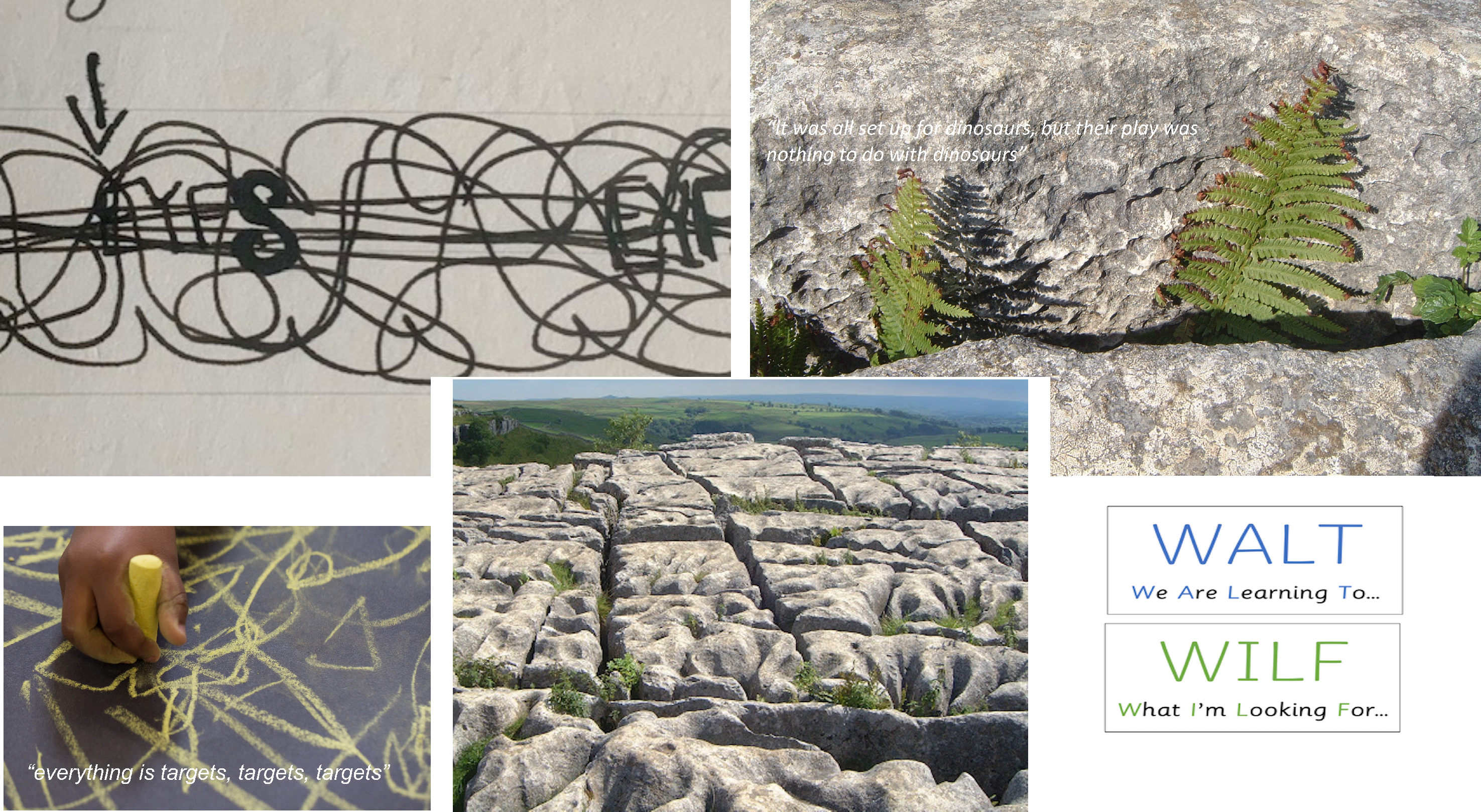
Worksheets-limestone fissures-playworlds.
Through filming children's play and using the footage as a provocation to listen to children's and teachers’ interpretations, a complex assemblage of narratives was made noticeable. Just like the plants in the limestone fissures, children's playworlds were not immediately apparent, hidden as they were beneath the official narrative of the classroom in which standardised learning outcomes and success criteria were displayed on the walls and in curriculum planning documents. Yet children explained how they found ways to adapt their play to co-exist alongside these formal learning activities. For example, five-year-old Ellie explained how the children introduced a legitimate reason for a peer to temporarily leave the play when he was called to the teacher's table to complete a literacy worksheet. He was sent to the shops, hence enabling him to comply with the teacher's request whilst maintaining a connection with the pretend play frame:
I’m not in it but I was with you, wasn’t I?
You had to go t’ shop.
The shop?
Well, you actually went to Mrs. Dalton's table.
Thus, children enacted collective agency by co-authoring storylines that enabled them to sustain the play by navigating or manipulating adult-imposed rules and routines. Just as plants adapt to changing environmental conditions, play bends and flexes to co-exist with the formal activities of the classroom through vibrant, dynamic entanglements of bodies, spaces and things.
Spacetime-cards (Jo)
I have examples of social media posts made from greeting cards to celebrate Mother's Day lurking in my data collections (Fig. 2). The mediated images show folded cards of artwork based on themes of spring flowers. The narrative text that accompanies the photographs emphasises the individuality through hashtags (#creative, #unique, #individual). Documenting such learning is common practice in ECEC, and recently digital and mobile forms have increased communication between children's family and school. Whilst there are advantages to families in digital access, my previous enquiries suggest affective costs for teachers lie in its time-consuming nature, but offer quick storytelling potentialities (Albin-Clark, 2023b).
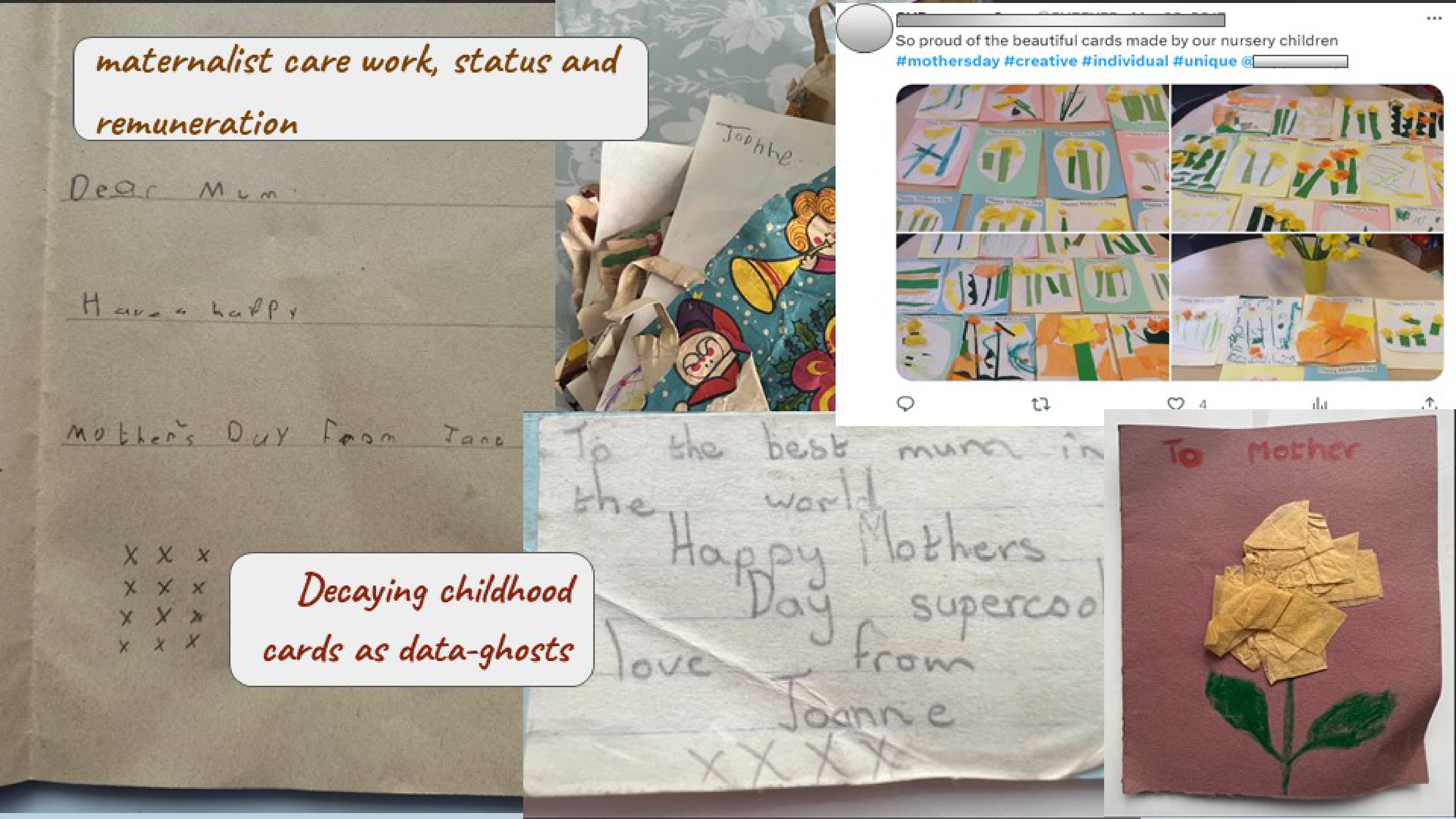
Spacetime-cards.
Re-turning to those social media posts leads me to revisit a dusty bag from my own school days that reveals faded exercise books, cracked paintings and examples of greetings cards I had made at a similar age to the cards in the social media posts. As I blow the dust away, it is striking how similar they are to the recent socially mediated cards. Not only is the construction and materiality similar with glued collage material, but also the subject. Mother's Day cards fifty years apart still nod to a stereotypical imagery associated with mothering in referencing genteel flowers. From those collages of tissue paper and glue crumbling and deteriorating away, I have since bundled up three packages of such paraphernalia for my own grown-up children that may eventually end up in their future attics. Future spacetimematterings to consider, feasts for all the little creatures who hide amongst the rafters.
Further questions unfurl from re-turning, and in one old Mother's Day card is inscribed; ‘Have a happy mothers day love Jane’, suggesting that my younger self had nonchalantly taken home a classmate's card from a pool of very similar looking cards, as Jane is a near enough name to Joanne. Another card amuses me with the words, ‘To the best mum in the world, Happy Mothers Day supercook, love from Joanne’. Now, my mum infamously dislikes cooking, so the term ‘supercook’ might have been suggested by a well-meaning teacher. I have learnt to pay attention to those ideas or things that linger and bother over time, and in previous writing I have thought about these ruptures of time as data-ghosts, powerful little shards of data that can call for attention (Albin-Clark, 2022, 2023a).
In both the old and new cards there are unchanging figurations of children, motherhood and ECEC that remain deep-rooted and gesture towards maternalist discourses, care work, low status and poor remuneration (Mikuska and Fairchild, 2020). Such stereotypical notions suggest little changes and point to some stubborn and unchallenged narratives that attach themselves to the experiences of being an embodied female (Braidotti, 2013).
Spreadsheets-data-classification (Nathan)
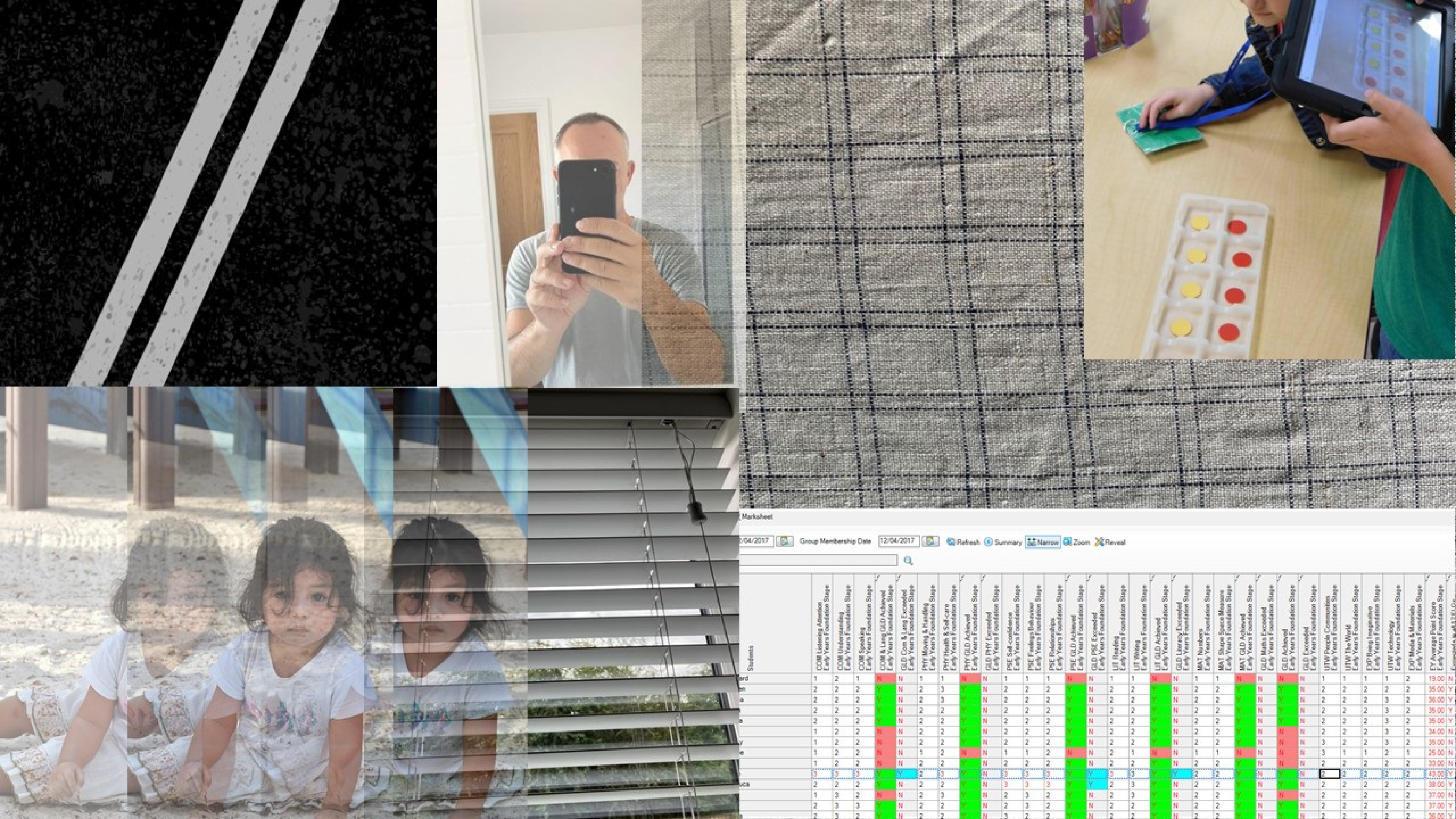
This story generates re-presentations from a professional life story told in a study I undertook on resistance and activism in ECEC (Fig. 3). Through a focused conversation, Amy, an educator and assessment lead in a day nursery,
3
expressed concerns about what she describes as ‘box-ticking’ and the limitations of current formative and summative assessments of children's learning and development: I think I have resisted from the second I went into it. Actively resisted it in terms of the two-year-old check.
4
So, every parent I met I would say: ‘We have to do this and we are supposed to use these criteria, so I have written a report which reflects where they are in the prime areas, but actually I want you to understand that this is not your child and that this is a very narrow way of assessing who your child is and can and cannot do and where they are in their life journey.’ … So, in a way I am a disruptor.
Spreadsheets-data-classification.
The assessment spreadsheets which Amy alludes to, illustrate the relationality and intra-action in-between educator and assessment documentation as material-discursive practices which are both constitutive and performative (Albin-Clark, 2021) ‘a written report which reflects where they are …’ In addition, I reflect on how Amy rejects the data doppelgängers (Pierlejewski, 2020) which she believes the summative assessment creates, suggesting to parents, ‘this is not your child’. Instead, as a self-proclaimed disruptor, she arguably foregrounds more care-full pedagogy and practice in her assessment of young children's learning and development.
Thinking with cracks
When cracks crack
Our discussion ponders the conditions for resistances that open cracking events. We start with considering when cracks crack and how time relates to and with resistances to datafication. Yet when resistance cracks is not always explicit. Time's doings are at work over differing affective spans within the stories. Nathan's storying of resistance is explicit to an instantaneous split second (I think I have resisted from the second I went into it). Whilst in both Nathan's and Liz's story, generations of time act within longer dense entanglements of spacetimematterings (Barad, 2014).
Cracks do not always have neat beginnings and endings (or indeed ever stop cracking) but materialise through material-discursive intra-actions in relation with things, places and people. Jo's story of Mother's Day cards stretch back the furthest across a generation gap of almost fifty years and has haunted through misremembered memories as data-ghosts (Albin-Clark, 2022, 2023a). Here, cards confirm the unchanging figurations that remain deep-rooted to maternalist discourses (Mikuska and Fairchild, 2020). Time is entangled between materiality and space (Barad, 2017; Varga, 2022). Temporalities are always in a dynamic relation (Fairchild, 2023). This suggests that past practices are still at work in the present, almost barely altered, with maternalist themes still pertinent to a gendered workforce (Read, 2019).
When resistances cause crackings, agency is already and always at work as a more-than-human performance. Temporalities stretch with and between instants and generational multiplicities. Sensing cards as material-discursive encounters folds the spacetimemattering of gently deteriorating cards with social media back into barely changing maternalistic discourses that haunt the ECEC imaginary (Albin-Clark, 2023b). Educational spaces as more-than-human entanglements cause us pause to consider the potentialities of such relationalities (Tammi, 2020).
Where cracks crack
Our second point ponders where cracks crack within and through the mundane ecologies of more-than-human daily educational life. Zooming in to investigate customary lifeworlds reveals that children are not passive victims of datafication. Rather, Liz's story illustrates how play in an already unfolding intra-action in between children and materials and spaces where narratives and identities are all performative. We frame these play episodes as micro resistances that are mobilised to push children's experiences beyond the prescribed learning outcomes that are tethered to statutory curriculum frameworks.
Like Taylor (2013), we have found classroom materialities are part of how resistances and power are at work, but we find resonance with Corsaro's (2000) application of Goffman's (2016) secondary adjustments. Corsaro frames secondary adjustments as acts of resistance through which children collectively navigate the constraints of the classroom through navigation, violation and subversion of rules. Play can thus be conceptualised as transformative, where children choose approaches and materials to express their autonomy and form an identity in resistance to educational discourses (Markstrӧm and Halldén, 2009).
Secondary adjustments constitute performances of collective agency that are enacted in peer cultures within an ECEC setting. However, we have found feminist posthuman and materialist theorising help us to understand the vitality and vibrancy of more-than-human life that exists when one peers into the cracks that rupture the seemingly homogenous landscape of datafication. Noticing where resistances cause cracks reveals a collective agency in peer cultures often unnoticed by adults but expertly navigated by children in seeking agency through maintaining play. Nevertheless, locating children's resistances within peer cultures means that the official practices within a setting are maintained as distinct from children's interests and enquiries. As such, children's agendas and priorities are positioned as separate from planned learning outcomes and objectives. By contrast, feminist posthuman and materialist theorising fractures the boundary between peer cultures and adult-led practices and re-presents the multiple entanglements of bodies, more-than-human matter and spaces that constitute the ecosystem of an ECEC setting. As we will discuss later, blurring the boundaries between children-play-educators highlights the potential of a relational pedagogy that offers new openings for resisting the datafication regime.
Noticing cracks crack
Our final section ponders how resistance cracks are noticed and become apparent when datafication appears to dominate the ECEC landscape. We acknowledge a growing body of critical scholarship on datafication and metric fixation as a pervasive regime. This research offers troubling insights into the reach and impacts of datafication on educators and children resulting in neoliberalised competitive, individualised and economised subjectivities. It is justifiably pessimistic in its outlook.
Conversely, the stories, illustrated through research-creation, reveal resistance cracks to the prevailing order. The resistances in these otherwise stories are the opening of small spaces, rents in the master narrative of datafication, which are often barely noticeable. These stories are local, and often ‘under the radar’ as children and educators disrupt conventions and dominant narratives in their living, being, working and playing.
Yet, more than resistance, these stories detail a creation – the enactment of alternative modes of being. Through the children's flourishing play in Jo's account and the quiet subversion of the educator in Nathan's narrative we see the ‘rich diversity of life as I peered into the fissures’ from Liz's memories. These disruptions are not necessarily knowingly contrived as a crack in the system, but they are, nonetheless, an articulation, a practice of a different type of doing. They are both negation and creation. But neither are these cracks isolated. Noticing resistances that crack as relational kinds of agency we suggest are transgressions that have affinities – cracks that reach out and connect with each other.
Reimagining resistances
From our thinking of when, where and the noticing of crackings we now reimagine the potentialities for resistance practices. In storytelling, there is potential for provoking new ways of being (Haraway, 2016) and what kinds of accountabilities are bound up with such reimaginings for pedagogical practices (Greenhalgh-Spencer and Zaliwska, 2019). In doing so, we ask questions about the potential of resistance and what kinds of actions we can take in practice, policy and research.
Resistances are more-than-human spacetimematterings
We build on the notion of resistance that creates a crack (Holloway, 2010) for agentic spaces for that nurture subjectivities. But unlike Holloway (2010), we do not find those time-spaces force divides between subject and objects. Instead we propose that affectivities of resistances are in constantly dynamic material-discursive relationships in-between subjects and objects. Resistance and power are not binary, but rather in a moving relationship (Fox and Alldred, 2017). Like Fairchild (2020), we find power is always on the move.
However, we propose that resistances create cracks that are more-than-human creative spaces of spacetimematterings (Barad, 2014). Such more-than-human spaces embrace notions of agency that have multiple figurations that can be relational, performative and collective. Burkitt's (2016) thinking is helpful in seeing the individual as not just an agent, but rather as an interactant in an interdependent web dynamically working in-between independence and dependence.
It needs to be acknowledged that resistances are implicated with contemporary policyscapes, as there must be something that invokes a need to resist. Yet our ponderings speak to discourses beyond the here and now. Longer (and deeper) storyings related to ECEC evoke hardly shifting viewpoints that reify conceptualisations of young children and their educators. This suggests resistance practices may have unspoken and obscured limitations related to what has brought educators to work in the field that is entangled over and through time that continue to linger and haunt (Albin-Clark, 2022, 2023a). It matters that we keep attending to these longer stories and ECEC's often unacknowledged history.
Resistances blurring in-between child-adult-play-classroom ecologies
The stories we have shared illustrate some ways in which agency is enacted as part of a lively material-discursive relationality that resists the grand narrative of datafication. We sense glimpses of hope in these micro resistances, yet we also recognise that separating children's and educators’ resistances places limitations upon how such acts can push against datafication and mobilise change. When enactments of play are restricted to classroom peer cultures, children's interests, enquiries and fascinations within more-than-human relationalities remain subservient to predetermined learning outcomes and assessment criteria. Shifting the gaze towards ECEC spaces-as-ecosystem enables a move away from the dualism of adult-directed learning and child-led play. Instead, play is positioned within a dynamic web of more-than-human relationalities.
This redirecting enables a creative reworking of how we understand teaching and learning in ECEC. The shift points towards a relational pedagogy characterised by intra-activities that are not fixed, but instead are constantly reacting and on the move (Rautio and Winston, 2015). We wonder hopefully about the new pedagogical stories that could unfold in spacetimematterings (Barad, 2014) as lively material-discursive intra-actions in-between more-than-human bodies to generate new ideas, knowledge and understanding. Returning to the notion of ecosystem as a ‘bubble of life’ (Rutledge et al., 2023: n.p.), we imagine the potential when resistances to datafication are mobilised.
Resistances practices could grow through story sharing
This paper has illustrated the power of sharing stories, in this case on resistances to datafication. There is provocative potential with storytelling practices to seek and reimagine novel ways of being alongside others (Haraway, 2016). Distinct from storytelling, we advocate for story sharing (Dove and Fisher, 2019) highlighting the reciprocity of the process. We contend that this sharing supports connectedness and solidarity in a landscape increasingly dominated by a datafication narrative. Such story sharing highlights examples of collective and relational agency at work and, at the same time, contributes to that very collective and relational agency in the field.
We also argue that these are not exceptional nor detached stories. Rather than isolated resistance cracks, we suggest these fissures are multiple and cumulative. Like Holloway (2010), we find noticing the connections between crackings as a way of making apparent the relationships and changes afoot with larger problems that societies face. The fissures in the limestone of Malham, Yorkshire in Liz's story join to create a network of cracks across the plateau. Similarly, the stories we have shared of children and educators in ECEC environments illustrate both the multiplicity and connectedness of resistances to datafication. There is both negation and creation in the cracks and the cracks are joining up. Such a perspective offers insight into the power and potential of many resistances to challenge the status quo.
Final thoughts
Resistance ecologies and agencies
Our implications have led us to posit that resistance practices unfold in ordinary spaces embedded within a complex more-than-human ecology. However, we acknowledge that pushbacks happen within a grander narrative of datafication discourses that leverage a powerful hold over the sector. Yet we have found that those discourses conceal a rich ecology of complexity and liveliness already (and always) in our moves away from positioning the more-than-human as passive (Lenz Taguchi, 2011).
Building on the work of Lilja and Vinthagen (2018), we conceptualise resistance practices as performative. Such complexity and liveliness embrace a conceptualisation of resistance practices through research-creation and feminist posthuman and materialist theorising that notice how normal things, spaces and time come to have affect (Truman, 2022). Similar to Tammi (2020), we have found it crucial to notice what humans co-exist with in educational spaces. Significantly, we have found that resistance practices create crackings that are not static. Thus, we build on Holloway's (2010) notion of crackings that generate agency and find that agency to be a dynamic affair, characterised as relational, collective, performative and more than-human figurations.
Resistance spacetimematterings
Noticing dynamically agentic figurations from resistance to datafication takes otherwise kinds of attention. It has meant us noticing the vibrancy of ecologies within more-than-human cracks and reminds us how inventive and agentive young children themselves already are. There is much to learn from noticing how young children in relation with the more-than world resist, relate and intra-act within the spacetimematterings of ECEC often unnoticed (and unabashed) by the adult gaze as they play.
Feminist posthuman and materialist theories have been helpful as they have enabled us to zoom into what is beyond the human. In addition, we have zoomed out to consider temporalities about what does not change in the longer and deeper histories of ECEC spacetimematterings, or another way of sensing the data-ghosts haunting the field (Albin-Clark, 2022, 2023a).
Like Fairchild (2020), we find Barad's theories of spacetimemattering helpful in reconfiguring ECEC as a site for multiple relationalities beyond the human that can circle back to the continual need to respond and be response-able to and for any spacetimematterings (Barad, 2014) that may reify the status and value assigned to the sector. Stories about the experiences of a highly gendered workforce with very young children still need to be told, and working with feminist posthuman theories offers some ways into understanding how hierarchies are embedded and embodied within mundane relationalities (Braidotti, 2013; Haraway, 2016).
Resistance crackings
Holloway's (2010) notion of cracks has enabled us to position resistance to datafication as a more-than-human intra-action of material-discursive cracking encounters that are not always noticed. We find that we can add to Holloway's concepts of cracks as resistances that are in a more-than-human dynamic and often unresolving relationality between power and pushbacks to resist (Alldred and Fox, 2017). Comparable to Malone et al. (2020), we have found feminist posthuman materialist theories generative for understanding power and agency at work in-between humans and other bodies. Like Liz's story of children adapting their play both within and outside of datafication agendas in relation with ordinary materialities, it is a hidden resistance that troubles subject-object binaries.
Instead, we offer resistance practices as cracking encounters that take account of a more expansive panoply of actors and actants in motion. Cracking can be found in instant moments, for example with Nathan's storying of a disruptive statement to parents that ‘this is not your child’. Cracking moments can also have lingering motions, such as the gently deteriorating Mother's Day card of Jo's story, where cracking events are longer and often unnoticed stubborn enactments that haunt ECEC (Albin-Clark, 2022, 2023a). Braidotti (2013) would argue this as an unchanging narrative of how gender is embodied. Stories seem to hardly alter and stretch across and through spacetimematterings both within the here and now and much further through shared histories.
Storying resistance as hope
An important point we want to end with is how the sharing of resistance stories matters because it creates hope. When a story is shared about resistance to datafication, it makes noticeable what is already at work and exemplifies an ethics of resistance (Dahlberg and Moss, 2005).
When we start with noticing how resistances cause cracks, then we tell ourselves the story of that doing. But the next step is crucial, because it involves a collegial orientation of sharing stories more widely. It is not enough to make or tell stories, because the sharing is what holds the potential for reciprocity (Dove and Fisher, 2019). Stories are potent bundles (Baglady et al., 2023) and when we share stories of resistance that create cracks, it strengthens the connectivity of resistances to datafication and builds a more resilient agency.
Our provocation to educators, academics and policymakers is to pay attention to the ecologies of resistances and the conditions for cracking points to emerge that are already at work within more-than human and everyday materialities. Because datafication narratives have been accused of marginalising agency and foregrounding passive interpretations of curricula (Chesworth and Hedges, 2024), there is much further work to be done. Story-sharing hopeful stories of resistance to datafication is a realistic and generative endeavour. We can all engage in story-sharing to mobilise larger cracking, fissures and fracturing to the dominance of datafication to create our own otherwise stories. Let us share hopeful and otherwise stories of the lively and vibrant agency and autonomy of ECEC already at work.
Footnotes
Declaration of conflicting interests
The authors declared no potential conflicts of interest with respect to the research, authorship and/or publication of this article.
Funding
The authors received no financial support for the research, authorship and/or publication of this article.

Notes
Author biographies
Jo Albin-Clark is a senior lecturer in early childhood education at Edge Hill University. Her research interests include documentation practices with feminist materialisms, posthuman and hauntological theories. Throughout her work, embodied senses of resistance and subversions to dominant discourses have been a central thread.
Nathan Archer is a researcher at Leeds Beckett University and has undertaken roles in practice, policy and research in early childhood education. He completed a PhD at the University of Sheffield in 2020 exploring the activism of educators. His research interests include issues of social justice, workforce reform policies and professional identities.
Liz Chesworth is a senior lecturer in early childhood education at the University of Sheffield. Her research focuses upon contemporary play cultures and dynamic approaches to curriculum. She has drawn upon children's perspectives to explore issues of power, agency and choice within classroom peer cultures.