




Abstract
Game-Based Learning (GBL) today involves the use of computers and video games specifically aimed at producing learning outcomes among children. Most games are designed to balance different subject matters and to assess the ability of the learners in retaining or applying the acquired knowledge. Children enjoy playing games and are completely involved in the activity for its own sake. “Flow State” refers to the amplification of a child’s concentration, interest, and mindsets while learning. This study intends to verify children’s preferences and interests in Game-based Learning. The study used big data analysis and methods to let children play 10 different games. The results will answer the following questions: 1. How long can children stay engaged while playing digital games? What is the relation between the length of engagement and their flow state? 2. Do children’s preferences in games differ between genders? 3. What are the children's preferences in games regarding different ages? 4. What are the relations between children's interests and achievements? Is children’s flow state related to their learning performances? The study answered the above questions in a quality-focused manner as a reference to the game design for early childhood and preschool teachers.
Introduction
The purpose of this study is to discover children’s preferences regarding game selection for Game-Based Learning (GBL) in Taiwan. Effective and interactive experiences of games can motivate children to participate in learning processes. According to various study results, reasons for children to play games are because games are fun, exciting, and offering the challenges of figuring things out (Dalton and Devitt, 2016; Gerkushenko and Gerkushenko, 2014; Godwin et al., 2015; Jones and Chang, 2012; Mouws and Bleumers, 2015 ). Other studies have found that children love games because they provide feelings of independence (Cheng, 2009; Grimley et al., 2012). In gaming scenarios, children enjoy the stimulation if they feel they are capable of meeting the challenges that the game comprises (Dalton and Devitt, 2016; Gerkushenko and Gerkushenko, 2014).
Csikszentmihalyi’s theory of “Flow State” (1975, 1990, 1998) explicated that children enjoy playing games when they are completely engaged in activities for their own sake. The “Flow State” refers to the amplification of children’s concentration, interest, and learning mindsets (Csikszentmihalyi, 1975, 1990, 1998). It implies the cognitive and affective absorption goes beyond attention and focus.
GBL today also applies to computer and video games, which is specifically aimed at children learning outcomes. Most games are designed to balance different subject matters and to assess the ability of the learners in retaining or applying the acquired knowledge (Prensky, 2007). Over the years, GBL’s research has tended to understand all aspects of children’s performance through a single game (Dalton and Devitt, 2016; Gerkushenko and Gerkushenko, 2014; Godwin et al., 2015; Jones and Chang, 2012; Mouws and Bleumers, 2015). However, these related studies rarely explore what kind of games children prefer.
According to the above discussion, this research hopes to explore and observe the following viewpoints in children's games:
Children like games. With the advent of the digital age, which types of games do children of different ages and genders prefer? Can these types of games create children's flow experience? Games are the key to children's growth. However, in traditional teaching, digital games are often separated from teaching. Can a GBL model be established to observe children’s growth process in game mechanics? Big data can observe children’s playing behaviors in multi-faceted ways. However, few studies are applying big data analysis of children's gaming preferences.
Therefore, this research hopes to re-explore the new generation’s preferences in digital games. In this case, our team cooperated with a manufacturer, “Kizpad,” to establish games, and then explore children’s behaviors in big data.
Caillois (2001) classified all games and fun activities in the world in the book of “Men, Play and Games,” and explored the influence of games on human behavior and preferences. This research refers to his concept and categorizes common digital games for children. In this way, the findings of this research can further establish children’s digital game module, which can be used as a reference for future game design and early childhood educators.
Research questions
Research question 1
How long can children stay engaged while playing digital games? What is the relation between the length of engagement and their flow state?
This research applies data to find out the duration children can remain focused while playing games. Are there any games that children can play for a longer time? If yes, what are the characteristics that promote longer gameplay?
Research question 2
Do children’s preferences in games differ between genders?
Different genders may have different interests and preferences in games. What types of games do little boys like to play? What do little girls like?
Research question 3
What are the children's preferences in games regarding different ages?
As children grow older, their interests may change or develop differently. What types of games that certain ages would like? Is there any significant difference?
Research question 4
What are the relations between children's interests and achievements? Is children’s flow state related to their learning performances?
Children's interests can create a flow state. The main purpose of GBL is to create a pleasant learning environment for children (Prensky, 2007). Therefore, “learning” should be emphasized in the game.
Theoretical background and literature discussion
Early childhood acquisition
What are the different statements between “learning” and “acquisition?” According to Brown (1989), learning happens when students have an awareness of receiving knowledge, skills, and information; acquisition is an unconscious and automatic process that people develop skills, knowledge, and information. Different theories have different ideas for “early childhood acquisition,” showed in Table 1.
Theoretical framework.
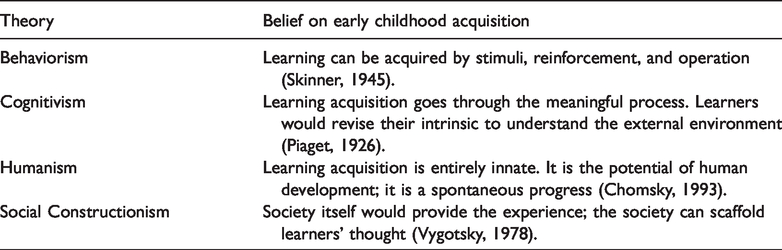
The researcher believes the early childhood acquisition can be natural and innate, and learning can automatically occur in a provided game.
Controversy over children playing digital games
There have been many controversies over children playing digital games, such as whether it is appropriate for young children to play digital games, and whether the information technology should be used in preschool and children’s family. From many studies, we can find the differences in this kind of perspective. Some researchers worried playing digital games would turn children into passive receivers, which not only reduces social interaction, but also deprive them of experiencing their actively (Kalas, 2010). On the other hand, some researchers believe that a wealth of technological literacy should be cultivated in the early childhood stage, and digital games should be integrated into other activities. This does not mean to replace the activities of young children’s large muscles and limbs. Other indoor or outdoor activities cannot be sacrificed (Kalas, 2010; New Zealand Council for Educational Research, 2004).
Research shows that early exposure to Information and Communication Technology (ICT) through digital games can not only cultivate children’s language skills, creativity, and mathematical thinking skills, but also enhance children’s experience in communication and cooperation with others (Kalas, 2010; Wang et al., 2010).
Even for children playing digital games, there are two sides to the sound. However, with the advent of our digital age, children will be exposed to digital products every day. Therefore, the main purpose of this research is to re-examine the digital games that children may be exposed on an every-day basis and observe children’s behaviors while playing digital games.
The significance of GBL and research on related children's games
GBL involves gameplay, which has defined learning outcomes. The idea of GBL is that if we can motivate children and allow them to develop an awareness of consequentiality, children can learn and acquire knowledge with information automatically (Van Eck, 2006).
Over the last decade, there has been phenomenal growth in GBL (Kulman, 2014; Peirce, 2013; Rivera, 2016). As a core constituent of the games, educational games combine learning with a motivating medium. The burgeoning growth of the games industry and the increasing prevalence of mobile and tablet devices have shifted learners’ expectations. As a result, GBL has helped learning become highly interactive and visually stimulating in positive ways (Kulman, 2014; Peirce, 2013; Rivera, 2016).
Why do we need GBL in early childhood acquisition? There are several reasons. First, children are interested in games. If we can provide learning games, we could enhance children’s learning motivation. Second, mobile devices can offer games. Therefore, we can provide ubiquity learning for children. Third, GBL allows learning to be automatic, which is related to our idea of early childhood acquisition.
To better understand GBL in young children’s preferences, we analyzed the researches of children’s digital learning. Table 2 shows the research papers which applied GBL in the studies.
The studies of GBL in early childhood education.
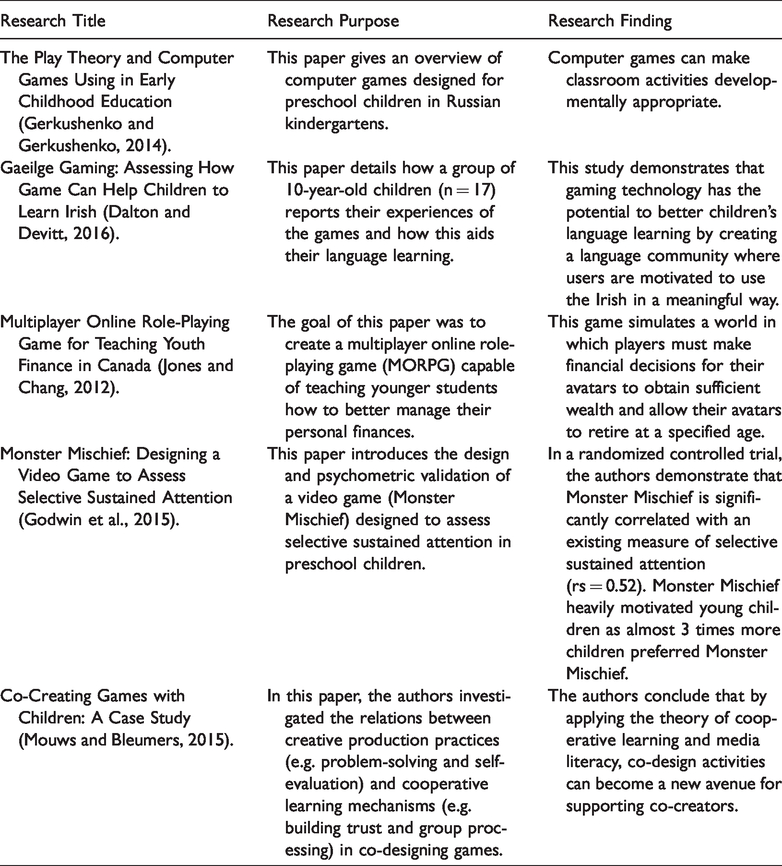
According to Table 2, most studies focus on how to implement games in different areas and subject matter, such as languages, finance, attention spans, and so on. Many of them showed evidence that GBL can assist children to understand a certain subject and to increase their attention spans. We all know children can learn better in the GBL, but we also need to explore their preferences when it comes to game selection.
Games and flow state
According to positive psychology, “Flow State” is also called “being in the zone”, which means players are in a mental state of fully immersed in a feeling of energized focus and enjoyment in the process of the activity (Cherry, 2020; Csikszentmihalyi, 1975, 1990, 1998; Nakamura and Csikszentmihalyi, 2002). In other words, “Flow State” is characterized by complete absorption in what one does and a resulting loss in one’s sense of space and time.
As we know, the “flow state” can provide an increased focus and attention span. The pertinent question here is, “What can stimulate children’s flow state?” Csikszentmihalyi’s explanation of “flow state” is likely to occur when facing a task with clear goals and specific responses warranted (Cherry, 2020; Csikszentmihalyi, 1975, 1990, 1998; Nakamura and Csikszentmihalyi’s, 2002). A well-designed game can be a good example of stimulating the “flow state.” This kind of game gives players very specific goals and responses so that it allows them to pay attention and focused on the game. “Flow state also happens when a person's skills are fully involved in overcoming a challenge that is just about manageable, so it acts as a magnet for learning new skills and increasing challenges… . ” (Csikszentmihalyi, 1998: 47) “If challenges are too low, one gets back to flow by increasing them. If challenges are too great, one can return to the flow state by learning new skills” (Csikszentmihalyi, 1998: 47).
If children play games which can activate the flow state, they may spend more time playing the same games, pay more attention to the game itself, and become willing to select the same game over and over again (Cherry, 2020; Csikszentmihalyi, 1975, 1990, 1998; Nakamura and Csikszentmihalyi, 2002).
Research structure
Following the theoretical background, the research structure of this study comprises three parts (Figure 1): early childhood acquisition, GBL, and the flow state while gaming. To provide each part with meaningful levels of depth, each part is related to the research questions as shown in Figure 1.
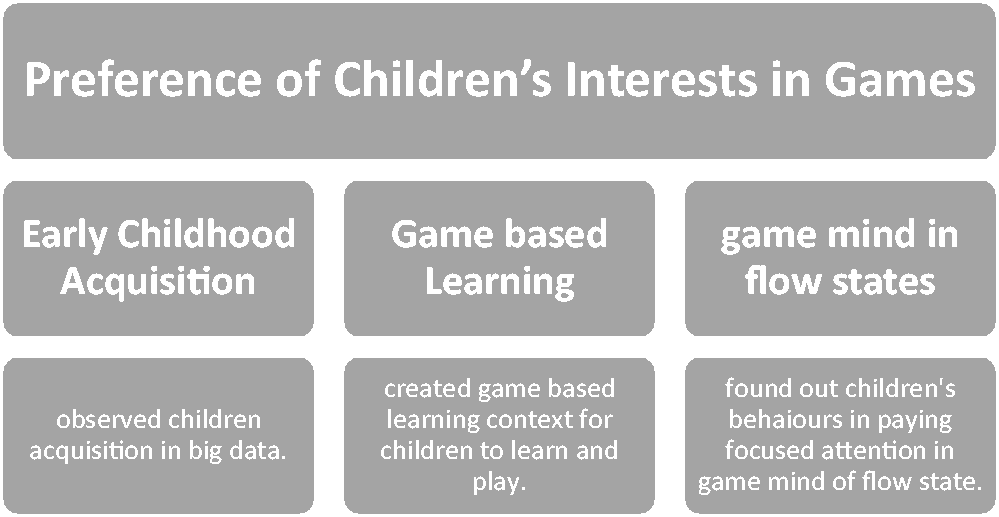
Research structure.
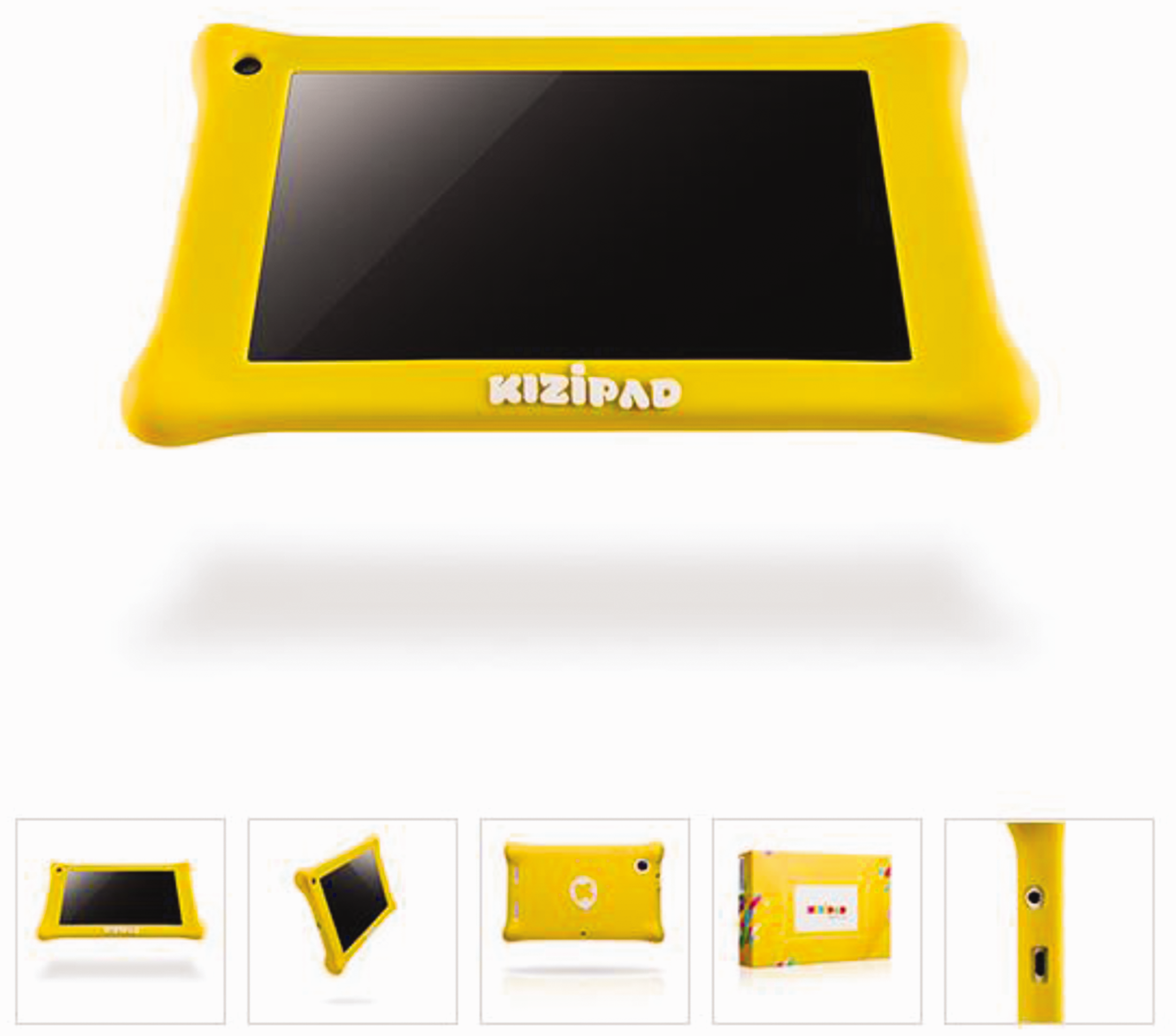
Kizpad is a children’s learning tablet (http://www.kizpad.com).
This study applies GBL and observes children’s playing behaviors. There are three concepts in the research structure. First, we intend to find out what early childhood acquisition implies in games. Second, we apply GBL as a context to observe children’s playing behaviors. After gathering all the concepts for games, we employ “big data” in games and collect information on children’s preferences and interests in games.
Research methodology
This study applied big data to find children’s playing behaviors regarding games. Big data techniques can help distinguish children’s preferences and interests regarding game behaviors (Laney, 2001; Reips and Matzat, 2014; Rouse, 2016). We categorized and analyzed the players’ behavior data to see if children can play the same games over and over again, and which factors influenced playing frequency.
To make the data more significant, we subdivide the big data to screen information on 1,000 children: children who have continued to play Kizpad for up to 1 year. The study uses big data analysis to screen out suitable players as the main foundation for our research.
Research instruments
In this study, we cooperated with the manufacturer Kizpad (www.kizpad.com) to explore the big data analysis. Kizpad is a children's tablet featuring 70 games. In Kizpad’s previous studies, they found their games can enhance children’s learning individually, automatically, and effectively (Lan and Tang, 2014, 2016; Tang et al., 2013).
According to our study’s purposes, we have implemented 10 games in five operation types: racing, constructing, creating, pointing, and card games. Then, we apply data to observe children’s playing behaviors. These five game categories represent the most common gameplay modes a child will encounter. Through these models, this study would determine which kinds of games contribute to the flow state.
To make this research meet the standards of research ethics, we set the electronic parental consent form in Kizpad (Please see Figure 2). When logging in to Kizpad at the beginning, parents would need to answer a questionnaire and agree to the experiment, and then fill in their children’s ages and genders. The consent form clearly states the purpose of the research to ensure that the collected data meet the purpose of the research.
Learning games
The games on Kizpad can be grouped into five different categories: racing, constructing, creating, pointing, and card (board) games. The five-game categories are described as follows.
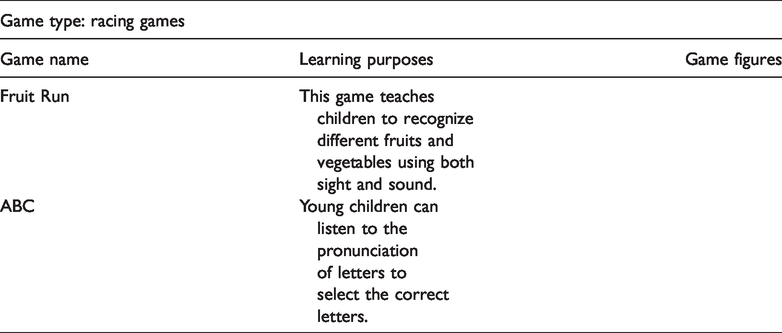
Racing game
The first category is “Racing Game.” Players need to respond to the sound with the correct answer quickly to make the object moving. We employ two racing games in the study: “Fruit Run” and “ABC,” which are described in Table 3.
Racing games.
Constructing game
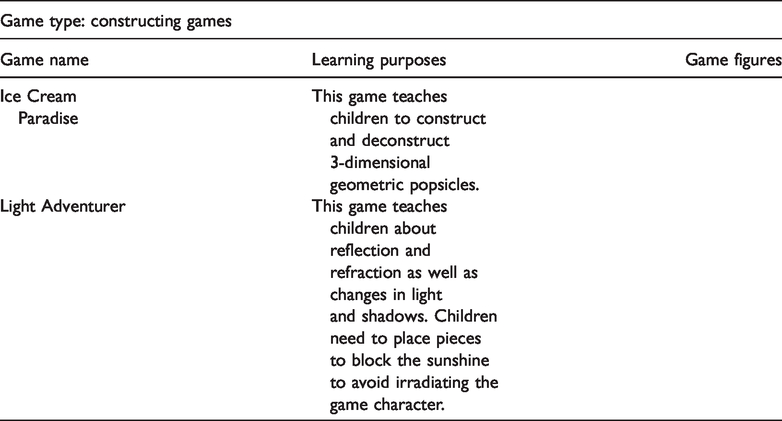
“Constructing Game” refers to the idea that players combine pieces to complete a task or to solve a problem. This kind of game is similar to the children’s “block game”. Children apply their logic skills in these games.
In the study, we pick two constructing games: “Ice Cream Paradise” and “Light Adventure,” which are described in Table 4.
Constructing games.
Creating game
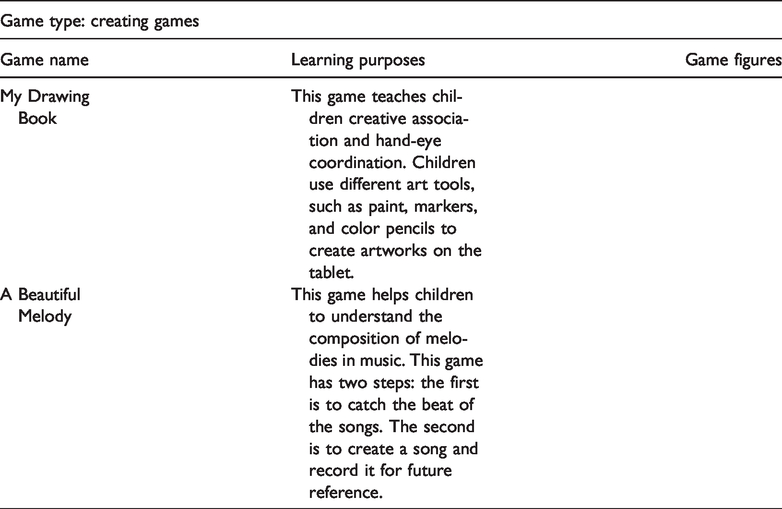
“Creating Game” involves players using their imagination to create things. Sometimes, players have to follow the rules to make things happen. However, most of the time, they need to create things by their imagination and creativity.
In the study, we employ two creating games: “My Drawing Books” and “A Beautiful Melody,” which are described in Table 5.
Creating games.
Pointing game
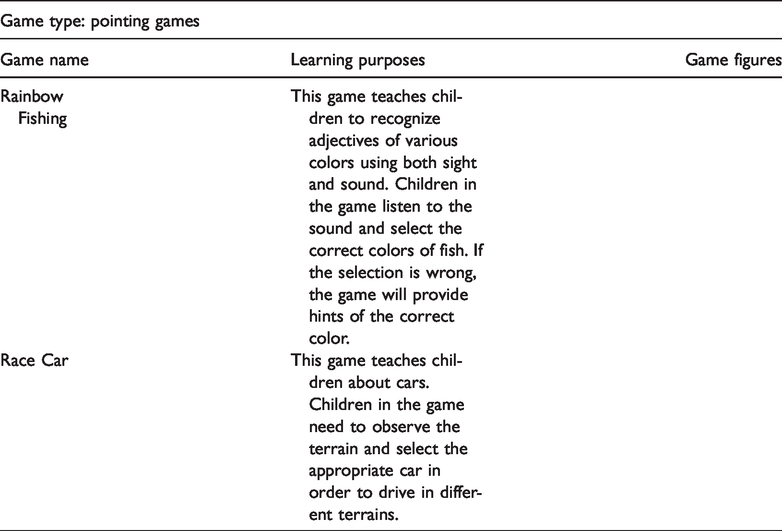
“Pointing Game” involves players selecting correct answers in a time frame. They need to click the answers to complete the missions in the game as quickly as possible. We pick two pointing games in the study: “Rainbow Fishing” and “Race Car,” which are described in Table 6.
Pointing games.
Card (board) game
“Card (Board) Game” involves players following certain rules to play against computers or other players by using cards or pieces.
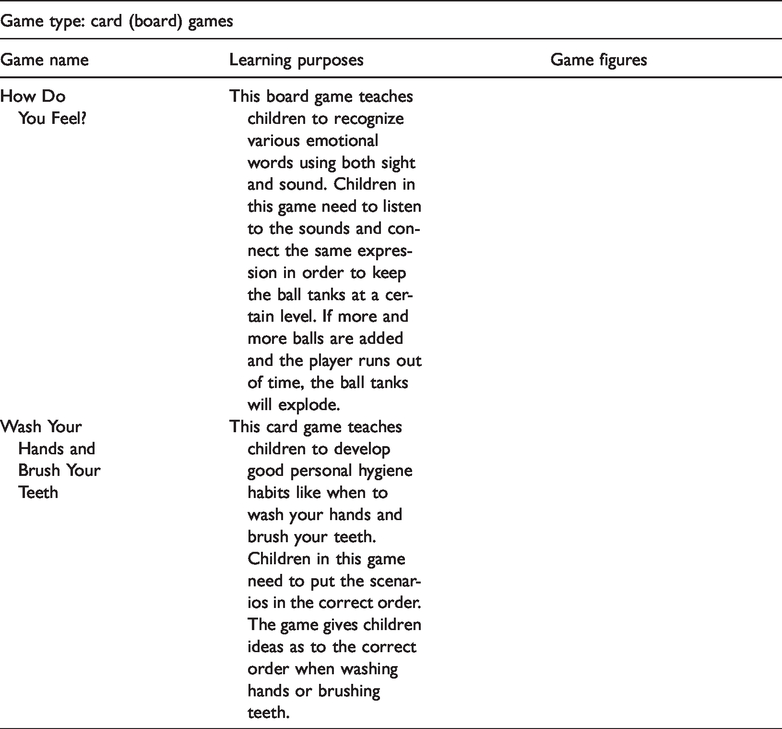
In this study, we use two cards (board) games: “How Do You Feel?” and “Wash Your Hands and Brush Your Teeth,” which are described in Table 7.
Card (board) games.
Participants
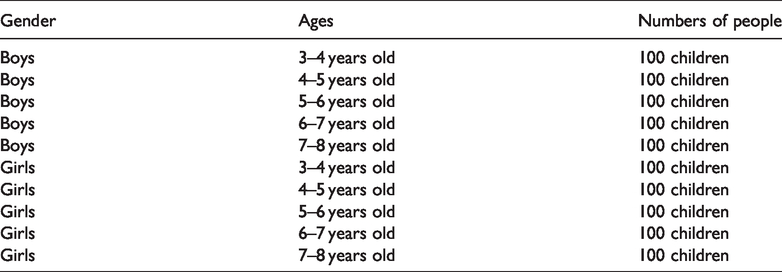
The 1,000 participants are children of Kizpad buyers. In this study, we select children randomly in the age range of 3 to 8 years old, which includes 500 boys and 500 girls as described in Table 8.
Participants.
Although buyers bought Kizpad at different times, we select users who bought Kizpad for more than one year and collect their data for the first year of having Kizpad. The participants are randomly chosen according to the following four rules:
The participants have at least first-year data from Kizpad. The participants are in the age range of 3 to 8 years old. The participants have opened and played Kizpad for more than 20 times. The participants have played 10 selected games in Kizpad more than one time each.
One thousand of the players who meet the four rules are randomly chosen as participants and their parents would receive confidential notifications from us. The notifications have been included in the following statement for parents to understand the process of the study.
The data only includes the player’s playing frequencies, ranks, age, and gender. No other information will be asked during the study. The study will randomly select 1,000 participants; however, the participants’ information will be confidential and will not be identified in the study.
The study determines the game preferences between different age groups and genders based on age and gender distribution. The 10 games are designed according to the theory of Developmentally Appropriate Practice (Gestwicki, 2016) so that children of different ages would not have any difficulty playing the game.
Results
Research question 1: How long can children stay engaged when playing digital games? What is the relation between the length of engagement and their flow state?
According to the data found, we averaged each child’s amount of playing minutes to see if children's attention and interests can be maintained during the weeks. We calculated the total number of minutes which one child spends each time playing Kizpad. If the game in Kizpad is idle for more than 10 seconds, the calculation will be stopped. The findings of 1,000 children for the first 30 weeks has been analyzed and shown in Figure 3.
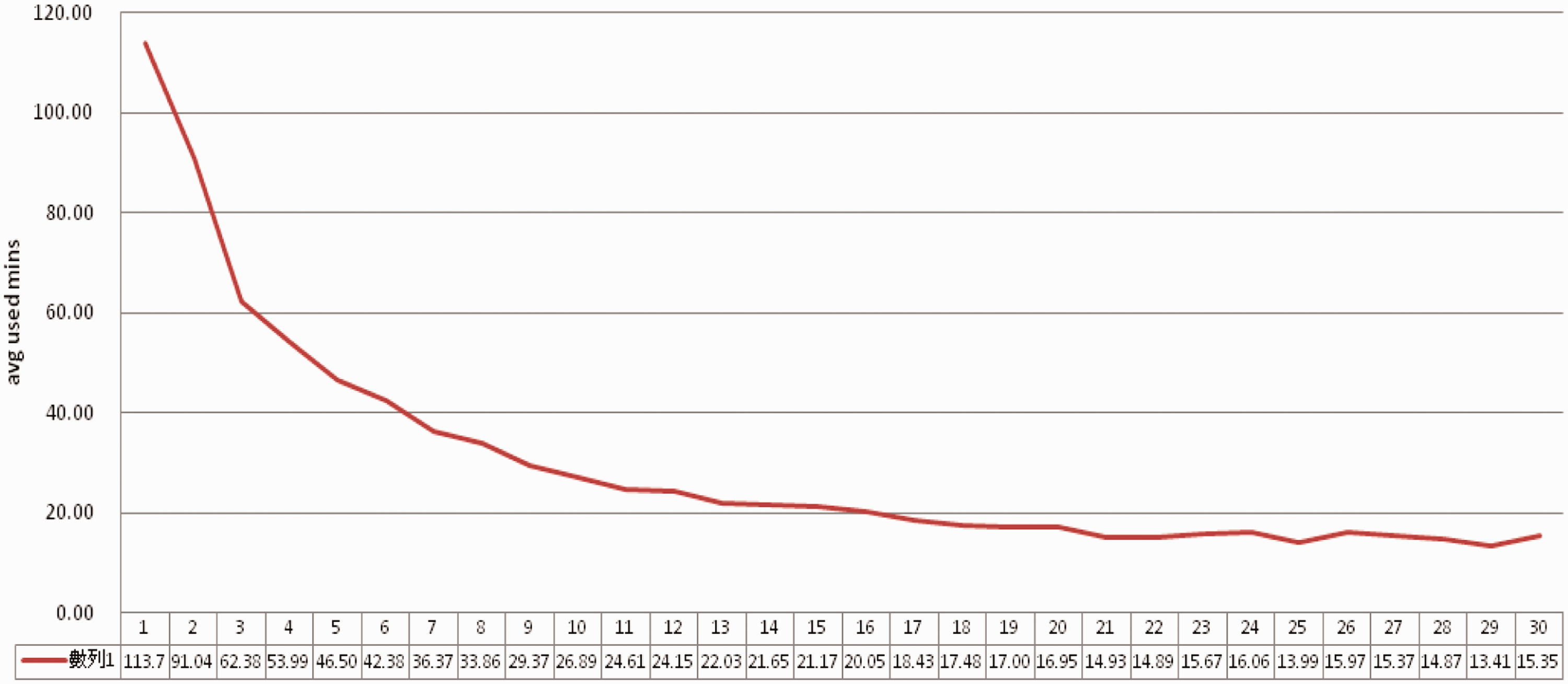
Average amount of used time (mins) per week.
In Figure 3, we find that the children's flow is high during the first week, with an average of 113.7 minutes of focused playtime per child in the first week. Children’s flow gradually declines as they are more familiar with Kizpad. Until the 10th week, the flow pattern is maintained at an average of 20 minutes a week.
According to our findings, games cannot maintain children’s attention or interests forever. Children’s interest would drop after 4 weeks of playing. Flow state means players are intense and concentrating on the present moment (Csikszentmihalyi, 1970, 1990, 1998). Therefore, the time curve in which players are focused on represents that the children’s flow cannot be maintained forever.
Based on the analysis of this research question, we find that children's preferences in games are the highest in the first 4 weeks (playing at least 60 minutes a week or more). As time goes on, they would reduce their total hours of gameplay.
Research question 2: Do children's preferences in games differ between genders?
To understand gender differences in children’s preferences, we have randomly selected 500 boys and 500 girls in the age range of 3 to 8 years old. Table 8 provides a big data analysis of genders’ preferences in playing games. This study takes the F value of each group to explore whether there is a significant difference in genders. If there is a significant difference, it will be marked by * in Table 9.
Children preferences for playing games according to gender.
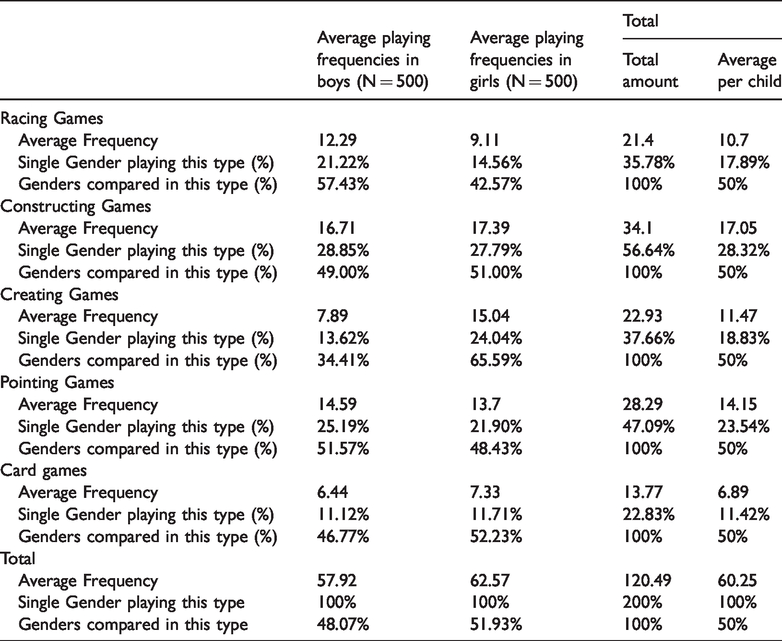
In Table 9, we can conclude that different genders in playing games have not reached a significant difference. However, to gain a clear view, we also provide charts and graphs.
Figure 4 represents “average amounts of different genders playing frequencies.” The study has averaged each child’s playing frequency and categorized the data into genders to see if the analyzed graph could show gender preferences in different game types.
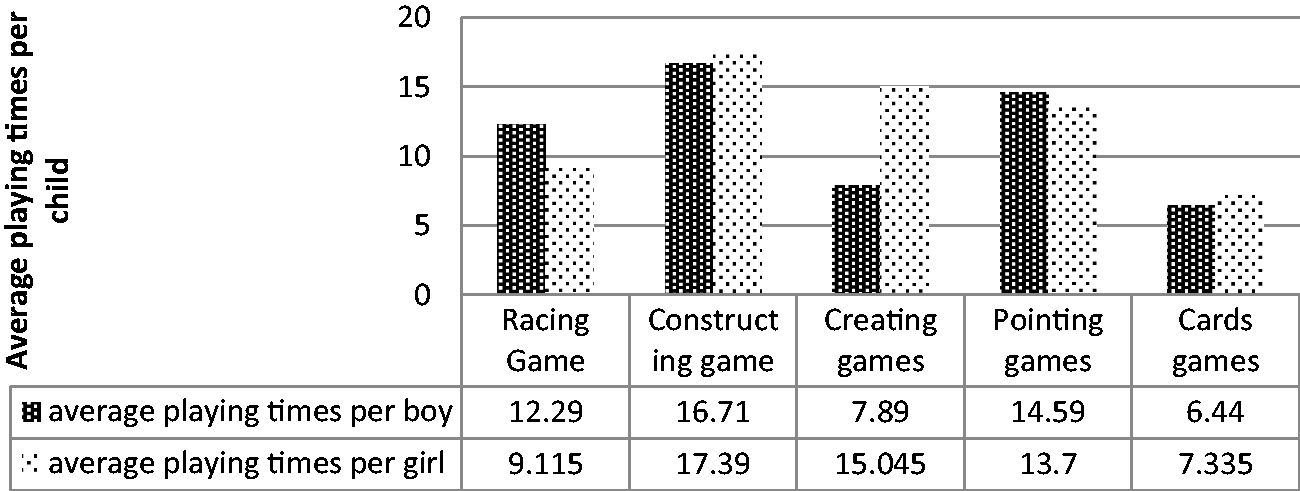
Average amounts of different genders’ play frequencies.
According to comparing boys’ and girls’ favorite games in Figure 4, boys prefer to play “racing games” and “pointing games.” Girls prefer to play “constructing games,” “creating games,” and “card games.”
Also, to explore children's preferences in favorite games under a single gender, we analyzed boys and girls separately. Figures 5 and 6 present each gender’s favorite game type. We have averaged their play frequencies within one year and put the data into percentages of charts to determine little boys’ and little girls’ game type preferences.
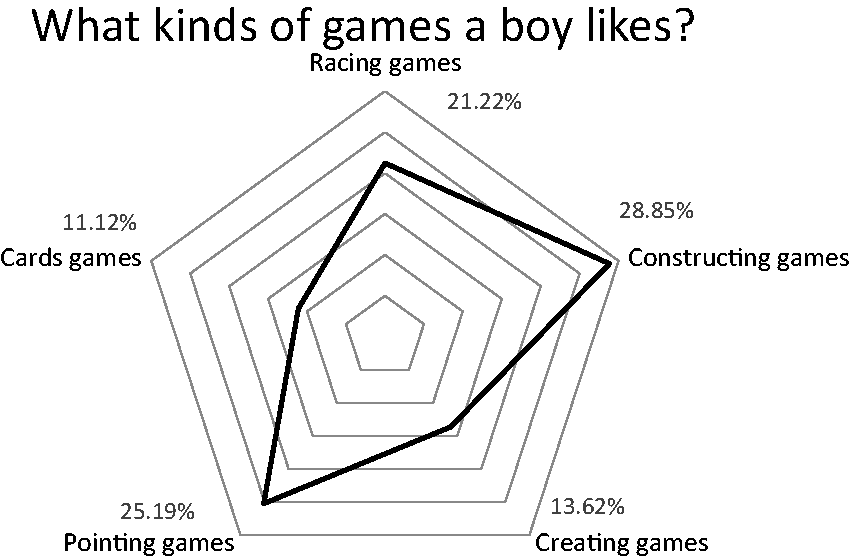
Boys’ preferred game type.
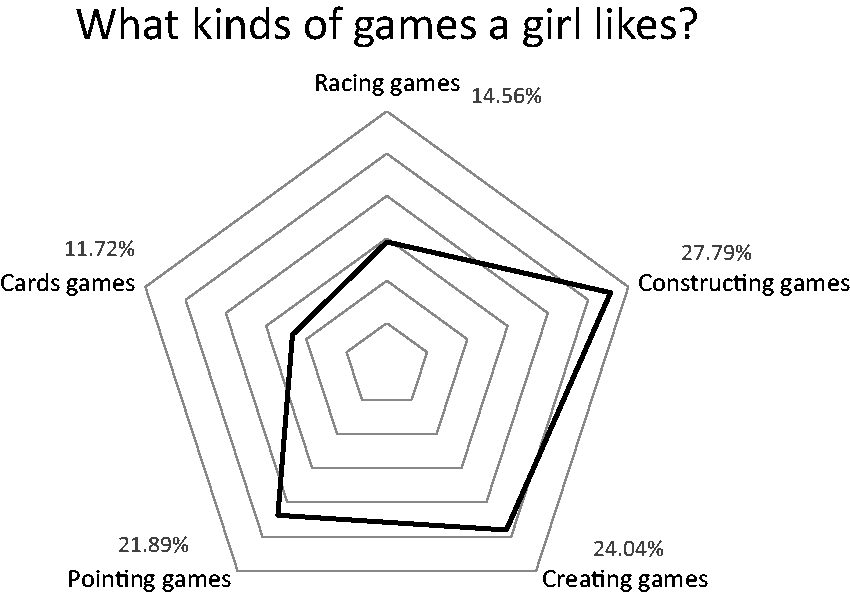
Girls’ preferred game type.
Based on the single-gender analysis, boys tend to choose “constructing games” and “pointing games” repeatedly, whereas little girls tend to choose “constructing games” and “creating games” repeatedly. However, about games children are less interested in, boys tend not to choose “card games” or “creating games,” whereas girls tend not to choose “card games” or “racing games.” Overall, this study shows all five types of games have almost an equal chance to be chosen by each gender.
To answer this question: How do boys and girls like digital games? We use Figure 7 to analyze. Figure 7 presents “genders' interest in playing games.”
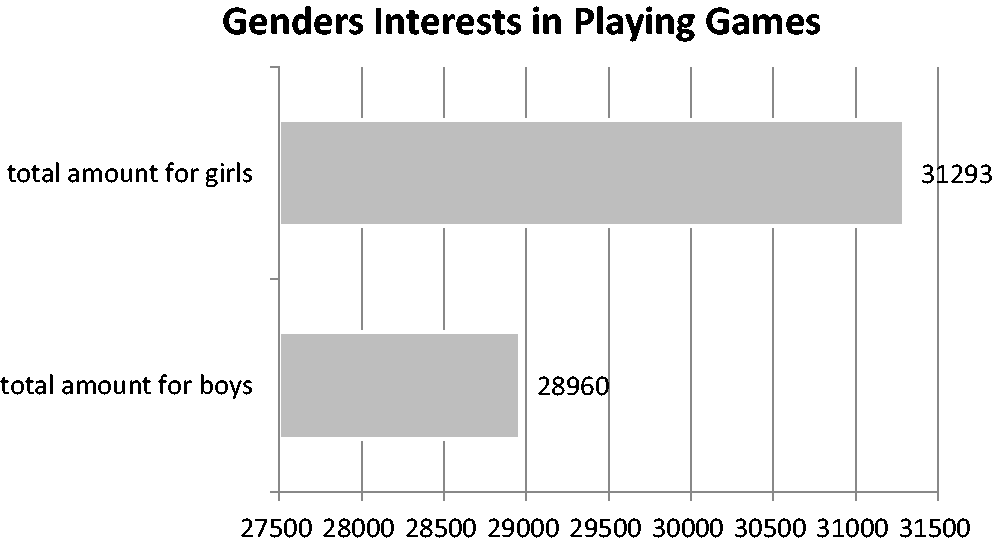
Genders’ interest in playing games.
In Figure 7, we found that girls have higher frequencies than boys. However, it depends on the kinds of games that we selected and created. In this study, girls tend to like the games that we selected for them and the 500 girls had higher frequencies of game playing than the 500 boys.
Based on the analysis of this research question, there are two findings as follows:
Boys and girls almost equally tend to select and play games; girls tend to have higher frequencies than boys. However, it depends on what kinds of games we have selected. On repetition, boys tend to choose “constructing games” and “pointing games” repeatedly, whereas little girls tend to choose “constructing games” and “creating games” repeatedly. Digital games can cross-gender differences, and children of different genders do not reach a significant difference in games.
Research question 3: What are the children's preferences in games in regarding different ages?
To understand how age difference alters children’s preferences, the study randomly selected 200 children from each age range group, such as “3 to 4,” “4 to 5,” “5 to 6,” “6 to 7,” and “7 to 8” years old. Table 10 provides children’s preferences in playing games at different ages. This study takes the F value of each age group and explores whether there is a significant difference among them. If there is a significant difference, it will be marked by * in Table 10.
Children’s preferences for playing games at different ages.
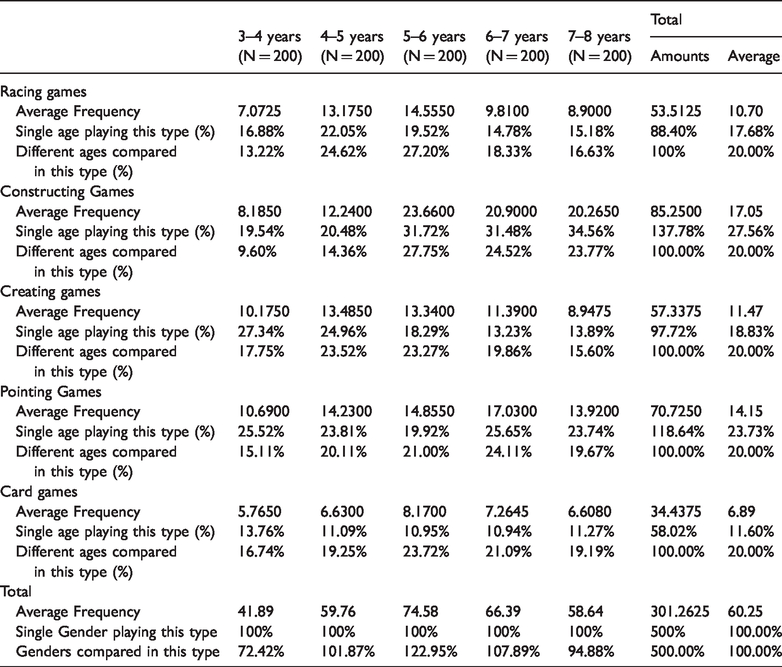
From Table 10, children playing games have not reached a significant difference. 1,000 children do not show significant differences in choosing and playing different game types within a year. However, to gain a clear view, we also provide charts and graphs in Figure 8.
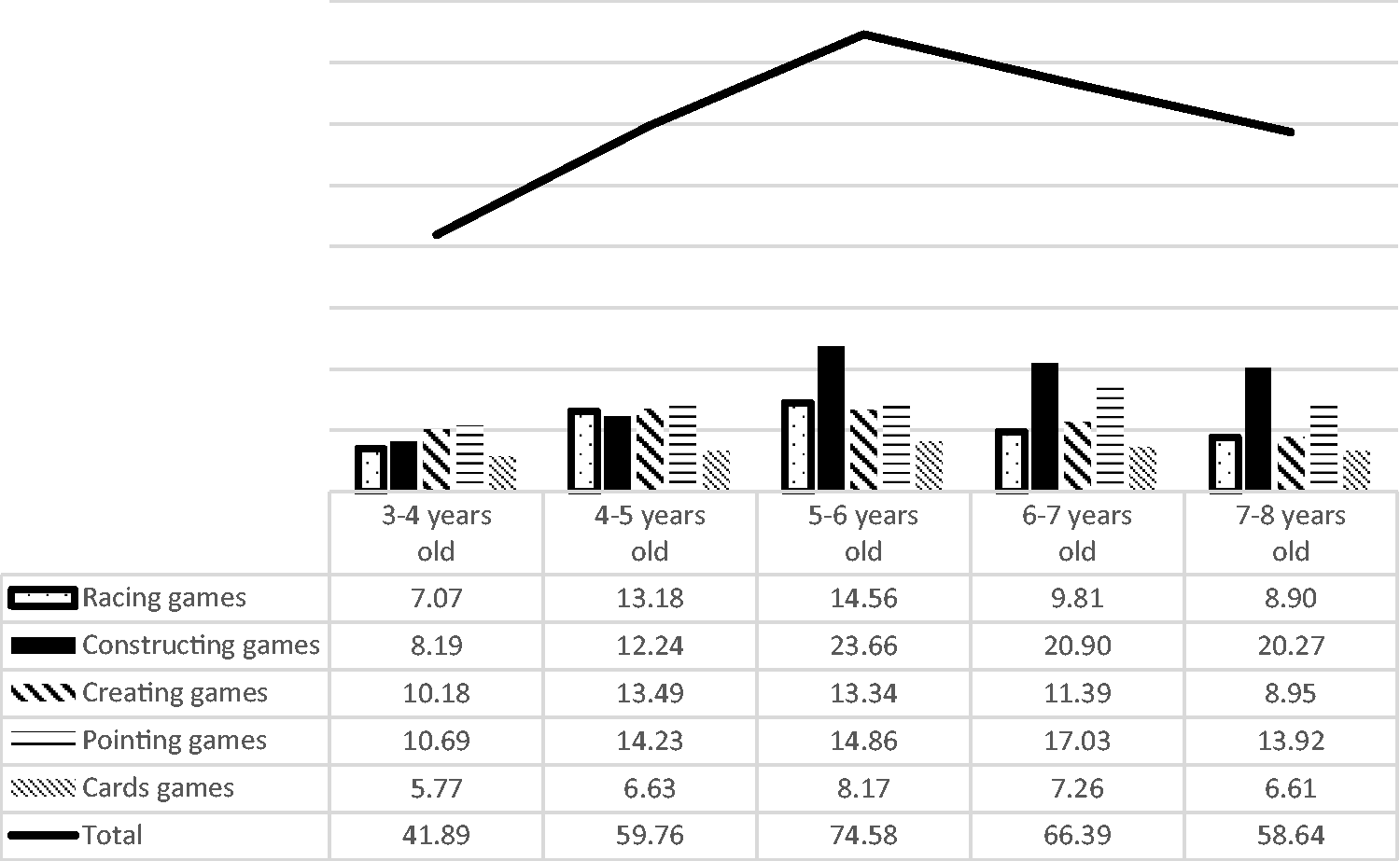
Average playing frequencies per child (different ages).
According to Figure 8, children’s interest in games varies at different ages. To “3 to 4” years old, children choose “creating games” and “pointing games” repeatedly; to “4 to 5” years old, children enjoy playing “creating games” and “pointing games”; to “5 to 6” years old, children enjoy playing “constructing games”; to both “6 to 7” and “7 to 8” years old, children enjoy playing “constructing games.”
According to the overall data, we can see that children the age of “5 to 6” years old enjoy playing digital games the most. Conversely, children in the age range of “3 to 4” years old have the lowest playing frequencies. As a result, we assumed that children aged “3 to 4” years old might be too young to operate digital games. It would be helpful if we can consider designing more appropriate games for younger children.
To explore the game preferences by each group of ages, the study analyzes each group separately. Figures 9 to 13 provide five charts that present “children’s game preferences for different age groups.” The study has averaged each child’s play frequencies at the age range of “3–4,” “4–5,” “5–6,” “6–7,” and “7–8” years old within one year and put the data into a percentage to determine the playing frequencies.
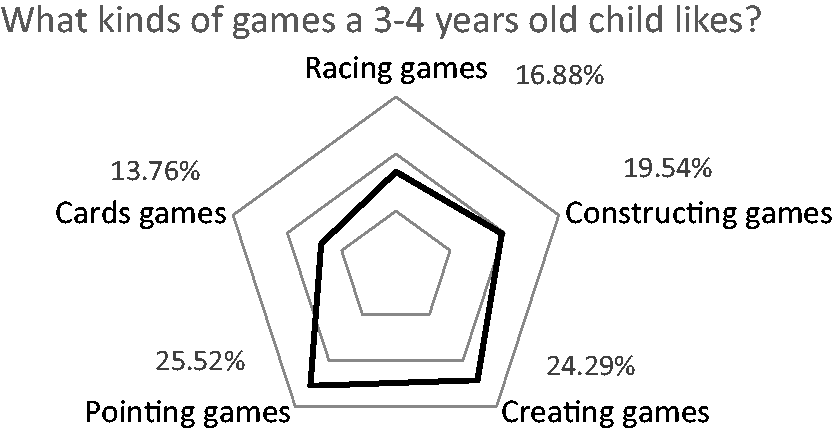
The game types that 3–4-year-old children prefer.
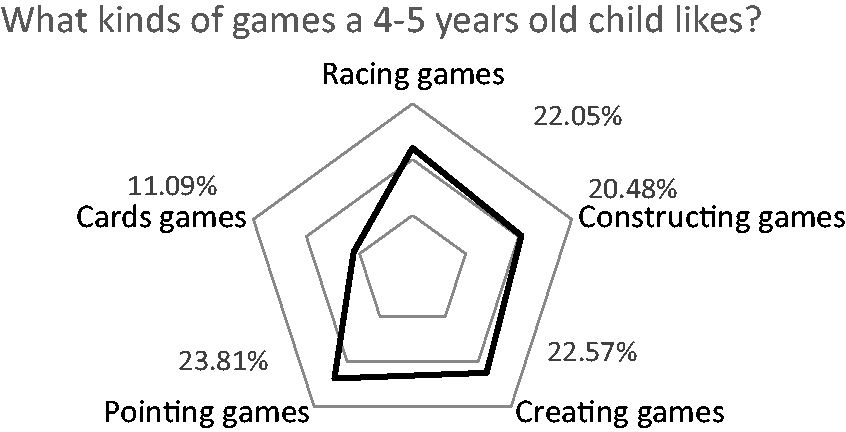
The game types that 4–5-year-old children prefer.
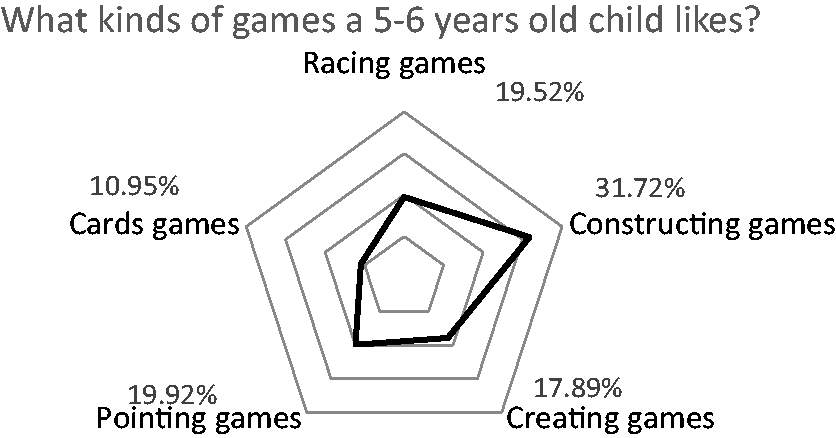
The game types that 5–6-year-old children prefer.
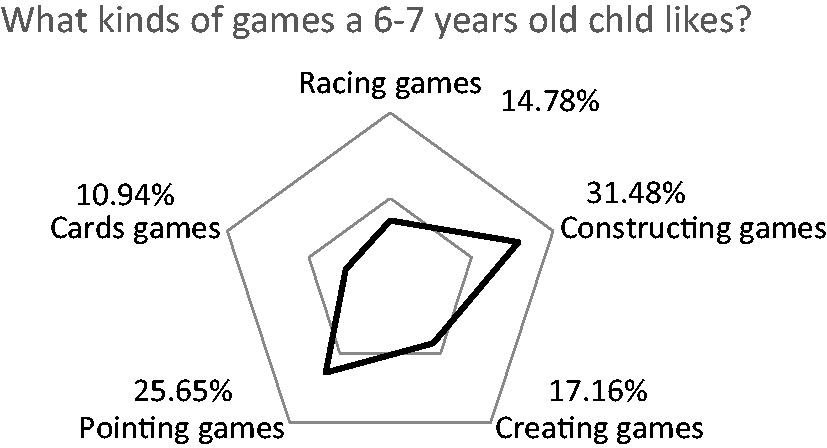
The game types that 6–7-year-old children prefer.
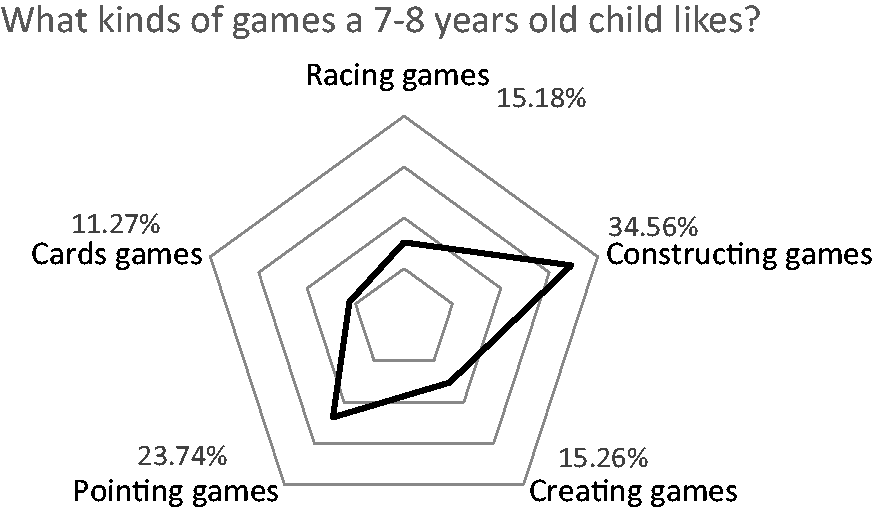
The types of games that different age groups of children prefer.
According to the five charts in Figures 9 to 13, children of “3–4” years old tend to choose “pointing games” and “creating games” repeatedly, whereas they do not choose “card games” and “racing games.” Children of “4–5” years old also choose “pointing games” and “creating games” repeatedly, but tend to not choose “card games” and “constructing games.” When turning to “5–6” years old, they tend to choose “constructing games” repeatedly the most, but tend to not choose “card games” and “creating games.” Children of “6–7” years old also choose “constructing games” repeatedly, but tend to not choose “card games” and “racing games less.” Once children reach elementary-school age, “constructing games” show the highest frequency of play, whereas “card games” and “racing games” show the lowest frequencies. Overall, we have found that children rarely choose “card games.” Participants in this study are young children aged three to eight years old and this leads us to think whether card games are low attractive to young children.
After the analysis of the research question 3, our findings are as follows:
There is no significant difference in the age group's preference in games. However, younger children show less frequency of playing games than older children. When choosing different types of games, children seldom select “card games”. We assume it is because “card games” are more difficult to understand and manipulate for young children.
Research question 4: What are the relations between children’s interests and achievements? Is children’s flow state related to their learning performances?
We designed the games with a three-star system. If the participating children do not reach any star level, it means that their learning performance is poor. “One Star” means that players need help to complete the game. “Two Stars” means that they can make it partially. Last, “Three Stars” means that they can complete the game independently. Table 11 illustrates the correlation coefficient among players’ interest, playtime, and achievement.
Correlation data between interests and achievements.
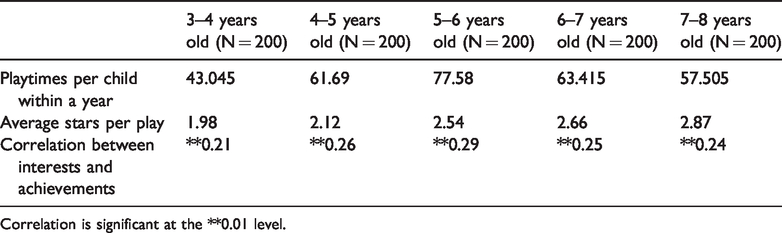
Correlation is significant at the **0.01 level.
According to Table 11, if children are interested in a game and willing to play it repeatedly, their achievement level would get significantly higher. In the study, we collected 104,316 entries in total where each playing frequency per child counts as one entry.
According to the above, the conclusions for research question 4 are found that attention and playing time affect children's learning effect.
Discussion
Based on the observation, we further discuss some critical findings, which are helpful for early childhood education and games as follows.
Critical finding 1: Children's acquisition can occur autonomously in a GBL scenario
Many studies have confirmed “Kindergarten and preschool curricula can adopt game-based settings as a learning medium to provide more opportunities for children's acquisition” (Cheng, 2009; Dalton and Devitt, 2016; Gerkushenko and Gerkushenko, 2014; Grimley et al., 2012; Godwin et al., 2015; Jones and Chang, 2012; Mouws and Bleumers, 2015).
This study has found children's learning effect is positively related to their game preference. If children can spend more time playing, they will be more likely to have better learning performance.
Critical finding 2: Digital games allow children to learn across genders and ages
In this study, there are no significant differences between gender and age in choosing digital games. Therefore, we can assume that as long as children are familiar with manipulating games, digital games can across ages and genders.
According to the “Flow State”, challenges can evoke children’s interest in trying the game. However, if there are too many challenges, it would be difficult for players to continue to pay attention to the games (Cherry, 2020; Csikszentmihalyi, 1975, 1990, 1998; Nakamura and Csikszentmihalyi, 2002).
Future research: Family education is a key factor for children’s GBL
When interviewing parents, we have learned that children's preferences in games are closely related to their family environment. If parents are willing to spend time with their children playing games, their children will enjoy playing more games. Children like to share and play games with their parents to enhance the parent-child relationship. In the future, we will deeply explore the relations between parents and children playing games.
Conclusion
GBL encompasses numerous aspects. A GBL environment can help children, instructors, and game designers to create a friendly learning setting. In this study, all the big data show that if children are willing to play the same games over and over again, they would grow and develop their achievement ranking automatically and successfully. The behavior of playing the same game repeatedly is defined as “flow state” which many participants in this study have achieved. The flow state facilitates children’s enjoyment of learning and which shows a significant and high positive correlation with their learning achievement.
In the future, we aim to continue to determine more behaviors in children’s acquisition, learning, and development. If more data can be collected, we may be able to help more game designers and instructors in kindergarten and preschool to understand how to design better games and to apply to instructions for young children.
Footnotes
Acknowledgments

Declaration of Conflicting Interests
The author(s) declared no potential conflicts of interest with respect to the research, authorship, and/or publication of this article.
Funding
The author(s) received no financial support for the research, authorship, and/or publication of this article.