




Abstract

EDITORIAL
Several months on from a rather eventful start to the year it looks like the rockiness the year began with is set to continue. January has come and gone claiming the title of hottest on record, possibly the highest minimum in the past 120,000 years. Meanwhile, though undoubtedly the world does not rely upon the United States to make meaningful change to environmental policy, the significant shifts in policy have caused quite reasonable concern about the long-term effects to the global effort in limiting the damaging effects of climate change. Most recently, there are now experts suggesting mass outages in Spain and Portugal may be partially caused by clean energy systems not yet robust enough to handle the nations’ energy needs. What continues to be evident is the need, whatever its form, for clear, concerted and consistent efforts from all.
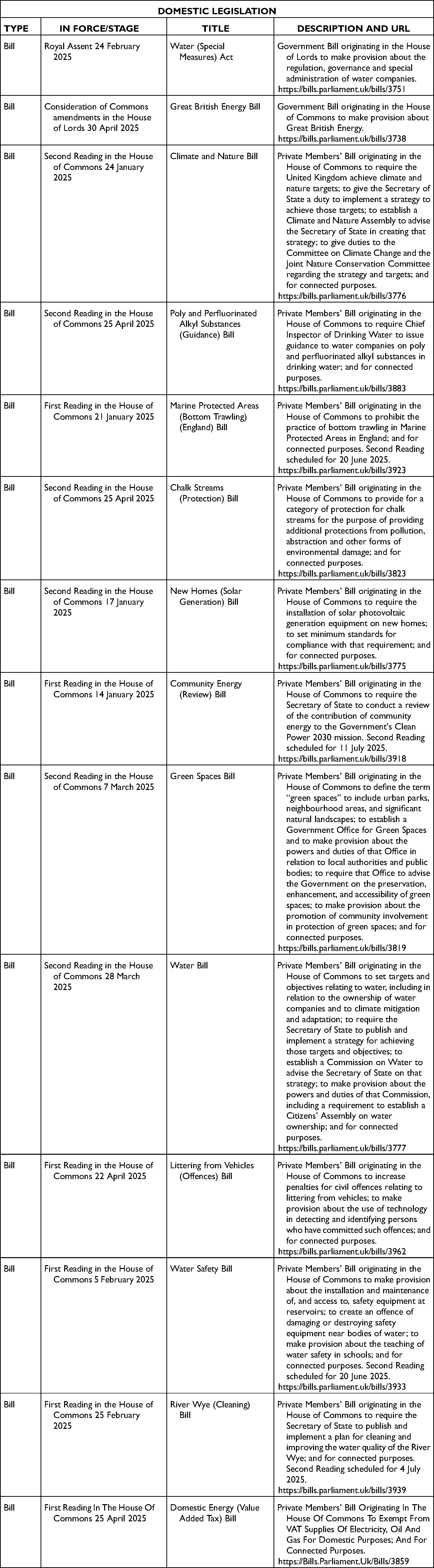
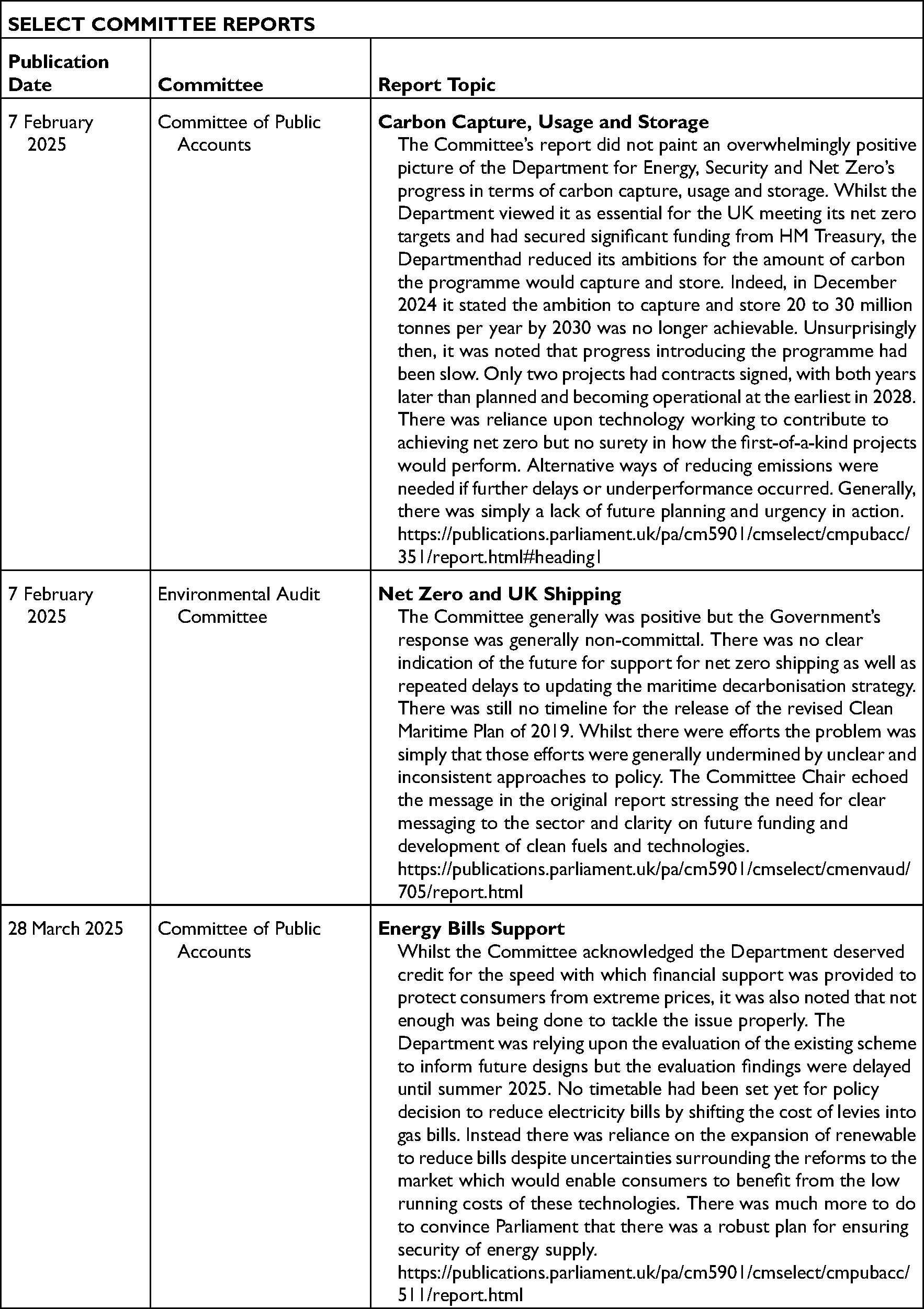
That sentiment was echoed in several select committee reports. The Committee of Public Accounts in several different reports noted a lack of clear, consistent and effective efforts to combat climate change and its ramifications. The Department for Energy, Security and Net Zero was criticised for its progress, or lack thereof, in respect of carbon capture, usage and storage. Similarly, the Committee noted the Department for Business, Energy and Industrial Strategy lacked a consistent and comprehensive approach to energy bills’ support with the Department overly relying on untested and, as yet, unexpanded renewable energy to reduce bills.
Some interesting cases came through the Courts in the early part of the year; in Greenpeace Ltd v Advocate General for Scotland the Court agreed that the Government's decision to grant consent under the Offshore Oil and Gas Exploration, Production, Uploading and Storage (Environmental Impact Assessment) Regulations 2020 was unlawful as the EIA failed to assess the effect of oil combustion on the environment. In R v Hallam, the Criminal Appeal Court confirmed that whilst conscientious motivation may be a relevant sentencing factor it didn’t preclude culpability being high or that lower sentences were justified to deter further protestors from breaking the law.
Read on for more updates.
Update
Anna McClean
TRINITY CHAMBERS
EU LEGISLATION AND TEXTS
Commission Regulation (EU) 2025/258 of 7 February 2025 amending Regulation (EU) 2017/2400 as regards the determination of the CO2 emissions and fuel consumption of medium and heavy lorries and heavy buses and the inclusion of vehicles running on hydrogen and other new technologies and amending Regulation (EU) No 582/2011 as regards the applicable rules on the determination of CO2 emissions and fuel consumption in order to obtain an extension to an EU type-approval
This continues as past amendments to account for new technologies and allow for further refinements taking into account such new technologies. The amendments include the introduction of new requirements to allow for vehicles: fuelled by hydrogen; fitted with efficient wheel ends; and fitted with multiple drivetrains capable of operating independently or capable of being recharged whilst in motion. It further introduces alternative procedures for determining aerodynamic performance (to reduce physical testing burdens) and new requirements so as to avoid conflicting obligations for the purpose of determining CO2 emissions and fuel consumption values for those vehicles that straddle two different regimes.
https://eur-lex.europa.eu/legal-content/EN/TXT/?uri=CELEX%3A32025R0258&qid=1745516837470
Directive (EU) 2025/794 of the European Parliament and of the Council of 14 April 2025 amending Directive (EU) 2022/2464 and (EU) 2024/1760 as regards the dates from which Member States are to apply certain corporate sustainability reporting and due diligence requirements
The Directive provides a two-year postponement to sustainability reporting legislated for under the Corporate Sustainability Reporting Directive (EU) 2022/2464 (CSRD) which required companies to comply for the 2025 and 2026 financial year. Further, the deadline for Member States to transpose Directive (EU) 2024/1760 was extended by one year in order to take into account possible delays in their ongoing transposition efforts.
https://eur-lex.europa.eu/legal-content/EN/TXT/?uri=CELEX%3A32025L0794&qid=1745517321556
Domestic case law
Planning
Frack Free Balcombe Residents’ Association v Secretary of State for Housing, Communities and Local Government [2025] EWCA Civ 495
The residents’ association appealed against the dismissal of its application to quash the planning inspector's decision to allow the developer to appeal against the refusal of planning permission for a hydrocarbon exploration and appraisal project. The planning inspector had held that the national need for the development in the interests of energy security outweighed the adverse impact it would have on the Area of Outstanding Natural Beauty in which it was located and amounted to exceptional circumstances. The appellant argued that the planning inspector had taken into account the benefits but not the harm of a future development of commercial production of hydrocarbons. The court dismissed the appeal. It held that the planning inspector gave weight to the benefit of exploration and appraisal as an activity, in its own right, but not the supposed benefits or harm of future commercial production. The court further rejected the argument that because hydraulic fracturing remained a possibility in the future, the planning inspector should have applied Policy M7b of the joint minerals local plan which applied to proposals involving hydraulic fracturing. Neither Policy M7b nor Policy M7a (which applied to proposals not involving hydraulic fracturing) extended to a form or phase of the development outside the four corners of the application and the decision-maker was not required to anticipate such development.
R (on the application of Bradbury) v Brecon Beacons National Park Authority [2025] EWCA Civ 489
Planning permission had been granted for the development of a covered yard for handling sheep on a farm within a Special Area of Conservation. The appellant had successfully brought a judicial review claim challenging this decision on the grounds that reg. 63(5) Conservation of Habitats and Species Regulations 2017 had been breached but, under s. 31(2A) Senior Courts Act 1981, the court has refused to grant relief. The appellant appealed against this refusal to grant relief, arguing that the court should adopt the reasoning in R (oao Cava Bien Ltd) v Milton Keynes Council [2021] EWHC 3003 (Admin), which had sought to set out 14 principles from case law on the operation of s. 31(2A) and whether the outcome would have been substantially different. The court dismissed the appeal. It rejected this argument and held that the principles, starkly stated and devoid of context, did not accurately reflect what the cases from which they were taken had decided and should not, therefore, be applied as if they were a checklist.
Secretary of State for Environment, Food and Rural Affairs v R (on the application of Pickering Fishery Association) [2025] EWCA Civ 378
Pickering Fishery Association had successfully brought a judicial review of the secretary of state's decision to approve the Environment Agency's Humber River Basis Management Plan, which provided a high-level, generic summary of how the conditions of waters were classified and the objectives and challenges for the water environment. The plan was the same as that for every plan in the country and was not specific to any river basin or district and the court had therefore held that it did not comply with reg. 13 Water Environment (Water Framework Directive) (England and Wales) Regulations 2017. The secretary of state appealed against this decision. The court dismissed the appeal and held that in order to comply with Directive 2000/60 and the Water Environment (Water Framework Directive) (England and Wales) Regulations 2017, a programme of measures drawn up under reg. 12 and reg. 13 could not be wholly generic but had to identify a programme or scheme of actions for each individual water body in order to achieve its environmental objectives.
Stop Portland Waste Incinerator v Secretary of State for Housing, Communities and Local Government [2025] EWHC 777 (Admin)
The claimant applied for statutory review under s. 288 Town and Country Planning Act 1990 of the secretary of state's decision to grant planning permission for an energy recovery facility. The court found that the planning inspector had applied the relevant provisions of the Waste Plan that formed part of the Dorset Development Plan and that the claimant's interpretation of the spatial strategy in the Waste Plan was too narrow, focusing on the location of sites without sufficient regard to other elements. It found that the reasons given by the planning inspector were intelligent and adequate and she had taken account of the relevant considerations. The application for statutory review was dismissed.
Basingstoke and Deane Borough Council v Loveridge [2025] EWHC 738 (KB)
The claimants applied for the renewal of an injunction against persons unknown for a further 12 months. The injunction was a Traveller Injunction which prohibited unauthorised encampments and the depositing of waste and covered 10% of the land comprised in the local authority area to restrain breaches of planning control. The court granted the renewal but highlighted that this type of injunction is exceptional and that in the event of the claimants seeking a further renewal, the onus would be on the claimants to justify its reasons for not pursuing byelaws. It also found that the claimants were not meeting the needs of the Gypsy and Traveller community and its decision not to create a transit site should be reconsidered.
New Forest National Park Authority v Secretary of State for Housing, Communities and Local Government [2025] EWHC 726 (Admin)
The claimant applied under s. 288 Town and Country Planning Act 1990 for statutory review of the defendant's decision to allow an appeal against the refusal of an application for planning permission for the extension to an existing dwelling. The claimants argued that the planning inspector had misdirected himself on the policy in the New Forest National Park Local Plan and failed to discharge the duty imposed by s. 11A(1A) National Parks and Access to the Countryside Act 1949. The court found that the planning inspector was correct to find that the proposed development was in conflict with the policy relating to extensions in the Local Plan, but that it was up to the planning inspector how much weight to give this when deciding whether the proposal conflicted with the Local Plan overall. It held that the purpose of the duty in s. 11A(1A) to conserve and enhance those characteristic features which justify designation of a National Park is discharged by establishing that the proposed development will leave those features unharmed. It found that the planning inspector's findings provided a clear justification for concluding that the proposed development would leave the significant characteristics of the New Forest National Park unharmed.
National Farmers’ Union v Herefordshire Council [2025] EWHC 536 (Admin)
The NFU applied for judicial review of policy in the defendant's mineral and waste local plan that sought to tackle the high levels of nutrients that were harming rivers in the local authority's area by controlling the disposal of agricultural waste by requiring an application for planning permission for a new agricultural livestock unit to include detailed plans showing how manure created would be disposed of without harming the environment. The NFU's argument was that this policy illegitimately sought to extend planning controls to agricultural activities. The court refused the application. It held that the local authority was not required to restrict its policy to ‘waste’ as defined by art. 3(1) Directive 2008/98. It further held that the requirement to produce method statements demonstrating that their waste was appropriately managed was necessary and did not offend the Newbury principles. It further held that the decision not to confine the nutrient neutrality requirement to the upper catchment of the River Wye was not irrational: there was a clear need for higher standards to protect the entire river catchment.
Duff v Causeway Coast and Glens BC [2025] NICA 8
The appellant appealed the judge's refusal to quash the decision to grant planning permission for a rural infill development and decision to grant declaratory relief only. The court allowed the appeal and held that the judge had erred in his decision, having failed to have regard to the fact that the planning authority had invited the appellant to make an application for judicial review having conceded that the planning permission had been granted illegally and was contrary to relevant policy. It further found that the judge had failed to properly consider the dangerous precedent that would be set if a clearly unlawful planning decision was allowed to proceed.
https://www.bailii.org/cgi-bin/format.cgi?doc=/nie/cases/NICA/2025/8.html&query=(title:(+duff+))
Environmental impact assessment
R (on the application of Deborah Glass Woodin on behalf of Friends of Grandpont Nature Park) v Oxford City Council [2025] EWHC 489 (Admin)
The claimants brought a judicial review claim challenging the defendant's decision to grant planning permission to itself for the construction of a pedestrian and cycle bridge across the River Thames. The court rejected the claimants’ argument that the defendant had erred in law by regarding the bridge as a standalone project rather than being integral to a wider development project. The court also rejected the claimants’ argument that the defendant adopted a flawed approach to the question of whether an EIA was required as it relied on a further EIA for a different planning application being done later: the reference to the future EIA was a factual observation and did not amount to reliance on an as yet unassessed exercise as the basis for the decision that the bridge was not EIA development. The court further rejected the claimants’ argument that the defendants gave wrong and unlawful advice that the EIA screening opinion could not be revisited.
Greenpeace Ltd v Advocate General for Scotland [2025] CSOH 10
The case before the court was to decide the appropriate remedy following the successful petitions by two non-governmental organisations for judicial review of the decision to grant consent under the reg. 14 and reg. 15 Offshore Oil and Gas Exploration, Production, Uploading and Storage (Environmental Impact Assessment) Regulations 2020. It was agreed that the decisions to grant consent were unlawful as the environmental impact assessments did not assess the effect on the climate of the combustion of the oil to be produced (as required by R (on the application of Finch) v Surrey CC [2024 UKSC 20). The issue before the court was whether the decisions should be reduced and remade or whether the court should grant declarator such that the decisions stood and the projects proceeded despite the decisions being unlawful. The court held that the balance lay in favour of granting reduction, but the reduction would be suspended to allow reconsideration to take place and allowing preparatory engineering and construction works to continue but not activities giving rise to emissions. Due to the timing of the Finch decision and the reconsideration, a considerable amount of time would have elapsed between the consents and the reduction, during which the developer commenced the projects. The retrospective effect of the reduction was removed and did not apply to works done during the period of suspension.
https://www.bailii.org/scot/cases/ScotCS/2025/2025csoh10.html
Environmental information
Shah v Information Commissioner [2025] UKFTT 375 (GRC)
The appellant appealed against the Information Commissioner's decision that the London Borough of Richmond upon Thames was entitled to rely on reg. 12(4)(b) Environmental Information Regulations 2004 (manifestly unreasonable) to refuse to provide information requested relating to the habitats regulations assessment of its draft development plan. The tribunal found that the request was broad and imposed a significant burden on the local authority which was disproportionate to the value of the information to the public and was therefore manifestly unreasonable. It did, however, find that the local authority could have suggested ways to refine the request and had therefore breached its duty under reg. 9 to provide advice and assistance.
Prichard v Information Commissioner [2025] UKFTT 353 (GRC)
The appellant appealed against the Information Commissioner's decision that Fladbury Parish Council was entitled to refuse the appellant's request for information relating to the proposed sale of a parcel of land by the Council to the Society for the Protection of Ancient Buildings on the grounds that it did not hold the information. The tribunal found that the Council had made efforts to locate relevant information and disclosed relevant information in response to the appellant's request. The appellant had not shown any evidence that the Council held any further relevant information.
White v Information Commissioner [2025] UKFTT 352 (GRC)
The appellant appealed against the information commissioner's decision that Kent County Council was entitled to rely on s. 12(4) Environmental Information Regulations 2004 (manifestly unreasonable) to decline to provide information requested regarding parking outside a specified residential address. The tribunal dismissed the appeal, finding that dealing with the request would have been burdensome for the local authority and that the appellant was using the request in an attempt to re-open the matter of how the local authority had responded to his previous complaints about parking. It further found that although there is a general public interest in the disclosure of information that relates to the issue of illegal parking, the appellant's particular request lacked any significant value or serious purpose and the public interest in the disclosure of the information requested was extremely limited: the overarching public interest in favour of maintaining the exception therefore outweighed the public interest in disclosing the information.
Shipp v Information Commissioner [2025] UKFTT 335 (GRC)
This case concerned an appeal against the information commissioner's decision that Huntingdonshire District Council was entitled to refuse to provide the appellant with information requested concerning the discharge of a condition attached to the planning permission for a local housing development. The tribunal allowed the appeal. It found that the information commissioner had erred in finding, in the absence of adequate evidence, that the Council did not hold the information requested. The condition related to road widening to include a footpath, details of which needed to be approved by the Council, and the tribunal found that it was highly unlikely that there was no record of the progress and signing off of this and the discharge of the condition. It held that the information commissioner had exercised his discretion inappropriately in accepting the local authority's explanation without further probing the existence of the information requested.
Amin v Information Commissioner [2025] UKFTT 325 (GRC)
This case concerned an appeal against the information commissioner's decision that the Department for Environment, Food and Rural Affairs was entitled under reg. 12(4)(e) Environmental Information Regulations 2004 (internal communications) to refuse the appellant's request for information in relation to a briefing note prepared for the Minister of the Department for Environment, Food and Rural Affairs ahead of a meeting with Drax, a well-known power generation business. The tribunal allowed the appeal. Whilst it agreed that reg. 12(4)(e) was engaged, it gave considerable weight to the desirability of accountability and transparency and found that the public interest favoured disclosure.
Judson v Information Commissioner [2025] UKFTT 287 (GRC)
The appellant appealed against the information commissioner's decision that Redcar and Cleveland Borough Council was entitled to rely on reg. 12(5) Environmental Information Regulations 2004 (adverse effect on the course of justice) to withhold information on legal advice it received in relation to the council's obligations relating to playing fields. The tribunal held that the information requested fell squarely within the definition of legal advice privilege and that whilst there was a significant public interest in disclosure, as the matter was live at the relevant date the balance came down strongly in favour of maintaining the exception. The appeal was therefore dismissed.
Murray v Information Commissioner [2025] UKFTT 270 (GRC)
The appellant appealed against the information commissioner's decision that the Forestry Commission was entitled to refuse to respond to the appellant's request for information under the Environmental Information Regulations 2004 relating to the causes of a landslip on FC land that adjoined the appellant's land. The tribunal dismissed the appeal and found that FC did not hold the information at the time of the request. It found that although there was a degree of delay and the appellant's request was not dealt with adequately in all respects, this did not point to a likelihood that FC was seeking to avoid its disclosure obligations. It found nothing surprising or unsatisfactory about FC's assertion that it did not download particular documents: it was noted that FC accepts that it is disinclined to hold information which it has no business need to hold since doing so makes it vulnerable to information requests. The tribunal noted that this ‘defensive mentality is increasingly prevalent in public bodies’. It further found that draft reports were prepared by consultants who had reserved right to ownership of the reports. The fact that it was envisaged that the finished reports would be delivered to FC and become its property did not justify the view that iterations of it in the course of preparation were held by the consultants on its behalf.
Amin v Information Commissioner [2025] UKFTT 221 (GRC)
The appellant appealed against the information commissioner's decision that the Department for Levelling Up, Housing and Communities was entitled to rely on reg. 12(4)(e) Environmental Information Regulations 2004 (internal communications) to refuse to disclose information relating to the secretary of state's decision to grant planning permission for a new coal mine in Whitehaven, Cumbria. The parties accepted that reg. 12(4)(e) was engaged, and the question before the tribunal was with regard to the public interest test. The tribunal confirmed that the public interest is to be considered as matters stood at the date of the secretary of state's decision to refuse the request for information and matters arising since then were not to be taken into account. It held that the information commissioner had attached too little weight to the factors favouring disclosure and too much weight to the factors favouring maintaining the exception. It found that greater transparency was required, especially given the controversial nature of the planning decision and the fact that there was a lack of public knowledge as to whether or not the ministerial submission recommended granting or refusing the planning application, the reasons for that advice and any reasons of the secretary of state for not following that advice. The appeal was therefore allowed and the Department was required to disclose the requested information.
Richard v Information Commissioner [2025] UKFTT 224 (GRC)
The appellant appealed against the information commissioner's decision that Ennerdale and Kinniside Parish Council was entitled to rely on reg. 12(4)(a) Environmental Information Regulations 2004 (information not held) to refuse to provide information relating to complaints made about a vehicle and livestock bridge construction project being carried out by the appellants. The tribunal accepted the evidence that the information had been deleted. It highlighted that the balance of probabilities was the correct standard of proof and it was not appropriate to leave ‘no stone unturned’ in searching for information but to carry out ‘a diligent, competent and appropriate search in all the circumstances’. The tribunal therefore dismissed the appeal.
Veasy v Information Commissioner [2025] UKFTT 226 (GRC)
The appellant appealed the information commissioner's decision that Devon County Council was entitled to refuse the appellant's request for information relating to the removal of trees on a footpath on land adjoining the appellant's. The tribunal found that the appellant had a legitimate interest in the question of the routes by which others are lawfully permitted to walk in the vicinity of his land but that disclosure of the requested information was not necessary for the purpose of that legitimate interest. The appeal was therefore dismissed.
Tees Valley Combined Authority v Information Commissioner [2025] UKFTT 215 (GRC)
The appellant appealed against the information commissioner's decision that information requested from it was environmental information and should have been handled under the Environmental Information Regulations 2004 rather than the Freedom of Information Act 2000. The information requested related to valuation reports commissioned by the appellant on the site of one of the largest brownfield remediation projects in Europe. The tribunal held that the information did not have only a minimal connection with the environment and could reasonably be held to fall with the EIR and the appeal was dismissed.
O’Hanlon v Information Commissioner [2025] UKUT 66 (AAC)
The appellant appealed against the first-tier tribunal's decision to uphold the information commissioner's decision that the Health and Safety Executive was entitled to withhold information relating to a particular site where demolition works had taken place. The tribunal held that the first tier tribunal had erred in finding that HSE held no further information within the scope of the request. It therefore set the decision aside and remitted it to the first tier tribunal to reconsider.
Butterworth v Information Commissioner [2025] UKFTT 129 (GRC)
The appellant appealed against the information commissioner's decision that Cornwall County Council was entitled to rely on reg. 12(4)(b) Environmental Information Regulations 2004 (manifestly unreasonable) to refuse the appellant's request for information relating to a proposed desalination project. The tribunal held that the exception in reg. 12(4)(b) was engaged as dealing with emails alone would likely take between 54 and 163 h and it was very likely that considerable additional work would also be needed to deal with other documents and records. It did, however, also hold that although there was a strong public interest in disclosure, diversion of the Council's resources in order to respond to a manifestly unreasonable request was not in the public interest and found that there would be a disproportionate diversion of the Council's resources from its other work. The tribunal went on to suggest that a more focused request could be used to obtain specific information and hold the Council to account. It concluded that the public interest in maintaining the exception did outweigh the public interest in disclosing the information and dismissed the appeal.
Driver v Information Commissioner [2025] UKFTT 112 (GRC)
The appellant appealed against the information commissioner's decision that Thanet District Council was entitled to rely on reg. 12(5)(e) Environmental Information Regulations 2004 (confidentiality of commercial or industrial information) to refuse to disclose information requested by the appellant. The tribunal held that a request for information concerning a proposed expansion of operations at a port did not relate to emissions and therefore did not engage reg. 12(9) and the Council was therefore entitled to rely on reg. 12(5)(e). The tribunal found that the public interest in maintaining the exception outweighed the public interest in disclosure in that the exception allowed the Council to engage in commercially sensitive discussions and in turn make commercially sensitive decisions which are of benefit to public funds and the economy of Thanet.
The Royal Borough of Greenwich v Information Commissioner [2025] UKFTT 85 (GRC)
The Council appealed against the information commissioner's decision that it was not entitled to rely on reg. 12(5)(b) Environmental Information Regulations 2004 (adverse effect on the course of justice) to withhold a draft report relating to its experimental low traffic neighbourhood scheme. The draft report had been attached to an email from the Council to its internal and external lawyers in the course of communications seeking legal advice on the scheme and a member of the public subsequently requested disclosure of those communications. The tribunal found that the information commissioner had erred in finding that the draft report did not attract legal professional privilege because it had been produced before legal advice was sought and the lawyers were not involved in drafting the report. The tribunal held that legal professional privilege attached to a document where the purpose was to seek legal advice. It found that the report was prepared by officials in the context of an ongoing series of communications between the Council and its lawyers. In any event, reg. 12(5)(b) did not require a document to be legally privileged: the test was whether disclosure would affect the course of justice, which was satisfied in this case.
Reaveley v Information Commissioner [2025] UKFTT 83 (GRC)
The appellant appealed against the information commissioner's decision that Kent County Council was entitled to rely on reg. 12(4)(b) Environmental Information Regulations 2004 (manifestly unreasonable) to refuse to provide correspondence relating to the removal of a tree from the verge at the front of the appellant's property. The tribunal dismissed the appeal. It found that the burden of dealing with the volume of correspondence would been significant and detracted from the available time to be spent on other matters. It also considered that responding to the request would likely be a gateway to further requests from the appellant in future that would add to that burden. The tribunal further found that the history between the appellant and the Council suggested that the request was being used as part of a campaign to question and undermine the Council, and that the information requested held no practical value.
Environmental damage
Catarina Oliveira Da Silva and Others v Brazil Iron Limited and Another [2025] EWHC 606 (KB)
The defendants applied for an order declaring that Brazil, rather than England and Wales, was the proper place for the claims to be tried. The claimants were residents of two communities in Brazil including indigenous Quilombola people who enjoyed certain protections under Brazilian law. The defendants were companies registered and domiciled in England and Wales that owned all the shares in the Brazilian company Brazil Iron Mineracao Ltd., which operates an iron ore mine in Brazil. The claimants claimed that as a result of continuous and unlawful pollution from the mine, they had suffered environmental damage to their land, crops and water sources, physical damage to their properties, disturbance from dust, and noise pollution. They also claimed to have been subjected to the invasion of their land, harassment and intimidation, and to have suffered financial loss and personal injuries. The court held that this was an exceptional case where there was a difference in the availability of funding in the two jurisdictions and a real risk that substantial justice would not be obtained in the foreign jurisdiction and the defendants’ application was therefore dismissed.
Climate change
R v Hallam [2025] EWCA Crim 199
This case concerned appeals against immediate prison sentences imposed on the appellants for offences committed in the name of Just Stop Oil protests concerning climate change issues. The court held that although the appellants’ conscientious motivation was a relevant factor, it did not preclude a finding that an appellant's culpability was high and the sentencing judge was not obliged to specify the amount by which a custodial term had been reduced to reflect it. The court also rejected the appellants’ argument that a less severe punishment was required to deter protestors from further law-breaking.
Waste
Singleton Birch Ltd v Revenue and Customs Commissioners [2025] UKUT 72 (TCC)
The appellants, a landfill site operator and a waste management company, appealed against a first-tier tribunal decision concerning the rate at which landfill tax was payable on waste disposal on non-hazardous waste produced by the waste management company at the landfill site operator's site. The landfill site operator had accounted for landfill tax at the lower rate on the basis that it was a ‘qualifying material’ under s. 42(2) Finance Act 1996. The tribunal in this case held that the first tier tribunal had erred in placing an impermissible gloss on the statutory wording and in its reasoning when deciding that the non-hazardous waste was not a qualifying material and set its decision aside. However, when remaking the decision, it found that the waste in question did not meet the statutory description and therefore did not attract the lower rate of tax.
R (on the application of Walleys Quarry Ltd) v Environment Agency [2025] EWHC 521 (Admin)
The applicant, a landfill site operator operating a waste disposal facility regulated under the Environmental Permitting (England and Wales) Regulations 2016, applied for a stay pending its statutory appeal against the closure notice served on it by the Environment Agency and for permission to seek judicial review of the notice. The notice was served following a number of years of heightened hydrogen sulphide emissions that had given rise to thousands of complaints from local residents and which were substantially above WHO guidelines for a significant time. The EA had taken various enforcement actions before serving the closure notice. The applicant sought permission to bring judicial review proceedings on the grounds that the notice was outside the EA's statutory powers in requiring it to immediately stop accepting waste, depriving the applicant of important safeguards which a revocation notice would have provided, and had been unfairly served without providing an opportunity to comment. The court refused the application and refused permission to bring a judicial review claim. It held that it had not been outside the EA's powers to require the applicant to stop accepting waste and that there was no general right to make representations. The application to stay failed as there was no real issue to be tried, but if the court was wrong it considered the applicant's financial position and held that the applicant had not provided the compelling evidence of a high degree of probability that it would become insolvent and unable to exercise its right of appeal.
Nuisance
R v Maxey (Larch) [2025] EWCA Crim 472
The appellants, who were part of a protest group concerned to halt the expansion of Heathrow Airport, were appealing against their convictions for conspiracy to cause a public nuisance. They had been arrested before the planned protest, which involved the flying of drones within the airport's restricted zone, took place and argued that there was no evidence to demonstrate that a public nuisance would ‘necessarily’ have resulted from their planned actions for the purpose of proving a conspiracy contrary to the s. 1(1)(a) Criminal Law Act 1977. The court held that the words ‘necessarily will amount to or involve the commission of any offence’ in s. 1(1)(a) related to the legal quality of the intended outcome rather than the inevitability of the outcome resulting.
Valero Energy Ltd v Persons Unknown [2025] EWHC 207 (KB)
The claimants, a large petrochemical group, owned and had the right to possess a number of sites in England and Wales which include oil refineries and terminals. The defendants were connected with Just Stop Oil, Extinction Rebellion, Insulate Britain and Youth Climate Swarm who trespass on and interfere with access to the claimants’ sites. This case was a review of the 5-year injunction granted against the defendants in January 2024. The court reviewed and, being satisfied that nothing material had changed, continued the injunction.
EU CASE LAW
Judgment of the Court (Grand Chamber) of 21 January 2025.
Land Niedersachsen v Conti 11. Container Schiffahrts- GmbH & Co KG MS “MSC Flaminia”, Case C-188/23
The Court was requested to provide a preliminary ruling concerning the validity and interpretation of Article 1(3)(b) of Regulation (EC) No 1013/2006 of the European Parliament and of the Council of 14 June 2006 on shipments of waste. The Court found that Article 1(3)(b) must be interpreted as meaning that the exclusion from the scope of that regulation that that provision provides for, pertaining to the waste generated on board a ship following damage sustained by that ship on the high seas until that waste is offloaded in order to be recovered or disposed of, no longer applies to the waste which remains on board that ship in order for it to be shipped, together with that ship, for recovery or disposal, after part of that waste has been offloaded in a safe port in order to be recovered or disposed of, that interpretation being in conformity with Article 1(4) of the Convention on the control of transboundary movements of hazardous wastes and their disposal, signed in Basel on 22 March 1989, approved on behalf of the European Economic Community by Council Decision 93/98/EEC of 1 February 1993.
https://eur-lex.europa.eu/legal-content/EN/TXT/?uri=CELEX%3A62023CJ0188&qid=1745508592458
Judgment of the Court (Tenth Chamber) of 6 March 2025.
Waltham Abbey Residents Association v An Bord Pleanála and Others, Case C-41/24
The Court was requested to provide a preliminary ruling regarding the interpretation of Directive 2011/92/EU of the European Parliament and of the Council of 13 December 2011 in the assessment of the effects of certain public and private projects on the environment. As amended by Directive 2014/52/EU of the European Parliament and of the Council of 16 April 2014. The Court found the wording of Article 2(1) of Directive 2011/92 was, in essence, similar to that of Article 6(3) of Directive 92.43. Case law of the Court provided that the condition laid down in Article 6(3) of Directive meant that, in the event of doubt as to the absence of significant effects, such an assessment must be carried out. It could therefore be deduced that, in the context of a screening procedure carried out under Directive 2011/92, two conditions must be met in order for the competent authority to be obliged to ask the developer to provide additional information. First, those observations must relate to potential ‘significant’ effects of the project in question on the environment. Secondly, those observations must be of such a nature as to preclude the conclusion that there can be no reasonable scientific doubt as to the possibility of the project having significant effects on the environment. The Court thus found that where, in the context of a screening procedure carried out under that provision, a third party has provided the competent authority with objective evidence as regards the potential significant effects of that project on the environment the authority must ask the developer to provide it with additional information and take that information into account before deciding whether or not an EIA is necessary for that project.
https://eur-lex.europa.eu/legal-content/EN/TXT/?uri=CELEX%3A62024CJ0041&qid=1745508592458
Judgement of the Court (Seventh Chamber) of 6 March 2025.
European Commission v Republic of Croatia, Case C-315/23
The Court declared that by failing to take all the necessary measures to comply with the judgment of 2 May 2019, Commission v Croatia (Biljane Donje landfill) (C-250/18) the Republic of Croatia failed to fulfil its obligations under Article 260(1) TFEU. The original judgment in 2019 related to the failure to consider stone aggregate deposited in Biljane Donje (Croatia) as waste, rather than by-product, and must be treated as waste. The Republic of Croatia had failed to take the necessary measures to ensure management of the waste deposited in Biljane Donje was carried out without endangering human health or harming the environment. The Republic of Croatia was ordered to pay the European Commission a lump sum and further penalty payments should the Republic of Croatia continue to fail to comply.
https://eur-lex.europa.eu/legal-content/EN/TXT/?uri=CELEX%3A62023CJ0315&qid=1745508592458
Judgment of the Court (Sixth Chamber) of 27 March 2025.
European Commission v Italian Republic, Case C-515/23
The Court declared that by failing to adopt all the measures necessary to ensure compliance with the judgment of 10 April 2014, Commission v Italy (C-85/13), the Italian Republic has failed to fulfil its obligations under Article 260(1) TFEU. This relates to the Italian Republic's failure to ensure the proper treatment of all urban wastewater from particular agglomerations. The Italian Republic was ordered to pay the European Commission a lump sum of €10 million. The Italian Republic was further ordered to pay a further penalty payments should they continue to fail to fulfil their obligations. Further costs were ordered against the Italian Republic.
https://eur-lex.europa.eu/legal-content/EN/TXT/?uri=CELEX%3A62023CJ0515&qid=1745508592458
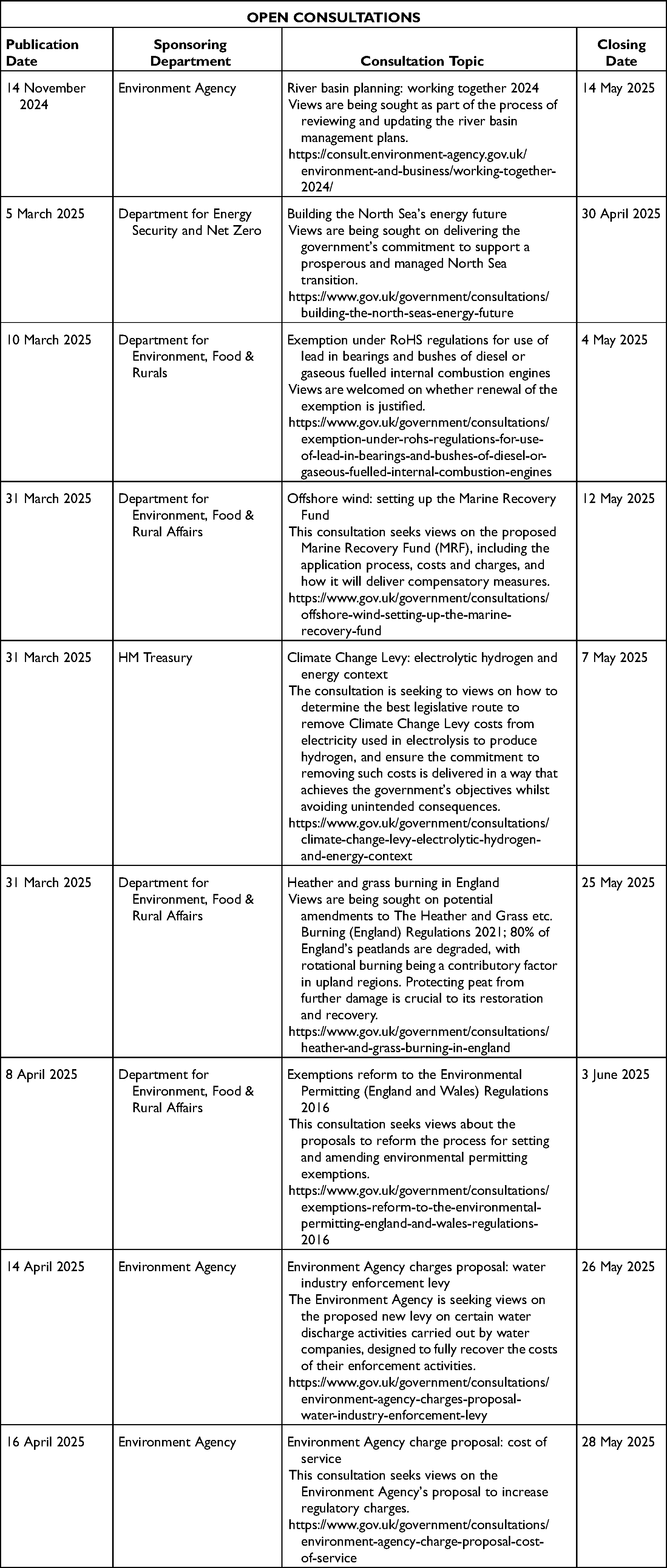
Consultations

NEWS AND MISCELLANEOUS
A landmark bill that would make the UK’s climate and environment targets legally binding seems doomed after government whips ordered Labour MPs to oppose it following a breakdown in negotiations.
A proposed law compelling the UK to meet new legally binding targets on climate change and protecting nature has failed to clear its first hurdle in the House of Commons.
https://www.bbc.co.uk/news/articles/c8xqv1l4qxno
The European Commission has reaffirmed its long-term commitment to tackling Europe’s climate and environment crisis by investing more than €86 million in new green strategic projects over the next ten years.
The House of Lords Environment and Climate Change Committee, chaired by Baroness Sheehan, has launched an inquiry into efficient nitrogen use.
The new President’s radical moves to roll back Democrat environmental measures go further than those of his first administration in a number of respects. These include mandating the EPA to reconsider a number of emissions measurements and requirements, encouraging logging, sacking staff at the National Oceanic and Atmospheric Administration and the Environmental Protection Agency, withdrawing from the Paris Accords, creating a National Energy Dominance Council to encourage oil and gas production, removing EV sales mandates and various others.
https://time.com/7258269/trump-climate-policies-executive-orders/
Collaboration between the two is crucial for addressing the intertwined planetary crises of climate change, nature and biodiversity loss, and pollution and waste.
A collision between two ships in the North Sea off East Anglia has raised concerns that local wildlife could be adversely affected. The Stena Immaculate was carrying fuel, while the Solong was carrying a number of containers of generic cargo and allegedly some containers of sodium cyanide, though this is denied by the vessel’s owners.
https://www.bbc.co.uk/news/articles/czdngyedm26o
The BBC’s World Service has reported that Columbian energy company Ecopetrol has polluted a large number of sites with oil, including water sources and biodiverse wetlands. The report is based on data leaked by a former employee which appears to show that the company covered up a large number of leaks. Ecopetrol says it complies fully with Colombian law and has industry-leading practices on sustainability.
https://www.bbc.co.uk/news/articles/crewlj11jljo
A reliance on net zero energy left Spain and Portugal vulnerable to the mass blackouts engulfing the region, experts said last night.
https://www.telegraph.co.uk/business/2025/04/28/blackout-risk-made-worse-by-net-zero/