




Abstract

EDITORIAL
As summer rolls through, bringing the uniquely sweltering British heat, it is easy to believe that climate change is something far off and irrelevant. Life continues with sunny days and backyard barbecues and the worrying events around the world that stem from climate change seem very far away. Yet looking at a single news cycle suggests something very different: Tony Blair recently made headlines announcing that net zero policies as they stand are doomed to fail, reservoirs in Iran are at their lowest level in a century due to an extreme heatwave, and scientists have growing reason to believe that climate change is helping COVID thrive.
Some interesting cases came before the courts. The 10:10 Foundation was unsuccessful in their attempt to judicially review the Secretary of State's decision to publish and review the Jet Zero Strategy (JZS) in 2022 and 2023 respectively. The High Court dismissed the application, finding that the consultation informing the JZS was lawful as it was not a consultation on aviation but on how to achieve net zero aviation by 2050 without directly restricting aviation demand. In R (oao Richards) v Environment Agency, permission was given to judicial review alleged regulatory failings of the Environment Agency in respect of pollution from Walleys Quarry. It is alleged the Agency was in breach of operational and procedural obligations in articles 2 and 8 of the European Convention on Human Rights.
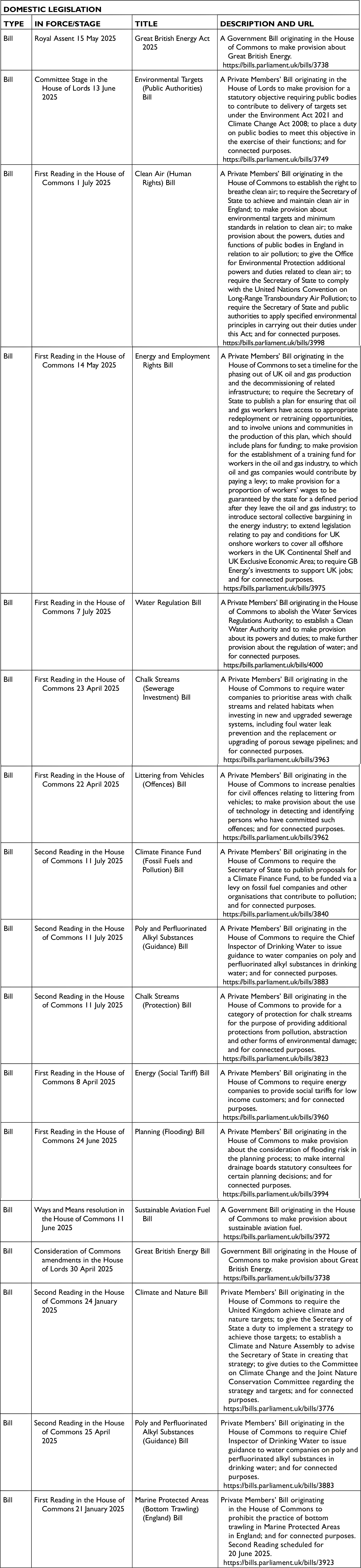
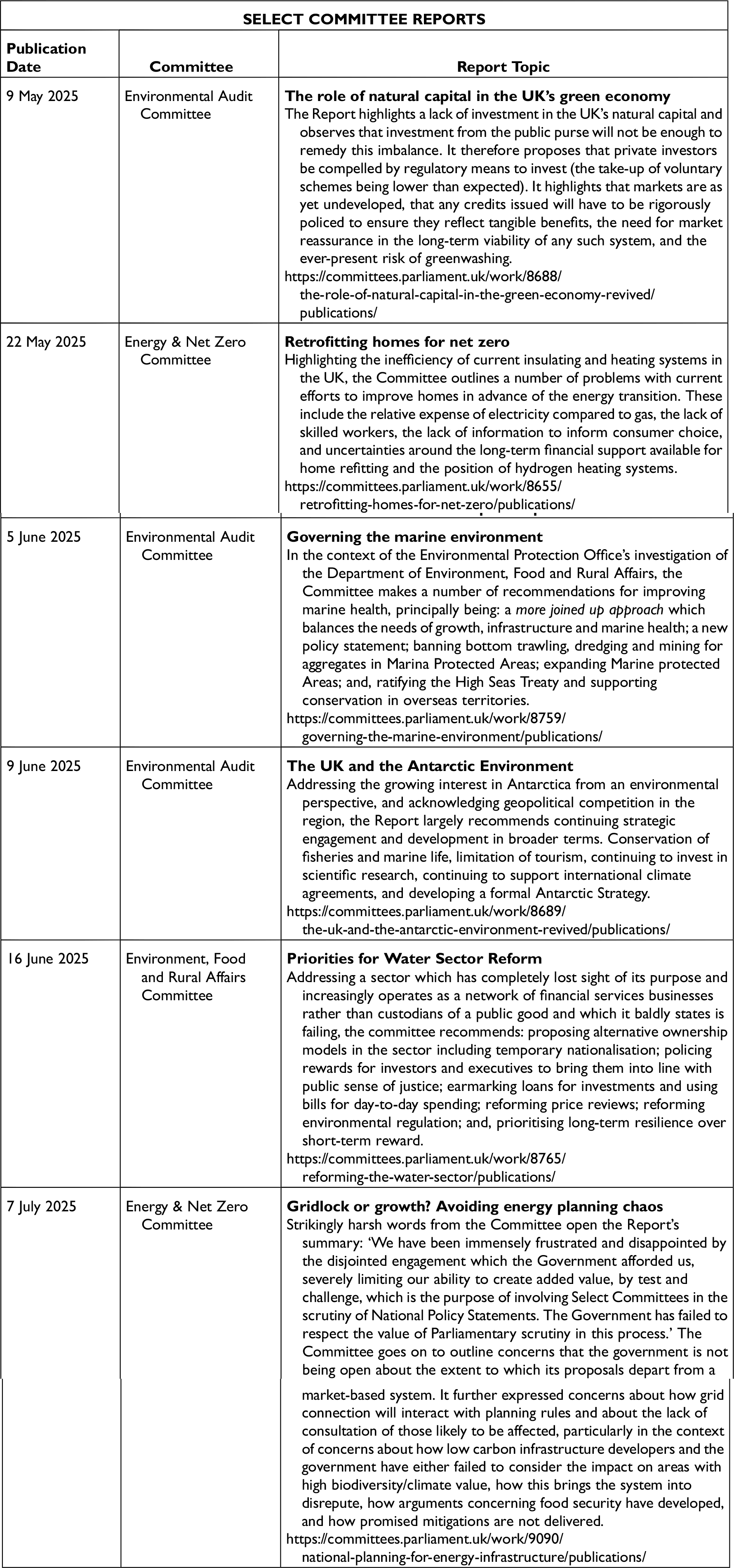
There was also some noteworthy work in Government this quarter. Numerous Bills had their first readings in the House of Commons, including the Clean Air (Human Rights) Bill, Littering from Vehicles (Offences) Bill, and the Sustainable Aviation Bill. On a slightly less positive note, the Energy & Net Zero Committee's report on retrofitting homes for net zero highlighted various concerns with the current efforts to improve homes before the energy transition, whilst its report on energy planning was positively scathing, noting the Government's disjointed engagement.
Read on for more updates.
UPDATE
Anna McClean
TRINITY CHAMBERS
Verity LJ Adams and Thomas Langley
EU LEGISLATION AND TEXTS
Commission Implementing Regulation (EU) 2025/1017 of 26 May 2025 on temporary emergency measures for Spain derogating from certain provisions of Regulation (EU) 2021/2115 of the European Parliament and of the Council and from Commission Delegated Regulation (EU) 2022/126, to resolve specific problems in the fruit and vegetables and wine sectors caused by severe adverse meteorological events
This allows for temporary derogations of Regulations (EU) 2021/2115 and (EU) 2022/126 to address issues in the fruit, vegetable and wine sectors caused by the severe adverse weather events of October and November 2024 in Spain.
https://eur-lex.europa.eu/legal-content/EN/TXT/?uri = CELEX%3A32025R1017&qid = 1753202093257
Commission Implementing Regulation (EU) 2025/1015 of 26 May 2025 on temporary emergency measures for Spain derogating from certain provisions of Regulation (EU) No 1308/2013 of the European Parliament and of the Council, Commission Delegated Regulation (EU) 2017/891 and Commission Implementing Regulation (EU) 2017/892, to resolve specific problems in the fruit and vegetables sector caused by severe adverse meteorological events
This allows for temporary derogations of Regulations (EU) No 1308/2013, Delegated Regulations (EU) 2017/891, and Implementing Regulations (EU) 2017/892 to address issues in the fruit and vegetable sector caused by the adverse weather events of October and November 2024 in Spain.
https://eur-lex.europa.eu/legal-content/EN/TXT/?uri = CELEX%3A32025R1015&qid = 1753202093257
Commission Implementing Regulation (EU) 2025/1176 of 23 May 2025 specifying the pre-qualification and award criteria for auctions for the deployment of energy from renewable sources
This provides that a certain share of auctions to deploy certain renewable energy technologies shall include (i) pre-qualification criteria on responsible business conduct, cybersecurity and data security and ability to deliver the project fully and on time and (ii) pre-qualification or award criteria to assess the auction's sustainability and resilience contribution. It will further specify these criteria in order to ensure a uniform application across the Union.
https://eur-lex.europa.eu/legal-content/EN/TXT/?uri = CELEX%3A32025R1176&qid = 1753202093257
Commission Implementing Regulation (EU) 2025/1178 of 23 May 2025 on laying down rules for the application of Regulation (EU) 2024/1735 of the European Parliament and of the Council as regards the list of net-zero technology final products and their main specific components for the purposes of assessing the contribution to resilience
This set out a list of net-zero technology final products and their main specific components for the purposes of assessing the contribution to resilience in accordance with Article 25, 26 and 28 of Regulation (EU) 2024/1735.
https://eur-lex.europa.eu/legal-content/EN/TXT/?uri = CELEX%3A32025R1178&qid = 1753202093257
Commission Implementing Regulation (EU) 2025/973 of 23 May 2025 amending and correcting Implementing Regulation (EU) 2021/1165 authorising certain products and substances for use in organic production and establishing their lists
This amends and corrects the list of authorised substances for organic production. In particular it: reclassifies certain active substances to low-risk in Annex I; amends entries for plant origin products and adds new substances to Annex II; clarifies feed ingredients, additive, authorisation substances and reclassification of calcium stearate and calcium propionate; merges and clarifies lists in respect of Annex V; and, provides a procedure for granting specific authorisations for the use of products and substances in organic products originating from the outermost regions of the Union.
https://eur-lex.europa.eu/legal-content/EN/TXT/?uri = CELEX%3A32025R0973&qid = 1753202093257
Commission Implementing Regulation (EU) 2025/905 of 12 May 2025 amending Regulation (EC) No 794/2004 as regards an internal review mechanism to follow up on the findings of the Aarhus Convention Compliance Committee in case ACCC/C/2015/128 and other procedural updates
This addresses the findings of the Aarhus Convention Compliance Committee that the Union was in breach of the Convention by failing to provide members of the public access to administrative or judicial procedures to challenge decisions on State aid measures taken by the Commission. An internal review mechanism to apply to State aid decisions should be established to address the findings.
https://eur-lex.europa.eu/legal-content/EN/TXT/?uri = CELEX%3A32025R0905&qid = 1753202093257
Commission Implementing Regulation (EU) 2025/842 of 6 May 2025 correcting certain language versions of Implementing Regulation (EU) 2018/2066 on the monitoring and reporting of greenhouse gas emissions pursuant to Directive 2003/87/EC of the European Parliament and of the Council
This corrects the French and Swedish language versions of Regulation (EU) 2018/2066 to amend errors which affect the substance of the relevant provisions.
https://eur-lex.europa.eu/legal-content/EN/TXT/?uri = CELEX%3A32025R0842&qid = 1753202093257
Commission Delegated Regulation (EU) 2025/1399 of 5 May 2025 amending Annex I to Regulation (EU) 2019/1021 of the European Parliament and of the Council as regards perfluorooctanoic acid (PFOA), its salts and PFOA-related compounds
This amends Annex I in respect of perfluorooctanoic acid (PFOA), its salts and related compounds. More specifically it extends the specific exemption for the use of PFOA, its salts and related compounds in fire-fighting foam for liquid fuel vapour suppression and liquid fuel fire already installed in systems, including both mobile and fixed systems (subject to certain conditions) to 3 December 2025, the maximum extension possible under the Convention.
https://eur-lex.europa.eu/legal-content/EN/TXT/?uri = CELEX%3A32025R1399&qid = 1753202093257
DOMESTIC CASE LAW
Environmental impact assessment
Haberlin's Application for Leave to Apply for Judicial Review, Re [2025] NIKB 45
The applicant sought leave to challenge a decision of the Planning Appeals Commission to grant planning permission for a housing development to the rear of their property. The grounds for the challenge included that the decision failed to consider updated and accurate information and was therefore illegal. The court found that the applicant's case amounted to an impermissible merits-based challenge to the decision and therefore refused the application.
R (on the application of Caffyn) v Shropshire Council [2025] EWHC 1497 (Admin)
This case concerned the approach taken by Shropshire Council to the environmental effects of proposed intensive poultry units at a farm. The court found in favour of the Council on various points, including: (i) the Council had carried out a legally adequate assessment of the effect of spreading raw manure on third party land; (ii) the Council had lawfully imposed a condition to prevent the spreading of raw manure on land, reasonably suitable to address its gap-closing objective. It found in favour of the claimant on other points, including: (i) having failed to address the legal criteria of causation and capability of reasonable assessment, the Council failed to carry out a legally adequate assessment of the effect of the spreading of digestate on third party land; (ii) the Council failed to carry out a lawful appropriate assessment of the effect before granting the permission. The claim succeeded on these points and the court quashed the planning permission.
Planning
R (on the application of Hilltop Experiences Ltd) v Norfolk County Council [2025] EWHC 1447 (Admin)
The claimant, who ran an outdoor education facility 30 m from the site, applied for judicial review of Norfolk County Council's decision to grant planning permission for a household waste recycling centre. The outdoor education facility was for children aged 4 to 12 years old and a proportion of the children using the facility had special educational needs and other vulnerabilities. The court rejected the claimant's argument that the Council had failed to consider alternatives and further held that there was no procedural duty on the Director of Highways, Transport and Waste to bring other sites to the attention of the court. The court held that the Council's decision that the development was not major development was a reasonable one, based on relevant considerations. In relation to the claimant's argument that the decision breached obligations under s. 149 Equality Act 2010, the court held that the principal legal issue was the degree to which the Council had a duty of inquiry in respect to the impact of the development on children with protected characteristics. It held that the Council need be concerned with the obvious impacts and was not under a duty to investigate every detail. It was entitled to rely on the information given by the Claimant as to its own site users and this was not a situation where there was a broad and undefined group where a decision maker might have to take a more proactive approach to investigate potential impacts. The application was dismissed.
R (on the application of Boswell) v Secretary of State for Energy Security and Net Zero [2025] EWCA Civ 669
The appellant appealed against the refusal of his claim for judicial review of the decision to grant development consent for a new gas-fired electricity-generating station that included the utilisation of carbon capture and storage. The secretary of state found that the greenhouse gas emissions from the development were a significant adverse effect that carried significant negative weight in the planning balance, but concluded that the development's benefits outweighed the harm. The appellant argued that the secretary of state's conclusion was inconsistent with guidance from the Institute of Environmental Management and Assessment. The court dismissed this argument and held that the secretary of state was not obliged to apply the guidance and could adopt another approach. The secretary of state was entitled to conclude that the development's benefits outweighed the significant adverse effect of its greenhouse gas emissions and to draw on the national policy statement EN-1 in doing so.
Climate change
Hassard's Application, Re [2025] NIKB 42
The applicants applied under art. 67BA Road (Northern Ireland) Order 1993 for an order quashing the decision of the Department for Infrastructure for Northern Ireland to proceed with the first phase of the proposed A5 dual carriageway. The court granted the application. It held that the requirements under s. 52 Climate Change Act (Northern Ireland) 2022 did not prevent a major infrastructure project which was a source of significant greenhouse gas emissions from being devised, promoted, constructed and put into operation by the Northern Ireland government department. However, it did rule out the construction and operation of such a project without robust planning, synchronisation and co-operation between all Northern Ireland government departments to ensure that it fitted into the plans, strategies and policies that mapped out a realistic and achievable pathway to net zero by 2050, meeting intervals targets and carbon budgets on the way.
R (on the application of Possible (The 10:10 Foundation)) v Secretary of State for Transport [2025] EWHC 1101 (Admin)
The claimants sought to challenge, by judicial review, the secretary of state's decision in July 2022 to publish the JZS and the 2023 review decision. The central issue was the lawfulness of the consultation undertaken to inform the JZS. The court dismissed the application. It found that the JZS consultation was not a consultation on aviation decarbonisation generally but a consultation on how to achieve net zero aviation by 2050 consistently with the objective of not directly restricting aviation demand. Whilst it might have been preferable to include a few lines of explanation of why demand management had been ruled out contrary to the advice of the Climate Change Committee, this was not a sufficient basis for finding the entire consultation unlawful. In choosing to consult on a strategy to achieve a specified objective, fairness did not require the defendant to also consult upon a different strategy to achieve a different objective. It found that the defendant had given appropriate consideration to non-CO2 emissions and that the effectiveness of the DDM in reducing such emissions was not an obviously material consideration that the defendant had to take into account. There is no general requirement to reconsult on changes to policies that have already been consulted on. The court also confirmed that there is no general common law duty on public bodies to give reasons for administrative decisions and that requiring the secretary of state to provide and publish reasons for all internal decision taken during the formulation of a policy or consultation would impose an unacceptable burden on minister and officials and make the everyday business of government unworkable.
Komatsu UK Ltd v Environment Agency [2025] UKFTT 639 (GRC)
The appellant company is a manufacturer of ground excavators for supply to the European construction industry. It appealed against the Environment Agency's decision to vary a climate change agreement between the Komatsu and the EA. The basis for the challenge was that the amended target was unfair because it was based in an unusually busy period. The tribunal held that it did not have the discretion to reduce the targets as to do so would require it to act beyond the powers that were available to the EA.
Nuisance
Alame v Shell Plc (formerly Royal Dutch Shell Plc) [2025] EWHC 1539 (KB)
The court determined preliminary issues in relation to claims against Shell plc and its operating subsidiary in Nigeria by the Bille and Ogale communities and individuals within those communities seeking damages and other remedies arising from extensive oil pollution in the Niger Delta. There were a number of issues determined, including: (i) the limitation period for trespass claims starts to run when the oil enters the claimant's land. For all other actions it is when the oil causes damage to the particular claimant; (ii) the principle of continuing torts set out in Jalla v Shell International Trading and Shipping Co Ltd [2024] AC 595 should be applied; (iii) subject to the relevant neglect being established, a claim may be brought against a licence-holder under s. 11 Oil Pipelines Act 1990 in relation to pipelines spills caused by third party interference; (iv) the Oil and Pipelines Act 1990 does not oust claims in common law for oil pipeline spills against persons other than the licence-holder; (v) a common law claim for damages caused by oil spills from non-pipeline assets may be brought; (vi) clean-up and remediation do not provide a defence to a claim in tort, but may be relevant in assessing loss; (vii) it is not possible to bring a tort claim in relation to damage caused by oil removed by third party interference.
Waltham Forest LBC v Sadiq [2025] 5 WLUK 5
Waltham Forest LBC applied for and was granted an injunction under s. 81(5) Environmental Protection Act 1990 requiring the freeholder of a block of flats to abate a nuisance caused by a build-up of waste around the flats’ communal bin area. The court was satisfied that the nuisance would continue if an injunction was not granted.
Enfield LBC v Beckford [2025] EWHC 1218 (Admin)
Enfield LBC appealed against a district judge's decision to quash a noise abatement notice issued to the respondent following complaints from the respondent's neighbours. The district judge had held that although the notice had been justified, it did not specify the steps needed to abate the nuisance and was therefore invalid. The court allowed the appeal. It held that s. 80(1)(a) Environmental Protection Act 1990 did not require steps to specified and that the judge had strayed into an unnecessary level of technicality. It further held that although the words ‘not likely to cause a nuisance’ in the notice might have been confusing, the court could remove these words for the sake of clarity.
Cooper v Ludgate House Ltd [2025] EWHC 1724 (Ch)
The claimants, owners of two leasehold flats, sought an injunction requiring the defendant to demolish substantial parts of a new office building. The claimants alleged that the new office building interfered with their right to light. The court declined to issue an injunction for a number of reasons, including the problematic enforcement, futility and disproportionate harm to the defendant's legitimate interest of an injunction. Damages were awarded in lieu of an injunction.
Environmental information
Thomson v Information Commissioner [2025] UKFTT 721 (GRC)
The appellant appealed against the Information Commissioner's decision that Thorne Moorends Town Council was entitled to rely on reg. 12(4)(b) Environmental Information Regulations 2004 (manifestly unreasonable) to refuse the appellant's request for Appendix 1 to the Thorne and Moorends Neighbourhood Plan Basic Conditions Statement. The tribunal found that the value and serious purpose identified were sufficient to defeat a claim that the request was manifestly unreasonable, even against the background and likely effect of the appellant's multiple other requests relating to the Neighbourhood Plan, which it accepted may tend to indicate that the request itself is a burden and may cause harassment or distress.
Smith v Information Commissioner [2025] UKFTT 711 (GRC)
The appellant appealed against the Information Commissioner's decision that St Helens Metropolitan Borough Council was entitled to rely on reg. 12(4)(b) Environmental Information Regulations 2004 (manifestly unreasonable) to refuse the appellant's request for information relating to the supply of electrical infrastructure to a proposed village. The tribunal held that reg. 12(4)(b) was not engaged. The nature and extent of the proposed development meant that there was a wider public interest in the information. The Information Commissioner had been wrong to conclude that there was harassment or distress to the Council's staff as part of his assessment that the request had been manifestly unreasonable.
Farnsworth v Information Commissioner [2025] UKFTT 670 (GRC)
The appellant appealed against the Information Commissioner's decision that Erewash Borough Council was entitled to rely on reg. 12(4)(b) Environmental Information Regulations 2004 (manifestly unreasonable) to refuse the applicant's subject access request for information about a planning application she had made. The information that the applicant wanted to see was a report prepared by consultants for the Council. The tribunal found that the report was not incomplete and the exception therefore did not apply. It further held that even if the exception did apply, there was no public interest in withholding the report from the public. The appeal was therefore allowed.
Bill v Information Commissioner [2025] UKFTT 630 (GRC)
The appellant appealed against the Information Commissioner's decision that the Liverpool University Hospitals NHS Foundation Trust was entitled to rely on reg. 12(5)(b) Environmental Information Regulations 2004 (adverse effect on the course of justice) to refuse the applicant's request for information relating to structure and engineering disputes relating to the structural defects in the Royal Liverpool University Hospital Building that required remediation. The tribunal held that reg. 12(5)(b) was engaged and that the public interest in maintaining the exception outweighed the public interest in disclosure. The appeal was therefore dismissed.
Newman v Information Commissioner [2025] UKFTT 603 (GRC)
The appellant appealed against the Information Commissioner's decision that National Highways was entitled to refuse the applicant's request for documents prepared for the Department for Transport concerning the M4 to Dorset Connectivity study. The tribunal held that the technical and source data upon which the documents requested were based fell outside the scope of the request and that National Highways had disclosed all the information relevant to the request.
NNB Generation Co (HPC) Ltd v Information Commissioner [2025] UKFTT 634 (GRC)
The appellant, a company developing a nuclear power station, appealed against the Information Commissioner's decision that it was a public authority and under an obligation to respond to a not-for-profit association's request for information under the Environmental Information Regulations 2004. The tribunal held that the entrustment test does not require the body concerned to be obliged to perform a function and that this test had been met. It rejected the applicant's argument that a power could not be a ‘special power’ because it mitigated a disadvantage rather than conferring an advantage and held that the special powers test was also met. However, when considering whether HPC was able to operate in a ‘genuinely autonomous manner’, it found that HPC was not controlled by the Office for Nuclear Regulation and was therefore not a public authority for the purpose of reg. 2(2)(d) Environmental Information Regulations 2004.
Hordle v Information Commissioner [2025] UKFTT 547 (GRC)
The appellant appealed against the Information Commissioner's decision that Ellingham, Harbridge and Ibsley Parish Council was entitled to rely on reg. 12(5)(f) Environmental Information Regulations 2004 (interests of the information provider) to refuse to disclose communications between Somerley and the Parish Council. The tribunal found that not all of the four conditions in reg. 12(5)(f) had been met and therefore reg. 12(5)(f) was not engaged.
Hanson v Information Commissioner [2025] UKFTT 482 (GRC)
The appellant appealed against the Information Commissioner's decision that Lewisham Borough Council was entitled to refuse to provide information relating to building and repair works. The tribunal held that the information requested was not environmental information and the request should therefore be dealt with under the Freedom of Information Act 2000 rather than the Environmental Information Regulations 2004. It found that the Information Commissioner had been wrong to be satisfied that, on the balance of probabilities, the Council did not hold some of the information requested.
Dews v Information Commissioner [2025] UKFTT 452 (GRC)
The appellant appealed against the Information Commissioner's decision that the Council of the City of Wakefield was entitled to rely on reg. 12(5)(b) and reg. 12(3) Environmental Information Regulations 2004 (course of justice and personal data) to refuse to provide information requested in relation to a noise abatement notice. The tribunal allowed the appeal. It held that information in an abatement notice in respect of a statutory nuisance was of considerable and legitimate interest to neighbours and of legitimate public interest for the purpose of assurance that the relevant authority had taken appropriate action as well as being of interest to anyone selling or buying property in the area. Whilst it accepted that people dealing with local authorities would have a legitimate expectation that their personal data was held and used by that authority in accordance with legal requirements relating to privacy, account must be taken of the fact that the notices could lead to a public prosecution in which case the expectation of privacy is significantly weakened. The tribunal accepted that the risk of harm of a negative effect was an important balancing factor but it had not seen evidence of any facts or specificity supporting the general assertion of risk of harm.
Whiteside v Information Commissioner [2025] UKFTT 442 (GRC)
The appellant appealed against the Information Commissioner's decision that the London Borough of Croydon was entitled to rely on reg. 13(1) Environmental Information Regulations 2004 (personal data) to refuse to provide information relating to a building control certificate relating to residential property. The tribunal dismissed the appeal. It found that the information requested was personal data. Whilst it accepted that the appellant was pursuing a legitimate interest, it was not satisfied that that interest pursued would be furthered by the information concerned.
Contamination
R (on the application of Clear the Air in Havering) v Havering LBC [2025] EWHC 1492 (Admin)
The claimants made an application for judicial review of the London Borough of Havering's decision not to identify land at Arnold's Field as contaminated within the meaning of Part 2A of the Environmental Protection Act 1990. The court held that: (i) determining the current use of the land is concerned with the impact of contamination on that use and whether the use is permanent or temporary may be relevant because it goes to the level of exposure for the human receptor. The EPA is not concerned with whether the use is lawful or not; (ii) the Council did not have the necessary material in respect of the impact from smoke to have properly taken that into account in reaching the decision as a critical part of the data had only been collected after fires had already taken place. It therefore held that the Council should reconsider the decision in light of the proper legal analysis and all the up to date data that had been collected.
Waste
R v Doherty [2025] NICC 13
The court sentenced the defendants to 2 and 3 years’ imprisonment under the Criminal Justice (Northern Ireland) Order 2008 after they pleaded guilty to the illegal depositing of controlled waste offences. The court found that the offences easily met the definition of category 1 harm within English sentencing guidelines: both defendants had acted deliberately, were motivated entirely by financial gain, and the scale of what they had created remained a significant issue.
Liddle v Hartlepool Borough Council [2025] UKFTT 602 (GRC)
The appellant appealed against Hartlepool Borough Council's decision to impose a financial penalty under s. 46C Environmental Protection Act 1990 for not placing refuse bins within the curtilage of their property. The appellant raised a number of points that suggested that the penalty was unfair in light of an arbitrary policy of imposing penalties against some people but not others. The Council made no response to rebut, explain or assist with this and the tribunal found that the appeal should succeed. It therefore quashed the penalty notice and removed the penalty.
R (on the application of Richards) v Environment Agency [2025] EWHC 1269 (Admin)
The claimant sought permission to apply for judicial review of regulatory failings of the Environment Agency in respect of pollution (hydrogen sulphide) from Walleys Quarry, Staffordshire. They claimed that the EA was in breach of operational and procedural obligations in art. 2 and art. 8 European Convention on Human Rights. The court granted permission on a number of grounds, including relating to the decision by the EA to exercise its powers under reg. 57(1) of the Environmental Permitting Regulations without consideration of the wider obligations under art. 2 and art. 8 ECHR.
Wallbridge v Hartlepool Borough Council [2025] UKFTT 622 (GRC)
The appellant appealed against the penalty imposed by Hartlepool Borough Council for failure to comply with a notice served under s. 46 Environmental Protection Act 1990 for leaving bins out on a non-collection day. S. 46A EPA provides where failure to comply with a s. 46 notice has caused or is likely to cause a nuisance or has been or is likely to be detrimental to local amenity they may be required to pay a fixed penalty. The appellant explained that they and their neighbours had used the communal alleyway to store their bins since they had moved into the property in 2016 and this had not been an issue until recently. The tribunal held that s. 46A EPA had not been satisfied and allowed the appeal. The tribunal was not able to make a finding that allowed the appellant to keep their wheelie bin in the alleyway (as requested by the appellant) as it only has jurisdiction to consider an appeal against the penalty.
Water
Manchester Ship Canal Co Ltd v Secretary of State for Environment, Food and Rural Affairs [2025] EWCA Civ 676
The appellant, owner of the Manchester Ship Canal, appealed against a judge's dismissal of its challenge to the secretary of state's decision to confirm a compulsory purchase order under the Water Industry Act 1991 to permit the discharge of water and treated effluent from a new pipe to drain into a brook that drained into the canal. The appellant's issue with the CPO was that it should be subject to a discharge proviso to preserve their common law right to bring a nuisance action if necessary. The secretary of state confirmed the CPO without the proviso. The court dismissed the appeal. It held that the judge had not misunderstood the appellant's submissions regarding the need for an additional proviso to preserve its common law rights and that although Manchester Ship Canal Co Ltd v United Utilities Water Ltd [2024] UKSC 22 had clarified the position regarding common law rights after her judgement, that did not affect the judge's analysis of the appellant's rights under protocol 1 of art. 1 European Convention on Human Rights.
National Parks
Darwell v Dartmoor National Park Authority [2025] UKSC 20
The appellants appealed against a decision that s. 10(1) Dartmoor Commons Act 1985 granted the public a right to camp on the Dartmoor Common. The court dismissed the appeal. In reaching this conclusion, the court looked at the language used in s. 10(1), the context of the National Parks and Access to the Countryside Act 1949 under which Dartmoor Common was established, the context of the Dartmoor Commons Act 1985, and the statutory history in relation to the regulation of public access to common land under s. 193 Law of Property Act 1925.
Aarhus Convention
HM Treasury v Global Feedback Ltd [2025] EWCA Civ 624
HM Treasury and the Secretary of State for Business and Trade appealed against a decision that a claim brought by the respondent environmental protection charity was a claim under the Aarhus Convention 2001. The appellant had brought a judicial review claim against the secretary of state's decision to make the Customs Tarriff (Preferential Trade Arrangements and Tariff Quotas) (Australia) (Amendment) Regulations 2023 under the Taxation (Cross-border Trade) Act 2018 Pt 1, to give effect to trade preferences on Australian imports under a free trade agreement between the UK and Australia. The respondent argued that this would increase greenhouse emissions from the production of cattle meat. The court held that the claim did not fall within art. 9(3) Aarhus Convention so as to give rise to costs protection. It held that art. 9(3) did not extend to any decision in breach of any national law that had an impact on the environment. It applied only to a contravention of a legal provision that concerned the environment.
EU CASE LAW
Judgment of the Court (Eighth Chamber) of 8 May 2025.
The Court declared that by failing to take the measures necessary to comply with the judgment of 16 July 2015 (Commission v Slovenia, C-140/14) regarding plot number 115/1 in the municipal land register of Teharje (Bukovžlak), the Republic of Slovenia failed to fulfil its obligations under Article 260(1) TFEU. Further, the Republic of Slovenia was ordered to pay a lump sum of €1.2 million to the European Commission, its own costs and those incurred by the European Commission.
https://eur-lex.europa.eu/legal-content/EN/TXT/?uri = CELEX%3A62023CA0318&qid = 1753208020756
Judgment of the Court (Second Chamber) of 15 May 2025.
The Court found no factor was disclosed such as to affect the validity of the provisions of Article 40 and 70 of the Commission Regulation (EU) No 389/2013 of 2 May 2013 regarding the final and irrevocable nature of the transactions and the time frames for their reversal.
Judgment of the Court (First Chamber) of 8 May 2025.
The Court found Article 9a of Directive 2011/92/EU of the European Parliament and of the Council of 13 December 2011 on the assessment of the effects of certain public and private projects on the environment, as amended by Directive 2014/52/EU of the European Parliament and of the Council of 16 April 2014, must be interpreted to mean that where the authority competent to determine whether a project referred to in Article 4(2) of Directive 2011/92 must be made subject to an environmental impact assessment, in accordance with Article 5 to 10 of the same Directive, is also the developer of the project an appropriate separation between conflicting functions when performing that duty must by implemented.
https://eur-lex.europa.eu/legal-content/EN/TXT/?uri = CELEX%3A62024CA0236&qid = 1753208020756
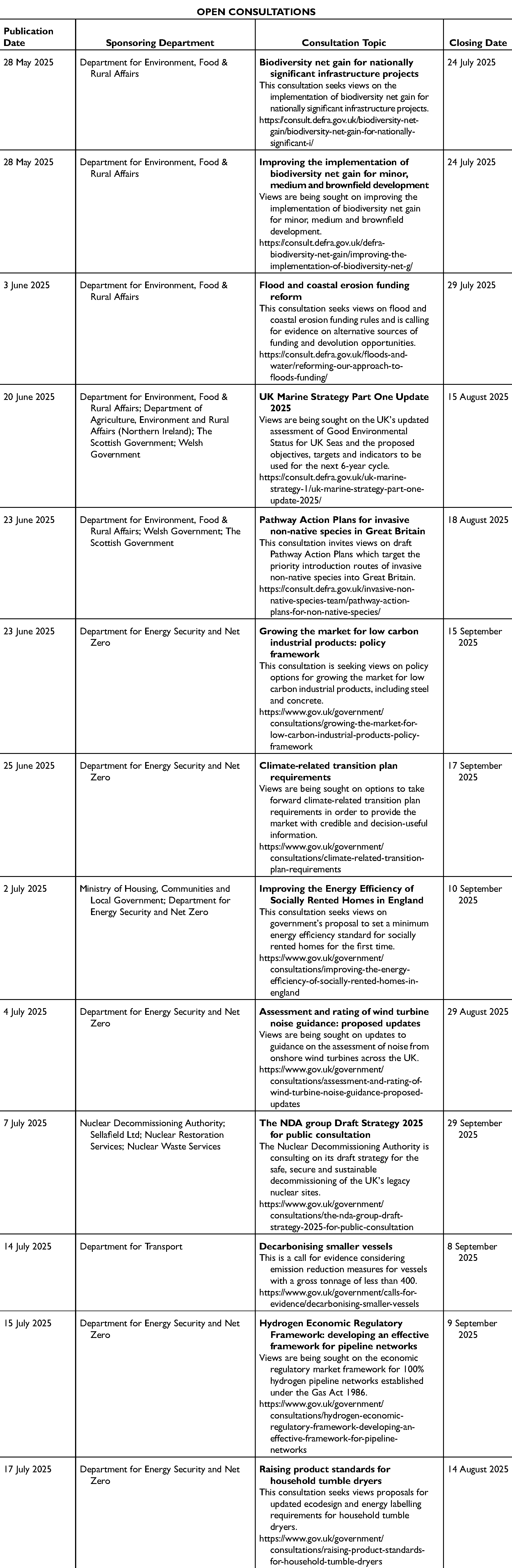
CONSULTATIONS

NEWS AND MISCELLANEOUS
‘Labour MPs ordered to sink landmark climate and environment bill’, The Guardian, 23 January 2025
A landmark bill that would make the UK's climate and environment targets legally binding seems doomed after government whips ordered Labour MPs to oppose it following a breakdown in negotiations.
‘Reform-led Durham county council scraps climate emergency declaration’, The Guardian, 17 July 2025
In a move which may presage the increasing movement of Net Zero measures into politically disputed territory, Durham County Council (recently won by Reform) scrapped its emergency declaration. The party has also warned energy bosses that it will not support Net Zero subsidies.
‘Recent droughts are “slow-moving global catastrophe” – UN report’, BBC News, 2 July 2025
The BBC reported on a recent UN Report, which observes the increasing levels of drought in the Mediterranean, Africa, South East Asia and Latin America. It documents a range of effects, from food insecurity in the Horn of Africa to insufficient water levels in the Panama Canal imperilling the viability of it as a transit.
‘Sharks and oysters set to thrive in warmer UK waters’, BBC News, 18 June 2025
UK waters were 4 degrees warmer than usual in May, prompting speculation that certain species (including previously-declining native oysters) will thrive in newly temperate seas – though static creatures such as clams may suffer.
‘Spain's grid operator blames power plants for blackout, dispute miscalculation’, Reuters, 18 June 2025
Spain's grid operator Redeia has blamed power plant operators for a mass blackout on April 28th. It rejected the view that the fault was solely that of an admitted surge from solar power sources, arguing that conventional power plant operators should have done more to manage the surge.
‘ScottishPower secures £1.35bn to upgrade UK grid for clean energy transmission’, edie, 8 May 2025
The UK's National Wealth Fund has collaborated with a number of private investors to raise £1.35 billion by way of investment in critical transmission projects in Scotland and interconnectors with England, including subsea cables, new substations and reconfigured overhead lines. £600 million of the investment comes from the Fund.
https://www.edie.net/scottishpower-secures-1-35bn-to-upgrade-uk-grid-for-clean-energy-transmission/
‘Environment secretary defends green policies – after Sir Tony Blair says net zero is “doomed to fail”’, Sky News, 30 April 2025
The government has defended its policy direction after former Prime Minister Tony Blair suggested that full fossil fuel transition would be in an impossibility, in a report published by his Institute. Energy Secretary Steve Reed in response pointed to the benefits of relying on domestically-produced energy.
‘Heatwave causes water shortages in Iran as temps top 50C’, Al-Jazeera, 20 July 2025
Reservoirs of the dams supplying water to Tehran are currently at their lowest level in a century. Water scarcity is a major issue in Iran, particularly in arid provinces in the country's south, with shortages blamed on mismanagement and overexploitation of underground resources, as well as the growing impact of climate change.
https://www.aljazeera.com/news/2025/7/20/heatwave-causes-water-shortages-in-iran-as-temps-top-50c
‘Why scientists fear climate change could help Covid to thrive’, Independent, 21 July 2025
As new variants continue to emerge, there is growing evidence that global warming could influence transmission of the virus. While globalisation and international transport are well-known drivers of the rapid spread of the virus, emerging research suggests climate change can influence Covid-19 transmission, mutation, and human susceptibility to infection.
https://www.independent.co.uk/climate-change/climate-change-covid-thrive-variants-b2788526.html