




Abstract

EDITORIAL
The end of what has been a rather tumultuous year, both in terms of politics and weather, was unsurprisingly just as chaotic. After record-breaking heat in the UK this summer, the United States suffered a bomb cyclone, leaving thousands without power in freezing temperatures. Similarly, at the beginning of December the UK Prime Minister reversed his previous decision to continue the ban on onshore windfarms, causing many to fear the effect this could have on our countryside, while long queues for electric car-charging stations have shown that change does come with some teething problems. However, there have been positive steps this year. Increased awareness of climate change issues, even if that does not yet translate into meaningful change per se, has seen a general public willingness to embrace positive change.
There is clearly still a long way to go. As the Joint Committee on the National Security Strategy noted with some considerable concern the last year particularly has shown that there is significant national vulnerability due to weather changes that isn’t being addressed. The increasing volatility of weather patterns leaves thousands at risk, as does rapidly rising energy costs, yet there has been little done that has effectively combatted these issues or prepared for further disruptions. The Committee of Public Accounts was similarly critical of the lack of effective change in respect of waste crime; to date HMRC has only brought a single (unsuccessful) prosecution under the landfill tax at significant expense. There are positive signs however: the Energy Bill attempts to tackle some of the issues surrounding energy production and security and the Decarbonisation and Economic Strategy Bill seeks to place duties on the Secretary of State to decarbonise the UK economy. Whilst these may be small steps they are signs of greater engagement and, hopefully, a positive way forward. Let us hope that we can continue positive momentum in the New Year.
Read on for more updates.
Anna McClean
Verity LJ Adams , Michael Haywood and Sarah Ismail
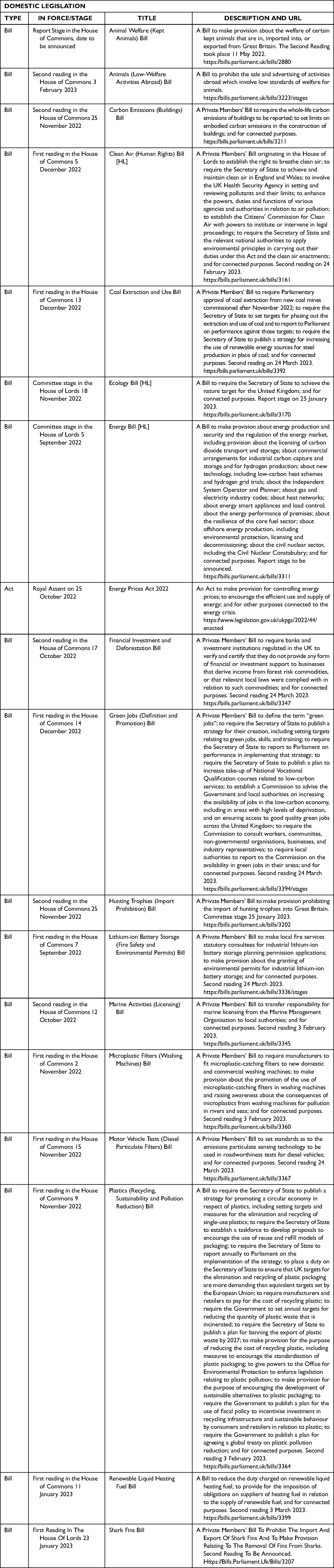
EU LEGISLATION AND TEXTS
Regulation (EU) 2022/2343 of the European Parliament and of the Council of 23 November 2022 laying down management, conservation and control measures applicable in the Indian Ocean Tuna Commission (IOTC) Area of Competence, amending Council Regulations (EC) No 1936/2001, (EC) No 1984/2003 and (EC) No 520/2007
This Regulation implements into Union law management, conservation and control measures established by the IOTC that are binding on the Union.
https://eur-lex.europa.eu/legal-content/EN/TXT/?uri = CELEX%3A32022R2343&qid = 1674232379757
Regulation (EU) 2022/2056 of the European Parliament and of the Council of 19 October 2022 laying down conservation and management measures applicable in the Western and Central Pacific Fisheries Convention Area and amending Council Regulation (EC) No 520/2007
This Regulation lays down management and conservation measures relating to fishing in the area covered by the Convention on the Conservation and Management of Highly Migratory Fish Stocks in the Western and Central Pacific Ocean, to which the Union has acceded pursuant to Decision 2005/75/EC, and with respect to the species of fish under the purview of that Convention.
https://eur-lex.europa.eu/legal-content/EN/TXT/?uri = CELEX%3A32022R2056&qid = 1674232379757
Commission Implementing Decision (EU) 2022/1953 of 7 October 2022 on greenhouse gas emissions covered by Decision No 406/2009/EC of the European Parliament and of the Council for the year 2020 for each Member State
Decision No 406/2009/EC of the European Parliament and of the Council lays down annual emission allocations for each Member State for each year of the period 2013–2020 and a mechanism to annually assess compliance with those limits. Member States’ annual emission allocations expressed in tonnes of CO2 equivalent are contained in Commission Decision 2013/162/EU.
https://eur-lex.europa.eu/legal-content/EN/TXT/?uri = CELEX%3A32022D1953&qid = 1674423610239
Commission Implementing Decision (EU) 2022/2336 of 28 November 2022 on the publication of a list indicating certain CO2 emissions values per manufacturer as well as average specific CO2 emissions of all new heavy-duty vehicles registered in the Union pursuant to Regulation (EU) 2019/1242 of the European Parliament and of the Council for the reporting period of the year 2020 (notified under document C(2022) 8428)
Decision regarding the publication of a list indicating certain CO2 emissions values per manufacturer as well as average specific CO2 emissions of all new heavy-duty vehicles registered in the Union pursuant to Regulation (EU) 2019/1242 of the European Parliament and of the Council for the reporting period of the year 2020
https://eur-lex.europa.eu/legal-content/EN/TXT/?uri = CELEX%3A32022D2336&qid = 1674423610239
Commission Implementing Decision (EU) 2022/2358 of 1 December 2022 on the French measure establishing a limitation on the exercise of traffic rights due to serious environmental problems, pursuant to Article 20 of Regulation (EC) No 1008/2008 of the European Parliament and of the Council (notified under document C(2022) 8694)
The Commission considers that the Measure (establishing a limitation on the exercise of traffic rights) is, pending the adoption and implementation of those more effective measures to lower CO2 emissions in air transport mentioned in Recital 38, not more restrictive than necessary to relieve the problems.
https://eur-lex.europa.eu/legal-content/EN/TXT/?uri = CELEX%3A32022D2358&qid = 1674423610239
Commission Implementing Decision (EU) 2022/2427 of 6 December 2022 establishing the best available techniques (BAT) conclusions, under Directive 2010/75/EU of the European Parliament and of the Council on industrial emissions, for common waste gas management and treatment systems in the chemical sector (notified under document C(2022) 8788).
The BATs conclusions for the common waste gas management and treatment systems in the chemical sector, as set out in the Annex, were adopted.
https://eur-lex.europa.eu/legal-content/EN/TXT/?uri = CELEX%3A32022D2427&qid = 1674423610239
Commission Implementing Decision (EU) 2022/2461 of 14 December 2022 recognising the ‘KZR INiG’ scheme for demonstrating compliance with the requirements set out in Directive (EU) 2018/2001 of the European Parliament and of the Council as regards biofuels, bioliquids, biomass fuels, renewable liquid and gaseous fuels of non-biological origin and recycled carbon fuels and repealing Commission Implementing Decision (EU) 2022/603
The ‘KZR INiG’ voluntary scheme (the scheme), submitted for recognition to the Commission on 23 September 2022, demonstrates the following elements for the fuels audited under the scheme:
Compliance of the consignments of biofuels, bioliquids and biomass fuels with the sustainability criteria laid down in Article 29(2) to (7) and (10) of Directive (EU) 2018/2001; compliance of economic operators with the obligation to enter accurate information into the Union or national databases on renewable fuels and recycled carbon fuels used in transport in accordance with Article 28(4) of Directive (EU) 2018/2001.
https://eur-lex.europa.eu/legal-content/EN/TXT/?uri = CELEX%3A32022D2461&qid = 1674423610239
Commission Implementing Decision (EU) 2022/2508 of 9 December 2022 establishing the BATs conclusions, under Directive 2010/75/EU of the European Parliament and of the Council on industrial emissions, for the textiles industry (notified under document C(2022) 8984)
The BATs conclusions for the textiles industry, as set out in the Annex, were adopted.
https://eur-lex.europa.eu/legal-content/EN/TXT/?uri = CELEX%3A32022D2508&qid = 1674423610239
DOMESTIC CASE LAW
Climate change
R (oao Friends of the Earth Ltd) v Secretary of State for International Trade/UK Export Finance (UKEF) [2023] EWCA Civ 14
This appeal concerned whether the decision to approve UKEF's $1.15 billion investment in a liquified natural gas project in Mozambique was unlawful. The applicants argued that the respondent had erred in law in concluding that the decision was not a breach of the UK Government's commitments under the Paris Agreement and that the decision was irrational as there had not been a quantification of the project's Scope 3 emissions. The court dismissed the appeal. It held that the Paris Agreement is an unincorporated international treaty that does not give rise to domestic legal obligations and was only one of a range of factors to which the respondents were required to have regard. It held that it was tenable for UKEF to reach the view that funding was aligned with the UK's obligations under the Paris Agreement and therefore that the court could not hold that it had made an error in law. The court also held that failure to make an estimate of the Scope 3 emissions did not render the decision irrational.
Friends of the Earth Ltd, R (On the Application Of) v Secretary of State for International Trade/UKEF & Anor (Rev1) [2023] EWCA Civ 14 (13 January 2023) (bailii.org)
Environment Agency v Amphenol Invotec Ltd [2022] UKUT 318 (AAC) and Environment Agency v Taylor Engineering and Plastics Ltd [2022] UKUT 317 (AAC)
These cases concerned the question of whether the first-tier tribunal had the power to reduce as disproportionate the amount of financial penalty imposed by the Environment Agency for breach of reporting requirements under a climate change agreement. The tribunal held that reg. 23 Climate Change Agreements (Administration) Regulations 2012, which gave the first-tier tribunal the power to hear appeals to reduce the amount of financial penalty imposed, only permitted such a reduction if the first-tier tribunal found that the Environment Agency had miscalculated the penalty. The first-tier tribunal cannot impose a reduced penalty amount that is different from the amount derived from the appropriate calculation under in reg.15.
Environment Agency v Amphenol Invotec Ltd (Environment) [2022] UKUT 318 (AAC) (28 November 2022) (bailii.org) and Environment Agency v Taylor Engineering and Plastics Ltd (Environment) [2022] UKUT 317 (AAC) (28 November 2022) (bailii.org)
Water
Fowler v Secretary of State for the Environment [2022] UKFTT 490 (GRC)
The respondent applied to strike out the appellant's application to appeal against the decision to designate part of his land as a Nitrate Vulnerable Zone. The appellant's grounds for bringing the appeal were that his practices and use of the land did not cause or significantly add to pollution. The tribunal granted the application to strike out the appeal. The applicant's grounds did not constitute one of the grounds for appealing against a designation as set out in the Nitrate Pollution Prevention reg.6(2)(b). The appellant had not produced any evidence to support an appeal on any of the grounds in reg.6(2)(b) and the tribunal held that in the absence of any such evidence there was no realistic prospect of the appellant's appeal succeeding.
Fowler v Secretary of State for the Environment [2022] UKFTT 490 (GRC) (30 December 2022) (bailii.org)
Manchester Ship Canal Co Ltd v Secretary of State for Environment, Food and Rural Affairs [2022] EWHC 3282 (Admin)
Manchester Ship Canal Company (MSCC) challenged the Secretary of State's decision to confirm a Compulsory Purchase Order (CPO) made under s.155 Water Industry Act 1991 authorising United Utilities to compulsorily discharge water, soil and effluent into Manchester Ship Canal. The grounds of the challenge were: (a) the Secretary of State has misdirected itself as to the proper legal and procedural context in which to evaluate and determine the inclusion of the protective provisions sought by MSCC, and (b) the Secretary of State had erred in law in determining that the purpose for which the order was made justified the interference with MSCC's rights under Art.1 of the First Protocol of the European Convention on Human Rights. The court dismissed grounds (a) and held that the Inspector had reached a judgment in the public interest, based on lengthy evidence and his main reasons for considering the protective provisions to be unnecessary were that the discharge would be regulated by the Environment Agency and that the water quality evidence was that scheme would have a net beneficial impact on the Canal. The court also dismissed ground (b) and held that whether the CPO strikes a fair balance between the interests of the public and those of MSCC is inherently more suited for decision by the inquiry process that formed part of the Water Industry Act 1991 statutory procedure than by the court.
The MSCC Ltd v Secretary of State for Environment, Food and Rural Affairs & Anor [2022] EWHC 3282 (Admin) (19 December 2022) (bailii.org)
Bland Charlton v Northumbrian Water Ltd [2022] UKUT 313 (LC)
The claimants sought compensation for diminution of the value of their farm. They claimed that this diminution of value was caused by what potential purchasers of the farm may think or fear following construction of an underground sewerage reservoir by the respondent on its neighbouring land. Sch. 12 para. 2(3) Water Industry Act 1991 provides for compensation where there has been ‘damage to, or injurious affection of, any land’. The tribunal held that in this phrase the terms ‘damage’ and ‘injurious affection’ were not synonymous. The term ‘injurious affection’ had the same meaning as in s. 10 Compulsory Purchase Act 1965 and therefore had to arise from action or work done without statutory authority, and ‘damage’ referred to physical damage or physical factors affecting the land, such as noise and smell. Neither term encompassed a diminution in value caused by intangible, non-physical factors.
Charlton & Anor v Northumbrian Water Ltd (COMPENSATION – WATER – injurious affection – damage to land) [2022] UKUT 313 (LC) (25 November 2022) (bailii.org)
Scott v Scottish Water [2022] SAC (Civ) 30
Scottish Water successfully appealed against a decision of the sheriff to award damages to the respondent for breach of its duty of care. The court held that the sheriff had not adequately or informatively dealt with the evidence or explained his findings in fact in a logical or supportable manner and whether or not the appellant had breached any duty of care could not be identified from his judgment. On a review of the evidence, the court did not agree that there was evidence to support the sheriff's finding that the appellant had breached its duty of care.
IAIN SCOTT v SCOTTISH WATER [2022] ScotSAC Civ 30 (20 October 2022) (bailii.org)
Environmental information
Tilson v Information Commissioner [2022] UKFTT 483 (GRC)
The appellant sought to appeal the Information Commissioner's Decision Notice in which it found that the public authority did not hold the requested information for the purposes of reg.12(4)(a) Environmental Information Regulations 2004. It was agreed by all parties that the public authority did not hold the requested information and the appellant's grounds for bringing the appeal were that the public authority ought to have held the requested information. The tribunal struck out the appeal. It held that the tribunal's role in considering an appeal against a Decision Notice which held that information was not held is to decide for itself whether the information is or is not held, not to consider whether the information should have been held or to make enforcement or information orders against a public authority.
Tilson v The Information Commissioner [2022] UKFTT 483 (GRC) (22 December 2022) (bailii.org)
Hall v Information Commissioner [2022] UKFTT 461 (GRC)
The appellant appealed against the Information Commissioner's decision that a county council was not required to disclose a dataset showing conservation areas designated by local planning authorities within its area. The tribunal dismissed the appeal. It held that because the information was already publicly available it was excepted from disclosure under reg. 6(1)(b) Environmental Information Regulations 2004. It also held that as the county council was not responsible for the designation of conservation area boundaries and the activity of supplying a consolidated spatial dataset fell outside its ‘public task’, it was entitled to rely on the exception in reg. 5(1)(a) Re-use of Public Sector Information Regulations 2015.
Hall v The Information Commissioner [2022] UKFTT 461 (GRC) (08 December 2022) (bailii.org)
South Gloucestershire District Council v Information Commissioner [2022] UKFTT 445 (GRC)
South Gloucestershire DC appealed against the Information Commissioner's decision that it had breached reg. 5(1) Environmental Information Regulations 2004 in relation to non-disclosure of information regarding the proposed acquisition of land by the Council to build a station carpark. The tribunal allowed the appeal. It found that disclosure would undermine ongoing negotiations and therefore that the public interest in maintaining the exception to disclosure under reg. 12 significantly outweighed any public interest in disclosure.
South Gloucestershire District Council v The Information Commissioners & Anor (Rev1) [2022] UKFTT 445 (GRC) (21 November 2022) (bailii.org)
Jones v Information Commissioner [2022] UKFTT 424 (GRC)
The appellant appealed against the decision of the Information Commissioner that their request for information from Animal and Plant Health Agency regarding badger culling and bovine tuberculosis was manifestly unreasonable and that the public interest lay in maintaining the exception to disclosure in reg. 12(4)(b) Environmental Information Regulations 2004. The tribunal held that it was possible to compare culled and non-culled land without the information requested from other existing reports even though this may not be as accurate as the data requested. It, therefore, held that the public interest in maintaining the exception did outweigh the public interest in disclosure as the public interest in disclosure could be at least partially met in another way.
Jones v Information Commissioner [2022] UKFTT 424 (GRC) (22 November 2022) (bailii.org).
Planning law
R (oao Sahota) v Herefordshire Council [2022] EWCA Civ 1640
The appellant appealed against the refusal of his claim for judicial review of the respondent's decision to grant planning permission for the erection of a cattle shed and extension to an existing agricultural building. The appellant argued that the judge had erred in admitting the ecology officer's witness statement explaining his advice and that the ecology officer's report had misled the planning committee into believing that an assessment under reg. 63 Conservation of Habitats and Species Regulations 2017 was not required. The court dismissed the appeal. It held that the basis on which the court could interfere with the judge's decision to admit the ecology officer's report was a limited one. The judge had not fallen into error as a matter of principle and his conclusion had been reasonably open to him. The court also held that the question whether a plan or project would adversely affect the integrity of a European-protected site was always a matter of judgement for the competent authority, and the court was neither entitled nor equipped to make this judgement. The competent authority was entitled to give significant weight to the advice of an expert national agency with relevant expertise.
Sahota, R (On the Application Of) v Herefordshire Council [2022] EWCA Civ 1640 (13 December 2022) (bailii.org)
R (oao Substation Action Save East Suffolk Ltd) v Secretary of State for Business, Energy and Industrial Strategy [2022] EWHC 3177 (Admin)
The claimant applied for judicial review of the Secretary of State's decision to make development consent orders for the construction of two offshore wind farms with associated onshore and offshore development. The claimant's grounds included that the Secretary of State had: (a) failed to take account of the claimant's representations as to the need for a minimum generating capacity; (b) irrationally excluded from consideration the cumulative effects of known plans for extension; and (c) failed to consider any alternative locations. The court refused the application. The exact generating capacity was unknown but the Secretary of State had carried out the planning balance on the basis that the development would constitute ‘highly significant additional renewable energy generation capacity’, a conclusion that was reasonably open to him. The court also held that the Secretary of State was entitled to disagree with the Examining Authority's statement that satisfactory assumptions could have been made to allow the future projects to be included in the cumulative assessment and to decide that the uncertainties about the future projects were such that it was not possible to undertake a reliable assessment of the cumulative effects for the purposes of reg. 21(1)(b) Environmental Impact Assessment Regulations 2017. It held that whether consideration of alternative sites was required is highly fact sensitive and a matter of planning judgment of the decision-maker and would only be relevant to a planning application in exceptional circumstances. The Secretary of State had considered alternative sites and its conclusion that they were not ‘important and relevant' were rational: the circumstances were not ‘wholly exceptional’.
Substation Action Save East Suffolk Ltd, R (On the Application Of) v Secretary of State for Business, Energy and Industrial Strategy [2022] EWHC 3177 (Admin) (13 December 2022) (bailii.org)
R (oao Plant) v Lambeth LBC [2022] EWHC 3079 (Admin)
The claimant applied for judicial review of the Lambeth LBC's decision to grant planning permission for the redevelopment of part of a council garden estate which required the removal of 4 mature trees, arguing that the local authority had misinterpreted local plan policy regarding the removal of trees. The court refused the application and held that the local authority had not misinterpreted the local plan policy which stated that where it was imperative to remove trees, adequate replacement trees must be secured. It held that the greater the value of the trees, the higher the hurdle for deciding that its removal was imperative, but that in deciding whether removal was imperative, the local authority could take account of more than whether the trees were ‘in the way’ in the sense of occupying physical space required for the development. The court also held that there was no inconsistency between this interpretation of the local plan policy and the National Planning Policy Framework.
Plant, R (On the Application Of) v London Borough of Lambeth [2022] EWHC 3079 (Admin) (02 December 2022) (bailii.org)
McCann's Application for Judicial Review, Re [2022] NICA 60
The appellant appealed against the dismissal of her application for judicial review of a local planning authority's decision to grant planning permission for construction of a further education college next to a lake in parkland. The appellant claimed to have seen otters in the lake and was concerned that the development would change the character of the park and cause trees to be felled. The court held that the grant of planning permission was unsustainable in law: it was not in accordance with the policies of the local plan; it breached reg. 3(3) Conservation (Natural Habitats, etc) Regulations (Northern Ireland) 1995 and was based on inaccurate and incomplete information relating to the presence of otters on the site, and; the local planning authority had failed to observe the notification requirements in the Planning (Notification of Council's own Applications) Direction 2015.
McCann, Re Application for Judicial Review [2022] NICA 60 (25 October 2022) (bailii.org)
Waste
Manson v Scottish Environment Protection Agency [2022] 11 WLUK 585
The appellant appealed against the imposition by the Scottish Environment Protection Agency (SEPA) under reg. 7 Environmental Regulations (Enforcement Measures) (Scotland) Order 2015 of a penalty for breach of s. 33(1) Environmental Protection Act 1990 regarding the disposal of controlled waste without a waste management licence on the grounds that the offence did not take place. The court refused the appeal and held that it was satisfied that the evidence was sufficient to meet the required standard of proof and the grounds of appeal disclosed no basis upon which the determination appeal might realistically be expected to be changed or set aside.
R v Anderson (Gordon) [2022] EWCA Crim 1465
The director of a waste and recycling company appealed against a 15-month suspended prison sentence after pleading guilty to 2 offences of failing to comply with an environmental permit and one offence of operating a regulated facility otherwise than in accordance with an environmental permit contrary to reg. 38 and reg. 41 Environmental Permitting (England and Wales) Regulations 2016. He also appealed against a 15-year directors disqualification order imposed under s. 2 Company Directors Disqualification Act 1986. The court held that the prison sentence was neither manifestly excessive nor wrong in principle. The judge had been entitled to find that the offending was deliberate and had properly applied the sentencing guidelines. The director's disqualification order was reduced to 6 years to reflect the appellant's previous good character and guilty pleas.
Anderson v R. [2022] EWCA Crim 1465 (09 November 2022) (bailii.org)
Nuisance
Tejani v Fitzroy Place Residential Ltd [2022] EWHC 2760 (TCC)
The claimant brought a claim against the landlord of his apartment, arguing that noises emanating from the façade of his apartment constituted private nuisance, or alternatively constituted a breach of the quiet enjoyment covenant in the lease. The court held that the noise was not such as to materially interfere with the ordinary comfort of the average person living in the apartment and therefore did not constitute an actionable nuisance. Neither had there been any breach of the terms of the lease.
Tejani v Fitzroy Place Residential Ltd [2022] EWHC 2760 (TCC) (02 November 2022) (bailii.org)
Partakis-Stevens v Sihan [2022] EWHC 3249 (TCC)
The claimants sought damages in nuisance and/or negligence against the developers and current owners of a neighbouring property in respect of ongoing flooding of their rear garden caused by alterations to the rear garden of the neighbouring property. The court held that landowners have a duty to take reasonable steps to prevent natural occurrences in their land from causing damage to neighbouring properties. There was a clear causative link between the alteration works and the significant flooding to the claimant's rear lawn and the harm was plainly foreseeable. The developers were culpable in undertaking the works without professional advice and without complying with planning permission conditions and were ordered to pay the claimant £59,000 in damages. The current owners were not entitled to refuse to do anything about the flooding and an injunction was granted requiring them to carry out drainage works, but there was no basis for awarding damages against them.
Partakis-Stevens & Anor v Sihan & Ors [2022] EWHC 3249 (TCC) (19 December 2022) (bailii.org)
Judge v Waugh [2022] NICh 16
The septic tank serving the plaintiff's property was located within the defendant's land. The plaintiff claimed that work carried out by the defendant and their predecessor in title, including the removal of trees and hedges, had disturbed the drainage system on the defendant's land causing water to seep into the plaintiff's land, and that the defendant had failed to maintain a watercourse which prevented the septic tank from functioning properly. The court held that the defendant was liable to remedy the functioning of the plaintiff's septic tank to the extent that he had breached his duty to keep a natural drainage system free from obstruction, but he was not liable for the increase in water egress into the neighbour's land caused by a reasonable change of use and an increase in annual rainfall.
Judge v Waugh [2022] NICh 16 (27 October 2022) (bailii.org)
Jones v Chapel-en-le-Frith Parish Council [2022] EWHC 2709 (KB)
This case concerned the remedy to be awarded to the appellants following their successful appeal that the noise of both the intended and unintended uses of a multi-use games area (MUGA) and skate park should be taken into account in determining whether a statutory nuisance had occurred. The appellants sought a specific abatement order requiring the respondent to remove all the MUGA and skate park equipment and to grass over the land to prevent the recurrence of the nuisance. The court held that the district judge had concluded that not all noise emanating from the MUGA and skate park amounted to a statutory nuisance and that the appropriate remedy was a general abatement order and the steps to be taken should follow the judge's factual findings and incorporate the extent to which the noise was a nuisance regardless of whether it arose from the park's intended use.
Jones & Ors v Chapel-En-Le-Frith Council [2022] EWHC 2709 (KB) (01 November 2022) (bailii.org)
EU CASE LAW
Deutsche Umwelthilfe eV v Bundesrepublik Deutschland, Case C-873/19, 8 November 2022
The Court found that:
Article 9(3) of the Convention on access to information, public participation in decision-making and access to justice in environmental matters, signed in Aarhus on 25 June 1998 and approved on behalf of the European Community by Council Decision 2005/370/EC of 17 February 2005, read in conjunction with Article 47 of the Charter of Fundamental Rights of the European Union, must be interpreted as precluding a situation where an environmental association, authorised to bring legal proceedings in accordance with national law, is unable to challenge before a national court an administrative decision granting or amending EC type-approval which may be contrary to Article 5(2) of Regulation (EC) No 715/2007 of the European Parliament and of the Council of 20 June 2007 on type approval of motor vehicles with respect to emissions from light passenger and commercial vehicles (Euro 5 and Euro 6) and on access to vehicle repair and maintenance information. Article 5(2)(a) of Regulation No 715/2007 must be interpreted as meaning that a defeat device can be justified under that provision only where it is established that that device strictly meets the need to avoid immediate risks of damage or accident to the engine, caused by a malfunction of a component of the exhaust gas recirculation system, of such a serious nature as to give rise to a specific hazard when a vehicle fitted with that device is driven. Furthermore, the ‘need’ for a defeat device, within the meaning of that provision, exists only where, at the time of the EC type-approval of that device or of the vehicle equipped with it, no other technical solution makes it possible to avoid immediate risks of damage or accident to the engine, which give rise to a specific hazard when driving the vehicle.
https://eur-lex.europa.eu/legal-content/EN/TXT/?uri = CELEX%3A62019CJ0873&qid = 1674226982639
Dansk Akvakultur v Miljø- og Fødevareklagenævnet, Case C-278/21, 10 November 2022.
The Court ruled that:
The first sentence of Article 6(3) of Council Directive 92/43/EEC of 21 May 1992 on the conservation of natural habitats and of wild fauna and flora must be interpreted as meaning that the continuation, under unchanged conditions, of the activity of an operation which has already been authorised at the planning stage must not, in principle, be subject to the assessment obligation laid down in that provision. However, where, on the one hand, the assessment which preceded that authorisation related solely to the impact of that project considered individually, disregarding its combination with other projects, and, on the other hand, that authorisation makes such continuation subject to obtaining a new authorisation provided for by national law, the latter must be preceded by a new assessment in accordance with the requirements of that provision. The first sentence of Article 6(3) of Directive 92/43 must be interpreted as meaning that, in order to determine whether it is necessary to subject the continuation of the activity of an operation that has already been authorised at the planning stage following an assessment which does not comply with the requirements of that provision to a new assessment in accordance with those requirements and, if so, in order to carry out that new assessment, account must be taken of the assessments carried out in the meantime, such as those preceding the adoption of a National River Basin Management Plan and a Natura 2000 plan, covering, inter alia, the area in which the site likely to be affected by that activity is situated, if those earlier assessments are relevant and if the findings, assessments and conclusions contained therein are complete, accurate and definitive.
https://eur-lex.europa.eu/legal-content/EN/TXT/?uri = CELEX%3A62021CJ0278&qid = 1674226982639
Porr Bau GmbH v Bezirkshauptmannschaft Graz-Umgebung, Case C-238/21, 17 November 2022
The Court (First Chamber) ruled that Point 1 of Article 3 and Article 6(1) of Directive 2008/98/EC of the European Parliament and of the Council of 19 November 2008 on waste and repealing certain Directives,
- must be interpreted as precluding national legislation under which uncontaminated excavated materials, which, pursuant to national law, are in the highest quality class, - must be classified as ‘waste’ where their holder neither intends nor is required to discard them and those materials meet the conditions laid down in Article 5(1) of that directive for being classified as ‘by-products’, and - only lose that waste status when they are used directly as a substitute and their holder has satisfied the formal criteria which are irrelevant for the purposes of environmental protection, if those criteria have the effect of undermining the attainment of the objectives of that directive.
https://eur-lex.europa.eu/legal-content/EN/TXT/?uri = CELEX%3A62021CJ0238&qid = 1674226982639
JP v Ministre de la Transition écologique and Premier minister, Case C-61/21, 22 December 2022
The Court (Grand Chamber) ruled:
Articles 3 and 7 of Council Directive 80/779/EEC of 15 July 1980 on air quality limit values and guide values for sulphur dioxide and suspended particulates, Articles 3 and 7 of Council Directive 85/203/EEC of 7 March 1985 on air quality standards for nitrogen dioxide, Articles 7 and 8 of Council Directive 96/62/EC of 27 September 1996 on ambient air quality assessment and management, Article 4(1) and Article 5(1) of Council Directive 1999/30/EC of 22 April 1999 relating to limit values for sulphur dioxide, nitrogen dioxide and oxides of nitrogen, particulate matter and lead in ambient air, and Article 13(1) and Article 23(1) of Directive 2008/50/EC of the European Parliament and of the Council of 21 May 2008 on ambient air quality and cleaner air for Europe, must be interpreted as meaning that they are not intended to confer rights on individuals capable of entitling them to compensation from a Member State under the principle of State liability for loss and damage caused to individuals as a result of breaches of EU law attributable to that Member State.
https://eur-lex.europa.eu/legal-content/EN/TXT/?uri = CELEX%3A62021CJ0061&qid = 1674226982639
CONSULTATIONS
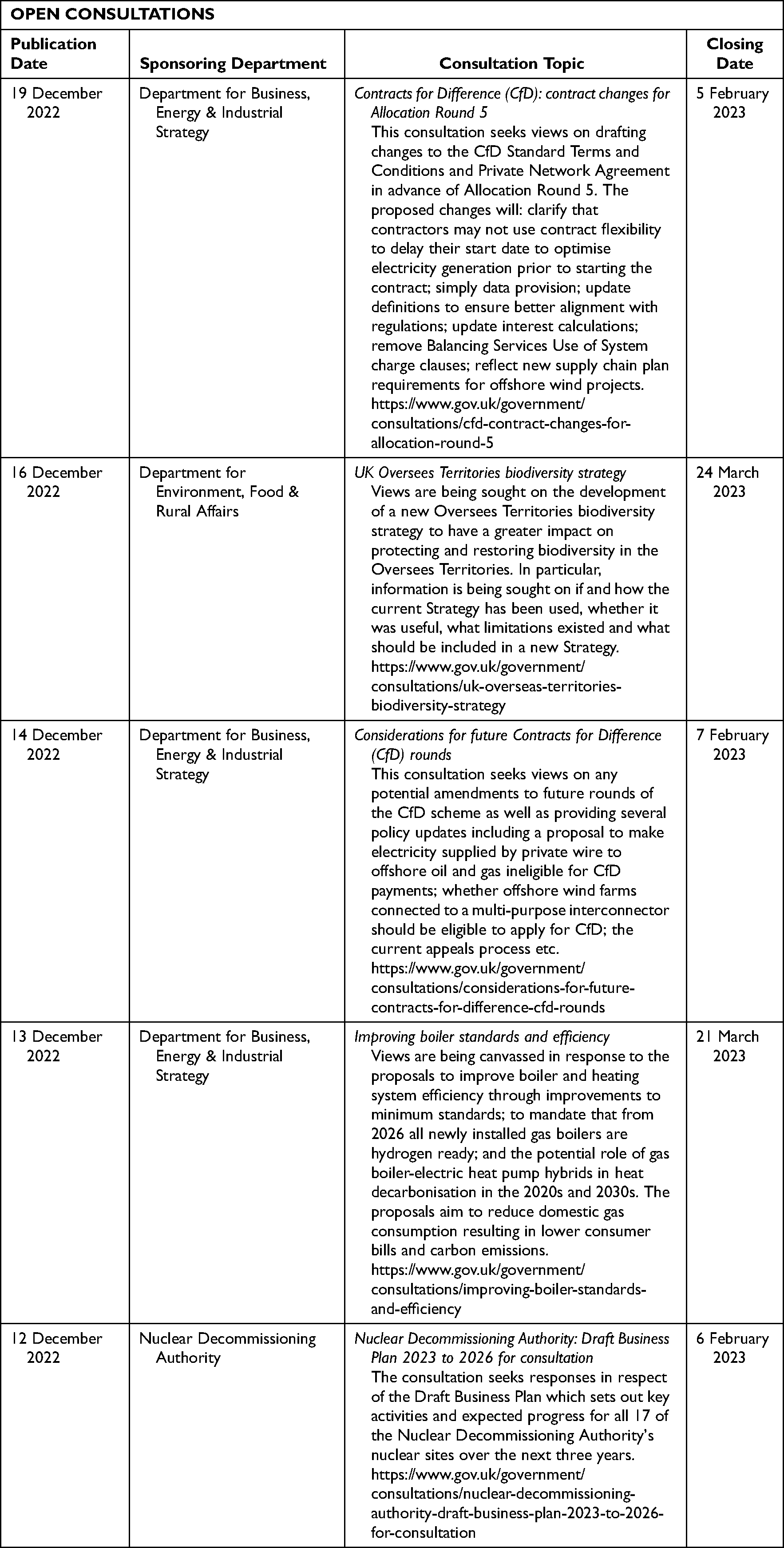
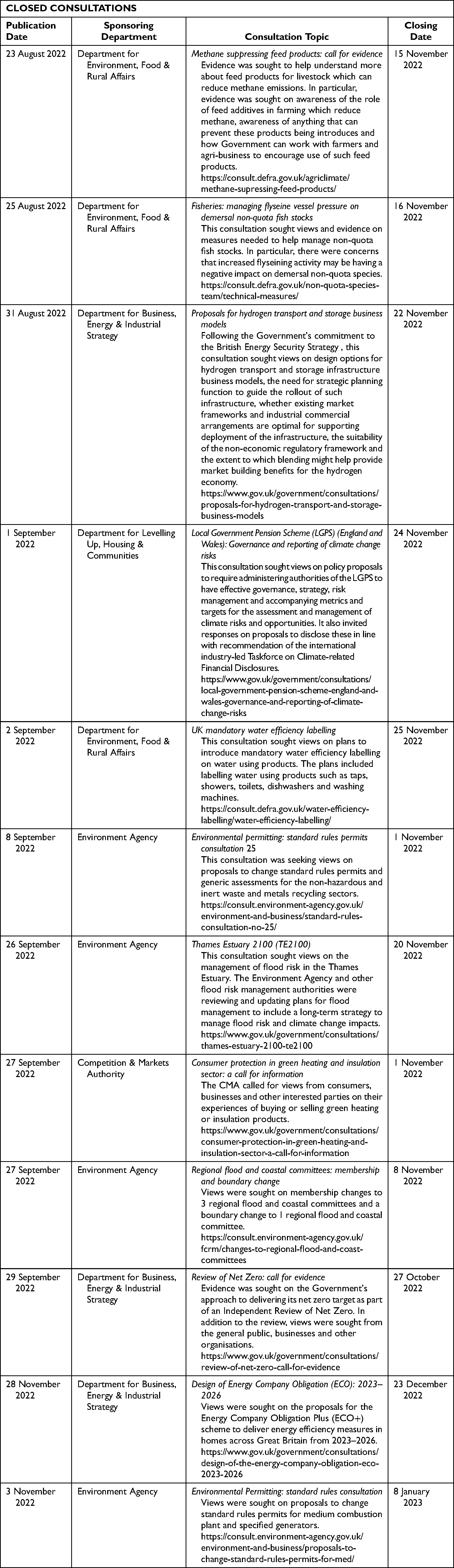
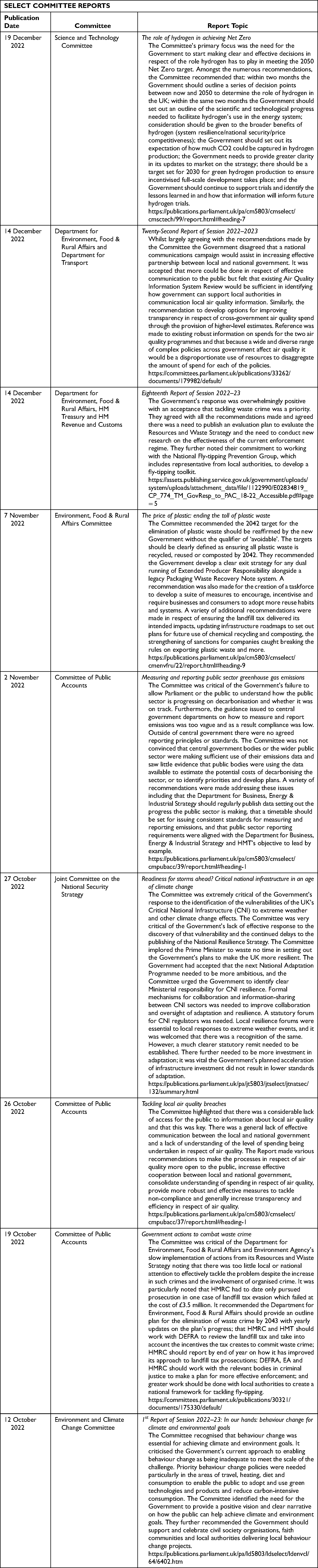
NEWS AND MISCELLANEOUS
‘New Year promises won’t resolve our meat problem’, The New Statesman, 18 January 2023
Just under a third of Brits say they are going reducetarian this year, but we need more to meet climate goals.
https://www.newstatesman.com/environment/2023/01/poll-britons-fewer-eat-less-meat-2023-last-year
‘Rees-Mogg's Bonfire of Environmental Bureaucracy’, The Byline Times, 20 January 2020
Campaigners fear that laws put in place to safeguard the environment could be ‘accidently’ lost if the Retained EU Law Bill is implemented. MPs have voted to pass a bill environmental campaigners say will put thousands of laws that protect the UK's nature and wildlife at risk. The Retained EU Law Bill was introduced during Liz Truss’ short-lived premiership by then Business, Energy and Industrial Strategy Secretary Jacob Rees-Mogg.
https://bylinetimes.com/2023/01/20/rees-moggs-bonfire-of-environmental-bureaucracy/
‘French Food Giant Danone Sued Over Plastic Use Under Landmark Law’, The New York Times, 9 January 2023
Danone, the French dairy giant, is being taken to court by three environmental groups who say it has failed to reduce its plastic footprint sufficiently, in a lawsuit challenging corporate social responsibility in the face of the climate crisis.
The groups accuse Danone – one of the world's top 10 plastic polluters, according to a recent study, of ‘failing to live up to its duties’ under a ground-breaking French law that requires large companies to address their environmental impact and has opened ways to sue them should they fail to do so.
https://www.nytimes.com/2023/01/09/world/europe/danone-sued-plastic-use-france.html
‘Litigating Climate Change before the Committee on the Rights of the Child in Sacchi v Argentina et al.: Breaking New Ground?’, Yusra Suedi, London School of Economics – Forthcoming article for the Nordic Journal of Human Right
In September 2019, 16 children petitioned against Argentina, Brazil, France, Germany, and Turkey before the United Nations Committee on the Rights of the Child (UNCRC) in what would come to be known as the Sacchi case. The children requested for the UNCRC to find that climate change is a children's rights crisis, that these States have caused and perpetuated the climate crisis by knowingly disregarding scientific evidence and that in so doing, they had violated the children's human rights. In October 2021, the UNCRC dismissed the petition upon the grounds that it was inadmissible as the petitioners had failed to exhaust domestic remedies.
https://papers.ssrn.com/sol3/papers.cfm?abstract_id = 4286128
‘Cop27: Everything you need to know about the Egypt climate summit’, The New Statesman, 18 November 2022
This year's UN climate change conference has been one of the most challenging yet. Here are the key details from the event.
https://www.newstatesman.com/environment/2022/11/cop27-climate-summit-dates-egypt-agenda
‘Review of literature on impacts of climate litigation’, University of Melbourne, 31 August 2022
Professor Jacqueline Peel, Dr Alice Palmer and Ms Rebekkah Markey-Towler completed a report for the Children's Investment Fund Foundation (CIFF) providing a Review of the Literature on the Impact of Climate Litigation, released in May 2022. Read the report here.
‘Half of green claims used to sell products in EU are misleading, Brussels finds’, Financial Times, 12 January 2023
Half of the environmental claims used to advertise products in the EU are misleading or unfounded, Brussels has found as it prepares to introduce rules to prevent greenwashing claims.
https://www.ft.com/content/5dde3181-3112-4280-8357-9b7881b7ae4c
‘Newcastle Clean Air Zone charge “not a tax-raising scheme”’, BBC News, 9 January 2023
Daily charges for some vehicles entering Newcastle city centre are not a tax-raising scheme for the council, its leader has said. Launching on 30 January, the Clean Air Zone (CAZ) will cover most of the city centre. Private cars will be exempt but older taxis will be charged £12.50 per day and non-compliant lorries, buses and coaches will have to pay £50 each day. Opponents warn it could deter people from visiting the city.
‘Supersized wind turbines could be built in England if onshore ban ends’, The Daily Telegraph, 2 December 2022
Hundreds of energy-generating devices twice as high as Big Ben could be erected if Rishi Sunak relaxes planning restrictions.