




Abstract
EDITORIAL
The new year is usually a time for hope, resolutions and a fresh start. Yet, this year feels less optimistic and more insurmountable. As we watch the utter devastation in Los Angeles it is perhaps difficult to feel hopeful for the future. Setting aside the political volleying and misinformation that spread rather disturbingly like the wildfires themselves, at least two things are becoming startlingly clear: first, climate change is a more pressing issue than ever. Secondly, it is vital governments do more to protect citizens not only from natural disasters but from those looking to profit and/or avoid responsibility. It's no wonder previous Select Committee reports have urged the importance of having national plans in place to ensure the country can respond quickly, effectively and humanely in such crises.
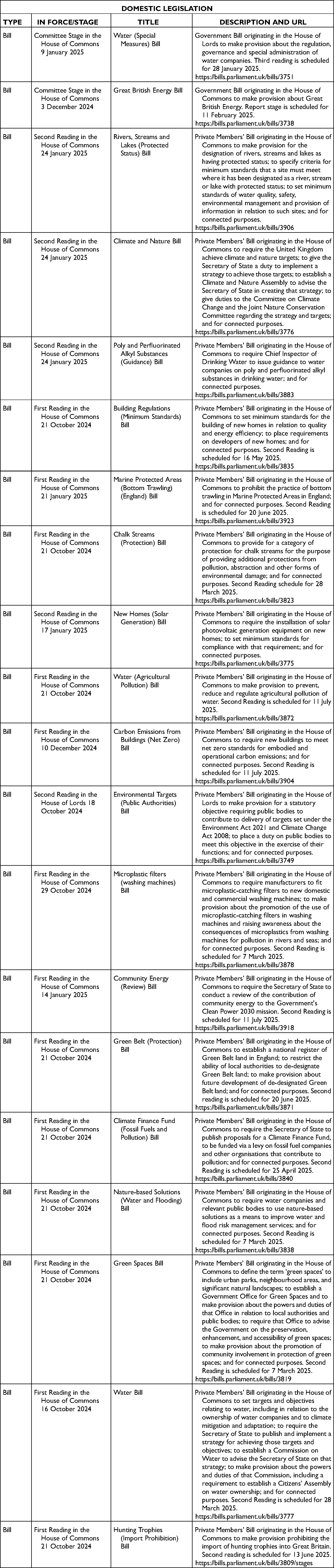
There has been a good deal of activity in Parliament in respect of environmental measures, though they are arguably still a drop in the ocean. Of some interest is the movement being made in tightening minimum standards in respect of building regulations (Building Regulations (Minimum Standards) Bill), reducing carbon emissions relating to building (Carbon Emissions from Buildings (Net Zero) Bill), and seeking to require new-builds to have solar panels (New Homes (Solar Generation) Bill).
Some interesting cases came before the courts in the latter quarter of the year. In Natural England v Cooper the Court of Appeal confirmed Natural England has the power to apply for injunctions to protect their interest in the discharge of their responsibilities under the 2006 Regulations. Proceedings continued in Alame v Shell Plc where Nigerian communities are claiming with regard to land and water which has been contaminated by oil pollution. Meanwhile, in Various Claimants v Mercedes-Benz Group AG the High Court found that decisions of the Kraftfahrt-Bundesamt in relation to the alleged subversion of the vehicle emissions control regime were not binding under English law.
Read on for more updates.
Update
Anna McClean
TRINITY CHAMBERS
Verity LJ Adams, Thomas Langley and Sophie Johnstone
EU LEGISLATION AND TEXTS
Regulation (EU) 2024/3012 of the European Parliament and of the Council of 27 November 2024 establishing a Union certification framework for permanent carbon removals, carbon farming and carbon storage products
As a supplement to sustained emission reductions, the Regulation offers the first voluntary EU-level certification framework for permanent carbon removals, carbon farming, and carbon storage in products. The framework will promote and support soil emission reduction and carbon removal activities in the EU.
https://eur-lex.europa.eu/legal-content/EN/TXT/?uri=CELEX%3A32024R3012&qid=1737997810128
Regulation (EU) 2024/2803 of the European Parliament and of the Council of 23 October 2024 on the implementation of the Single European Sky (recast)
This Regulation sets down rules for the establishment and implementation of the Single European Sky so as to strengthen air traffic safety standards. This should aid development of the air transport system and improve the general performance of the air traffic management and air navigation services.
https://eur-lex.europa.eu/legal-content/EN/TXT/?uri=CELEX%3A32024R2803&qid=1737997810128
https://eur-lex.europa.eu/legal-content/EN/TXT/?uri=CELEX%3A32024R0573&qid=1737997810128
Regulation (EU) 2025/40 of the European Parliament and of the Council of 19 December 2024 on packaging and packaging waste, amending Regulation (EU) 2019/1020 and Directive (EU) 2019/904, and repealing Directive 94/62/EC
This Regulation seeks to streamline currently fragmented rules and vague requirements under the current regulations in respect of EU packaging requirements. Simplifying and streamlining the regulations is intended to remove uncertainty, reduce additional costs to economic operators and commits to reinforcing the essential requirement for packaging with a view to making all packaging reusable or recyclable by 2030.
Regulation (EU) 2024/3024 of the European Parliament and of the Council of 27 November 2024 amending Regulation (EU) No 691/2011 as regards introducing new environmental economic account modules
The Regulation introduces three new environmental economic account modules: forest accounts, environmental subsidies, and ecosystem accounts. These would contribute directly to the Union's environmental policy priorities as laid down in the 8th Environment Action Programme which calls for establishing, without delay, a binding Union framework to monitor and report on Member States’ progress towards phasing out fossil fuel subsidies, based on an agreed methodology, and setting a deadline at Union, national, regional and local level for the phasing out of such subsidies consistent with the ambition of limiting global warming to 1.5°C.
https://eur-lex.europa.eu/legal-content/EN/TXT/?uri=CELLAR%3A2d8386cf-b373-11ef-acb1-01aa75ed71a1
Regulation (EU) 2024/2865 of the European Parliament and of the Council of 23 October 2024 amending Regulation (EC) No 1272/2008 on classification, labelling and packaging of substances and mixtures
This Regulation contains rules on the classification, labelling and packaging of chemical substances and mixtures on the EU market. It establishes and amends rules to make the process of identification and classification of hazardous chemicals more efficient whilst also targeting lacunas in the rules and high levels of non-compliance.
https://eur-lex.europa.eu/legal-content/EN/TXT/?uri=CELEX%3A32024R2865&qid=1737997810128
DOMESTIC CASE LAW
Planning law
Waverley BC v Secretary of State for Levelling Up, Housing and Communities [2024] EWHC 3302 (Admin)
Waverley Borough Council applied to quash the planning inspector's decision to grant planning permission for a development of 53 dwellings within the setting of Surrey Hills National Landscape (although not in the SHNL itself). The planning inspector had concluded that the development would not have a harmful effect on the SHNL due to the distance between them, the topography, and the fact that the development's design could be carefully controlled, and it would therefore not be at odds with para. 182 of the National Planning Policy Framework. The planning inspector had found that the development's harmful effect on its more immediate surroundings was outweighed by other factors and fell within the presumption in favour of sustainable development in the NPPF. The Council argued that the planning inspector had failed to take proper account of the harmful impacts of the development's area when determining the effect on the SHNL and had given inadequate reasons. The court refused the application and held that the decision set out the basis for the judgement that there would be no adverse impact on the SHNL, had undertaken the assessment required by the NPPF, and had explained his conclusions with clarity. It further held that the Council's complaint was excessively legalistic and courts had repeatedly cautioned against hypercritical scrutiny of planning decisions and the laborious dissection of decision letters in an effort to find fault.
Transport Action Network v Secretary of State for Transport [2024] EWHC 2885 (Admin)
The claimant applied for permission to bring a judicial review claim against the secretary of state's decision to make the A66 North Trans-Pennine Development Consent Order. It argued that the defendant's reliance on human health as supporting imperative reasons of public interest was ultra vires reg. 64(2)(a) Conservation of Habitats and Species Regulations 2017. The court rejected this argument and held that it was not irrational for the secretary of state to find that the human health considerations, together with the public safety considerations, were insufficient to justify the conclusion that they overrode the limited impact on the blanket bog. The claimant also argued that the secretary of state failed to have regard to the National Networks National Policy Statement 2014 in relation to development in an Area of Outstanding Natural Beauty. The court confirmed that established and well-known aspects of national policy do not need to be recited by rote in decision letters: the question of the court is whether, viewing the decision as a whole, the decision maker can be said to have lost sight of the relevant policy provisions in reaching their decision. It held that the secretary of state was plainly satisfied that this was an exceptional case in which acceptance of the relatively limited degree of harm was justified. The court therefore refused permission to bring a judicial review claim.
Environmental impact assessment
Natural England v Cooper [2025] EWCA Civ 15
Natural England had previously been granted an interim injunction against Mr Cooper restraining him from ploughing or working fields on his farm save in compliance with the Environmental Impact Assessment (Agriculture) (England) (No 2) Regulations 2006. The issue before the court was whether NE had the power and standing as the regulator under the 2006 Regulations to obtain an injunction to secure compliance with the Regulations. The court held that s. 13(1) Natural Environment and Rural Communities Act 2006 confers an incidental power on NE to apply for an injunction to protect its interest in the discharge of its responsibilities relating to the protection of the environment under the 2006 Regulations. It further held that this was not limited to injunctions relating to enforcement action against past offences but also covered injunctions designed to secure compliance with statutory requirements in future. The court also held that the statutory scheme was sufficient to give NE standing to seek an injunction to secure compliance with the 2006 Regulations without having to invoke the assistance of the Attorney General. The court granted a permanent injunction, finding that Mr Cooper had made it plain that in the absence of an injunction he would persist in cultivating the land in breach of the 2006 Regulations.
Rae v Glasgow City Council [2025] CSIH 1
A resident living near to a number of high-rise buildings reclaimed against the Lord Ordinary's refusal to reduce the local authority's screening opinion that concluded that an environmental impact assessment was not required for the demolition of those buildings. The resident claimed that: (i) the Lord Ordinary had erred on relying on R (oao Finch) v Surrey CC [2024] UKSC 20 which had been decided after the substantive hearing as the parties had not had a fair opportunity to address the courts on its implications; (ii) the Lord Ordinary should have held that the respondent had erred in taking into account mitigation and remedial measures. The court refused the petition. It held that it was only necessary for a judge to afford the parties opportunity to comment upon an authority that contradicted the submissions if fairness dictated it. In order to succeed, the complaining party would have to demonstrate that the authority was wrong, which the reclaimer had not done. It further held that the extent to which mitigation measures could be taken into account in a screening opinion varied according to the circumstances. In assessing the legality of a screening opinion, the courts should not impose too high a burden on planning authorities in relation to what was no more than a procedure intended to identify the relatively small number of cases in which the development was likely to have significant environmental effects.
https://www.bailii.org/scot/cases/ScotCS/2025/2025csih1.html
Wildcat Haven Community Interest Co v Scottish Ministers [2024] CSIH 39
The Wildcat Haven Community Interest Co, which aimed to protect and conserve the Scottish wildcat population, reclaimed against the Lord Ordinary's dismissal of its petition for judicial review of the respondent's decision to grant consent for the construction of a wind farm in a forest in Aberdeenshire. The petitioners argued that the reporter had failed to correctly apply the new mitigation hierarchy in policy 3(b)(iii) National Planning Framework 4, which introduced a requirement for decision-makers to take a sequential approach and prefer mitigation measures which avoided or minimised an environmental impact over those which sought to offset the impact. The court refused the reclaiming motion and held that although policy 3(b) introduced an important new requirement for major developments to demonstrate a contribution to the enhancement of biodiversity, there was nothing in the wording of the policy that signalled a material change in the mitigation strategy or in how potentially adverse environmental effects were to be assessed and dealt with by decision-makers. In any event, matters of weight and planning judgement were for the decision-maker not the court. The new issue for the reporter arising from policy 3(b) was whether the proposal went beyond mitigation and offered biodiversity enhancement. The reporter decided that this could be achieved and there was no reason for the reporter to revisit her conclusions on the mitigation of the potential adverse impacts set out in her first report.
https://www.bailii.org/scot/cases/ScotCS/2024/2024csih39.html
Administrative law
White v Plymouth City Council [2024] EWHC 2854 (Admin)
The claimant made an application for the local authority to be committed for contempt of court for interfering with the due administration of justice and breaching an injunction. The claimant had obtained an injunction to prevent the Council from felling 129 mature trees in order to carry out a redevelopment scheme. The injunction was granted on the condition that the claimant issue judicial review proceedings by close of business that day, which she did. The claimant submitted that the Council pushing its decision on the scheme through under an urgent procedure and mobilising the site so quickly was designed to impede her ability to challenge the decision thereby interfering with justice. The court refused the application and held that the claimant had failed to show the evidence of a strong prima facie case that is required to obtain permission to proceed with application for committal on the ground of interference with the due administration of justice.
Environmental information
Meira v Information Commissioner [2025] UKFTT 18 (GRC)
This case concerned an appeal brought under s. 57 Freedom of Information Act 2000 against the decision of the Information Commissioner upholding the Lambeth Council's refusal of a request for information. The information requested was the planning preapplication information relating to property owned by the Council that was adjacent to the appellant's home and that the Council was applying for a planning preapplication for developing before making it publicly available for sale. The Council refused to provide the requested information citing the exception under reg. 12(5)(d) Environmental Information Regulations 2004 (confidentiality of proceedings). The tribunal dismissed the appeal. It held that the preapplication process amounted to proceedings under reg. 12(5)(d) and found that the information met the threshold for confidentiality. The tribunal further held that disclosure of the information would be likely to have a significant adverse effect on the pre-application process and that on the balance of probabilities the public interest favoured non-disclosure. Whilst it accepted the concerns raised by the appellant, it was clear that all relevant information would in any event be released to the world at large at the final planning stage if a full planning application was subsequently made, thereby providing appropriate transparency and accountability.
Burn v Information Commissioner [2024] UKFTT 1143 (GRC)
This case concerned an appeal against the Information Commissioner's decision that the London Borough of Enfield had no further recorded information within the scope of the appellant's request for information. The appellant had requested a copy of the latest Meridian Water Masterplan (a large scale regeneration and development programme led by the Council). The tribunal allowed the appeal. It held that to fall within the scope of the request, it was not necessary for any documents to have been completed, agreed upon and adopted. It found that, on the balance of probabilities, the Council held further information within the scope of the request.
Abbott v Information Commissioner [2024] UKFTT 1119 (GRC)
This case concerned an appeal against the Information Commissioner's decision that Basingstoke & Deane Borough Council was entitled to rely on reg. 12(5)(b) Environmental Information Regulations 2004 to withhold information requested about the felling of trees adjacent to a specific property as the information was part of a live and ongoing insurance claim. The appellant did not challenge the application of reg. 12(5)(b), but claimed that the Council held further information within the scope of the request. The tribunal dismissed the appeal. Whilst it understood why the appellant believed that the Council ought to hold the additional information, it found that it did not. It further held that although the appellant had concerns that the Council did not follow the Information Commissioner's timeline guidance, this did not constitute grounds for an appeal. It further noted that the EIR gives a right to information held by a public authority, not a right to answers to general questions.
Blakely v Information Commissioner [2024] UKFTT 1112 (GRC)
This case concerned an appeal against the Information Commissioner's decision that the Health & Safety Executive was entitled to rely on reg. 12(5)(a) Environmental Information Regulations 2004 (adverse effect on international relations, defence, national security or public safety) to withhold information requested about safety incidents at sites with containment level 4 laboratories. The tribunal dismissed the appeal, finding that the information, together with information already in the public domain, provided an opportunity for information regarding processes, staff and facilities to be deduced and used by a person with malign intent. Whilst it agreed with the appellant that those laboratories trusted to work with the most dangerous pathogens and toxins are performing an important public duty and the public is entitled to hold them to account and that the public interest was particularly important in this case because the appellant was a member of the press and the press has an important role as a watchdog for the state's performance of its functions, it found that the public interest in maintaining the exception outweighed the public interest in disclosing the information.
Lower Oldpark Community Association v Information Commissioner [2024] UKFTT 1052 (GRC)
This case concerned the appellant's request for information from the Northern Ireland Public Services Ombudsman regarding complaints made against the Northern Ireland Housing Executive. The tribunal held that the information requested was not environmental information and the applicable law was therefore the Freedom of Information Act 2000 rather than the Environmental Information Regulations 2004. The tribunal held that, on the balance of probabilities, the relevant information was held by the NIPSO and that insufficient enquiries had been made to locate it. However, the information requested was exempt from disclosure under s. 44 FOIA which applies if the data is protected from disclosure: the information concerned was protected from disclosure under s. 49 Public Services Ombudsman Act (Northern Ireland) 2016 as information obtained in deciding whether to begin an investigation, during an investigation or in resolving a complaint.
Davies v Information Commissioner [2024] UKFTT 1017 (GRC)
This concerned the appellant's request for information from the Greater London Authority relating to data on the emissions savings from the Ultra Low Emission Zone. The Information Commissioner had determined that Transport for London was entitled to rely on reg. 12(4)(b) Environmental Information Regulations 2004 (manifestly unreasonable) to refuse to comply with the request. The tribunal refused the appellant's appeal of this decision on the basis that it would be a disproportionate use of resources.
Mitchell v Information Commissioner [2024] UKFTT 1083 (GRC)
This case concerned the appellant's request for information from Plymouth City Council relating to current site accreditation certificates for a waste management site. The Council provided some of the information requested but advised that some of the information was not held in English and some was not held at all. The Information Commissioner upheld this. The tribunal held that it was not for it to determine whether any type of information should be held by a public authority or that it should be held in a particular form. The only question for it to consider was whether the environmental information within the scope of the appellant's request was held by the Council. The tribunal held that, on the balance of probabilities, the Council did not hold any further information which would be disclosable in response to the appellant's request and dismissed the appeal.
Murray-Smith v Information Commissioner [2024] UKFTT 1064 (GRC)
This case concerned five decisions by the Information Commissioner that were challenged in linked appeals. The decisions related to requests for information made by the appellants to Transport for London relating to the make and model of CCTV, CCTV enforcement, and parking enforcement cameras. The tribunal held that the information requested was within the scope of the Environmental Information Regulations 2004 because traffic cameras are used for purposes which include reducing emissions from traffic. It further held that disclosure of the information would be likely to adversely affect public safety and/or national security and that it would or would be likely to adversely affect the course of justice. It found that damage to cameras and other infrastructure with which they are co-located, such as traffic lights, and threats to the safety of those who work in the Ultra Low Emission Zone have all occurred, and that there was a potential risk to the criminals themselves, the public, and those investigating incidents, and the Council was entitled to rely on the exemptions to disclosure in reg. 12(5)(a) (national security or public safety) and reg. 12(5)(b) (course of justice). It held that the public interest in disclosure was outweighed by the public interest in maintaining the exception.
Shiel v Information Commissioner [2024] UKUT 369 (AAC)
This case was an appeal against the decision of the First-tier Tribunal in relation to the appellant's request for information from the North Sunderland Harbour Commissioners. The issue was whether the information requested, which related to the names of the commissioners of the NSHC, was ‘environmental information’ under reg. 2(1) Environmental Information Regulations 2004. The court held that the information requested was not in relation to a measure or activity, as was required by reg. 2(1), and the tribunal's decision did not involve the making of an error on a point of law.
Cawthorne v Information Commissioner [2024] UKFTT 978 (GRC)
This case concerned an appeal against the Information Commissioner's decision that Telford and Wrekin Council was entitled to withhold information relating to Stoneyhill landfill site under reg. 12(4)(b) Environmental Information Regulations 2004 (manifestly unreasonable). The tribunal found held that although the appellant had made 14 previous information requests between 2008 and 2020 and a further 7 requests over 9 days in July 2023, they were not voluminous and the information was neither wide ranging nor lacking in focus. Whilst the tribunal accepted that the appellant copying a number of recipients into his email requests could utilise additional resources as many individuals would be looking at the same correspondence, it held that taking the requests as a whole the information requested was not excessive.
Shvorob v Information Commissioner [2024] UKFTT 941 (GRC)
This case concerned an appeal against the Information Commissioner's decision that London Borough of Bexley was entitled to rely on s. 14 Freedom of Information Act 2000 (vexatious) and/or reg. 12(4)(b) Environmental Information Regulations 2004 (manifestly unreasonable) to refuse the appellant's request for information. The appellant was a local blogger and had made requests for information, including on the Ultra Low Emission Zone and road safety, to establish and check facts prior to publication. The tribunal did consider some of the requests to be burdensome. However, it clarified that the fact that a request was burdensome must not be conflated with it being manifestly unreasonable and it did not find that the high threshold for manifestly unreasonable had been reached, particularly as the Council could have charged the applicant for the information. It found that the requests served the public interest and for those requests that were burdensome, the Council had not provided the appellant with the level of advice and assistance required under reg. 9(1) Environmental Information Regulations 2004. The Council was therefore ordered to reconsider the appellant's requests for information.
White v Information Commissioner [2024] UKFTT 912 (GRC)
This case concerned an appeal against the Information Commissioner's decision that the Freedom of Information Act 2000 was the appropriate regime for dealing with a request for information regarding the Government's Covid-19 response and that the Cabinet Office was entitled to rely on s. 12(1) FOIA to refuse to disclose the requested information. The appellant argued that the information requested was environmental information because it related to airborne diseases and therefore the request should have been dealt with under the Environmental Information Regulations 2004. The tribunal rejected this argument, confirming that the FOIA regime was the correct regime for determining the request and holding that the time it would take to respond to the request would exceed the relevant limit such that the request was unreasonable.
Pollution
Alame v Shell Plc [2024] EWCA Civ 1500
The claimants were communities in Nigeria whose land and water had been contaminated by oil pollution. This case concerned an appeal by the defendants of an oil pollution claim against a High Court order allowing the claimants to amend their proceedings to include additional oil spills and losses and an appeal by the claimants against a declaration that the claims would have to proceed as ‘global claims’ as the claim was insufficiently particularised as to causation to proceed in the conventional way. The court dismissed the defendant's appeal and allowed the claimant's appeal. It found that the original pleadings specified 10 oil spills but also included damage caused by spills identified as including other spills and the amendments were further particulars of the original claim rather than an attempt to introduce new causes of action. The fact that each specified additional spill had its own set of facts did not mean that they were outside the very wide scope of the original pleadings. It further held that no judge or court was entitled to require a party to establish their case by a particular method and that unless and until the point was reached where a claim was to be dismissed or stayed, the litigant's right to bring the claim and their freedom to determine how they intended to prove their claim should normally be respected.
Various Claimants v Mercedes-Benz Group AG [2024] EWHC 2904 (KB)
This case concerned group litigation relating to the alleged subversion of the vehicle emissions control regime in Regulation (EC) 715/2007 by the defendant motor vehicle manufacturers. The claimants alleged that the manufacturers had sold cars that contained software that cheated or subverted the regime. The court determined preliminary issues concerning the effect of decisions made by the German authorities, in particular whether decisions made by the Kraftfahrt-Bundesamt (KBA) as to the presence of the software were binding on the court and/or claimants involving one defendant manufacturer as non-addressees of the decisions. The court found that the decision of KBA did not represent a binding decision before the German courts and therefore could not be binding under English law.
Waste
Howells v Newport City Council [2025] EWHC 22 (Ch)
Newport City Council applied to strike out the claimant's claim regarding ownership of a 2.5-inch laptop hard drive containing the private key to his Bitcoin deposited in error by his partner at a household waste recycling site owned and operated by the Council. The claimant asserted that the Bitcoin was worth over £600 million and that he needed the hard drive to access it. The claimant sought declarations that he was the owner of the hard drive and everything on it and an order that the local authority deliver the hard drive or allow his team of experts to excavate the landfill to find it or, alternatively, compensation equivalent to the value of the Bitcoin. The court found for the Council. It held that under s. 14(6)(c) Control of Pollution Act 1974, ‘anything delivered to a disposal authority or a collection authority by another person in the course of using the facilities shall belong to the authority and could be dealt with accordingly’ and the court rejected the claimant's argument that it was possible that a thing might belong to several people concurrently. It also rejected the claimant's argument that s. 14(6)(c) did not apply where someone disposed of items without the owner's consent, finding that the disposal authority's freedom to deal with items delivered to it could not sensibly be contingent on matters of which it had no knowledge or control. The restitutionary claim was also rejected as any such claim is based on retention of legal title and is not available where the asset was a chattel, as the hard drive was. It further held that the claimant had not retained an equitable interest in the hard drive under a constructive trust as this was ruled out by s. 14(6)(c) and the Council's retention of the hard drive was not, in any event, unconscionable.
Cheng v Hartlepool Borough Council [2024] UKFTT 00963 (GRC)
The appellant appealed against a fixed penalty notice served by Hartlepool Borough Council under s. 46C Environmental Protection Act 1990 for failing to comply with a notice relating to their household waste bin being left out on a non-collection day. The court accepted the appellant's argument that there were lots of bins in the street behind his property but his bin was within his property, allowing the appeal and withdrawing the fixed penalty.
Climate change
Shell UK Ltd v Persons Unknown [2024] EWHC 3130 (KB)
In three separate, but connected, claims the claimant sought final injunctions against named and unknown protestors who had been involved in directed deliberately disruptive protests against the claimants. The claimants brought two claims in trespass and nuisance against persons unknown who had obstructed the highway and interfered with a private right of way and access from the highway. The third claim asserted a conspiracy to injure on the part of the protesters and persons unknown. Interim injunctions were in place and the claimants were seeking final injunctions of 5 years duration to prevent future breaches of their civil rights. The court held that there was no fixed test for application of the court's discretion under s. 37 Senior Courts Act 1981: the key question was whether to do so would be just and convenient, but there had to be a real and imminent threat that a tort or breach of public law would be committed and would cause real harm. There procedural guidelines set out in Canada Goose UK Retail Ltd v Persons Unknown [2020] EWCA Civ 303 were to be followed and a careful balancing exercise was required if the injunction would interfere with the unknown protesters’ human rights. The court held that all the factors that needed to be weighed into the balance had been satisfactorily addressed in relation to each claim and the injunctions were granted.
R (on the application of Friends of the Earth) v Secretary of State for Environment, Food and Rural Affairs [2024] EWHC 2707 (Admin)
The claimants applied for judicial review of the third National Adaptation Programme published by the secretary of state. The claimants argued that: (i) the risk reduction goals in NAP3 did not comply with the duty in s. 58 Climate Change Act 2008; (ii) the secretary of state had not properly considered the risk to delivery of the policies and proposals; (iii) the secretary of state had failed to give adequate consideration to the equality impacts of NAP3; (iv) the decision to adopt NAP3 breached their rights under s. 6 Human Rights Act 1998. The court refused the application. It held that s. 58 did not prescribe how ambitious NAP3's objectives in relation to climate change adaptation needed to be save that they had to address the risk identified in the most recent climate change report. If an objective was thought insufficiently ambitious, the remedy lay in the ability of the climate change committee to say so and the requirement to publish its report. It further held that the objectives the secretary of state was required to set out under s. 58(1)(a) were not required to be quantified or quantifiable and that the threshold for delivery risk was rationality, which had been met. In relation to the claimants’ human rights, the court held that there was no general interpretive principle requiring the court to favour a construction which better promoted the interests protected by the ECHR over one promoting those interests less effectively. The obligation imposed by s. 3 HRA 1998 was of relevance only when one of the competing constructions was incompatible with ECHR rights.
Nuisance
Lewis v Francis [2025] EWHC 17 (Admin)
The appellant appealed against the district judge's decision ordering him to pay the respondent's costs pursuant to s. 19(1) Prosecution of Offences Act 1985. The appellant had objected to the behaviour of the respondent's two dogs in the yard to which they had shared access and had brought a statutory nuisance claim under s.82 Environmental Protection Act 1982. The claim was dismissed on the basis that the evidence was so weak that no reasonable tribunal could determine that a statutory nuisance had been made out. The court allowed the appeal. The judge had found that the appellant should have known that his claim was so weak that it was bound to fail but the test was not whether the evidence was too weak but whether the decision to prosecute was wholly unreasonable.
EU CASE LAW
Judgment of the Court (Ninth Chamber) of 4 October 2024. European Commission v French Republic, Case C-268/23
The Court declared the French Republic failed to fulfil its obligations under Article 4 and/or 5 of Directive 91/271, as amended, read in combination with Annex A.B thereto, Article 10 of that directive, as amended, and Article 15 of the said directive, as amended, read in combination with annex IB and D by failing to take the measures necessary to ensure (concerning the 78 agglomerations) urban waste water collected was, before discharge, subject to secondary treatment in compliance with Article 4 of Council Directive 91/271/EEC of 21 May 1991 concerning urban waste water treatment, as amended by Regulation (EC) No 1137/2008 of the European Parliament and of the Council of 22 October 2008, respecting the parameters set out in Annex I B thereto, or to an equivalent treatment. This applied in respect of measures taken at the latest by 31 December 2000 for the 20 agglomerations whose population equivalent is more than 15,000; by 31 December 2005 for the 5 whose population equivalent was between 10,000 and 150,000 and the 53 whose population equivalent is between 2,000 and 10,000. Furthermore, they failed to take the measures necessary to ensure that, at the latest by 31 December 1998, in the 10 of those agglomerations whose population equivalent is more than 10,000 and where urban waste water is discharged to receiving waters designated as ‘sensitive areas’, within the meaning of Directive 91/271, as amended, that urban waste water was, before discharge, subject to treatment more stringent than a secondary treatment or an equivalent treatment, in compliance with Article 5 of that directive, as amended, respecting the parameters set out in Annex I B. Moreover, the urban waste water treatment plants of those 78 agglomerations were designed, constructed, operated and maintained to ensure sufficient performance under all normal local climatic conditions and that, when those plants were being designed, account was taken or seasonal variations of the load in accordance with Article 10 of Directive 91/271, as amended and that the competent authorities or appropriate bodies monitored discharges from the urban waste water treatment plants of those 78 agglomerations to verify their compliance with the requirements Annex 1B to Directive 91/271, as amended, following the control procedures laid down in Annex I D thereto as is required by the first indent of Article 15(1) of that directive.
https://eur-lex.europa.eu/legal-content/EN/TXT/?uri=CELEX%3A62023CA0268
Judgment of the Court (Second Chamber) of 4 October 2024. Friends of the Irish Environment CLG v Government of Ireland and Others, Case C-727/222
The Court ruled that Article 2(a) of Directive 2001/42/EC of the European Parliament and of the Council of 27 June 2001 on the assessment of the effects of certain plans and programmes on the environment must be interpreted as meaning that a measure adopted by the government of a Member State solely on the basis of a provision of the Constitution of that Member State providing that the executive power of the State is to be exercised by or on the authority of that government does not meet the condition of being ‘required by legislative, regulatory or administrative provisions ’ and, consequently, cannot constitute a ‘plan ’ or a ‘programme ’ for the purposes of that Article 2(a).
https://eur-lex.europa.eu/legal-content/EN/TXT/?uri=CELEX%3A62022CJ0727&qid=1737990330854
Judgment of the Court (Tenth Chamber) of 17 October 2024. European Commission v Republic of Malta, Case C-304/23
The Court ruled that the Republic of Malta failed to fulfil its obligations under Article 4 and 10 of Council Directive 91/271/EEC of 21 May 1991 concerning urban wastewater treatment by failing to take the measures necessary to ensure that urban wastewater from the agglomerations of Malta South and Malta North entering collecting systems is, before discharge, subject to secondary treatment or an equivalent treatment. Further, it failed to fulfil its obligations under Article 5 of that directive by failing to take the measures necessary to ensure that urban wastewater from the agglomeration of Malta North entering collecting systems is, before discharge into sensitive areas or their catchment areas, subject to more stringent treatment than that described in Article 4 thereof. Finally, the Republic of Malta failed to fulfil its obligations under Article 15 of, and Annex I.B and I.D to, that directive by failing to monitor discharges of urban waste water from the agglomerations of Malta South and Malta North in order to verify compliance thereof with the requirements of Annex I.B to that directive in accordance with the control procedures laid down in Annex I.D to that directive. The Republic was ordered to pay costs.
https://eur-lex.europa.eu/legal-content/EN/TXT/?uri=CELEX%3A62023CJ0304&qid=1737990330854
Judgment of the Court (Third Chamber) of 14 November 2024. European Commission v Federal Republic of Germany, C C-47/23
The Court declared that the Federal Republic of Germany has failed to fulfil its obligations under Article 6(2) of Council Directive 92/43/EEC of 21 May 1992 on the conservation of natural habitats and of wild fauna and flora, as amended by Council Directive 2013/17/EU of 13 May 2013, by failing in a general and structural manner to take appropriate steps to avoid the deterioration of habitat types 6510 (lowland hay meadows) and 6520 (mountain hay meadows) protected by the Natura 2000 network, listed in Annex I to Directive 92/43, as amended, in the sites designated for those habitat types. The Court dismissed the remainder of the action and ordered the European Commission and the Federal Republic of Germany to bear their own costs.
https://eur-lex.europa.eu/legal-content/EN/TXT/?uri=CELEX%3A62023CJ0047&qid=1737990330854
Judgment of the Court (Sixth Chamber) of 14 November 2024. European Commission v Republic of Bulgaria, Case C-165/23
The Court declared that, by failing to establish and implement one single action plan or a set of action plans and to transmit that or those action plans to the European Commission without delay, the Republic of Bulgaria has failed to fulfil its obligations under Article 13(2) and (5) of Regulation (EU) No 1143/2013 of the European Parliament and of the Council of 22 October 2014 on the prevention and management of the introduction and spread of invasive alien species. Further, the Court declared that, by failing to establish, or include in its existing system, a surveillance system of invasive alien species of EU concern, including all the information referred to in Article 14(2) of Regulation No 1143/2014, the Republic of Bulgaria has failed to fulfil its obligations under Regulation (EU) No 1143/2013 of the European Parliament and of the Council of 22 October 2014 on the prevention and management of the introduction and spread of invasive alien species. The Court ordered the Republic of Bulgaria to pay the costs.
https://eur-lex.europa.eu/legal-content/EN/TXT/PDF/?uri=OJ:C_202500130
Judgment of the General Court (Sixth Chamber) of 27 November 2024. BASF SE and Others v European Commission, Case T-453/22
The applicants, BASF SE, Dow Europe GmbH and Nouryon Functional Chemical BV, sought the annulment of Commission Delegated Regulation (EU) 2022/692 of 16 February 2022 amending, for the purposes of its adaptation to technical and scientific progress, Regulation (EC) No 1272/2008 of the European Parliament and of the Council on classification, labelling and packaging of substances and mixtures, in so far as concerns the harmonised classification and labelling of the substance N-carboxymethyliminobis (ethylenenitrilo)tetra(acetic acid) and its pentasodium and pentapotassium salts in the hazard class for reproductive toxicity, Category 1B. The Court rejected the applicant's six pleas as unfounded and dismissed the action in its entirety. The Court ordered BASF SE, Dow Europe GmbH and Nouryon Functional Chemical BV to hear their own costs and pay those incurred by the European Commission and ordered the French Republic and the European Chemicals Agency to each bear their own costs.
https://eur-lex.europa.eu/legal-content/EN/TXT/?uri=CELEX%3A62022TJ0453&qid=1737990330854
Judgment of the Court (Fifth Chamber) of 28 November 2024. ENGIE Deutschland GmbH v Landesregulierungsbehörde beim Sächsischen Staatsministerium für Wirtschaft, Arbeit und Verkehr, Case C-293/23
The Court ruled that Points 28 and 29 of Article 2 and Article 30 to 39 of Directive (EU) 2019/944 of the European Parliament and of the Council of 5 June 2019 on common rules for the internal market for electricity and amending Directive 2012/27/EU
must be interpreted as precluding national legislation under which an undertaking which, by replacing the existing distribution system, constructs and operates an energy facility for the supply of electricity, generated by a combined heat and power plant, to several residential buildings with up to 200 dwellings and with an annual energy transfer of up to 1 000 MWh, is not subject to the obligations of a distribution system operator, since the costs of constructing and operating the energy facility are borne by the end consumers, who are the tenants of those dwellings, and the electricity generated is sold by that undertaking to those consumers, if that facility is used to transport electricity at high, medium or low voltage for sale to customers and if none of the exemptions or derogations from those obligations which are expressly provided for in that directive is applicable.
https://eur-lex.europa.eu/legal-content/EN/TXT/?uri=CELEX%3A62023CJ0293&qid=1737990330854
Judgment of the General Court (Fourth Chamber) of 11 December 2024. Carmeuse Holding SRL v European Commission, Case T-385/22
The applicant, Carmeuse Holding SRL, asked the Court to annul the Commission Decision of 14 February 2022 instructing the Central Administrator of the European Union Transaction Log to enter changes to the national allocation tables of Belgium, Bulgaria, Czechia, Denmark, Germany, Estonia, Ireland, Spain, France, Italy, Lithuania, Hungary, Romania, Slovenia, Finland and Sweden into the European Union Transaction Log, in so far as that decision concerns it. The Court rejected all four of the applicant's pleas and dismissed the action. Carmeuse Holding SRL was ordered to bear its own costs and pay those incurred by the European Commission.
https://eur-lex.europa.eu/legal-content/EN/TXT/?uri=celex:62022TJ0385
Judgment of the Court (Grand Chamber) of 21 January 2025. Land Niedersachsen v Conti 11. Container Schiffahrts-GmbH & Co. KG MS ‘MSC Flaminia’
The Court ruled that Article 1(3)(b) of Regulation (EC) No 1013/2006 of the European Parliament and of the Council of 14 June 2006 on shipments of waste must be interpreted as meaning that the exclusion from the scope of that regulation that that provision provides for, pertaining to the waste generated on board a ship following damage sustained by that ship on the high seas until that waste is offloaded in order to be recovered or disposed of, no longer applies to the waste which remains on board that ship in order for it to be shipped, together with that ship, for recovery or disposal, after part of that waste has been offloaded in a safe port in order to be recovered or disposed of, that interpretation being in conformity with Article 1(4) of the Convention on the control of transboundary movements of hazardous wastes and their disposal, signed in Basel on 22 March 1989, approved on behalf of the European Economic Community by Council Decision 93/98/EEC of 1 February 1993.
https://eur-lex.europa.eu/legal-content/EN/TXT/?uri=CELEX%3A62023CJ0188&qid=1737990330854
Judgment of the Court (Seventh Chamber) of 17 October 2024. Umweltforum Osnnabrücker Land eV, Case C-461/23
A request for a preliminary ruling was made in proceedings between Umweltforum Osnabrücker Land eV and the Landkreis Osnabrück concerning the lawfulness of a decree adopted by the latter designating a landscape protection area as an integral part of a Natura 2000 site. Seven questions were put before the Court; in light of the conclusions of the Court in respect of the first two questions, the remaining questions did not need to be addressed. The Court found that Article 3(2)b of Directive 2001/42, read in conjunction with Article 6(3) of Directive 92/43, must be interpreted as meaning that a legislative act by which the Member State concerned designates a site as a special area of conservation, under Directive 92/43, and which lists the human activities which are prohibited on that site, subject to the exceptions which that legislative act also lay down, is not covered by the concept of ‘plans and programmes’, within the meaning of Directive 2001/42, in respect of which an environmental assessment is required.
https://eur-lex.europa.eu/legal-content/EN/TXT/?uri=CELEX:62023CJ0461
CONSULTATIONS

NEWS AND MISCELLANEOUS
‘Cop28 president says there is ‘no science’ behind demands for phase-out of fossil fuels’, The Guardian, 3 December 2023
The president of Cop28, Sultan Al Jaber, has claimed there is ‘no science’ indicating that a phase-out of fossil fuels is needed to restrict global heating to 1.5C, the Guardian and the Centre for Climate Reporting can reveal.
‘Labour announces major overhaul of EPCs ahead of 2030 rental property deadline’, Landlord Knowledge, 26 September 2024
The government has revived the target of an EPC C rating for rental properties by 2030 and promised both a consultation on the proposals (opened 4th December 2024) and some measure of subsidies for the conversion of properties in relevant areas.
‘Nearly £22bn pledged for carbon capture projects’, BBC News, 4 October 2024
The government has pledged around £22 billion for two carbon capture projects based in Merseyside and Teesside, though it has been criticised both from left and right – that the projects are untested on the one hand and enable the UK to delay fully phasing out its use of gas-fired power stations.
‘Court of Appeal ruling clears the way for full trial of Nigerian communities’ oil pollution claims against Shell to finally go ahead in 2025’, Leigh Day, 6 December 2024
Law firm Leigh Day, which represents the claimants in the Bille and Ogale claims against Royal Dutch Shell and its Nigerian subsidiary SPDC, recently posted concerning a Court of Appeal ruling in the Claimant's favour that the claims were not to be treated as ‘global claims’. The practical result, as summarised at [17] of the judgment, is that the Claimants therefore do not need to prove that there was no material causation of their loss and damage by a party other than the Defendants. This requirement would have constituted a substantial difficulty for the Claimants if the first instance decision had been upheld.
‘COP29: Key outcomes and next steps for the UK’, Climate Change Committee, 11 December 2024
Reporting on November's COP29 conference in Baku, Azerbaijan, the CCC highlighted (i) the UK's announcement of its new emissions target of 81% of 1990 emissions by 2035 and the replication of the model of a carbon budget in other countries (ii) a new climate finance goal of £300 billion from the developed world by 2035 (iii) further steps towards an integrated global carbon market (iv) relatively limited progress towards goals in respect of both mitigation of emissions and adaptation.
https://www.theccc.org.uk/publication/cop29-key-outcomes-and-next-steps-for-the-uk/
‘Complete ban on bee killing pesticides moves forward’, UK Government, 21 December 2024
The UK government has announced plans to end the emergency approvals granted by the previous administration for the use of neonicotinoid pesticides, which have been linked to declining bee populations.
https://www.gov.uk/government/news/complete-ban-on-bee-killing-pesticides-moves-forward
‘Phasing out sales of new petrol and diesel cars from 2030 and supporting the ZEV transition’, UK Government, 24 December 2024
The UK Government has announced an open consultation on the next phase of the zero emissions vehicles mandate. The consultation comes in the wake of significant alarm for the future of the UK car industry in the wake of the decision by Stellantis to close the Vauxhall plant at Luton, which was partly driven by the EV sales mandate.
‘Trump aims to crush legal curbs on his climate rollback – but it may not be easy’, The Guardian, 31 December 2024
The US President has variously promised in the past to increase oil and gas production, reduce subsidies for renewables introduced by his predecessor, reduce funding for the EPA, remove pollution rules for automobiles and power plants, and withdraw the US from the Paris Agreement for the second time. However, activist lawsuits are unlikely to go away completely.
https://www.theguardian.com/us-news/2024/dec/31/trump-climate-policy