




Abstract
EDITORIAL
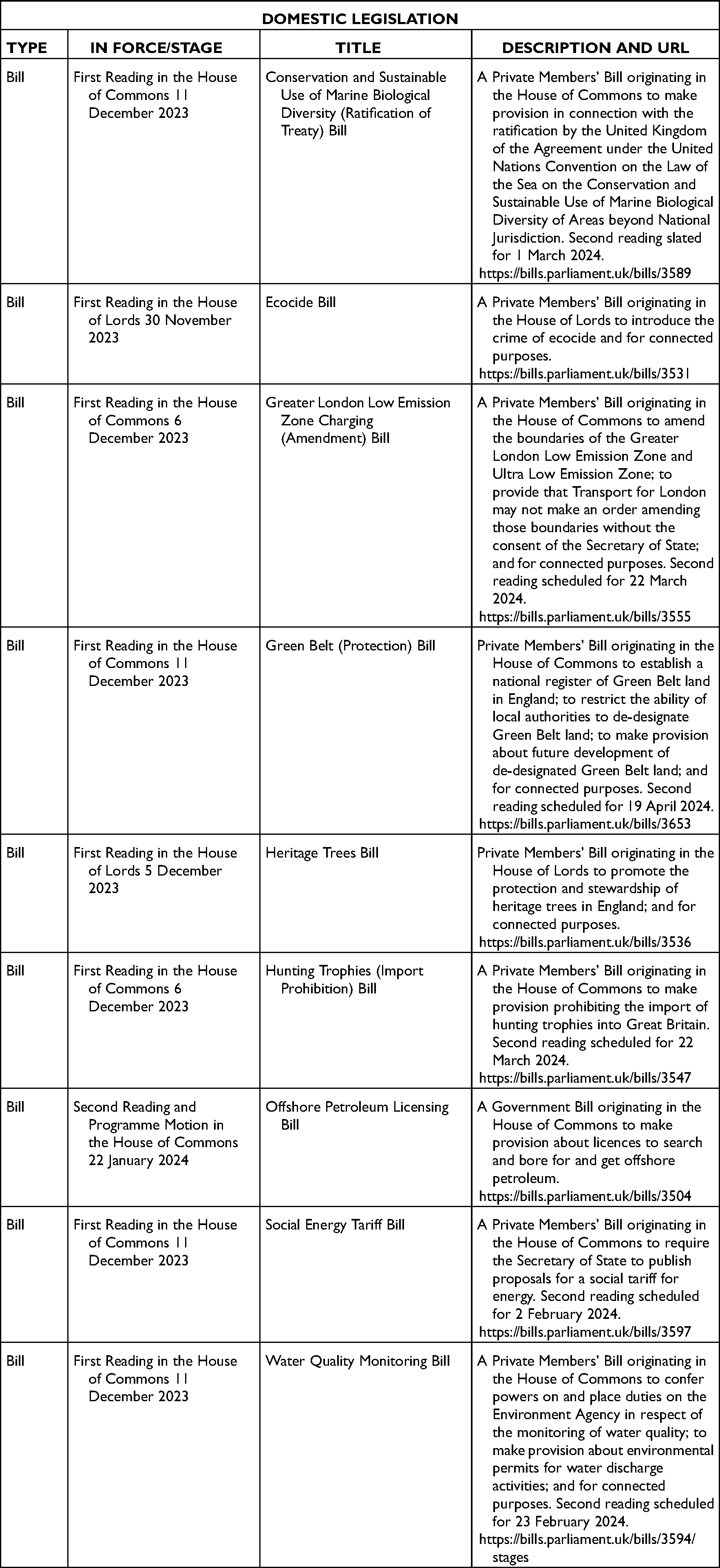
As a flurry of snow hit the UK in early December, so did a flurry of Private Members’ Bills, tackling everything from the conservation of marine biological diversity, to the protection of heritage trees and to the creation of greater powers and duties for water quality monitoring. It’s perhaps no wonder that there was a desire to push forward legislation which would make positive changes to the environment given 2023 was the hottest year on record and it has been predicted that January 2024 will be the warmest recorded start to a year yet.
The end of the year was eventful in other ways too. COP28 at the end of November 2023 proved to make for interesting headlines, with allegations that the UAE was using COP28 to push for oil and gas deals. Despite the initial rocky start, it has been suggested that the agreement was a major move forward in the climate change fight by specifically identifying, for the first time, the role of fossil fuel emissions in driving up temperatures and outlining a future decline for coal, oil and gas. Only time will tell whether the initial hope that seems to have sprung from the end of COP28 will actually turn into something tangible. What is clear is that there is still a fair way to go in obtaining meaningful action from world leaders in the fight against climate change.
October and December also brought intriguing legal challenges which remain pending. Kevin Jordan and Doug Paulley, supported by Friends of the Earth, brought a challenge to the UK’s National Adaptation Programme 3 in October, whilst Uplift and Greenpeace UK in December announced they were mounting separate legal challenges against the Government’s decision to allow development of Rosebank North Sea oilfield. Hopefully, the new year will bring new resolve to confront the realities of climate change and help move us forward to a more sustainable global future.
Read on for more updates.
Update
Anna McClean
TRINITY CHAMBERS
Verity LJ Adams and Sarah Ismail
EU LEGISLATION AND TEXTS
Regulation (EU) 2023/2405 of the European Parliament and of the Council of 18 October 2023 on ensuring a level playing field for sustainable air transport (ReFuelEU Aviation)
This Regulation lays down harmonised rules on the uptake and supply of sustainable aviation fuels (SAF). The Regulation applies to aircraft operators, to Union airports and their respective Union airport managing bodies, and to aviation fuel suppliers.
https://eur-lex.europa.eu/legal-content/EN/TXT/?uri = CELEX%3A32023R2405&qid = 1706197043208
DOMESTIC CASE LAW
Environmental information
Craddock v Information Commissioner [2024] UKFTT 9 (GRC)
The appellant appealed against the Information Commissioner’s decision that Kent County Council was entitled to refuse the appellant’s request for a copy of all digitised title maps for the county. The Council had refused the request on the grounds that the maps were available to access free at Kent History and Library Centre and digital copies could be purchased, and the information was therefore already publicly available and easily accessible and available in the format requested. The appellant complained to the Information Commissioner on the grounds that: (i) the information was not publicly available by virtue of being available for inspection at the Council’s record office and it was not easily accessible as it was disclosed in a form physically remote from the appellant and incapable or impracticable of being captured in a satisfactory form for the appellant’s intended use and the Council was therefore not entitled to rely on the exemption from disclosure under reg. 6(1)(a) and (b) Environmental Information Regulations 2004; (ii) the Information Commissioner should have considered whether, if the request for information was correctly refused under reg. 6(1)(b) EIR, it should have been disclosed under the Freedom of Information Act 2000; (iii) the fee proposed to be charged by the Council was not a reasonable amount for the purpose of reg. 8(3) EIR. The tribunal held that the information was available to the public in the ordinary sense of the word (the information was not restricted from any person in principle) and that the term ‘easily accessible’ did not require the Council to provide the information in a form that accommodated the appellant’s proposed use of the information. The tribunal held that the appellant’s journey time and costs were not material. The tribunal also held that s. 39 FAO acknowledges EIR as the paramount but not exclusive regime governing the disclosure of environmental information and the exemption from disclosure under s. 39(1) FOA for information that is exempt under the EIR is a qualified exemption so that the public interest in maintaining the exemption must outweigh the public interest in disclosure. However, it found that the information was reasonably accessible to the appellant under s. 21 FOA and therefore exempt from disclosure under s. 21. As the information was exempt from disclosure, the court did not address the question of the reasonableness of the Council’s proposed charges for the maps.
William Shiel v Information Commissioner [2023] UKFTT 01057 (GRC)
North Sunderland Harbour Commissioners had refused to provide information requested by the appellant. The appellant appealed against the Information Commissioner’s decision that information withheld (‘the names of those persons on the register of fishermen’) was not environmental information as defined in the Environmental Information Regulations 2004 and the NSHC therefore had no obligation to disclose it. The tribunal dismissed the appeal and held that, although the register of fishermen was created as a result of obligations under the North Sunderland Harbour Order 1931, the register had only a minimal connection to and impact on the environment and the NSHC was under no duty to disclose the information requested pursuant to reg. 5 EIR.
Rhondda Cynon Taff County Borough Council v The Information Commissioner [2024] UKFTT 00027 (GRC)
The Council appealed against the Information Commissioner’s decision that it was required to disclose information about the location of disused coal tips within the area. The Information Commissioner had determined that the exemption in reg. 12(4)(d) Environmental Information Regulations 2004 was engaged but that the public interest favoured disclosure: it was of greater interest to the public to be aware of where these potentially dangerous sites were located rather than to shield the Council from having to answer any queries which might arise from disclosure due to the fact that the information was unreliable and unverified and therefore potentially misleading. The tribunal dismissed the appeal.
Roberts v Information Commissioner [2024] UKFTT 23 (GRC)
The appellant appealed against the Information Commissioner’s decision not to require Stratford on Avon Council to disclose information relating to a Memorandum of Understanding about the potential purchase of Wellesbourne Airfield. The Council had provided some of the information requested but withheld the majority under reg. 12(4)(d), reg. 12(5)(d), reg. 12(5)(e), and reg. 12(5)(f) Environmental Information Regulations 2004. The appellant contended that the public interest test should override the exceptions. The tribunal held that the public interest in maintaining the exceptions outweighed the public interest in disclosure in light of the need to enable the Council to negotiate freely and dismissed the appeal.
Reeves v Information Commissioner [2023] UKFTT 1032 (GRC)
The appellant appealed against the Information Commissioner’s decision that Wiltshire Council was entitled to withhold information requested regarding an application to register certain land as a town or village green in accordance with reg. 5(3) and reg. 13(1) Environmental Information Regulations 2004. The tribunal held that whilst the public interest is relevant to most exceptions to the duty to disclose, it does not apply where that information is the personal data of either the requestor or a third party. Whether or not the applicant consents to the disclosure of his personal data was not a relevant consideration: reg. 5(3) takes any personal data of the requestor outside the scope of the EIR.
Nockolds Solicitors Limited v Information Commissioner [2023] UKFTT 984 (GRC)
This case concerned the request for information relating to a noise assessment at Stansted Airport Ltd from the Civil Aviation Authority. The CAA refused to provide the information, relying on reg. 12(5)(e) and reg. 12(5)(f) Environmental Information Regulations 2004. The Information Commissioner concluded that disclosure of the information would adversely affect the course of justice and therefore reg. 12(5)(b) was engaged and that the balance of the public interest favoured maintaining the exception. The appellant argued that the request for information would not insert unfairness into the proceedings because the communications requested were not those between a lawyer and client. The tribunal disagreed with this and held that the exception in reg. 12(5)(b) was engaged and disclosing the information would have an adverse effect on the course of justice as it would breach the fundamental principle of legal professional privilege. It agreed with the Information Commissioner that the balance of public interest favoured maintaining the exception.
Salter v Information Commissioner [2023] UKFTT 999 (GRC)
The appellant had requested information from Barnsley Metropolitan Council about the development of a link road as part of a wider housing and infrastructure project. The Council provided some information but redacted certain details. The appellant was appealing against the Information Commissioner’s decision that the Council could rely on reg. 12(5)(e) Environmental Information Regulations 2004 to withhold some of the information requested. The tribunal held that reg. 12(5) was engaged and that, on balance, the public interest favoured maintaining the confidentiality of commercial information of the developer and Council which would be adversely affected by disclosure. The tribunal did, however, note that the Council had made some errors in its handling of the appellant’s request, including initially responding under the Freedom of Information Act 2000.
Rubio v Information Commissioner [2023] UKFTT 987 (GRC)
This case concerned a request by the appellant for information regarding Hertford Heaths Parish Council’s pre-submission consultation in respect of its draft neighbourhood plan. The appellant’s were appealing against the Information Commissioner’s decision that the Council had disclosed any information that it held within the scope of the request. The tribunal held that there was evidence of an inadequate search by the Council and the Information Commissioner should have considered this. The Information Commissioner had erred in accepting the Council’s assertion and the tribunal required the Council to undertake a further search for the requested information.
Brooks v Information Commissioner [2023] UKFTT 964 (GRC)
The appellant appealed against the Information Commissioners decision that Gwynedd Council was entitled to rely in reg. 12(5)(b) Environmental Information Regulations 2004 to withhold information in relation to an application for prior notification of agricultural or forestry development for a particular property. The tribunal held that reg. 12(5)(b) was not engaged as there was no evidence that the prejudice required by reg. 12(5)(b) would occur. The tribunal therefore concluded that the Information Commissioner had erred in the exercise of his discretion and/or the decision involved an error in law and allowed the appeal.
Judson v Information Commissioner [2023] UKFTT 00919 (GRC)
The appellant appealed against the decision of the Information Commissioner regarding a request for information relating to a Covenant and Deed of Dedication relating to certain land and a licence agreement between Guisborough Town Football Club and RCBC from Fields in Trust. The tribunal found that on the balance of probabilities the Council did not hold the information requested and dismissed the appeal.
Boland v Information Commissioner [2024] UKFTT 42 (GRC)
The appellant appealed against the decision of the Information Commissioner that the Environment Agency could rely on reg. 12(5)(a) Environment Information Regulations 2004 to withhold information relating to the Mill Leese Flood Storage Area. The appellant wished the appeal to address his claims regarding the conduct of the Information Commissioner, including whether he had properly discharged his responsibilities. The tribunal held that its role and powers were limited to consideration of whether the Information Commissioner’s decision was in accordance with the law and it had no jurisdiction to determine matters relating to the conduct of the Information Commissioner or how he handled any investigation in respect of a complaint made to him. It therefore dismissed the appeal.
Ashwin v Information Commissioner [2023] UKFTT 883 (GRC)
The appellant requested information from the Environment Agency in relation to its annual assessment of salmon stocks. The Information Commissioner confirmed that the EA was entitled to refuse to provide the information under reg. 12(4)(b) Environmental Information Regulations 2004 and the appellant appealed this decision. The tribunal dismissed the appeal and held that the EA was entitled to rely on the exception in reg. 12(4)(b). It found that the time required to respond to the request was significantly disproportionate to time spent on the EA’s other responsibilities and that the appellant had a responsibility to ensure that his engagement with the EA did not reach a level that was manifestly unreasonable. It also found that the appellant’s original serious purpose had become vexatious to some extent, much of the appellant’s communication had been aimed at pressuring the EA into accepting his own approach to salmon stock assessment, and that there was evidence of distress and anxiety caused to staff. It also found that the public interest in maintaining the exception outweighed the public interest in disclosure and that the EA had gone to great lengths to provide information and explanation to satisfy the public interest in the EA’s approach to assessing salmon stocks.
National Highways Ltd v Information Commissioner [2023] UKFTT 895 (GRC)
This case concerned information requested from National Highways relating to the Arundel Bypass. National Highways refused the request. The Information Commissioner determined that the exception under reg. 12(5)(b) was engaged but that the public interest lay in disclosure and ordered National Highways to disclose the information. The tribunal held that the Information Commissioner’s decision was clearly wrong for a number of reasons, including that he had failed to attach sufficient weight to the crucial role that legal professional privilege plays in our justice system and the consequential need for a compelling reason to be shown to justify denying any public body the right to rely on it. The Information Commission had also erred in the factors which he had found sufficient to tip the public interest in favour of disclosure, such as public opposition and anticipated costs. The tribunal concluded that the exception under reg. 12(5)(b) was engaged and the public interest under reg. 12(1)(b) favoured maintaining the exception.
Reeves v Information Commissioner [2023] UKFTT 882 (GRC)
The appellant appealed against the Information Commissioner’s decision that a local authority was entitled to rely on reg. 6(1)(b) to refuse to provide him with digital versions of photos it had published on its website in PDF format. The court allowed the appeal and held that in determining that the information was accessible in an alternative form or format, the Information Commissioner had wrongly disregarded the qualitative substance of the information sought: he was wrong to assume that PDF and digital formats of the same photograph provided access to the same information.
Smith v Information Commissioner [2023] UKFTT 876 (GRC)
The appellant requested information from Merseyside Fire and Rescue Service relating to a fire at a battery energy storage system site. The Information Commissioner had determined that MFRS had supplied some of the requested information and had correctly cited reg. 12(4)(a) Environmental Information Regulations 2004 in respect of the fire management plan (which was not held) and reg. 12(4)(d) in respect of correspondence requested. The tribunal held that MFRS did not hold the fire management plan, but that the Information Commissioner’s conclusion that some of the information that had been withheld on the basis that it was still in the course of completion was untenable. It also held that in the case of the correspondence, the public interest favoured maintaining the exemption: the correspondence related to a document that was in the process of being prepared and the exemption was needed to provide the authors with the safe space needed to examine the evidence and make judgements thereon without the distracting pressure of dealing with third-party interest and intervention. The tribunal wished to make it clear its reasoning in this regard should not be understood as closing the door on publication of correspondence generally: the timing of the request was of high significance in this case.
Emissions
Kool Blast Europe Ltd v Environment Agency [2024] UKFTT 4 (GRC)
This case concerned the appeal against civil penalties issued by the Environment Agency pursuant to reg. 31A Fluorinated Greenhouse Gas Regulations 2015. The appeals were brought pursuant to all 4 grounds listed in reg. 26(7). The tribunal held that: (i) the EA was entitled to serve a penalty notice whilst discussions were still taking place as to whether any exemption applied; (ii) the fact that the appellant’s breaches were unintentional and they were unaware of changes to the law did not prevent the EA from imposing a penalty; (iii) the appellant could not rely on the failure of HMRC to take action: compliance with the regulations was the appellant’s responsibility.
Klima-Therm Limited v Environment Agency [2023] UKFTT 1080 (GRC)
This case concerned an appeal against the penalty issued by the Environment Agency in respect of the appellant’s failure to obtain sufficient HFC quota authorisations in breach of art. 14(1) EU Regulation 517/2014. The tribunal concluded that the decision to serve a penalty notice was reasonable, but that the amount of penalty was unreasonable. As there was no history of non-compliance, the appellant had not intended to breach the regulations, and its failure was based on a misunderstanding, the culpability was at the level of negligent. It held that whilst the appellant had gained financial advantage and there needed to be some deterrent to prevent breaches of the regime, the particular circumstances of the breach must be taken into account. On this basis the additional amount of the penalty above the financial gain should be modest and the tribunal ordered that the penalty be reduced from £44,725 to £20,000.
Gullivair Limited v Environment Agency [2023] UKFTT 936 (GRC)
The appellant appealed against the penalty of £24,200 imposed by the Environment Agency’s under the Emissions Trading Scheme. The tribunal concluded that the appellant had only contacted the EA at the eleventh hour. Despite the EA doing everything it reasonably could to facilitate the appellant’s compliance, it had failed to take the necessary action. The tribunal noted the appellant’s willingness to comply after the deadline, but held that this carried insufficient weight in this case to alter where the balance lay. It therefore held that the penalty’s interference with the appellant’s property rights was amply justified by the public interest in maintaining the integrity of the UK Emissions Trading Scheme.
John Paton and Sons Ltd v Glasgow City Council [2023] CSOH 74
The operator of a vehicle repair business challenged the lawfulness of the local transport authority’s central Glasgow low emission zone scheme and the provisions of the Low Emission Zones (Emission Standards, Exemptions and Enforcement) (Scotland) Regulations 2021 fixing the scheme’s penalty levels. The court held that the scheme was not unlawful or irrational. It interfered to a limited extent with the art. 1, Protocol 1 European Convention on Human Rights rights of the petitioner, but the interference was justified. It also held that the consultation for the scheme was not unlawful as a result of improper consultation and predetermination.
https://www.bailii.org/scot/cases/ScotCS/2023/2023_CSOH_74.html
Scania (Great Britain) Ltd v Environment Agency [2023] UKFTT 947 (GRC)
The appellant appealed pursuant to sch. 5 Fluorinated Greenhouse Gases Regulations 2015 against the Environment Agency’s imposition of a £200,000 penalty for failure to obtain sufficient HFC authorisations as required by art. 14(1) EU Regulation 517/2014. The appellant argued that the level of the fine was unreasonable as it was disproportionate, the EA had failed to have regard to the absence of any actual environmental harm or properly take account of the mitigation advanced by the appellant, and that that level of penalty should be reserved for cases in which there was higher culpability. The tribunal found that there was nothing unreasonable in the use of the statutory maximum as the initial penalty amount. The impact of any breach on the integrity of such schemes was a very important consideration. It also held that although the EA had taken an erroneous approach to the calculation of the penalty, this did not necessarily mean that the penalty applied was an unreasonable one. However, it recognised that there was considerable mitigation as the appellant was of good character, had self-reported the breached, fully co-operated with the EA, and attempted to take steps to remedy its breaches. The tribunal therefore allowed the appeal and directed the EA to vary the penalty to £90,511.
Water
Department of Agriculture, Environment and Rural Affairs v McClure [2023] NICA 64
This case concerned the question of whether a person could be guilty of offence under art. 7(1)(a) Water (Northern Ireland) Order 1999 when they were not present at the time of the offence and therefore played no personal, physical part in the offending discharge. The court held that the actus reus of the offence was the discharge or deposit of any poisonous, noxious or polluting matter to water and the offence was established where it was proven beyond reasonable doubt that the defendant committed the actus reus without knowledge and that no specific state of mind was required. The court held that the strict liability offence established by art. 7(1)(a) could be proven against a defendant who was not present at the time of the discharge where: (i) he owned and controlled a farm; (ii) pollution was discharged into a waterway as a result of work undertaken on that farm; and (iii) that work was undertaken by individuals who were operating as his servants/agents.
Brookhouse v Environment Agency [2023] UKUT 282
This case concerned a claim for compensation under the Water Resources Act 1991 for alleged damage to the claimant’s property due to rising groundwater levels caused by the EA’s work. The tribunal found on the basis of the hydrology evidence that the claimant had succeeded in establishing that the damage to the property has been caused by the EA’s works and would be further damaged in the future.
R (on the application of Pickering Fishery Association) v Secretary of State for the Environment, Food and Rural Affairs [2023] EWHC 2918 (Admin)
The claimant applied for judicial review of the secretary of state’s decision to approve the updated Humber River Basin Management Plan. The claimant’s central proposition was that the secretary of state had misdirected herself on reg. 12 Water Environment (Water Framework Directive) (England and Wales) Regulations 2017, which sets out the procedure for setting environmental objectives and programmes of measures, by considering that the programme of measures did not have to relate specifically to an individual water body. The court granted the application. It held that the secretary of state had misdirected herself on reg. 12 in considering that a programme of measures submitted by the Environment Agency in relation to the updated Humber River Basin Management Plan could be wholly generic. The programme of measures had to focus on whether, when and how the environmental objectives designated for the individual water body would be met.
Planning
R (on the application of Substation Action Save East Suffolk Ltd) v Secretary of State for Energy Security and Net Zero [2024] EWCA Civ 12
The appellant appealed against the refusal of its claim for judicial review of the secretary of state’s decision to make development consent orders for the construction of 2 nationally significant infrastructure projects comprised of wind farms and associated onshore and offshore development. The appellant contended that the secretary of state’s requirement to apply the sequential test found in the Overarching National policy Statement for Energy, the National Planning Policy Framework, and Planning Policy Guidance required it to locate the development in an area which was not at medium or high risk of flooding unless there were no other sites reasonably available. The court held that although the secretary of state had to be satisfied that a sequential approach had been applied at the site level to minimise risk and direct the most vulnerable uses to areas of lowest flood risk, it was a matter of planning judgement for the decision-maker as to how that was done. The secretary of state was not required to demonstrate that there was no other reasonably available site with a lower risk of flooding. The court found that the judge in the first instance had been correct in finding that the surface water flood risk had been considered at all the relevant stages of the process and it was artificial to try to separate a site selection from a design stage in this case. The court also found that the secretary of state’s decision to defer assessment of the cumulative impacts of the projects was rational and lawful because there was inadequate information available on which a cumulative assessment could be based. The secretary of state had therefore not breached reg. 21(1)(a) and (b) Infrastructure Planning (Environmental Impact Assessment) Regulations 2017.
R (on the application of Clarke-Holland) v Secretary of State for the Home Department [2023] EWHC 3140
Two local planning authorities and a local resident applied for judicial review of a Parliamentary announcement that 2 decommissioned Ministry of Defence sites were to be used to accommodate asylum seekers. The court refused the application. It held that the secretary of state’s use of permitted development rights under Class Q of Sch. 2, Pt. 19 Town and Country Planning (General Permitted Development) (England) Order 2015 in order to mitigate the emergency created by the urgent need to accommodate asylum seekers was lawful where the proposed development was on Crown land and the numbers of asylum seekers she had a duty to accommodate were at unprecedented levels. The court also held that the screening direction under reg. 5(3) Town and Country Planning (Environmental Impact Assessment) Regulations 2017 that the proposed use of the sites was not likely to have significant effects on the environment was not irrational, despite the fact that it had been approached on the basis that it was a 12-month project whilst it was actually envisaged that it would be for a longer term.
R (on the application of Campaign to Protect Rural England) v Secretary of State for Transport [2023] EWHC 2917 (Admin)
Campaign to Protect Rural England sought to challenge the secretary of state’s decision to grant development consent for the A57 Link Roads Scheme on the grounds that when concluding that the benefits of the scheme outweighed the harm to the Green Belt such that there were ‘very special circumstances’ justifying inappropriate development in the Green Belt, the secretary of state had unlawfully failed to personally assess whether credible alternatives might deliver similar benefits with less harm. The court held that the alternatives put forward were not mandatory considerations and the secretary of state was entitled to rely on the assessment by National Highways.
NRS Saredon Aggregates Ltd v Secretary of State for Levelling Up, Housing and Communities [2023] EWHC 2795
This case was a statutory review pursuant to s. 288 Town and Country Planning Act 1990 of the Inspector’s decision to dismiss the claimant’s appeal against Worcester County Council’s decision to refuse planning permission for a sand and gravel quarry. The court found that when assessing the weight to be attributed to the biodiversity net gain for the purpose of assessing whether there were very special circumstances outweighing the harm to the openness of the Green Belt, the Inspector reduced the weight on the basis of a mistaken belief that some of the biodiversity net gain would be required in any event as a result of forthcoming legislation. The court held that this error was material and it could not be satisfied that the decision would have been the same but for the error. It therefore quashed the Inspector’s decision.
Bramley Solar Farm Residents Group v Secretary of State for Levelling Up, Housing and Communities [2023] EWHC 2842 (Admin)
The claimant applied for statutory review of the Inspector’s decision to grant planning permission for a renewable energy generating station. The court refused the application. It held that the Inspector had been entitled to determine that modifications to the original scheme had been minor and he had not erred when considering whether the land was a valued landscape under para. 17(b) National Planning Policy Framework. It also held that there was no statutory obligation on the applicant to consult on the revised scheme at the appeal stage, but consultation might be required in a particular case in order to meet the common law requirements of fairness. The court held that the applicant had carried out adequate consultation.
R (on the application of Together Against Sizewell C Ltd) v Secretary of State for Energy Security and Net Zer [2023] EWCA Civ 1517
A campaign group appealed against the decision to refuse permission to bring a judicial review application in respect of the Sizewell C (Nuclear Generating Station) Order 2022 made by the secretary of state to give development consent to the construction of a nuclear power station. At the time of the application for development consent, no permanent supply of potable water had been identified by the developer. A report undertaken for the secretary of state recommended that development consent should not be granted unless the water supply had been resolved. The secretary of state granted development consent as they considered the power station and the water supply were separate projects. The court found that the secretary of state had been entitled to find that they were separate projects for the purposed of reg. 63 Conservation of Habitats and Species Regulations 2017 and that they could rationally conclude that the consideration of the cumulative impacts arising from a subsequent development that was still inchoate could be deferred to a later consent stage. The water supply approval would not inevitably be approved on the basis that construction of the power station had begun and there was no evidence for assuming that the regulators would not carry out their statutory duties to assess the impact.
Nuisance
Hunt v Pollard [2024] 1 WLUK 143
The appellants appealed against a decision of a magistrates’ court that light emitted from an external carriage lantern on the respondent’s neighbouring property did not amount to a statutory nuisance under s. 79(1) Environmental Protection Act 1990. The court held that there was no expert evidence from the appellants to counter the respondent’s expert evidence that there was no light pollution and dismissed the appeal. The magistrates’ court had been entitled to give weight to the respondent’s expert evidence despite the fact that there were limitations to it.
Chalmers v Diageo Scotland Ltd [2024] CSIH 2
This case concerned the respondent’s claim that the level of ethanol emitting from an adjacent whisky ageing facility encouraged the germination, growth and development of a particular fungus that resulted in black, sooty deposits and staining covering their property, amounting to a nuisance. The reclaimer sought dismissal of the action. The reclaiming motion was dismissed and the court held that there was no deficiency in relevancy or specification of the averments either in respect of causation or liability.
https://www.bailii.org/scot/cases/ScotCS/2024/2024_CSIH_2.html
National Highways Ltd v Kirin [2023] EWHC 3000 (KB)
This case concerned applications by the claimant to commit each of 12 defendants for contempt of court arising from their alleged breach of a precautionary injunction against Persons Unknown associated with the Just Stop Oil protest group against trespassing on the structures of the M25. The questions considered by the court were whether (i) it is a necessary ingredient for a finding of a breach of an injunction that the defendant has actual knowledge of it and its terms; (ii) the applicant bears the burden of proving knowledge of the criminal standard or the defendant has the burden of proving absence of knowledge to the civil standard. The court that actual knowledge is a necessary ingredient for liability and the burden is on the defendant to establish, on the civil standard, that s/he did not have knowledge of the existence of the order and/or its material terms: to impose the burden of establishing knowledge on the applicant would be tantamount to holding that the applicant also had to establish actual knowledge and that would be contrary to existing case law.
Energy
Safeguard World International Holdings Limited v Environment Agency [2024] UKFTT 34 (GRC)
The appellant appealed against the level of the penalty imposed by the Environment Agency under reg. 39 Energy Savings Opportunity Scheme Regulations 2014 regarding its failure to comply with an enforcement notice requiring it to comply with Pt. 4 and Pt. 5 of the Regulations. The tribunal dismissed the appeal. It held that the word ‘unreasonable’ in reg. 48(1) did not demote unreasonableness in the classic public law sense. The EA’s decision to increase the penalty was not unreasonable and the level was not manifestly too high. The EA had taken the relevant aggravating and mitigating factors into account and was entitled to give them the weight it did.
Marshell Oil LLP v Environment Agency [2023] UKFTT 948 (GRC)
The appellant sought to appeal under reg. 48(1) Energy Savings Opportunity Scheme Regulations 2014 against the Environment Agency’s imposition of a £67,500 penalty for failure to comply with an Enforcement Notice requiring it to carry out an ESOS assessment in accordance with Pt. 4 of the Regulations. The appellant contended that the amount of the penalty was unreasonable and the EA had failed to take account of the actual or potential harm caused by the breach. The tribunal concluded that whilst the poor service provided by the appellant’s registered office will have contributed to the length of non-compliance, it did not excuse the negligence of the appellant in not taking steps to acquaint itself with its domestic law responsibilities. However, the tribunal allowed the appeal in part: it found that as the correct categorisation of the appellant at the time of the notice was ‘medium’, the fine should be reduced to £20,000.
R (on the application of Greenpeace Ltd) v Secretary of State for Energy Security and Net Zero [2023] EWHC 2608
The claimants sought judicial review of decisions by the secretary of state in connection with the licensing by the Oil and Gas Authority to further offshore oil and gas exploration and production. Under the Environmental Assessment of Plans and Programmes Regulations 2004, the secretary of state was required to carry out a strategic environmental assessment of its offshore energy plan, which contained policy for further licensing. The assessment did not address downstream greenhouse gas emissions from end use by consumers of oil and gas. The court confirmed that there was no legal general principle that the environmental effects of the consumption of an end product that resulted from a development had to be treated as an indirect effect of that development. The court held that the secretary of state’s reasoning that there was insufficient causal connection between the plan’s policy and emissions from end uses was not irrational. The court also held that the secretary of state was not in breach of the requirement in reg. 12(2)(b) of the Regulations to assess reasonable alternatives: he had been entitled to assume that some of the additional hydrocarbons produced in the plan would be consumed within the UK, thereby reducing the need for imports, and to conclude that not undertaking further licensing rounds would increase imports.
Climate Change
R (on the application of Global Feedback Ltd) v Secretary of State for Environment, Food and Rural Affairs [2023] EWCA Civ 1549
This case concerned an application for judicial review of the Secretary of State for Environment, Food and Rural Affair’s decision to adopt the 2022 food strategy. The applicant argued that the food strategy was a proposal or policy within s. 13(1) Climate Change Act 2008 and the Environment Secretary had failed to comply with the duty in that provision to ‘prepare such proposals and policies as the Secretary of State considers will enable the carbon budgets that have been set under the Act to be met’. The court dismissed the appeal. It held that the duty in s. 13(1) was imposed on the Secretary of State for Energy, Security and Net Zero and it did not apply to the preparation and adoption of a food strategy by the Secretary of State for Environment, Food and Rural Affairs.
R (on the application of ClientEarth) v Financial Conduct Authority [2023] EWHC 3301 (Admin)
The claimant sought permission to apply for judicial review of the Financial Conduct Authority’s decision to approve the shares prospectus of the interested party oil and gas producer under Regulation (EU) 2017/1129. The claimant alleged that the FCA had erred in law by approving the prospectus because it had breached art. 16 of the Regulation as it did not disclose the producer’s assessment of the materiality of its climate-related financial risks and the specificity of the climate-related risks associated with the producer’s securities. The court held that the requirements of art. 16(1) were not hard-edged and whether they had been met required an evaluative judgement: the court could not substitute its own view if the FCA’s assessment was rational. Whilst the claimant disagreed with the FCA’s evaluation as to whether the requirements of art. 16 were met, it had failed to demonstrate any arguable error of law in the FCA’s approach or conclusions.
Waste
R (on the application of Suez Recycling and Recovery UK Ltd) v Environment Agency [2023] EWHC 3012 (Admin)
The claimant operator of a waste reclamation plant applied for judicial review of 2 compliance assessment reports (CARs) issued by the Environment Agency. The claimant’s environmental permit included a condition regarding the odour levels of emissions from the plant’s activities and the CARs recorded a breach of this condition. The Regulators’ Code (issued under s. 22 Legislative and Regulatory Reform Act 2006) requires regulators to provide an impartial and clearly explained route to appeal against a regulatory decision. The EA considered that a ‘regulatory decision’ was a decision in the exercised of a regulatory function which was adverse to a regulated person by imposing on them a mandatory obligation and therefore did not apply to the CARs. The court granted the application and held that the meaning of ‘regulatory decision’ was not confined to a decision adverse to a regulated person by imposing a mandatory obligation.
EU CASE LAW
Judgment of the Court (Seventh Chamber) of 7 December 2023.
The Court declared that by failing to take the necessary measures to ensure the agglomerations (of Békés, Dabas, Dunavarsány, Hódmezővásárhely, Keszthely, Kéthely, Kiskunhalas, Köröm, Marcali, Mezőtúr, Nagykőrös, Pilisvörösvár, Soltvadkert, Szécsény, Szentendre, Szentes, Szigetszentmiklós, Tököl, Tolna, Veresegyház, Zalaegerszeg and Zalakaros) were provided with collecting systems for urban waste water and connections to those systems Hungary failed to fulfil its obligations under Articles 3 and 10 of Council Directive 91/271/EEC of 21 May 1991 concerning urban waste water treatment. Further, by failing to take the measures necessary to ensure that the above agglomerations' urban wastewater entering collecting systems was, before discharge, subject to secondary treatment or an equivalent treatment, Hungary failed to fulfil its obligations under Articles 4 and 10 of Directive 91/271. Finally, by failing to take the measures necessary to ensure that, in the agglomerations of Keszthely, of Kéthely, of Marcali, of Zalaegerszeg and of Zalakaros, urban waste water entering collecting systems was, before discharge, subject to more stringent treatment than secondary treatment, Hungary failed to fulfil its obligations under Articles 5 and 10 of Directive 91/271.
https://eur-lex.europa.eu/legal-content/EN/TXT/?uri = CELEX%3A62022CJ0587&qid = 1706196414148
Judgment of the Court (Sixth Chamber) of 14 December 2023.
On 18 October 2018, Romania was ordered, under Article 260(1) TFEU to take necessary measures to decommission 68 landfills. The deadline for compliance was extended to 30 September 2020. Romania acknowledged that, on expiry of the deadline, it had not taken all necessary measures to comply with that judgment regarding the decommissioning of 47 of these landfills. The Commission therefore invited the Court to find that Romania had failed to fulfil its obligations under Article 260(1) TFEU. The Court did make this finding and ordered Romania to pay the Commission a lump sum of EUR 1,500,000, plus 600 per discharge per day, per day of delay in implementing the necessary measures, and costs.
https://eur-lex.europa.eu/legal-content/EN/TXT/?uri = CELEX%3A62022CJ0109&qid = 1706196414148
CONSULTATIONS


NEWS AND MISCELLANEOUS
“Cop28 President Says there is ‘No Science’ Behind Demands for phase-out of Fossil Fuels”, The Guardian, 3 December 2023
The president of Cop28, Sultan Al Jaber, has claimed there is “no science” indicating that a phase-out of fossil fuels is needed to restrict global heating to 1.5C, the Guardian and the Centre for Climate Reporting can reveal.
“UK Government Plans Further Nuclear Power Expansion”, BBC News, 11 January 2024
Ministers say the project would be the biggest expansion of the sector in 70 years, reducing reliance on overseas supply.
“Australia not Prepared for How Antarctic Ice Changes will hit Economy, Scientist Warns”, The Guardian, 21 January 2024
A leading Antarctic scientist has urged the Albanese government to pay closer attention to abrupt changes under way in the southern continent warning they will affect Australian in ways that are little understood and research into them is drastically underfunded.
“Examining COP28’s Potential Impact on Climate Change”, BBC News, 13 December 2023
Once the gavel came down in Dubai, the warm words flowed - but will it really have an impact on climate change?
“Is Climate Change Speeding Up? Here’s What the Science Says.”, The Washington Post, 26 December 2023
This year’s record temperatures have some scientists concerned that the pace of warming may be accelerating. But not everyone agrees.
“Looking Back At Top Moments For The Environment In 2023”, UN Environment Programme, 28 December 2023
In 2023, countries came together in unprecedented ways to tackle the triple planetary crisis of climate change, nature biodiversity loss and pollution and waste. This environmental multilateralism led to landmark pacts to end chemical pollution and transition the world away from fossil fuels, among a host of other milestones, many of which were supported by the United Nations Environment Programme (UNEP).
https://www.unep.org/news-and-stories/story/looking-back-top-moments-environment-2023
“Window to Avoid 1.5°C of Warming Will Close Before 2030 If Emissions Not Reduced”, Imperial College London, 30 October 2023
Without rapid carbon dioxide emission reductions, the world has a 50% chance of locking in 1.5°C of warming before 2030 according to a new study. The study, led by Imperial College London researchers and published today in Nature Climate Change, is the most up-to-date and comprehensive analysis of the global carbon budget.
https://www.imperial.ac.uk/news/248913/window-avoid-15c-warming-will-close/
“Why Many Scientists Are Now Saying Climate Change is an all-out ‘emergency’”, The Washington Post, 30 October 2023
Escalating rhetoric comes as new study shows there are just six years left to keep global warming to 1.5 degrees Celsius at current CO2 emissions rate.
“‘Gobsmackingingly bananas’: Scientists Shocked by September’s record-breaking Heat”, The Telegraph, 5 October 2023
Global temperatures soared to record-breaking heights in September and 2023 is on track to become the hottest year on record, the European Union’s Copernicus Climate Change Service said on Thursday.
“After the hottest year ever, January is on track to be so warm that for the first time a 12-month period will exceed the 1.5-degree Paris Accords”, Fortune, 9 January 2024
Earth last year shattered global annual heat records, flirted with the world’s agreed-upon warming threshold and showed more signs of a feverish planet, the European climate agency said Tuesday.