




Abstract

EDITORIAL
As summer rolls by, changes to the global climate continue to provide news fodder. While last year we faced record levels of heat, this year summer in the UK has been marked by rain while we watch our friends in continental Europe face sweltering heat at the hands of the Cerberus and Charon heat waves. Wildfires in Greece add an additional threat to those already posed by record high temperatures. Moreover, there are concerns that the extreme temperatures will cause more extreme weather in the autumn. Is it any wonder that the UN Secretary General, António Guterres, labelled this the ‘era of global boiling’ and that the Head of the World Meteorological Organisation warned that action regarding climate change was no longer a luxury but a necessity?
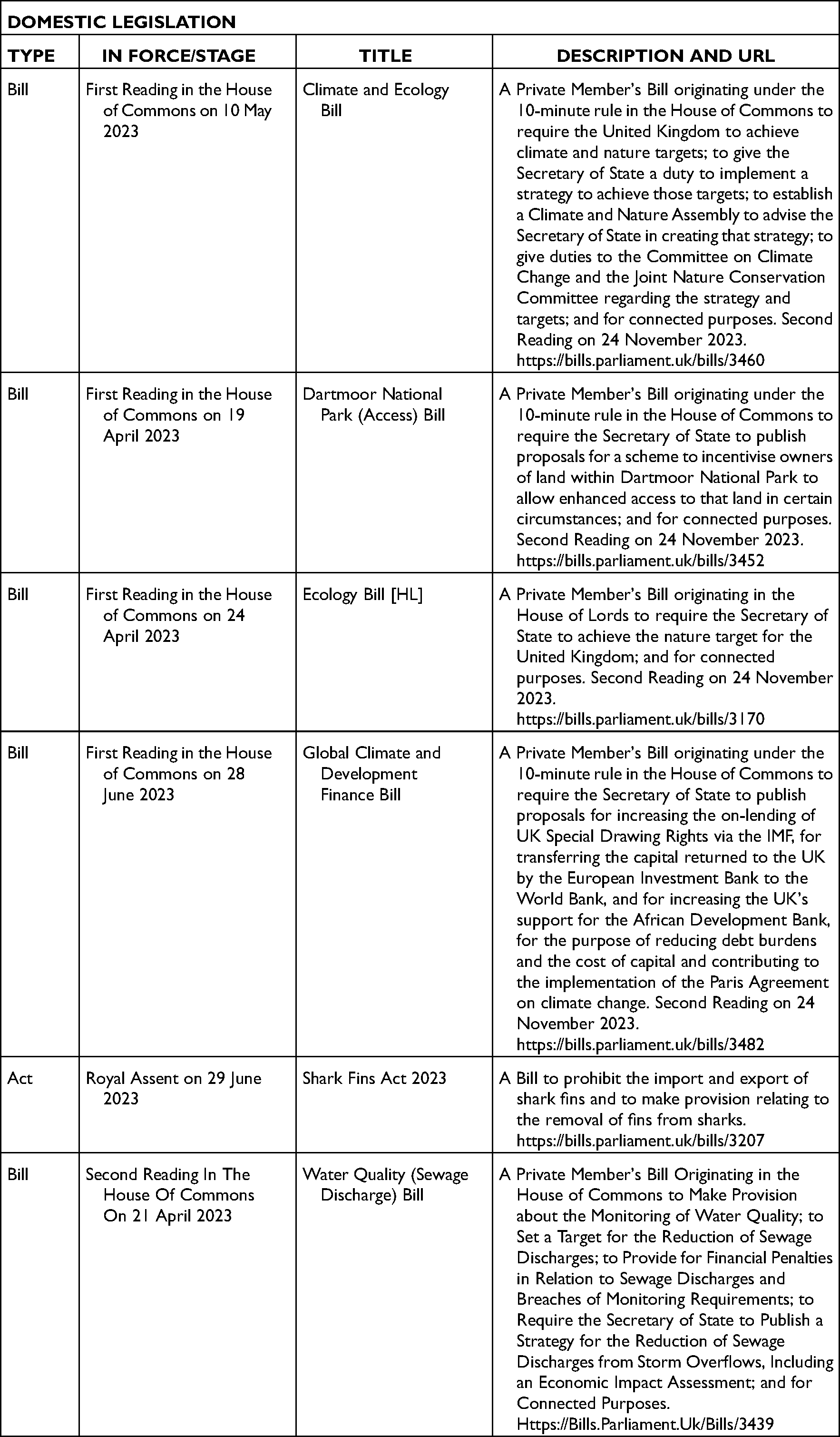
Sadly, however, there appeared to be the threat of a climb-down by the government on the net-zero targets for 2030. However, luckily we saw some positive movements in respect of climate change in parliament. The first readings of the Climate and Ecology Bill, Ecology Bill and Global Climate and Development Finance Bill are a positive move forward. After news broke in May of the horrendous state of water quality in Britain, the Water Quality (Sewage Discharge) Bill will hopefully get even more traction.
In ClientEarth v Shell Plc, ClientEarth sought permission to bring a derivative claim against Shell's company directors for having breached their duty in respect of the climate change risk management strategy. Yet more cases were brought in respect of protesters. TfL sought injunctions against 129 named defendants and unknown persons in Transport for London v Persons Unknown to prevent further protests at 34 identified locations which would block roads and surrounding areas. The Court granted the injunction, noting that while it did interfere with the Defendants’ rights under Art 11 and 12 of the ECHR, it was in pursuit of a legitimate aim and necessary in a democratic society. Similar decisions were made by the High Court in Transport for London v Lee and National Highways Ltd v Persons Unknown where injunctions were sought and granted to prevent protestors from blocking roads and similar.
Read on for more updates.
Update
Anna McClean
TRINITY CHAMBERS
Verity LJ Adams, Michael Haywood and Sarah Ismail
EU LEGISLATION AND TEXTS
Commission Regulation (EU) 2023/3 of 3 January 2023 correcting the German language version of Regulation (EU) 2019/1781 laying down ecodesign requirements for electric motors and variable speed drives pursuant to Directive 2009/125/EC of the European Parliament and of the Council, amending Regulation (EC) No 641/2009 with regard to ecodesign requirements for glandless standalone circulators and glandless circulators integrated in products (Text with EEA relevance)
C/2023/17
https://eur-lex.europa.eu/legal-content/EN/TXT/?uri=CELEX%3A32023R0003&qid=1682245433975
Directive (EU) 2023/958 amending Directive 2003/87/EC as regards aviation's contribution to the Union's economy-wide emission reduction target and the appropriate implementation of a global market-based measure
PE 8 23 INIT
This Directive introduces amendments to the EU ETS legislation in relation to its application to aviation to ensure that it contributes to the emission reduction target in accordance with the European Green Deal and later in the Commission's 2030 Climate Target Plan.
https://data.consilium.europa.eu/doc/document/PE-8-2023-INIT/EN/pdf
Sustainable Fisheries Partnership Agreement between the European Union and the Republic of Madagascar
ST 9007 2023 INIT
This agreement will allow 65 tuna fishing vessels from EU Member States to access Madagascar waters over a period of 4 years in exchange for €700,000 per year and €11 million sectoral support to accompany the sustainable development of the fisheries sector and the blue economy in Madagascar.
https://eur-lex.europa.eu/legal-content/EN/TXT/?uri=CONSIL%3AST_9007_2023_INIT&qid=1690375057506
Regulation of the European Parliament and of the Council establishing a carbon border adjustment mechanism
PE 7 2023 INIT
The Carbon Border Adjustment Mechanism (CBAM) would require importers of certain energy-intensive goods to pay a levy in respect of their imports that corresponds to the price of emissions allowances under the EU Emissions Trading System.
https://eur-lex.europa.eu/legal-content/EN/TXT/PDF/?uri=CONSIL:PE_7_2023_INIT
Regulation of the European Parliament and of the Council on the making available on the Union market and the export from the Union of certain commodities and products associated with deforestation and forest degradation and repealing Regulation (EU) No 995/2010
PE 82 2022 INIT
The Regulation sets out rules governing the entry of traded goods and raw materials originating from tropical forest ecosystems on the EU market and the export of derived products from the Union.
https://eur-lex.europa.eu/legal-content/EN/TXT/?uri=CELEX%3A32023R1115
Directive of the European Parliament and of the Council on energy efficiency and amending Regulation (EU) 2023/955 (recast)
PE 15 2023 INIT
The recast Directive introduces a series of measures to aid in accelerating energy efficient practices as well as requiring EU countries to achieve an average yearly energy savings rate of 1.49% from 2024 to 2030 in critical sectors.
Directive (EU) 2023/959 of the European Parliament and of the Council of 10 May 2023 amending Directive 2003/87/EC establishing a system for greenhouse gas emission allowance trading within the Union and Decision (EU) 2015/1814 concerning the establishment and operation of a market stability reserve for the Union greenhouse gas emission trading system (Text with EEA relevance)
PE/9/2023/REV/1
This Directive reviewed the legislative framework to ensure the latest climate ambition is met. It intended to ensure effective protection for the sectors exposed to significant risk of carbon leakage, addressed the distributional and social effective of the transition, ensured the sectors not included in the EU ETS contribute cost-effectively to emission reductions, reviewed the monitoring reporting and verification system of CO2 emissions from maritime transport and reviewed the Market Stability Reserve.
Regulation of the European Parliament and of the Council concerning batteries and waste batteries, amending Directive 2008/98/EC and Regulation (EU) 2019/1020 and repealing Directive 2006/66/EC
PE 2 2023 REV 1
The Regulation strengthens sustainability rules and applies to all batteries throughout the life cycle of a battery including through to recycling.
https://eur-lex.europa.eu/legal-content/EN/TXT/?uri=CONSIL%3APE_2_2023_REV_1
DOMESTIC CASE LAW
Recycling
Abdul Majid and Son Ltd, Petitioner [2023] CSOH 41
This case concerned the Deposit and Return Scheme for Scotland Regulations 2020, under reg.11 of which the producer of the packaging must pay the person from whom they collect the packaging a ‘reasonable handling fee’. The operator of a small enterprise petitioned for judicial review of the decision of the administrator of the deposit and return scheme determining the reasonable handling fee payable under reg.11. The court held that as the administrator was a private company set up to administer the scheme, it had no statutory power to set the reasonable handling fee and the petitioner was not contractually bound to accept the fee announced by it. The court also held that the four factors listed in reg.11(4) to be taken into account in setting the fee were by reference to the specific costs of that return point and not to general costs experienced by retailers in Scotland as a whole.
Planning
C G Fry and Son Ltd v Secretary of State for Levelling Up, Housing and Communities [2023] EWHC 1622 (Admin)
The claimant sought to quash the Secretary of State's decision to refuse to discharge conditions attached to a reserved matters approval in relation to planning permission for a mixed-use development because there had not been an appropriate assessment under the Conservation of Habitats and Species Regulations 2017. The claimant argued that the requirement for an appropriate assessment only applied to the planning permission stage and not to the discharge of conditions on a reserved matters approval, and that if an appropriate assessment was required the scope of the assessment should reflect the scope of the conditions being considered. The court refused the application. It held that although on a strict reading of art.63 Regulations an appropriate assessment was only required at the planning permission stage, under art.6(3) Habitats Directive a project should not be agreed until an appropriate assessment had been undertaken. The discharge of the conditions was a necessary step in the implementation of the development and the decision that the conditions could not be discharged without an appropriate assessment was consistent with art.6(3). The Regulations demanded a purposive interpretation so that the appropriate assessment provisions of reg.63 applied to a subsequent consent stage, including reserved matters applications and the discharge of conditions. The court also held that reg.63 required an appropriate assessment of the implications of the part of the project to which the consent related, which in this case was the whole development.
Persimmon Homes (Thames Valley) Ltd v Worthing BC [2023] EWCA Civ 762
The developer appealed against the decision that a planning inspector had erred in allowing its appeal against the local authority's refusal of outline planning permission for mixed-use development. The local authority had refused permission because the site lay outside the built-up area defined in its core strategy and was not allocated for residential development and because of the substantial adverse visual impact on the local area and the National Park. The planning inspector had reversed the local authority's decision on the basis that the site offered an acceptable location for development and the effect on the landscape was limited. The local authority had then successfully applied to quash that decision, with the High Court holding that the inspector had not provided adequate reasons for his conclusions and had misapplied Government policy for development that would affect the setting of a National Park. The court in this case dismissed the appeal against the decision of the High Court. It held that the inspector had provided proper reasons for his decision and his conclusions showed a reasonable and lawful exercise of planning judgement, but the inspector's reasons left substantial doubt that he had lawfully applied the relevant national policy regarding development within the setting of a National Park. His assessment of the likely effects did not demonstrate that he had given ‘great weight’ to the conservation and enhancement of the National Park's landscape and scenic beauty as required under para.176 of the National Planning Policy Framework.
Duff v Causeway Coast and Glens BC [2023] NICA 22
The appellant appealed against the dismissal of his application for leave to apply for judicial review of the respondent's decision to grant planning permission for an infill dwelling. The appellant had not objected to the planning application but sought to challenge the decision. The appellant's interest was based purely upon environmental protection. The court held that he had standing to bring judicial review proceedings despite not having participated in the planning process. It held that the question of standing required careful consideration and was to be determined by the court. Although a litigant should ordinarily have participated in the planning process, in this case, where the appellant was properly engaged with rural planning policy, the local authority (acknowledging that its decision had been unlawful) had invited him to apply to have the planning permission quashed, and there were no other challengers to the decision, the circumstances were exceptional, and the appeal was allowed.
R (on the application of Friends of the West Oxfordshire Cotswold) v West Oxfordshire District Council [2023] EWHC 901 (Admin)
A defendant local authority had granted planning permission for development consisting of a number of residential dwellings on land adjacent to an ancient woodland. The ecological assessment and biodiversity management plan submitted with the application for planning permission included a 5-metre buffer zone between the development and the ancient woodland and planning permission was granted subject to the approval of plans and schemes to protect the ancient woodland. The local authority subsequently approved such plans despite them showing that the 5-metre buffer could not be achieved at three points along the boundary, and the claimant challenged this approval and the discharge of the condition. The court held that the wording of the condition permitted no room for planning officers to subsequently vary the width of the buffer zone on an application to discharge and that, given the express importance of the buffer zone, the decision must be quashed.
R (on the application of Plant) v Lambeth LBC [2023] EWCA Civ 809
The appellant appealed against the local authority's decision to grant planning permission for a redevelopment that involved felling mature trees. The local plan policy required particular account to be taken of existing trees on the site and provided that planning permission would not be granted if it resulted in the loss of trees of significant amenity, historic or ecological/habitat conservation value. The local plan also required that adequate replacement planting be secured where it was ‘imperative’ to remove trees. The appellant submitted that this amounted to an absolute prohibition on felling the trees, and the policy regarding replacement trees provided for replacement planting if the prohibition was breached. The court held that this was not the case and that it should be treated as delineating and defining the circumstances in which trees might be removed. It also held that the variables to be taken into account when interpreting the word ‘imperative’ included: (i) the significance, quality and value of the trees; (ii) whether the proposed development could be implemented without removing the trees; (iii) the benefits sought to be achieved by the scheme and (iv) whether an alternative scheme could achieve the same/similar benefits without requiring the removal of the trees.
Environmental information
Patricia Guthrie v The Information Commissioner [2023] UKFTT 00443 (GRC)
This appellant appealed against the Information Commissioner's decision relating to the appellant's request for information from Brent Council regarding a redevelopment project. The appellant had made a general request for ‘all information relating to the property’ and the plans for developing it. This request had been refused and the Information Commissioner had concluded that the Council had been entitled to refuse to disclose the information. In this instance, the panel held that, unlike the Freedom of Information Act 2000, the Environmental Information Regulations 2004 do not impose a specific limit on the amount which the public authority must do to respond to a request and therefore public authorities may be required to accept a greater burden to provide environmental information under the EIR than other information under the FOIA. However, the information relating to the property and its development went back 40 years and therefore the Commissioner had not erred in accepting that responding to the request would require a disproportionate use of public resources and impose a disproportionate burden on the Council. The tribunal agreed that while there is a strong public interest in transparency and accountability on the part of public authorities regarding environmental information, this was outweighed by the even stronger public interest in protecting public authorities from exposure to disproportionate burden of resources and expense in responding to such wide-reaching requests for information.
Judson v The Information Commissioner [2023] UKFTT 384 (GRC)
The appellant filed a Notice of Appeal in respect of the Information Commissioner's decision upholding a public authority's reliance on the exception in reg.12(4)(a) of the Environmental Information Regulations 2004 (that it did not hold the information requested) to refuse to provide information requested by the appellant. The tribunal held that this was not a case that could be described as ‘not fit for a full hearing’. Confusion had been caused by the public authority's change of stance during its correspondence with the appellant and information had subsequently come to light that the Information Commissioner was unable to consider in conducting the balance of probabilities exercise. It was immaterial whether the Information Commissioner regarded the evidence as failing to change his conclusions – the appropriate course was for the tribunal to consider the matter afresh.
ENVIRONMENTAL IMPACT ASSESSMENT
Nuisance
Jalla v Shell International Trading and Shipping Co Ltd [2023] UKSC 16
The appellants appealed against a decision that they were out of time to amend their claim against the respondent for private nuisance arising from an offshore oil spill. The spill had been caused by a ruptured pipeline in an oilfield off the coast of Nigeria. The oil had leaked for 6 hours and had washed up on the shore on the Nigerian coast, where the appellants owned land, with a devastating effect on their land. The appellants issued a private nuisance claim within the 6-year limitation period provided for in s.2 Limitation Act 1980. More than 6 years later, they sought to amend their pleadings to add a new claim, arguing that for so long as oil from the spill remained on their land and was not cleaned up there was a continuing nuisance. The court dismissed the appeal. It held that the general principle is that a continuing nuisance is one where there is a repeated activity by the defendant or an ongoing state of affairs for which the defendant is responsible that results in the cause of action accruing afresh on a continuing basis. It held that in this case the spilled oil not having been removed from the land did not constitute a continuing nuisance. Holding otherwise would be contrary to principle and would undermine the law on limitation and would impliedly convert the claim of private nuisance into one of failure to restore the land.
Chalmers v Diageo Scotland Ltd [2023] CSOH 43
Homeowners took action against the defender in respect of nuisance caused by the release of ethanol vapour from their nearby warehouse, alleging that the vapour escaped into the surrounding atmosphere and encouraged the growth of a fungus that caused their house and garden to be affected by sooty deposits or staining. The defender sought to have the action dismissed or, alternatively, exclusion of particular parts of it, on the grounds that there was a lack of clarity in relation to what the pursuers were arguing in relation to the fungus and inconsistency in the language used. The court held that it was clear what the pursuer had to prove and therefore there was no lack of clarity as to the case that the defender had to answer. Although there was some inconsistency of language in the pleadings, this did not result in any genuine risk of confusion as to what the pursuers’ case was.
https://www.bailii.org/scot/cases/ScotCS/2023/2023_CSOH_43.html
Transport for London v Persons Unknown [2023] EWHC 1038 (KB)
The claimant sought an injunction against 129 named defendants and certain defined persons unknown, including supporters of Insulate Britain, preventing the blocking of the roads and surrounding areas at 34 identified locations on the basis that the protests constituted trespass, private nuisance and/or public nuisance. The court held that the protestors entering onto the claimant's land and using it for a purpose other than exercising a public right of way constituted trespass, that the protests constituted private nuisance as they caused a substantial and unreasonable interference with the enjoyment and exercise of the rights of way of other road users, and that a public nuisance arose as the protests prevented the public from freely, safely and conveniently passing along the roads. The court found there was a real and imminent risk of further protests that would infringe the claimant's rights and cause grave and irreparable harm for which damages would not be an adequate remedy. The interference with the defendants’ rights under art.11 and art.12 European Convention on Human Rights was in pursuit of a legitimate aim and was necessary in a democratic society. As such it struck a fair balance between the legitimate aim and requirements of freedom of expression and freedom of assembly, and it was just and convenient for a final injunction to be made against the named defendants. With regard to the persons unknown, the seven guidelines for granting interim injunctions against persons unknown had been met.
Transport for London v Lee [2023] EWHC 1201 (KB)
The claimant sought an injunction against named defendants and persons unknown to prevent them from blocking, slowing down, obstructing or otherwise interfering with access to or the flow of traffic on specified roads, lasting for a period of 5 years with annual reviews. The question before the court was whether it was appropriate to make the proposed injunction against persons unknown in circumstances where a single breach would suffice to put a person in breach at risk of committal proceedings. The court held that there was a real risk of the rights of the claimant and others being breached, with a risk of grave and irreparable harm. The court therefore held that while the granting of an injunction would be an interference with the defendants’ rights under art.11 and art.12 European Convention on Human Rights, this was in pursuit of a legitimate aim. The court was satisfied that the proposed injunction was proportionate and struck a fair balance between the Convention rights of the defendants and the rights of others.
National Highways Ltd v Persons Unknown [2023] EWHC 1073 (KB)
The claimant sought a continuation of an injunction preventing climate change protestors from blocking, endangering, slowing down, obstructing or otherwise preventing the free flow of traffic on the M25 and certain other roads. The court granted the application. It held that there was a real risk that protests would continue, and the injunction was continued for a year with a review in the month before it expired. However, the defendants were given 2 weeks in which to provide an undertaking not to protest by blocking the roads for 2 years and defendants who signed an undertaking would be removed from the list of defendants. The court was not prepared to continue the disclosure obligations requiring the police to disclose the identity of those arrested during the protests so that they could be named in proceedings without considering further submissions from the claimant.
Partakis-Stevens v Sihan [2023] EWHC 1051 (TCC)
This case concerned work undertaken by developers to the garden of a property neighbouring the claimant's property. The main action concerned the claimant's allegation that the developers’ work had caused flooding to their garden as a result of surface water run-off that amounted to nuisance and that the developers had been negligent in undertaking the works. The developers had sold the property and the claimant was also claiming that the current owners had continued the nuisance by failing to take steps to remedy the run-off. The current owners defended this claim and brought an additional claim seeking a contribution from the developers, alleging breach of the property sale contract and fraudulent misrepresentation for not having informed them of the dispute with the claimant. The court held that the developers were liable to the claimant in nuisance and negligence and awarded damages. It also held that the current owners were liable in nuisance and granted an injunction requiring them to undertake remedial works. The court held that the developers were liable to the current owners for misrepresentation and awarded damages fully indemnifying them for the losses incurred as a result of the misrepresentation.
Waste
Markovic v Leicester City Council [2023] UKFTT 516 (GRC)
The appellants appealed against the imposition of a fixed penalty for failure to comply with a notice served under s.46 Environmental Protection Act 1990 relating to their failure to take their bins off the footpath after collection. Under s.46, a person who fails to comply with a written warning without reasonable excuse can be required to pay a fixed penalty. The appellants argued that they were not aware that bins could not be left on the street because it was the practice of other properties on the street to do the same. The court held that it would ordinarily attach little weight to this as it is the responsibility of residents to understand their obligations. However, in combination with the appellants’ lack of English language skills, their reasons for not removing their bin amounted to a reasonable excuse.
Climate change
ClientEarth v Shell Plc [2023] EWHC 1137 (Ch)
The claimant sought permission to bring a derivative claim, alleging that the defendant company's directors had breached their duty regarding the company's climate change risk management strategy, including the duty to promote the success of the company under s.172 Companies Act 2006 and the duty to exercise reasonable care, skill and diligence under s.174. Specifically, it alleged that the directors had failed to set an appropriate emissions target, that the strategy for the management of climate risk did not establish a reasonable basis for achieving the net zero target and was not aligned with the Paris Agreement on Climate Change 2015, and that the directors had not prepared a plan to ensure timely compliance with the requirement for a 45% emissions reduction by 2030. The court refused the application. It held that the claimant had not made out a prima facie case that there was no basis on which the directors could reasonably have concluded that the actions they had taken had been in the company's interests. Nor had they made out a prima facie case that the court should grant the relief sought.
EU CASE LAW
WertInvest Hotelbetriebs GmbH v Magistrat der Stadt Wien (C-575/21) EU:C:2023:425
An Austrian court asked the ECJ to give a preliminary ruling on the interpretation of the rules in Directive 2011/92 on the effects of public and private projects on the environment (EIA Directive) in relation to the granting of development consent for an urban development project. The development consent decision had been referred to the court and the applicant submitted that, having regard to the thresholds and criteria in Austrian law, the project was not subject to the requirement for an environmental impact assessment. The ECJ held that the requirement to carry out an EIA for an urban development project could not be determined exclusively by reference to the size of the project and that development consent should not be granted for the individual construction measures which form part of larger urban development projects without either an EIA or a case-by-case assessment of the environmental effects in order to clarify the need for an EIA.
European Commission v Portuguese Republic, Case C-220/22, 29 June 2023
The Court (Sixth Chamber) declared that the Portuguese Republic had failed to fulfil its obligations under Article 13(1) of Directive 2008/50/EC of the European Parliament and of the Council of 21 May 2008 on ambient air quality and cleaner air for Europe by systematically and persistently exceeding the annual limit value for nitrogen dioxide from 1 January 2020 to the year 2020 in the zones of Lisboa Norte, Porto Litoral and Entre Douro e Minho. It had further, in respect of all those zones, failed to fulfil its obligations under Article 23(1) of Directive 2008/50 and in particular its obligation to take appropriate measures so that the exceedance period could be kept as short as possible. The Court ordered the Portuguese Republic to pay the costs.
https://eur-lex.europa.eu/legal-content/EN/TXT/?uri=CELEX%3A62022CJ0220&qid=1690454093489
European Commission v Ireland, Case C-444/21, 29 June 2023
The Court (Second Chamber) declared that Ireland had failed to fulfil its obligations under Article 4(4) of Council Directive 92/43/EEC of 21 May 1992 on the conservation of natural habitats and of wild fauna and flora, as amended by Council Directive 2013/17/EU of 13 May 2013, by failing to designate as special areas of conservation as soon as possible (or within 6 years at most) in respect of 217 of the 423 sites of Community importance included on the list established by Commission Decision 2004/813/EC of 7 December 2004 and further failing to define detailed site specific conservation objectives for 140 of the sites. Further, the Court declared that by failing to adopt the necessary conservation measures which corresponded to the ecological requirements of the natural habitat types referred to in Annex I and the species referred to in Annex II to Directive 92/43, as amended by Directive 2013/17, present on the 423 sites of Community importance referred to in point 1 of the operative part, Ireland had failed to fulfil its obligations under Article 6(1) of Directive 92/43, as amended. The Court dismissed the action as to the remainder and ordered Ireland and Germany to bear their own costs whilst also ordering Ireland to bear the costs incurred by the European Commission.
https://eur-lex.europa.eu/legal-content/EN/TXT/?uri=CELEX%3A62021CJ0444&qid=1690454093489
CONSULTATIONS


NEWS AND MISCELLANEOUS
‘ClientEarth loses High Court fight with Shell over climate strategy’, The Guardian, 24 July 2023
An environmental law charity has lost an attempt to revive a lawsuit against Shell over its climate strategy after the High Court in London refused permission to bring a case against the energy company.
‘Michael Gove calls for relaxation of net zero measures and warns against treating environment as “religious crusade”’, Sky News, 23 July 2023
The Housing Secretary said the proposal to ban landlords from renting out their homes unless they pay to increase the energy performance certificate rating of their properties should be pushed back past 2028.
‘Plastic pollution: Campaigners around the world are using the courts to clean up – but manufacturers are fighting back’, The Conversation, 26 June 2023
Amid growing concerns over plastic pollution and weak governmental response to it, individuals and communities have been seeking action by resorting to courts.
‘Japan to get crucial UN support to release Fukushima water into ocean’, The Age, 4 July 2023
Japan is set to receive a report from UN nuclear watchdog to approve its plan to release treated radioactive water from the tsunami-wrecked Fukushima plant into the ocean despite fierce resistance from Beijing and some local opposition.
‘The Supreme Court just upended environmental law at the worst possible moment’, The Washington Post, 30 June 2023
The Supreme Court just made official what environmentalists have dreaded would come to pass as soon as Donald Trump was elected president: a radically conservative majority, in West Virginia v. Environmental Protection Agency, has seriously threatened environmental law's ability to safeguard public health and welfare.
‘The lawyers taking polluters to court: “No company is above the law”’, The New Statesman, 15 May 2023
The CEO of ClientEarth on how legal action is breaking political stasis on the climate.
‘Water companies with faulty sewage monitors to be automatically penalised under new Ofwat rules’, The Telegraph, 9 May 2023
The regulator will set new targets for water companies to reduce spills from storm overflow sites in England and Wales from 2025.
https://www.telegraph.co.uk/news/2023/05/09/water-companies-faulty-sewage-monitors-penalties-ofwat/
‘EU passes nature restoration law in knife-edge vote’, The Guardian, 12 July 2023
The EU has narrowly passed a key law to protect nature – a core pillar of the Commission President Ursula von der Leyen's European Green Deal – after months of fiery debate and an opposition campaign scientists criticised as misleading.
https://www.theguardian.com/world/2023/jul/12/eu-passes-nature-restoration-law-vote-meps