



Abstract
This study proposes a framework for examining hashtagged content on social media, which captures how specific issue frames (i.e. hashtags) contribute to navigable structures. We introduce ‘interwoven multimodal discourse’ as a pluralist alternative to the widely applied unitary approach in which trending hashtags serve as primary sites of analysis. The study argues that ‘interweaving’ of social media discourse takes place through practices such as hashtag colocation, which result in ambient and navigable structures. Analysis of hashtag colocation networks can serve as an approach for mapping ambient affiliations accessible through such structures. We analyse a hashtag colocation network constructed using a sample of 1100 Instagram posts related to climate change uploaded during the United Nations Climate Change Conference 2021 (COP26) held in Glasgow to demonstrate two structural properties of interwoven discourse on Instagram: (1) hashtags contribute to multiple thematic clusters and (2) micro-level hashtags representing secondary topics are nested within larger thematic clusters.
Introduction
Social media hashtags – that is, digital markers used to self-categorise content or develop a thread of conversations (Caliandro, 2017) – allow organising collective phenomena around focal points, such as social issues, brands, events and political actors. Different theoretical perspectives, such as discursive activism, ad hoc issue publics (Bruns and Burgess, 2011; Bruns and Moe, 2014) and affective publics (Papacharissi, 2016) examine the role hashtags play in enabling public discourse. These perspectives show how hashtags serve as spaces for mobilising various user groups via affective as well as discursive forms of engagement. The use of hashtags to mark a given post can indicate the relevance of an utterance to a specific discourse. Hashtags allow individual and collective selection, labelling and interpretation of issues as well as the demarcation of the boundaries of digital discourse. Moreover, they serve as technical access points to streams of content, and render digital discourse related to a given issue searchable. As this aligns with Entman’s (2006) notion that framing involves selection of some aspects of reality and making them more salient through textual means, the use of hashgtags can be considered as a digital manifestation of framing. A hashtagged term performs the dual function of acting as a ‘frame’ that represents a specific topic as well as a technical element that allows user access to posts containing the term. Accordingly, hashtagged public discourse constitutes searchable groups of utterances framed using hashtags that label distinct topics related to a given discourse.
This study addresses three limitations in current hashtag publics literature: (1) a widely used unitary view that favours dominant or popular frames, (2) lack of attention to differences between text-based platforms (e.g. Twitter) and social media primarily driven by images (e.g. Instagram) and (3) limited emphasis on platform affordances. Researchers who take a unitary view consider one or a few popular (i.e. ‘trending’) hashtags as primary frames within which a given public discourse takes place (e.g. Choo et al., 2022; Clark-Parsons, 2019; Dawson, 2020; Harlow and Benbrook, 2017; Nacher, 2020; Parsloe and Holton, 2017; Suk et al., 2019). The unitary view emerged around Twitter hashtags and gradually became influential in studies that examine Instagram (e.g. Barbour and Heise, 2019; Ben Taleb et al., 2019; Henderson et al., 2021; Jaramillo-Dent and Pérez-Rodríguez, 2019; Kim and Lee, 2022; Mee and Jackson, 2022; Rosa and Soto-Vásquez, 2022). Although the unitary approach provides useful insight into the depth of debate within chosen frames, it has limited potential to map how a multifaceted public discourse takes place via multiple hashtags.
While social media research needs to embrace the multiplicity of hashtag publics, it is also crucial to consider whether visual elements uniquely apply to our understanding of hashtag publics. Although the technical functionality of hashtags remain the same across platforms, and social network sites (SNS) that are not primarily driven by images (e.g. Twitter) allow visual content, there are subtle differences in meaning-making and cultural practices associated with hashtags between text-based and image-based platforms, the latter of which some scholars refer to as ‘visual social media’ (Leaver et al., 2020) or ‘digital visual media’ (Dean, 2019). Visual social media contain polysemic elements, such as memes, as well as visual objects that elicit different meanings when employed in different ways (Highfield and Leaver, 2016). Such polysemy may particularly encourage colocation (i.e. the use of multiple hashtags to mark individual posts), which results in increased interconnectivity among streams of content. For instance, Instagram content related to specific social or political issues span across a wide variety of hashtags, including hashtags that mark different aspects related to the issue as well as topics that may not seem directly relevant to specific issues (Rathnayake and Suthers, 2021). A unitary view offers limited potential to understand the multifaceted nature of visual content, as individual images often represent multiple ‘publics’.
Hashtags operate on semantic, social and technical levels, and serve as social metadata as well as parts of linguistic structure and discourse semantics (Zappavigna, 2015). While many previous studies focus on meaning-making associated with hashtagged content, they do not adequately acknowledge the technical functionality of hashtags that enables digital affordances, such as searchability (boyd, 2011) and navigability (Sundar and Limperos, 2013). Accordingly, a ‘pluralist’ approach is needed to examine how digital publics related to specific issues constitute a multitude of interconnected frames, which allow seamless navigability for users.
This study proposes interwoven digital discourse based on the notion of ambient affiliations (Zappavigna, 2011) as an alternative to the unitary publics approach. We focus on the plurality of digital publics by emphasising how specific issue frames (i.e. hashtags) contribute to navigable structures, which make ambient affiliations accessible to users. Our contribution is two-fold. First, we introduce ‘interwoven multimodal discourse’ – that is, fields of content on social media that consist of interconnected and navigable frames enabled by platform affordances – as a pluralist alternative to the above-mentioned unitary approach. We argue that ‘interweaving’ of content is afforded by social media where ambient and navigable structures emerge via hashtag practices. Second, we demonstrate two structural properties of interwoven structures of discourse, using overlapping community analysis: (1) dominant issue frames, trending hashtags for instance, permeate multiple ‘thematic clusters’ – that is, groups of utterances represented by interconnected hashtags that represent specific topical orientations within digital discourse, and (2) hashtags representing narrow or secondary themes are nested within or intertwined with larger themes. We use a sample of Instagram posts covering the 2021 United Nations Climate Change Conference (COP26), which was held in Glasgow, Scotland from 31 October to 13 November 2021, to demonstrate analytical techniques. The case of COP26 serves only as a convenient illustrative example: the analytical approach proposed in this study has broader implications for analysing other hashtagged content on social media.
Hashtag publics: towards a pluralist conception
Understanding hashtagged discourse as a collective process of framing social phenomena is central to our conception of interwoven multimodal discourse. Based on Entman’s (2006) conceptualisation of framing, we identify hashtagged public discourse as a collective process of framing social phenomena using social media affordances. Entman’s conceptualisation suggests that frames operate throughout the communication process, performing a variety of functions, including selection and highlighting, and use of the highlighted elements to construct an argument about problems and their causation, evaluation and/or solution. Hashtagged discourse emerges and operates through individual and collective selection, labelling and interpretation of social issues as well as the negotiation of solutions for such issues. The terms marked by the ‘#’ symbol serve as shared labels that represent distinct frames within the discourse and unify content that share the hashtag as belonging to the corresponding frame.
Rival, parallel and trivial(?) hashtags
Hashtags are dynamic phenomena, which are open to definition, redefinition and re-appropriation (Papacharissi, 2016). Therefore, the study of hashtags should embrace the plurality of digital discourse. Previous work provides useful insight into hashtags as social entities and tools for analysis (La Rocca and Boccia Artieri, 2022), and the unitary view remains a widely applied practice in social media research. This study does not negate the unitary approach; instead we emphasise the need for a nuanced and pluralist approach for understanding hashtagged interactions.
Studies of contemporary social and political movements, particularly those that mobilise around specific hashtags, often require a unitary approach. Papacharissi (2016) notes that hashtags such as #BlackLivesMatter can be considered as framing devices that allow crowds to transform into publics driven by affect, which materialise discursively through social network sites. The use of dominant frames, such as #BlackLivesMatter and #MeToo as framing devices for analytical purposes indicates their use as primary sites within which specific discourses take place. This embraces the unitary view that, for analytical purposes, such hashtags can be considered akin to digitally mediated publics. This approach is appropriate in contexts such as #BlackLivesMatter, where the chosen hashtags mobilise individuals and develop a collective identity to such an extent that it can alter existing paradigms and outlive rival hashtags (Langford and Speight, 2015). Individual hashtags can serve as primary sites of investigation for events in which the use of hashtags is a central aspect of activism or functioning of political movements (Papacharissi, 2016).
The practice of using hashtags as framing devices for scholarly inquiry extends beyond movements and activism organised around hashtags. Bruns and Burgess (2011) argue that ‘hashtag communities’ – that is, user groups that may not necessarily share interests, be aware of or engage with each other but that share a specific textual attribute – can act as issue publics gathered around central interests (e.g. #ausvotes, #londonriots, #wikileaks). These issue publics form ad hoc, perform and dissolve within a short time period. This perspective can be seen to great extent in many studies, which examine a variety of Twitter hashtags (e.g. Evans and da Silva, 2021; Jarvis and Eddington, 2021; Maas et al., 2018; Mortensen, 2017; Ross and Bhatia, 2019; Veenstra et al., 2014). Although this is a common approach in social media research, unitary framing limits the validity of claims made regarding digital discourse distributed across different hashtags unless the chosen hashtags play a central role in mobilising discourse.
Increasingly, scholarly work points to the emergence of rival as well as parallel hashtags around social and political issues, including discrimination and anti-government protest. Such hashtags operate even within the contexts of political movements that operate primarily via dominant hashtags. For instance, Goodman, Tafi and Coyle (2022) show the use of alternative ‘lives matter’ formulations to obscure or deny discrimination and maintain racist status quo. Similarly, Graham et al. (2020) demonstrate the emergence of ad hoc rival narratives among pro-government and anti-government political campaigners. Moreover, previous studies also show how parallel or ‘satellite’ counter publics operate within political issues. For instance, Kuo (2016) suggests that hashtags such as #Solidarityisforwhitewomen and #NotYourAsianSideKick form as racialised counterpublics, which consists of individuals who are ‘invisible’ within broad issue publics. Dunklin and Jennings’s (2022) analysis of #BlackTransLivesMatter shows the contentions related to ‘satellite’ publics that are distanced from but relevant to the mainstream discourse. Moreover, hashtags can also be subject to ‘hijacking’ where activists ‘repurpose’ the hashtag or collocate it with another in order to mobilise user groups (Blevins and Lee, 2022). In addition, as Blevins et al. (2019) demonstrated, hashtags representing different schemas, such as ideologies, concepts and more trivial hashtags, such as places and proper names, emerge within digital conversational environments.
The above discussion highlights several limitations of unitary framing of digital publics. First, it may encourage exclusionary choices, which favour dominant (i.e. ‘trending’) hashtags in the selection of sites for analytical purposes and may overlook the role played by secondary, tertiary or other hashtags related to the issue. Second, a unitary view may ignore the connections among hashtag publics that evolve as separate issue publics. Nevertheless, unitary framing is widely used in Twitter research and has permeated Instagram studies to a significant extent (e.g. Barbour and Heise, 2019; Ben Taleb et al., 2019; Henderson et al., 2021; Jaramillo-Dent and Pérez-Rodríguez, 2019; Kim and Lee, 2022; Mee and Jackson, 2022; Rosa and Soto-Vásquez, 2022). This necessitates a pluralist approach for demarcating digital issue publics, especially because such a perspective acknowledges the presence of multiple publics, including rival, parallel and satellite publics related to a given issue. More importantly, a pluralist approach can provide useful insight into the positionality of individual hashtags within a broad public discourse.
Scholars have used different approaches to capture the multifaceted nature of hashtaggged discourse. In particular, purposive selection of several hashtags is appropriate for comparative analysis of parallel or rival issue publics. However, the distinctiveness of selected hashtags and the multiplicity of a given digital discourse play a crucial role in determining the validity of claims being made. McMonagle et al. (2019) select three distinct hashtags (#cymraeg, #frysk, and #gaeilge) to conduct a comparative analysis of the use of three minority languages: Cymraeg/Welsh, Frysk/Frisian and Gaeilge/Irish. The choice of hashtags for sampling is crucial within this context as the selected hashtags specifically identify distinct language communities. This allowed researchers to highlight differences among hashtags and argue that communities that each hashtag represented had unique character. Selection of a range of issue publics can also minimise biases to considerable extent. For instance, Jackson et al. (2020) provide a comprehensive analysis of a wide range of hashtags revealing engagement within networked counterpublics related to race and gender, such as #YesAllWomen, #MeToo, #FastTailedGirls, #YouOKSis and #SayHerName. This approach allows researchers to examine the characteristics of each issue public. Moreover, a strategic sampling approach can also effectively mitigate the limitations of the unitary approach to some extent. For instance, Hautea et al. (2021) employ a systematic approach by selecting top content and identifying hashtags that had high visibility for sampling purposes. Moreover, selection of a wide range of hashtags based on different criteria (Carpenter et al., 2022) can provide a broader perspective. Although the above approaches provide a systematic basis for sampling, it can be less effective if the selected hashtags lack distinct characteristics or issues being investigated spread across a wide range of related topics. Using key terms, including hashtagged words (e.g. Blevins et al., 2019), as entry points can be more effective as it eliminates issues caused by the selection of specific hashtags and allows researchers to examine the positionality of hashtags within a broad discourse. The following section further problematises the unitary approach.
Polysemy, hashtag colocation and visual communication
While analysis of dominant hashtags does not adequately acknowledge the presence of rival and parallel hashtags, it also overlooks the role multiple hashtags play within individual posts. Researchers have highlighted the use of multiple hashtags within individual tweets (Booten, 2019) and the role they play within the semantic structure (Zappavigna, 2015). Our intention is to stress analytical implications of co-occurring hashtags on social media. Colocation is a common practice among social media users, especially on visual social media platforms. We adapt the notion of polysemy – the presence of more than one sense in a lexeme (Polysemy (multiple meaning), 2018] – to demonstrate how the practice of hashtag colocation further problematises the unitary approach. A polysemous expression makes different contributions in different contexts and is a mixture of both pragmatic modulation – that is, derivation of senses, generation of specific senses based on general senses in particular – and ambiguity (Recanati, 2017). This concept is generally used in linguistics, yet it offers a useful perspective to understand media content. For instance, Edgerly et al. (2011) argue that polysemy presents a difficult challenge for activists who use mass media for political purposes. They note that the use of ambiguous terms makes protests vulnerable, generating resistive readings that support reactionary agenda. Carragee (2003) demonstrates how the use of specific frames that resonate with national values can restrict polysemy. Moreover, Boxman-Shabtai and Shifman (2014) identify textual attributes that characterise polysemy in mediated humour. Their discussion of ‘centrifugal multimodality’ – that is, how ‘different modes of communication embedded in a text invoke (or ‘pull towards’) different meanings’ (p. 984) – shows that the presence of elements such as images, sound, layout and hyperlinks complicate text and influence readers’ engagement.
Social media posts are multimodal expressions, which often contain text and images that convey multiple meanings and are marked with several tags. The use of multiple hashtags to mark a post indicates ‘presence’ of a post in multiple frames. Colocation of hashtags within individual posts may result from polysemous interpretation of a post from the perspective of those who post content. Figure 1(a) shows an Instagram post accessed using the hashtag #climatechange. The post has been marked using a number of hashtags, which represent distinct public discourses including sustainability, veganism and slow fashion (see Figure 1(b) to (d)). The visual content of the post is highly ambiguous, and a unitary framing may describe the post as an image that primarily represents a public organised around a specific topical orientation. For instance, researchers who study climate change may treat the image as a member of #climatechange and ignore the membership of the post within other streams (e.g. #fashion).
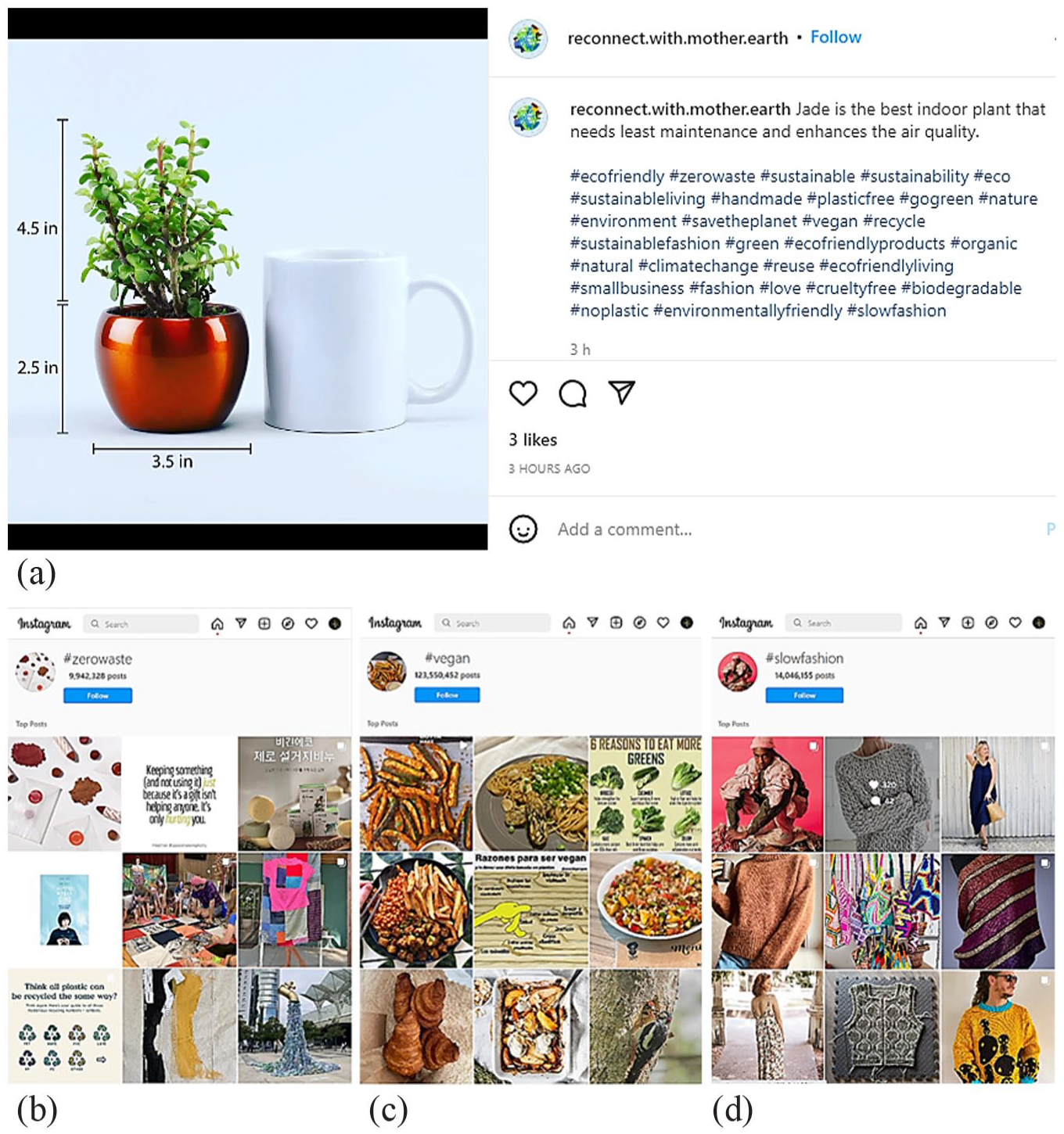
An Instagram post that contributes to multiple topics. (a) Post; (b) #zerowaste; (c) #vegan; (d) #slowfashion.
Figure 1(a) also includes a range of hashtags, such as #love, #smallbusiness, #crueltyfree and #natural, which do not adequately contribute to a coherent message. As Highfield and Leaver (2015) suggested, this may indicate that the user may simply use hashtags to enhance the caption and may not intend each hashtag to group together with other hashtags in a meaningful way. This is also consistent with the argument that, within phatic and primarily visual discourse, the sense of presence conveyed does not depend solely on the content of images (Niemelä-Nyrhinen and Seppänen, 2019). Moreover, the use of multiple hashtags may also show strategic use of platform affordances to enhance visibility of content. A dearth of work on this technical aspect demands a notion of publicness in which hashtags are understood in relation to their positionality within ambient and navigable structures enabled by platform affordances.
An alternative: interwoven structures of multimodal discourse
The above issues should be addressed on two levels: (1) the use of the unitary approach should be limited to issues that require such an emphasis (e.g. #MeToo, #BlackLivesMatter), and (2) analytical approaches should capture the ability of hashtags to contribute to multiple discourses. We use the notion of ambient affiliations (Zappavigna, 2011) to propose a perspective that addresses the latter. Zappavigna (2015) argues that tagging enables searching social media discourse and supports ambient communion allowed by the ability to find utterances made by others. She notes that, from this perspective, connections are ambient as there is sense of presence of others within the network, although they may not be necessarily linked to each other via user accounts or conversations. This suggests that hashtags, as social metadata, enable real-time search that allows users to observe how a given social media discourse unfolds. Accordingly, the presence of a wide range of hashtags in a stream of posts means that users are exposed to a wider set of ambient affiliations. These affiliations allow users to navigate different topics (i.e., themes) within the discourse. This argument acknowledges affordances such as searchability (boyd, 2011) and navigability (Sundar and Limperos, 2013) that enable user movement through the medium.
Interconnected fields of content on Instagram characterises a set of ambient affiliations, rather than well-defined publics. This view is particularly useful within the current context where there are variations in people’s experiences with social media and the fact that digital data do not adequately represent certain populations (Hargittai, 2020). As affordances, hashtags enable interweaving of different frames related to a given discourse. The ‘interweaving’ of frames – that is, building interconnectedness among frames – is a socio-technical process, which involves meaning making as well as enacting technical functionality. Zappavigna (2015) argues that, while hashtags function on the level of discourse and typography, they are also used to search for information and track or coordinate conversations within a domain, signal the presence of others within the network, and retrieve and aggregate different dimensions of the discourse. While platforms allow users to engage with a population of ambient affiliations (Zappavigna, 2011), hashtags allow communing affiliations around values within a social stream (Zappavigna and Martin, 2018). Such ambient affiliations on social media exist as interwoven structures formed through hashtag practices, such as colocation. Our discussion of structures of multimodal discourse acknowledges that social media content consists of different media elements (e.g. text, images and videos) interconnected through the use of technical functionality and serves as an alternative to the unitary hashtag publics approach.
The notion of affordances, which takes an ecological view to describe action possibilities offered by a given environment (Gibson, 1976), helps develop the above conceptualisation from a socio-technical perspective. Affordances are defined as a relational structure between technology and users that enable or constrain behaviour (Evans et al., 2017). Scholars identify a range of social media affordances, such as replicability, searchability, scalability (boyd, 2011), agency, interactivity and navigability (Sundar and Limperos, 2013). The use of hashtags shows users’ awareness of the linguistic functions of hashtags as well as imagining of affordances of technology (Nagy and Neff, 2015) as a result of which users actively render their utterances findable (Zappavigna, 2011). ‘Interwoven structures of multimodal discourse’ can be defined as interconnected streams of content, which include multimodal content (i.e. text, images, videos) marked by rival and parallel hashtags as well as hashtags that do not contribute to meaningful publics or communities. Such structures are ambient navigable spaces, which include individual users and publics accessible for further engagement.
As the use of the hashtag symbol in a post activates navigable links, a post with multiple hashtags serves as an invitation for viewers to navigate different groups of posts. Therefore, posts that contain multiple hashtagged words contribute to navigable, interconnected and non-linear structures. Accordingly, as a user practice, colocation plays a central role in structural interweaving (i.e. interlinking of different groups of content). Figure 2 demonstrates this argument using a series of posts that include hashtagged terms and other words represented by ‘H’ and ‘W’ respectively. If the hashtag H1 in the figure is considered as a dominant frame, Posts 1, 2 and 3 constitute the population (i.e. frame or public) for analytical purposes. However, the presence of the hashtag H2 in Post 3 makes the second frame accessible from the first frame. Similarly, the presence of H3 in the second frame (Post 4) makes the third frame navigable. This indicates that all three frames are interconnected via collocated hashtags, and for research purposes, the population of interconnected frames should be identified as an interwoven structure within which some frames may represent specific movements or issue publics. In the following sections, we demonstrate an approach for mapping the structure of interwoven publics related to socio-political issues.
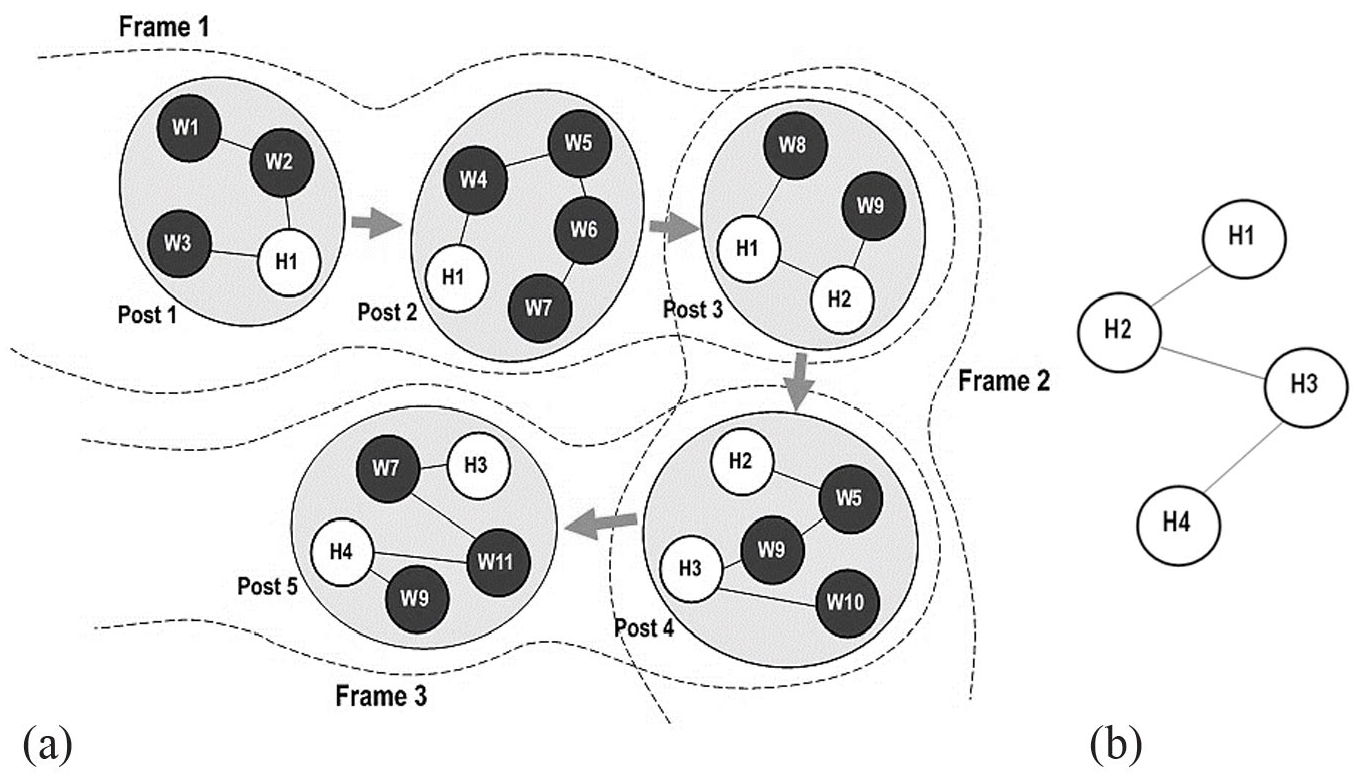
Interweaving of content structures. (a) Navigable frames; (b) navigable structure. Letters H and W in (a) represent hashtags and non-hashtagged words, respectively; (b) shows the navigable structure created by colocated hashtags in posts.
Mapping structures of multimodal discourse
We propose an analytical strategy that consists of three key steps for mapping multimodal discourse: (1) sampling based on keywords, rather than key hashtags, (2) constructing networks based on hashtag colocation for mapping structures and (3) identifying linked and nested communities within structures.
Data access points: key terms versus key frames
Key terms used in a given discourse, rather than dominant frames, are more appropriate entry points to gather samples that can capture interwoven structures. This approach does not depend on hashtags for sampling (e.g. Blevins et al., 2019), and hence can capture larger structures. We used 25 search terms (e.g. climate change, sustainability, green energy, plastic waste, climate action, climate crisis, Greta Thunberg, Extinction Rebellion, CO2 emissions) to obtain a sample of 1100 Instagram posts related to climate change that were uploaded between 31 October and 13 November 2021, covering the United Nations Climate Change Conference held in Glasgow. The sample was obtained via Crowdtangle, a public insights tool operated by Meta that provides access to publicly available posts on Instagram. Hashtagged terms in any language other than English and that do not elicit any meaning (e.g. #q?r) were removed from post captions. A network graph was constructed by representing the remaining hashtags as nodes (vertices), and then creating an edge between the nodes for two hashtags if they occur in the same post caption adjacent to each other, weighting edges by the number of such co-occurrences. The resulting network has 2856 hashtags (nodes) and 29,601 co-occurrences (edges).
Hashtag co-occurrence networks and link community analysis
Hashtag colocation networks can be considered as maps of interwoven discourse as they show the interconnected structure of hashtagged content, mapping connections among navigable frames. Co-occurring hashtags in a given post are relational elements as the post functions as an interface that connects distinct frames. Figure 2(b) shows a network representation of the structure of posts given in Figure 2(a), which shows how users can navigate between Post 1 and Post 5 by clicking hashtagged terms in posts.
Although other researchers use networks constructed based on hashtag colocation to analyse digital discourse (e.g. Ichau et al., 2019; Schöps et al., 2019), there have been two main limitations of prior studies. First, hashtag network analysis has been used primarily for understanding what the discourse is about, rather than how it is structured as a navigable discursive space. Second, analysis of such networks sometimes apply ‘community detection’ algorithms that partition networks into nonoverlapping cohesive subgraphs, with the node representing each hashtag occurring in exactly one subgraph, and then interpret what each subgraph is about. The latter is a major limitation as it does not acknowledge the fact that colocation enables hashtags to connect posts to multiple thematic clusters within hashtagged discourse. Our analytical approach is based on the principle that a hashtag can become a member of multiple thematic clusters. Accordingly, we apply link community analysis (Ahn et al., 2010; Kalinka and Tomancak, 2011) to examine how hashtags organise into overlapping thematic clusters. The link community approach embraces the fact that nodes may belong to multiple ‘communities’ via different relationships, and communities of nodes can overlap (Ahn et al., 2010). The method considers similarities between links that share nodes and uses hierarchical clustering to form maximum density partitions of links. Then nodes are assigned membership in potentially multiple and overlapping node communities according to the partitions of links that are incident on them. This approach is consistent with the fact that a specific hashtag may relate to utterances in completely different aspects of the discourse. For instance, as numerous hashtags such as #zerowaste, and #slowfashion are used in the post given in Figure 1 to annotate the picture, #zerowaste contributes to conversations related to #slowfashion as well as others.
Several network metrics were calculated prior to link community analysis to observe the general structure of the network. Degree (the number of edges per node) was calculated to examine the dominance of individual hashtags in the network. While hashtags related to COP26 and climate change had high degree values (e.g. #COP26: 539, #climatechange: 370, #sustainability: 326, #climatecrisis: 245, #pollution: 198, #carbonfree: 162), low degree nodes showed limited relevance to the climate change discourse. An average path length of 3.30 showed that nodes were not distant from each other and, in general, users can navigate between frames in less than four steps (or clicks).
Characterising interwoven multimodal discourse
We perform link community analysis on two levels to characterise interwoven structures of discourse within our sample. First, we identify link communities (i.e. thematic clusters) in the network data set to demonstrate how hashtags permeate different themes within the discourse. Second, we examine thematic clusters nested within broader clusters of hashtags.
Link communities: interwoven thematic clusters
Link community analysis showed that the network included 1114 induced node communities (maximum partition density = 0.566, number of nodes in largest cluster = 127). Figure 3(a) to (e) visualises five thematic clusters that demonstrate how hashtags permeate multiple clusters. As shown in Figure 3, #climatejustice, #IndigenousPeoples and #greenpeace contributed to clusters (a) and (e). Although these hashtags appeared in both clusters, each cluster had a unique orientation. Thematic cluster (a) had an emphasis on topics related to climate politics and included hashtags such as #climatejustice, #IndigenousRights, #IndigenousPeoples, and #socialjustice, #greenwashing and #greenpeace. This cluster also included a hashtagged reference to Jennifer Morgan, environmental activist, specialist in climate change policy and former Executive Director of Greenpeace, and the Paris Agreement (#parisagreement). Cluster (a) also included a range of general hashtags including #fossilfreerevolution, #climatebreakdown and #ecosystems. This shows that the cluster reflects a general set of tags related to climate change and the COP26 conference. Although cluster (e) included hashtags such as #climatejustice and #greenpeace, it also had a specific emphasis on the Democratic Republic of the Congo. The emphasis on Congo was highlighted via several hashtags including #CongoBasin, #SaveCongoRainforest and #DRC. Other general hashtags in cluster (e) such as #Together4Forests and #ForestProtection indicated specific attention to forests. Differences between clusters (a) and (e) show that hashtags common to both clusters play a different role in each cluster and are used in different aspects of the public discourse. Figure 3 also shows that #COP26 appears in both clusters (a) and (b). Cluster (b) has a distinct focus on comics, cartoons and illustration. Users indicate the relevance of COP26 to these hashtags by collocating #COP26 with hashtags such as #comic, #illustration and #cartoon. Accordingly, #COP26 plays a different role in cluster B by connecting content related to arts and illustration to the conference. As #COP26 appears in clusters (a) and (b), and as clusters (a) and (e) share several hashtags, users can navigate among streams of content by clicking collocated hashtags in these clusters. From the perspective of those who create content, users create interconnected fields of discourse covering COP26, environmental issues faced by Congo as well as arts and illustration.
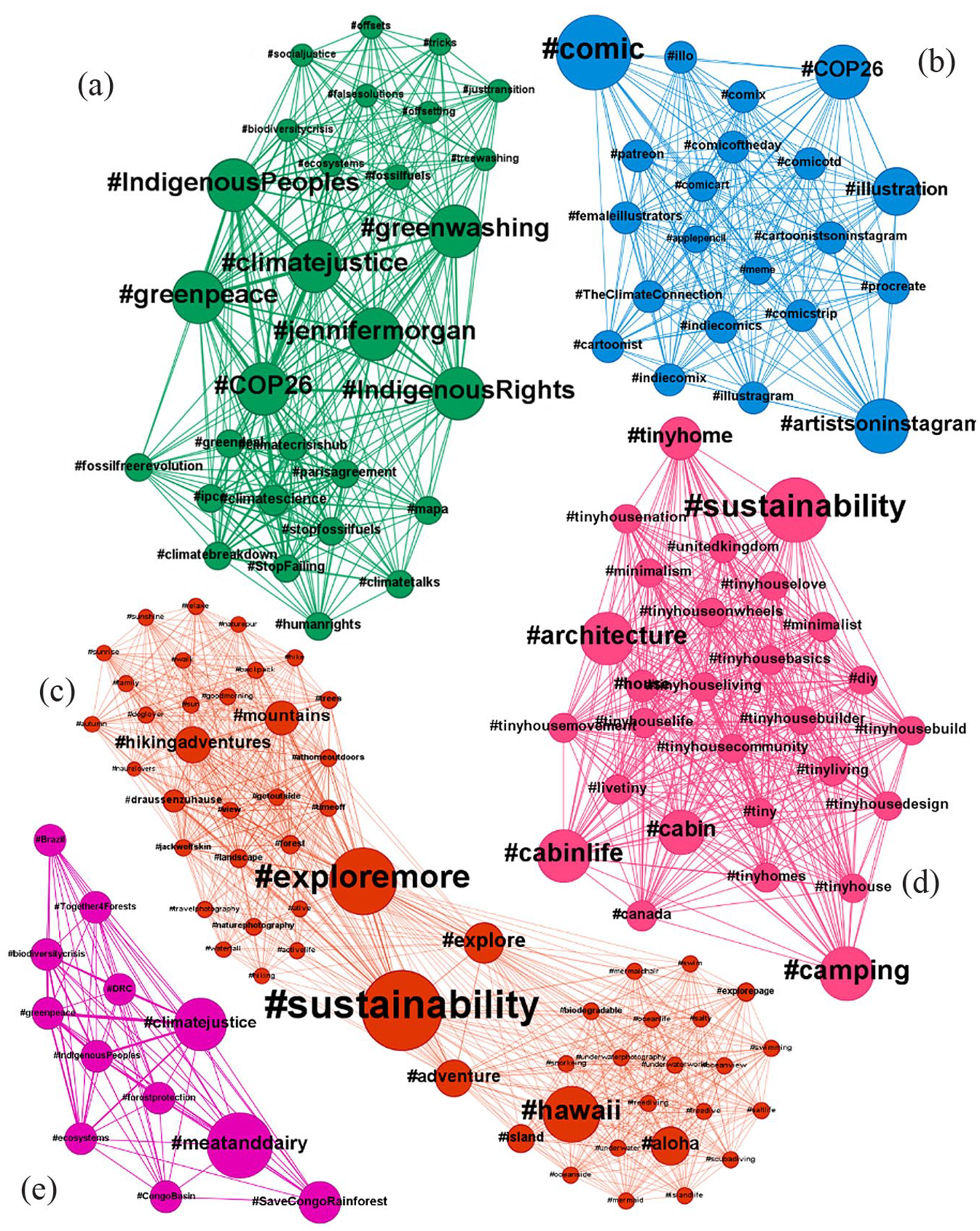
Thematic clusters. This figure shows five thematic clusters that have different topical orientations: (a) COP26 and climate politics, (b) comics, cartoons and illustration, (c) outdoor activity, (d) architecture and house design, (e) climate justice and the Democratic Republic of the Congo.
Similarly, the hashtag #sustainability appeared in clusters (c) and (d) although these clusters had different scopes. Cluster (c) focuses on topics related to outdoor activity marked by general hashtags (e.g. #explore, #exploremore, #mountains, #hikingadventures, #freediving, and #underwaterphotography) and a specific reference to Hawaii (i.e., #hawaii, #aloha and #island). Conversely, cluster (d) included a range of tags related to architecture, house design in particular (e.g. #tinyhouselove, #tinyhousecommunity, #tinyhomes) and cabin life (e.g. #cabin, #cabinlife). The common hashtag (i.e. sustainability) contributes to the publics that cover these two distinct aspects. In clusters (b) and (d), general hashtags connect secondary topics (e.g. #freediving, #tinyhomes) to the climate change discourse. This suggests that hashtags that permeate multiple clusters contribute to unify discourse by bridging between (i.e. interweaving) distinct thematic clusters. From a conceptual perspective, diversity of the above clusters show signs of polymorphism – that is, presence of multiple orientations in issue-response networks (Rathnayake and Suthers, 2018). Within this context, the crucial role played by dominant frames in leading multiple distinct clusters show their ability to unify discourse by serving as conduits that connect those clusters.
Community centrality – a centrality measure that weights the number of link communities that a given node belongs to based on how distinct the link communities are from each other (commweight, Kalinka and Tomancak, 2011) – was calculated to further examine the extent to which specific hashtags are connected to different communities (representing thematic clusters in the current analysis). Possible values are 0 for nodes not belonging to any link communities, 1 for nodes belonging to only one community, and larger values for nodes belonging to multiple distinct communities. This allows identification of hashtags that contribute to the interweaving of different aspects of climate change discourse. 1 Table 1 shows community centrality values for hashtags sampled from the distribution at three different intervals (from high to low). The results show that hashtags with high community centrality values are highly relevant to the climate change discourse while hashtags that have low community centrality values are less relevant. This shows that users in different discursive communities connect hashtags related to climate change, such as #COP26, #climatecrisis and #climatechange, to other topics.
Community centrality values (ComC).
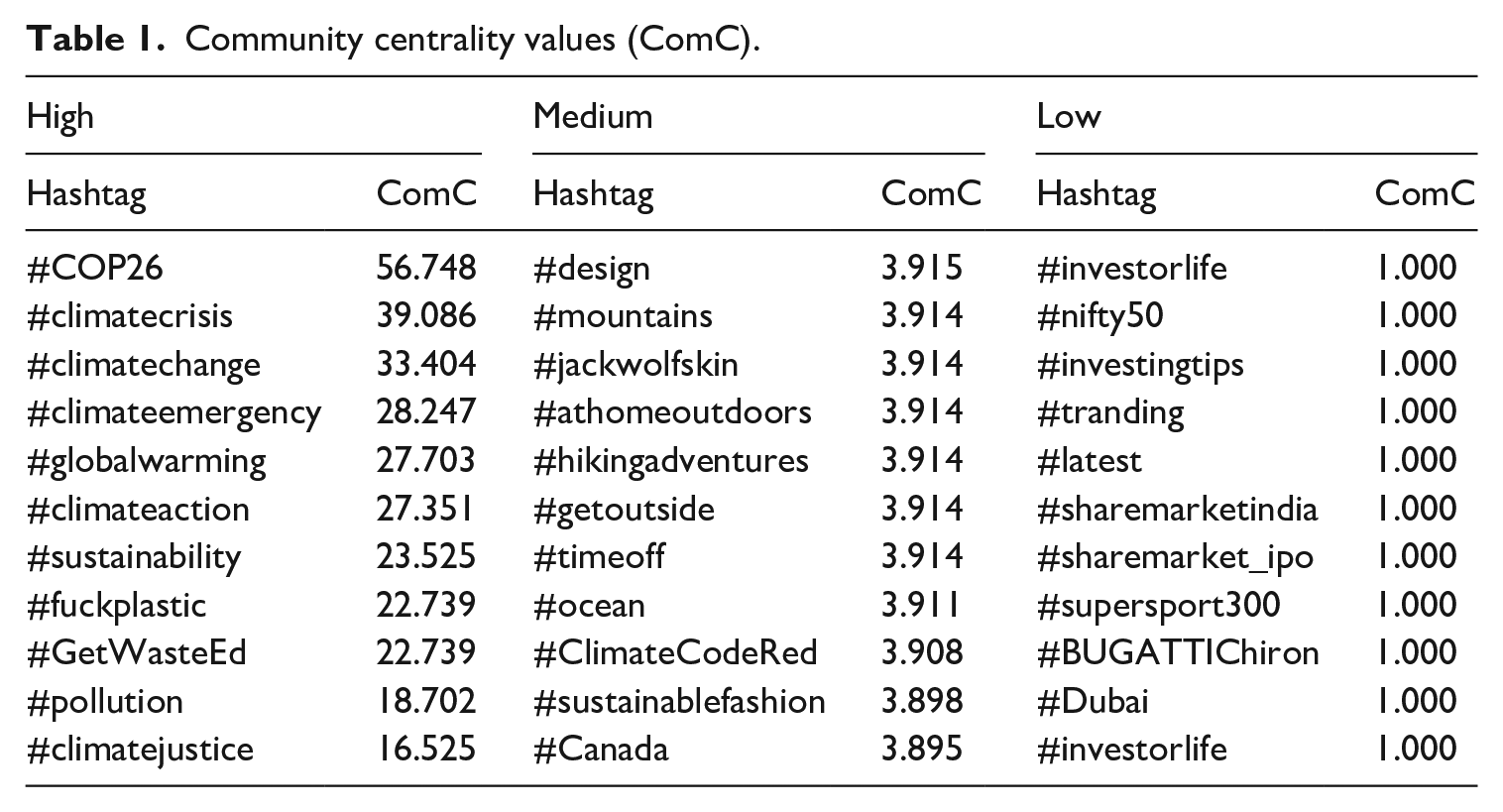
Hashtags such as #design, #mountain and #sustainablefashion are not highly central, but show some community reach. Hashtags that do not have direct relevance to climate change such as #investorlife, #sharemarketindia and #BUGATTIChiron had no community centrality (belong to only one community). The connection between community centrality and relevance of hashtags to the climate change debate can be seen as a diffusion of the discourse to different realms of engagement on Instagram. This allows those who access secondary frames, such as #Dubai, to navigate the climate change discourse.
Nested communities: intertwined thematic cluster structures
Nested link communities represent thematic clusters in which two topics are intertwined. Our analysis produced 222 nested communities showing a diverse set of local nested thematic cluster structures. We identified four general orientations within the nested communities: (1) thematic clusters in which specific topics related to climate change are embedded within broad topics, (2) climate change hashtags binding together everyday hashtags to form thematic clusters, (3) leading climate change hashtags binding clusters to form a nested community and (4) thematic clusters that represent unrelated topics. Figure 4 shows examples for each orientation. Edges for each cluster are visualised in different colours. Node pies show the extent to which a node is a member of a specific cluster. Figure 4(a) and (b) shows how specific topics are embedded within general climate change hashtags. Figure 4(a) includes a cluster (orange edges) that includes specific hashtags, such as #SwasthBharat, #BanegaSwasthIndia, #HealthyIndia, #Nutrition and #SDG2030 that reflect a specific conversation; this cluster is intertwined with another cluster (green edges) that includes general hashtags (#CarbonEmissions, #ClimateEmergency, #ClimateStrike). Similarly Figure 4(b) shows how a specific set of hashtags related to extreme weather events (e.g. #droughts, #heatwaves, #storms, #flashfloods) is embedded within a general structure.
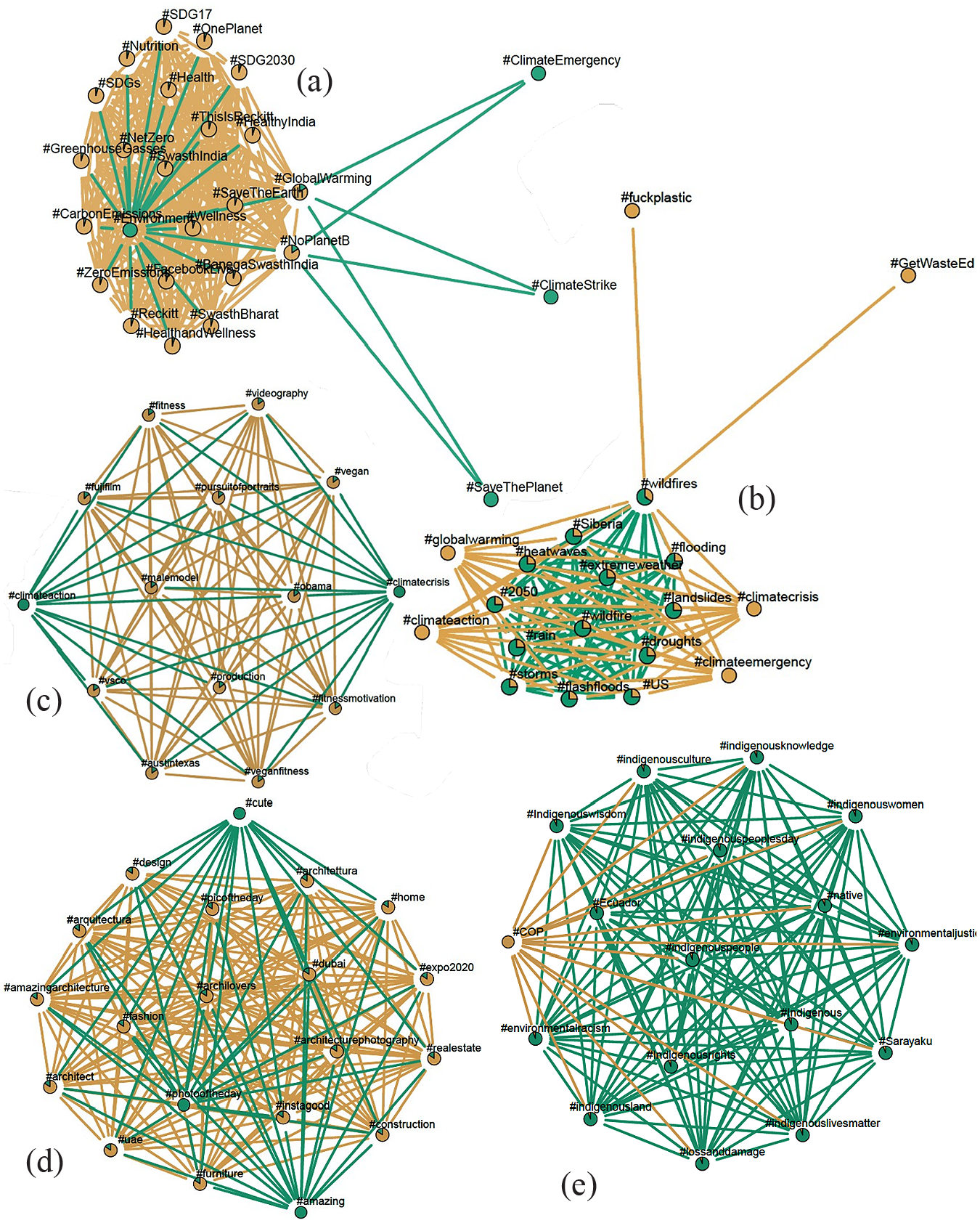
Nested cluster structures. This figure shows five nested community structures: (a) Climate emergency, health and India, (b) extreme weather events and climate crisis, (c) fitness, modelling and climate action, (d) architecture, construction and everyday hashtags, (e) COP and indigenous rights.
Figure 4(c) and (e) shows how users connect secondary hashtags to climate change discourse. Figure 4(c) shows a cluster that includes an interconnected set of general hashtags related to fitness and modelling (e.g. #fitness, #malemodel, #veganfitness and #videography) (orange edges). Two general hashtags related to climate change (#Climateaction and #Climatecrisis) are connected to this cluster forming a nested community. This shows how leading climate change hashtags are used to ‘bind’ everyday hashtags, connecting them to the climate change discourse. This is an important aspect of user behaviour as connecting secondary topics related to everyday life to the climate change debate is crucial in building awareness. The hashtag #COP in Figure 4(e) performs a similar function by binding a set of secondary frames to form a nested community. However, the secondary hashtags have a political orientation (e.g. #Indigenousrights, #indigenousland, #Indigenouslivesmatter) relevant to the climate change debate. This shows that leading hashtags add an extra ‘layer’ in which secondary topics contribute to both a local thematic cluster as well as a broader cluster that includes climate change hashtags. The network also included nested communities that are not related to climate change. For instance, the cluster given in Figure 4(d) shows that a topical structure related to architecture, construction and real estate (orange edges) is interconnected with another set of general Instagram hashtags, such as #cute, #amazing and #photooftheday.
Discussion and conclusion
The above characterisation of structures of digital discourse provides a conceptual basis as well as methodological guidance to approach analysis of hashtagged content on Instagram from a pluralist perspective. While the unitary approach can shed light on the depth of discourse within selected hashtag publics, especially on text-based social media, interwoven structures describe complex navigable structures that span across a multitude of hashtags on Instagram. Researchers who aim to understand the distributed nature of digital discourse related to a given issue should focus on the diversity of content that constitute navigable structures, rather than the nature of discourse within selected hashtags. The analytical approach suggested in this study can serve as a method for mapping ambient affiliations (Zappavigna, 2011), which are made navigable via the use of hashtags. While linked and nested structures characterise the interwoven discourse related to climate change captured by our sample, the presence of such structures is not a unique property of this data set, nor even hashtagged publics in general. Therefore, analysis of ambient affiliations should not be limited to hashtags and the method proposed in this study. For example, our approach could be applied to map interrelated conversational structures among actors who engage in phatic communion (Miller, 2015).
The method used in this study includes both sampling based on keywords and the use of overlapping community analysis. As these two aspects are not interdependent, these can be applied separately for different purposes. Researchers may use the sampling approach proposed above for different types of analysis. Future work using the method outlined here can be applied to other data sets to map the structures through which conversations are connected, including lateral connections between topic frames (illustrated schematically in Figure 2(b) and suggested by repeated hashtags in Figure 3), and nesting of topic frames (Figure 4). From a methodological perspective, the proposed pluralistic approach provides several benefits for social media researchers. First, the use of keywords, as opposed to key frames, as entry points for data collection minimises overdependence on specific dominant hashtags while still capturing the dominance of such frames and the role they play within the discourse. For instance, high degree and community centrality values of general hashtags, such as #climatechange, #sustainability and #climatecrisis indicate their ability to serve as dominant frames within the climate change discourse. Second, the proposed approach offers an opportunity for examining connections among distinct discourses. The key terms used to obtain the sample for this study directly represented the climate change discourse. Yet, frames that capture issues such as marginalisation of indigenous communities emerged within the discourse. Samples that cover distinct, yet interrelated, issues can explain how different discourses are interconnected. Work that maps such interconnections can minimise issues caused by selection bias. Future analysis of interwoven structures should also focus on the role different actors, including organisational social media accounts, play within public discourse. This study’s approach can be modified to construct semantic networks based on word–pair networks (including hashtagged terms) created based on word adjacency, to investigate how navigable links are embedded within semantic structures.
As Ahn et al. (2010) note, link communities can describe different types of networks, such as protein–protein interaction and metabolic networks as well as communication and social networks. The empirical evidence presented in this study demonstrates that hashtagged content constitutes complex structures that can be found in other natural networks. Specifically, these properties provide useful insight to understand the nature of digitally mediated spaces formed via hashtags. As demonstrated in Figures 3 and 4, the climate change discourse captured by the sample consists of a wide range of topics, such as climate crisis, deforestation, marginalisation of indigenous communities, adventure, art and architecture. Such diversity of topics across communities indicates polymorphism – diversity in topical orientations and the presence of different collective phenomena within hashtagged publics (Rathnayake, 2021; Rathnayake and Suthers, 2018). Rathnayake and Suthers’ prior analysis of polymorphism within hashtags takes a unitary approach as they examine samples based on dominant frames. The presence of polymorphism in the present study shows that polymorphic topical structures also exist in visual discourses marked by a multitude of frames. This shows that polymorphism is a generalisable property of hashtagged content on social media. However, nesting of distinct communities within the network complicates the concept. Rathnayake and Suthers (2018) argue that polymorphism is present when social media user clusters have different orientations and/or structures. Coexistence of different foci within a nested thematic cluster suggests the presence of an internal form of polymorphism. Accordingly, we characterise interwoven discourse as internally and externally polymorphic structures.
The above results can provide general insight to understand the effects of social media in shaping the public sphere. Dahlgren (2005) stresses the role the Internet plays in facilitating communicative heterogeneity and notes that expansion of communicative spaces via the Internet results in pluralisation as well as dispersion of the relatively clustered public sphere associated with mass media. Dahlgren also suggests that fragmentation of the public sphere caused by communicative heterogeneity opens up a research theme that ‘encompasses an overarching systematic perspective’ (p. 152). Interwoven structures of discourse can serve as such an overarching perspective as it focuses on widespread discussions about a given issue that constitutes different topics (e.g. deforestation, architecture, cars) as well as interests of different communities (e.g. indigenous groups). The above analysis shows how such fragmented topical orientations coexist within the same communicative space. Moreover, our conceptualisation embraces how such topics are brought to visual phatic communication via strategic use of hashtags. Dahlgren stresses that the vision for a singular, unitary public sphere has been rejected or seen as ideal. Conversely, the concept of interwoven structures of discourse embraces the fact that technological affordances (i.e. hashtags) and meaning-making practices (i.e. colocation) can contribute to unify different topical communities by bridging between conversations, allowing utterances to contribute to different topical communities and enabling user navigation across different topics. Our analysis focuses on visual social media. Nevertheless, such unification is likely to exist in text-based social media.
Footnotes
Funding
The author(s) received no financial support for the research, authorship and/or publication of this article.
