



Abstract
The purpose of this study was to analyze Instagram photos posted by Black men with the #IAmABlackMan challenge as part of the ongoing Black Lives Matter movement to (a) understand the overall sentiments surrounding the hashtag challenge, (b) assess the nature of cultural projection as visually communicated through Instagram, and (c) examine how others interpret the cultural projection of these Black men through the images. This study uses a mixed-methods approach comprised of a social media insights sentiment analysis, qualitative and quantitative semiotic visual analyses, a qualitative and quantitative survey, and thematic analysis to analyze the images, comments, and perceptions of posts using the #IAmaBlackMan hashtag on Instagram.
Introduction
The #IAmABlackman hashtag challenge circulated the newsfeeds of many on Instagram in May of 2020. It prompted Black men to share images of themselves with the following caption: I am a Black man. I build up. I don’t tear down other Black men! I have felt the pain of being torn down and I have decided I will be deliberate about building others! If I didn’t tag you, please don’t be offended. I tried to pick people I thought would do this challenge! All too often, we men find it easier to criticize each other instead of building each other up. With all the negativity going around let’s do something positive! Upload one picture of yourself . . . only you. Then tag as many brothers to do the same. Let’s build each other up, instead of tearing ourselves down. #IAmABlackman—@Instagram
The aim of the challenge was to build Black men up through confidence and solidarity after the May 25, 2020, murder of George Floyd. The visual statements that these men were making could be described as a form of cultural projection, “the conscious or unconscious effort by a social group and its allies to place new images of itself before other social groups, and before the general public” (Merelman, 1995, p. 3).
Photos have tremendous potential to influence viewers and perpetuate or challenge stereotypes. In a visually saturated online social world, much of what people know about the world beyond their own personal interactions is learned through photographs and videos. Photographs are highly influential online, more likely to be shared (Casas & Williams, 2019; Geise et al., 2021; Li & Xie, 2020) and spread faster and more convincingly than text alone (Friggeri et al., 2014). They are emotional forms of communicating, capable of transporting readers to the experiences of the people pictured. More than words alone, photos are perceived as truthful evidence, offering support for accompanying text (Gamson et al., 1992; Lester, 2013; Newman et al., 2012; Newton, 2001). That images imply meaning through association or juxtaposition rather than making a direct association—what Abraham (2003) refers to as “implicit visual propositioning”—means they can subtly change impressions through repetition. Social movements, such as the Black Lives Matter (BLM) movement of which #IAmABlackMan is a part, can underscore their own understandings of an idea, activity, or value through photographs. Furthermore, they can contribute to relationship-building through identification and visibility, allowing social movements to gain new participants and sustain the life of the movement (Edrington, 2020).
The purpose of this article is to analyze the sentiments, photos, comments, and perceptions of posts by Black men with the #IAmABlackman hashtag. In doing so, we assess the nature of cultural projection as visually communicated through Instagram, gain an understanding of the sentiments surrounding the challenge, and uncover how viewers perceive the cultural projection of Black men through these images. Using multiple and mixed methods, this analysis uncovers identification and visibility of Black Americans through cultural projection. The theory has primarily been applied to organizations trying to appeal to different audiences, including corporations (Page, 1997), museums (Johnson & Pettiway, 2017; Mason, 2004), and political campaigns (Stamps et al., 2022). Although there are a few studies that engage cultural projection and selfies (Abdullah et al., 2019; Jain & Jain, 2017), this study is the only one to the authors’ knowledge to examine both visual content and perceptions, thus suggesting the effectiveness of the counter-stereotype attempts. Situated at the intersection of visual communication, social media, and cultural projection, the findings add to the literature on cultural projection via digital visual expression, tying visual communication theory to cultural and strategic communication. As subordinate groups increasingly harness the power of visuals on social media to counter historical stereotypes (as one recent example, Stop Asian Hate), the findings of this study as well as the methods employed contribute to the existing cultural projection literature beyond the scope of BLM.
Literature Review
Background: BLM
When Alicia Garza took to Facebook to voice her frustrations of the acquittal of George Zimmerman after the murder of Black teenager Trayvon Martin in the summer of 2013, the term Black Lives Matter took on a life of its own. In a public posting to Black Americans, Garza utilized Facebook to write what she referred to as a love letter to her people: “Black people, I love you. I love us. Our lives matter.” In response, one of Garza’s friends, Patrisse Cullors, “corrected” her statement by rewriting “Black lives matter.” Garza, Cullors, and another friend Tomeli strategically migrated to Twitter (now X) and connected the phrase with a hashtag. This was strategic in nature because the use of hashtags allows protestors and activists to communicate quickly to share information and mobilize in real time despite spatial boundaries (Tufekci, 2017). Noting the significance of hashtags, Kuo (2018) proposed that: the significant impact of hashtags isn’t just message content, hashtags form networks that move discourse beyond insular discussion to speak across borders and boundaries; any participation in the discussion aids the messages’ ability to spread quicker and wider across multiple clusters and generate a larger network (p. 511).
Using hashtags in social media activism is helpful, as it organizes, links, and even archives conversations making them more visible by trending them (Kuo, 2018). Because of this, #Blacklivesmatter became visible to many people within as well as outside the networks of the three friends. However, it didn’t catapult into a movement until the shooting death of another Black American teenager on August 9, 2014, 18-year-old Michael Brown in Ferguson, Missouri, and after his killer’s acquittal on November 25, 2014. Images of Brown used on news outlets sparked discussion about the portrayal, framing, and stereotypes of Black men in the media. Hashtags such as #iftheygunnedmedown were widely circulated after Brown’s death to challenge the media’s use of certain images when speaking about Black men. With this hashtag, “social media users posted two different pictures of themselves, one hegemonically ‘positive’ and the other ‘negative’” (Korn, 2019, p. 42). This hashtag “challenged how media outlets often choose how to characterize individuals of color, based on the photographs selected to represent them” (R. L. Jackson, 2016, p. 314) and highlighted not only media representation of Black men but also the power of the visual narrative.
Following the brutal murder of George Floyd in May 2020, BLM yet again became a prominent movement. Similar to the Rodney King case in South Central L.A., the circulation of the 1991 video allowed people who had otherwise been naïve about the social injustices faced by Black Americans to bear witness, join the conversation, and take action through protest. Given the media coverage of Floyd’s murder intertwined with the stay-at-home orders of the COVID-19 pandemic, unlikely participants began to take notice and felt compelled to act. The deaths of Black men and the circulation of associated visuals, particularly Michael Brown and George Floyd, propelled BLM into a global movement, illuminating the significance of visuals in activism (Florini, 2019; S. J. Jackson et al., 2020; Ray et al., 2017; Taylor, 2016). Floyd’s murder “ignited one of the largest and most wide-spread series of protests against anti-Black racism in the United States in recent history” (Mir & Zanoni, p. 3). One way this anti-racist sentiment appeared was through cultural projection via social media. This resurgence of racial reckoning warranted an increased use of social media platforms for activism, particularly Instagram (Li, 2022). BLM, similar to other new media movements, took advantage of social media’s affordances by sharing information, images, commentary, and personal testimonies through the use of “specialized hashtags” to push their agendas forward (Edrington, 2022, p. 644). Effectively engaging in hashtag activism, “discursive protest on social media united through a hashtagged word, phrase or sentence” (Yang, 2016, p. 13), affirmed the power that digital activism has on shaping public discourse. Similar to #BlackLivesMatter, and #iftheygunnedmedown, the #IAmABlackMan hashtag became a “counterpublic circuit desirable for Black individuals seeking justice” (Dunklin & Jennings, 2022, p. 765).
Visual Stereotyping
Stereotyping is an oversimplification of a depiction of a particular group of people, often created and reiterated by the media (Entman, 1996; Fahmy et al., 2014). Stereotypes are unrepresentative, blunt, and sometimes false entirely, limiting the ability for viewers to “think anew about situations and people” (Dennis, 2012; Entman, 1996, p. x; Lippmann, 1922, p. 89). As Newton and Williams (2011) summarize, they impose “crude, reactive filters through which one human being can categorize another almost reflexively, without the benefit of conscious thought or interpersonal interaction” (p. 199). Viewers are forced to form judgments about people based on skewed, exaggerated, and incomplete portrayals (Elliott, 2011; Ibrahim, 2010). Having been presented with ready-made media images of what various categories of people should look like and act like, “one is prone to jump to conclusions when presented with a person fitting descriptions of the category” (Shoemaker et al., 1973, p. 67).
The distinct traits of visual information processing imply that photographs can be particularly potent in cultural projection. On visual social media sites, photos are scrolled past quickly and passively without the time and scrutiny given required of text-based communication. The “truthiness” effect of images means that even images that have no relationship with the content of accompanying text increase acceptance of the claim as true (Newman et al., 2012). Stereotypical photography acts to demarcate the worthy from the unworthy, encourages people to make judgments about the character of others, teaches the public which lifestyles are acceptable, and can have societal consequences in terms of public opinion, which may turn into public policy (Elliott, 2011; Enteman, 2011: 20; Fyfe & Law, 1988; Secord et al., 1976). Visuals create rich sensory responses that affect memory (Graber, 1990; Nelson et al., 1976) and are generally perceived as more credible (Sundar, 2008). Due to their emotionality (Hannah, 2021; Powell et al., 2015), they might have stronger and longer-lasting effects on citizen’s behavior and attitudes. Furthermore, pictures stay in the memory longer (Mayer, 2019) and can be retrieved from the memory more quickly (McBride & Dosher, 2002).
Importantly, photographs imply meaning through association, juxtaposition, and repetition rather than making a direct association (Abraham, 2003; Abraham & Appiah, 2006; Riessman, 2008). While news media cannot explicitly state that there is a connection between race and negative qualities, they can—whether intentionally or not—hint at a connection through the juxtaposition of images and words (Bird, 1996; Entman, 1994; Martindale, 1996; Rodriguez & Dimitrova, 2011). For example, in the 2006 seminal study by Abraham and Appiah, online news stories were either illustrated with no images, with two photographs of Black people, with two photos of White people, or with one of each person. Images of Black people primed racial stereotypes and led to a stronger association of Black people with social problems. Images are crucial in forming collective memory, engaging spectatorship, and framing complex events (Hariman & Lucaites, 2016).
Common visual stereotypes of Black males are that they are: loud and excessive (Johnson, 2015; Margolis, 1999), poor (Clawson, 2002; Margolis, 1999), violent criminals (Doyle, 2006; R. L. Jackson, 2006; R. L. Jackson & Dangerfield, 2004; Oliver, 2003), rebellious outsiders (Page, 1997; Hooks, 2004), uneducated and incompetent (R. L. Jackson & Dangerfield, 2004; Johnson et al., 2009), and over-the-top hip-hop fans (Henry et al., 2004; Perry et al., 2014; Entman & Rojecki, 2007). These portrayals distort the general public’s views of Black males, potentially promoting hostility toward them (Entman & Gross, 2008). Visuals dealing with race may function to create common humanity by disregarding established caricatures and creating recognition of others (Gallagher & Zagacki, 2005).
Challenging Stereotypes Through Visuals in Social Movements
Gallagher and Zagacki (2007) urge scholarship on visual counter-stereotyping efforts because “rhetorical scholars have been less inclined toward these images, generally focusing instead on the speakers and the speeches of the movement” . . . “by considering the transformative capacity of photojournalism as it mediates between the universal and the particular, and enables viewers to experience epiphanic moments when issues, ideas, habits, and yearnings are crystalized into a single recognizable image” (p. 114, 113). Edrington and Gallagher (2019) demonstrated how an image may serve to shift or change the narrative of a movement in their study of iconic images from the BLM movement, saying that analyzing photos “is only the start of understanding its consequence in relation to the larger movement and the ongoing project of producing and distributing images of consequence to our civic and social lives” (p. 206). Gallagher and Zagacki’s rhetorical visibility framework and Edrington and Gallagher’s work are of particular relevance to the present study because of their focus on racially inscribed images associated with the BLM movement.
Cultural Projection
Cultural projection is “the conscious or unconscious effort by a social group and its allies to place new images of itself before other social groups, and before the general public” and an “instrument for representing Black culture to Americans” (Merelman, 1995, p. 3). While anyone who posts a photograph of themselves online is projecting something to the public, the nature of an organized social group posting a new image of themselves with a unified voice defines cultural projection. Subordinated groups engage in cultural projection when it and its allies put forth new pictures of itself beyond its own borders. Although social media offers open access to users, it does not neutralize societal hierarchies. Black men remain a subordinated group in these spaces because their visibility is often shaped by racial bias in both user interactions and platform algorithms. Studies have shown that Black users face disproportionate content moderation (Matamoros-Fernández, 2017) and that images of Black men are more likely to be flagged as threatening or inappropriate (Sap et al., 2019). This introduces an additional layer of emotional labor that Black men have to perform when trying to culturally project. In addition, engagement patterns on social media reflect offline biases, with Black creators frequently needing to work harder to gain the same level of visibility as their White counterparts (Roberts, 2019). In this context, their participation in cultural projection is not just about representation but about actively resisting the ways their presence is policed, overlooked, or misinterpreted online. By inviting respect, commendation, debate, and engagement, these new images contest negative stereotypes (Merelman, 1995).
Cultural projection is a two-directional process involving a dominant group and subordinate group and can lead to four results: (a) Syncretism, which is the union of different or opposing principles; (b) Hegemony, which is dominance over subordinate groups, or when dominant groups control the flow of cultural projection, (c) Polarization, wherein dominant and subordinate groups equally reject the other’s efforts at cultural projection, or (d) Counter-hegemony, wherein subordinates and their allies convert dominants to subordinate versions of the world.
Studies to date have most often looked at organizations’ or the mass-media’s cultural projection efforts. For example, Page (1997) examined Time Warner’s sponsorship of Songs of My People implemented by a Black American cultural change agent tasked with providing an infrastructural interface between corporate elites, Black artists, and mass markets for Black commodities. Stamps et al. (2022) examined news coverage of some of the first Black mayors of U.S. cities and the themes of racial identity and policy using a cultural projection lens. Mason (2004), Johnson and Pettiway (2017), and Johnson and Sink (2015) focused on cultural projection via museums and museum websites, respectively. These studies have aimed to see how institutions have projected Black people and culture, often with a market-focus. While museums and cultural institutions often present themselves as neutral arbiters of history and knowledge, this neutrality is, in many cases, a constructed illusion rather than an objective truth. Historically, museums have operated as gatekeepers of cultural narratives, curating exhibitions that reflect dominant perspectives while marginalizing others (Bennett, 1995). The claim of neutrality often masks the ways in which these institutions participate in cultural hegemony, determining which histories are preserved and how they are framed (Sandell, 2007). Even as museums have become more inclusive, their approaches to representation remain shaped by institutional priorities, funding sources, and broader sociopolitical influences (Chynoweth et al., 2019). This means that the projection of Black culture in museum spaces is never purely descriptive; it is always shaped by decisions regarding what is included, omitted, or emphasized. Recognizing this dynamic challenges the assumption that cultural projection by institutions is impartial and instead positions it as a site of power and negotiation.
The Meaning of Visuals: Visual Social Semiotics
In visual social semiotics, images are analyzed in part via the interactional relationship between the viewer and viewed within a particular context (Jewitt & Oyama, 2001; Kress & van Leeuwen, 2006). Various aspects of image compositions create different impressions of an issue, or a person presented. In this study, we are interested in three aspects of Kress and van Leeuwen’s (2006, 2020) framework for visual analysis: Gaze, point of view, and social distance. These are necessary because they refer to multiple interactions that can occur between participants and viewers of the image which is important to understand when assessing cultural projection.
Gaze refers to the eye contact between the viewer and participant and can take the form of a demand or an offer. A demand is implied when the subject of an image gazes directly into the viewer’s eyes. The subject of the photograph “demands that the viewer enter into some kind of imaginary relation with him or her” (Kress & van Leeuwen, 2006, p. 118). This contact creates high engagement and can imply either strength, defiance, pity, or other emotions. The facial expression reflected in the subject also impacts the implied meaning (Fahmy et al., 2007). Instead of gazing directly into the viewer’s eyes, an offer is visually communicated when the subject of the photo is viewed rather than viewing. “It offers the represented participants to the viewer as items of information, objects of contemplation, impersonally, as though they were specimens in a display case” (Kress & van Leeuwen, 2006, p. 119).
Point of view addresses vertical and horizontal perspectives (Kress & van Leeuwen, 2006). If the photographed is portrayed at eye level with the viewer, equality is connoted. If the subject in the photo is below eye level, or looked down upon, they appear less powerful than the viewer. Conversely, if the subject of the photo is above the eye level of the viewer, they will appear more empowered. In this study, we refer to this horizontal relationship as POV 1. The vertical angle of an image, whether oblique or frontal, also implies different relationship dynamics between the subject of a photo and their viewer. An oblique angle represents detachment and marginalization, while a frontal angle signals involvement and engagement between the participant and the viewer. We refer to this variable as POV 2 in the present study.
Image-producers have the option of depicting participants in close, medium, or long shots, referred to as frame size. Essentially, the tighter the shot, the more intimacy that is implied. Personal intimacy between the viewer and portrayed is signified when the photo shows only the head, also called a close-up frame. Personal distance is implied through a medium frame, which shows the head and shoulders or to the waist is more social in nature. Finally, public distance is communicated through a long shot, or one that shows the whole body or bodies. This final framing generally visually communicates a sense of detachment (see also Harrison, 2003).
Summary and Research Questions
The literature shows that marginalized groups can culturally project alternative narratives of themselves to counter existing stereotypes held by dominant groups. Research has long established the power of visuals in creating and countering viewer impressions, including stereotypes. The concept of cultural projection, specifically, has been used to study the efforts of traditional media and organizations to culturally project alternative views of Black Americans. However, studies have not yet looked at this visual countering through the lens of cultural projection on individuals’ social media. In this article, we analyze the sentiments, photos, comments, and perceptions of posts by Black men with the #IAmABlackman hashtag to assess the nature of cultural projection as visually communicated through Instagram users. Specifically, we ask:
Method
Answering RQ1
The social media listening software Brandwatch was used to answer the first research question, “What are the overall sentiments surrounding the #IamABlackMan hashtag challenge?” Sentiments were exported from Twitter from a 1-month period (June 5, 2020, to July 6, 2020). The sentiment analysis feature determines the emotional tone through a series of words pertaining to a specific topic, revealing attitudes, opinions, and emotions for online mentions of a specific hashtag.
Answering RQ2
The second research question, “In what ways do Black men culturally project themselves via #IamABlackMan on Instagram?” was answered through a quantitative and qualitative analysis of images with the hashtag. Instagram was chosen as the platform of focus because the challenge originated on this platform and because it is primarily a place of photo sharing.
For the quantitative analysis, all images with that hashtag (123) from a 1-month period (June 5, 2020, to July 6, 2020) were collected via CrowdTangle. Nine images were removed due to them being a video, making the total number of images 114. A visual content analysis was performed on these images using a codebook based on Kress and van Leeuwen’s (2006, 2020) interactive meanings: Gaze, point of view 1 and 2, and social distance. Gaze could be coded as demand or offer. If a participant was making direct eye contact with the viewer, the image was coded as demand, whereas if the participant was not looking at the viewer, the photo was coded as offer. POV 1 was coded as either frontal or oblique. Images were coded as frontal if the person in the image was shown straight on, and oblique if they were depicted from the side. POV 2 was coded as high, eye level, or low angle. An image was coded as having a high angle when it was taken from a higher point than the person in the image, as eye-level when the participant was at the same level as the viewer, and as a low angle when it appeared that the viewer was looking up at the subject of the image. Finally, Social Distance was coded as a close-up, medium, or long frame size. An image was coded as a close-up when only the head and neck were shown; medium when the image showed the person waist up, and long when the person was shown in their entirety. To achieve intercoder reliability, authors met multiple times to discuss and refine the codebook and practice coding. Ultimately, two of the authors coded 10% of the sample. Intercoder reliability was achieved for each variable (Gaze: k = .81; Point of View: k = .75; and Social Distance: k = .75).
Given the author’s position as a Black American, five images were selected that defy stereotypes of Black men as identified in the literature: absent fathers, uneducated, poor, violent, and rebellious outsiders for the qualitative portion of the RQ1. The representative photos were chosen by the authors based on their counter-resemblance to the stereotypes. These images reflect the ways individuals engaged in cultural projection within the #IAmABlackMan challenge. Much like curated exhibitions in museums, which construct narratives through careful selection and display (Mason, 2004), social media users make deliberate choices in how they visually present themselves. The images analyzed in this study featured polished, professional-looking compositions rather than casual, everyday selfies. This aligns with research on digital self-presentation, which suggests that social media users selectively curate images that reinforce aspirational identities and counter dominant stereotypes (Marwick & Boyd, 2011). The qualitative portion of the analysis also relied upon the Kress and van Leeuwen framework but allowed for a richer understanding of the deeper meaning of the photos using both descriptive and interpretive approaches.
Answering RQ3
The third research question, “In what ways do viewers perceive the cultural projection of Black men through the #IAmaBlackMan hashtag on Instagram?” was answered in two ways: (a) An Institutional Review Board (IRB)-approved quantitative survey with an adapted photo-elicitation approach on the five representative photos mentioned above and (b) a thematic analysis of user comments on these five photos. In total, 255 representative participants were recruited through Prolific and were paid $31 per hour for their participation. The high compensation based upon time was used to incentivize thoughtful qualitative responses. Respondents who spent less than 15 min on the survey were eliminated. The mean age of respondents was 48.11. In total, 51.8% were males and 46.3% were females, with the remainder responding that they were non-binary or preferred not to say. In total, 75.9% of responded were White, 12.8% were Black, with the remainder being Asian, Hawaiian/Pacific Islander, American Indian/Native Alaskan, or preferring not to say. Most respondents (90.7%) did not recognize the #IAmABlackman challenge. They were average Instagram users, with a mean of 4.09 on a 1–7 Likert-type scale. Respondents were first asked about their impressions of the people in the five photographs identified in RQ2 using a scale. Specifically, they were asked to rate their impressions of the photo subjects on a 7-point scale from “very negative” to “very positive.” A photo-elicitation approach was also used to glean qualitative impressions of the subjects of the photos. Photo-elicitation is the use of photographs during an interview or survey and was first described by Collier (1957), allowing viewers to elaborate on their own evaluations without being forced into certain categories. The method is said to evoke feelings, information, and memories and can reveal insights that might be apparent to the interviewee but not the researcher (Harper, 2004, p. 23).
Finally, RQ3 was augmented through a thematic analysis of the comments on the five photos (Braun & Clarke, 2006). The initial step involved becoming familiar with the data set. Codes were derived from pre-existing knowledge and theoretical frameworks related to racial identity, positive racial identity development, and online discourse. Each code was defined, providing clear criteria for its application to the data. A subset of the comments was coded using the preliminary codebook to assess its applicability to the data set. Adjustments were made to the codebook as needed, ensuring that it accurately captured the nuances of the comments. While the deductive approach provided a structured foundation, inductive coding was introduced to capture any unexpected or novel themes from the data. The final codebook, now a hybrid of deductive and inductive codes, was systematically applied to the entire data set. Codes were assigned to relevant comment segments, capturing patterns related to racial identity, authenticity, intersectionality, and other themes.
Results
RQ1: Sentiment Analysis
Brandwatch’s sentiment analysis revealed an increase in overall impressions of the hashtag challenge. Both negative sentiments (by 300%) and positive sentiments (by 925%) increased over the 1-month period. There were no clearly discernible patterns in the change of emotional reactions. The volume of mentions that used anger as an emotion increased by 2100%, joy by 1675%, sadness by 414%, fear by 100%, and disgust by 30%.
RQ2: Visual Analysis
Quantitative Overview
The majority of the images were taken from a front-facing point of view (90; 79%) with a close-up frame (74; 65%) and the participants exhibiting a demanding gaze (69; 61%). Most broadly speaking, the Kress and van Leeuwen (2020) framework would suggest that the Black men who posted these images were inviting the viewer into a closer, more intimate, and equal relationship with them. Details of the five images follow to provide a more nuanced examination.
Qualitative Analysis of Five Images
Photo 1: Fatherhood
Figure 1 shows in black-and-white a smiling Black man—presumably a father—holding a baby while seated on a chair or couch. The smile is wide and open-mouthed, eyes squinted closed, and his head is tipped back and to the right slightly, implying laughter. A refrigerator in the near background suggests that they are in a domestic setting. The clothing suggests the same. The man wears a plain sleeveless top and the baby, who faces the man and therefore away from the viewer, is topless with a blanket covering its lower half. As the man is close-eyed and facing slightly up and to the right, he is not addressing the viewer directly, so no direct contact is made with us. The gaze here is therefore an offer; he is offering his image to the us the viewers as a source of information or an object for contemplation. In physical relation to him, we are at a just outside of reaching distance—a far personal distance. This is the distance at which people stand when someone says, “stand away so I can look at you” (p. 124). We are not intimate, but we are in the room together in this home setting. The straight-on camera angle implies involvement. At this frontal horizontal angle, the represented participant says, “What you see here is part of our world” (p. 136). The vertical angle is very slightly high. While this camera angle can connote that the viewer is looking down upon the subject, the man posted (and perhaps took) the photo himself, so the angle instead suggests a level of vulnerability. The combined compositional variables, the facial expression of bursting-with-joy, and the photo content, together communicate that the subject invites us into his personal home to offer himself as an example of what Black fatherhood looks like. In this way, he culturally projects an alternative narrative to the stereotype of Black males being absentee fathers.
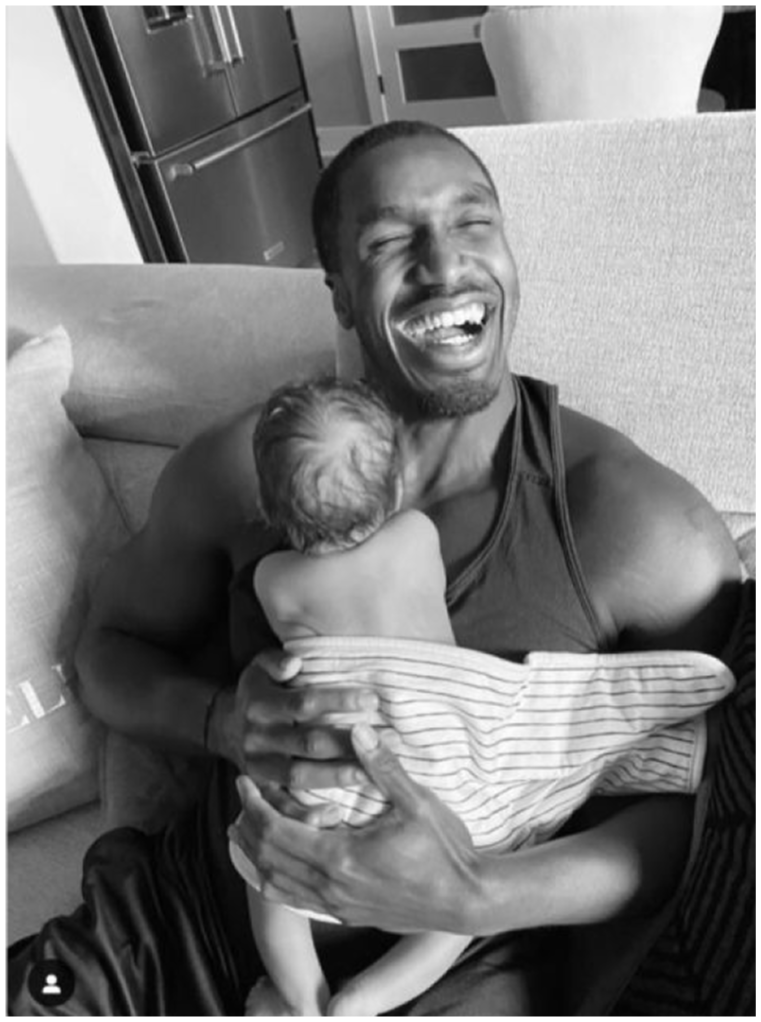
Fatherhood.
Photo 2: Protesting for Peace
The second photo is a black-and-white shot showing a Black man holding a tattered hand-painted white-on-black sign that reads “Peace.” He is outdoors, as indicated by the trees in the background and stands in front of a crowd, many of whom also hold signs. It would appear as though those in the background are of varying races and looking in different directions, doing different things, but we can infer that this is a protest or demonstration setting. Noticeably, the background people are dressed in lighter colors and considerably further back from the man in the foreground, who contrasts with his dark sign, shirt, COVID mask, and darker skin tone. He is photographed waist up, at eye level with the viewer, at a direct frontal view, and looking unmistakably directly at the camera. His direct gaze with the viewers is implying a demand. He wants something from—or wants to do something to—the viewer (Kress & van Leeuwen, 2020). His eyes are slightly squinted and earnest, his brow somewhat furrowed. An exasperated plea is implied: “See me.” Paired with the word on the sign, a desperation in hopes of peace might inferred. As we are at eye level with him, equality is signified between viewer and viewed. The direct horizontal vector further designates this connection. We, both viewer and viewed, are together at this public gathering, presumably with similar goals. We are at a far personal social distance to perhaps a public-style distance. He singles us out with his eyes: “I am looking at you.” The directness of the eye contact, the points of view, relative closeness, and frankness of the sign make it seem as though the man saw a photographer and stepped up to make his statement. He is unreservedly culturally projecting a clear counter-narrative to the stereotype of the violent and angry Black man.
Photo 3: Military Man
In fully decorated and crisp military uniform, we see a man from the mid-abdomen up. Gazing directly at the viewer, his facial expression is somewhat ambiguous, with a closed mouth and eyes neither open wide nor squinted. His countenance might be described as matter-of-fact or even obligated. What he demands from the viewer might simply be, “here I am. Take it or leave it.” A blank face, as this one might be perceived, may make viewers uncomfortable, whether intended or not (Kress & van Leeuwen, 2020). If perceived this way, the moderately close frame with little head space can add to a sense of confrontation. A nearly imperceptible vacancy in his eyes also might hint at a potential internal disharmony—a conflict between expressing who he is and understanding how he is actually seen. As military servants are traditionally seen as honorable, patriotic, and quintessential American, the demeanor of the participant alludes his pondering whether he, as a Black man, has been seen in this way. The setting may also enlighten the tone of the photo. The openness, lighting, and what appears to be a counter in the blurred background imply a public place. The photograph may be official in nature; taken by the military or press. In public posed photos, this direct demand pose is usually preferred, as it is a context that seeks to connect authorities with viewers (Kress & van Leeuwen, 2020, p. 119). The frontal angle further fosters involvement between subject and viewer. Posting this photo as part of the #IamaBlackman challenge ultimately negates the stereotype of Black male as rebellious outsider. He culturally projects the image of an honorable Black American who enacts his civic duty to protect his country, even in a country that has conventionally failed to protect him.
Photo 4: Piano Player
In Figure 4, we are presented with a full-color image with a side view of a black-and-white suit-clad man playing a piano. The piano sits atop an ornate royal purple rug and is lighted by a crystal chandelier and two floor-to-ceiling arched windows. Gilded and baroque-style furniture lines the perimeters of the room, along with a presumably rare outstretched mounted white tiger who overlooks from the top left wall. The Piano Player does not look at us directly, neither wanting anything from us nor directly addressing us. Instead, he is offering himself to us as an objective exemplification and wishes not to foster an emotional attachment with the viewer. The long distance between the viewer and viewed suggests that we are and are to remain strangers (Kress & van Leeuwen, 2020, p. 124). While we are at or near-eye level, which might connote equality, that he is seated at an oblique angle in relation to the viewer suggests that he is presenting himself as an other; not a part of our world. An imaginary barrier exists between us. The selection of this image for presentation highlights the multifaceted nature of the Black man. His clothing style and the room in which he is seated speak of high culture, opulence, and elegance. His suit jacket and pants communicate refinement and style, while the crisp white sneakers ground him and illuminate his connection to Black culture. These visual cues, in combination with the semiotics of composition, paint the picture of a wealthy and educated Black male who displays himself as set apart from the others. He has defied the stereotypes of the poor uneducated Black male and in his cultural projection, he says, “behold, the Black male.”
Photo 5: Success in a Suit
In Figure 5, we see a relatively tall Black man in a tailored and ironed khaki-colored suit, bowtie, and shined brown leather oxfords. He is mid-stride toward the viewer, exhibiting upright posture, hands swinging to the side, and smiling with a slightly open mouth—perhaps speaking—and a gaze that peers partly toward the left of the image frame. In one hand, he grips a rolled-up paper. The flooring and background indicate this is likely a basketball court with an ongoing game. His light suit contrasts the mostly otherwise dark clothing, making him a clear focal point. The setting and suit suggest he works for a basketball team, potentially as a coach. With no direct eye connection with the viewer, he exhibits an offer gaze, and we are mere onlookers. We are therefore not involved with him but allowed to look at him. The tight crop and small headspace allude to slightly more closeness. The oblique angle indicates that he is not at all attached with the viewer nor we with him. It would appear as though the photographer was crouched with taking the photograph, as we are scarcely looking up at the man. This angle, although subtle gives him an air of power and importance, one that is accentuated by his posture, movement, position on the court, and clothing. They all show affluence. One could gather that the selection of this image for the challenge was strategic in that it highlights this Black man as debonair and successful. The visuals, facial expression, and composition say “look at me.” Success in a Suit, with his confidence, swagger, and sophisticated clothing, counters the narrative of the poor Black man.
RQ3: Audience Perceptions of Five Photos
Photo 1: Fatherhood
Thematic Analysis
Survey participants overwhelmingly saw Fatherhood (Figure 1, above) as a solid counter to the stereotype of absentee Black fathers. They valued the honesty and authenticity of the captured moment. The natural display of joy and the close bond between father and daughter highlighted Black men’s humanity and emotional depth, which often gets overshadowed by negative stereotypes. By showing genuine happiness and strong family connections, this image effectively challenges misconceptions and underscores the importance of positive portrayals in influencing perceptions of Black identity. Representing a racially diverse family also sparked conversations about the significance of diverse family portrayals in the media, contributing to a broader understanding and acceptance of interracial relationships and families in society.
Survey Responses
This image was the most highly rated of all the photos, with a mean response of 6.49. In addition, males responded significantly more favorably (M = 6.60, SD = .80) than females (M = 6.37, SD = .91), t(246) = 2.1, p = .037. The effect size was X (Cohen’s d = .27).
Photo 2: Protesting for Peace
Thematic Analysis
Protesting for Peace (Figure 2) evoked a range of strong reactions, from admiration for the man’s dedication to doubts about the effectiveness of protests. Despite differing opinions, the picture sparked conversations about activism, nonviolent resistance, and the complexities of social justice movements. It exemplifies the multifaceted nature of dispelling stereotypes, prompting thoughtful reflections on activism. The image also highlighted the individual’s passion and determination, qualities that are often overshadowed by stereotypes of Black men as violent. By presenting a Black man actively involved in a peaceful protest, the photograph challenges these damaging narratives and emphasizes the significance of activism and social justice. The responses indicated that while some viewers were skeptical about the impact of protests, many appreciated the sincerity and commitment reflected in the individual’s actions, recognizing the broader context of the struggle for equality and justice.

Protesting for Peace.
Survey Analysis
Ultimately, this image was received the least positively of all five images, with a mean response of 5.16. There were significant differences in responses by both gender and race. Males (M = 5.33, SD = 1.44) responded significantly more positively than females (M = 4.94; SD = 1.66), t(249) = 1.96, p = .05. The effect size was X (Cohen’s d = .25). In addition, respondents who defined their race as Black were significantly more positive toward the photo (M = 5.70; SD = 1.31) than those who self-defined as White (M = 5.07; SD = 1.61), t(226) = 2.14, p = .03 (Cohen’s d = .40).
Photo 3: Military Man
Thematic Analysis
Some observers commended Military Man’s (Figure 3) commitment to his duties, while others expressed skepticism or indifference toward the military establishment. The photo also evoked a spectrum of emotions, from admiration and appreciation for the individual’s service to uncertainty and critique based on personal perspectives about the military. Viewers pointed out the individual’s composed appearance and the symbolic significance of his uniform and decorations, influencing perceptions of professionalism and pride. However, the differing attitudes toward military service highlighted the intricate nature of public perceptions. While many acknowledged the individual’s achievements and sacrifices, others approached the military institution with doubt, shaping their overall interpretation of the photograph. This contrast underscores the complex societal discussions around the military and its role, showcasing identity and service’s intricate and layered nature.

Military man.
Survey Analysis
This image received an overall positive mean response of 5.49. There were no significant differences in means by race, gender, or education.
Photo 4: Piano Player
Thematic Analysis
The musician’s musical talent and artistic expression were greatly admired in Figure 4. The photo was interpreted as portraying a profound dedication and love for the arts, shedding light on a frequently overlooked aspect of Black male identity. Reactions to the musician’s attire and the elegant setting varied, reflecting the personal nature of aesthetic judgments. While some viewers were drawn to the sophistication and cultural depth of the scene, others found certain elements to be mismatched. Despite these differing opinions, the image effectively challenged the stereotype of uneducated Black men by presenting a story of cultural and intellectual accomplishment. The photo sparked conversations about the significance of highlighting diverse talents and success stories within the Black community, underscoring the importance of representation in dispelling damaging stereotypes.

Piano player.
Survey Analysis
Overall, participants responded with a mean score of 5.91 toward Photo 4. Again, males responded more positively (M = 6.11, SD = 1.00) than females (M = 5.72, SD = 1.16), t(249) = 2.85, p = .005 (Cohen’s d = .363).
Photo 5: Success in a Suit
Thematic Analysis
People’s reactions to Figure 5 varied, with some admiring his style and confidence while others felt uneasy about the context of the photo. Many observers associated the man’s appearance with success, leadership, and achievement, especially in professional and entrepreneurial settings, challenging stereotypes of Black men as economically disadvantaged or excluded. While some viewers praised his fashion sense and self-assured presence, others expressed uncertainty or doubt about the image’s meaning. The different interpretations of the photo reflect the complexity of visual representation. Nevertheless, the image underscored the importance of portraying Black men in roles that convey achievement and authority, contributing to a more comprehensive understanding of Black masculinity, including economic success and professional excellence.
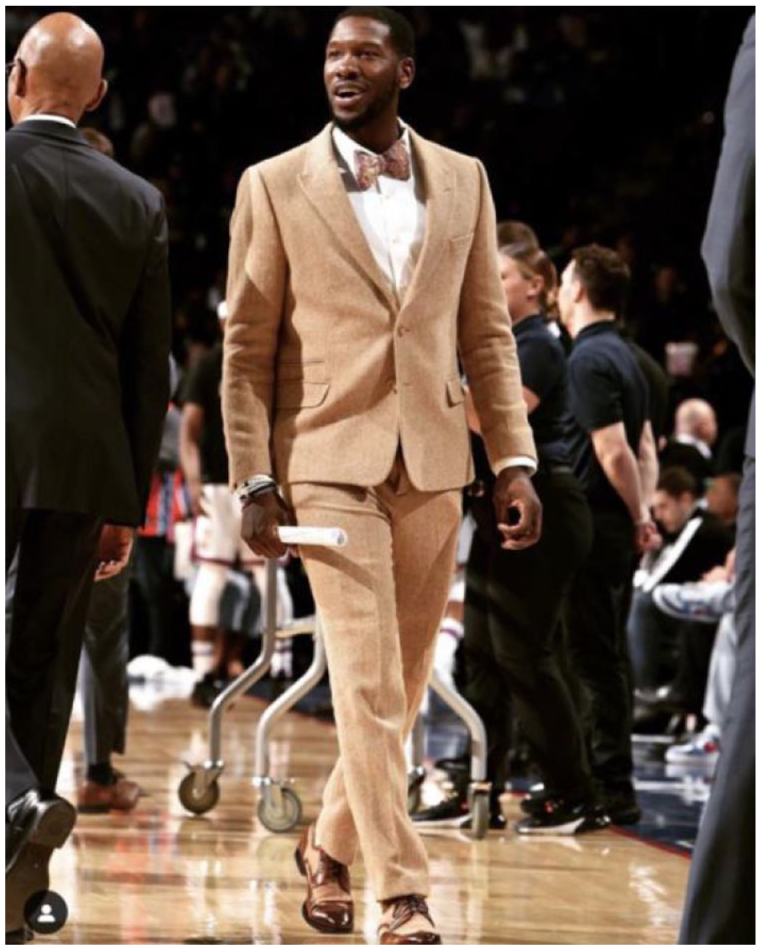
Success in a suit.
Survey Analysis
The mean response to Photo 5 featuring a basketball coach was 5.53. Respondents who self-reported as Black rated the photo significantly higher (M = 6.00, SD = 1.00) than those who self-reported as White (M = 5.47, SD = 1.25), t(50.59) = 2.69, p = .005 (Cohen’s d = .433).
Discussion and Conclusions
This study illuminates cultural projection theory as applied to racially motivated social media movements, shedding light on how members use visual communications to gain visibility and oppose existing stereotypes and how people perceive these efforts. While past studies have applied cultural projection theory to examine the counter-narrative efforts made by larger organizations and mainstream media, this research applies the cultural projection theory (CPT) to the contemporary visual social media environment by examining the efforts of individuals engaged in activism through their participation in the #IAmABlackManChallenge on their personal social media pages. To the authors’ knowledge, it is the first study to look at visuals posted by users of Instagram. Furthermore, it is the first to explore visual cultural projection through a qualitative social semiotic approach with a quantitative component while also examining perceptions. The results ultimately show that Black men use social media to feature positive images of themselves that directly counter stereotypes, underscoring the potential of visual representations to challenge existing narratives and foster more inclusive views of Black masculinity. By interrogating prevailing misconceptions and showcasing the diverse experiences and identities within the Black community, visual imagery emerges as a potent force for social change.
For the most part, the Black men who posted images as part of the #IamaBlackman challenge visually communicated a desire to invite viewers into a closer, more intimate, and personal relationship with them. Broadly, the images were well received by viewers and most of the differences came down to gender rather than race. Fatherhood was an intimate offer, and the most well-liked of the images, a direct opposition to the Black absentee father. The positive perception suggests syncretism or a broad agreement about the universal of the value of family. Male respondents reacted particularly positively to this photo. The two photos with significant differences in perceptions by race and therefore perhaps the least success in cultural projection were Peace and Success in a Suit. The first of these images counters the stereotype of violence and the second image, poverty. While it is not possible to draw broad conclusions based on perceptions of only two photos, these results might point to potential areas of resistance in the destigmatization efforts of the Black American male. The stereotype of Black males as violent and poor may be stickier than some others. Peace, in fact, was the poorest-received image of the five. That may be because of the stereotype itself, or admittedly could be due to other factors, including the mask, black-and-white color scheme, and overall dark tone.
The photo-elicitation comments help uncover some nuances as to how the photos were received. Respondents consistently connected with the authenticity and emotional depth captured in each image, recognizing the pivotal role-played by these representations in shaping positive perceptions. The genuine displays of joy, determination, professionalism, and talent depicted in the photographs resonated with viewers, contributing to dismantling narrow stereotypes. Despite the varying contexts of the photos, there was a shared appreciation for the subjects’ achievements and success, emphasizing the importance of diverse and affirming portrayals in reshaping societal narratives. However, the analysis also highlighted the complexity and ambiguity inherent in these representations. Viewers’ interpretations were influenced by their biases, experiences, and cultural backgrounds, underscoring the nuanced nature of perception. The photographs incited discussions about diversity and representation, with respondents valuing the portrayal of multifaceted roles inhabited by Black men beyond traditional stereotypes. This highlights the ongoing need for efforts to present authentic and varied images of Black masculinity in both media and public discourse.
The sentiment analysis further pointed to a level of anger, fear, disgust, and sadness present during a 1-month period after the start of the challenge. Further investigation (viewing select tweets that were noted as negative) shows that the words associated with negative emotions and sentiments were part of the caption. For example, words and phrases such as tear down, pain, criticized, offended, and negativity were tagged as a negative sentiment for the challenge. However, these are words and phrases used in the caption to demonstrate why the challenge was created in the first place. Considering the nature of Brandwatch’s sentiment analysis algorithm, additional research should be conducted to further investigate the overall sentiment of the #IAmABlackMan challenge. Understanding the sentiments of this challenge is important as it highlights how (a) people felt about the challenge and (b) how people engaged with the challenge. The more people tweeted about the challenge using the specified hashtag #IAmABlackman, the more the sentiments increased. The sentiment analysis is flawed, as it registered certain words from the challenge statement as negative although they were intended to be positive. Reviewing the sentiments of the challenge provided cursory insight into how viewers could potentially perceive the cultural projection of Black men which led to research question three.
The findings of this study demonstrate that the #IAmABlackMan challenge was an effective form of cultural projection, allowing Black men to present counter-narratives to dominant stereotypes through visual media. The images analyzed reflected themes of resilience, fatherhood, professionalism, and activism, challenging long-standing misrepresentations of Black masculinity. Viewer responses, particularly through photo-elicitation and sentiment analysis, suggest that these representations resonated positively with many audiences, although some images—especially those related to activism and economic success—revealed lingering tensions in public perception. This highlights both the progress made in reshaping narratives through digital activism and the persistent barriers that such movements must navigate.
This study adds to existing research on the BLM movement by emphasizing the role of user-generated visual content in shaping public discourse. While much of the scholarship on BLM has focused on textual activism, protest mobilization, and institutional responses, this research centers on the power of individual digital storytelling in fostering social change. By applying the concept of cultural projection to the visual sphere of Instagram, this study expands the understanding of how grassroots activism operates within social media ecosystems, reinforcing the idea that visual narratives are central to modern movement-building. The results suggest that social media challenges like #IAmABlackMan serve not only as acts of resistance but also as mechanisms for community-building and public engagement, contributing to the longevity and adaptability of the BLM movement.
Furthermore, this study begins to uncover the manner in which racially motivated social media movements use images online to culturally project more positive visual communications of themselves to oppose existing stereotypes as well as how the visuals were perceived. While this study specifically focused on the images put forth by Black men participating in the #IAmABlackMan challenge on Instagram, future research could assess if the use of specific hashtags on social media as it relates to social movements is a form of cultural projection. Hashtags such as #policebrutality, #Blackboyjoy, #racism, “Blackking, #georgefloyd, and #ahmaudarbery were often added to the caption of these images, although we did not analyze these. Future research should continue to delve into the convergence of visual culture, identity formation, and stereotype subversion, paving the way for more nuanced and equitable representations of Black masculinity in media and society. In addition, future research should specifically examine the intentional efforts of activists through a purposive sample. While the argument could be made that engaging in activist efforts makes one an activist, participants in this sample did not explicitly identify themselves as activists. The results of the study and methods employed can be applied to other racially motivated movements and activist movements that have circulated on social media such as #StopAsianHate.
Footnotes

Funding
The authors disclosed receipt of the following financial support for the research, authorship, and/or publication of this article: This project was funded by an internal grant received through the College of Information and Communications at the University of South Carolina.
Declaration of conflicting interests
The authors declared no potential conflicts of interest with respect to the research, authorship, and/or publication of this article.