




Abstract
This article seeks to contribute to the field of digital research by critically accounting for the relationship between hashtags and their forms of grammatization—the platform techno-materialization process of online activity. We approach hashtags as sociotechnical formations that serve social media research not only as criteria in corpus selection but also displaying the complexity of the online engagement and its entanglement with the technicity of web platforms. Therefore, the study of hashtag engagement requires a grasping of the functioning of the platform itself (technicity) along with the platform grammatization. In this respect, we propose the three-layered (3L) perspective for addressing hashtag engagement. The first contemplates potential differences between high-visibility and ordinary hashtag usage culture, its related actors, and content. The second focuses on hashtagging activity and the repurposing of how hashtags can be differently embedded into social media databases. The last layer looks particularly into the images and texts to which hashtags are brought to relation. To operationalize the 3L framework, we draw on the case of the “impeachment-cum-coup” of Brazilian president Dilma Rousseff. When cross-read, the three layers add value to one another, providing also difference visions of the high-visibility and ordinary groups.
Introduction
In 2007, when Chris Messina made a tweet suggesting the use of # to organize content, he could not have predicted how the movement of adding the hash symbol before a word, a sequence of characters, or an emoji would become an everyday social practice inside and outside of web platforms. The adoption of the # symbol goes beyond the labeling of trackable content or elements; instead, it is now undertaken as “multiple, open-ended, and contingent phenomen[on]” in society (Rambukkana, 2015, p. 5) that serves digital research as a storytelling device.
At the same time, the use of hashtags points to controversial and tricky activities (projected to create, induce, or keep alive a given debate/conversation). Either way, these activities have demanded medium-specific methods and research (Gerlitz & Rieder, 2018; Rogers, 2013). In alignment with new media scholars (Highfield & Leaver, 2016; Langlois & Elmer, 2013; Rieder & Röhle, 2017; van Dijck, 2013), we argue that social media research faces multiple challenges related to its complexity, both in terms of the amount of information that circulates online and, especially, of the need to investigate how to carry out research with the indispensable technical knowledge. This involves raising questions, for instance, regarding how to approach hashtags through platform mechanisms and how to handle the affordances and limitations imposed by their infrastructure (see Marres, 2017; Rieder et al., 2015).
Against this background, this article proposes a framework to tackle the problem of the methods applied to understanding collectively formed actions mediated by social media platforms, that is, what we refer to as “hashtag engagement.” To that end, we acknowledge “methods” as not only complementary to digital research but in an interdependent position (Latour, 2010; Rogers, 2013) and, consequently, the study of “hashtag engagement” as something that requires technical knowledge and (a minimum) practical expertise on applied research with digital methods. In this regard, we incorporate the notions of technicity (Simondon, 2009, 2017) and platform grammatization (Agre, 1994; Gerlitz & Rieder, 2018; Stiegler, 2006, 2012) to better understand the complexity and challenges of hashtagging for digital research.
Furthermore, we present the three-layered (3L) perspective which aims to “repurpose” the way we reason about hashtag engagement, moving from folksonomy aspects to their multiple and complex role in and through social media. Under the lens of digital methods (Rogers, 2013, 2019) and distinguishing high-visibility versus ordinary actors and related content, the 3L approach aims toward providing a novel way for reasoning and doing research about hashtag engagement. To conceptually and practically introduce our proposal, we draw on the case of the “impeachment-cum-coup” of Brazilian president Dilma Rousseff. The demonstrations of March 2016 are particularly meaningful as they marked a heightened peak of political polarization in Brazil. We then took advantage of Instagram both as a source of historical data generated by millions of citizens and as a site of research. We first revisit the role of hashtags and situate “hashtag engagement” to underpin the 3L perspective.
Revisiting the Role of Hashtags
The use of hashtags is undoubtedly a part of our digital life. There is a hashtag for almost every social interest, for example, political causes or protests (#elenão vs. #elesim), branding or advertising campaigns (#PepsiGenerations), genre representation (#femboy), the awareness of illness (#microcefalia), erotic content (# ), tourism (#RiodeJaneiro), gastronomy (#foodporn), memories (#tbt), and so on. As natively digital objects (Liu, 2009; Rogers, 2013), hashtags may serve as indexes for their functions, meanings, and practices. That is to say, one can search for, navigate, or engage with hashtags, while others can monitor, trace, and retrieve small or large datasets linked to them. Engaging with hashtags may express local or global conversations, compact or large events, and controversial or non-controversial issues (Bruns & Burgess, 2011; Burgess et al., 2015; Highfield, 2018; Pearce et al., 2020; Tiindenberg & Baym, 2017). It is essential also to recall that hashtagging is not exclusively human activity, but often the fuel behind effective bot activity (Bessi & Ferrara, 2016; Omena et al., 2019; Wilson, 2017) also used on social media for political and marketing purposes. And that means, beyond the capacity to represent communities, publics, discourses, or sociopolitical formations, hashtags can be perceived as sociotechnical networks, both as “the medium and the message” (Rambukkana, 2015).
The act of engaging with hashtags is not a new theme within Social Media Studies, particularly for Twitter. This platform is the most common focus of hashtag-led studies, with a vast theoretical and empirical literature that addresses the relationship between hashtags and social formations (see Bode et al., 2014; Bruns & Burgess, 2011; Burgess et al., 2015; Small, 2011). Moreover, the use of political hashtags is a prevailing criterion in corpus selection (Jungherr, 2014, 2015). On Instagram, however, scholars have approached hashtags in selfie studies (Tifentale, 2015), commemoration and celebration (Gibbs et al., 2015), geolocalization and socio-spatial divisions (Boy & Uitermark, 2016), and as innovative visual methods to research emoji hashtags (Highfield, 2018) or climate change images (Pearce et al., 2020). Also, hashtags serve as a path to either training data for the development of automatic image annotation (Giannoulakis & Tsapatsoulis, 2016) or for addressing human behavior (see Cortese et al., 2018; Tiidenberg & Baym, 2017).
On Instagram, the use of hashtags began in 2011, 1 promoted by the platform community team through an initiative named “Weekend Hashtag Project”: a weekly campaign that stimulates a culture of hashtag use in association with artistic and creative photographic styles, giving users a chance to have their publications featured by Instagram. Beginning at the end of 2011, weekly suggestions were prompted every Friday, such as #throughthefence and #middleoftheroad in November, and #vanishingpoint in December. 2 Over time, the prefix “WHP” 3 became compulsory for those who wanted to join the project and the weekly announcements moved beyond the Instagram Blog on Tumblr to other platforms such as Twitter and Facebook. After Instagram, a new tagging practice has also emerged throughout the #insta tags family—for example, #instagood, #instamood, #instadaily, #instalike, #instalove. These tags, moving across platforms, not only gave rise to readymade hashtag thematic lists to boost (automated) engagement, 4 but have also pushed the boundaries of hashtagging, and challenged hashtag based-studies.
Beyond serving as a description of visual content (Giannoulakis & Tsapatsoulis, 2016) or as an index for a topic, a hashtag is also a register for the realm of feelings, ideas, and beliefs (Paparachissi, 2015). To demonstrate this, #BrasilContraOGolpe [Brazil against the coup] may serve as a good example. In late March 2016, this tag emerged from Dilma Rousseff’s supporters and “democracy advocates.” Activists, intellectuals, journalists, politicians, and ordinary users started using #BrasilContraOGolpe as a reference to the impeachment process against the president—considered by many as a “modern coup” (Jinkings et al., 2016). Pro-impeachment supporters, however, have also adopted the usage of the tag, but shifting its original meaning to support their arguments: claiming that the real coup would be that of keeping Dilma Rousseff and her Labour Party (PT) in charge of the government. This meaning shift, especially concerning polarized debates in pro- and anti-programs (see Akrich & Latour, 1992; Rogers, 2018), is an example of double-sense hashtags.
To locate these modes of appropriation, a technical understanding of the platforms’ functional forms of living (technicity) must be entangled with the process of doing digital methods (Rogers, 2019). Studies based on hashtags, however, should not conflate different platforms but, rather, apply different analytical procedures to each one (see Highfield, 2018; Highfield & Leaver, 2015; Rogers, 2017). Conversely, hashtags can be viewed as “problematic” content for digital research due to their failure to cover certain sensitive issues that tend to be disguised, such as pro-eating disorder content (see Gerrard, 2018). The collective adoption of tags can also be employed as a comparative source to grasp hashtagging activity in different platforms, which can be used to adapt methodological approaches (Highfield & Leaver, 2016). Despite unveiling different layers of reasoning the logics of the hashtag adoption and its consequences in a given context, these studies do not necessarily address hashtagging as a collective action movement. Alternatively, we further introduce the idea of discussing hashtag engagement rather than the hashtag adoption, conflating with the technicity of Instagram and its grammatization process.
Situating Hashtag Engagement
What, then, does the word engagement in “hashtag engagement” refer to? Engagement is taken as actions, metrics, and research indicators. For instance, one can argue that hashtag engagement is commonly associated with the act of using tags to engage with news, activism, brand strategies, event-based information, politics, demonstrations, automation practices, or particular debates. However, the term “engagement” has been either used to name platform-afforded metrics (or the totality of commensurable activities in a media item) or taken as an indicator for research design. Engagement metrics have thus become part of general digital media literacy as well as parameters for selecting data samples to be further analyzed. Partly encouraged by terminology adopted by platforms themselves, 5 these metrics have even merged with the very notion of engagement in common parlance. 6
On this topic, Marres (2017) refers to the analytic figure of power-law as a critical issue in “the re-validation of hierarchical forms of social and public life” (p. 71). According to Marres, by feeding power laws back to users in the form of trending lists, digital platforms not only inform what goes on in digital settings but also serve “as an instrument that influences collective action.” And, while these can be understood as actual and faithful results of how users generally relate to the media, Gillespie (2017) draws attention to how the “platform metaphor” may hide inherent biases and active intervention of the internet high-tech companies, while suggesting a smooth standing point from which users can participate equally and fairly. Both of these remarks remind us that hashtag engagement also responds to platform infrastructures and mechanisms.
In this scenario, we understand that social media engagement can be approached under a dual logic. In one way, it prioritizes the sum of actions media items receive from many actors. Alternatively, engagement with a topic can be perceived by the recurring use of natively digital objects (Rogers, 2013) or grammars of action (Agre, 1994) from many actors about a topic—that is, many people using particular terms, hashtags, or images. Following platform mechanisms, the first logic is reflected on the most engaged list or what is dominant in terms of popularity and influence—parameters commonly taken for sampling purposes in social media research. The second logic refers to the diffuse posting of content related to particular issues that do not necessarily reach large numbers of “likes,” “shares,” or similar actions. That is where we would also find “ordinary” posts kept out of the spotlight—in a distribution that is similar to C. Anderson’s (2008) notion of the long tail.
The dual logic of social media engagement thus raises concerns in research methods, particularly the understanding of the high-visibility and ordinary lists: what different stories can they tell? How may these lists complement or contradict one another? Some researchers have addressed specific concerns regarding how the practice of emphasizing high-visibility content or the logic of popularity may lead to social media studies driven by engagement parameters (Marres & Weltevrede, 2012; Rosa et al., 2018). On the contrary, there is a long-standing debate around what “ordinary” means and why it matters for Cultural, Communication and Media Studies. For instance, in an attempt to describe the ordinariness of culture, Williams (1989) explained how difficult it is to interpret the ordinary or unknown audience. In his view, ordinary people do not belong to “the normal description of the masses”; they belong to the unknown or unseen structures (Williams, 1989, p. 98).
This article thus proposes, from a standpoint of quali-quantitative methods (Latour et al., 2012; Moats & Borra, 2018; Venturini, 2010), an alternative perspective to addressing engagement in social media research; a call to embrace not only highly visible content, but also ordinary, less-visible content for the interpretation of hashtag-mediated actions.
Reasoning With and Through the Medium
The study of hashtag engagement also requires a grasping of the functioning of the platform itself (technicity) along with the platform techno-materialization process—which “enable (s) behavioural fluxes or flows to be made discrete (in the mathematical sense) and to be reproduced” (Stiegler, 2012, p. 2) (grammatization). In this regard, we incorporate the notions of technicity and grammatization, which not only complement one another but are crucial for social media research and, accordingly, for the concretization of the 3L approach.
Technicity
The philosophy of Gilbert Simondon (2009, 2017) reminds us of the crucial role of technicity for an understanding of “the mode of existence of the whole constituted by man and the world” (2017, p. 173)—a reality mediated by technical objects. The reasoning proposed in this article derives from Simondon’s ideas on the essence of technicity (2017) and the technical mentality (2009). Technicity, in a specific manner, refers to the notion of “function” as being associated with the technical and practical forms of knowledge of technical objects and how they relate to us. On this basis, technicity would simultaneously precede and take place with and in technical objects: first by being related to figural structures or the realm of ideas and, second, by the recognition of technical objects as a practical reality. This movement (from representative aspects to the praxis of techniques), consequently, divides technicity into two orders of thought: theory and praxis. In this way, technicity concomitantly triggers not only theoretical but also technical and practical knowledge on the functioning of technical objects and their relationship with human beings.
A technical mentality thus implies thinking hashtag engagement with, in, and through social media platforms. Rather than only looking at the content, a study based on the technicity of Instagram should also consider the functioning of its technical interfaces and algorithmic techniques. One example of this would be to take advantage of application program interface (API) documentation using the knowledge about platform data access regimes, endpoints, and their respective limitations and rate limits to repurpose social media research. 7 This article aligns with concerns raised by scholars such as Rieder et al. (2015) and Langlois and Elmer (2013), by looking at what is in social media technical interfaces as a way to perceive how social media grammars (hashtags) have been rendered and made available. In doing so, we propose, in practical ways, a more techno-aware understanding of social life (Marres, 2017) in pursuit of studying “hashtag engagement” on social media.
Platform Grammatization
When referring to grammatization, we are addressing an extension of the concept forged by Auroux (1994)—a process of description, formalization, and discretization of human behaviors into representations, so that they can be reproduced (Crogan & Kinsley, 2012). This is what the French philosopher of technology, Bernard Stiegler (2006, 2012), called the process of digital grammatization in which “all behavioural models can now be grammatised and integrated through a planetary-wide industry of the production, collection, exploitation, and distribution of digital traces” (Stiegler, 2012, p. 2). More recently, Gerlitz and Rieder (2018), envisioning the infrastructural aspects of Twitter, presented an updated definition of grammatization: when users inscribe themselves into predefined forms and options produced and delineated by technical interfaces (software) to structure their activity. Beyond providing a way of looking at things, platform grammatization simultaneously produces standardization of actions (e.g., likes) and formalizes these activities to calculability. This is a relevant concept for digital methods-based research, due to its strong focus on media-specificity, which, in the case of social media, is very much defined by their grammatization of social activity.
Next, we borrow Agre’s (1994) technical understanding of “grammars of action” or the representative forms of “discourse-made-machinery,” such as hashtagging, commenting, posting, replying, and so on. In this sense, hashtags are no longer text, but, by being clicked, they enact a navigational function. Thus, hashtag engagement is embedded into the platform databases that predefine specific properties (e.g., a tagged post has a caption, an image, or video and date of publication), the relationship between them (e.g., hashtags appear in Instagram posts), and a set of actions (e.g., liking or commenting on posts, using filters; see Gerlitz & Rieder, 2018). When considering how social media databases store and organize actions attached to the # symbol, we verify multiple forms of storing and further accessing hashtag data. As an illustration, through the former Instagram Platform API, it was possible to recall the number of times a profile mentioned a given tag (suggesting a form of appropriation) or the provision of ways of seeing correlations among tags (through a co-tag network). Meanwhile, the current Instagram Graph API only allows the search for the most popular or recently published tagged content.
In other words, and despite its prestructured form (#), hashtags can be differently embedded into social media databases permitting, then, different ways of reading hashtag engagement. Along with this grammatization process, hashtags can also acquire different meanings and purposes in the modes they are used and, therefore, researched. That is what we refer here as “the grammars of hashtags,” how social media capture and reorganize the different modes of actions attached to hashtagging.
The 3L Perspective for Studying Hashtag Engagement
The 3L perspective assembles hashtag engagement, their related content, and the actors involved by distinguishing dominant and ordinary groups embedded in social media practices and mechanisms. The practical awareness of the platform grammatization and technicity is the basis that concretely informs the 3L approach. This kind of knowledge, we argue, provides practical ways of reasoning with and through the functioning of the platform itself and its conjunction with hashtag engagement. Just as digital methods (Rogers, 2013, 2019) the 3L perspective must follow and evolve with the medium, its methods, and the affordances of digital data. Following the lexicon and proposal of Rogers (2018), this perspective also serves as a form of “critical analytics” or “alt metrics” for social media research by locating issue networks and creating indicators that are alternatives to marketing-like measures.
We understand hashtag engagement as collectively formed actions mediated by technical interfaces. In other words, grammatized actions that move toward descriptions of images and feelings or toward particular topics of discussion (or issues), which require a (minimum) collective level of commitment. These sociotechnical formations, differently inscribed within web platforms, offer a framed (but sturdy) perception of society while providing social media research with different levels of analysis. Through the lens of the 3L perspective and along with the proposal of sociologist Bruno Latour (2010; Latour et al., 2012), the study of hashtag engagement allows analysis to move between the levels of the element (micro) and of the aggregates (macro). 8 With Latour and others (Omena, et al., 2019; Venturini et al., 2015, 2018), we embrace a “navigational practice” not restricted to either of those levels but a research practice that goes from micro to macro and back, taking any of them as a starting point for the inquiry. Few studies, however, have been developed on methods for researching hashtag engagement on Instagram on such bases. This is a contribution we expect to make with our 3L perspective for hashtag engagement studies on (but not restricted to) Instagram.
In what follows, we explain each layer comprising the integrated 3L approach. Although presented in a linear sequence, they must be taken together, as layers of the same object.
Layer 1: High-Visibility Versus Ordinary
On this analytical level, unique actors are identified and subsequently distinguished according to the modes of activity and engagement metrics received by their posts over time (the acts of hashtagging or interacting with tagged content). In so doing, we attempt to cover both high-visibility and ordinary actors and related content, as well as answer the following questions: who are the high-visibility and the ordinary actors? Who dominates the debate? What is the visual and textual content related to them? What are the sites of image circulation? How about the distribution of users, posts, and engagement?
The main challenge is in proposing a threshold for delimiting high-visibility from ordinary hashtag usage, its related actors, and content. 9 Driven by Rogers’s (2018) alternative metrics to study issue networks in social media research, we considered the persistence of user activity over time as they are inscribed in platform engagement metrics. Thereby, it is an attempt to address what the social media digital attention economy either emphasizes or not. In this logic, high-visibility actors and content are understood as the minority, which exhibit comparatively high and consistent engagement metrics (e.g. likes and comments counts) across the observed time span. This would indicate not only the scale of their audience but also their ability to receive responses to their publications. Conversely, ordinary actors and content would be the majority, exhibiting comparatively lower engagement metrics, reaching a smaller audience. Of course, these categories are not empirically self-evident. Rather, the threshold needs to be arbitrarily defined by grounded criteria.
Layer 2: Hashtagging Activity
The second layer relates to the repurposing of hashtagging activity for grasping the grammars of hashtags. By this, we mean the ways in which social media platforms capture and reorganize the different modes attached to hashtagging. Far from being neutral intermediaries (Latour, 2005), hashtags are taken as entities to which the activities of users, bots, and platform algorithms converge and through which they mutually transform one another. Although such entanglement can be very complex, it is possible, in line with digital methods’ perspective (Rogers, 2013), to repurpose hashtags as traces from which one may infer those activities.
Besides framing the most active actors or serving as qualitative parameters to inquire into high-visibility and ordinary groups, the intensity and rhythm of hashtag mentions may indicate actors very committed to specific issue spaces, as well as potential botted accounts (see Omena et al., 2019). Patterns of concomitant hashtag use can indicate different hashtagging practices, including shifts of meaning, purposeful deviations, as well as hashtag ambiguity and ironic usage. We argue that different approaches should be embraced to read the forms of appropriation and frequency of use regarding one or more hashtags.
Looking at the affordances of Instagram to hashtagging activity, this layer seeks to answer questions such as the following: What can frequency of hashtag use reveal about high-visibility and ordinary groups? What can the number of times hashtags are mentioned by a given account tell us about particular actors or automated agency? How can the co-occurrences of hashtags indicate different hashtagging practices? How do hashtags mediate actors’ engagement with a cause?
Layer 3: Visual and Textual Content
Finally, hashtag engagement should also be related to the content of the posts within which they are mentioned. The third layer focuses on visual and textual content, providing an overview of the diversity and richness of narratives attributed to particular hashtags. Here, the focus is on understanding the images and texts to which hashtags are brought to relation, taken as constituent parts of their meanings and related practices. In that regard, and accounting for high-visibility and ordinary groups, this layer asks: what stories can the visual and textual tell? What are the visual and textual compositions or meanings related to certain hashtags? How about the sites of image production and circulation?
The quali-quantitative approach is of particular relevance at this analytical level. Considering our interest in massive ordinary posts, this approach would be laborious—not to say unfeasible. However, distant reading methods for both texts and visual content can be mobilized for identifying recurring patterns (Dixon, 2012) among the dataset, without losing sight of their manifestations. This is the main challenge of this layer, whose operationalization will be detailed further.
The Praxis of Hashtag Engagement Research
Political Context, Scholarly Approaches, and Framing of the Brazilian Case
The case study approaches two antagonistic protests staged in Brazil in March 2016, during a rise in political animosity in the country. On the 13th of that month, protesters went to the streets in many cities in support of an ongoing parliamentary process to remove President Dilma Rousseff from office. Five days later, on the 18th, protesters contrary to the removal took their turn, expressing concern that the proposed impeachment lacked legal cause and would thus be qualified as a “parliamentary coup” (Jinkings et al., 2016). In respect to the terminology used by each of the groups in defining themselves—and wary of not prematurely resolving the implied controversy (Latour, 2005; Venturini, 2010)—we chose to refer to the protests, respectively, as “pro-impeachment” and “anti-coup.”
It is essential to understand this case within a broader political context. Addressing Brazilian demonstrations staged between 2013 and 2016, Alonso (2017) discusses elements that could have facilitated their emergence with an interest in the styles of mobilization of each cycle of demonstrations. These include the wave of global autonomist protests starting in 2010 (from Tunisia to Wall Street), Brazil’s international visibility due to the sports events it would host in the following years; corruption scandals and their spectacularization; and the rapid reconfiguration of Brazilian social strata (see P. Anderson, 2011; Lima, 2010), which destabilized symbols of social hierarchy (race, income, and education, among others).
This 4-year period, culminating in 2016, is commonly divided into three protest waves. First is that of the so-called “June Journeys”: mass demonstrations which, at their peak in June 2013, brought an estimated 1 million people to the streets. They marked the emergence of an autonomist and leaderless style of demonstration, which took governments and traditional movements by surprise, but which also culminated in ideologically ambiguous protests coalescing agendas across the political spectrum—from anarchist to pro-dictatorship demands. Next would be what Alonso (2017) refers to as the 2015 “Patriot cycle,” 10 following the 2014 presidential elections, which Rousseff won by a very narrow margin. To the right of the political spectrum, allegedly nonpartisan groups achieved prominence, especially on social media (Omena & Rosa, 2017). They were able to mobilize a wide range of conservative political strands, from major players in the financial and industrial sectors to religious fundamentalists and conservative citizens from higher economic strata.
The case studied in this article is part of the third wave, more directly tied to Rousseff’s impeachment process, which, officially, pursued accusations of administrative misconduct (which came to be known as “fiscal pedaling”) in December 2015. Most protests took place in 2016, when the aforementioned conservative groups were prominent established players in Brazilian protests. The polarization already experienced in the second wave was magnified by the reconfiguration of the public agenda, with antagonistic groups of supporters and detractors of Rousseff’s deposition becoming delineated.
Despite the actual judicial arguments of the process, public debate inherited much of the agenda of the previous wave, with pro-impeachment demonstrators focusing on corruption scandals, targeting the Workers’ Party, and mobilizing mostly citizens from higher economic strata. Calls for Rousseff’s ousting were accompanied by several misogynistic depictions of Rousseff—the first-ever female president of Brazil—as discussed by scholarly inquiries of the case (see Corrêa, 2017). Hatred against left-leaning activists and marginalized segments of the population, commonly associated with a progressive agenda, was also increasingly manifest in that context. Anti-coup demonstrators’ discourses focused on the defense of democracy and often exhibited explicit partisan stances.
Although this event has prompted scholarly inquiries on several aspects of the process, there are surprisingly few works that investigate how protesters represented themselves in that context. The impeachment process has been more often studied with regard to how it was reported by the press or by groups leading the protests (see Fausto Neto, 2016; Tavares et al., 2016), with little attention paid to ordinary protesters’ visual depiction of the event or to Instagram as a site of observations. 11 In what follows, we will present a study of this case based on our 3L perspective, building upon Instagram’s culture of use and affordances.
Operationalizing the 3L Perspective
Taking advantage of Instagram’s API Platform, which at the time allowed researchers to going back days, months, and even years in time, data collection occurred in several iterations from 13 to 31 March 2016. Our study relied on Visual Tagnet Explorer (Rieder, 2015) to collect publicly available posts according to queries based on hashtags. Chosen upon immersive observation of the context and through previous exploratory data collection and analysis (co-hashtag networks and Excel’s pivot table), the selected hashtags (Table 1) corresponded to the following criteria: having a significant amount of mentions, bearing clear connection with the topic, being an indicator of counter-reactions, or being an indicator of new connections on the topic. The datasets were later filtered by matching the dates of the posts and the protests, limiting the scope to the two dates—13 March for pro-impeachment and 18 March for anti-coup. The final combined dataset included 19,231 unique Instagram accounts with a total of 22,423 posts.
List of hashtags selected for the case study.
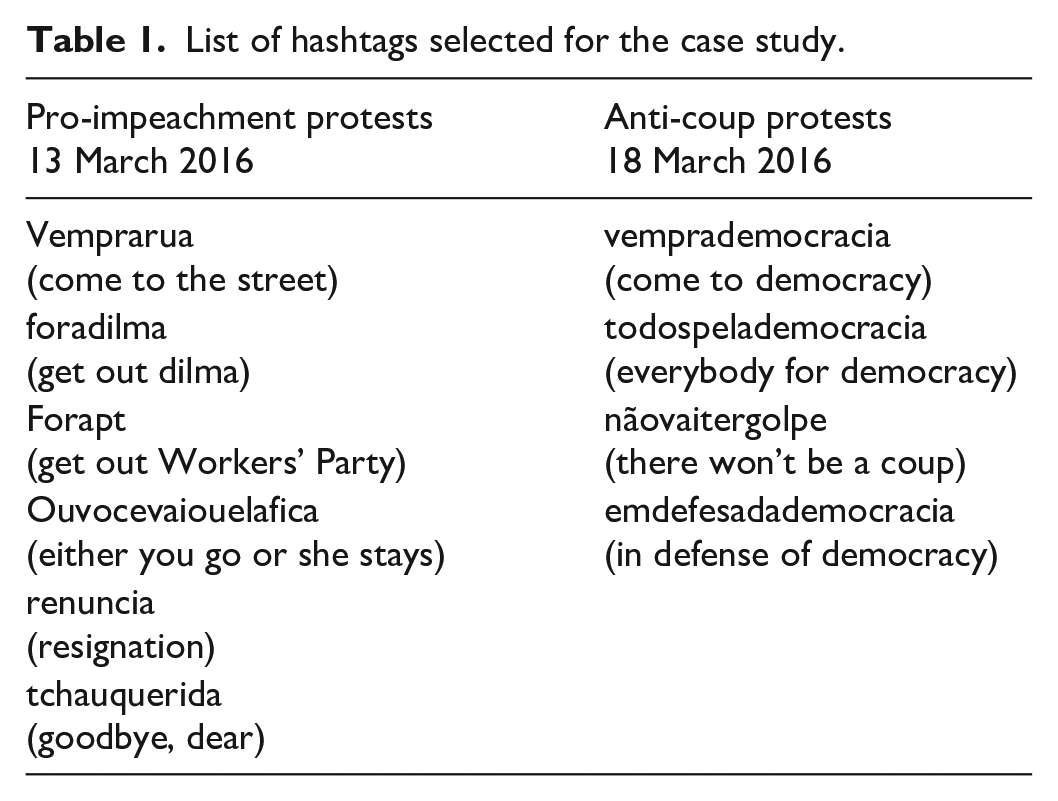
Following the 3L perspective, the distinction of high-visibility from ordinary was based on the combination of two factors: first, detecting unique actors (Instagram accounts) and then the testing of different thresholds for the average platform engagement metrics (sum of like and comment counts) of the users’ posts over time. In so doing, we expected to find a viable threshold that could distinguish between a minority group of users which received a large portion of the total sum of engagement metrics of all posts in the dataset. Through this process, we came to define the threshold at the 98th percentile of average engagement per post, per user. Using this boundary, we found similar distributions for both pro-impeachment and anti-coup datasets. In both cases, high-visibility actors were a minority responsible for roughly 4% of all the posts in each dataset; yet, they received around 50% of all engagement-related activity. Through this procedure, we sought to distinguish the most visible (and, therefore, most popular and influential) actors and their related content from the rest.
Next, for the analysis of hashtagging activity, we focused on hashtags’ frequency of use and their concomitant mentioning. The former was taken as an indicator of popular tags, which we compared between high-visibility and ordinary users in each protest. The concomitant mentioning of hashtags was observed through co-occurrence network built on Gephi Version 0.9.2 (Gephi Consortium, 2017), taken as analytical devices to observe patterns of hashtagging practices. 12
For the visual dimension, we relied on an experimental approach based on that proposed by Ricci et al. (2017). Post images were automatically labeled based on their content using a computer vision API—Google Cloud Vision API Version 1.0 (Google, 2017). 13 The automated image classification was later combined with Gephi and a custom Python script (Mintz, 2018) for building a computer vision-based network. The so-called image-label networks in which we can see clusters of images connected by their descriptive labels. For the textual content, we resorted to two analytical tools: CorTexT Manager (Lisis Laboratory, 2017) and Textanalysis (Rieder, n.d.). The former, advanced by topic modeling algorithms, allowed us to visualize co-term networks of Instagram captions and their related hashtags (clustered by political positioning). Textanalysis served our case study to compare the use of emojis in the captions of posts by high-visibility and ordinary users.
Findings
In this section, we present the findings of the case study of the “impeachment-cum-coup” of Brazilian president Dilma Rousseff. We applied the 3L perspective to study political polarization in Brazil through the lens of hashtag engagement and considering two national demonstrations: the pro-impeachment (March 13) and anti-coup (March 18) protests.
High-Visibility Versus Ordinary
Through the distinction made at this stage, we were able to inquire on high-visibility actors and their related content. Who are they? What can activity over time tell us about high-visibility actors? To what visual elements are they attached? We identified a very particular structure in both pro-impeachment and anti-coup groups (Table 2): on one side, a group of actors who obtain high levels of engagement metrics with very few publications, while on the other, a group of actors with a large number of publications over the day of protests also getting high levels of engagement metrics (see Omena et al., 2017).
The high-visibility actors in Brazilian protests. Instagram, March 2016.

In a more specific example, Figure 1 shows the configuration of high-visibility actors (dots) positioned according to received engagement metrics (vertical axis) along the day of the protests (horizontal axis). At the top, the actress Viviane Araújo points to a trending characteristic in the dominant visuality among public figures: selfies, whereas the classic imagery of the crowds is mainly promoted by non-official campaign accounts and the organizer of the protests—namely, chegadecorruptos, foracorruptos_rn and vemprarua. Other visual elements addressed by the high-vis actors in pro-impeachment protests expose the support of the then Federal Judge Sérgio Moro and the Operation Car Wash or the appearance of humorous images (e.g., Dilma in the shape of Zika mosquito) and aggressive messages addressed to Dilma Rousseff and Lula.
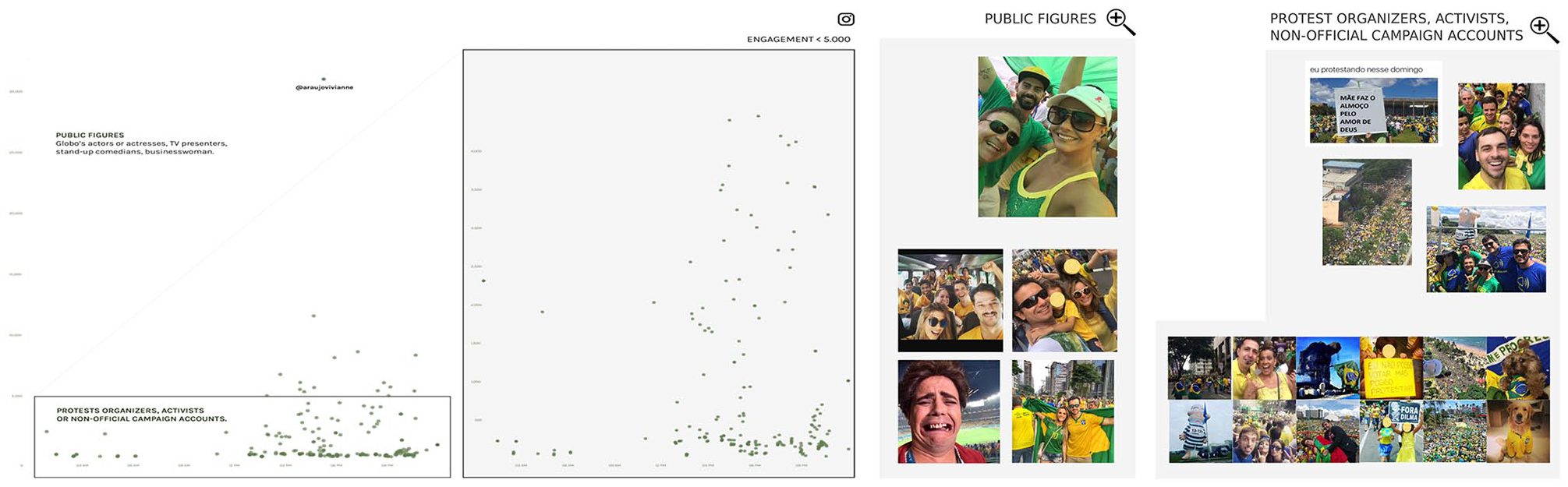
High-visibility actors of the pro-impeachment protests in Brazil, 13 March 2016. Composition, engagement flow over time, and visual elements (scatter plot design by Beatrice Gobbo).
There were also some unexpected findings: first, an account dedicated to pets (petscharm) among high-visibility actors. This Instagram account published a series of images of dogs wearing Brazil’s football garment or the Brazilian flag, elements also worn or carried by protesters. With regard to actors’ activity and their associated engagement metrics, we saw an ongoing posting activity over 13 March 2016 and, between 3 p.m. and 9 p.m., high peaks of engagement that may correspond to the simultaneous protest acts across different cities in Brazil (Figure 1). It is also important to point out deleted non-official campaign accounts on Instagram, such as opereacaolavajatooficial (official operation car wash), which lead us to question their authenticity and role.
Hashtagging Activity
As a next step in the analysis of hashtag engagement, we considered the grammars of hashtags by reading Instagram’s different forms of capturing hashtagging. Looking at referential tags and their use frequency, we noticed different preferences among high-visibility and ordinary actors (Figure 2). For instance, in pro-impeachment protests, #foradilma (get out Dilma) and #forapt (get out PT) were more frequent among ordinary users, while #vemprarua (come to the street) was slightly more frequent among high-visibility ones. In anti-coup protests, ordinary actors gave preference to #naovaitergolpe (there won’t be a coup), while high-visibility actors opted for #vemprademocracia (come to democracy). The different cultures of appropriation among high-visibility and ordinary actors provide a more accurate description of hashtag engagement practices.

Proportional frequency of hashtag mentions (number of mentions over the number of posts) for high-visibility and ordinary groups. Filtered to the 10 most mentioned hashtags of each dataset. Visualization created with Tableau Desktop (Version 10.4.6; 2018).
Now, we turn our attention to hashtag mentions and related actors, more precisely, who are the high-visibility actors and how many times they mention particular tags. Beyond seeing tag preferences among high-visibility and ordinary actors, the contribution of this analysis is in the detection of very committed Instagram accounts with given hashtags. So far, and unlike occasional mentions, we have seen that the persistence of hashtag mentions over time may refer to those actors responsible for keeping the debate regarding protesters’ grievances alive. Conversely, accounts with few mentions can equally reach high engagement metrics by being related to public figures, humorous or artistic visual content (e.g., tiacrey, lalanoleto, artedadepressao), or politicians and activists (e.g., humbertocostapt, fernando.domingos.sim).
To take a concrete example, in the pro-impeachment protests, the most committed actors by hashtag mention were mainly non-official campaign accounts—namely, chegadecorruptos, foracorruptos_rn, operaçãolavajatooficial, petscharm, and the organizers of the protests (vemprarua). The behavior of these Instagram accounts points to an automated agency (see Omena et al., 2019). Regarding the anti-coup protests, non-official campaign accounts (e.g., rosangelacct, transitivaedireta, liliferrer14) also took part in the “most active list” by hashtag mentions, but so did alternative media (e.g., medianinja) and one of the organizers of the protest (cutbrasil). Regarding non-official campaign accounts, we found strong suggestions that third-party applications were being used to boost engagement metrics.
The visual exploration of co-occurring hashtag network added value to the hashtagging activity perspective. Rather than following the typical cluster analysis to study the partisan use of hashtags and related topics, we approached emblematic hashtags adopted by pro- and anti-programs as a form of seeing a shift in meaning. That is what we call double-sense hashtags. After scrutinizing #nãovaitergolpe (there won’t be coup) (Figure 3) co-occurrence network, we were able to detect purposeful shifts of the hashtag’s meaning—for instance, hashtags supporting the impeachment process and connected to the main slogan of the pro-impeachment protests “come to the street.” In addition, tags addressing messages directly related to the now-former presidents of Brazil—“get out Dilma,” “get out Lula,” and the association of an inflatable puppet wearing prison uniform, named Pixuleco, with Lula.

#nãovaitergolpe co-occurring network related to anti-coup protests in Brazil, 18 March 2016. Instagram Platform. Network attributes: 1,250 nodes (hashtags) and 11,487 edges (co-occurrences). Visualization created with Gephi, layout: Force Atlas 2 (Jacomy et al., 2014), “LinLog mode” option enabled.
Visual and Textual
Visual content was analyzed through an image-label network built upon pre-trained machine learning models of Google Cloud Vision API. We interpreted this network by describing clusters of images brought together by formal similarity; an exercise of relabeling the image classification provided by the vision API (Figures 4 and 5). Through this approach, we found that both pro-impeachment and anti-coup visualities exhibited a similar overall pattern, annotated by three major clusters: selfies and portraits, crowds, and graphic pictures (banners, image macros, text, etc.). However minor, both networks had food and beverage clusters, which we have also found to be related to the protests themselves. Each of the groups had pejorative nicknames for antagonist protesters which were based on food: “coxinhas” (a popular Brazilian treat made with chicken) and “mortadela” (a popular type of sausage), respectively, used by anti-coup and pro-impeachment protesters.

Image-label network of the pro-impeachment protests, 13 March 2016, Brazil. Original Instagram images plotted according to relative node positions of a bipartite network built with Google Cloud Vision API’s Version 1.0 (Google, 2017) “Label Detection” data. Network attributes: 18,986 nodes (1,358 labels and 17,628 images) and 80,479 edges. Layout: Force Atlas 2 (Jacomy et al., 2014), “Prevent overlap” option enabled.

Image-label network of the anti-coup protests, 18 March 2016, Brazil. Original Instagram images plotted according to relative node positions of the bipartite network built with Google Cloud Vision API’s Version 1.0 (Google, 2017) “Label Detection” data. Network attributes: 2,872 nodes (587 labels and 2,285 images) and 10,508 edges. Layout: Force Atlas 2 (Jacomy et al., 2014), “Prevent overlap” option enabled.
Several unique clusters were detected in each network, pointing to a particular visual culture. The pro-impeachment (see Figure 4) had a large cluster of variations of the Brazilian flag, which shows its strong connection with patriotic iconography. A prominent cluster of dog pictures was also found, which indicates the trivialization of political engagement, while also possibly relating to how pets are commonly treated and represented by middle-class Brazilians. Lying between individual and group portraits were a significant amount of people wearing sunglasses, which seems to relate to how these accessories are status symbols within Brazil. Contrary to this, the anti-coup image-label network (see Figure 5) had a comparatively smaller cluster of individual or small group portraits, with crowd photos being more prominent. The Brazilian flag was much less featured, while other symbols, such as red protest t-shirts and newspaper clippings, stood out. Within the individual portrait cluster, bearded faces composed a small but meaningful cluster which relates to a typical expression of political identity in the left.
To compare visual content between high-visibility and ordinary groups of each protest, we resorted to a quantitative approach of label attribution frequency (Figure 6). Regarding the image-label networks, the pro-impeachment dataset had a higher occurrence of labels which relate to close-up portraits (e.g., “sunglasses,” “facial expression,” “face”). These labels were slightly more common in the ordinary group than in the high-visibility one. In the anti-coup dataset, labels related to collective imagery were more common (e.g., “festival,” “demonstration,” “event”), indicating a different representational tendency for this protest. These labels were also more common among the high-visibility than the ordinary group.
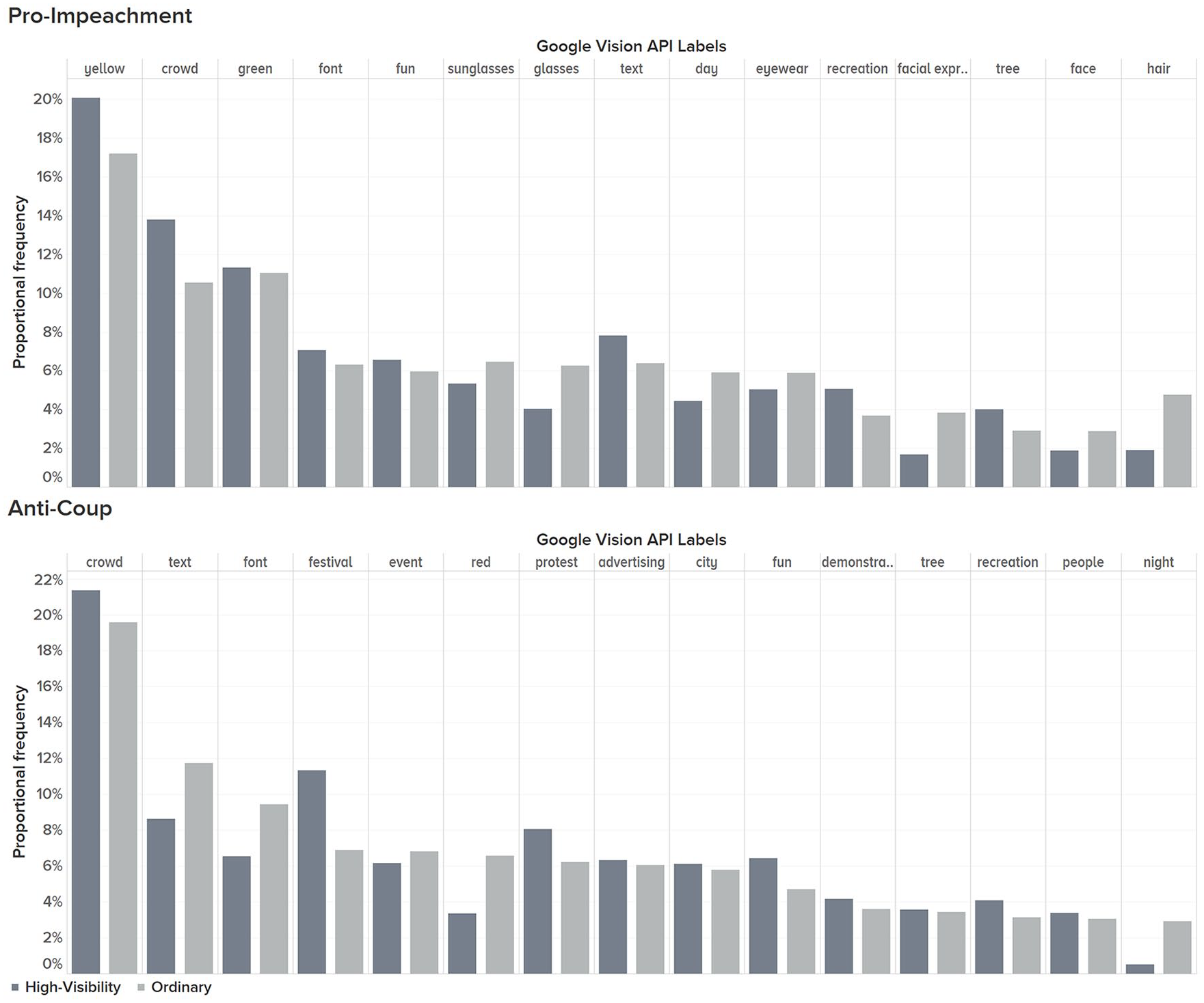
Proportional frequency of Google Cloud Vision API Version 1.0 (Google, 2017) label attributions (number of attributions over a number of posts) for high-visibility and ordinary groups. Filtered to the 15 most used attributed labels of each dataset. Visualization created with Tableau Desktop (Version 10.4.6; 2018).
Moreover, labels indicating colors were among the top occurring in both datasets: yellow and green for the pro-impeachment protests; red for the anti-coup protests, beyond being, respectively, associated with the Brazilian flag or the national football uniform (pro-impeachment) and to the Workers’ Party or other left-wing movements (anti-coup). Colors, here, indicate a statement of Brazilians’ position.
Seeking to identify the specificities of the discourse adopted in each of the political perspectives (anti-coup and pro-impeachment) and groups (high-visibility and ordinary), we visualized textual content (Instagram captions) in different levels of analysis (Figure 7) through co-term networks. We first visualized the textual content of both protests gathered in four main clusters (Figure 7, left): two related to anti-coup positioning, and the other two connected to the pro-impeachment group. In the latter, we see expected slogans against Dilma and surprising national anthem terms, while in the anti-coup clusters there are appeals for the impeachment process to end and for respecting the results of the 2014 democratic elections in Brazil. In opposition to this broad perspective, we separated the co-term networks by closely looking at the high-visibility and ordinary groups. The high-visibility network (Figure 7, center) shows more isolated clusters, scarcely interconnected. The places where the protests occurred are what connect the polarized debate. In the ordinary textual network (Figure 7, right), the main component shows more dense connections, thus reproducing concerns similar to those we have already mentioned.

Textual analysis of Brazilian protests in March 2016 via co-term networks. Instagram captions and related hashtags were clustered according to political positioning (the pro-impeachment and anti-coup selected hashtags), and according to co-occurrences of the 50 top terms in Instagram captions. Nodes are terms and edges co-mentioning relationships. Software analysis: CorTexT Manager (Lisis Laboratory, 2017).
The richness of these different narratives is found in isolated clusters that reveal very particular concerns, belonging solely to one group. It was the case of the appearance of terms suggesting Brazilians to not be moved by hatred but to “protest peacefully” as a part of high-visibility textual content and the specific terms associated with an alternative media account—namely, Mídia Ninja (Figure 7, center). Another example, now in the ordinary network (right side), entails nationalistic rhetoric referring to the Brazilian national anthem. Finally, but no less important, while high-visibility actors acknowledged Brazilians for their participation in the pro-impeachment demonstrations, the ordinary actors expressed how proud they were of being present at the protest.
Ultimately, mixing the visual and textual content, we observed the use of emojis in Instagram captions. Emojis (formerly called “emoticons”) have had a significant role in computer-mediated communication, serving as a path to sharpen emotional expressiveness on text-based interactions. In our perspective, these objects are interesting because they can be apprehended in terms of representativeness (high-vis and ordinary) and positioning (pro-impeachment vs. anti-coup), and not only as an act of tagging per se.
Figure 8 depicts the appropriation of emojis in high-visibility and ordinary groups, ranked according to frequency of use. At a glance, representative colors may be seen in pro-impeachment icons (yellow and green) as well as in symbolic icons for the anti-coup group (tulip and raised fist). This points to different use preferences, also serving as a reinforcement of the visuality (Instagram images) attached to the polarized groups. However, when comparing the appropriation of emojis by different groups, while the ordinary group has a heart among the most used emojis, high-visibility accounts opted for the globe showing the Americas, smiling face with sunglasses, and a party popper. In addition, the skin tone of emojis reveals an interesting perspective about race (represented by squares in Figure 8), with a predominance of light skin and medium skin tones among protesters, except for the high-visibility accounts of the anti-coup demonstrations, which had medium-dark and dark skin tones.

The appropriation of emojis according to high-visibility and ordinary groups; emojis organized according to frequency of use.
Conclusion
This article sought to critically and methodologically contribute to digital research by looking at the specific case of hashtag engagement. Through digital methods, we introduced the 3L perspective: a hands-on approach that operationalizes new forms of digital social enquiry. It has, in its core, the entanglement of the technicity of Instagram and its grammatization process as a lens for hashtag engagement analysis. Just as the appraisal of what is trendy in Hashtag Studies or Social Media Research and what is often kept out of research concerns; that is, both high-visibility and ordinary actors, actions, and related hashtagged content. The core outcome of this kind of research is the assumption/perception of that high-visibility as a mirror of the social media digital attention economy. However, in being re-signified through the detection of unique actors combined with platform metrics over time, it serves as an alternative approach to social media vanity metrics. By enquiring hashtag political engagement on Instagram, we confirmed the importance of including high-visibility versus ordinary groups (Layer 1), hashtagging activity (Layer 2), and its related visuality and textuality (Layer 3) as layers of the same object of study.
Through the case of the impeachment-cum-coup of Brazilian president Dilma Rousseff in 2016, substantial differences between the high-visibility and ordinary groups were uncovered—both in terms of hashtag usage culture and related content. By looking at the structural shape of high-visibility groups in Layer 1, we found that impactful visual content requires little effort from public figures, politicians, and artists (often with one post), while continuous activity over time is a mandatory task for non-official campaign accounts and independent media (often with a high number of posts). In Layer 2, the different ways in which hashtags are captured by social media databases expose different cultures of appropriation. The choice of tags and their intensities of use changes between high-visibility and ordinary actors. These grammatized actions also point to very particular behaviors—from the double-sense hashtags to an automated agency. With the third layer, we navigate through the whole (all images and textual content) to its parts (what pertains to high-visibility and ordinary) and back and forth. When cross-read, the three layers add value to one another, providing a rich and in-depth vision of the case study. This could not be understood without uncollapsing hashtags, often treated as monolithic indices, without internal differences.
In this scope, the 3L approach adds value to social media research by accounting for how the functional/practical relationship between technicity and platform grammatization concretely informs the process of reasoning with and through the medium. However, it is essential to observe the significant changes in social media APIs and their impact on research, as argued by Venturini and Rogers (2019): a call for researchers to gain independence from standardized pathways. For instance, and after the implementation of Instagram Graph API, the tool used in this study is now obsolete (see Rieder, 2016), leading us back to scraping-based tools as an alternative to pursuing the 3L perspective, e.g., Instaloader (Version 4.2.6, 2019). Another point concerns the inherent limitations of our proposal, which are certainly not exhaustive of possibilities to explore the modes of engagement beyond unique actors and their respective metrics and activities. For instance, to follow hashtags and account for their algorithmically driven placement in users’ feeds or to account for the biases and limitations of computer vision and machine learning as analytical instruments of analysis (see Mintz et al., 2019).
Furthermore, the challenges of applying digital methods for hashtag engagement research concerns how to deal with the ephemeral ways of being of social media and their changeable ways of grammatizing actions. Regardless of the possible changes in platforms and research tools or protocols, the conjunction of the 3L pertains to key points often addressed in social media research. With this knowledge and positioning the notions of technicity and grammatization as a practical matter, this article may contribute to what Rogers calls a medium-specific theory. Therefore, and as it follows the ways in which platforms operate, the techniques and enquiry proposed by 3L shall evolve through time. We also hope that this framework can enhance the understanding of hashtag engagement and, regardless of the platform-specific derivations, being further applicable on different platforms.
Footnotes
Acknowledgements
The article systematized approaches explored in two data sprints (DMI Summer School 2017, University of Amsterdam; and SMART Data Sprint 2018, Universidade Nova de Lisboa), with early results presented at the ECREA Digital Culture and Communication Section Conference (November 2017, Brighton, UK). The authors thank all the participants and designers in the data sprint projects—namely, Suay Ozkula, Gabriela Sued, Ece Elbeyi, Alessandra Cicali, Beatrice Gobbo, Gustavo C. Matta, Ana Rita Costa, Alice Teixeira, Cecília Barbosa, Giacomo Flaim, Lorena Cano-Orón, and Tarcízio Silva. They also thank Paulo Nuno Vicente for the feedback and comments on the first version of the article, and express appreciation to the anonymous reviewers and Bernhard Rieder, who made valuable contributions to improving the article.
Declaration of Conflicting Interests
The author(s) declared no potential conflicts of interest with respect to the research, authorship, and/or publication of this article.
Funding
The author(s) disclosed receipt of the following financial support for the research, authorship, and/or publication of this article: J.J.O. is funded by Fundação para a Ciência e Tecnologia (FCT), with the scholarship number PD/BD/128252/2016; A.G.M. received a doctoral scholarship from CAPES Foundation in support of his research; and E.T.R. was partially funded by Fundação de Amparo Pesquisa do Estado do Rio de Janeiro (Faperj), with the support E-26/210-047/2017.
