




Abstract
This paper investigates the topics and affiliations associated with the hashtag #AllCatsAreBeautiful on the social media platform Twitter. Drawing on concepts from social semiotics (systemic functional theory) and critical animal studies, the paper identifies a number of potentially overlapping topics or fields, including anti-policing, the commodification of nonhuman animals, gender and sexism, and body image or body-shaming, as well as a more general positive appreciation or admiration of cats. The paper discusses how people position themselves in relation to those topics, through patterns of ideational and attitudinal meanings, and how cats are represented and appreciated visually, verbally and intersemiotically. Cats, in this context, play an important role in struggles for social justice, symbolizing freedom and resistance as well as love and solidarity. #AllCatsAreBeautiful highlights topics or spaces around which bonds can be made and communities of shared values or interests can be co-constructed.
Introduction
Hashtags are commonly used on social media as metadiscursive markers, typically indicating the topic or ‘aboutness’ of a particular utterance. Identified by a chain of characters (usually in the form of words, phrases or abbreviations) preceded by the hash or pound symbol (#), hashtags differ from other classification systems (such as the Dewey Decimal Classification) in their being largely user-generated, decentralized and non-hierarchical, what Vander Wal (2007) calls a ‘folksonomy’, rather than a taxonomy, of categories and terms.
Examining hashtags from a social-semiotic perspective, Zappavigna (2015: 279–280) argues that ‘aboutness’ is just one of the basic functions of the hashtag. In addition to telling us something about content, hashtags also provide a means of organizing and sharing our feelings and opinions about that content. 1 Crucially, for Zappavigna and others, hashtags can be markers of affiliation and identity. They allow users to co-construct, maintain and challenge different communities of shared values, opinions and feelings around particular topics or fields of experience and to form various alliances and oppositions. Zappavigna (2011, 2012, 2014) refers to this type of connectivity as ‘ambient affiliation’; that is, being connected in ways that do not necessarily imply familiarity or direct, face-to-face forms of interaction, something akin to Anderson’s (1991[1983]: 6–7) ‘imagined community’.
Ambient affiliations can be identified by ideation–attitude couplings (Zappavigna, 2011: 795, after Knight 2008) in which content or experience is connected to positive, negative or ambiguous viewpoints and/or emotions. The hashtag #fakenews, for example, couples the notion of news (newly received or noteworthy information) with negative veracity or valuation (Zappavigna, 2018: 101–120; see also Martin and White, 2005: 52–58). This coupling may in turn be coupled with other experiences and attitudes, creating clusters or syndromes of ideational and attitudinal meanings around which social bonds can be formed (see Martin, 2004; Martin and Stenglin, 2007; Stenglin, 2004, 2008, 2009). Although the hash symbol gives certain parts of the text thematic prominence, ideation–attitude couplings are not restricted to hashtags. In a short text like ‘I fucking love #GoT’, no explicit attitude is expressed in the hashtag (GoT refers to the television series Game of Thrones). Rather, the content or experience of GoT is coupled with upscaled positive affect elsewhere in the text (fucking love). Couplings can also occur intersemiotically, with emoticons, emojis and still or moving images, so that ‘#GoT :)’ or #GoT alongside a moving image of someone dancing on a table likely expresses positive appreciation of the television series.
In this paper, I examine the kinds of meanings and affiliations that are co-constructed around the hashtag #AllCatsAreBeautiful on the social media platform Twitter (URL: www.twitter.com). All Cats Are Beautiful is perhaps best known as an acrostic for A.C.A.B., a common acronym or initialism for All Cops (or Coppers) Are Bastards. In May 2016, this acrostic received considerable media attention after a woman in Madrid was fined for carrying a bag bearing an image of a cat and the words ‘All Cats Are Beautiful’ and ‘A.C.A.B.’ (Ollero, 2016; Rubio Hancock, 2016). The fining officers argued, and the charge sheet noted, that A.C.A.B. should be understood as a cipher for All Cops Are Bastards, a potential contravention of article 37 of the then recently introduced citizen safety law, popularly referred to in Spain as la ley mordaza (the gag law) (Jiménez Gálvez, 2015; New York Times, 2015). 2 While #AllCatsAreBeautiful is often used as part of a critique of the police or policing, a cursory analysis of the hashtag reveals a potentially more diverse application, one that, in general terms at least, might be more broadly associated with subversive or liberationist-abolitionist ideas and movements, as well as the more obvious positive appreciation of cats. The aims of this study are to explore some of the topics and affiliations associated with the hashtag, and their potential interconnectedness, and to examine how and why cats are represented visually and verbally in connection with those topics.
Social semiotics and critical animal studies
In order to explore the topics and affiliations associated with #AllCatsAreBeautiful, I draw on insights from social semiotics (systemic functional theory) and critical animal studies. Although rather different—the former seeks to describe and explain processes of meaning-making as social practice, while the latter examines and challenges certain relations between humans, other animals and the environment—both approaches are variously concerned with social transformation, seeing scholarship and research as ‘a mode of intervention in critical social practices’ (Halliday, 2003[1993]: 223; see also Halliday, 2013: 15; Martin, 1992: 575), ‘link[ing] theory to practice, analysis to politics, and the academy to the community’ (Best et al., 2007: 5). 3 I briefly summarize some of the ideas most pertinent to this study in the sections that follow.
Social semiotics
Social semiotics is a theory of signs in society (Hodge and Kress, 1988). Drawing on systemic functional theory (e.g. Halliday, 1978), social semiotics models language and other sign-systems as meaning-making resources, the meanings or functions of which are determined by the kinds of choices available in particular eco-social contexts. Those resources, their expressions and possible meanings, and the contexts of which they are a part can be variously described in terms of their paradigmatic and syntagmatic relations, their levels of abstraction and instantiation and their representational, interpersonal and organizational potential (see Halliday and Matthiessen, 2004: 19–31).
Of particular relevance to this paper are the discourse semantic systems of
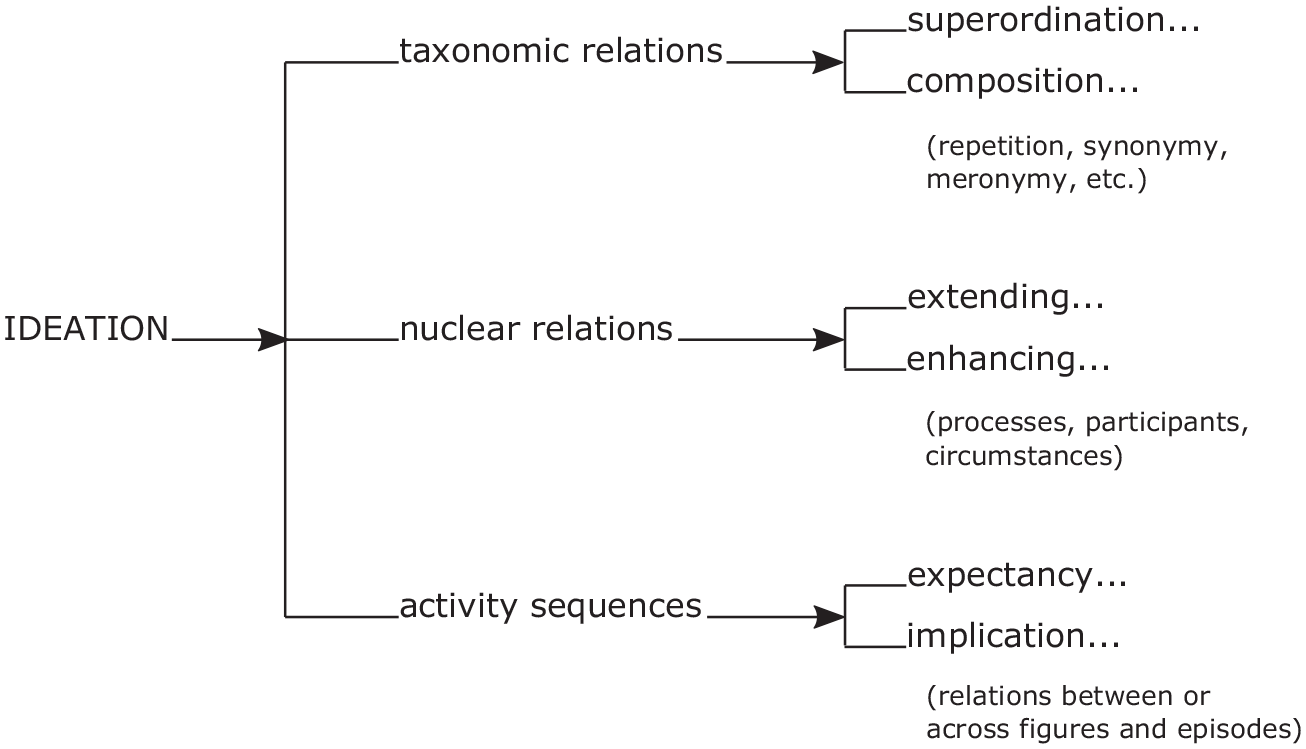
System network for
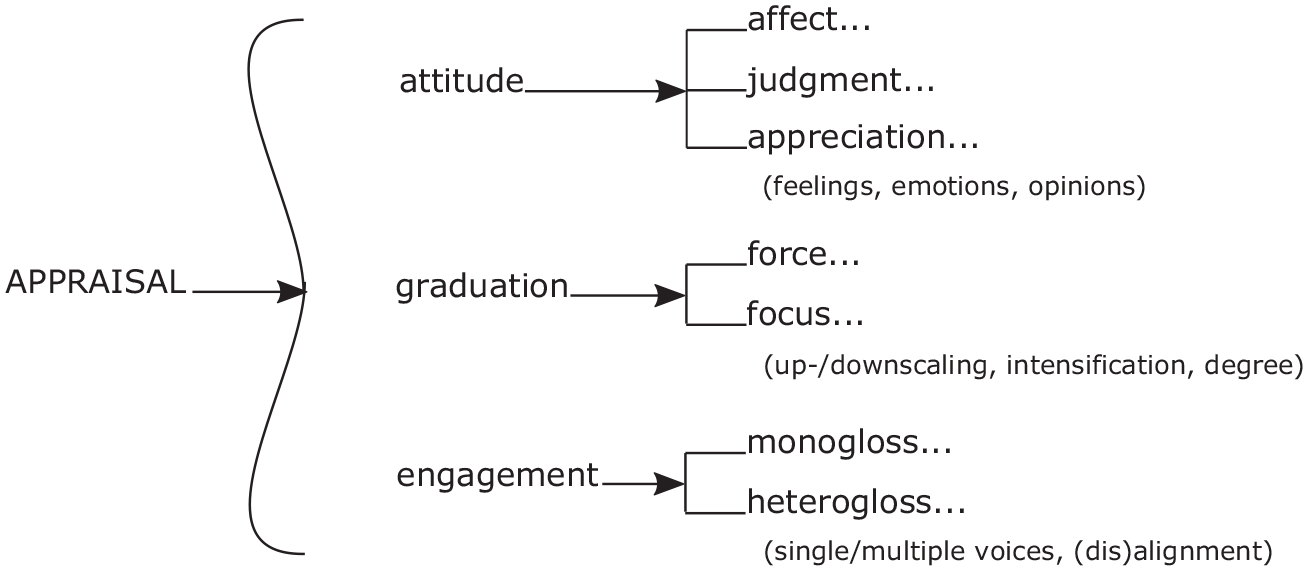
System network for
Critical animal studies
Best et al. (2007) lay out the foundations for critical animal studies. They highlight ten key points or principles that include an interdisciplinary and intersectional approach to the relations of humans with other animals and with the environment (see also Nocella et al., 2014: xxvii–xxviii). Critical animal studies identifies and interrogates the kinds of power structures that mediate human–nonhuman animal relations, and advocates for change.
In this paper, critical animal studies is crucial to understanding how and why some of the topics identified and discussed herein are interrelated. For Best et al. (2007) and other critical animal studies scholars, the exploitation and oppression of nonhuman animals are intertwined or share commonalities with other forms of oppression such as ‘sexism, racism, ablism, statism, classism, militarism and other hierarchical ideologies and institutions’ (Best et al., 2007: 6). Critical animal studies thus draws on the work of the Combahee River Collective (2017[1977]) and Crenshaw (1991), among others, in highlighting interlocking forms of oppression and arguing for an holistic approach to the study and transformation of those forms of oppression. By including the animal other, critical animal studies recognizes the roles and relations of human and nonhuman animals in struggles for liberation.
Materials and methods
#AllCatsAreBeautiful corpus
The #AllCatsAreBeautiful corpus is a collection of 1539 publicly available texts, or ‘tweets’, from the social media platform Twitter, published between 19 April 2011 and 13 April 2019. 6 The corpus contains 104,240 words and 584 still or moving images (not including user-profile images). Most texts use English as their primary language, but a large number of Spanish-, German- and Russian-language texts are also included. In total, 21 languages are represented in the corpus.
Material was collected using the search term #AllCatsAreBeautiful (not case sensitive). Results were saved using the print function in an internet browser (Safari). Texts were then saved in a single PDF (portable document format) and converted into a .txt file.
As can be seen from Figure 3, the distribution of texts varies over time. Most notable is the spike in May 2016 in connection with the arrest of a woman in Madrid for carrying an All Cats Are Beautiful bag (see comments in Introduction). Other spikes in activity relate to events such as International Cat Day (8 August) and National Cat Day (22 February in Japan, 1 March in Russia, 29 October in the United States), as well as ‘A.C.A.B. Day’ (13 December; where the date-form ‘1312’ relates to the first, third, first and second letters of the Roman alphabet).
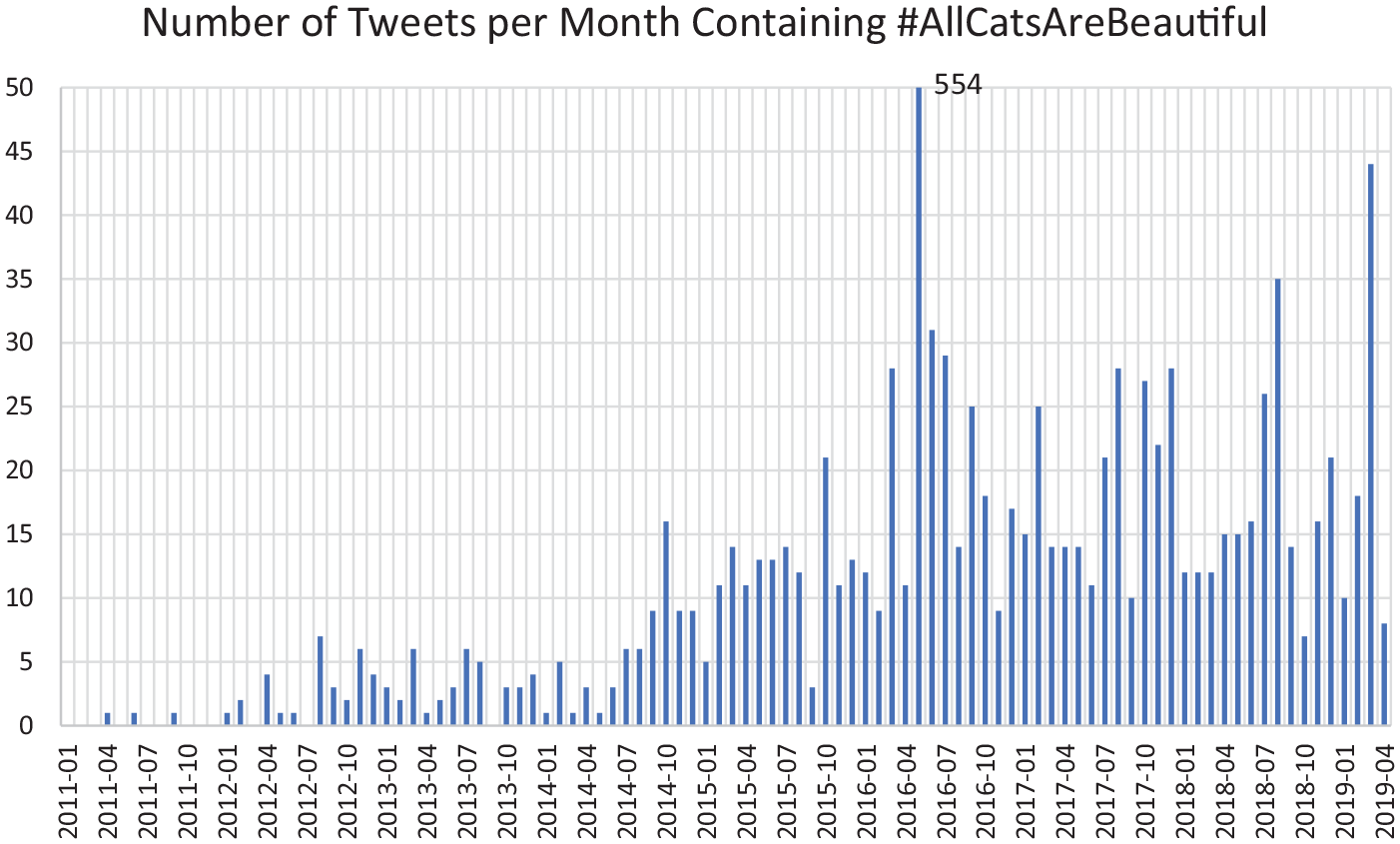
Number of tweets per month containing #AllCatsAreBeautiful. Number for May 2016: 554. Total number for study period: 1539.
Annotation and analysis
I used UAM CorpusTool 3.2 (Wagsoft, 2015) to annotate the corpus. The software allows for annotation and analysis based on system networks like those shown in Figures 1 and 2. The corpus was automatically annotated for part of speech as well as
The example in Figure 4 shows how all cats are beautiful can be parsed lexicogrammatically. We can use this and other lexicogrammatical analyses as an entry point for exploring the discourse semantics. Ideationally, we can track the processes, participants and circumstances within and across texts and note, for example, taxonomic relations of repetition (cat), synonymy (e.g. kitty), meronymy (e.g. paws), hyponymy (e.g. tabby) and antonymy or contrast (e.g. dog). Interpersonally, beautiful expresses a positive reaction to or appreciation of those cats, and the focus expressed by all suggests a response to—or countering of—some alternative position in which some but not all cats are considered beautiful. These and other kinds of ideational and interpersonal meanings can be examined within and across texts, allowing us to identify patterns of ideation–attitude couplings such as [ideation: cat/attitude: +appreciation].
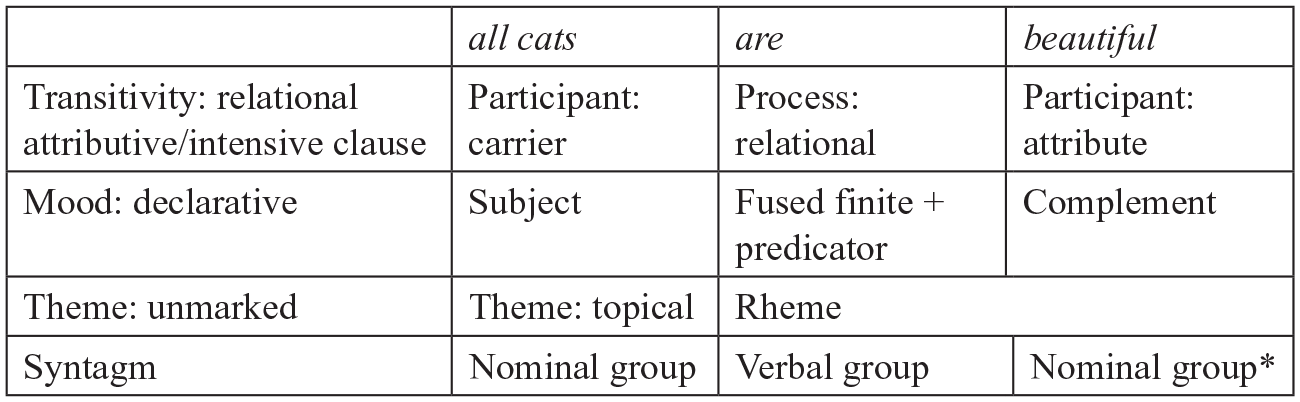
Box diagram showing multisystemic lexicogrammatical analysis of a single clause.
Texts were also annotated according to whether or not they contained images, whether or not those images were still or moving, whether images were photographs or illustrations/animations, whether or not they depicted cats, what type(s) of cats, how those cats were framed (close, medium and long shots) and positioned (frontal, profile; looking at the viewer), and what kinds of activities cats were involved in (lying, sleeping, eating, pouncing, etc.). I also made a note of other visual elements, including the presence and arrangement of people and other animals, and the setting or surroundings. Most of the visual annotations and analyses follow the work of O’Toole (1994), Kress and van Leeuwen (2006), O’Halloran (2008) and Economou (2009). Like the verbal analyses described above, certain visual representations can couple with particular types of attitude. For example, a photograph of a cat jumping up to reach a toy might evoke positive appreciation (of the cat’s ability or capacity), that is [ideation: ‘cat’ ‘jump’/attitude: +appreciation]. Similarly, a particular set of visual attributes, for example shiny fur and bright eyes, might evoke positive appreciation or positive affect—feelings or emotional responses that can be graded in various ways, for example by close, medium or long framing or by adjustments in brightness and colour saturation.
As noted in the Introduction, ideation–attitude couplings can also occur intersemiotically. A cat emoji, for example  , accompanied by the word beautiful, for example, might suggest a similar ideation–attitude coupling to those described above. Considered together, then, these and similar intra- and intersemiotic couplings complement each other and provide a potential for people to bond around a shared sense of taste or emotion, that is a positive appreciation or positive affect for cats.
On the basis of these visual and verbal analyses, and by examining accompanying hashtags and other texts or tweets in conversational threads, I was able to categorize texts into several distinct yet potentially interrelated topics. Topics were identified as frequently occurring ideational units or meanings around which certain attitudes are expressed. In the following sections, I present and discuss those topics.
Anti-policing: All cops are bastards
As noted in the introduction, #AllCatsAreBeautiful is often used as part of a critique of policing. Those critiques range from complaints and protests about the actions or attitudes of police officers to wider calls for reform or abolition of policing and punitive justice (cf. Vitale, 2017). Accompanying hashtags here include #AllCopsAreBastards, #ACAB, #1312, #LeyesMordaza (gag laws), #NoSomosDelito (we are not a crime), #FTP (fuck the police; some texts also use ‘film the police’) and #FckCps (fuck cops). In the corpus, approximately 60% of texts refer to or respond to this critique. The most ‘liked’ and ‘retweeted’ of the texts in the corpus belong to this particular topic. 8
Ideationally, texts here are marked by reference to the police or policing (see examples below). Verbally, this includes participants connected by repetition, synonymy, meronymy and metonymy, for example police, officer, cop, pig, patrol and (police) force. More broadly, superordinates refer to crime, justice and the law (and especially ‘gag law’, ley mordaza, in the case of Spanish-language texts). Processes in material clauses are realized verbally by arrest, fine, abuse, kill and murder, and relational clauses of identification generally serve to characterize police and the law (see attitudinal meanings below). Circumstances specify when and where activities take place, for example now and in the street, and the kinds of agents involved, for example by an undercover cop.
Visually, texts include depictions of police and police vehicles. Processes involving these participants are variously circumstantial, reactional, transactional and non-transactional (cf. Kress and van Leeuwen, 2006). Examples of these include police officers standing in the street, a raised middle finger directed at a police officer (Figure 5), police making an arrest and burning police cars. A variety of emojis complement these ideational meanings, including  ,
,  and
and  .
.
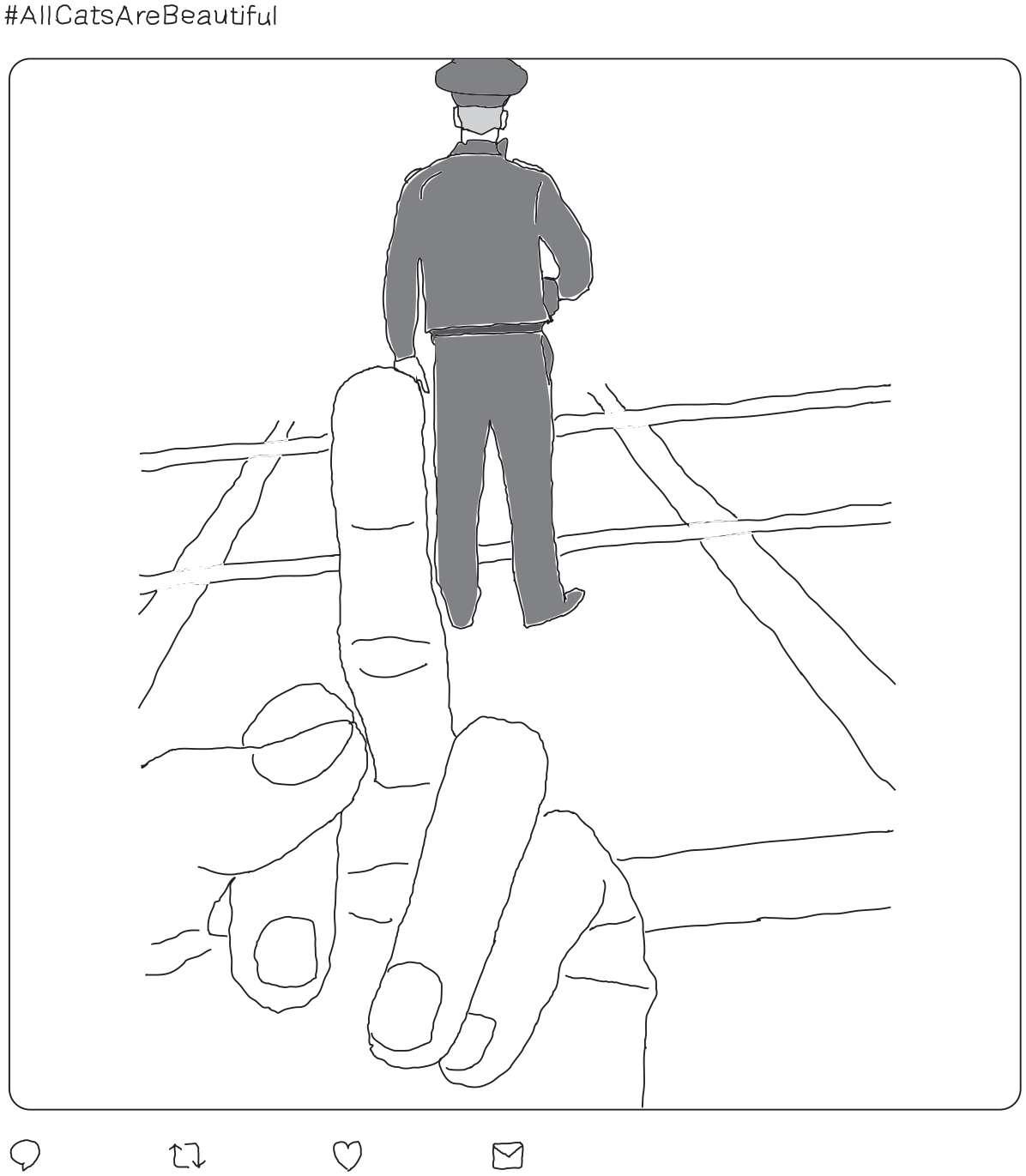
Topic: anti-policing. Image shows raised middle finger behind police officer. Full-colour photograph.
The visual and verbal ideation described above couples almost exclusively with negative evaluation. This is primarily expressed through the acrostic All Cats Are Beautiful, where negative appreciation or judgement is carried by the implied substitution for (and sometimes explicit reference to) All Cops Are Bastards. As can be seen from accompanying hashtags, this negative judgement can also be encoded verbally or numerically through abbreviations like ACAB, 1312 and FTP. Other negative evaluations (primarily [judgement: –propriety]), several of which are mentioned above in the ideational analysis, include abuse, penalty or fine, repression, censorship, complaint, violence or violent, brutality and racism or racist. Terms like freedom, democracy and justice (see above) are variously negated, countered or otherwise called into question (e.g. no freedom, real democracy, ‘justice’). The main ideation–attitude coupling instantiated in these texts is [ideation: ‘police’/attitude: –judgement or –affect].
The only positive evaluations coupled with policing are those expressed by law enforcement itself. The acrostic All Cats Are Beautiful is so widely used or familiar as a critique of policing that there are attempts by police to counter or challenge its discursive power. The Spanish Civil Guard (Guardia Civil), for example, uses the hashtag #AllCopsAreBrave alongside #AllCatsAreBeautiful, and in a conversational thread involving the Mannheim Police (Polizei Mannheim), the alternative acrostics #AllCopsAreBeautiful and #AllCarsAreBeautiful are used.
Cats are typically construed as being in direct opposition to the police. Some tweets use the hashtags #CatsHateCops and #CatsNotCops. Cats are also compared and contrasted with dogs, with the latter usually representing or referring to police and others in positions of authority and the former representing an anti-authoritarian position. 9 The hashtag #NoDogsNoMasters (a reference to the socialist-anarchist slogan No Gods, No Masters) is also used.
Cats’ projected opposition to policing is especially clear in the images. Cats are represented as actors in transactional processes, pouncing on or pawing police cars and police officers (see examples in Figures 6 and 7). In one text, a cat is seen running through a cloud of gas, attempting it seems to reach for a gas cannister in the street, the presumed setting for a protest or riot. Another instance, shared by several users, is a short video depicting a cat escaping from a leash held by a police officer. There are also several variations, both illustrated and photographed, of cats with arched backs, puffed-up tails and claws and teeth bared. The most commonly occurring of these is the ‘sabotabby’ or sabot-cat, a commonly used image for direct actions such as (wildcat) strikes and sabotage (see Figure 8).
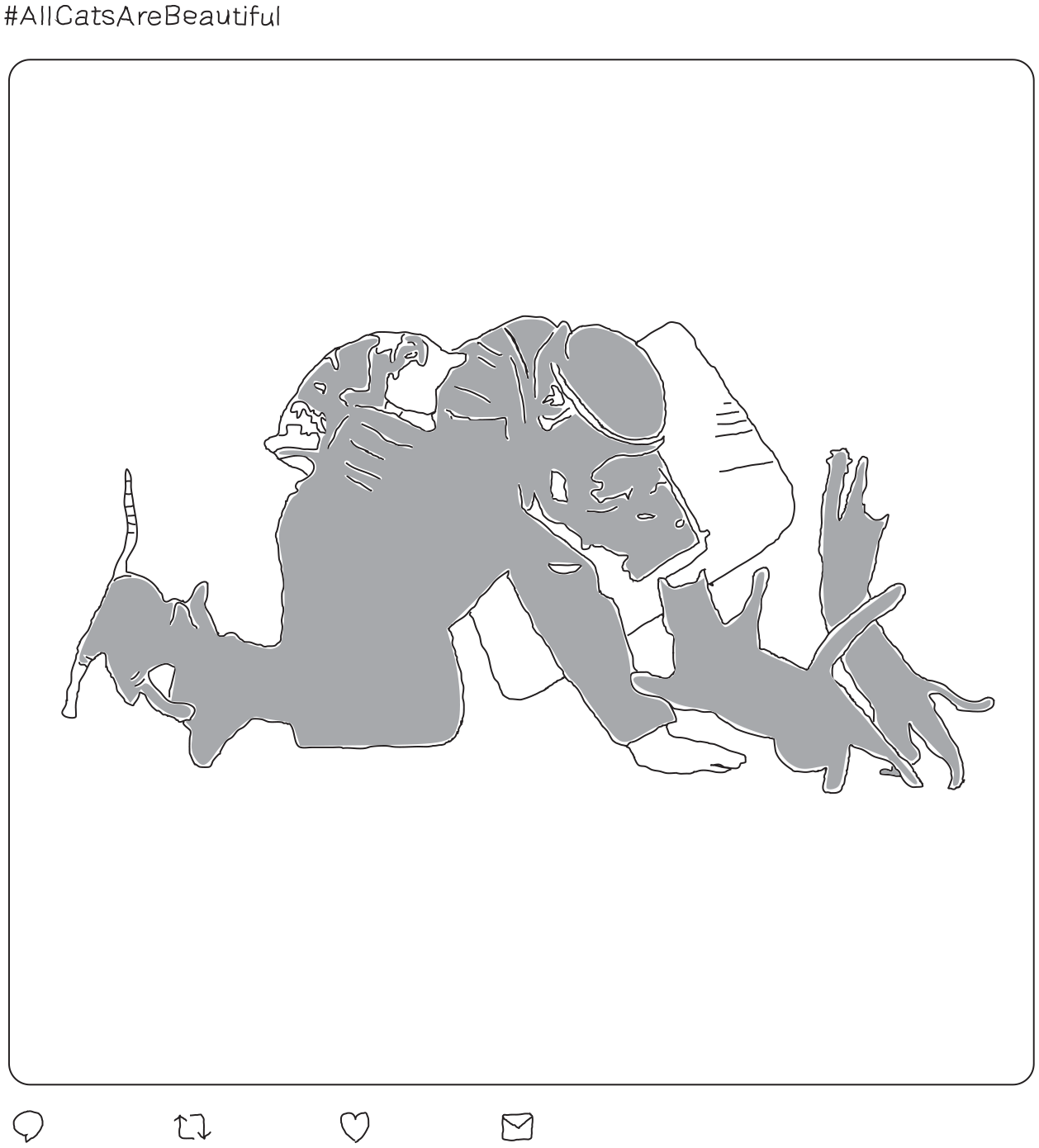
Topic: anti-policing. Image shows four cats attacking a police officer in riot gear. Duotone photographic collage, silhouette-like.
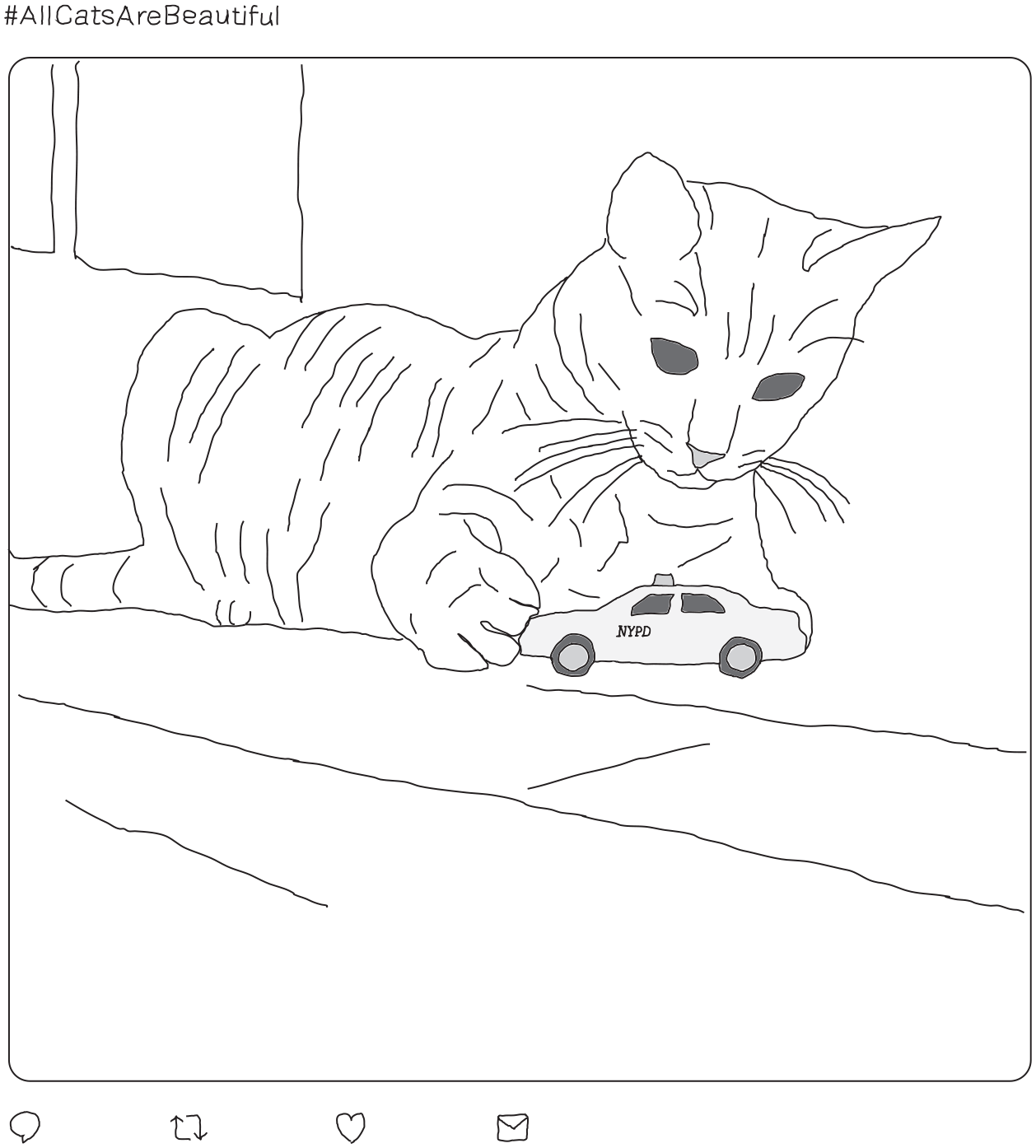
Topic: anti-policing. Image shows cat pawing toy police car. Full-colour photographic image.
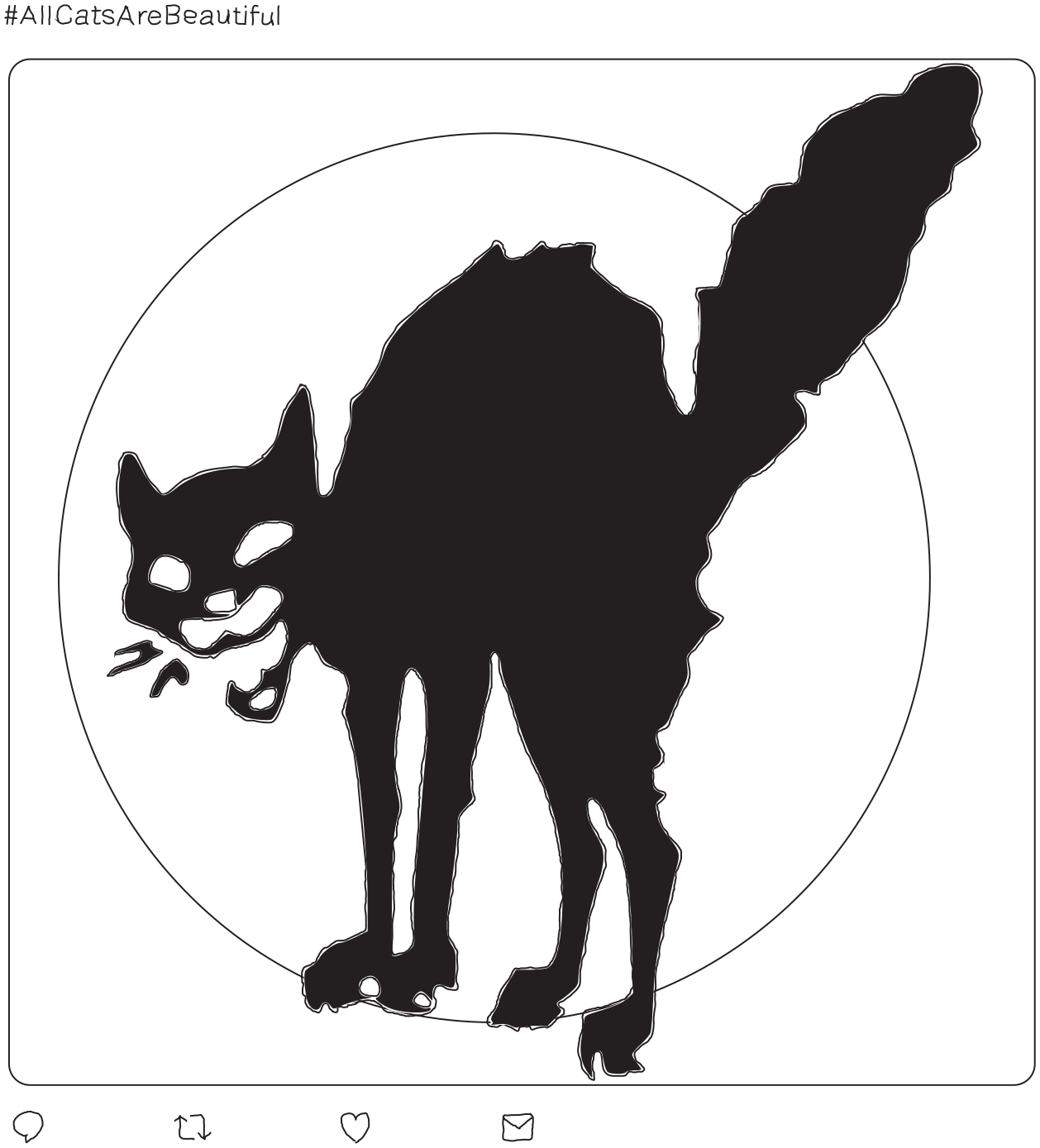
Topic: anti-policing. Image shows black cat with arched back, puffed-up tail, claws and teeth bared. Duotone illustration. Original drawing by Ralph Chaplin.
A variety of cat-emojis are also used, including  ,
,  ,
,  and
and  . The smiling-cat-with-heart-eyes emoji, , for example, is used in one text to express solidarity with or admiration for the supporters of a woman arrested in Madrid (see Introduction). In another, it appears as part of the counter-discourse described earlier, expressing support or admiration for police officers. Non-cat emojis, in addition to those mentioned above, include raised fists (
 ), flexed biceps (
 ), hearts of various colours (e.g.

 ) and fire (
 ), expressing a range of attitudes, such as solidarity, strength, love and (com)passion. These attitudes are coupled for the most part with people or groups campaigning against or affected by police violence and extensions of police powers.
#AllCatsAreBeautiful
The texts in this part of the corpus are characterized, then, by ideation–attitude couplings that express negative attitudes, usually [judgement: –propriety], towards police. This typically occurs when the hashtag #AllCatsAreBeautiful can be interpreted as the acrostic ACAB, All Cops Are Bastards, which is dependent on taxonomic relations concerning police, policing or the law. Additionally, anti-policing texts express positive attitudes towards cats as well as campaigns or campaigners against police, and victims of injustice. This positive evaluation is not only one of [appreciation: +reaction] (e.g. beautiful); there are also visual and verbal instances of admiration, that is [judgement: +capacity] or [judgement: +tenacity], that relate to strength, loyalty and resistance.
Finally, it is worth noting that, while approximately 60% of the texts in the corpus express anti-police sentiment, there are considerable variations across languages. Among the Spanish-language texts, for example, almost 85% (434/517 texts) are critical of police and policing (a similar figure applies to French texts, but these are considerably fewer in number: 17/21). 10 This compares with 67% of German-language texts and 39% and 35% of English- and Russian-language texts, respectively. Although Swedish, Dutch, Basque and Polish texts comprise only a very small part of the corpus (eight in total), all of them fall into this anti-policing category.
Cats as commodities: Adopt don’t shop
Some of the texts in the corpus (about 4%) appear to critique the treatment of animals, and cats in particular, as property or commodities. Here, cats in need of homes, questions about the breeding and sale of animals and the rights or liberties of those animals are highlighted. Co-occurring hashtags in this topic include #AdoptDontShop, and their Spanish and Indonesian equivalents, #AdoptaNoCompres and #AdopsiJanganBeli, as well as #CatRescue, #AnimalLiberation, #ALF (Animal Liberation Front) and #Antispecismo (antispeciesism).
Ideationally, these cats-as-commodities texts are marked by repeated visual and verbal reference to cats (not just those in the hashtag #AllCatsAreBeautiful). Cats are sometimes classified as rescue cats or shelter cats, and they are often goals in material clauses of possession, with processes realized by the verbs shop and buy. These clauses are negated, and they are contrasted, or countered, with clauses whose processes are realized verbally by adopt (see especially #AdoptDontShop). Further ideational contrasts are made between shelter and rescue, on the one hand, and home, on the other.
Evaluative language in this subsection of the corpus is often the same as or similar to that of the more general positive appreciation of cats (see below), for example lovely, happy, cute, adorable and cool. But negative feelings or emotions are also expressed. One text highlights the anxiety, sorrow or pain experienced by rescue cats (distress; see above). Another expresses disappointment or sadness at the claim that black cats are less likely to be adopted than other cats (so sad; see below). Several texts (all posted by the same user) use the hashtag #InMemory to honour a deceased rescue cat.
Visually, cats are photographed (rarely drawn) up close and personal, looking at or just off camera, giving a sense of both individuality and intimacy.
11
They appear relaxed, represented circumstantially in lying or sitting positions (see Figure 9), sometimes asleep; they are occasionally photographed in pairs or threes. Very few moving images are used, but one particularly striking example is of a white cat escaping from a cage (see redrawn still in Figure 10). Some texts use smiling-face emoticons, for example :), but emojis like those described in the previous section are rarely used; there is only one instance of a smiling cat with heart eyes () and one of a raised fist (, see below). Interpersonally, these photographs, emoticons and emojis function primarily to express admiration, happiness, love and solidarity.
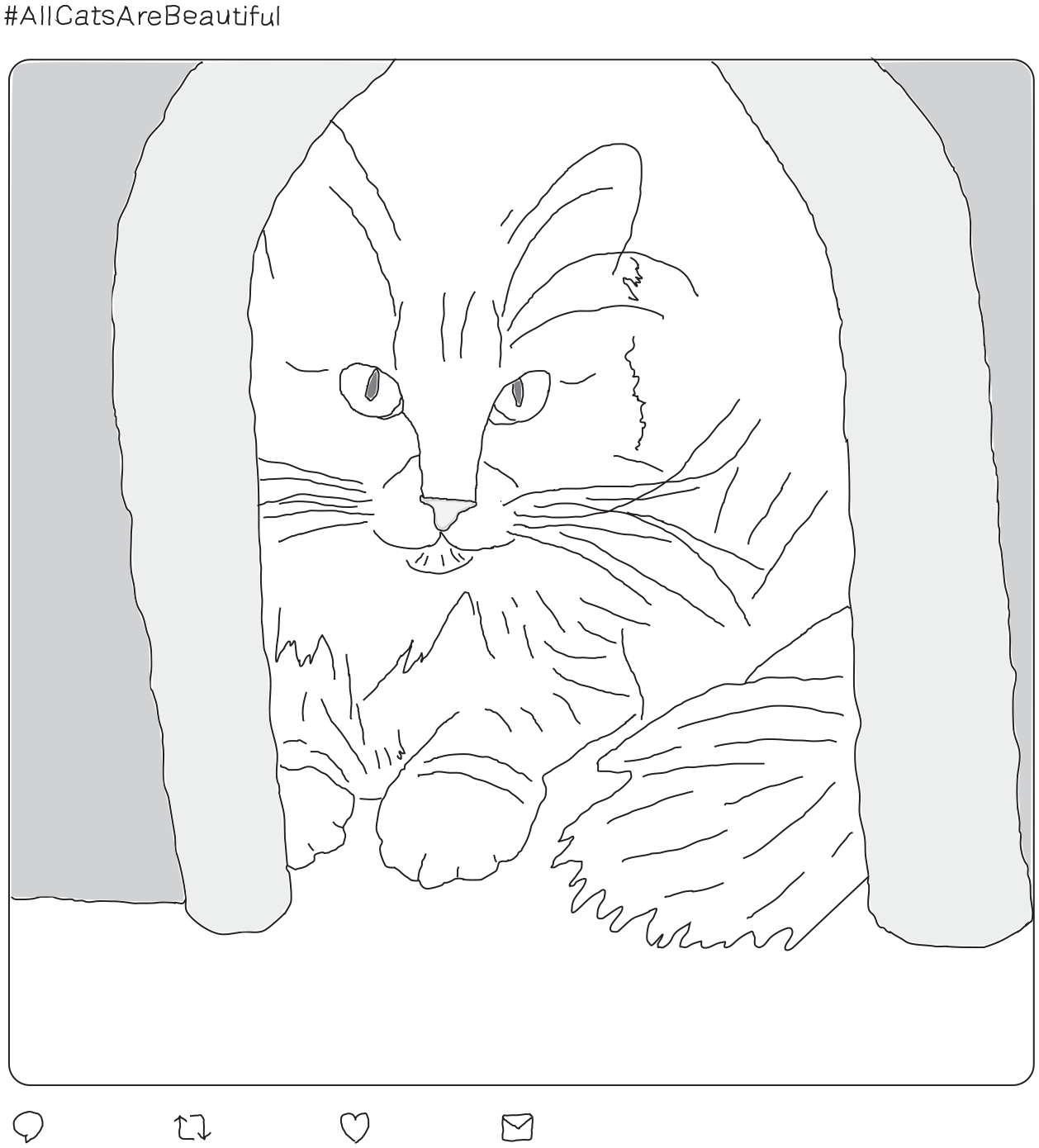
Topic: cats as commodities. Image shows cat lying in opening of cat house. Full-colour photographic image.
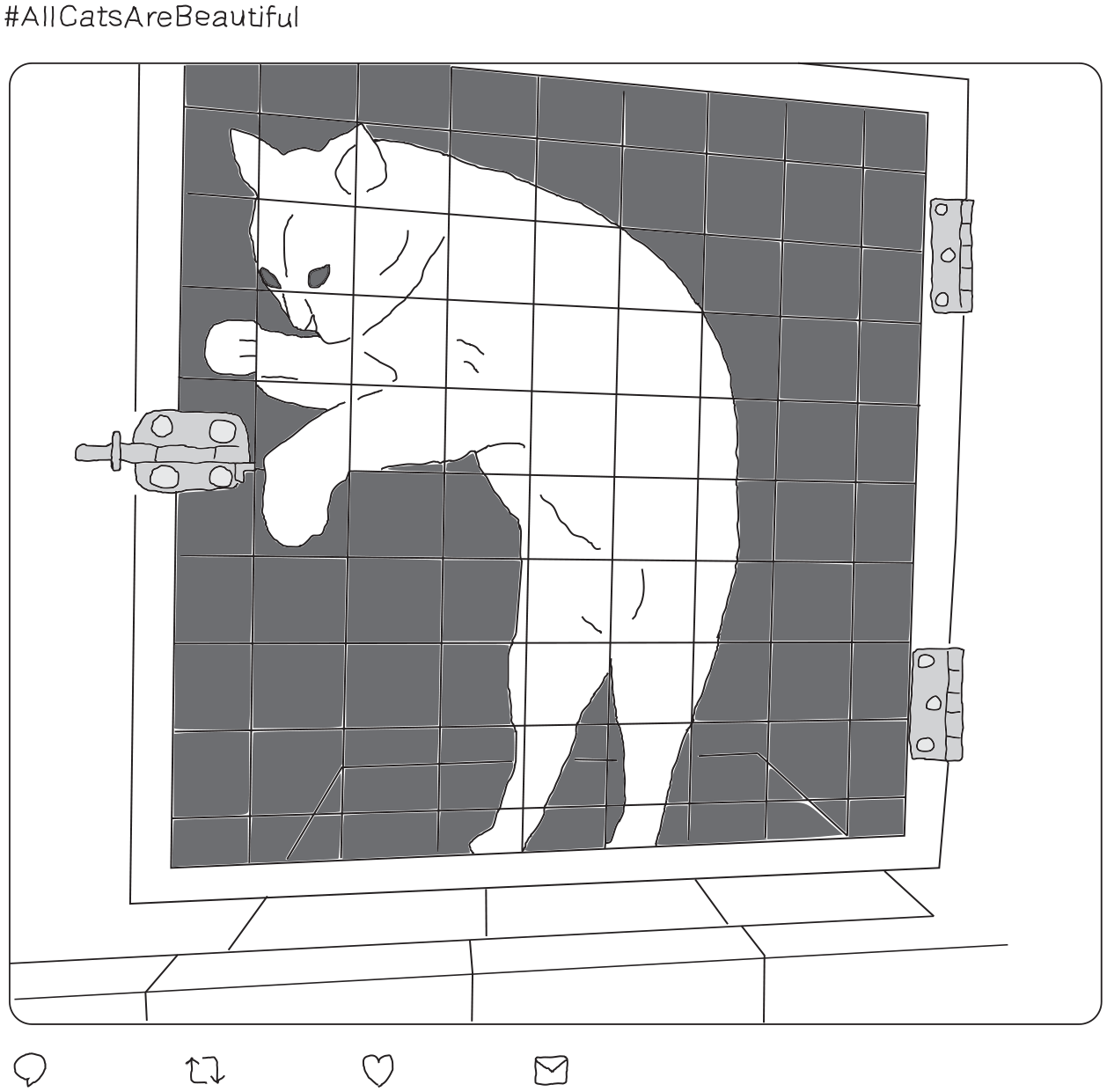
Topic: cats as commodities. Image shows cat escaping from cage. Full-colour still from moving GIF image.
In these cats-as-commodities texts, the positive appreciation expressed by the hashtag #AllCatsAreBeautiful—aimed at all and not just certain cats—is complemented explicitly by feelings of positive appreciation and positive affect towards rescue cats. Other ideation–attitude couplings include [ideation: ‘rescue cat’/attitude: affect: unhappiness] and [ideation: ‘rescue cat’/judgement: +social-esteem]. At a more general level, then, there seems to be a potential for bonding around a shared sense of empathy (positive judgement and affect) rather than a shared sense of distrust, dislike or disgust (negative judgement and affect) as in the anti-policing texts.
Despite the differences between the cats-as-commodities and anti-policing texts, they are not mutually exclusive. One text, for example, uses #AllCatsAreBeautiful alongside #Antispeciesism and #Antifascism, ostensibly rejecting the dominion of humans over other animals as well as humans over other humans, and highlighting a possible connection between the two fields of experience (cf. Best et al., 2007: 6 and section on critical animal studies). Another uses the hashtags #AllCatsAreBeautiful and #ACAB to challenge in an ostensibly humorous way certain ideas of cat ownership. Both texts connect the positive appreciation of cats, that is [ideation: ‘cat’/attitude: +appreciation], with the negative appreciation of external authority/ownership or authoritarianism, that is [ideation: ‘authority’/attitude: –appreciation].
Finally, it is worth noting the variation across languages with regard to cats-as-commodities. Half of the Indonesian texts (17/34), for example, fall under this category, while relative numbers for English- and Spanish-language texts are considerably lower (5%, 26/569 and <1%, 2/517, respectively). One text in Croatian (the only Croatian text in the corpus) uses #AllCatsAreBeautiful in reference to helping injured and unwanted or neglected cats.
Gender and sexism: Cats against cat-calls
Another topic identified in the #AllCatsAreBeautiful corpus, accounting for about 1% of texts, deals with gender and sexism. Accompanying hashtags here include #FVG (feminist vigilante groups or gangs), #TransIsBeautiful, #AllClitsAreBeautiful and #OpFemaleSec (a hashtag used by feminist hacktivist collective FemAnon). Gender-and-sexism texts focus on feminism, homophobia and transphobia, safety and security, the representation and treatment of women in the media and the (sexual) abuse of women and girls.
Texts in this category are marked by lexis that taxonomically refers to women and girls, to sexuality, sex and gender, and/or to sexual violence, for example woman, women, girl(s), lady, ladies, fem(me), female, trans, sex, men, boys and rape. In the examples below, clauses are material, relational and mental. Like other texts in this part of the corpus, they construe a field in which the actions of some participants, for example the media and men, negatively impact on the lives of others, for example indigenous women activists and LGBTQ+ activists and supporters, and in which the qualities or attributes of those participants are characterized and projected. Evaluative language expresses a sense of frustration, anger and unease, for example disgusting, enraged, fuck, twats and uncomfortable. But feelings of love and solidarity are also evident, for example love, respect and the hashtag #IStandWithTarneen. 12 Ideation–attitude couplings in the examples below include [ideation: ‘newspaper’/attitude: –judgement, –appreciation] and [ideation: ‘men’/attitude: –affect], as well as the intersemiotic [ideation: ‘street art’/attitude: +affect].
Cats rarely feature verbally in gender-and-sexism texts beyond the hashtag #AllCatsAreBeautiful. When they do, they are represented as partners or supporters in struggles for change, for example cats against cat-calls, we cat do it (see below) and cats for trans rights!!! Here, cats are coupled with positive judgement ([+propriety]), creating a potential for bonding around a shared sense of social justice.
Visually, cats are represented in similar ways to those in the cats-as-commodities texts (see above). In photographs, they appear relaxed, in sitting or lying positions, facing the viewer (see Figure 11), creating a sense of social alignment and intimacy. There are also illustrations of cats that suggest a more generic and less personalized perspective that might invite ‘an empathetic stance, where common humanity’ and cat-kind ‘is recognized’ (Painter et al., 2013: 33). These include an image that combines an iconic representation of a cat with the circle-cross symbolic representation of woman or female (see Figure 12), a spray-painted graffiti image of a cat-like woman (or woman-like cat) surrounded by kittens and the words ‘cats against cat-calls’ (see above), and a repurposed version of the ‘We Can Do It!’ poster featuring a cat’s head and ‘We Cat Do It!’ 13
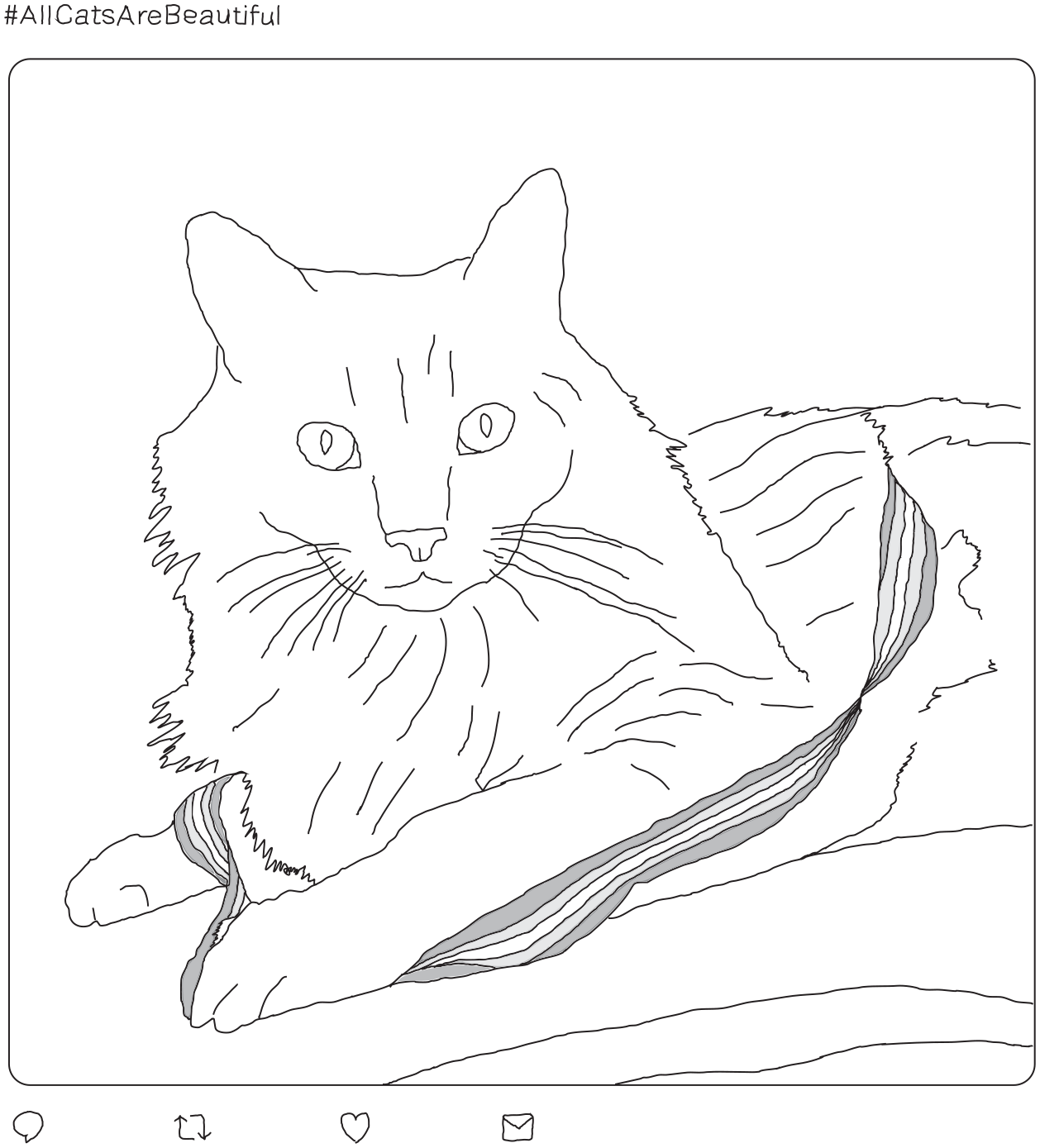
Topic: gender and sexism. Image shows cat lying on bed. Full-colour photograph, ribbon in colours of transgender flag (pink, blue, white).
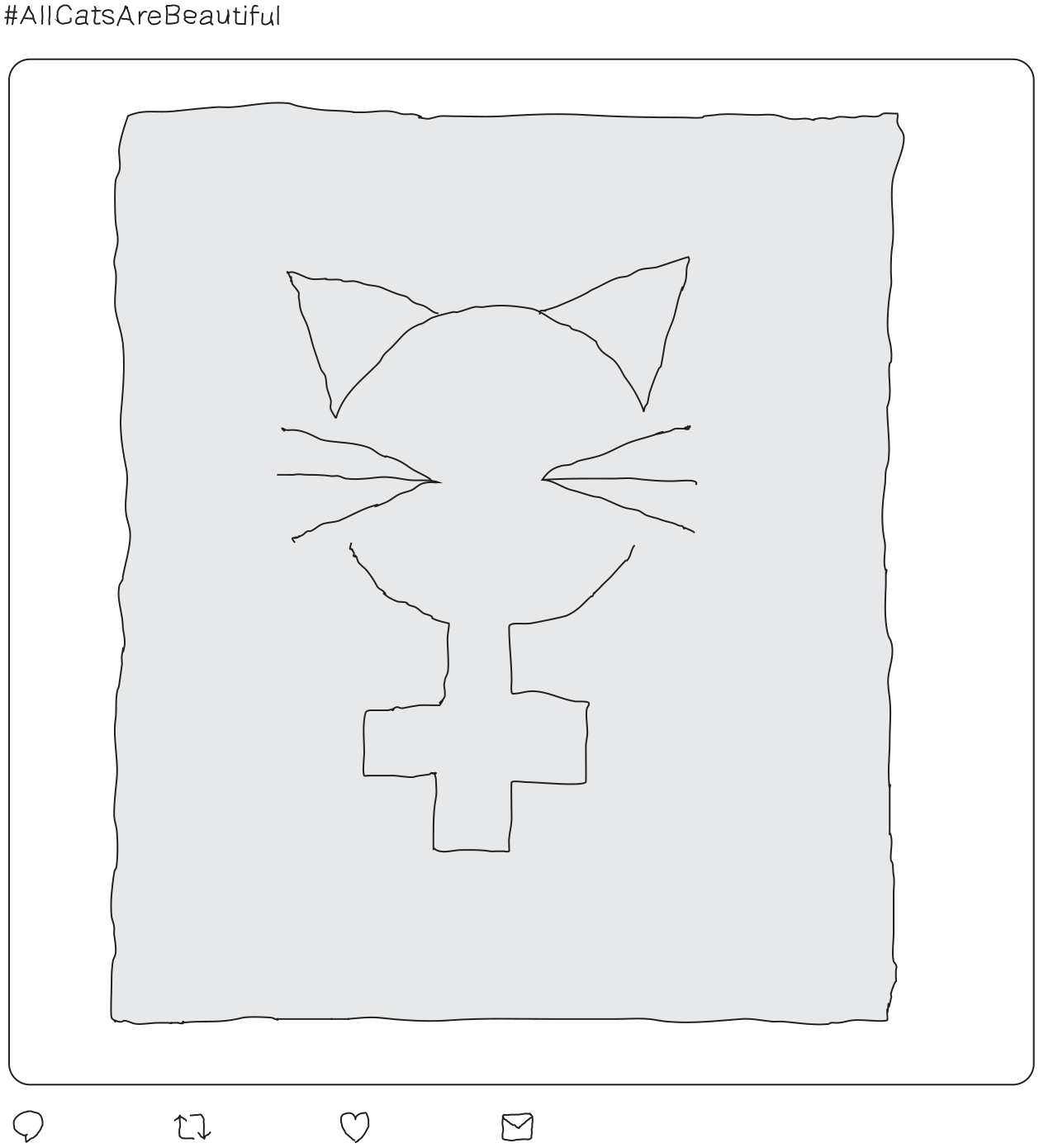
Topic: gender and sexism. Image shows cat and symbolic representation of female/womanhood. Duotone illustration, line-drawing.
Non-cat images in this topic include line-drawings of human clitorises (cf. #AllClitsAreBeautiful) and a photograph of an arm with the letters A.C.A.B. drawn or tattooed on it. (The latter example is an expression of support for a woman activist whose similar tattoo was negatively criticized in the press.) As for emojis and emoticons, the smiling-cat-with-heart-eyes emoji () is used several times, and there is one instance each of a raised fist (), a black flag ( ), a red rose (
 ) and a purple heart (). The ideational and attitudinal meaning potentials of these images couple intra- and intersemiotically to express admiration, support for and solidarity with those engaged in struggles for gender-related freedom and justice, that is [ideation: ‘gender-related activism, activists’/attitude: +appreciation, +judgement].
As with cats-as-commodities, gender-and-sexism has some ideational overlap with the anti-police texts. One text (see below) uses the #FemAnonFatal and #OpFemaleSec hashtags alongside #FuckTrump and #OpICE (ICE: Immigration and Customs Enforcement in the United States), ostensibly connecting anti-sexism with antiauthoritarianism and the abuse of power, for example the evoked [+judgement] of #OpFemaleSec plus the [–affect] of #FuckTrump. Similarly, another text reads ‘Fuck fascism. Respect and serve your sisters, brothers and non-binary comrades.’ Like the previous example, a positive ideation–attitude coupling pairs with a negative one. Other connections with anti-police discourse can be seen below, with metonymic reference to police or policing (i.e. mr officer, ‘security’). The first of these, which includes a photograph of someone wearing an A.C.A.B. All Clitorises Are Beautiful t-shirt in the setting of a park, appears to be a reference to the arrest of a woman in Madrid (see above). It seems to couple police with negative judgement, mocking the ineptitude ([social esteem: –capacity]) of law enforcement in Spain. In the last of the examples below, upscaled negative affect (really uncomfortable) is coupled with ‘security’—note how the scare quotes distance or dissociate the textual voice from the conventional meaning of the word, ostensibly questioning its legitimacy and contrasting with the appeal to stay safe (Please be safe, BBs). Other texts, not included here, make explicit the relation between sexism (and sexual violence) and the police, highlighting or commenting on reports of the sexual/physical abuse of women and girls by police officers. The ideation–attitude couplings in these texts are [ideation: ‘police’/attitude: –judgement, –affect].
#FuckTrump #OpIce [. . .] #AllCatsAreBeautiful [. . .] #FemAnonFatal #OpFemaleSec [. . .]
In general, then, gender-and-sexism texts invite readers to bond around a shared sense of struggle or support for gender recognition, equality, and/or freedom. Ideation–attitude couplings identify and characterize, on the one hand, groups, organizations or systems of oppression and, on the other, the victims and supporters of those who are oppressed. Cats are represented as partners in those struggles, as supporters of transgender rights and women’s liberation, for example. Moreover, the positive appreciation or judgement expressed by the hashtag #AllCatsAreBeautiful is mirrored in the sense of empathy towards and solidarity with victims and activists, and the negative appreciation or judgement of #AllCatsAreBeautiful—as an acrostic and subsequent abbreviation for All Cops Are Bastards—mirrors the sense of anger and frustration directed towards sources of violence or oppression.
Most of the texts in this segment of the corpus are in English. A smaller number of Spanish-language texts are also included, but these are primarily of the kind that overlap with anti-police texts.
Body image and body-shaming: Feline–human bodies
Several texts in the #AllCatsAreBeautiful corpus (approximately 1%) are about body image or body-shaming. Accompanying hashtags include #BodyShaming, #NoCatShaming, #FatCat, #RealCatsHaveCurves and #PlusSizeCats.
Texts in this part of the corpus refer almost exclusively to cats (unlike the anti-policing and gender-and-sexism texts discussed above). Ideationally, taxonomic relations form around the lexical items cat, body, (beauty) standards and physical and/or mental health. Clauses are typically relational, characterizing cats and cats’ bodies in various ways, and/or material, appealing (usually to society or popular media) for an end to certain beauty standards. Evaluative language in these texts includes fat, overweight, chubby, ugly, shame and unrealistic. Some of this negative affect and negative appreciation is countered or rejected with stop, enough, end this and not. 14 Body-positive language includes the hashtags #RealCatsHaveCurves, #CurvyCatsAreSexy and #PlusSizeCats, as well as #AllCatsAreBeautiful more generally.
Visual elements in body-image texts include photographs of cats. These cats generally appear in sitting or lying positions, and all are framed as close-ups. Several cats look directly at or just off camera; others are positioned as turned or turning away, sometimes from above (see Figure 13); and some are framed so as to focus only on certain body parts (see Figure 14). Several of these images give a sense of anonymity or detachment that is not generally present in the other topics. Among the emojis and emoticons used in body-image texts are , ,  and :(, variously lamenting or ridiculing (e.g. [–affect] or [–appreciation]) the physical and mental wellbeing of cats and the standards or expectations demanded of them.
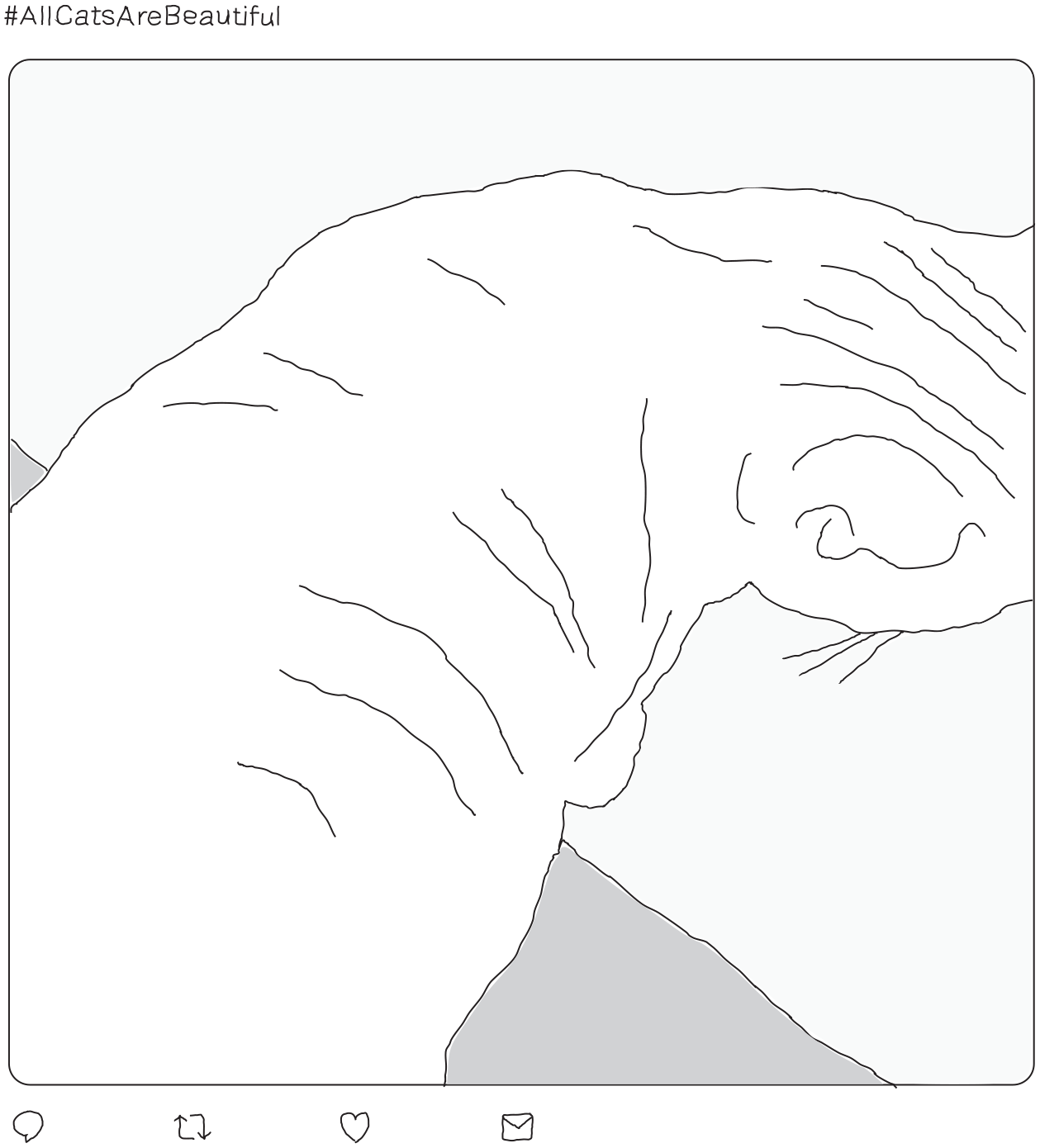
Topic: body image. Image shows cat from above. Full-colour photograph.
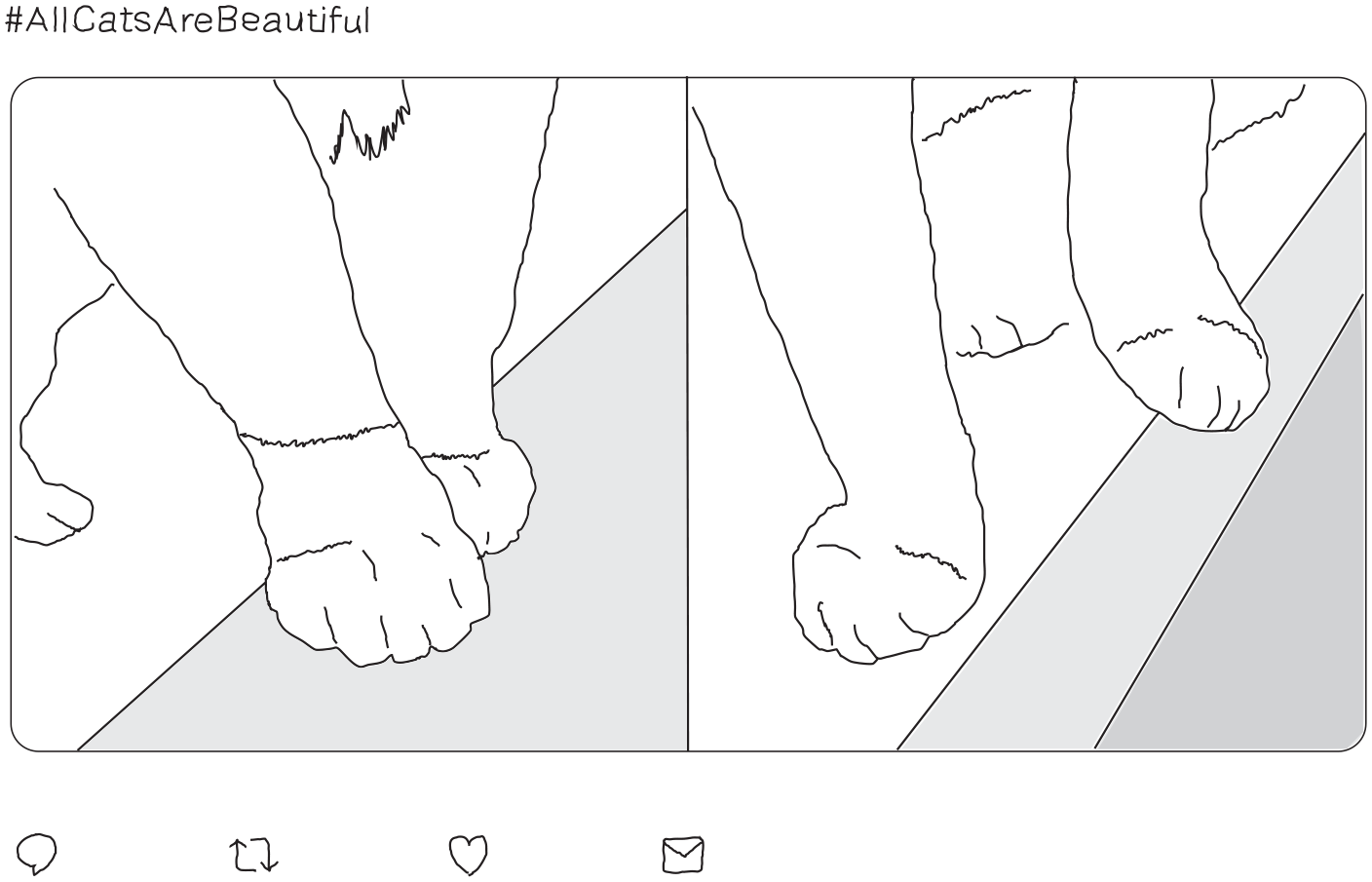
Topic: body image. Image shows cat legs. Full-colour photograph × 2.
In these texts, cats’ bodies often appear to be a metaphor or surrogate for human bodies, with the discourse echoing (and sometimes parodying) that of social pressures to conform to or aspire to certain standards of physical beauty or normality (cf. Cassidy, 2019). One text makes the comparison or connection with humans explicit: ‘Cat ladies don’t have to conform to rigid standards of beauty like human models’.
Ideation–attitude couplings in body-image texts tend to form around cats or cats’ bodies and the positive or negative appreciation of those bodies, as well as negative appreciation or countering of beauty standards and of the cultures or institutions that set or influence those standards. Instances from the examples above include [ideation: beauty standards/attitude: –appreciation] and [ideation: curvycats/attitude: +appreciation]. 15 These and similar ideational–attitudinal meanings form clusters around which a shared sense of negative attitude towards society’s beauty standards (for cats and/or humans) and a positive attitude towards bodily diversity might be formed.
There is some potential overlap between body-image and gender-and-sexism texts (see above), particularly in the way certain beauty standards might apply to women and girls. There is also a reference to manspreading in one of the body-image texts. 16
The language used in body-image texts is almost exclusively English. One text includes some German (Katze und Kater), but all four of its hashtags are in English.
Positive appreciation: All cats are beautiful
#AllCatsAreBeautiful expresses positive appreciation as well as implying a countering or corrective, that is every cat, not just certain cats. All texts in the corpus include this hashtag and express this meaning in some way, regardless of the field of experience they otherwise construe. However, one group of texts (a little over 30% of those in the corpus) highlights this meaning above all else. Cats and their characterization are up front and centre; it is this that is most ideationally salient in the text. Accompanying hashtags in this topic include #Cat or #Cats, #CatsOfInstagram, #InstaCat, #Catstagram, #CatContent, #Kitten, #Caturday, #Meow, #Love and #ILoveCats.
The first public use of #AllCatsAreBeautiful on Twitter, dated April 19, 2011, reads: ‘Intruder cat in courtyard. Must go and say hi.’ The positive appreciation and countering in this text is not only carried by the hashtag #AllCatsAreBeautiful; it is also implied by the need or desire to greet the cat despite the cat’s potentially unwelcome or uninvited status (intruder). Although many texts in this category include only the hashtag #AllCatsAreBeautiful and nothing else verbally, some express similar counter + positive-attitude pairings (see examples below). 17
Lol am I the only person who thinks hairless cats are adorable? #allcatsarebeautiful [. . .]
Even if you’re allergic #AllCatsAreBeautiful [. . .] cats are cats and can only be cats
Ideationally, texts in this category focus almost exclusively on cats. Taxonomic relations include repetition of the word cat, as well as near synonyms such as kitty and kitten and meronymic onomatopoeia such as meow and purr. In these texts, cats are often carriers in attributive relational clauses.
Evaluative language includes beautiful/beauty, like, love, adorable, happy, good, cute and lovely (see examples above). On the rare occasion that potentially negative attitude is expressed, for example bad, ugly, lazy, such terms are questioned, negated, ironized or presented as positive qualities (see below).
Visually, texts in this category are marked by the inclusion of photographs of cats, many of which are linked to the image- and video-sharing platform Instagram (cf. hashtags #CatsOfInstagram, #InstaCat and #Catstagram). Those photographs variously depict cats circumstantially or transactionally, in states of rest or activity, lying, sleeping, running and playing. Images are often of the demand type (Kress and van Leeuwen, 2006: 116 ff.), where eye contact between the represented participant (the cat) and the interactive participant (the viewer) is established. Images are tightly framed, as close-up or medium shots, suggesting intimacy or close social distance. An example is shown in Figure 15. Popular cat emojis include and .
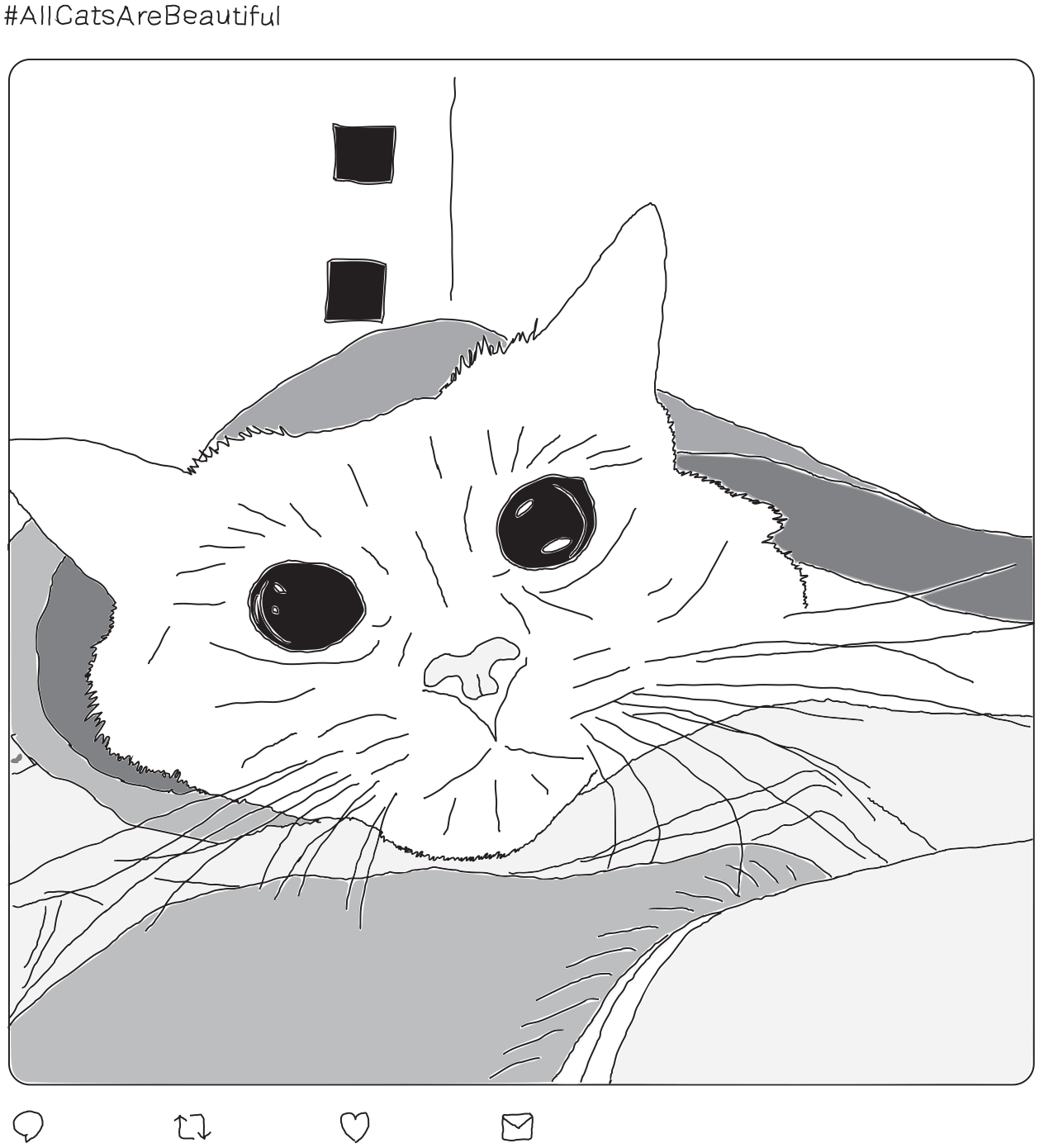
Topic: positive appreciation. Image shows cat wrapped in blanket. Full-colour photograph.
The positive appreciation and countering suggested by #AllCatsAreBeautiful seems to be complemented visually in some texts. For example, one text features an image of a cat with strabismus. The text reads ‘Wanted to take home this cross-eyed beauty today’. Other texts include photographs of cats with missing eyes or with otherwise unusual appearances. There may be some crossover here with the body-image topic discussed above.
Non-cat images are rare in positive-appreciation texts. One text contains a photograph of a wall bearing the quote ‘Time spent with cats is never wasted’ (accredited to Sigmund Freud). Others include images of lions or tigers rather than domesticated cats. Non-cat emojis include red hearts and smiling faces, and there are several instances of the smiling- or laughing-face, sticking-out-tongue, and heart emoticons, that is :), :D, :p and <3.
Crossover with other topics includes body-image (see comments above) and gender-and-sexism. In the case of the latter, several texts include the hashtag #YesAllCats, complementing the countering suggested by all in All Cats Are Beautiful. #YesAllCats might also be based on #YesAllMen, a response to #NotAllMen, both of which are associated with the #MeToo campaign against the sexual abuse and harassment of women (see, for example, Fileborn and Loney-Howes, 2019).
In positive-appreciation texts, then, ideation–attitude couplings are, perhaps unsurprisingly, almost exclusively [ideation: ‘cats’/attitude: +appreciation]. The only exceptions are occasional couplings with negative attitude, but, as noted above, these are typically negated, countered or ironized in some way. Readers and writers are invited to bond around this shared appreciation of cats, creating the basis for a community of cat admirers.
The texts in this category raise an interesting question with regard to
As with the other categories, there are notable differences across languages. Over 50% of English-language texts can be categorized as general positive-appreciation. The percentages for other languages tend to be lower. Spanish, for example, is under 10%, while German and French are 30% and 14%, respectively. The two Japanese texts in the corpus both belong to the positive-appreciation category.
Cats and liberationist-abolitionist discourses
As the analyses above show, the hashtag #AllCatsAreBeautiful has wide application that goes beyond the positive appreciation or admiration of cats. Crucially, for this study, #AllCatsAreBeautiful appears to be used for a variety of social and political reasons, many of which overlap or intersect. Some of those uses are widely recognized, such as commentary on or critique of policing and punitive justice. Others—the commodification of nonhuman animals, racism, gender and sexism and body-shaming—may be less familiar. 18 What these fields of experience seem to have in common, however, is a liberationist or abolitionist perspective and a desire for social transformation.
But why cats? Why not clitorises or cars, or other examples from the corpus such as clowns, containers, clones or computers? 19
It seems there are certain characteristics of cats—for example, their perceived independence or autonomy and their relative wildness or untamedness—that are highly valued, especially in anti-police discourse. These characteristics are represented visually and verbally in the corpus, alongside other qualities such as love and affection. Verbally, cats are often in subject and/or theme position, as carriers of various attributes such as beautiful, cute, adorable, lovely, happy, friendly, bad (luck), antifa(scist), anarchic, disobedient, ungovernable, feral and free. Less frequently, cats are actors or behavers in actions of playing, attacking or leap(ing) or sensers or phenomena in emotive mental clauses (e.g. Cats hate cops or I love cats). Visually, cats are depicted as pouncing, pawing or arching their backs, or lying or sleeping. They are often framed in close-up, eyes engaging the reader, creating a sense of intensity and intimacy (cf. Linné, 2016, on ‘interspecies intimacy’). (Body-image texts tend not to include this kind of visual engagement.) While verbal and visual resources in these texts tend to complement each other, intersemiotic divergence can be used to sarcastic or humoristic effect, for example the visual representation of a dog alongside the verbal claim of being a cat.
There are important links between cats and people or groups who, historically, have been ostracized, alienated or oppressed. For example, cats—and black cats in particular—are often imagined as the companions or familiars of witches, or as witches transformed. The history of witches and witchcraft is a complex one. Federici (2004), for example, interprets the witch trials of mediaeval Europe as violent processes of control over the bodies and lives of (primarily) women, as part of a reconfiguration of roles and relations in the transition from feudal to early-capitalist societies. Witches (or those deemed witches) were considered a threat to this newly emerging mode of production. The association of cats with witches in historical and contemporary contexts makes them a similar threat, one that challenges certain orthodoxies and authorities, and one that suggests alternative ways of being.
Also of relevance to this paper is the link between cats and the working class or workers’ movements. The sabot-cat, usually either a tabby or a black cat, is a common symbol of direct action, particularly sabotage and strikes (Salerno, 1989). Here, the cat, with its arched back and bushy tail, bearing its teeth and claws, is a symbol of resistance and confrontation (see Figure 7 above).
Another, more general, reason why cats (and not clowns, containers, computers and so on) are represented and appreciated in these particular ways is their relative ubiquity online. The popularity of ‘LOLCats’ and cat-based memes makes cats an important part of online internet culture(s) (Miltner, 2014; Shifman, 2014). If activists want to create or represent mass movements, as well as concepts such as freedom, resistance and ungovernability, cats may be a good choice in these kinds of digital environments.
Using cats as a substitute for the human can allow activists to say or do things that might be difficult to say or do otherwise, or to say or do things differently or humorously, reaching out to others, building community and offering critiques in ways that more earnest activities might not allow. But cats are not only symbols of resistance; they are also symbols of love and affection. Centring cats as part of human struggles for social justice may allow activists and others to create experiential and social distance between themselves and the issues at stake. In situations where activism can be physically and mentally exhausting (and, for some, potentially dangerous and life-threatening), cats can provide joy and playful forms of subversion.
Concluding remarks: Ambient affiliation, bonding and critical animal studies
#AllCatsAreBeautiful has a diverse range of applications. This diversity varies across languages and over time, but many of its uses or meanings appear to overlap. While these potential overlaps are important—suggesting that topics like policing, animal liberation, gender and body-image might be part of a wider, interconnected struggle—it is not to say that users explicitly or deliberately connect or identify with all these fields of experience. Ambient affiliation, as formulated by Zappavigna (2011, 2014), describes a possibility or potential for bonding around particular topics. Users may not be aware of the diversity of experiences and attitudes associated with a particular hashtag, but the values they express in relation to that hashtag are both ‘findable’ and potentially ‘bondable’ (Zappavigna, 2014: 224).
As Martin (2004: 327) notes, aligning with and bonding around certain value-positions is a complex process. Shared affect helps us bond around empathy and emotions; shared judgement helps us bond around principles and ethics; and shared appreciation helps us bond around preferences and aesthetics (Martin, 2004: 329; Martin and White, 2005: 42; Stenglin, 2004: 403). In the case of #AllCatsAreBeautiful, participants can variously bond around a shared positive appreciation or admiration of cats, a negative judgement and appreciation of police and policing, a positive judgement and appreciation of activists and activism, a negative appreciation of societal norms and so on. What connects these potential bonds is the hashtag #AllCatsAreBeautiful. It serves as a bonding icon (Stenglin, 2004, 2009) around which shared value-positions can be negotiated and communities instantiated.
Critical animal studies (CAS) provides us with a useful lens for understanding those communities and the possible interrelations between them. With its intersectional approach and its inclusion of the animal other, CAS highlights and critiques overlapping forms of oppression. It includes axes of class, ethnicity, gender, ability and generation, as well as all manner of hierarchical ideologies and institutions such as statism, militarism and speciesism (cf. Best et al., 2007: 6). In the case of #AllCatsAreBeautiful, seemingly disparate fields of experience such as state violence, the exploitation of nonhuman animals and body-shaming can be more readily understood as part of a set of interrelated antihierarchical or liberatory struggles.
Footnotes
Declaration of conflicting interests
The author declared no potential conflicts of interest with respect to the research, authorship, and/or publication of this article.
Funding
The author received no financial support for the research, authorship, and/or publication of this article.