



Abstract
Digital well-being concerns individuals’ subjective well-being in a social environment where digital media are omnipresent. A general framework is developed to integrate empirical research toward a cumulative science of the impacts of digital media use on well-being. It describes the nature of and connections between three pivotal constructs: digital practices, harms/benefits, and well-being. Individual’s digital practices arise within and shape socio-technical structural conditions, and lead to often concomitant harms and benefits. These pathways are theoretically plausible causal chains that lead from a specific manifestation of digital practice to an individual well-being-related outcome with some regularity. Future digital well-being studies should prioritize descriptive validity and formal theory development.
Keywords
How can people live a good life both thanks to and despite the constant use of digital media? There will be no simple answers—findings will depend on which aspects of digital media use, of well-being, and of any number of intervening factors are selected. There is nothing inherently beneficial or harmful in digital media per se, but they can and do play a role for people’s well-being. The introduction of new technologies generally entails a discourse from euphoria, to moral panic, to normalization—affordance is initially mistaken for inevitability and existing socio-technical structures are ignored (Baym, 2010; Franklin, 1999; Morley and Silverstone, 1990). As digital media have become increasingly intertwined with everyday activities, so has their potential impact. This has led to overly generalized fears and claims, such as that smartphones are destroying the current generation of adolescents (Bell et al., 2015; Twenge, 2017a). Instead of digital detoxes (Syvertsen and Enli, 2019) or screen time apps (Beattie and Daubs, 2020), we need better theories and valid findings on how, why, and when digital media lead to harms and benefits. This article develops a general digital well-being framework providing a guide for specific, substantive theory development and empirical research. To this end, it connects three types of variables: (1) digital practices, (2) proximal outcomes in the form of harms and benefits, and (3) measures of well-being as distal outcomes.
Digital well-being: happiness when digital media are omnipresent
Many studies of digital media have analyzed socially relevant outcomes, such as political participation (Boulianne, 2018) or social capital (Williams, 2019). The digital well-being framework (Figure 1) explicitly extends this perspective by including subjective well-being, or happiness, as the target variable of personal, organizational, and government decision-making (Frijters, 2020; Helliwell, 2020). We care about digitization because ultimately technology is expected to foster a good life—a life lived in accordance with socially negotiated and personally held values (Quan-Haase, 2015; Vallor, 2010; Van Dijck, 2019). Yet, “technology, appearing now to ride roughshod over hopes for democracy and community, is viewed in much public discourse as a culprit behind a world gone rogue” (Swartz et al., 2019: 351). The (isolated) effects of digital practices among the myriad factors that impact well-being are presumably small (Kardefelt-Winther et al., 2020; Orben et al., 2019; Orben and Przybylski, 2019), making theoretical precision ex ante data collection all the more critical. Because communication is constitutive of social relations and thus human well-being (Fuchs, 2020; Spottswood and Wohn, 2020), enveloping this process into digital media does become central to the study of well-being in digitized societies.
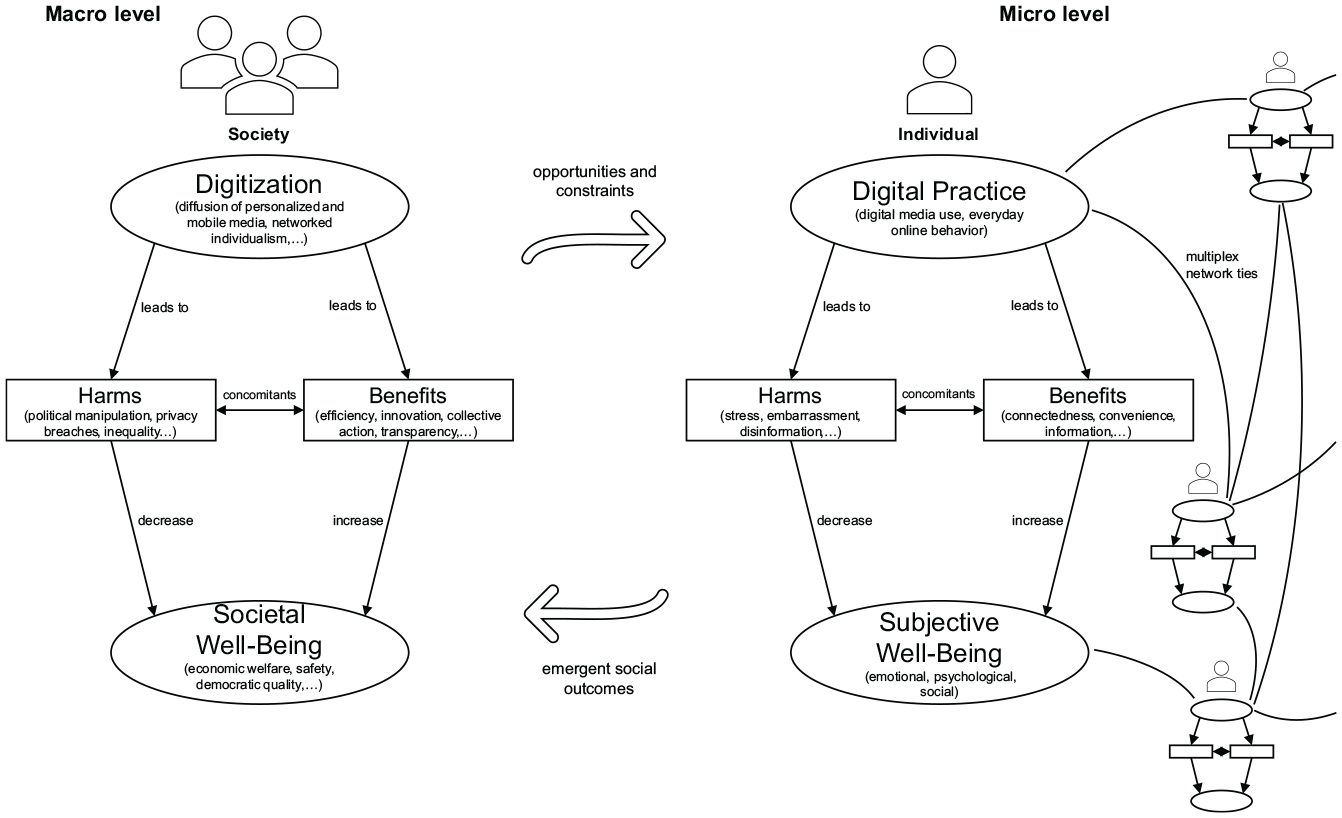
Digital well-being framework. An individual’s digital practice leads to often co-occurring manifest harms and benefits, which in turn affect subjective well-being. These steps may be moderated by additional variables, such as personality or situation. Individuals are embedded in social networks and society, whose structural trends and technologies constrain and afford individual action, while also being the complex emergent product of micro-level processes.
Subjective well-being is a self-evaluation or declaration people make about the quality of their lives (Diener et al., 2018a; Helliwell and Aknin, 2018; Keyes, 2014). It refers to happiness in terms of pleasure and satisfaction, which can include dimensions such as purpose, positive relationships, and functioning in social groups. Measures of subjective well-being generally include a cognitive appraisal, such as life satisfaction overall or in specific domains, and positive and negative affect (Miao et al., 2013). Explanations for variations in happiness commonly involve health, work, and relationships (Diener et al., 1999, 2018b; Headey et al., 1985; Watson, 1930). The proposed framework offers a frame to cumulate the specific effects of digital media use and a way of systematizing processes (and their corresponding substantive theories) at the intersection of digitization and well-being. Accordingly, digital well-being is understood here as a shorthand term for how digital media use is connected to well-being, rather than referring to moments of being satisfied with one’s digital media use.
Combined with the normative stance that technology should improve the quality of life (Amichai-Hamburger, 2009; Franklin, 1999; Griffy-Brown et al., 2018), the following delineation is proposed for digital well-being as a research field: Digital well-being concerns individuals’ affect (e.g. positive emotions), domain satisfaction (e.g. one’s relationships or job), and overall life satisfaction in a social environment characterized by the constant abundance of digital media use options (for related approaches, see Amichai-Hamburger and Furnham, 2007; Büchi et al., 2019; Floridi, 2014; Gui et al., 2017; Vanden Abeele, 2020). This abundance forces decisions on digital practices, even if it is to not use digital media in a given situation. Consequently, digital well-being interrogates the proximate relationships between the use of digital media and subjective well-being, and digital media’s modifications of “analog” influences on and outcomes of well-being. In less digitized societies, the framework is equally applicable, but presumably the relative contribution of digital media use to well-being is smaller in everyday life.
Different research traditions have dealt with the relationship between digital media use and well-being with different assumptions and definitions. Findings depend on how both concepts are defined and operationalized, and on a host of potential moderators and mediators for this primary relationship (Kushlev, 2018; Rosas, 2012). One study may find negative well-being-related effects because it operationalizes social media use as clicking on links and the like button on Facebook (Shakya and Christakis, 2017), whereas another finds positive effects because it measures social media’s integration into social routines (Bekalu et al., 2019). In a large national sample where US teens were directly asked about the overall effect of social media use, 45% presumed a neither positive nor negative effect; among those who assumed an effect, positive outweighed negative (Anderson and Jiang, 2018). Several findings, however, do indicate negative impacts of digital media uses on measures indicative of personal well-being (Dienlin and Johannes, 2020; Liu et al., 2019; Salo et al., 2017). Psychological digital well-being research generally focuses on adolescents with screen time as the independent variable and indicators of depression or anxiety as the dependent variable (for an overview, see Dienlin and Johannes, 2020; Odgers and Jensen, 2020), with the current state of research indicating clinically insignificant relationships and little evidence regarding cause and effect.
Studies have focused on negative aspects such as problematic Internet use (Caplan, 2002), Internet addiction (Beard, 2005), smartphone addiction (Panova and Carbonell, 2018), fear of missing out (Przybylski et al., 2013), or social comparison (Midgley et al., 2021). Whether temporarily disconnecting from digital media has positive well-being effects is unclear (Radtke et al., 2021), yet may hold some promise in self-determined digital media habits (Aagaard, 2021). Recently, more person-centered research has emerged. For example, Griffioen et al. (2021) video-recorded and then interviewed 114 emerging adults; they found that smartphones were omnipresent but uses, motivations, and feelings varied greatly, thus concluding that indiscriminate measures, such as screen time cannot induce uniform effects on well-being.
Turel et al. (2018) report that a short abstinence from social networking site use resulted in reduced perceived stress, especially in excessive users. The independent variable was one specific type of digital practice, and the dependent variable was one specific type of a proximal harmful outcome. In addition, the relationship was more pronounced for heavy users—intensity of use thus functioned as an additional specification. Wolfers et al. (2020) found that experiencing above-average stress led to less passive Facebook use 6 months later, and more Facebook use in a passive manner increased stress; yet, this pattern was found only for younger adults and only for reading as opposed to writing posts. These studies illustrate how rigorous research can find methodologically valid negative impacts of media use on well-being-related outcomes and should be distinguished from generalized claims, such as that we all suffer from digital overuse (Montag and Walla, 2016) or that smartphones ruin our lives (Twenge, 2017b).
In contrast, many sociologically motivated studies assume beneficial impacts of digital media use on longer term life chances; it certainly makes sense to propose that more access to and skilled use of various digital resources for information, communication, or entertainment have a positive impact on people’s lives. Digital inequality research suggests that digital media use is individually beneficial, but socially problematic because its proliferation tends to exacerbate social inequalities through a rich-get-richer mechanism (Hargittai, 2008; Helsper, 2021; Robinson et al., 2015; Van Dijk, 2020). Digital inequality research and policies rest on the assumption that access to and use of digital media produce benefits (Duff, 2011; Sanders and Scanlon, 2021) which justifies investing in infrastructure and skills. Recent studies in this tradition examined the subjective (Büchi et al., 2018) and tangible (Van Deursen and Helsper, 2018) benefits of Internet use, and other positive aspects, such as connectedness (Chan, 2015), social support (Utz and Breuer, 2017), or online information and advice (Van Ingen and Matzat, 2018).
Meta-analytical research found that “problematic” Internet use (Çikrıkci, 2016) and “social media addiction” (Duradoni et al., 2020) were negatively associated with well-being. For social media and adolescents, an analysis of US-based teens showed the simultaneous occurrence of positive (e.g. affirmation, amusement) and negative affect (e.g. isolation, envy) (Weinstein, 2018). Most recently, individually differential digital media use effects were examined with experience sampling and multi-level modeling: Beyens et al. (2020) found that for 17% of the sampled adolescents, passive Instagram use increased momentary happiness (while decreasing it for 9% and having no effect for 74%). The conclusion that not all engagement with digital media is equivalent is surprisingly recent in the psychological literature (Dienlin and Johannes, 2020; Valkenburg et al., 2021), and for well-being-related measures beyond momentary affect or for general populations, there are no studies to date separating intra- and inter-individual effects over time.
A sociological framework to connect digital media and well-being
Because empirical studies find both negative and positive effects, and meta-analyses indicate that there is no generalizable impact, a framework to accommodate harmful and beneficial pathways preserving a comprehensive perspective is required. Substantive theories need to describe isolated mechanisms that may be masked in generalized statistical associations, narrowly define concepts of digital practices and personal well-being, and enable very specific studies with several moderators and mediators. For example, digital communication practices could be shaped by the “altered” expressions of individuals’ traits as compared to offline social interactions. However, how social position and structure impact these experiences, and how the single results are indicative of more general trends should not be lost in the quest for micro-level precision. A specific kind of use for a specific sample of people under specific conditions can have positive or negative proximal and distal well-being outcomes, but ultimately a relevant question is how to govern digital technologies in society. Policymakers urged to take action and public offices pressed for guidance—are digital platforms responsible for the diffusion of hate speech? should smartphones be banned in schools?—will be tempted to generalize and simplify very specific findings. However, this should not discourage digital well-being research from continuing with very specific research and adopting a comprehensive perspective where findings will tend to be a perhaps unsatisfying “it depends.”
The constituent elements of the framework and their connections are described and illustrated in a graphical model encoding the explanatory principles (Figure 1). The framework calls for the development and application of theories that specify the components and the nature of their interrelations. These mechanisms are theoretically plausible causal chains that lead from a specific manifestation of digital practice to a relevant individual harm and benefit with some regularity, and ultimately to subjective well-being. Considering the role of social structural constraints and opportunities for individual digital practice is the first analytical step. How individuals then use digital media and how this may ultimately affect their well-being is the second step—this step is emphasized in the remainder of the article because it is empirically the most accessible. The third step, the logic of aggregation and transformation, focuses on how the digital practices of networked individuals translate to social outcomes that eventually again function as structural opportunities and constraints (see, e.g. Coleman, 1986; Emirbayer and Mische, 1998; Hedström and Ylikoski, 2010).The framework seeks to complement the predominance of psychological approaches in digital well-being research with a sociological lens. A psychologist’s interest may be in the effect of social media browsing on mood, whereas a sociologist might analyze differences in norms of appropriate smartphone use according to social class. The digital well-being framework can situate both types of inquiry and integrate their findings. If one study were to find that habitually scrolling through Instagram consistently led to negative affect, it would be necessary for any kind of general and socially relevant conclusion to (a) replicate the finding under a broad range of circumstances, balance the effect with any number of concomitant additional harms and benefits, and include other social media prevalent in a population’s digital media repertoire; and equally importantly to (b) study how such individual digital practice comes to be as a result of social reproduction and milieus, how class origins dictate communication preferences and norms, and how aggregated digital practices affect the life course and inter-generationally engender new socio-technical developments (Hargittai, 2008; Helsper, 2021; Weiß, 2020). Such a comprehensive research program may appear unachievable, but without the cumulation and integration it seeks, isolated effects will continue to feed moral panics or technological solutionism about digital media in society (Orben, 2020b). The big picture is characterized by the rise of digital networked communication (Cardoso, 2008; Neuman, 2016; Rainie and Wellman, 2012) with consequences for inequality, labor, education, and culture (Cooper, 2002; Couldry et al., 2018; Franklin, 1999; Jessie et al., 2017) within a “desynchronized high-speed society” (Rosa, 2003).
Anticipated or realized consequences of digitization at this level of analysis not only include increased efficiency, innovation, and transparency but also political manipulation, privacy breaches, and growing socioeconomic inequality. Digitization and its ensuing benefits and harms impact the well-being of society as measured, for example, by economic welfare, safety, democratic quality, life expectancy, or educational opportunities. The structural rules of the digitized society are shaped by public and private governance mechanisms, such as competition policy (Just, 2018), while the dominant digital mediators, such as social media platforms, also govern everyday individual practices (Brubaker, 2020; DeNardis and Hackl, 2015; Latzer and Festic, 2019). Digitization and interconnected technological innovations codetermine “the terms in which social, political, and economic relations are played out” (Wajcman, 2002: 360). With relative stability, such current macro conditions function as structural–situational constraints and opportunities for an individual. Even highly individualized attributes, such as preferences in digital media use, relate to the social structure, to the conditions in which people were socialized and live their everyday lives (Bourdieu, 1977, 1984; Guhin et al., 2021; Robinson, 2009; Wacquant, 2016). Where a pathologizing or narrow psychological view of digital practice would shift responsibility to individuals, the digital well-being framework accounts for system-level impacts on everyday individual practice without precluding creative agency.
Digital practice includes all behaviors related to digital media, such as uses and habits—this may be social interaction, information seeking, transactions, or entertainment—or avoidance and disconnection. As with well-being, digital practice can be operationalized at various levels and thus produce diverging outcomes. For example, posting a public photo of one’s graduation through the Facebook app includes information on the device (mobile), the type of application (social networking site), the specific application (Facebook), the specific feature (image sharing), the social interaction (one-to-many), and the message (public, self-presentation, content) (Meier and Reinecke, 2020). Each level may become meaningful and operate differently, which exposes the futility of searching for simple, overall digital media effects. The plainest form of digital practices can be considered an action in the sociological sense. Actions have direct consequences, here included as harms and benefits. However, these actions also have causes; they are motivated and initiated through desires, beliefs, and opportunities shaped by social interaction (Hedström, 2005). The framework recognizes that individuals’ practices and well-being can also depend on others; and between micro and macro, there is any number of aggregates of individuals that can become meaningful, such as an organization or group. In addition to social influence, the following trends appear particularly relevant in framing individuals’ practices (Campbell, 2019; Gui et al., 2017; Vanden Abeele et al., 2018; Webster, 2014; Yeung, 2017; Yeykelis et al., 2014): (1) an abundance of digital media use options, (2) the convergence of different activities in the same device, (3) the exploitation of human attention by platforms, and (4) the potential for anytime, anywhere use.
At the micro level of individuals, digital practices can yield beneficial and harmful outcomes; for example, increased feelings of belongingness, convenience, or relevant information; but also stress, disinformation, or embarrassment. Harms and benefits are the proximal outcomes of digital practices and can arise in parallel or sequentially. Importantly, beneficial and harmful consequences of digital practices are often likely to be positively related (Blank and Lutz, 2018; Van Dijk, 2020, chapter 7). For example, self-expression on social media may increase well-being, but at the same time the risk of embarrassment may increase as content can be taken out of context or reach unintended audiences. Links between a specific manifestation of digital practice and outcomes as diverse as making new friends (Van Deursen and Helsper, 2015) and reducing stress (Turel et al., 2018) ultimately matter because of their potential cumulative impacts on people’s general well-being. Measuring subjective well-being as a generalized, mediated outcome of digital practices provides a transparent normative evaluation of these practices and can substantiate policy measures.
The framework (Figure 1) is generalized and simplified in that it does not indicate the specific digital practice or measure of well-being, and it does not specify the concrete harms or benefits; these depend on the precise theories pertaining to the selected digital practices in each study. Established well-being instruments (Diener et al., 1985; Liddle and Carter, 2015; Tennant et al., 2007) can be selected and adapted to fit the temporality and level of the presumed effects of concrete harms and benefits of a specific digital practice. Crucially, the digital well-being framework keeps subjective well-being analytically separate from digital practices and harms and benefits. That is, digital practices, proximal harms and benefits, and distal subjective well-being remain separate measures whose causal links need to be theorized and tested. Consequently, digital well-being research should not resort to compressing the causal links between digital practices and well-being into a univariate self-assessment (“the way I use digital media makes me happy”) or replace the reference point of subjective well-being—life in general or specific domains—with digital practice (“I am happy with my digital media use”).
Sketching an application of the digital well-being framework
The digital well-being framework is intended to stimulate substantive theory development, enable critical interpretation of existing empirical studies, and instruct new study designs. Harms and benefits are an intermediary step, or mediator, between digital practices and subjective well-being. Depending on the theory, concrete operationalizations of these elements, and the level of analysis, conditionalities, or moderators, come into play. The basic question from the mediator perspective is: Does digital practice X lead to the harm or benefit M which affects well-being? The “final” labeling of M as a harm or a benefit is retrospective, depending on its empirical effect on well-being (see Figure 2). The question from the moderator perspective is: Under which condition C do the paths from X to M and M to Y hold?
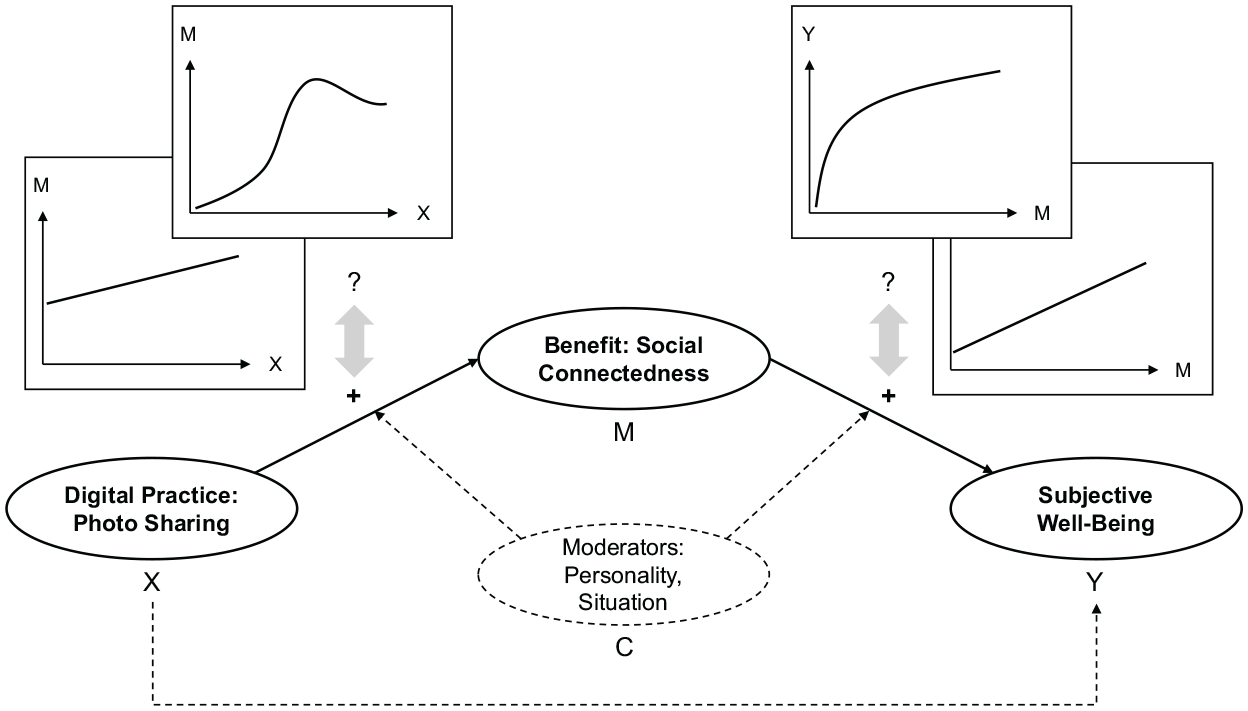
Basic causal model for the relationships between exemplary specifications of a digital practice and a benefit. To formalize this basic causal diagram, the functional forms need to be specified, and despite positive correlations in both steps, the specifics may lead to remarkable divergence in the model-implied data (Robinaugh et al., 2021). Here, an (unbounded) linear relationship for X→M seems implausible; more likely, an initial increase from zero to “some” sharing with close friends would strongly increase connectedness, up to a certain point, after which it may be perceived as alienating. Similarly, social connectedness may have a decreasing rather than constant positive marginal effect on subjective well-being (M→Y). Furthermore, these paths of primary interest may be conditional, that is, moderated by additional variables (C).
Researchers can map an interesting phenomenon onto the framework to determine a plausible pathway and invoke or develop substantive theory. First, a narrowly defined phenomenon, an element of a person’s digital practice, needs to be operationalized; for example, “the number of images shared in direct messages with recipients described as close friends within a certain period.” A plausible mechanism would be that such sharing leads to experiencing social connectedness, which in turn increases general well-being (Lomanowska and Guitton, 2016; Mauss et al., 2011; Valkenburg and Peter, 2007)—here, input from or development of specific theoretical mechanisms is required. Possible moderators include personality (primarily between-person; for example, the link is stronger for extraverted people) or situational differences (primarily within-person; e.g., when close friends are physically distant, connectedness is more dependent on photo sharing). If the phenomenon were defined less precisely, for example, by omitting the recipient characteristic, then this may very well function as a moderator (that the recipient is or is not a close friend).
Another aspect to consider, specifically when attempting to formalize parts of the general framework as a model, is the presumed functional form of the relationships (see Figure 2). Making explicit assumptions of this kind is needed for a risky, and thus informative, test of the model (Meehl, 1978). Conventional statistical testing could lead to the result that the model is “correct” because a zero or negative correlation for the two paths is unlikely. However, a risky test of the model would need to use well founded specifications to simulate data and compare it to empirical data, only suggesting retention of the model if the two align, as this implies that the empirical data were generated by the specified relationships (Jansen et al., 2021; Robinaugh et al., 2021). Specifications of parts of the digital well-being framework need to consider causality and cyclical relationships. For example, it is possible that overall, individuals experiencing low social connectedness (between-person) or individuals at moments in their everyday life when social connectedness is low (within-person) seek to increase their sharing with close friends. This reverses the above assumed causal process and empirically, it implies a negative correlation between sharing and connectedness. This shows that even for a seemingly simple bivariate relationship, the explanatory mechanisms require much precision often lacking (Thomas et al., 2021) (see example in Figure 3; replication code: https://osf.io/zk2x8/?view_only=ba4b8be2f4134622a0dbc95012ca2f63).
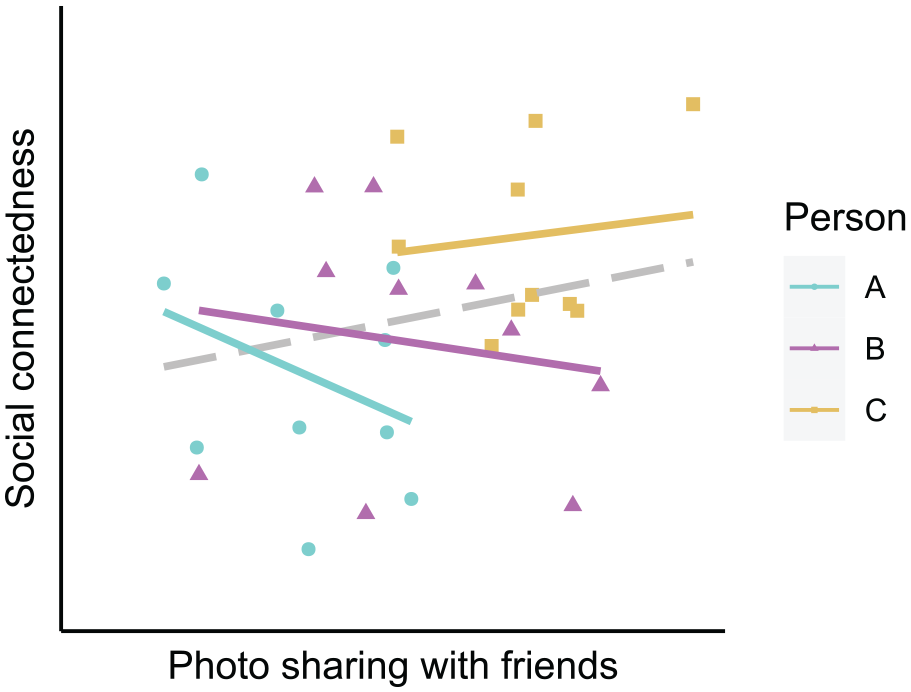
Between-person and within-person associations. The scatter plot shows simulated data for three people with 10 measurements each on two variables (photo sharing with friends and social connectedness). Solid lines represent individual linear fit; the dashed line represents the global linear fit, that is, across people. Overall, sharing more photos with friends is associated with greater social connectedness. However, for persons A and B, the association is negative—the relationship within all individuals could be negative while the between-person correlation is still positive Pearl (2014).
Future directions
Fears about new information and communication technologies’ disastrous effects on society appear to be based on the observations of co-occurring trends—for example, rising levels of depression and increasing smartphone ownership—combined with technological determinism (Livingstone, 2018; Odgers, 2018; Ophir et al., 2020). To counter this and advance cumulative digital well-being research, two strategies will be critical: building valid descriptive knowledge combining established with new modes of data collection and formalizing theoretical mechanisms for risky tests, preferably in a longitudinal perspective. Studies that focus on identifying, describing, and validly measuring (new) empirical phenomena are an essential initial step toward cumulative theory developments in digital media effects. For example, this could mean capturing ordinary people’s perceptions of social media platforms based on diary interviews (Lupinacci, 2021) or describing differences in smartphone usage using device logs rather than self-reports (Geyer et al., 2021; Parry et al., 2021). Such descriptively valid knowledge is necessary before attempting to explain and understand the causes and consequences of these observable patterns (Smaldino, 2019). Complex but weak models should not crowd out “simple” descriptions of digital practices (Gerring, 2012; Munger et al., 2021).
A main critique of the extant literature on digital media use and well-being is the lack of causal evidence. The solution to the causality problem is not not asking causal questions or hedging in non-causal language like “X is associated with Y.” Researchers need to explicate the assumed mechanisms that generated the observed data—directed acyclic graphs can be employed to clearly state such a data-generating model (Elwert and Winship, 2014; Grosz et al., 2020). Ideally, formal models based on these precise assumptions are used to simulate data which is then contrasted with longitudinal empirical data (Jansen et al., 2021). Applications of advanced techniques, such as random-intercept cross-lagged panel models, require a minimum of three panel waves (Hamaker et al., 2015), and the testing of even simple bivariate hypotheses becomes relatively intricate (Thomas et al., 2021). However, trading comprehensive but shaky models for parsimonious and robust explanations again seems worthwhile. The time interval between measurements will depend on the expected variation in the measures of digital practices, outcomes, and well-being. For example, online job searching may produce a relevant benefit, that is, finding a fulfilling job, and thus increase life satisfaction, but starting a new job is a comparably rare event. Similarly, connecting an hourly prompted mobile survey on negative and positive affect with harms deriving from self-disclosure on social media would not be able to detect the real effects of such digital practices and their more masked long-term consequences. A theoretical match regarding the temporal perspective on the framework’s three core types of variables, digital practices, harms/benefits, and well-being is thus key.
Conclusion
The general digital well-being framework separates digital practices from their proximal outcomes, recognizing these outcomes as often co-occurring concrete harms and benefits. There is nothing inherent in digital media that is harmful or beneficial, yet the digitization of society and everyday life can undoubtedly impact well-being. This impact has been difficult to assess empirically due to a lack of reliable and valid measurement, formal models, and strong theory. The digital well-being framework guides the selection and specification of plausible paths between specific manifestation of individuals’ digital practices and well-being-related outcomes. Its scope and generality invite researchers to select moderators and mediators—that is, specify the conditionalities and intermediate steps—most relevant to the digital practice, harm or benefit, and well-being measure under scrutiny. The framework provides a set of general principles that call for the formalization of the specific manifestations and relations to generate valid findings on digital media effects. Justified calls for methodological reform (Orben, 2020a; Parry et al., 2021) need to be accompanied by theory integration. This would go a long way in avoiding exaggerated claims, spurious findings, tautologies, non-disprovable vagueness, and post hoc explanations as theory surrogates (Gigerenzer, 2010). A useful theory of digital well-being will not be static, but rather subjected to a cycle of identification, development, formalization, and evaluation (Borsboom et al., 2021; Little and Pepinsky, 2016; Van Rooij and Baggio, 2021).
In conclusion, digital media should not be treated as pharmaka, that is, as poison, cure, and scapegoat. Rather, digital media increasingly envelope and shape human communication which is essential for well-being—their impact is neither predetermined nor non-existent. Aiming for abstraction without oversimplification, the digital well-being framework describes three crucial interdependencies: (1) Individuals’ digital practices depend on the opportunities and constraints, situational and long-term, afforded by their social surroundings and technological developments. (2) Different manifestations of individuals’ digital practices lead to often concomitant concrete harms and benefits. (3) The balance between and cumulation of concrete harms and benefits affect overall well-being. Continued conceptual work is required to integrate single empirical studies of necessarily narrow validity and thereby attain generalized knowledge.
Footnotes
Acknowledgements
The author thanks Tobias Dienlin, Marco Gui, Ellen Helsper, Katharina Sommer, and Mariek Vanden Abeele as well as the Media Change and Innovation Division (Michael Latzer, Noemi Festic, Kiran Kappeler, Michael Reiss, and Tanja Rüedy) for their support, feedback, and suggestions.
Funding
The author(s) disclosed receipt of the following financial support for the research, authorship, and/or publication of this article: This research was supported by a Research Talent Development Grant from the University of Zurich Alumni organization. Parts of this research were conducted as Fellow of the Digital Society Initiative, University of Zurich, and as Visiting Fellow at the Department of Media and Communications, London School of Economics and Political Science.
