




Abstract
Although the ubiquitous connectivity afforded by mobile media brings benefits to people’s work, social, and leisure lives, these benefits are sometimes overshadowed by the burdens of 24/7 connectivity, which challenge the well-being of individuals and society. Digital well-being is an emerging concept that refers to how people experience these benefits and burdens. This Special Issue brings together five articles that push the boundaries of digital well-being research by shedding light on the opportunities and challenges that people experience in relation to mobile connectivity, exploring the role of digital disconnection for digital well-being, and theorizing the conceptual underpinnings of digital well-being. In this editorial, we first give a definitional overview of the digital well-being concept and situate it in the field of mobile media and communication scholarship. Next, we identify two key issues that emerge from the Special Issue, and explain how the individual articles further our understanding of them. These issues are: (a) the strong conceptual link between digital well-being and digital disconnection; and (b) the conceptual difference between digital well-being as a psychological condition and as a socio-cultural artefact. To end, we present a future research agenda on digital well-being by first identifying current knowledge gaps, and next highlighting several themes that we anticipate as crucial in the forthcoming decade of digital well-being research in an age of mobile connectivity.
Introduction
Contemporary society is characterized by the widespread uptake and rapid integration of mobile media into everyday life. Relying on a sophisticated yet largely invisible technological infrastructure, these mobile media afford individuals, groups, and institutions to disembed social interactions and activities from time and place constraints. As such, the advent of mobile media has significantly re-organized how people do things (Vanden Abeele et al., 2018). Mobile devices such as smartphones, laptops, and wearables, enable us to connect with others, to work remotely, to access and consume information instantly and on-the-go, and to interact with our environment in entirely new ways (e.g., via Quick Response [QR] codes and location-based services).
The re-structuring of society around mobile connectivity brings undeniable benefits to individuals and society (Vanden Abeele et al., 2018). However, there are also concerns about its potential drawbacks. As mobile connectivity is increasingly taken for granted (Ling, 2008), individuals are also increasingly expected to be permanently online and permanently connected (Vorderer et al., 2017). This state of being ‘always-on’ (Nguyen, 2021) is often experienced as a burden to well-being. As a result, people describe their relationship to mobile devices as ambivalent (Ytre-Arne et al., 2020), oscillating between feelings of resistance and resignation (Park & Kaye, 2019, p. 224).
Digital well-being has recently emerged as a novel concept that gives expression to the delicate balance between benefits and drawbacks that people experience in relation to 24/7 connectivity (Vanden Abeele, 2021). Given the deep impact of mobile connectivity on everyday life and society, developing a “mobile perspective” on digital well-being is essential. The five articles of this Special Issue on “Digital Well-Being in an Age of Mobile Connectivity” meet this aim. They further understanding of the opportunities and challenges that mobile connectivity brings to the well-being of individuals and society. In this editorial, we explain how the articles push boundaries in this nascent field of research by presenting both theoretical conceptualizations and empirical evidence in relation to mobile media and digital well-being. Before doing so, however, we first give an overview of digital well-being definitions, and situate these against scholarship on mobile media and communication.
Digital well-being: an emerging concept
Digital well-being is an emerging concept in the field of social sciences and humanities that garners attention from scholars in a wide variety of disciplines, including cultural studies (e.g., Beattie and Daubs, 2020), human–computer interaction (e.g., Monge Roffarello and De Russis, 2021), philosophy (e.g., Dennis, 2021), communication sciences (e.g., Vanden Abeele, 2021), sociology (e.g., Gui et al., 2017), and psychology (e.g., Dadischeck, 2021). Its scholarly use has grown exponentially over the past five years (see Figure 1).
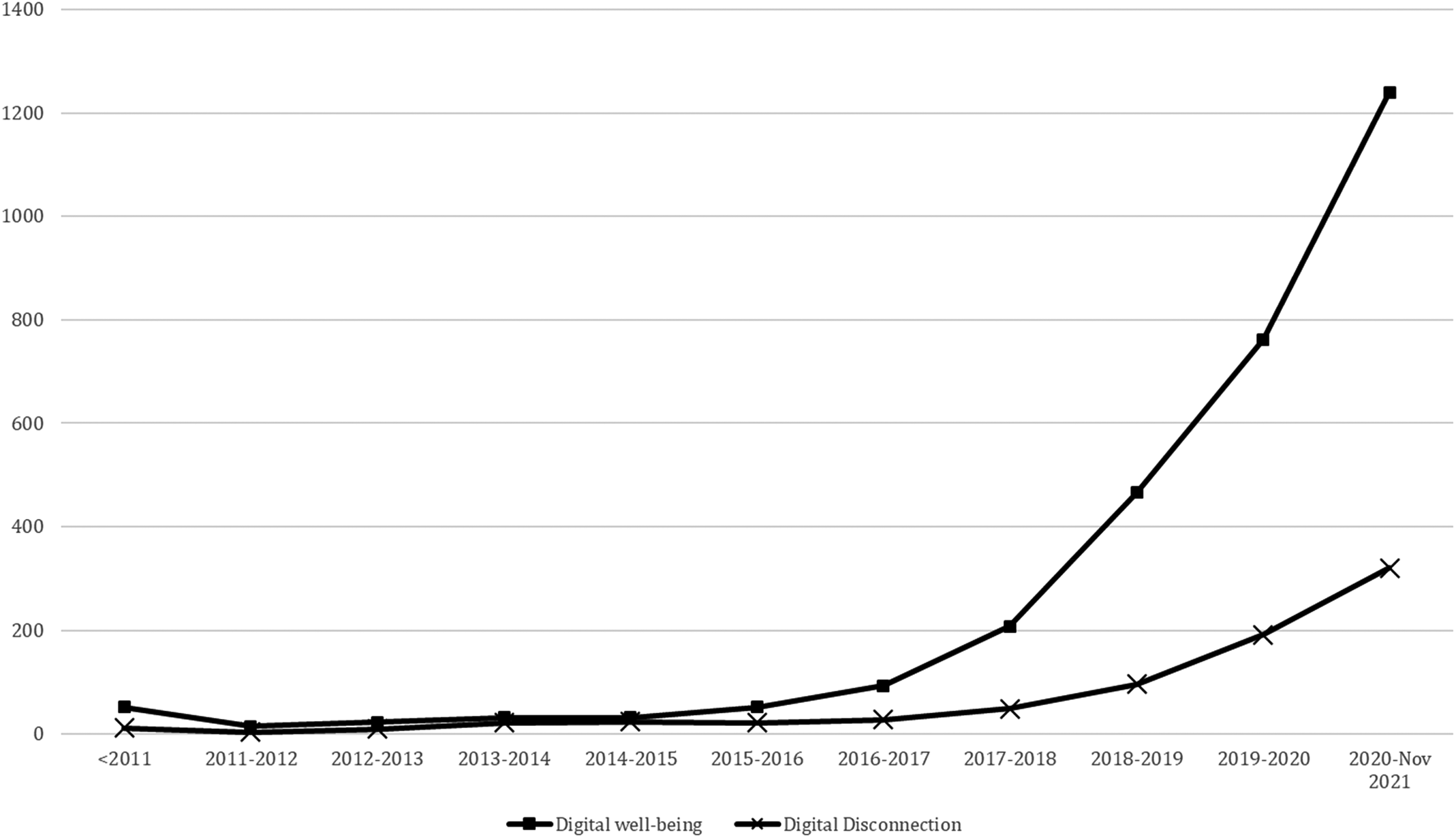
Annual growth in the use of the terms digital well-being and digital disconnection in scholarly articles listed in the Google Scholar database (retrieved November 3, 2021)
In spite—or perhaps because—of its exponential growth, digital well-being remains a fuzzy concept of which definitions vary wildly. In terms of scope, for example, some scholars interpret digital well-being very broadly, encompassing a multitude of digital media effects on well-being. For Burr and Floridi (2020, p. 5), for instance, digital well-being refers “loosely to the project of studying the impact that digital technologies, such as social media, smartphones, and AI, have had on our well-being” (p. 5). Such definitions resonate with traditional media effects approaches, in which linear associations are sought between various aspects of digital media use and indicators of well-being (e.g., Dienlin and Johannes, 2020; Meier and Reinecke, 2020; Valkenburg, 2022). Partly in response to a growing realization that there are both theoretical and methodological limitations to such approaches, 1 more recently other definitions have been developed, attempting to be more precise and putting greater emphasis on the pervasiveness of digital media and mobile connectivity in everyday life. Büchi (2021, p. 4), for instance, describes digital well-being as concerning “individuals’ affect (e.g. positive emotions), domain satisfaction (e.g. one’s relationships or job), and overall life satisfaction in a social environment characterized by the constant abundance of digital media use options,” and Vanden Abeele (2021, p. 7) defines digital well-being as “a subjective individual experience of optimal balance between the benefits and drawbacks obtained from mobile connectivity.”
Definitions also range in the extent to which they bring normative and moral-evaluative elements to the table. Some scholars, for instance, describe digital well-being as an individual’s competency to “align use of digital technology with their personal long-term goals” (Lyngs, 2019), to be achieved via a “mature and appropriate handling of digital media” (Herden et al., 2021, p. 20), while others emphasize the role of technological, social, and institutional environments in producing digital well-being experiences (Vanden Abeele, 2021)—for instance, by linking digital well-being to “habitus” (Büchi, 2021). There appears consensus, however, that digital well-being requires “self-understanding of what it means to lead a life that is good for us in an increasingly digital society” (Burr & Floridi, 2020, p. 5; italics in original), which involves the balancing of its benefits and harms (Büchi, 2021; Jones et al., 2018; Vanden Abeele, 2021).
The above (non-exhaustive) overview of the definitional landscape highlights the ambiguity of the digital well-being concept. Despite its various definitions, however, one observation that stands out across the multitude of conceptualizations is that the concept of digital well-being frequently emerges to give expression to the challenges that people perceive in our ever-increasingly digital world in which mobile media use renders individuals ubiquitously connected. Matthes et al. (2021), for instance, situate digital well-being in the context of the “Permanently Online, Permanently Connected” lifestyle (Vorderer et al., 2017), Nguyen (2021) discusses digital well-being in relation to the challenges of living in an “always-on” society, and in their recent editorial for a Special Issue on agentic perspectives on mobile media (non-)use, Karsay and Vandenbosch (2021, p. 782) speak of “endless connectivity” as a key challenge of our modern times that may jeopardize digital well-being. Interestingly, these terms resonate with observations of early researchers in the mobile media and communication community. In 2002, for instance, Katz and Aakhus (2002) coined the term “perpetual contact,” and Licoppe (2004) describes contemporary individuals as living in a perpetual state of “connected presence,” with mobile media rendering them 24/7 “individually addressable” Ling (2008).
Taken together, the available conceptualizations of digital well-being highlight that the benefits of mobile connectivity, but also—and perhaps even more strongly—the burdens of mobile connectivity, are considered key features of contemporary “media life” (Deuze, 2011). Mobile media scholars are currently actively exploring these features, among others through the identification of novel concepts such as “messaging guilt” (Halfmann et al., 2021) and “availability stress” (Hall, Steele, et al., 2021). As we currently witness the emergence of digital well-being as a separate field of research (Karsay & Vandenbosch, 2021), it becomes essential to identify the unique role of mobile connectivity—and especially mobile communication, in shaping these experiences and thereby our understanding of what it means to be “digitally well.” This Special Issue on “Digital Well-Being in an Age of Mobile Connectivity” meets this aim.
The Special Issue presents five articles that differ widely in terms of their methodologies and disciplinary perspectives, and thus in terms of their ontological and epistemological approaches to digital well-being. We argue that the diversity of these perspectives sheds light on two core issues present in contemporary digital well-being scholarship, that warrant further attention if we are to better understand how mobile connectivity shapes individual life and society. These two issues, positioned at the intersection of media studies and media effects research, are: (a) the inescapable link between digital well-being and digital disconnection; and (b) the conceptual difference between digital well-being as a psychological condition and digital well-being as a cultural artefact.
Issue 1: are digital well-being and digital disconnection two sides of the same coin?
Public and scholarly discussions frequently address what users can do to safeguard or improve their digital well-being. The question of user agency over mobile connectivity (Karsay & Vandenbosch, 2021) plays a central role in these discussions, as there is general consensus that the addictive design of mobile technologies—referring to smartphones and mobile apps in particular—challenges user agency (Vanden Abeele, 2021). Recognizing that some users need help in managing their screen time, a new industry has emerged that aims to support users, among others by helping them place limits to their connectivity. In the commercial domain, for example, we see initiatives such as Google’s Digital Wellbeing, that invites to “fine-tune your tech habits to achieve your personal digital wellbeing goals” using various tips, tricks, and tools (wellbeing.google/). Similarly, but from a more activist stance, the Center for Humane Technology believes we need to “regain control” (humanetech.com/) and to that end describes tips and tricks that can “increase your well-being.” These tips and tricks often focus on managing one’s access and use of mobile devices, and frequently encompass making use of screen time apps and digital detoxing.
In the scholarly domain, we see the development of a research field parallel to that on digital well-being that focuses explicitly on such “digital disconnection,” which scholars in this field define as the act of placing (temporary) limits to one’s connectivity as a means to regain control, and thereby restoring one’s well-being (Syvertsen, 2020; Syvertsen & Enli, 2019). The field of research on digital disconnection is showing a similar exponential growth as that of digital well-being (see Figure 1).
In both media effects and media studies research, digital disconnection is both implicitly (e.g., Vanden Abeele, 2021) and explicitly (e.g., Fast, 2021; Nguyen, 2021) recognized as an act that might be conducive to digital well-being. 2 In media effects research, for instance, a growing number of studies explore the effects of limiting—mostly mobile—connectivity on well-being and its associated outcomes, often using synonymous or adjacent concepts to digital disconnection such as “smartphone abstinence” (Wilcockson et al., 2019), “social media abstinence” (Hall, Xing, et al., 2021), “digital detox” (Schmuck, 2020), and “smartphone disengagement” (Matthes et al., 2021). In media studies research, the notion that individuals disconnect to restore their well-being is, for instance, recognized in narratives on digital detoxing, that often emphasize a nostalgic desire to return to the “good life” that we had before the advent of mobile connectivity (e.g. Syvertsen and Enli, 2019).
Research on digital well-being and digital disconnection shows substantial conceptual overlap, which calls for a deeper theoretical integration. Given the centrality of mobile connectivity in both strands of scholarship, the “mobile perspective” embraced by two articles in this Special Issue contribute to such integration. The first article, by Radtke et al. (2022), presents a systematic literature review of randomized controlled trial experiments exploring the effects of one particular form of digital disconnection, namely “digital detoxing,” on well-being and associated outcomes. In their selection of studies, Radtke et al. (2022) limit themselves to studies in which the use of mobile social media is constrained. This is an interesting methodological choice, which the authors justify by referring to the often-assumed negative impacts on well-being attributed to mobile connectivity. Surprisingly, the 12 studies reviewed generally showed either no effects or mixed effects regarding their “digital detox efficacy” on a wide variety of outcomes including subjective well-being, cognitive performance, and health. However, detoxing did come true on its promise to lower screen time, and showed consistency in lowering self-reported depressive symptoms across three studies. The authors conclude that the current evidence is inconclusive, and call for further empirical examination that sheds light on the “mechanisms” via which this particular form of digital disconnection might effectuate change. The second article, by Rosenberg and Vogelman-Natan (2022), shows that inspiration for such mechanisms might be found in interpretative digital disconnection research.
Rosenberg and Vogelman-Natan (2022) draw from 25 interviews with mobile phone “refusers,” a term used to denote long-term voluntary non-use of mobile phones (rather than non-use as a result of external constraints such as lacking financial resources). In their analysis, they find two subgroups. Idealists reject mobile connectivity on ideological grounds: Their digital disconnection is political in that it represents a form of resistance against the perceived “social evil” that smartphones bring to society. Realists, on the other hand, choose non-use because they experience improved well-being from their digital disconnection—an experience that many realists stumbled upon accidentally, after being forced into a temporary break from their mobile device because it was broken or stolen. Rosenberg and Vogelman-Natan’s (2022) analysis helps to understand the complexity of the unique motivations behind digital disconnection in an era of mobile connectivity—thereby offering some answers to why digital detox studies show such mixed findings. First, it highlights that individuals often voluntarily choose to disconnect rather than being externally “forced” or asked to do so (as was the case in the randomized controlled trials of digital detoxing as examined by Radtke et al. [2022]). Second, it illustrates that digital well-being is not only a practice that occurs out of concerns over individual well-being, but that can also be ideologically motivated, as refusers express deep concern over the collective digital well-being of society.
In sum, although the studies of Radtke et al. (2022) and Rosenberg and Vogelman-Natan (2022) adopt different empirical approaches, they both highlight smartphones as central to users’ quest for digital well-being. They both implicitly and explicitly recognize that smartphones are deeply ingrained in everyday life, making disconnection from these devices a complex endeavor of which the effects on well-being appear not straightforward nor generalizable. Moreover, mobile media disconnection has meaning beyond the realm of the personal, as it can also be an act that carries social and political meaning, namely as an act of resistance against the ubiquity of mobile media that calls for a critical consideration of its risks for the digital well-being of society at large.
Issue 2: should digital well-being be considered a psychological condition or cultural artefact?
One reason why Radtke et al. (2022) did not find a consistent, generalizable effect of a mobile social media detox on well-being could be that the impact of mobile social media use on well-being is trivial and therefore negligible to begin with. After all, if there is no meaningful negative association for digital disconnection to have any impact on, it is logical that such disconnection produces only marginal effects (Hall, Xing, et al., 2021). But how can we accept this explanation, without delegitimizing the experiences of Rosenberg and Vogelman-Natan’s (2022) participants, as well as participants in various other disconnection studies (e.g., Nguyen, 2021; Ytre-Arne et al., 2020), who describe being endlessly connected as burdensome, and finding relief in varying practices of disconnection?
A relevant question that can shed light on this seeming contradiction is to what extent we should consider digital well-being as a psychological condition, or rather as a cultural artifact. The former perspective approaches the perceived negative consequences of mobile connectivity from a clinical-psychological perspective, while the latter perspective understands such perceived “digital harms” as socio-culturally constructed phenomena (Sutton, 2020). If we conceive of digital harms as socio-culturally constructed phenomena, we might accept that they exist in the perceptions and experiences of individuals despite there being a lack of a meaningful and generalizable causal effect of digital media use on established indicators of well-being such as life satisfaction or psychosocial functioning. This may be a relevant observation to make in the context of mobile connectivity, which, through its pervasive nature, has become so ingrained in everyday life that almost all facets of life have been re-structured around it (Ling, 2008). This “deep mediatization” of life is occurring at an unprecedented pace (Hepp, 2019). In merely two decades, mobile media, and mainly smartphones, have become personal devices that accompany us throughout our lives 24/7, to the extent that they can even be considered indispensable extensions of the bodily self (Park & Kaye, 2019; Ross & Bayer, 2021). As we likely still find ourselves in the midst of the domestication of mobile connectivity, people’s perceptions and understandings of the harms that these technologies may bring to both individual and societal well-being may at least partly reflect our human fears about and struggles with this new reality.
Understanding the potential harms of mobile connectivity as such social constructions resonates with the third article in this Special Issue, by Valasek (2022), who presents a critical, socio-cultural analysis of digital (un)wellness. This analysis illustrates how contemporary conceptions of what is normal—and therefore desirable—in terms of our relationship with digital technologies such as smartphones is heavily influenced by behaviorist thinking. According to such thinking, users are inherently flawed by their own “primitive brain” which sets them up for failure in the control of their screen time. Digital well-being interventions such as digital detox apps, then, are legitimized as they become necessary tools that make up or compensate for our human deficiencies. However, Valasek (2022) argues, such a behaviorist, medicalized perspective on digital well-being can obscure its political dimensions, among others by obfuscating differences between (supposedly) “innate” deficiencies to control one’s media use and persisting social and economic inequalities that explain losses of control, thereby reproducing the latter. As such, the author invites scholars to think beyond the mere idea of self-regulation as a solution to digital unwellness, and to consider the everyday structural purposes of technology that may act as social stratifiers and shape experiences of digital well-being. Such a socio-constructivist perspective on digital well-being legitimizes the (un)wellness that individuals may experience, irrespective of whether there is clinical evidence of any harm to their psychology.
Yet, mobile media effects researchers are also increasingly attuned to the situational and social dimensions of digital well-being. This shows in the development of innovative theoretical models that shy away from technologically determinist thinking by accounting for the situatedness and contextualization of individual media experiences with mobile media and communication. An example of such theoretical innovation is the fourth contribution to this Special Issue, by Schneider et al. (2022). In their article, they introduce the Integrative Model of Mobile Media Use and Need Experiences (IM3UNE) that lays out a theoretical framework to explain how and when mobile media can be detrimental or beneficial for well-being. The framework is innovative in that it offers a salutogenic—rather than a pathogenic—perspective to mobile media effects, focusing on how people can thrive while integrating mobile media and ubiquitous connectivity in their everyday lives. First, the authors propose that the demands of mobile connectivity—for instance, constant availability—can satisfy or frustrate basic psychological needs (i.e., one’s autonomy, competence, relatedness), which are ultimately important for one’s well-being. Second, how people appraise and cope with such mobile media demands depends on their sense of coherence (i.e., mindfulness, self-control, and meaningfulness), an individual characteristic that acts as a personal resource to deal with mobile connectivity. By extrapolating the pathways that link mobile media use to well-being, and highlighting how predisposed individual characteristics may shape these pathways, the framework guides future research in examining the nuances of the effects of mobile media use on well-being.
The final contribution to this Special Issue, by Meier (2022), is a great example of empirical work that puts such a nuanced perspective to practice. The author moves away from the often critiqued “technology addiction” and “screen time” approaches that have dominated in prior research on mobile media use and well-being. Instead of conflating mobile usage with problems (i.e., technology addiction) or ignoring people’s psychological engagement with technology (i.e., screen time), Meier (2022) investigates how person- and day-level aspects of habitual mobile checking contribute to procrastination—a key problem outcome of mobile usage—and how this procrastination might in turn decrease well-being. The large-scale diary study among 532 student smartphone users, who together filled out 2,331 diaries, showed that mobile checking habits predicted how much students procrastinated over the course of five days. While habitual mobile checking showed only very small or no direct associations with well-being, procrastination was linked to decreased positive affect and meaningfulness. By separating habitual mobile usage from problem outcomes and well-being, this study contributes towards a more rigorous, unbiased, and theoretically grounded study of digital well-being.
As shown by the studies in this Special Issue, both perspectives—seeing digital harms as a socially constructed phenomenon or as an actual effect on mental health outcomes—can co-exist. Digital harms are socio-cultural phenomena, in that they exist in the minds of mobile media users and are therefore perceived and experienced as “real”, thereby potentially obscuring external forces that (re-)produce inequalities. At the same time, theoretical and methodological developments in media effects research are paving the way towards a more nuanced understanding of when and how mobile media use may be actually beneficial or detrimental to subjective well-being outcomes, thus strengthening clinical evidence in this domain. These developments are not only timely, but also necessary in order to construct meaning to the concept of “digital wellbeing” in an age where mobile technology takes on a central, indispensable role in all facets of everyday life and society, making it difficult for one to completely disconnect.
Digital well-being: a future research agenda
In context of the increasing pervasiveness of mobile technology and its endless connectivity, and given the increasing digitalization of almost all domains of people’s everyday lives and larger society, digital well-being is likely to become ever more relevant as a research topic. Based on our observations of the current research field, and in light of the contributions of the current Special Issue, we outline several directions for future research.
As with most media and communication scholarship, digital well-being research is so far predominantly based in western, more economically affluent, information societies. In the systematic review by Radtke et al. (2022) on digital detoxing, for instance, only 2 out of 21 studies, namely from South-Korea and the United Arab Emirates, were conducted outside Europe, the United States, Australia, and New Zealand. Recent research suggests, however, that experiences of digital well-being and disconnection are vastly different in socio-cultural and socio-technical contexts where people have less stable access to digital media and the Internet (Treré, 2021), and thus more research from alternative contexts is warranted.
Moreover, looking forward, research may also address how persistent social and digital inequalities may shape people’s experiences of digital well-being. First, what does it mean to be digitally “well”? It is likely that digital well-being has different connotations for different people of various backgrounds. As Valasek (2022) notes, we should be mindful of how digital well-being is constructed for those who are at a structural social and economic disadvantage. Second, how can people then attain digital well-being? While current literature often thinks of self-regulated disconnection as a remedy to the consequences of excessive and uncontrolled mobile media use, for socioeconomically and digitally disadvantaged populations other interventions may be more important for attaining digital well-being (Karsay & Vandenbosch, 2021; Valasek, 2022). Relatedly, motivated by digital inequality scholarship, research could focus on the digital skills that become ever more important to navigate and manage the increasingly complex digital information environment, and that can help prevent perceptions of overuse and overload (Gui et al., 2017; Hargittai & Micheli, 2019; Nguyen, 2021), thereby fostering digital well-being.
Acknowledging that perceived benefits and drawbacks of perpetual mobile connectivity are in part socially constructed, future research also needs to draw on methodological approaches that respect the socio-cultural and socio-technical construction of digital well-being. Such methods can include research of qualitative nature, such as interviews and ethnographies, but can also rely on more direct quantitative assessments of how people think and feel about their connectivity that highlight the individual, momentary/temporal, and contextual nature of digital media effects. In order to address such dynamics, researchers are increasingly urged to include research methods that allow for examining these nuances, such as quantitative and qualitative experience sampling methods.
Finally, we see opportunities for further convergence between media studies and media effects approaches to the study of digital well-being and disconnection in several themes that become increasingly salient throughout recent scholarship. One such theme is that of the (un)voluntariness of digital connectivity and (dis)connection, where future mobile media effects research might focus more strongly on what motivates individuals to seek or avoid disconnection from mobile media, and whether voluntariness moderates its effectiveness (as called for by Radtke et al., 2022). Interpretive and critical media studies perspectives, then, may focus on issues of inequality and power in relation to digital well-being and (the voluntariness of) disconnection, examining how their negotiation may challenge, but also perpetuate, the social order of society. Combined, these perspectives can hopefully shed light on whether involuntary disconnection is desirable, feasible, and, if so, under which conditions and with which caveats.
In future research on the voluntariness of digital disconnection, careful attention needs to be directed to whether one can truly disconnect from mobile connectivity in a society that increasingly builds its processes and structures (e.g., banking, vaccination passports) into a wide variety of mobile information systems. To fully participate in this society, one needs to be tethered to one’s personal devices at least to a certain degree. With mobile media accompanying individuals throughout every step of the day, it becomes ever more difficult for individuals to live without them (Park & Kaye, 2019). An interesting question that arises at the horizon is whether and how developments in the area of wearable and even implantable technology may impact how people understand and practice digital well-being and digital disconnection. As these technologies are expected to further amplify processes of self-extension (Ross & Bayer, 2021), it is thinkable that they both resolve and challenge certain benefits and drawbacks of mobile connectivity.
Another theme that we discern is that of mindfulness, and how to become more “present” in digital environments that continuously invite us to engage with mobile devices that render us into a state of “absent presence” (see Gergen, 2002). Here, the IM3UNE model from Schneider et al. (2022) foregrounds mindful media use as a potential key towards a healthier relationship with mobile connectivity, while the work of Meier (2022) explains why such mindful use can be challenged through processes of habituation that alter our self-control over smartphone use. The positioning of mindfulness as a potential antidote to the loss of control associated with mobile media use is increasingly recognized in digital well-being intervention studies, where mindfulness training appears promising to make the relationship with technology healthier (e.g., Regan et al., 2020). It also resonates with critical approaches to digital disconnection, although these approaches reveal that mindful use is not a miracle solution to problems of “overconnection,” such as Baym et al.’s (2020) study on mindful scrolling. Valasek’s (2022) analysis also reminds us to be attentive to moral-evaluative judgments here, which digital ethnographies reveal to be prevalent. For instance, Rosenberg and Vogelman-Natan’s (2022) research reveals a (nostalgic) desire for a more mindful way of living, that individuals perceive to be jeopardized by the attention economy and therefore inspires them to “resist” by giving up mobile connectivity altogether. Also, a future in which we embrace implantable technology might require us to radically alter our understanding of habitual and mindful use altogether.
To conclude, we wish to point to a final concept that is appearing on the horizon of digital well-being and digital disconnection research, and that is interwoven with that of mindfulness: sustainability. As society finds itself at a pivotal moment, dealing with major crises such as climate change and the COVID-19 pandemic, while battling ongoing systemic problems of inequality and polarization, the call to “redesign” our way of living is growing. Scholarship increasingly recognizes digital well-being and digital disconnection as potential routes towards a more sustainable life. In the literal sense, more mindful use of media technologies may help reduce energy and resources needed from our physical environment (Moe & Madsen, 2021), and make us more attentive to the conditions in which the raw materials to build our devices are mined. But developing a healthier relationship with mobile technology may also be conducive to a more sustainable society by helping us to “live a morally good life” in less straightforward ways. Odell (2020), for instance, sees a more mindful relation to mobile connectivity as an opportunity to re-center attention on our local environmental and social ecologies, thereby reframing our notion of “non-productive time” as time in which we devote care—to ourselves, to others, and to nature, rather than time in which we do not make money. These developments may illustrate a new phase in our collective effort to domesticate mobile connectivity in everyday life. But as Fast (2021) and Görland and Kannengießer (2021) note, we should be wary of internalizing acts of “slowing down” through digital disconnection and being more mindful to our mobile media use as necessary “acts of recovery” to enable greater productivity in the future, as mobile connectivity then simply serves as a scapegoat for other, more profound problems in the social organization of our society. To that end, it is essential to continue developing mobile perspectives on the phenomena of digital well-being and disconnection.
Footnotes
Acknowledgements
We would like to express our gratitude to the people who have made this Special Issue on “Digital Well-Being in an Age of Mobile Connectivity” possible. In particular, we would like to thank the Mobile Media & Communication editors, Steve Jones, Veronika Karnowski, Rich Ling, and Thilo von Pape for their continuous support throughout the process; the authors of this Special Issue for their great contributions to this collection; and all reviewers who devoted time to engage with their works. We also wish to thank the editors and Adrian Meier for feedback on an earlier version of this article. Mariek Vanden Abeele and Minh Hao Nguyen share first authorship.
Funding
The author(s) disclosed receipt of the following financial support for the research, authorship, and/or publication of this article: Mariek (Maria M. P.) Vanden Abeele is funded by the European Union’s Horizon 2020 research and innovation programme under the European Research Council (ERC) Starting Grant agreement “DISCONNECT” No. 950635. Minh Hao Nguyen is funded by the European Union’s Horizon 2020 research and innovation programme under the Marie Skłodowska-Curie grant agreement “Disconnect2Reconnect” No. 891281.

Notes
Author biographies
Mariek M. P. Vanden Abeele is an associate professor in digital culture at imec-mict, Ghent University (Belgium) and the Department of Cognition and Communication, Tilburg University, the Netherlands. She combines media psychological and media sociological perspectives to understand how mobile media use affects daily life and society. She currently works on multiple projects focusing on digital well-being and digital disconnection.
Minh Hao Nguyen is a Marie Slodowska-Curie fellow and senior research & teaching associate at the Department of Communication and Media Research of the University of Zurich. Her main line of research examines the content, uses, and consequences of digital media for health and well-being, and how digital competencies play a role in this. Under this larger umbrella of digital well-being research, she has a particular interest in digital disconnection.