



Abstract
Digital inequality scholarship has consistently found that people from varying societal positions experience digital media in their lives in divergent ways. Therefore, the growing body of research examining the relationship of social media use and well-being should account for the role of social inequality. This piece synthesizes key empirical research that has addressed the nexus of digital inequality, social media use, and well-being from one or more angles. Based on this extant scholarship, we develop a framework for research that integrates relevant perspectives from multiple disciplines.
Introduction
Digital inequality refers to how people’s societal position affects their digital access, skills, and types of uses, as well as the outcomes of digital engagement, ultimately feeding back into their life chances (Hargittai, 2021). As such, scholarship that interrogates the link between social media use and well-being must also account for the role of social stratification in this relationship. Longer-term longitudinal designs are needed in social media effects research to increase explanatory power and pertinence for policy interventions (see, for example, Orben, 2020).
It is important for communication research to draw on additional perspectives when examining the relationship of social media use and well-being to account for the myriad of processes that stem from people’s unequal societal positions, which may well influence this relationship. Economics and policy studies position various well-being measures as target outcomes of human activities (e.g., Helliwell, 2021); psychology provides individual-level motivations for and outcomes of social media use (e.g., Luo & Hancock, 2020); and sociology investigates the implications of structural inequalities on people’s practices and well-being (e.g., McDaniel, 2013). Purely disciplinary work has produced little to explain the full cycle of how people’s social media uses—shaped by their social position, personality, and technological affordances—lead to diverse short-term outcomes and impact their long-term quality of life (Büchi, 2021). Well-being economics has all but ignored digital media, media psychological studies tend to disregard the societal-level implications of individuals’ social media use, and in sociological research, social media’s affective outcomes are somewhat of a blind spot. The aim of this article is to synthesize key empirical research that has addressed the nexus of digital inequality, social media use, and well-being from one or more angles to then develop a framework for research that integrates all of these relevant perspectives from multiple disciplines.
We define digital inequality as the systematic differences between individuals of different socioeconomic backgrounds concerning their access to, skills in, uses of and outcomes derived from engagement with digital media. Subjective well-being is defined as individuals’ own evaluation and declaration of the quality of their lives (Keyes, 2014). Social media are internet-based communication applications where people can interact with others synchronously or asynchronously, where this interaction is often visible to others, and where much of the content is user-generated (Bayer et al., 2020; Carr & Hayes, 2015; Obar & Wildman, 2015; Papacharissi, 2015; Treem et al., 2016).
From the Digital Divide to Digital Inequality
The term digital divide was originally intended to signify “the divide between those with access to new technologies and those without” (National Telecommunications and Information Administration [NTIA], 1999), with a clear policy goal of closing this divide based on the assumption that “[i]nformation tools, such as the personal computer and the Internet, are increasingly critical to economic success and personal advancement” (NTIA, 1999). Over time, the term digital inequality has been used to encompass differences beyond access such as skills, uses, and outcomes (Büchi, 2017; DiMaggio & Hargittai, 2001; Hargittai, 2008; Robinson et al., 2015; van Dijk, 2013). Digital skills (Hargittai & Micheli, 2019), breadth of use (Leukel et al., 2021), and benefits such as connectedness (Zhou et al., 2021) or coping resources (van Ingen & Matzat, 2018) are consistently related to social background such that more privileged people tend to benefit more from their digital media use. There is much less work on harms as potential outcomes of digital media uses (e.g., Gangadharan, 2017; Gui & Büchi, 2021); what little exists has found mixed evidence of how these relate to socioeconomic status.
Digital inequality literature shows that socioeconomic status and power relations structure how social media are used (Schradie, 2020; Yates & Lockley, 2018), and accordingly also their immediate positive and negative outcomes. Thereby, this perspective offers critical context for the psychology of social media use. Following Bourdieu’s (1984) social theory, when someone is, for example, not motivated to use social media (preference), this individual’s “taste” is related to inequality: preferences are co-produced by structures and socialization (Guhin et al., 2021). Not wanting to use social media because it is not of interest to the person may also very much be a reflection of skills, that is, not knowing what it can be used for and thus not realizing that it could indeed be very relevant and of interest (Hargittai & Micheli, 2019). To be sure, people have agency and vary in their preferences and skills beyond their socioeconomic status, and we also cannot determine universally what “good” preferences are. Yet without a structural sensibility, the connection between social media use and subjective well-being is reduced to a question of individual choices, responsibilities, and deficits leaving important societal-level parts of the puzzle unaccounted for.
Well-Being and Outcomes of Differentiated Social Media Use
Well-being as a general term has been used to refer to objective measures—objective in the sense that they are “externally assessable”—comprising factors such as wealth or educational attainment (Helliwell, 2021; Ryff et al., 2021). From a sociological perspective, these are components of socioeconomic status and, accordingly, function more as predictors of both subjective well-being and social media use. The concept has also been used as an umbrella term for psychological variables such as depression or stress that may be affected by social media usage. However, when subjective well-being or happiness is the target outcome (Frijters et al., 2020), variables such as income and physical health, or emotions and moods are contributors to subjective well-being rather than a measure of quality of life themselves. We follow this stricter definition as described earlier.
To organize research on well-being-related outcomes of differentiated social media use, we further distinguish three theoretical dimensions of general subjective well-being (see Figure 1): emotional, psychological, and social. Empirical research on social media use effects has focused almost exclusively on specific short-term, proximal outcomes such as mood, which then—empirically largely unobserved—may contribute to longer-term, general subjective well-being.

Subjective well-being taxonomy based on Keyes (2002, 2014), Ryff (1989), Diener et al. (1999), and Lamers et al. (2011).
Based on an extensive literature search, Table 1 provides an overview of selected high-quality (e.g., in terms of sampling, measurement, or analysis) empirical studies published in the past 3 years. Further inclusion criteria were that the study measured a form of subjective well-being (e.g., life satisfaction) or a closely related measure (e.g., mood) and that this was connected to social media use or socio-digital inequality, or both. The main gaps are highlighted as no single study has traced the full cycle of how social status affects the way social media are used, which then produce proximal well-being-related outcomes that accumulate into longer-term general well-being, and ultimately feed back into individuals’ life chances (see Figure 2). In addition to the fact that we did not find a study that covers all five columns of Table 1, the studies have additional limitations or specificities. The employed longitudinal perspectives vary greatly: Brailovskaia and Margraf (2020) correlate repeated cross-sectional variables, Fioravanti et al. (2021) administered a questionnaire once per day for a month, Beyens et al. (2020) had six daily measures for 1 week, and Orben et al. (2019) used an existing 8-year panel data set. Regarding outcomes, some studies feature both proximal and distal well-being measures, but do not model them as sequential (e.g., Schemer et al., 2021). Furthermore, disciplinary/theoretical perspectives, participant samples, and measures of social media use also vary greatly between studies. Given this vast heterogeneity, it is no surprise that reviews (Course-Choi & Hammond, 2021) and reviews of reviews (Valkenburg et al., 2022) generally find inconsistent effects.
Overview of Contributions and Gaps in Selected Studies of Inequality, Social Media Use, and Well-Being.
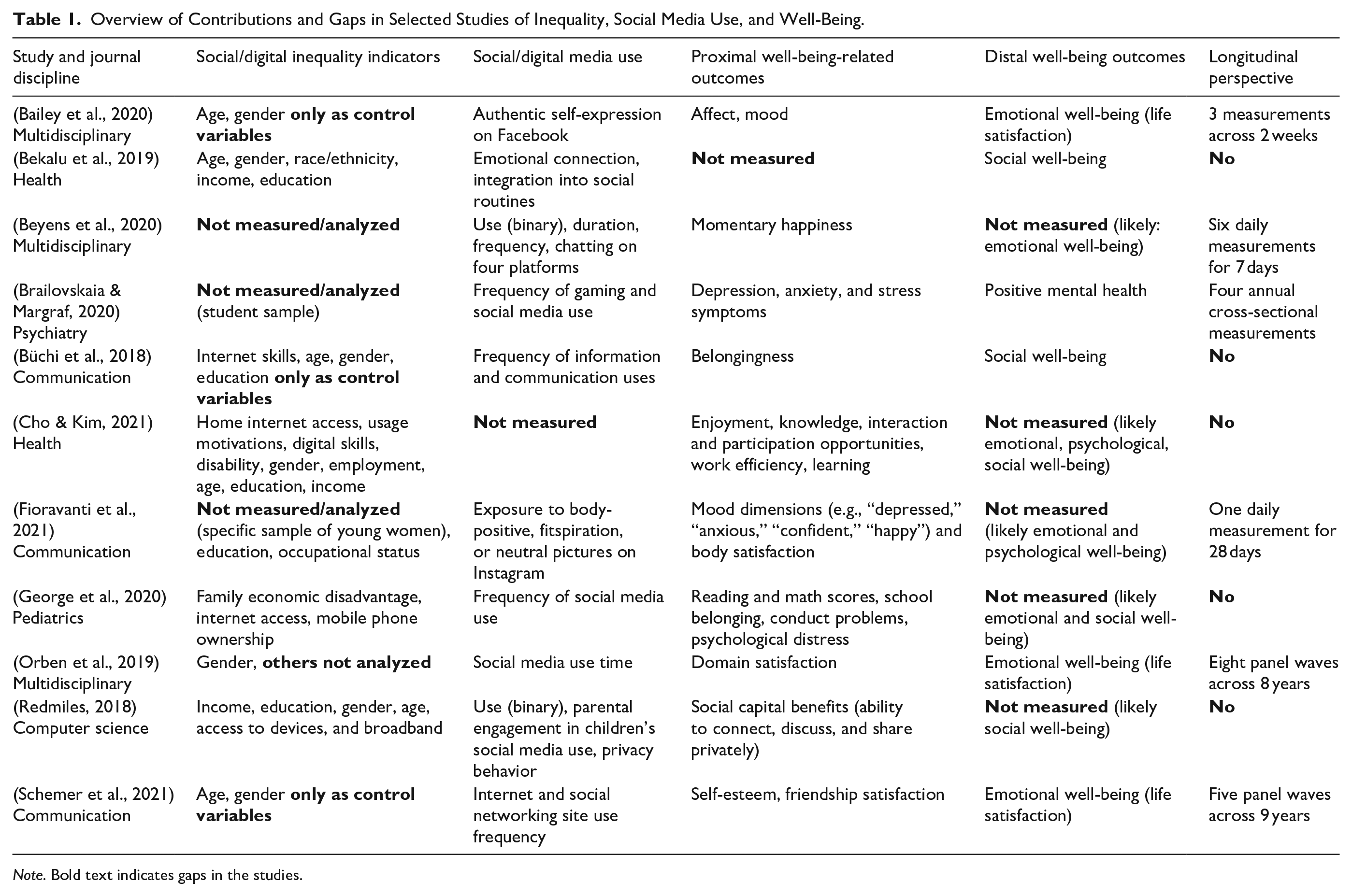
Note. Bold text indicates gaps in the studies.

Conceptual framework for considering digital inequality when studying social media use and well-being.
Longitudinal analyses and experience sampling methodology (ESM) in particular appear to have become more common which is a much-needed addition to cross-sectional studies (Schnauber-Stockmann & Karnowski, 2020). However, those longitudinal investigations that include a distal subjective well-being measure (and we only found studies measuring the emotional well-being dimension, for example, Orben et al., 2019; Schemer et al., 2021) have not addressed dimensions of socio-digital inequality to date. Conversely, studies explicitly concerned with digital inequality often lack the fine-grained mechanisms of how digital media use affects outcomes (e.g., Büchi et al., 2018; Cho & Kim, 2021). The two dominant theoretical influences behind digital media research, media psychology (see, for example, Reinecke & Oliver, 2017) and digital sociology (see, for example, Selwyn, 2019), in combination would have much to offer toward a better understanding of “digital well-being” in the context of pervasive social media use and inequality (Büchi, 2021). Accordingly, we have tried to bring these perspectives together by highlighting their unique contributions as well as their blind spots and devising an integrated framework below.
A Road Map for Elevating Research on Social Media Use and Well-Being
Media psychology has mostly equated only proximal outcomes such as momentary happiness (“how happy do you feel right now?”) with subjective well-being (e.g., Beyens et al., 2020; Reissmann et al., 2018). Many studies motivated by psychological theory find proximal outcomes of social media use and imply that these logically cumulate to impact one of the three theoretical well-being dimensions (emotional, psychological, social; see Figure 1). However, for this last step, empirical research is largely missing. Looking at the beginning of the causal chain from socioeconomic background to social media use to subjective well-being, the few digital inequality studies that assess subjective well-being as an outcome have failed to account for important intermediary steps, such as connectedness. Presumably, this is due to both a lack of theoretical advancement and unidisciplinary research foci as well as methodological challenges. The latter include measuring antecedents, social media uses, and outcomes over time, across platforms and devices, of diverse populations. Policy interventions geared toward mitigating social media’s harmful outcomes and promoting its beneficial aspects require robust research findings that position social media use in the context of social structures. This calls for longer-term longitudinal research and outcome measures beyond emotional well-being, and collected from diverse samples.
The taxonomy in Figure 1 can help future research make explicit the type of well-being measured and its theoretical significance. As a step toward ameliorating the lack of “full cycle” empirical research, in Figure 2 we propose a conceptual framework that combines the digital inequality and digital well-being perspectives. Subjective well-being functions as the target outcome in this framework which is broadly compatible with economics (Frey & Stutzer, 2002), psychology (Diener et al., 2018), sociology (Veenhoven, 2008), and communication (Vorderer, 2015) approaches. General subjective well-being and its emotional, psychological, and social dimensions are directly and bidirectionally linked with the objective conditions of people’s lives, that is, their socioeconomic status. The positions individuals occupy in the social structure are associated with differential resources—these can manifest, for example, in unequal access to digital devices, support, or various skills relevant for digital media use. These preconditions then influence the extent and types of social media uses associated with various positive and negative outcomes (internal/psychological as well as tangible consequences). Cumulatively and over time, these structured outcomes will impact a person’s overall subjective well-being, eventually feeding back into their socioeconomic status (e.g., through job performance) directly or intergenerationally. As a holistic view, Figure 2 should not be interpreted as a template for a single study but rather as a framework for a research program. It is our hope that when single studies are planned with such a framework in mind, they will be able to contribute to the big picture question of social media’s role in well-being better. Without the digital inequality framework applied to studies of how social media use and well-being relate, findings about the latter will mistakenly assume that they apply to all population segments equally, something that digital inequality scholarship suggests is unlikely to be the case.
Footnotes
Declaration of Conflicting Interests
The author(s) declared no potential conflicts of interest with respect to the research, authorship, and/or publication of this article.
Funding
The author(s) received no financial support for the research, authorship, and/or publication of this article.
