




Abstract
The purpose of this article is to estimate the impact of Internet access on poverty for a sample of people living in contrasting regions located across rural Mexico. Using a quasi-experimental technique, our results suggest that Internet access is an additional mechanism that contributes to decreasing poverty levels. Consequently, it could assist in increasing the proportion of people living out of poverty in rural areas; however, this is not uniform across regions (higher positive effects are estimated for less developed regions). These findings highlight the prevailing regional heterogeneity in Mexico’s rural sector and suggest that governments must design better-targeted public policies that address the uneven development in Internet diffusion typical of the rural sector. These policy improvements would allow governments to maximize the potential benefits of the Internet, as this technology alone is not sufficient to break the cycle of poverty in middle-income countries like Mexico.
Introduction
The Internet has brought many changes to our daily lives, ranging from online education to home office activities, especially with the current conditions of limited social contact related to the COVID-19 pandemic (Ting et al., 2020). Scholars have highlighted the advantages of this digital age for society, including access to markets (Atasoy, 2013; Mercer, 2006), public services like education and health (Grazzi and Vergara, 2014), and business opportunities (Mushtaq and Bruneau, 2019), as well as lower transaction costs (Galperin and Viecens, 2017) and better income opportunities (Whitacre et al., 2014). However, these benefits are not equally available in all regions and nations, and the digital gap has widened in some areas (Mansell, 2017; Sujarwoto and Tampubolon, 2016; Van Deursen and Van Dijk, 2019).
In Mexico, the digital gap between rural and urban areas is considerable (Mecinas, 2016). In the urban sector, the rate of Internet adoption was 71%, while in the rural sector, this was only 39% (Instituto Nacional de Estadística y Geografía (INEGI), 2017a). Because of unequal development in telecommunications infrastructure, Internet access is uneven throughout the nation (INEGI, 2017a). The most significant deficiencies in Information and Communications Technologies (ICTs) are in southern Mexico, which has been left behind due to geographical dispersion, low population density, challenging topography, and inadequate incentives to expand investment in ICTs (Deichmann et al., 2004; Negrete, 2018; Ovando and Olivera, 2018).
In addition to the digital divide that exists between Mexico’s rural and urban sectors, Internet service provision has also been unequal within the rural sector. This inequity could accentuate the social and economic inequalities that characterize rural economies and contribute to the decreased social mobility and wellbeing of rural dwellers (Martínez-Domínguez and Mora-Rivera, 2020). As a result, the effects of Internet access on various economic and social indicators are distinct for each region analyzed. Despite the evident relevance of regional analyses in rural areas with specific challenges due to location, there are only a few studies globally that evaluate the effects of Internet access in the rural sector at the regional level (Jung and López-Bazo, 2020; Park, 2017; Young, 2019), and specifically, we have not found any studies that have done this in Mexico.
Aimed at addressing this gap in the literature, the goal of this article is to estimate the potential impact of Internet access on various poverty indicators in Mexico’s rural sector, distinguishing between the effects associated with distinct regions throughout the nation. To meet our objective, we employ a propensity score matching (PSM) technique with data taken from the Module of Socioeconomic Conditions of the National Household Income and Expenditure Survey (Módulo de Condiciones Socioeconómicas de la Encuesta Nacional de Ingresos y Gastos de los Hogares [MCS-ENIGH]) for 2016 and 2018. The data in this survey provide information on the socioeconomic characteristics of Mexico’s inhabitants, their productive activities, and access to ICTs—particularly the Internet. This information also allows us to analyze poverty using a multidimensional approach.
Our research makes two fundamental contributions to the debate on the digital divide in rural areas. First, the study estimates the potential effect of Internet access on various poverty indicators, classifying the impacts by region. While the literature has analyzed the direct effects of the Internet on poverty (Kenny, 2002; Risner and Gadhavi, 2015), scholars in Mexico have considered only case studies (Chávez and Sánchez, 2013; Mariscal et al., 2016). As such, instead of attempting the impossible task of generalizing the results in case studies, our research employs statistically representative data on a sub-national level. This approach conserves the statistical representativeness of our findings and represents a first step in analyzing the Internet–poverty nexus on a regional scale in rural Mexico with sufficient statistical confidence.
Second, despite efforts made in recent decades to reduce poverty, it continues to be a global issue (Banerjee and Duflo, 2020) and is the first sustainable development goal (SDG) proposed by the United Nations (2020).The institution responsible for measuring poverty in Mexico indicated that in 2018, 42% of the total population was living in poverty, with this increasing to 55% in rural areas (Consejo Nacional de Evaluación de la Política de Desarrollo Social (CONEVAL), 2019a). These figures have motivated policy makers and academics to search for mechanisms to reduce these high poverty levels prevalent in developing countries (Banerjee and Duflo, 2011; Singh and Chudasama, 2020). Although some scholars have stated that ICTs, and in particular the Internet, could help reduce poverty (Galperin and Viecens, 2017; Mushtaq and Bruneau, 2019), empirical studies examining its impact on regions in rural areas are almost nonexistent. This article evaluates the potential impact of Internet access on several measures of poverty at the regional level in rural Mexico to contribute to the limited but expanding number of quantitative studies analyzing the Internet–poverty nexus. Furthermore, it presents empirical evidence to promote the design of public policies that favor Internet-based tools in supporting the acquisition of new media literacies by rural inhabitants with different regional characteristics. The goal of these policies should be to reduce inequalities in the distribution of Internet access, and consequently, economic and social inequalities. In this way, we can effectively foster the development of rural communities through the benefits that Internet access could have on the income and wellbeing of rural Mexico’s population in the hopes of reducing poverty.
Literature review
ICTs as a mechanism for poverty reduction
Although analyses of the impacts of ICTs on poverty are abundant, the link between the two variables is not clearly understood (Galperin and Viecens, 2017; Moodley, 2005). Some scholars have analyzed the nexus between ICTs and poverty from a qualitative and theoretical perspective (Aker and Blumenstock, 2015; Makoza and Chigona, 2012; Mariscal et al., 2016; Moodley, 2005). Aker and Blumenstock (2015) explore the trends in the adoption and use of ICTs in sub-Saharan Africa and describe a simple framework for understanding the primary channels through which mobile phones might influence economic development. The authors, however, point out that there are still considerable gaps in understanding the opportunities for development through mobile telephony, which policy makers should consider when proposing mobile phone-based development policies. Similarly, Makoza and Chigona (2012) and Moodley (2005) examine the impact of ICTs on development in southern Africa, yet the studies found contradictory results. While Makoza and Chigona confirm that the use of ICTs has a positive effect on the livelihoods of microenterprises, Moodley concludes that ICTs should not be viewed as an instrument that positively affects development on its own since additional variables to combat poverty must also be implemented.
On the other hand, some empirical studies have focused on examining this relationship from a quantitative approach (Aker and Mbiti, 2010; Chávez and Sánchez, 2013; Mushtaq and Bruneau, 2019; Tiwari, 2008). Some analyze metadata from various countries (Aker and Mbiti, 2010; Mushtaq and Bruneau, 2019; OECD, 2010; Rodríguez and Sanchéz-Riofrío, 2017; UNCTAD, 2019; World Bank, 2018), while other works have carried out case studies using microeconomic data to examine the ICT–poverty alleviation nexus (Aker et al., 2016; Chávez and Sánchez, 2013; Jensen, 2007; Tiwari, 2008). In the first case, using panel data from 61 countries, Mushtaq and Bruneau (2019) determined that ICTs accelerate economic growth while reducing poverty and inequality. Rodríguez and Sanchéz-Riofrío (2017) obtained similar results for Latin American countries, discovering that technological change paired with education can influence poverty reduction thanks to an ICT-related increase in productivity. These findings are supported by Kelly and Rossotto (2012) and ECLAC (2020), which agree that designing public policies aimed at universalizing access to digital technologies could play an essential role in boosting development. ECLAC also highlights that said universalization can help individuals mitigate the impacts of the COVID-19 pandemic, especially for households that do not yet have access to ICTs. In addition, international organizations like the United Nations Conference on Trade and Development (UNCTAD) and the World Bank have pointed out that the digital economy has become essential in promoting development, particularly for low- and middle-income countries (UNCTAD, 2019; World Bank, 2018). In sub-Saharan Africa, Aker and Mbiti (2010) explore how access to and the use of mobile telephony can affect economic outcomes and assess current evidence of its potential to improve economic development.
In terms of research based on a case study, Aker et al. (2016) use microdata from four primary data sets to implement a randomized experiment exploring the impacts of using mobile money in a cash transfer program in Niger. The authors find that electronic money transfers reduce delivery costs in comparison with manual cash distribution and can even positively impact household consumption patterns; however, to take advantage of the benefits of electronic transfers, the necessary infrastructure must first be developed. In India, Tiwari (2008) and Jensen (2007) analyze the nexus between ICTs and poverty alleviation; the first study focuses on exploring whether ICTs enable the improvement of rural human capital and expand involvement in market opportunities, while the second examines whether the use of ICTs could improve market performance. The main finding is that the adoption of mobile phones corrects market failures and therefore increases both consumer and producer welfare.
However, not all scholars are optimistic about the effects of ICTs on poverty (Arunachalam, 2004; Kenny, 2003). Arunachalam (2004), for example, considers ICTs to be a necessary but insufficient condition for development and suggests focusing on poverty alleviation rather than on bridging the digital divide. It should also be mentioned that some studies have emphasized the need to make an exhaustive review of the predominant perspective analyzing the possible benefits attributed to ICTs (Mansell, 2002, 2010, 2017; Scheerder et al., 2019). The studies by Mansell (2010 and 2017) highlight the need for an ethical examination of the economic and social consequences of the penetration of technologies and digital services since the predominant opinion simply indicates that society must adapt to the current path of technological change. Mansell, however, emphasizes the usefulness of global dialogue about what individuals value when digital technologies mediate their life. In addition, Scheerder et al. (2019) mention that the predominantly quantitative focus of research on the digital gap offers little explanation of the existence of digital inequalities; therefore, if the purpose is to understand how the use of technology reinforces social inequalities, it is fundamental to incorporate considerations of both social and economic context into the analysis.
In Mexico’s case, recent research has stressed that the digital divide is both a technological and social problem that requires attention (Arellano, 2020; Martínez-Domínguez, 2020). However, only a few studies have analyzed the relationship between ICTs and poverty from different perspectives (Chávez and Sánchez, 2013; Mariscal et al., 2016). Mariscal et al. (2016) use a combination of the capabilities approach and livelihoods perspective to analyze the mechanisms through which ICTs may have an impact on poverty alleviation. The authors show that mobile broadband access and practical training enable low-income communities to develop new skills, engage in new practices, and find useful applications for old and new abilities, needs, and interests. Using a microeconomic approach, Chávez and Sánchez (2013) define digital poverty lines and estimate a probit model of their determinants. The authors find that extreme digital poverty correlates negatively with the possession of household assets. Regarding educational variables, the results point out that schooling is negatively associated with extreme digital poverty. Finally, involvement in public government programs tackling poverty shows a positive effect in reducing digital poverty.
Internet as an additional tool for poverty reduction
Several studies have focused on examining the Internet–poverty nexus using quantitative methods; some have employed a macroeconomic perspective, while others focus on a microeconomic approach. Based on the hypothesis that long-term poverty reduction is driven mainly by economic growth (Barro, 2000; Kraay, 2006), some of the scholars who have used macro data have explored whether the Internet has a positive growth effect by examining the nexus between Internet investments and aggregate economic activity (Czernich et al., 2011; Kenny, 2002; Koutroumpis, 2009; Mayo and Wallsten, 2011). Using panel data from 22 Organization for Economic Co-operation and Development (OECD) countries and a joint estimation of a macroeconomic function and a simultaneous equations model to consider the endogeneity of telecommunications investment, Koutroumpis (2009) shows that a higher broadband penetration rate increases economic growth. Along the same vein, Czernich et al. (2011) find that broadband penetration has a positive impact on annual gross domestic product (GDP) per capita in a sample of 25 OECD countries.
Although these findings showing a positive effect of the Internet on growth were widely accepted initially, development literature suggests that economic growth alone cannot alleviate poverty, especially when high inequality remains (Krishna et al., 2007; Wade, 2004). Based on this, Akerman et al. (2015) and Atasoy (2013) employed a microeconomic perspective to analyze the link between broadband and development. Using panel data and a quasi-experimental approach, the former examines the impact of broadband coverage on labor income and productivity in Norway. Their findings reveal that although broadband availability increases the marginal productivity of skilled labor, it worsens the productivity of unskilled workers. Atasoy (2013) also finds a connection between the expansion of broadband Internet access and growth in the employment rate of the United States.
Other studies have also employed microdata to examine the nexus between Internet and poverty reduction, but as a direct relationship (Mercer, 2006; Risner and Gadhavi, 2015; Sayer, 2018; Sujarwoto and Tampubolon, 2016). Sayer (2018) uses Colombia’s 2015 free Internet provision program as a source of exogenous variation in potential Internet access to find evidence of a causal relationship between Internet access and poor individuals’ consumption patterns. His research reveals that Internet access increases the consumption of certain luxury goods and services due to social media’s catalytic effect. In another study, Risner and Gadhavi (2015) monitor change in an extreme poverty reduction program in Bangladesh through a system combining smartphones and Internet connectivity. Their work shows that real-time, comprehensive monitoring tools can improve the effectiveness of programs focused on reducing poverty. Conversely, Sujarwoto and Tampubolon (2016) analyze the relationship between spatial inequality and the Internet divide in Indonesia and conclude that the Internet deepens spatial inequality and spatial inequality increases the Internet divide.
Recently, in Latin America, scholars have been interested in looking at the relationship between broadband access and development in general, and poverty alleviation in particular (Galperin and Mariscal, 2016). The authors present five case studies for Latin America of particular relevance. These include the study carried out in Mexico examining how the adoption of the Internet in marginalized communities contributes to improving their development. In two additional studies for the Mexican case, Mecinas (2016) explores how recent constitutional and legal reforms have contributed to bridging the digital divide; while Negrete (2018) looked at how the Internet affects agricultural productivity and rural poverty, finding that the Internet has almost no impact on agriculture and that its effects on productivity and rural poverty are minimal.
Research methodology
Data
The data used in this research were taken from the MCS-ENIGH for 2016 and 2018. The primary objective of the survey is to obtain detailed information about the amount, structure, and distribution of household income; access to healthcare, social security, and education of household members; food security in households; and the characteristics of household services, including Internet access (INEGI, 2017b, 2019). In both waves of the survey, Internet access refers to households with fixed Internet (cable/ADSL service) or mobile Internet (3G/4G long-term evolution [LTE]); that is, households who answered “yes” to the question “Does this household have Internet?” Therefore, in this research, Internet access is considered a dichotomous variable at the household level.
The design and sample selection allow us to obtain representative results at a national and subnational level. The sample size for 2016 was 244,911 individuals, with 91,588 (37.4%) living in the rural sector; while for 2018, the sample size was 256,676 individuals, with 100,986 (39.3%) in the rural sector. Out of the total population of rural areas in 2016, individuals with Internet access totaled 9.1%, a figure which increased to 14% by 2018.
Dimensions of poverty
This research employs the concept of poverty from a multidimensional perspective (Alkire and Foster, 2011). In Mexico, the National Council for the Evaluation of Social Development Policy (CONEVAL) defines two main approaches to analyze multidimensional poverty: the wellbeing and the social rights approach. The first approach categorizes the approximations of unsatisfied basic needs, assets, and capabilities, and the second is associated with the existence of fundamental, inalienable, unique, and interdependent human rights (CONEVAL, 2019b).
Based on these two focuses, and considering the available information from MCS-ENIGH in 2016 and 2018, we calculate the seven dimensions used by CONEVAL to measure poverty: six dimensions that describe social rights (quality and spaces of housing, access to basic housing services, access to food, educational backwardness, access to health services, and access to social security) and one dimension that refers to wellbeing (total current income per capita). 1
Dependent and independent variables
Once the dimensions are defined, the following step is to create a measurement that allows us to identify individuals living in multidimensional poverty. The first step in the process is to generate dummy variables to identify the vulnerable population in each of the six dimensions of human rights and aggregate them in a deprivation index. 2 The second step is to determine whether a person is poor or not in terms of wellbeing, considering the income poverty line. 3 By aggregating the deprivation index and the poverty line, we can accurately identify the population that faces a situation of multidimensional poverty. Using the extreme income poverty line 4 and the threshold of extreme deprivation (three or more deprivations), we identified the population living in extreme multidimensional poverty (CONEVAL, 2019b).
The independent variables were grouped into two major blocks: demographic and socio-economic characteristics. It is worth noting that scholars studying Internet access determinants have previously considered the independent variables included in our probit models (Grazzi and Vergara, 2014; Mariscal et al., 2016; Martínez-Domínguez and Mora-Rivera, 2020; Van Deursen and Van Dijk, 2011). The demographic characteristics taken into account are gender, age, household size, underage children, elderly adults, and indigenous language. The variables that describe the socio-economic features are student, paid worker, self-employed worker, primary education, secondary education, high school education, technical education or more, number of rooms, number of vehicles, and remittances. Appendix A in the Supplementary material presents the definitions and metrics for dependent and independent variables used in the probit models and for outcome variables (poverty indicators) used in the PSM.
Identification strategy: PSM approach
Matching techniques are used frequently in estimating the effects of an intervention (treatment) on one or more variables of interest (Galperin and Arcidiacono, 2019; Hah, 2020). These techniques were developed specifically to estimate causality in cross-sectional survey data (Abadie and Imbens, 2016; Rosenbaum and Rubin, 1983). The current study assumed that Internet access is akin to receiving treatment, which allows us to measure the impact of this treatment on our four outcome variables, represented by poverty indicators typical of the Mexican population. To obtain unbiased estimations, we ensured that no statistically significant differences exist between individuals who have Internet access and those who do not (Imbens, 2000). A sample of people without Internet access identical to the population with Internet access was created to control potential bias (a counterfactual). In this manner, having Internet access or not can be considered a random event (Cameron and Trivedi, 2010), and the difference in poverty levels between beneficiaries and non-beneficiaries can be attributed entirely to the treatment.
In practice, one of the main challenges when using matching is to solve the dimensionality problem that appears when a very large number of characteristics must be balanced. To deal with this problem, we used what is known as the propensity score, defined as a function that estimates the probability of receiving treatment given a vector of characteristics (Rosenbaum and Rubin, 1983); in other words, the vector is summarized in a single number. This number can be estimated using a probit or logit model, which can predict the probability that one person will have Internet access based solely on his own characteristics. As shown by Rosenbaum and Rubin (1983), the computed propensity score is exogenous; that is, potential outcomes are independent from the treatment conditional on it. In this manner, the estimator of PSM is guaranteed to have effectively captured the effect of Internet access on poverty levels.
There are several matching algorithms to identify non-treated individuals with a propensity score close to that of those treated (Abadie and Imbens, 2016; Becker and Ichino, 2002). In this study, we estimate the results for four of them: nearest neighbor, kernel, radius, and linear regression matching.
Data analysis and findings
Descriptive statistics from a regional perspective
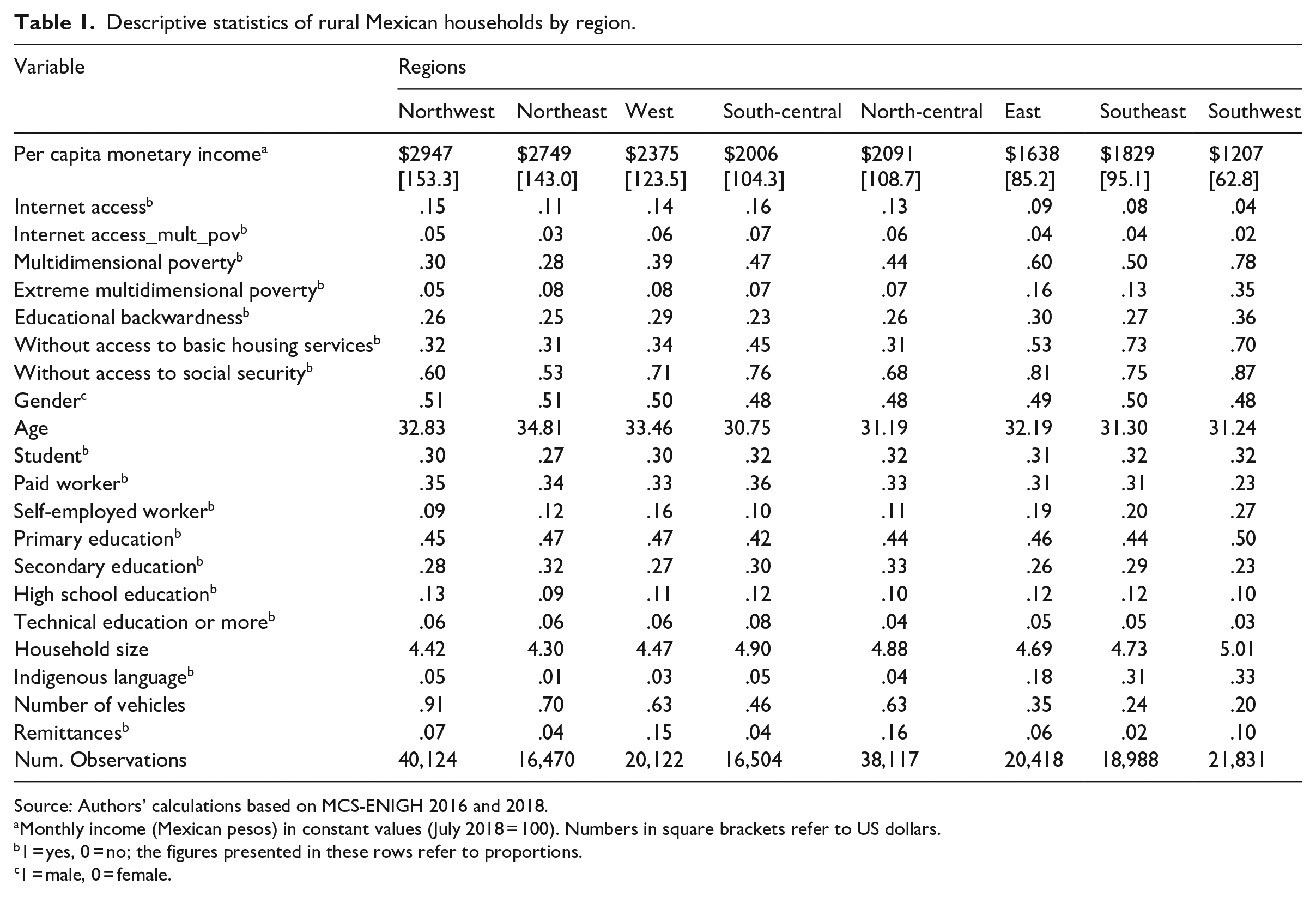
The statistics presented in Table 1 reflect interesting differences and similarities among the eight regions of rural Mexico (see Figure 1). 5 Based on these figures, we can suggest that Mexico’s regional development in recent decades is crucial to understanding the nation’s current situation, in both social and economic terms. Observing patterns in regional growth and development reveals the unequal territorial evolution in a nation and allows us to define lines of political action aimed at improving living conditions for the population (Amarante and Colacce, 2018; Gasca, 2009).
Descriptive statistics of rural Mexican households by region.
Source: Authors’ calculations based on MCS-ENIGH 2016 and 2018.
Monthly income (Mexican pesos) in constant values (July 2018 = 100). Numbers in square brackets refer to US dollars.
1 = yes, 0 = no; the figures presented in these rows refer to proportions.
1 = male, 0 = female.
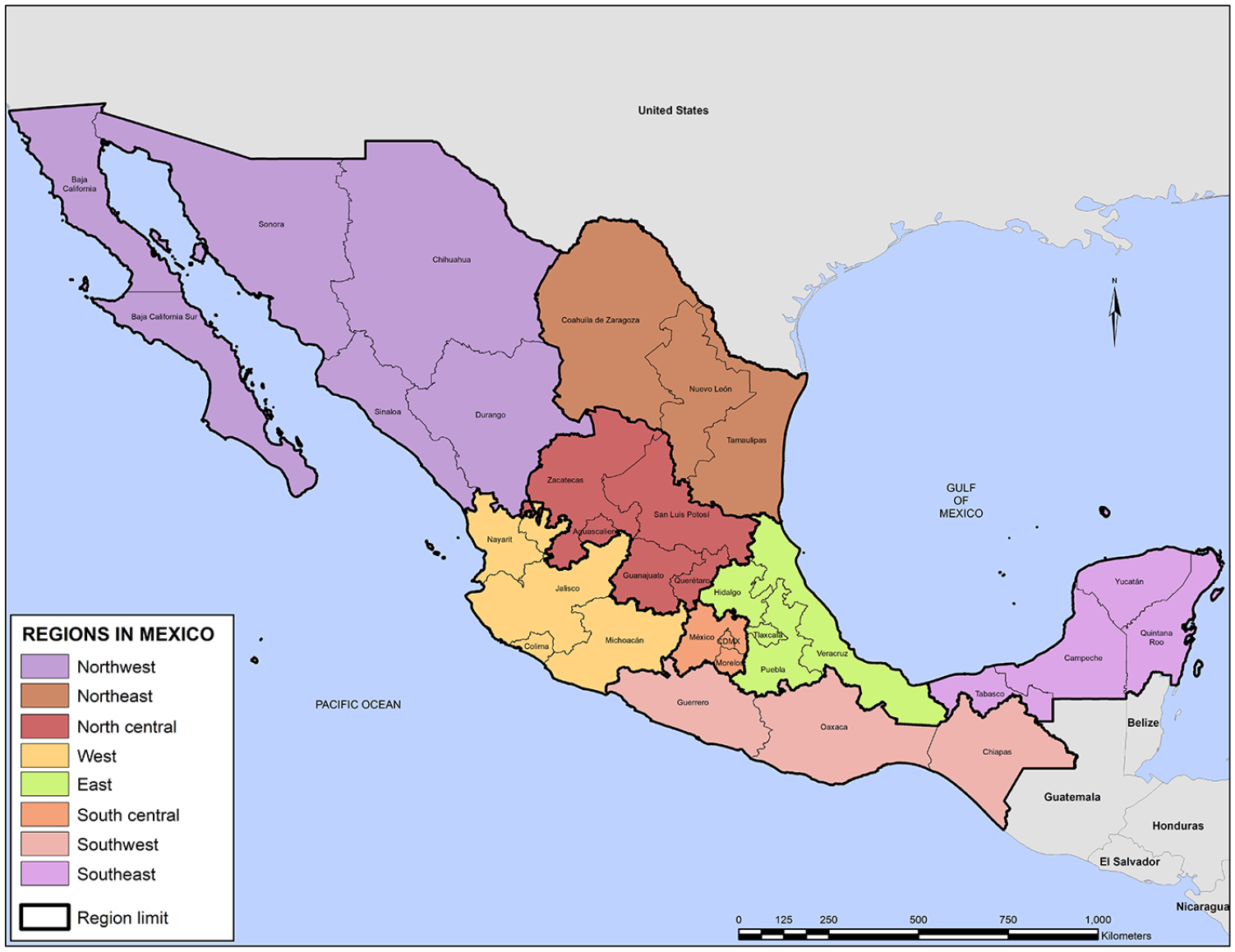
Regions in Mexico considered in this research.
Unequal development within Mexico has confirmed the clear existence of differing realities among the nation’s inhabitants. The benefits attributed to economic growth and globalization have been distributed unequally throughout the country. For example, the regions with more physical infrastructure, human and institutional capital, and communication with international markets, have performed better in almost all economic and social indicators. On the other hand, regions lacking these advantages have shown considerable backwardness (Gasca, 2009; Mendoza-Velázquez et al., 2020). The first group of regions includes the north and west regions of Mexico (the northeast, northwest, and west), which have much lower levels of poverty and extreme poverty than the other regions, especially compared with the east and southeast regions (Rey and Sastré-Gutiérrez, 2010).
The figures in Table 1 indicate that the east and south regions (the southeast and southwest) show higher levels of economic and social backwardness. Their average income levels, indicators of housing infrastructure, and access to telecommunications and labor markets are much lower than in the central, west, and north regions of Mexico. In particular, the southwest region, comprising the states of Chiapas, Guerrero, and Oaxaca (see Figure 1), is the region with the greatest levels of vulnerability and shortages of basic services, including Internet access. Data for this region indicate that only 4% of its population has Internet access, 36% has educational lags, and the average income is 50% less than the income of the north areas of Mexico (see Table 1).
The average values in Table 1 illustrate the contrasts in some of the variables of interest among areas considered for this research. The average per capita monetary income is higher in the north and central-west regions of the country. In contrast, the south and east regions have the lowest per capita monetary income, a fact that directly correlates with the degree of marginalization and economic development experienced in Mexico over the last few decades (Mendoza-Velázquez et al., 2020; Rey and Sastré-Gutiérrez, 2010).Meanwhile, Internet access behaves similarly to income, with higher penetration in the north and lower penetration in the south of the country, except for the south-central region, which includes Mexico City, a location with one of the highest proportions of Internet availability at the household level in the entire country (INEGI, 2017a).
Regarding socio-demographic characteristics, figures show no significant differences in terms of gender and average age among regions. Concerning the productive activities carried out by individuals in the rural sector, the proportion of inhabitants identified as students is very similar throughout the country. Nevertheless, in terms of paid workers, a significant difference exists between the southwest region and all other regions, which is possibly linked to the low development of labor markets and lack of formal employment. This finding is reinforced by the fact that the proportion of inhabitants who identify as self-employed workers is much higher in the southwest region.
The analysis of educational level reveals that as the schooling level increases, the proportion of people who reach a defined level decreases, a behavior found to be similar in all regions. For example, almost half of respondents obtained a primary education; however, the regional average for those who had completed technical or higher education was only 5%. As for household socio-demographic characteristics, the data show that the percentage of speakers of an indigenous language in the southern regions is more than 30%, yet only 4% in the central and northern areas of the country. Concerning household liquidity, there is a significant difference observed again between the north and south regions, this time in the number of vehicles owned. While nine out of ten households own a vehicle in the northwest region, in the southwest only one in five does, evidence of the sharp regional economic inequalities present in Mexico. We see a crucial need to carry out studies from a regional perspective to identify the existence of “the different Mexicos” within the nation.
PSM results
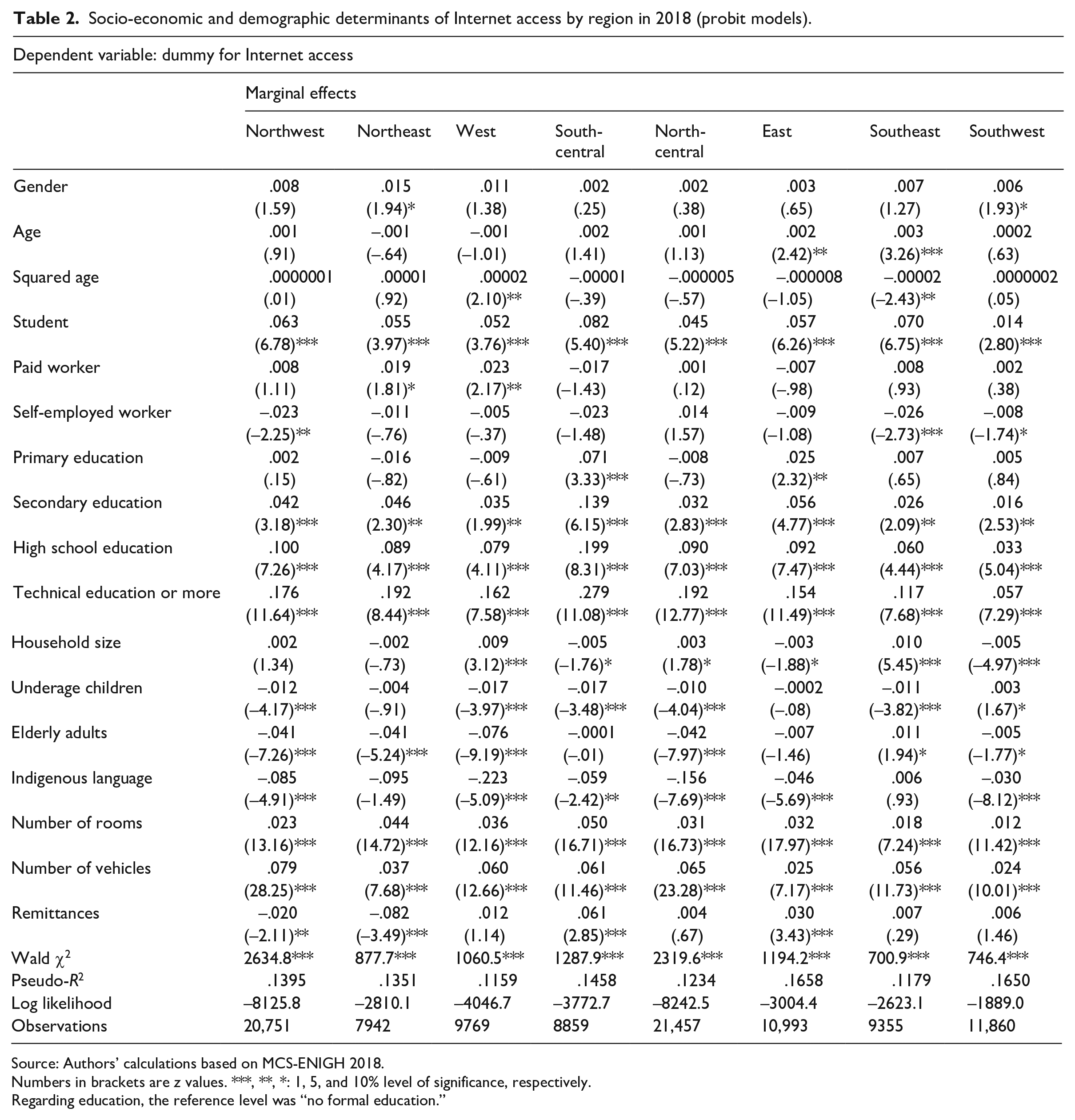
Prior to presenting the main findings of the PSM approach, Table 2 shows the results of probit models for 2018, which identify the main determinants of the Internet access used in the literature (Chaudhuri et al., 2005; Martínez-Domínguez and Mora-Rivera, 2020; Van Deursen and Van Dijk, 2019). 6 To simplify the interpretation of the probit models’ results, marginal effects at the means (MEM) were calculated. It should be highlighted that in the case of binary variables (e.g. gender), MEM measures the discrete change, while for continuous variables, MEM measures the instantaneous rate of change (Cameron and Trivedi, 2010).
Socio-economic and demographic determinants of Internet access by region in 2018 (probit models).
Source: Authors’ calculations based on MCS-ENIGH 2018.
Numbers in brackets are z values. ***, **, *: 1, 5, and 10% level of significance, respectively.
Regarding education, the reference level was “no formal education.”
The results of the probit models highlight that the main factors influencing Internet access are related to educational aspects (educational levels, being a student), economic characteristics (number of dependents, being a paid-worker, receiving remittances), household features (liquidity covariates), and ethnicity attributes (speaking an indigenous language). Figures from Table 2 reveal that the probability of an individual having access to the Internet increases if that person is a student; similarly, as their educational level improves, the likelihood of having Internet access rises considerably in all regions; however, notable differences exist among areas in terms of magnitude. While the south-central region registers a 28% increase in the probability of having Internet access linked to having completed technical or higher education, in the southwest region this increase is only 6%. The variation can be attributed to the considerable differences in infrastructure and higher education in the central and northern parts of the country compared with the south (Deichmann et al., 2004; Rey and Sastré-Gutiérrez, 2010). Regardless of the analyzed area, results suggest that speaking an indigenous language has a negative effect on the probability of accessing the Internet; however, the impact is considerably higher in the west and north-central regions than in the rest of the country. At the household level, the Internet access likelihood negatively correlates throughout the country with the number of household dependents (underage children and elderly adults), with marked variations in the magnitude of the impact among the eight regions of study.
In addition, some variables show contrasting behavior between regions. While being a paid-worker significantly increases the likelihood of having Internet access in the northeast and west regions, the opposite is true in the northwest and south regions for self-employed workers. Likewise, remittances affect the likelihood of accessing the Internet in a different way depending on the analyzed area. In the north, they negatively impact this probability; in the south-central and eastern regions, they have a strong and positive effect, while in the rest of the country, their impact is null. These results suggest that this behavior could be related to the historical tradition of Mexico–EU migration present in the central-western regions of Mexico.
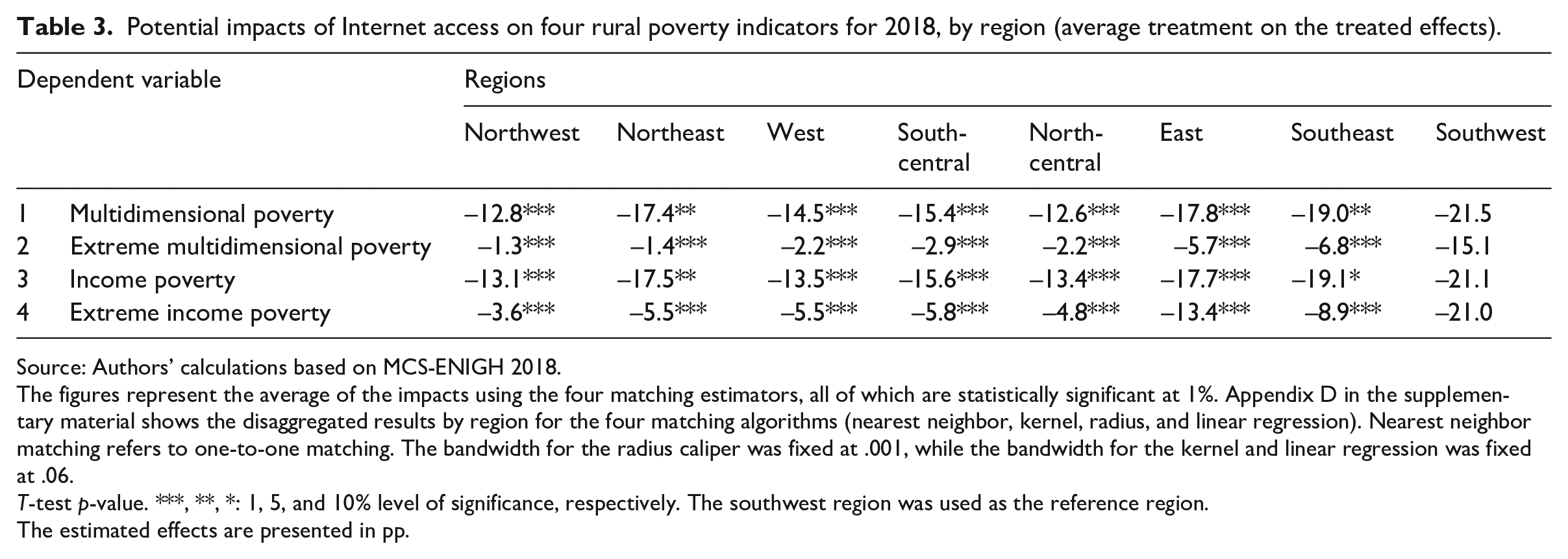
Table 3 shows the estimated impacts of Internet access on four poverty indicators characteristic of rural Mexico. These figures represent the mean of the average treatment effects on the treated (ATT) for 2018 by region 7 using the four matching algorithms, all of which are statistically significant at 1%. Overall, the results of Table 3 reveal that regardless of the poverty indicator or the region analyzed, Internet access can be perceived as an additional element that contributes to improving the living standards of the rural Mexican population by allowing improved access to basic services, such as education, healthcare, and job markets, among others services. This access helps to address rural poverty, especially in regions with the highest rates of marginalization and a traditional lack of Internet access. Thus, and as noted in the previous sections, it is interesting to evaluate whether the effect is homogeneous across regions or if, on the contrary, it differs according to the level of economic development.
Potential impacts of Internet access on four rural poverty indicators for 2018, by region (average treatment on the treated effects).
Source: Authors’ calculations based on MCS-ENIGH 2018.
The figures represent the average of the impacts using the four matching estimators, all of which are statistically significant at 1%. Appendix D in the supplementary material shows the disaggregated results by region for the four matching algorithms (nearest neighbor, kernel, radius, and linear regression). Nearest neighbor matching refers to one-to-one matching. The bandwidth for the radius caliper was fixed at .001, while the bandwidth for the kernel and linear regression was fixed at .06.
T-test p-value. ***, **, *: 1, 5, and 10% level of significance, respectively. The southwest region was used as the reference region.
The estimated effects are presented in pp.
When analyzing the results by poverty indicator, row (1) reports the estimated impact of Internet access impact on the probability of multidimensional poverty for the eight regions analyzed. Overall, in all regions, Internet access can be recognized as an additional mechanism that increases the living standards of Mexico’s rural population since it contributes to reducing the probability of being multidimensionally poor. Nevertheless, there are statistically significant variations in magnitude. While in the north-central region this probability decreases by 12.6 percentage points (pp), in the southwest the reduction is almost double (21.5 pp). In other words, the contribution of Internet access to decreasing multidimensional poverty is considerably more significant in the region with the highest marginalization levels. A possible explanation for these differences may be related to the fact that the regions with the lowest levels of economic development obtained greater benefits from the Internet given that access to this service in itself entails a substantial improvement to inhabitants’ standard of living. Meanwhile, in more developed regions, Internet access contributes significantly less to improving the welfare of residents.
The analysis of extreme multidimensional poverty is shown in row (2) of Table 3. Similar to the previous poverty indicator, the results indicate that having Internet access represents a useful tool that allows individuals facing multidimensional poverty to address their situation in a better way than those who do not yet have access to this ICT. Yet the influence is not homogeneous among regions. The two northern regions (northwest and northeast) have the impacts of the lowest magnitude, with 1.3 and 1.4 pp, respectively. At the other extreme is the southwest region, where the likelihood of living in extreme multidimensional poverty decreases by 15.1 pp, such differences are statistically significant at 1% (see Table 3). Considering that the southwest region includes two of the states with the highest marginalization and lowest economic development levels in Mexico (Chiapas and Oaxaca), this finding should be considered as key information for policymakers interested in addressing the high poverty levels prevailing in this area of the country (CONEVAL, 2019a).
The remainder of Table 3 shows the potential impact of Internet access on the likelihood of being poor by income (considering both the income poverty line and extreme income poverty line as thresholds). In the first case, the results once again indicate that Internet access has the greatest influence on income poverty in the southwest region; however, a lower possible benefit is identified in the north of the country, specifically in the northwest. In the second case, it is worth noting that, in terms of magnitude, the estimated effect for the southwest region is similar to that found in the previous income poverty indicator and significantly greater than that of any of the remaining seven regions, particularly the northwest region. These findings highlight the fact that Internet access could help to improve the liquidity constraints of individuals facing a situation of income poverty, even those related to accessing proper nutrition, with particular emphasis on the region with the lowest levels of economic development in Mexico (the southwest region).
Overall, our results for the four poverty measures confirm that dissimilarities among the eight regions do exist and suggest that they are related to the level of economic development. All regions derive benefits from having Internet access; however, those which are less developed economically appear to achieve more significant positive impacts on the probability of being poor (multidimensional or by income) than medium or highly developed regions. These benefits can be translated into better incorporation in the labor markets and even enable rural households to access education and health services of higher quality. Still, without the contextual framework of media literacy and socio-economic uplifting, the effects identified in the poverty indicators could reduce or even disappear (Scheerder et al., 2019; Mansell, 2010, 2017).
Discussion
Much like the findings of Mariscal et al. (2016) and Chávez and Sánchez (2013), the results of our probit models for Mexico’s rural regions (Table 2) identify schooling as the main determinant of Internet access. However, our findings go a step further by showing that the magnitude of the effect is different for each region. For instance, while human capital variables appear to remain positive in all regions, the impact is vastly higher for the north and central regions and minimal for southern regions. Similarly, higher schooling levels are associated with greater effects in the central and northern regions than in the southern region. As an example, in the southwest region, the probability of having Internet access increases by 3.3% when an individual has completed high school; yet in the south-central and northwest regions this increase is six to three times higher, at 19.9 and 10%, respectively.
These findings are in line with studies which argue that households with the highest human capital levels have higher probabilities of accessing and using the Internet (Grazzi and Vergara, 2014; Martínez-Domínguez and Mora-Rivera, 2020). Likewise, our results also emphasize that access to the Internet for students varies from region to region due to the sharp differences in school infrastructure across Mexico. Meanwhile, household liquidity variables (number of rooms and number of vehicles) show a positive sign, which is stronger for the central regions and lower for the southern ones. This liquidity variable coincides with evidence found by Martínez-Domínguez and Mora-Rivera (2020), and Chaudhuri et al. (2005), who conclude that the greater a household’s wealth and physical capital, the higher its possibility of accessing the Internet.
Two main findings contribute to previous literature on the effects of Internet access on poverty levels in rural Mexico. First, according to our estimates, it is possible to suggest that Internet access is an additional mechanism that could contribute to reducing a person’s probability of living in poverty or extreme poverty. In other words, Internet access is strongly associated with lower poverty levels in all rural regions, and this observed effect is highly significant. In contrast to research arguing that ICTs do not have positive causal effects on poverty (Mansell, 2002; Sujarwoto and Tampubolon, 2016), our estimates match those of scholars who have found ICT access to have a positive influence on poverty reduction in Asia, Africa, and Latin America, including Mexico (Mariscal et al., 2016; Mushtaq and Bruneau, 2019; Risner and Gadhavi, 2015; Rodríguez and Sanchéz-Riofrío, 2017). Furthermore, as the work of Chávez and Sánchez (2013) demonstrates, we find that the Internet can be a beneficial tool in reducing poverty but, as we previously mentioned, these benefits must be accompanied by the acquisition of the necessary skills for the correct digital, social, and economic development of the rural population (Mansell, 2010; Moodley, 2005).
The second contribution is the varying degree of potential benefits of Internet access on poverty measures in rural regions of Mexico. We observe that the possible effects on extreme income poverty and extreme multidimensional poverty—two indicators accounting for greater economic and social vulnerability—are higher for the south and east regions, while the impact is more acute in the southwest region. This means that the low probability of living in extreme multidimensional poverty related to having Internet access is more than ten times higher for the southwest region than for both the northwest and northeast regions. This regional variation reinforces the findings of studies that identify geographic location as a key factor in the impact that Internet access can have on several development variables (Pick and Nishida, 2015; Srinuan and Bohlin, 2013). Moreover, our estimates coincide with Sujarwoto and Tampubolon’s (2016) assertion that the Internet deepens spatial inequality among regions in a given territory.
This article contributes evidence to the various studies which argue that a lack of investment in infrastructure in areas, such as health, education, financial services, roads, and ICTs, particularly Internet access, means increased levels of vulnerability for rural inhabitants (Galperin, 2017; Salemink et al., 2015; Van Deursen and Van Dijk, 2019). Overall, our research shows that Mexico’s rural sector continues to experience a significant digital divide in terms of Internet access, a gap which is more pronounced for the southern regions compared with the north and central zones. This finding reveals the tremendous social, economic and digital inequalities that prevail in the rural areas of developing countries like Mexico (Mariscal et al., 2016; Martínez-Domínguez and Mora-Rivera, 2020; Rey and Sastré-Gutiérrez, 2010).
Conclusion
This research provides important insights into the relationship between Internet access and poverty in Mexico’s rural population, considering the regional heterogeneity that characterizes the nation. Given the prevailing high levels of poverty in Mexico’s rural sector and the low penetration of the Internet among poor rural residents, the study’s results contribute evidence to improve our understanding of the links between the digital gap and its implications for the levels of wellbeing in developing countries.
We employed a quasi-experimental technique to identify the impact of Internet access on four poverty indicators for a sample of people living in contrasting regions throughout rural Mexico. Our findings reveal that Internet access is related to lower poverty levels in households that have access to this technology compared with households that do not. Therefore, we find an important association between accessing the Internet and an increase in the proportion of people not living in poverty in rural areas. These Internet benefits, however, are heterogeneous among regions, having a more significant impact in southern Mexico (an area characterized by higher levels of economic and social vulnerability); and a lower impact in the northern part of the country. Such findings suggest a negative correlation between the levels of economic growth and development in Mexico’s regions and the association of Internet access with lower levels of rural poverty. This result shows that the greatest potential benefits of the Internet may exist in areas where the penetration of this service has historically been lower, which in turn represents a magnificent opportunity to boost the development of telecommunications infrastructure in those areas with greater economic lags. Therefore, access to ICTs in general, and the Internet in particular, should be considered as a human right that coexists with and helps to promote the exercise of other fundamental social rights such as education, health, culture, freedom of expression, and social mobility. This access would make it possible to improve the living standards of rural households in general, and to an even greater extent in those facing higher vulnerability, which could in turn translate into lower poverty levels, as our results highlight.
Thus, our study adds to the previous literature by identifying the potential effects of Internet access on poverty not only at the national level, but also at the regional level. This evidence confirms the idea that Internet access could be an additional mechanism to improve the wellbeing of the inhabitants of a nation that aspires to be less unequal and better regionally integrated, as having Internet contributes to upgrading access to various services and markets (i.e. education, health, and job market), thus increasing the possibilities of generating income. However, the results in no manner indicate that Internet access on its own could reduce poverty and that it is a tool to relieve the government of its obligations to combat poverty. On the contrary, our findings should be viewed as evidence that will help improve the focus and application of regional public policies aimed at promoting the rural population’s inclusion in the digital era. In this way, Internet access could contribute to the wellbeing and achievement of human beings.
Hence, the results of this research offer essential elements that support initiatives the Mexican government has been working on for some years aimed at providing digital services to rural communities in the country. One of the most notable is the “Red Compartida” project, which has the main objective of increasing the coverage and quality of telecommunications services at internationally competitive prices. Likewise, our findings are in line with the federal administration’s two current initiatives focused on expanding digital services to promote wellbeing. On one hand, the creation of the “Connectivity Program in Public Areas” is aimed at facilitating the access and availability of the Internet and other ICTs in priority public sites, thus strengthening efforts by the Mexican government to provide services and execute priority programs and projects. Another initiative is the “Social Coverage Program,” which seeks to guarantee access to ICTs, and in particular to broadband and the Internet, in localities that currently lack these services. The program focuses primarily on the most marginalized regions of Mexico, ensuring that the population facing a situation of poverty and vulnerability has access to these technological services.
Thus, the main implication of this study from a policy perspective is the need to promote and focus on policies aligned with regional characteristics to cope with inequality in Internet access, as well as the subsequent potential impacts of the Internet in contributing to poverty reduction in rural areas. To aid in narrowing the digital gap in Mexico’s rural areas, we recommend promoting public policies that improve Internet access by developing the necessary infrastructure in each region and expanding the supply of high-speed Internet, especially in southern Mexico. The development of this infrastructure should be understood as a strategic issue, since in crises, such as the current COVID-19 pandemic, it is the only way to guarantee the exercise of human rights such as education, health, and even access to basic information. Likewise, it is the government’s best ally in working to preserve equity rights and prevent further deepening of the economic and social inequalities characteristic of developing countries.
Another recommendation would be to implement measures to effectively reduce connection prices and, at the same time, provide training in digital education. Much greater attention should be given to public policies that promote the acquisition of digital literacy skills for large portions of the population, which would then enable the development of a comprehensive digital ecosystem that promotes the wellbeing of the inhabitants of rural areas. The result would be an improved use of cyberspace and potential benefits associated with the Internet.
Despite the contributions of our study, we can identify limitations related to the type of data used in the analysis. First, it would be desirable to have panel information that would allow us to incorporate a dynamic analysis of Internet access, understood beyond a binary decision, and its relationship with poverty; unfortunately, the current sources of data available in Mexico make this an impossible task. Second, we suggest that the study be extended beyond Internet access. In future research, we recommend obtaining information that identifies not only households with Internet access in the home, but also the members of the household who use the Internet, along with their purposes for doing so. Such information will allow us to analyze how the appropriation and patterns of using the Internet affect various development indicators, including poverty. To do this, we would need the information to identify Internet use and usage patterns in combination with data about income and the dimensions of poverty, and thus add elements to the current debate on the digital divide in rural Mexico. Despite these limitations, our study highlights the vital role that Internet access could play as an additional mechanism to contribute to reducing the poverty levels of people living in rural areas, with positive potential implications for their wellbeing in the long term.
Supplemental Material
sj-pdf-1-nms-10.1177_14614448211000650 – Supplemental material for Exploring the impacts of Internet access on poverty: A regional analysis of rural Mexico
Supplemental material, sj-pdf-1-nms-10.1177_14614448211000650 for Exploring the impacts of Internet access on poverty: A regional analysis of rural Mexico by Fernando García-Mora and Jorge Mora-Rivera in New Media & Society
Footnotes
Funding
The author(s) received no financial support for the research, authorship, and/or publication of this article.

Supplemental material
Supplemental material for this article is available online.
Notes
Author biographies
References
Supplementary Material
Please find the following supplemental material available below.
For Open Access articles published under a Creative Commons License, all supplemental material carries the same license as the article it is associated with.
For non-Open Access articles published, all supplemental material carries a non-exclusive license, and permission requests for re-use of supplemental material or any part of supplemental material shall be sent directly to the copyright owner as specified in the copyright notice associated with the article.
