




Abstract
This study examines the properties of linear and nonlinear low-frequency fractional dust-acoustic waves (DAWs) in a complex plasma with polarization force. This model is composed of inertialess Maxwellian electrons and ions as well as inertial negatively charged dust grains. In this model, the dust-neutral collisions incorporate the dissipative effect of wave damping. The impact of the polarization force term, the electron concentration, and dust-neutral collisions on the linear properties of DAWs is examined. To investigate the impact of various physical parameters on the profile of nonlinear dust-acoustic solitons (DASs), the fluid model equations are reduced to the damped Korteweg-de Vries (KdV) equation via the reductive perturbation technique (RPT) in the limit of vanishingly small dust-neutral collisions. It is known that the damped KdV equation is completely nonintegrable, that is, it does not support exact solutions. Thus, in the second part of this study, the fractional damped KdV equation is derived to examine the influence of fractionality on the dynamics of dissipative DASs. For this purpose, we utilize an appropriate transformation to convert the integer-order evolutionary wave equation (damped KdV) into a damped fractional KdV (FKdV) equation. Subsequently, we employ one of the most precise methods for studying fractional differential equations, called the Tantawy technique. The time-varying solutions of both integer and damped FKdV equations yield weakly negative-polarity dissipative dust-acoustic solitons (DDASs). A numerical investigation of the evolution of (non)fractional DDASs, focusing on the polarization force term, electron concentration, and dust-neutral collisional parameter, is presented.
Keywords
Introduction
The nonlinearity in dusty plasmas has been a subject of great interest to researchers over the past several decades due to its critical significance in many physical settings. Dusty plasma can be found throughout the cosmos, both in space and in laboratory settings. In the realm of space research, dusty plasma has been documented in cometary tails, planetary rings, interstellar clouds, the earth’s mesosphere, and the earth’s ionosphere, 1 while the realization of dusty plasma in connection with laboratories has been linked with the coating of thin films, 2 plasma crystals, 3 etc. The presence of charged dust particles introduces various modes. These modes include dust-acoustic (DA) mode, 4 dust-ion-acoustic (DIA) mode,5,6 dust cyclotron mode, 7 dust drift mode, 8 and dust lattice mode.9,10 Dust-acoustic wave (DAW) is a much-explored mode in which the restoring force to sustain the DAW is provided by the thermal pressures of the electrons and ions, and the inertia comes from the overall mass of the dust grains. The first theoretical study of DAWs was made by Ref 4, and this study was subsequently experimentally validated in various laboratory studies.11–13
The charged dust grains immersed in plasmas are controlled by various forces. The electrostatic force is perhaps the most significant. The electric force mostly confines negatively charged species via the positive plasma potential. The electric field is often far less in the bulk plasma than the electric field in the sheath region because of the quasi-neutrality of the former. In the context of non-uniform plasmas, the Debye sheath around the particulates deforms, creating a polarization force that exerts additional force on the dust. The non-zero gradient of the plasma’s local electron and ion densities contribute to the non-uniformity appearing in the plasma. In accordance with Ref 14, the polarization force being applied on the dust grains is given by

In equation (1)
The majority of the investigations involving DAWs were restricted to a simple plasma model, meaning that the effects of neutrals were not considered, and even minimal interest has been shown in this direction. Although neutral gas is more relevant to star material in galactic dynamics 22 and most dusty plasmas in laboratories are partially ionized, dust-neutral collisions nonetheless have consequences. In addition, dusty plasmas seen in laboratory apparatuses 11 have finite size and a high density of neutral numbers. Charge-neutral particle collisions were shown to have a major impact on wave properties, because in certain experimental scenarios the mean free paths for dust-neutral collisions have been found to be on the order of typical wavelengths linked with the excited waves. 12 In addition, many researchers have been concentrating on the impact of collisions on the dynamics of DAWs in the past few years. Taking into account the collisions between charged dust particles and neutrals, Mahanta and Goswami 23 examined the behavior of an unmagnetized dusty plasma near a conducting boundary. Similarly, Gao et al. 24 studied the effect of dust-neutral collisions on damped DAWs using the particle-in-cell (PIC) simulation technique. The KdV and quasi-nonlinear Schrödinger equations were analyzed analytically as well as numerically in the presence of dust neutral collisions. Using the reductive perturbation technique, Khan et al. 25 derived the damped KdV equation and studied dissipative DA solitons (DASs) in a superthermal dusty plasma. The superthermality and dust-neutral collisions were shown to have a significant effect on the linear and nonlinear characteristics of DAWs. Very recently Khalid et al. 26 studied the dissipative DASs in an anisotropic superthermal dusty plasma, exploring the influence of superthermality and pressure anisotropy on the dynamical behavior of dissipative DASs.
The research in the context of dissipative solitons has important relevance to various plasma models,27–32 nonlinear optics,33–35 and many other fields. Recognizing the significance of examining the influence of diverse physical parameters that induce the damping of nonlinear phenomena (e.g., dissipative SWs, dissipative cnoidal waves (CWs), dissipative shock waves, dissipative RWs and breathers, etc.,) in plasma physics and other scientific fields, numerous researchers have concentrated their endeavors on identifying highly precise approximate solutions to simulate these nonlinear phenomena, as articulated by various evolutionary wave equations (EWEs) derived from distinct plasma systems.36–42 These categories of EWEs incorporate particular physical effects that render them entirely non-integrable, meaning they cannot accommodate exact solutions. Thus, they require the derivation of numerical or semi-analytical solutions through appropriate techniques to model the phenomena described by them. The Ansatz method is one of the most accurate and widely used methods for analyzing non-integrable EWEs. It has derived highly accurate semi-analytical approximations for modeling various nonlinear phenomena in plasma physics and many other interdisciplinary fields. It has succeeded in deriving many semi-analytical solutions, which in turn have provided accurate explanations for various nonlinear physical phenomena described by this type of equation. In this context, the Ansatz approach was for the very first time employed to find the solution of the damped nonlinear Schrödinger equation (NLSE) and, thereby, derive the highly accurate semi-analytical solutions that were later used to model dissipative RWs and dissipative breathers (DBs) in unmagnetized pair ion plasmas in the presence of collisions. 43 To analyze and examine the accuracy of the aforementioned solutions and the Ansatz approach, various researchers determined the global error over the entire study domain and compared these approximations with the numerical simulation-based solutions using the finite difference method. The Ansatz approach was further applied to study the family of damped Gardner–Kawahara equations, generating two general semi-analytical solutions with high accuracy. These solutions were later employed to investigate dissipative SWs and CWs in electronegative plasmas. 44 The same framework successfully examined the family of forced-damped Kawahara equations (KE). It achieved exact and very precise approximations for modeling numerous nonlinear phenomena that may occur and propagate in a plasma. 45 These dissipative structures can be viewed as an inherent aspect of information and have significant applications in fiber-optic communications, particularly due to the stationary profile of solitons. For solitons to convey information, they must be able to persist for a considerable amount of time despite dissipation occurring within the medium. Nevertheless, dissipative solitons lack stationary solutions, unlike the soliton profiles in energy-conserving systems. The amplitude, width, and speed of dissipative solitons alter over time as they propagate, eventually diminishing with time. Since most systems are intrinsically dissipative, solitons in these lossy systems are constantly damped and, as a result, require external energy to be boosted in order to maintain a stable profile. Due to charged particle and neutral collisions, solitons in plasma may experience damping. In addition, dissipation in plasmas may be related to Landau damping, interparticle collisions, or kinematic fluid viscosity, such as shear stress from inertial fluid motion. Motivated by these potential applications, the study aims to investigate the properties of dissipative solitons in a complex plasma in the presence of a polarization force. This topic has not been explored. This is why we study the effect of polarization force on dissipative DASs (DDASs) in Maxwellian dusty plasma.
Given the significant success of fractional differential equations (FDEs)46–48 in modeling a wide variety of physical, engineering, biological, and chemical problems, etc., owing to their ability to reveal behaviors that integer differential equations (DEs) fail to describe, they have thereby attracted numerous researchers to focus their efforts on analyzing various EWEs in their fractional representations to comprehend the dynamics of distinct natural occurrences in engineering, biological, physical, and chemical-physical systems. In this context, numerous studies have been conducted on analyzing various types of FDEs and deriving either exact, semi-analytical, or numerical approximations using multiple techniques to understand the behavior and dynamics of the phenomena described by these equations. For example, numerous studies have analyzed fractional EWEs that describe linear and nonlinear phenomena that are produced and propagated in plasma and in similar media, such as fluid mechanics, optical fibers, and water waves. The integer-order nonlinear KdV equation:
Numerous studies have been undertaken on this family to derive approximations that can be used for modeling various nonlinear phenomena, including fractional solitary waves, fractional CWs, fractional periodic waves, fractional shock waves, and others. For instance, the fluid equations for a collisionless, unmagnetized plasma composed of inertial cold electrons and inertialess Maxwellian ions with two distinct temperatures have been reduced to the FKdV equation to investigate the properties of fractional solitons in this model.
53
The authors employed the variational-iteration method (VIM)54–56 to address the FKdV equation. The authors discovered that the fractional order significantly influences the soliton amplitude. In Ref 57, the nonlinear characteristics of fractional electron-acoustic SWs have been investigated in a homogeneous unmagnetized plasma composed of inertial cold electrons, inertialess nonthermal hot electrons, and stationary positive ions. The authors employed the reductive perturbation technique (RPT) to reduce the fluid model equations to the integer-order KdV equation. Subsequently, they transformed the integer-order KdV equation into its fractional counterpart by an appropriate transformation. After that, the authors employed the VIM to formulate analytical approximations for the SWs and examined the profound influence of fractional-order parameters on their characteristics. Also, the El-Wakil group
58
has reported the characteristics of fractional ion-acoustic SWs in the framework of the FKdV equation in an unmagnetized, weakly relativistic plasma. Using the RPT, the authors reduced the fluid model equations to the integer-order KdV equation. Subsequently, they employed an appropriate transformation to convert the integer-order KdV equation to its counterpart form and examined it utilizing the VIM. Many other methods and techniques have also been used to analyze the fractional KdV-type equations and derive some analytical and numerical approximations. For example, the residual power series method (RPSM) was employed to analyze quadratic nonlinearity FKdV and modified cubic nonlinearity FKdV equations
59
as well as geophysical FKdV.
60
The homotopy perturbation Sumudu transform method was applied for analyzing the inhomogeneous linear FKdV equation.
61
Additionally, the generalized FKdV equation has been numerically solved utilizing the finite difference method, and the influence of the fractional-order parameter on the soliton profile has been examined.
62
The Yang transform was employed in conjunction with the Adomian decomposition method (ADM) and the homotopy perturbation method (HPM) to solve the time-fractional coupled KdV equations.
63
The time-fractional third-order KdV equations were analyzed in the framework of Caputo sense using the Mohand decomposition method.
64
Despite all these effective methods that have succeeded in analyzing various types of FDEs, the fractional models still pose a major challenge in achieving a balance between efficiency and computational accuracy. Therefore, one of the motivations of this study is to analyze the following damped FKdV equation

This equation (2) will be solved for the first time using a novel technique called the Tantawy technique65–68 for the purpose of examining the fractionality’s effect on the behavior of dissipative solitons. It should be mentioned here that all previous studies are based on analyzing various fractional EWEs that support exact solutions in their integer forms. However, in the current study, we apply the Tantawy technique to analyze equation (2) and derive highly accurate approximations for this equation. This technique has successfully studied many fractional EWEs, such as fractional Burgers-type equations, 65 the fractional Fokker–Planck (FP) equations, 66 fractional fourth-order Cahn-Hilliard equations, 67 and fractional quadratic nonlinearity KdV equation, 68 and its results have been compared with many other effective methods, including the new iterative method (NIM),65,68 the RPSM, 65 optimal auxiliary function method (OAFM), 66 homotopy perturbation transform method (HPTM), and variational iteration transform method (VITM). 67 The comparison results demonstrated the superiority of the Tantawy technique over these methods in analyzing linear and nonlinear fractional EWEs. From this standpoint, one of the primary objectives of this study is the very first time derivation of highly accurate approximations to the damped FKdV equation for modeling damped FKdV solitons.
The paper is arranged as follows: The physical model and the equations are given first. Linear waves are then analyzed followed by the derivation of the damped KdV equation and its time-dependent solution in the form of DDASs. Next, the Tantawy technique has been used to analyze the damped FKdV equation. Finally, the numerical analysis of DDASs has been performed in the context of relevant plasma parameters. The key results are summarized at the end.
The physical model and governing equations
To undertake the numerical study of DDASs in a collisional polarized dusty plasma, the plasma model is made up of cold inertial dust grains being negatively charged (number density n d , mass m d , and charge q d = −Z d e), inertialess Maxwellian electrons (number density n e , mass m e , and charge q e = −e) and ions (number density n i , mass m i , and charge q i = e). Both electrons and ions adhere to the Maxwell–Boltzmann distribution, while the additional effect of the polarization force on the DDASs is also taken into account. The charge neutrality condition at equilibrium reads ni0 = ne0 + Z d nd0, where Z d is the charge state of the dust grains, while ni0, ne0, and nd0 are the equilibrium number densities of the ions, electrons, and dust grains, respectively.
With the incorporation of all these effects and considering one-dimensional geometry, the following model equations can be used for describing the dust dynamics in the current plasma model

Here, ϕ is the electrostatic potential and u
d
the fluid velocity of dust particles. The quantities u
d
, ϕ, and n
d
are, respectively, normalized by e/k
B
T
i
, nd0, dust acoustic speed
The normalized form to the densities of the Maxwell–Boltzmann electrons and ions reads

Considering ϕ ≪ 1, the Taylor expansion of equation (4) with truncation of the expansion at the second-order are combined with Poisson’s equation (third-one in system (3)) to give us

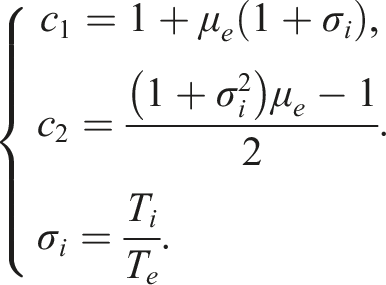
Linear analysis
To carry out an investigation of linear DAWs in collisional-polarized dusty plasma, we linearize the set of equations (3)–(5) and, assuming the plane wave solution of the form


It is seen that the dispersion characteristics of the DAWs depend on the relevant plasma parameters. In Figure 1, we have plotted the real part of the frequency versus the wavenumber k. It is pertinent to mention that the wave damping rate, as manifested via the imaginary part, does not depend on k. The diminishing behavior of the wave frequency is observed with increasing values of the dust neutral collisional term ν. Another intriguing finding, as seen from the figure, is that k has threshold values k1 and k2 (as evident from (18)) and correspond to ν = 0.02 and, ν = 0.05, respectively. We also observe that the wave is overdamped and would not propagate below these critical values. This overdamping system is in use until Plot of ω
r
against k with varying values of dust-neutral collisional parameter ν. Here, R = 0.10, μ
e
= 0.02, and σ
i
= 0.02.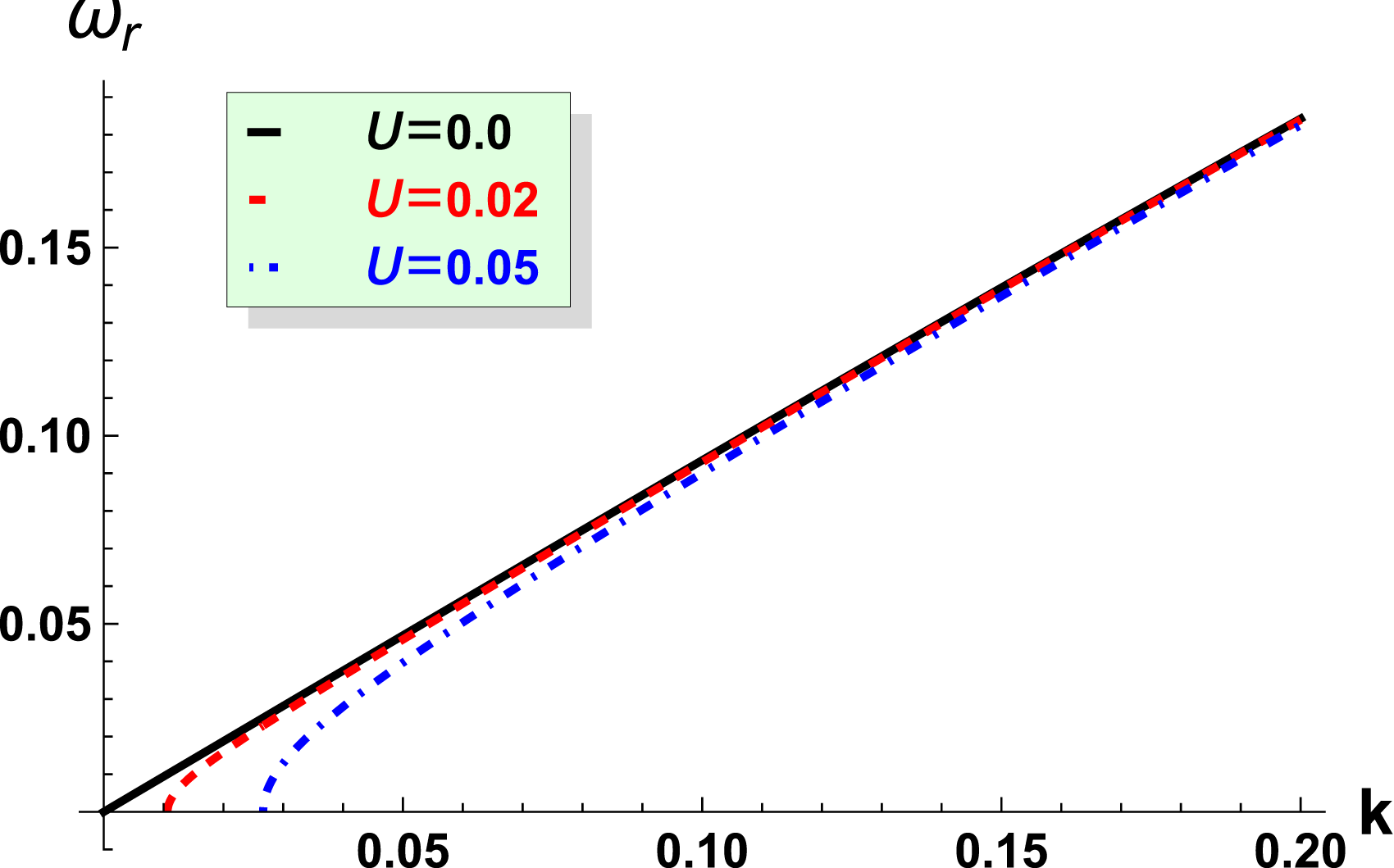

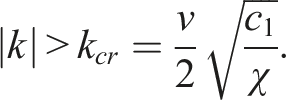
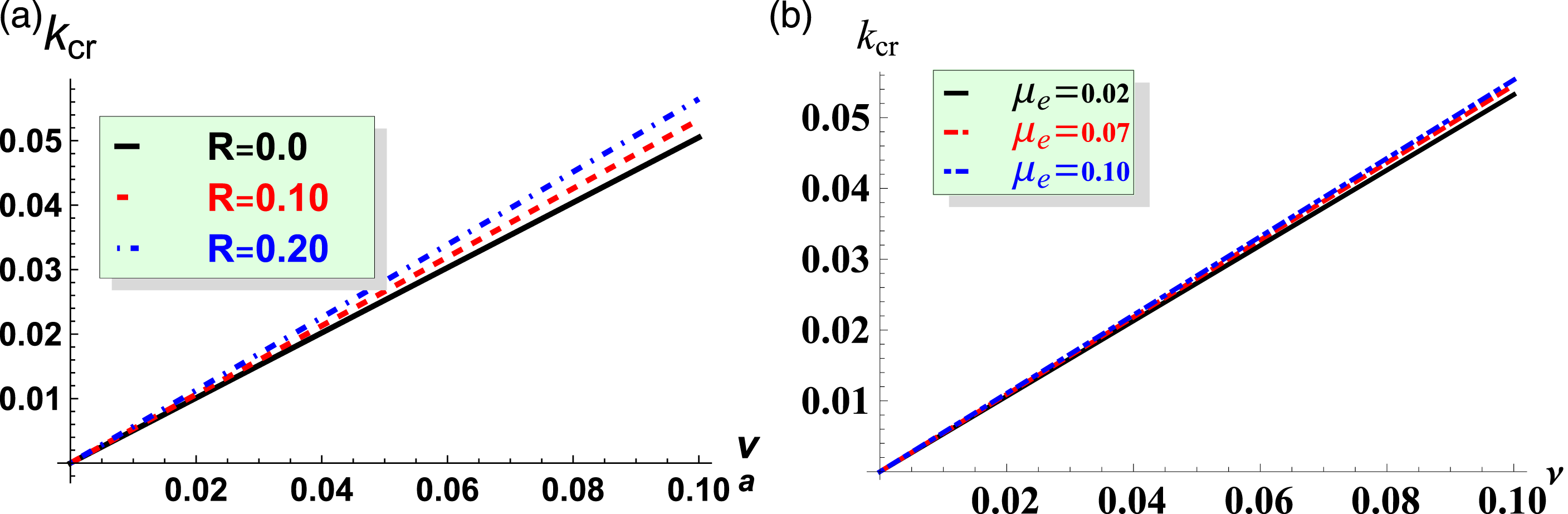
Figure 2 displays the critical wavenumber k
cr
as a function of ν for different values of the polarization term R, and electron concentration μ
e
. In Figure 2(a), it is seen that higher values of R result in increased values of k
cr
while considering μ
e
and σ
i
being fixed. Similarly, taking into account the fixed values of R and σ
i
, the k
cr
shows an increasing behavior with low dust concentration (i.e., high μ
e
values)-see Figure 2(b). The critical value k
cr
is shown as a function of (a) the polarization force term R and (b) the electron concentration μ
e
.
In the limit of long wavelength, that is, by considering


Ignoring the collisions, that is, if we set ν = 0 in equation (10), we have

Deriving the evolutionary wave equation
To model dissipative structures on the dust scale via the RPT,
69
the following stretching of the spatial and temporal coordinates in terms of an infinitesimally small parameter ϵ is introduced as


Substitution of equations (13) and (12) into system (3), the first order perturbations along with the dust-acoustic phase velocity are obtained as follows
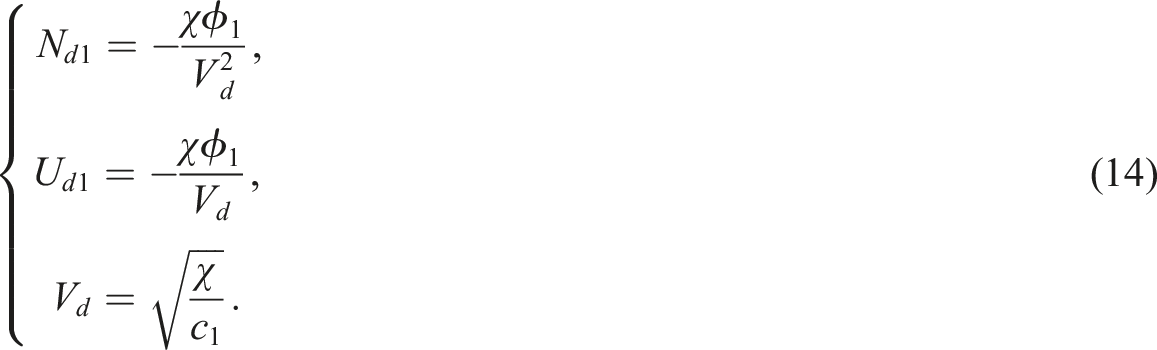
The following set of equations result from collection of the next higher-order terms in ϵ



To incorporate the impact of dust-neutral collisions that is compatible with equations (12) and (13), we make use of the normalization assumption


In equation (18), the last term is the collisional term that characterizes the dust-neutral collisions. The standard KdV equation for DAWs in polarized collisionless Maxwellian plasmas is recovered when there are no collisions, or when Γ = 0. A typical KdV equation signifies a fully integrable Hamiltonian system that complies with infinite conservation laws.
71
Following this, the use of the energy conservation law is made while ignoring the collisional effects by taking Γ = 0 in equation (18). The resulting equation is multiplied by ϕ(ξ, τ) and then integrated by considering the limits (−∞, ∞) under conditions, namely, ϕ(ξ, τ) → 0, ∂
ξ
ϕ(ξ, τ) → 0, and

Here,




In equation (23), the quantity


The Tantawy technique for analyzing the damped FKdV equation
This section presents a concise yet detailed step-by-step guide to the Tantawy technique for analyzing the damped fractional KdV (FKdV) equation. We direct the reader to consult for further information regarding this technique to the references.65–68 However, before applying the Tantawy technique to analyze the fractional EWEs, it is necessary to convert the integer-order damped KdV equation (18) to its fractional counterpart. For this purpose, we follow the same approach as used in Refs. 57, 58 to convert the integer-order equation (18) to its fractional counterpart as follows


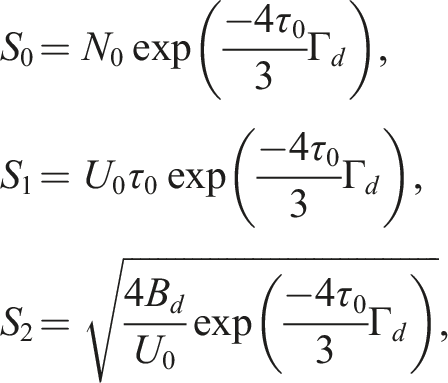
To analyze damped FKdV equation (27) using the Tantawy technique, the following brief steps are introduced:
Step (1) According to this technique, the analytical approximate solution to any fractional PDE is introduced in the following Ansatz form

Step (2) Substituting the Ansatz (29) into equation (27) and for m
th
− approximations (say, m = 3), we get

Step (3) Utilizing the MATHEMATICA built-in command of time CFD

Step (4) In equation (31), after applying the time CFD and accumulating all equal power coefficients of τ
iα
∀ i = 0, 1, 2, 3, we finally get

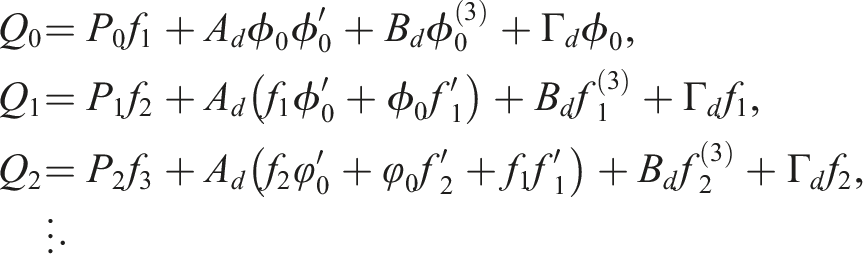

Step (5) Solving the system



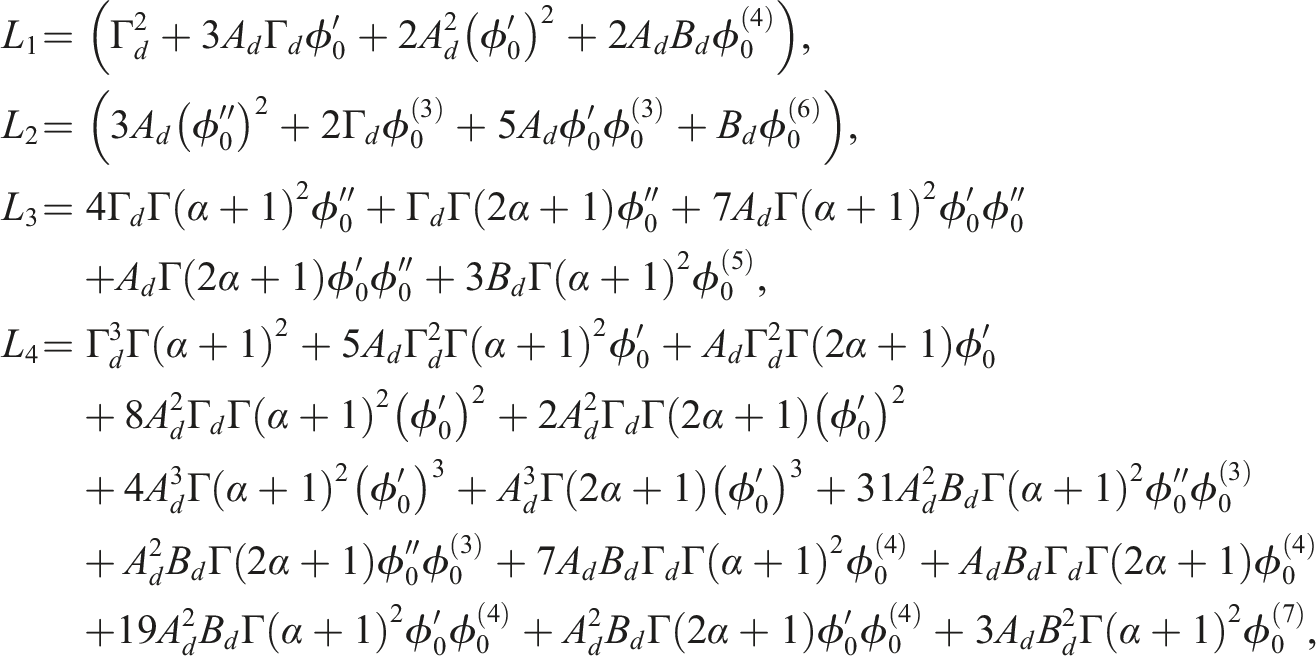
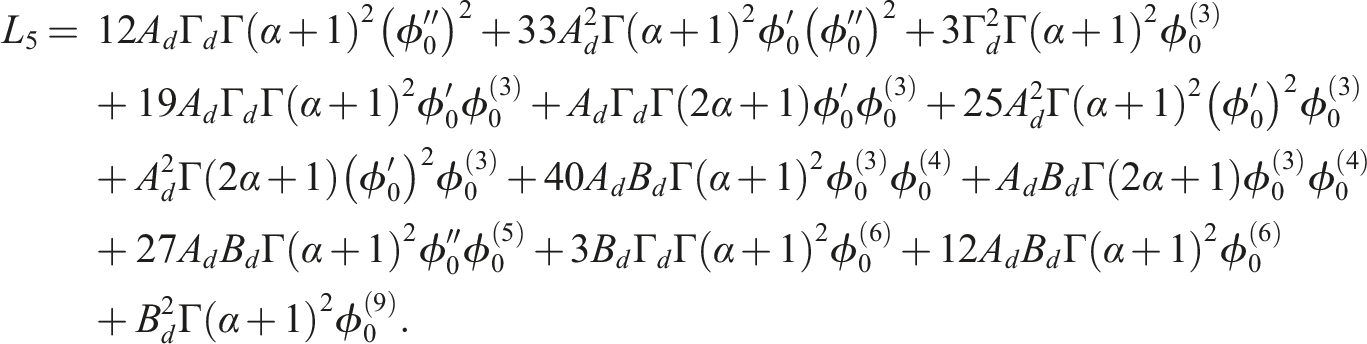
Step (6) Substituting the value of the IC ϕ0 provided in equation (28) into equations (33)–(35) and after straightforward computations, we finally obtain the explicit values of f1, f2, and f3 as follows:




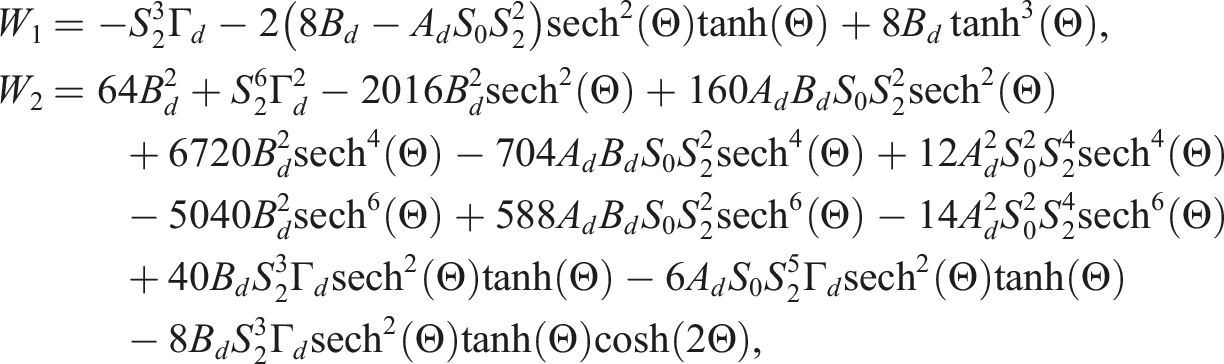
Step (7) The analytic approximate solution to the damped FKdV equation (27) is obtained by substituting the obtained values of

Results and discussion
The aforementioned solution has been subject to some approximations, which are also applicable to dissipative perturbations.
72
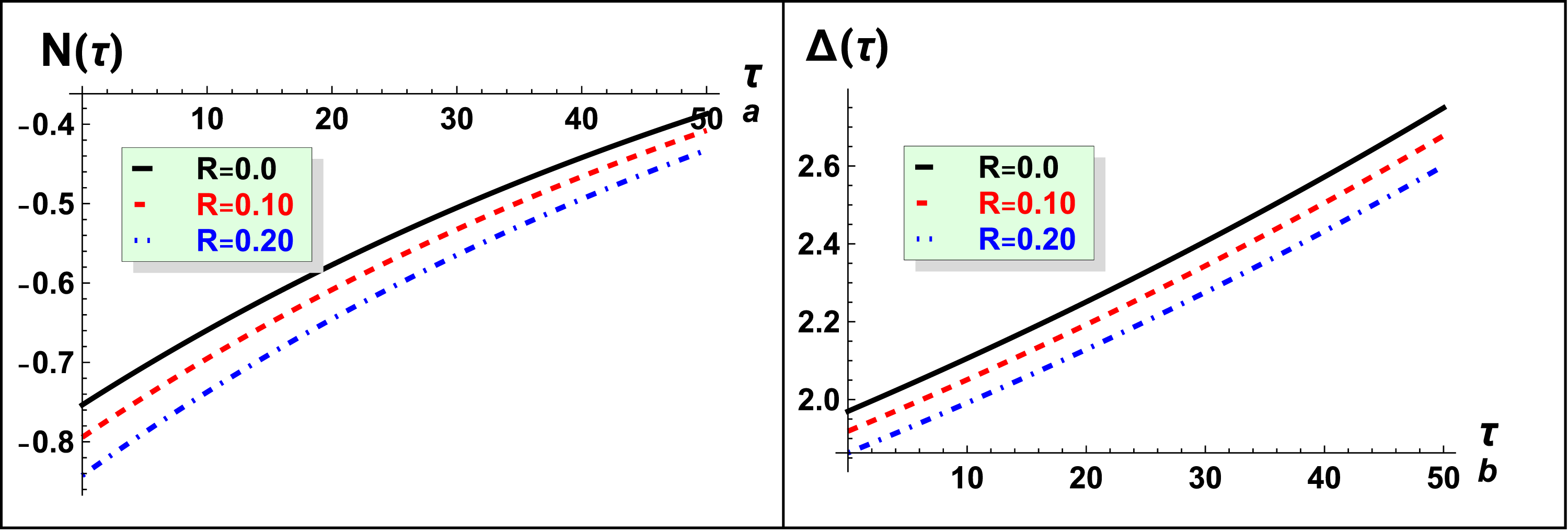
Higher orders in the perturbation analysis provide corrections to the leading-order solution; they have no effect on the soliton parameters, which are determined by leading-order solutions and include velocity, amplitude, and width. Additionally, it is seen that dust-neutral collisions cause the soliton velocity U(τ), energy, ɛ(τ) and amplitude N(τ) to decrease exponentially with time τ. Figure 3 shows how the polarization force term R affects the time-dependent amplitude N(τ) and width △(τ), while considering μ
e
= 0.02, Γ
d
= 0.01, U0 = 0.5 and σ
i
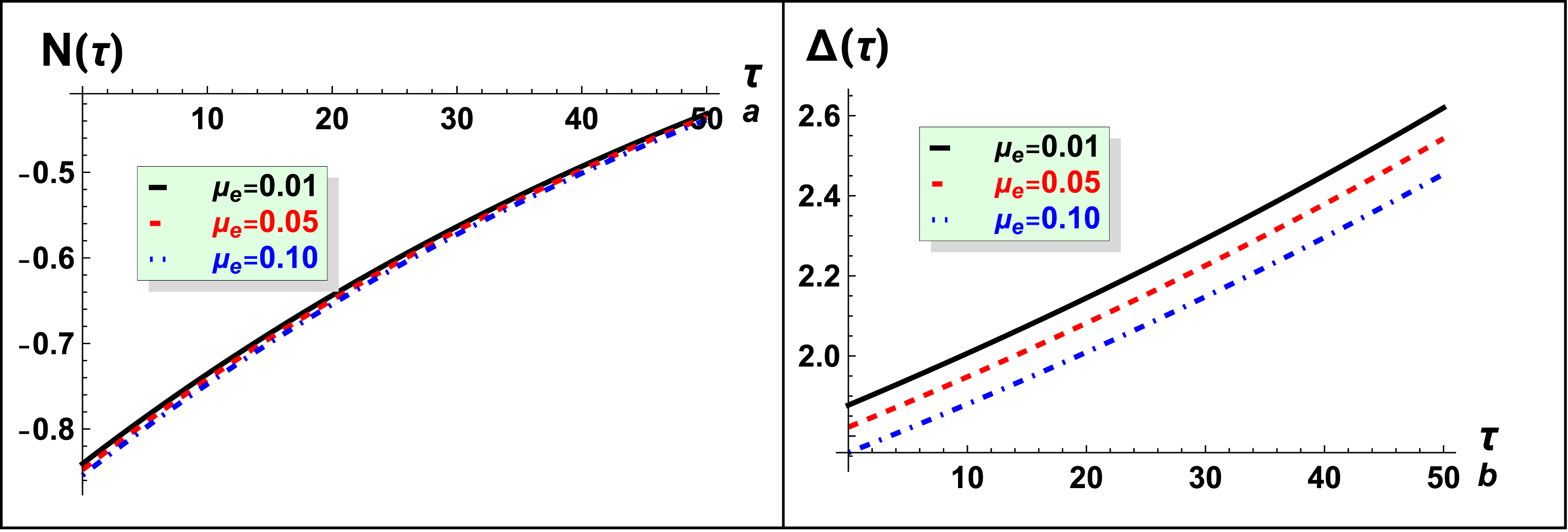
= 0.02. The amplitude (in absolute value) increases with higher values of R, while the width decreases with increasing values of R, resulting in narrower soliton pulses. Again, an increase in amplitude and a decrease in width of the solitons is observed with higher values of electron concentration μ
e
(lower dust concentration); see Figure 4. The other parameters for this figure are R = 0.20, Γ
d
= 0.01, U0 = 0.5 and σ
i
= 0.02. As illustrated in Figures 4(a) and (b), the amplitude of the soliton N(τ) increases, while the width △(τ) decreases over time. This was anticipated because taller pulses require them to be narrower, and the product Plot of (a) the time-dependent amplitude N(τ) against time τ and (b) the time dependent width △(τ) against τ for different values of R. Plot of (a) the time-dependent amplitude N(τ) against τ and (b) the time dependent width △(τ) against τ, for different values of the electron concentration μ
e
.
Clearly, solitons dampen due to the dissipative force linked to dust-neutral collisions, and thus solitons are able to travel only a certain distance (
In Figure 5, the effect of R on the dynamics of DDASs has been explored while other plasma parameters (μ
e
, σ
i
, Γ
d
) are fixed. The amplitude of DDAS is seen to increase while a decrease in the width of the nonlinear structures is observed with higher values of R. An increase in R enhances the nonlinearity of the system, and thereby the steepening effect dominates over dispersion, leading to narrower DDASs. This finding is consistent with the result in Refs. 17, 18. In the vicinity of R ∼ 1, the solitons are dampened, as this will cause the polarization force to balance the electrostatic force, and as a result, the net force acting on the dust particles will become vanishingly minor. As happens, the polarization effects have the potential to totally obscure the DDASs. The variation in the nature of the DDASs with the electron concentration μ
e
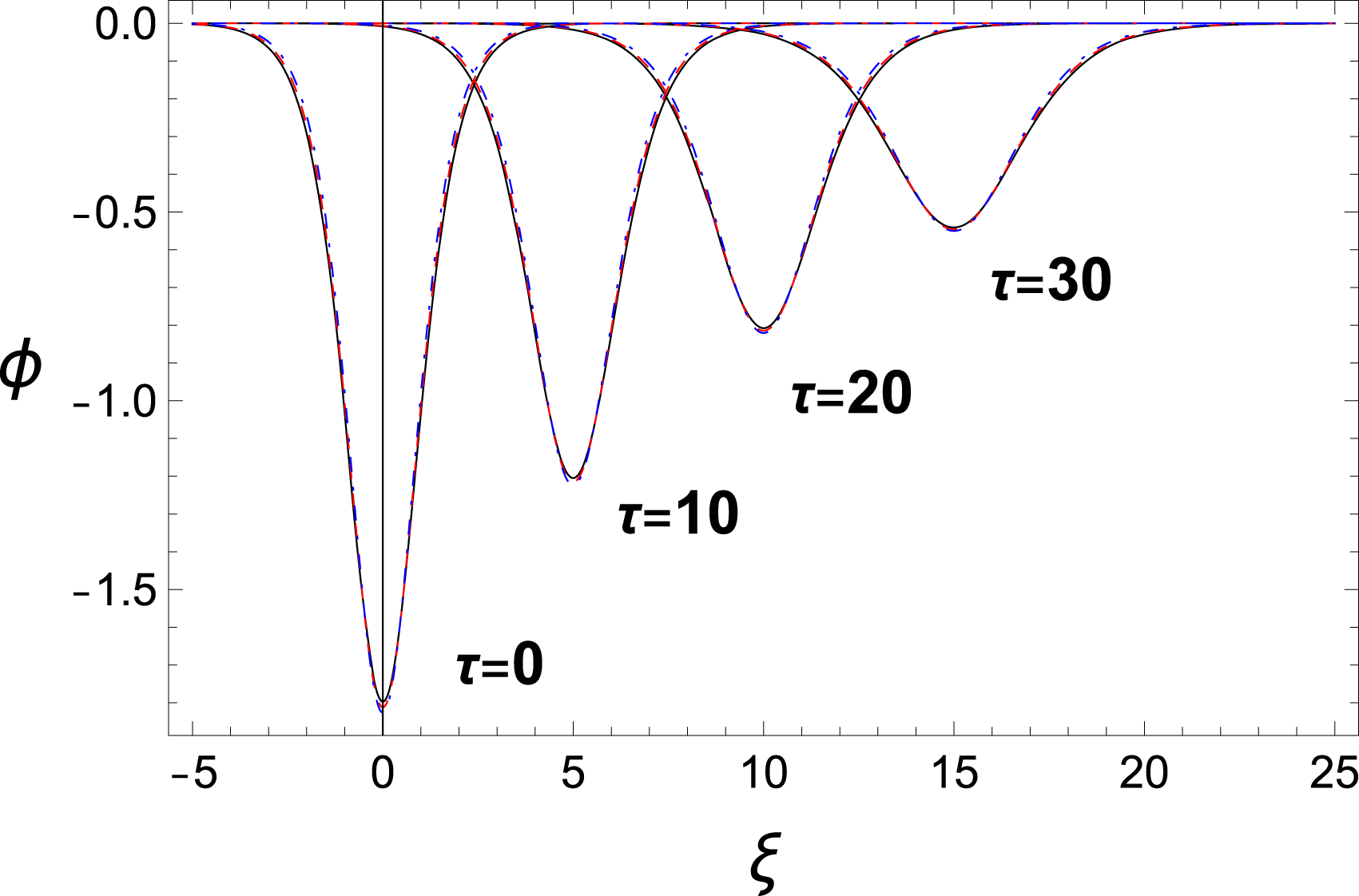
is shown in Figure 6. While considering the fixed values of R, σ
i
, Γ
d
, it is found that the amplitude (width) of the nonlinear structures increases (decreases) with higher values of μ
e
(which therefore reflects as the lower dust concentration). This result is qualitatively in agreement with Ref. 17. Plot of the time dependent DDASs against the polarization force terms R, that is, R = 0 (solid curve), R = 0.10 (dashed curve) and R = 0.30 (dotdashed curve). Other parameters read U0 = 0.5, μ
e
= 0.02, σ
i
= 0.02, and Γ = 0.03. Plot of the time dependent DDASs against the electron concentration μ
e
= 0.01 (solid curve), μ
e
= 0.05 (dashed curve) and μ
e
= 0.10 (dotdashed curve). Here, R = 0.30, Γ = 0.03, σ
i
= 0.01, and U0 = 0.5.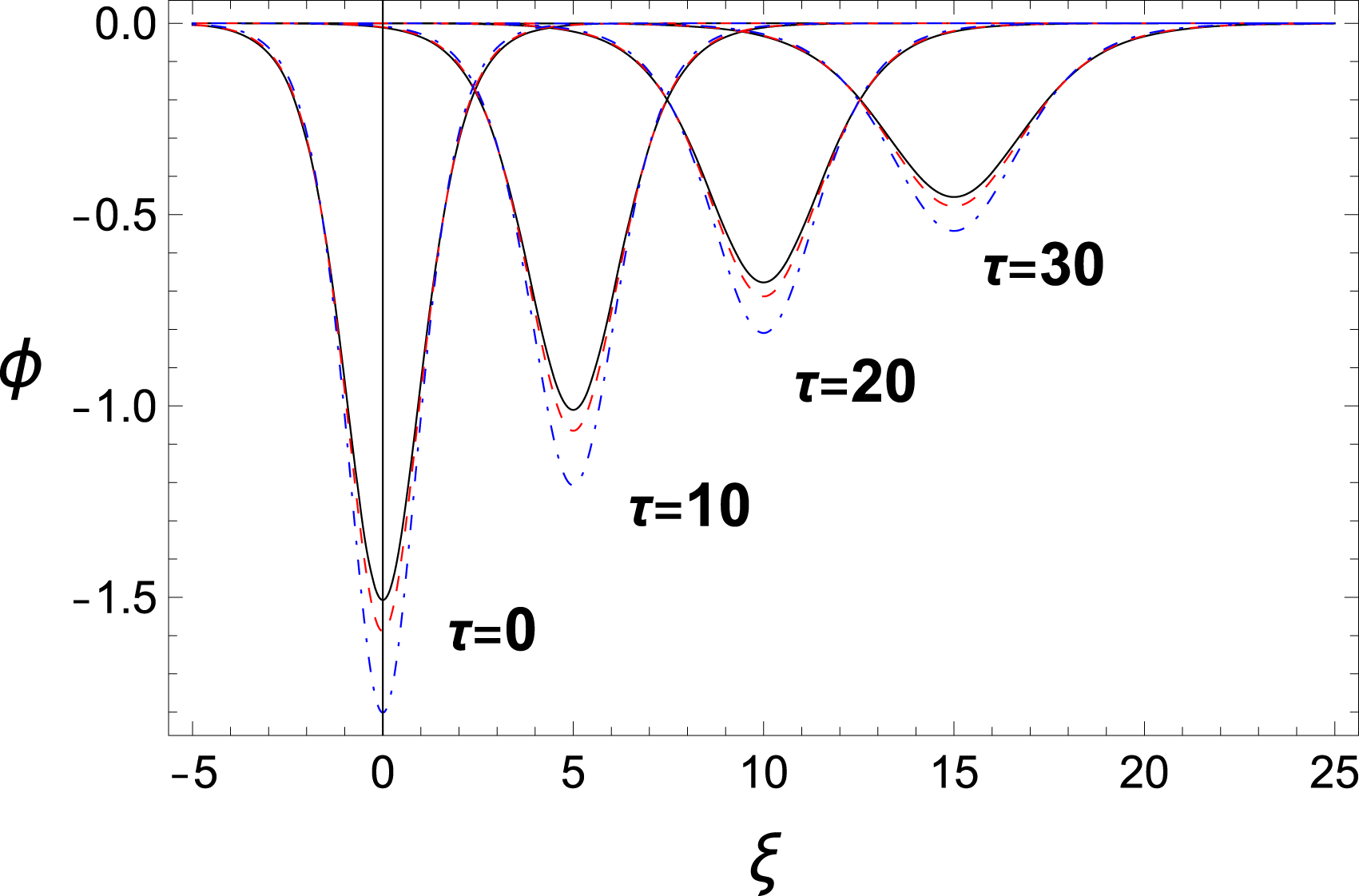
It is a fact that when dust-neutral collisions are present, the solitons become damp over time and eventually die out as τ → ∞. In order to quantitatively characterize this effect on the shape of DDASs, we have plotted ϕ versus ξ for different values of the dust-neutral collisional parameter Γ
d
while keeping other plasma parameters (viz., R, σ
i
and μ
e
) fixed (see Figure 7). The amplitude of DDASs decreases while its width increases with increasing values of the collisional parameter Γ
d
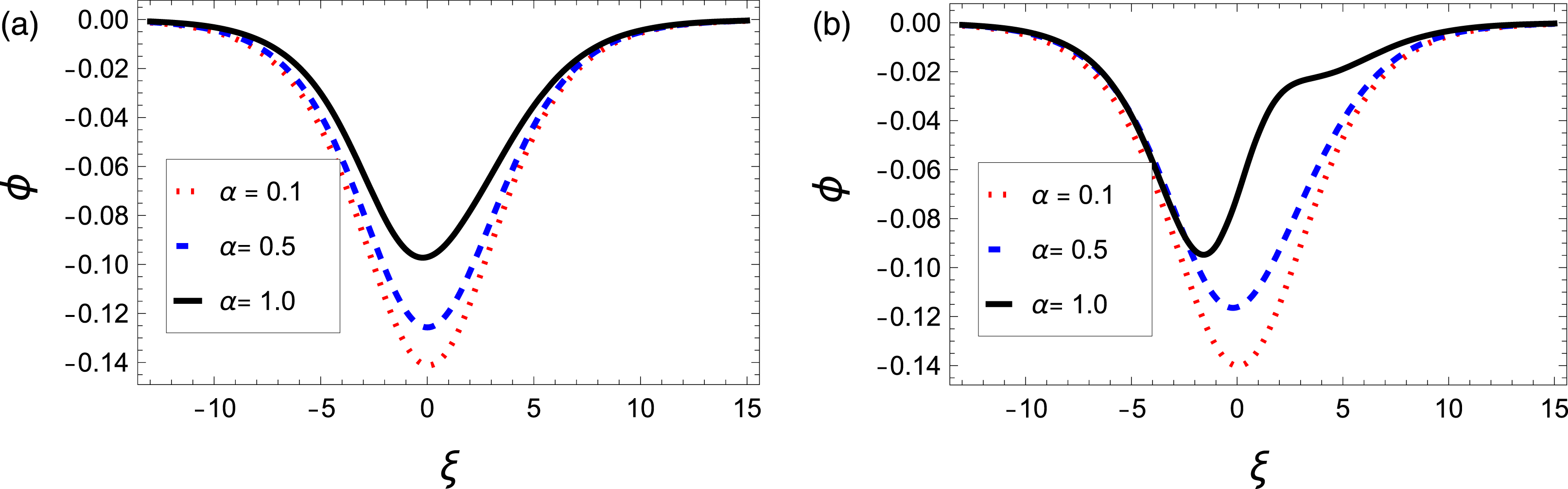
. As dust-neutral collisions cause the solitons to lose energy (amplitude diminishes), and to compensate for the energy loss, the solitons tend to spread out in space, resulting in larger width of DDASs. In other words, the nonlinearity weakens as a result of energy loss, while the dispersion (which tends to spread the wave) becomes more dominant and thus leads to a broader soliton structure. Figure 8 examines the approximation (39) against the fractional parameter α. The dissipative fractional soliton profile shows profound sensitivity to the fractional parameter α, as indicated in Figure 8. This may clarify some of the ambiguities that may manifest on the dissipative soliton profile during propagation, which the non-fractional solutions of the integer damped KdV equation (18) did not resolve. Furthermore, these results may bridge the gap between theoretical results and space observations or experimental results. To assess the precision of the derived approximation and the efficacy of the Tantawy technique, we estimated the absolute error of the derived approximation (39) compared to the approximation (23) due to the lack of an exact solution for the integer-order damped KdV equation (18), as shown in Table 1. Plot of the time dependent DDASs against the collisional parameter, that is, Γ = 0.01 (solid curve), Γ = 0.03 (dashed curve) and Γ = 0.05 (dotdashed blue curve). Here, R = 0.30, μ
e
= 0.02, σ
i
= 0.02, and U0 = 0.5. The fractional dissipative soliton (FDS) approximation (39) is investigated against the fractional parameter α: (a) The 3-D profile of the FDS approximation in the 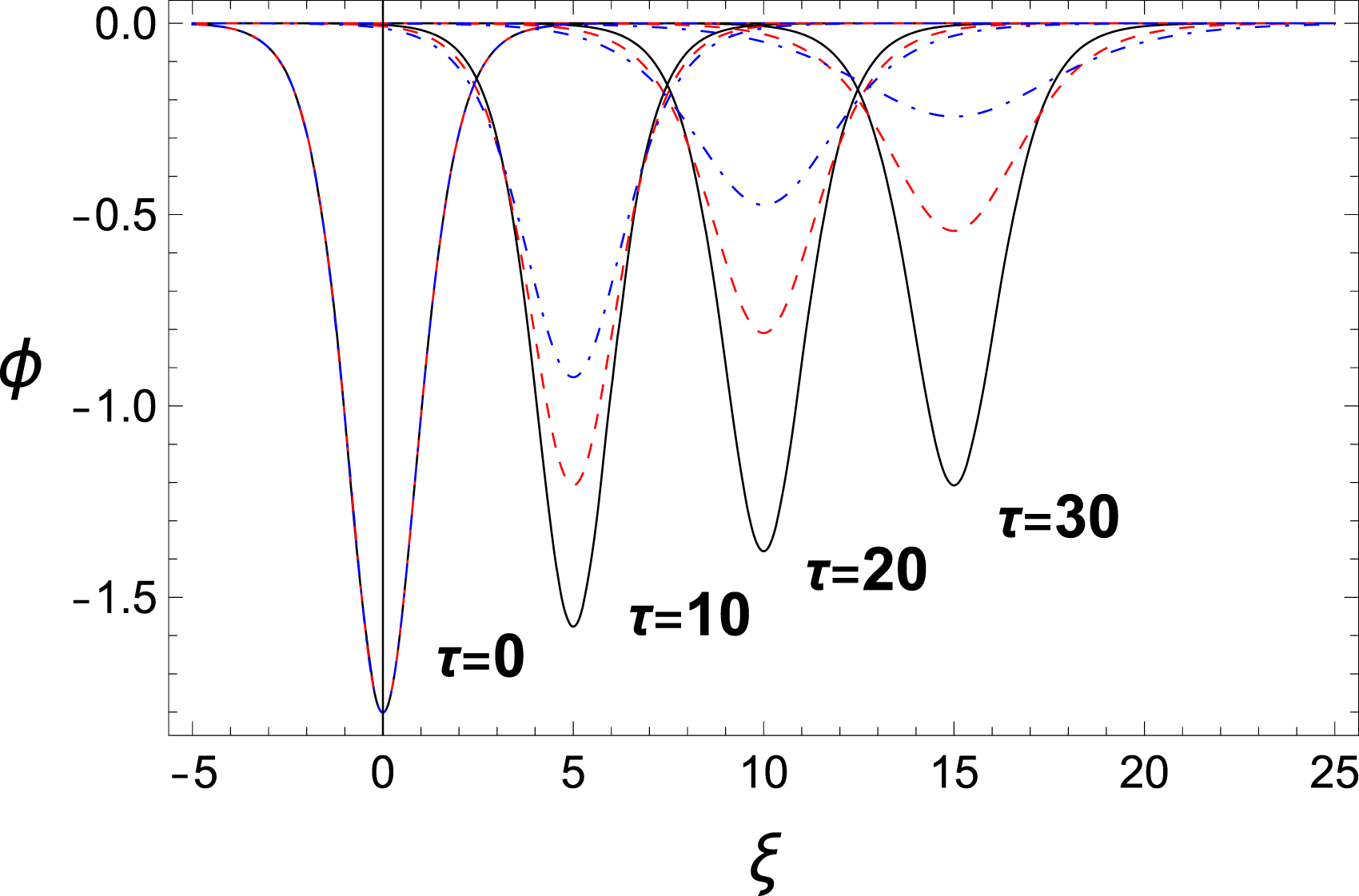
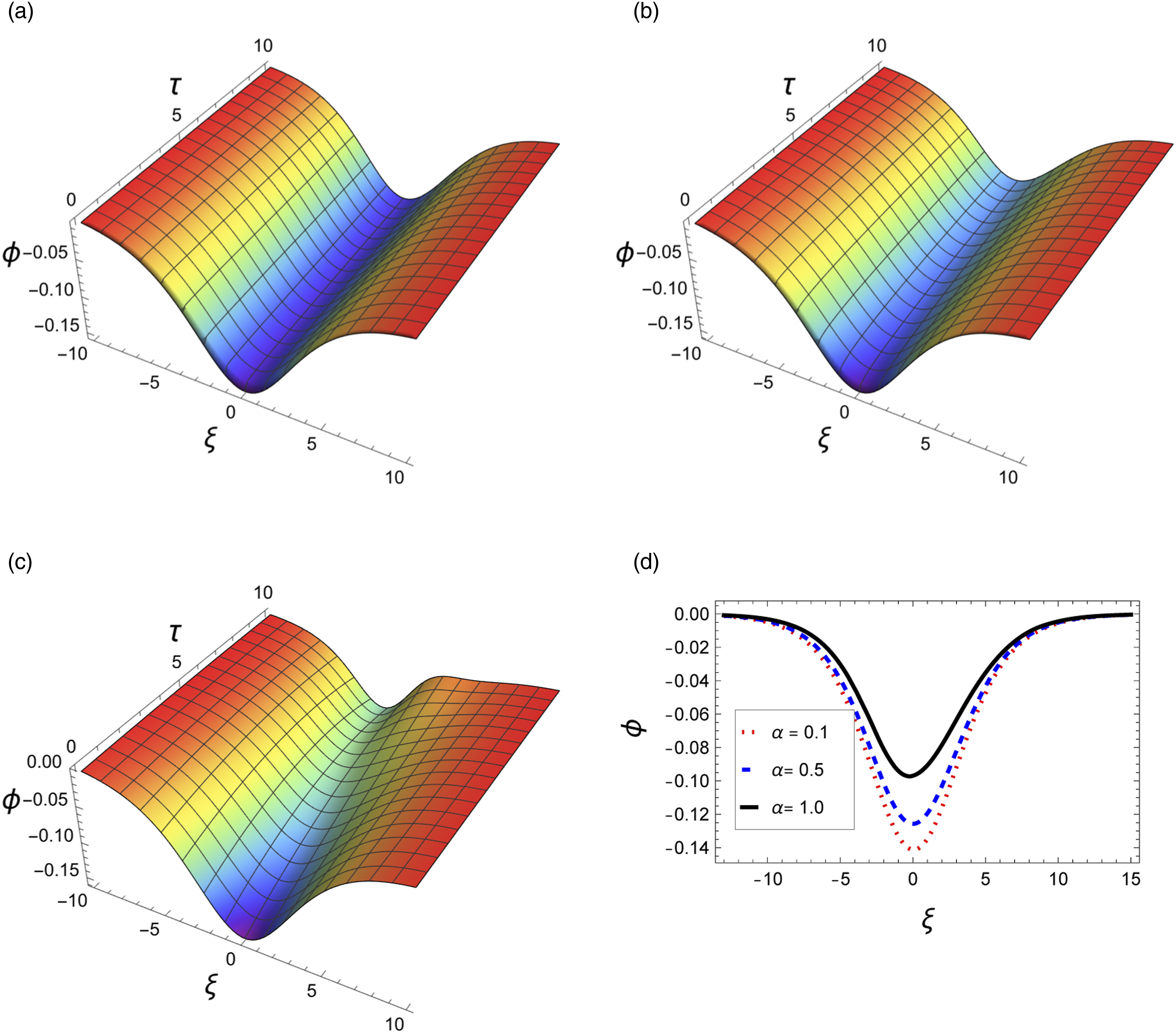

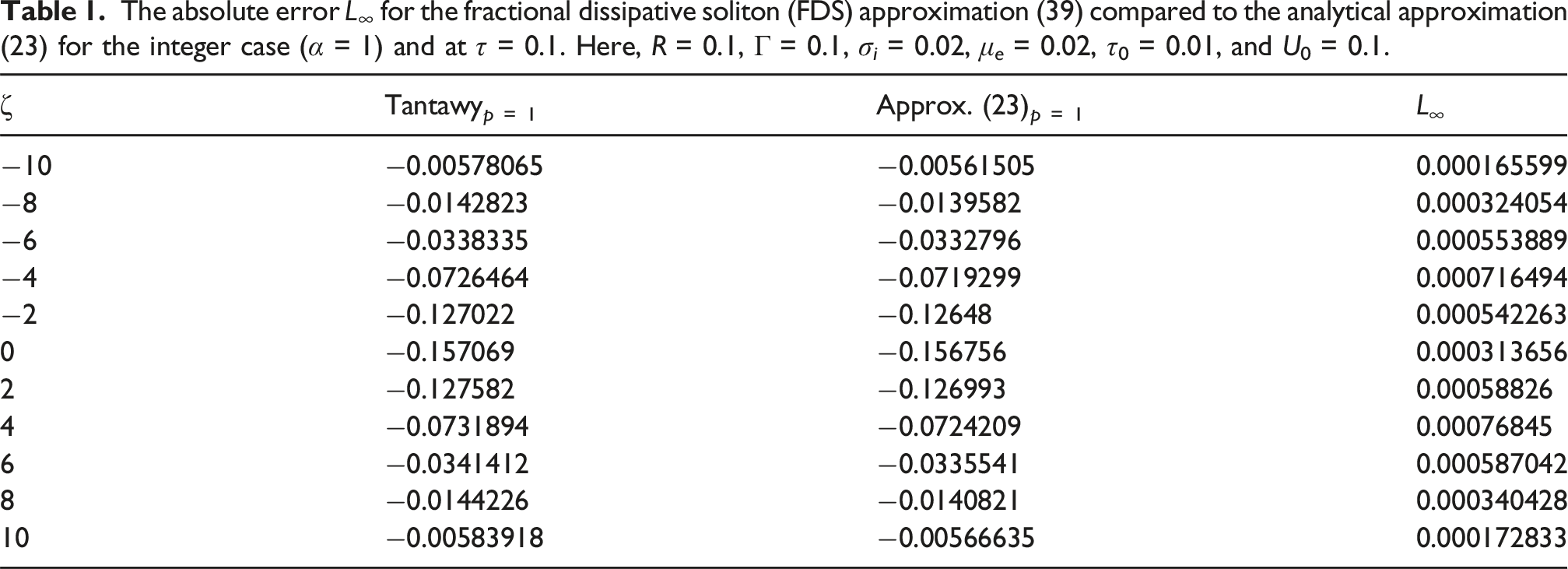
We conducted a graphic comparison between the analytical approximation (23) of the integer-order and the derived approximation (39) at α = 1, as illustrated in Figure 9. We also examined the analytical approximation (39) against the fractional-order parameter α at various time intervals, as seen in Figure 10. This figure illustrates that the profile of the fractional dissipative soliton changes over time during propagation, attributable to the collisional term’s influence. This figure also shows that the influence of the fractional-order parameter becomes more pronounced over longer durations. A comparison between the fractional dissipative soliton (FDS) approximation (39) at α = 1 and the approximation (23): (a) The 3-D profile of the FDS approximation in the The fractional dissipative soliton (FDS) approximation (39) is examined against 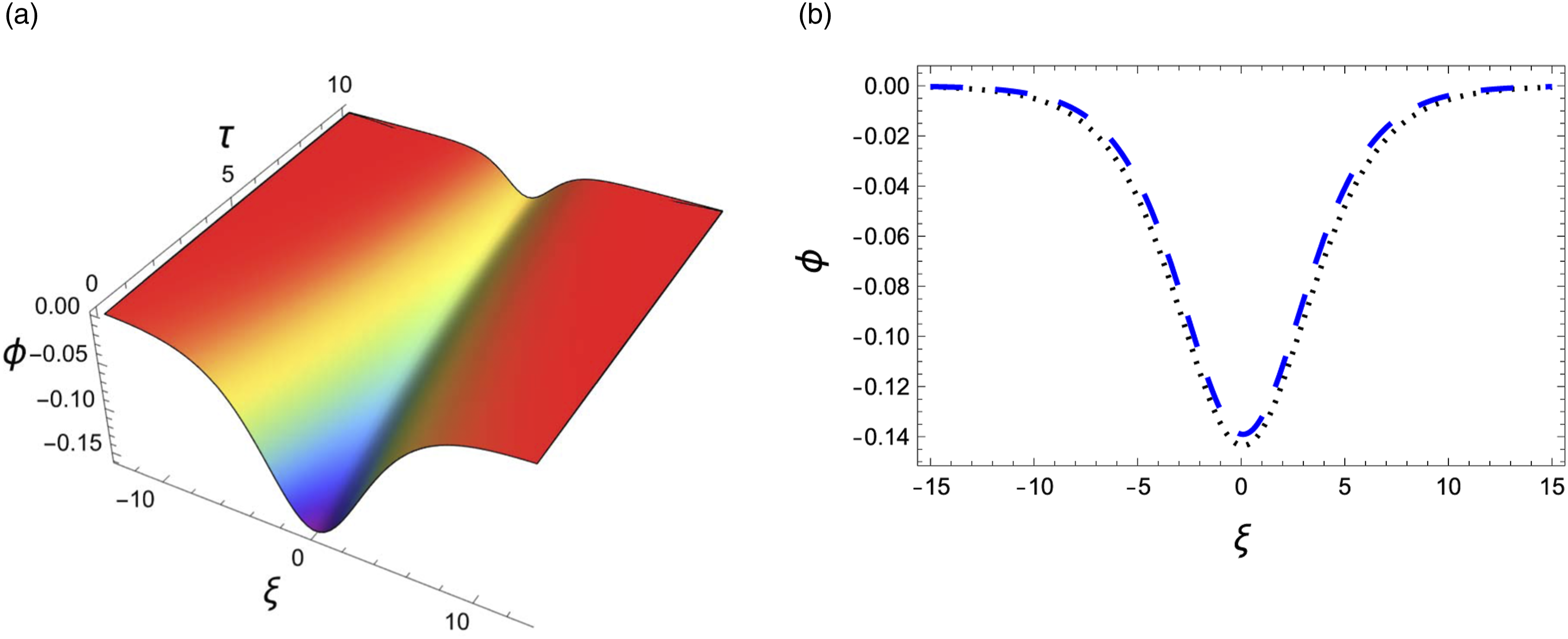
Conclusion
To conclude, we have examined the linear and nonlinear characteristics of both non-fractional and fractional dust-acoustic waves (DAWs) in a polarized dusty plasma composed of inertialess Maxwellian electrons and ions, along with inertial negatively charged dust grains. Dust-neutral collisions, characterized by a collision rate that is markedly lower than the dust plasma frequency, are the source of the dissipative effects. The use of the RPT yields the derivation of the damped KdV equation, whose analytical and numerical analysis reveals the existence of negative potential, weakly dissipative dust-acoustic solitons (DDASs), which evolve in a specific manner. In the linear case, the dispersion characteristics of DAWs are shown to have a profound dependence on the polarization force term, the electron concentration, and the dust-neutral collisional parameter. In the nonlinear limit, it was demonstrated that a substantial connection exists between the propagation characteristics of DDASs and the relevant plasma parameters, that is, the polarization force term R, the electron concentration μ e , and the collisional frequency term Γ d . Specifically, the amplitude (width) of the DDASs increases (decreases) with rising values of the electron concentration and the dust polarization force term. In contrast, smaller (in amplitude) and broader (in width) DDASs are produced by increasing dust-neutral impacts.
In the final part of this study, we investigated the properties of fractional dissipative solitons by reducing the integer-order (non-fractional) damped KdV equation to its corresponding damped fractional KdV (FKdV) equation through an appropriate transformation. Then, one of the latest and most accurate methods for analyzing FDEs, known as the Tantawy technique, was employed to analyze the damped FKdV equation and derive analytical approximations for this equation, aiming to gain a deeper understanding of the dynamics of fractional dissipative soliton propagation in plasma physics. The effect of the fractional parameter α on the behavior of fractional dispersive solitons was also studied, and it was found that the profile of fractional dissipative solitons is sensitive to any change in the fractional parameter α. One of the reasons for studying the fractionality impact on the behavior of various nonlinear waves in plasma physics is to gain a deeper insight of these phenomena and uncover some of the ambiguities that were previously unknown by studying these phenomena via integer-order EWEs. Fractional analysis may play a significant role in bridging the gap between the inconsistencies in some practical results or space observations and the theoretical results obtained by analyzing integer-order EWEs. The absolute error of the generated approximations at α = 1 has been estimated to assess the accuracy of these approximations and the efficiency of the used technique. Nevertheless, as the damped KdV equation lacks an exact solution owing to the damping term, we juxtaposed the resulting approximations with the semianalytical solution of the non-fractional damped KdV equation. The analytical results revealed the excellent accuracy of the derived approximations and their stability over the study domain, which enhances the efficiency of the Tantawy technique in addressing these types of stiff issue, commonly employed in various physical and engineering applications.
The present study may have relevance to various space plasma settings 76 (like cometary tails, planetary rings, etc.,) and laboratory plasma (fusion devices like Tokamaks,77,78 etc.,) wherein the dust-neutral collisions cannot be overlooked.
Future work: Numerous recent studies have examined the analysis of various types of evolutionary wave equations (EWEs) in their fractional forms to elucidate the dynamics and behavior of various enigmatic engineering and physical phenomena observed in laboratory experiments or space observations, which do not align with the theoretical analysis of these equations in their integer forms. From this perspective and for part (II) of this series, we will analyze the nonplanar (cylindrical and spherical) FKdV equation to attain a comprehensive grasp of the behavior and dynamics of the propagation of cylindrical and spherical fractional SWs and CWs. This will in turn offer more precise explanations for certain enigmatic phenomena observed in space, which the integer equations could not adequately elucidate. By analyzing the nonplanar FKdV equation and deriving approximations for the cylindrical and spherical SWs and CWs, we can explain the ambiguity surrounding these phenomena that manifest in many plasma systems and establish a convergence between laboratory data, specific space observations, and theoretical investigations. Numerous effective and precise mathematical techniques have successfully analyzed various fractional EWEs, yielding favorable results that can be applied to investigate the nonplanar FKdV equation, including HPH, RPSM, and NIM. Moreover, the Tantawy technique 65 has just emerged, producing results that frequently exceed those of alternative methods.
Footnotes
Acknowledgments
The authors express their gratitude to Princess Nourah bint Abdulrahman University Researchers Supporting Project Number (PNURSP2025R17), Princess Nourah bint Abdulrahman University, Riyadh, Saudi Arabia.

Author contributions
All authors contributed equally and approved the final version of the current manuscript.
Funding
The authors disclosed receipt of the following financial support for the research, authorship, and/or publication of this article: This work was supported by Princess Nourah bint Abdulrahman University Researchers Supporting Project Number (PNURSP2025R17), Princess Nourah bint Abdulrahman University, Riyadh, Saudi Arabia.
Declaration of conflicting interests
The authors confirm that they have no competing interests to disclose.
Data Availability Statement
Data sharing is not applicable to this article as no new data were created or analyzed in this study. El-Tantawy has executed all calculations, derived approximations, Mathematica codes, and figures.