




Abstract
This study investigates the nonlinear dynamics of low-frequency dust-acoustic waves in a viscous plasma environment. It emphasizes the formation and behavior of shock and solitary waves, considering the interplay between inertial fluid dust particles and inertialess Maxwellian ions and superthermal two-electron temperature (TET). The reductive perturbation method is applied to establish the nonlinear evolution equation, which involve both the Korteveg-de-Vries-Burgers (KdVB) and modified Korteveg-de-Vries-Burgers (mKdVB) equations. The quantitative and qualitative attributes of damped oscillatory waves, monotonic shock waves, and solitary waves are examined. The mKdVB equation is shown to support the propagation of dust-acoustic solitary waves, both compressive and rarefactive in nature, while the KdVB equation admits the propagation of dust-acoustic rarefactive solitary waves and dust-acoustic shock waves. Additionally, monotonic shock wave and damped oscillatory shock wave solutions of the KdVB and mKdVB equations are also found. It is observed that as Saturn’s magnetosphere expands, both the amplitude and the width of the electric field decrease. Regarding the analysis of the TET, Our study revealed that the magnitude and width of dust-acoustic solitons, whether compressive or rarefactive, grow with an increase in cold electron temperature and the kappa electron distribution. We also demonstrated that the dust viscosity parameter and kappa distribution of electrons significantly affect the magnitude of dust-acoustic monotonic shock waves and damped oscillatory shock waves. These investigations contribute to understanding nonlinear structures in Saturn’s inner magnetosphere, a region where dust grains and superthermal TET have been detected by various satellite missions.
Keywords
Introduction
The study of dusty plasmas has garnered significant attention from researchers worldwide in recent years. These plasmas contain particles as small as nanometers or micrometers suspended within them. The study of dusty plasmas is a novel and remarkable field, enabled by the collective and interacting processes between charged dust grains and plasmas.1–3 Generally, these plasmas are partially or completely ionized gases consisting of electrons, ions, neutral gas molecules, and micron-sized charged dust grains. These dust grains can acquire thousands of electron charges and be billions of times heavier than the ions. 4 The size of the dust particles affects their charge; larger dust particles possess a higher charge. In the presence of these dust particles, coupling through electrostatic forces or other forces, such as collisions or viscous forces, may occur, leading to a transition from weakly linked to crystallized structures.5,6 Therefore, the wave characteristics in such complex systems are expected to differ significantly from those of ordinary two-component plasmas. Although dust grains may not actively contribute to wave motion at certain frequencies, their presence as charged particles can significantly influence the characteristics of typical plasma wave modes.7,8 Recently, the study of various collective processes in dusty plasmas has garnered substantial attention due to its significance and relevance in astrophysical, space, and laboratory plasma settings, including cometary tails and asteroid zones, planetary magnetospheres, mesosphere, interstellar media, interplanetary space.4,9–13 However, viscosity has a significant impact that cannot be disregarded in various plasma systems, including ultra-cold neutral plasmas and strongly coupled dusty plasmas. Electrons in plasma are used to charge dust grains by connecting them to their surface, leading the plasma to run out of electrons entirely. Additionally, the laboratory observations and Saturn’s F-ring also have this instance. 14
Radio data collected from the Cassini spacecraft14–16 indicates that ions at high-energy levels follow a power law as they orbit Saturn’s magnetosphere. To align with the observational data from Saturn’s magnetosphere, the author, 16 using the kappa distribution, used values of κ between 6 and 8. The Cassini team’s latest observations from the spacecraft orbiting Saturn’s magnetosphere showed distances between 5.4 and 18 R s , where R s is the radius of Saturn, which is R s = 60,268 km. 17 The kappa-distributed electrons in the magnetosphere of Saturn provide an adequate justification for the measured facts. Vasyliunas 18 first introduced the concept of kappa velocity distribution functions, illustrating that plasmas with an abundance of superthermal non-Maxwellian electrons typically have a long tail in the high-energy region. In space plasmas, high-energy particles commonly follow non-Maxwellian distributions, including the kappa distribution and the coextensive q-distribution. The kappa-distributed electron was used to study nonlinear ion-acoustic traveling waves in Ref. 19. Recently, Goswami et al. 20 explored the effects of kappa-distributed positrons and warm electrons on amplitude-modulated electron-acoustic waves, with a focus on bipolar ions. Space plasmas in regions like the terrestrial magnetosheath and interstellar medium exhibit two challenging kinetic features: (1) flattened “flat-top” distributions at low energies, indicating suppression of near-thermal particles, and (2) enhanced high-energy tails revealing suprathermal populations. While Maxwellian distributions fail to capture these non-equilibrium features and κ-distributions only model the suprathermal component with a single index, the (r, q) distribution elegantly resolves both phenomena through its dual-parameter structure, with r controlling core flattening and q governing tail enhancement. This provides a unified framework that not only generalizes traditional models (reducing to κ when r = 0 and Maxwellian when q → ∞) but also offers physical interpretability by linking parameters to underlying processes like turbulent heating (r) and particle acceleration (q). The distribution has proven particularly valuable in magnetosheath studies, 21 solar wind, 22 and as benchmarks for kinetic simulations. 23 Batool et al. 24 examined the influence of the (r, q) electron distribution on the formation and interaction of multiple solitons, drawing on data from the Cassini spacecraft’s observations in Saturn’s magnetosphere. Refs. 25–27 studied how the properties of solitary waves and nonlinear cnoidal waves depend on generalized electron distributions. Furthermore, the propagation of the electron-acoustic 28 and positron-acoustic 29 cnoidal waves has been investigated to examine the effects of the nonthermal parameter.
Dusty plasmas with dissipative properties support shock waves rather than solitary ones. Factors contributing to dissipation in dusty plasmas include dust collisions, dust-charge fluctuations, Landau damping, and dust fluid viscosity, which can all alter wave characteristics.30–32 Tiofack et al. 33 examined the effect of kinematic viscosity-induced dissipation on the propagation of solitary wave structures. They also studied the impact of self-gravitation on the dynamics of multi-rogue waves and dark soliton collisions. In addition, the study in Ref. 34 examined how variations in dust kinematic viscosity impact breathers and rogue waves in a dusty plasma with kappa-distributed particles, demonstrating that these variations enhance wave properties. The Korteweg-de-Vries (KdV) equation was derived by factoring in the effects of nonthermal ions. 35 This nonthermal plasma model was similarly applied in the derivation of the updated KdV equation.36,37 Only solitary waves with finite amplitude were visible in the data in 38–41. Many authors have explored the influence of dust kinematic viscosity in complex plasmas with kappa distribution or generalized (r, q) distribution.42–44 In other studies, The reductive perturbation technique (RPT) was utilized to study dust-acoustic (DA) shock waves in dusty plasmas, taking into account dust-charge fluctuations and the effects of nonthermal ions, leading to the construction of the KdV-Burgers (KdVB) equation.45–47 Very recently, the Tantawy technique has been employed to investigate the family of fractional Burgers equations, 48 which are crucial in the study of shock waves in plasma physics, as well as the Fokker-Planck equations, 49 which is widely used in optical physics.
Various partial differential equations describe nonlinear waves in multiple fields, including optical fibers, Bose-Einstein condensates, oceanography, plasma physics, and biophysics, among others.50–54 Many researchers have shown interest in studying complex plasma’s two-electron temperature (TET). Some notable studies include shock waves in dusty plasma with TET, 55 solitary and shock waves in a TET, 56 face-to-face collision of ion-acoustic solitary and shock waves in a TET plasma, 57 multidimensional rogue waves in dusty magnetoplasmas having superthermal ion with TET, 58 and the study of dust grains in the presence of superthermal electrons. 59 It is commonly known that the evolution of shock waves, including solitons, is described by the KdV equation and its family. Solitons can propagate within a wavepacket without oscillations because they form when wave dispersion and nonlinearity are balanced. Nonlinear wavepackets can occasionally propagate in dispersive media, with external disturbances leading to an exponential increase in wave amplitude.60–63
To the best of our knowledge, there are no existing reports on the shock wave phenomena and bifurcation of DA waves (DAWs) in a complex viscous plasma with kappa-distributed TET in Saturn’s inner magnetosphere. Therefore, using the KdVB and modified KdVB (mKdVB) equations as a framework, our goal in this work is to conduct a quantitative and qualitative analysis of shock waves in a plasma model containing bi-kappa hot (cold) electrons and negatively charged dust grains. We examine the dust-acoustic shock waves (DASWs) solution of the KdVB equation along with their associated damped oscillatory and monotonic shock waves, about the effect of various parameters. We also examine the dust-acoustic compressive solitary wave (DACSW) and dust-acoustic rarefactive solitary wave (DARSW) solutions of the mKdVB equation.
Basic fluid equations
In this study, we explore DAWs in an unmagnetized viscous dusty plasma made up of inertialess Kappa TET and thermal ions as well as inertial dust grains. Given that Z
d
denotes the dust charge and nh0, nc0, ni0, and nd0 denote the unperturbed number densities of hot and cold electrons, ions, and dust grains, respectively, and accordingly, the neutrality condition for this model can be expressed as ni0 = nc0 + nh0 + Z
d
nd0. The set of normalized equations that explain how DAWs evolve is written as
64
:
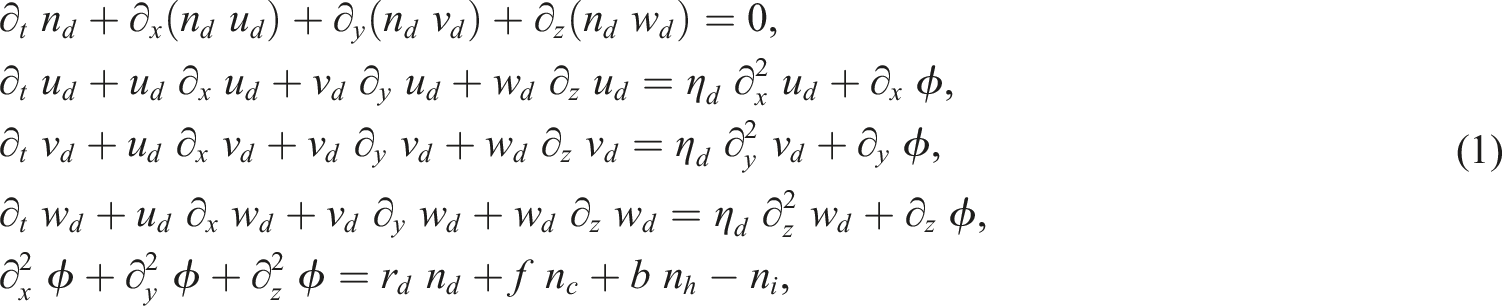
It is essential to remember that T
i
stands for the ion’s temperature, whereas Tc,h stands for cold and hot kappa dispersed electrons. The parameter η
d
= ϵ1/2 η represents the dust kinematic viscosity. The time is scaled by

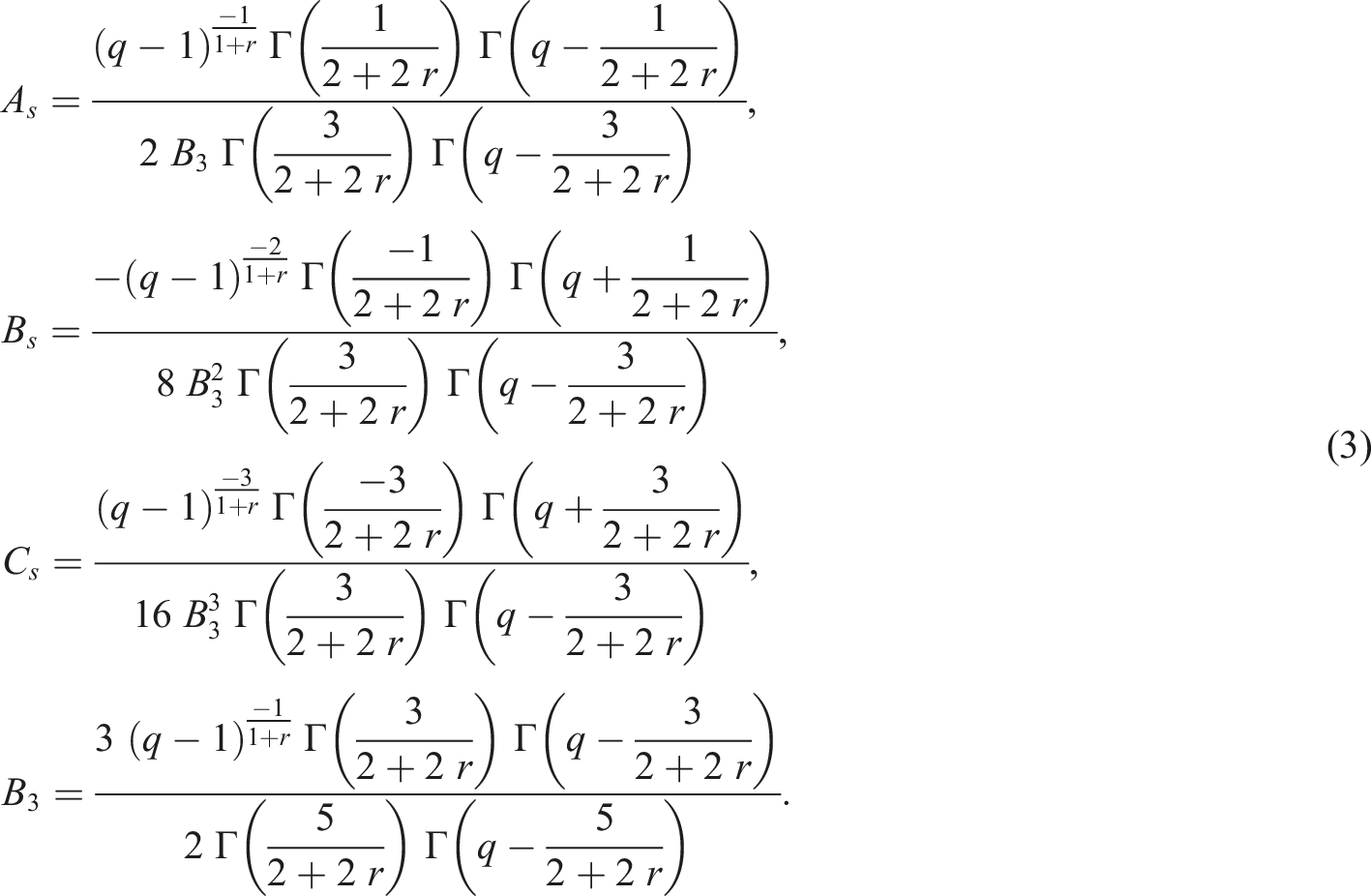
On the other hand, the Maxwellian ion’s normalized number density is as follows
64
:

By using the Taylor’s expansion to equations (2), and (4), then substituting into the last equation of system (1), one can obtain the following Poisson’s equation:


Derivation of the KDVB equation
We use the classic RPT, where the space and time coordinates are stretched as a function of the dust-charge fluctuation, to get the evolution equation for DAWs in a viscous dusty plasma:
ξ = ϵ1/2 (l1 x + l2 y + l3 z − v
p
t), τ = ϵ3/2 t, and η
d
= ϵ1/2 η,where ϵ, (0 < ϵ < 1) is a scaling parameter that measures the weakening of the perturbation amplitudes, and v
p
is the phase velocity. Additionally, the wave vector’s direction cosines are l
x
, l
y
, and l
z
, so that:
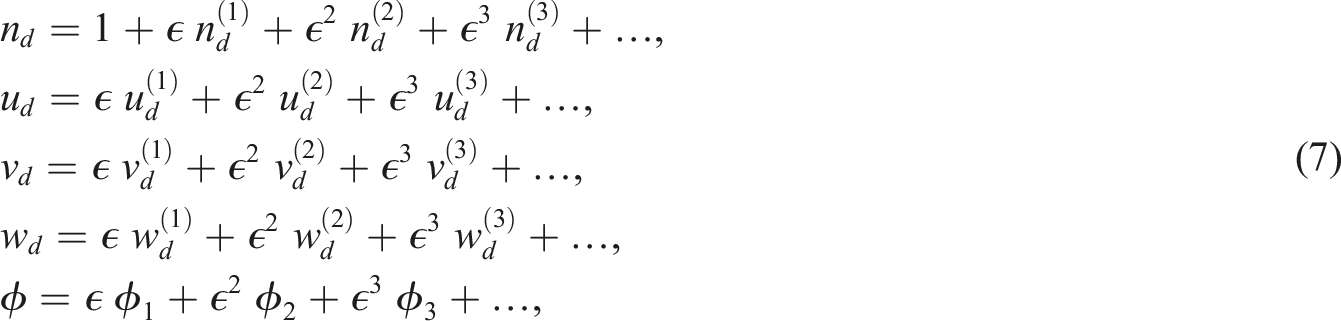
The first-order solutions as a function of the potential are obtained by rewriting the equations of system (1) into the fundamental equations and solving the resulting system at a lower order of ϵ:

Furthermore, the phase velocity can be deduced on the above solutions as

Through substituting the lowest order of the x, y, and z momentum components with the subsequent higher order of epsilon in the momentum equations, we have got the following relations:
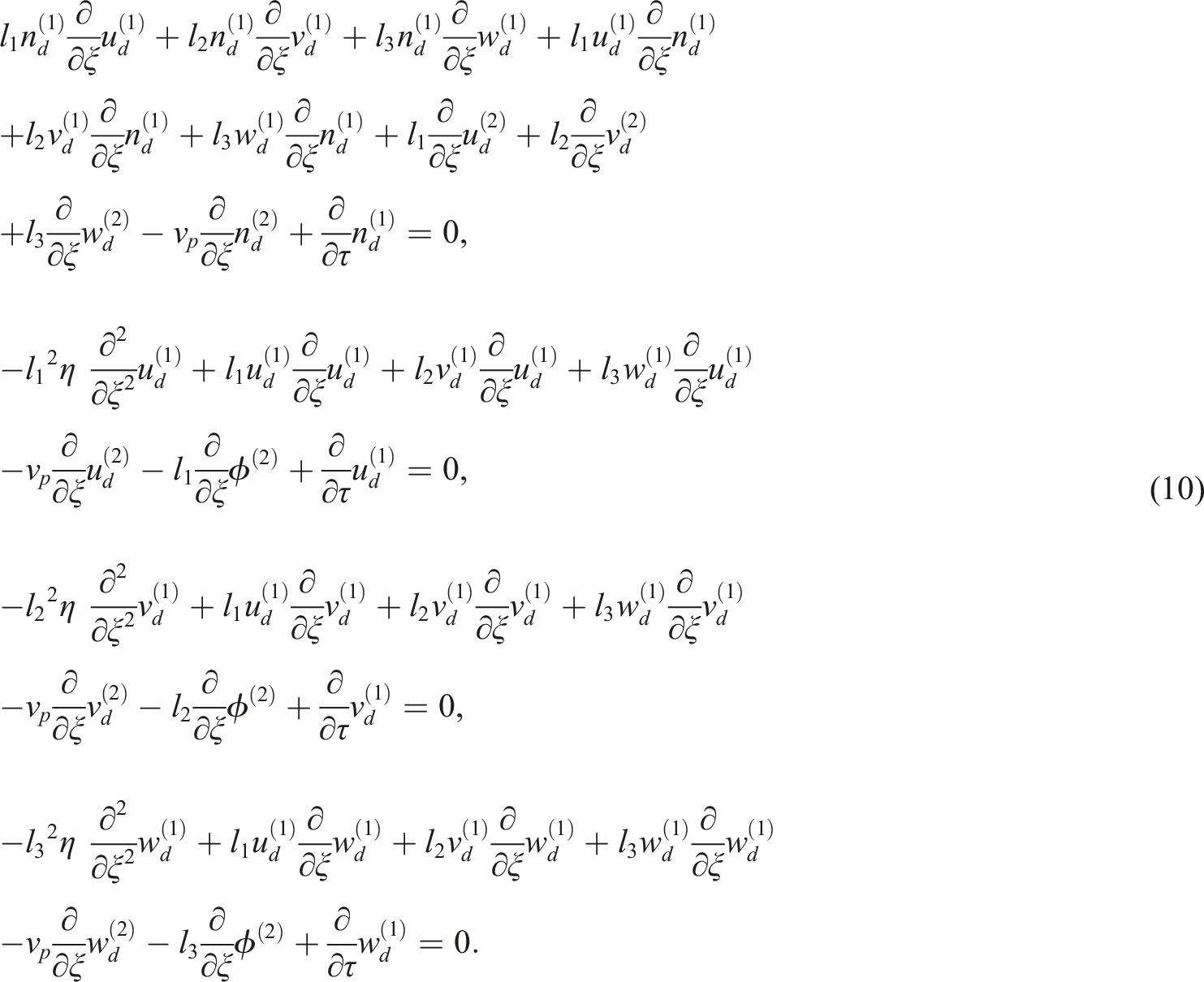
By solving this system with the help of the third order quantities one can easily obtain the KdVB equation which governs the dynamics of viscous DAWs in Saturn’s inner magnetosphere where two-electrons temperature effect is considered:


Analysis of bifurcation and solution of the KdVB equation
By applying the transformation ζ = (ξ − u0 τ) to the KdVB equation and integrating with respect to ζ, the resulting expression is obtained as follows:

The bifurcation approach is used to examine potential solution types by examining system phase portrait. We can obtain the following dynamical system for KdVB equation:

Periodic orbits near the center give rise to a family of periodic wave solutions. Bifurcation analysis identifies two equilibrium points: a saddle point at (0, 0) and a center point at (2 u0/A, 0). Figure 1 illustrates this behavior: Figure 1(a) depicts the dissipation-free case, while Figure 1(b) shows the outward spiral induced by dissipation. In contrast, a homoclinic orbit at (0, 0) generates a rarefactive solitary wave solution, a soliton arising when dissipation is neglected and which is given by: Phase portrait of equation (14): Panel (a) with η = 0, while in (b) η = 0.1. Along with, T
c
= 2 eV, Z
d
= 100, nh0 = 0.05, T
h
= 1400 eV, T
i
= 0.1 eV, nc0 = 10.5, q = 5, and r = −0.4, and u0 = 0.2.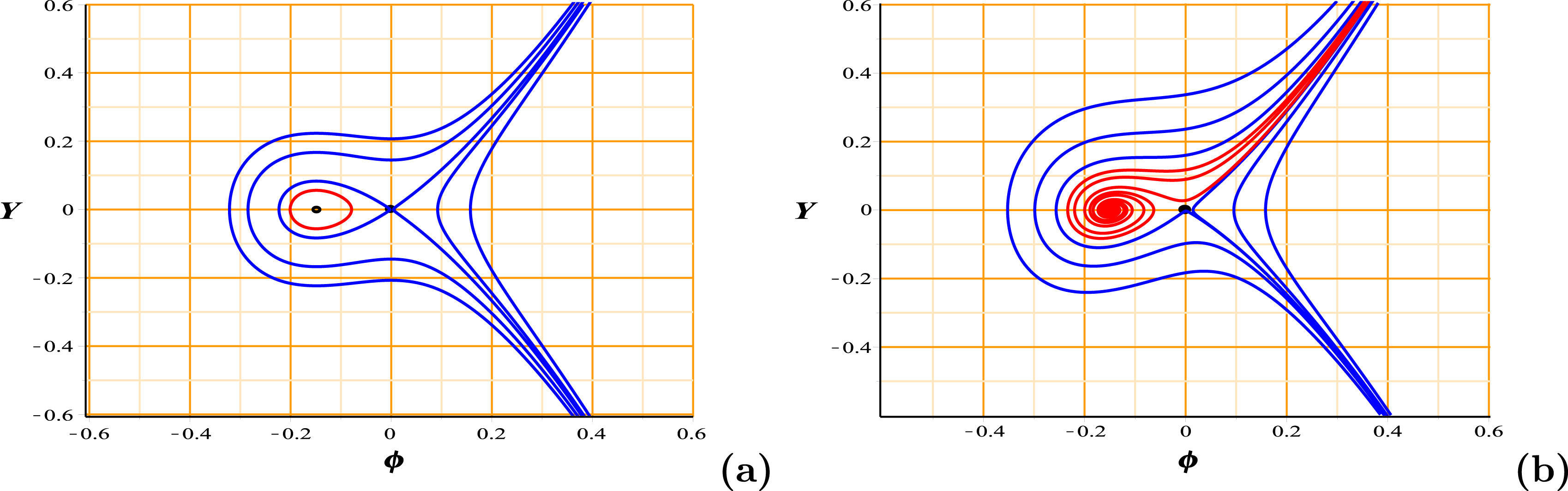

Generally, the system of equations becomes dissipative and the total energy is not conservative when the Burgers term C is included in the KdVB equation. Therefore, it renders it harder to construct the precise solution of the KdVB equation with simplicity. A wide range of computational methods have been developed to solve various kinds of nonlinear differential equations. The tangent hyperbolic (tanh) approach was one of them.
65
It has been demonstrated that this approach is an effective mathematical strategy for resolving these kinds of problems. The transformation ζ = (ξ − u0 τ) and Y = tanh(μ ζ) have been applied in compliance with this process, where u0 is the nonlinear structural velocity and 1/μ represents the width of the soliton. Although the order of the linear term and the highest order nonlinear term are balanced, the tanh technique provides the solution for partial differential equation (11), which yields the following series solutions:


When the dissipative term outweighs the dispersive term, a different kind of solution can be produced. Integrating the KdVB equation with respect to ζ yields the following result:



A monotonic shock wave is truly described by this kind of solution, and its behavior is compared to the relevant plasma properties.
However, if we take the asymptotic boundary condition into account, we can obtain a different kind of solution of particular importance. This suggests that as ζ → ±∞, we have d2ϕ/dζ2 = dϕ/dζ = 0. This provides the nonlinear KdVB differential equation’s asymptotic solution as: ϕ0 = 2 u0/A. By assuming that ϕ = ϕ0 + ϕ1, the second-order linear differential equation is linearizable from equation (18) and we obtain:


Qualitative analysis of the KdVB solution
We will use in this work the following plasma parameters values, which belong to the inner magnetosphere of Saturn (5.4R s − 9.8R s ). For this region, the plasma parameters chosen are: T c = (0.01 − 2)eV, T h = (300 − 1400)eV, T i = 0.1 eV, n c = (2.5 − 10.8)cm−3, n h = (0.01 − 0.07)cm−3, n d = 0.05 cm−3, Z d = 100. 66
We now analyze DARWs behavior using relevant plasma parameters. Figure 2(a) demonstrates the influence of cold electron temperature T
c
on DARWs amplitude, revealing a direct correlation: higher T
c
values amplify the waves. Figure 2(b) and (c) illustrate how (r, q)-distributed electrons act on the maximum amplitude of rarefactive solitary waves. Notably, the amplitude of DARWs diminishes with increasing spectral index q (Figure 2(b)), indicating stronger superthermality, while it grows with increasing nonthermal parameter r (Figure 2(c)), which enhances the population of energetic electrons. Figure 2(d) presents the impact of cold electron density on DARWs amplitude. The rarefactive amplitude, derived from the KdVB equation, decreases with rising cold electron density. This trend stems from the quasi-neutrality condition, which links increased cold electron density to reduced dust number density. The behavior of DASWs will now be investigated using relevant plasma parameters. Figure 3(a) illustrates how the amplitude of DASWs is influenced by the q electron distribution. The amplitude of DASWs notably increases with the rising value of the nonextensive parameter q, reflecting its significant influence on wave dynamics. Figure 3(b) shows how the spectral index (r) affects DASWs. The amplitude of DASWs decreases as the value of r increases. It is important to highlight that higher r values correspond to a weakened non-Maxwellian tail, indicating a more distinct solitary structure as the population of energetic cold electrons in phase space decreases. Figure 3(c) reveals the dissipation’s effect on the amplitude of DASWs (via η). As viscosity increases, the amplitude of the shock wave predicted by the KdVB equation (11) shows a corresponding rise. This is explained by the shock wave’s magnitude, which is proportional to the dissipation coefficient. Figure 4 illustrates the variation of the related electric field E of DASWs. As illustrated in Figure 4(a) and (b), both r and T
c
influence the electric field in comparable ways. Specifically, as the values of r and T
c
increase, the amplitude and width of the electric field associated with DASWs of the KdVB equation (11) decrease. In contrast, the behavior observed in Figure 4(c) and (d) reveals a different trend. As q and R
s
increase, both the amplitude and width of the electric field exhibit corresponding growth. Dust-acoustic rarefactive waves solution (15): Variation of cold electron temperature in panel (a) with Z
d
= 100, nh0 = 0.05, T
h
= 1400 eV, T
i
= 0.1 eV, nc0 = 10.5. Influence of q, and r distribution in panel (b), and (c) respectively, with Z
d
= 100, nh0 = 0.01, nd0 = 0.05, T
h
= 1400 eV, T
i
= 0.1 eV, T
c
= 2 eV, and nc0 = 2.5. The impact of the cold electron density in panel (d) with Z
d
= 100, nh0 = 0.01, nd0 = 0.05, T
h
= 1400 eV, T
i
= 0.1 eV, and T
c
= 2 eV. Along with q = 5, r = −0.4, η = 0.6, and u0 = 0.2. Evolution of the electrostatic potential solution (24). Influence of q, and r distribution in panel (a), and (b) respectively, with Z
d
= 100, nh0 = 0.01, nd0 = 0.05, T
h
= 1400 eV, T
i
= 0.1 eV, T
c
= 2 eV, u0 = 0.2, and nc0 = 2.5. Panel (c) shows the dissipation effect via η. The evolution of the electric field solution (17). Influence of spectral index r in panel (a) with Z
d
= 100, nh0 = 0.01, nd0 = 0.05, T
h
= 1400 eV, T
i
= 0.1 eV, T
c
= 2 eV, u0 = 0.2, and nc0 = 2.5. Impact of cold electron temperature on E in panel (b) with Z
d
= 100, nh0 = 0.05, nc0 = 10.5, T
h
= 1400 eV, T
c
= 0.1 eV, T
i
= 0.1 eV. Influence of the nonextensive index on E in panel (c) with Z
d
= 100, nh0 = 0.01, nd0 = 0.05, T
h
= 1400 eV, T
i
= 0.1 eV, T
c
= 2 eV, u0 = 0.2, and nc0 = 2.5. Influence of the Saturn magnetosphere radius variation on E in panel (d) with T
i
= 0.1 eV. Along with η = 0.6, and u0 = 0.2.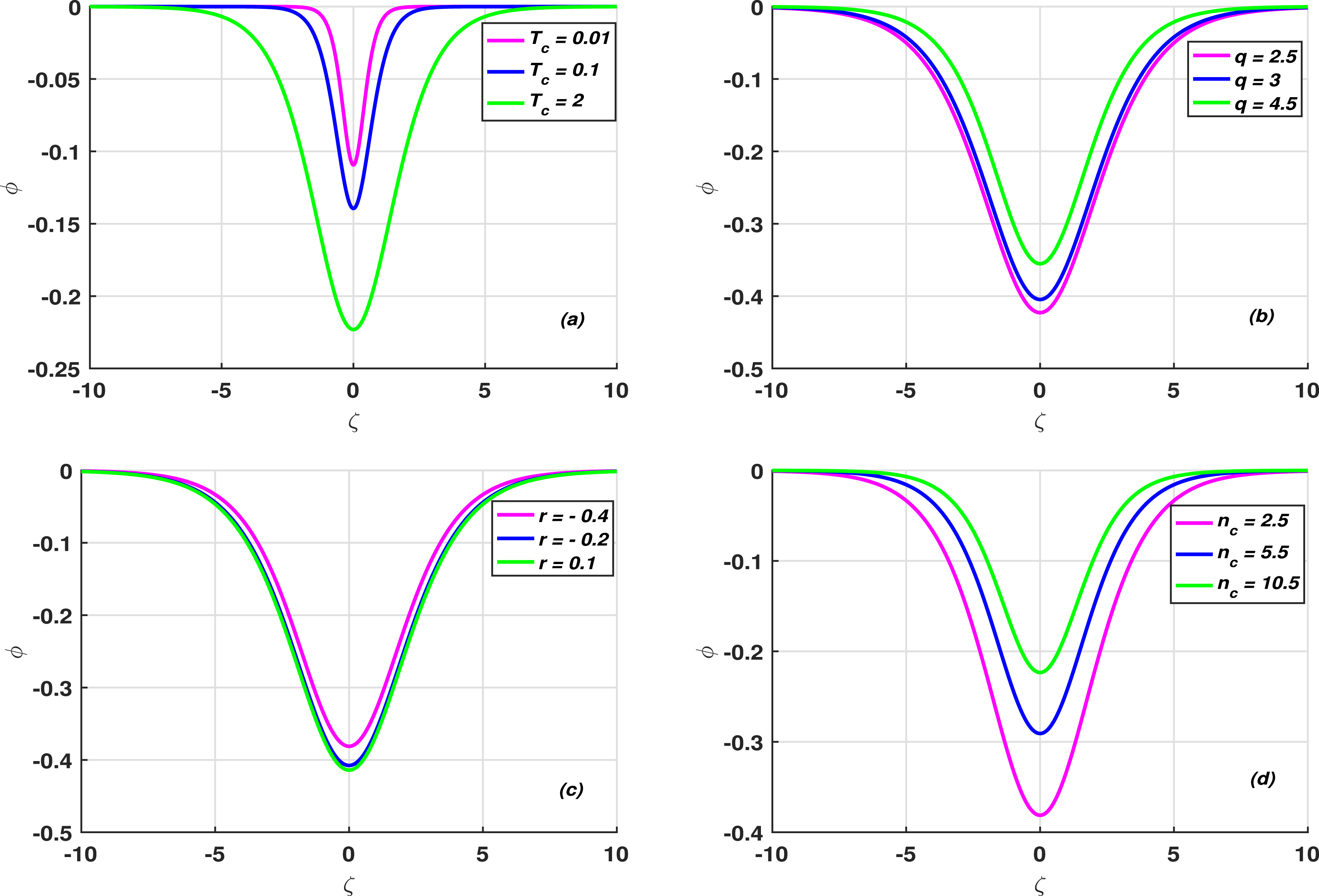
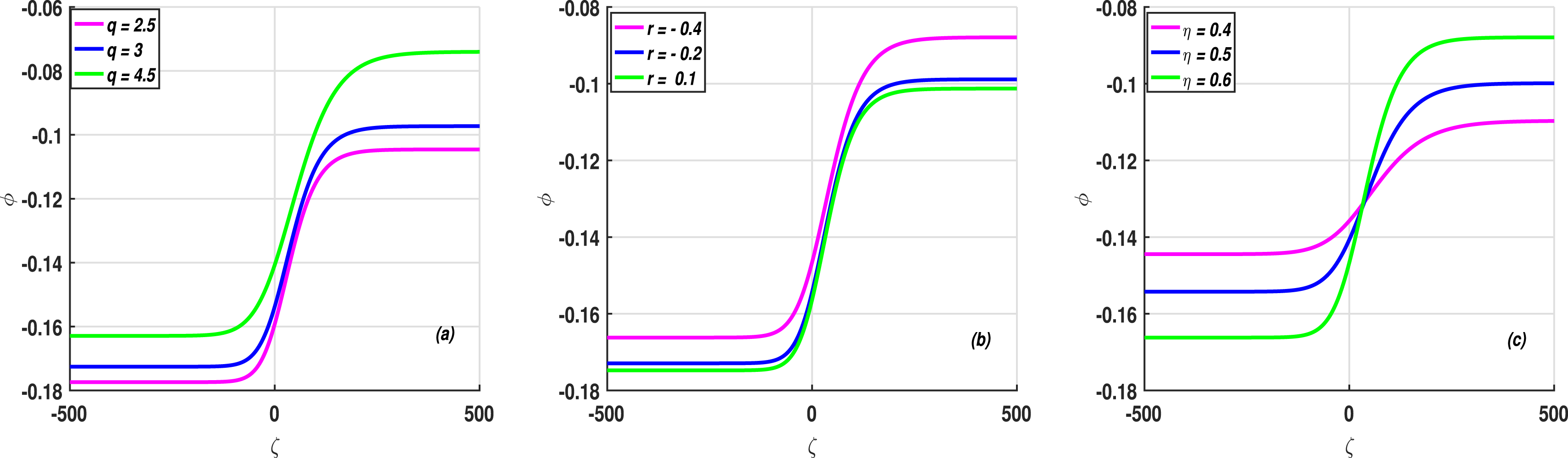
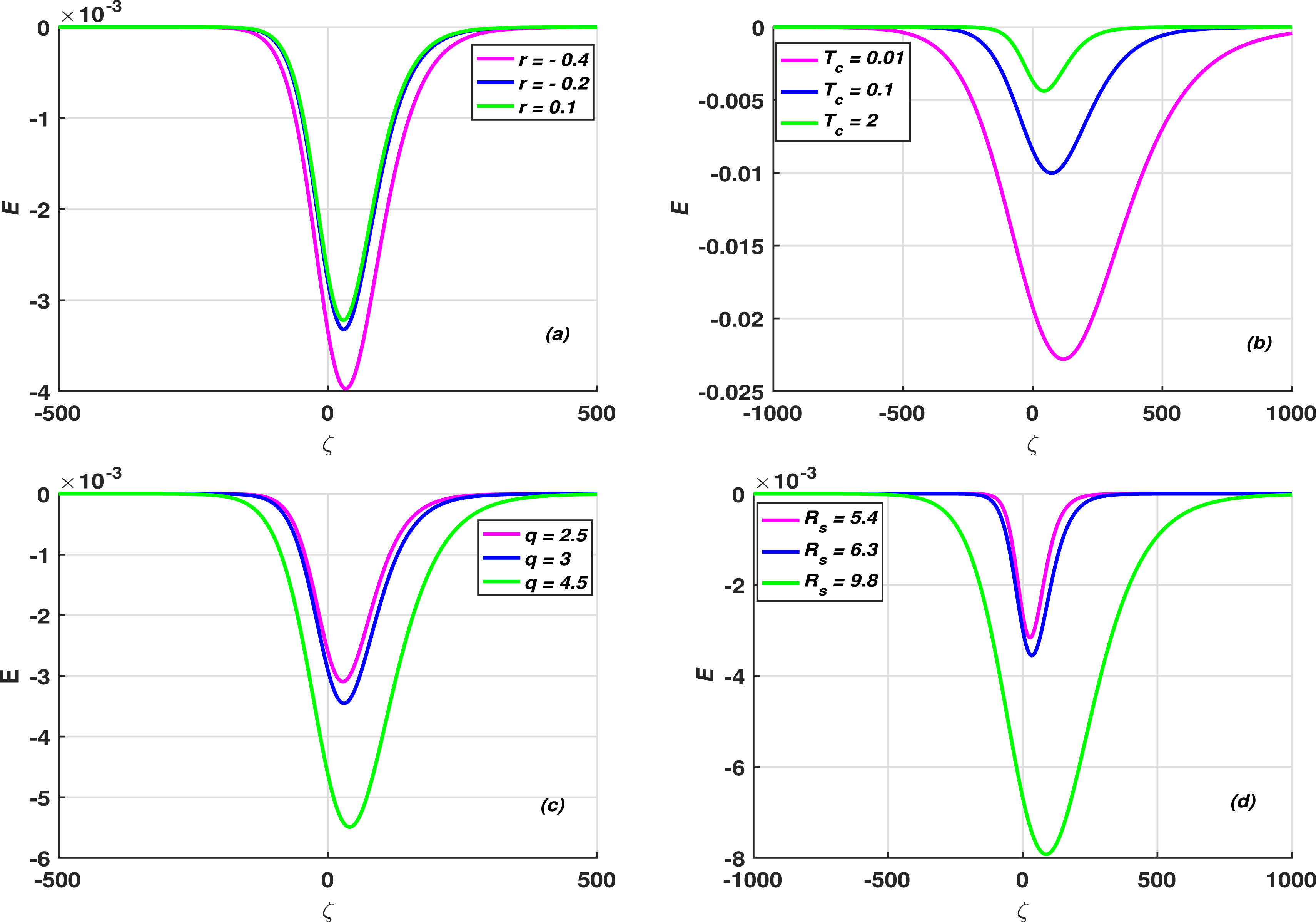
Figure 5 illustrates the profile of dust-acoustic monotonic shock waves (DAMSWs) described by equation (20) at different values of the radius parameter R
s
, viscosity η, and the spectral index q. Figure 5(a) shows that the amplitude decreases with increasing R
s
, and a similar trend is observed in Figure 5(c) as the parameter q increase. While the opposite is true for the q parameter as shown in panel Figure 5(c). Consequently, increasing R
s
causes the system’s dispersion and dissipation to decrease, which lowers the shock wave’s characteristics. Solitons emerge in conservative systems due to the interplay between dispersion and nonlinearity, achieving a delicate balance. Conversely, non-conservative systems can produce shock waves through the interplay of dispersion and dissipation. Consequently, an increase in the spectral index q leads to an enhancement of the shock wave’s amplitude, suggesting that a TET complex plasma following the (r, q) distribution experiences a larger shock wave. Conversely, Figure 5(b) demonstrates that the width of the monotonic shock wave grows as the value of η increases. Dust-acoustic monotonic shock waves solution (20): Variation of the Saturn magnetosphere radius in panel (a) with, R
s
= 5.4, (T
i
= 0.001 T
c
eV, nc0 = 10.5, T
c
= 1.8 eV, T
h
= 300 eV, Z
d
= 100, nd0 = 0.32, and nh0 = 0.02). R
s
= 6.3, (T
i
= 0.001 T
c
eV, nc0 = 10.5, T
c
= 2 eV, T
h
= 1400 eV, Z
d
= 100, nd0 = 0.05, and nh0 = 0.01). R
s
= 9.8, (T
i
= 0.001 T
c
eV, nc0 = 2.5, T
c
= 8 eV, T
h
= 1100 eV, Z
d
= 100, nd0 = 0.002, and nh0 = 0.07). The viscosity effect in panel (b) with, Z
d
= 100, n
h
= 0.01, n
d
= 0.05, T
h
= 1400, T
i
= 0.1, T
c
= 2, n
c
= 5.5. Influence of q distribution in panel (c), with Z
d
= 100, nh0 = 0.01, nd0 = 0.05, T
h
= 1400 eV, T
i
= 0.1 eV, T
c
= 2 eV, and nc0 = 2.5. Along with r = −0.4, η = 0.6, and u0 = 0.2.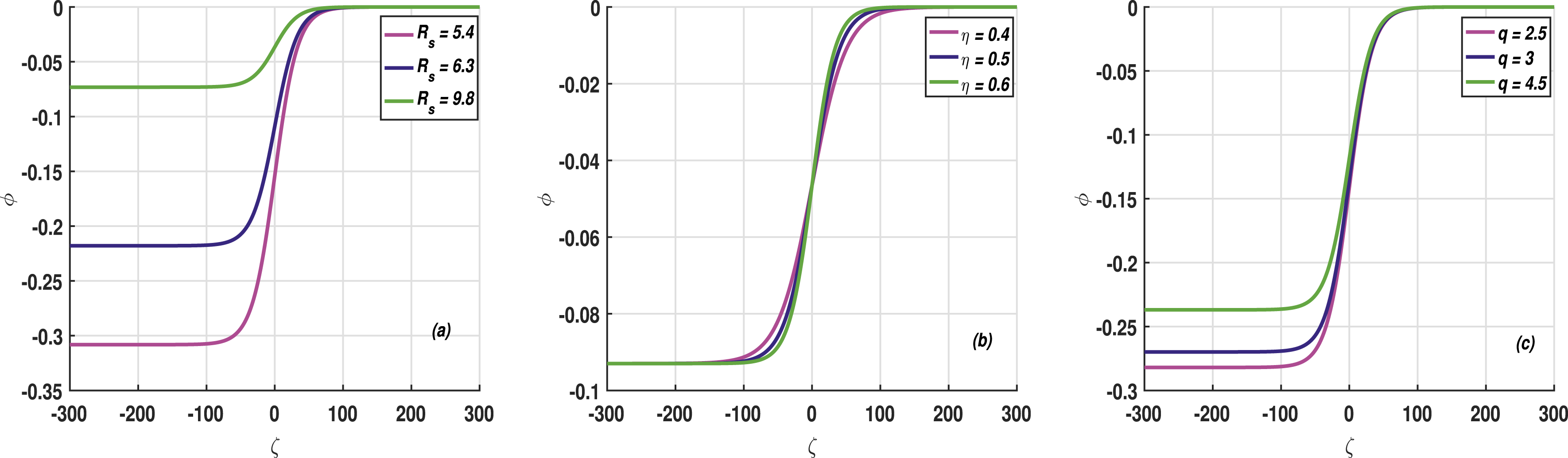
Figure 6 displays the dust-acoustic damped oscillatory shock waves (DADOSWs) solution plotted against ζ for various plasma characteristics. In Figure 6(a), the profile of damped oscillatory shock waves changes with kinematic viscosity, while Figure 6(b) illustrates the variations of damped oscillatory shocks with different values of the cold electron densities. The figures reveal that the amplitude of the oscillatory shock wave rises as η increases, while it diminishes with higher values of n
c
. Damped oscillatory shock waves solution (22): The viscosity effect in panel (a) with Z
d
= 100, nh0 = 0.01, nd0 = 0.05, T
h
= 1400 eV, T
i
= 0.1 eV, T
c
= 2 eV, u0 = 0.2, q = 5, and r = −0.4, and the cold electron density variation in panel (b).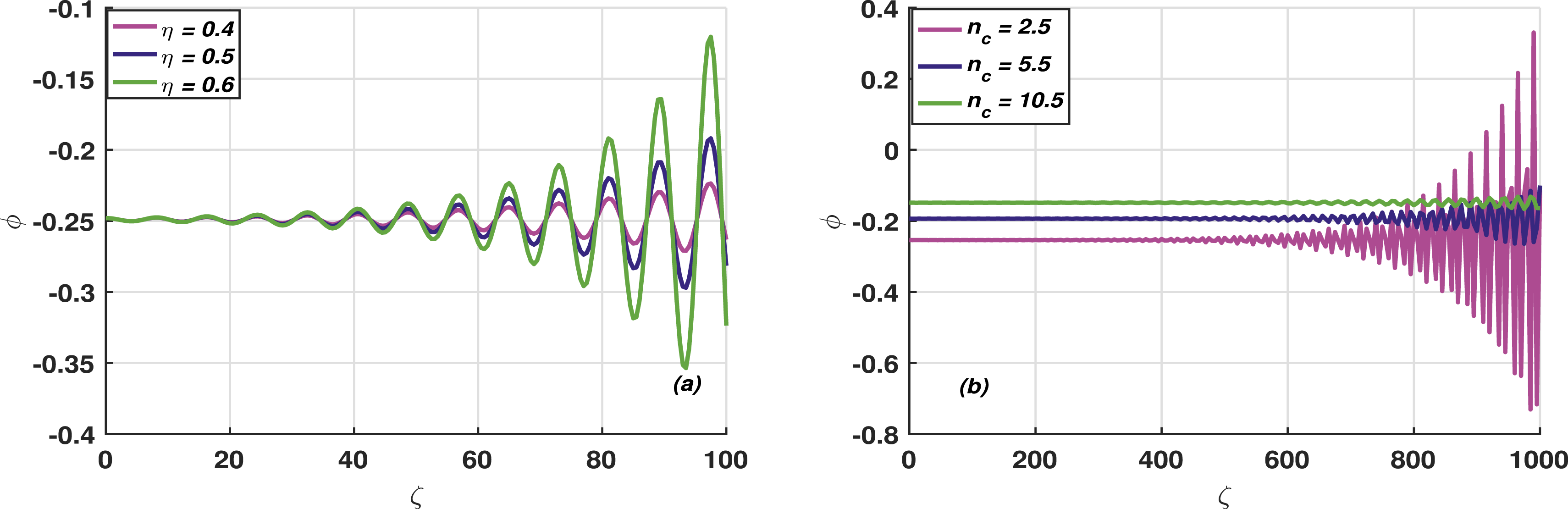
Derivation of the MKDVB equation
The nonlinear term vanishes in certain areas of the system parameters where A = 0 (see Figure 7). Consequently, we must seek a higher nonlinearity to address the absence of the quadratic nonlinearity coefficient in the KdV equation. For this purpose, the following new stretched coordinates are considered to examine the nonlinear wave propagation in the unmagnetized plasma at critical values of some plasma composition. ξ = ϵ (l1 x + l2 y + l3 z − v
p
t), τ = ϵ3 t, and η
d
= ϵ η. This method extends the independent variables in the following ways: Plot of the nonlinear coefficient of the KdVB equation against the q distribution, with Z
d
= 100, nh0 = 0.05, T
h
= 1400 eV, T
i
= 0.1 eV, T
c
= 2 eV, nc0 = 10.5, and r = −0.4.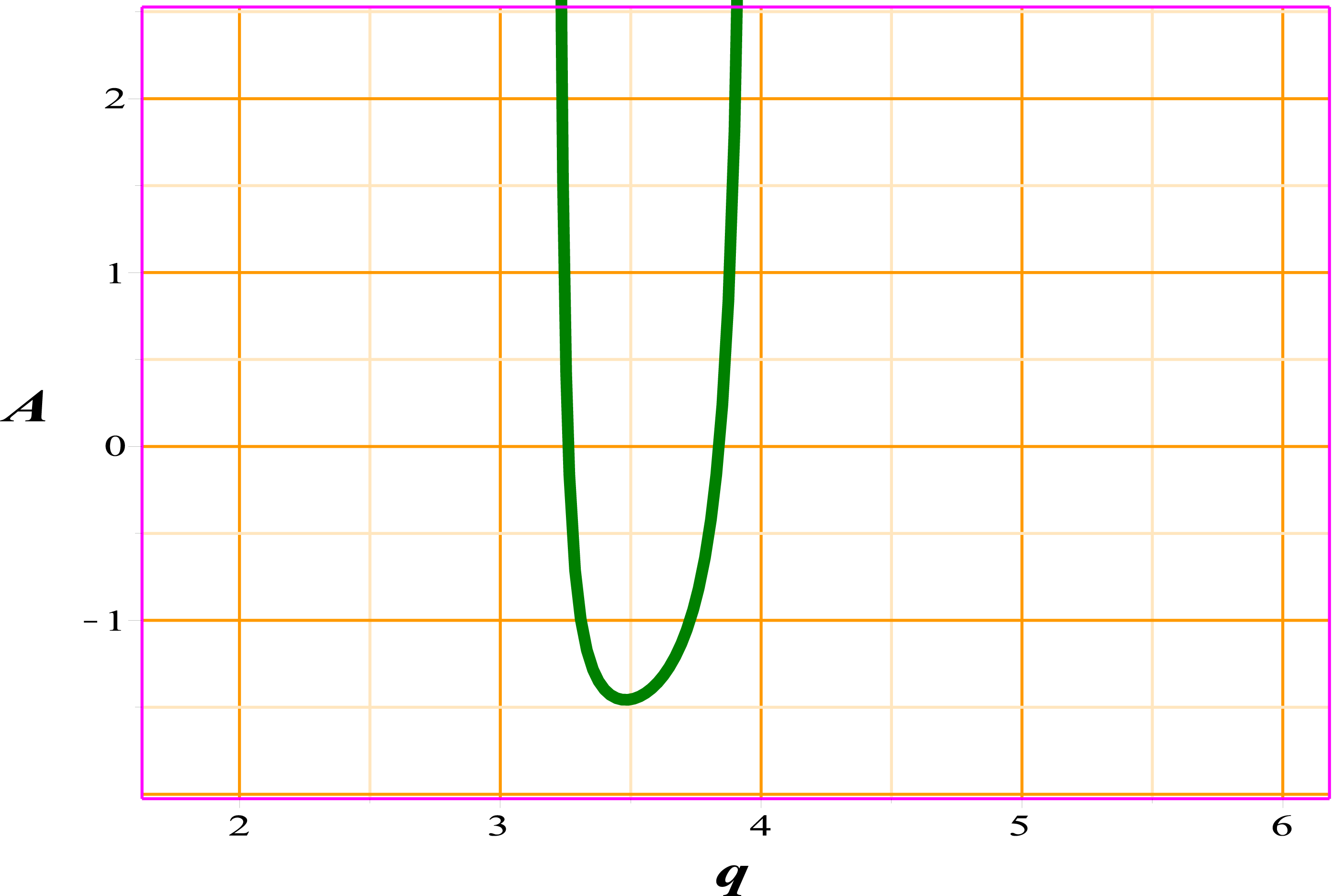
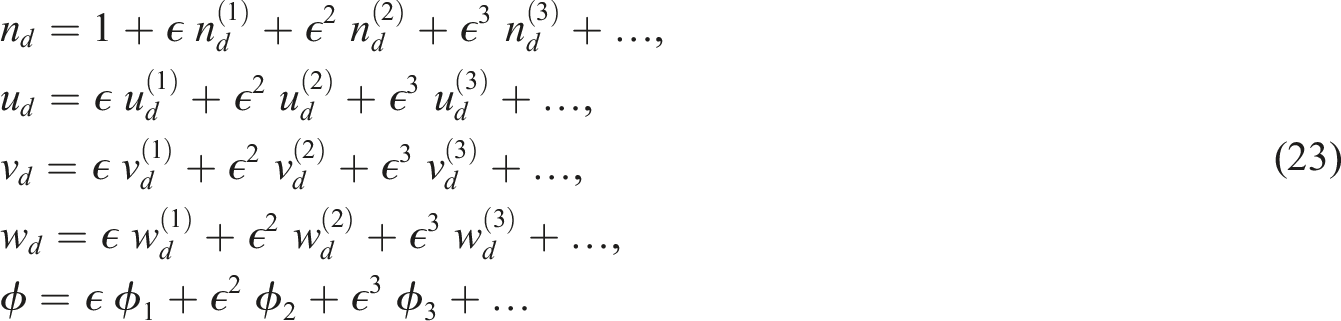
Additionally, following a few algebraic steps, the second-order perturbed values,

Moreover, the mKdVB equation can be obtained via algebraic manipulation of the next order series of ϵ, which produces equations for


Bifurcation analysis and solutions of the mKdVB equation
We convert the mKdVB equation to the system of traveling waves by using the same stretched as in KdVB equation ζ = (ξ − u0 τ), the mKdVB equation becomes:


The dynamical system given by equation (28) possesses three equilibrium points which are: C0(0, 0), Bifurcation analysis of dynamical system (28). Panel (a) with η = 0, whereas in panel (b) η = 0.1. Along with Z
d
= 100, nh0 = 0.01, nc0 = 10.5, nd0 = 0.05, T
h
= 1400 eV, T
c
= 0.1 eV, T
i
= 0.1 eV, r = −0.4, q = 5, and u0 = 0.2.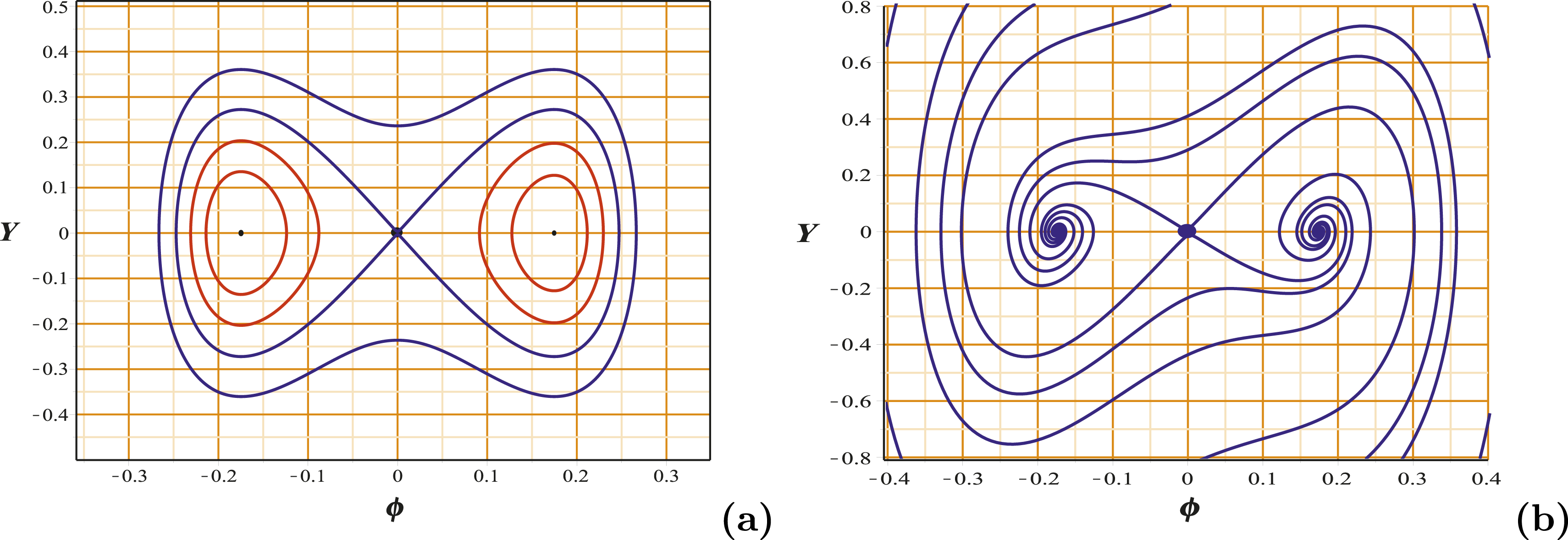
We now explore the behavior of DA nonlinear periodic (DANP) waves through the relevant plasma parameters. As the cold electron temperature T
c
(Figure 9(a)), and the nonextensive parameter q (Figure 9(b)) increase, both DANP waves’ amplitude and width grow. This can be interpreted by the fact that an increase in T
c
and q increases the impact of dispersion and nonlinearity, leading to an increase on the properties of DANP waves. On the other hand, this indicates that the production of DANP waves is profoundly influenced by the population of cold electrons. Dust-acoustic nonlinear periodic waves with respect to the mKdVB equation. Influence of q distribution in panel (a) with Z
d
= 100, nh0 = 0.01, nd0 = 0.05, T
h
= 1400 eV, T
i
= 0.1 eV, T
c
= 2 eV, and nc0 = 2.5. Variation of cold electron temperature in panel (b) with Z
d
= 100, nh0 = 0.05, T
h
= 1400 eV, T
i
= 0.1 eV, and nc0 = 10.5. Along with u0 = 0.2, r = −0.2, and q = 5.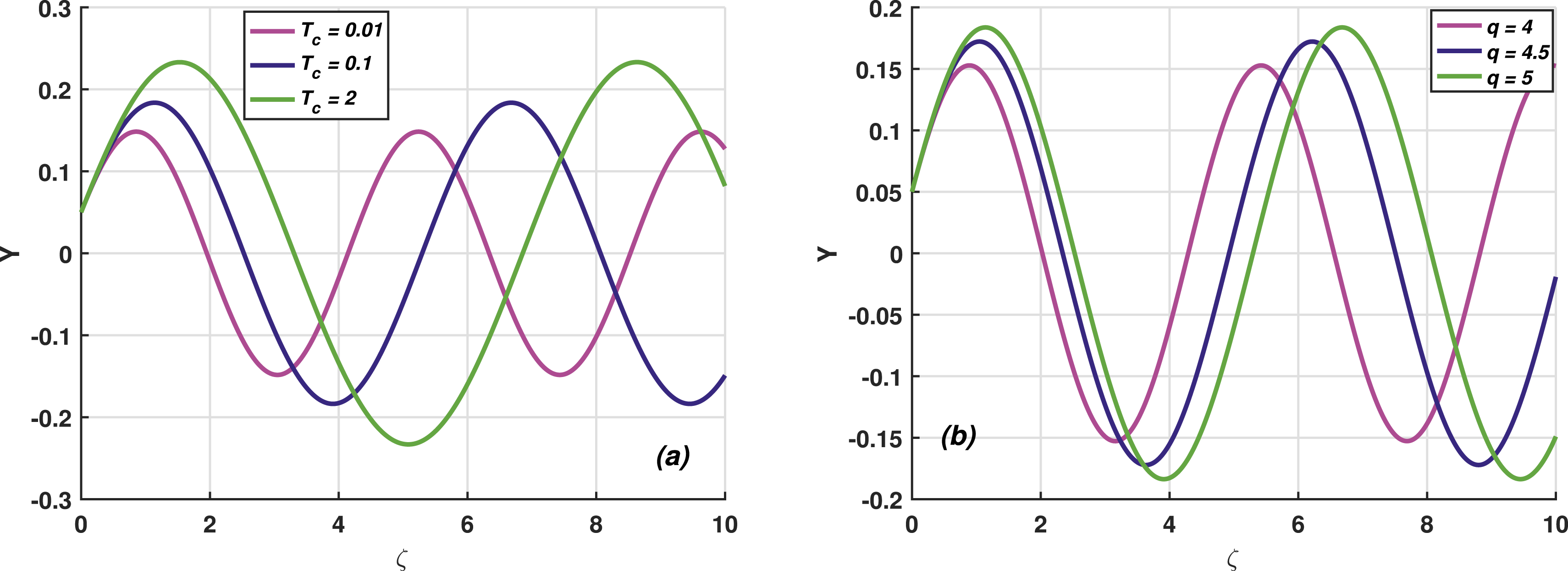
Conversely, when Burger’s component fails to appear, the solitonic solution is given as follows: Dust-acoustic compressive (rarefactive) solitary waves solution (29). Variation of cold electron temperature in panel (a) with Z
d
= 100, nh0 = 0.05, T
h
= 1400 eV, T
i
= 0.1 eV, and nc0 = 10.5. The impact of the cold electron density in panel (b) with Z
d
= 100, nh0 = 0.01, nd0 = 0.05, T
h
= 1400 eV, T
i
= 0.1 eV, and T
c
= 2 eV. Influence of q and r distribution in panels (c) and (d) respectively, with Z
d
= 100, nh0 = 0.01, nd0 = 0.05, T
h
= 1400 eV, T
i
= 0.1 eV, T
c
= 2 eV, and nc0 = 2.5. Along with u0 = 0.2.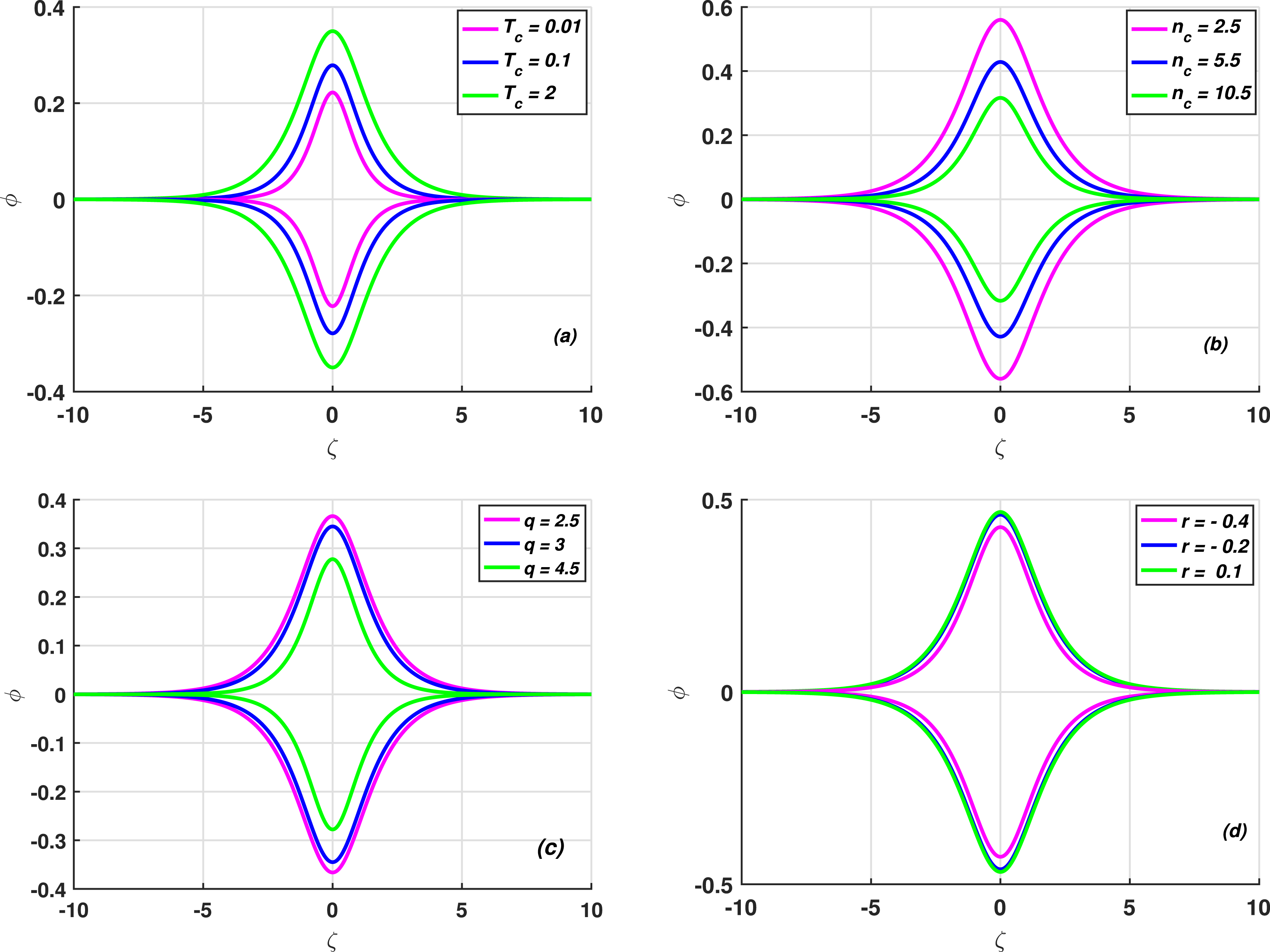

When the dissipative term outweighs the dispersive term, equation (27) takes the form:


In Figure 11, the DAMSWs derived from the mKdVB equation (27) is plotted against ζ and various values of spectral index q, temperature of cold electron T
c
, and kinematic viscosity η. Figure 11(a) and (b) show that the amplitude of DAMSWs increases with higher values of q and T
c
. Conversely, Figure 11(c) illustrates that the width of DAMSWs increases with the rise in kinematic viscosity (η). As a result, all these parameters favor the development of robust shock waves in plasma with TTE, adhering to the generalized (r, q)-distribution. Dust-acoustic monotonic shock waves with solution (31) to the mKdVB equation. Influence of q distribution in panel (a). Variation of cold electron temperature in panel (b). Panel (c) displays the dissipation η effect. Along with Z
d
= 100, nh0 = 0.05, T
h
= 1400 eV, T
i
= 0.1 eV, T
c
= 0.01, nc0 = 10.5 u0 = 0.2, r = −0.4, q = 3.5, and K = 1.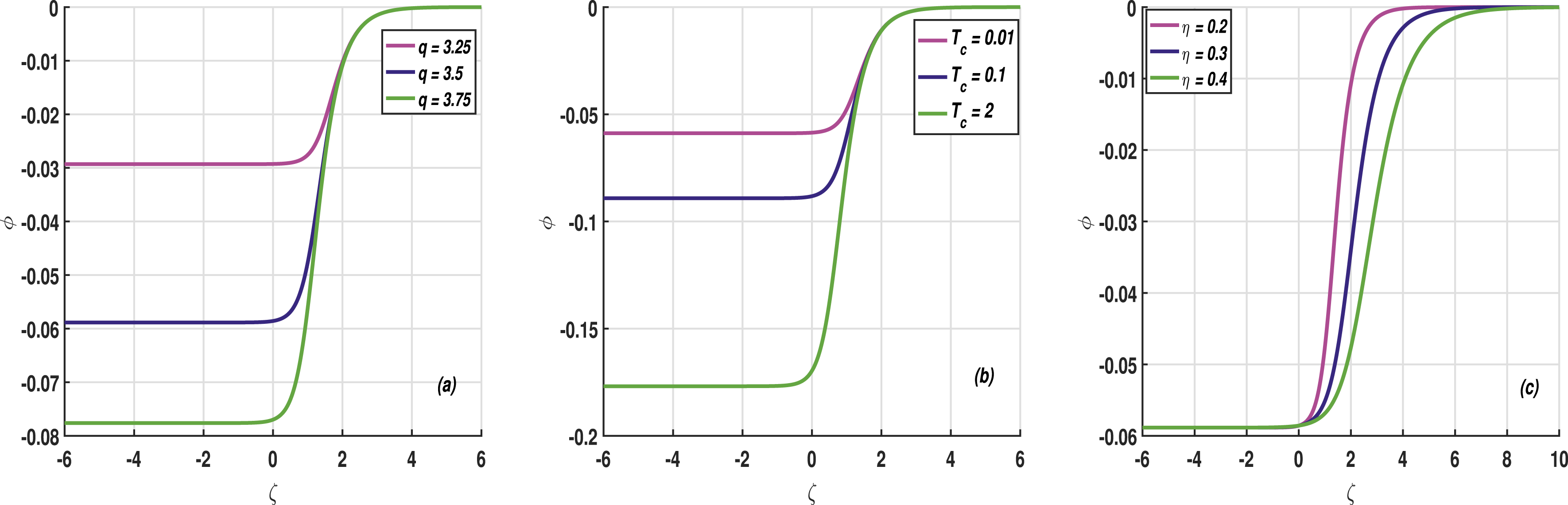
Moreover, the mKdVB equation also admits DADOSWs solution in the form (we adopt the same approach to the KdVB equation): Dust-acoustic damped oscillatory shock waves solution (32) to the mKdVB equation. Influence of q distribution in panel (a) whereas panel (b) shows the dissipation η effect. Along with Z
d
= 100, nh0 = 0.05, T
h
= 1400 eV, T
i
= 0.1 eV, T
c
= 0.01, nc0 = 10.5, u0 = 0.2, r = −0.2, g = 0.001, and q = 3.5.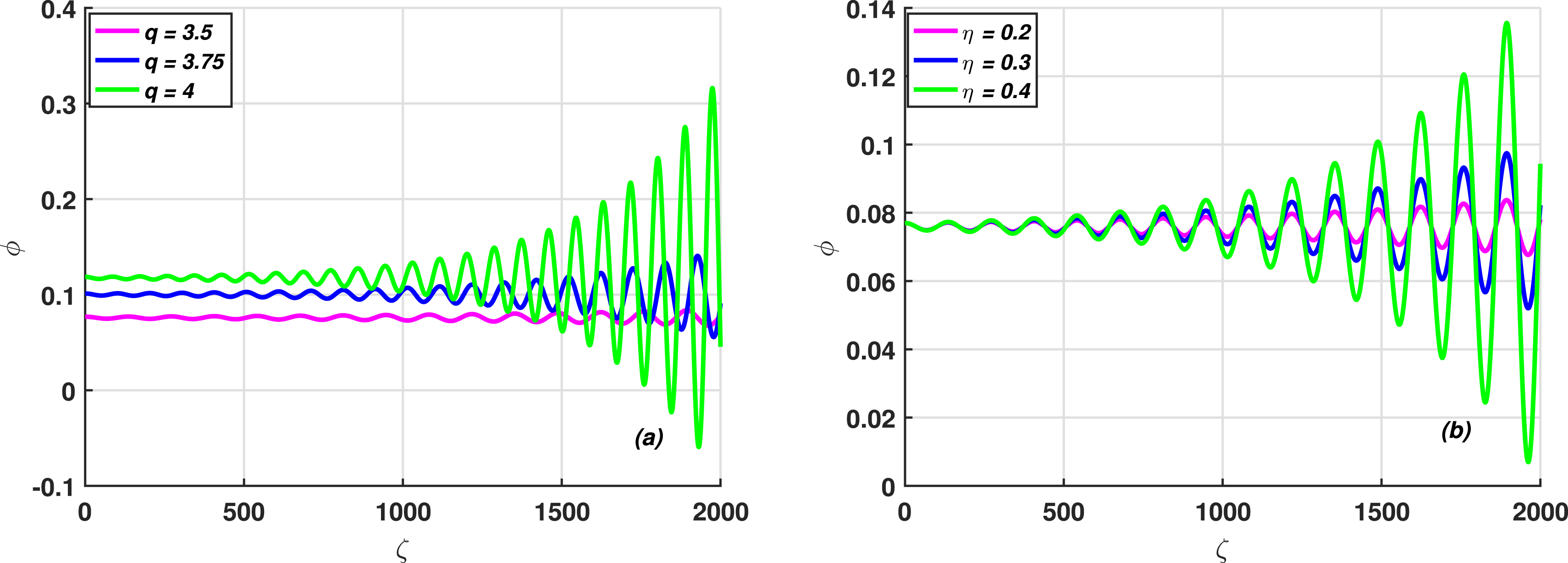

Conclusion
Our research examined dust-acoustic solitons and shock waves within a viscous plasma featuring evenly distributed hot and cold electrons along with Maxwellian ions, taking inspiration from various satellite missions around Saturn. We derived the KdVB and mKdVB equations using the standard reductive perturbation method. Our analysis covered various wave types, including compressive, rarefactive, monotonic, and damped oscillatory shock waves. Our findings reveal that the KdVB equation supports dust-acoustic shock waves, monotonic shock waves, and damped oscillatory shock waves. In contrast, in addition to monotonic shock waves and damped oscillatory shock waves solutions, the mKdVB equation can accommodate both dust-acoustic compressive and rarefactive waves. Additionally, we demonstrated that the amplitude and width of the electric field decrease as Saturn’s magnetosphere radius increases. Furthermore, our observations indicate that the magnitude and width of dust-acoustic solitons, both compressive and rarefactive, increase with higher cold electron temperatures and the kappa distribution of electrons. Moreover, the viscosity parameter and kappa distribution of electrons affect the magnitude of dust-acoustic monotonic shock waves and damped oscillatory shock waves. These findings provide insight into the distinctive features of soliton structures and nonlinear shocks within Saturn’s inner magnetosphere, where multiple satellite missions have verified the presence of negative viscous dust grains alongside cold and hot superthermal electrons.
Footnotes

Author contributions
All authors contributed equally for calculations, analysis and write-up.
Acknowledgments
The authors express their gratitude to Princess Nourah bint Abdulrahman University Researchers Supporting Project number (PNURSP2025R439), Princess Nourah bint Abdulrahman University, Riyadh, Saudi Arabia. This study is supported via funding from Prince Sattam Bin Abdulaziz University project number (PSAU/2025/R/1446).
Funding
The author(s) received no financial support for the research, authorship, and/or publication of this article.
Declaration of conflicting interests
The authors affirm the absence of any conflicts of interest.