




Abstract
The family of Fokker–Planck (FP) equations has been widely used in various physical applications, especially optical physics. It has proven effective in understanding numerous nonlinear phenomena observed in optical fiber. Accordingly, we analyze the time fractional FP (FFP) equations to understand the underlying mechanics of the phenomena described by the suggested models, control the generation and propagation of these phenomena, or prevent their occurrence altogether to achieve the desired applications. Thus, in this investigation, some techniques, such as a novel technique, which is called the “
Keywords
Introduction
Fractional calculus (FC) allows the generalized form of differentiation and integration, which is way broader than integer order calculus. As a result, the number of followers in this field is rapidly increasing. On the other hand, different kinds of fractional derivatives, namely, Riesz, Grunwald-Letnikov, Caputo, Riemann-Liouville, and superconformable fractional derivatives, exist.1–4 The memory effect is the feature that non-integer differential and integral operators transmit all the information on a function along with a weighting relation. The specific phenomenon is termed the memory effect. Fractional differential equations (FDEs), which may also involve fractional partial differential equations (FPDEs), are frequently used to analyze many physical systems. Studying these equations in academic research is essential since they are applied across several other disciplines, such as electrical circuits, quantum physics, electrochemistry, theoretical biology, and nonlinear plasma waves.5–11 The nondifferentiable behavior of FPDEs is an essential factor in their usefulness in various frames.
In contradistinction to the operators of an integer order, which can usually precisely predict the system’s future just by knowing its present state, the first and second-order FPDEs are pretty different. They not only consider the current state of the system but also its past state. This characteristic will ensure high consistency between the mathematical model and the investigated physical process or system. The FDEs are potentially complicated tasks, mainly where numerical calculations are often applied. Regarding fractional partial differential equations (FPDE) for physical realization, fast and reliable computations are the key.12–14 Several methodologies have been employed to address the issue at hand, such as the fractional operational matrix method (FOMM),
15
the Elzaki transform decomposition method (ETDM),16,17 the homotopy analysis method (HAM),
18
the homotopy perturbation method (HPM),19,20 the iterative Laplace transform method,
21
and the variational iteration method (FVIM).
22
Fokker and Planck devised the Fokker-Planck (FP) equation to theoretically understand a Brownian movement and fluctuations of probability distributions for stochastic processes in both temporal and spatial ranges. A second-order unbounded expansion can then derive the FP equation (FPE) from the Kramers–Moyal expansion of the master equation. The chemical master equation is the angular noise approximation version, which allows for obtaining a more exact version. FPE, the main feature of the so-called mathematical technique, is widely applicable to many natural science processes. However, these are among many other models like the probability flux, polymer dynamics, electron relaxation, solid state systems, and quantum optics. The primary aim of our work is to investigate FFPE, which the following generic form can describe


The FFP equation (FFPE) has proved efficient in many fields, such as biological molecules, chemical physics, energy consumption, and optical fiber.23,24 The existing FFPE has been extended to deal with internal properties, mechanical behavior, and diffusion phenomena. 17 For instance, it is usually quite challenging to secure accurate data that can be used to solve the FDEs. Therefore, various analytical and numerical techniques indulge these curious minds. Examples of advanced numerical methods are the Laplace transform method (LTM), 18 the multistep reduced differential transform method (MRDTM), 25 the predictor-corrector approach, 26 the Adomian decomposition method (ADM), 27 and the variational iteration method (VIM). 28 They are used to tackle diffusion-type odes. Marinca et al. 29 formulated an optimal auxiliary function to derive the analytical solutions for the flow of fourth-grade fluids from an endless vertical cylinder.
Meanwhile, in 2013, Laiq Zada and his coauthors 30 published another article regarding a new method to solve PDEs, especially the seventh-order generalized Korteweg-de Vries (KdV) equation. As you have read, the finding resulted from modifying the technique. The proposed approach considers additional convergence control parameters and functions to ensure the method converges quickly and smoothly. The strategy efficiency can be altered either by modifying the accessory service or by increasing the number of convergence control auxiliary tuning knobs.
The primary objective of this study is to develop a novel technique, referred to for the first time as the “
Preliminaries
This section provides an overview of fundamental terminology and conclusions about the Caputo fractional derivative.


For • • • •
General procedure for the OAFM
Here, we present a concise and straightforward explanation of the OAFM, which can be used to analyze fractional PDEs.
32
First, the following FPDE is introduced to apply the suggested method Step (1): To solve equation (5) and produce an approximate solution that has two components, we introduce the following formula Step (2): To get the zeroth- and first-order approximations, we insert equation (7) into equation (5), which leads to the following outcome: Step (3): To derive the zeroth-order approximation Step (4): From equation (8), the term Step (5): To expedite the solution of equation (11) and enhance the rate of convergence for the first-order approximation Step (6): The first-order approximation Step (7): Determining the convergence control parameters










General procedure for the “Tantawy technique”
Due to the innovative nature of this technique and its initial mention here, stemming from the publication delay of Prof. El-Tantawy and Prof. Alvaro Salas’s paper, it is imperative to acknowledge that Prof. El-Tantawy and Prof. Salas are responsible for its intricacies. Consequently, all credit for this technique is attributed to him, and it has been named in his honor to safeguard the rights of all parties involved.
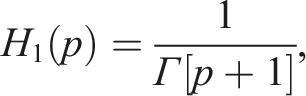
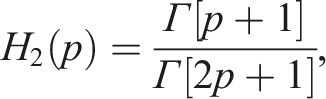
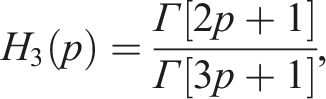
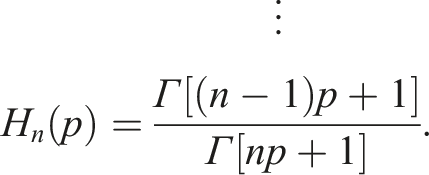
The subsequent points will elucidate the Tantawy technique for analyzing fractional differential equations and several intricate physical and engineering problems: Step (1): To solve the IVP (5), the following Ansatz is introduced Step (2): Insert the Ansatz (15) into equation (5) yields Step (3): Collecting the coefficients of the same power of Step (4): Equating to zero the coefficients Step (5): By inserting the obtained values of









Test examples and numerical investigation
Let us apply the proposed method’s previous steps to analyze and model some fractional differential equations with multiple applications in different physical systems. Below, we will discuss some other forms of the Fractional Fokker–Plank equation (FFPE).
Example (1)
Consider the following first model of the FFPE


The OAFM for analyzing example (1)
Consider the following terms of equation (17),



The initial approximation/IC, according to OAFM, reads

Applying the inverse operator on equation (22) yields

Using equation (23) in equation (20), the following term is obtained

According to the OAFM procedure, the first approximation reads

We choose the following auxiliary function


After substituting equations (24), (26), and (27) into equation (25), we get

Applying the inverse operator on equation (28) yields

Collecting equations (23) and (29), we get

Applying the least square technique, the following values of auxiliary constants are obtained

The final solution using auxiliary constant reads

The Tantawy technique for analyzing example (1)
Here, the Tantawy technique is introduced to analyze example (1). This technique is summarized in the following brief steps: Step (1): To solve the IVP (17), the following Ansatz is introduced Step (2): Inserting the Ansatz (33) into equation (17) to find the values of the unknown functions Step (3): Collecting the coefficients of the same power of Step (4): Equating to zero the coefficients Step (5): Inserting the value of IC Step (6): Inserting the obtained values of



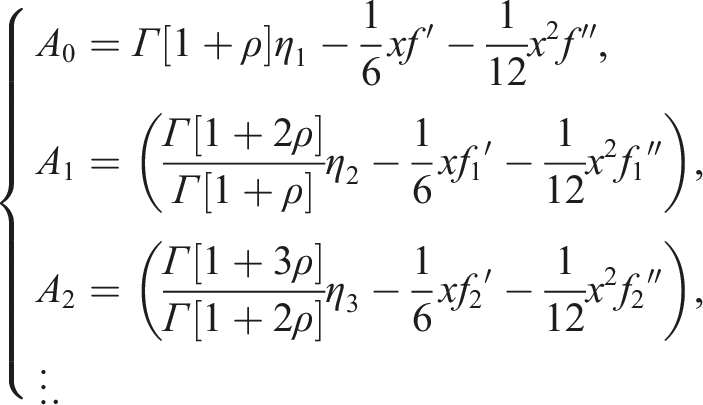
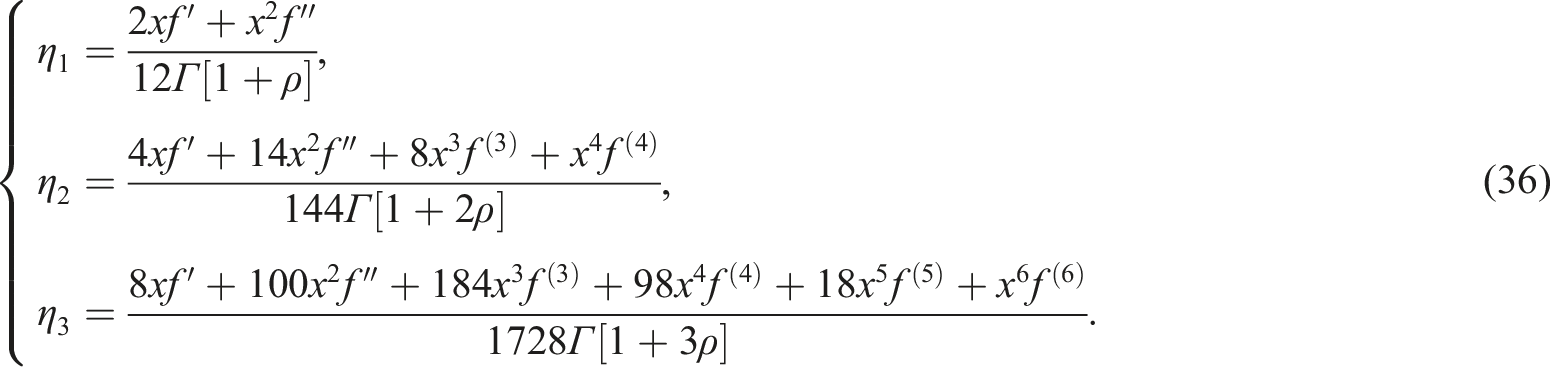


The residual error for this approximation reads
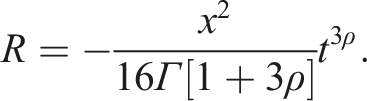
Utilizing Laplace HPM (LHPM) and following extensive computations and significant time expenditure, we obtain findings identical to those produced by the Tantawy technique

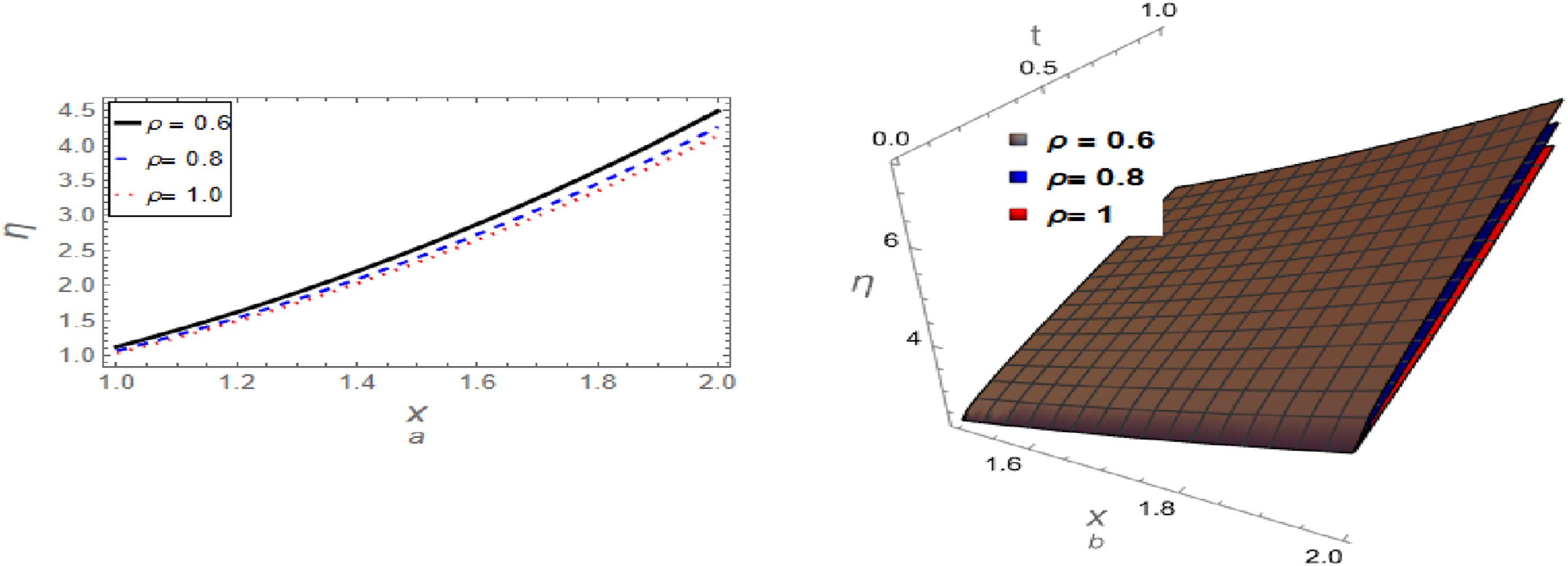
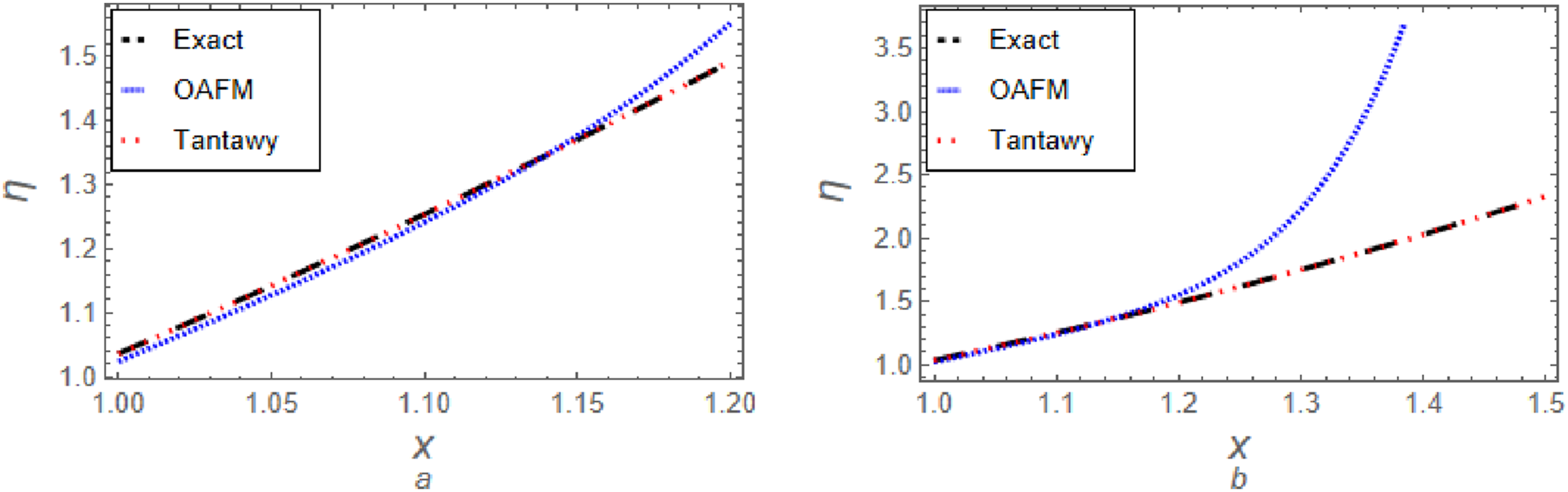
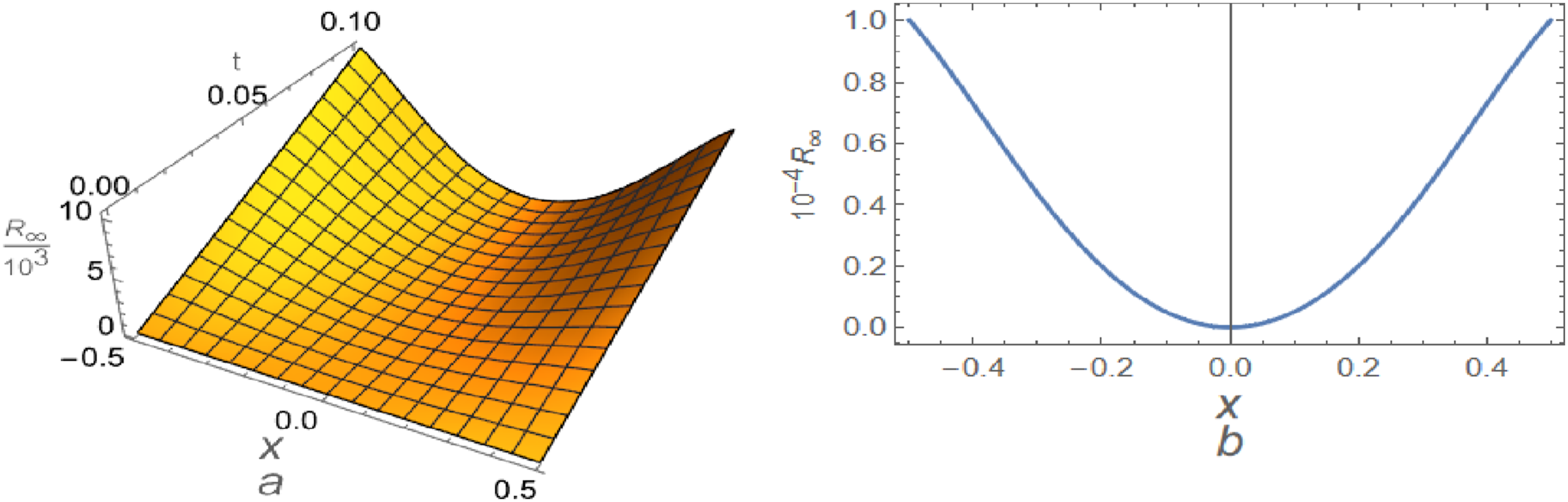
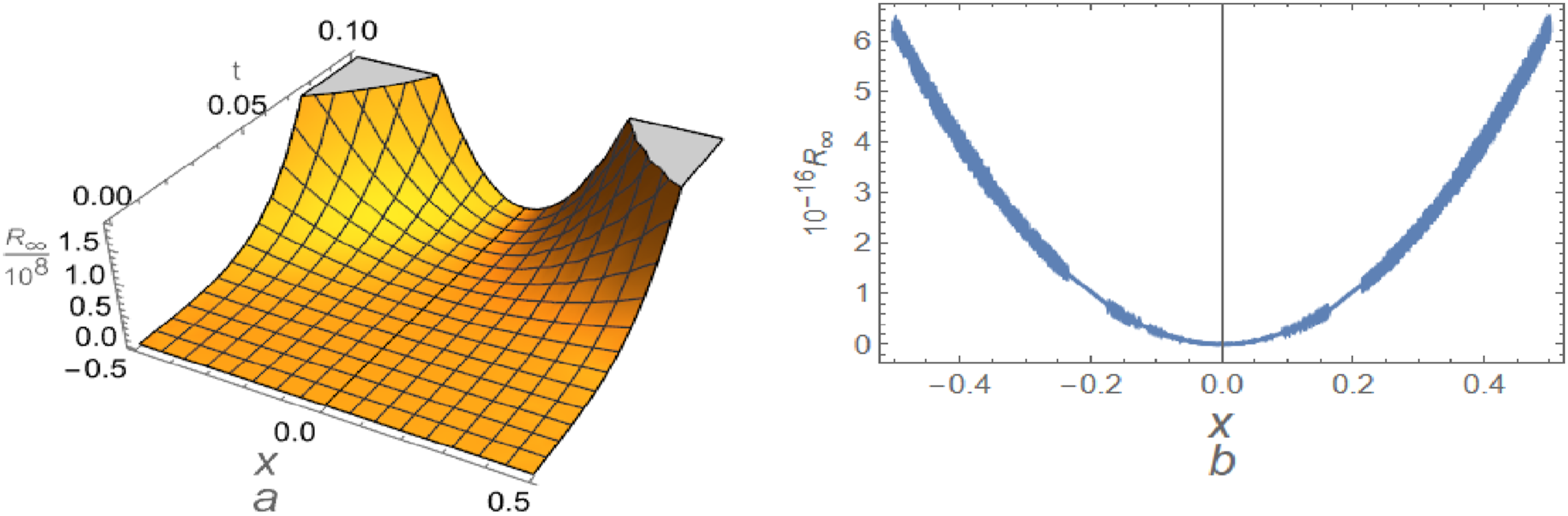
The approximations (32) and (38) using OAFM and the Tantawy technique are, respectively, depicted in Figures 1 and 2 for various values to the fractional order parameter The behavior of fractional approximation (32) using OAFM at various values of fractional order parameter for example 1 (a) two-dimensional graph at The behavior of fractional approximation (38) using Tantawy technique at various values of fractional order parameter for example 1 (a) two-dimensional graph at A comparison between the derived approximations (32) and (38) with the exact solution (3) for the integer case at The absolute error The absolute error 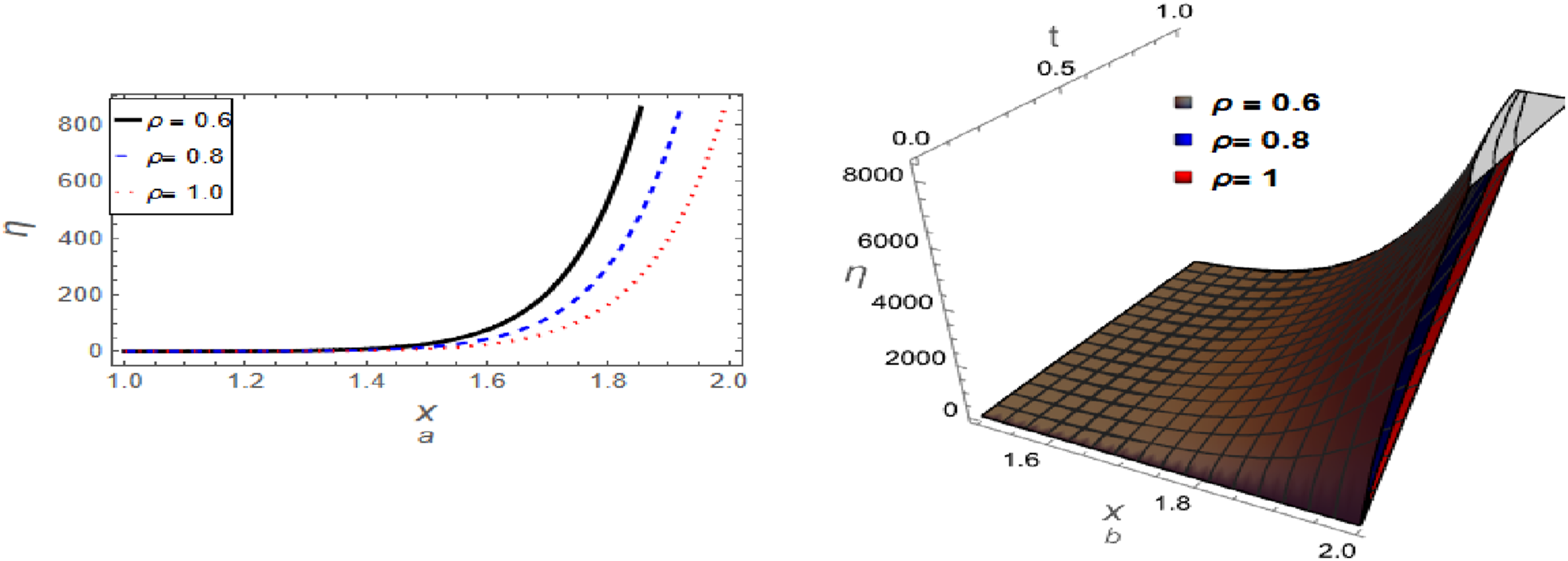
Example (2)
Considering the following second model of FFPE


We apply the two proposed techniques for analyzing this model as follows.
The OAFM for analyzing example (2)
The following terms of equation (39) are introduced



The initial approximation/IC, according to the OAFM, reads

Applying the inverse operator on equation (44) yields

Using equation (45) in equation (41), we get

According to the OAFM procedure, the first approximation reads

The following auxiliary function is introduced


After substituting equations (45), (48), and (49) into equation (47), we get

Applying the inverse operator on equation (50) yields

Now, by collecting equations (45) and (51), the following OAFM solution is obtained

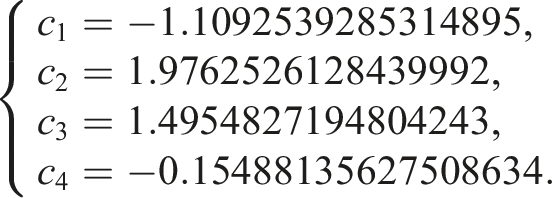
Now, by inserting the obtained values if auxiliary constants in equation (53), the following approximation is obtained

The Tantawy technique for analyzing example (2)
The Tantawy technique can be utilized to examine example (2) by delineating the subsequent points: Step (1): To solve and analyze the IVP (39), the following Ansatz is introduced Step (2): To determine the values of the unknown functions Step (3): Collecting the coefficients of the same power of Step (4): Equating to zero the coefficients Step (5): Inserting the value of IC Step (6): Inserting the obtained values of



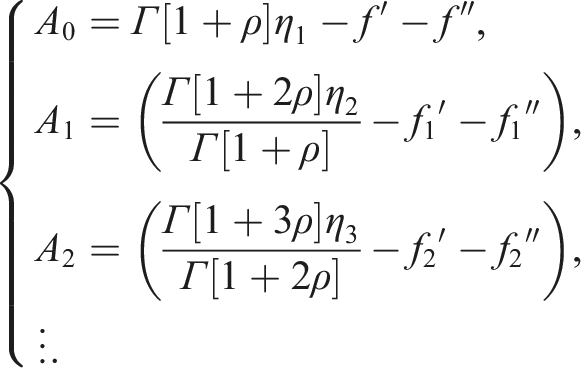
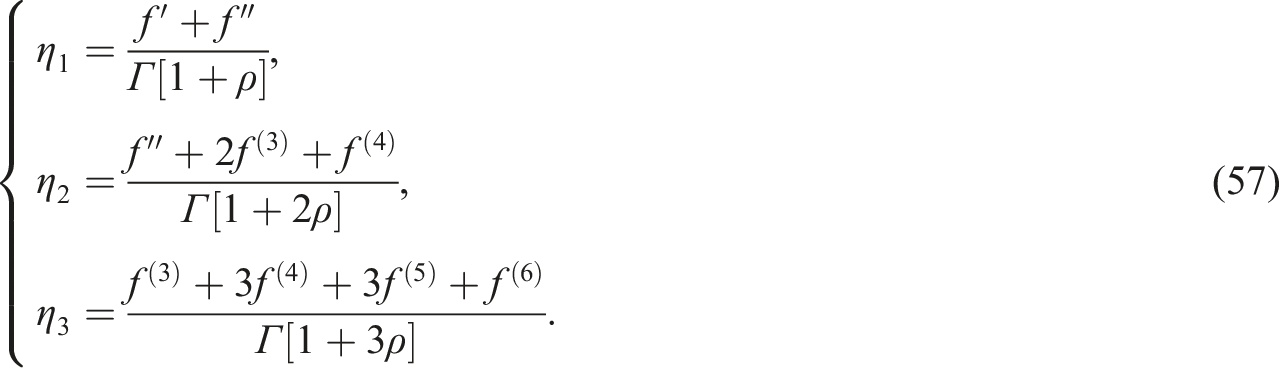


The residual error for this approximation equals to zero.
Utilizing Laplace HPM (LHPM) and following extensive computations and significant time expenditure, we obtain findings identical to those produced by the Tantawy technique
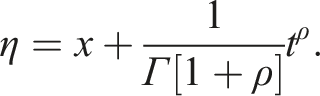
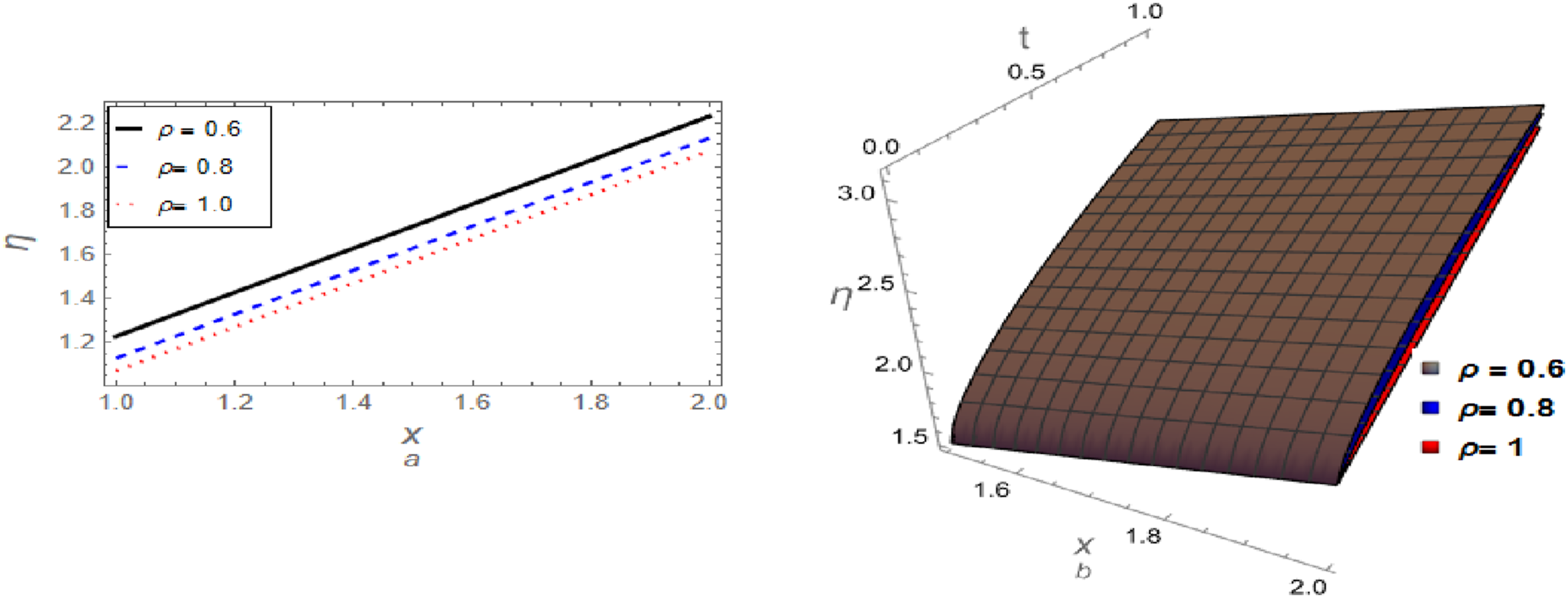
Figures 6 and 7 illustrate the graphic analysis of the approximation (53) using OAFM and the approximation (59) using the Tantawy technique for various values of the fractional order parameter ρ. These figures clearly show that the fractional coefficient dramatically influences the behavior of the phenomena described by this model. Therefore, this effect can expose the ambiguity surrounding certain behaviors observed in the phenomena that this model studied. The behavior of fractional approximation (53) using OAFM at various values of fractional order parameter for example (2): (a) two-dimensional graph at The behavior of fractional approximation (59) using Tantawy technique at various values of fractional order parameter for example (2): (a) two-dimensional graph at 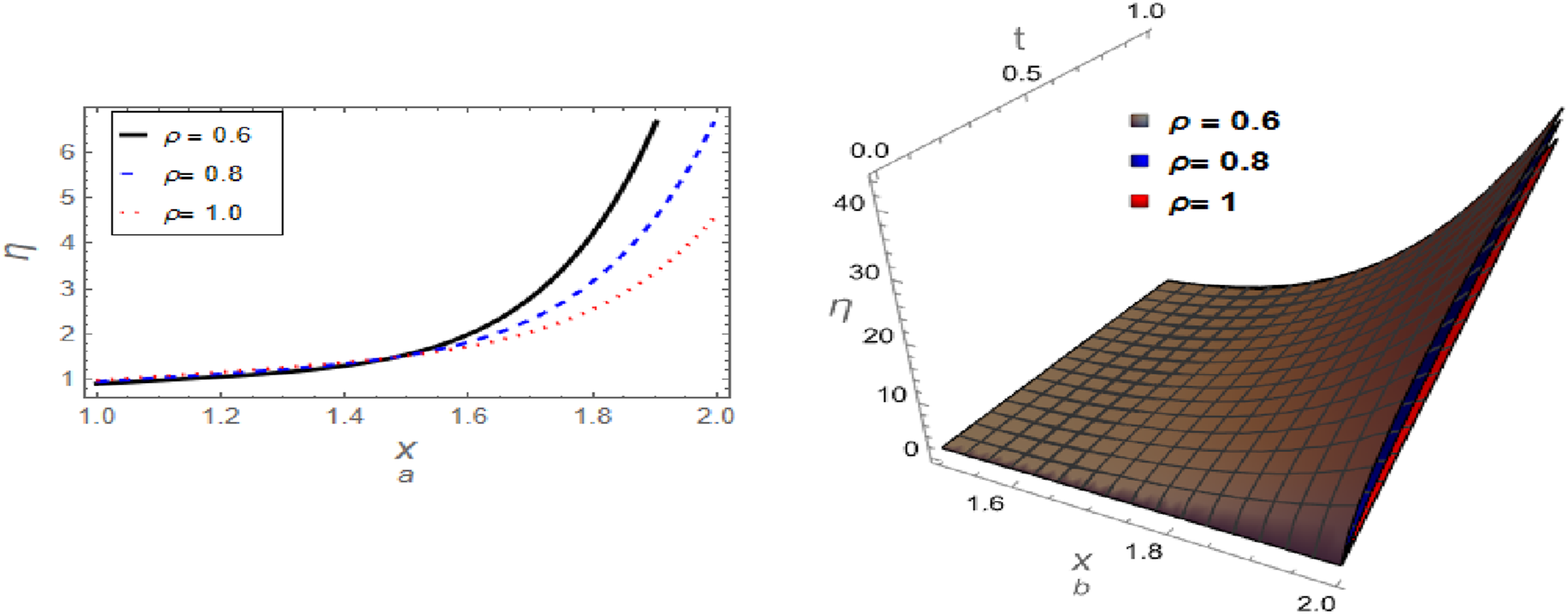
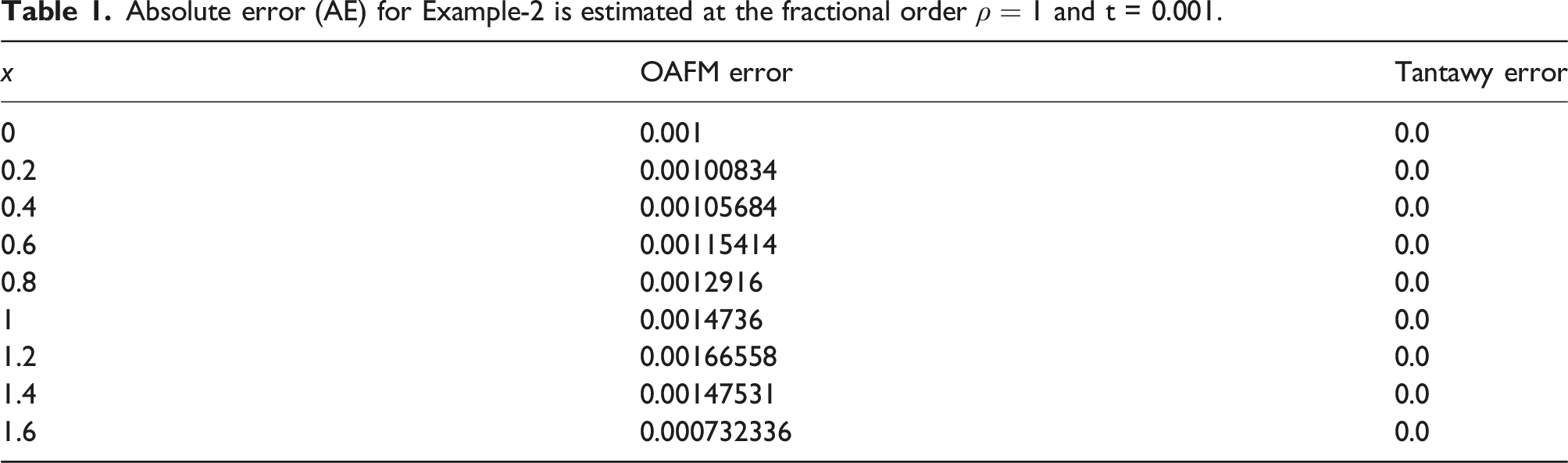
Additionally, in Figure 8, we compared the exact solution of the integer case (ρ = 1) with the approximations (53) and (59) to assess the concordance between the generated approximations and the exact solution. It is found that, in a short time, the derived approximations closely align with the exact solution of the integer case, as illustrated in Figure 8(a). However, over a long time, the approximation (53) obtained through OAFM diverges from the exact solution, whereas the approximation (59) derived from Tantawy’s technique achieves complete concordance, as shown in Figure 8(b)), which conforms to the high accuracy for the obtained solution via Tantawy’s approach. Consequently, this implies that analyzing a wide range of physical and engineering problems will yield favorable results using Tantawy’s approach. Moreover, we numerically calculated the absolute error of both approximations, as illustrated in Table 1. The efficiency and accuracy of Tantawy’s technique are demonstrated in this table compared to OAFM. A comparison between the derived approximations (53) and (59) with the exact solution Absolute error (AE) for Example-2 is estimated at the fractional order 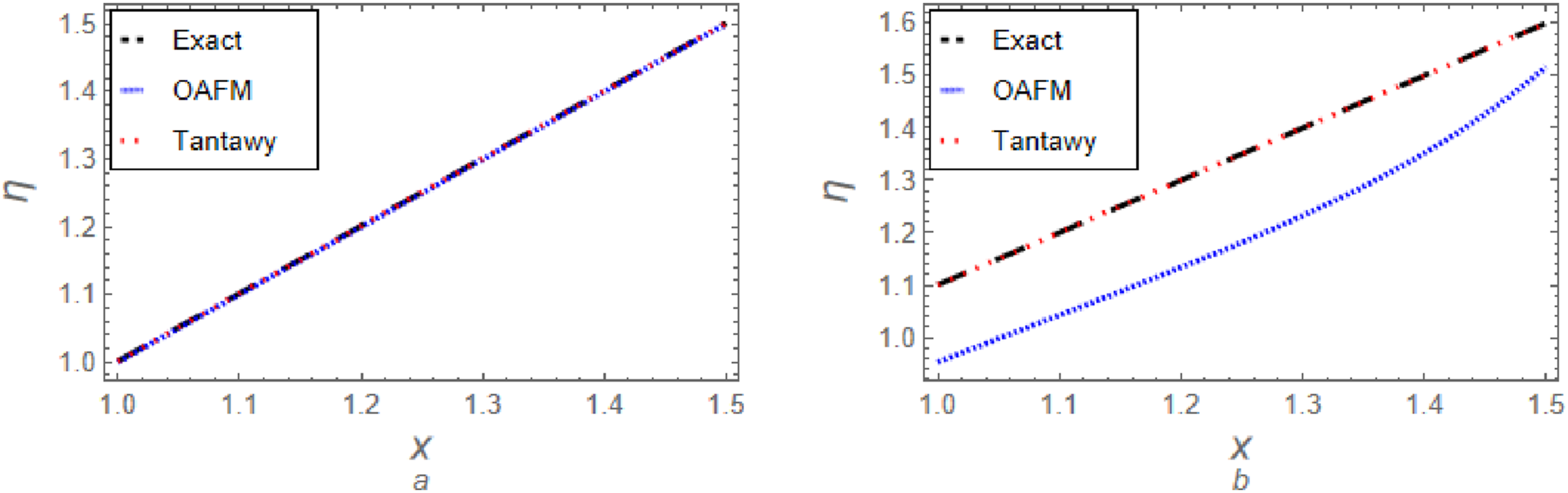
Example (3)
Considering the following third form of the FFPE


Here, we apply the two proposed techniques for analyzing this model.
The OAFM for analyzing example (3)
The following terms of equation (60) read


The initial approximation, according to the OAFM, reads
Applying the inverse operator on equation (66) yields
Using equation (67) in equation (64), we get
According to the OAFM procedure, the first-order approximation can be constructed as follows
The following auxiliary function is defined

After substituting equations (66)–(68) into equation (69), we get
Applying the inverse operator on equation (72) yields
By collecting equations (67) and (73), the following OAFM solution is obtained
The Auxiliary constants for this example read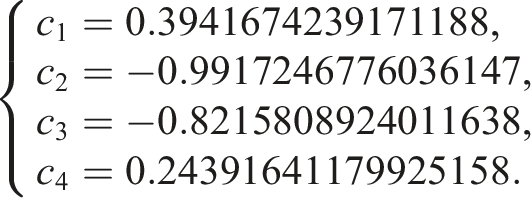

The Tantawy technique for analyzing example (3)
The Tantawy technique can be utilized to analyze example (3) by delineating the subsequent points: Step (1): To solve and analyze the IVP (60), the following Ansatz is considered Step (2): To determine the values of the unknown functions Step (3): Collecting the coefficients of the same power of Step (4): Equating to zero the coefficients Step (5): Inserting the value of the IC Step (6): Inserting the obtained values of











The residual error for this approximation reads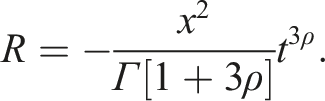
Utilizing Laplace HPM (LHPM) and following extensive computations and significant time expenditure, we obtain findings identical to those produced by the Tantawy technique
Both the approximation (75) using OAFM and the approximation (81) using Tantawy technique are graphically analyzed for different values to the fractional order parameter The behavior of fractional approximation (75) using OAFM at various values of fractional order parameter for Example (3) (a) two-dimensional graph and (b) three-dimensional graph. The behavior of fractional approximation (81) using Tantawy technique at various values of fractional order parameter for Example (3) (a) two-dimensional graph and (b) three-dimensional graph. A comparison between the derived approximations (75) and (81) with the exact solution (62) for the integer case: (a) at a short time and (b) at a long time. Absolute error (AE) for Example 3 is estimated at the fractional order 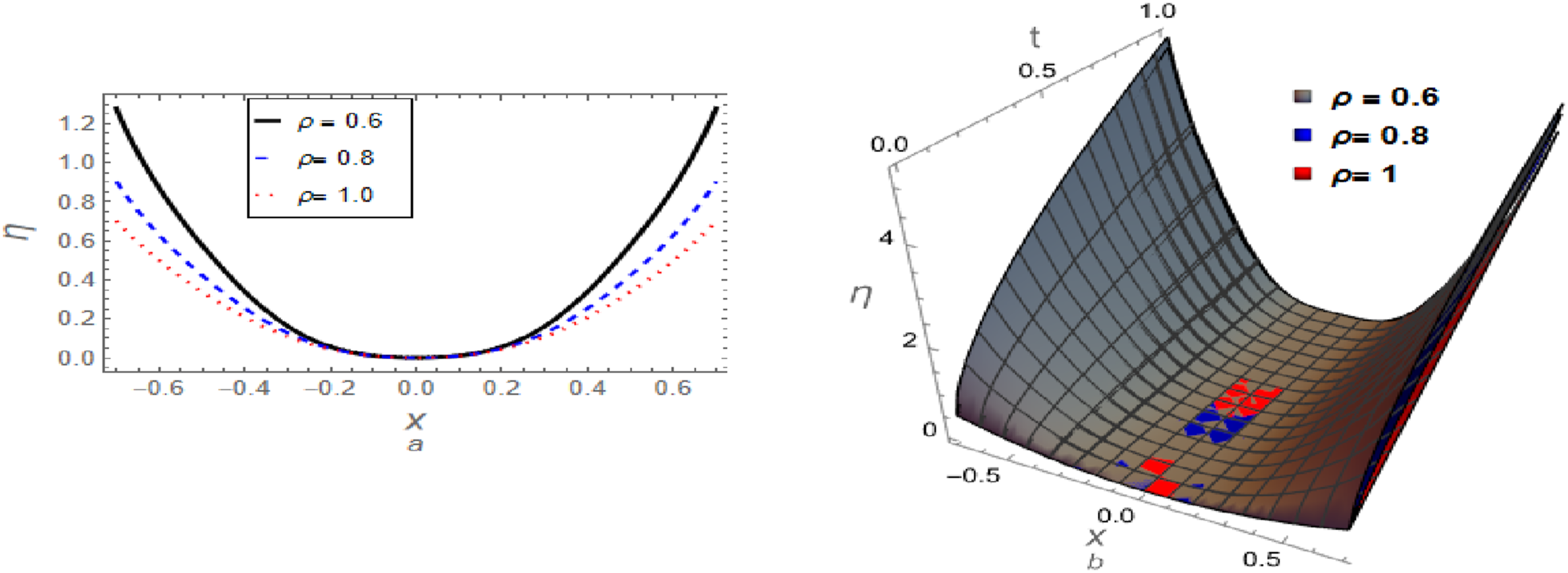
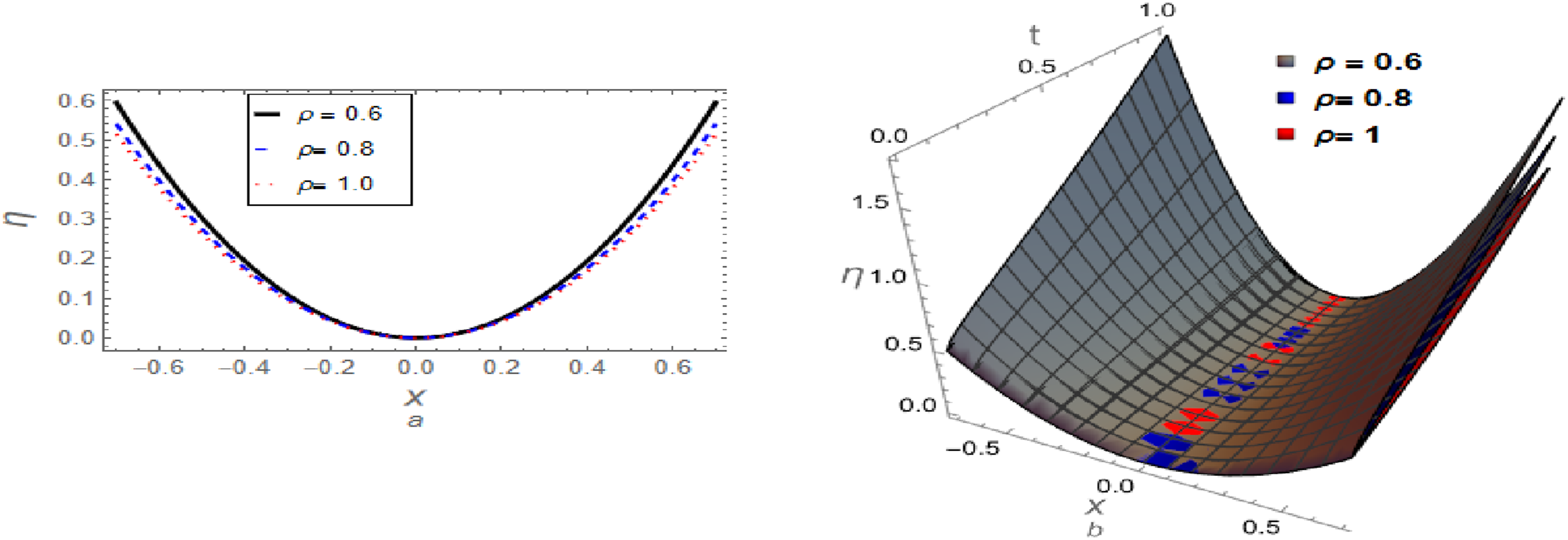
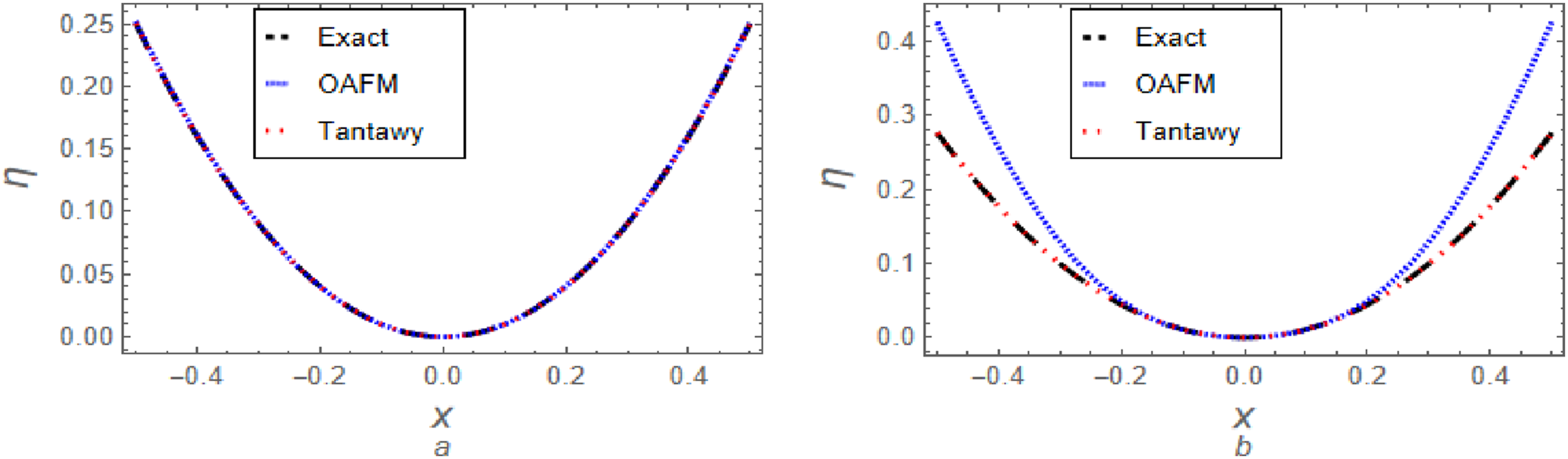
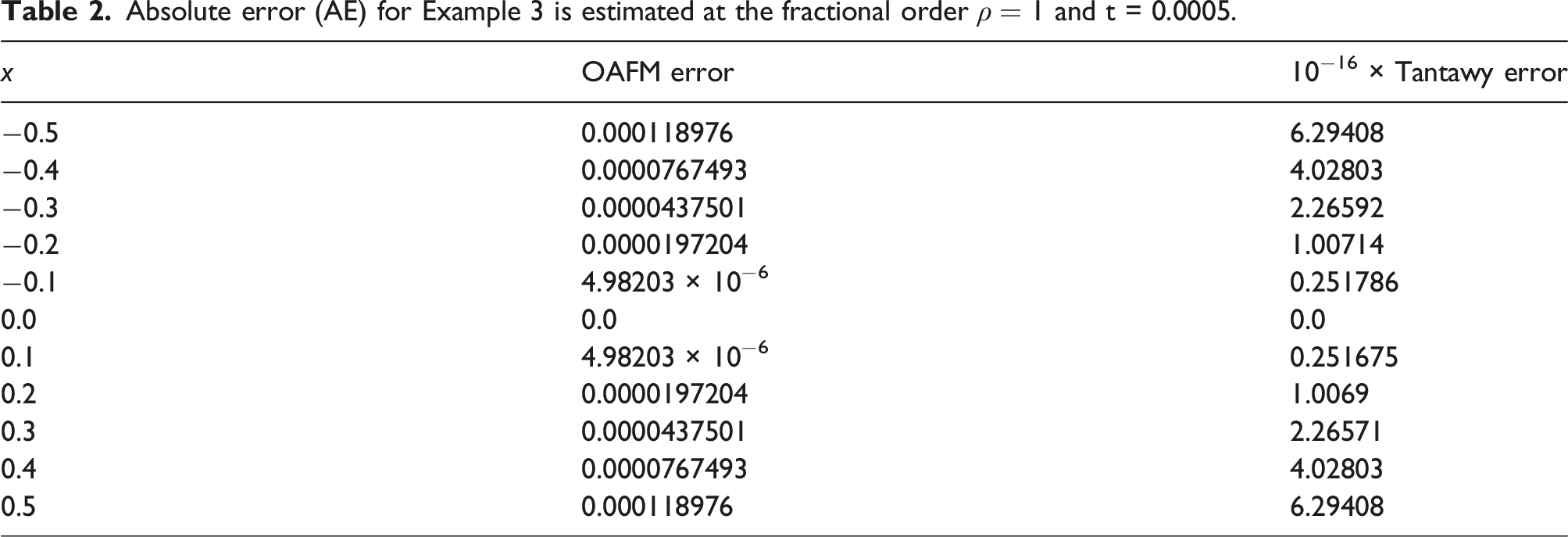
The comparison results showed the high accuracy and efficiency of the derived approximations, which enhances the efficiency of the proposed methods. However, it is essential to highlight the innovation of the Tantawy technique. The numerical analysis proved that the Tantawy technique is more accurate throughout the whole study domain and significantly outperforms OAFM. Future studies anticipate this technique to be the most popular among various analysis methods due to its simplicity in calculation, efficiency, and high stability, leading to the derivation of more accurate approximations and the provision of closed solutions for exact solutions.
Conclusion
In this investigation, a novel technique, the “Tantawy technique,” has been implemented for analyzing the fractional Fokker–Planck (FFP) equations, in addition to the optimal auxiliary function method (OAFM) in the framework of the Caputo operator. Since Tantawy’s technique was mentioned for the first time in this investigation, we have provided a simplified explanation to enable the reader to comprehend and apply it to any new model. The two methods have been used to three distinct models of the FFP equation, each exhibiting different levels of complexity, to study them and derive highly accurate approximations that simulate the nonlinear phenomena described by these models. All derived approximations of the three models utilizing the two proposed methods have been graphically and numerically investigated. This analysis included two-dimensional and three-dimensional graphical representations to elucidate the dynamics of the nonlinear phenomena described by these models and assess the fractional parameter’s influence on their behavior. Additionally, we estimated the absolute error of all derived approximations compared to the exact solutions as the benchmark for the integer cases to evaluate the correctness of these approximations. Also, we conducted a graphical and numerical comparison of the resulting approximations to assess the efficacy of each method individually. It was found that both approaches yield favorable results in the limited research domain, but in arbitrary/large domains, Tantawy’s technique is distinctly superior to OAFM in terms of accuracy and stability. This, in turn, promises good results and enhances Tantawy’s technique in analyzing various physical and engineering problems and other problems related to studying the equations of ascension in their fractional forms.
Moreover, the Tantawy technique, developed for the first time, has effectively analyzed the most complicated problems. It is distinguished by its extreme simplicity, high accuracy, and stability throughout the whole study domain, which is not attained by many other methods. Additionally, it generated more accurate and stable approximations than many other similar methods. We anticipate that the Tantawy approach, given the current study and its remarkable outcomes, will emerge as the most favored and popular method among its counterparts in future studies.
While the Tantawy technique yields results comparable to LHPM, it is more adaptable, efficient, and uncomplicated than LHPM. Furthermore, unlike alternative methods, it does not necessitate any complexities. Moreover, calculations require less time than other laborious and time-intensive approaches.
Future work
• Considering the physical and engineering significance of the models analyzed through the “Tantawy technique,” these models may also be examined using various other methodologies that have demonstrated their efficacy in addressing diverse physical and engineering challenges, such as homotopy perturbation-type techniques,33–36 the Elzaki decomposition method (DM),
37
the variational iteration method,
38
the Laplace transform DM,
39
the residual power series method (RSPM), and the new iteration method (NIM)40–44, as these methods are anticipated to yield more precise approximate solutions in comparison to numerous alternative approaches. • In future studies, researchers might compare the approximations made by other methods with those made by the Tantawy technique to determine how reliable and helpful this new method is. Furthermore, Tantawy’s technique can be used to analyze various (non)-integrable fractional plasma wave equations, such as the family of third-order fractional KdV-type equations,45–49 the family of fifth-order fractional KdV-type equations,50–55 the family of fractional nonlinear Schrödinger-type equations,56–60 to understand the behavior and propagation dynamics of nonlinear phenomena arising in multi-plasma systems. The Tantawy technique is also expected to successfully analyze fractional ordinary differential equations such as different fractional pendulum oscillators.61,62 • Since this is the first core of the Tantawy technique, which we integrated with the Caputo operator to analyze the problem under study, it is anticipated that this technique will be applicable with several additional operators, including the two-scale fractal derivative and He’s fractional derivative.63–67
Footnotes
Acknowledgments
The authors extend their appreciation to the Deanship of Scientific Research and Libraries in Princess Nourah bint Abdulrahman University for funding this research work through the Research Group project, Grant No. (RG-1445-0005).
Author contributions
All authors contributed equally and approved the final manuscript. A sole inventor of the “Tantawy Technique”: Samir A El-Tantawy.
Declaration of conflicting interests
The author(s) declared no potential conflicts of interest with respect to the research, authorship, and/or publication of this article.
Funding
The author(s) disclosed receipt of the following financial support for the research, authorship, and/or publication of this article: The authors extend their appreciation to the Deanship of Scientific Research and Libraries in Princess Nourah bint Abdulrahman University for funding this research work through the Research Group project, Grant No. (RG-1445-0005).
Author’s Note
A sole inventor of the “Tantawy Technique”: Samir A El-Tantawy.
