




Abstract
This work explores the low-frequency ion-acoustic waves (IAWs) formation and interaction in a magnetized plasma containing dynamical inertial positive ions and inertialess hot and cold electrons that obey the q-nonextensive statistics. The reductive perturbation method is utilized to obtain the Korteweg-de Vries (KdV) equation for describing the low-frequency IAWs in proximity to critical values of the pertinent physical variables in the system. At specific essential plasma compositions, the modified KdV (mKdV) equation is derived for the parameter values at which the KdV model fails to analyze the nonlinear dynamics of the low-frequency IAWs adequately. The current plasma model accommodates both positive polarity (compressive) and negative polarity (rarefactive) solitons. The Hirota bilinear method generates multi-soliton solutions for the mKdV equation. We calculate the first three solitons in the series to understand the propagation dynamics of the multi-solitons and analyze them graphically to comprehend the propagation mechanism of these waves inside the present plasma model. The impact of the plasma parameters on the properties of multi-soliton solutions is discussed. Furthermore, the novelty of the results present in our study concerns the more complex scenario of interaction of three-solitons of opposite polarities, namely, two compressive solitons and a rarefactive soliton. One of the main characteristics observed during interactions between compressive and rarefactive solitons is the appearance of two humps or two dips at the moment of collision. The importance of this study lies in the fact that nonlinear wave propagation in plasmas is an emerging area of research that provides an understanding of energy or particle transport phenomena in laboratory and astrophysical plasmas.
Keywords
Introduction
For many years, extensive research has been carried out theoretically and experimentally to explore the dynamics of low-frequency ion-acoustic waves (IAWs).1–4 Washimi and Tanuiti 1 were the first to study IAWs in an electron-ion plasma model theoretically. Since then, the study of these waves has attracted much interest due to their remarkable presence in astrophysics and laboratory plasmas. Moreover, theoretical and experimental findings demonstrate the significance of IAWs in the active galactic nuclei, heating of turbulence, laser-plasma interaction, particle acceleration, and other related phenomena.5–8 The low-frequency IAWs are recognized as electrostatic plasma modes, in which an inertial ion population oscillates against a thermalized background of electrons that dominates and provides the required restoring force.9,10 The linear characteristics of the IAWs have been thoroughly investigated and well mastered.11,12 Regarding nonlinear effects, the Korteweg-de Vries (KdV) equation obtained by careful compensation between dispersive and nonlinear effects may allow for the creation of ion-acoustic solitons.1,13
A certain number of particles existing in plasmas are generally described statistically. Numerous research studies have historically examined plasma particles in thermodynamic equilibrium that adhere to the Maxwell-Boltzmann distribution. This distribution is also used to represent the long-range interactions in collisionless plasma. However, numerous observations revealed by satellites have proven the existence of particles moving very quickly compared to their thermal speeds and displaying behavior different from the Maxwell-Boltzmann distribution. The q-nonextensive statistic, first discussed by Renyi 14 and later by Tsalis,15,16 is widely used today by many researchers to describe the motion of particles out of thermodynamic equilibrium. Researchers in plasma physics are interested in studying nonextensive plasma because of its broad applicability to various astrophysical and cosmological scenarios.14–16 Recently, Bachirou et al. 17 studied the nonlinear super high-frequency positron-acoustic rogue waves (PARWs) in the plasma model with the nonextensive distribution of electrons and positrons. It was obtained that the nonextensive elements enhance the characteristics of the super PARWs. Alhejaili et al. 18 investigated the problem of instability and the occurrence of breathers in collisional electronegative plasmas using the dissipative nonlinear Schrödinger equation (NLSE) as a framework. They explained how the collision effect and the nonextensive parameter modify the properties of solitons. On the other hand, they demonstrated that the nonextensive parameter played an essential role in the stability of an electronegative plasma.
The study of magnetized plasmas is of fundamental interest in the processes encountered, in particular in inertial confinement fusion, 19 astrophysics, 20 and laboratory plasmas. 21 Indeed, the magnetic field (MF) can strongly modify a plasma’s linear and nonlinear dynamics by a gyratory movement of charged particles along the field lines. Several works have been undertaken in plasma physics to show how the MF impacts the stability of the waves.22–25 The impact of the MF on the bright and dark soliton was studied in Refs. 26,27, through the NLSE. It was also detected that the characteristics of the Peregrine soliton and super-rogue waves are disturbed due to the MF. 28
The fact that the space environment hosts complex nonlinear wave phenomena has attracted many researchers in recent years. One of these complex nonlinear phenomena encountered in space plasmas is the formation and propagation of solitons. The soliton is a particular type of wave that travels without deformation or damping and maintains its shape even when colliding with another soliton. Indeed, several spacecraft missions (e.g., Viking, 29 S3-3, 30 POLAR, 31 FAST, 32 GEOTAIL 33 ) have clearly revealed the presence of solitons in space plasmas. Motivated by this, various models have been employed to describe the properties of solitons observed in unmagnetized and magnetized plasma systems.34,35 The analysis of low-frequency ion-acoustic (IA) solitary waves (IASWs) in plasma models with two-temperature electron (TTE) species (cold and hot) has also gained interest in recent years. Recent observations by satellite missions such as FAST at the auroral region, 36 GEOTAIL and POLAR 37 in the magnetosphere, Viking Satellite, 29 have clearly confirmed the existence of such plasmas with two electrons species. The existence of IASWs in plasmas with TTE has been reported experimentally. 38 Thanks to these observations, studying IASWs in plasmas containing TTE has received particular attention. For example, the conditions under which IASWs and double layers coexist in a multi-ion plasma were obtained. 39 Moreover, modulational instability of IAWs in an unmagnetized plasma with TTE has been investigated. 40 In addition, the occurrence of small amplitude IASWs in a plasma with TTE was reported, and the appearance of negative and positive potential IASWs was observed. 41 Furthermore, by considering a plasma model with TTE, it has been demonstrated that the amplitude of the IASWs is profoundly modified due to the presence of hot electrons. 42 Considering the small amplitude regime, nonlinear evolution equations of the KdV or modified KdV (mKdV) type were derived to study these solitons. Saha et al. 43 studied positron-acoustic waves in a multi-ion plasma on the framework of the KdV and mKdV equations and obtained the compressive and rarefactive solitary waves (SWs). Rahman et al. 44 showed that the nonthermal effects of positrons and electrons significantly influence the amplitude of KdV and mKdV solitons. The KdV and mKdV equations were also obtained by Ferdousi et al., 45 who studied the dynamics of low-frequency IAWs in an e-p-i nonextensive plasma. Furthermore, SWs described by the KdV and mKdV equations retain their shapes, amplitudes, speeds, and energies after collisions. 46 Extended higher-order KdV-type equations have also been explored by many researchers.47–49 Besides plasma, the concept of solitons and linear theory have also been used to describe important and practical problems in mathematical physics and various fields of applied science.50–54
Several approaches have been used in the past to describe the evolution of nonlinear waves in plasmas. One of the most widely used techniques is the reductive perturbation method (RPM), involving a near-equilibrium expansion in terms of an ad hoc smallness parameter ɛ ≪ 1. 1 Such perturbation technique has been used continuously over the last several decades to derive the famous evolution equations like KdV, mKdV, KdV Burger’s, Zakharov-Kuznetsov equations and NLSE etc. There are other powerful methods such as multiple time scales, 55 derivative expansion, 56 and the Krylov-Bogoliubov-Mitropolsky method. 57 But these methods generally lead to the derivation of the NLSE. In addition, these methods do not allow the study of nonplanar nonlinear waves, unlike RPM. Very often, the RPM method leads to integrable nonlinear partial differential equations (PDEs), that is to say from which exact solutions can be deduced. However, all derived evolution equations obtained via RPM do not support exact solutions. In this case, it is necessary to use some numerical or semi-analytical techniques to analyze the non-integrable evolution equations. Several semi-analytical methods have thus been associated with RPM when the nonlinear evolution equations were not integrable such as the Adomian decomposition method, 59 the homotopy perturbation method, 58 the Galerkin method. 60 However, these methods are not easy to apply in many nonlinear equations and require considerable effort. In this situation, it is necessary to resort to numerical techniques.
Another intriguing and exciting aspect of physical systems is the study of multi-soliton (MS) interactions. These types of solutions are essential for describing complex nonlinear phenomena occurring in several environments, such as oceanography, 61 fiber optics, 62 and plasmas. 63 Several analytical methods, including the inverse scattering transform, 64 the Backlund transformation, 65 the Darboux transformation, 66 and the Riemann-Hilbert method, 67 have been used to obtain the MS solutions of PDEs. In addition, Hirota’s bilinear method (HBM)47,68,69 was widely used to determine MS solutions of the nonlinear integrable equations in various fields such as nonlinear optics, plasma physics, engineering sciences, oceanography, and others that require bilinearization of nonlinear PDEs. The legend Wazwaz70–79 is regarded as a pioneer of Hirota’s method due to his extensive contributions to its application and several modifications. Wazwaz employed this method to investigate several evolutionary plasma and fluid equations and to get many soliton and lump solutions. For instance, Wazwaz 70 used HBM for analyzing two extended (3 + 1)-dimensional Kairat-II and Kairat-X equations and deriving MS, lump, and breather solutions. Wazwaz 71 developed a novel evolutionary equation known as the (3 + 1)-dimensional potential KP-B-type KP (pKP-BKP) equation and employed HBM to investigate MS and lump solutions for this model. Wazwaz 72 formulated six novel Painlevé integrable equations and examined them utilizing Hirota’s direct approach. The author derived the MS and additional solutions for these six models. Wazwaz 73 employed HBM to investigate the (3 + 1)-dimensional modified and standard integrable Ito equations of seventh-order dispersion. The author has successfully derived multiple analytical solutions, including MS, multi-singular soliton, and various other solutions, utilizing HBM and unique ansatz approaches. Wazwaz 74 examined an extended integrable (3 + 1)-dimensional Ito model and utilized the HBM to derive MS and lump solutions for this model. Wazwaz 75 used HBM for deriving the MS and lump solutions for a novel variety of integrable Boussinesq with different dimensions. Subsequently, numerous researchers persisted in employing Hirota’s method to investigate and analyze various nonlinear phenomena occurring in diverse physical systems, particularly in plasma physics. For instance, Shohaib et al. 80 used the HBM to study MS propagation in TTE, with particular reference to space plasmas like the B-ring of Saturn and the area immediately beyond the terrestrial magnetopause. They discovered that the non-Maxwellian nature of the electrons influences the collision time and location as well as the propagation characteristics of the soliton. Jahangir et al. 81 examined the nonlinear dynamics of electron-acoustic (EA) waves (EAWs) in the terrestrial magnetosphere using the HBM. Therefore, they explained their results in terms of bipolar and tripolar structures of electric fields. Jahangir et al. 82 studied the EA multi-soliton’s interaction in the atmosphere’s auroral region. Using the HBM, they obtained the single and two-soliton solutions of the KdV and mKdV equations. They showed that the plasma parameters significantly influence the nonlinear dynamics of EA solitary waves (EASWs). Batool et al. 83 used HBM to investigate MS collision of electrostatic waves in pair-ion-electron plasmas. In particular, they showed that the phenomenon of shape alteration due to the energy exchange between the components of the solitons is more complex in the case of the interaction with three solitons. The HBM was also employed by Khattak et al. 84 who studied the collision of EAWs in Saturn’s magnetosphere and inferred that the time and location of the collision changes as we move away from Saturn. It is also worth mentioning that logarithmic transformation and symbolic calculation without using HBM have also been applied to study MS and Peregrine-like rational solutions of the perturbed Radhakrishnan-Kundu-Lakshmanan equation. 85 A survey of the available literature shows that the majority of work on MS for plasma systems has focused on the interaction between two-solitons. However, due to the complexity of the phenomena encountered in space, simple solitons and collisions between two solitons may prove unsuitable for describing these phenomena. In this case, interactions between three or more solitons can be helpful for a better understanding of these complex patterns. The three-soliton solution is rarely studied in the context of plasma physics and will, therefore, constitute one of our primary concerns in this work. Furthermore, the novelty of the results present in our study concerns the more complex scenario of interaction of three-solitons of opposite polarities, namely, two compressive solitons and a rarefactive soliton. Thus, this work aims to study the IA solitons (IASs) and interactions of IA two-soliton and three-soliton in a magnetized plasma with TTE. This research finds its applications on the phenomenon of energy transfer between charged particles in the plasma through elementary processes of elastic and inelastic collisions. Moreover, these phenomena (elastic and inelastic collisions) are actually observed between energetic particles in confined plasma, during the production of energy by thermonuclear fusion in a magnetized enclosure called Tokamak. 86 In addition, these results could also aid in understanding the problem of drift and diffusion, plasma conductivity, and electromagnetic energy absorption, where elastic collisions play a significant role.
In this study, we describes the plasma model for the IAWs in magnetized collisionless plasma. Using the RPM, the plasma model is changed into KdV and mKdV equation. Thus, the bilinear form of the mKdV is introduced, and the single-, two-, and threesoliton solutions are derived employing the HBM.
The physical model of low-frequency IAWS
We study the nonlinear dynamics of IAWs in a magnetized collisionless plasma composed of singly charged inertial positive ions (with charge e and mass m
i
) and two distinct groups of q-nonextensive distributed electrons, cool electrons (n
c
) and hot electrons (n
h
) (nc,h are cool and hot electron density). At equilibrium, the quasi-neutrality condition requires nh0/ni0 = 1 − ϑ, where ϑ = nc0/ni0 is the density ratio of cold electrons to ions. The ambient MF
• the continuity equation which expresses the law of conservation of mass






Derivation of the evolutionary wave equations
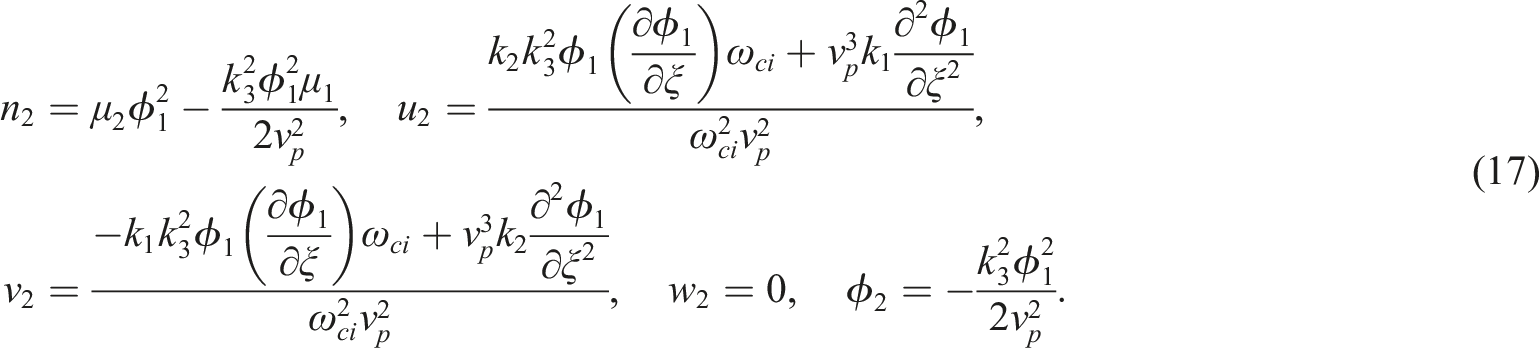
We establish the KdV equation for the IAWs in a magnetized q-nonextensive plasma with TTE using the RPM and the stretched coordinates
1
:



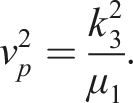






It is obvious from equation (15) that the dispersion coefficient is independent of the MF parameter ω ci , but the nonextensive parameters (qc,h) and the TTE influence the dispersion and nonlinear coefficients.
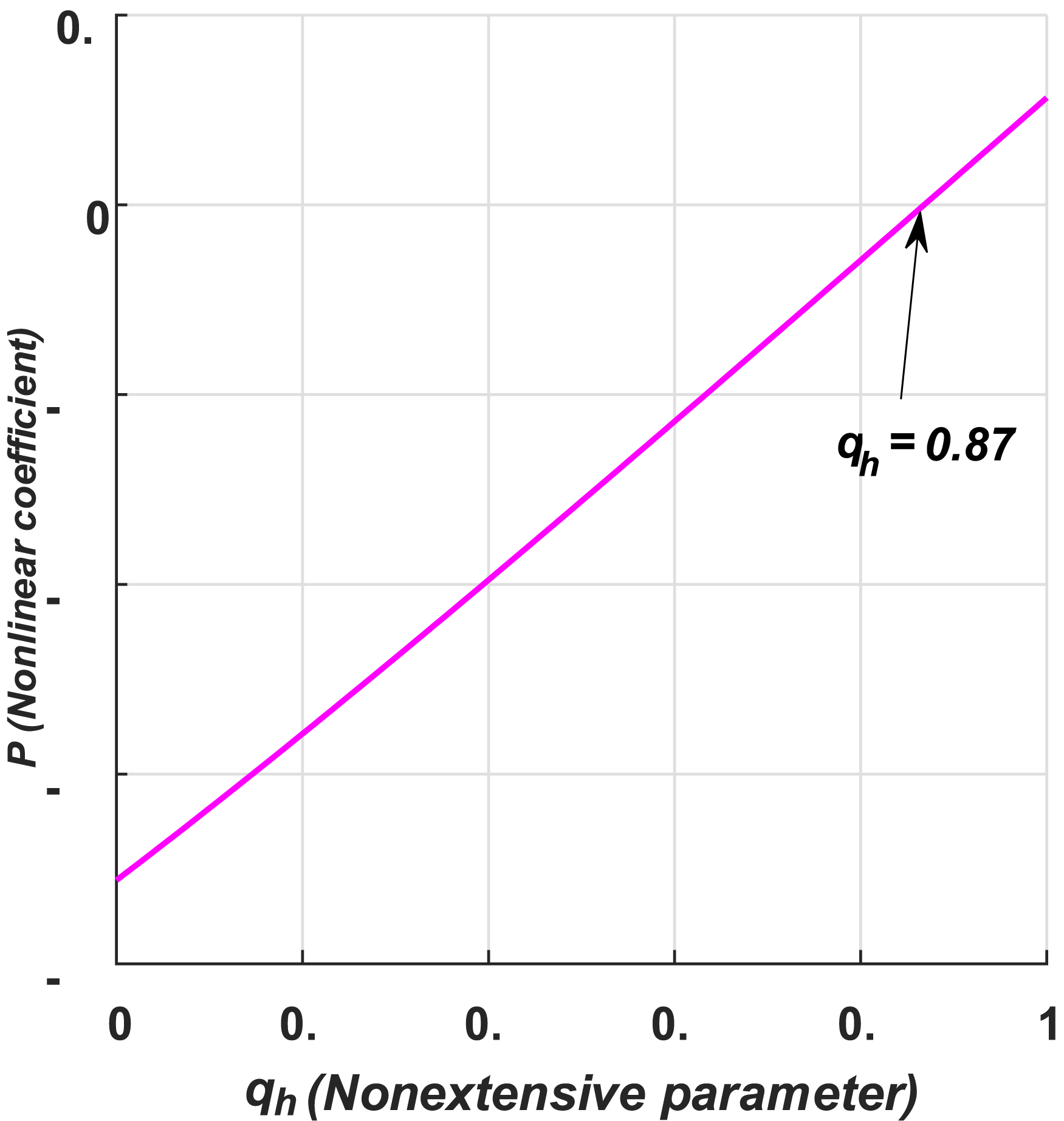
The nonlinear coefficient P, a function of q
h
, q
c
, δ, and ϑ is what drives the KdV equation. With fixed values of these parameters, Figure 1 illustrates how P can take positive or negative values depending on the nonextensive parameter q
h
. However, the coefficient P of the nonlinear part in the KdV equation becomes zero when q
h
= 0.87, q
c
= 0.5, δ = 0.3, ϑ = 0.3, and ω
ci
= 0.5. The KdV equation cannot be applied to such a set of numbers. Consequently, we develop the mKdV equation by considering the higher-order coefficients of ϵ. Evolution of the nonlinear coefficient of the KdV equation against q
h
.




Bilinear form and multi-soliton solution for the MKDV equation
In this section, we use the HBM68,88 to compute the MS solutions of the mKdV equation.70–79 Several scholars have employed this method to construct the N-soliton solutions of nonlinear PDEs.89–93 Hirota employed carefully chosen transformations of the dependent variables to get the MS solutions.70–79 We transform equation (19) to the standard mKdV equation as






One-soliton solution
We solve the linear differential equation for F1 in first order ϵ to derive the one-soliton solution. The corresponding one-soliton solution is given by One CIASWs for mKdV equation, with ω
ci
= 0.5, k3 = 0.94, ϑ = 0.2, q
c
= 0.5, δ = 0.2, q
h
= 0.3, and r1 = 0.5. One RIASWs for mKdV equation, with ω
ci
= 0.5, k3 = 0.94, ϑ = 0.1, q
c
= 0.5, δ = 0.6, q
h
= 0.4, and r1 = 0.5.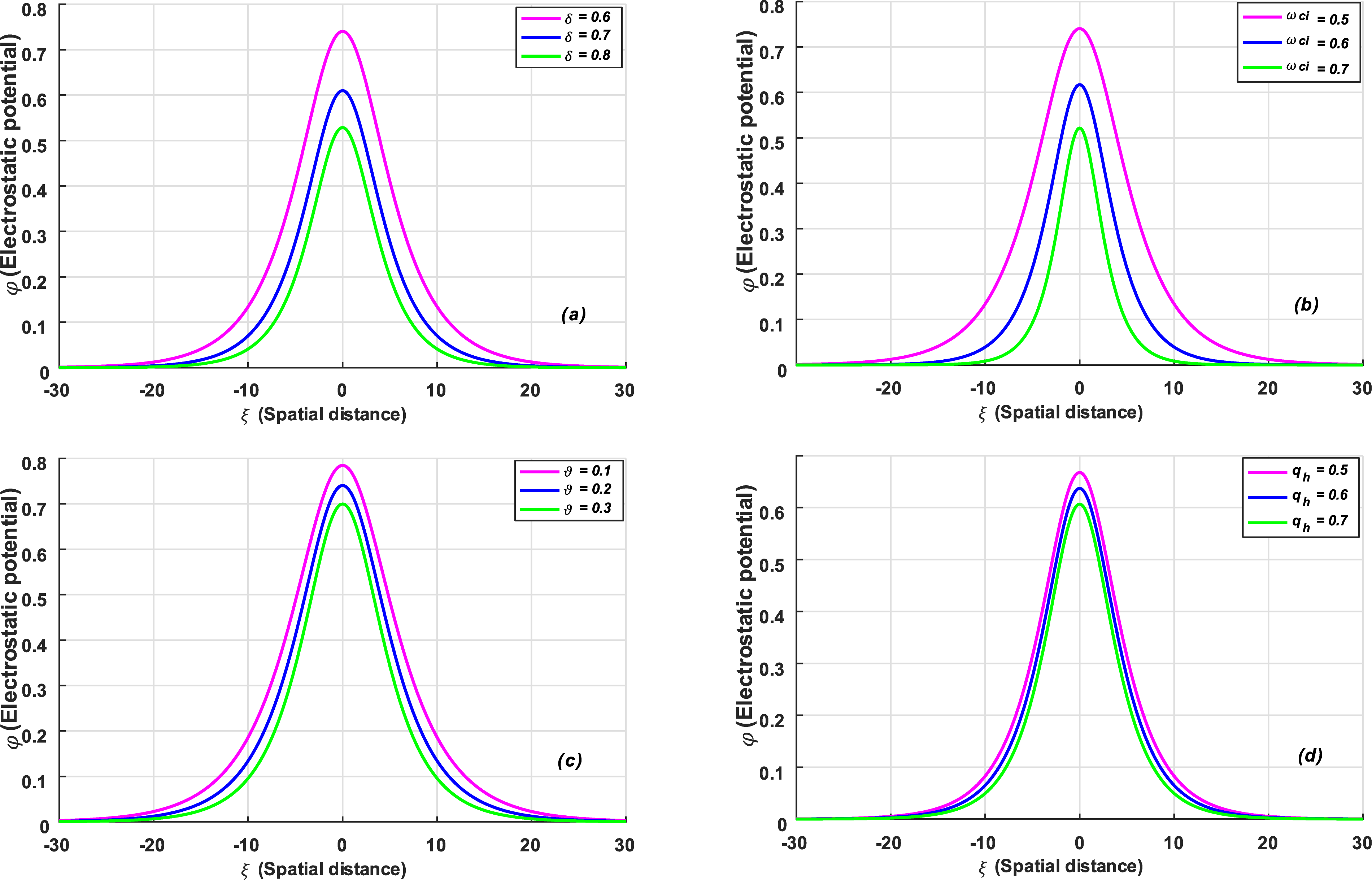
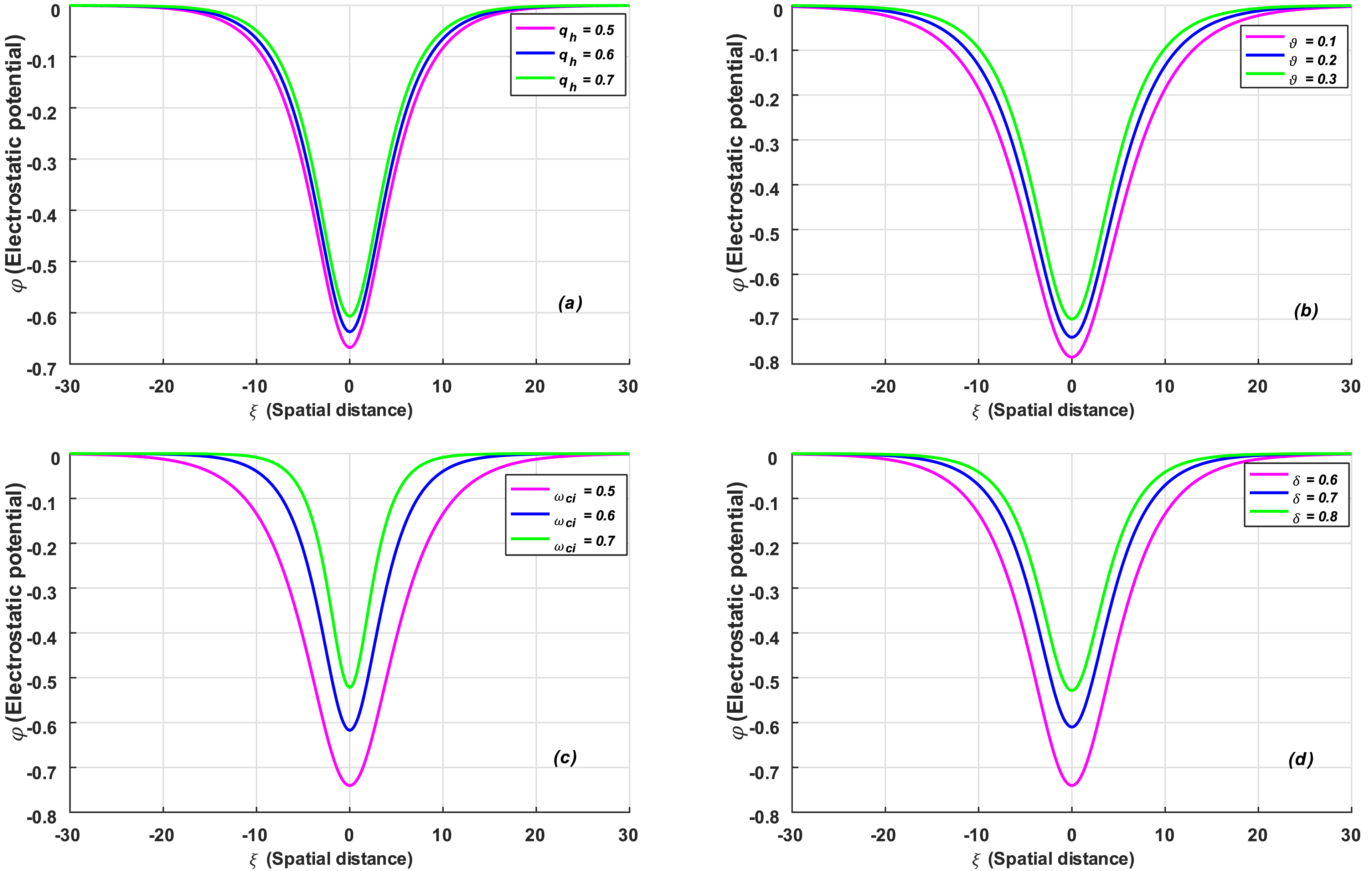

Moreover, a decrease in the depth and width of the RIASWs is observed in Figure 3(a)-(d) for an increase in the relevant plasma parameters ω ci , δ, ϑ, and q h , respectively. Physically, the pulses become shorter as the parameters ω ci , δ, ϑ, and q h increase because they decrease the nonlinearity and spread the energy.
Two-solitons solution
In a similar way, the two-solitons solution can be generated by solving the resulting linear partial differential equation in ϵ2 order to find F1 and F2. We find that

We examine in Figure 4 the interaction between two-soliton solution since they exhibit unusual behavior in this context. The collision of two CIASWs, at different times is shown in Figure 4(a). The interaction snapshots are displayed at moments τ = −110, −25, and 110. As the time rises, the two CIASWs move to the right. This plot shows that the taller soliton moves faster than the shorter one. At a given time, the two-solitons collide and exchange energy during this collision process. In the colliding zone, the two-solitons unify to form a single distorted peak. Eventually, at a later time, they regain their shape and split apart, giving the impression that the two CIASWs have switched positions. Figure 4(b) illustrates the interplay of two RIASWs at different periods, such as τ = −110, 0, and 110. In the interaction zone, it can be observed that the taller rarefactive soliton catches the shorter one. Then both continue moving at different speeds, with the taller rarefactive soliton moving faster than the shorter one. Behaviors similar to those of the panel in Figure 4(a) are observed. Interaction between two CIASWs (a), and two RIASWs (b) for mKdV equation, with ω
ci
= 0.5, k3 = 0.94, ϑ = 0.1, q
c
= 0.5, δ = 0.6, q
h
= 0.4, r1 = 0.5, r2 = 0.3.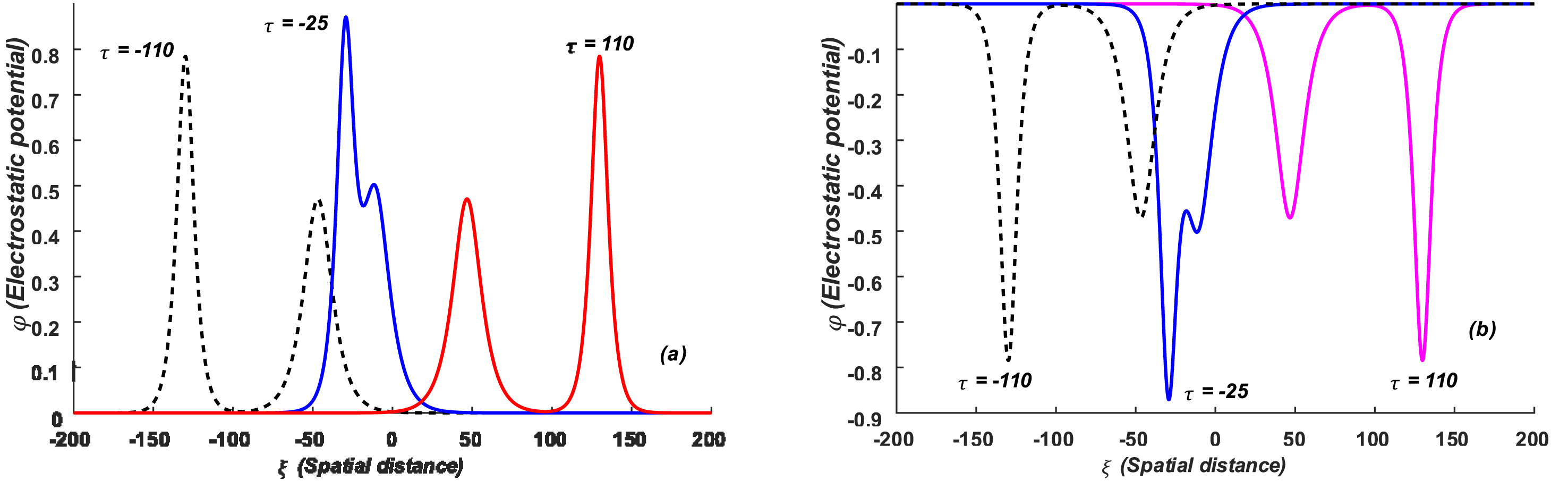
The other crucial situation is depicted in Figure 5, showing the interaction of solitons of opposite polarity. To achieve the evolution of the interaction between CIASWs and RIASWs, we consider the opposite sign values of the wavenumbers r1 and r2. The figure shows that the compressive (taller) and rarefactive (shorter) solitons initially move to the right. At a given time, the two solitons collide, and the rarefactive soliton splits into two symmetrical dips of lower amplitude than initially. Finally, at the larger time, we obtain the two separated solitons, the taller of which moves in the space in front of the shorter. Figure 5(b) instead presents the interactions between a large amplitude rarefractive soliton and a small amplitude compressive soliton. Here we see that the compressive soliton splits into two humps of lower amplitude than the initial one. At a larger time, the two solitons recover their initial shapes. Interaction between CIASWs and RIASWs for mKdV equation, with ω
ci
= 0.8, k3 = 0.94, ϑ = 0.1, q
c
= 0.5, δ = 0.6, q
h
= 0.4, r1 = −0.07, and r2 = 0.3.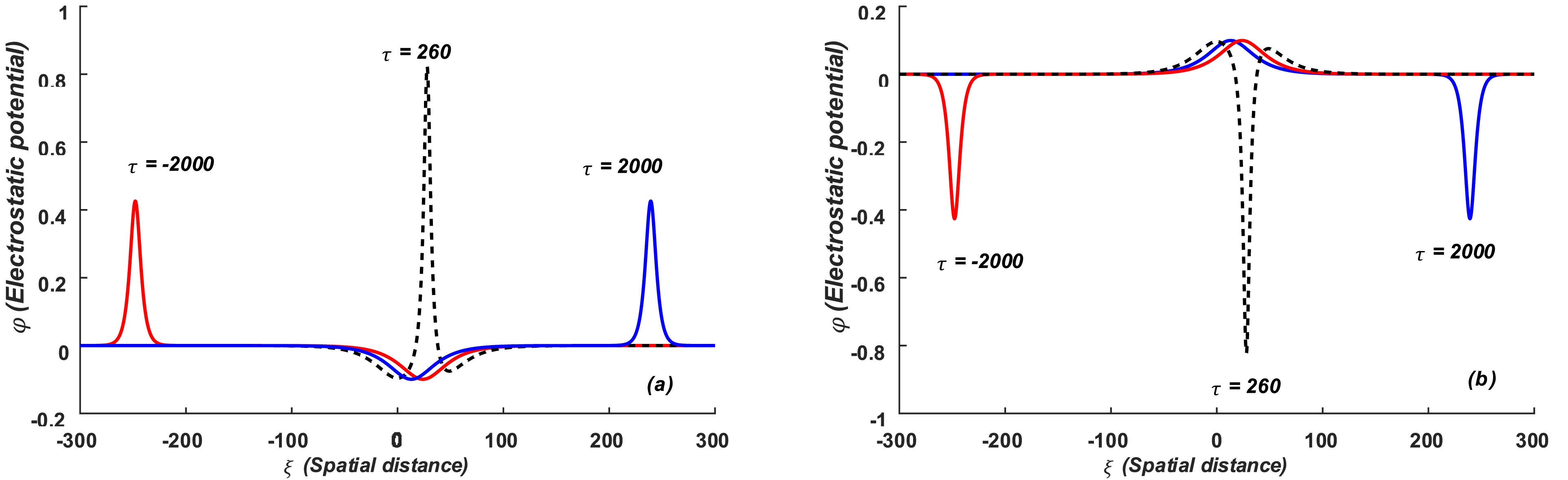
The spatio-temporal state of two solitons provided by equation (28) is plotted in Figure 6. It should be noted that when the distance between a pair of colliding solitons is far enough from the other pair, the solitons in the farther pair will interact more quickly than those closer and, therefore, have a large amplitude. This result is valid when the collision time is the same for the two pairs of colliding solitons. Figure 6(a) and 6(b) display the impact of varying the ratio between cold and hot electron temperatures δ on the interaction of CIASWs in the plasma model. We see that in Figure 6(a) obtained for δ = 0.6, the two solitons are initially further apart than those in Figure 6(b) obtained with δ = 0.8. We can, therefore, conclude that the fastest interaction occurs for low values of δ. This is consistent with the single soliton result where the δ parameter was shown to decrease the amplitude of a single CIASW, consequently decreasing the speed of the soliton. Interaction time, therefore, slows down as δ increases. Figure 6(c) (ω
ci
= 0.6) and 6(d) (ω
ci
= 0.75) show the impact of increasing the MF parameter ω
ci
on the interaction of two RIASWs. By applying the same reasoning as in Figure 6(a) and 6(b), we can say that the fastest interaction occurs for low values of ω
ci
since the parameter ω
ci
decreases the amplitude of single RIASW. Collision between two CIASWs (a,b), two RIASWs (c,d), CIASWs and RIASWs (e) for mKdV equation, with ω
ci
= 0.5, k3 = 0.94, ϑ = 0.1, q
c
= 0.5, δ = 0.6, and q
h
= 0.4.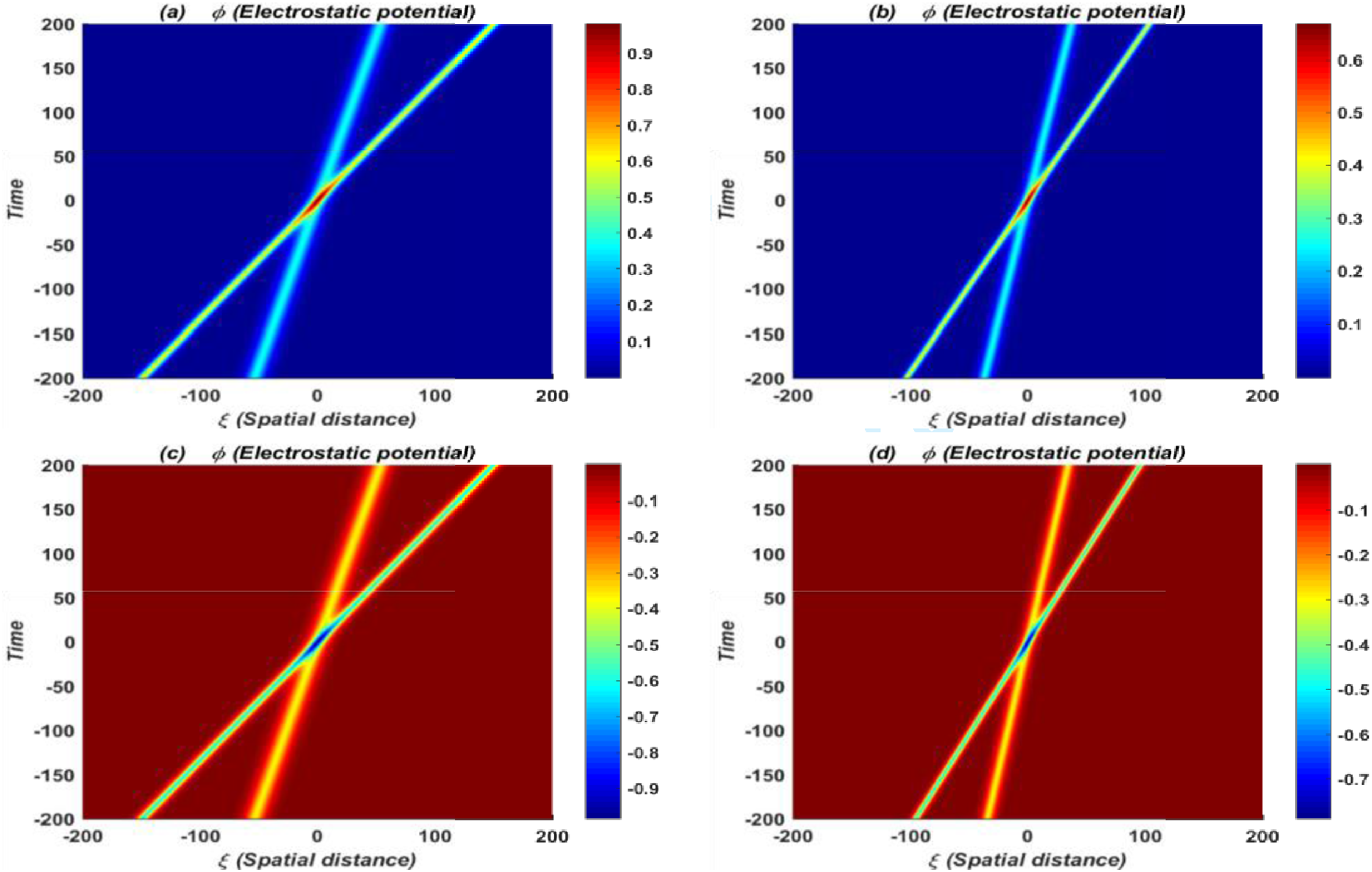
Three-solitons solution
By using the same approach to the two-solitons problem, the three-solitons solution can be obtained by solving the resulting linear PDE in ϵ3, in order to find the quantities F1, F2, and F3. Here, we have
83



The phenomenon of elastic collision among three-soliton provided by equation (30) is presented in Figure 7 (CIASWs) and Figure 8 (RIASWs). These figures display a snapshot of the interactions of the three CIASWs (RIASWs) at various times, and we observe a multiple collision process of solitons. The three compressive (rarefactive) waves initially move to the right, with the larger amplitude soliton behind the two shorter ones. At τ = 0, the two shorter solitons collide, forming a distorted peak. Later, the distorted peak combines with the larger soliton to create a single soliton. After these two collisions, the three solitons gradually separate from each other and finally regain their initial shapes and amplitudes. Interaction between three CIASWs for mKdV equation, with ω
ci
= 0.9, k3 = 0.94, ϑ = 0.1, q
c
= 0.5, δ = 0.5, q
h
= 0.4, r1 = 0.5, r2 = 0.3, and r3 = 0.09. Interaction between three RIASWs for mKdV equation, with ω
ci
= 0.9, k3 = 0.94, ϑ = 0.2, q
c
= 0.5, δ = 0.5, q
h
= 0.3, r1 = 0.5, r2 = 0.3, and r3 = 0.09.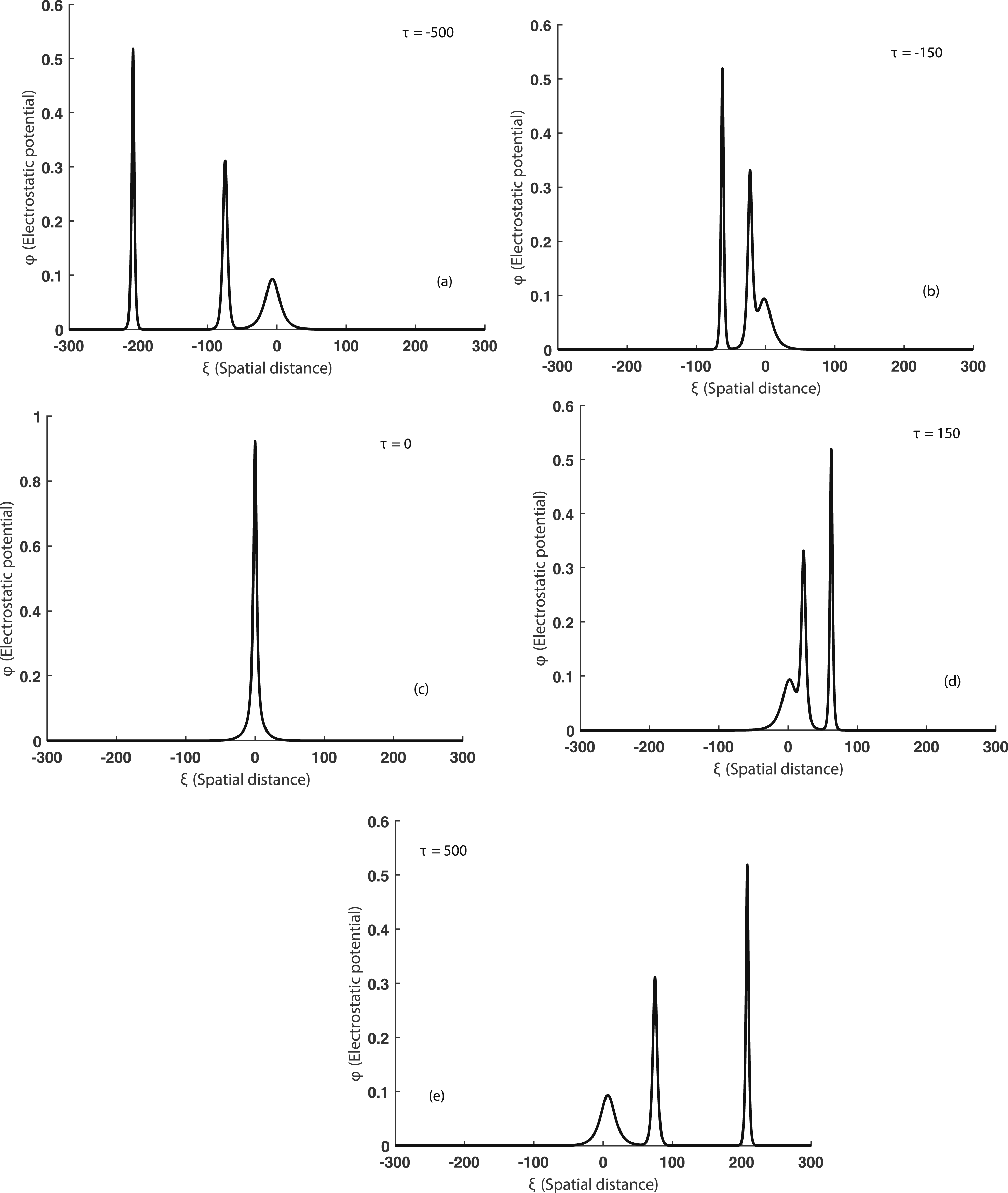
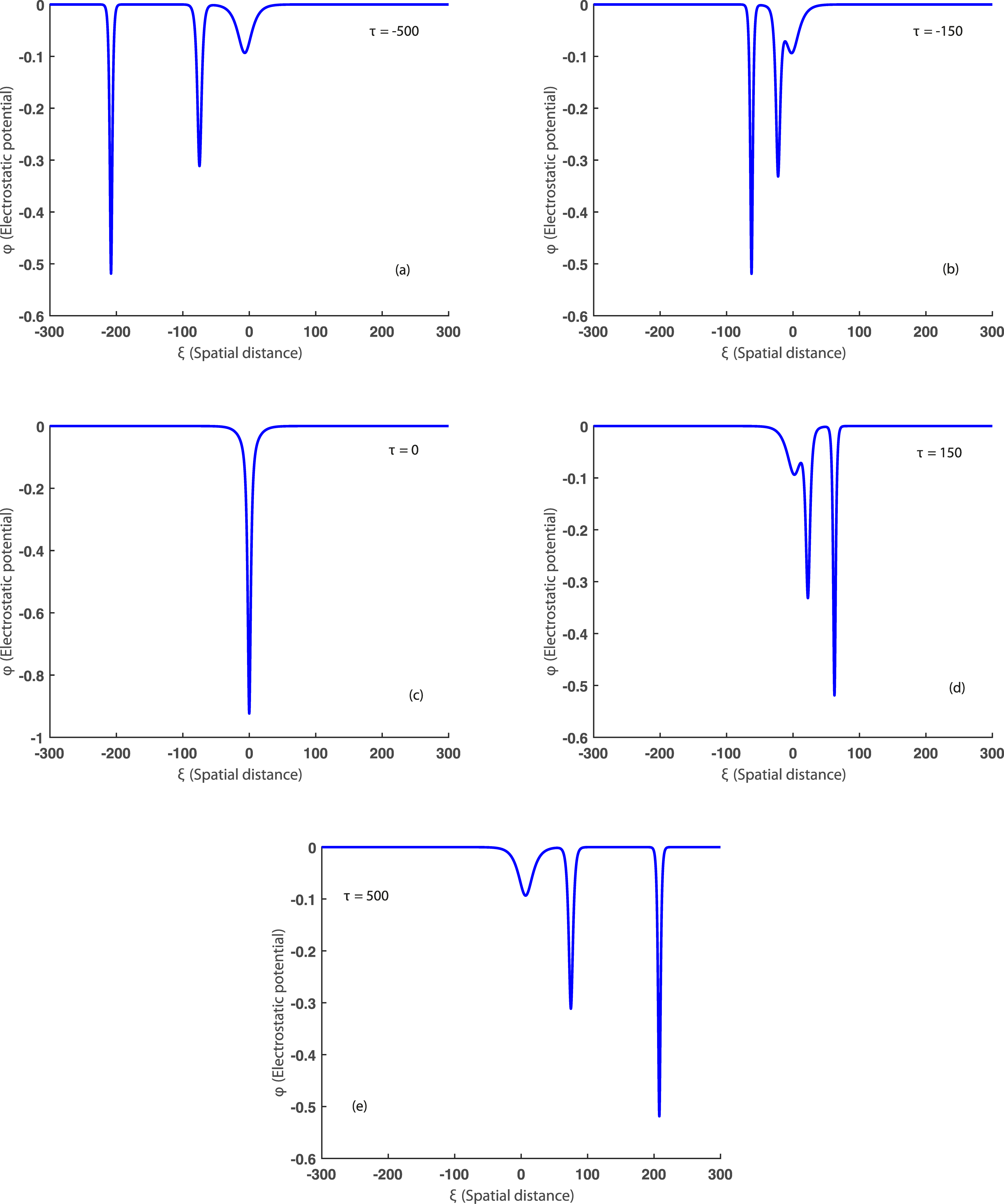
Figure 9 shows the evolution of elastic collision among two compressive and one rarefactive soliton for the mKdV equation. Here too, we observe a multiple collision process of solitons. At τ = −80, the three solitary waves initially move to the right. The first interaction begins at τ = −10, where the three solitons combine to form a composite structure. Over time, the composite structure coalesces to create a single soliton peak at τ = 0. After the interactions, they separate from each other and return to their initial shapes and amplitudes at τ = 80. This clearly proves the fact that these different interactions take place without loss of energy. Interaction between two CIASWs and one RIASW for mKdV equation, with ω
ci
= 0.5, k3 = 0.94, ϑ = 0.2, q
c
= 0.5, δ = 0.2, q
h
= 0.3, r1 = −0.5, r2 = 0.3, and r3 = 0.73.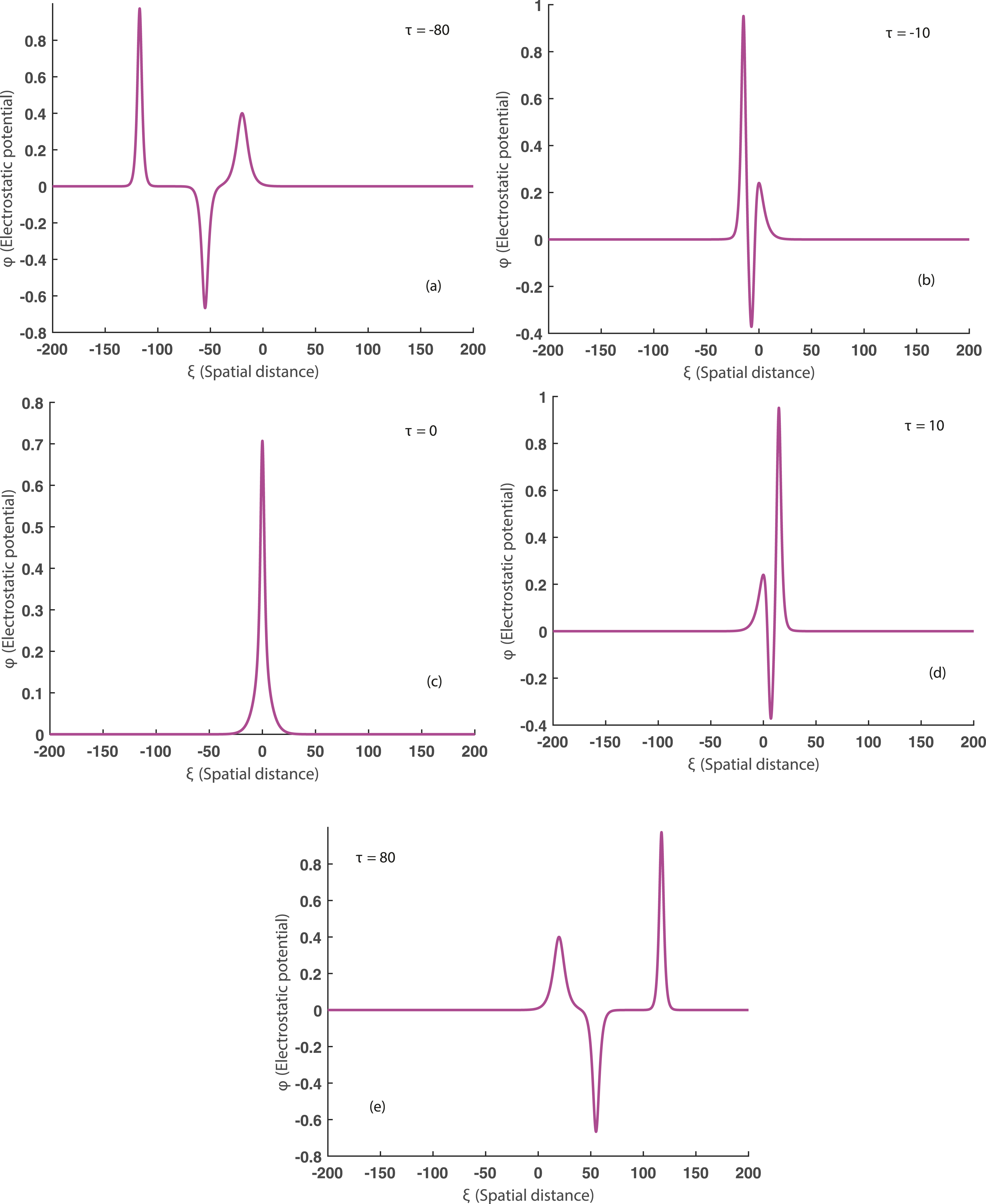
Figure 10(a) (ϑ = 0.1) and 10(b) (ϑ = 0.3) show the impact of increasing the parameter ϑ on the spatio-temporal regime of the interaction between one CIASW and two RIASWs. It can be seen that with the increasing of ϑ, the spatial scale of interaction increases, and the solitons in Figure 10(a) interact faster as the ion density in the plasma increases. This behavior is in agreement with the result of a single soliton since the parameter ϑ drops the amplitude of single solitary waves (see Figure 2(a) and 3(d)), thereby, decreasing the speed of the soliton. Collision between one CIASWs and two RIASWs for mKdV equation, with ω
ci
= 0.5, k3 = 0.94, q
c
= 0.5, δ = 0.6, q
h
= 0.4, r1 = −0.5, r2 = 0.3, and r3 = 0.73.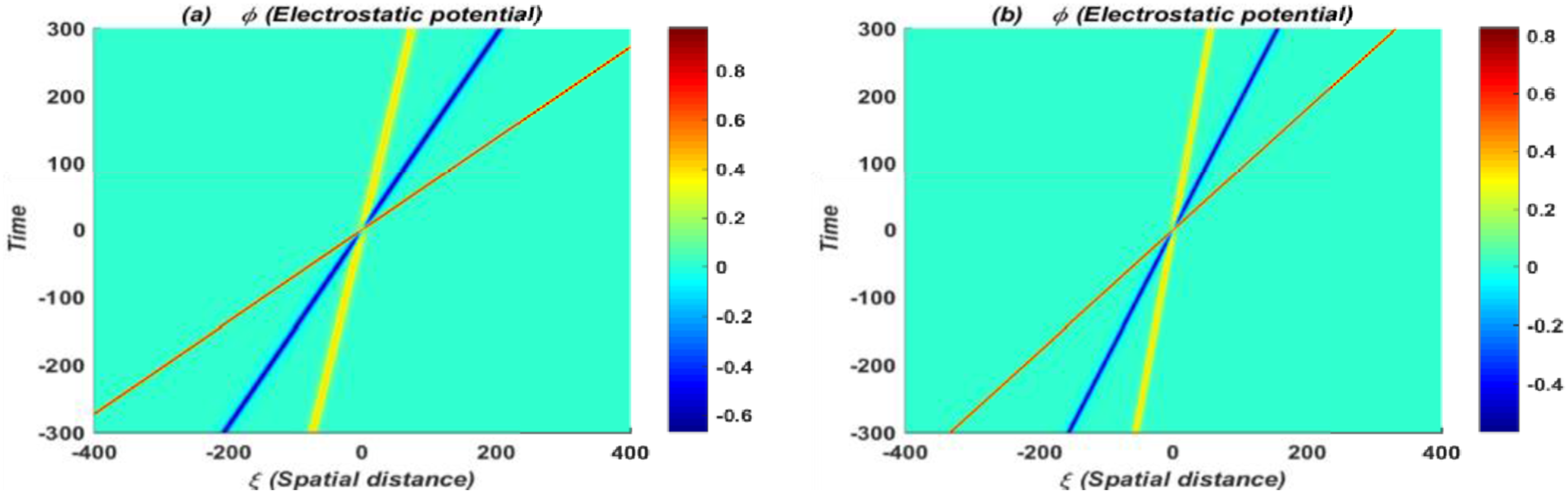
Conclusion
In this paper, we have examined the formation and interaction of the ion-acoustic waves (IASWs) in a plasma model composed of inertial positive ions and two-temperature electrons (inertia cold and q-nonextensive distributed hot). From this plasma model, we have employed the RPM to derive the KdV equation. Subsequently, we have obtained a set of plasma parameters for which the KdV equation is no longer valid and derived, in this case, the mKdV equation. Using the HBM, we have obtained the one-, two-, and three-soliton solutions of the mKdV equation in the form of compressive (positive polarity) and rarefactive (negative polarity) waves. The parametric role of cold-to-hot electrons temperature δ, the MF parameter ω ci , the density ratio ϑ, and the q-nonextensive distributed hot electrons q h on the compressive and rarefactive solitary wave profiles have been explored. The main results of the article are summarized as follow: Increasing the parameters (δ, ω ci , ϑ, q h ) reduced both the width and amplitude of the compressive and rarefactive waves. Regarding the exciting phenomenon of the interaction dynamics of solitons with the same polarity and solitons with opposite polarity, we have shown that the rise in the values of cold-to-hot electrons temperature ratio δ and MF parameter ω ci decreases the interaction time and shortens the separation distance between the colliding solitons. More interestingly, the interaction between three-solitons has also been investigated. It was observed that even though there were several collision processes, the solitons regained their shape and amplitude after the interactions. The results of this work should help understand the salient features of IASWs interaction in space and astrophysical plasmas where ions and TTE (with q-nonextensive distribution) are frequently encountered. Nevertheless, the KdV and mKdV equations we use here are one-dimensional, and the analytical study using the RPM is only valid in the case of small amplitude nonlinear waves. In the case of arbitrary amplitude nonlinear waves, numerical simulations are more indicated to analyze the system’s behavior with respect to the relevant plasma parameters. Therefore, it is intriguing to examine a higher dimensional equation, such as the (3 + 1)-dimensional coupled Davey-Stewartson equation, in order to directly numerically simulate the associated equations and study the phenomenon of energy transfer through the process of elastic and inelastic collision among energetic particles on the same plasma model.
Footnotes
Acknowledgments
The authors extend their appreciation to the Deanship of Scientific Research and Libraries in Princess Nourah bint Abdulrahman University for funding this research work through the Research Group project, Grant No. (RG-1445-0005).

Authors contributions
All authors contributed equally and approved the final version of the current manuscript.
Funding
The author(s) disclosed receipt of the following financial support for the research, authorship, and/or publication of this article: The authors extend their appreciation to the Deanship of Scientific Research and Libraries in Princess Nourah bint Abdulrahman University for funding this research work through the Research Group project, Grant No. (RG-1445-0005).
Declaration of conflicting interests
The author(s) declared no potential conflicts of interest with respect to the research, authorship, and/or publication of this article.
Use of AI tools declaration
The authors declare they have not used Artificial Intelligence (AI) tools in the creation of this article.
Data Availability Statement
Data sharing is not applicable to this article as no new data were created or analyzed in this study.