




Abstract
The characteristics of (non)linear dust-ion acoustic waves (DIAWs) in a collisionless, magnetized dusty plasma are investigated. The current model is composed of (r, q)-distributed electrons along with warm ions and stationary dust grains with negative charge. Both linear and nonlinear waves are considered to progress in x- z plane. The properties of linear waves are studied by deriving the dispersion relation for the plasma parameters of Saturn’s magnetosphere. The fluid equations of the current model are reduced to the universal Korteweg-de Vries (KdV) equation in order to study the characteristics of oblique propagation of DIA solitary waves (DIASWs). The critical point at which the nature/polarity of solitons changes is determined precisely. The influence of various plasma parameters, namely, obliqueness, magnetic field, densities, temperatures, and double spectral indices of the (r, q)-distributed electrons on DIASWs is investigated for Saturn’s magnetosphere. The DIASWs of (r, q)-distributed electrons are also compared with Maxwellian electrons. This work would be helpful to study other astrophysical and laboratory plasma systems where dusty plasmas and (r, q) distribution are predicted.
Keywords
Introduction
The dusty plasma, also known as complex plasma, is like ordinary (electron-ion (e − i)) plasma system with the addition of micro or nano-sized charged dust grains.1,2 The addition of dust particles alters the usual linear and nonlinear e − i plasma modes, by virtue of the variation of the charge, mass, number, and size of dust particles, to the dust-acoustic waves (DAWs),3,4 the DIAWs, 5 the dust-ion acoustic (DIA) rogue waves (DIARWs), 6 DIA dissipative solitons, 7 the dust lattice waves, 8 etc. in the plasma system. The dusty plasma is a widely studied field of research due of its vast existence regimes in laboratory, 9 as well as in space plasmas, for example, cometary tails, interstellar medium, planetary rings, and terrestrial and planetary magnetospheres.10,11 The dust grains are initially neutral; however, they attain the negative charge when the electrons are caught by their surface or become positively charged by photoemission or thermionic emission.12,13
The DIAWs were first predicted theoretically in 1992, 5 which were later discovered and confirmed experimentally in 1996. 14 Since then, many researchers have extensively investigated the (non)linear DIAWs in space and laboratory dusty plasmas.15–19 The finite amplitude DIASWs with both positive and negative inertial ions have been studied for both positive and negative solitons. 20 Recently, Hassan et al. investigated the DIAWs in a superthermal magnetized collisional plasma in the presence of opposite polarity dust. 21 They studied the effects of superthermality, adiabaticity, viscosity, magnetic field (MF), obliqueness, the charge on dust and collisions for the solitons and shock waves.
A substantial variation of the Maxwellian distribution has led to the discovery of non-Maxwellian velocity distributions recently22,23 in both space and astrophysical plasmas including magnetosheath, magnetospheres, ionosphere, sun wind, and interstellar medium. 24 The deviations of the velocity distributions include superthermal tails, known as kappa or generalized Lorentzian distribution 25 as well as the flat top behavior in bow shocks, magnetosheath and the magnetotail.26,27 Qureshi et al. 28 established a comprehensive and general velocity distribution with flat tops and the high energy tails, named as the generalized (r, q) distribution function. Here, index q determines the particles population in the long tails, whereas the index r ascertains the population of particles at low energies for the flat top of distribution. This distribution function approaches to Maxwellian case for r = 0 and q → ∞ and a kappa distribution 29 for r = 0 and q → κ + 1. Recently, a few researchers have investigated the linear as well as the nonlinear propagation properties of various waves in plasma physics by utilizing the (r, q) distribution function to estimate the effect of spectral indices on the waves. Qureshi et al. 30 employed the generalized (r, q) distribution to investigate the terrestrial lion roars, primarily studied by using bi-Maxwellian distribution, 27 and showed that it agreed with the observed data for (r, q) distribution. Sidra et al. investigated the ion acoustic solitons and periodic structures in upper ionospheric plasmas. 31 The interaction of DIASWs has been studied for Saturn’s rings with (r, q) distributed electrons with cubic nonlinearity to investigate the influence of spectral indices on interaction regime. 32
Saturn’s magnetosphere (SMS) being the second largest magnetosphere of all the planets in the solar system, discovered for the first time in 1979 by the Pioneer-11 spacecraft, is created due to the interaction of sun wind with the internal MF of the planet. 33 The main subject of research of Cassini mission has been the study of SMS since 2004 which has provided deep insights about Saturn’s inner atmosphere and space around it. The SMS is filled with dusty plasmas due to the planetary rings, as well as its moon, where the major contribution of plasma comes from its moon Enceladus. 34 The Saturn rings are specifically important examples of dusty plasma, since they are electron depleted regions due to charging of dust particles by the background electrons. 5
In this investigation, the DIAWs will be studied in a collisionless magnetoplasma, comprising the warm ions, (r, q) distributed electrons, and stationary dust grains. The motivation for considering the present model is many fold: first, the magnetized plasma exists in SMS, so a realistic model is to consider the MF. Second, the MF affects the charged particles anisotropically for parallel and perpendicular propagation. So, we have considered both directions for propagation of DIAWs. Third, a general double parameter electron distribution is considered which takes into account the flat top and elongated tail effects and can approach kappa and Maxwellian distributions for the limiting cases.
This study is sectioned in following pattern. In the Mathematical Model section, the fluid model equations leading to the oblique propagation of DIAWs in a magnetized collisionless plasma is considered. The Linear Dispersion Relation section discusses the linear mode of DIA waves and Evolutionary Equation and DIASWs section is devoted to derive the evolution equation (KdV equation) by utilizing the reductive perturbation scheme (RPS). The Linear Dispersion Relation section presents the numerical analysis and discussion for the effects of various plasma parameters on the propagation of DIASWs belonging to SMS. Main findings of our results are summarized in the Numerical Results and Discussion section.
Mathematical model
A homogeneous, collisionless complex plasma is considered consisting of warm ions and non-Maxwellian electrons that follow (r, q)-distribution along with stationary dust grains. The dust charge and size of the grains are assumed to be constant. The wave propagates obliquely along x − axis and the z − axis and MF is aligned along the z − axis








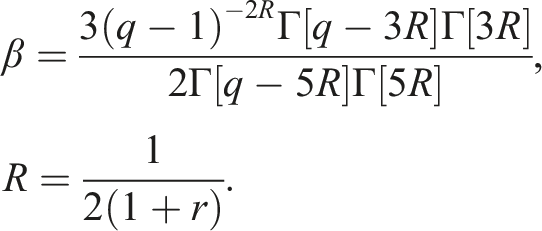
The normalized density of the non-Maxwellian electrons follows the (r, q)-distribution
28




Linear dispersion relation
The linear properties of the plasma system under consideration can be studied with the help of the linear dispersion relation (LDR). Accordingly, we utilize the linearized system of the equations (4)–(9) and consider the planar form of perturbations

By solving equation (13), we finally get the LDR

Here, positive and negative signs, respectively, denote the fast and slow modes of DIAW. The fast mode represents the obliquely propagating ion cyclotron wave, since ω+ → Ω (which is the ion cyclotron frequency) as k → 0. However, the slow mode represents the obliquely propagating ion-acoustic wave (IAW). Additionally, it may be observed from the above expression that the linear properties of the waves depend upon plasma parameters through
Evolutionary equation and DIASWS
For studying the characteristics of DIASWs, the RPS is applied to derive a suitable evolution equation.35,36 Accordingly, the following stretching is utilized for space and time coordinate

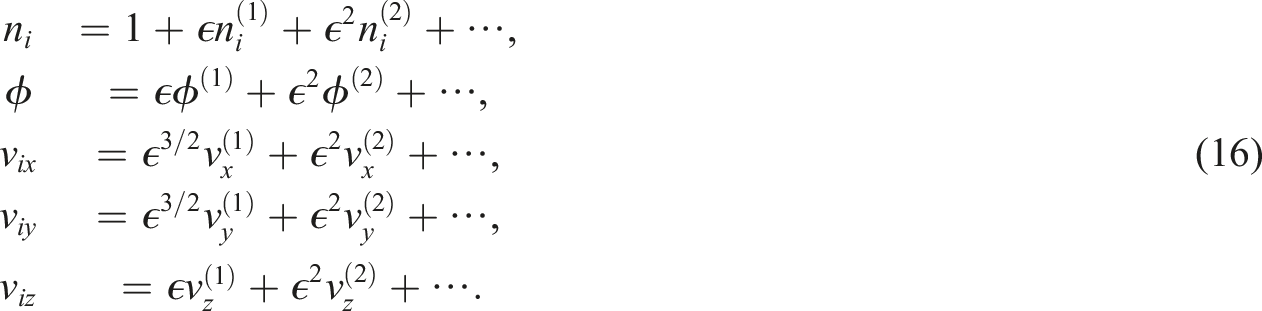
Using both the stretching (15) and expansions (16) in the model equations (4)–(9), we get the reduced equations in terms of different powers of ϵ. The equations with the lowest-order of ϵ give us
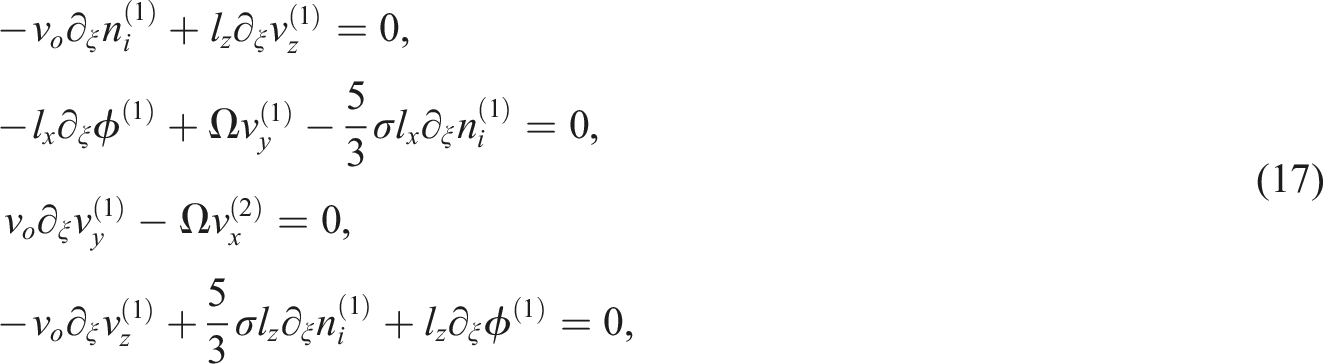

By solving the above system, the following normalized phase velocity is obtained

The higher-orders of ϵ give us


After tedious mathematical algebraic steps, we finally obtain the following KdV equation for the obliquely propagating DIAWs


A steady-state solution of KdV is obtained
37
by using a traveling wave solution

It is worth mentioning here that for the complex plasmas, there is a critical point at which the nonlinearity coefficient a vanishes. At this point, the nonlinearity no more balances the dispersive coefficient for a stable soliton formation. For present dusty plasma, the coefficient a vanishes, that is, a = 0 at the following critical value of the electron concentration

Thus, the solitary wave changes its polarity (compressive to rarefactive, or vice versa), below and above this critical point. It may be seen that the critical value to the electron concentration μ c depends upon all the plasma parameters and parameters of electron distribution function, but is independent of the MF B0 and direction cosine l z .
Numerical results and discussion
We analyze the structure of both linear and nonlinear electrostatic DIAWs numerically in this section for a dusty magnetized plasma. Both linear and nonlinear properties of DIAWs are greatly influenced by various plasma parameters. To observe the impact of various parameters, we take into account dusty plasma parameters of the SMS,33,34,38 with MF B0 = 0.04G, temperature of electrons k
B
T
e
= (10 − 100)eV, density of electrons ne0 = (1 − 4) × 102cm−3, dust grains charge and density as z
d
= 100 and nd0 = (0.1 − 10)cm−3, respectively. Furthermore,
First, the influence of dusty plasma parameters, namely, MF B0, temperature ratio σ(= T
i
/T
e
), and dust concentration nd0, on the linear properties of the DIAW can be observed by plotting the LDR (14) as shown in Figure 1. Figure 1 shows the influence of The frequency ω+ of fast mode is plotted versus wave vector k to show variation of dust concentration nd0, MF B0, and temperature ratio σ. Here, the standard curve is plotted for nd0 = 0.5cm−3, ne0 = 102cm−3, B0 = 0.04G, σ = 0.01, q = 2.5, r = 0.3, and θ = 10.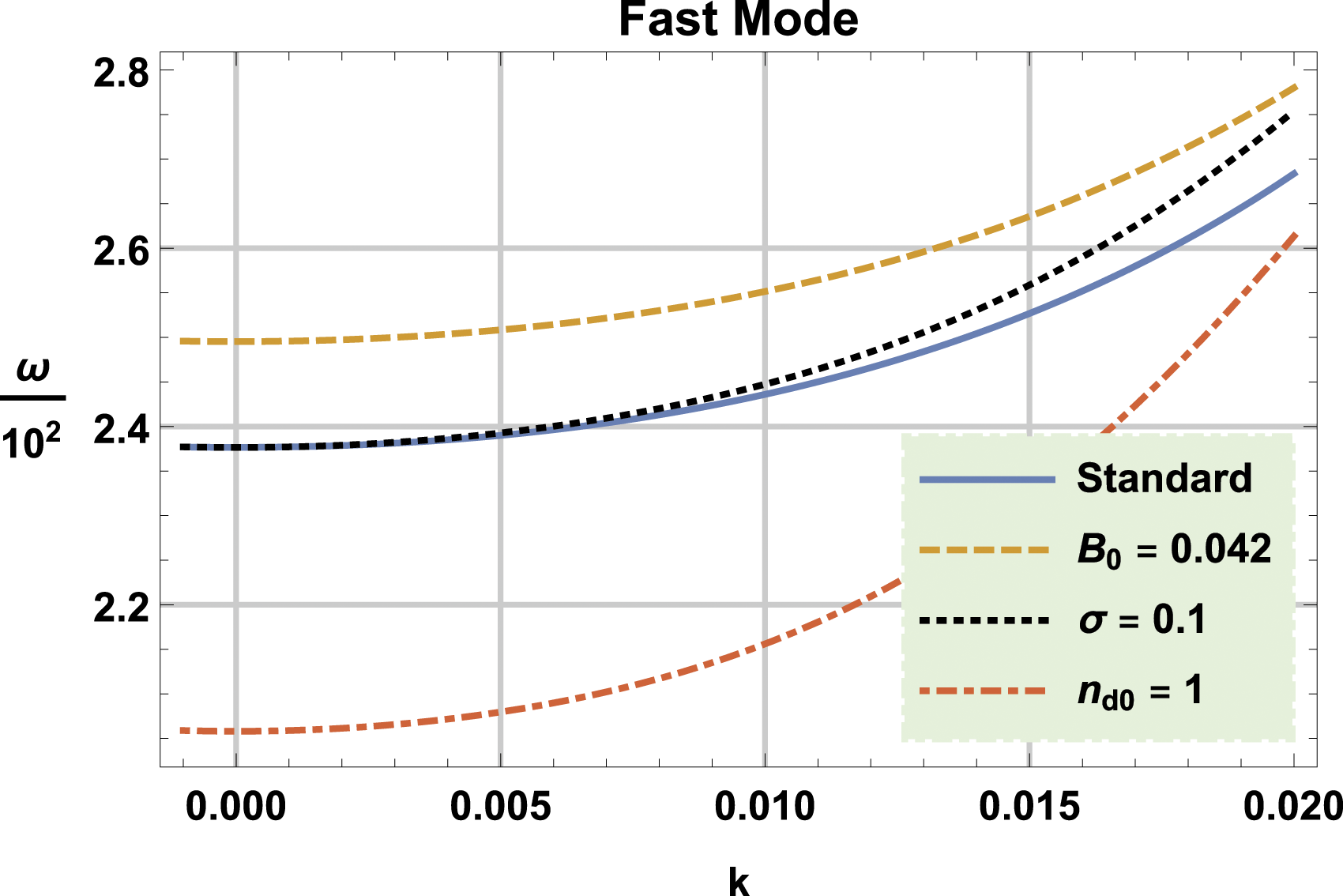
Figure 2 delineates the effects of plasma parameters The frequency ω− of slow mode is plotted versus wave vector k to show variation of dust concentration nd0, MF B0, and temperature ratio σ. Here, the parameters are same as Fig. 1.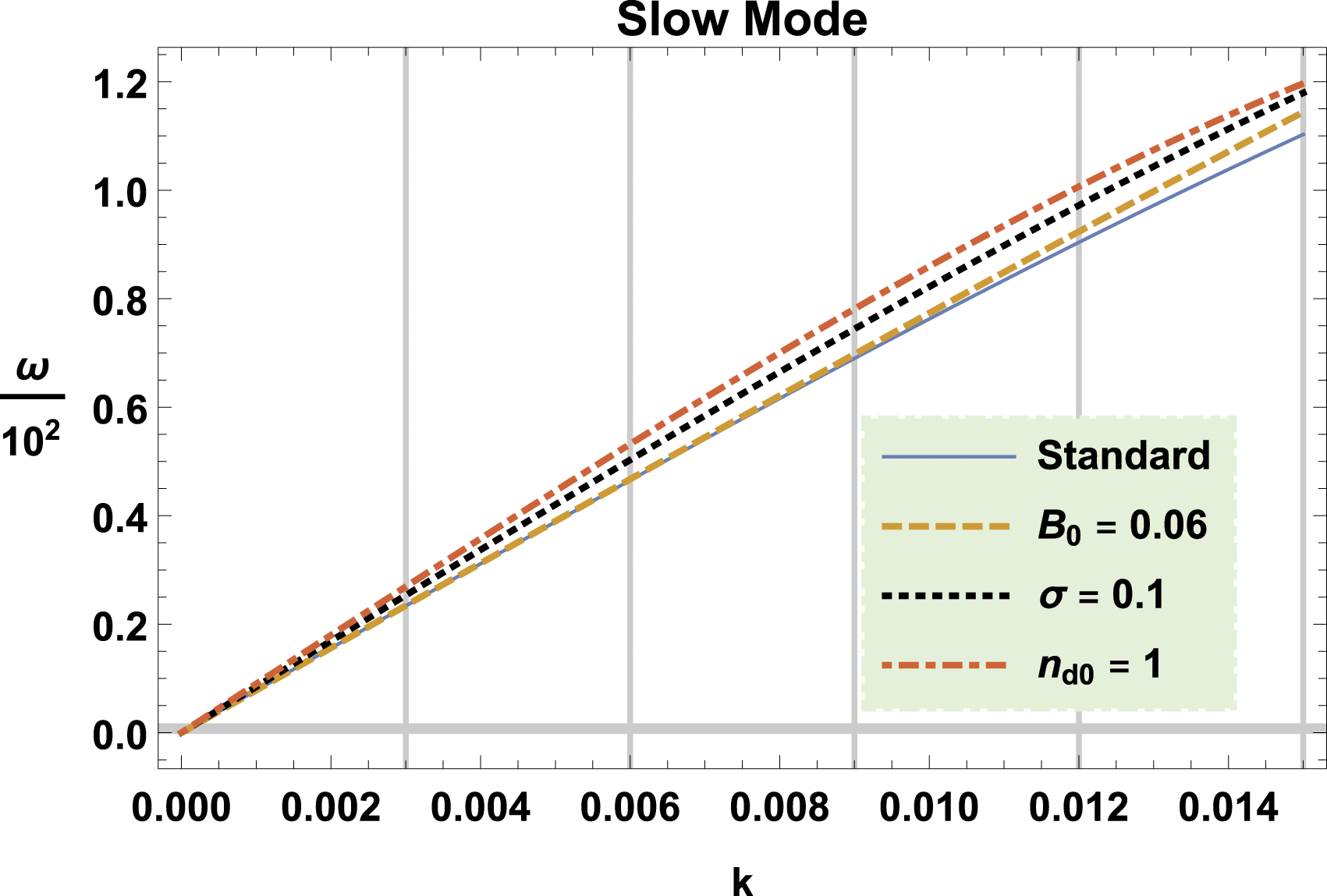
Besides the mentioned plasma parameters The frequency ω+ of fast mode is plotted versus wave vector k to show variation of q, r and angle θ. Here, the standard curve is plotted for nd0 = 0.5cm−3, ne0 = 102cm−3, B0 = 0.04G, σ = 0.1, q = 2.5, r = 0.3, and θ = 10.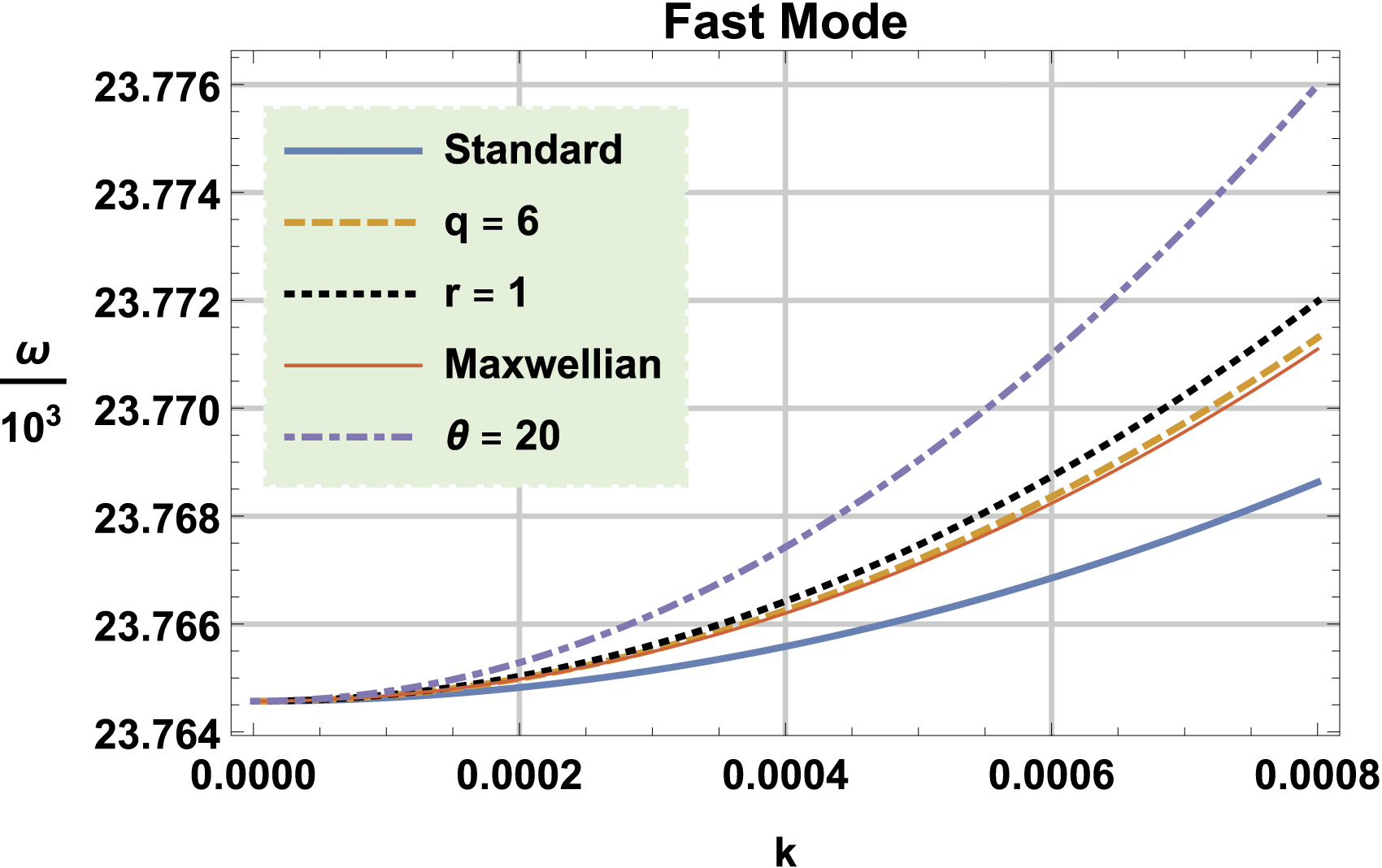
Figure 4 illustrates the influence of indices The frequency ω− of slow mode is plotted versus wave vector k to show variation of q, r and angle θ. Here, the parameters are same as the Figure 3.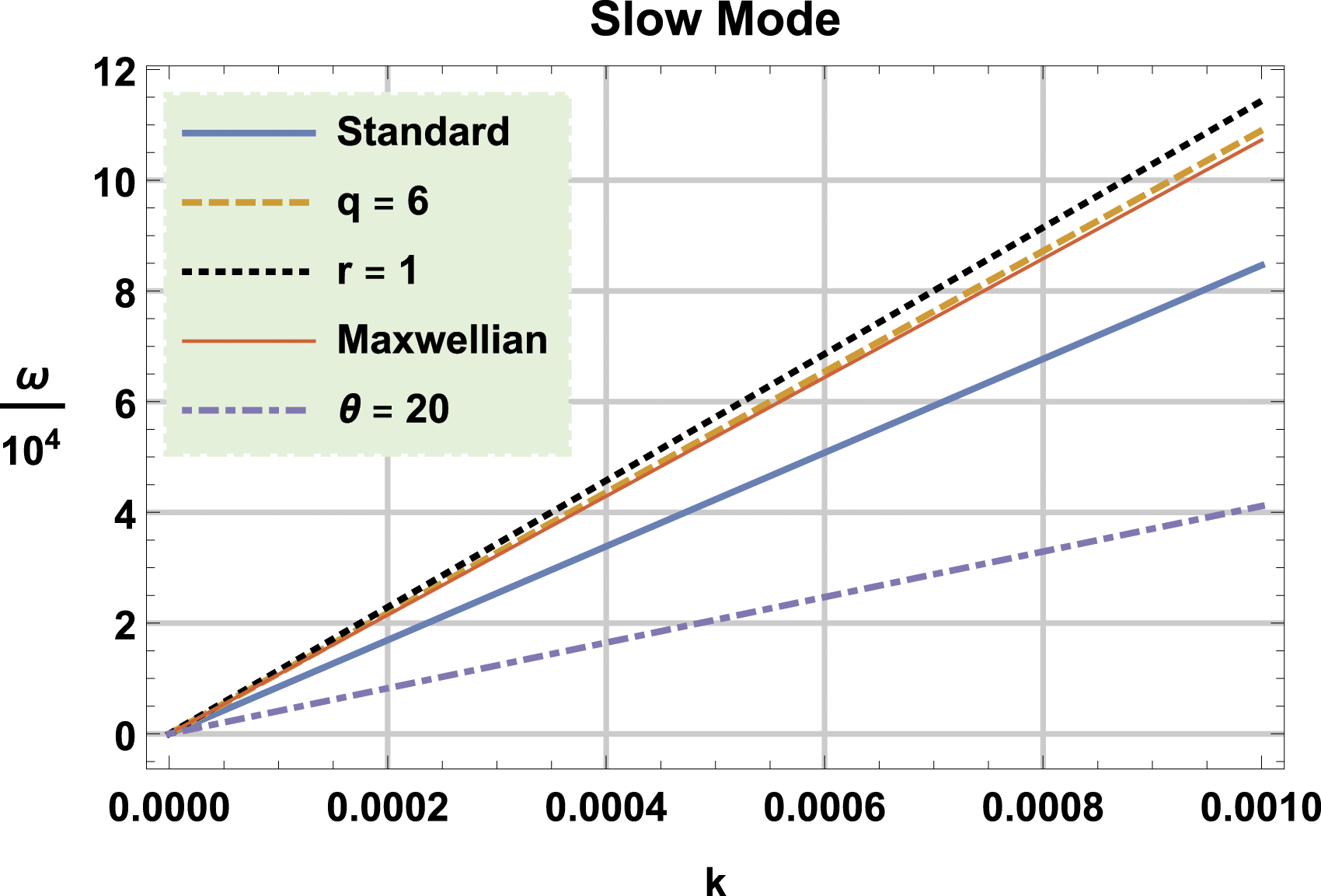
The nonlinear propagation of the DIAWs belonging to SMS also alters for dusty plasma parameters
Figure 5 presents the variation of the nonlinearity coefficient a with the concentration nd0. It is shown that the critical point shifts to the lower value of nd0 with the increase of value of σ. On the other hand, the critical value shifts to the higher values of nd0 with the increase of both superthermality and flatness parameter, q and r, respectively. The critical value determines the change of polarity of a soliton from compressive to rarefactive. This critical point exists only in multicomponent plasmas, which in our case, depends upon all plasma parameters except MF and direction cosines. The nonlinearity(a) is plotted versus dust concentration (nd0). Here, the standard curve is plotted for ne0 = 102cm−3, σ = 0.01, q = 2, r = 0.3.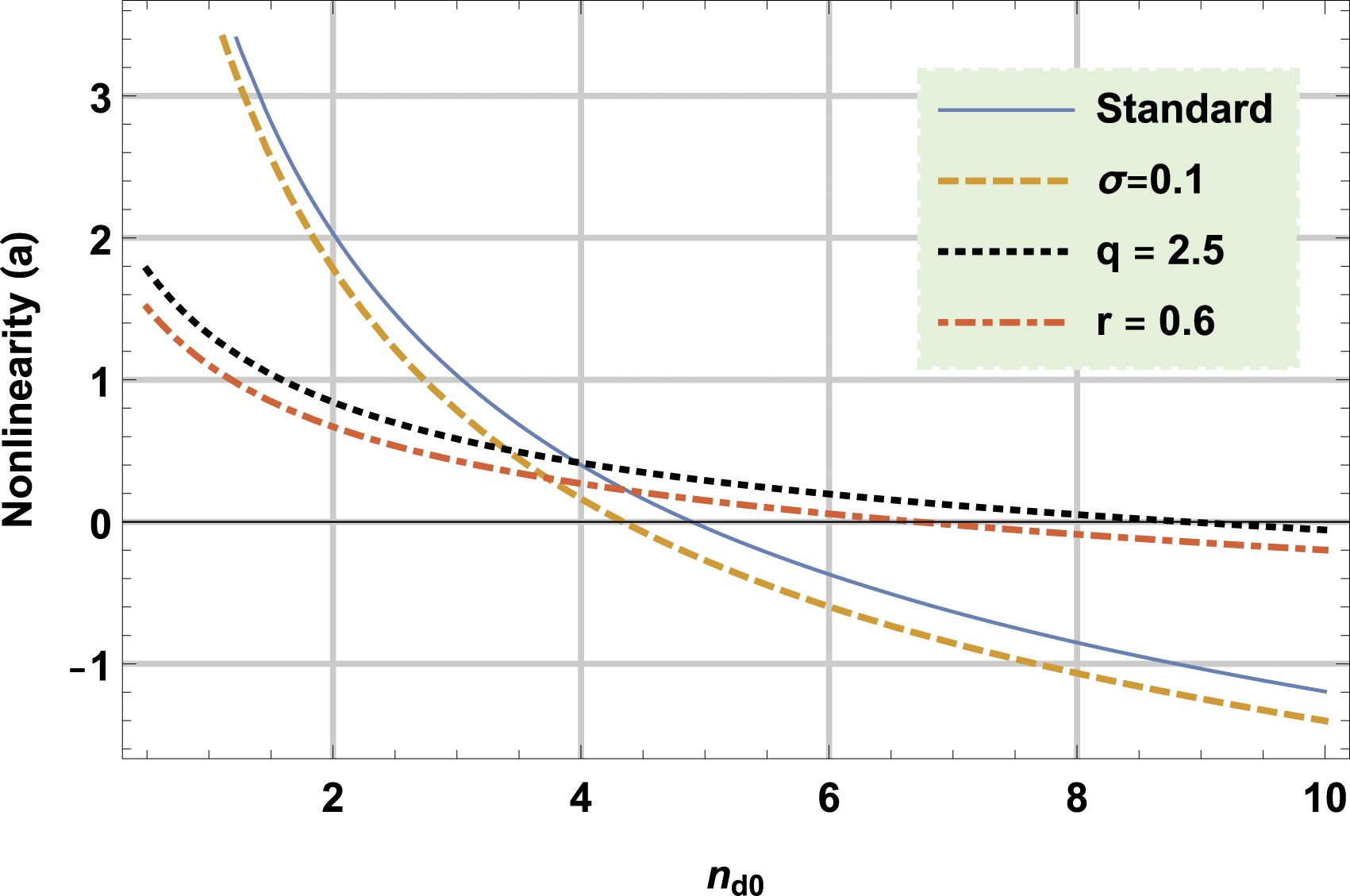
The dusty plasma parameters also significantly alter the nonlinear characteristics of the DIASWs by changing the amplitude (3u/a) and width ( Electric potential ϕ1(ξ, τ) of DIASW is plotted across the dust concentration nd0. Here, ne0 = 102cm−3, B0 = 0.04G, σ = 0.1, q = 2, r = 0.3, τ = 1, u = 0.03, and l
z
= 0.75. Electric potential ϕ1(ξ, τ) of DIASW is plotted across the temperature ratio σ. Here, ne0 = 102cm−3, B0 = 0.04G, nd0 = 4cm−3, q = 2, r = 0.3, τ = 1, u = 0.03, and l
z
= 0.75.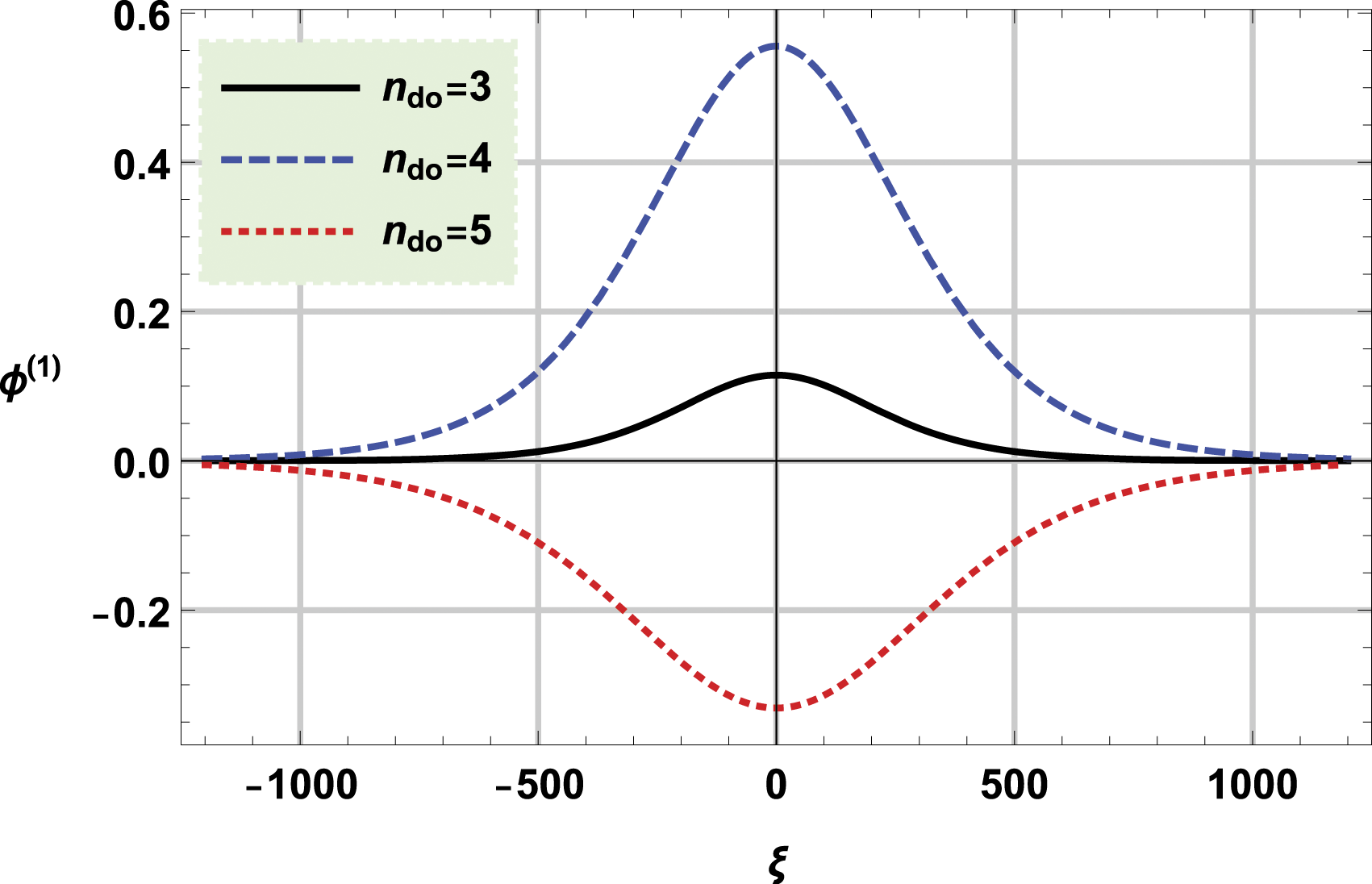
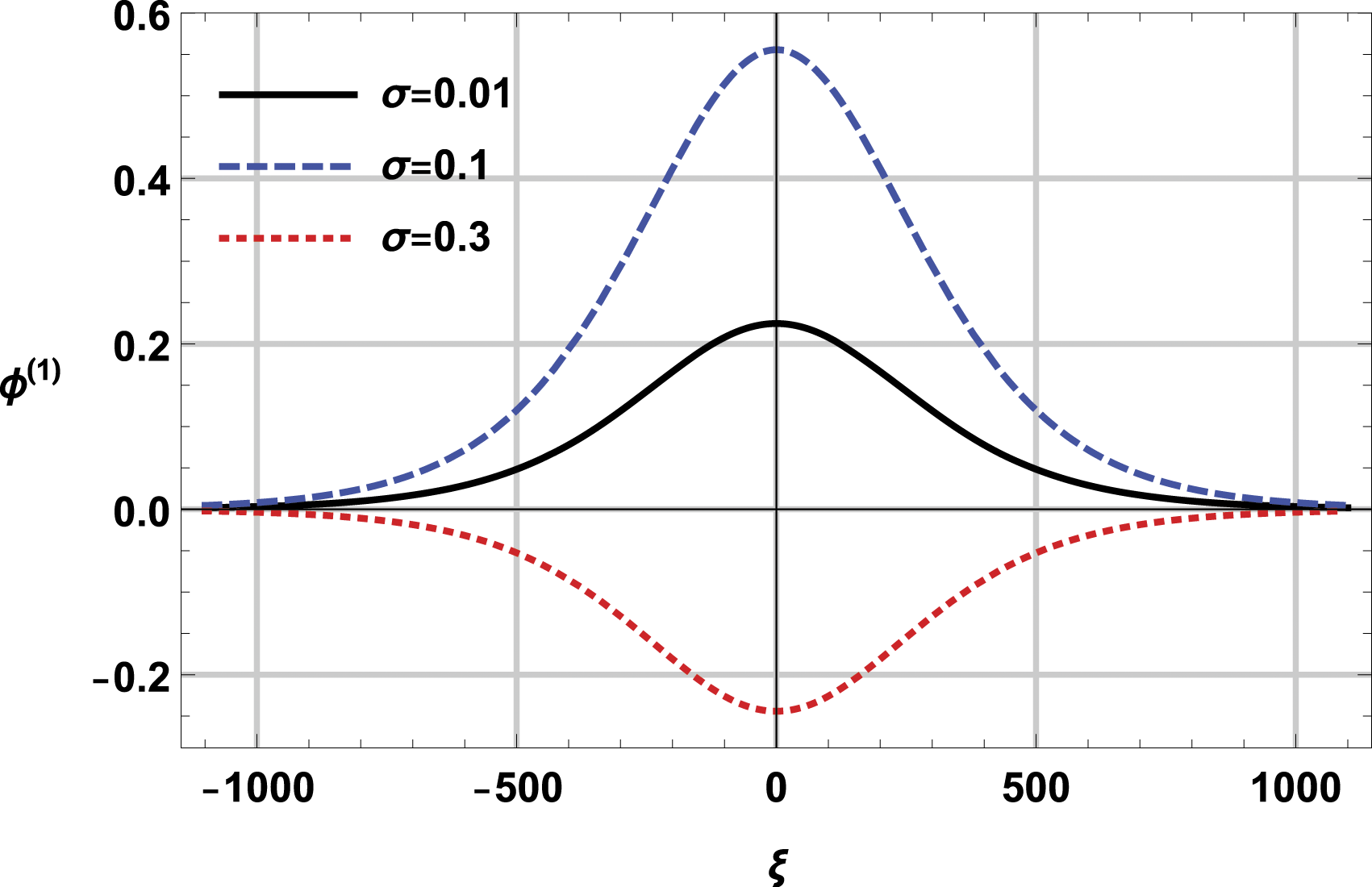
Figure 8 shows the effect of double spectral parameters (r, q) on the properties of the DIASWs. The comparison of the curves shows that the increase of the superthermality index q would lead to the reduction of the amplitude of soliton while the flatness index r enhances solitons amplitude. The comparison between the Maxwellian and non-Maxwellian (r, q) cases shows that the soliton amplitude becomes higher for (r, q) case having higher values of q and r than Maxwellian case. However, the soliton amplitude becomes lower for (r, q) electrons having lower r and q values than Maxwellian case. Electric potential ϕ1(ξ, τ) of DIASW is plotted across the spectral indices (r, q). Here, B0 = 0.04G, ne0 = 102cm−3, nd0 = 4cm−3, q = 2, r = 0.3, τ = 1, σ = 0.1, u = 0.03, and l
z
= 0.75.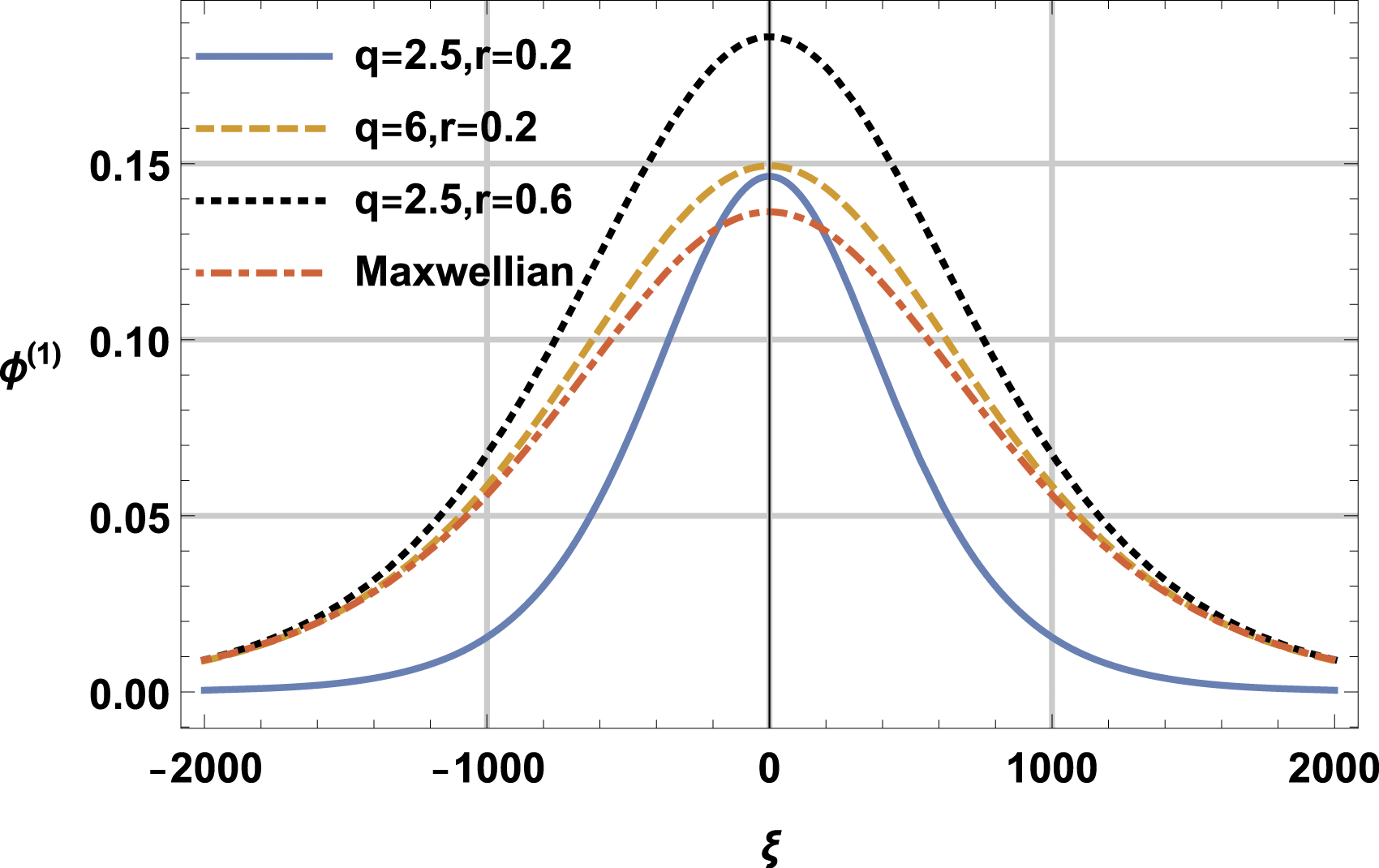
Conclusion
The paper presents the study of oblique propagation of both linear and nonlinear DIAWs in a magnetized collisionless dusty plasma having (r, q) distributed electrons. It has been analyzed that the obliqueness in the present model gives two modes of the phase velocity of the DIAWs. The fast mode has been shown to represent the obliquely propagating ion cyclotron wave, since ω+ → Ω as k → 0, while the slow mode to represent the magnetized obliquely propagating IAW, affected significantly by the temperature ratio. It has been observed that the frequency ω of the fast mode enhances with increasing the propagation angle, while the frequency of slow mode decreases with the increasing of propagation angle. Moreover, the linear properties of the DIAW are greatly influenced by the magnetic field (MF) and double indices of (r, q) distributed electrons. The nonlinear obliquely traveling DIASWs have been studied by deriving the nonlinear partial differential KdV equation. The critical point has been determined analytically and discussed. It has been observed that the critical point depends upon all plasma parameters and double spectral indices; however, it becomes independent of MF and direction cosine. The amplitude of the solitary structure has been shown to depend upon the dust concentration, temperature ratio, magnetic field, direction cosine, superthermality parameter q and the flatness parameter r. The present work may be extended to the laboratory and space plasma systems, where dusty plasmas and (r, q) distributed electrons have been predicted.
Future work: In this plasma model, if the nonplanar geometrical effect, the collisional force between the plasma particles or the higher-order perturbation is/are considered,39–41 we will get some non-integrable evolution equations which can be solved using some semi-analytical and numerical approaches.42–48
Footnotes
Acknowledgments
The authors express their gratitude to Princess Nourah bint Abdulrahman University Researchers Supporting Project number (PNURSP2023R378), Princess Nourah bint Abdulrahman University, Riyadh, Saudi Arabia.
Author’s contributions
All authors listed have made a substantial, direct, and intellectual contribution to the work and approved it for publication.
Declaration of conflicting interests
The author(s) declared no potential conflicts of interest with respect to the research, authorship, and/or publication of this article.
Funding
The author(s) disclosed receipt of the following financial support for the research, authorship, and/or publication of this article: This work was supported by the Princess Nourah Bint Abdulrahman University (PNURSP2023R378).
Availability of Data and Material
All data that support the findings of this study are included within the article.
