




Abstract
The progression of nonlinear electron-acoustic waves (EAWs) in a magnetized and collision-free plasma made up of cold inertial electrons, inertialess superthermal electrons, and stationary background ions with special reference to Saturn’s magnetosphere (SMS) is explored. The method of reductive perturbation (MRP) is employed to obtain the evolution equation (i.e., Zakharov– Kuznetsov equation (ZKE)) that governs the propagation of electron acoustic solitons (EASs). Using the elegant and efficient Hirota bilinear method (HBM), multi-soliton solutions (MSSs) of the ZKE are determined. The impact of the effects of hot-to-cold electron density ratio, magnetic field (MF) strength, and superthermality on single as well as the interaction of EASs is examined. Estimates of the values of the electric field at several radii of SMS (i.e., 12R s − 17.8R s , where R s is the radius of Saturn) are presented, which are found in μV/m to mV/m range and are in perfect agreement with the data from Cassini radio and plasma wave science wideband receiver. Moreover, the influence of the relevant plasma parameters on the interaction time and spatial extent of the interacting EASs is also explored.
Keywords
Introduction
In connection with double layers, electrostatic solitary waves (SWs) were observed in different plasma regions, first in the terrestrial auroral zone on S3-3 mission in 1970,1,2 and since then they have been observed in the terrestrial magnetotail, 3 magnetopause, 4 magnetosheath, 5 and bow shock. 6 Apart from the terrestrial environment, SWs have been observed in the proximity of Jupiter’s moon Europa 7 and Saturn. 8 The SWs are the pulses in the electric field waveform data and are formed when the dipole antenna is aligned with the background magnetic field. 8 Electron-acoustic solitons (EASs) are associated with the high-frequency (HF) component (HFC) of broadband electrostatic noise (BEN) and have been observed in the dayside auroral ionosphere by Viking spacecraft. 9 Gurnett et al. 10 initially identified the BEN that was observed in several missions predominantly at the boundary layer along auroral field lines and in turbulent sweep but was not linked with the electrostatic SWs. Fast Fourier transform was used by Matsumoto et al. 3 to transform the magnetotail findings of the electrostatic SWs and BEN (being observed in the time and frequency domains, respectively) to make a connection between them. 11
HF electrostatic waves have caught the attention of numerous researchers on account of their observations in the laboratory12,13 and space plasmas.14,15 The electron-acoustic waves (EAWs) may exist in plasmas comprising two non-isothermal populations (cold and hot) of electrons with cold background ions.
16
The inertia can be provided by cold electrons, whereas the hot-electron thermal pressure is the source of the restoring force, and the massive ions play the role of a neutralizing background.
16
The two-temperature electrons (TTEs) population plasmas have been reported in magnetospheres of Earth, Saturn, laser-plasma corona, and other planetary magnetospheres.17,18 The existence of EAWs was initially proposed by Fried and Gould in 1961
19
and later confirmed experimentally by Henry and Trguier in 1972.
20
These HF electrostatic waves have frequency ω between ion plasma frequency ω
pi
and electron plasma frequency ω
pe
and the phase velocity (PhV) λ obeying the inequality
The nonlinear studies of EA solitary waves (EASWs) have been reported by various researchers both in unmagnetized22,23 and magnetized plasmas.24,25 Plasmas consisting of TTEs with stationary ions were studied in the context of EASWs using the method of reductive perturbation (MRP) and Sagdeev potential approach. 26 They inferred that MRP is not appropriate to study the medium-strength Korteweg-de Vries (KdV) solitons. Devanandhan et al. 27 explored the EAWs in an unmagnetized multicomponent plasma with non-isothermal electrons and background ions. The authors concluded that the amplitude of the EAS is affected by the cold electron temperature and the density of the superthermal electrons. EASs have been studied in a multicomponent plasma comprising cold electrons, hot electrons, beam electrons, and ions. 22 It was reported that the electron beam component in the plasma causes generation of the compressive EASs, however, Verheest et al. 28 added that the positive polarity potential EASs are also possible without an electron beam, provided the hot-electron inertia is taken into account. Dayside measurements of the Viking spacecraft from the auroral zone have been examined by considering the findings of a plasma model for EASs by Singh et al. 15
Magnetized plasmas have also been extensively studied by many authors over the years. For instance, Mohan and Buti 29 explored the two-component current carrying magnetoplasma by obtaining a modified KdV (mKdV) equation with hot ions and cold electrons. The authors deduced that the electron to ion temperature ratio (T e /T i ) affects the soliton amplitude and hence its velocity. The propagation of EASs in a high beta multicomponent plasma with two non-isothermal ions having mass disparity was also examined. 30 Supersonic holes were shown along with solitons that were reported to be caused by large amplitude perturbations. Dubouloz et al. 31 investigated the generation of turbulence in the dayside auroral zone by a gas of EASs in magnetoplasmas. The results were compared with the Viking findings in the dayside auroral zone to explain the high-frequency component of BEN. Small amplitude compressive solitons can be classified as three-dimensional EA beam solitons in an auroral return current region. Berthomier et al. 32 showed that at altitudes less than 4000 km (FAST altitude range), spherical SWs were observed, while at high altitudes over the POLAR altitude range, the SWs were seen to be stretched out transverse to the magnetic field. They surmised that the formation of fast solitons observed by FAST and POLAR missions could be generated by the slow EASs.
Classical plasmas are high-temperature tenuous plasmas naturally occurring in near-earth space plasmas, the magnetosphere of Mercury, solar wind, and Saturn. 33 The electrons have been considered Maxwellian distribution (MD) in most of the research studies on EASs. However, data from satellites reveal the distribution of electrons to deviate from MD in space plasmas where collisions of the particles are infrequent.34,35 Such distribution of electrons is described as kappa distribution, which is identical to MD at low energies, but, exhibits a departure from it at high energies. 36 Vasyliunas 37 led the way by proposing kappa distribution to fit the findings of OGO I and OGO III from the terrestrial magnetosphere. 35 Since then, it has been shown by numerous observations that kappa distribution with 2 ≤ κ ≤ 6 fits the terrestrial magnetosheath, plasma sheet, radiation belts, solar wind, terrestrial magnetosphere, magnetospheres of Saturn, Mercury, and Uranus as well as other observational data.33,38 Many researchers used kappa distribution to investigate the effect of non-Maxwellian electrons on the propagation features of (non)linear EASs in various plasma models.39,40 We are interested in a laboratory rich in populations of TTEs like Saturn’s magnetosphere (SMS) to study the EASs.
Plasmas in the SMS have diverse characteristics owing to their varying composition observed at different radial distances. The first ever mission on Saturn was Pioneer XI to sample the plasma. 41 Depending upon the electron density profile at increasing radial distances, two boundaries can be allocated in the magnetosphere of Saturn. Therefore, it can be categorized in three altitudes (i) below 9R s (R s = 60,268km is the radius of Saturn) the inner magnetosphere, (ii) between 9 and 13R s , the middle magnetosphere, and (iii) above 13R s , the outer magnetosphere. 42 Plasmas in the SMS can come both from its rings and moons such as Enceladus, 43 Rhea and Dione, 44 Tethys, 45 and Titan. 46 Electrons having energies from 2eV to 10MeV have been reported in the SMS by combining measurement data on Saturn from three experiments, namely, the plasma science (PLS), low energy charged particle (LECP) instrument, and cosmic ray system (CRS) experiment. 47 Cassini mission with two instruments on board CAPS/ELS 48 and MIMI/LEMMS, 49 being in orbit from 2004 to 2017 around Saturn, produced new data for electron observations and it was shown that the energy spectrum ranges from a few eV to few tens of MeV. 42 Different ion species including N+, O+, H+, OH+, and H2O+ have also been observed in several missions with varying temperatures and densities as one moves away from Saturn. 18
A Zakharov–Kuznetsov equation (ZKE) can be characterized by the balance between the dispersion arising from charge separation, gyroradius effects, and nonlinearity. 33 This equation can typically be used for investigating the propagation of finite but small amplitude acoustic waves in a plasma and many other mediums. Note that the ZKE can only be studied in the context of magnetized plasmas. EASs have been studied by numerous researchers in magnetoplasmas by deriving ZKE.50,51 When it comes to the transfer of energy and momentum, solitons become significant because of the property of holding its identity after interaction. The wave propagation in naturally occurring physical systems calls for the consideration of multi-soliton solutions (MSSs). MSSs are crucial for comprehending nonlinear wave interaction in these systems because the majority of the natural occurrences are inherently nonlinear. A variety of techniques can be utilized including Hirota bilinear method (HBM),52,53 Bäcklund transformation, 54 inverse scattering transform, 55 and Darboux transformation 56 to obtain the MSSs. To obtain the MSSs, the HBM 53 is applied to truncate the perturbation expansions at higher orders. In recent years, numerous papers have employed HBM to study interaction of solitons in unmagnetized plasmas,57–59 however, the soliton interaction in magnetized plasmas has received relatively far less attention. In this paper, we have investigated the single soliton and MSSs in a multicomponent magnetized plasma formed from cold inertial electrons, superthermal hot electrons, and stationary ions in the vicinity of the SMS. The paper is structured as follows: The set of model equations for EAWs in a multicomponent magnetoplasma are given in Sec. II. In Sec. III, the MRP is employed by reducing the basic fluid equations of the current plasma model to the two-dimensional (2D)-ZKE. In Sec. IV, HBM is carried out for determining the MSSs, that is, one- and two-soliton solutions of the ZKE. Parametric analysis of the 2D-ZK solitary wave (SW) solutions is presented in Sec. V. The summary of the major findings is given in Sec. VI.
Theoretical model
A homogeneous collision-free magnetoplasma made up of stationary background ions, cold inertial electrons, and hot inertialess superthermal electrons bearing kappa
The number density and momentum conservation equations are given as follows



In space plasmas, most particle distributions have been observed to have high energy tail for superthermal electrons.
60
The function distribution (FD) to the inertialess superthermal/kappa distributed electrons reads as
58

Here, the spectral index κ depicts the degree of superthermality of energetic electrons forming the tail of the distribution which fulfills the condition κ > 3/2,

The expression in equation (5) can be expanded in Taylor series form for smaller values of the potential to get the form n
h
= 1 + C1ϕ + C2ϕ2 + ⋯, where C1 and C2 are expansion constants given as






Derivation of the 2D-ZKE
Here, the MRP is applied for reducing equations (7)–(11) to the 2D-ZKE for describing the small amplitude acoustic SWs on the electron time scale in the current plasma model. According to the mentioned method, both time and space coordinates are stretched as
61


To get the linear dispersion relation (LDR), multiscale expansion of the variables given in equation (13) is incorporated in equations (7)–(11) and the collection of the lowest order terms of ϵ, that is, O(ϵ) → ϵ3/2 yields


Solving equations (14) and (15) yields the following linear PhV Λ of the EAW

The squared order terms in ϵ for equation (10) give

Collecting the next order terms of ϵ, that is, O(ϵ) → ϵ5/2 from equations (7)–(11), we obtain the following set of equations for second-order perturbed quantities




By algebraic manipulation of equations (17)–(20) and utilizing nc1 and uc1 from equation (14), the following 2D-ZKE is obtained



It has been noticed that linear phase velocity Λ appears in the coefficient of nonlinear term A and dispersion coefficients terms B and C and, therefore, their dependence on densities of the electrons and superthermality is evident, whereas dispersion can vary with magnetic field variation as β appears in both of the dispersion coefficients.
Multi-soliton solution to the 2D-ZKE
Here, the HBM,
52
which is a renowned technique to obtain the multi-soliton solution (MSS) of many integrable equations including the 2D-ZKE, is employed. It uses the following transformation equation62,63 to obtain the SW solution of 2D-ZKE





One-soliton solution
According to HBM,
52
for exactly one-soliton solution, we employ the exponential function, the series in equation (28) truncates at first order of ɛ and, therefore, we have


Incorporating g in equation (24) gives the following one-soliton solution of the ZKE

Two-soliton solution
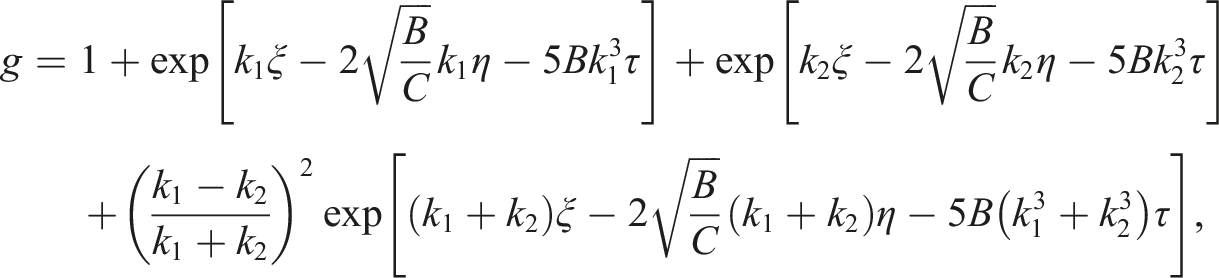
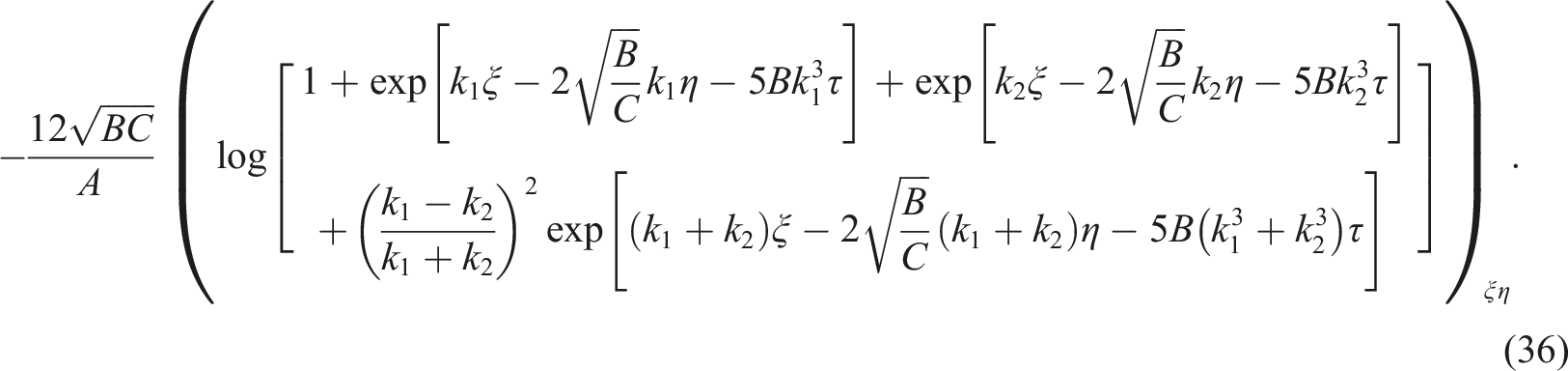
The two-soliton solution is procured by assuming the function g1 as the superposition of exponential functions and g2 as the interaction of two exponential functions. The expansion of g in equation (28) truncates at squared order of ɛ for considered values of the perturbed terms of g in the required two-soliton solution





Results and discussion
We shall use the parameters of Cassini’s data
42
within 20R
s
(R
s
is the radius of Saturn
In Figure 1 Plot of the electrostatic (ES) potential of 2D-ZK soliton against variation in density ratio α = 0.4, 0.5, 0.6, and 2 with other parameters as, k = 0.6, κ = 3.5, B
o
= 0.0001G, n
co
= 0.25cm−3, n
ho
= 0.1, 0.125, 0.15, and 0.5. Plot of the ES potential of 2D-ZK soliton against variation in ambient magnetic field B
o
= 0.0001G, 0.00015G, and 0.0002G with k = 0.6, κ = 3.5, n
co
= 0.25cm−3, and n
ho
= 0.1cm−3.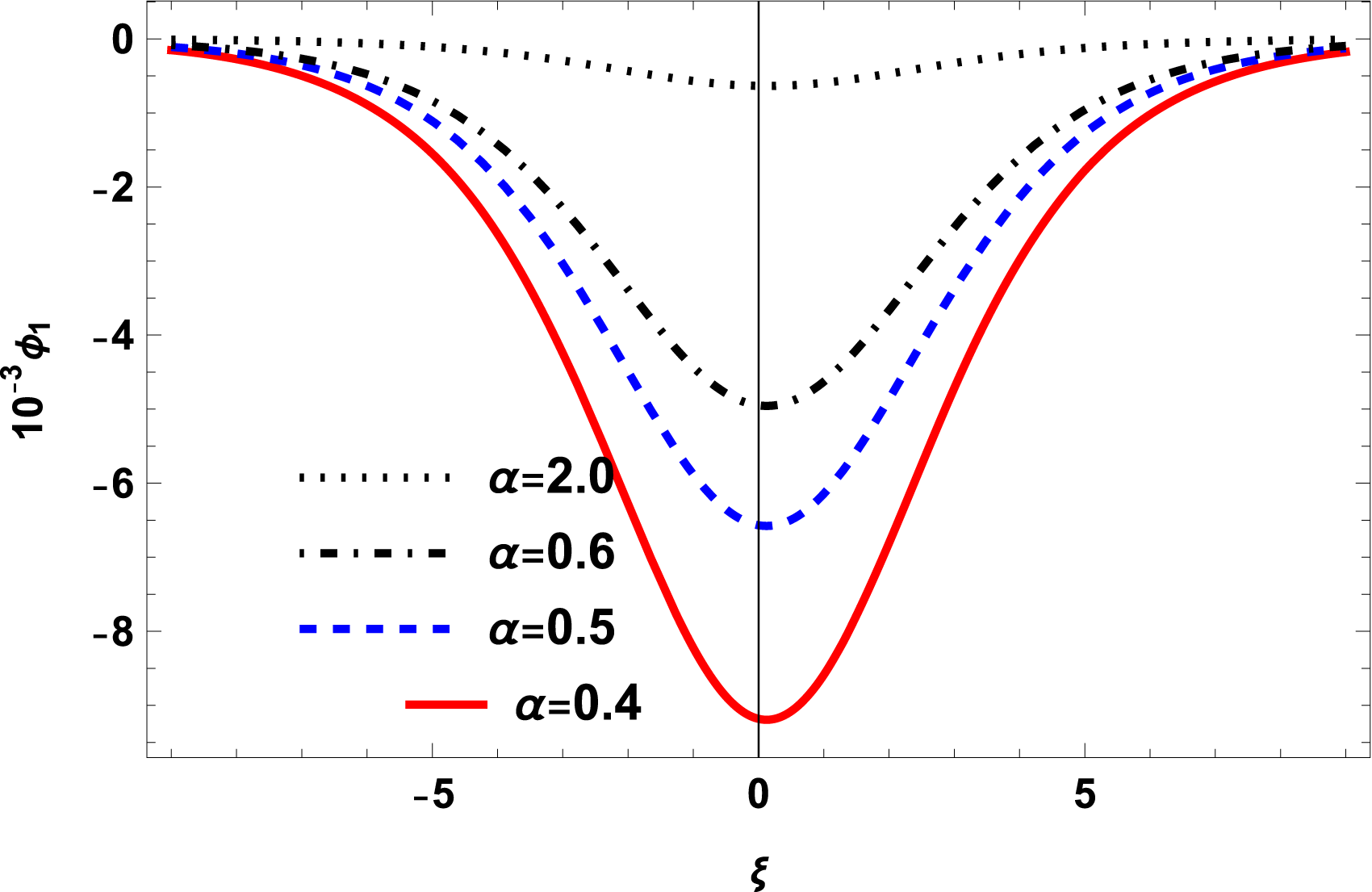
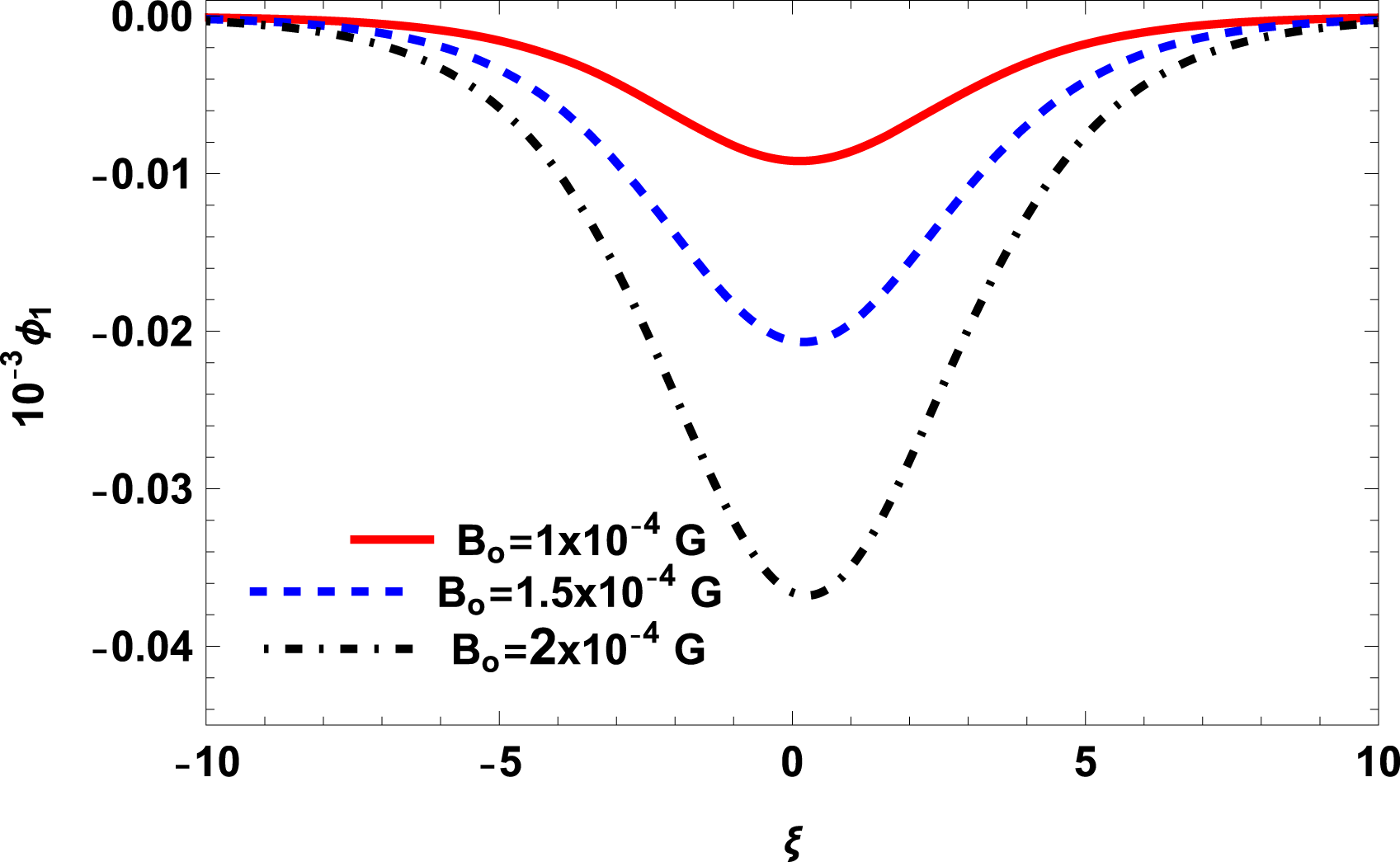
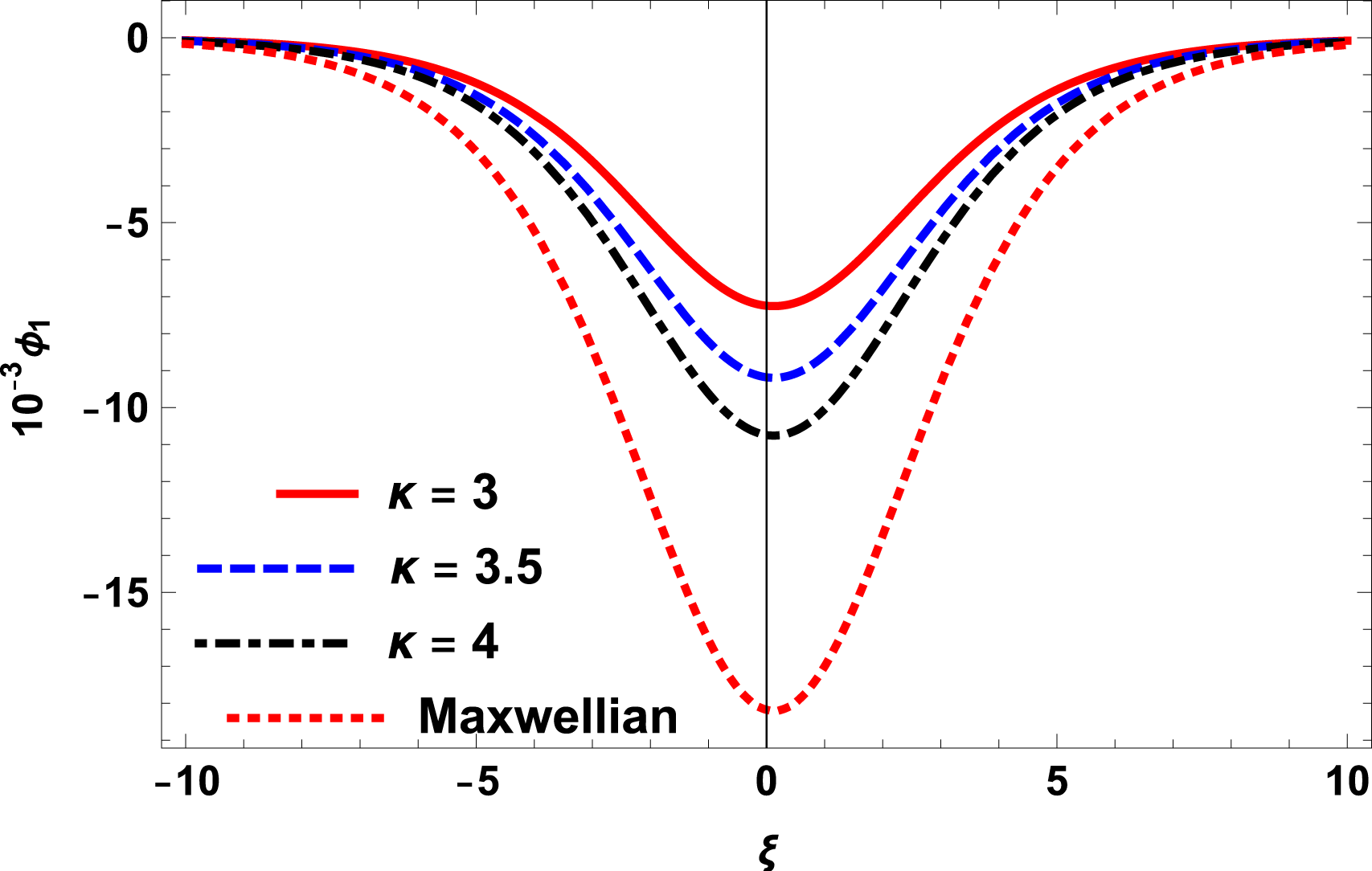
Figure 3 Plot of the ES potential of 2D-ZK soliton against variation in superthermality κ = 3, 3.5, 4, and 10 (Maxwellian) with k = 0.6, B
o
= 0.0001G, n
co
= 0.25cm−3, and n
ho
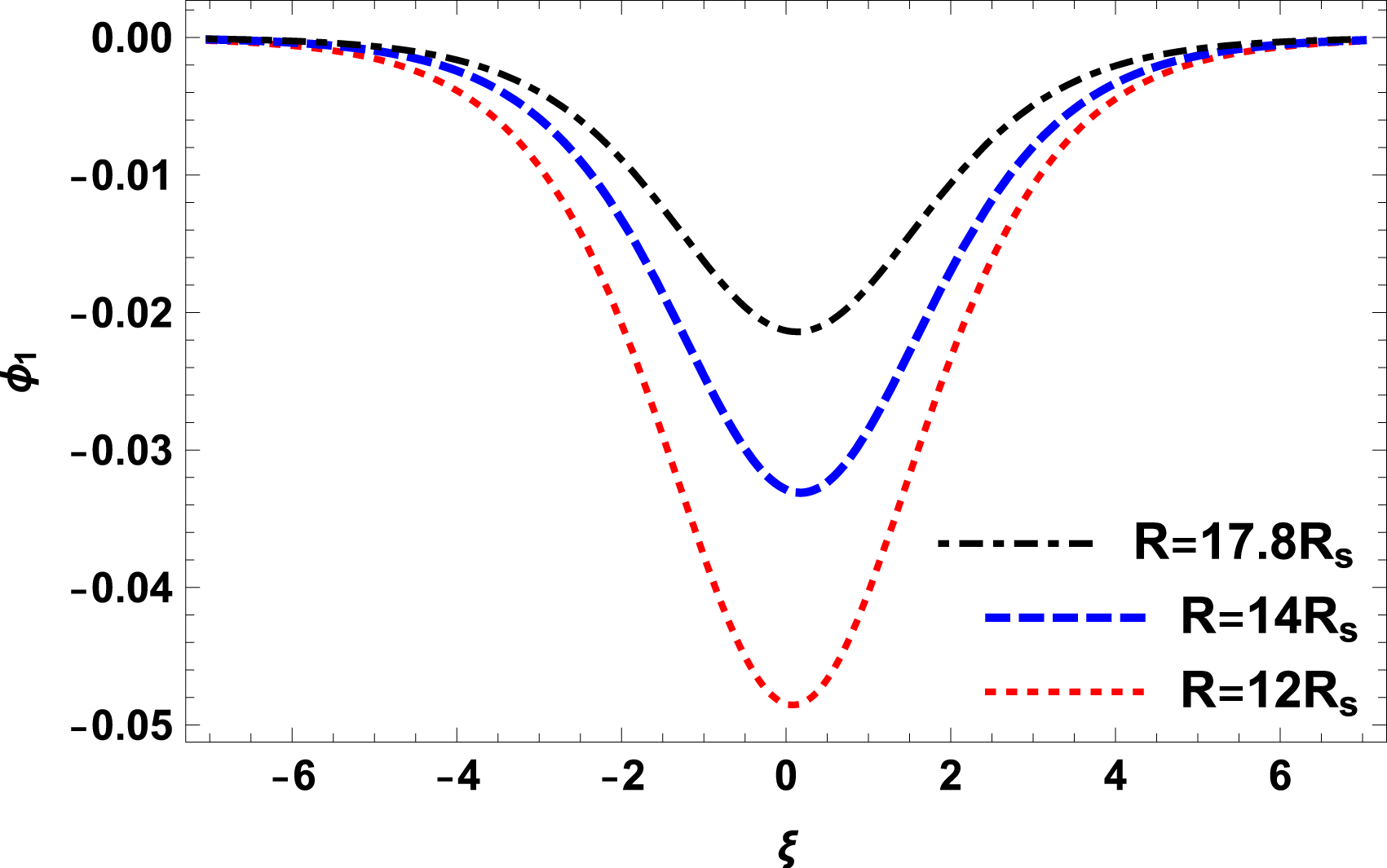
= 0.1cm−3. Variation of the ES potential of 2D-ZK soliton with increasing distance from Saturn R = 12R
s
, 14R
s
, and 17.8R
s
. Parameters being used k = 0.95 (fixed) (i) α = 0.12, κ = 3.5, and B
o
= 0.00012G at 12R
s
(dotted line), (ii) α = 0.67, κ = 6, and B
o
= 0.00011G at 14R
s
(dashed), and (iii) k = 0.95, α = 0.47, κ = 3.8, and B
o
= 0.00008G at 17.8R
s
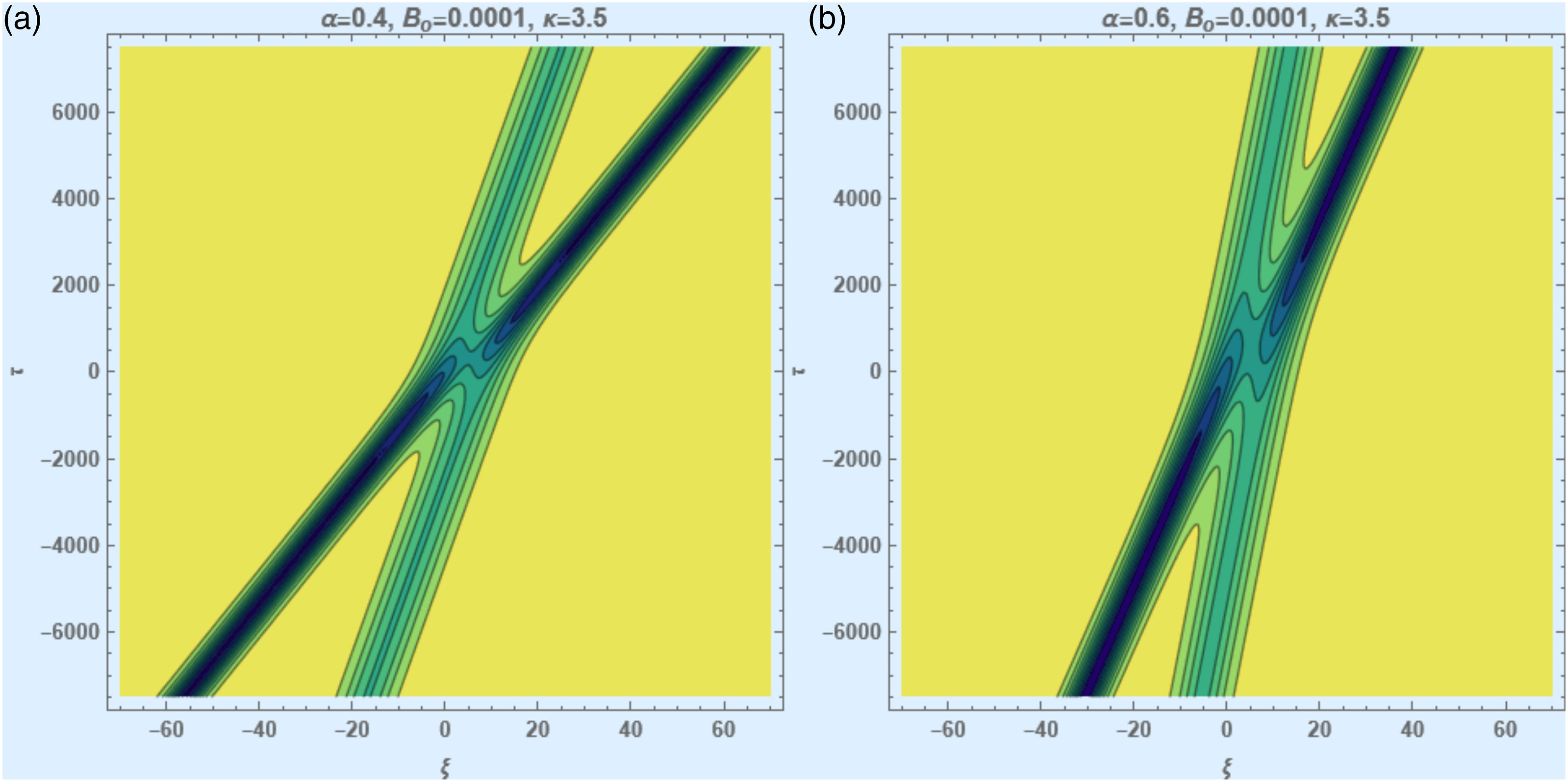
(dot-dashed). Contour plot of the interaction of the 2D-ZK solitons versus the varying electron density ratio α = 0.4 and 0.6 with k1 = 0.6, k2 = 0.4, B
o
= 0.0001G, and κ = 3.5. (a) α = 0.4, n
co
= 0.25cm−3, and n
ho
= 0.1cm−3, (b) α = 0.6, n
co
= 0.25cm−3, and n
ho
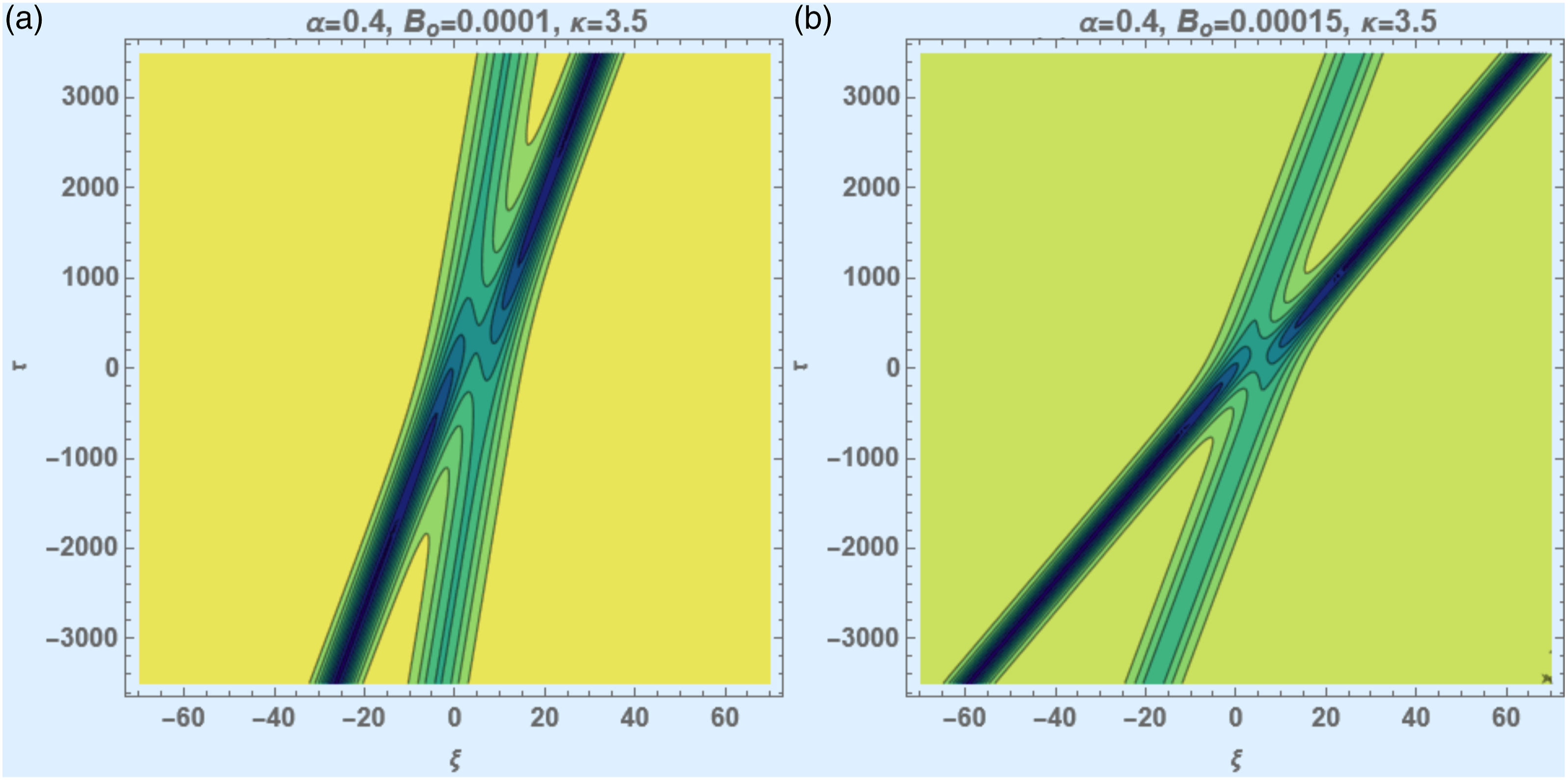
= 0.15cm−3. Contour plot of the interaction of the 2D-ZK solitons versus the varying magnetic field (a) B
o
= 0.0001G and (b) B
o
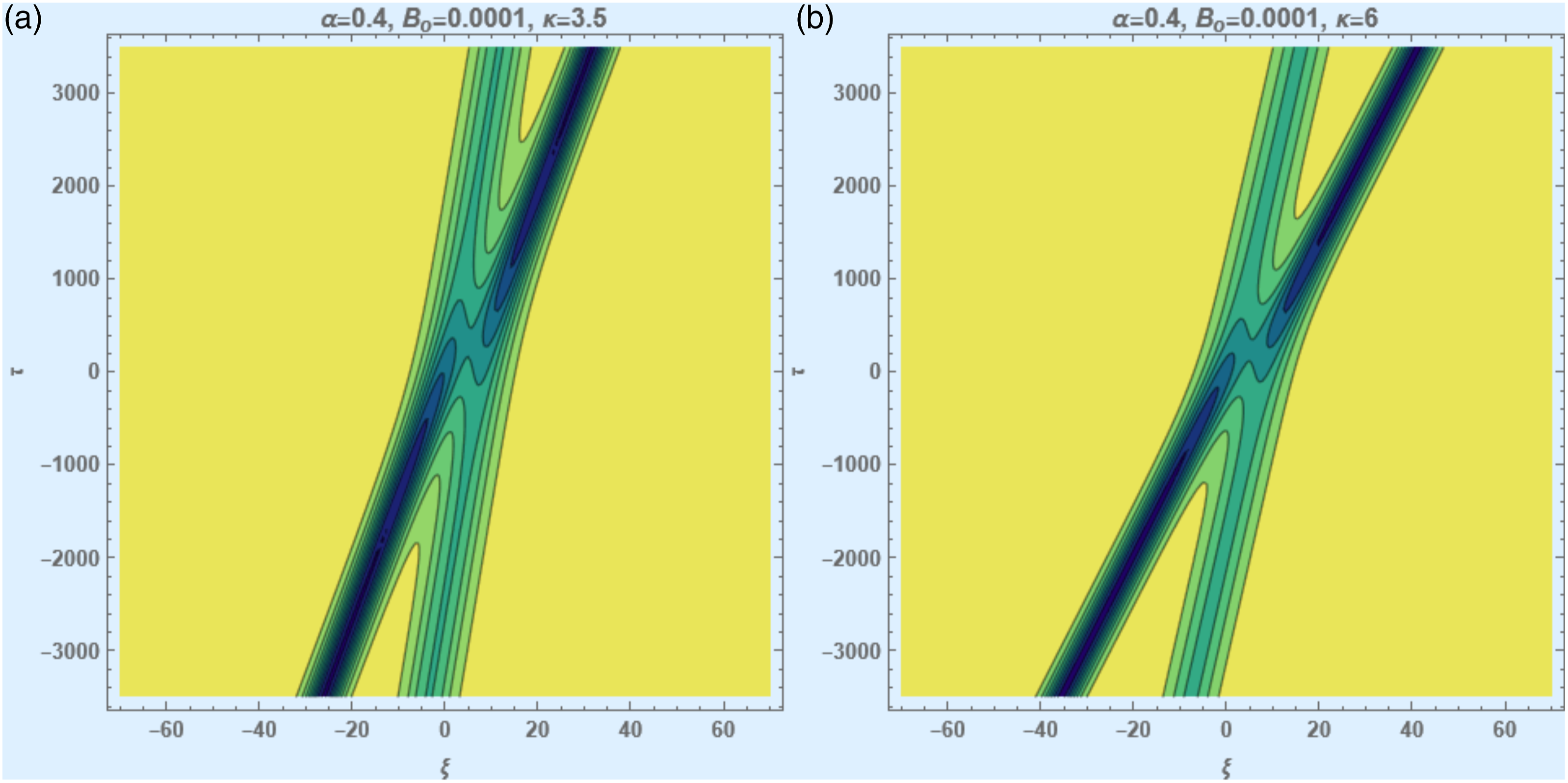
= 0.00015G. Other fixed parameters being used are k1 = 0.6, k2 = 0.4, α = 0.4, and κ = 3.5. Contour plot of the interaction of the 2D-ZK solitons versus the varying superthermality (a) κ = 3.5 and (b) κ = 6. Other fixed parameters being used are k1 = 0.6, k2 = 0.4, α = 0.4, and B
o
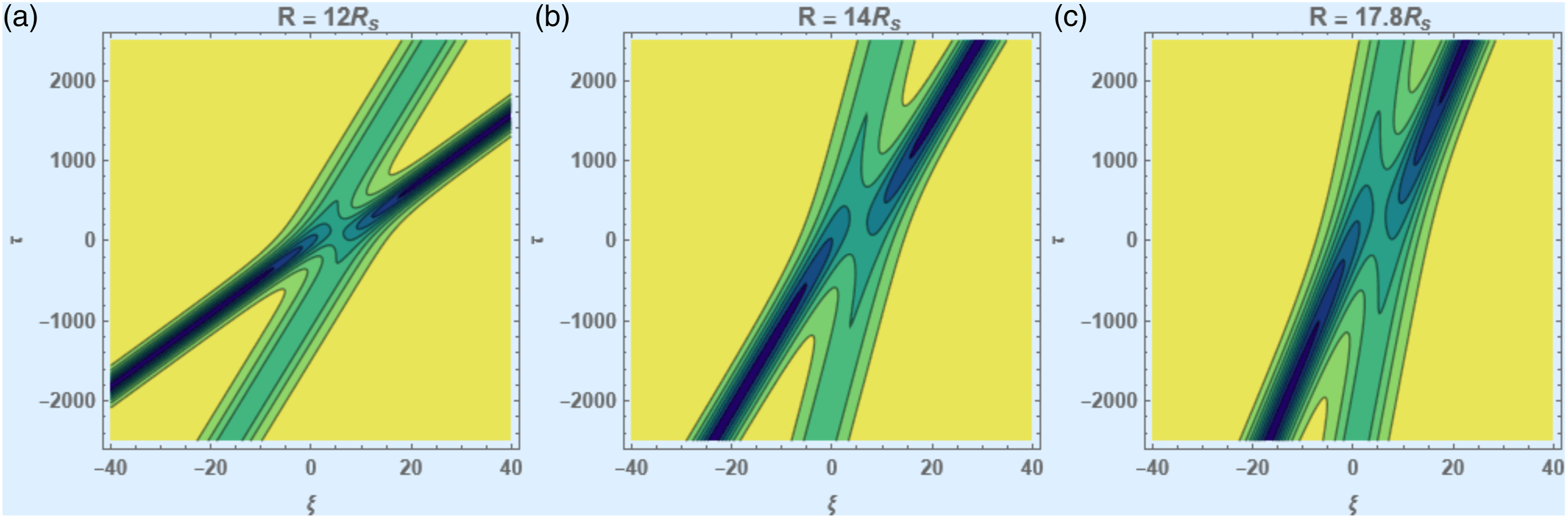
= 0.0001G. Contour plot of the interaction of 2D-ZK solitons at disparate radii from Saturn R = 12R
s
, 14R
s
and 17.8R
s
. Parameters being used k1 = 0.6 and k2 = 0.4 as fixed and others are (a) n
co
= 1cm−3, n
ho
= 0.11cm−3, κ = 3.5, and B
o
= 0.00013G at 12R
s
, (b) n
co
= 0.15cm−3, n
ho
= 0.10cm−3, κ = 6, and B
o
= 0.00011G at 14R
s
, and (c) n
co
= 0.15cm−3, n
ho
= 0.07cm−3, κ = 3.8, and B
o
= 0.00008G at 17.8R
s
.

Conclusion
The formation and interaction of electron-acoustic solitons (EASs) have been examined in a plasma comprising two temperature electrons (inertial cold and superthermal kappa distributed hot) and stationary ions. Two-dimensional Zakharov–Kuznetsov equation (2D-ZKE) has been derived under the small amplitude limit. One- and two-soliton solutions of 2D-ZKE have been obtained using Hirota’s direct method. Response of the single soliton and interaction mechanism for EASs have been studied by varying parameters like electron density ratio, magnetic field (MF) strength, and spectral index, κ, at different radial distances from Saturn. The study of single soliton has revealed that, for increasing hot-to-cold electron density ratio and superthermality, the amplitude and speed of the soliton decrease, whereas enhancing the MF augments the amplitude of the 2D-ZK EAS. The amplitude of the solitons has been found to decrease significantly at longer distances from Saturn. The theoretically obtained electric field values in Saturn’s magnetosphere (SMS) have been found to range from a few hundreds of μV/m to a few tens of mV/m at different Saturn’s radii which concur very well with the data from Cassini radio and plasma wave science wideband receiver. As regards the interaction, EASs have been found to retain their shape after the interaction. It has been found that the increasing values of hot-to-cold electron density ratio and the spectral index, κ, slow down the interaction time and shorten the separation distance between the interacting solitons, whereas the enhancement in the magnetic field speeds up the interaction time and enhances the separation distance between the interacting solitons. We have given the estimates of the separation distance between the interacting solitons for the variation in the plasma parameters for SMS. We have examined the interaction of solitons at different radii from Saturn and it has been deduced that the interaction time and spatial interaction regions vary as one moves away from Saturn. The present study will help to comprehend the formation and interaction of EASs in SMS, however, it may be pointed out that the theoretical framework presented here is general and can be applied to laboratory plasmas.
The future work could include physical effects like collisional force between the particles inside the plasma or nonplanar geometrical effects which make the resulting nonlinear evolution equations nonintegrable.65–67 For solving and analyzing these evolution equations, some approximate techniques such as the family of the homotopy perturbation method (HPM),68,69 the family of Adomian decomposition method (ADM), 70 and many other numerical methods 71 could be gainfully employed.
Footnotes
Acknowledgments
The authors express their gratitude to Princess Nourah bint Abdulrahman University Researchers Supporting Project number (PNURSP2023R378), Princess Nourah bint Abdulrahman University, Riyadh, Saudi Arabia. One of the authors (W. Masood) acknowledges the support from the Abdus Salam International Centre for Theoretical Physics (AS-ICTP) for his visit under the Regular Associateship Scheme.
Declaration of conflicting interests
The author(s) declared no potential conflicts of interest with respect to the research, authorship, and/or publication of this article.
Funding
The author(s) received no financial support for the research, authorship, and/or publication of this article.

Data Availability Statement
Data sharing is not applicable to this article as no new data were created or analyzed in this study.