This paper suggests a universal approach to solve nonlinear periodic vibration equations by He–Laplace method, a coupling of He’s perturbation method and Laplace transform. The nonlinear periodic solitary solution of vibration equation is used as an example to elucidate the effectiveness and simplicity of the method, only few iterations are needed to obtain an extremely accurate solution.
The study of nonlinear differential equations is key in lot of areas such as physics, applied mathematics, engineering and other related fields. A challenging difficulty is to suggest precise analytical approximate solution in a computationally efficient manner of a strongly nonlinear differential equation. Particularly, the nonlinear periodic vibration equation has received considerable attention where the aim is to obtain analytical approximation of the nonlinear periodic vibration equations. The problem is even more challenging in the presence of a discontinuity. It is well known that the classical periodic solitary solutions of nonlinear vibration equations and Korteweg–de Vries converge to solitary-wave solutions as the period length grows unboundedly. This latter result is important in principle since most of the numerical simulations of solutions of these sorts of equations are actually performed with periodic boundary conditions, even though one is attempting to approximate solutions on the entire real axis, which arises from the dimensionless hydrodynamics equations describing the nonlinear propagation of the quantum ion-acoustic waves. With the aid of symbolic computation, many types of new analytical solutions of the nonlinear vibration equation are constructed in terms of some powerful ansatze, which include new doubly periodic wave, solitary wave, shock wave, rational wave, and singular wave solutions. The Euler–Bernoulli beam theory or linear string vibration results in a linear vibration equation. For a non-linear vibration, its governing equation can be written as
where F represents the nonlinear term. All nonlinear vibration equations can be converted into the following form of equation (1). For example, we consider the well-known KdV equation
Differentiating equation (2) with respect to time results in
The above equation can be converted into the equations as shown in equation (1), which reads
This paper focuses on nonlinear periodic solutions of vibration equations using a coupling of the He’s perturbation method and Laplace transform, which was initially been proposed to solve the nonlinear vibration equations. We consider the generalized fifth-order vibration equation of the form
where and are the arbitrary constants. We can assign different values to and s in, which shows different variations on the properties of equation (5). For example, when and then equation (5) becomes Lax equation and equation (5) becomes Sawada-Kotera (SK) equation if and , representing two different equations namely N-soliton solution and conservation laws with an infinite set. The nonlinear vibration equations with and its N-soliton solution are not known, but it is known to be integrable and have bilinear representation. In this article, we use the combination of homotopy perturbation method HPM1,2 and Laplace transform introduced by He3,4 and determined its various application.3,4 Many researchers applied HPM and its modified forms5,6 to solve linear and nonlinear problems arise in engineering and applied science problems. The He–Laplace method is the modified form of He’s HPM,1 introduced by Khan and Wu.7Khan and Wu7 combined the idea of He’s homotopy perturbation method and Laplace transform for the numerical treatment of different nonlinear problems arising in various physical phenomena. The He–Laplace method is the most suitable method to solve the physical model problems because no linearization of He’s HPM method and its modified form was used by many researchers to solve nonlinear problems arising in different fields.8,9 Assumptions and restrictions are required for He–Laplace method, which may amend the problem. He–Laplace method essentially demonstrates how we can calculate the approximate solution of nonlinear differential equations using the combination of homotopy perturbation method and Laplace transform. A solution obtained by He–Laplace method is in the form of rapidly converging series. Sometimes, it may appear in the closed form.
Many researchers studied the nonlinear vibration equations Hereman and Nuseir,10 Hone11 scaled the similar solution of three integrable PDEs namely KK equation, fifth-order KdV equation, and SK equation. Hu et al.12 determined the solution of (2 + 1) dimensional KK equation. Parker13,14 obtained the N-soliton solution of SK and KK equation. Musette and Verhoeven15 achieved the solution of fifth-order KK equations of integrable cases of Henon–Heiles system. Tam and Hu16 found three Soliton solutions of KK-type equations using Hirota method and Mathematica. Das and Popowicz17 studied the nonlinear dispersive fifth-order integrable equation and its hierarchy. Inc18 determine the Soliton solution of the KK equation numerically and convergence analysis of the decomposition method. Recently, Al-Amr19–29 used the reduced differential transform to study the KK equation.
In the next section, the basic idea of Laplace transform and homotopy perturbation method is discussed. Implementation of the proposed method for the nonlinear problem is then explained. The solution of the problems is given in the subsequent section. Then convergence analysis of proposed method is discussed and conclusion is drawn in the last section.
He–Laplace method
To demonstrate the idea of He–Laplace method, assume partial differential equation which is nonlinear and non-homogeneous with initial conditions of the form
where D represents the linear differential operator of the first order, that is and R denotes the linear differential operator, and N denotes the nonlinear differential operator. is the source term. Apply the Laplace transform on both sides of equation (6)
Using the differential property of Laplace transform, we have
Operating Laplace inverse transforms on both sides of equation (9) gives
where represents the terms obtained from the source term and prescribed the initial conditions. He–Laplace method admits the solution in the form
and nonlinear terms can decompose as
Using He’s polynomial
substitute equations (11) and (12) in equation (10), according to He–Laplace method, a homotopy is constructed of the form
which is the coupling of Laplace transform and homotopy perturbation method using He’s polynomials. Equating the coefficients of like powers of p, we have
The general recursive relation is given by
Implementation of the method
Consider the generalized fifth-order nonlinear evolution equation given in equation (5) known as KK equation of the form
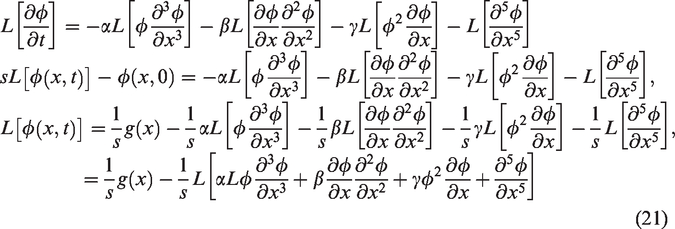
First, we apply the Laplace transform on both sides of equation (5)
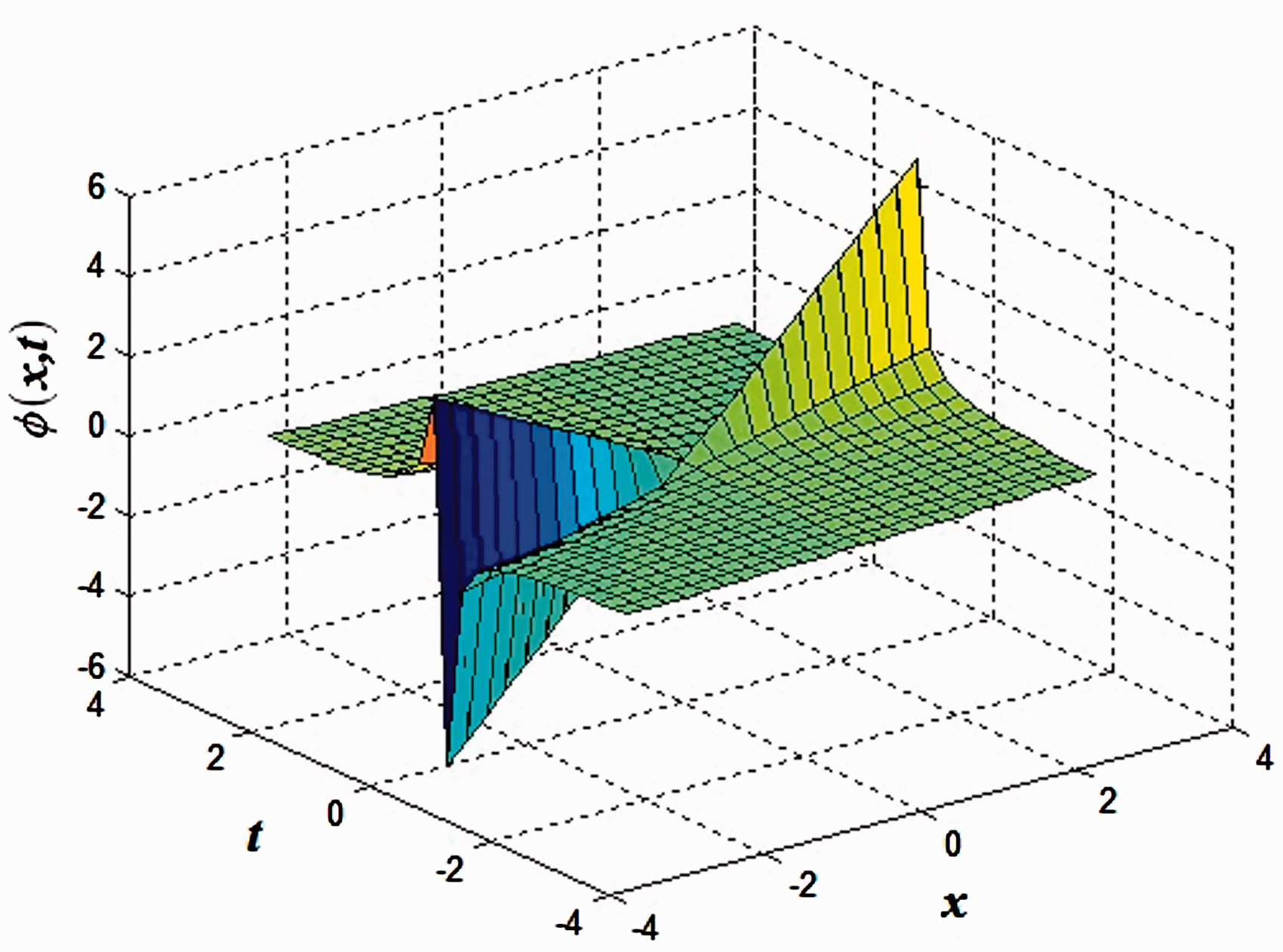
Numerical results obtained by the proposed method show that a reasonable approximation has been achieved with exact solution as shown in Figure 1. By the addition of more approximation terms, absolute error can be minimized. Numerical results proved the accuracy and efficiency of the proposed method. Furthermore, discretization of variables is not necessarily required for the He–Laplace method.
Representing the numerical solution of vibration equation.
Conclusion
In this manuscript, we presented the periodic solitary solutions of nonlinear vibration equations. The periodic soliton solution obtained by our method captures all the characteristics of vibrational properties that are associated with periodic solitons. We also studied the bifurcation and chaotic solutions of nonlinear wave equations, and the influence of integration constant on the periodicity of the solution of nonlinear vibration equations, which is named as bifurcation
Footnotes
Declaration of conflicting interests
The author(s) declared no potential conflicts of interest with respect to the research, authorship, and/or publication of this article.
Funding
The author(s) disclosed receipt of the following financial support for the research, authorship, and/or publication of this article: This work was supported by the Natural National Science Foundation of China under the grant no 11571140 and 11671077 and Faculty of Science, Jiangsu University, Zhenjiang, P. R. China..
HeJH.A coupling method of a homotopy technique and a perturbationtechnique for non-linear problems. Int J Non Linear Mech2000;
35: 37–43.
3.
HeJH.The homotopy perturbation method for nonlinear oscillators with discontinuities. Appl Math Comput2004;
151: 287–292.
4.
HeJH.A tutorial review on fractal spacetime and fractional calculus.Int J Theor Phys2014;
53: 3698–3718.
5.
AdamuMYOgenyiP.Parameterized homotopy perturbation method. Nonlinear Sci Lett A2017;
8: 240–243.
6.
El-DibYO.Multiple scales homotopy perturbation method for nonlinear oscillators. Nonlinear Sci Lett A, 2017;
8: 352–364.
7.
KhanYWuQ.Homotopy perturbation transform method for nonlinear equations using He’s polynomials. Comput Math Appl2011;
61: 1963–1967.
8.
LiuZJAdamuMYSuleimanE, et al.
Hybridization of homotopy perturbation method and Laplace transformation for the partial differential equations. Therm Sci2017;
21: 1843–1846.
9.
MishraHKNagarAK.He-Laplace method for linear and nonlinear partial differential equations.J Appl Math2012;
▪ :▪.
10.
HeremanWNuseirA.Symbolic methods to construct exact solutions of nonlinear partial differential equations. Math Comput Simul1997;
43: 13–27.
HuXBWangDLQianXM.Soliton solutions and symmetries of the 2 + 1 dimensional Kaup-Kupershimdt equation. Phys Lett A1999;
262: 409–415.
13.
ParkerA.On soliton solution of the Kaup-Kupershimdt equation, I. Direct bilinearisation and solitary wave. Phys D2000;
137: 25–33.
14.
ParkerA.On soliton solution of the Kaup-Kupershimdt equation, II. Anomalous N-soliton solutions. Phys D2000;
137: 34–48.
15.
MusetteMVerhoevenC.Nonlinear superposition formula for the Kaup-Kupershimdt partial differential equation. Phys D2000;
144: 211–220.
16.
TamHWHuXB.Two integrable differential-difference equations exhibiting soliton solutions of the Kaup-Kupershimdt equation type. Phys Lett A2000;
272: 174–183.
17.
DasAPopowiczA.A nonlinear dispersive fifth order integrable equation and its hierarchy. J Nonlinear Math Phys2005;
12: 105–117.
18.
Inc M.On numerical Soliton solution of the Kaup-Kupershimdt equation and convergence analysis of the decomposition method. Appl Math Comput2006;
172: 72–85.
19.
Al-AmrMO.New application of reduced differential transform method. Alexand Eng J2014;
53: 243–247.
20.
HeJH.Some asymptotic methods for strongly nonlinear equations. Int J Mod Phys B2006;
20: 1141–1199.
21.
HeJH.New interpretation of homotopy perturbation method. Int J Mod Phys B2006;
20: 2561–2568.
22.
HeJH.Recent development of the homotopy perturbation method. Topol Meth Nonlinear Anal2008;
31: 205–209.
23.
HeJH.An elementary introduction to recently developed asymptotic methods and nanomechanics in textile engineering. Int J Mod Phys B2008;
22: 3487–3578.
24.
HeJH.An elementary introduction to the homotopy perturbation method. Comput Math Appl2009;
57: 410–412.
25.
HeJH.A note on the homotopy perturbation method. Therm Sci2010;
14: 565–568.
26.
HeJH.Analytical methods for thermal science – an elementary introduction. Therm Sci2011;
15: S1–S3.
27.
HeJH.Homotopy perturbation method with an auxiliary term.Abstract Appl Anal2012;
▪: ▪.
28.
HeJH.Asymptotic methods for solitary solutions and compactons.Abstract Appl Anal, 2012; 2012: 916793.
29.
HeJH.Homotopy perturbation method with two expanding parameters. Ind J Phys2014;
88: 193–196.