




Abstract
This paper examines the modulational instability (MI) of low-frequency dust-acoustic waves in a dusty quantum plasma that contains inertial dust particles and inertialess Thomas-Fermi distributed ions and electrons. In this model, the ions and electrons are assumed to be in a degenerate quantum state. By using a reductive perturbation technique, the fluid governing equations are reduced to an evolutionary equation (say, a nonlinear Schrödinger equation that governs this phenomenon). A detailed investigation is carried out on the dispersion relation, group dispersion coefficient, nonlinearity coefficient, and the regions of the MI. Regions of stability and instability are precisely determined based on the MI criteria and the pertinent physical parameters of the model under examination. We also examine some nonlinear modulated phenomena (localized envelope structures), such as dark, bright envelope solitons, rogue waves, and breathers that can propagate in stable and unstable regions.
Keywords
Introduction
In the past few decades, researchers have investigated various nonlinear instabilities and collective modes in dusty plasmas. 1 A dusty plasma consists of electrons, ions, and extra components of extremely massive charged dust particles, or grains of size in micrometers. The latter occurs in charged particle systems 2 and astrophysical environments, such as planetary rings, 3 cosmic environment, 4 the earth’s ionosphere, and circumstellar disks.5–7 Dusty plasmas gained attention because of their applications in the manufacturing of novel semiconductor materials and microelectronics in various industries.7,8 The dynamical profile of dusty plasmas is more complex than that of electron-ion plasmas owing to the charge, mass, and size distribution of heavy dust particles. Furthermore, the collective dust-plasma interaction has introduced new eigenmodes such as dust-acoustic waves (DAWs), 9 dust ion acoustic waves (DIAWs), 10 and dust lattice waves (DLWs). 11 In the DAWs, the pressure of electrons and ions provides the restoring force, while the inertia needed to sustain the wave comes from the mass of dust particles. The ions and electrons move more quickly than DAWs’ phase speed, while the frequency of the dust plasma is higher than that of DAWs. 12
The nonlinear dynamics of DAWs have been focused on by the plasma community due to its rich and highly dynamic profile characteristics as compared to the other modes. In this connection, Rosenberg and Kalman studied the DAWs in a dusty plasma having strongly coupled negatively charged dust particles with peculiar mention to laboratory dusty plasma. 13 The effects of dust size on the propagation of DAWs in a dusty plasma were investigated by Brattli and Havnes. 14 Similarly, Singh and Rao 15 investigated linear and nonlinear DAWs in inhomogenious plasma made up of charged dust particles, along with the electrons and ions following Maxwell Boltzmann distribution.
In recent years, quantum effects associated with quantum recoil (Bohm potential) and quantum statistical pressure (Fermi pressure) have been intensively studied in quantum plasmas owing to their physical relevance and occurrence in laser plasmas,
16
microelectronic devices,
17
and dense astrophysical systems (neutron stars and white dwarfs)
18
and elsewhere. In dusty plasmas, the quantum effects become measurable when the charged dust particle de Broglie thermal wavelength
The presence of highly charged dust particles in metallic nanostructures and microelectronics form quantum dusty plasma. Such plasmas have gained noticeable attention due to their potential applications and occurrence in electronic devices and supernova environments. 22 Therefore, many authors have shown a keen interest in investigating the dynamics of linear and nonlinear plasma waves in quantum dusty plasma. For example, the nonlinear and linear dynamics of DAWs in an unmagnetized quantum electron-ion-dust plasma have been investigated by Shukla and Ali. 19 The authors found that the Fermi statistics and quantum diffraction effects greatly changed the nonlinear propagation and dispersive properties of the DAWs. 19 El-Taibany and Wadati 23 investigated the dynamics of DAWs in nonuniform dusty quantum plasmas by applying reductive perturbation technique (RPT). The instability of parametric decay of DAWs in an inhomogeneous cold quantum dusty plasma has been studied by Jamil and Shahid. 24 Furthermore, Abdelsalam et al. 20 examined the linear and nonlinear dynamics of low-frequency DAWs in dense Thomas-Fermi plasma.
Due to the nonlinearity of the medium or self-interactions, the wave propagating in a dusty plasma experiences amplitude modulation. The standard technique of multiple space and time scales is used for studying this mechanism,25,26 which results in a nonlinear Schrödinger equation (NLSE). The NLSE is a basic equation in plasma that describes the behavior of modulated wavepackets as they travel through a nonlinear medium.27–32 It is a partial differential equation (PDE), which includes both dispersion and nonlinear effects. The NLSE is commonly used to study modulated envelope solitons, breathers, rogue waves (RWs), and modulational instability (MI) of nonlinear structures.27–32 Very recently, the MI and associated modulated envelope electron-acoustic solitons have been examined in a non-Maxwellian plasma consisting of inertial cold fluid electrons and inertialess hot κ-deformed Kaniadakis distributed electrons in addition to stationary positive ions. 27 Within the context of the NLSE and modified KdV equations, the El-Tantawy et al. 28 examined the solitons collision and rogue waves in an unmagnetized plasma consisting of Cairns-Tsallis electrons and cold ions. Shan and El-Tantawy 29 examined the planar ion-acoustic super RWs in an unmagnetized plasma composed of cold positive ions and superthermal electrons influenced by a cold positron beam. The MI and modulated ion-acoustic nonlinear structures, including rogue waves and breathers (Akhmediev breathers, Kuznetsov-Ma (KM) solitons), were examined in an unmagnetized plasma consisting of inertialess light negative species (electrons and negative ions) following the Maxwellian distribution, and inertial fluid cold positive ions. 30 El-Tantawy 31 studied the MI of ion-acoustic waves (IAWs) and the corresponding dissipative RWs in ultracold neutral plasmas, which consist of inertial ions and Maxwellian hot electrons in the existence of an ion kinematic viscosity. The nonlinear IAWs three-dimensional (3D) MI in a non-Maxwellian electron-positron-ion magnetoplasma has been investigated. 32 The criteria for the 3D MI set have been formulated and thoroughly examined. The authors demonstrated that the criteria delineating the onset of 3D MI are entirely distinct from those of one-dimensional MI. The possible occurrence of the localized structures (envelope solitons) in various physical systems due to the balance between wave group dispersion and nonlinearities is revealed by NLSE-based analysis.33–36 Various scholars have employed numerous methodologies to reduce the fundamental equations of the system under investigation to the family of NLSE. Perhaps the most famous of these methods is the Krylov-Bogoliubov-Mitropolsky (KBM) perturbation method,37,38 multiple-scales perturbation theory,39,40 and the derivative expansion method (DEM).41–43 For example, Kourakis and Shukla 44 employed an RPT (the DEM) to investigate the MI of electron-acoustic waves in space plasmas composed of inertial cold electrons and inertialess Boltzmann-distributed hot electrons as well as stationary ions. Chhabra and Sharma 45 employed the KBM perturbation method to investigate the stability of oblique modulation of the IAWs in a two-ion plasma. The stability of oblique modulation of IAWs in a collisionless plasma, including two cold-ion species with varying masses, concentrations, and charge states alongside hot Maxwellian electrons, has been examined utilizing the KBM perturbation technique. 46 Liu et al. 47 found that the effects of dispersion and nonlinearity in the ocean can be effectively described by using general NLSE (GNLSE), in contrast to other mathematical approaches. The authors employed the Semi-inverse variational principle for the GNLSE and obtained various structural solutions for solitary waves. 47 The topological one-soliton solutions of NLSE in optical fibers with dual-power nonlinearity were studied by Eslami and Mirzazadeh. 48 The applications of the cubic NLSE with periodic potential in condensed matter systems were investigated by Bronski et al. 49 Furthermore, many authors highlighted the applications of NLSE in turbulence and fluid dynamics in the numerical study of hydrodynamics. 50
It has been found through analytical and numerical techniques that modulated wavepackets are related to the MI, which may produce envelope structures whose properties depend upon the criteria required for the presence of MI. 51 The MI is a nonlinear mechanism associated with harmonic generation in plasmas and has many applications in fiber telecommunication, 52 charge transport in molecular systems, 53 and signal transmission lines. 54 A lot of attention has been given to the MI of DAWs due to its importance in space, the astrophysical environment, and laboratory settings. Amin and Morfill investigated the MI of finite-amplitude DAWs and DIAWs against oblique perturbation. 55 In Ref. 56 the authors investigated the amplitude modulations of DAWs in dusty plasma with superthermal ions. Similarly, Taibany et al., in an unmagnetized hot dusty plasma containing thermal ion investigated the oblique MI of the DAWs. 57 Furthermore, Misra and Amar studied the amplitude modulation of DAWs in three species of dusty quantum plasma by applying the RPT. 58
Charged particles in a degenerate plasma follow Fermi-Dirac statistics instead of Boltzmann statistics. 5 According to Maxwell Boltzmann statistics, the temperature and particle number density of the ideal quasi-neutral classical gas raise its pressure, preserving thermodynamic equilibrium at high temperatures. However, in the case of very dense plasmas, the situation is quite different. In this case, new state laws come into play, which are associated with the quantum Bohm potential, and Fermi-Dirac distribution holds for high Fermi temperature. The pressure of degenerate plasmas weakly depends upon the temperature and remains nonzero even at an absolute zero temperature. The pressure of the plasma is only a function of particle number density. The chemical potential decreases to Fermi energy for dense degenerate plasmas. When the plasma degenerates with small particle interaction and the particle density is high, the Thomas-Fermi approximation can be applied. The dynamics and propagation of collective oscillations in a degenerate dusty plasma having inertialess species (ions and electrons), and dynamic dust grains are profoundly affected by the particle number density. 59
In this paper, we contribute to existing research on nonlinear DAWs by studying the nonlinear dynamics of modulated low-frequency DAWs in an unmagnetized Thomas-Fermi collisionless plasma comprised of electrons, ions, and inertial dust particles. We investigate the growth rate for various dust concentrations, the occurrence of MI, the nonlinear envelope solitary structures associated with DAWs.
The structure of the paper goes as: Section 2 presents a set of governing equations. In Section 3, perturbation analysis, dispersion relation derivation, and group velocity expression are performed. The derivation of NLSE is also carried out in Section 3. In Section 4, the effects of dust concentration are studied on the growth rate and MI. The study of localized envelope excitations is carried out in Section 5, while Section 6 presents the breather type rogue wave like solutions of NLSE. Section 7 of the paper includes conclusions.
Basic model equations
We examine a collisionless, unmagnetized Thomas-Fermi plasma composed of inertial negatively charged dust particles alongside degenerate ions and electrons. The normalized one-dimensional fundamental fluid equations governing the behavior of Thomas-Fermi plasma are


The dimensionless dust density N
D
, dust-speed V
D
, and electric potential ϕ are, respectively, scaled as N
D
= N/N
o
, V
D
= V/C
D
, and
Perturbative analysis and derivation of the planar NLSE
The dynamics of a slowly varying modulated amplitude (envelope) associated with DAWs are investigated using an RPT. Gardner and Morikawa were the first to use the DEM to study the nonlinear behavior of hydrodynamic waves in a cold plasma.
60
Taniuti and Wei later expanded this technique to solve weakly nonlinear and dispersive systems.
61
The technique is referred to as an RPT because it reduces the behavior of the system’s PDEs to the solution of nonlinear equations.
62
This technique involves rescaling both time and space variables in basic equations and introducing new variables that can describe long-wavelength phenomena. The small perturbation around the equilibrium state A(0) = [1,0,0]
T
in the relevant state variable A describes the system at time t, and position x is given by Both (a) the frequency ω and (b) group velocity v
g
are examined against the dust/electron concentration μ
e
and the carrier wavenumber k.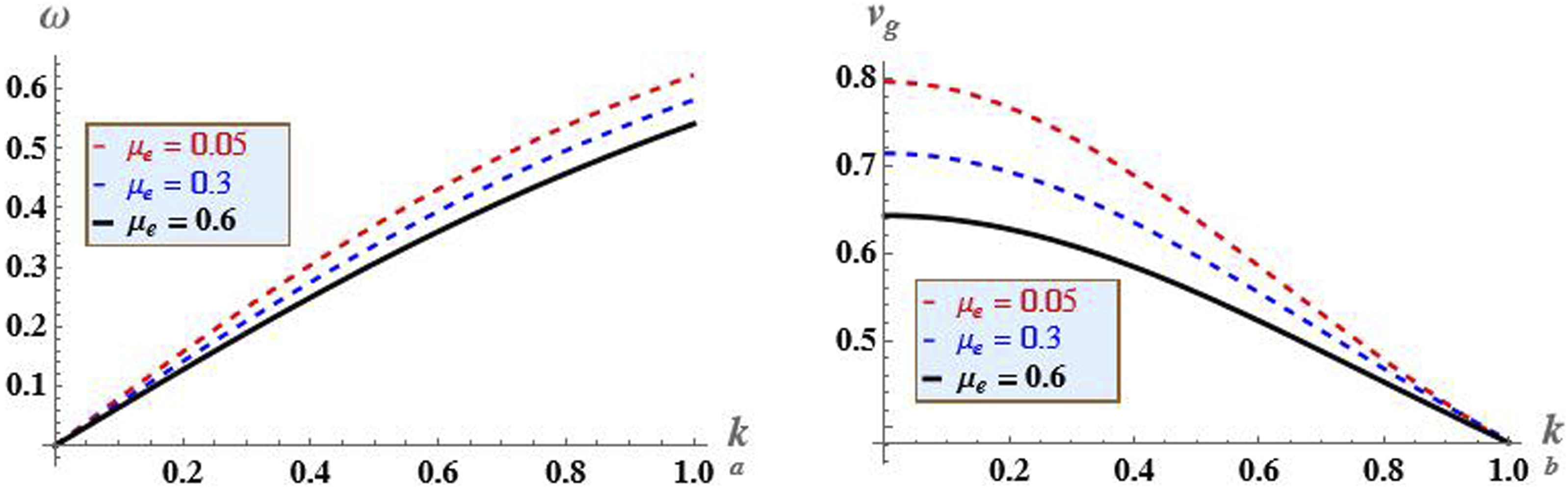










Now, the phase speed of the DAWs for the current model is obtained while considering smaller k values, that is, (k2 ≪ α), as predicted in Ref. 59 and given by



For

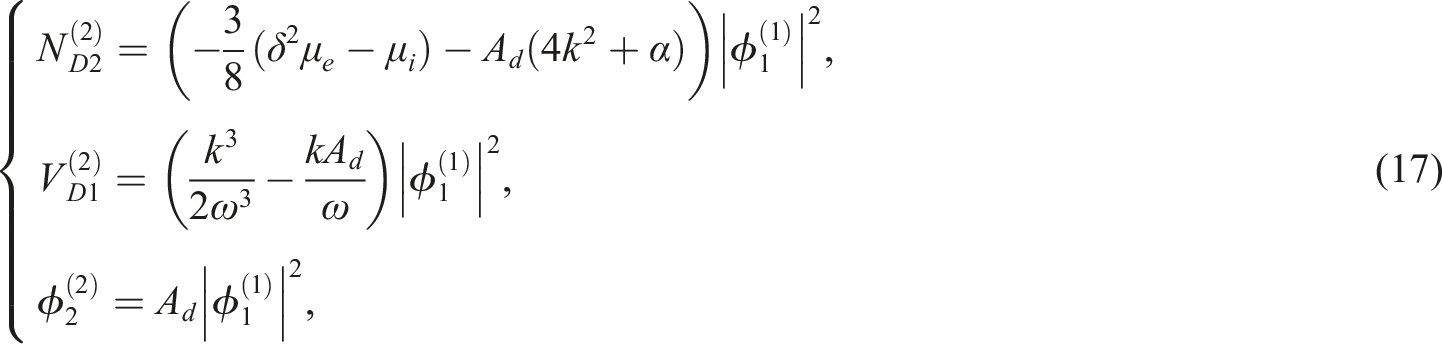

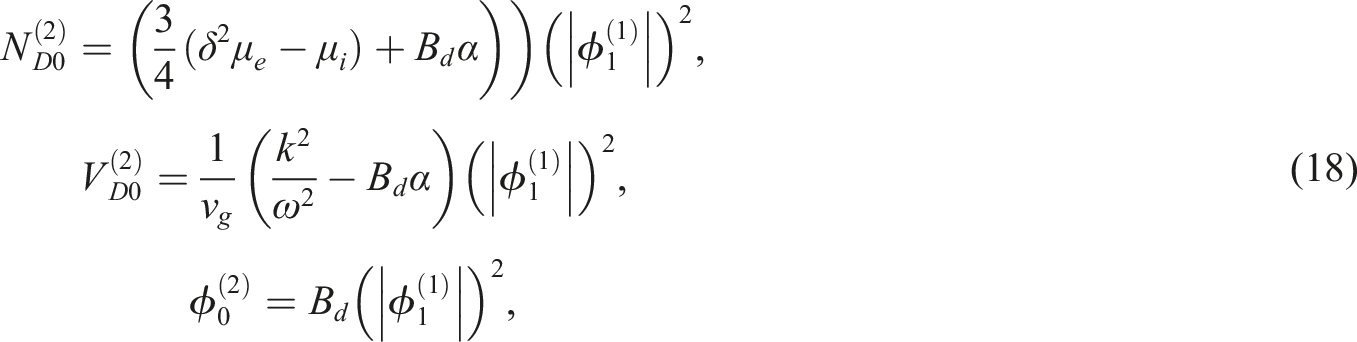
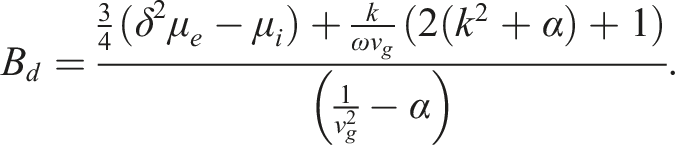
Using different expressions from the above equations for different orders in n, the following planar NLSE is derived in the first-harmonics l = 1, and the third-order n = 3 as


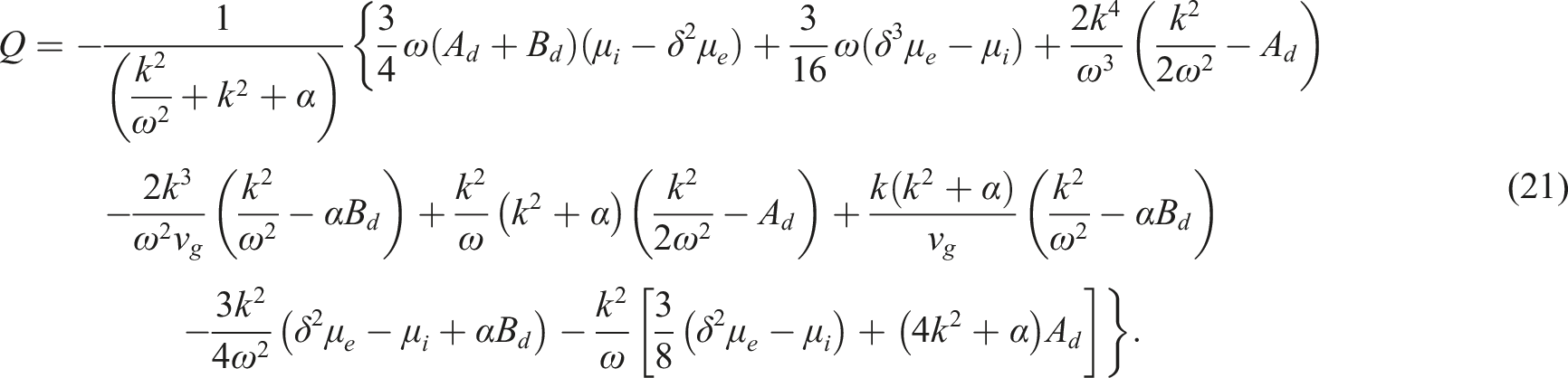
As the expressions for the coefficients P and Q clearly depend on the parameters Both (a) the dispersion coefficient P and (b) the nonlinearity coefficient Q are examined against the dust/electron concentration μ
e
and the carrier wavenumber k.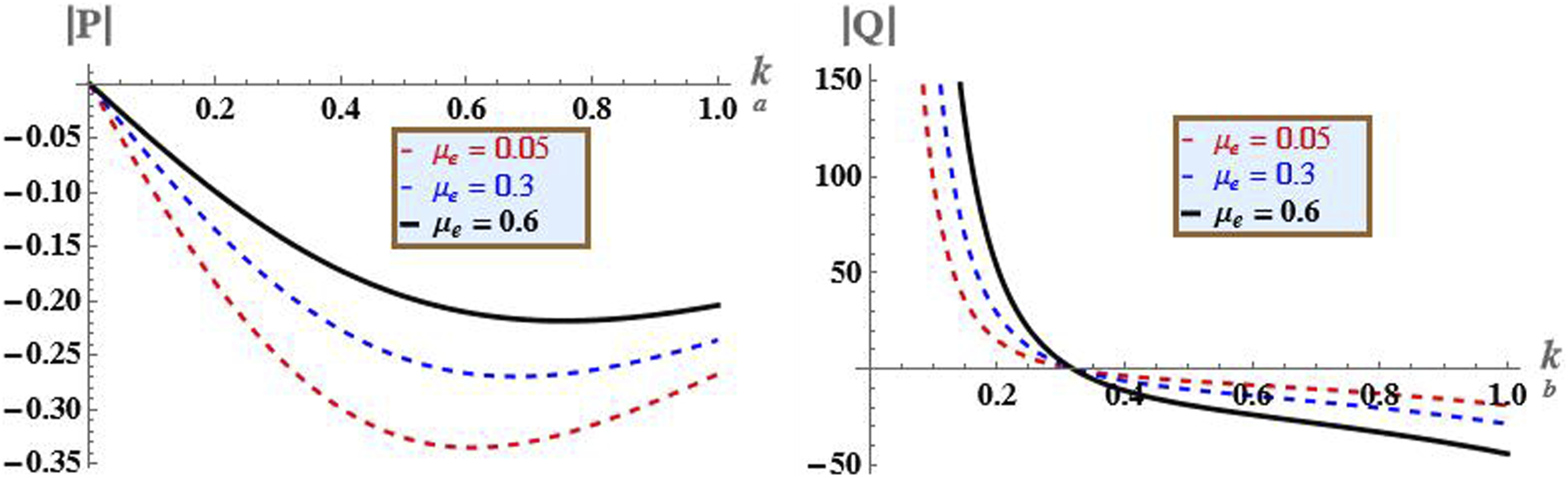
Modulation instability (MI) analysis
The MI analysis of the DAWs, represented by the NLSE (19), is studied by linearizing the solution of monochromatic (Stokes) wave63,64 with

It can be seen from equation (22) that for stable modulation, the ratio Q/P must have negative values (both Q and P have opposite signs), which occurred at smaller values of k (longer wavelength). However, MI sets when

To investigate the behavior of modulated structure waves, we first should determine the stable and unstable regions based on the ratio Q/P, in which the positive (negative) values of Q/P correspond to unstable (stable) regions. The ratio Q/P is numerically examined against the electron concentration μ
e
and the carrier wavenumber k as displayed in Figure 3. Notably, the pole(s) are in accordance with the roots of Q; this results in a change in the sign of the Q/P, which gives the value of critical wavenumber k
Cr
, over which instability appears. In technical terms, k
Cr
divides the region(s) that are stable (k < k
Cr
) from the region(s) that are unstable (k > k
Cr
). Bright and dark (black or gray) envelope solitons are formed for values above and below k
Cr
. In the stable region (k < kCr or Q/p < 0), as the value of μ
The stable and unstable regions are investigated against the dust/electron concentration μ
e
and the carrier wavenumber k based on the sign of ratio Q/P.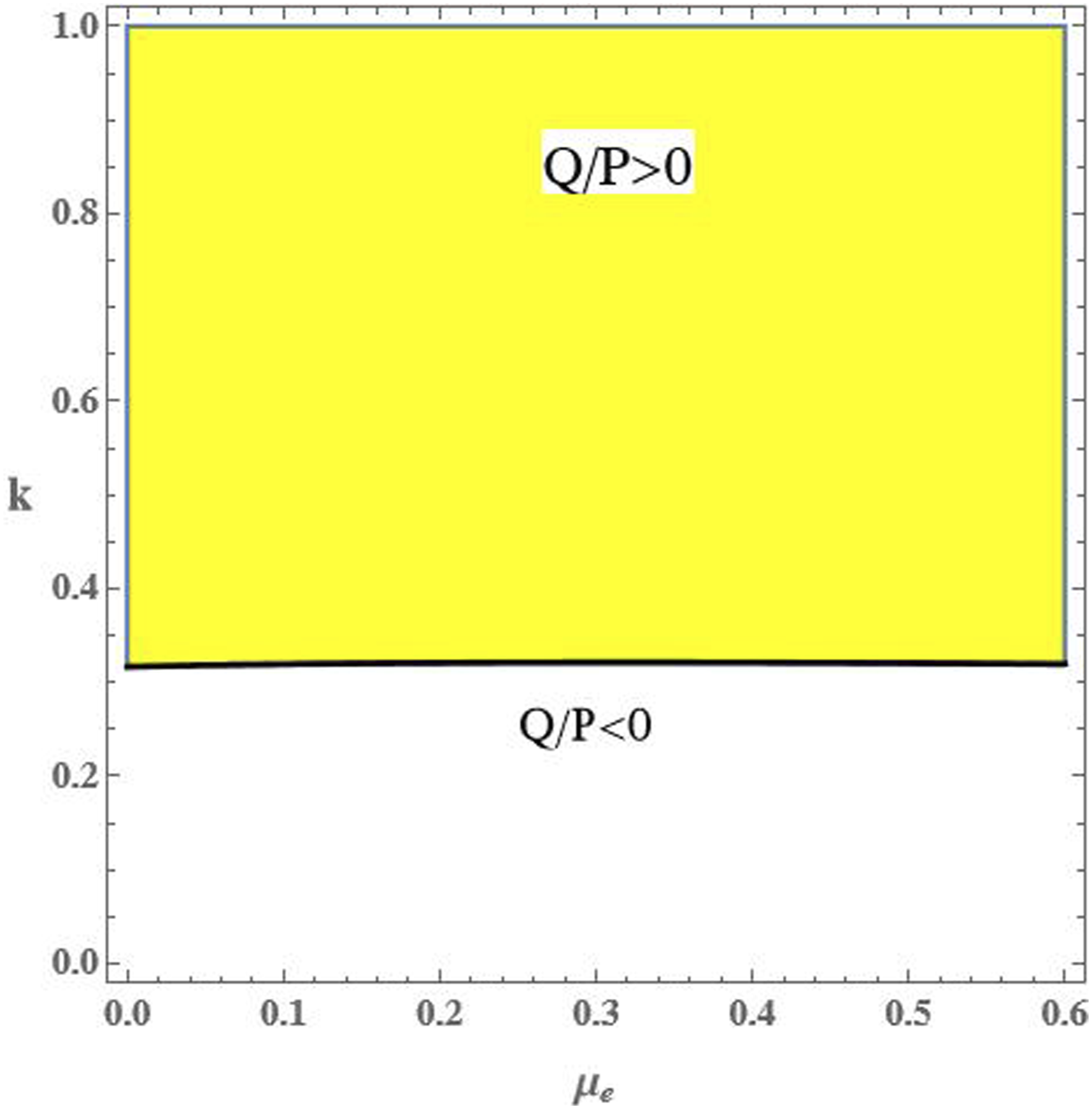
Planar modulated envelope solitons
Here, we consider two examples in order to demonstrate the applicability of our results. We first considered the values of parameters that are pertinent to semiconductor quantum well
66
: N
Do
≈ 1011 cm−3, N
eo
≈ 5 × 1016 cm−3, T
Fi
≈ 2.5 × 10⁻⁴ K, T
Fe
≈ 5.74 K, considering m
D
/m
i
≈ 1012, where m
i
denotes ion mass. Secondly, we considered that the typical values of the plasma parameters correspond to dense astrophysical environments (white dwarfs, magnet stars, etc.)
67
: N
Do
≈ 1.9 × 1021 cm−3, N
eo
≈ 2 × 1027 cm−3, T
Fi
≈ 2946 K, and T
Fe
≈ 6.71 × 10⁷ K. The Fermi ion to Fermi electron temperature ratio δ can be written in terms of μ
e
as
The localized solutions of NLSE (19) describe the arbitrary amplitude nonlinear excitation that exists in the form of bright and dark envelope solitons. By using ψ(ζ, τ) = ρeiϑ(ζ,τ) into equation (19), one can obtain the exact formula for envelope structures, where ϑ denotes the nonlinear phase shift due to self-interaction and ρ is the envelope amplitude (both change weakly in space and time). The final expressions for ϑ and ρ are derived in Ref. 65
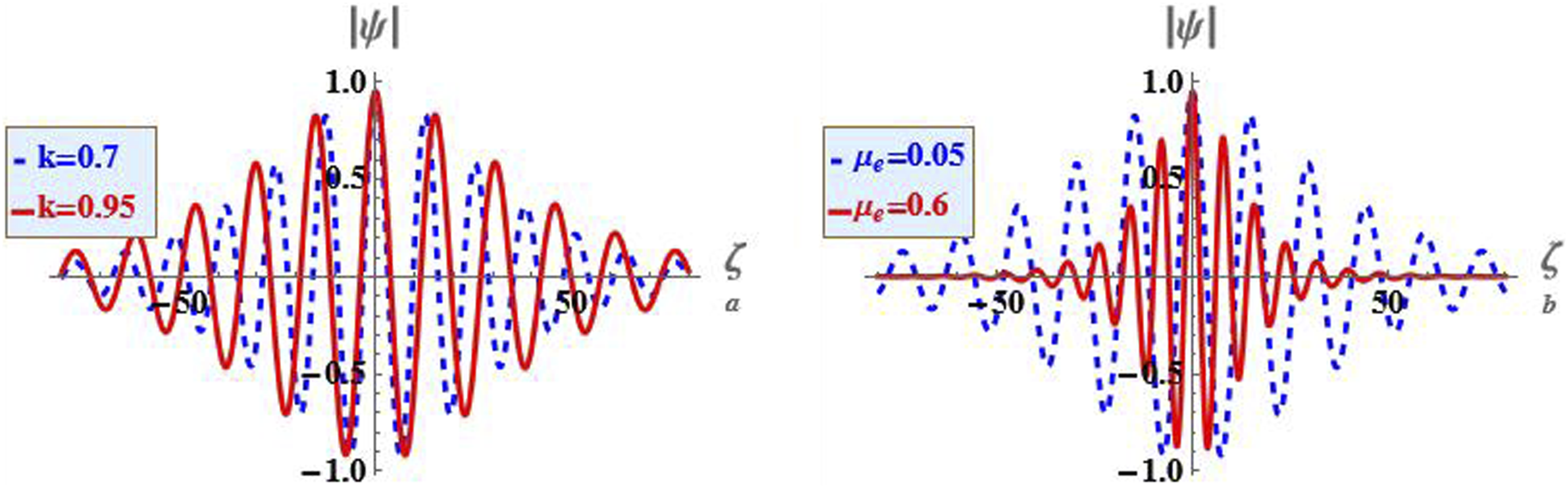
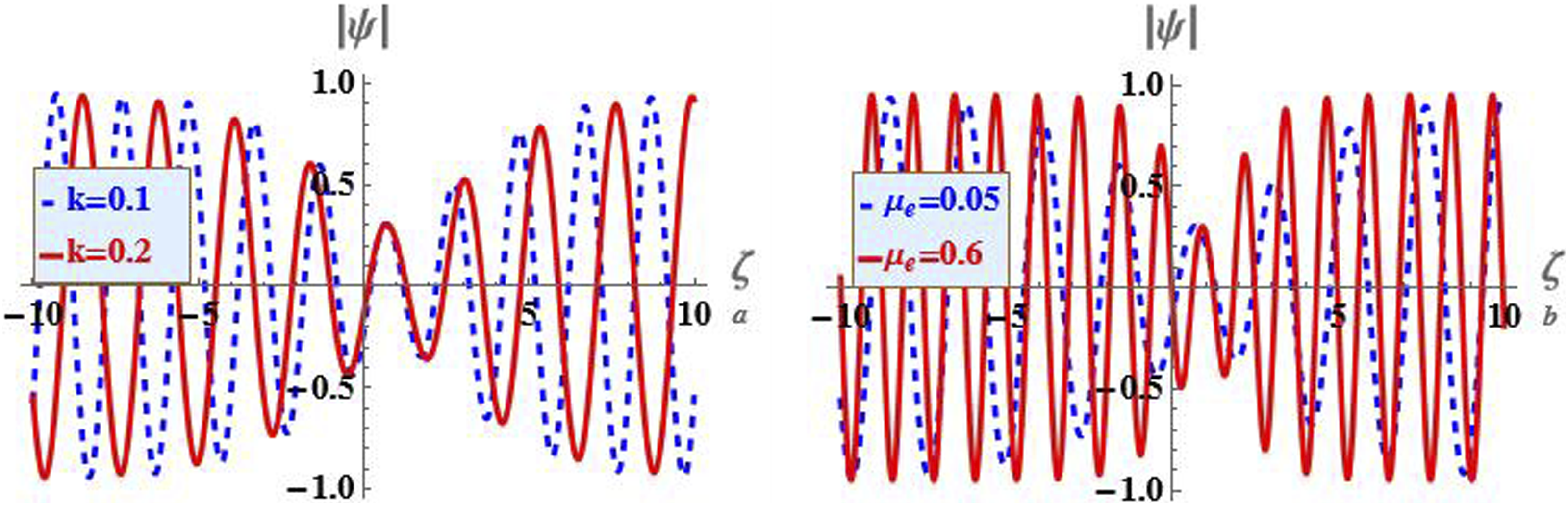
In the region of large wavenumbers (or short wavelengths), the ratio Q/P has positive values and the carrier wave is modulationally unstable (see Figure 3). The carrier wave due to external perturbations may either “collapse” or it can produce modulated wave packets in the form of a “bright” envelope or localized envelope “pulses” that restrict the carrier wave. The exact expression derived in as follows
64

where v
o
, L, and Ω denote the envelope velocity, pulse width, and frequency of oscillation at rest, respectively. It is observed that, conversely to KdV solitons, where L2ψ
o
= constant, L and ψ
o
satisfy In the unstable region, that is, for Q/p > 0, the bright envelope soliton solution (24) is plotted against (a) the carrier wavenumber k and (b) the dust/electron concentration μ
e
.

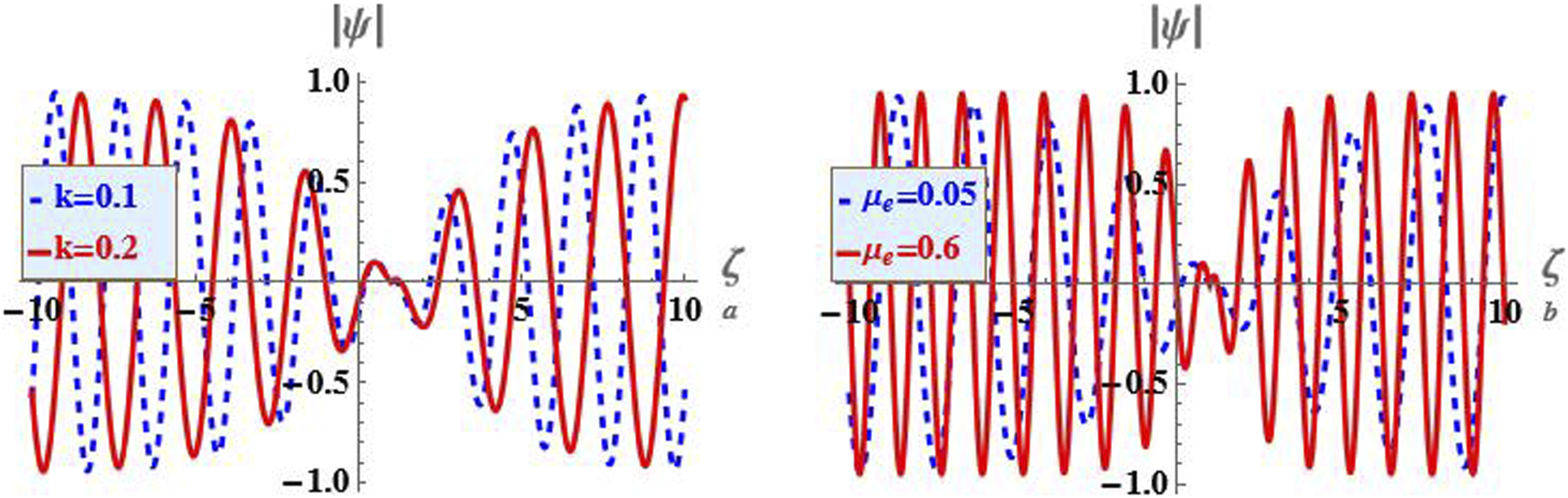
Here, the depth of the void is determined by the positive constant d, equal to one for black solitons and less than one for gray solitons; see Figures 5 and 6, respectively, localized voids or envelope holes appeared in the middle, surrounded by zones of constant amplitude on either side, extending both to infinities. These excitations can either attain a finite or disappearing amplitude in the middle. The dark envelope soliton (gray or black) (25) is numerically investigated against the carrier wavenumber k and μ
e
as evident in Figures 5 and 6. In the stable region, that is, for Q/p < 0 and for and d = 1, the black envelope soliton solution (25) is plotted against (a) the carrier wavenumber k and (b) the dust/electron concentration μ
e
. In the stable region, that is, for Q/p < 0 and for and d = 0.95, the gray envelope soliton solution (25) is plotted against (a) the carrier wavenumber k and (b) the dust/electron concentration μ
e
.
Planar rogue waves (RWS) and breathers
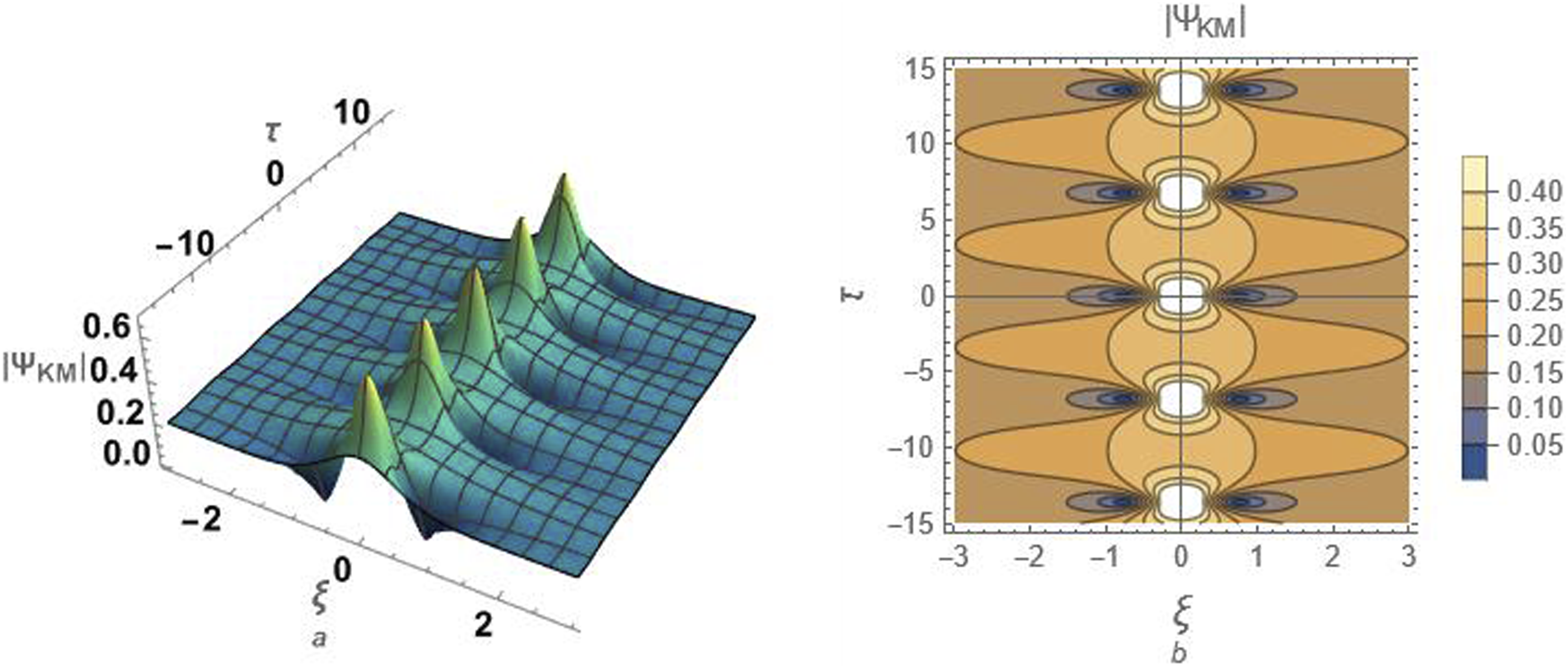
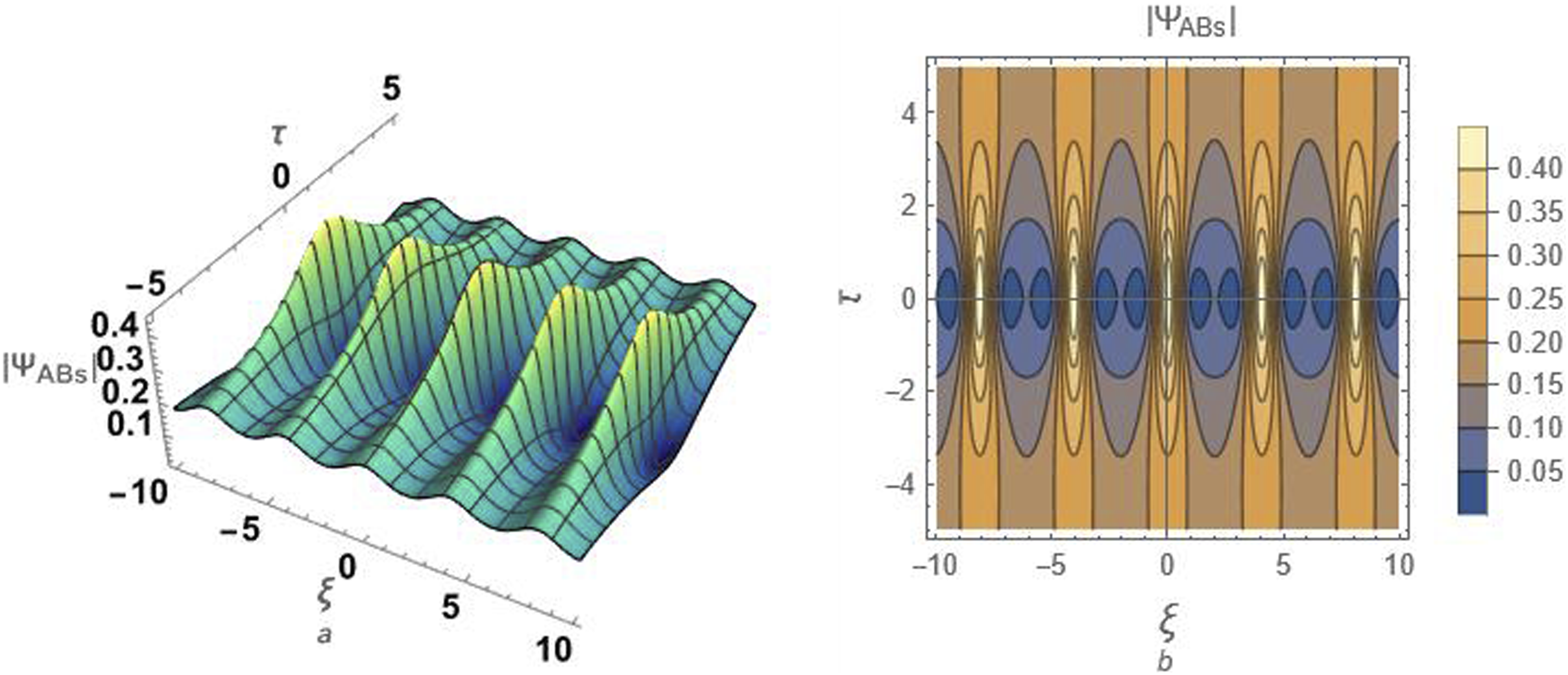
As is known and proven in the literature, the NLSE supports a hierarchy of solutions for various types of modulated nonlinear structures that propagate with the group velocity, including modulated envelope solitons discussed previously and other rational solutions that may be localized in space-time or periodic in either time or space alone. The most renowned of these solutions are the RWs and breathers. RWs are a category of modulated waves distinguished by the absorption of substantial energy from the surrounding medium, and they originate and propagate in unstable regions. These waves are localized in space-time and arise abruptly and vanish instantaneously without a trace, in contrast to breathers, which are categorized into two types: Akhmediev breathers (ABs), characterized by spatial periodicity and temporal localization and Kuznetzov-Ma breathers (KMBs), distinguished by temporal periodicity and spatial localization. Only for simplicity, we rewrite the NLSE (19) in the following form: (I) For s > 1/2, the solution (27) reduces to the KMBs solution Ψ
KM
(see Figure 7), that is, (II) For 0 < s < 1/2, the solution (27) reduces to the ABs solution, that is, (III) Now, for The Kuznetzov-Ma breathers (27) for s = 0.75 is examined in the The Akhmediev breathers (27) for s = 0.2 is examined in the





It is clear from Figure 9 that the RW solution (30) is localized in both spatial and temporal dimensions. The Rogue waves (30) for s → 1/2 is examined in the 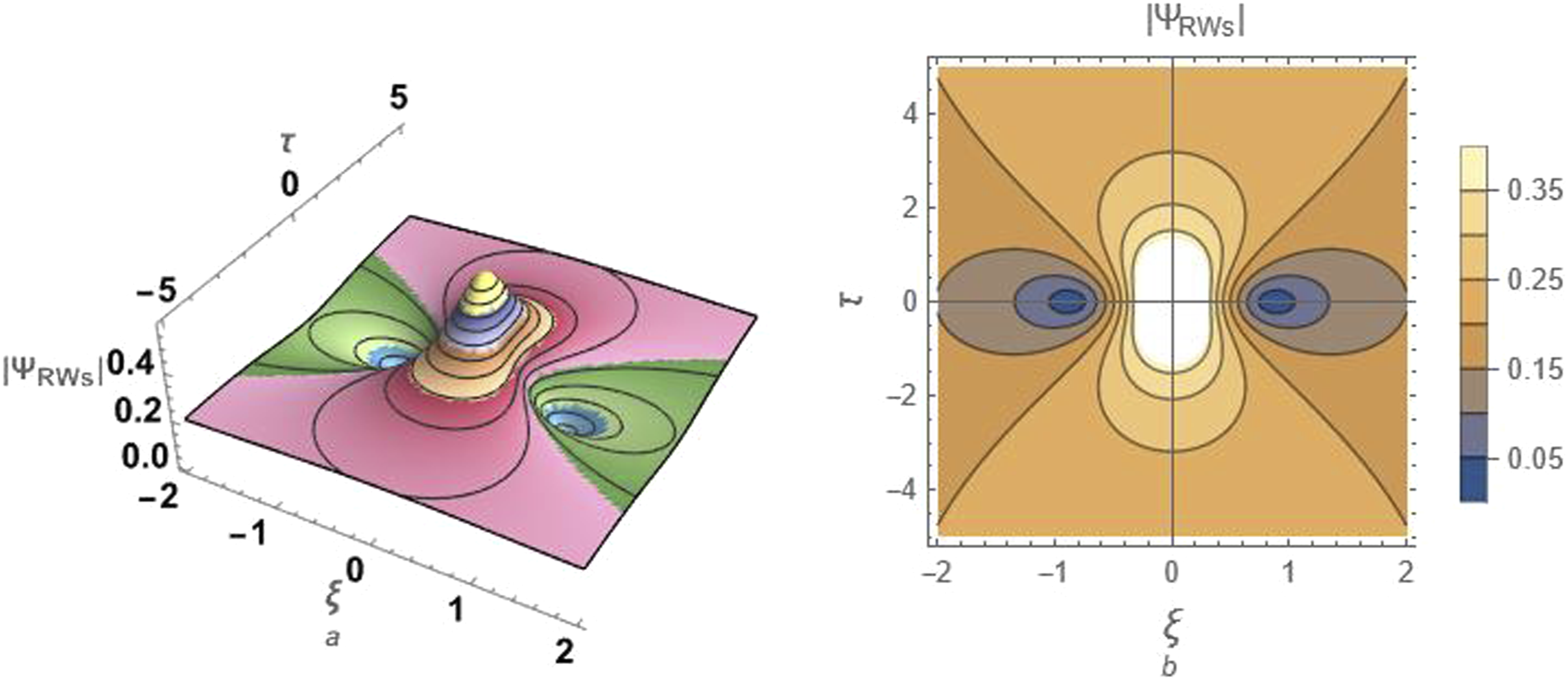
The general peaks of breathers can be derived at τ = 0, as indicated by solution (27)

and the maximum amplitude to breathers reads

From relation (32), it is clear that the maximal amplitude of RWs is smaller than that of the KMBs but more than that of the ABs, that is,
Now, let us examine the effect of the dust/electron concentration μ
e
and the carrier wavenumber k on the RW profile. Prior to proceeding, we should remember that the impact of the related parameters The impact of dust/electron concentration μ
e
and the carrier wavenumber k on the RW profile Ψ
RWs
: (a) Ψ
RWs
against μ
e
for k = 0.5 and (b) Ψ
RWs
against k for μ
e
= 0.3.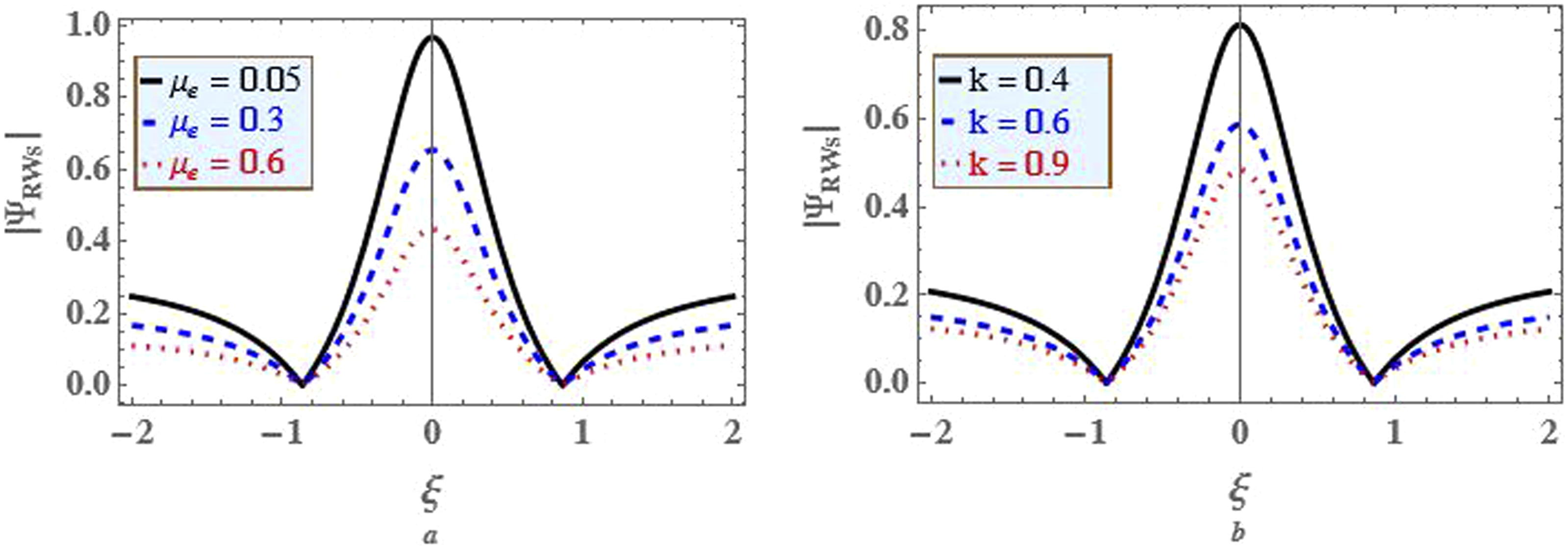
Conclusions
We have conducted a theoretical and numerical analysis of the modulation instability (MI) of dust-acoustic waves (DAWs) that propagate in unmagnetized degenerate Thomas-Fermi dusty plasmas, consisting of inertial negatively charged fluid dust grains and inertialess Thomas-Fermi ions and electrons. To investigate the MI phenomena, the governing fluid equations of the current plasma model have been reduced to the planar nonlinear Schrödinger equation (NLSE), which is essential for analyzing this phenomenon. Subsequently, we examined the influence of dust/electron concentration on the dispersion relationship and group velocity, discovering that dust/electron concentration significantly impacts the behavior of these physical quantities. Furthermore, we have analyzed the impact of dust/electron concentration on the dispersion and nonlinearity coefficients, which delineate the regions of stability and instability within the system under study.
Furthermore, we examined the influence of dust/electron concentration on specific localized nonlinear modulated waves capable of propagation in these regions, including bright, black, and gray envelope solitons. Moreover, in the unstable region, the rogue waves (RWs) and breathers (Akhmediev breathers (ABs) and Kuznetzov-Ma breathers (KMBs)) have been numerically investigated. It was found that the maximal amplitude of RWs is smaller than that of the KMBs but more than that of the ABs. Also, the impact of the dust/electron concentration μ
e
and the carrier wavenumber k on the RW profile has been numerically reported. It was observed that both the amplitude and width of the RW shrink with the enhancement of
Finally, our findings will be more helpful in understanding the properties of modulated DAWs, which could be found in metallic nanostructures, dense degenerate Fermi gas, and near-supernova environments with massively charged dust particles. Our results may also help design semiconductors and microelectronics devices contaminated by highly charged dust particles.
Footnotes
Acknowledgments
The authors express their gratitude to Princess Nourah bint Abdulrahman University Researchers Supporting Project Number (PNURSP2024R17), Princess Nourah bint Abdulrahman University, Riyadh, Saudi Arabia. This study is supported via funding from Prince Sattam bin Abdulaziz University, Saudi Arabia Project No. PSAU/2025/R/1446. In the end, the authors gratefully acknowledge the constructive suggestions of the anonymous referees which significantly improved the quality of the manuscript.
Author Contributions
All authors contributed equally and approved the final version of the current manuscript.
Declaration of conflicting interests
The author(s) declared no potential conflicts of interest with respect to the research, authorship, and/or publication of this article.
Funding
The author(s) disclosed receipt of the following financial support for the research, authorship, and/or publication of this article: This work was supported by the Princess Nourah bint Abdulrahman University Researchers Supporting Project Number (PNURSP2024R17), Prince Sattam bin Abdulaziz University, Saudi Arabia Project No. (PSAU/2025/R/1446).
