




Abstract
The current paper presents the first treatment to obtain the solution of a complex Helmholtz–Duffing oscillator. This model has described the elevation of the surface waves in fluid mechanics. The non-perturbative approach is used to convert the nonlinear oscillator to a linear oscillator to derive the solution of the complex nonlinear oscillator. This paper has opened the path for a new way to study more complex nonlinear elevation of surface waves.
Keywords
Introduction
In recent decades, further attention has been owing to the nonlinear problems in fluid mechanics, plasma physics, and optical fiber communication. After building nonlinear partial differential equations to depict these nonlinear phenomena and then analyzing the analytical and numerical solutions of these nonlinear models, the actuality of these nonlinear phenomena can be known.1,2 Modeling, discretization, and numerical analysis of the two-way fluid-structure interaction between a fishing wobbler and a water stream were studied in. 3
One of the important categories in fluid mechanics is the investigation of surface waves. In physics, a surface wave is a mechanical wave that propagates along the interface between differing media.4–7 A usual sample is gravity waves along the surface of fluids, such as ocean waves. Gravity waves can also occur within fluids, at the interface between two fluids with distinct densities. When the surface is disturbed, surface waves will be generated on the free surface of fluids. For instance, Figure 1 shows the elevation of the fluid interface due to the disturbance. The theoretical formulation for the excitation of surface waves and normal modes was simply developed, in Ref.
8
These waves are mainly sought in such a way that their implicit amplitude depends on the unknown function of time with the spatially periodic description. The association of a normal mode formalism to compute dispersion and excitation of surface waves led to establishing nonlinear Helmholtz–Duffing oscillator behaviors to describe these waves.9–13 The graphic of a surface elevation.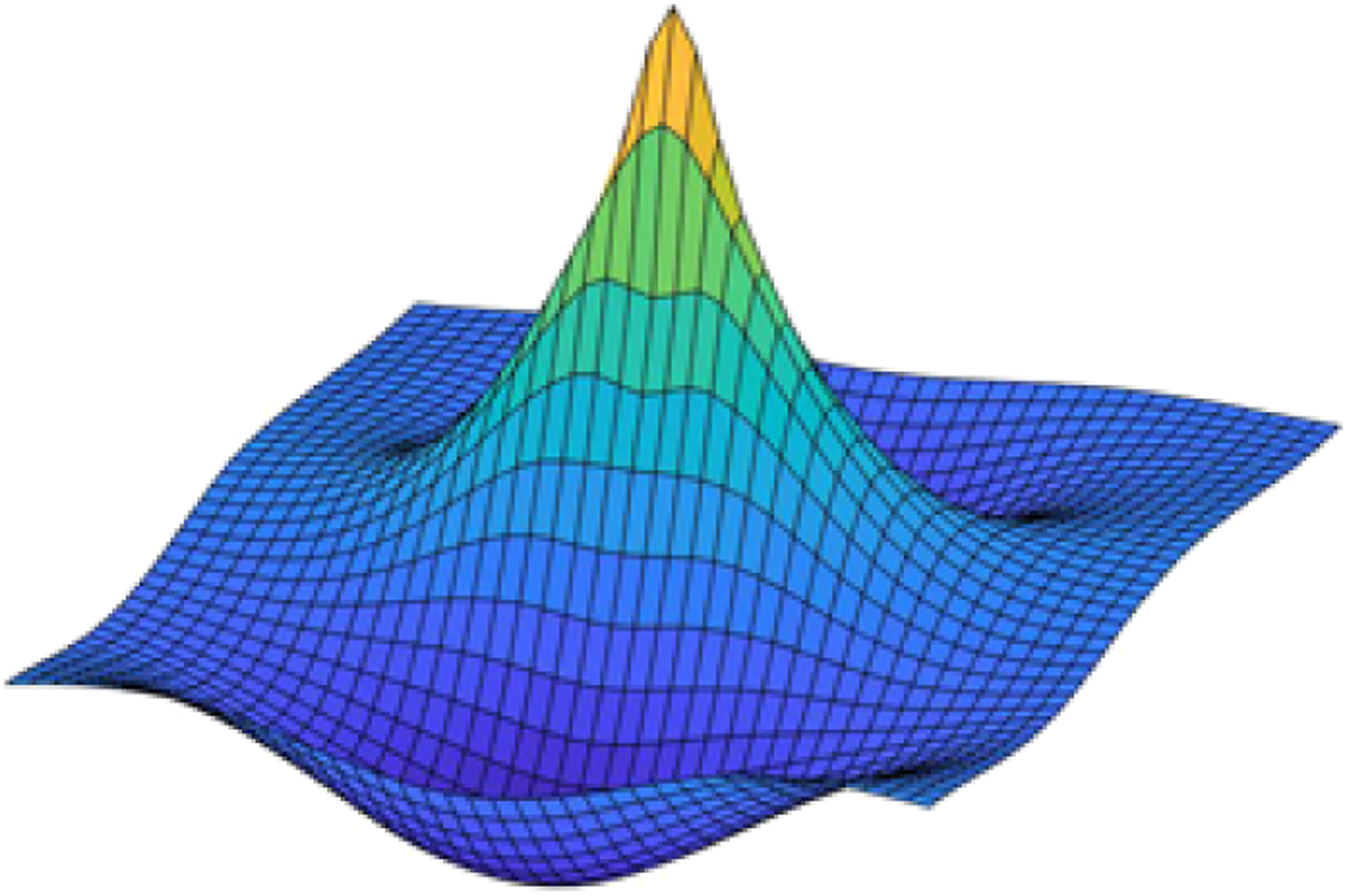
Helmholtz–Duffing oscillator is similar to the MEMS oscillator. 14 A Micro-electromechanical System (MEMS) oscillator is a type of oscillator that contains an electromechanical resonating structure built using a semiconductor fabrication process. The nonlinear Helmholtz–Duffing oscillator equation is a classical integrable equation that contains plenty of significant properties and occurs in many physical areas.15-18 Computed the elevation surface wave propagating at the surface of a fluid is described by the Helmholtz–Duffing oscillator.19–22 It is known that this family is integrable, that is, its exact solution is available in the absence of the damping effect. Otherwise, if the damping effect and somewhat other friction forces are taken into consideration, a non-integral differential equation will arise, that is, its exact solution is not available. 23 The elevation function for inviscid fluids is described by the Helmholtz–Duffing equation with real coefficients. The presence of viscosity in the fluid models will produce a complex Helmholtz–Duffing equation. 20 Due to the difficulty of solving the complex nonlinear equation, some authors resort to separating the equation that covers the elevation into two equations one represents the real part and the second refers to the imaginary part of the original equation.20,22 However, this approach yields two nonlinear differential equations controlled by one unknown variable, which leads to several ill solutions. By eliminating any part between the two equations, a new equation with real coefficients will result. The resulting equation has an ill solution. 24
In the present paper, we consider the damped and unforced Helmholtz–Duffing oscillator taking into account the complexity of the coefficients. We solve it using an extended version of He’s frequency approach for the damped case. This oscillator was solved in Ref. [17] for real coefficients. The non-perturbative method 25 is used through the classical He’s frequency formula.25–31 It is noted that He’s frequency formula is first established by He 32 via an ancient Chinese algorithm, which is also successfully applied to fractal oscillators 33 and also leads to a numerical method called Chun-Hui He’s iteration method in literature. 34 Further, He’s frequency formula has successful established the frequency for fractional nonlinear oscillation.35,36
Based on the non-perturbative method, we present an improved deep approach to solving complex oscillations. The present approach can lead to obtaining a remarkably rigorous solution. Through this method, also a generalization is provided. 25
Problem statement
Consider the complex Helmholtz–Duffing oscillator in the form


A profound conception of the technique of nonlinear vibrations has a fruitful role in explaining the confusion of a lot of engineering and physical behaviors in different fields of science. In the non-complex coefficient in equation (1), there are many analytical methods available for solving the classical nonlinear oscillation, see Refs. [37, 38].
Since the nonlinear equation (1) is composed of real and imaginary coefficients then the configuration of its solution

The argument of the complex solution is represented by
To solve equation (1) in the simple approach, the method of the non-perturbative technique may be applied. This method depends on obtaining the equivalent linearized form for equation (1). For this aim, one may be reformatted equation (1) in the simplest representation.
The representation in the equivalent linearized approach
Because of the equivalent linearized method,29,31 equation (1) can be rearranged in the following form with two complex partitions


The partition

It is noted that equation (3) represents the complex non-homogenous Helmholtz–Duffing oscillator with complex damping effects. Postulate that the nonlinear oscillation has a frequency denoted by
As mentioned in Ref. [31], the equivalent linearized form of equation (3) can be sought in the following linear damping complex oscillator





The Helmholtz part is estimated in the following form
17

Now, equation (6) declares a non-homogenous linear complex second-order equation having complex damping effects. To simplify equation (6) one may apply the normal form technology. Therefore, introducing the following transformation

Insert (12) into equation (6) yields

This is the non-homogenous normal form equation. Its total solution is composed of the combination of the homogenous solution and the particular solution. Its particular solution in the complex form is given by

Assuming that the complex homogenous solution of equation (13) may have the following form



These are two simultaneous equations in two unknowns

It is noted that the stability criteria require that

To find the frequency

It is noted that the positive sign is chosen in (20) to ensure that
It is known that the combination of the suggested solution (15) and its complex conjugate is also represented a solution so the total homogenous solution can be described in the form

Employing the combination of (14) and (21) into (12) the total complex solution arises in the form

This is the total solution of the complex Helmholtz–Duffing oscillator (1) having the form

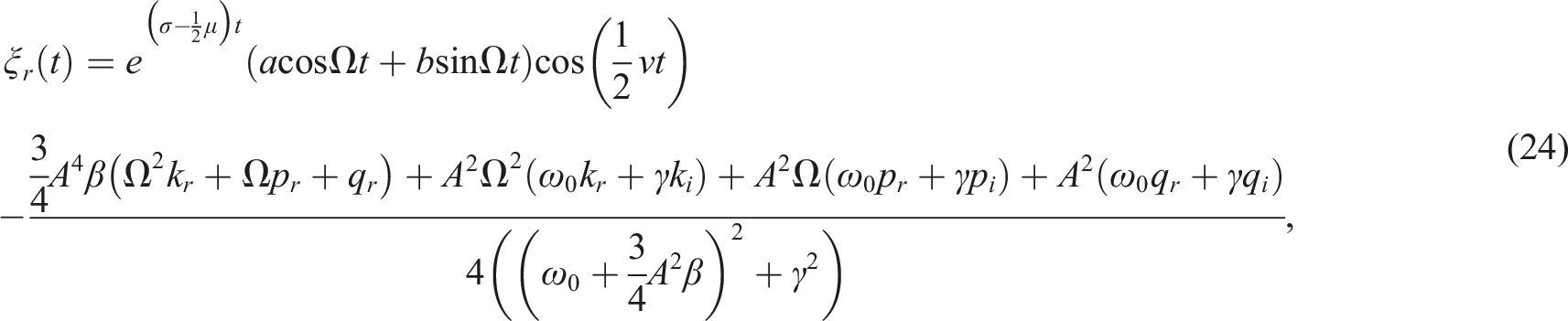
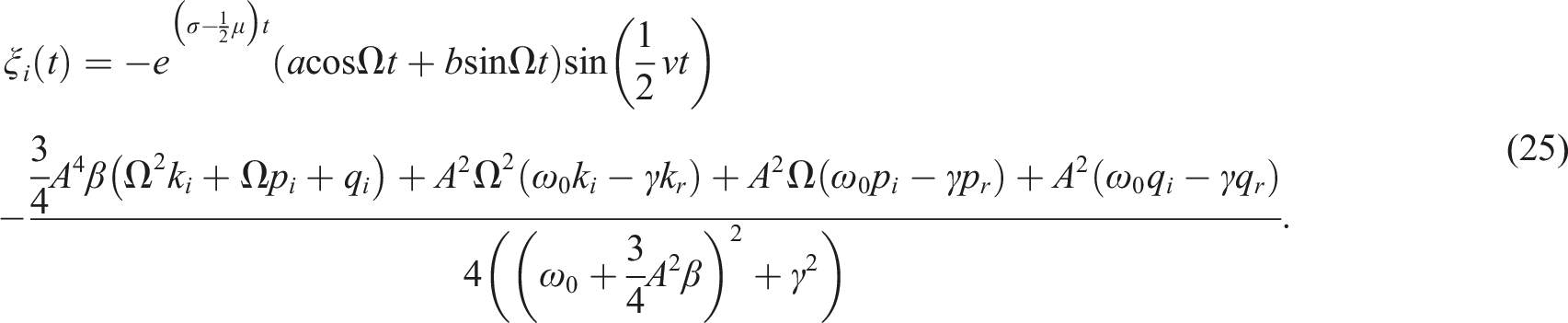
The complex solution (23) can be reformulated in the polar form as



It is noted that the function

This leads to

Numerical estimation
To understand the scope of the above technique, numerical illustrations are made for the final solution (31). The following system is chosen for the calculations:
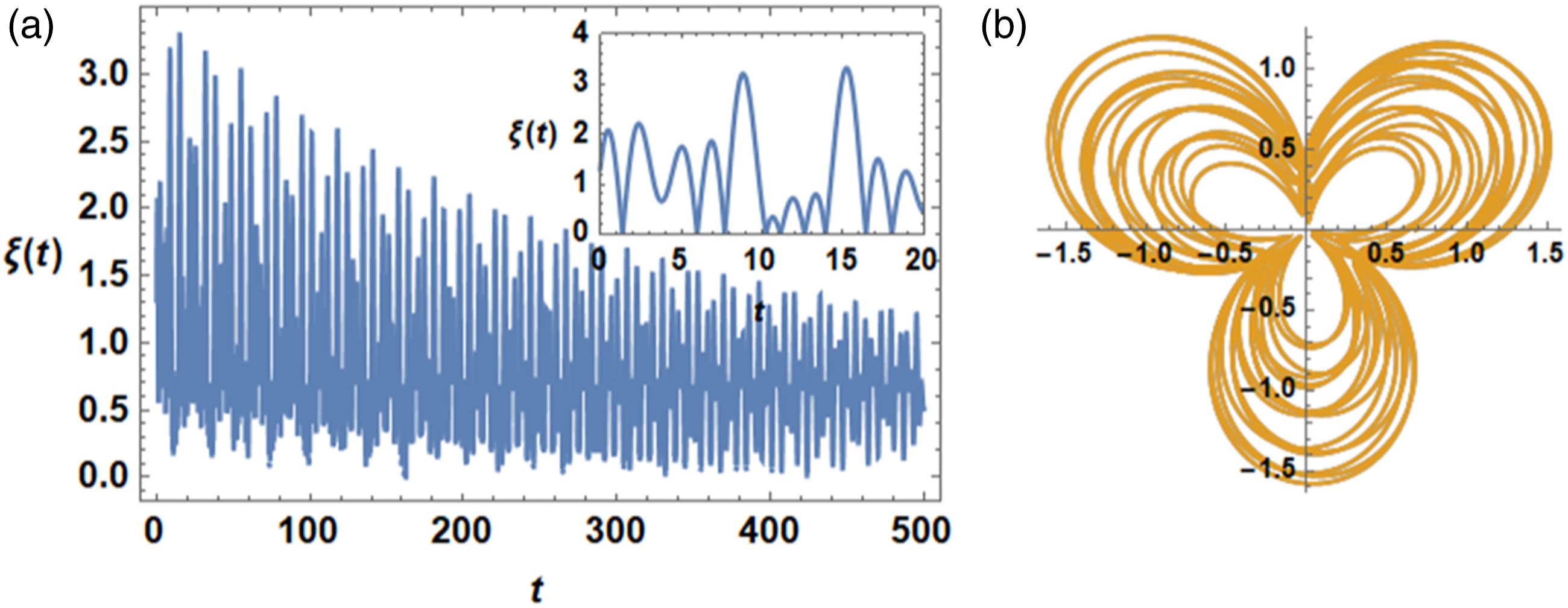
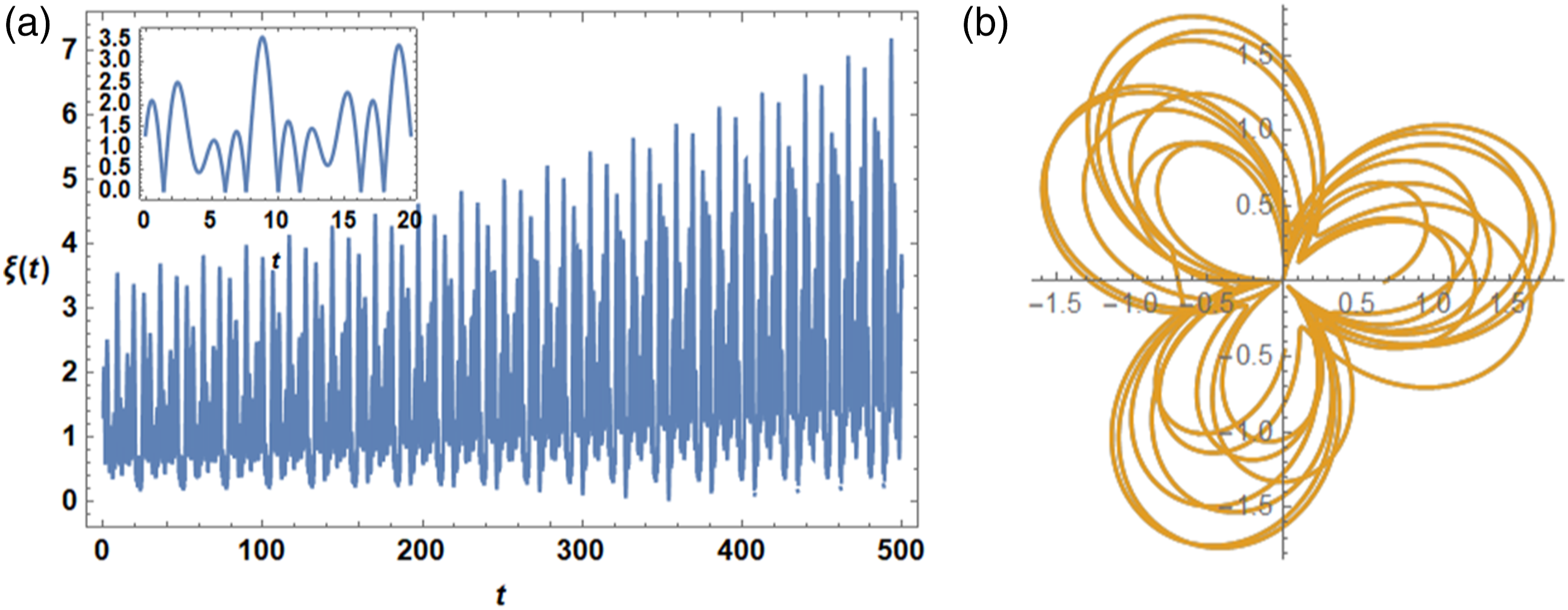
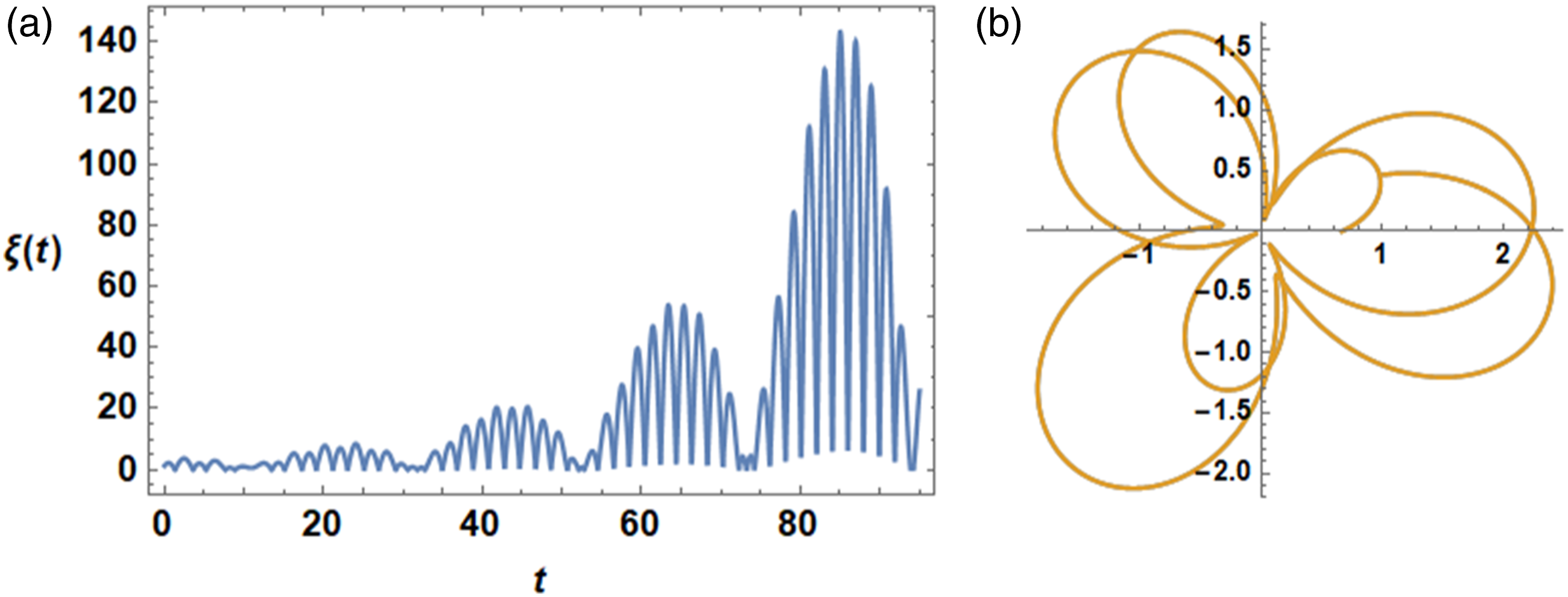
The calculations are displayed in the graphs presented in Figures (2, 3, and 4). Further, the polar representation corresponding to each case is graphed. In Figure 2(a), the time history shows that there is a damping behavior along with increasing time. The same behavior is observed in Figure 2(b) in which there are no closed curves. Similarly, damping behavior still occurs when the parameter Time history for the solution (30) for Figure 2(b): The polar representation for the system (a): Time history for the solution (30) for Figure 3(b): The polar representation for the same system is given in Figure 2(a) except that 4(a): Time history for the solution (30) for Figure 4(b): The polar representation for the same system is given in Figure 2(a) except that the graph is considered in Figure 4(a). (a): Time history for the solution (30) for Figure 5(b): The polar representation for the same system is given in Figure 2(a) except that the graph is considered in Figure 5(a). 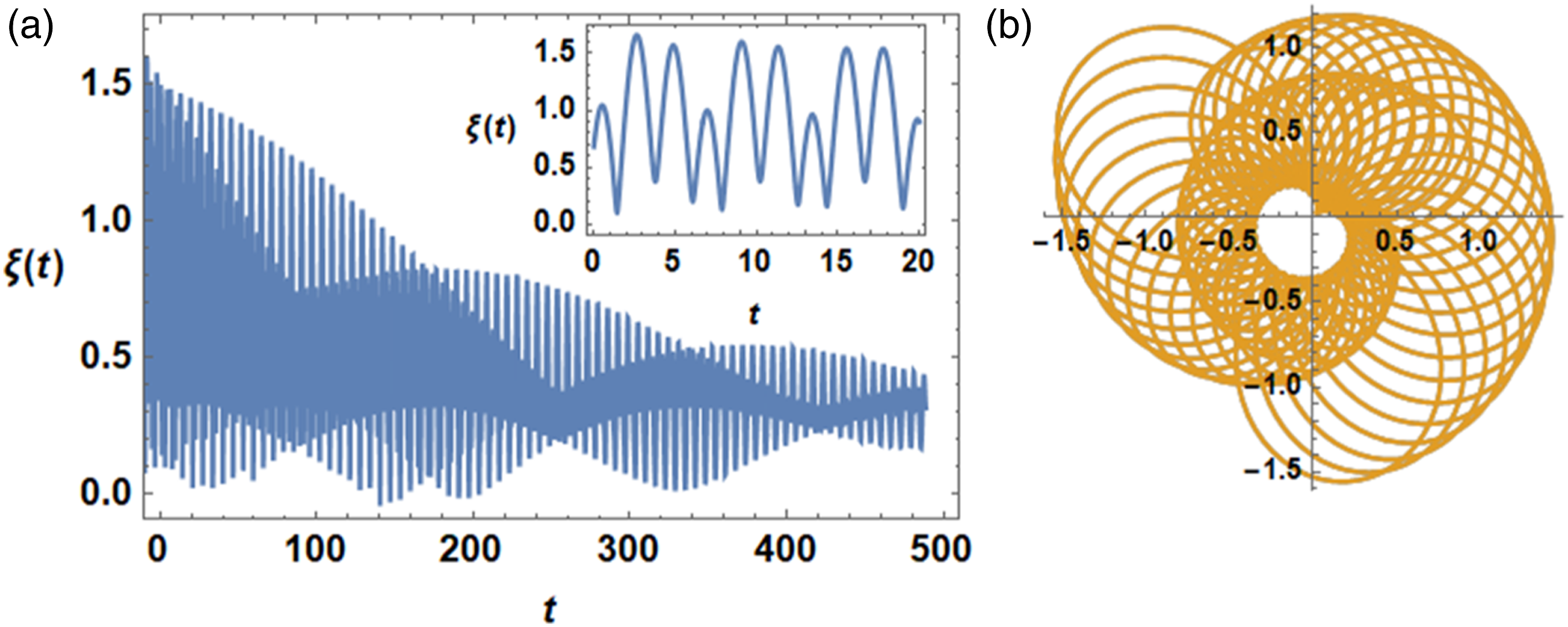
In Figure 6(a), (b)), the same graph of Figure 2(a), (b) is considered except the real parts of the quadratic forces have been changed to the value (a): Time history for the solution (30) for Figure 6(b): The polar representation for the same system is given in Figure 2(a) except that the graph is considered in Figure 6(a). 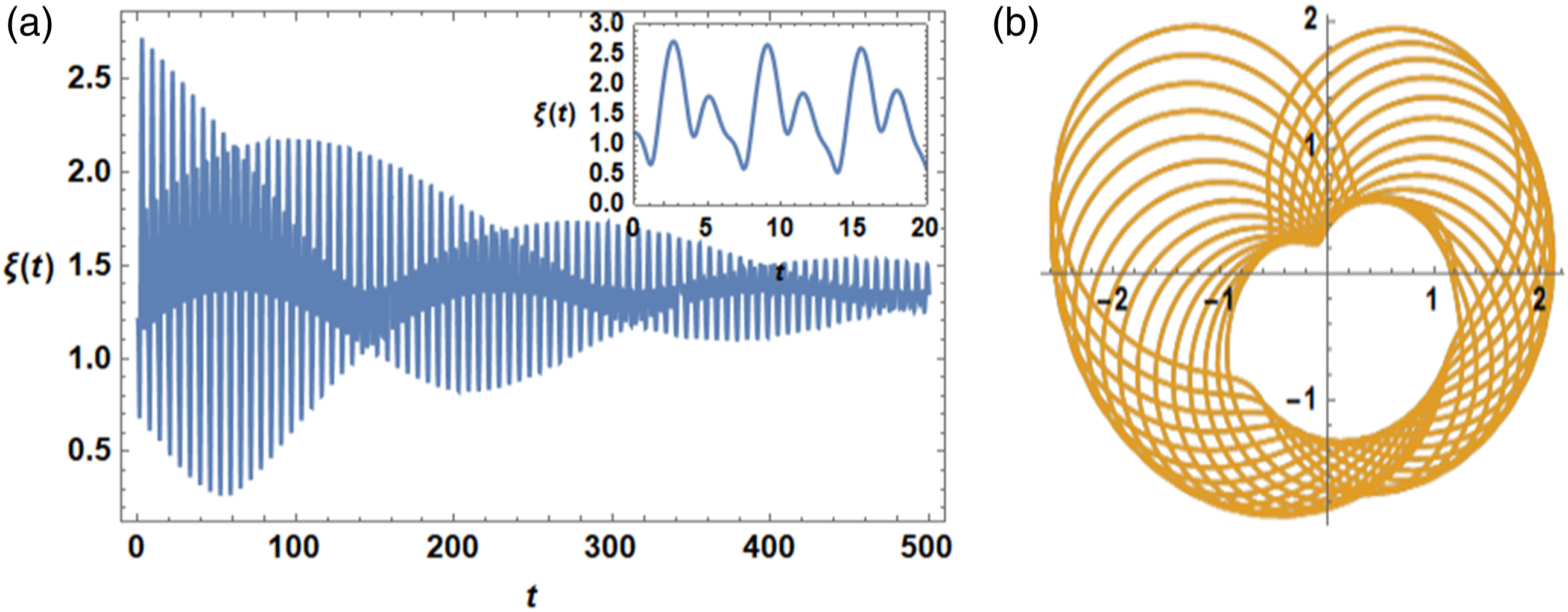
Conclusion
In this paper, the analysis has been made to solve the nonlinear oscillator having complex damping forces and complex quadratic forces of the Helmholtz–Duffing type. The non-perturbative approach is used to formulate He’s frequency formula which comes in the complex representation. Further, the method leads to linearizing the damping nonlinear oscillator to convert to a complex damping linear oscillator. The complex solution is obtained and performed in the polar representation. With the help of its complex conjugate, the real solution is obtained which is described as a real physical phenomenon in fluid mechanics. This solution is graphed numerically with time history and polar representations. The proposed method has demonstrated its high accuracy and high efficiency in the derivation and computation of frequency for complex nonlinear oscillators. It should also be pointed out that the proposed method can be easily extended to fractal nonlinear problems for vibration analysis.
Footnotes
Declaration of Conflicting Interests
The author(s) declared no potential conflicts of interest with respect to the research, authorship, and/or publication of this article.
Funding
The author(s) received no financial support for the research, authorship, and/or publication of this article.
