




Abstract
The exploration of nonlinear damped oscillators is driven by their common occurrence in real systems where damping and nonlinearity dictate stability and energy dissipation. This study is innovative due to the complex phenomena they display, including amplitude-dependent frequencies, bifurcations, and chaos, which are not represented by linear frameworks. Therefore, this issue addresses distinct five nonlinear dynamical systems, focusing in understanding and improving dynamic behavior of mechanical systems like vibration isolation, energy harvesting, and precision control. The goal of the study is to implement He’s frequency formula (HFF) in order to realize analytical justifications of extremely weakly nonlinear oscillators. The novel methodology, which is effectively converting a nonlinear ordinary differential equation (ODE) to a linear one, is referred to as the non-perturbative approach (NPA). It is well known that all conventional perturbation methods rely Taylor expansions to approximate restoring forces when present, which often introduces limitations and reduces the accuracy of the resulting solutions. The results are validated throughout a graphical comparison as well as Tabular comparison with the Mathematica Software (MS). Additionally, some problems are validated with modified algebraic method (MAGM). Moreover, the NPA allows in investigation of the matters’ stability analysis, which was difficult in the previous approaches. The application of NPA of science and technology and applied research is therefore useful in studying approximations of abundant nonlinear dynamical systems as well as fluid dynamics.
Keywords
Introduction
The current work involves studying a range of nonlinear phenomena in physics and structural mechanics, which can be modeled as an oscillator with significant nonlinear stiffness and damping coefficients. A nonlinear active vibration control technique was recommended in justifying the vibration of both linear and nonlinear structures. 1 A class of one-degree-of-freedom oscillators with linear and nonlinear springs and viscous dampers in the existence of bilateral rigid impact and friction were examined. 2 The analytical conditions for all possible motions are derived through the analysis of vector fields along the associated discontinuous boundaries, as in the case of oscillatory systems. The two-dimensional basic mappings were defined based on mapping dynamics, and stability analyses and analytical predictions of various periodic motions are completed. A new formulation for beam vibrations on an elastic foundation incorporating quintic nonlinearity was successfully developed, as presented in Ref. 3. In mechanical and industrial applications, the nonlinear vibration analysis of beams in steel structures was very crucial. It is necessary to understand how the beam vibrates in its transverse mode, which in turn gives the system’s inherent frequency, in order to properly build the beam structures. Based on Hamilton’s principle, the quintic nonlinear oscillator, the homotopy analysis method, was constructed and analytically solved. 4 A comparison between analytical and numerical solutions was developed in order to confirm the validity of the findings. The energy of a mechanical system appears to be the intrinsic loss function of a machine learning approach to resolve a mechanical problem. 5 A multitude of concerns was studied, and the method’s applicability for engineering purposes was assessed. The variational physics-informed neural network has been identified as an exceptional instrument for static structural evaluations. 6
In numerous fields, both linear and nonlinear ODEs are employed to describe issues that relevant to mathematics, chemistry, biology, physics, and engineering. Because scientific and technical phenomena are frequently appropriated to the shape of nonlinear kinds, the nonlinear ODE is therefore highly helpful in explaining them. The nonlinear ODEs were therefore essential in applied mathematics, physics, and engineering. 7 The importance of mathematical calculations in research and literature concerning nonlinear ODEs in many scientific and technical fields was underscored. 8 The most multipurpose methods in evaluating nonlinear engineering problems are used perturbation approach, which was widely utilized to derive approximate analytical responses to nonlinear ODEs. 9 It was developed to examine the behavior of these ODEs using both numerical and approximation techniques. 10 A number of novel techniques have recently been developed in analyzing nonlinear ODEs. Therefore, several researchers developed a few special methods. In order to obtain analytical responses that are relatively close to the exact solutions, a lot of scientists investigated a variety of novel and distinctive strategies. It was done using the Lindstedt-Poincaré process. 11 The homotopy perturbation method (HPM), 12 global residue harmonic balance technique, 15 cosine Ateb function. 14 A nonlinear dynamical system with three degrees of freedom, comprising numerous pendulums, was examined. 15 The nonlinear dynamical behavior of an un-stretched double pendulum with two degrees of freedom, where its pivot traverses an elliptical path at a constant angular velocity, was investigated. 16 The dynamics of a two-degree-of-freedom nonlinear system, exemplified by a spring pendulum with a suspension point following an elliptical path, were analyzed. 17 The inquiry centered on a dynamical system comprising a linear damped transverse tuned-absorber linked to a nonlinear damped spring pendulum, with its suspension point traversing an elliptical trajectory, was analyzed. 18 The mathematical modeling of a dynamical system associated with a piezoelectric device was investigated. 19
A nonlinear oscillator can be made almost linear by using the HFF. A review was conducted in some advancement in asymptotic techniques of systems that were weakly or strongly nonlinear oscillator.
20
Some of the more straightforward techniques of nonlinear oscillators were covered through the homotopy perturbation analysis (HPA), the max-min approach, and the HFF.
21
The HFF was explained mathematically, and the frequency of projected accuracy was increased by adding the weighted average. A strictly nonlinear oscillator was studied using an approachable and straightforward technique.
22
In nonlinear oscillators with arbitrary initial conditions, previous work offered a simple frequency prediction method.
23
To quickly and precisely understand the nonlinear vibration of some systems, a very helpful technique was developed. A discussion of periodic qualities, unstable features, and a spinning pendulum is adopted via the application of the HFF. The NPA, which is the essential technique in the current investigation in discovering analytical approximation responses of various ODEs, was recently advanced.24–42 To show the effectiveness and precision of the current method, a comparison is made via the NS between the linear as well as nonlinear ODEs. Furthermore, the NPA significantly diverges from traditional perturbation methods, including the multiple time scales method and the HPM. The NPA transcends being a mere alternate method, and the subsequent points underscore several of its distinctive attributes. An effective way in understanding vibrational properties of nonlinear systems entails the formulation of a straightforward frequency prediction technique of nonlinear oscillators with diverse initial conditions. The next sections delineate the summarized benefits of NPA as follows. (1) An innovative strategy is applied to obtain a new linear ODE that is equivalent to the original nonlinear one. (2) The innovative strategy creates an exact correlation between these two ODEs. (3) A new linear ODE is formulated, equivalent to the prior nonlinear equation, employing the inventive method. This solution effectively addresses the shortcomings of prior techniques. (4) In contrast to alternative perturbation approaches, the NPA facilitates professionals in assessing the stability of the situation effortlessly. (5) One method appears to be a direct, promising, and compelling instrument. (6) The NPA can be extended to incorporate other configurations of interconnected dynamical systems that are considered significant and effective in modeling complex behaviors. (7) Taylor series expansion is commonly employed to approximate restoring forces in all conventional perturbation methods, including the widely used multiple time scales method. In contrast, the NPA circumvents this limitation, offering a more flexible alternative. (8) The NPA employs a novel strategy for handling restoring forces that is fundamentally different from traditional perturbation techniques and is not classified as a perturbation method.
Investigating nonlinear damped oscillators experimentally entails building and observation of physical systems, where both damping and nonlinearity are prominent, enabling researchers to directly measure and analyze their intricate reactions under controlled conditions. One can create a mechanical apparatus, such as a mass-spring system featuring a nonlinear restoring force (e.g., a stiffening or softening spring), in conjunction with adjustable damping components like magnetic eddy current dampers or viscous dashpots. This system can be driven by harmonic or impulsive excitations, while displacement, velocity, and phase trajectories are recorded using high-speed sensors and data acquisition systems. In electrical circuits, nonlinear resistive components like diodes, when combined with inductors and capacitors, can function as experimental analogs, with oscillation amplitudes and frequencies monitored by spectrum analyzers. By methodically altering parameters, such as damping coefficients, forcing amplitudes, or nonlinear stiffness profiles, and juxtaposing observed behavior with theoretical predictions or numerical simulations, these experiments not only corroborate models but also uncover unforeseen dynamical characteristics such as sub harmonic resonances, abrupt transitions, and chaotic oscillations, offering critical insights into the complex physics of nonlinear damped systems. The NPA is outlined in the following step-by-step flowchart to enhance clarity and understanding. This visual reference outlines the method, emphasizing the essential operations that optimize and improve the problem-solving process. Therefore, Figure 1 illustrates a detailed flowchart that outlines the systematic procedure utilized to evaluate a nonlinear ODE using the NPA with the HFF. The method aims to convert a nonlinear ODE into a corresponding linear one, so enabling analysis. The transformation is accomplished by presenting a provisional solution to the nonlinear system. This solution undergoes rigorous testing and validation through numerical simulations. It should be noted that the NPA has three main restrictions. These limitations may be summarized as follows. (i) It transforms a weakly nonlinear oscillator of second-order ODE into a comparable linear one. (ii) The initial conditions (ICs) is restricted as: (iii) To achieve a better accuracy, the initial amplitude must less than unity. Establishes the process, specifically highlighting the integration of NPA and HFF.
40
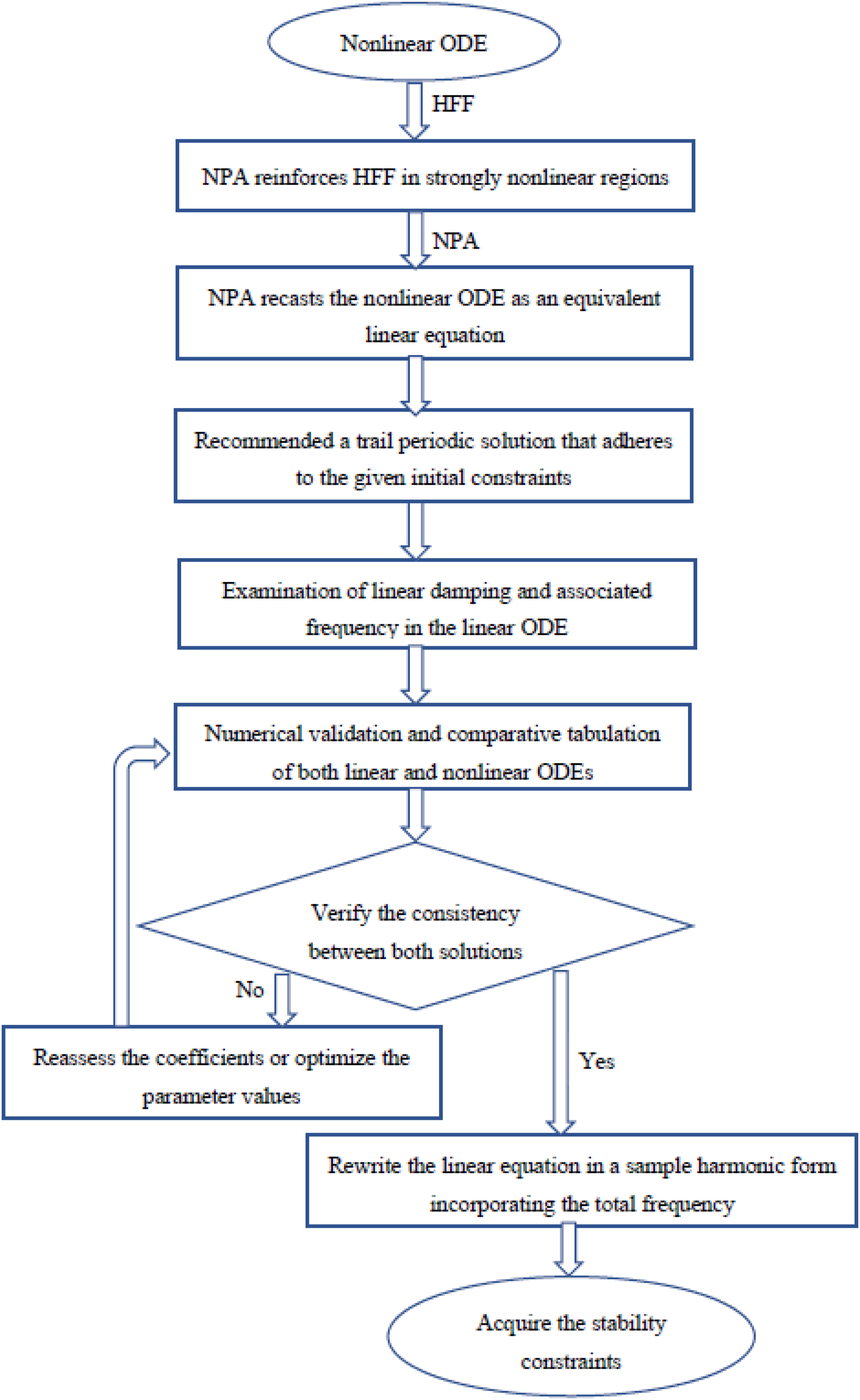
These findings are substantially advance contemporary engineering and high-tech gadget design via improved predictive modeling and experimental validation. To clarify the presentation of the current work, its remainder is divided into five sections that aid in making its presentation more understandable. In
Applications
The purpose of this section is to analyze some examples of highly nonlinear oscillators using the NPA that was previously described.24–42
Example 1
The issue of a rotary oscillator with linear and nonlinear torsional springs and dampers entails examining the dynamic behavior of a rotating system influenced by restorative and dissipative forces. The system comprises a stiff rotor undergoing angular displacement due to a torsional spring and damper. The spring demonstrates linear stiffness, which is proportional to displacement, as well as nonlinear stiffness, incorporating higher-order factors. The damping mechanism comprises linear viscous damping and nonlinear damping elements that are contingent upon higher powers of angular velocity. The governing equation of motion, a second-order nonlinear ODE, summarizes the interaction of inertial, restoring, and damping forces. The analysis emphasizes the characterization of the system’s stability, its response to external excitations, and the impact of nonlinearity on phenomena including resonance, bifurcations, and possible chaotic behavior. It is believed that a rotary oscillator with linear and nonlinear torsional springs and dampers is shown in Figure 2. The form of the ruling ODE is as follows43,44: Displays the nonlinear torsional springs and dampers, along with the rotary oscillator, are divided into four categories: 1 linear, 2 nonlinear, 3 linear, and 4 linear damper.
44


We apply the ICs to equation (1) as follows:

In accordance of the previous description of the NPA, for more convenience, equation (1) could be rewritten as follows:24–42



Herein the ICs are given as follows:
The parameter
A NPA aims to addressing physical problems, commonly employed in quantum mechanics, field theory, or nonlinear dynamics, and utilizes a trial solution that posits an assumed functional form of the unknown quantity (such as a wave function, field, or trajectory), integrating essential symmetries, and qualitative behavior of the system without dependence on small-parameter expansions. Rather than considering interactions as minor adjustments, the trial solution is immediately incorporated into the governing equations (or an action/principle) to derive self-consistent, precise, or variational equations of its parameters. This is important as it effectively captures strongly coupled or nonlinear effects that perturbative series cannot express, enabling the description of phenomena such as solitons, instantons, or bound states arising from the whole, nonlinear structure of the theory.
One such formulation for the necessary linear ODE is as follows:

Following the previous outcomes,24–42 one gets

In the NPA, the equivalent frequency denotes the effective oscillation frequency that arises from the complete nonlinear dynamics of a system, as opposed to a linearized or weak-coupling approximation. It physically illustrates how the system “vibrates” or progresses when all higher-order interactions and strong couplings are incorporated, often achieved by solving self-consistent equations derived from a trial solution. The equivalent frequency is important as it accounts for amplitude-dependent shifts and nonlinear effects, such as those found in enharmonic oscillators or highly linked quantum systems, where the actual oscillation rate diverges from the simplistic linear frequency. Consequently, it offers profound understanding of genuine dynamical behavior and facilitates precise predictions in domains where the traditional perturbation techniques fail.
Concerning to the non-secular quadratic term, one finds:

The standard normal form of the linear NPA approach yields the following total frequency:

It follows that the standard stability criterion requires:

To make things easier, the MS can be used to match the original ODE with the corresponding linear ODE for the selected sample system:
To evaluate the accuracy of the NPA, the obtained solutions are compared with those derived from the MAGM
44
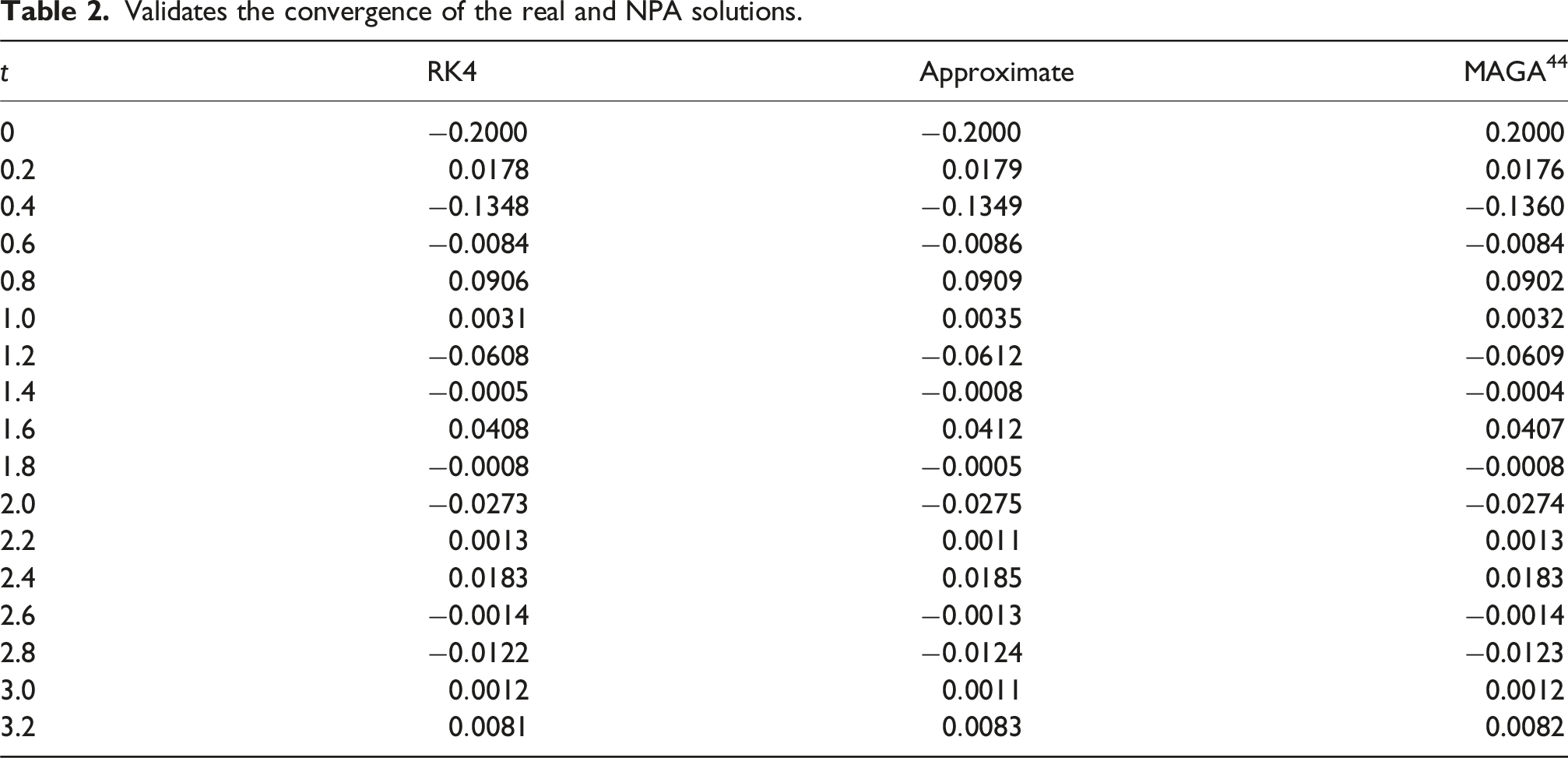
and the well-established fourth-order Runge-Kutta (RK4) method, a robust numerical technique. It is clear from Figure 3 that the numerical solution (NS) works well for this initial value problem. The results obtained in Table 1 are clearly showed that the NS outperformed the MAGM compared to the numerical solutions. Shows solutions of application 1 obtained by the NPA, MAGM, and RK4 for Validates the convergence of the real and NPA solutions.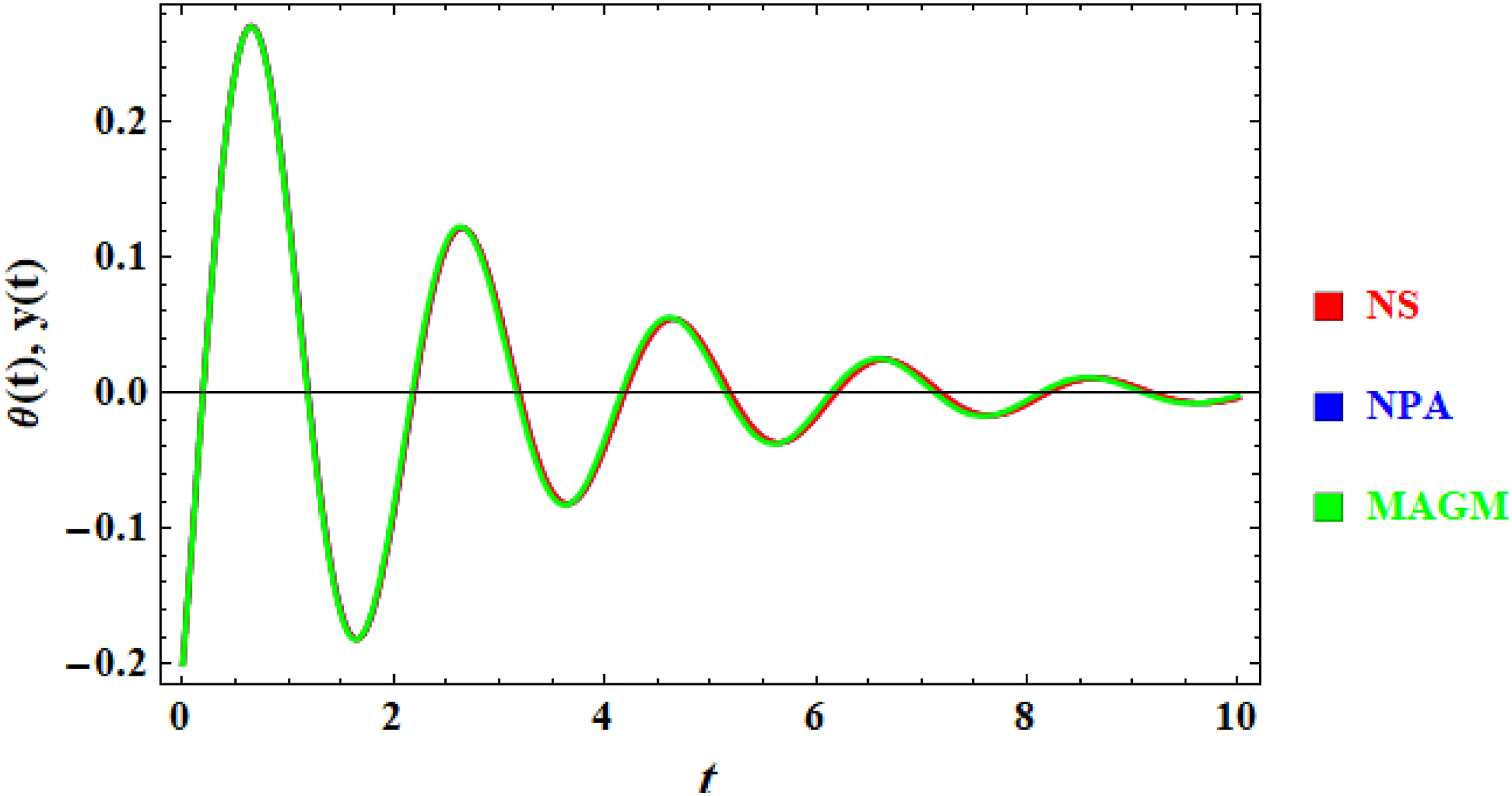
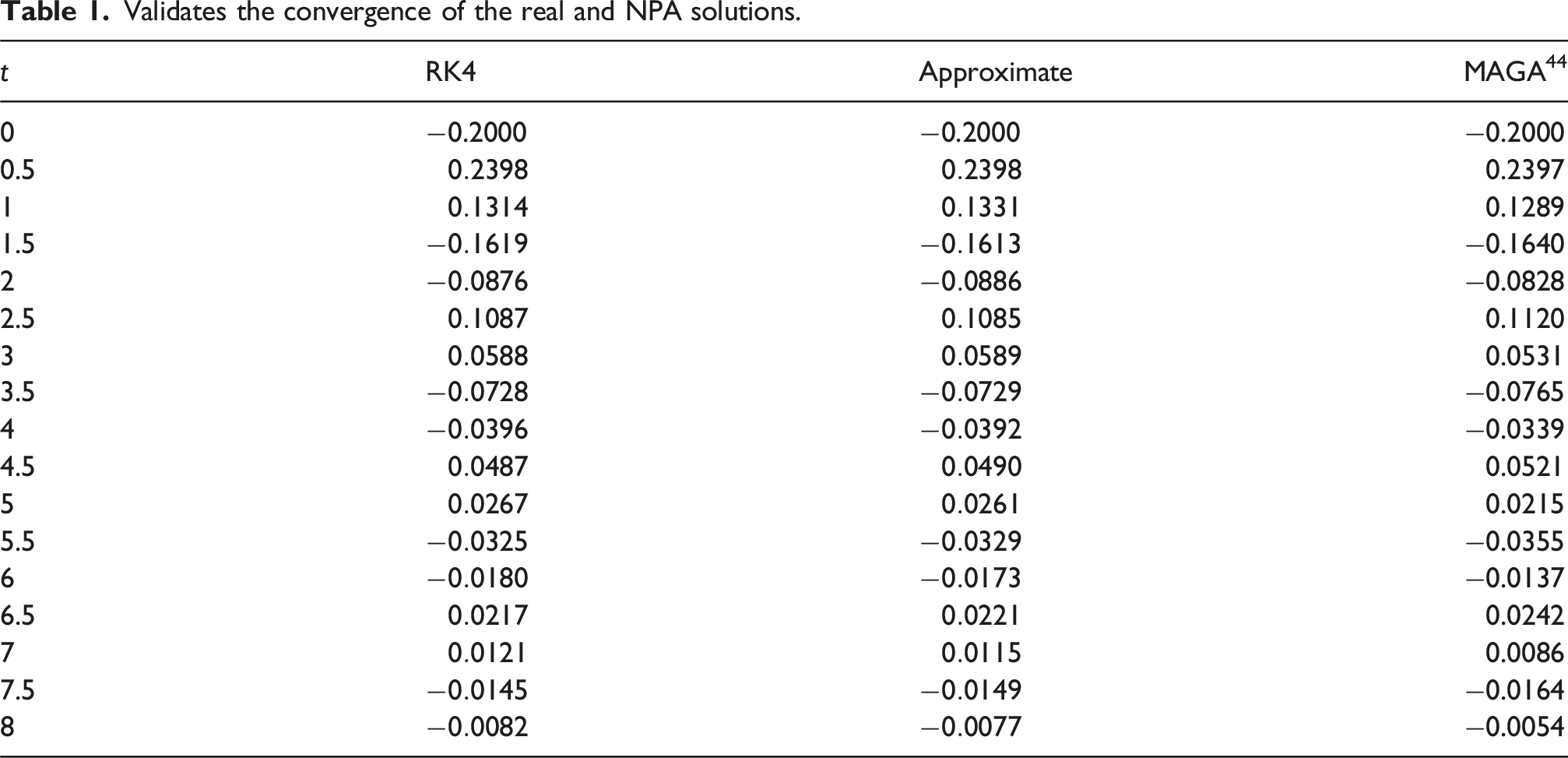
Optimal correspondence between the two planar curves, one depicting a linear ODE and the other a nonlinear counterpart, transpires when their solutions have analogous behavior or coincide within a designated domain. This may occur because of the fundamental dynamics of systems exhibiting shared characteristics, such as symmetry, ICs, or parameter regimes that diminish the significance of nonlinearities. In specific instances, a nonlinear ODE can be approximated to a linear one at equilibrium points or under minor perturbations, resulting in analogous trajectories or graphical representations. This matching is essential in streamlining intricate systems while preserving critical attributes for analysis or forecasting.
For more convenience, as benefits of NPA, the stability profile of the previous equation (1) can be represented in Figure 4. This is done by utilizing the total frequency as given by equation (9). For simplicity, the following figure is sketched to display the influence of the parameter Displays the stability profile of equation (1), with variation of the parameter 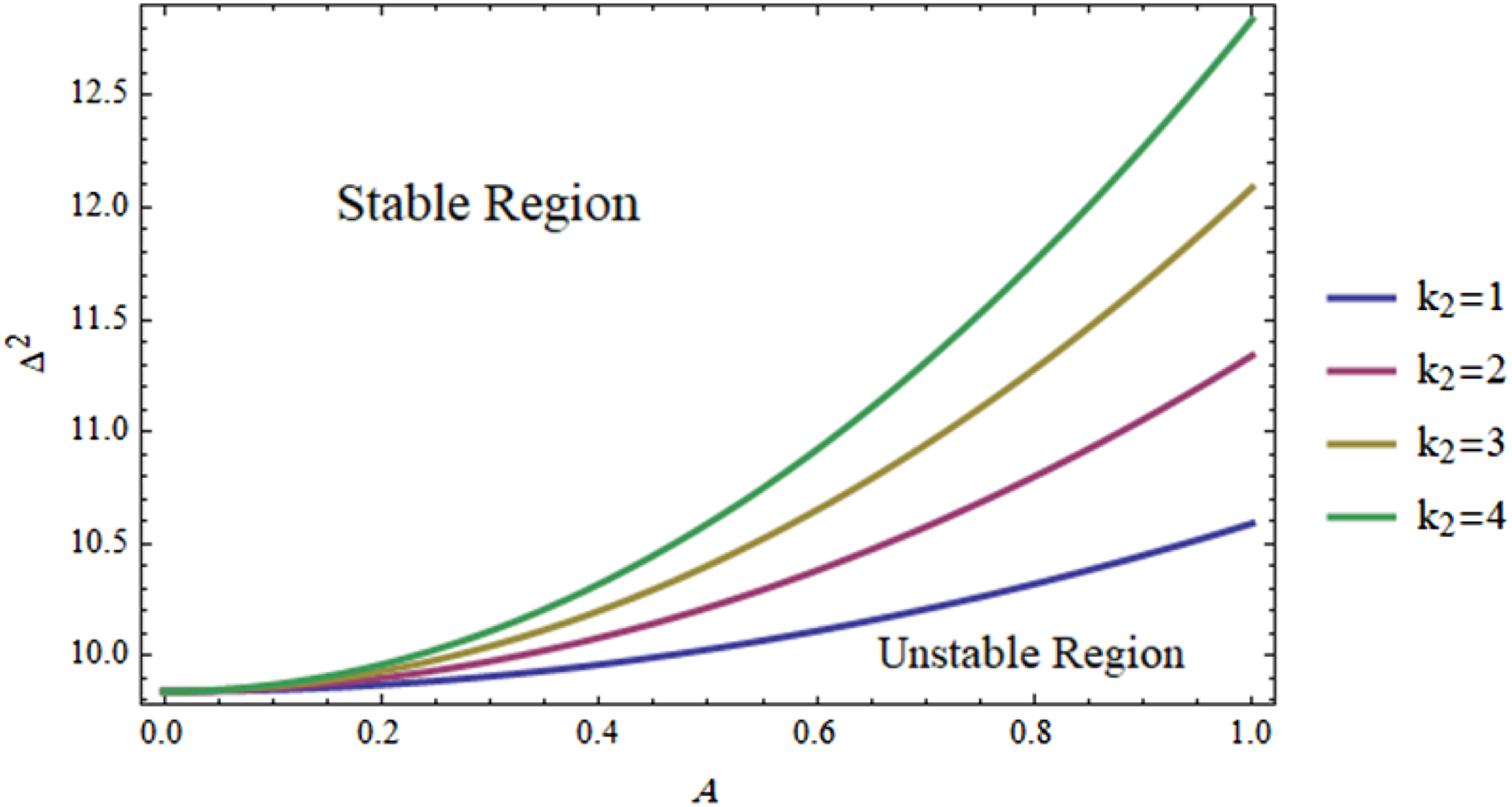
In equation (1), the parameter
Example 2
The issue of nonlinear vibrational analysis of beams entails ascertaining the dynamic response of beam structures under external excitations, while considering geometric and material nonlinearities. In contrast to linear vibration issues, where the response correlates directly with the excitation, nonlinear systems display complications including amplitude-dependent natural frequencies, mode coupling, and possible occurrences of bifurcations or chaotic behavior. The governing equations are generally derived from the Euler-Bernoulli or Timoshenko beam theories, adjusted to incorporate nonlinear factors resulting from significant deformations, material stress-strain correlations, or boundary conditions. Addressing this issue necessitates sophisticated numerical or analytical approaches, including the finite element method, perturbation techniques, or direct time integration, to precisely represent the nonlinear dynamic behavior essential in engineering fields such as aerospace, civil, and mechanical systems. In the mechanical and manufacturing processes, the nonlinear vibrational analysis of beams employed by steel frameworks is especially crucial. Understanding how a beam vibrates in its transverse mode, which gives the system’s inherent frequency, is crucial to designing beam structures correctly. As previously shown,4,44 the traversal vibrations of a beam described by following nonlinear ODE:
We apply the ICs to equation (11) as follows:
According to the above explanation of the NPA, equation (11) might be translated as follows for ease of use:

Following Moatimid et al.24–42 to achieve the target. It should be noted that the form that follows can be used to indicate the estimating response for the provided ODE:
Herein the ICs are assumed as:
The parameter
The following is one way to formulate the following linear ODE:
By means of the MS, one obtains

The standard normal form of the linear NPA yields the following total frequency:
It follows that the standard stability criterion requires:
To make things easier, the MS can be used to match the original ODE as given in equation (11) with the corresponding linear ODE as shown in equation (16) for the selected sample system:
Validates the convergence of the real and NPA solutions.
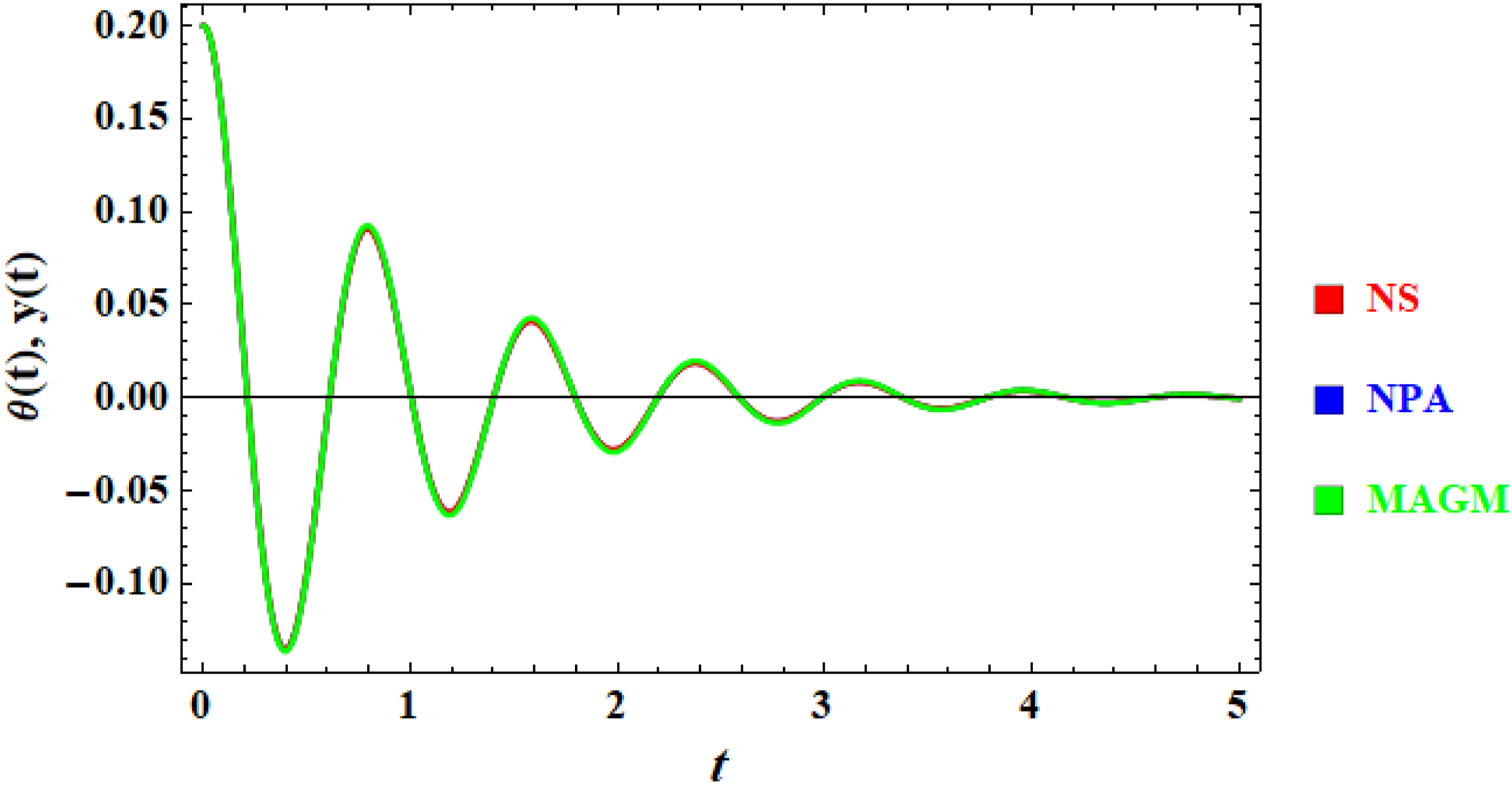
Solutions of application 2 obtained by the NPA, MAGM, and RK4 for the following data:
The optimal correspondence between two planar curves, one representing a linear ODE and the other a nonlinear one, occurs when their solutions exhibit similar behavior or coincide within a certain domain. This may arise due to the intrinsic dynamics of systems displaying common traits, such as symmetry, ICs or parameter regimes that reduce the impact of nonlinearities. In many cases, a nonlinear ODE can be approximated by a linear one at equilibrium points or under slight perturbations, yielding similar trajectories or graphical representations. This matching is crucial for optimizing complex systems while maintaining vital characteristics for analysis or prediction.
To enhance convenience, the stability profile of the preceding equation (11) might be depicted as an advantage of NPA. This is accomplished by employing the entire frequency as specified by equation (19). To illustrate the impact of the parameter Exhibitions the stability outline of equation (11), with variation of the parameter 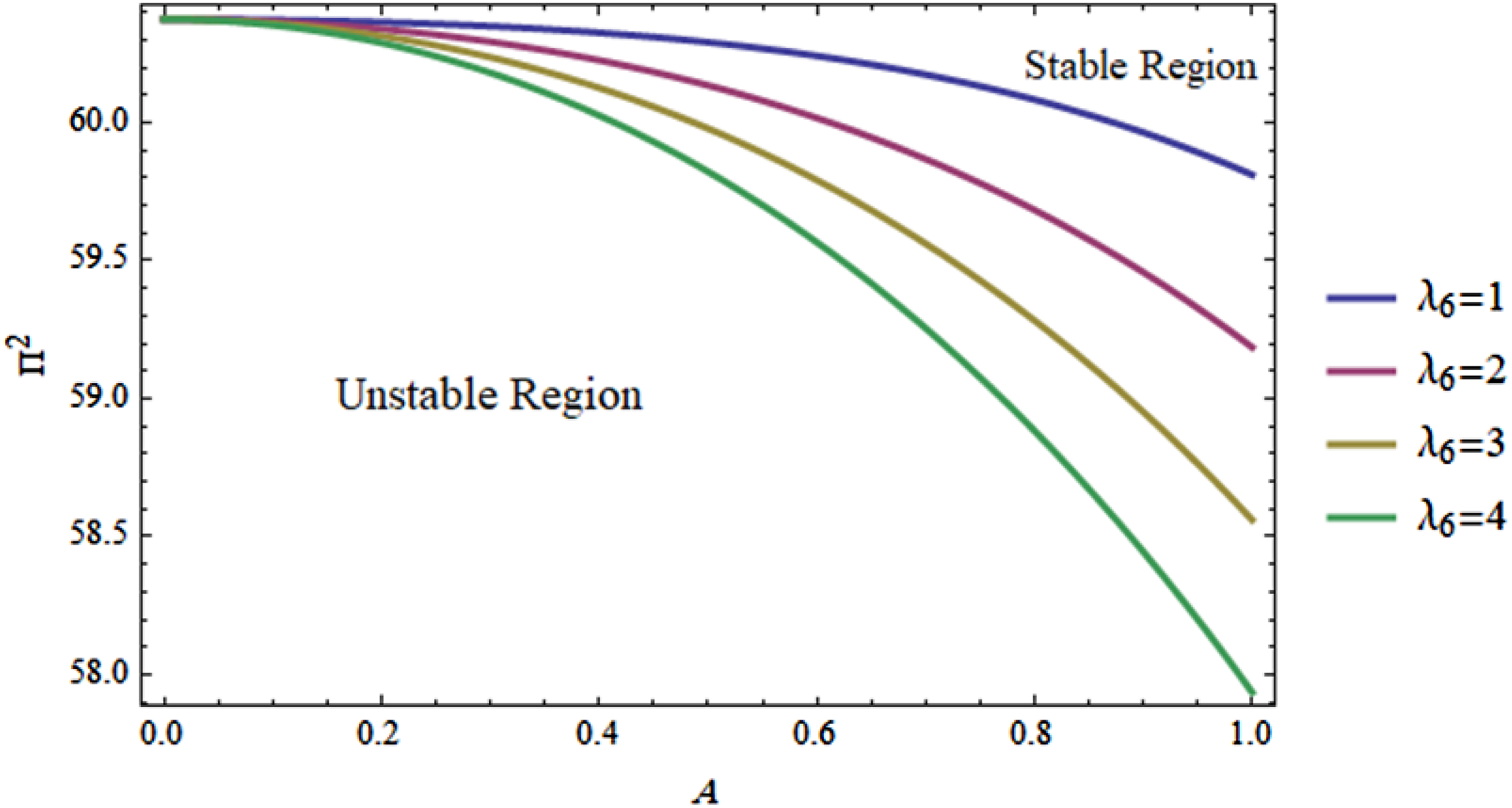
In equation (11), the parameter
Example 3
Nonlinear vibration of an electrostatically actuated micro beam
The issue of a fully clamped microbeam entails examining the mechanical response of a slender, elastic beam secured at both boundaries and exposed to several loading situations. This encompasses comprehending its static and dynamic responses to external forces, electrostatic actuation, or thermal loads, which may result in bending, buckling, or vibrations. The governing equations of motion are formulated based on elasticity theory, commonly represented by the Euler-Bernoulli beam theory or Timoshenko beam theory, and generally constitute a nonlinear ODE owing to geometric nonlinearity or coupled field phenomena such as electromechanical interactions. Resolving this issue necessitates the consideration of BCs that mandate zero displacement and rotation at extremities, presenting difficulties in analytical solutions and requiring numerical or approximation methods for practical applications. In this example, we will consider a fully clamped micro beam. As previously shown,45–49 Figure 7 illustrates the configuration of this beam as follows. Displays a double-sided driven clamped-clamped microbeam-based electromechanical.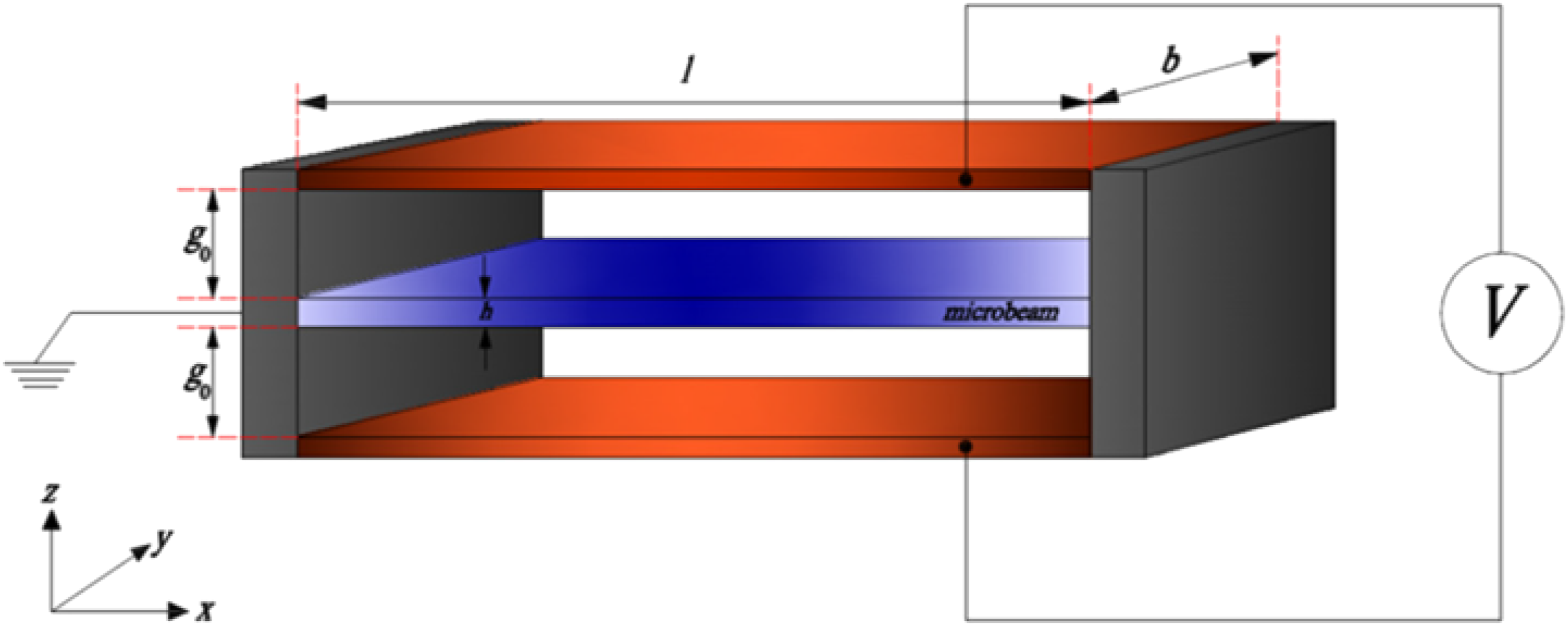
The equation of motion of this beam may be represented as follows:
For more convenience, the above NPA explanation suggests translating equation (21) as follows:

To reach the goal, adhere to Moatimid et al.
42
Note that the estimated output for the given NPA can be indicated using the manner that described as follows:
Herein the ICs are assumed as follows:
The parameter
One approach to creating the necessary linear ODE is as follows:
By means of the MS, one achieves

Therefore, the following are required by the standard stability criterion:
To simplify is significant the MS can be utilized to match the relevant linear ODE for the chosen sample system, as indicated in equation (24) with the original NPA as provided in equation (21).
The ideal correspondence between two planar curves, one depicting a linear ODE and the other a nonlinear one, arises when their responses demonstrate analogous behavior or coincide within a specified domain. This may occur due to the inherent dynamics of systems exhibiting shared characteristics, such as symmetry, ICs, or parameter regimes that mitigate the effects of nonlinearities. In numerous instances, a nonlinear ODE can be approximated by a linear one at equilibrium points or under minor perturbations, resulting in analogous trajectories or graphical representations. This alignment is essential in enhancing intricate systems, while preserving critical attributes for evaluation or forecasting.
From Figure 8, one can observe that the obtained results was verified through a comparison with the RK4 at the amplitude Display the approximate frequencies with the exact frequencies in equation (21).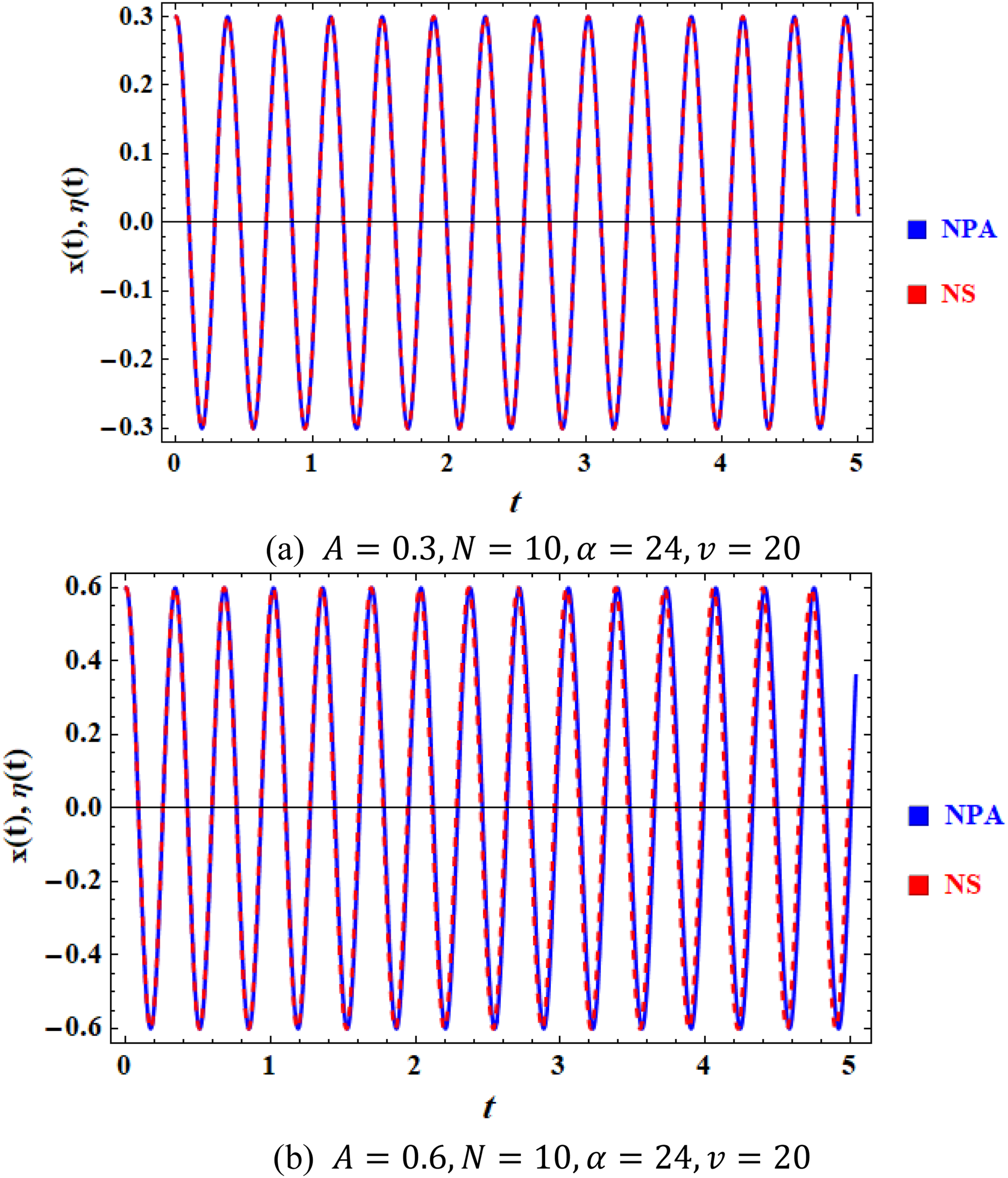
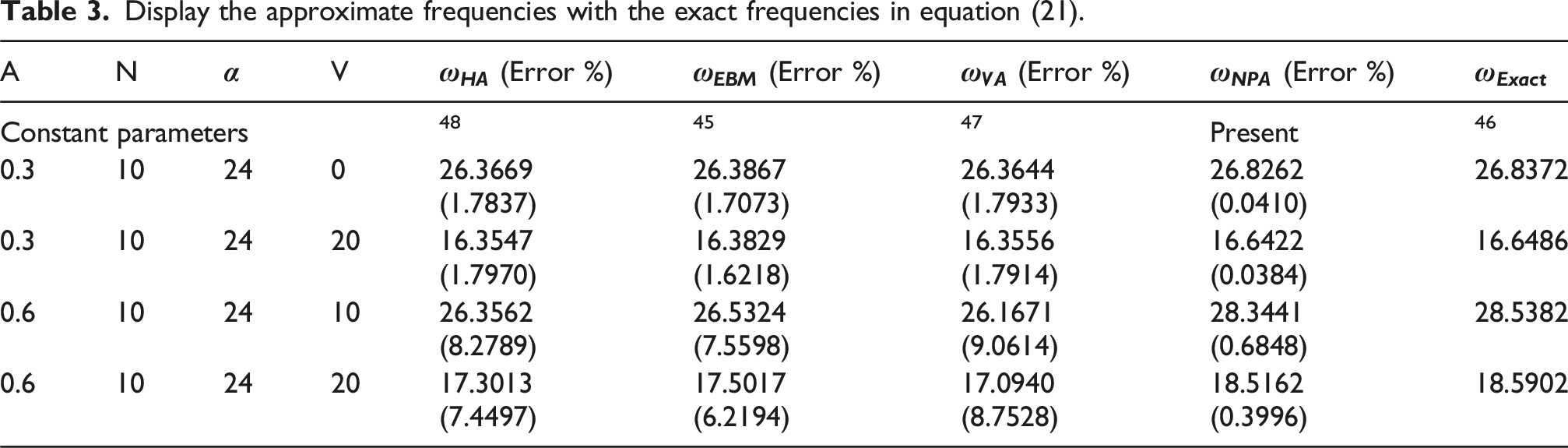
Figure 9 illustrates the behavior of an electrostatically actuated micro beam ( Effect of parameter N on the nonlinear frequency of electrostatically micro beam.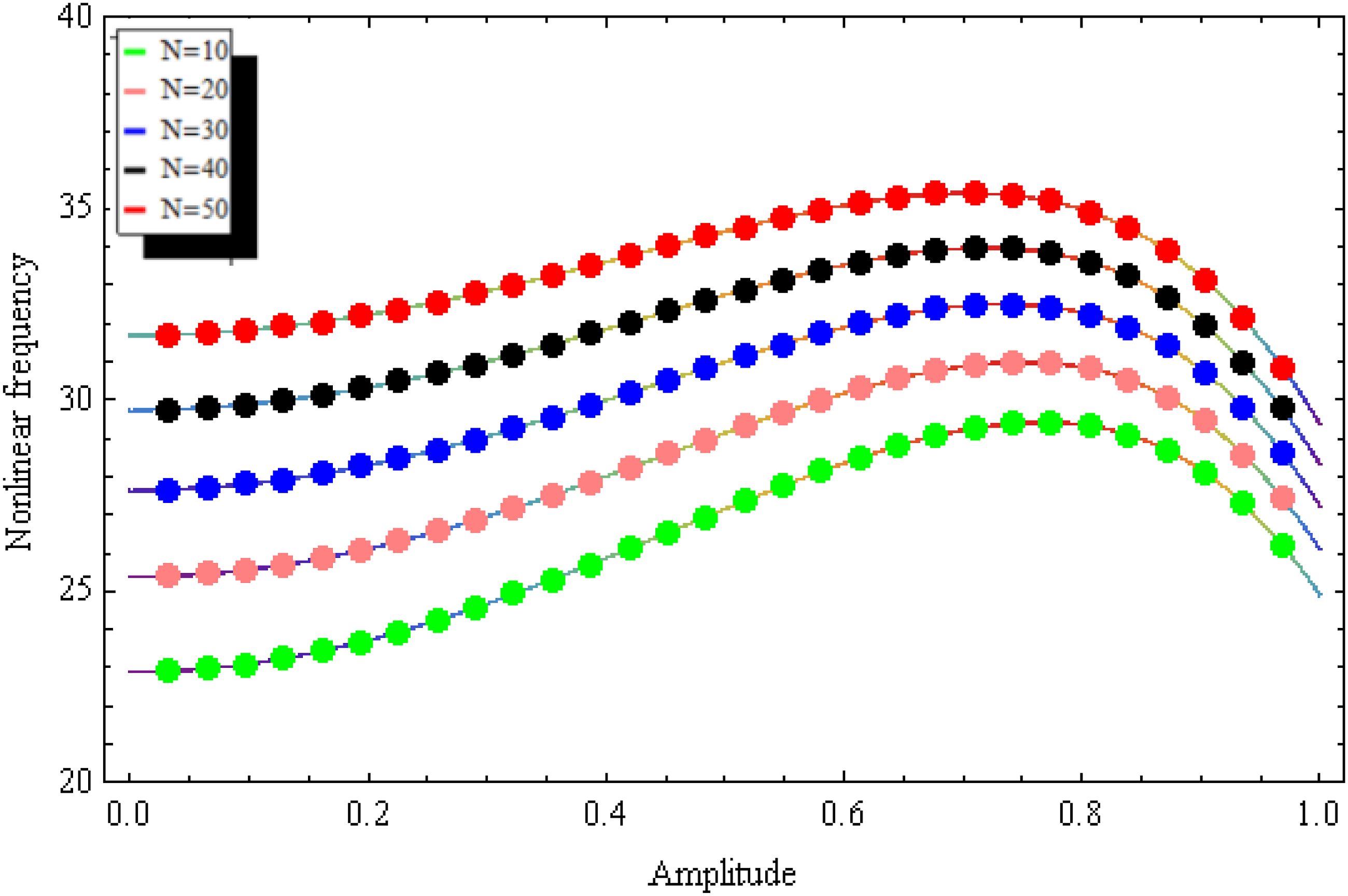
Figure 10 illustrates the influence of the V parameter on the nonlinear frequency of an electrostatically actuated micro beam, plotted against amplitude. Initially, increasing the V parameter leads to a rise in the nonlinear frequency. However, this trend reverses after the amplitude reaches its peak value; further increases in V then result in a decrease in the nonlinear frequency. Effect of parameter V on the nonlinear frequency of electrostatically micro beam.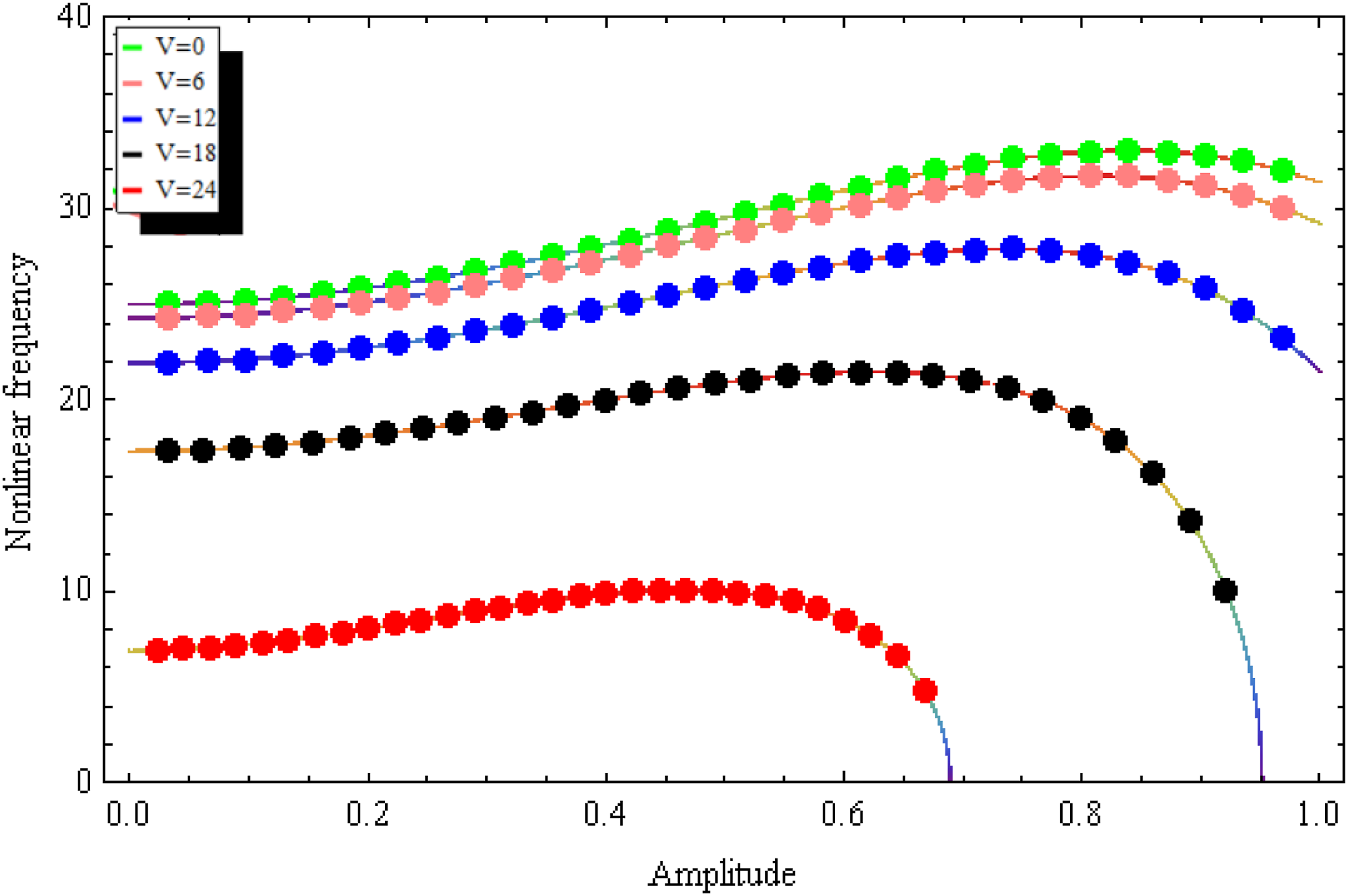
Figure 11 shows the effect of the parameter Effect of parameter 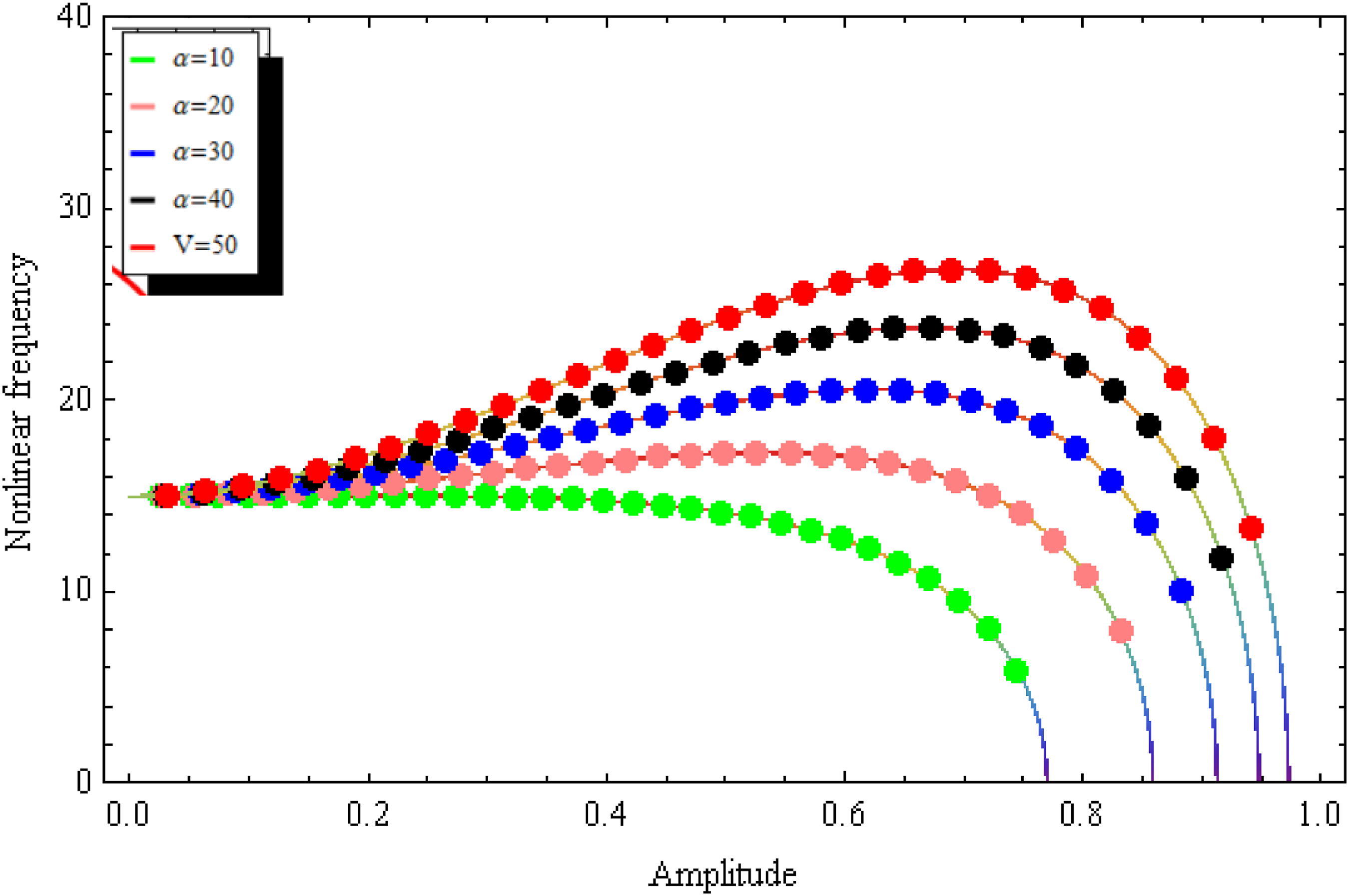
Example 4
Frequency of the doubly clamped beam type N/MEMS
In the realm of N/MEMS (Nano/Micro-Electromechanical Systems), the issue of a doubly clamped beam pertains in comprehending and enhancing its mechanical performance under diverse settings. Beams, anchored at both extremities, undergo deformation as a result of forces such as electrostatic, thermal, or piezoelectric loads. Primary issues involve precisely modeling deflection, stress distribution, and resonance frequency while considering nanoscale phenomena such as surface tension, Casimir forces, and material nonlinearities. This issue is crucial for the design of sensors, actuators, and resonators, as the interaction among structural mechanics, material characteristics, and external stimuli influences the performance, dependability, and scalability of the devices. Figure 12 depicts the structure of a doubly clamped beam category N/MEMS impacted by van der Waals
50
attraction. In this schematic, It shows an illustration of a nano- or microbeam that is electrically operated and affected by the Van der Waals force.
43
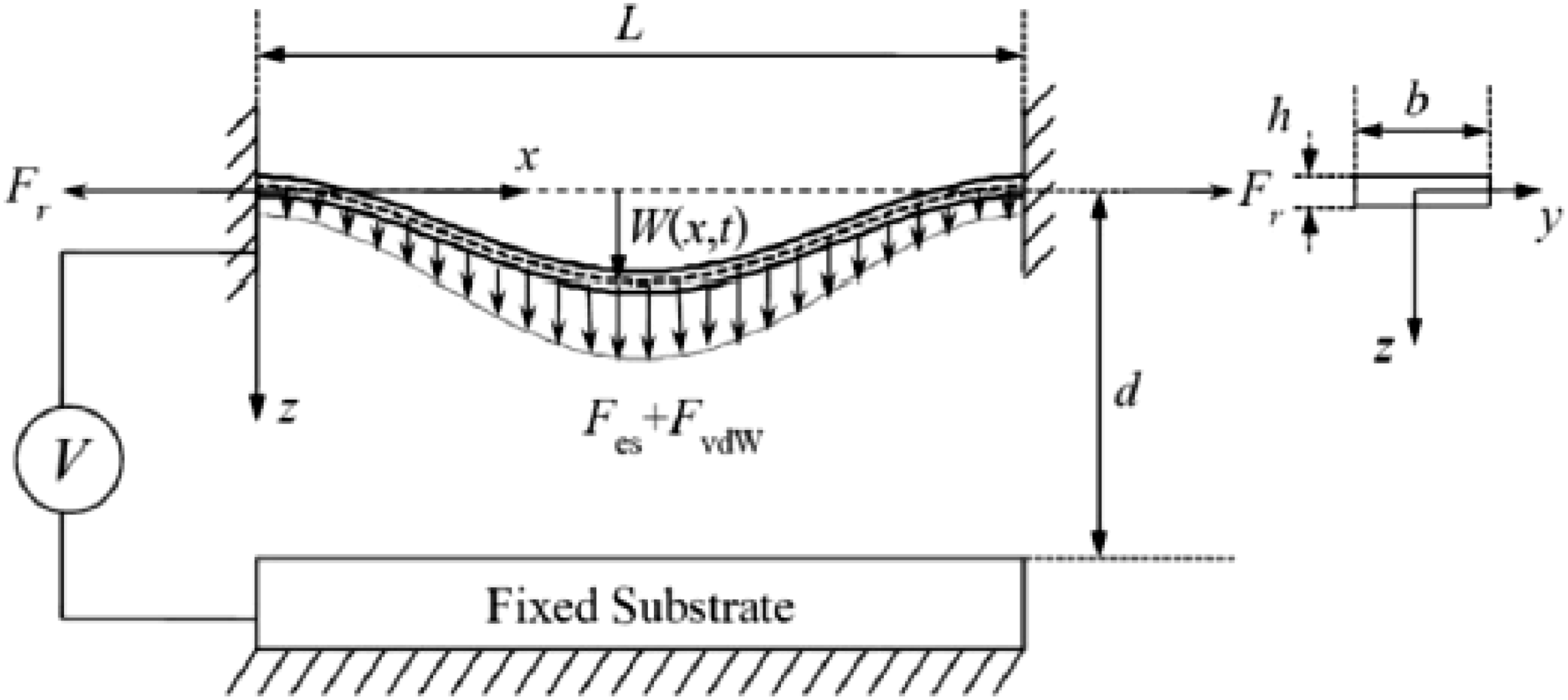
This structure’s equation of motion can be shown as follows:
Rewrite equation (29) to be

The NPA description that described above advises interpreting equation (29) this way for greater convenience:
The NPA description above advises interpreting equation (30) this way for greater convenience:

As seen from equation (31), the first odd function that produce secular terms. Additionally, the second function addresses even function which did not produce secular terms.
Following Moatimid et al.19–29 to achieve the objective. Keep in mind that the following method aims to represent the predicted result for the provided NPA:
Here the ICs are expected as:
The parameter
The following method purposes for generating the required linear ODE:
Because of the original equation (31) has not any damping terms, equation (33) is written. Using the same preceding, one can obtain

As previously shown in the description of the NPA, the quadratic terms that did not produce the secular terms are provided by the direct substitution to give the following expression:
Accordingly, the fundamental stability requirement demands the following:
For more convenience, the nonlinear ODE as given in equation (39) is plotted in corresponding with its comparable linear ODE as stated in equation (33) for a sample chosen system as given in Figure 13 as follows.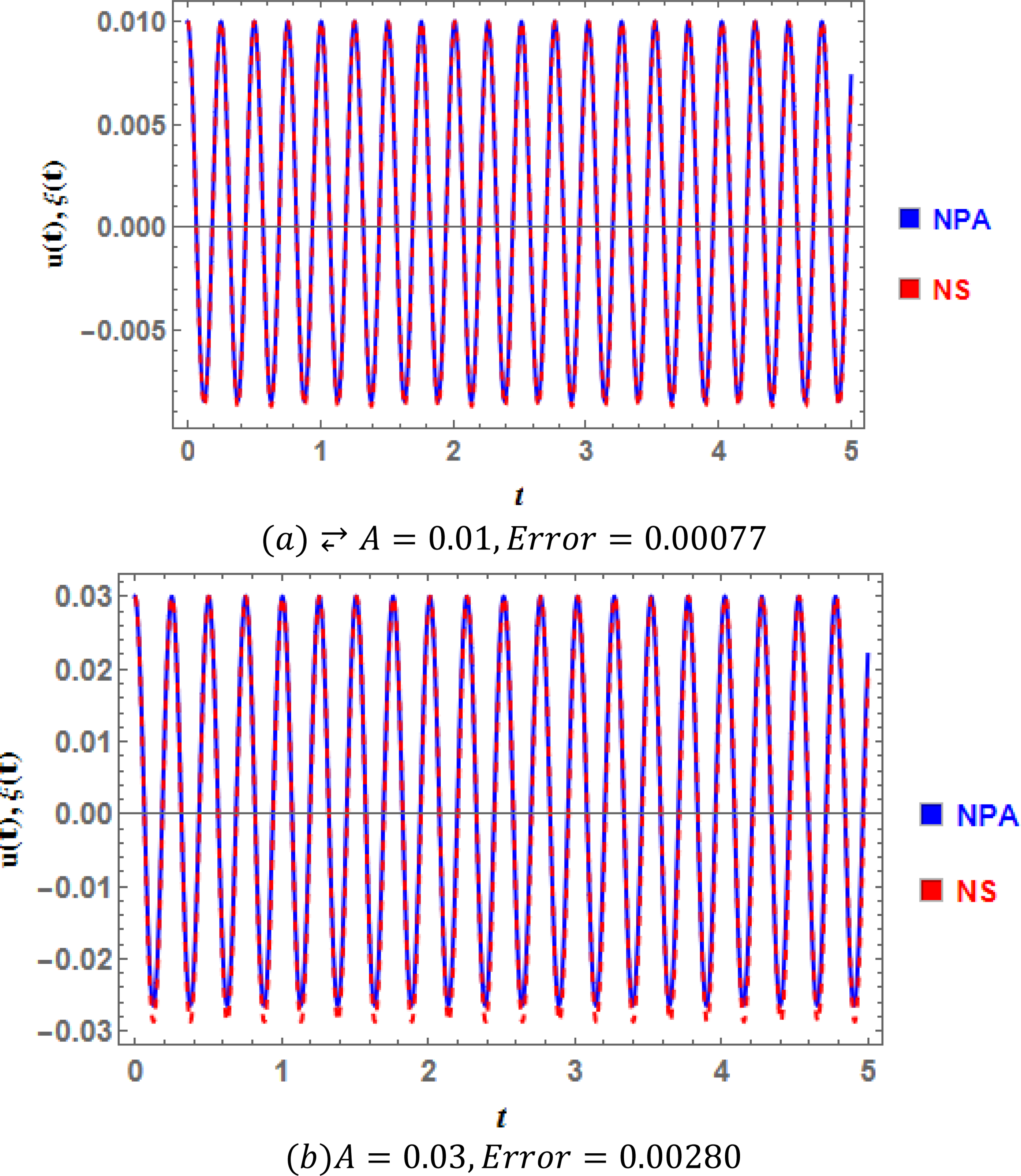
The NS came to the conclusion that the two solutions have an absolute error of 0.00077 at
Example 5
Nonlinear simple pendulum
Example describes the motion of a simple pendulum without damping or external forcing, where:
Equation (38) is the nonlinear equation of motion of a simple pendulum without damping or driving forces, where
In light of the NPA, equation (38) can be written as follows:
As in examples (1–4), assuming a predicting solution, where the guessing solution is given by
The equivalent frequency may be determined from the following integration:
Utilizing the MS, equation (41) results in
The equivalent linear differential equation is then given as follows:
Figure 14 shows that the absolute error between the two solutions is 0.00139526. Matching between the two solutions of NPA and numerical solution of equation (38).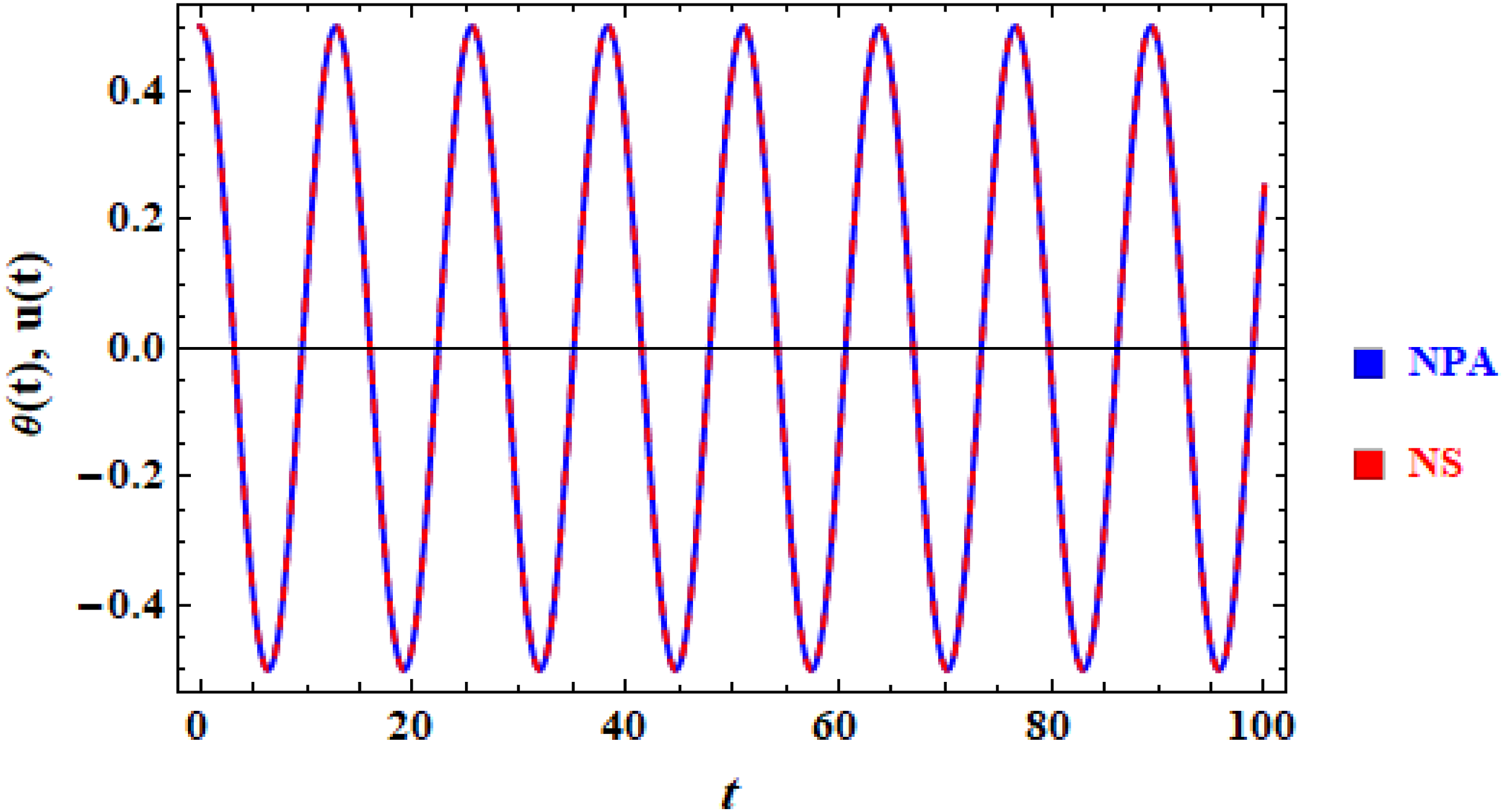
The stability profile of the preceding equation (38) may be presented in Figure 15 as a benefit of NPA to improve convenience. This is achieved by utilizing the total frequency as delineated by equation (42). The following figure demonstrates the effect of the parameter in conjunction with the previously mentioned parameters. Exhibitions the stability outline of equation (38), with variation of the parameter 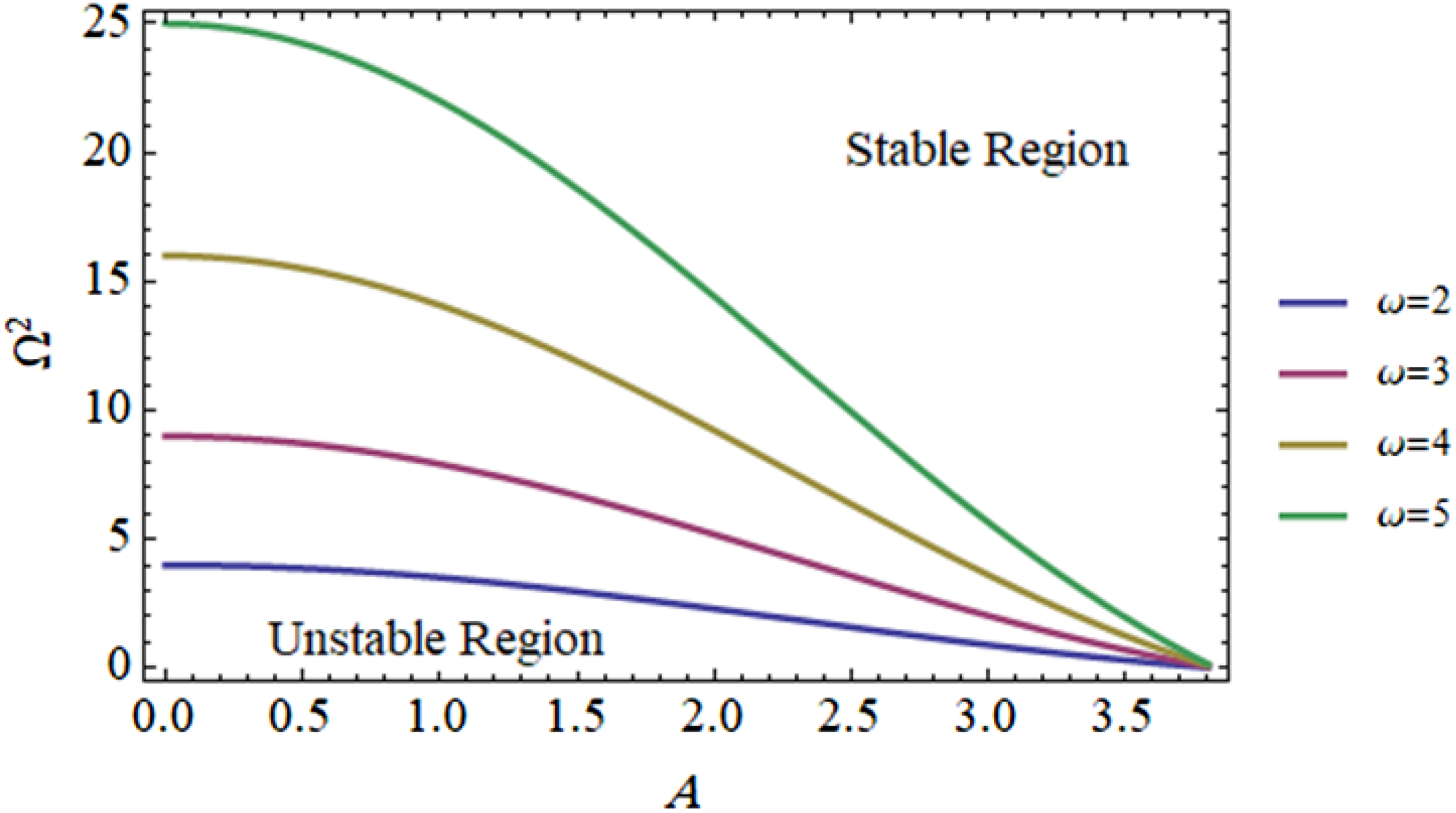
In the equation
Results and discussion
Beams are an integral component of construction because they are utilized extensively in the manufacturing of metal for a variety of industrial purposes, such as construction, bridges, aircraft arms, aerospace automobiles, and other structures. This objective is to analyze the HFF in order to realize the analytical justifications for different kinds of oscillators that are exceedingly nonlinear. We theoretically and computationally examine the connection between elastic forces and the solution of a particular class of oscillators with significant nonlinear damping. We took five instances of beams from various scientific and technological domains. The results clearly demonstrate that the proposed approach offers significant advantages over traditional perturbation methods, particularly in terms of ease of implementation and computational efficiency. As evidenced by the data presented in Tables 1–3 and Figures 3, 5, 8, 13, and 14, the analytical frequency approximations obtained using the new method show excellent agreement with the NSs, confirming its accuracy and reliability. These findings highlight the robustness of the method in capturing the essential nonlinear dynamics with minimal computational effort. Furthermore, the simplicity and generality of the proposed NPA suggest that it can be effectively extended to a wide range of nonlinear ODEs commonly encountered in engineering and physics applications. 13
Concluding remarks
In the previous study, the NPA was introduced and applied, as an efficient method to analyze various kinds of nonlinear ODEs. This procedure produced a new frequency that, like simple harmonic situation, is similar to a linear ODE. This straightforward methodology yielded results that not only match the numerical results well but also turn out to be more accurate than the results obtained in several popular approximation methodologies, when tested in physiologically meaningful expert examples. A numerical comparison with the MS validated the theoretical results. Both the theory’s and the NPA findings were highly compatible. It was well known that all conventional perturbation methods simplified the existing situation by enlarging the restoring forces where they exist by the application of Taylor expansion. This susceptibility is irresponsible, when the NPA is used. Furthermore, the NPA makes it possible to properly investigate the stability analysis of the concerns, something that was not possible with earlier standard methodologies. The NPA offers a valuable framework in science, technology, and applied research for analyzing approximations of strongly nonlinear oscillators in microstructures. Its flexibility makes it well-suited to handle a wide range of nonlinear scenarios. Future investigations should focus on refining the initial methodology or highlighting the most significant outcomes. (1) Through the designated method, a nonlinear ODE was successfully reduced to an equivalent linear equation. (2) A strong connection existed between these two equations. (3) Conventional methods used Taylor expansions to address restoring forces, but this dependency is eliminated by the NPA. (4) The present methodology, in contrast to previous traditional approaches, enabled us to perform a stability analysis of the issue. (5) In conclusion, the proposed technique presents itself as a simple, efficient, and appealing tool for analyzing various types of nonlinear oscillatory systems.
In the subsequent works, we want to examine the state spaces of multi-degree systems based on the following attributes. (i) The concept of multiple degrees of freedom in fundamental pendulums expands their traditional one-degree-of-freedom motion to intricate systems where numerous interconnected pendulums operate either autonomously or interactively. (ii) This markedly enhances their physical behavior, facilitating the characterization of complex dynamical systems found in both natural and artificial settings. (iii) Multi-degree-of-freedom pendulum systems are crucial in analyzing coupled oscillations, wave propagation phenomena, and energy transfer mechanisms, with wide-ranging applications in mechanical and civil engineering, robotics, and seismology. (iv) Understanding their dynamic behavior can contribute to improved vibration control in structures, optimized design of coupled oscillatory mechanisms in machinery, and the development of advanced robotic systems with flexible joints. (v) Furthermore, these systems provide tractable approximations of more intricate processes, such as vibrational modes in molecular systems and the nonlinear behavior characteristic of chaotic physical systems.
Analyzing the degrees of freedom allows researchers to gain insights into resonance, stability, and energy distribution, establishing multi-degree-of-freedom pendulums as vital tools in exploring nonlinear dynamics and developing innovative engineering solutions.
Footnotes

Funding
The authors received no financial support for the research, authorship, and/or publication of this article.
Declaration of conflicting interests
The authors declared no potential conflicts of interest with respect to the research, authorship, and/or publication of this article.
Appendix
The mathematical expressions for the governing physical parameters