




Abstract
Abstract
This paper focuses on the numerical investigation of a strongly nonlinear oscillator with cubic and harmonic restoring force. We transform this oscillator as a free damped cubic-quintic Duffing oscillator equation by Taylor approximation. The approximated solutions with high accuracy are provided by using the global residue harmonic balance method (GRHBM) without any discretization or restrict assumptions. The sensitive analysis of the approximation or the frequency with respect to the amplitude is considered in detail. Numerical comparisons with Runge–Kutta method and harmonic balance method are given to show the efficiency and stability of GRHBM.
Introduction
Nonlinear oscillations have wide applications in physics, mathematics, mechanics and engineering areas.1–15 Generally, the nonlinear differential equations (NDEs) can be used to model the nonlinear oscillators. Due to the strong nonlinearity of NDEs, the study of accurate approximations has been paid much attention. In the past decades, many perturbation and analytical approaches were proposed for solving NDEs. Traditional perturbation methods are not effective for the strong nonlinear oscillators or NDEs and do not give the approximations with sufficient accuracy. In order to overcome these limitations, some analytical methods were investigated including harmonic balance method,16,17 variational iteration method,18,19 homotopy analysis method,20,21 homotopy perturbation method,22,23 Li–He’s modified homotopy perturbation method, 24 enhanced homotopy perturbation method, 25 asymptotic method,26,27 energy balance method, 28 differential transformation method, 29 parameter expansion method, 30 parameter expansion method, 31 variational principle, 32 frequency-amplitude formulation 33 and so forth.
In this paper, we consider a strongly nonlinear oscillator with cubic and harmonic restoring force
1
Schematic configuration of the nonlinear oscillator (1).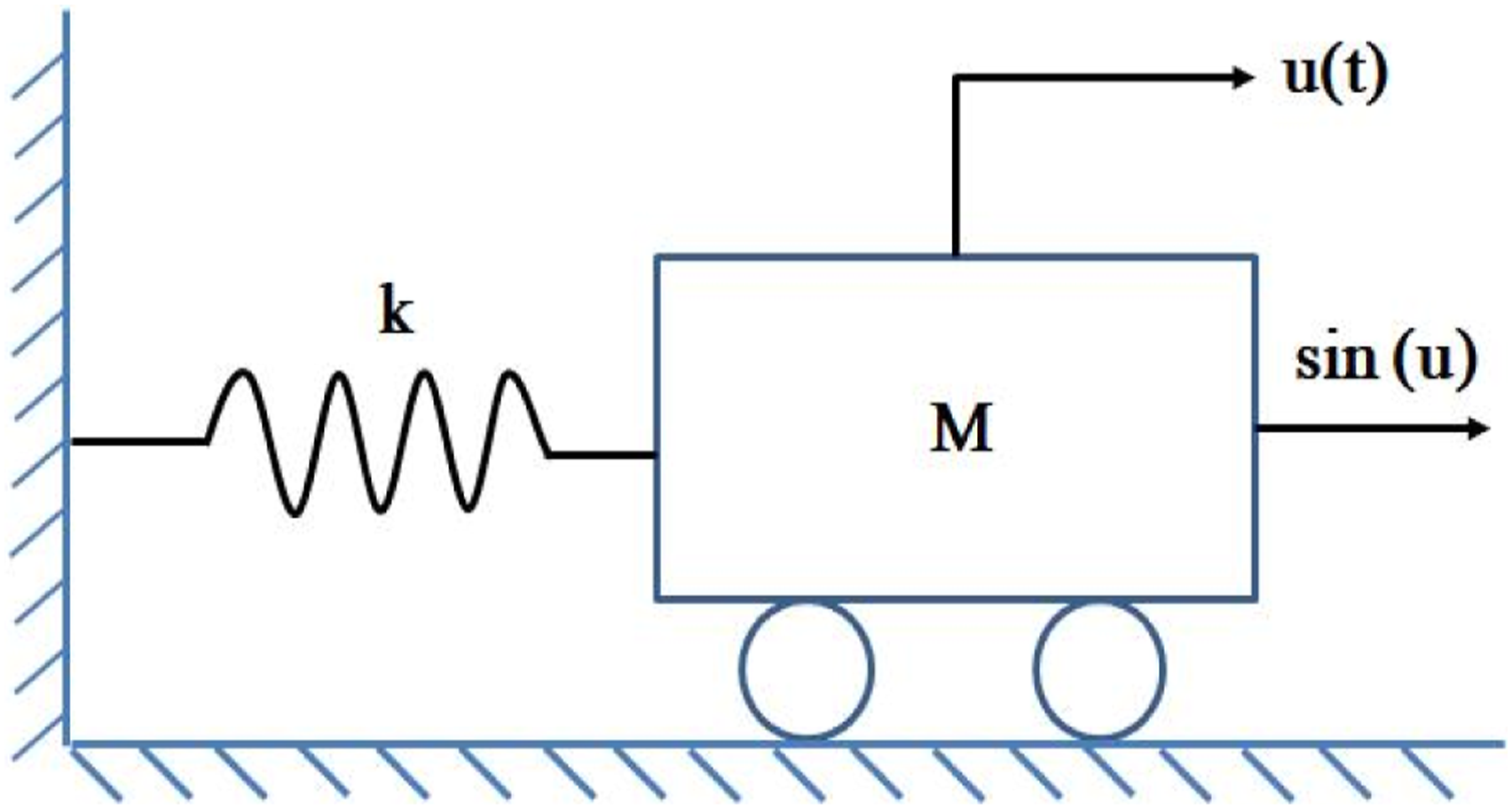


Hosen and Chowdhury proposed an analytical technique based on the harmonic balance method (HBM) for solving this strongly nonlinear oscillator with cubic and harmonic restoring force. 1 A modified energy balance method (MEBM) was proposed for obtaining the higher-order approximations. 34 We remark that MEBM may perform less efficient than HBM in some special cases. El-Dib and Matoog pointed out that the period solution of (1) is available when the coefficients of (1) satisfy some constrained condition. 35 Recently, harmonic balance method proposed by Borges et al. 36 was also applied for solving the nonlinear oscillators.4,16,17 There are some modifications and improvements of HBM, such as modified harmonic balance method, 37 residue harmonic balance method 38 and spreading residue harmonic balance method. 39 In fact, for this strongly nonlinear oscillator (1), the accuracy of the HBM solution in Hosen and Chowdhury (2015) 1 may deteriorate with the increase of the amplitude or the time. The motivation of this paper lies in that an approximation with high accuracy will be helpful for understanding the vibration behaviour of this nonlinear oscillator. For this purpose, we will consider an analytical approach based on the global residue harmonic balance method (GRHBM) and the Taylor approximation. The GRHBM is an approximation method combined the ideas of the residue harmonic balance method and the homotopy perturbation technology. Different with HBM and MEBM, the residual part can be used to modify the previous approximations of the nonlinear equations. Due to the efficiency of GRHBM, it has been applied to various kinds of the strongly nonlinear oscillators and nonlinear systems arising from mechanics and engineering areas.3,40–44 Together with GRHBM and Taylor approximation, an efficient technique can be proposed for solving the oscillator (1). By applying the Taylor approximation of the nonlinear term sin(u), we first obtain a free damped cubic-quintic Duffing oscillator equation.45,46 Then the approximations with high accuracy are given with the help of GRHBM without any discretization. For illustrating the effectiveness of GRHBM, an example resulting from the initial value problem of (1) is discussed in detail. We further consider the sensitive analysis of the approximated solution or the frequency about different amplitude A. Numerical comparisons with Runge–Kutta method (RK) and the harmonic balance method are provided. Finally, some conclusions are given.
Analysis of the strongly nonlinear oscillator (1) by GRHBM
Denote f(u) = u + au3 + b sin(u), the nonlinear system (1) can be simplified as

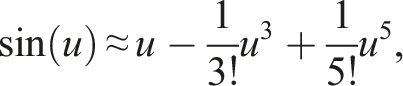

We remark that the above equation can be seen as a free damped cubic-quintic Duffing oscillator equation.45,46
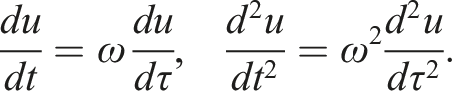
We then consider GRHBM for solving (4). By introducing an auxiliary variable τ = ωt, we have

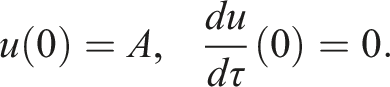
Assume that the initial approximation to (5) is defined by

Substituting u1(τ) into (5) yields that




We next show the construct of the second order approximation to (5). According to GRHBM, the second order approximated solution to (5) can be expressed as

Different with HBM,4,16,17 all the residual errors of the present approximation are used to improve the higher-order approximations in GRHBM. By GRHBM, the nonlinear function F1(τ, ω2, u2) can be formulated by substituting the approximation (8) into (5) and taking the coefficients of p. By combining F1(τ, ω2, u2) with R1(τ), we have the nonlinear system as follows

In order to obtain the unknown parameters in (9), we further equate the coefficients of cos τ and cos 3τ defined by (9) to zero. It follows the nonlinear equations


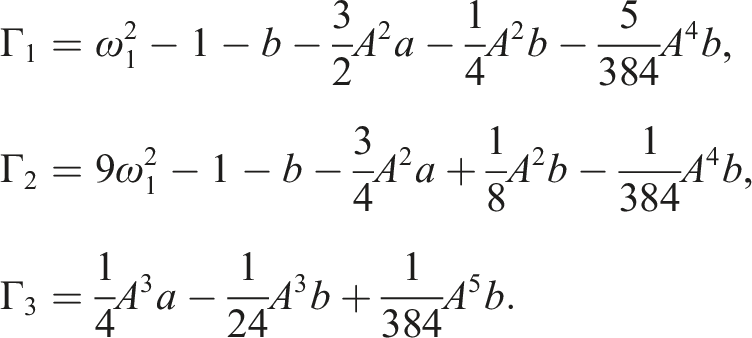
It is easy to obtain λ and ω2 as


Numerical results
In this section, we test an initial value problem associated with (1) to show the effectiveness of GRHBM. We compare it with some existing methods including Runge–Kutta method and harmonic balance method. 1
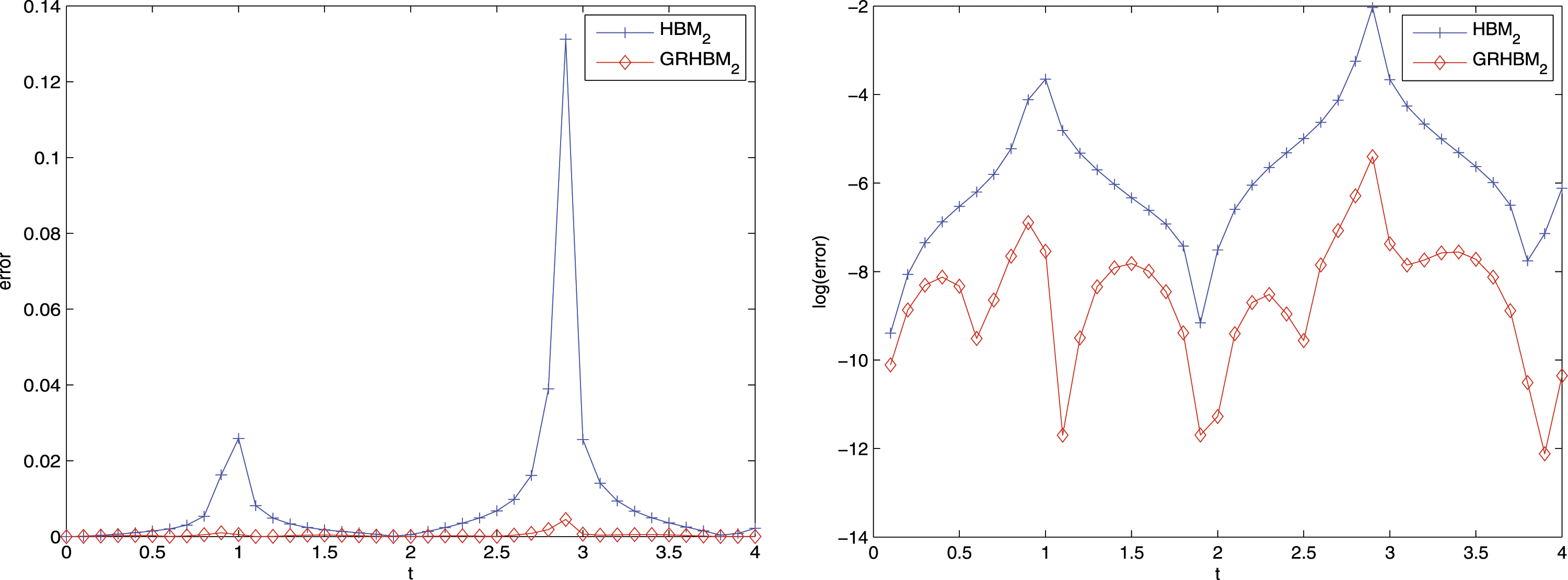
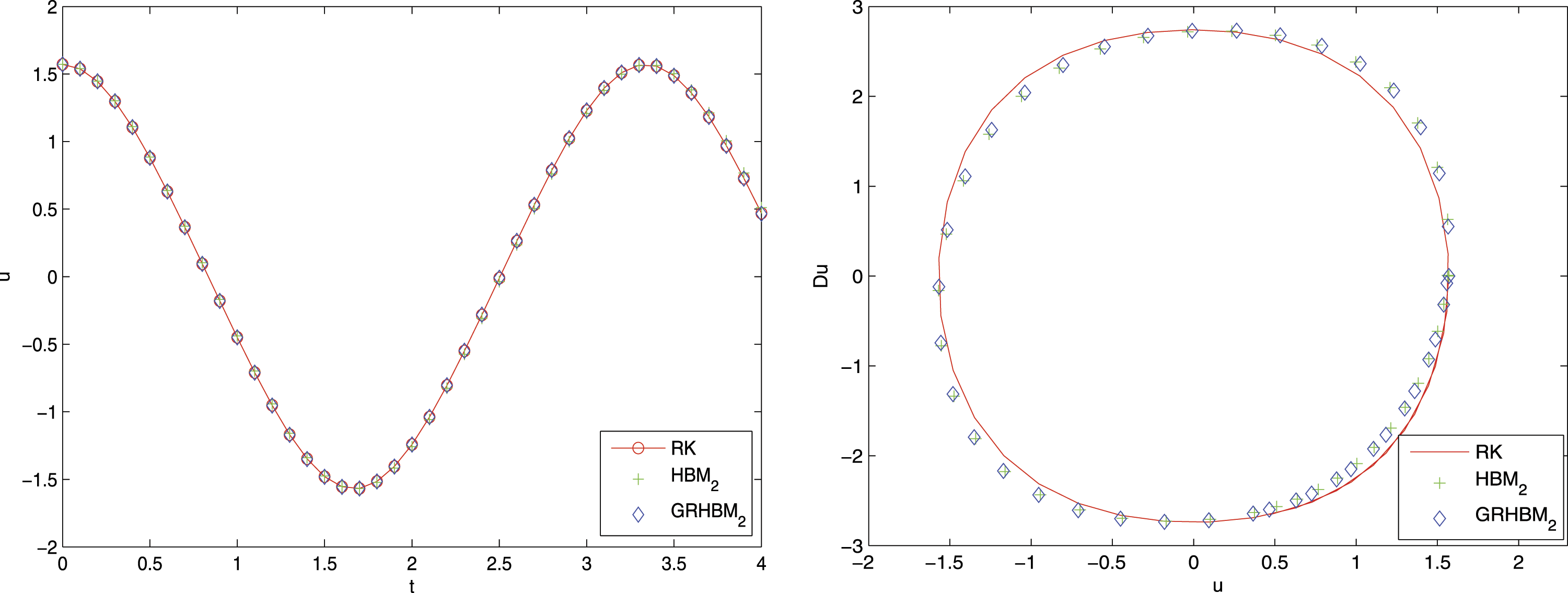
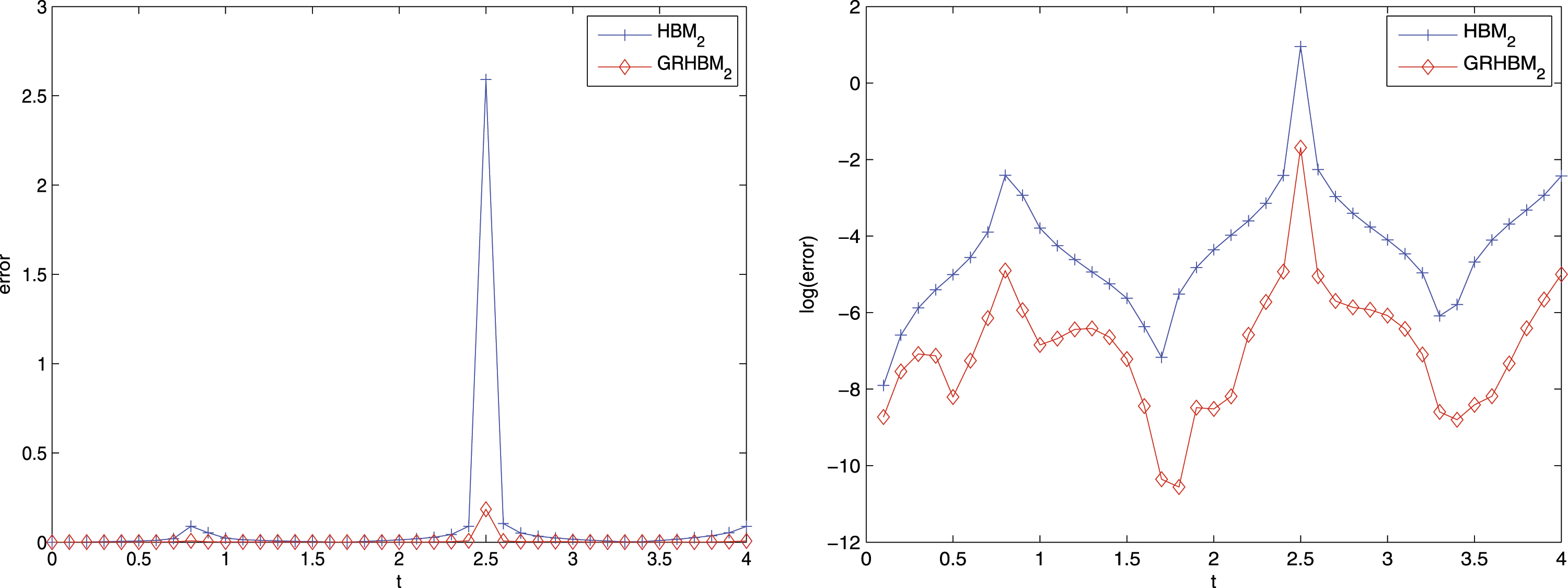
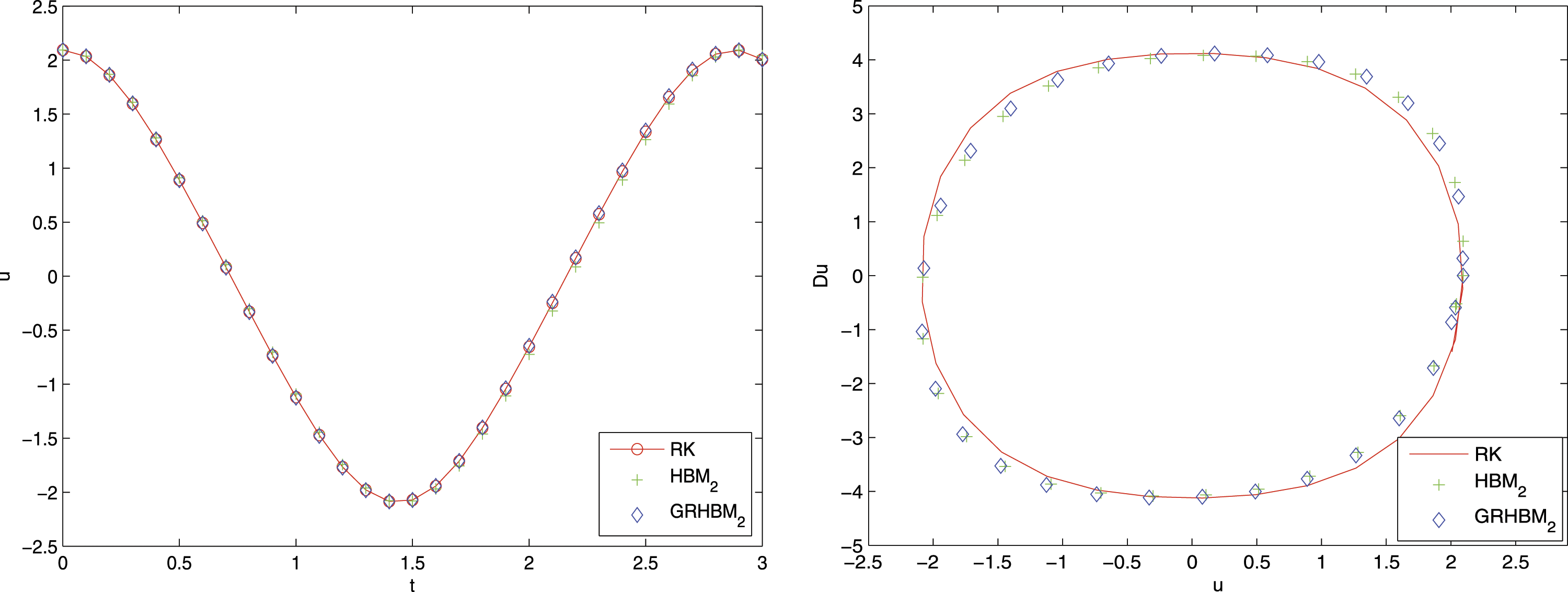
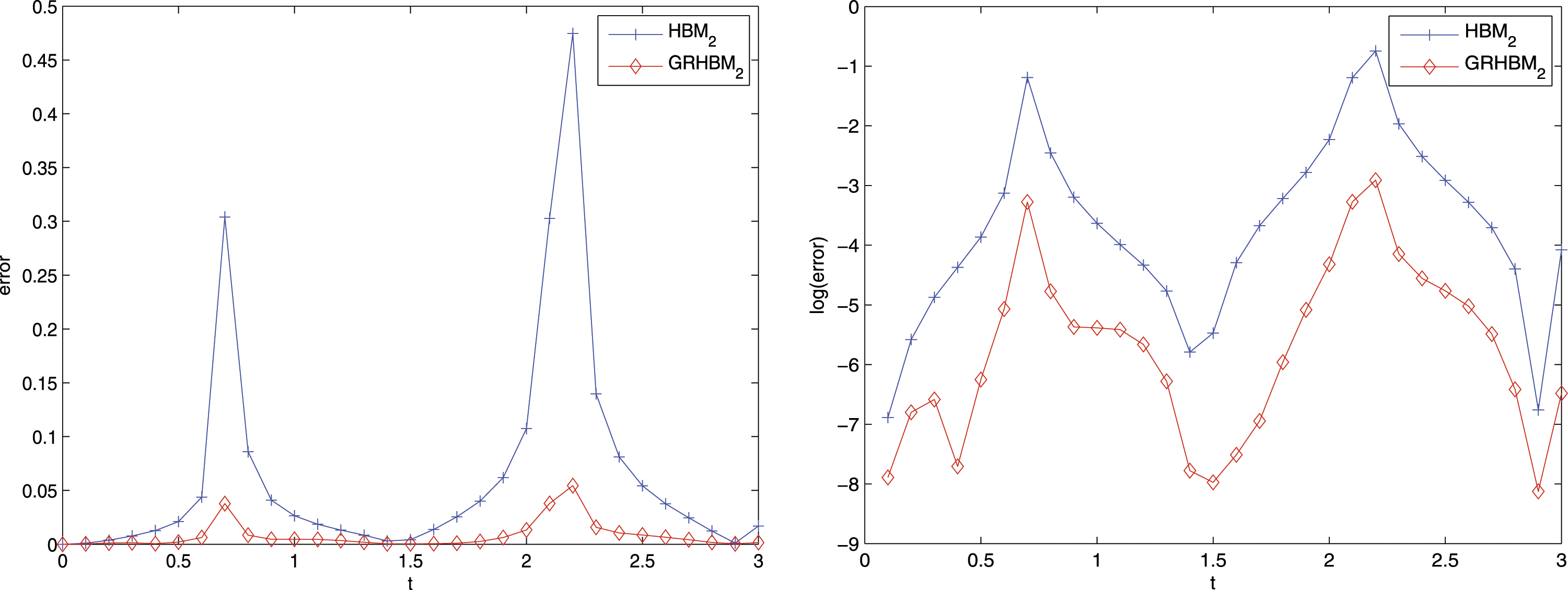
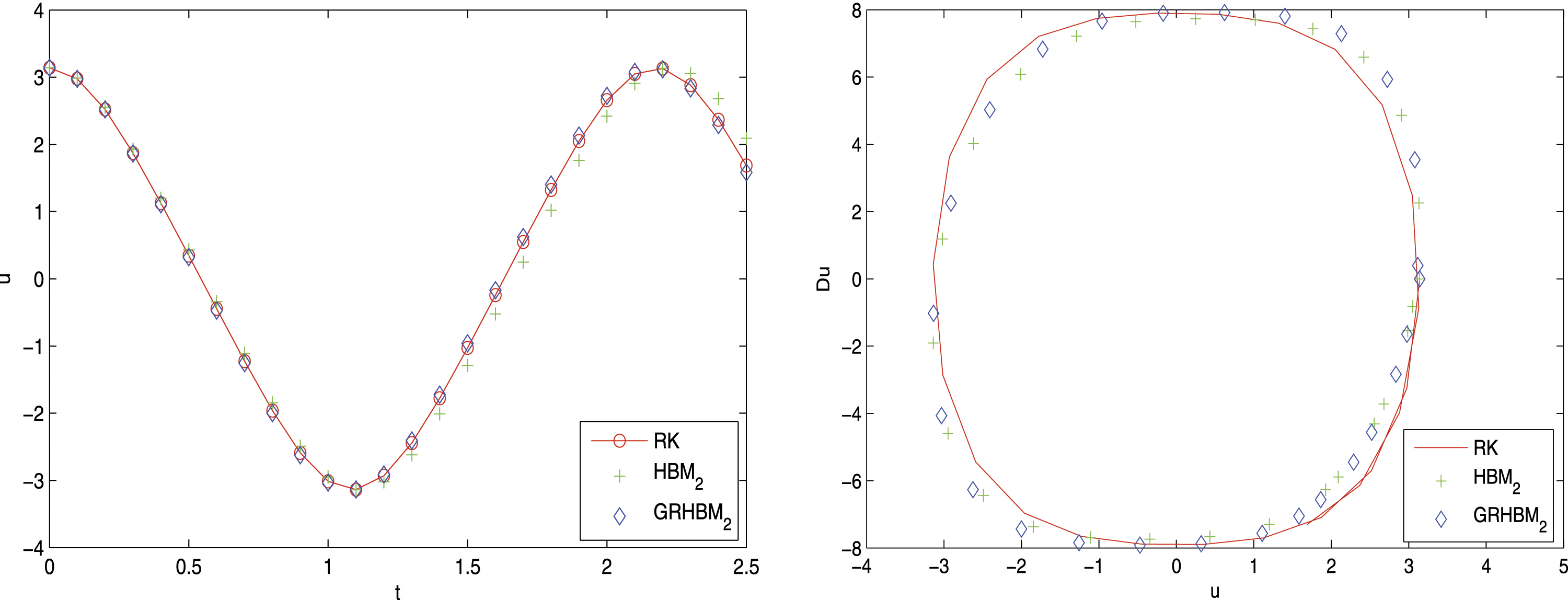
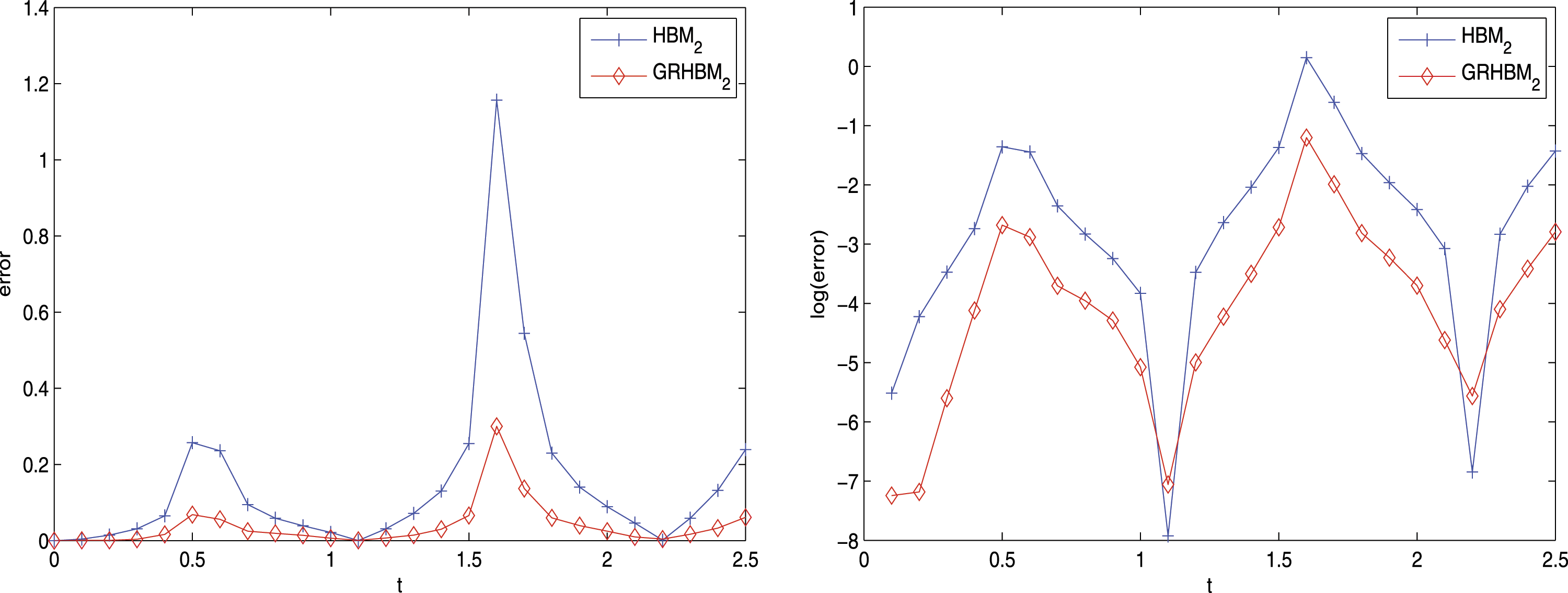
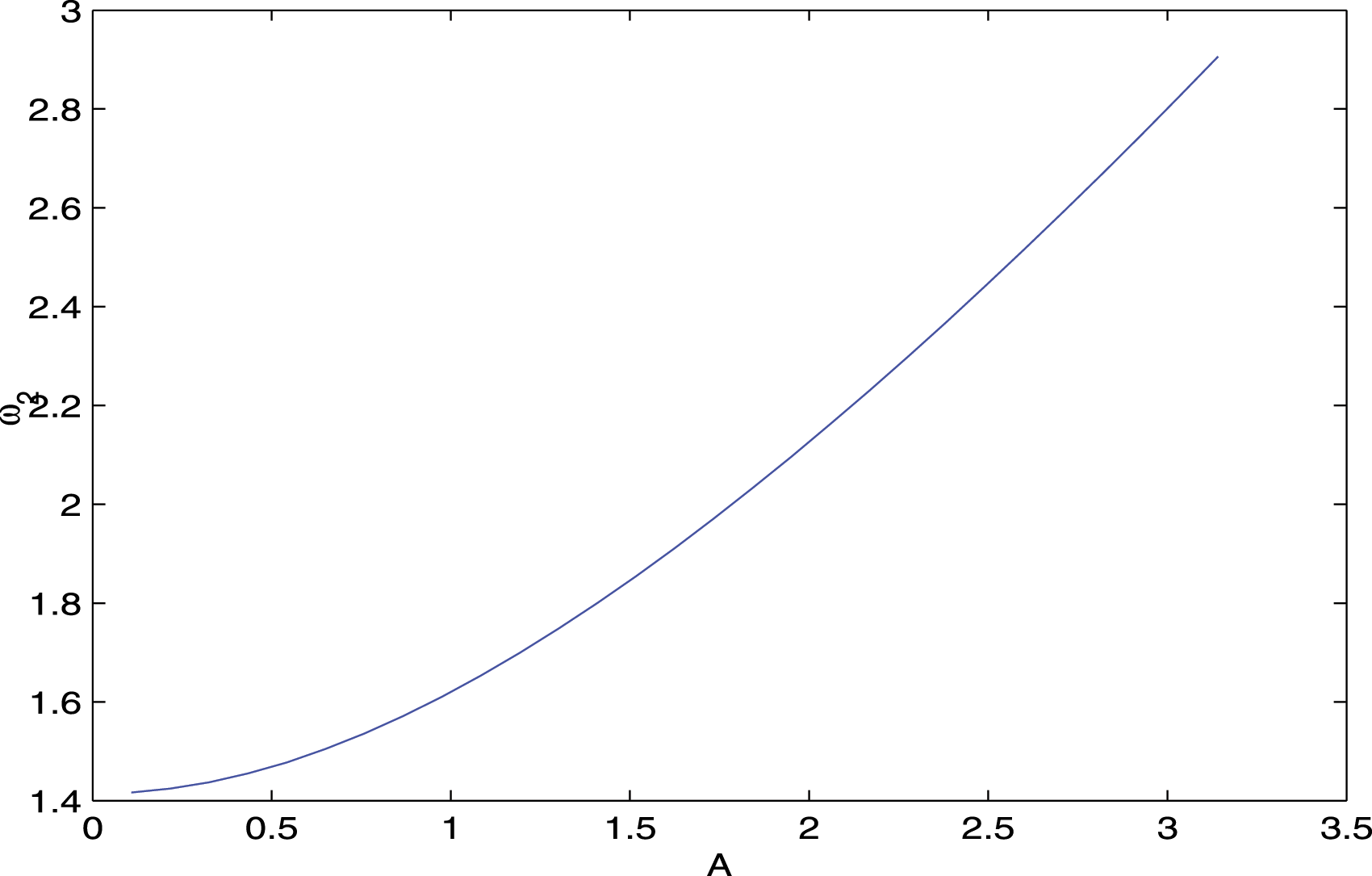
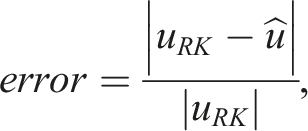
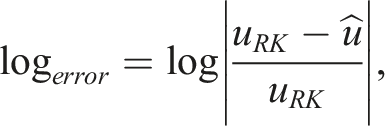
We focus on the numerical behaviour of the strongly nonlinear oscillator (1) with a = b = 1 and different A. Four cases including Numerical comparisons of the approximations to (1) with Comparisons of errors of HBM and GRHBM with Numerical comparisons of the approximations to (1) with Comparisons of errors of HBM and GRHBM with Numerical comparisons of the approximations to (1) with Comparisons of errors of HBM and GRHBM with Numerical comparisons of the approximations to (1) with A = π: u (left) and Comparisons of errors of HBM and GRHBM with A = π: error (left) and log
error
(right). Curve of 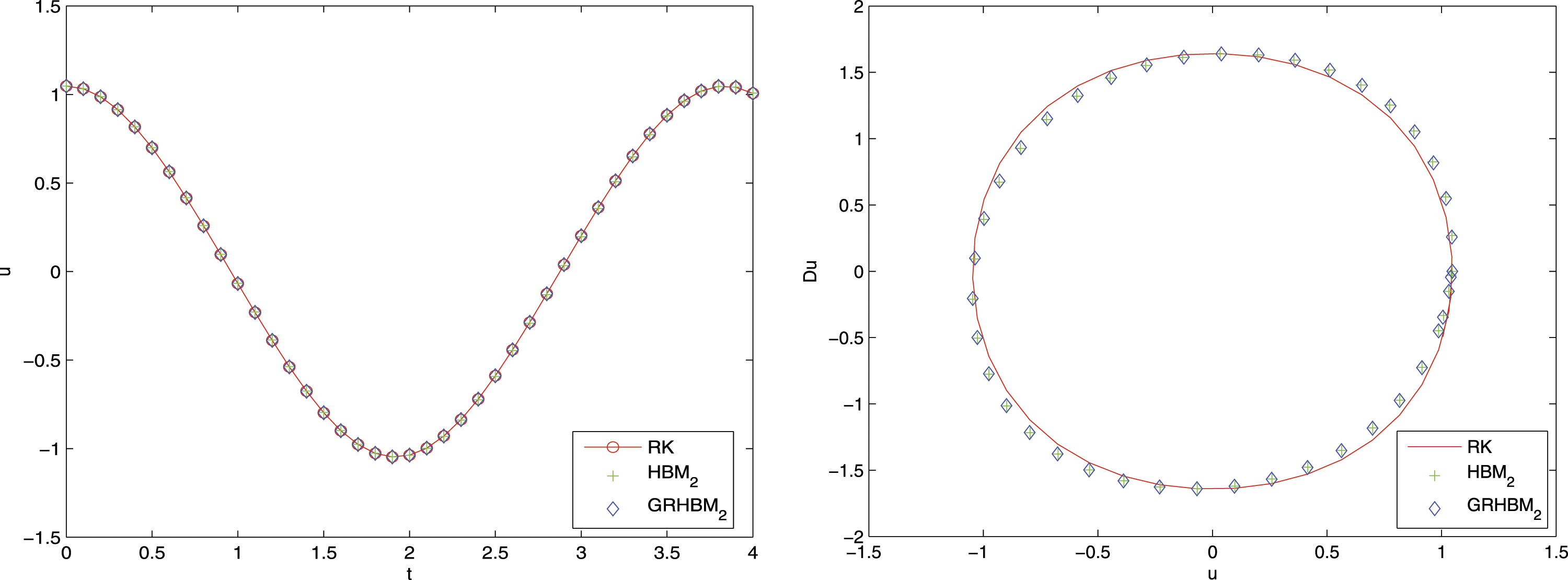
Conclusions
This paper dealt with the strongly nonlinear oscillator with cubic and harmonic restoring force by using the global residue harmonic balance method (GRHBM). The approximations were provided without complicated calculations, which agree well with the solutions given by Runge–Kutta method. The sensitive analysis of the approximation and the approximated frequency about the amplitude were also investigated. Comparisons with HBM and Runge–Kutta method confirmed that GRHBM is an effective and reliable method for this nonlinear oscillator. However, there still remains an open problem on choosing the optimal approximation of the nonlinear term sin(u) so that the accuracy of the approximations and the computational cost can be as small as possible. Our future work will focus on considering this open problem and extending GRHBM to other nonlinear oscillators.
Footnotes
Declaration of conflicting interests
The author(s) declared no potential conflicts of interest with respect to the research, authorship, and/or publication of this article.
Funding
The author(s) disclosed receipt of the following financial support for the research, authorship, and/or publication of this article: The work was supported by the Natural Science Foundation of Zhejiang Province (LY17A010001).
