



Abstract
In this paper, we consider a fractional nonlinear oscillator for a mass attached to a stretched elastic wire. The coupling technique based on the fractional complex transform and the global residue harmonic balance method is proposed for solving this fractional oscillator. The approximated periodic solutions and frequencies are provided without complicated computation and discretization. The frequency–amplitude relationship is investigated to show its monotonic property. Numerical approximations for the nonlinear oscillator with integer or fractional orders are compared with the approximations by some existing methods. Numerical results confirm the effectiveness and robustness of the proposed method.
Keywords
Introduction
Nonlinear oscillations can be modelled by the nonlinear oscillators and have been widely applied in science and engineer areas.1–14 It is difficult to give the exact solutions of different nonlinear oscillators, so the scholars focused on the analytical and numerical approaches for solving the nonlinear oscillators. These efficient techniques include harmonic balance method,1,8 harmonic balance method with Newton iteration modification, 7 He’s frequency–amplitude formulation,9,10 homotopy perturbation method,15,16 variational iteration method,17,18 fractional complex transform,19,20 global residue harmonic balance method21,22 and so on.
In reference
7
, Sun, Wu and Lim considered the motion of a mass attached to a stretched elastic wire, and proposed a combined method based on Newton’s method and harmonic balance method for the corresponding nonlinear oscillator as follows

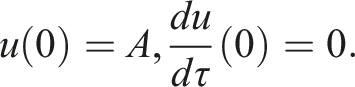
The initial conditions for (1) are given by

Equation (1) can also be used to model the nonlinear oscillation system with an irrational elastic term.
8
The frequency–amplitude relationship was investigated by He’s frequency–amplitude formulation.
9
Homotopy perturbation method or variational iteration method proposed by He were also suggested for finding the approximated solutions or frequencies of this nonlinear oscillator.15–18 Hosen et al.
23
proposed a modified energy balance method for further understanding the numerical properties of three highly nonlinear oscillators. In order to optimize the simplicity of harmonic balance method, Razzak applied a modified harmonic balance method for solving (1), and provided its approximated frequency and periodic solution.
24
Theoretically, it is meaningful to investigate the oscillation behaviour of the above nonlinear system that involves long memory in time. It also may be interesting to observe the oscillation phenomenon of (1) from an extremely small time scale. The fractional calculus has gained considerable attention in the past decades, and involves different definitions of fractional derivatives such as Riemann–Liouville fractional derivative, fractional Riesz derivative, fractional Caputo derivative, Jumarie’s fractional derivative, Atangana-Baleanu-Caputo fractional derivative and He’s fractional derivative and others.20–26 Due to the non-local property of the fractional operator defined by some fractional derivatives, the fractional differential equations can be modelled to simulate the above two nonlinear phenomena. Motivated by the work in the literatures,27–31 we will consider the following fractional nonlinear oscillator based on He’s fractional derivative


The modified initial conditions for (3) can be formulated by

We remark that the fractional nonlinear oscillator is different with the fractal oscillator which is defined by the two-scale fractal derivative in a fractal space.33–36
We are interested in the numerical investigation of the fractional nonlinear oscillator for a mass attached to a stretched elastic wire. Different with the original oscillator (1), the difficulty for solving (3) arises from its fractional differential operator. We will consider a combined method for investigating the numerical behaviour of the fractional oscillator (3). It is a coupling method based on the fractional complex transformation and the global residue harmonic balance method (named as FCT-GRHBM). The fractional complex transformation (FCT) is first used to transform the fractional system (3) as the ordinary oscillator (1). Different from the existing approaches in the references,7,24 the global residue harmonic balance method (GRHBM) will be suggested for finding the corresponding approximated periodic solutions and frequencies. Numerical results consist of two parts, where one is the comparisons of the approximations by FCT-GRHBM with the exact frequency and the approximations by some existing methods, and the other is the numerical comparisons of the fractional oscillators with different orders. Finally, some conclusions and remarks are given.
Analysis for fractional nonlinear oscillator
In this section, we consider an initial value problem of the fractional oscillator (3) by a combined technique. The suggested technique is based on the fractional complex transformation and the global residue harmonic balance method. We show this method for nonlinear system (3) below.
The fractional complex transformation (FCT) was first proposed by He and Li, and has been widely used for investigating the fractional nonlinear systems.
19
The physical understanding of FCT can be illustrated from the viewpoint of two scales.37–39 In practical applications, we can observe the wave propagation from different scales. The discontinuity in the propagation process may occur when the wave is observed at the small scale of t. Besides, the smooth wave can be predicted when it is measured at the larger scale T. By FCT with


Denoting

One can verify that f (u) satisfies the constrained condition f (−u) = −f (u) in GRHBM.21,22 Therefore, we consider GRHBM for solving the transformed oscillator (6).
By GRHBM, an auxiliary variable τ = ωT with an unknown frequency ω can be introduced. Then we have the derivative results as follows

By (6) and (9), we have the following nonlinear oscillator

We reformulate (10) as the following equation

Assume that the first order approximation of (11) is given by

We substitute (12) into (11), and obtain the following nonlinear system about ω1

By setting the coefficient of the constant term as zero, we have the following equation with respect to ω1

Thus, the first order approximated frequency can be defined by

We remark that the approximated frequency above is the same as that obtained by homotopy perturbation method.
15
The frequency ω1 is monotonic increasing about the amplitude A. Indeed, ω1 increases from
The motivation of GRHBM is that the approximations can be given by similar technique like Newton iteration. The modifications of the approximated solutions or frequencies are based on the residual part of the previous system. We denote the residual part of (13) by

The second order approximations are given by

By substituting (17) into (11), we obtain a nonlinear function about the harmonic terms cos 2iτ(i = 0, 1, 2, 3). By GRHBM, we further collect the coefficients of the p-term of the suggested function. The results can be formulated as the following nonlinear function

Here, the coefficients Γ
i
(i = 1, …, 4) are defined by
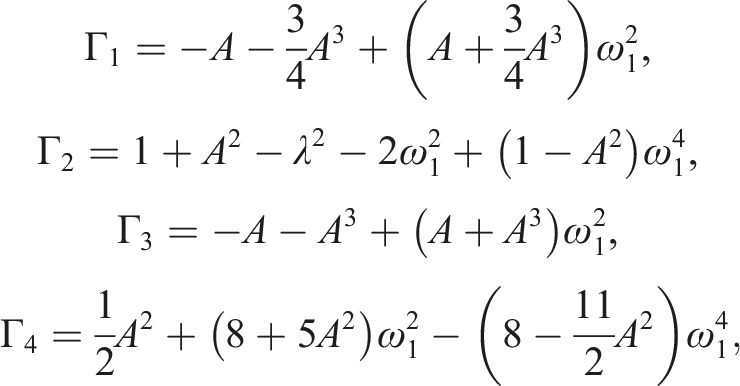
The coupling system of both F1(τ, ω2, ρ) and R1(τ) is used to provide the modifications of u1(τ) and ω1. GRHBM considers the following nonlinear equation

In order to remove the secular terms, the coefficients of the constant and cos 2τ terms should be equal to zero. It follows a linear system with respect to ω2 and ρ




The second order approximated solution to (6) follows from (17), where the second order approximated frequency is given by

We recall the fractional complex transformation T = t
α
/Γ(1 + α), and obtain the second order approximation to (3)

Numerical results
In this section, we consider the numerical analysis of the fractional nonlinear oscillator (3). We test FCT-GRHBM, harmonic balance method with Newton iteration’s modification (HBM), modified energy balance method (MEBM) and Runge-Kutta method (RK) for this nonlinear system.7,23 For clarity, we consider two cases, where one is the classical oscillator (1) with α = 1, and the other is the fractional oscillator (3) with different fractional orders.
We first consider the numerical behaviour of (1). The frequency-amplitude relation is important for understanding the oscillation of (1). We recall the exact period of (1) given in reference
7

The exact natural frequency can be followed by

We plot the numerical curves of the exact or approximated frequencies with 0 ≤ A ≤ 15 and λ = 0.5 in the left side of Figure 1. The error curves of the approximated frequencies given by FCT-GRHBM, HBM and MEBM are presented in the right side of Figure 1, where the error is defined by Frequency–amplitude relation for (3) with λ = 0.5.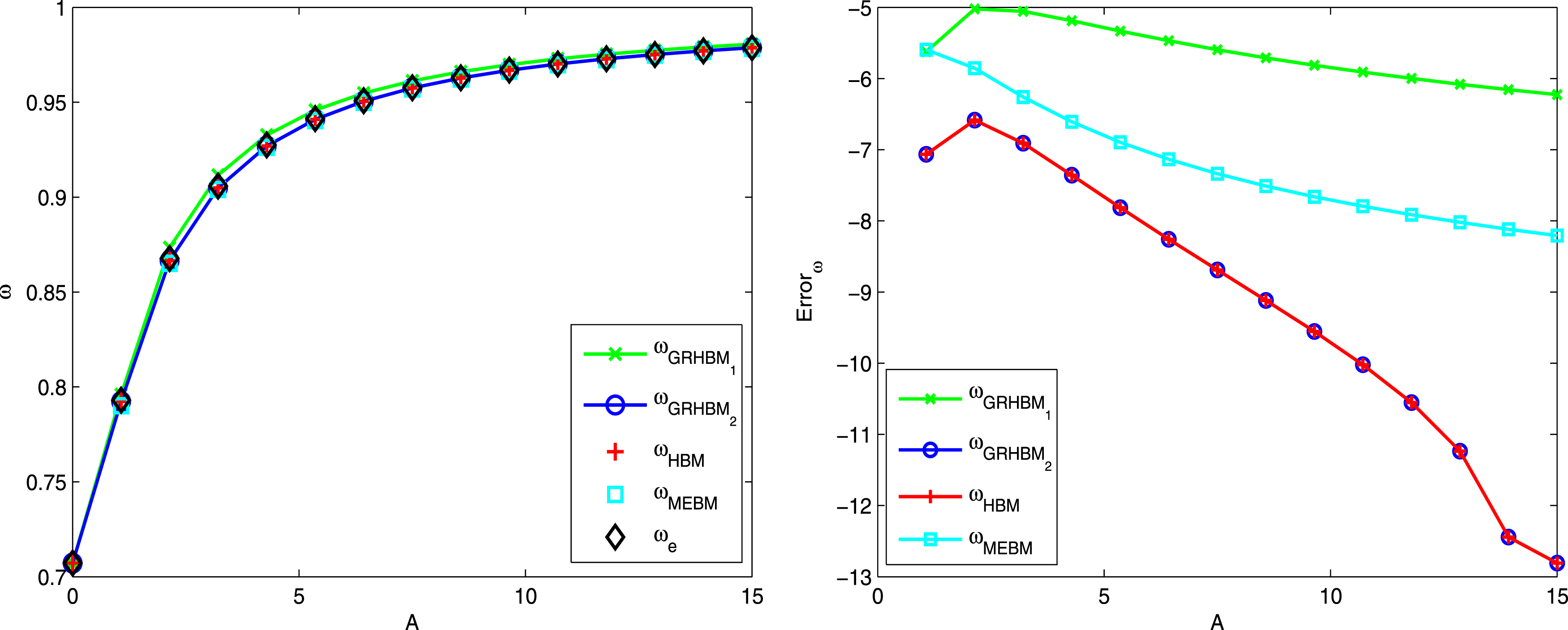
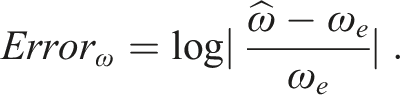
Figure 1 shows the monotonic increasing property of Frequency–amplitude relation for (3) with λ = 0.75.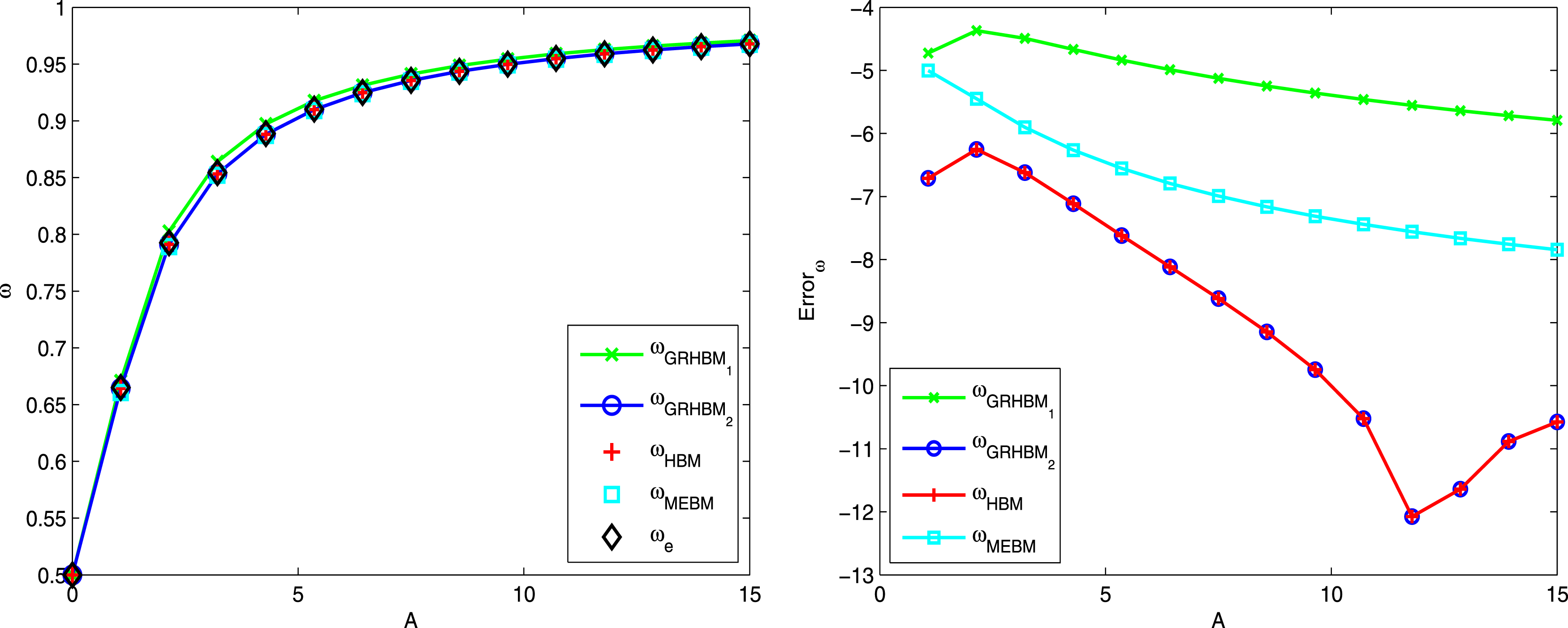
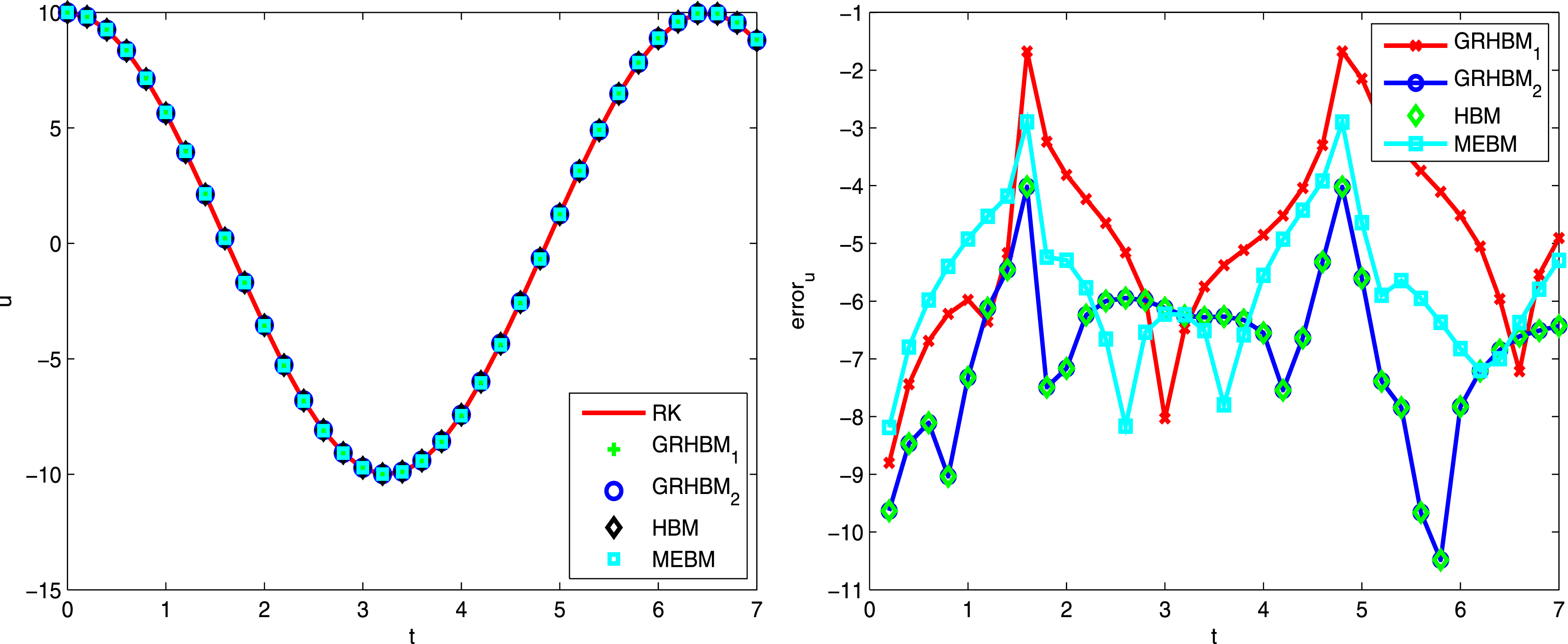
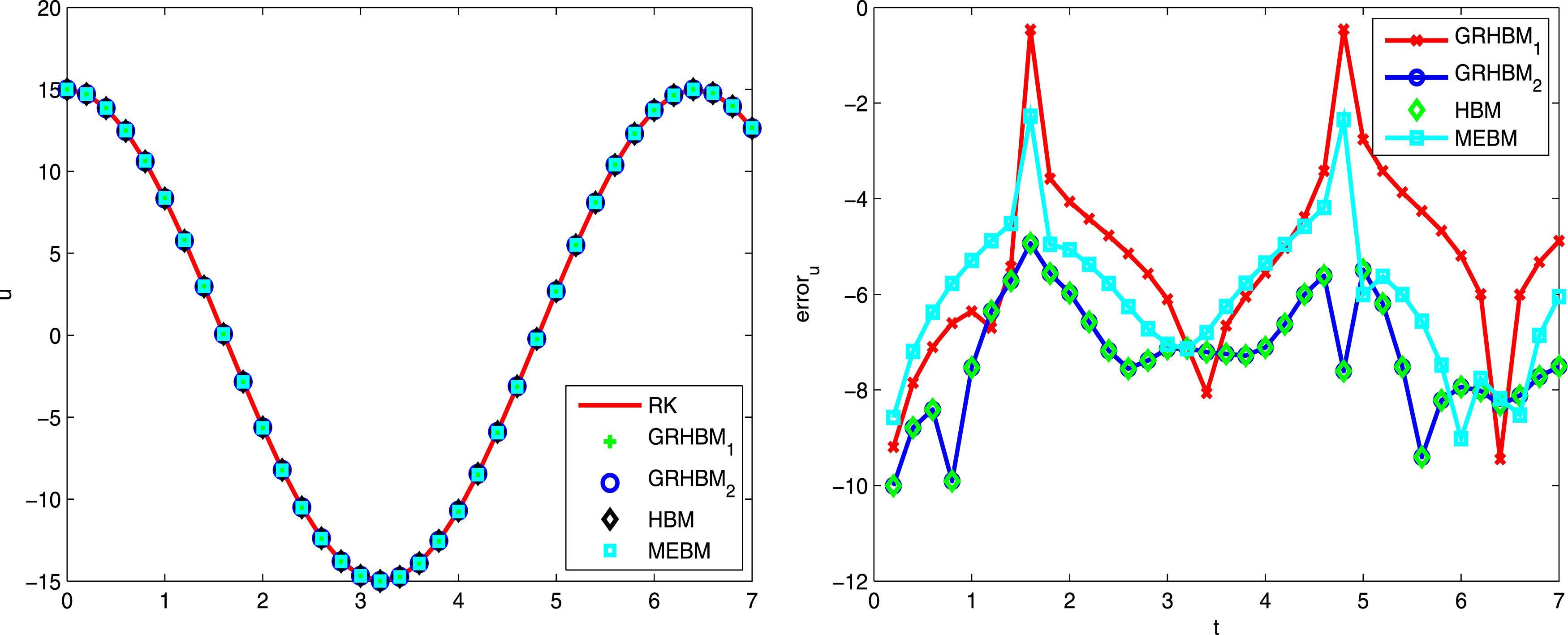
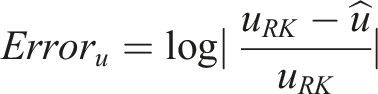
We then test the numerical approximations given by RK, FCT-GRHBM, HBM and MEBM. For comparison, we consider the following log error Numerical comparisons for (3) with A = 5 and λ = 0.5. Numerical comparisons for (3) with A = 10 and λ = 0.5. Numerical comparisons for (3) with A = 15 and λ = 0.5. Numerical comparisons for (3) with A = 5 and λ = 0.75. Numerical comparisons for (3) with A = 10 and λ = 0.75. Numerical comparisons for (3) with A = 15 and λ = 0.75.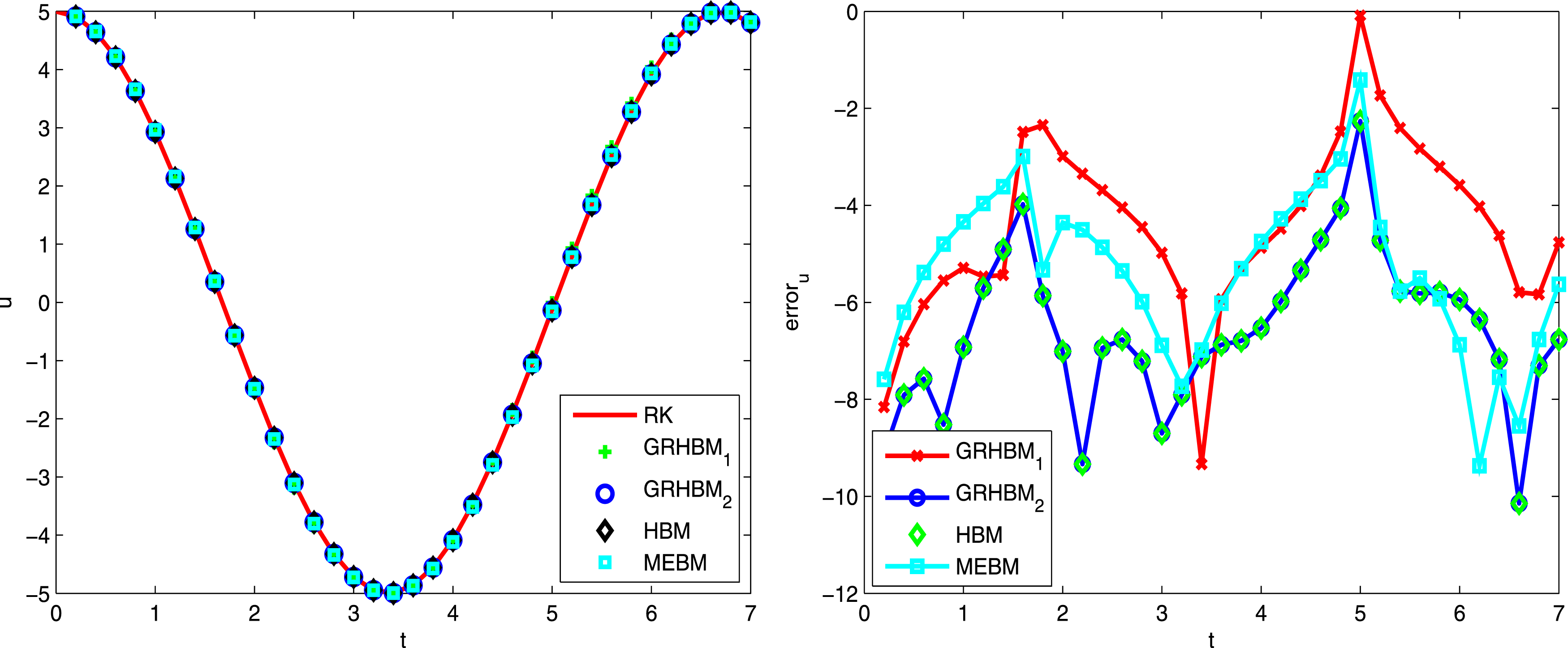
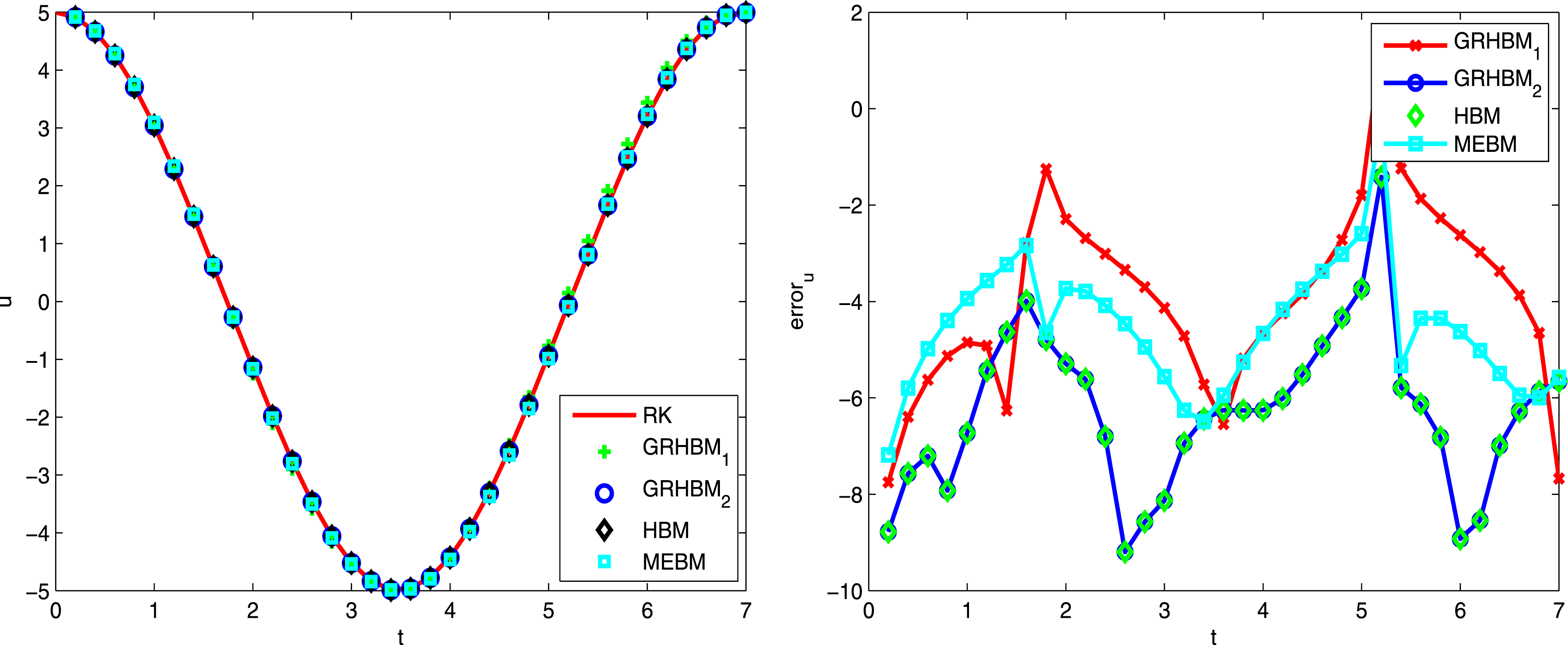
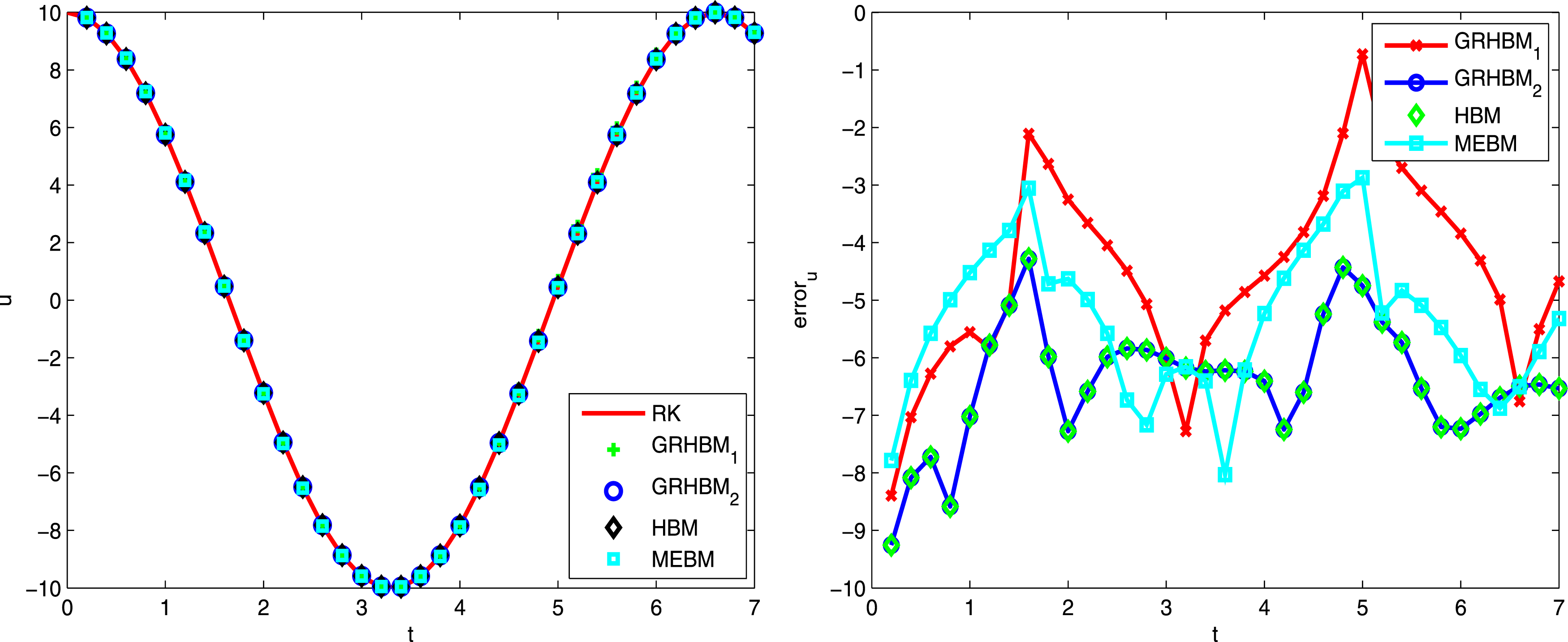
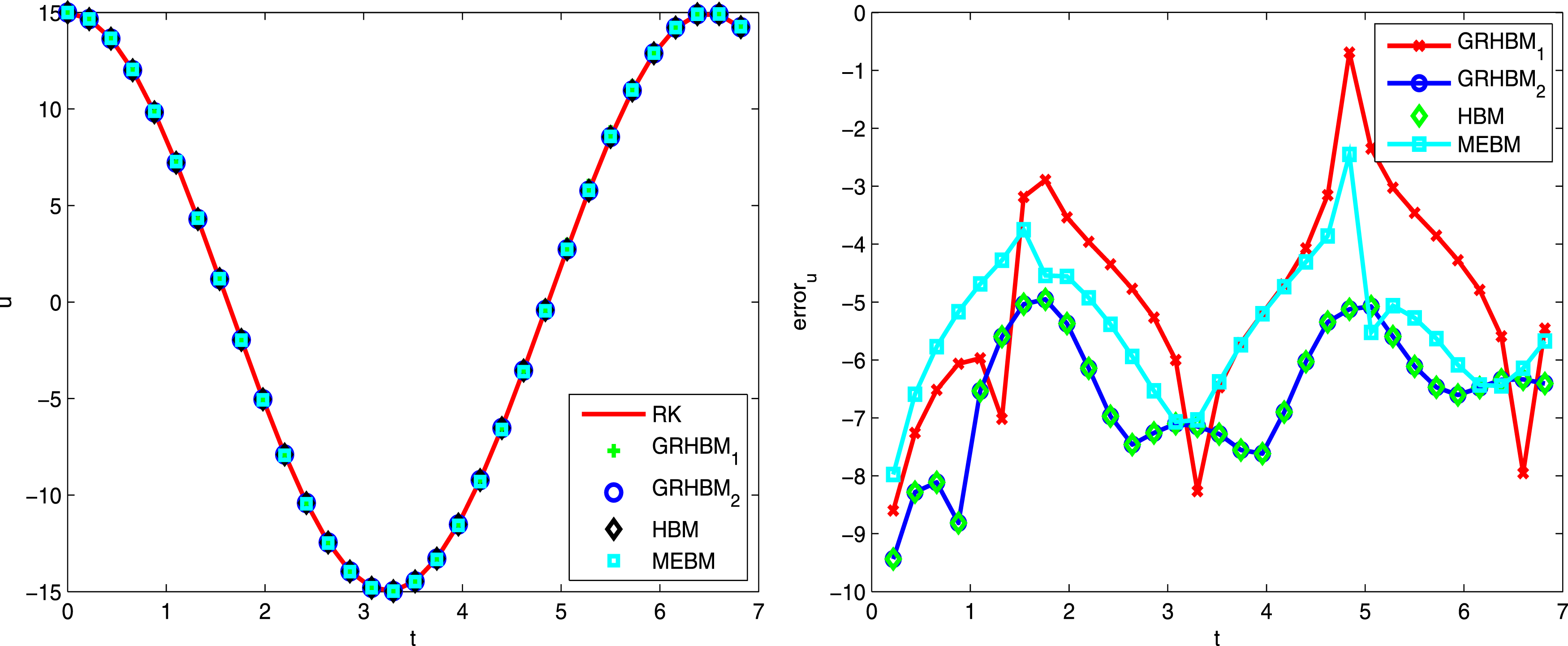
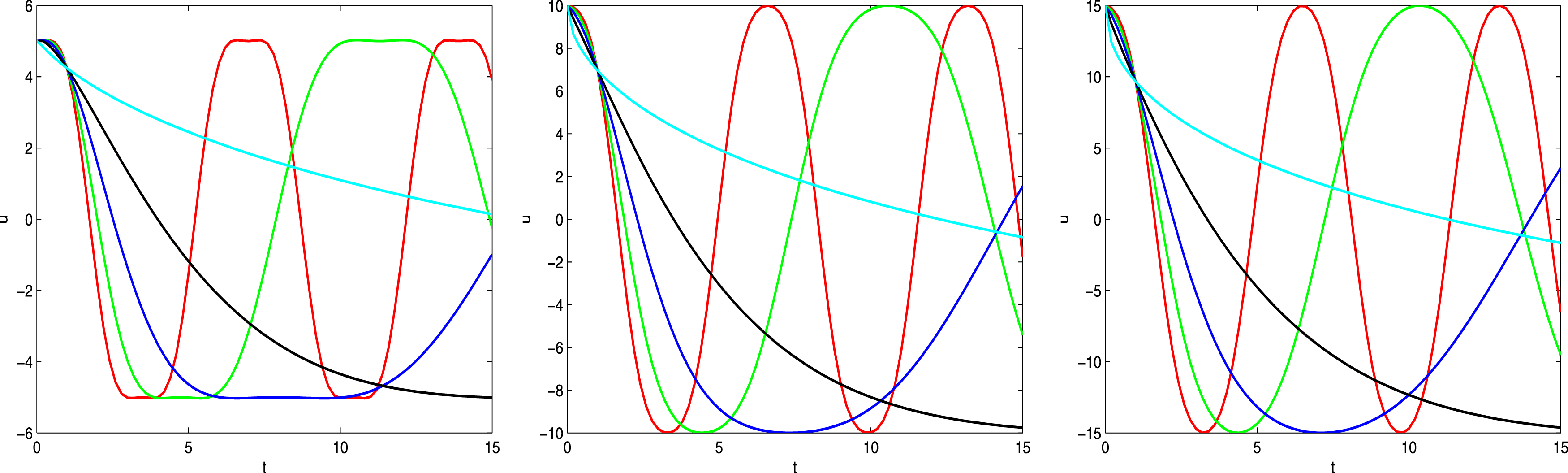
We finally consider the numerical analysis of the fractional nonlinear oscillator (3). Numerical investigation focuses on the approximations with respect to different amplitude A and fractional order α. Figure 9 shows the nonlinear oscillation phenomenon of the approximated solutions of (3) with λ = 0.5. It follows that the periodic oscillation appears when the fractional order α approaches to 1. The impact of the fractional order on the time interval between two spikes is also considered. Different with the traditional oscillator, the time interval between two spikes increases along with the decrease of the fractional order. Similar behaviours can be seen from Figure 10 for the fractional oscillator with λ = 0.75. In summary, we can conclude that the proposed method is efficient and robust for solving the original or fractional nonlinear oscillator of a mass attached to a stretched elastic wire. Numerical behaviour of FCT-GRHBM solutions with λ = 0.5 and different α (left: A = 5, middle: A = 10, right: A = 15, red: α = 1, green: α = 0.8, blue: α = 0.6, black: α = 0.4 and cyan: α = 0.2). Numerical behaviour of FCT-GRHBM solutions with λ = 0.75 and different α (left: A = 5, middle: A = 10, right: A = 15, red: α = 1, green: α = 0.8, blue: α = 0.6, black: α = 0.4 and cyan: α = 0.2).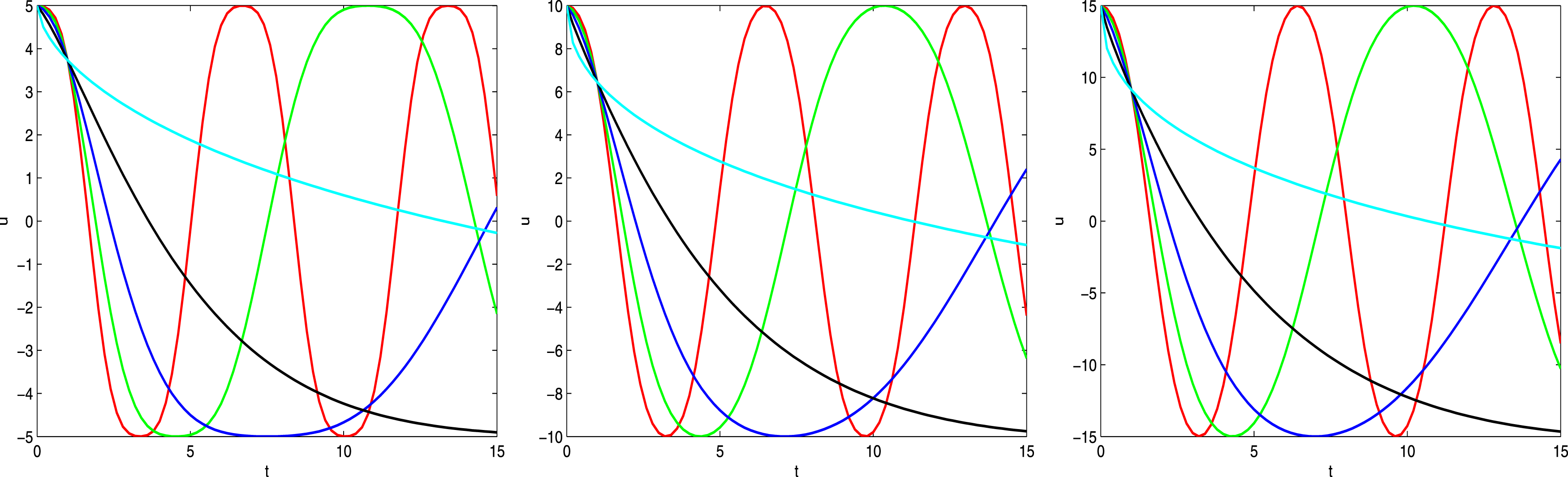
Conclusions
In this paper, a coupling method based on the fractional complex transform and the global residue harmonic balance method was proposed for solving the fractional nonlinear oscillator for a mass attached to a stretched elastic wire. The approximated periodic solutions and frequencies were given, and compared with some existing method including harmonic balance method with Newton iteration modification, modified energy balance method and Runge–Kutta method. Sensitive analysis shows the monotonic increasing property of the frequency–amplitude relation. Numerical results indicated the approximations agree well with the exact frequencies or the numerical solutions by Runge–Kutta method. We touched a little on the numerical investigation of this fractional oscillator, and gave the relation between the fractional order and the time interval among two spikes. However, the physical understanding or pull-in instability about this fractional oscillator also needs further consideration. Our future work will focus on this topic.
Footnotes
Declaration of conflicting interests
The author(s) declared no potential conflicts of interest with respect to the research, authorship, and/or publication of this article.
Funding
The author(s) received no financial support for the research, authorship, and/or publication of this article.
