This paper focuses on the numerical investigation of the fractional nonlinear oscillator for a restrained cantilever beam with an intermediate lumped mass. A numerical approach based upon the fractional complex transformation and the global residue harmonic balance method (FCT-GRHBM) is suggested for approximately solving this fractional oscillation system of fifth-order nonlinearity. The approximated fractional periodic solutions and frequencies are provided by FCT-GRHBM, which are not touched in the existing literature. Numerical results and sensitive analysis with respect to different parameters are shown to confirm its efficiency.
Fractional calculus has been becoming a hot topic with deep applications in engineering and scientific areas. We can trace its history back to 1695 when the fractional derivative was first considered by Leibnitz. There are various types of fractional derivatives in the existing literature, including He’s fractional derivative, the local fractional derivative, fractional Riemann–Liouville derivative, fractional Caputo derivative, conformable fractional derivative and others.1–6 The partial differential equations together with different fractional derivatives (named as FPDEs) can be used to model various systems arising from fluid mechanics, mathematical biology, plasma physics, hydrodynamics, electrochemistry, nano technology and signal processing and other fields.1–8 Due to the non-local property of the fractional operators in FPDEs, it is a challenging task to exactly solve the corresponding equations. Reviewing the existing improvements in the last few decades, some analytical and numerical methods were proposed for approximately solving the fractional partial differential equations.9–14
In 1997, Hamdan and Shabahen considered the nonlinear vibration of a restrained cantilever beam with an intermediate lumped mass.15 Based upon the assumption of inextensibility and the neglect of the shear and rotary inertial effects of the cantilever beam, a conservative oscillator with fifth-order nonlinearity was provided by using the Rayleigh–Ritz approach.15 Due to the strong nonlinearity of this oscillation system, it is difficult to give its exact solutions, and different scholars paid attention to approximately solve this nonlinear equation. Chen and Chen adopted the differential transformation method for solving the free vibration problem.16 This nonlinear oscillator was seen as a fifth-order Duffing type temporal problem by Qian et al., and the homotopy analysis method was suggested for giving its approximated frequencies and periodic solutions.17 Bayat and Pakar proposed the variational approach for obtaining the approximated solutions to the nonlinear oscillator of an elastically restrained beam with a lumped mass.18–20 Two efficient methods including the variational approach and the energy balance method were used to study the periodic solutions of the conservative oscillator with fifth-order nonlinearity.21 The strong nonlinear oscillator of polynomial type was also investigated by using the harmonic balance method in Ref. 22. Although some progress has been made on numerical computation of the nonlinear oscillator for the restrained cantilever beam, the numerical analysis of the approximations with respect to different parameters requires further investigation.23,24
As shown in the existing literature,3,9,10,13,14 it is interesting to model the vibration behaviour depending on the time history, and observe its physical phenomenon on an extremely scale for the nonlinear oscillators. Due to the inability of the integer order derivatives to meet the above requirements, this may result in invalidity for the existing nonlinear oscillators. For addressing the above issues, the fractional partial differential equations can be suggested by using the memory property of the fractional derivative and the fractional two-scale theory. We remark that the fractional partial differential equations together with He’s fractional derivative have gained critical attention as a topic applied to engineering areas.3,9,10,13,14 The two-scale theory can be used for approximately constructing the relation between the small scale and the large scale for different time-spatial spaces.9,10 This is the main motivation of this paper, that is the fractional modification of the nonlinear vibrations of a restrained cantilever beam with an intermediate lumped mass will be helpful for understanding its vibration behaviour. Another topic about this fractional nonlinear oscillator is also meaningful, including the numerical analysis of the fractional approximated solutions with respect to the order of the fractional derivative, and the sensitive analysis of the approximated frequency about the amplitude and other parameters. The frequency analysis of the cantilever beams may be helpful for ensuring the rationality of engineering design and the safety of structures.15,17,21,22,25–28 Therefore, we will consider the following time-fractional nonlinear vibrations of a restrained cantilever beam with an intermediate lumped mass
with the initial conditions given by
where A is the amplitude of an oscillation system, is an integer constant that may take the value of , and are four positive constants. The fractional operator is defined by He’s fractional derivative9,10:
When , equation (1) reduces to the original conservative oscillator of fifth-order nonlinearity in Ref. 15.
In this paper, we will consider the numerical analysis of the fractional nonlinear oscillation of the restrained cantilever beam. As shown in the existing literature,13,29,30 FCT-GRHBM is a numerical approach based upon the fractional complex transformation (FCT) and the global residue harmonic balance method (GRHBM). It can be efficiently used for finding the approximations to the fractal or fractional partial differential equations. We consider the FCT-GRHBM approach for solving the initial value problem related with the fractional oscillation system (1). By the fractional complex transform proposed by Li and He,3,9,10,30–34 the fractional oscillator of fifth-order nonlinearity can be approximately transformed to the conventional oscillator with an integer order derivative. Then, GRHBM is used to construct the approximated solutions and frequencies of the transformed oscillator.13,29,30,35 We remark that GRHBM can give the approximations like Newton iteration. Different from the harmonic balance method, variational approach and other methods, since the residual part is used for the iteration correction, the accuracy of the approximated solutions by GRHBM can be further improved. Compared results with some existing methods including the Runge–Kutta method and the variational approach are presented to confirm its efficiency and improvement. The oscillation behaviour of the fractional approximations with respect to different amplitudes and fractional orders is illustrated by some two or three-dimensional figures. We also further consider the sensitive analysis of the approximated frequency about different parameters. Finally, some conclusions and future work are given.
FCT-GRHBM approach for fractional nonlinear vibrations of a restrained cantilever beam with an intermediate lumped mass
In this section, the FCT-GRHBM approach is used for approximately solving the fractional oscillator (1). The detailed flowchart of this approach is given below (Figure 1).
Flowchart of FCT-GRHBM approach for fractional oscillator (1).
By the fractional complex transformation proposed by Li and He,3,9,10,29–32 the fractional equation (1) can be approximately written as
We can rewrite (4) as the following nonlinear equation:
where satisfies the constrained condition . Then by GRHBM,13,29,30,35 we introduce an auxiliary variable for the conventional derivatives in (4), and obtain the following transformed results:
where is a unknown frequency.
By using (6), the nonlinear system (4) can be equivalently formulated as
with the following transformed initial conditions
Assume that the initial approximation of (7) is given by
where is the first order frequency determined later.
By substituting (9) into (7), we have the equation about the harmonic terms as follows:
where can be seen as the residual part of the term defined by
In order to remove the secular terms of the nonlinear equation, the coefficient of the term is set as zero. This means that
It follows the formulation of defined by
We notice that the first order approximated frequency is identical to that given by harmonic balance method, variational approach and He’s formulation.20,22,24 Generally, the accuracy of the first order approximation may be low, due to the neglect of the residual terms in (10). For improving the accuracy of the numerical approximations, GRHBM considers the corrections to the approximated solutions and frequencies by further combing the residual terms. We assume the second approximations are defined by
where , and are two unknown constants.
We substitute (14) into (7), and obtain a nonlinear equation about the terms. As shown in the previous paragraph, this system can be divided into two parts. The first part is a nonlinear function about two terms and , and the second part results from the rest terms. These two parts are denoted by and , respectively. Again, the secular terms need to be equal to zero, which implies that the coefficients of and arsing from and are set as zero. We summarize the above analysis as the following equation about and
with defined by
One can have the following results from (15) and (16)
Then, the second order frequency can be given by
The determination of the third order approximations is similar to the first and second order ones by GRHBM. Thus, the third order solution and frequency can be formulated by
Here, the unknown approximation can be formulated as follows:
where and are three unknown constants. The nonlinear function can be constructed from the p-terms related with and . Recalling the residual function , we obtain the combined equation as follows:
By assuming the coefficients of the harmonic terms of (27) as zero, we have the following linear equations
where and are given by
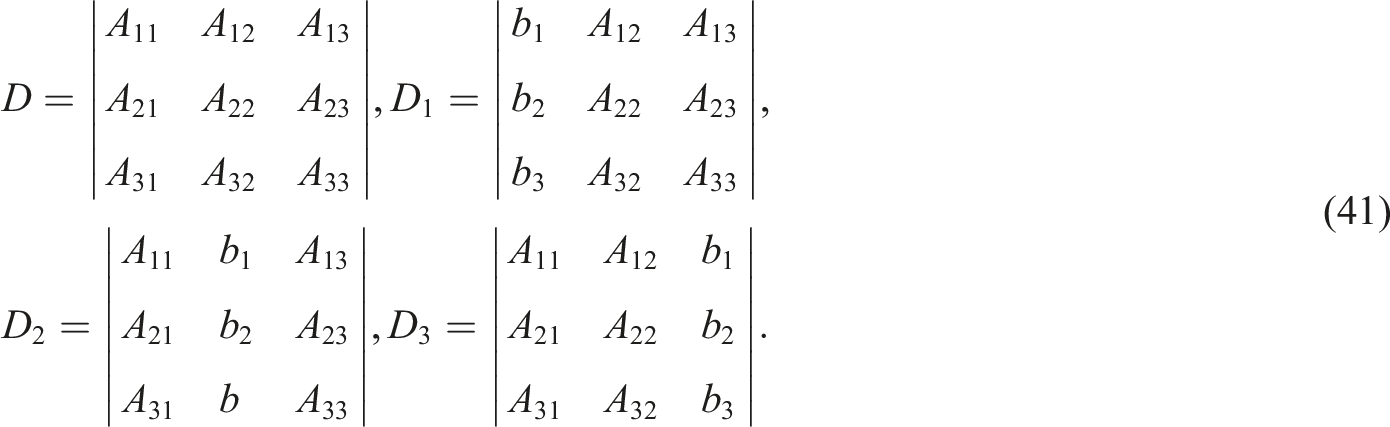
We use D and to express the determinants related with (28)
When , it follows from Cramer’s rule that
By (25) and (42), we have the third order approximated frequency as follows:
Therefore, by the variable transformation , the third order fractional approximated solution to (1) can be formulated as follows:
where and are defined by (42) and (43), respectively. One can find that the fractional approximations to (1) was not considered in the existing literature. Generally speaking, the second or third order approximations given by FCT-GRHBM can efficiently model the vibration behaviour of the fractional or conventional oscillators.
Results and discussions
In this section, we test the efficiency of the FCT-GRHBM approach for solving the fractional nonlinear oscillator (1), and compare it with some existing methods, such as Runge–Kutta method (RK) and variational approach (VA). Table 1 shows the parameters and the amplitude A for the approximations. Four cases will be considered for investigating the numerical results of system (1).
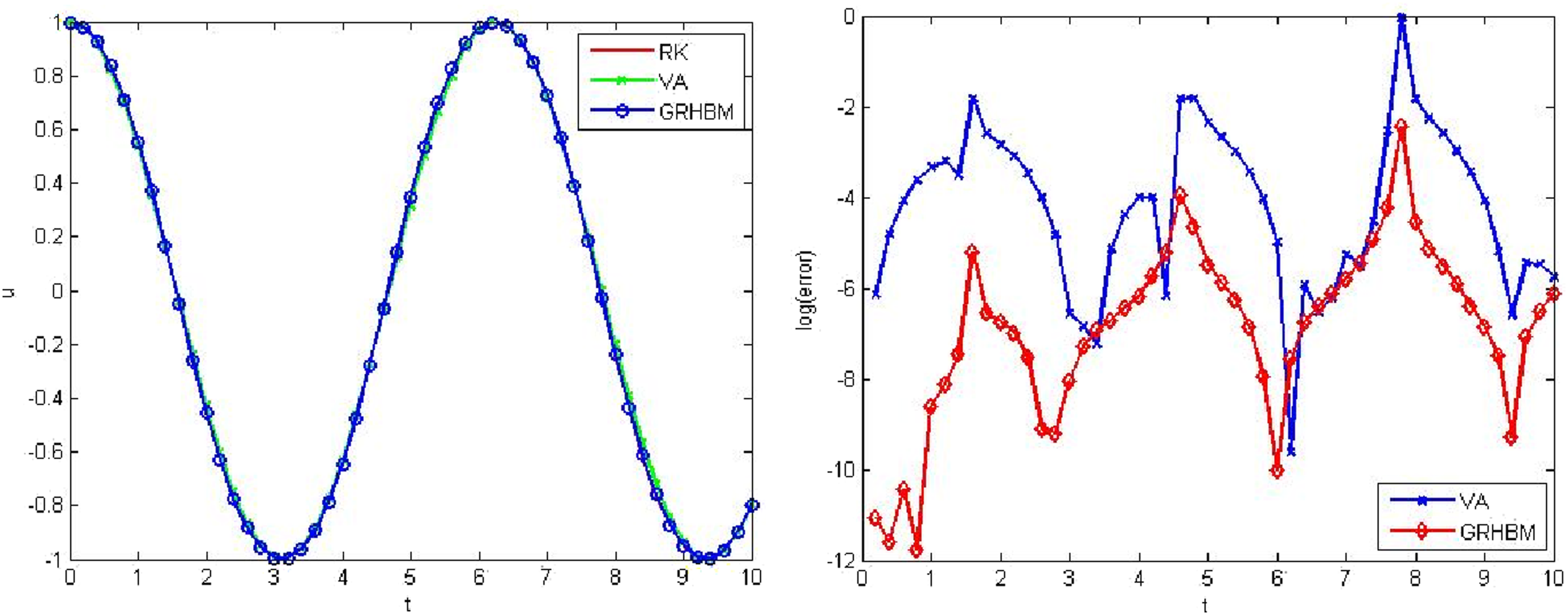
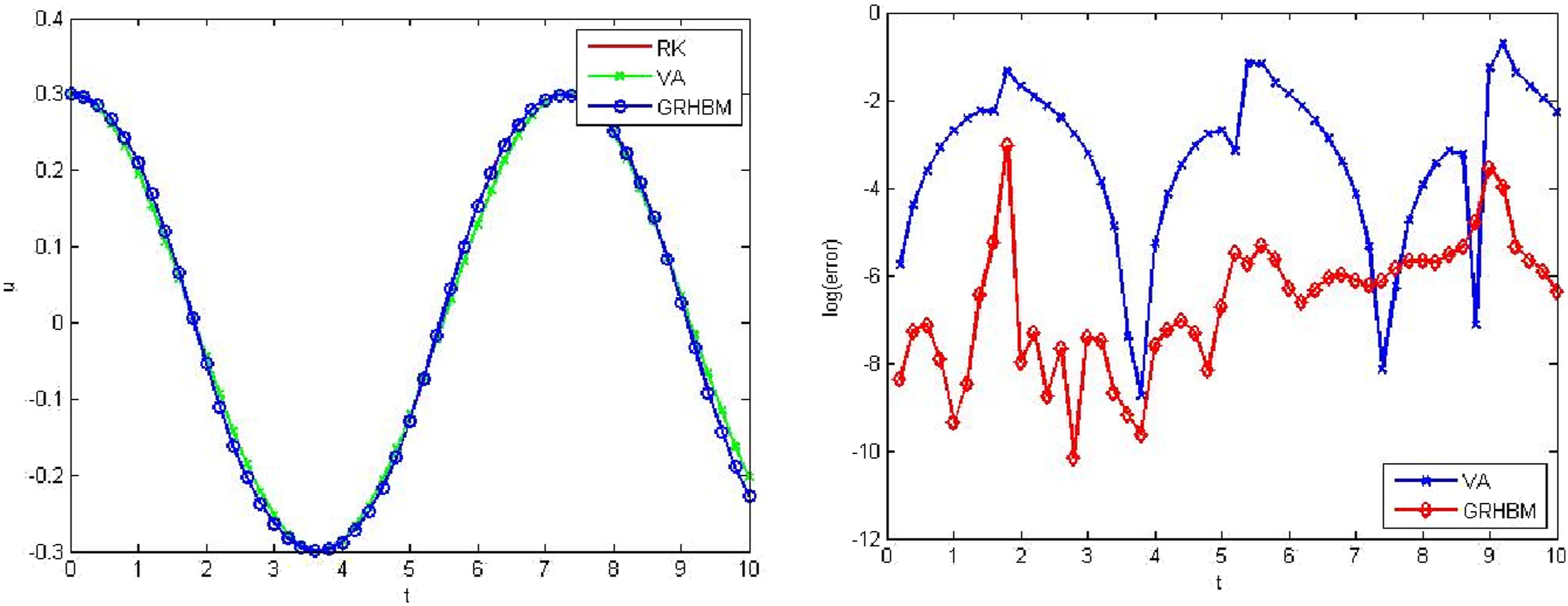
For the first case I, we set , and perform the FCT-GRHBM approach for solving the nonlinear system (1) with an integer order . For comparison, we also test Runge–Kutta method and variational approach. The numerical results provided by the approximations by RK and VA and the third order approximations by GRHBM are shown on the left side of Figure 2. One can find that the approximations given by GRHBM and VA agree well with the numerical solutions by RK. In order to further compare the accuracy of the approximated solutions, we introduce the log of the residual error as follows:
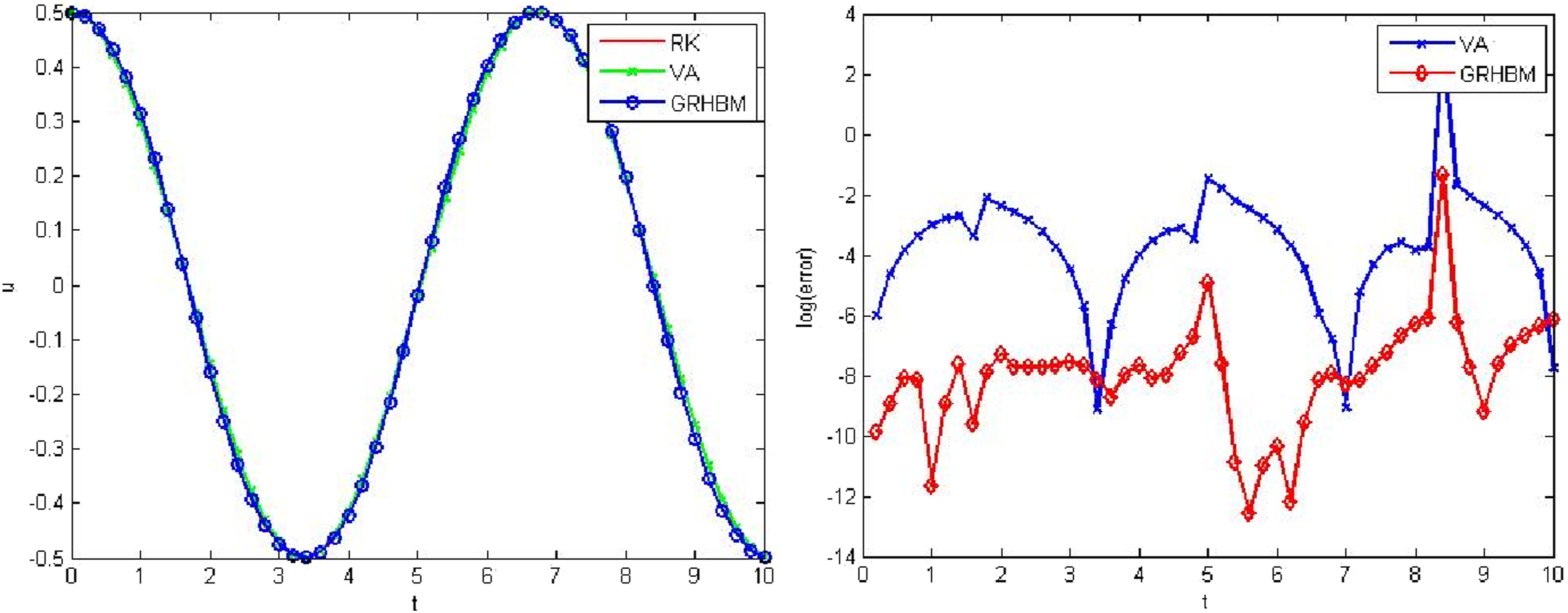
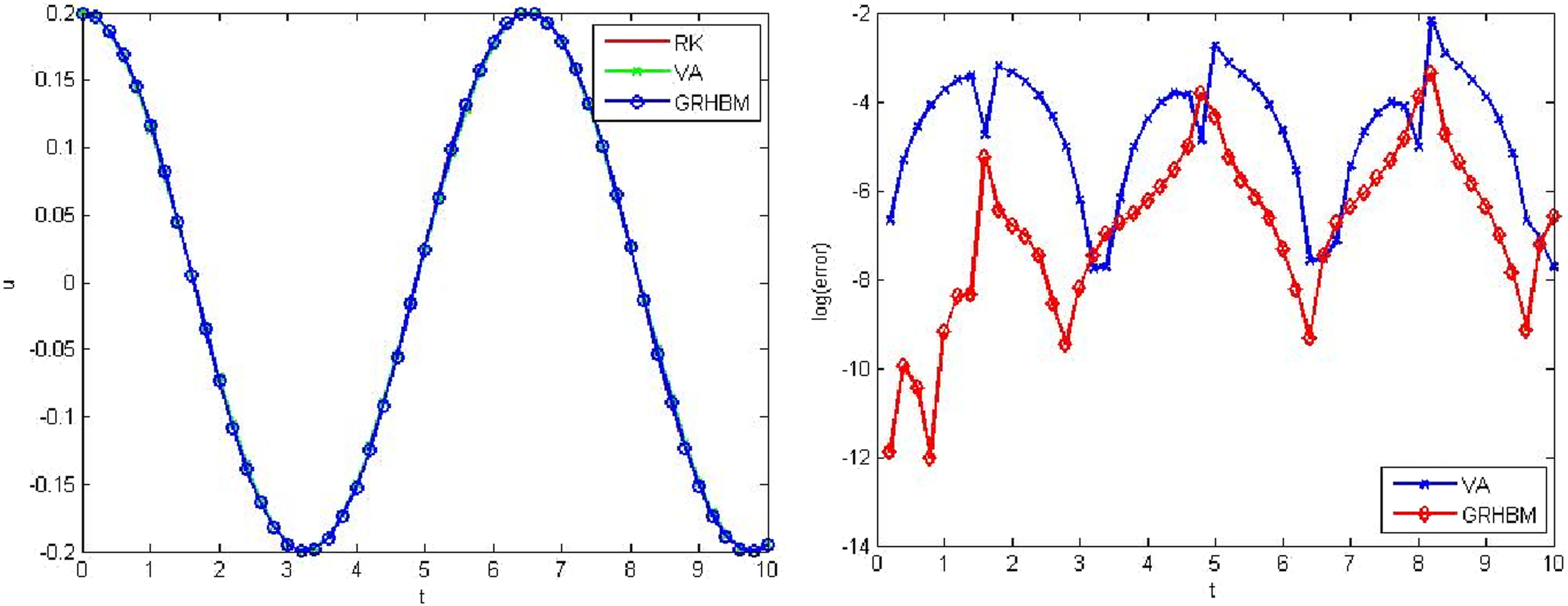
where u is an approximation given by GRHBM or VA, and is the numerical approximation obtained by RK. The curves of the log error of these two approximations are depicted on the right side of Figure 2. By comparing with the VA technique, the accuracy of GRHBM has been greatly improved by considering the residual part of the nonlinear system. We test the impact of the amplitude and other parameters with respect to the nonlinear oscillation behaviour of (1). The second case II with is presented in Figure 3, and the numerical behaviour is similar to the first case. Again, GRHBM performs better than VA. Numerical results for the rest two cases III and IV are shown in Figures 4 and 5, respectively. By Figures 2–5, the oscillation behaviour is stable with respect to different amplitudes. For further detailed comparisons, we also consider the root mean square errors (RMSE) of the approximations given by GRHBM or VA. The errors in Table 2 indicate the efficiency of the FCT-GRHBM technique over the variational approach.
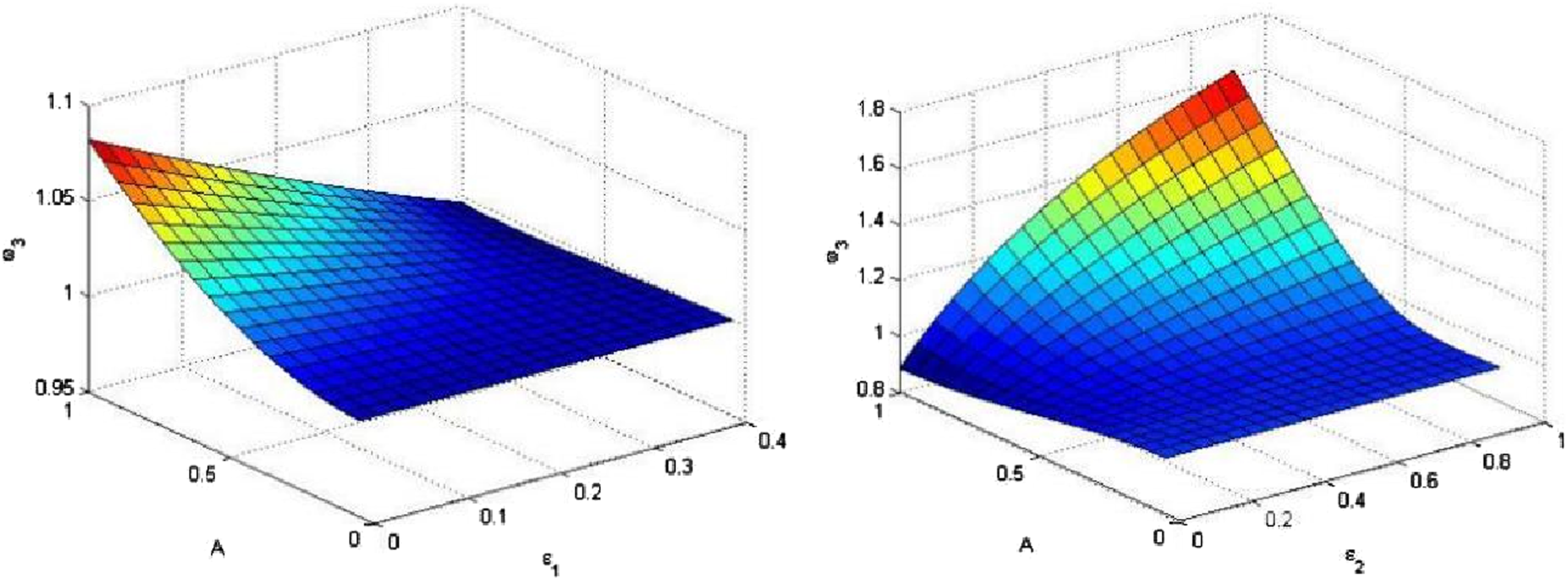
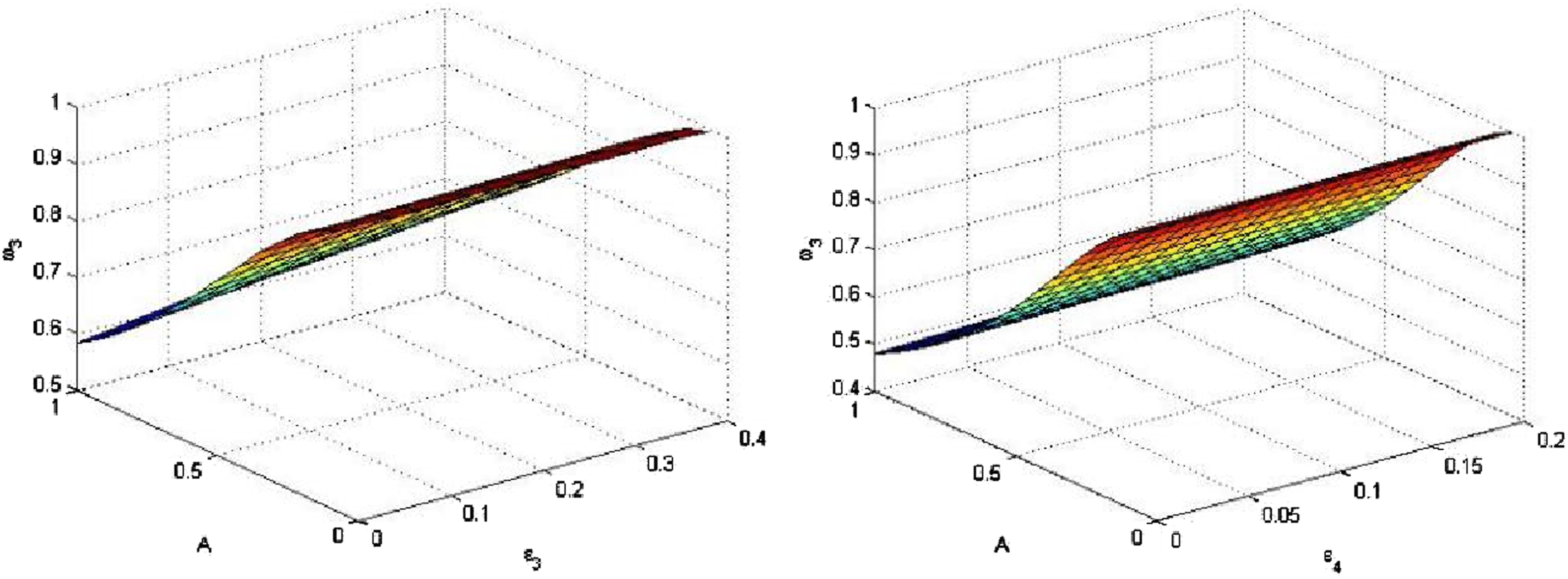
As shown in the introduction, it is meaningful to consider the sensitive analysis of the approximated frequency about different parameters. The approximated frequencies given by VA and GRHBM are listed in Table 3. One can find that can be further corrected by considering the residual error in the previous iteration of GRHBM. Since the behaviour of the approximated frequencies given by GRHBM is similar, we take the sensitivity study of the third order approximated frequency defined by (43) as an example. Four different types will be tested to illustrate the sensitivity of . Figure 6 shows the surface of with and , where other parameters are the same as those used in case I. Numerical results in the left side of Figure 6 show that the frequency is monotonic increasing about the amplitude A, and monotonic decreasing about the parameter . The right side of Figure 6 gives the opposite phenomenon with and other constants given by case II. The approximated frequency is monotonic decreasing and monotonic increasing with respect to the amplitude A and the parameter , respectively. The sensitive surfaces in Figure 7 are similar, where and 2 are considered for the analysis of the approximations, respectively. We remark that the above frequency analysis concerning the amplitude and other parameters may be helpful for optimizing the structure of the cantilever beam.
Approximated frequency by VA and GRHBM.
Case
I
1.0071
1.0071
1.0102
1.0101
II
0.9326
0.9326
0.9349
0.9351
III
0.9655
0.9655
0.9658
0.9658
IV
0.8597
0.8597
0.8626
0.8642
Surfaces for approximated frequency (Left: and , Right: ).
Surfaces for approximated frequency (Left: and , Right: and ).
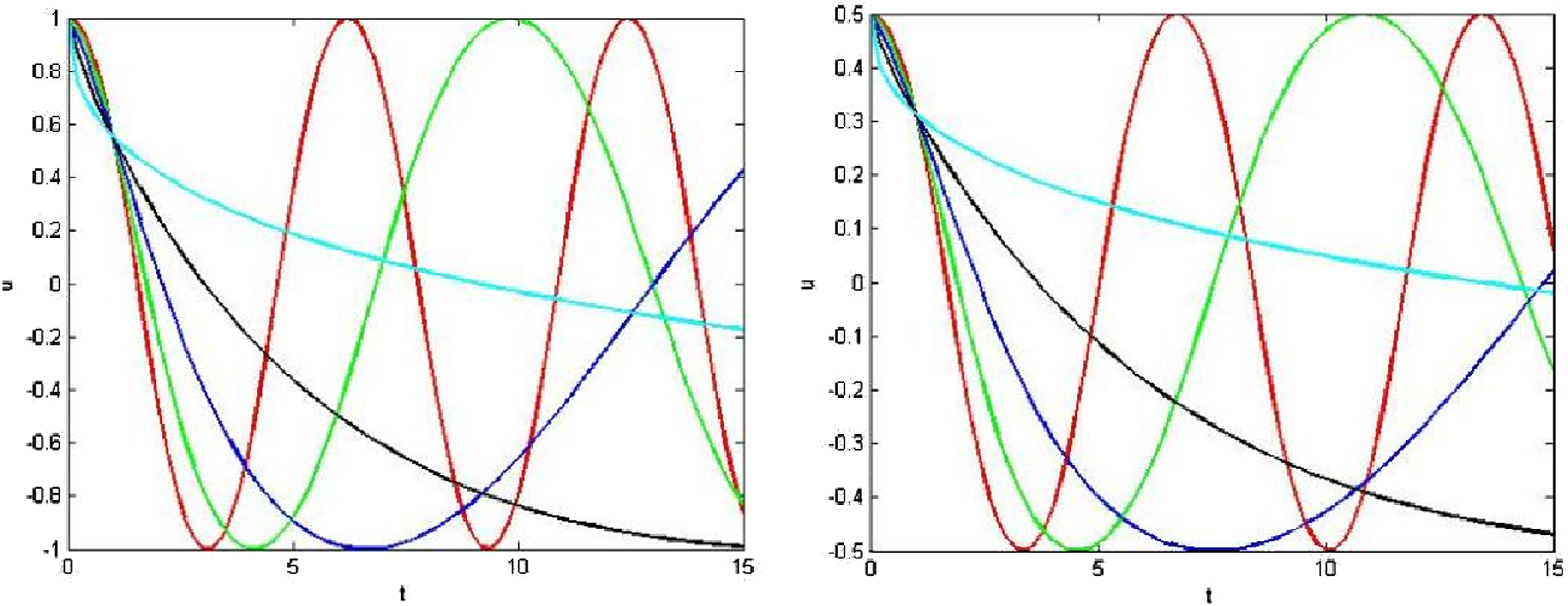
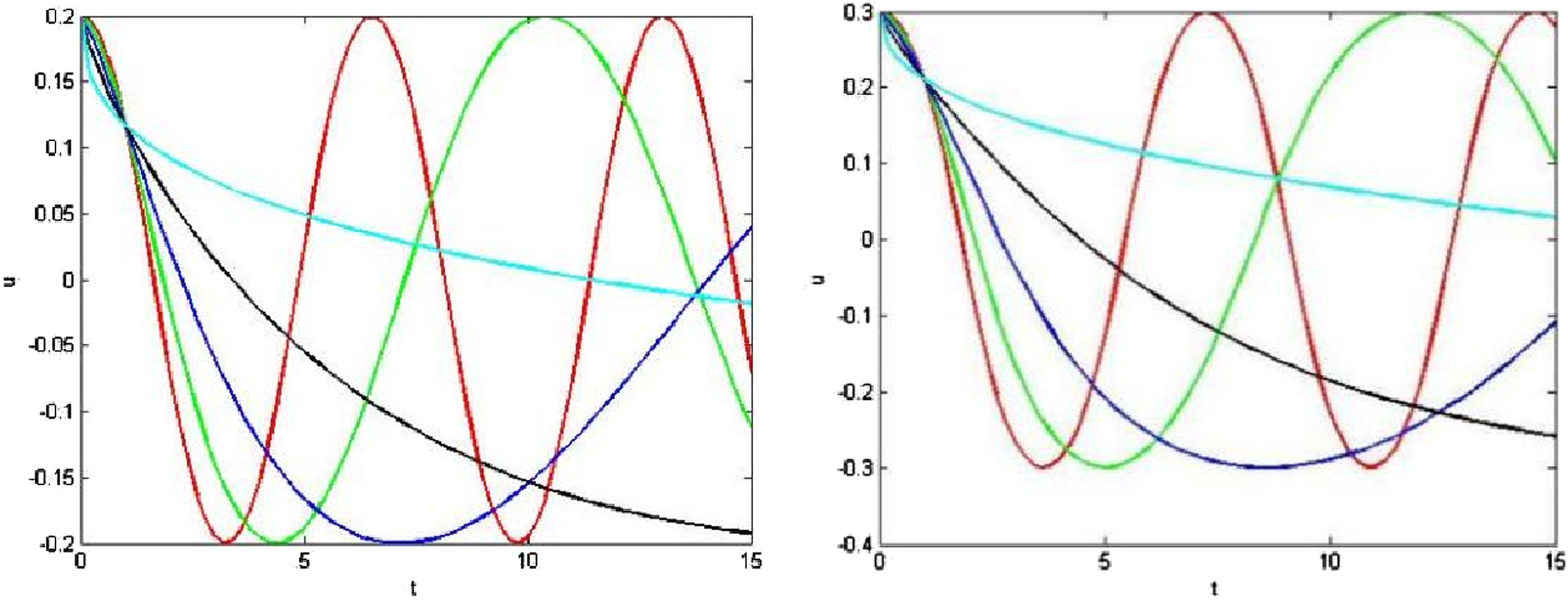
Finally, we consider the impact of the fractional order about the oscillation behaviour of the fractal oscillator (1). The tested parameters result from the four cases mentioned in Table 1. Figure 8 shows the oscillation behaviour of the fractional nonlinear system of a restrained cantilever beam with an intermediate lumped mass with differential fractional orders. It is to note that red: , green: 0.8, blue: , black: and cyan: for Figures 8 and 9. The periodic vibration phenomenon exhibits when the fractal order approaches to 1, and the oscillation fades away for lower value of . As the fractional dimension decreases, the variation of the time interval between two spikes shows an increasing trend. Similar behaviour can be seen from Figures 8 and 9 for the rest three cases.
Numerical behaviour of fractional periodic approximations with different fractional dimensions (Left: Case I, A = 1, Right: Case II, A = 0.5, red: , green: 0.8, blue: , black: and cyan: ).
Numerical behaviour of fractional periodic approximations with different fractional dimensions (Left: Case III, A = 0.2, Right: Case V, A = 0.3, red: , green: , blue: , black: and cyan: ).
Conclusions
In this paper, a numerical approach called as FCT-GRHBM was presented for solving the fractional nonlinear oscillator for a restrained cantilever beam with an intermediate lumped mass. The third order approximated solutions and frequencies were given, and compared with the approximations obtained by some existing methods. The fractional approximations are new and not touched in the existing references. The sensitive analysis of the approximated frequency with respect to various amplitudes and parameters was also investigated, which may be helpful for improving the rationality of engineering design and the stiffness and stability of structures of the cantilever beam. Numerical results for the fractional nonlinear oscillation system confirmed the effectiveness of the suggested approach.
It should be interesting to apply this combined technique for solving the fractional or fractal nonlinear oscillators in engineering and other fields, such as the viscoelastic beams described by fractional derivatives, the elastically restrained functionally graded Timoshenko beam, the beams with different boundary conditions, the fractional harmonic oscillator with position-dependent mass and others.26–28,36,37 On the other hand, due to the constrained conditions of FCT-GRHBM, it is also an open problem that how to choose the order of approximations for guaranteeing its optimality. We will consider these two topics in our future work.
Footnotes
Declaration of conflicting interests
The author(s) declared no potential conflicts of interest with respect to the research, authorship, and/or publication of this article.
Funding
The author(s) received no financial support for the research, authorship, and/or publication of this article.
ORCID iD
Junfeng Lu
References
1.
OldhamKBSpanierJ. The fractional calculus: theory and applications of differentiation and integration to arbitrary order. New York: Academic Press, 1997.
2.
PodlubnyI. Fractional differential equation. New York: Academic Press, 1999.
3.
HeJH. A tutorial review on fractal spacetime and fractional calculus. Int J Theor Phys2014; 53: 3698–3718.
4.
YangXJGaoFSrivastavaHM. A new computational approach for solving nonlinear local fractional PDEs. J Comput Appl Math2018; 339: 285–296.
5.
OdibatZ. Approximations of fractional integral and Caputo fractional derivatives. Appl Math Comput2006; 78: 527–533.
6.
El-AjouA. A modification to the conformable fractional calculus with some applications. Alex Eng J2020; 59(4): 2239–2249.
7.
OldhamKB. Fractional differential equations in electrochemistry. Adv Eng Software2010; 41: 9–12.
8.
El-NabulsiRA. On a new fractional uncertainty relation and its implications in quantum mechanics and molecular physics. Proc R Soc A2020; 476: 20190729.
9.
LiZBHeJH. Fractional complex transform for fractional differential equations. Math Comput Appl2010; 15: 970–973.
HamdanMNShabanehNH. On the large amplitude free vibrations of a restrained uniform beam carrying an intermediate lumped mass. J Sound Vib1997; 199: 711–736.
16.
ChenSSChenCK. Application of the differential transformation method to the free vibrations of strongly non-linear oscillators. Nonlinear Anal-Real2009; 10(2): 881–888.
17.
QianYHLaiSKZhangW, et al.Study on asymptotic analytical solutions using HAM for strongly nonlinear vibrations of a restrained cantilever beam with an intermediate lumped mass. Numer Algorithm2011; 58(3): 293–314.
LuJFShenSChenL. Variational approach for time-space fractal Bogoyavlenskii equation. Alex Eng J2024; 97: 294–301.
20.
BayatMPakarI. On the approximate analytical solution to non-linear oscillation systems. Shock Vib2013; 20(1): 43–52.
21.
SfahaniMGBarariAGanjiSS, et al.Dynamic response of a beam carrying a lumped mass along its span. Int J Adv Manuf Technol2013; 64: 1435–1443.
22.
CveticaninLIsmailGM. Higher-order approximate periodic solution for the oscillator with strong nonlinearity of polynomial type. Eur Phys J Plus2019; 134: 266.
23.
SfahaniMGBarariAOmidvarM, et al.Dynamic response of inextensible beams by improved energy balance method. P I Mech Eng K-J Mul2011; 225: 66–73.
24.
KontomarisSVChliverosGMalamouA. Approximate solutions for undamped nonlinear oscillations using He’s formulation. J2023; 6: 140–151.
25.
SofiA. Nonlinear vibrations of beams with fractional derivative elements crossed by moving loads. Int J Non Lin Mech2024; 159: 104567.
26.
RomanLPrzemysławW. Nonlinear vibration of viscoelastic beams described using fractional order derivatives. J Sound Vib2017; 399(7): 228–243.
27.
JenaSKChakravertySMalikanM, et al.Implementation of Hermite-Ritz method and Navier's technique for vibration of functionally graded porous nanobeam embedded in Winkler-Pasternak elastic foundation using bi-helmholtz nonlocal elasticity. J Mech Mater Struct2020; 15(3): 405–434.
28.
SedighiHMShiraziKHRezaA, et al.Accurate modeling of preload discontinuity in the analytical approach of the nonlinear free vibration of beams. P I Mech Eng C-J Mec2012; 226(10): 2474–2484.
29.
LuJMaL. Analysis of a fractal modification of attachment oscillator. Therm Sci2024; 28(3A): 2153–2163.
30.
ChenBLuJXiaZ. Numerical investigation of the fractal capillary oscillator. J Low Freq Noise V A2023; 42(2): 579–588.
31.
LuJ. Application of variational principle and fractal complex transformation to (3+1)-dimensional fractal potential-YTSF equation. Fractals2024; 32(1): 2450027.
32.
AinQTHeJH. On two-scale dimension and its applications. Therm Sci2019; 23(3B): 1707–1712.
33.
HeJH. Seeing with a single scale is always unbelieving: from magic to two-scale fractal. Therm Sci2021; 25(2B): 1217–1219.
34.
HeJHAinQT. New promises and future challenges of fractal calculus: from two-scale thermodynamics to fractal variational principle. Therm Sci2020; 24(2A): 659–681.
35.
JuP. Global residue harmonic balance method for Helmholtz-Duffing oscillator. Appl Math Model2015; 39: 2172–2179.
36.
LiGWangGNiJ, et al.The vibration analysis of the elastically restrained functionally graded Timoshenko beam with arbitrary cross sections. J Low Freq Noise V A2021; 40(4): 1853–1875.
37.
BaleanuDJajarmiASajjadiSS, et al.The fractional features of a harmonic oscillator with position-dependent mass. Commun Theor Phys2020; 72(5): 055002.