



Abstract
This paper applies the VIM-Padé technique for solving a nonlinear free vibration of a conservative oscillator. It is a combined method based on the variational iteration method, Laplace transformation and the Padé approximation. An approximated solution with extremely high accuracy can be obtained with ease. Runge-Kutta method is adopted to verify the efficiency of the technique.
Introduction
We consider the equation of motion



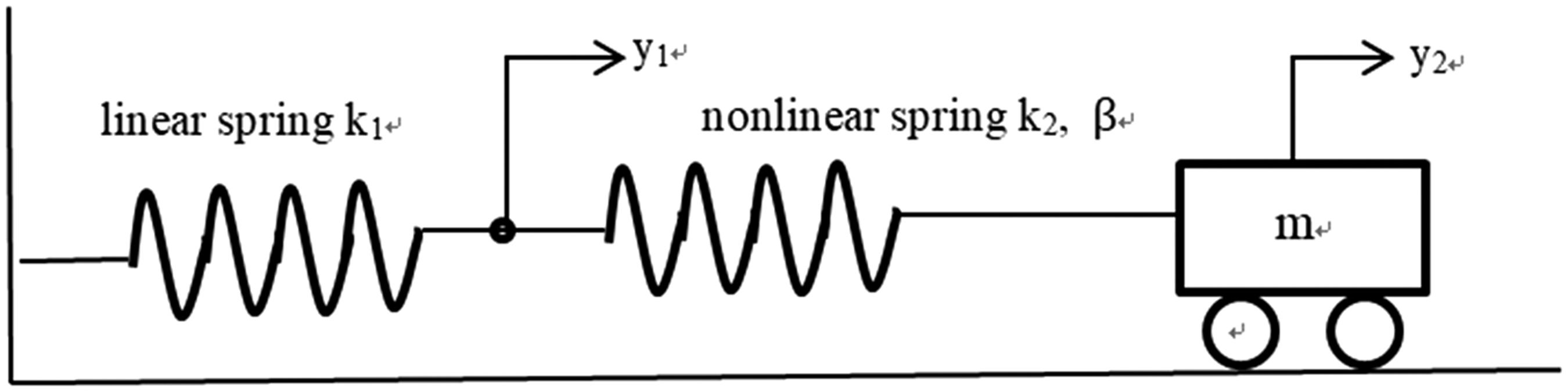
Nonlinear system of a mass with serial linear and nonlinear springs over a frictionless contact surface.
As shown in the literature,1,2 the deflection of linear spring is given by

The displacement of attached mass

Recently, some numerical and analytical methods were proposed for solving this nonlinear oscillator, including Lindstedt method and harmonic balance method, 1 the modified armonic balance method, 2 the homotopy analysis method, 3 He’s iteration perturbation method, 4 the variational iteration method (VIM), 5 Hamiltonian approach, 6 the global residue harmonic balance method, 7 He’s frequency formulation 8 and other methods. 9 As a classical method, the VIM has been paid much attention,10–13 due to its wide application for solving the linear and nonlinear differential equations. In order to reduce the computational cost of VIM, Abassy et al. 14 and Lu 15 proposed a modified VIM. Anjum and He applied Laplace transform to identify the Lagrange multiplier involved in the iteration algorithm. 16 A reliable algorithm based upon the homotopy perturbation method was applied to the strongly nonlinear oscillators.17–21 Motivated by these improvements, we consider an analytical approach (VIM-Padé) based on the VIM, Laplace transformation and the Padé approximation to solve the nonlinear oscillator (equation (1)). Two numerical examples will be presented to show its efficiency.
The VIM-Padé technique for nonlinear oscillator
We apply the VIM-Padé technique based on VIM, Laplace transformation and Padé approximation22,23 to the equation of motion (1). By VIM,10–13 a correct functional can be constructed as follows

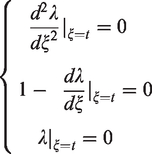
The multiplier

To begin with an initial approximation



By using the normalization condition
Numerical example
In this section, we will consider two initial value problems of the nonlinear oscillator (equation (1)) to show the efficiency of VIM-Padé technique. We will compare it with Runge-Kutta method, and consider the sensitivity of the parameter A. All the numerical computations are performed by a mathematical software on PC with an Intel Core 2 Duo CPU, 2.4 GHz, and 8 GB RAM.
We first consider the nonlinear oscillator (equation (1)) with m = 1, k1 = 50, k2 = 5,

By the above iteration (9), it follows the following approximations




To improve the accuracy of the approximation

The Laplace transformation is applied to the fourth-order approximation


The [4/4] Padé approximation to

We rewrite the [4/4] diagonal approximation as

By using the inverse Laplace transformation to the [4/4] Padé approximation, we obtain the following VIM-Padé solution

Similarly, the rest VIM-Padé solutions can be given by the previous procedure. Based on the approximation

In order to show the efficiency of the VIM-Padé method, we provide the numerical comparisons of the VIM-Padé method and Runge-Kutta method for solving nonlinear oscillator (equation (1)). Figure 2(a) to (c) shows the numerical behaviors of the approximations to
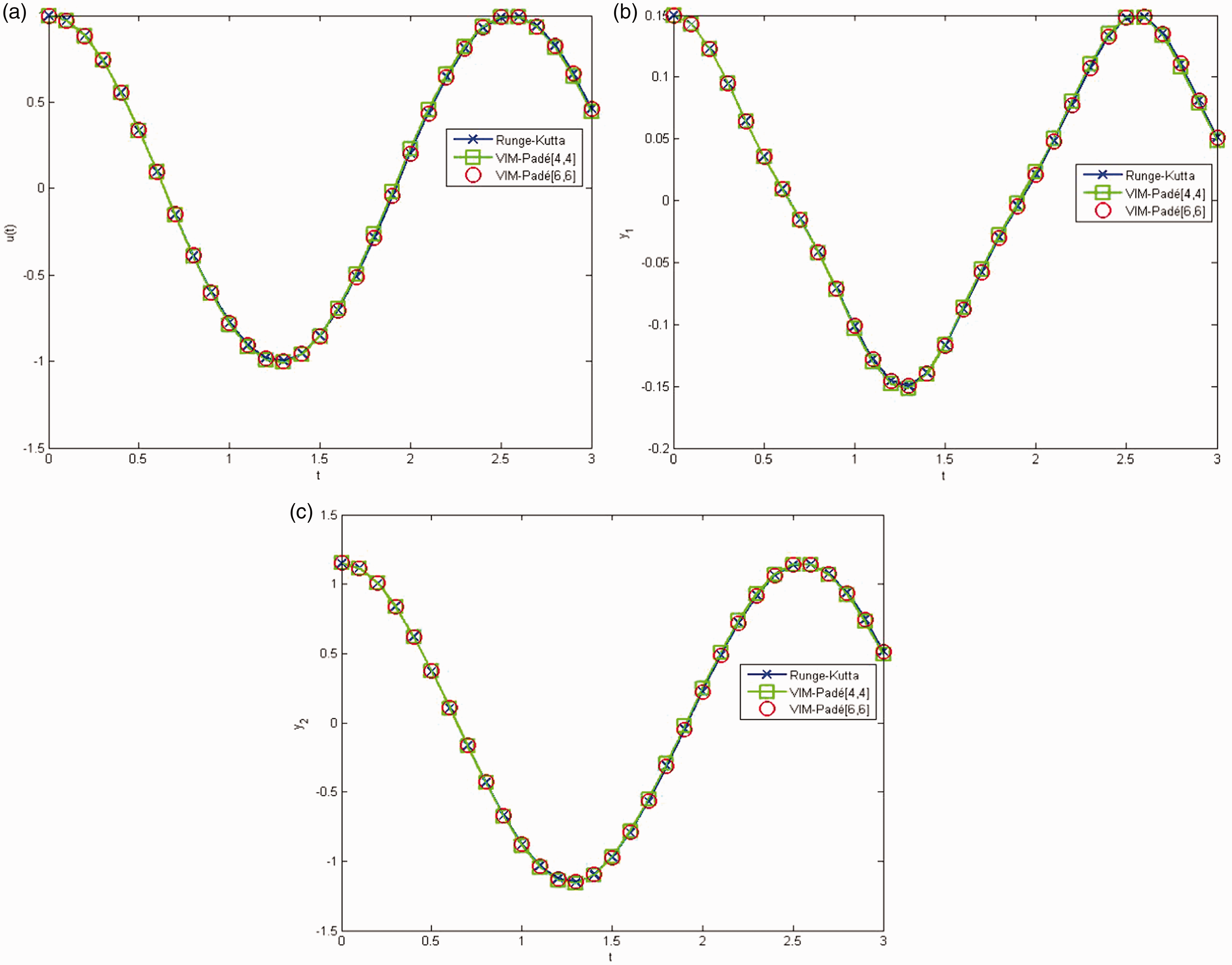
Numerical results of VIM-Padé solutions and Runge-Kutta solutions with A = 1, (a) u(t), (b)
We then consider the sensitivity of the parameter A. We will further consider the initial value problem associated with the nonlinear system (equation (1)) with a different A = 0.5. The VIM iteration formula can be represented as

By iteration (10), it follows the fourth-order approximation

We can obtain the [4/4] and [6/6] VIM-Padé solutions as follows


We show the numerical comparisons of the VIM-Padé solutions and the Runge-Kutta solutions in Figure 3(a) to (c), respectively. The numerical results show that the VIM-Padé technique also performs well for the oscillator (equation (1)) with a different A. The approximated solutions obtained by VIM-Padé technique are expressed by a series of cosine functions. We note that the two frequencies are approximately multiplied, and the multiplier relationship will be improved further by considering more iteration steps of the VIM. In sum, the VIM-Padé technique can be seen as an efficient method for solving this nonlinear oscillator.
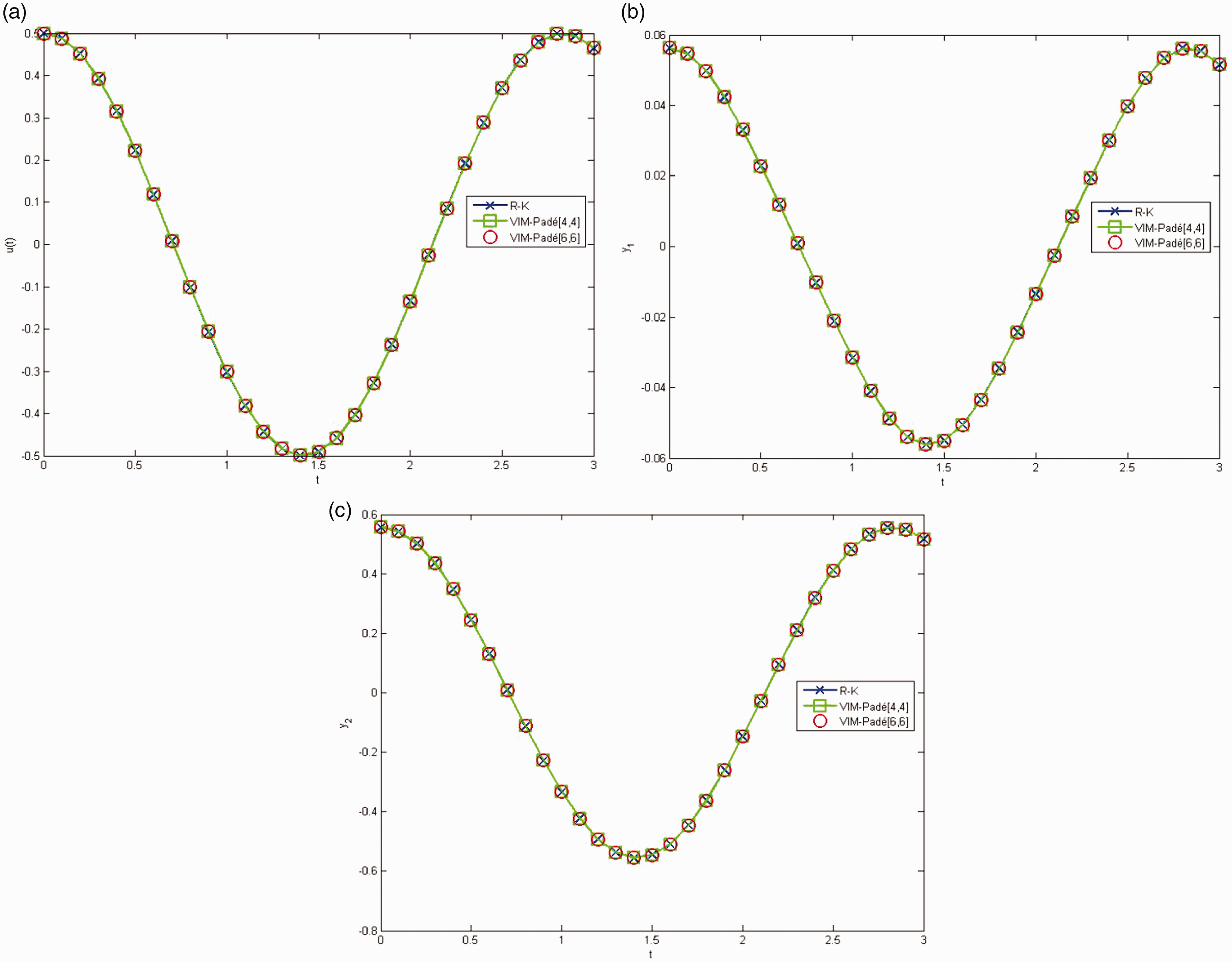
Comparisons of VIM-Padé solutions and Runge-Kutta solutions with A = 0.5, (a) u(t), (b)
Conclusions
In this paper, we focused on the nonlinear free vibration of a conservative oscillator by a combined VIM-Padé technique. Numerical examples associated with two initial value problems were considered to illustrate the effectiveness of this method. Comparisons of the VIM-Padé technique and Runge-Kutta method were provided, showing that the VIM-Padé method performs well without linearization or perturbation. However, there are also two open problems, one is that how to obtain the approximated period solutions given by a series of cosine functions with a frequency and its multiples, the other is that how to choose the order of VIM-Padé approximation and the initial approximation such that the total computational cost can be optimal. We will focus on these two topics in our future work and extend the VIM and its modification to the nonlinear systems with fractal or fractional derivatives.29–37
Footnotes
Declaration of conflicting interests
The author(s) declared no potential conflicts of interest with respect to the research, authorship, and/or publication of this article.
Funding
The author(s) disclosed receipt of the following financial support for the research, authorship, and/or publication of this article: The work was supported by the Natural Science Foundation of Zhejiang Province (LY17A010001).